
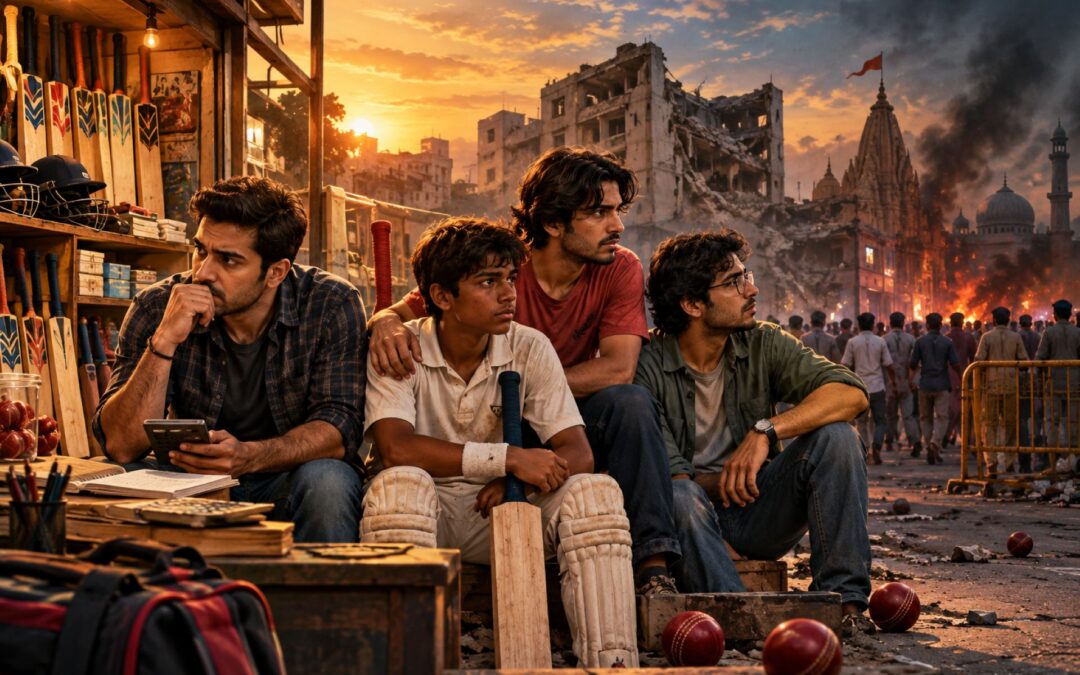
Published by Rupa & Co. in 2008, The 3 Mistakes of My Life is Chetan Bhagat’s third novel and one of his clearest attempts to connect the private ambitions of young Indians with the larger forces shaping contemporary India. According to Bhagat’s official fact sheet, the book was released in May 2008, while his own Q&A about the novel explains its deliberately symmetrical design: three young men, three mistakes, and three major worlds—business, cricket and religion.
At its centre is Govind Patel, a mathematically gifted young entrepreneur from Ahmedabad who believes that careful calculation can make life manageable. His closest friends complicate that worldview. Ishaan lives emotionally through cricket, while Omi grows up around a temple and becomes increasingly exposed to religious politics. Their attempt to build a modest cricket business gradually draws in Ish’s younger sister Vidya, a phenomenally talented Muslim boy named Ali, political activists, an earthquake, a famous cricketing comeback and finally the communal violence of 2002.
The title makes the novel sound like a straightforward confession about three bad decisions, but the story is more interesting than that. Govind’s first “mistake” is entangled with an unforeseeable natural disaster, his second is a sustained act of secrecy and betrayal, and his third lasts only a second during an attempted murder. The novel therefore becomes as much about guilt and the limits of personal responsibility as it is about making mistakes.
Spoiler warning: This article explains the complete novel, including all three mistakes, the riot climax, major deaths and the ending.

The Suicide Note That Frames Govind’s Story
The novel opens several years after its main story has already ended. In December 2005, a fictionalised version of Chetan Bhagat receives an email from an unknown young businessman in Ahmedabad. The sender, identified only as G. Patel, says that the message is both a confession and a suicide note and reveals that he has been swallowing sleeping pills while writing it. He mentions three mistakes, an estranged friend named Ish and a woman named Vidya, but refuses to explain what happened.
Bhagat is disturbed precisely because the sender is so matter-of-fact. The email does not sound like a theatrical threat designed to attract attention; it sounds like the final accounting of someone who has spent years judging himself and has decided that the numbers no longer justify continuing. Bhagat therefore tries to identify him rather than dismiss the message as something sent by a stranger.
With help from Professor Basant at IIM Ahmedabad, Bhagat traces the sender to Govind Patel, a twenty-five-year-old patient at Ahmedabad’s Civil Hospital. Govind has survived the overdose but initially sees little reason to talk. Bhagat flies from Singapore to Ahmedabad, visits him in hospital and eventually persuades him that telling the story may matter even if it cannot alter what has already happened.
The framing device establishes several questions before the main narrative begins. The reader knows that Govind will survive, that something has destroyed his friendship with Ish, that Vidya remains emotionally important to him and that Govind has interpreted three past events as catastrophic failures. What the reader does not yet know is whether that interpretation is fair.
Govind then takes over as the principal narrator. The rest of the story becomes a retrospective confession told by a man who already knows the consequences of his decisions, which means his descriptions of ambition, friendship and risk are coloured by guilt long before the younger Govind in the story understands what is coming.
Building Team India Cricket Shop
Govind’s story begins in Ahmedabad in 2000 with three young friends watching an India–South Africa cricket match. Their different reactions to cricket reveal their personalities almost immediately. Ishaan, usually called Ish, treats the match with emotional intensity and superstition; Omi is easier-going; Govind observes the others while instinctively thinking in terms of probability, value and practical consequence.
Govind is the most obviously ambitious of the three. His father has abandoned the family, and Govind lives with his mother, whose small food business helps support them. Govind supplements the household income through mathematics tuition and takes pride in having scored exceptionally well in the subject. He does not dream of an abstract corporate career so much as independence: he wants to build something of his own and become financially secure through his own judgment.
Ish’s deepest identity is tied to cricket. He was an excellent local player whose hopes of progressing further never became a professional career, and subsequent attempts to find another direction have not given him the same sense of purpose. He understands batting, bowling, equipment and young players almost instinctively, but he lacks Govind’s patience with money and planning.
Omi is the least professionally defined. His family is associated with a temple in Belrampur, and his parents expect him to remain connected to that religious world. Omi neither possesses Govind’s business hunger nor Ish’s consuming passion for cricket, but he is loyal to both friends and wants a life that is not simply an extension of his family’s expectations.
Govind sees an opportunity in the unused commercial space around Omi’s temple complex. Cricket is enormously popular, Ish understands the sport, the temple attracts families and students, and Omi’s family can provide them with inexpensive premises. Govind proposes a shop selling cricket equipment, and after some resistance Ish agrees to join on the condition that Govind handles the financial side.
They call it Team India Cricket Shop. The name matters because the business begins as an extension of friendship rather than simply a profit-making venture: Govind contributes commercial discipline, Ish supplies expertise and credibility, and Omi provides the location and helps manage customers.
The first months reveal Govind’s genuine talent. The shop does not remain narrowly focused on bats and balls. Govind notices that the same schoolchildren who buy sports equipment also need notebooks, pens and other supplies, so the shop expands into stationery. He begins offering maths tuition while Ish offers cricket coaching, turning one small retail outlet into several complementary income streams.
This early success also establishes Govind’s first important weakness. He is not merely pleased when something works; he immediately begins imagining how much larger it could become. The modest temple shop starts to look temporary to him, and he fixes his attention on a new commercial development in Navrangpura, where a modern air-conditioned mall appears to promise better customers, higher margins and a more prestigious future.
The mall represents something larger than another location. Belrampur is familiar, crowded and rooted in old relationships, while Navrangpura represents the Ahmedabad Govind wants to join: newer, wealthier and commercially ambitious. His attraction to the mall therefore combines sensible entrepreneurship with a desire to escape the scale of the life he has inherited.
The shop also brings the friends into contact with political forces they would otherwise have been able to ignore. Omi’s maternal uncle, Bittoo Mama, is active in a Hindu political organisation and regards Omi as a natural recruit because of the family’s temple background. Mama is affectionate toward Omi and often helpful to the boys, but he expects political loyalty in return and sees religious identity as inseparable from public life.
Through Mama, the friends attend a gathering hosted by the influential Parekh-ji. Parekh presents religious grievances in political terms, describing Hindu identity as something that must be organised and defended. Ish is uncomfortable with the atmosphere, while Govind is resistant for a different reason: he dislikes ideological demands that interfere with business and sees himself as essentially agnostic.
Govind nevertheless notices Parekh’s charisma. That detail is important because the book does not portray political mobilisation as effective only on the foolish or obviously hateful. Parekh understands how to transform private anxieties and historical grievances into a coherent emotional story, even if Govind refuses to accept the story itself.
At the same time, Ish asks Govind to tutor his younger sister Vidya for the medical entrance examinations her family expects her to take. Govind initially treats the assignment as another maths class. Vidya, however, is restless, easily distracted and far less committed to medicine than everyone around her assumes.
Their early tuition sessions establish the difference between them. Govind believes concentration can solve most problems, while Vidya is curious about life beyond examinations and family plans. Their irritation with one another gradually becomes interest, introducing a relationship that will eventually collide with Govind’s loyalty to Ish.
By the end of this opening movement, the novel’s main systems are in place. The friends have a growing business, Ish has not yet found a replacement for his lost cricketing ambition, Govind has begun imagining a much larger commercial future, Omi is being pulled toward his uncle’s politics, and Vidya has entered Govind’s private life. What still seems like a cheerful entrepreneurial friendship story is already accumulating obligations the three friends will eventually struggle to reconcile.
Ali and Ish’s Dream of Cricketing Greatness
The arrival of Ali changes Ish’s life more profoundly than the cricket shop does. Local boys tell him about a young player who rarely participates in organised cricket but can apparently hit almost anything when he does. Ish initially treats the story as another exaggerated claim about a neighbourhood prodigy, but when he sees Ali bat, the talent is unmistakable.
Ali is physically unimpressive. He is thin, tires quickly and does not possess the overall athleticism associated with a complete young cricketer. Yet his ability to read and strike the ball is extraordinary. Ish bowls to him and discovers that deliveries that should trouble an inexperienced child can be met with startling timing and power.
Ali’s talent also comes with a problem. Sustained concentration and rapid play give him severe headaches and exhaustion, so Ish takes him to doctors. Within the novel, specialists describe Ali as having an unusually accelerated reflex-and-processing system, allowing him to respond to a ball with extraordinary speed and accuracy. This “hyper-reflex” explanation is a fictional mechanism in Bhagat’s story rather than a medical claim the novel or its readers can safely generalise beyond the character.
For Ish, the diagnosis is less important than what it confirms emotionally: Ali possesses the kind of rare cricketing gift Ish believes should not be wasted. Ish’s own playing career never reached the level he wanted, so training Ali gives him a new route into the sport. Coaching stops being a side service offered by Team India Cricket Shop and becomes Ish’s purpose.
Ali’s father, Naseer Alam, initially resists. The family does not have money for specialised coaching, and Ali is already struggling with school after moving from a madrasa into a different educational environment. When Ish offers cricket coaching without charge, the conversation expands into another problem: Ali also needs help with mathematics.
Ish volunteers Govind before Govind has agreed. Govind, whose tuition time has real commercial value, dislikes the idea of working for free, but Ish is willing to compensate him because he sees Ali’s development as more important than money. Govind eventually becomes part of Ali’s support system almost despite himself, reinforcing one of the novel’s central patterns: Govind repeatedly discovers that his friendships impose obligations his accounting cannot fully measure.
Dinner with Ali’s family also brings the boys into direct contact with a political worldview very different from Bittoo Mama’s. Naseer Alam is involved with a secular political party and is openly critical of communal division. Omi challenges him, and the conversation becomes an argument about Hindu and Muslim grievances, political manipulation and the difficulty of reconciliation.
Naseer’s most important idea is that long relationships require mechanisms for repair. Communities will inevitably hurt one another, just as families and friends do, but they survive only when some process allows resentment to be acknowledged and relationships rebuilt. The observation foreshadows both the communal disaster later in the novel and Govind’s personal crisis with Ish: violence becomes irreversible when people lose the ability or willingness to reconcile.
Ali begins training with Ish, but genius does not make him an easy student. His endurance is poor, his interest fluctuates and he sometimes resists the discipline Ish demands. Ish, meanwhile, can become authoritarian because he treats Ali’s gift as something larger than Ali himself.
Their conflict peaks when Ali taunts Ish about his own failed cricket career. The insult strikes the most sensitive point in Ish’s identity, and Ish hits him. Almost immediately, the act horrifies him. The boy he wants to protect has exposed a wound Ish has never resolved, and Ish has responded by abusing the authority that coaching gives him.
Govind helps Ish recognise what is actually at stake. Ali is not merely a talented child who should obey him; he is also Ish’s chance to turn personal disappointment into something constructive. Ish apologises, Ali returns and their relationship becomes deeper because Ish has had to accept that mentorship requires patience rather than ownership.
While Ish becomes increasingly absorbed by Ali, Govind continues tutoring Vidya. She tells him more clearly that medicine is not her ambition. Her family has defined a respectable future for her, but she wants to study public relations, become independent and experience a world larger than the domestic and educational expectations surrounding her.
Govind and Vidya also spend time away from formal lessons, and their relationship slowly changes from teasing familiarity to attraction. Because Govind is Ish’s closest friend and Vidya’s tutor, he recognises the danger almost immediately. His awareness does not stop the relationship from developing, but it ensures that secrecy and guilt are built into it from the beginning.
Another minor but significant figure enters through the shop’s supply network. Giriraj Pandit, a Kashmiri Pandit displaced by militancy, introduces another history of communal suffering. The novel uses him briefly rather than developing him into a major character, but his presence complicates any attempt to divide victimhood neatly along one religious line.
By this point, Ish and Govind have both found projects that extend beyond the shop. Ish wants to build Ali into the cricketer he could never become. Govind wants to build a larger business while also becoming increasingly involved with Vidya. Omi, meanwhile, remains closest to the original world of the temple and therefore most vulnerable to being pulled into Mama’s expanding political activities.
The Earthquake and Govind’s First Mistake
Govind’s ambition eventually crystallises around the Navrangpura mall. He has saved aggressively and is willing to commit a large share of the partners’ accumulated capital, along with borrowed money, to secure a shop there. Ish and Omi are less enthusiastic about the financial risk, but Govind believes the move is the logical next stage of growth.
Then the logic of the plan becomes irrelevant. On January 26, 2001, Gujarat is struck by the devastating earthquake that forms one of the novel’s major real historical anchors. The U.S. Geological Survey records the earthquake as a magnitude 7.7 event centred in Gujarat, and Bhagat incorporates the destruction directly into Govind’s personal story.
The new mall collapses before Govind can receive the future he has already imagined from it. The money committed to the property is effectively destroyed, while the debts remain. For Govind, who has built his identity around anticipating risk and making rational decisions, the psychological damage is almost as severe as the financial loss.
He calls the mall investment the first mistake of his life. There is some basis for that judgment: he has concentrated too much capital in one expansion, underestimated the danger of leverage and treated future growth as though it were guaranteed. Yet the immediate cause of the loss is an earthquake, something no ordinary small businessman could reasonably have incorporated into his calculations.
That distinction matters because Govind does not make it. Instead of separating poor diversification from natural catastrophe, he internalises the entire event as evidence that his judgment has failed. His confidence collapses, and for a period he becomes incapable of functioning as the energetic entrepreneur who persuaded the others to take the risk.
The original temple shop becomes their lifeline. Because Govind had wanted to leave it behind, its survival carries an irony he cannot miss. Ish and Omi continue working while Govind gradually returns, and Vidya also reaches out to him, strengthening the emotional connection between them at a time when his usual confidence is weakest.
Cricket then helps restore the business as well as Ish’s morale. The novel follows India’s famous comeback against Australia at Eden Gardens in March 2001. The actual Kolkata Test ended with India winning by 171 runs after following on, driven by V.V.S. Laxman’s 281 and Rahul Dravid’s 180.
For Ish, the match is sporting ecstasy; for Govind, it also demonstrates cricket’s commercial power. Public enthusiasm brings customers back toward cricket merchandise, while the friends find new business opportunities through schools and broader supply arrangements. The shop does not magically erase the debt, but Govind begins rebuilding through the same combination of calculation and improvisation that made the original store succeed.
The sequence also provides one of the novel’s clearest parallels between cricket and life. India appears to have lost before the match changes direction, just as Govind treats the earthquake as the destruction of his future before discovering that the business can recover. Bhagat does not make the parallel subtle, but within this kind of popular fiction its directness gives the recovery narrative emotional momentum.
Most importantly, the first mistake establishes the pattern through which Govind will interpret later events. He judges himself by outcomes. If something ends badly and his choice contributed to it, he tends to absorb the whole catastrophe into personal responsibility, even when luck and outside forces were equally or more important.
Goa, Australia and Ali’s Bigger Opportunity
As the business recovers, Ish’s ambitions for Ali become larger. The boy’s local performances convince him that ordinary neighbourhood coaching will not be enough. Ali needs exposure to people who can recognise what makes him exceptional and perhaps provide access to a professional pathway.
An India–Australia one-day match in Goa gives the friends an opening. They travel with Ali, and Govind uses his confidence and improvisational ability to push beyond the access they legitimately possess. What begins as a cricket trip becomes another example of Govind’s business personality functioning outside business: he understands systems, sees where rules are flexible and talks his way into opportunities that would otherwise remain closed.
They encounter Fred Li, an Australian fast bowler created for the novel. Fred tests Ali rather than merely accepting Ish’s claims and quickly recognises the unusual quality of the boy’s timing and reactions. His interest matters because it is the first time someone from outside Ish’s emotional circle validates Ali’s potential.
Fred eventually helps arrange an opportunity in Australia. The trip creates a practical problem because it costs money and interrupts the shop, but Govind’s growing wholesale activities and the recovering business make it possible. By now the friends’ lives are increasingly interconnected: profits from Govind’s commercial system help finance Ish’s cricketing dream, while Ali’s promise gives the business and friendship a purpose that cannot be reduced to money.
Australia also punctures some of Ish’s assumptions. He is passionate and knowledgeable, but passion is not the same as professional sports science. Fred emphasises conditioning, patience and discipline, exposing Ali to a more systematic training environment than the improvised structure Ish can provide in Ahmedabad.
Ish responds by pushing hard, and Ali suffers an ankle injury during training. Fred criticises Ish for overtraining him. The episode is significant because Ish’s devotion contains its own danger: he wants Ali to succeed so intensely that he can stop seeing the child’s physical limits.
Ali is eventually presented with the possibility of a longer-term Australian pathway. The opportunity would involve relocating and, within the logic of the novel, accepting Australian citizenship as part of a route toward representing that country. For a boy who has already been treated in India partly through his Muslim identity, the offer raises the question of what national belonging means.
Ali refuses because he wants to play for India. The decision is uncomplicated in the scene but important to the novel’s wider structure. Later, men will try to kill Ali as though his religion makes him an outsider to the nation, while Ish risks his life because he sees precisely the opposite: Ali’s cricketing gift makes him part of India’s future.
The Australia trip also forces Govind to recognise his feelings for Vidya. Removed from Ahmedabad, he finds himself missing her rather than enjoying the freedom he might once have imagined. Their telephone conversations become more intimate, and Omi notices enough to warn him.
Omi understands the danger more clearly than Govind wants to. Vidya is not simply another young woman Govind has met. She is Ish’s sister, Govind is supposed to be her tutor, and their friendship group depends on a level of trust that a secret relationship could destroy.
Govind nevertheless returns to Ahmedabad emotionally committed to continuing the relationship. He brings Vidya a small container of sand from Bondi Beach, an inexpensive gift that becomes intimate because it proves that he was thinking of her while far away. The object is trivial commercially and valuable personally, exactly the sort of value Govind’s normal calculations have trouble expressing.
The business, meanwhile, keeps expanding. Govind develops wholesale opportunities and steadily reduces the burden left by the earthquake. His professional life therefore appears to be returning to order at the same time that his private life is becoming increasingly difficult to control.
Political pressures also intensify. Bittoo Mama wants Omi to do more work for the Hindu party, while Naseer Alam is connected to the rival secular formation. Govind continues telling himself that politics is someone else’s concern, but the people he loves are now positioned on multiple sides of the divide.
Govind and Vidya: The Second Mistake
Govind and Vidya’s relationship crosses from emotional intimacy into open secrecy after his return from Australia. The Bondi sand becomes part of their private world, and their teasing conversations turn into kissing. Govind understands that he is hiding something consequential from Ish, but his awareness produces compartmentalisation rather than restraint.
Vidya has her own reasons for embracing the relationship. Her family assumes that she should become a doctor, while she increasingly views that future as another form of confinement. Govind is one of the few people who takes her ambition to study public relations seriously, so romance, validation and the possibility of independence become intertwined.
The novel does not present their relationship as an encounter between equals in every respect. Govind is her tutor and her brother’s closest friend, and the attraction begins before she turns eighteen. Vidya nevertheless repeatedly asserts her own desires, challenges Govind’s caution and refuses to behave as though her family should decide her future for her.
Around them, the political climate darkens. The September 11 attacks become part of local rhetoric, with global events folded into arguments about Muslims, terrorism and Hindu vulnerability. Bittoo Mama’s party later loses an election, but Parekh-ji does not interpret defeat simply as failure; he thinks strategically about how public anger can be organised over time.
Govind remains much more interested in Vidya than in politics. On her eighteenth birthday, he goes to her home for what is ostensibly another tuition session. Their attraction culminates in sex on the terrace while the rest of the family is elsewhere in the house.
The novel treats the scene as a decisive boundary crossing. Vidya tells Govind she loves him, while Govind leaves unable to respond with the same emotional clarity. He recognises that he has not simply broken a tutoring rule; he has concealed a relationship with the sister of the friend who trusts him most.
Govind identifies this as his second mistake. Unlike the earthquake loss, the event cannot be attributed to chance. He has had repeated opportunities to tell Ish, stop the relationship or acknowledge what it means, and instead he chooses secrecy.
The relationship continues, making the word “mistake” more complicated. Govind later realises that this was not a single uncontrolled encounter because he and Vidya keep meeting. Whatever he wants to call the first night, the secrecy becomes an ongoing decision.
A pregnancy scare forces them to confront consequences that Govind cannot reduce to a romantic adventure. When Vidya’s period is late, Govind instinctively starts thinking in probabilities. They used contraception, the statistical likelihood may be low, and perhaps the delay has another explanation.
None of that reassures Vidya. The scene deliberately demonstrates the inadequacy of Govind’s favourite intellectual tool in an emotional crisis. Probability can describe risk, but it cannot tell two frightened eighteen- and twenty-something-year-olds what they will do if the unlikely event has actually happened.
Govind eventually manages to offer emotional support instead of merely calculating. They discuss possibilities without reaching a clear decision, and the scare passes. The larger problem, however, remains unresolved: Ish still does not know about them, and every additional meeting increases the scale of the eventual betrayal.
Govind’s second mistake is therefore not best understood as “falling in love.” The more serious failure is the attempt to separate love from loyalty, pretending he can maintain an intimate relationship with Vidya while leaving his friendship with Ish untouched. That illusion survives only because Ish does not yet possess the information that would destroy it.
Godhra, the Riots and Govind’s Third Mistake
The final movement begins with Bittoo Mama waiting for the return of a group of religious volunteers from Ayodhya, including his teenage son Dhiraj. When their train is delayed, Mama initially treats it as an inconvenience. A phone call then makes clear that something is wrong with the coach in which Dhiraj is travelling.
News reports reveal that a carriage of the Sabarmati Express has burned near Godhra and that passengers have died. Within the novel, the first information comes through confused television coverage, rumours and frightened phone calls, which means characters react before any stable historical account is available. Dhiraj is among the dead.
The novel places its fictional climax inside the real communal catastrophe that followed the Godhra train burning. A contemporary Human Rights Watch investigation into the 2002 Gujarat violence documents the much larger historical setting, but Bhagat’s individual characters, their bank siege and the precise confrontation involving Ali are fictional constructions rather than documentary recreations.
Mama’s grief becomes the immediate emotional engine of the climax. Until now he has been a political organiser capable of ugly rhetoric but also an uncle who jokes, eats and talks with the boys. Dhiraj’s death collapses the distance between ideology and personal rage.
The friends quickly realise that Ahmedabad is becoming dangerous. Shops close, rumours spread and attacks begin. Ali happens to be with them, transforming the wider violence into an immediate responsibility: they have a Muslim child in their care at precisely the moment mobs are seeking Muslim targets.
They move to a bank building connected with their business arrangements and try to keep Ali hidden. From inside, they encounter the reality that communal violence is not an abstract argument between political positions. People outside are being attacked, and the city’s ordinary geography—shops, homes, roads and religious identities—has been transformed into a system for identifying potential victims.
Eventually Mama arrives with a mob. His demand is simple: surrender Ali. The boy is not accused of doing anything to Dhiraj or anyone else; he is being treated as a substitute target because he belongs to the community Mama now blames collectively.
Govind tries negotiation before violence. His first instinct is still transactional: if some members of the mob can be bribed or persuaded to leave, the size of the threat can be reduced. The strategy partially works, demonstrating again that crowds are not always ideologically uniform, but enough attackers remain to keep Ali in mortal danger.
Govind also calls Parekh-ji for help. The conversation destroys any lingering possibility that the novel regards Parekh merely as a religious idealist. He refuses to intervene meaningfully and rationalises the anger unleashed around him, revealing the gap between those who convert grievance into political power and those who bear the physical consequences.
Inside the building, the friends face an argument that exposes their deepest differences. Govind calculates the situation in stark terms: if three friends fight a large armed mob to protect one boy, they may all die and Ali may still be killed. From a crude utilitarian perspective, the numbers appear irrational.
Ish rejects the premise. For him, Ali is not an interchangeable life in an equation. He is a child under their protection, someone Ish loves and an exceptional cricketer whom Ish describes as a national treasure. Surrendering him would mean accepting the mob’s right to kill an innocent boy because of his religion.
Omi chooses Ish’s side. This decision completes a transformation that has been developing quietly throughout the book. The priest’s son who has spent time helping his Hindu-nationalist uncle decides that inherited religious solidarity cannot outrank his responsibility to an innocent friend.
The three therefore prepare to defend the building. They use whatever the surroundings provide, including kerosene, fireworks, improvised barriers and eventually an LPG cylinder. The sequence becomes much more like an action thriller than the relatively realistic business-and-friendship novel of the opening chapters, but the narrative logic is clear: objects from everyday commercial life are turned into weapons because ordinary civic order has collapsed.
Their defence injures and disperses many attackers, but Mama and several men survive and reach them. At the worst possible moment, another secret explodes. Ish picks up Govind’s phone and sees a message from Vidya that makes their relationship unmistakable.
The betrayal hits Ish in the middle of an already overwhelming crisis. His best friend has been secretly sleeping with his younger sister while pretending nothing has changed between them. Ish attacks Govind in rage before the external threat forces their attention back toward survival.
Mama and his remaining men eventually capture or overpower the friends and discover Ali. Omi intervenes when his uncle moves to kill the boy. He places himself between Mama and Ali, trusting at some level that family will restrain Mama even when ideology has not.
It does not. Mama’s trishul enters Omi’s body, fatally wounding him. The act is devastating partly because Mama does not set out to murder his nephew, but by the time he recognises what he has done, his rage has already crossed the boundary that relationship was supposed to protect.
As Omi dies, he tries to break the communal logic that killed him. He insists that Ali is innocent and that Muslims cannot be treated as a single guilty category. His final position is therefore the opposite of the politics he inherited: he dies protecting the individual person in front of him rather than obeying a collective identity.
Mama remains determined to kill Ali. Ish, Govind and Ali are restrained or injured, but Ish signals to Govind that there may be an opportunity to move the boy out of the path of the next attack. Govind understands the plan.
Then he sees Mama charging with the trishul and becomes afraid. For a moment Govind thinks about what will happen if the weapon enters his own body. He knows he needs to act but hesitates while imagining his own death.
He eventually breaks free enough to pull Ali aside. The strike misses the boy’s torso, but one prong of the trishul penetrates Ali’s wrist. Govind later becomes obsessed with the belief that if he had moved one second earlier, Ali would have escaped without injury.
That second becomes his third mistake.
The distinction between failure and success is cruelly narrow. Govind does, in fact, save Ali from a potentially fatal blow. Yet because the injured wrist is the wrist on which Ali’s cricketing future depends, Govind sees only the damage that his hesitation failed to prevent.
The violence continues. Ish frees himself, and the confrontation eventually reduces to a bizarre, brutal version of the activity that has united much of the novel. Ali has a bat, Ish has access to cricket balls, and the two communicate through the sporting understanding they have developed over years of training.
Ish throws the ball toward Ali rather than Mama. Ali strikes it directly into Mama at close range, then repeats the action. His extraordinary batting ability, which throughout the book has represented sporting promise, becomes a survival weapon.
Mama falls and dies from his injuries. Other attackers are killed, incapacitated or flee, while Ish, Govind and Ali survive. The cost is enormous: Omi is dead, Ali’s wrist has been badly damaged, Ish has learned of Govind and Vidya, and the friendship that created Team India Cricket Shop has been shattered.
Govind tries to celebrate the fact that they saved Ali, but Ish does not respond with relief toward him. His indifference is more frightening to Govind than anger. As Ish leaves with Ali, the friend whose approval has mattered for years begins treating Govind as though he no longer belongs in his life.
The Epilogues: What Happens to Govind, Ish, Vidya and Ali
The narrative returns to Govind’s hospital bed in 2005, where he explains what happened during the three years after the riot. The physical crisis ended, but the relationships did not recover with it. Omi’s death leaves his family devastated, while Govind and Ish continue working in proximity without restoring their friendship.
Team India Cricket Shop survives in a divided form. The premises are effectively split between Ish’s cricket work and Govind’s stationery and business activities, turning the shop into a physical representation of the friendship: both men remain connected to what they built together, but a boundary runs through the middle.
Vidya is sent to Mumbai, where she eventually pursues the public-relations education she wanted rather than the medical career originally chosen for her. She and Govind are separated, although his feelings for her remain unresolved. The second mistake therefore does not simply disappear when Ish learns the truth; the relationship continues to matter even after its secrecy has helped destroy the friendship.
Ali survives but his wrist does not recover adequately on its own. The damage is especially cruel because his gift depends on the coordination and speed with which he can strike the ball. Ish continues caring for him and becomes the central adult figure in his life after the violence destroys his family.
Doctors eventually identify an expensive reconstructive surgical possibility abroad. Govind has been saving money and sees paying for the operation as an opportunity to repair at least part of the harm for which he blames himself. When he offers the money, however, Ish refuses it.
Ish’s rejection is the final trigger for Govind’s suicide attempt. Govind has spent years believing that money is one of the few things he can reliably create and use to solve problems. If even the money he has saved cannot repair Ali’s wrist or earn a chance at forgiveness, his entire logic of restitution appears to collapse.
That is the point at which he sends the email that opened the novel.
After hearing the whole story, Bhagat refuses to accept Govind’s conclusion that death is the logical answer. He contacts Ish and Vidya and draws them back into the hospital room, forcing the relationships Govind has treated as permanently closed to become active again.
Govind finally tells Vidya that his feelings were not merely lust or a temporary lapse. More importantly, he confronts Ish directly and apologises. The reconciliation is not presented as though the preceding years disappear, but Ish begins to soften when the practical question of Ali’s future returns.
The solution requires what the friends have repeatedly failed to achieve alone: cooperation. Govind’s savings can help finance the operation, while Ish remains essential to Ali’s training and recovery. Repair becomes possible only when they stop treating money, cricket and friendship as separate domains.
Bhagat asks Govind for permission to turn the story into a book. Govind agrees on one condition: they should not release the story until they know whether Ali’s surgery works. The frame therefore remains unfinished until the outcome of the cricketing future damaged by Govind’s third mistake can be known.
The brief second epilogue supplies that answer. After surgery in London and a period of rehabilitation, doctors allow Ali to face a ball again. Ish bowls to him, Ali moves forward and turns his repaired wrist through the shot.
The ball goes for a straight six. The novel ends not with Govind’s business, Vidya’s career or a political conclusion, but with the survival of the possibility that brought Ish back to cricket in the first place.
Ahmedabad and Gujarat as More Than a Backdrop
Ahmedabad matters to The 3 Mistakes of My Life because the city contains several social worlds within a relatively small geographical area. Bhagat acknowledged the importance of Gujarat’s entrepreneurial culture in his discussion of the novel’s origins, and Govind’s business instincts are inseparable from a setting where commerce is treated not merely as employment but as identity, independence and intelligence.
Belrampur represents one version of the city. It is local, crowded and relationship-driven, with the temple, school, bank, family homes and small shops existing within the same social ecosystem. Team India Cricket Shop succeeds there because the friends understand the people around them, and Govind can continually adjust the business to what neighbourhood families actually need.
Navrangpura represents aspiration. The mall promises air conditioning, wealthier customers, prestige and entry into a newer consumer economy. Govind’s determination to move there reveals the extent to which progress, for him, initially means leaving older structures behind rather than improving his position within them.
The earthquake violently challenges that model of progress. A modern commercial development that Govind treats as safer and more advanced than the old temple shop collapses, while the less glamorous business he wanted to outgrow survives. The contrast is not a simple argument against modernisation, because Govind remains entrepreneurial afterward, but it undermines his belief that newer and larger automatically means more secure.
Australia creates another spatial contrast. The trip exposes Ish and Ali to training systems, infrastructure and professional pathways unavailable to them in their improvised Ahmedabad arrangement. Yet Ali rejects the possibility of redirecting his identity toward Australia, suggesting that better institutions do not automatically replace emotional belonging.
The novel’s later use of Ahmedabad is much darker. During the riot sequence, the same dense social geography that previously helped the business becomes dangerous because neighbourhood knowledge can now be used to classify people. Temples, homes, shops and streets cease to be neutral spaces when communal identity determines where someone is safe.
The setting therefore changes function across the novel. Ahmedabad begins as a place of youth, commerce, cricket and familiar argument; the earthquake turns it into a landscape of physical vulnerability; communal violence then exposes its political and social fractures. Govind’s adulthood develops through all three versions of the same city.
Bhagat is strongest when the city appears through ordinary detail rather than abstract description. Conversations over food, customers bargaining in the shop, coaching sessions, family expectations, schoolchildren and local political gatherings make the environment feel inhabited. Even critics who find parts of the later plotting contrived have often recognised that the novel’s everyday Ahmedabad has a specificity that helps ground its more melodramatic events.
At the same time, the book’s treatment of Gujarat’s politics is necessarily narrower than its treatment of neighbourhood life. The historical violence of 2002 involved forces and experiences far beyond the fictional conflict among Omi’s family, Naseer Alam, Parekh-ji and Ali. The novel is therefore most persuasive when read as a story about how communal politics enters the lives of these characters, not as a comprehensive explanation of the real events.
Character Analysis: Govind, Ish, Omi, Vidya and Ali
The novel’s central characters are constructed around contrasting ways of understanding value. Govind trusts calculation and enterprise, Ish trusts emotional commitment and cricketing instinct, Omi trusts relationships more than ideology until those relationships collide, Vidya wants autonomy from prescribed roles, and Ali possesses a talent that adults repeatedly try to interpret on his behalf. Their differences are initially complementary, but the plot becomes tragic when each character’s strongest trait becomes a source of rigidity.
Govind Patel
Govind is both the protagonist and the filter through which almost the entire story reaches the reader. His mathematical intelligence is genuine rather than cosmetic: he thinks constantly in terms of margins, risk, percentages, opportunity costs and optimisation. That mindset makes him unusually effective at running the shop because he notices connections the others do not.
His rationality is also defensive. Govind has grown up without the security of a dependable father and has learned that money and competence provide forms of control that emotional dependence cannot guarantee. Business is therefore not merely greed; it is his method of constructing a world in which results can be traced to decisions.
That worldview works extremely well when the problem involves stock, pricing or customer demand. It becomes much less useful when the problem is an earthquake, a frightened girlfriend, communal hatred or a friend’s sense of betrayal. Govind repeatedly reaches for calculation precisely when the situation requires moral or emotional judgment.
The pregnancy scare provides one of the clearest examples. Govind knows that the probability of pregnancy is relatively low, but Vidya needs to know what they will do if the unlikely outcome is real. His mathematics answers the statistical question while evading the human one.
The riot creates the most extreme version of the same conflict. His first argument against fighting the mob is numerically defensible: sacrificing three people for one child seems irrational if everyone dies. Yet Ish understands something Govind’s equation excludes—that handing Ali over makes the friends participants in his murder.
Govind’s weaknesses should not obscure his courage. He stays during the riot, helps defend Ali, ultimately pulls him away from Mama’s strike and spends years saving money for his surgery. The third mistake is therefore powerful precisely because Govind is not simply cowardly; he acts bravely but judges himself by the one second during which fear delayed that action.
His relationship with Vidya exposes a different flaw. Here Govind cannot blame probability or external catastrophe. He understands that secrecy violates Ish’s trust but persuades himself that he can keep different parts of life in separate compartments, just as he keeps different categories in an account book.
The adult Govind narrating the story is therefore both insightful and unreliable in a specific way. He remembers his failures clearly, but his moral accounting is too severe. He tends to interpret suffering as proof of personal culpability, which is why the title’s three “mistakes” tell readers as much about Govind’s psychology as about the events themselves.
His attempted suicide completes that pattern. After Ish refuses his money for Ali’s surgery, Govind does not merely feel rejected; he concludes that the final practical instrument through which he could compensate for the past has become worthless. His recovery begins when other people refuse the premises of that calculation and force him back into relationship.
Ishaan
Ish is Govind’s emotional opposite. Where Govind asks whether something makes sense, Ish asks whether it matters. Cricket matters to him at a level deeper than profession, which is why the failure of his own playing career leaves him directionless.
Ali restores that purpose. Ish does not simply recognise talent; he experiences the discovery as a second chance to participate in the form of excellence from which he feels excluded. Coaching Ali therefore becomes an act of love, ambition and self-repair.
That intensity makes Ish a powerful mentor but not always a healthy one. He can overtrain Ali, react badly to defiance and interpret the boy’s development as a mission that justifies ignoring practical limits. Fred’s criticism in Australia is valuable because it distinguishes devotion from expertise.
Ish also possesses the strongest instinctive moral clarity during the riot. When Govind turns Ali’s survival into an equation, Ish refuses the entire method of calculation. Protecting an innocent child is, for him, not something whose value depends on whether the odds are favourable.
His language about Ali as a “national treasure” is more complicated. On one level, it resists communal exclusion by insisting that a Muslim boy belongs to India and may one day represent it. On another, the phrase risks suggesting that Ali deserves protection because of exceptional talent rather than because he is an innocent human being.
The novel partly solves that tension through Ish’s actual behaviour. He cared for Ali before anyone knew the boy could reach international cricket, remains with him after the wrist injury threatens that future and effectively becomes responsible for him after the riots. His commitment eventually exceeds the talent that initiated it.
Ish’s reaction to Govind and Vidya is also emotionally understandable even when violent. Govind has not merely dated his sister; he has hidden the relationship while continuing to behave as Ish’s closest friend. Ish learns about the betrayal during the most traumatic night of his life, minutes before Omi dies and Ali is nearly killed.
His three-year refusal to forgive Govind is therefore not a simple tantrum. Ish associates Govind with multiple injuries at once: the secret relationship, the hesitation that damages Ali’s wrist and the collapse of the friendship group after Omi’s death. The eventual reconciliation matters because Ish has to separate those injuries enough to recognise that Govind is neither the riot nor the earthquake nor Mama.
Omi
Omi initially appears to be the least complicated member of the trio. He lacks Govind’s ambition and Ish’s intensity, and much of his early role consists of following whichever friend has a stronger plan. That apparent simplicity makes his development easy to underestimate.
His family background places him at the intersection between religion and friendship from the beginning. The temple makes the shop possible, while his uncle’s political network gradually expects more of him. Omi therefore benefits materially from the same social structure that later tries to demand ideological loyalty.
He is not portrayed as an intellectual political thinker. Omi can repeat communal assumptions and is susceptible to Mama’s influence, but he also remains attached to people more strongly than to doctrine. The tension grows as political identity demands that he view individuals primarily as members of communities.
Ali becomes the test. Early in the novel, Omi is uncomfortable with aspects of the boy’s Muslim identity and with helping him, but continued contact makes abstract prejudice harder to maintain. Ali becomes a child he knows, coaches around and protects.
Omi’s death completes that movement. When Mama tries to kill Ali, Omi physically places his own body between them. His final insistence that Ali is innocent rejects the idea of collective religious guilt at exactly the moment his uncle embodies it most completely.
The tragedy is sharpened because Mama loves Omi. Communal violence does not merely turn one community against another; it destroys relationships within the supposed in-group as well. Mama becomes so committed to revenge that he kills the nephew whose religious identity he believes he is defending.
Omi consequently ends as more than the easy-going third friend. His final choice gives the novel its clearest moral rejection of communal logic, because he sacrifices himself not for an abstract secular principle but for a specific person he knows does not deserve to die.
Vidya
Vidya enters the novel through Govind’s gaze, which both gives her energy and limits her characterisation. Govind notices her appearance constantly and often interprets her behaviour through a young man’s confusion about women. This perspective can be comic, but it also means readers rarely experience Vidya except through the narrator who desires her.
Within that limitation, she has a coherent conflict of her own. Her family expects her to pursue medicine, but she wants to study public relations and experience greater independence. Her struggle is therefore another version of the book’s wider concern with young people resisting futures prescribed by family and social structure.
Govind matters to her because he initially enters as an authority figure and gradually becomes someone who takes her ambitions seriously. He helps her with mathematics but also tells her that wanting something different from medicine is legitimate. Their relationship is consequently tied to her desire to define herself.
The ethical complications cannot be ignored. Govind is her tutor, older than she is and her brother’s closest friend. Their attraction begins before her eighteenth birthday, creating a power imbalance even though Vidya is not written as passive.
Bhagat also gives Vidya substantial agency. She flirts, initiates emotional conversations, challenges Govind’s evasiveness, articulates her career plans and says she loves him when he is too frightened to reciprocate openly. Treating her simply as someone upon whom Govind acts would misrepresent the novel.
The pregnancy scare further demonstrates her vulnerability within that agency. Whatever the statistical risk, the physical consequences would fall primarily on her, which is why Govind’s abstract calculations frustrate rather than comfort her. She forces him to acknowledge that responsibility cannot be outsourced to probability.
Her eventual move to Mumbai is important because it prevents her story from ending as punishment for the romance. She pursues the field she wanted, lives outside Ahmedabad and later returns to Govind’s life on more equal terms. Even so, the novel never develops her interior world as extensively as it develops the three male friends, and that remains one of the limitations of her characterisation.
Ali
Ali functions simultaneously as a child, a cricketing prodigy and a symbolic figure, and those roles are not always perfectly balanced. As a child, he is inconsistent, stubborn and sometimes more interested in ordinary activities than in fulfilling Ish’s grand ambitions. Those traits help prevent him from becoming purely an emblem of talent.
His cricketing ability gives Ish a new purpose and creates opportunities that none of the friends could otherwise access. The fictional “hyper-reflex” explanation turns him into an almost fantastical sporting prospect, but the novel repeatedly counterbalances that gift with weakness: headaches, poor stamina, limited physical conditioning and eventually the catastrophic wrist injury.
Ali’s relationship with Ish is the emotional centre of his character. Ish begins by seeing potential and gradually becomes guardian, coach and surrogate family. After the riot, when Ali has lost his parents and his cricket future is uncertain, Ish’s continued commitment proves that the relationship has moved beyond ambition.
His Muslim identity becomes politically significant because other characters impose meaning on it. Naseer connects him to secular politics; Mama’s mob treats him as a communal target; Ish sees him as an Indian sporting future; Australia offers another national pathway. Ali himself repeatedly resists being reduced to those categories.
His refusal to pursue Australian representation is therefore one of the book’s clearest statements about belonging. He wants to play for India even though India will soon contain people willing to kill him for being Muslim. The contradiction gives the riot climax much of its force.
Ali’s final six restores his sporting possibility, but it also resolves a moral question for Govind. The child Govind believes he failed is not permanently destroyed by that failure. Recovery does not erase the injury, but it prevents Govind’s one second of hesitation from becoming the final definition of Ali’s life.
Bittoo Mama, Naseer Alam and Parekh-ji
Bittoo Mama, Naseer Alam and Parekh-ji represent different ways political identity enters the private world of the younger characters. None is a comprehensive portrait of Indian politics, but together they create the ideological pressure surrounding Omi, Ali and the friends.
Mama is the most psychologically developed because the boys know him personally. He can be generous, funny and protective, which prevents his later violence from belonging to an entirely separate personality. The death of Dhiraj radicalises grief that already has an ideological structure ready to receive it.
That does not absolve him. Plenty of bereaved people do not become murderers, and the novel makes clear that political narratives have trained Mama to transform one crime into collective blame. His tragedy is not simply that grief changes him; it is that he chooses a worldview in which killing Ali can feel like justice.
Naseer Alam provides an opposing political vocabulary. He criticises communal division and argues that long-term coexistence requires reconciliation rather than endless accounting of injury. His position is attractive within the novel, but he too is connected to organised politics and admits that parties of every kind can benefit from division.
Parekh-ji is colder than either man. Mama genuinely feels the grievances he voices, while Parekh understands grievance as political capital. His refusal to help during the riot exposes the moral emptiness behind rhetoric that mobilises ordinary people toward confrontations from which leaders can remain protected.
Together, the three adults show different relationships between belief and power. Naseer wants political organisation to contain division, Mama allows personal pain and identity to fuse into revenge, and Parekh turns identity into strategy. The young characters become casualties of that larger struggle even though none of them begins the novel with politics as a central ambition.
Friendship, Loyalty, Love and Betrayal
The emotional foundation of the novel is not Govind’s romance with Vidya but the friendship among Govind, Ish and Omi. Team India Cricket Shop works because their weaknesses and strengths fit together: Govind gives the group direction, Ish gives it passion and expertise, and Omi gives it social grounding. Their friendship produces something none of them could easily build alone.
That interdependence explains why Govind’s secrecy hurts Ish so deeply. If Govind and Ish were merely acquaintances, dating Vidya would be a family disagreement. Because Ish has trusted Govind as a brother-like friend and business partner, the hidden relationship feels like evidence that Govind has been living a second life inside the friendship.
The novel also distinguishes different kinds of loyalty. Ish’s loyalty to Ali is almost absolute, while Govind’s loyalty tends to be negotiated against practical consequence. Omi initially appears more passive than either, but in the climax he demonstrates the most unconditional loyalty of all by putting his body between Ali and Mama.
Love repeatedly creates conflicts rather than solving them. Ish’s love of cricket can become controlling, Mama’s love for Dhiraj turns into destructive vengeance, Govind’s love for Vidya leads him into secrecy, and Govind’s love for Ish eventually contributes to his suicidal despair because he cannot tolerate permanent rejection.
The novel therefore resists the idea that strong feeling is automatically moral. Emotion can motivate protection or violence depending on what it attaches itself to. Ish and Mama are both passionate men, but one uses passion to protect a child while the other uses it to justify collective revenge.
A recent critical discussion of friendship in the novel has similarly treated friendship as both a stabilising and destabilising force rather than a simple virtue. That reading fits the text because the friendships create obligations that save lives while also making betrayal more painful than it would otherwise be.
Reconciliation becomes the necessary counterweight. Naseer Alam introduces the concept early when he argues that long relationships survive only through mechanisms that allow people to return after conflict. The epilogue eventually applies that social idea to Govind and Ish personally.
Forgiveness does not mean concluding that nothing wrong happened. Govind did deceive Ish, Ish does have reasons for anger, and the hesitation during the riot has real consequences. Reconciliation becomes possible only when Ish stops treating Govind as the sole container for everything that went wrong.
Business, Cricket and Religion: The Novel’s Three Interlocking Worlds
Bhagat has explicitly said that he designed the novel around three boys, three mistakes and the three subjects of business, cricket and religion. The structure initially appears almost diagrammatic: Govind represents business, Ish represents cricket and Omi is linked through family to religion. The novel becomes more interesting when those categories stop staying separate.
Business finances cricket. Cricket crosses religious divisions. Religion enters business through the temple location and later destroys the safety of commercial space. Vidya’s romance cuts across Govind’s supposedly rational life, while Ali’s talent transforms a Muslim schoolboy into someone Ish imagines representing India.
Business and the Dream of Control
Govind’s entrepreneurship is one of the novel’s most convincing elements because it is shown as a process rather than a personality label. He notices demand, adds stationery, creates tuition services, thinks about location, negotiates supply, reinvests profits and later moves toward wholesale distribution. The shop grows because he continually converts observation into a commercial decision.
His attitude toward money is also more nuanced than simple greed. Govind grew up without reliable economic security, so money represents independence and the ability to fulfil obligations. He wants to support his mother, build a future and avoid being dependent on institutions or relatives.
The problem emerges when commercial reasoning becomes his general philosophy. Govind begins treating life as though good analysis should produce predictable outcomes. The mall investment appears rational because the location seems superior, but the earthquake demonstrates that no model eliminates contingency.
Academic criticism has read characters like Govind within a wider pattern of the entrepreneurial subject in contemporary Indian popular fiction. Shakti Jaising’s work on the “maturing entrepreneur” in popular Indian fiction offers a useful lens here: Govind’s adulthood is repeatedly measured through enterprise, self-management and the assumption that individual decisions should determine personal success.
Bhagat partly accepts that entrepreneurial ideal and partly dismantles it. Govind really is capable, disciplined and inventive, and the business survives extraordinary shocks because of those qualities. At the same time, the novel subjects him to disasters that cannot be understood through merit alone.
Money also changes meaning across the story. At first it measures profit, then it becomes the source of guilt after the mall collapses, then a tool for rebuilding, then a possible means of funding Ali’s surgery. When Ish refuses Govind’s savings, the refusal devastates him because it proves that money cannot automatically purchase moral repair.
The epilogue ultimately restores money to a more limited but useful place. Govind’s savings matter because surgery costs money, but those savings become meaningful only when Ish agrees to cooperate. Capital can help repair a wrist; it cannot independently repair a friendship.
Cricket, Talent and National Belonging
Cricket begins as entertainment and commerce, but it gradually becomes the novel’s strongest language of shared identity. Ish experiences the sport almost religiously, while Govind understands its market. Ali transforms it into a question of talent, mentorship and national belonging.
The use of the real 2001 Kolkata Test is especially effective because India’s improbable comeback allows Bhagat to connect private and national optimism. The friends watch a team recover from a position that appears hopeless, and the victory helps restore business confidence after the earthquake. Cricket provides emotional energy that crosses from television into commerce and daily life.
Ali deepens the symbolism. His talent appears before religious politics becomes directly threatening, so Ish knows him first as a batsman rather than as “a Muslim boy.” That order matters. Communal politics later attempts to reverse it by making religion the only category that matters.
The Australian opportunity introduces a second national possibility. Ali could imagine a pathway in a system better equipped to develop him, but he wants to represent India. His choice makes the later attempt to exclude him from India through communal violence especially bitter.
Rakesh Ramamoorthy’s scholarly discussion of cricket and majoritarian nationalism in the novel offers an important complication to the common idea that cricket automatically unites. National sport can bridge differences, but nationalism can also become exclusionary depending on who is allowed to define the nation.
The novel contains both possibilities. Ish’s nationalism is inclusive when he calls Ali a national treasure and risks his life for him. Mama’s politics is exclusionary when religious identity becomes a test of who belongs.
There is also an uncomfortable implication in Ish’s language. If Ali were an ordinary Muslim child with no cricketing gift, would the moral obligation to save him be any weaker? The answer should clearly be no, but Ish’s emphasis on Ali’s future sporting value occasionally makes the defence sound conditional on exceptional talent.
The plot ultimately corrects this through action. Ish remains committed after Ali’s wrist injury threatens the very talent that first attracted him. His guardianship shows that the relationship has become personal rather than purely instrumental.
Religion, Politics and Communal Identity
Religion enters the novel before communal violence through Omi’s family and the temple that houses the shop. At that stage religion is part of everyday social structure rather than automatically a source of conflict. The temple provides space, community and livelihood.
The shift occurs when political actors convert religious identity into grievance. Bittoo Mama encourages Omi to recruit young people, while Parekh-ji provides an ideological narrative in which historical injury, electoral competition and present-day identity reinforce one another.
Naseer Alam offers a secular counterargument, but the novel does not portray politics as a clean contest between one good party and one bad one. Naseer himself admits that political organisations often benefit from division, and Govind distrusts the entire arena because he sees people being turned into voting blocs.
That distrust is understandable but ultimately inadequate. Govind believes he can stay outside politics by focusing on business, yet politics enters the shop through Omi, enters cricket through Ali and eventually enters the bank with weapons. The novel’s implicit argument is that refusing political engagement does not guarantee political events will leave an individual alone.
The Godhra sequence shows how grief becomes collectivised. Dhiraj is a specific person who dies in a specific act of violence, but Mama converts his son’s death into a justification for killing a different child who had nothing to do with it. Individual accountability disappears as soon as community identity becomes the unit of blame.
Omi’s death rejects that logic at the highest possible cost. He does not stop being Hindu, renounce his family or become interested in abstract political theory. He simply concludes that Ali is innocent and that his uncle has no right to kill him.
That distinction is one of the novel’s strongest moral insights. Its target is not religious identity itself so much as the process by which identity becomes permission to stop seeing individuals.
The weakness lies in simplification. Parekh-ji and some of the riot characters occasionally operate more as embodiments of political positions than as fully realised people, and the complexity of Gujarat’s actual history cannot be contained inside the fictional conflict. The communal material works best as an examination of what ideological hatred does to these friendships rather than as an exhaustive account of why the real violence occurred.
What the Three Mistakes Really Mean
The title encourages readers to treat the novel as a sequence of three errors followed by redemption, but the events Govind calls mistakes are morally unequal. One is a business risk magnified by natural disaster, one is a sustained act of secrecy, and one is a moment of fear during an attempted killing. Govind’s decision to place all three in the same category reveals his tendency to judge himself by consequences rather than by intention, knowledge and reasonable responsibility.
That difference is essential to understanding his suicide attempt. Govind is not crushed by three identical bad decisions. He is crushed because he has developed a worldview in which every terrible outcome linked to him becomes evidence of personal failure.
The First Mistake — Risk and Bad Luck
Govind’s investment in the Navrangpura mall is genuinely aggressive. He commits too much of the partners’ available capital to one expansion, takes on debt and assumes that the commercial advantages of the location justify concentration of risk.
That part can fairly be criticised. An entrepreneur who ties most of a small business’s resources to a single development creates vulnerability.
The earthquake, however, is not the sort of foreseeable market event that better arithmetic could have eliminated. Govind could have diversified his capital, but he could not have prevented the mall from collapsing. Calling the entire loss his mistake therefore confuses imperfect risk management with responsibility for catastrophe.
His reaction is a classic form of hindsight bias. Once the terrible outcome is known, the decision that preceded it feels obviously foolish. Before the earthquake, however, the same investment looked ambitious and risky rather than absurd.
The first mistake consequently teaches Govind the wrong lesson before the novel eventually corrects it. He concludes that his judgment itself cannot be trusted, when the more accurate conclusion would be that even good judgment cannot guarantee safety.
The Second Mistake — Love, Secrecy and Betrayal
The second mistake contains much more genuine agency. Govind knows that his relationship with Vidya places him in conflict with Ish, understands that his role as tutor complicates the situation and repeatedly chooses concealment.
The error is not best defined as attraction. People do not fully control whom they desire, and Vidya reciprocates. Nor is Vidya simply something belonging to Ish whose brotherly permission should determine her romantic life.
The real betrayal lies in secrecy. Govind wants the intimacy of a relationship with Vidya without accepting the effect that relationship will have on his closest friendship. He therefore denies Ish the information necessary to respond until the truth emerges accidentally during a crisis.
The tutor-student dimension adds another ethical problem. Their attraction begins while Govind occupies a position of educational authority and while Vidya is still under eighteen, even though the sexual relationship begins after her eighteenth birthday. The novel often treats the situation through youthful humour and Govind’s desire, but contemporary readers are likely to notice the power imbalance more strongly.
At the same time, describing the entire relationship as a mistake would erase Vidya’s agency and the possibility that Govind actually loves her. The epilogue moves in that direction when he finally acknowledges his feelings openly.
The second mistake is therefore not “Vidya.” It is Govind’s attempt to enjoy a meaningful relationship while evading the honesty and consequences that meaningful relationships require.
The Third Mistake — Fear in a Single Second
The third mistake is the most ethically difficult. Mama is charging Ali with a trishul, Govind understands that he may be able to pull the boy aside, and for approximately one second fear of being stabbed himself delays his movement.
That second matters. Because Govind acts slightly later, the weapon catches Ali’s wrist rather than missing him completely, threatening the cricketing future that has become central to Ish and Ali.
Yet Govind still acts. He pulls Ali away from a blow that could have killed him. Judging the action only by the wrist injury obscures the fact that Govind is behaving under extreme threat and ultimately risks his own life.
Ish’s anger is understandable because he sees hesitation where he wanted absolute commitment. From Govind’s later perspective, however, the event becomes evidence that he selfishly valued his own life above Ali’s. That judgment is far harsher than the situation warrants.
The third mistake therefore exposes the novel’s deepest question about responsibility. Moral courage does not require absence of fear; it requires action despite fear. Govind’s one-second delay may be a failure by the impossible standard he sets for himself, but it is also an ordinary human reaction inside an extraordinary act of violence.
This is why the three mistakes should not be placed on a single moral scale. The first involves risky judgment plus disaster, the second involves deception over time, and the third involves hesitation under lethal threat. Govind’s tragedy is partly that he treats them as though the same accounting method can measure all three.
Mathematics, Probability and the Novel’s Recurring Motifs
Mathematics is more than Govind’s academic strength. It is the language through which he attempts to make the world predictable. He calculates margins, tuition income, expansion costs, odds and risks because numbers promise a relationship between cause and effect.
The novel repeatedly places him in situations where probability remains technically relevant but emotionally insufficient. The mall could have been a rational investment and still be destroyed. Pregnancy can be statistically unlikely and still terrify two people. Fighting a mob can be strategically irrational and still morally necessary.
This does not mean Bhagat rejects mathematics. Govind’s analytical ability repeatedly saves the business and helps the friends survive. The limitation lies in confusing one powerful mode of reasoning with a complete philosophy of life.
Money operates as a related motif. Govind initially understands value largely through price and profit, but the story keeps producing valuable things that cannot be priced: Ish’s trust, Vidya’s love, Ali’s talent and Omi’s loyalty. By the epilogue, Govind’s money matters most when it is offered for someone else’s recovery rather than his own advancement.
The number three provides the novel’s most obvious structural pattern. There are three central friends, three mistakes and three major domains. The symmetry gives the novel an immediately comprehensible architecture, although life inside that structure is deliberately messier than the pattern implies.
The shop is another important motif. It begins as the physical embodiment of friendship, where each boy contributes something the others lack. After Omi dies and Ish rejects Govind, the divided shop becomes an architectural representation of broken intimacy: the business survives, but the shared space no longer means the same thing.
The mall functions as the opposite image. It represents future expansion and modern commercial aspiration until it becomes rubble. The destroyed structure turns Govind’s confidence in linear progress into something literally collapsed.
The temple and bank similarly change meaning. The temple begins as a source of family identity and opportunity, while political mobilisation gradually complicates its social world. The bank, normally associated with money and security, becomes a fortress in which the friends use commercial materials to resist a mob.
Bondi sand carries a smaller but revealing symbolism. Govind, the man most concerned with monetary value, gives Vidya something economically worthless because its meaning comes entirely from memory and attention. Their relationship keeps forcing him to recognise categories of value that no account book can capture.
Ali’s wrist becomes the most consequential physical symbol. His talent has always depended on the speed and precision of bodily reaction, so damage to the wrist converts Govind’s one-second hesitation into a lasting visible consequence. Surgery and the final six later transform the same wrist from evidence of failure into evidence of repair.
The recurring pattern across these objects is destruction followed by reconstruction. The business survives the earthquake, the friendship survives estrangement, Ali’s wrist survives injury, and Govind survives his suicide attempt. The novel is optimistic, but its optimism depends on repair rather than on pretending damage never occurred.
Narrative Structure, Voice, Humor and Pacing
The framing device gives The 3 Mistakes of My Life a confessional structure. Readers meet the suicidal adult Govind before meeting the ambitious young entrepreneur, so even cheerful early scenes carry knowledge that something will go badly wrong. The question is not whether the friendship will fracture but how.
Using a fictionalised Chetan Bhagat as the recipient of Govind’s confession also blurs the line between realism and invention. The technique allows the novel to present itself as though the author has stumbled into the story of an ordinary young Indian, reinforcing Bhagat’s broader popular-fiction persona without requiring the narrative to claim documentary truth.
Govind’s first-person voice is direct, colloquial and frequently comic. He notices money, bodies, food, customers and awkward social details in the same matter-of-fact style, which keeps the book accessible even when the subject becomes dark. Bhagat himself has described his preferred approach as using a light style while darker themes operate underneath, and his comments on the novel fit its tonal strategy closely.
The humour works best when it emerges from character. Govind’s compulsive calculations, Ish’s cricket obsession and Omi’s relaxed literal-mindedness make early friendship scenes lively. The comic tone also creates attachment before the plot turns toward loss.
The difficulty is tonal transition. The book eventually moves from shopkeeping, tuition and romance into earthquake trauma, communal murder and an improvised siege involving explosives. Readers willing to accept popular melodrama may experience the escalation as gripping, while others may feel that the final action mechanics belong to a different novel.
The use of real events helps maintain continuity. The earthquake, the Kolkata Test and the 2002 violence progressively enlarge the scale of what can intrude into the friends’ lives. Public history begins by affecting business, then energises cricket and finally overwhelms the personal world almost entirely.
The 21 numbered chapters also create rapid momentum. Bhagat rarely pauses for long descriptive passages or interior abstraction; character is revealed through conversation, decisions and immediate problems. This makes the book easy to read but can leave complicated political or psychological issues less fully explored than the plot requires.
Dialogue is therefore one of the novel’s primary tools. Characters frequently debate their beliefs directly, whether Govind and Ish are arguing about money, Naseer and Omi about communal politics or Vidya and Govind about career and relationships. The method is efficient, although it can make ideological positions sound unusually tidy.
The two epilogues solve an important structural problem. Ending with the riot would leave the title’s moral question unresolved because Govind’s guilt matters only insofar as it shapes his later life. The first epilogue therefore completes the relationships, while the second completes the cricket story.
That second epilogue is only a tiny fraction of the novel, but structurally it carries enormous weight. Ali’s six does not provide new exposition; it supplies the final answer to the fear that has organised Govind’s guilt since the third mistake.
The Ending Explained: Forgiveness, Repair and Ali’s Final Six
The literal ending begins before Ali picks up a bat in London. Its first resolution occurs in the Ahmedabad hospital, where Govind’s suicide attempt forces the estranged characters into the same room. For three years he has behaved as though Ish’s refusal to forgive him is a permanent verdict.
The hospital breaks that assumption. Vidya returns, Ish returns and Govind is forced to speak rather than communicate through money or silent regret. The very act of bringing them together recreates the sort of reconciliatory mechanism Naseer discussed much earlier in the novel.
Govind’s acknowledgement of his love for Vidya is part of that repair. During their original relationship he could accept desire more easily than emotional vulnerability. Saying what she meant to him becomes a sign that he is no longer trying to classify the relationship as a contained mistake.
The central reconciliation, however, is with Ish. Govind cannot undo the secrecy, Omi’s death or the delayed movement that injured Ali. What he can do is apologise and offer the resources he has built since then toward Ali’s future.
Ish also has to change. His anger has legitimate foundations, but maintaining total rejection for years turns Govind into a symbolic target for losses much larger than Govind caused. Accepting cooperation does not mean declaring Govind innocent of every failure; it means allowing the relationship to exist after failure.
Ali’s operation gives that repaired friendship a practical task. Govind’s money and Ish’s devotion are finally placed on the same side again. Business and cricket, which the plot has repeatedly separated and reunited, now cooperate rather than compete.
The final batting test then resolves the third mistake at the level Govind most fears. Ali moves forward, uses the reconstructed wrist and hits the ball straight for six. The boy’s talent has survived.
The six should not be interpreted as a magical erasure of trauma. Omi remains dead, Ali has lost family, the riot happened, and years of friendship have been lost. The ending is hopeful because damage proves survivable, not because it proves insignificant.
The shot also returns cricket to its original role as something shared rather than weaponised. During the riot, Ish and Ali use cricket balls and a bat to kill Mama because the sport has been dragged into violence. In London, the bat and ball become sport again.
Govind’s deepest recovery comes from the same transformation. He has treated Ali’s injured wrist as proof that one fearful second defines his moral identity. When Ali hits the six, the consequence Govind thought permanent becomes something that can be repaired.
The ending therefore reframes the entire title. Mistakes matter, but they do not have to become identities. Govind made bad decisions, experienced terrible luck and hesitated in fear, yet none of those things requires the conclusion that his life has lost all value.
Critical Review: How Well Does The 3 Mistakes of My Life Hold Up?
The 3 Mistakes of My Life succeeds first as a highly accessible story. Bhagat knows how to give characters immediate goals, place obstacles in front of them and keep one plotline feeding another. The cricket shop creates business stakes, Ali gives Ish a purpose, Vidya complicates Govind’s friendship, Omi connects the group to politics, and the historical events progressively force these separate concerns together.
The early business material is especially effective. Govind’s expansion from cricket merchandise into stationery, tuition and wholesale activity gives the entrepreneurship concrete form. Readers understand why he believes he is good at business because the novel shows him making small decisions rather than merely announcing his talent.
The cricket material is similarly energetic. Bhagat captures the emotional scale with which fans experience Indian cricket, and the use of the Kolkata Test provides a convincing bridge between public sport and private optimism. Ish’s coaching of Ali also gives cricket a character function beyond fandom.
The friendship among the three boys is the novel’s greatest emotional asset. Their banter, arguments and complementary roles make the later collapse meaningful. Omi’s death works because he has spent most of the novel as the comparatively uncomplicated friend whose loyalty seems almost ordinary until the moment it requires extraordinary courage.
Govind is also a strong choice of narrator for the book Bhagat wants to write. His mathematical, emotionally defensive perspective provides a consistent lens through business, romance and violence. The title’s moral ambiguity becomes possible because readers can recognise that Govind’s judgments about himself are not necessarily the same as the novel’s fairest judgments.
The political ambition of the book deserves credit as well. Bhagat takes characters introduced through ordinary middle-class concerns and refuses to let them remain insulated from communal conflict. The argument that private life can be invaded by forces one tries to ignore remains relevant.
Yet the political treatment is also where simplification becomes most consequential. Parekh-ji sometimes functions less like a psychologically complex person than an embodiment of cynical majoritarian strategy. Naseer frequently serves as the articulate secular countervoice, while Mama’s transformation condenses wider communal forces into a personal revenge story.
That compression makes the novel dramatically efficient but historically limited. Readers should not mistake the fictional triangle among these characters for a complete explanation of Gujarat in 2002. The book is more successful at showing how communal ideology destroys relationships than at explaining all the political, institutional and historical processes behind the violence.
The Australia sequence is another weak point. Fred Li’s rapid recognition of Ali, access to international-level training and the prospect of an Australian pathway create convenient bridges for the plot. A contemporary review by Rashmi Bansal similarly criticised the Australia material and the later climax as contrived, even while recognising strengths in Bhagat’s depiction of Ahmedabad.
Ali himself is sometimes too perfectly designed for the novel’s needs. His extraordinary reflex mechanism makes him unique enough to justify Ish’s obsession, while his poor stamina creates vulnerability and his religion places him at the centre of the communal conflict. The construction is narratively useful but visibly constructed.
The riot climax pushes plausibility further. Three young men using fireworks, fuel, an LPG cylinder and sports equipment to fight a large mob belongs closer to commercial action cinema than to the social realism of the opening chapters. Some readers will accept the tonal escalation as part of Bhagat’s storytelling style; others will feel that spectacle weakens the seriousness of the historical setting.
The final killing of Mama through cricket balls is particularly double-edged. Symbolically, it turns Ali’s gift into the means of resisting the man trying to kill him. Dramatically, it is memorable. Realistically, it is an extremely engineered resolution.
Vidya’s treatment has also aged unevenly. Her desire to reject an imposed medical career and build an independent life remains one of the novel’s appealing strands, and she possesses considerably more agency than a purely passive romantic interest. However, Govind’s narration frequently reduces her to physical observation and broad assumptions about women.
The teacher-student dynamic deserves more discomfort than the novel itself consistently gives it. Attraction begins before Vidya turns eighteen, and Govind occupies both an educational role and the position of her brother’s trusted friend. The fact that Vidya actively participates does not eliminate those asymmetries.
Bhagat’s prose is similarly mixed. Its strengths are speed, clarity and conversational immediacy. Readers rarely have to struggle to understand who wants what or why a scene matters.
The cost is literary roughness. Psychological complexity is often stated rather than discovered gradually, dialogue can become a vehicle for arguments the author wants placed on the table, and comic observations occasionally rely on stereotypes. Readers looking for subtle prose or deep interior ambiguity will probably find the style limited.
The title itself is both one of the book’s smartest devices and one of its most questionable. It creates a strong organising principle, but only the second mistake fits the ordinary meaning of a sustained personal error without major qualification. The first is inseparable from an earthquake, while the third is a momentary delay under mortal danger.
That mismatch may actually strengthen the novel if treated as part of Govind’s psychology. Govind does not merely make mistakes; he over-assigns responsibility to himself. The structure becomes more interesting when readers are allowed to disagree with the narrator’s moral accounting.
The novel’s emotional logic is strongest when it deals with repair. Business recovers after the earthquake, Ish finds purpose after his failed cricket career, Ali receives another chance after injury, Vidya escapes a career she does not want, and the broken friendship begins to heal after years of silence. Bhagat repeatedly damages something before testing whether it can be rebuilt.
What has aged well is the book’s attention to aspiration. Young people still negotiate family expectations, uncertain careers, entrepreneurship, migration, education and the desire to build identities different from those assigned to them. The collision between personal ambition and political identity has hardly become less relevant.
Its scepticism about communal mobilisation also remains forceful. Mama’s trajectory demonstrates how genuine pain can be exploited by an ideology that converts individual grief into collective hatred. Parekh’s political calculation remains recognisable as a broader warning about leaders who benefit when ordinary people stop seeing one another as individuals.
Some gender humour, the male gaze and the casual treatment of Govind’s relationship with a student have aged less comfortably. So has the fictional medical explanation of Ali’s talent, which works better as a storytelling device than as anything approaching scientific realism.
The final reconciliation is arguably too neat. Govind has attempted suicide, Ish has rejected him for years and the group has survived extreme violence, yet the hospital encounter moves relatively quickly toward cooperation. The novel prioritises emotional closure over a prolonged reconstruction of trust.
Still, the optimism is not completely unearned. Govind has spent years trying to repair the consequences of the past, Ish has spent those same years protecting Ali, and both still care about the boy’s future. The hospital does not invent a shared purpose; it makes them acknowledge one that never disappeared.
The novel’s strongest contribution is therefore not a profound theory of business, cricket or religion individually. It is the way Bhagat makes those worlds collide inside the lives of people who begin with ordinary ambitions. A shop, a coaching project, a secret romance and a political family connection gradually become inseparable from questions about loyalty, nationhood and moral responsibility.
Its most significant limitation is the same instinct that makes it readable. Bhagat likes clear patterns, fast plotting and emotionally legible conflicts, so complex realities sometimes become cleaner than they should be. The three-part structure, exceptional cricketer, ideological adults and spectacular climax occasionally feel designed rather than discovered.
For readers who approach it as accessible contemporary Indian popular fiction rather than as a definitive political novel, those weaknesses do not erase its achievements. The book remains engaging, emotionally direct and unusually willing to place the aspirations of ordinary young men beside some of the most painful public events of their time.
It is especially worth reading for people interested in friendship stories, cricket in fiction, middle-class aspiration and the development of mass-market Indian English novels. Readers whose priority is stylistic sophistication, political nuance or strict realism may find the novel less satisfying, but even they can see why its combination of immediacy and recognisable social concerns reached such a large audience.
The fairest final judgment is that The 3 Mistakes of My Life is stronger as a story of friendship, guilt and recovery than as either political analysis or literary realism. Its simplifications are real, and some of its plotting strains credibility, but its central emotional problem survives those weaknesses.
Govind begins by believing that life can be organised like an account: make good decisions, control risk, work hard and receive the corresponding result. The novel systematically dismantles that assumption. Earthquakes destroy good plans, love ignores convenient boundaries, public violence enters private lives and courage can arrive one second later than a person wishes it had.
That is why the title ultimately means more than its neat three-part structure suggests. Govind’s real mistake is not simply that he invested badly, loved secretly or hesitated under threat. It is that he allows the worst consequences of those moments to become a total judgment on his worth.
The ending refuses that judgment. Ish can forgive without pretending there was no betrayal, Vidya can choose a future beyond the one her family planned, Ali can bat with a repaired wrist, and Govind can continue living without proving that every loss has been reversed. The 3 Mistakes of My Life remains worth reading because beneath its commercial plotting and melodrama lies a durable idea: people are responsible for their choices, but no human life should be reduced to its worst decisions, its worst luck or its most frightened second.
Last Updated on October 5, 2026 by Aseem Gupta