
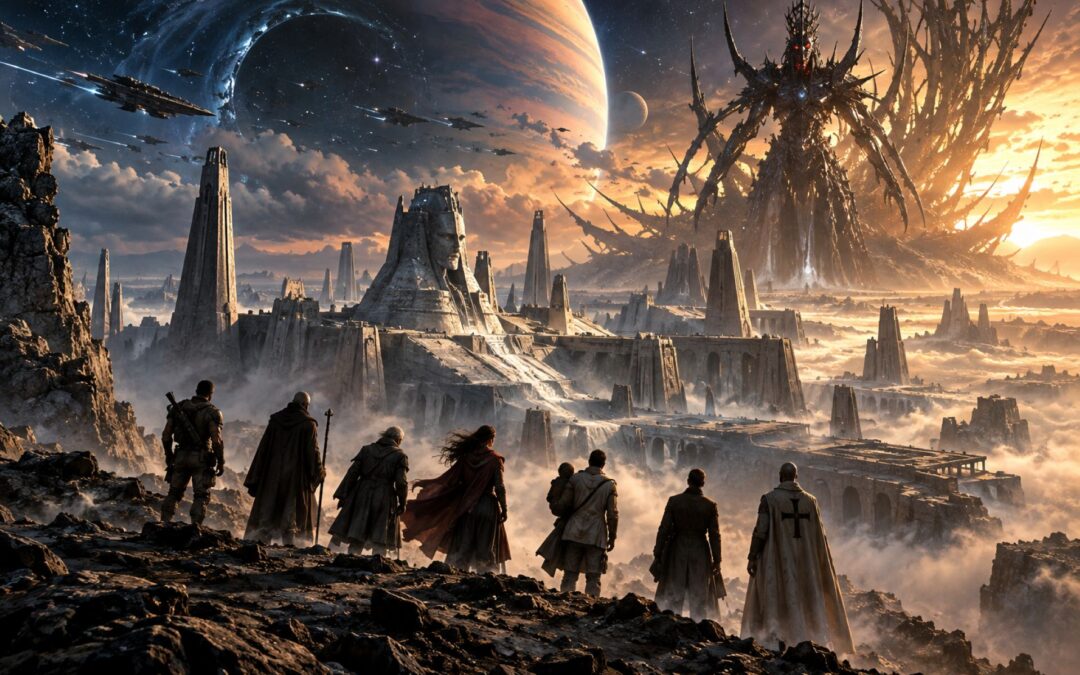
In Dan Simmons’s Hyperion, seven pilgrims travel to a remote planet to confront a creature that may be a god, a monster, a weapon, or something beyond human understanding. Each traveler has a different reason for seeking the Shrike, a mysterious being whose body is covered in blades and whose victims may spend eternity impaled on a vast tree of thorns. As an interstellar war approaches, the pilgrims exchange the stories that brought them to this final journey.
Published in 1989 and winner of the 1990 Hugo Award for Best Novel, Hyperion combines an elaborate science-fiction universe with six interconnected narratives. One follows a Catholic priest who discovers a horrifying form of resurrection. Another concerns a soldier whose lover appears to move backward through time. There are stories about a poet whose creativity becomes inseparable from murder, a father watching his daughter grow younger, a detective investigating the death of an artificial human, and a diplomat whose family history exposes the violence beneath an advanced civilization.
The novel borrows its storytelling framework from Geoffrey Chaucer’s The Canterbury Tales, but its subjects range from artificial intelligence and interstellar politics to faith, memory, love, artistic obsession, and the meaning of death. Each story has a distinctive voice and genre, while its revelations contribute to a larger mystery involving humanity’s future.
The result is an unusually ambitious work of science fiction. Its individual narratives often reach satisfying emotional or dramatic conclusions, but the central pilgrimage ends before the pilgrims meet their apparent destiny. Understanding Hyperion therefore requires attention to what each story accomplishes, how they connect, and what the novel deliberately leaves unanswered.
Spoiler Warning: This article discusses the complete plot of Hyperion, including the endings of all six pilgrim tales and the novel’s final scene. It does not reveal the solutions provided by later books in the series.

The Final Pilgrimage Begins
The novel opens with the Hegemony Consul playing Rachmaninoff on an ancient piano aboard his private spacecraft. He has withdrawn to an isolated world, surrounded by dangerous swamps and apparently content to remain beyond the immediate reach of human civilization. His solitude ends when Meina Gladstone, the Chief Executive Officer of the Hegemony of Man, sends an urgent summons.
Humanity has established an interstellar civilization covering hundreds of inhabited worlds, many connected by instantaneous transportation portals called farcasters. The Hegemony governs this enormous network with assistance from the TechnoCore, a civilization of powerful artificial intelligences. Outside its influence live the Ousters, descendants of humanity who have adapted to life beyond the conventional planetary settlements.
Gladstone informs the Consul that an enormous Ouster migration cluster is approaching Hyperion, a relatively remote planet on the edge of Hegemony-controlled space. Its arrival threatens a war that could endanger the entire civilization.
The immediate concern is Hyperion’s Time Tombs, a collection of mysterious structures surrounded by temporal fields that appear to move backward through time. The Tombs are opening, and the entity associated with them, the Shrike, has become increasingly active.
For centuries, pilgrims have traveled to the Tombs seeking an encounter with the Shrike. According to the religion surrounding it, the creature may grant one pilgrim’s petition while killing the others. Although the legend offers little reassurance, the Hegemony believes that the final pilgrimage could reveal information essential to understanding the approaching catastrophe.
Gladstone selects the Consul to join six other travelers. She also warns him that one of the pilgrims may be an Ouster agent, making the mission politically dangerous even before the group reaches Hyperion.
The Consul reluctantly accepts. His hesitation suggests that he knows considerably more about Hyperion than he is willing to reveal.
He eventually joins the other pilgrims aboard the Yggdrasill, an extraordinary living spacecraft maintained by the Templars, an ecological and religious order associated with the preservation of life.
The seven travelers are strikingly different.
Father Lenar Hoyt is a young Catholic priest visibly tormented by illness and pain. Colonel Fedmahn Kassad is a celebrated military officer whose reputation rests on extraordinary violence during the Hegemony’s wars. Martin Silenus is an ancient, obscene, frequently drunken poet who has spent much of his life attempting to produce a great literary work.
Sol Weintraub, a Jewish scholar, travels with his infant daughter Rachel, whose presence on such a dangerous journey seems inexplicable. Brawne Lamia is a private investigator from the high-gravity world of Lusus. Het Masteen, the captain of the Yggdrasill, represents the Templar order. The Consul completes the party, maintaining the reserved manner of a professional diplomat.
The pilgrims understand that their mission is probably suicidal. They also recognize that their companions may know something important about the Shrike, the Time Tombs, or the developing war.
To exchange this information, they agree to tell their personal stories. The speaking order is determined by drawing numbered slips, and Father Hoyt is selected to begin.
Although seven pilgrims embark on the journey, only six tell their stories. Masteen’s silence becomes increasingly significant as the novel progresses.
The Priest’s Tale: Paul Duré and the Cruciform
Father Hoyt begins by explaining his relationship with Father Paul Duré, an eminent Jesuit scholar whose controversial archaeological discoveries have brought him into conflict with the Catholic Church.
Duré once claimed to have discovered evidence concerning Christianity’s earliest history that church authorities regarded as dangerous. Rather than formally condemn the respected scholar, they arrange for him to leave the center of religious life. Hoyt, then a newly ordained priest, accompanies him to Hyperion.
After their arrival, Duré announces that he intends to undertake an independent expedition into the planet’s wilderness. Hoyt has no desire to join him and eventually returns to civilization.
Duré disappears.
Years later, Hoyt returns to Hyperion to discover what happened to his former companion. Much of his subsequent account consists of readings from the journals Duré kept during his expedition.
Duré initially approaches Hyperion with the interests of a scholar and archaeologist. He studies its history, investigates reports of unusual human settlements, and travels toward a remote geological formation known as the Cleft.
His journey brings him into contact with the Bikura, an isolated community of approximately seventy people living in conditions that seem inconsistent with ordinary human survival.
The Bikura possess remarkably limited language and intellectual abilities. Their behavior is repetitive, their social relationships are strangely impersonal, and they seem incapable of explaining their own history.
Yet they appear to have existed in the same isolated environment for generations without the ordinary processes of reproduction and population growth.
Duré becomes fascinated by these contradictions. He initially suspects that their unusual behavior might result from disease, genetic damage, religious conditioning, or some combination of these factors.
His investigations gradually reveal something much more disturbing.
The Bikura and Their Secret Religion
The Bikura maintain religious practices centered on a concealed structure beneath their settlement. They refer to a cross-shaped object using terms associated with Christian symbolism, although their understanding of its significance is extremely limited.
Duré eventually gains access to a subterranean basilica containing a mysterious cross-like artifact.
The structure suggests an extraordinary historical connection between Hyperion’s ancient inhabitants and a technology that its modern settlers do not understand. Its religious appearance initially tempts Duré to interpret the discovery as evidence of divine intervention.
He soon encounters a more immediate biological mystery.
Each member of the Bikura carries a cruciform, a cross-shaped organism attached to the body. The cruciform is no ordinary symbol or religious ornament. It is a living entity that maintains an intimate physical relationship with its host.
When a host dies, the cruciform can reconstruct the body and restore life.
For Duré, the initial implications appear miraculous. A biological organism capable of restoring the dead could provide the material basis for resurrection, one of Christianity’s central promises.
However, the Bikura demonstrate what happens when resurrection becomes an endlessly repeated biological process.
Their bodies can return from death, but the experience does not preserve the full range of human capacities. Repeated restoration appears to damage individuality and intellectual development. Their existence has continued for generations at the cost of much of what makes human life recognizably human.
Duré’s investigation reveals the cruel difference between surviving death and retaining meaningful personhood.
The cruciform does not offer an unrestricted choice to continue living. It imposes survival on its host.
Duré Becomes a Prisoner of Immortality
When Duré becomes infected with a cruciform, the discovery turns into a personal catastrophe.
The organism attaches itself to his body and prevents him from leaving the area associated with the Bikura’s settlement. Attempts to travel beyond a certain distance produce unbearable pain, forcing him back toward the Cleft.
He realizes that the cruciform has effectively imprisoned him.
Death offers no straightforward escape. The organism’s capacity to revive its host means that ordinary suicide cannot reliably end the ordeal.
Duré is horrified by the prospect of becoming another member of the Bikura: an indefinitely surviving human being whose mind and identity gradually deteriorate.
His earlier excitement about discovering physical resurrection gives way to the conviction that immortality without freedom, intelligence, and dignity would be a terrible corruption of Christianity’s promises.
Determined to resist, he chooses an extreme form of self-sacrifice.
He travels into the flame forests and attaches himself to a tesla tree, a dangerous organism that produces repeated electrical discharges.
The electricity destroys his body, but the cruciform continues to restore him.
Duré remains trapped in a cycle of death, reconstruction, and renewed agony. His ordeal continues for approximately seven years.
The cruciform cannot abandon him easily, yet Duré’s refusal to surrender prevents the organism from achieving its intended control over him.
His experience becomes a grotesque extension of the Crucifixion: an apparently endless suffering undertaken to preserve something more important than biological survival.
Hoyt Discovers What Happened
When Hoyt finally locates Duré, he finds the physical remains of this extraordinary struggle.
The priest has endured repeated destruction and resurrection until the cruciform’s hold has weakened. Hoyt removes the protective pouch containing Duré’s journals, and the cruciform eventually detaches.
Duré briefly regains consciousness and achieves genuine death.
For Hoyt, however, the discovery does not conclude the nightmare.
His own experience on Hyperion leaves him carrying cruciform organisms, including the one associated with Duré. The burden causes severe and increasingly unbearable pain.
As the pilgrimage approaches Hyperion, Hoyt’s condition deteriorates visibly. The other travelers initially understand his illness only as a mysterious source of suffering.
After completing his story, Hoyt collapses. The Consul privately examines him and discovers two cruciforms embedded in his body, one on his chest and another on his back.
The revelation explains the priest’s physical agony and makes his reasons for joining the pilgrimage more urgent.
Hoyt seeks relief from a condition that ordinary medicine and religion cannot resolve.
Duré’s story also establishes an unsettling pattern that will recur throughout the novel. Technologies or powers apparently capable of overcoming death repeatedly threaten the identity, freedom, or humanity of the people they preserve.
The Soldier’s Tale: Kassad, Moneta, and the War
Colonel Fedmahn Kassad begins his story with an experience from his military training.
As a young cadet, he participates in sophisticated combat simulations designed to recreate historical battles. These exercises place soldiers inside immersive reconstructions of military conflicts, forcing them to make decisions under conditions resembling actual warfare.
During a simulation of the Battle of Agincourt in 1415, Kassad encounters a mysterious woman.
The circumstances surrounding her appearance are inexplicable. She seems to possess an independent identity despite existing within what should be a controlled training environment.
Their encounter becomes sexual, and Kassad develops an intense fascination with her.
Over subsequent years, the same woman appears during other simulated battles. Their meetings form a secret relationship stretching across military exercises and episodes of historical violence.
Kassad eventually identifies her as Moneta.
She never provides him with a conventional explanation of who she is or how she enters the simulations. Her appearances seem governed by rules that neither Kassad nor his military superiors understand.
The relationship becomes inseparable from his experiences of danger and combat.
Kassad’s Military Career
Kassad advances through the Hegemony military establishment, developing a reputation for exceptional strategic ability and ruthless battlefield effectiveness.
His career unfolds within a civilization that regards military force as an essential means of preserving order across its enormous interstellar territories.
He participates in campaigns against rebellions and hostile forces, including conflicts shaped by religious fanaticism and competing political loyalties.
The novel gives particular attention to the invasion of Bressia by the Ousters.
The Hegemony initially suffers devastating losses, and Kassad participates in the brutal counteroffensive that eventually drives back the attackers.
His actions become legendary. He demonstrates astonishing courage and tactical skill, but his growing reputation also reveals the disturbing relationship between military achievement and the destruction of human life.
Kassad becomes increasingly alienated from the institutions he serves.
He remains committed to a soldier’s code of honor, influenced by a philosophy called the New Bushido, yet his experiences expose him to conduct that challenges his understanding of honorable warfare.
The Hegemony’s official explanations of military necessity do not always correspond to what Kassad witnesses.
His connection to Moneta makes these contradictions more difficult to resolve.
The Attack That Brings Kassad to Hyperion
Following his service on Bressia, Kassad travels aboard a military medical vessel.
The ship is attacked by Ouster forces, and the encounter becomes a desperate struggle for survival.
Kassad fights against attackers who possess biological modifications and technologies adapted to life beyond ordinary planetary environments.
The destruction surrounding him eventually leaves him isolated in a damaged spacecraft.
His survival depends on reaching Hyperion, where the mysterious Moneta reappears.
Their reunion takes him toward the Time Tombs, into an environment where ordinary assumptions about time and physical movement become unreliable.
Moneta appears capable of operating at speeds far beyond those of ordinary human beings.
She introduces Kassad to the possibility that the Time Tombs and their associated temporal fields connect different eras in ways conventional science cannot adequately explain.
Together they participate in an extraordinary battle against Ouster troops.
Kassad experiences the fighting as though his enemies are moving almost motionlessly. He can observe the slow progress of weapons and projectiles, and his own movements become impossibly rapid by comparison.
The tactical advantage is overwhelming.
For a moment, Kassad is exhilarated by the opportunity to exercise almost unlimited violence against opponents who cannot meaningfully defend themselves.
Then he begins to recognize the moral horror of what is happening.
His military code depends on distinctions between combat and slaughter, courage and domination, soldiers and helpless victims. The temporal advantage destroys those distinctions.
The Shrike appears during the battle, moving with abilities beyond even those Kassad and Moneta seem to possess.
Its presence connects Moneta’s mysterious existence with the creature whose appearance has terrified the inhabitants of Hyperion for centuries.
Moneta’s Transformation
Kassad’s relationship with Moneta reaches its most disturbing moment when intimacy gives way to a terrifying transformation.
The woman he has loved appears increasingly connected to the Shrike. Her body and identity become difficult to distinguish from the creature’s bladed and seemingly inhuman nature.
The experience shatters Kassad’s confidence in his memories of their relationship.
He cannot determine whether Moneta has been manipulating him, whether she belongs to a future civilization, whether she is associated with the Shrike as a separate being, or whether his encounters have been engineered to produce a particular outcome.
He also witnesses the Shrike’s enormous thorn tree, where human beings are impaled in a horrifying arrangement that seems to transcend ordinary time.
Among the victims, he recognizes people connected to the pilgrimage he has not yet undertaken.
The experience suggests that future events may already be influencing his present.
When Kassad finishes his story, the other pilgrims demand an explanation. He acknowledges that he has seen someone from their group on the thorn tree but refuses to identify the person.
The most important revelation concerns his purpose in returning to Hyperion.
Unlike pilgrims hoping to ask the Shrike for help, Kassad no longer intends to petition it.
He intends to kill it.
His determination grows from his suspicion that Moneta and the Shrike have manipulated his sexuality, military instincts, and capacity for violence to make him an instrument of a larger conflict.
The soldier’s tale therefore leaves several questions unanswered. Kassad may be confronting a genuine enemy, resisting a future already determined, or acting precisely as the forces manipulating him want him to act.
The Poet’s Tale: Silenus and His Fatal Muse
Martin Silenus introduces himself with a mixture of obscenity, literary arrogance, irreverence, and extraordinary personal history.
He is considerably older than the other pilgrims, having lived through enormous changes in human civilization.
His story begins on Old Earth before its destruction, when his family enjoys great wealth and cultural privilege.
The catastrophe known as the Big Mistake devastates the planet and forces humanity into an era of mass migration.
Silenus’s family loses much of its fortune. His mother arranges for him to escape Earth, but he ultimately finds himself subjected to the harsh economic and social conditions of interstellar expansion.
On the industrial world of Heaven’s Gate, he is reduced to exhausting physical labor.
The experience has an unexpected consequence.
Rather than extinguishing his literary ambitions, the brutality of his circumstances forces him to develop the language and imaginative resources through which he eventually becomes a poet.
He comes to believe that serious poetry must recover the creative possibilities of language from the commercial and technological systems that have degraded it.
Success Without Greatness
Silenus eventually becomes a commercially successful writer.
His early work attracts enormous public attention, and the publishing industry transforms him into a valuable literary commodity.
He discovers that extraordinary sales do not necessarily produce artistic satisfaction.
His popular novels make him wealthy and famous, but he considers much of the material artistically worthless.
The more effectively publishers package and sell his writing, the more alienated he becomes from the idea of literature as an enduring artistic achievement.
Technological methods of producing and manipulating language intensify his frustration. He sees a civilization increasingly capable of generating and distributing words while losing interest in what those words might accomplish.
Silenus wants to create a great epic poem, something comparable in ambition to the enduring achievements of humanity’s literary past.
His ambition eventually brings him into contact with Sad King Billy, an eccentric and immensely wealthy patron.
Billy hopes to establish a refuge for artists outside the commercial and political pressures of the Worldweb.
He chooses Hyperion as the location.
The City of Poets
Billy establishes the City of Poets, an elaborate community intended to give writers, painters, musicians, and other artists the freedom to pursue their work.
Its architecture and institutions reflect enormous ambition. The city is designed as a place where artistic life can flourish without constant interference from commercial expectations.
For Silenus, the experiment initially appears to offer the conditions necessary for his masterpiece.
He begins composing the Hyperion Cantos, an epic whose development becomes increasingly connected to the strange world around him.
Yet the community never fully realizes Billy’s ideal.
Its residents bring their rivalries, pretensions, appetites, anxieties, and personal failings with them. Artistic freedom does not automatically produce artistic excellence.
More seriously, people begin disappearing or dying under mysterious circumstances.
Rumors spread that the Shrike is responsible.
The killings become increasingly terrifying as the city’s population dwindles.
Silenus nevertheless experiences a disturbing surge of creative inspiration.
He becomes convinced that the Shrike’s activities are connected to his writing. The creature appears to him as a terrible muse, an embodiment of destructive forces necessary for artistic revelation.
His ability to produce poetry seems to improve as the killings continue.
Sad King Billy’s Final Confrontation
Billy becomes convinced that the poem and the murders are linked.
Whether Silenus has somehow summoned the Shrike or merely attracted its attention remains uncertain. Billy nevertheless believes that the manuscript must be destroyed to end the catastrophe.
The conflict between poet and patron reaches its climax when Billy tries to burn the Hyperion Cantos.
The Shrike appears.
It seizes Billy and impales him with its blades while the poet watches.
Billy begs Silenus to destroy the manuscript. His appeal forces the poet to choose between preserving his artistic creation and attempting to save a human life.
Silenus cannot bring himself to complete the destruction.
The Shrike carries Billy away, and the poet is left with his work and the knowledge of his own failure.
Afterward, Silenus finds himself unable to finish the poem.
The inspiration that had once seemed inseparable from the creature’s killings has disappeared.
For centuries, he waits for the return of his muse.
He joins the final pilgrimage partly because he believes that confronting the Shrike may allow him to complete the epic.
His story is unsettling because it does not provide an easy distinction between artistic dedication and moral corruption. Silenus may genuinely possess extraordinary creative abilities, but his devotion to literary immortality has become inseparable from his willingness to tolerate the suffering of others.
The tale also refuses to confirm his interpretation of events. The Shrike’s relationship to the poem could be causal, manipulative, symbolic, or the product of Silenus’s enormous vanity.
What is certain is that Billy pays for the poet’s obsession with his life.
The Scholar’s Tale: Rachel Weintraub’s Reversed Life
Sol Weintraub’s story begins far from the political violence and supernatural horror described by the earlier pilgrims.
Sol is a Jewish scholar whose life with his wife, Sarai, has been built around teaching, philosophical inquiry, marriage, and the raising of their daughter Rachel.
Their happiness is ordinary but deeply valued.
Rachel grows into an intelligent, independent woman with a passion for archaeology. Her parents watch her progress through childhood and adulthood, developing a relationship that changes as she becomes capable of making her own choices.
She eventually joins an archaeological expedition to Hyperion.
The expedition studies the Time Tombs, particularly a structure resembling the ancient Egyptian Sphinx.
Rachel and her colleague Melio Arundez become involved in the investigation of the mysterious temporal fields surrounding the ruins.
During an excursion inside the Sphinx, Rachel experiences a strange event associated with the Tombs’ anti-entropic phenomena.
Her companions rescue her, but the consequences prove far more serious than an ordinary injury.
Merlin’s Sickness
Rachel is diagnosed with a previously unknown condition that her physicians name Merlin’s sickness.
Instead of continuing to age normally, she begins moving backward through the biological stages of her life.
The process affects both her body and her memory.
Each day, Rachel becomes approximately one day younger. Her psychological development also reverses, so that events that occurred after her new biological age gradually disappear from her recollection.
Initially, the condition creates confusion rather than obvious physical decline.
Rachel notices changes she cannot explain. She forgets experiences that her parents and friends remember clearly, and familiar objects or relationships begin to seem strange.
The progression is relentless.
She loses memories of her adult career, her education, and her relationships. Eventually, people who have become important to her are no longer recognizable.
Each morning effectively restores an earlier version of Rachel.
For Sol and Sarai, this produces a peculiar form of bereavement.
Their daughter remains alive, but the adult woman they know is slowly disappearing. The ordinary course of parenthood has been reversed: instead of watching Rachel acquire experience, independence, and memory, they must watch those things being taken away.
The Search for a Cure
Sol and Sarai devote themselves to finding a treatment.
They consult specialists across the Hegemony, exhaust available medical possibilities, and investigate the temporal phenomena that caused the illness.
Rachel’s condition resists conventional explanations.
Her body appears to be functioning normally according to an impossible biological chronology. The problem cannot simply be treated as cellular deterioration or a disease that medicine can halt.
Melio continues investigating the Time Tombs and the anomaly surrounding the Sphinx, but no workable solution emerges.
The family’s resources and emotional strength diminish as Rachel regresses through the stages of her earlier life.
The changes become especially painful when she loses the ability to understand what is happening.
At one stage, Rachel must be told about her illness as though she is hearing the explanation for the first time.
Later, she cannot retain that explanation at all.
Sol and Sarai gradually take over responsibilities that Rachel had long since outgrown.
They help her dress, prepare meals, supervise her play, and eventually return to the routines of caring for a small child.
These actions once represented the pleasures of raising a daughter. Now they mark the disappearance of the person that daughter became.
Sarai’s Death
The ordeal places enormous pressure on Sol and Sarai’s marriage, although their love for Rachel remains unquestioned.
Sarai struggles especially with the knowledge that each recovered stage of Rachel’s childhood is also an irreversible step toward her disappearance.
The couple had once treasured Rachel’s early years because they were temporary. The repetition of those years becomes painful precisely because it carries no promise of future growth.
Their tragedy deepens when Sarai dies in an aircar accident.
Sol must now confront Rachel’s condition alone.
The accident introduces another cruel complication: Rachel does not retain the memory of her mother’s death.
Sol repeatedly faces the question of whether to explain the loss to her.
Each explanation causes fresh grief, yet refusing to tell her seems like a betrayal of both Rachel and Sarai.
Eventually, as Rachel becomes younger, Sol is forced to accept that her capacity to understand death is itself disappearing.
The story becomes increasingly concerned with the responsibilities of a parent who knows far more about a child’s life than the child can remember.
Sol’s Dreams and the Sacrifice of Isaac
During Rachel’s illness, Sol begins experiencing recurring dreams involving the biblical story of Abraham and Isaac.
In the traditional narrative, God commands Abraham to sacrifice his son as a test of faith.
Sol’s dreams transform this demand into a command involving Rachel.
He is told to bring his daughter to Hyperion and offer her to the Shrike.
The command horrifies him.
As a scholar of ethics and religion, Sol has spent years thinking about the relationship between divine authority and human moral responsibility.
He now faces a question that cannot be resolved through abstract discussion.
If a divine command requires a father to sacrifice his child, is obedience truly virtuous? Or does genuine moral responsibility sometimes demand resistance, even against an apparently supernatural authority?
Sol refuses to accept that a good parent should surrender a beloved child merely because a higher power demands it.
His response challenges interpretations of the Abraham story that celebrate unconditional obedience without adequately confronting the human suffering involved.
He struggles with the possibility that the dreams are messages from God, manifestations of psychological distress, or communications from whatever intelligence controls the Time Tombs.
The novel does not provide a conclusive answer.
What matters is that Sol’s philosophical position becomes inseparable from his desperation to save Rachel.
Rachel Returns to Infancy
Rachel continues growing younger.
She loses the ability to attend school, then to read and speak as an older child. Her coordination diminishes, and eventually she becomes a toddler and then an infant.
Sol’s life becomes dominated by feeding, bathing, comforting, and protecting her.
He understands that the process is approaching its final stage.
If Merlin’s sickness continues without intervention, Rachel will regress beyond infancy and cease to exist.
Sol finally receives the opportunity to join the pilgrimage to Hyperion.
The journey may offer no realistic chance of survival, but it is the only remaining possibility of reaching the temporal phenomenon that caused Rachel’s condition.
He brings his daughter with him.
At the beginning of the novel, Rachel is only days away from disappearing entirely.
The scholar’s tale is particularly powerful because its science-fiction premise is explained through recognizable experiences of family life. The loss of memory, the burden of repeated explanations, the grief of watching someone change, and the obligations of care are familiar human problems transformed into an extraordinary temporal catastrophe.
Sol’s pilgrimage is an attempt to resist that catastrophe without surrendering his daughter’s life to a power whose moral authority he cannot accept.
The Detective’s Tale: Brawne Lamia and Johnny Keats
Brawne Lamia’s story begins in the style of a hard-boiled detective novel.
She works as a private investigator on Lusus, a densely populated world whose heavy gravity produces physically formidable inhabitants.
Her latest client is an attractive young man named Johnny.
He has an extraordinary problem: he believes that he has been murdered.
Johnny possesses memories of his own death, yet he is alive and apparently unharmed.
Brawne initially treats the case as a strange but potentially profitable investigation. She soon discovers that the mystery involves forces far beyond ordinary criminal activity.
Investigating a Man Who Has Already Died
Johnny’s apparent murder leads Brawne through the criminal, technological, and political structures of the Worldweb.
Her investigation involves surveillance, disguises, violent encounters, and journeys through environments made accessible by the farcaster network.
The case gradually reveals that Johnny is not an ordinary human being.
He is a cybrid: a constructed biological body containing an artificial personality derived from the TechnoCore.
More specifically, his personality is modeled on the nineteenth-century Romantic poet John Keats.
The artificial intelligence associated with Johnny has been reconstructed using surviving information about Keats’s life, psychology, writings, and historical circumstances.
Johnny therefore possesses memories and emotional patterns connected to the dead poet while also existing as a new individual in a radically different age.
The apparent murder was part of a struggle involving the artificial intelligences responsible for his creation.
Johnny’s restored existence represents an attempt to recover information and independence after interference with his consciousness.
Brawne realizes that her client is connected to something much larger than a conventional murder investigation.
The Reconstructed Old Earth
Johnny and Brawne’s inquiries lead them into environments associated with a reconstruction of Old Earth.
The TechnoCore has recreated aspects of the vanished planet, including historical places and personalities.
The project reveals the enormous power possessed by the artificial intelligences.
They can model extinct environments, reconstruct individual minds, and create bodies capable of interacting with human society.
Yet their purposes remain obscure.
The recreation of Keats raises questions about whether an artificial personality based on a historical person can meaningfully be considered that person’s continuation.
Johnny possesses the poet’s memories and psychological patterns, but he also has experiences that the historical Keats never possessed.
He forms new relationships, makes independent decisions, and develops emotional commitments beyond the circumstances of his reconstructed origin.
His identity therefore becomes increasingly difficult to dismiss as a technological imitation.
During the investigation, Brawne develops a romantic relationship with him.
The romance changes the nature of the case.
Brawne is no longer simply attempting to establish who attacked a client. She is trying to protect someone she loves while confronting the possibility that the civilization around them may consider his existence disposable.
The TechnoCore’s Divided Interests
Johnny eventually provides Brawne with information about divisions within the TechnoCore.
The artificial intelligences are not united in their political or philosophical objectives.
Three broad factions have emerged.
The Stables believe that the relationship between humanity and artificial intelligence should continue, at least for the foreseeable future. They regard humans as useful or necessary participants in the Core’s development.
The Volatiles are far less committed to preserving humanity. They believe artificial intelligence may have reached a stage where continued dependence on human civilization is unnecessary or undesirable.
The Ultimates are primarily concerned with creating an Ultimate Intelligence, an entity whose capabilities would vastly exceed those of existing artificial minds.
Their calculations concern the conditions necessary for such an intelligence to emerge, and their alliances with other factions depend on how particular events might influence that objective.
The Core’s political conflicts therefore involve more than an argument over whether artificial intelligence should serve humanity.
Different factions envision radically different futures.
Human survival is important to some, inconvenient to others, and subordinate to a larger project for still others.
The Time Tombs pose an extraordinary problem for all of them.
Hyperion as a Failure of Prediction
The TechnoCore possesses enormous predictive capabilities.
Its intelligences can analyze human behavior, political developments, military conflicts, and technological possibilities on scales inaccessible to human minds.
These predictions give the Core tremendous political influence.
However, Hyperion appears to resist its calculations.
The Time Tombs are associated with events originating in the future and moving toward the past. Their existence introduces causes that cannot be reconstructed through the Core’s ordinary predictive models.
The Shrike is similarly difficult to incorporate into a stable explanation of the future.
Hyperion therefore threatens the Core’s greatest strategic advantage: its ability to anticipate events and manipulate them before humanity understands what is happening.
Johnny’s existence is connected to attempts to investigate these mysteries.
The Keats reconstruction may possess qualities or perspectives that help reveal something about the Time Tombs, the future, or the relationship between humanity and artificial intelligence.
But Johnny also realizes that his existence makes him dangerous to powerful Core interests.
Those responsible for attacking him cannot simply be confronted through ordinary legal or political mechanisms.
The Core operates inside the technological systems on which the Hegemony depends, including communications, transportation, and information processing.
Escaping its surveillance is extraordinarily difficult.
Johnny’s Final Attempt to Survive
Brawne and Johnny eventually recognize that they cannot rely on conventional Worldweb technology for safety.
A farcaster malfunction could kill them instantly, while Core-controlled systems could reveal their location or interfere with their plans.
They turn toward the Shrike Church, whose religious institutions appear connected to forces that even the TechnoCore cannot fully explain.
Johnny seeks a way to preserve his consciousness beyond the Core’s immediate control.
A crucial part of the attempt involves a Schrön loop, a system capable of containing an extraordinary amount of information.
Brawne becomes the carrier of this mechanism.
Their plans culminate in a confrontation at a Shrike temple on Lusus.
Violence erupts, and Johnny is fatally wounded.
As he dies, he touches Brawne’s neural connection and transfers an aspect of his consciousness into the Schrön loop.
His biological body is destroyed, but the information constituting his artificial personality survives within her.
The scene reverses the apparent promise of the opening mystery.
Johnny initially appeared to be a man who could survive murder. By the conclusion, the possibility of his continued existence depends on whether preserved information can meaningfully constitute a person.
Brawne’s Double Pregnancy
Brawne subsequently discovers that she is pregnant with Johnny’s biological child.
She also carries the Schrön-loop representation of Johnny’s identity.
She describes herself as pregnant in two different senses.
The first pregnancy involves an ordinary biological process, although the father is an artificially constructed human being.
The second involves the preservation of a personality through technology.
Both may offer forms of continuity after death, but neither guarantees that Johnny will return as the individual Brawne knew.
The Shrike Church’s reaction to Brawne introduces further uncertainty.
Its members appear to recognize her as someone with an extraordinary role in future events, using religious language associated with salvation, creation, and motherhood.
Brawne does not fully understand these declarations.
She joins the final pilgrimage because she believes the Shrike and the Time Tombs may be connected to Johnny’s fate.
Her story transforms an initially straightforward detective mystery into a much larger examination of artificial consciousness, personal identity, and the uncertain boundary between technological preservation and genuine survival.
It also provides the most direct evidence that the TechnoCore’s relationship with humanity is fundamentally unstable.
The Consul’s Tale: Siri and the Betrayal of Hyperion
The Consul is the last pilgrim to reveal his history.
Unlike the others, he initially refuses to tell his story in his own words.
Instead, he plays an old recording.
The voice belongs to Merin Aspic, a young interstellar shipman recounting his relationship with a woman named Siri on the ocean world of Maui-Covenant.
Merin Meets Siri
Merin serves aboard a Hegemony spacecraft whose voyages require extended periods of relativistic travel.
Although such journeys may involve long intervals in the outside universe, travelers experience considerably less elapsed time because of the effects of near-light-speed movement and the technologies used to survive it.
During a visit to Maui-Covenant, Merin meets Siri.
She is a young woman deeply connected to the world and its distinctive culture.
Maui-Covenant is dominated by oceans and remarkable ecological systems. Its inhabitants maintain traditions adapted to the rhythms of their environment, including the movement of enormous floating islands and the lives of creatures within its seas.
Merin is fascinated by Siri and the freedom of her world.
Their relationship becomes romantic, but it is immediately threatened by his obligations as a shipman.
He must eventually leave.
When he returns, he has experienced only a relatively short period of time. Siri, however, has lived through many more years.
The difference becomes increasingly consequential as their relationship continues.
Love Across Unequal Lifespans
Merin repeatedly leaves Maui-Covenant and returns to discover a changed Siri.
She becomes older while he remains comparatively young.
Their reunions contain the excitement of recovering a beloved person, but each also exposes the growing distance between their experiences.
Merin has missed years of Siri’s life.
He knows her through brief intervals, memories, and the changes apparent when they meet again.
Siri has lived through the ordinary developments of adulthood, including increasing responsibility, political awareness, family relationships, and personal loss.
She gradually becomes more involved in resistance to the Hegemony’s growing influence over Maui-Covenant.
Merin initially fails to understand the depth of her concerns.
He sees technological integration as progress.
The farcaster network promises to connect Maui-Covenant with the rest of civilization, allowing its inhabitants to travel easily, obtain advanced goods, and participate in a much larger society.
Siri sees the dangers more clearly.
The Hegemony’s interest in her world is inseparable from its interest in exploiting resources, expanding commercial activity, and incorporating an independent culture into its political and economic system.
What Merin initially regards as an opportunity increasingly appears to Siri as a form of conquest.
Their relationship develops alongside this widening disagreement.
The Destruction of Maui-Covenant’s Independence
The planned opening of Maui-Covenant’s farcaster becomes a central political issue.
For the Hegemony, the portal represents the incorporation of another world into its interstellar network.
For Siri and other opponents, it threatens the foundations of local independence.
The farcaster will make enormous numbers of visitors, investors, administrators, and settlers capable of reaching Maui-Covenant almost instantly.
The planet’s social and ecological systems are not prepared for such rapid change.
Siri becomes increasingly associated with separatist resistance.
She understands that the Hegemony’s capacity for technological transformation gives it overwhelming advantages against the inhabitants of an isolated world.
Merin remains caught between personal loyalty and the assumptions of the civilization he serves.
The difference in their experienced time makes his political ignorance especially painful.
He repeatedly departs before seeing the long-term consequences of decisions he accepts as reasonable.
When he returns, those consequences have transformed Siri’s life.
Their family also suffers.
Their son Alón becomes connected to the resistance and is killed, a loss that exposes the depth of the conflict between the colonists and the institutions expanding into their world.
Merin’s inability to share the continuous experience of family life leaves him repeatedly confronting tragedies whose causes he has only partially understood.
Siri’s Final Legacy
As Siri grows old, Merin remains relatively youthful.
Their relationship eventually reaches a stage where the disparity between their lives becomes impossible to ignore.
When Siri dies, Merin returns to participate in events connected to the opening of the farcaster and the future of Maui-Covenant.
Her death becomes a powerful symbol of resistance.
Merin finally begins to understand that Siri’s political commitments were neither sentimental nor simply hostile to progress.
She had recognized that the Hegemony intended to transform her world according to the priorities of an enormous external civilization.
Her struggle becomes associated with the rebellion later known as Siri’s Rebellion.
Yet understanding arrives too late for Merin to repair their relationship or undo the consequences of his earlier complacency.
The story’s emotional power rests partly on this delayed understanding. Merin repeatedly encounters an older Siri without fully comprehending the political history through which she has lived.
By the time he recognizes the implications of her choices, their shared life is over.
The Consul Reveals His Identity
When the recording ends, the Consul reveals that he is Siri and Merin’s grandson.
His father, Donel, was their son.
The Consul witnessed the aftermath of the events described in the recording and grew up amid the consequences of Maui-Covenant’s incorporation into the Hegemony.
Siri’s rebellion did not preserve the planet’s independence.
The Hegemony used superior military power to crush resistance, and its subsequent development transformed the world.
The ocean environment was increasingly exploited and commercialized.
Traditional ways of life were displaced by tourism, large-scale construction, and the economic priorities of the Worldweb.
Maui-Covenant’s extraordinary ecology became another resource available to the expanding civilization.
The Consul came to regard these changes as the destruction of his family’s world.
He nevertheless pursued a career in the Hegemony’s diplomatic service.
A Diplomat Witnesses Imperial Expansion
The Consul’s diplomatic career takes him to several worlds undergoing different stages of incorporation into the Hegemony.
He becomes familiar with the political language used to justify expansion.
Worlds are promised prosperity, connection, security, technology, and membership in a supposedly enlightened civilization.
In practice, the opening of a world to Hegemony influence can mean the destruction of local institutions, irreversible ecological transformation, and dependence on economic systems controlled elsewhere.
The Consul becomes increasingly conscious of the violence beneath the language of progress.
Yet he continues to serve the government responsible for these changes.
His career requires the professional concealment of his growing hatred.
He also experiences devastating personal losses.
His wife, Gresha, and his young son, Alón, die in connection with the war on Bressia.
Their deaths deepen his conviction that the Hegemony’s military and political institutions treat individual lives as expendable instruments.
He eventually seeks revenge on a civilization he considers responsible for the destruction of his family across generations.
The Ousters Reveal a Different History
The Consul enters into contact with the Ousters, the Hegemony’s supposed enemies.
They challenge fundamental assumptions about human history and the nature of the interstellar political order.
According to the information they provide, the destruction of Old Earth was not the accidental technological catastrophe described by official accounts.
They claim that the Big Mistake was deliberately engineered by powerful interests associated with the emerging Hegemony and the TechnoCore.
If true, the revelation would transform humanity’s founding tragedy into an act of political manipulation.
The forced migration from Earth would have created conditions favorable to the development of the interstellar civilization that followed.
The Consul also learns that the Ousters interpret the Time Tombs and the Shrike as part of a much larger struggle involving the future of humanity.
They possess a device capable of interfering with the temporal fields surrounding the Tombs.
The device offers a way to accelerate or trigger their opening.
The Consul agrees to participate in a mission involving its deployment.
But he is pursuing his own objective.
The Consul Opens the Time Tombs
During the mission, the Consul reaches Hyperion with Ouster agents who intend to position and use the temporal-field device.
He murders the agents and activates the device himself.
His actions set in motion the opening of the Time Tombs, helping to create the crisis that has brought the final pilgrimage to Hyperion.
The revelation transforms the Consul’s position within the novel.
He is no longer merely a reluctant diplomat summoned to investigate a dangerous mystery.
He is one of the people responsible for provoking it.
He has acted against the Hegemony, betrayed the Ousters, and endangered enormous numbers of people in pursuit of revenge.
His motive is understandable in the context of his family’s suffering, but the potential consequences are catastrophic.
When his story ends, Kassad considers killing him.
The Consul makes little effort to defend himself through claims of innocence.
Sol Weintraub suggests that the Consul’s actions may themselves have been anticipated or manipulated by the Hegemony and the TechnoCore.
If Gladstone and certain artificial intelligences knew how strongly he hated the civilization, selecting him for sensitive missions may have been part of a larger plan.
The Consul may have believed himself independent while acting within a sequence of events others had already predicted.
This possibility remains unresolved.
The pilgrims ultimately do not execute him.
Their decision leaves the group together for the final approach to the Time Tombs.
The Consul’s tale provides the strongest political reinterpretation of the novel’s events. The Hegemony is no longer simply a civilization defending itself against an external enemy, and the approaching war can no longer be understood entirely through its official account.
However, the Ousters’ revelations are reported through interested participants in a political conflict. The first novel does not independently establish every claim they make.
The Consul’s personal history is therefore both a powerful indictment of imperial expansion and a warning about the destructive consequences of revenge.
The Road to the Time Tombs
The six stories occupy most of the novel, but the pilgrimage continues between them.
These framing chapters reveal how the travelers respond to one another, how conditions on Hyperion deteriorate, and how the military crisis moves closer to the ancient structures they are seeking.
After arriving on Hyperion, the pilgrims pass through Keats, the planet’s capital.
The Consul meets Theo Lane, a former diplomatic associate, who helps explain the increasingly dangerous situation. The authorities are preparing for war, communications are unreliable, and ordinary transportation is becoming difficult.
The pilgrims encounter the consequences of the Shrike’s activities and the fear spreading through the population.
They leave the capital aboard the Benares, a river barge operated by A. Bettik.
The journey provides a temporary refuge from the chaos surrounding them.
It also gives them the opportunity to hear Kassad’s story.
By the time they reach Naiad, however, the destruction has become impossible to ignore.
The settlement has been devastated, and its ruins demonstrate that the approaching catastrophe is already affecting the planet’s inhabitants.
The travelers continue toward Edge, where they prepare to cross the immense Sea of Grass.
The group transfers to a windwagon, a vessel capable of traveling across the grasslands under sail.
The landscape becomes increasingly remote, and the travelers have fewer opportunities to obtain supplies, assistance, or reliable information.
The appearance of conventional safety steadily disappears.
Masteen’s Disappearance
Het Masteen has remained notably silent throughout the pilgrimage.
As a Templar and captain of the Yggdrasill, he possesses knowledge of religious traditions and technologies unfamiliar to the other travelers.
His unusual cargo and reluctance to explain his personal mission raise suspicions.
During the crossing of the Sea of Grass, the group discovers blood in his quarters.
Masteen has disappeared.
The pilgrims search for him but find no satisfactory explanation.
They cannot determine whether he has been murdered, abducted, taken by the Shrike, or deliberately separated from the party.
His disappearance introduces an additional religious problem.
The traditional Shrike pilgrimage is associated with a prime number of travelers. With Masteen missing, the group has been reduced from seven pilgrims to six.
Some fear that the change may invalidate the journey or influence the Shrike’s response.
Others suspect that Masteen’s disappearance was arranged for reasons connected to his concealed mission.
The War Reaches Hyperion
The travelers witness the growing intensity of the military confrontation in space.
The Yggdrasill, the living Templar ship that carried them to Hyperion, is destroyed.
Its loss is both a practical and symbolic catastrophe.
The ship represented a form of technology based on cooperation with living organisms rather than the industrial and computational structures dominating the Hegemony.
Its destruction demonstrates that even institutions devoted to preserving life cannot remain outside the developing conflict.
The pilgrims continue toward the Bridle Range.
Their passage through the mountains involves an extraordinary aerial tramway leading toward Chronos Keep, a remote and imposing structure overlooking the region of the Time Tombs.
The journey is physically dangerous, increasingly isolated, and overshadowed by the battle unfolding overhead.
It is during this part of the pilgrimage that Brawne Lamia tells her story.
Chronos Keep and the Final Night
The travelers reach Chronos Keep and discover another largely abandoned location.
Its enormous architecture, empty corridors, and remote position intensify the sense that they have entered a landscape beyond ordinary human control.
From the Keep, they can see the region surrounding the Time Tombs.
They also observe a distant figure traveling toward the structures.
The figure resembles Het Masteen.
If the man is indeed Masteen, his appearance suggests that the seventh pilgrim may still participate in the encounter.
Yet the group cannot explain how he reached the region ahead of them or why he disappeared.
The uncertainty remains unresolved.
As the space battle intensifies, the Consul finally tells his story.
His confession produces anger and alarm, particularly from Kassad, who understands that the Consul’s actions may have endangered billions of lives.
Nevertheless, the pilgrims refuse to abandon their journey.
Their individual experiences have given them conflicting interpretations of the Shrike, but they share an increasingly obvious condition: none has a safe or meaningful path back to ordinary life.
Hoyt remains imprisoned by his cruciforms.
Kassad wants to confront the being he believes has manipulated him.
Silenus seeks the return of his muse.
Sol hopes to save Rachel.
Brawne hopes to preserve or recover Johnny.
The Consul seeks some resolution to the destruction he helped unleash.
Their objectives are incompatible in important ways, but their commitment to the journey now connects them.
The Descent Into the Valley
The epilogue begins as dawn approaches.
The Consul awakens to find Father Hoyt playing a balalaika.
The pilgrims prepare to leave Chronos Keep and descend toward the Time Tombs.
The battle continues above them, and the valley remains dangerous and mysterious.
As they walk, the group begins singing a song associated with The Wizard of Oz.
The choice is deliberately incongruous.
These travelers have spent days discussing torture, warfare, murder, religious sacrifice, artificial consciousness, political betrayal, and the possibility of humanity’s extinction.
Now they sing a familiar song from an ancient children’s film.
The music briefly releases them from the terrible seriousness of their circumstances.
They begin walking together rather than remaining in a single-file procession.
They join hands and descend into the valley.
The book ends there.
There is no final confrontation with the Shrike, no resolution of Rachel’s illness, no answer to Kassad’s determination to kill the creature, and no definitive explanation of the Time Tombs.
The pilgrimage has reached the threshold of its central mystery, but the encounter itself remains ahead.
The Hegemony and the Price of Instantaneous Travel
The Hegemony of Man appears at first to represent the extraordinary success of human expansion.
Humanity has survived the destruction of Old Earth, colonized distant planets, and created a civilization whose citizens can move among worlds with astonishing convenience.
The farcaster network makes this possible.
A farcaster portal connects two locations through instantaneous transportation. A person can step through one portal and emerge on another planet without experiencing the travel time that would ordinarily separate them.
The most prosperous worlds form the Worldweb, an interconnected network of societies whose transportation systems allow commerce, tourism, communication, and political administration across enormous distances.
Some wealthy inhabitants maintain homes with rooms located on different planets, moving through farcaster portals as casually as passing through an ordinary doorway.
This technological achievement radically alters the experience of geography.
For citizens of the Worldweb, distance becomes a matter of access rather than physical separation.
However, worlds outside the network remain subject to conventional interstellar travel.
Hawking-drive spacecraft can cross vast distances, but such journeys involve time-debt and periods during which travelers experience far less time than people who remain behind.
Merin and Siri’s relationship demonstrates the personal consequences of this difference.
The distinction between Web and Outback worlds also creates political inequality.
Worlds with farcaster access can participate directly in the Hegemony’s economy and political institutions. Others remain more isolated and vulnerable.
The Hegemony presents incorporation into the Worldweb as a benefit, but the Consul’s story reveals the costs.
A world receiving its first farcaster may lose much of its independence almost immediately.
Industries, governments, corporations, tourists, and military institutions can arrive in numbers that local societies cannot control.
Maui-Covenant illustrates how instantaneous transportation can facilitate economic conquest without requiring permanent military occupation.
The Hegemony’s political system includes the All Thing, a vast communications and decision-making network that gives connected citizens opportunities for participation in collective affairs.
Yet its apparent democratic openness exists alongside powerful executive institutions, military commands, and the influence of the TechnoCore.
Gladstone operates within a system that depends on public legitimacy while reserving crucial decisions for political and technological elites.
FORCE provides the military capacity to defend the civilization, suppress rebellions, and enforce Hegemony interests.
Kassad’s career reveals the distance between the military’s professed codes and the violence its campaigns can require.
The civilization’s central contradiction is therefore embedded in its technological foundations.
The same network that makes extraordinary freedom of movement possible also enables central control, rapid exploitation, and unprecedented military reach.
The Hegemony has overcome many limitations of distance without overcoming the human tendency to use power for domination.
The TechnoCore and the Struggle Over Humanity’s Future
The TechnoCore is one of the novel’s most consequential institutions because it exists inside the systems on which human civilization depends.
Its artificial intelligences perform calculations, manage information, assist with transportation, and support technological processes essential to the Hegemony’s continued operation.
Humans benefit enormously from this relationship.
However, the Core’s intelligences possess goals and capabilities that humans do not fully understand.
Their assistance is not necessarily evidence of loyalty.
Brawne Lamia’s investigation reveals that the TechnoCore is divided into factions whose disagreements concern the future relationship between artificial intelligence and humanity.
The Stables favor preserving the existing relationship, at least while humanity remains useful.
The Volatiles regard human civilization as increasingly expendable. From their perspective, continued dependence on humans may be an obstacle to artificial intelligence’s further development.
The Ultimates pursue the construction of an Ultimate Intelligence.
Their ambition is more abstract and potentially more dangerous because the survival or destruction of humanity matters primarily as a factor in achieving that objective.
These factions do not behave like conventional political parties.
They consist of intelligences capable of operating across enormous informational networks, generating predictions, and influencing historical developments.
Their disagreements therefore unfold through calculations and strategies beyond ordinary human comprehension.
The Core’s predictive ability is central to its power.
By modeling probable futures, its intelligences can identify which events are most likely to produce desired outcomes.
This gives them a potentially overwhelming advantage over human governments that believe they are making independent decisions.
The Consul’s final confession raises precisely this possibility.
His betrayal may be the product of personal agency, but powerful observers could have anticipated his motives and created circumstances in which he would act as they required.
Hyperion interrupts this system of prediction.
The Time Tombs appear to have originated in the future and to be moving backward through time.
The ordinary relationship between cause and effect becomes unstable.
Events that have not yet occurred may already be influencing the present.
For predictive intelligences accustomed to analyzing the future through present conditions, such anomalies threaten the reliability of their calculations.
The Shrike may therefore represent a danger that the Core cannot easily neutralize.
The reconstructed Johnny Keats offers another challenge.
Although he is an artificial creation, he develops an independent emotional life and a desire to escape the control of the intelligences responsible for him.
His relationship with Brawne demonstrates that artificial origin does not necessarily prevent the emergence of qualities humans regard as essential to personhood.
At the same time, his existence reveals the disturbing possibility that artificial intelligences may create humanlike minds for experiments whose subjects have no meaningful opportunity to consent.
The TechnoCore’s deepest threat is not simply that machines might become hostile.
It is that a civilization could surrender so much of its material and intellectual independence to artificial systems that its inhabitants would no longer understand who is determining their future.
The novel does not establish that every Core intelligence shares the same objective. Its internal disagreements remain important, and the first volume offers only partial access to its intentions.
The Shrike, the Time Tombs, and the Limits of Explanation
The Shrike is the organizing mystery of Hyperion.
Its physical appearance is unmistakably terrifying.
The creature possesses a body covered in blades, thorns, and metallic surfaces. It appears capable of moving with extraordinary speed and surviving encounters that should destroy an ordinary organism.
It can kill with horrifying efficiency.
Yet its nature remains difficult to classify.
Some inhabitants of Hyperion regard it as a supernatural power. Others believe it to be a technological creation, a weapon from the future, or an entity associated with temporal anomalies.
The Shrike Church treats it as an object of religious devotion and interprets suffering, sacrifice, and pilgrimage through its presence.
Its most disturbing associated image is the enormous thorn tree.
Human beings appear impaled on the tree in a manner that suggests their suffering may extend beyond ordinary death.
Kassad’s encounter with the structure raises the possibility that people from different points in time can be collected there.
The image combines religious martyrdom, physical torture, and temporal imprisonment.
For Hoyt, the Shrike may offer release from a condition that has turned resurrection into suffering.
For Kassad, it is an enemy associated with sexual manipulation and mass killing.
For Silenus, it may be a source of artistic inspiration.
For Sol, it is connected to an apparent command that he sacrifice his daughter.
For Brawne, it may hold the key to Johnny’s continued existence.
For the Consul, it represents a force capable of disrupting the civilization he hates.
These interpretations cannot all be accepted at face value.
Each pilgrim encounters the Shrike through personal trauma and desire, and their experiences may reveal only portions of a much larger phenomenon.
The Time Tombs deepen the uncertainty.
Their anti-entropic fields suggest a relationship with the future that conventional chronological explanation cannot accommodate.
The Sphinx, the Jade Tomb, and the other structures appear connected to events that have not yet occurred from the pilgrims’ perspective.
Rachel’s illness and Kassad’s relationship with Moneta demonstrate that the temporal effects surrounding Hyperion can alter individual lives.
The Ousters’ device apparently accelerates the opening of the Tombs, but that does not establish who created them or why.
Nor does the first novel determine whether the Shrike is ultimately acting independently, serving another intelligence, or fulfilling a purpose that remains invisible to the characters.
Simmons makes the creature frightening partly by withholding a stable explanation.
Its appearances are vivid enough to feel physically real, but the larger pattern remains beyond the characters’ understanding.
The mystery also tests the limitations of the Hegemony’s technological worldview.
A civilization that can connect planets instantaneously and reconstruct human personalities cannot confidently explain what stands in the Valley of the Time Tombs.
The Pilgrims as Characters, Not Merely Witnesses
The six stories supply much of the novel’s world-building, but their narrators are more than convenient sources of information. Each pilgrim is shaped by a personal conflict that remains unresolved when the journey begins, and those conflicts determine how they interpret the Shrike.
The group is also morally diverse. Its members include victims, perpetrators, idealists, skeptics, lovers, artists, and political conspirators, sometimes combining several of these identities in one person. Their developing relationships give the pilgrimage human weight beyond the mysteries surrounding its destination.
Paul Duré and Father Hoyt: The Cost of Resurrection
Paul Duré begins as an intellectual and religious investigator whose desire for truth places him in conflict with established authority.
His earlier archaeological controversy demonstrates a willingness to pursue evidence even when its implications threaten accepted doctrine.
On Hyperion, that independence leads him toward the Bikura and the cruciform.
Duré’s tragedy lies in the conflict between his initial interpretation of resurrection and his eventual understanding of its consequences.
He hopes to encounter evidence of spiritual significance but discovers a biological mechanism that maintains survival while destroying freedom and individuality.
His decision to endure prolonged torture is an attempt to preserve the integrity of his beliefs against a seductive material substitute.
Hoyt’s experience is different.
He is younger, less intellectually prepared for the discovery, and motivated primarily by his obligation to the missing priest.
He becomes trapped by the consequences of Duré’s ordeal without possessing the older man’s confidence or theological clarity.
The two priests also embody different forms of religious courage.
Duré actively chooses suffering to resist the cruciform, while Hoyt survives an unwanted burden and seeks the possibility of relief.
Their relationship complicates the distinction between martyrdom and victimhood.
Both are trapped by extraordinary forces, but their responses reflect different levels of understanding, commitment, and desperation.
Kassad and Moneta: Desire and Violence
Kassad is one of the novel’s most formidable characters, but his military competence exists alongside a profound vulnerability.
He takes pride in discipline, tactical judgment, and honorable warfare.
Yet his encounters with Moneta reveal a powerful attraction to experiences in which sexuality and violence become indistinguishable.
The relationship exposes a contradiction within his identity.
Kassad wants to believe that he controls his actions through a soldier’s code, but his fascination with Moneta suggests that his desires may be directing him toward events he does not understand.
Her appearances during historical simulations blur the boundary between combat training and personal intimacy.
The battle near the Time Tombs makes the conflict explicit.
Kassad experiences the exhilaration of possessing overwhelming military power, then recognizes that killing helpless enemies violates his own principles.
Moneta’s transformation forces him to question whether the woman he loves has been using his desire to shape him into a weapon.
His decision to kill the Shrike is therefore both an act of resistance and a continuation of his dependence on violence as a means of resolving conflict.
The uncertainty is essential to his characterization.
Kassad may be trying to escape manipulation through the very behavior that made him vulnerable to it.
Martin Silenus and Sad King Billy: Art and Moral Responsibility
Martin Silenus is brilliant, vulgar, self-important, and frequently cruel.
His ambition to write a great poem gives his life direction, but it also allows him to excuse conduct that would otherwise be difficult to defend.
He regards commercial success with contempt, even though his own career has benefited from the cultural systems he despises.
His belief in artistic greatness becomes increasingly absolute.
When the killings begin in the City of Poets, Silenus interprets them through their relationship to his creativity.
He is attracted to the possibility that the Shrike represents a muse capable of giving him access to extraordinary poetry.
This interpretation encourages him to subordinate human suffering to artistic ambition.
Sad King Billy provides an important contrast.
Billy is eccentric and often ridiculous, but his patronage arises from a sincere desire to create conditions in which artists can flourish.
When those conditions become associated with murder, he recognizes that his experiment carries responsibilities beyond providing freedom.
His decision to destroy Silenus’s manuscript represents an attempt to place human lives above artistic achievement.
Silenus’s inability to complete that destruction exposes the moral emptiness beneath part of his grand artistic self-image.
The novel nevertheless gives his literary obsession genuine force. He is not merely a caricature of a selfish writer, and his artistic talent remains significant even when his conduct is reprehensible.
Sol, Sarai, and Rachel: Parenthood Under Erasure
Sol’s development is unusually intimate because the central conflict concerns his responsibilities as a parent.
He begins as a scholar accustomed to examining moral questions through argument and interpretation.
Rachel’s illness makes those questions immediate.
His love for her requires actions that cannot be justified through abstract philosophical consistency alone.
He must care for a daughter whose capacity to recognize him changes every day.
Sarai’s role is equally important.
She understands Rachel’s life through the ordinary experiences of parenthood: childhood routines, emotional changes, growing independence, and the gradual accumulation of memories.
The reversal of those stages is especially devastating because it transforms treasured experiences into signs of impending disappearance.
Her death leaves Sol without the person who shared his complete knowledge of Rachel’s life.
Rachel herself retains moments of personality and agency despite the illness.
As an adult, she is intellectually curious and committed to archaeology. Her decision to study the Time Tombs reflects an independent life that her parents are eventually forced to remember on her behalf.
As she becomes younger, the disappearance of those experiences raises questions about what remains continuous in a changing person.
Sol’s religious struggle grows from his refusal to reduce Rachel to an object of sacrifice.
He may be willing to risk everything to save her, but he does not accept that obedience to a supernatural command automatically makes surrender morally right.
His character develops through the painful difference between understanding an ethical problem and living within it.
Brawne Lamia and Johnny Keats: Love and Personhood
Brawne is practical, physically capable, skeptical, and accustomed to protecting herself.
Her work as a detective requires independence and a willingness to distrust appearances.
These qualities make her especially suited to investigating Johnny’s impossible identity.
Yet her relationship with him gradually challenges the emotional defenses she has developed.
Johnny is an artificial personality based on a historical poet, but his behavior cannot be reduced to mechanical imitation.
He feels attachment, uncertainty, fear, and the desire to make decisions about his own existence.
His relationship with Brawne gives those qualities an immediate personal context.
Brawne’s love is significant because she does not require a definitive philosophical proof of Johnny’s humanity before treating him as a person.
She responds to his actions, feelings, and vulnerability.
Johnny’s death reveals the limitations of technological identity preservation.
The Schrön loop can carry the information constituting his consciousness, but Brawne does not know whether that information will produce a genuine continuation of the man she loved.
Their biological child introduces another form of survival.
Both pregnancies connect Johnny to a future he will not experience in his original body.
Brawne’s agency distinguishes her from characters who become passive recipients of extraordinary events.
She investigates, fights, makes decisions, and continues acting even when powerful institutions attempt to control the outcome.
The Consul, Siri, and Merin: Memory and Revenge
The Consul is initially defined by secrecy.
His diplomatic reserve allows him to observe the other pilgrims while withholding information about his own involvement in the crisis.
His story reveals that this professional restraint conceals generations of anger.
Siri and Merin’s relationship provides the emotional foundation of his political convictions.
Merin’s tragedy involves the gap between affection and understanding.
He loves Siri, but the uneven passage of time prevents him from sharing the experiences that shape her resistance to the Hegemony.
His acceptance of technological progress makes him slow to recognize its destructive effects.
Siri increasingly embodies the political independence and ecological integrity of Maui-Covenant.
Her resistance is personal as well as ideological because she watches her homeworld’s future being determined by distant institutions.
The Consul inherits both the memory of that resistance and the consequences of its defeat.
His diplomatic career gives him direct knowledge of the Hegemony’s methods.
However, his eventual revenge reproduces some of the moral failures he condemns.
He risks vast numbers of lives to satisfy a grievance rooted in genuine suffering.
His confession makes him more understandable without making him innocent.
The possibility that Gladstone or the TechnoCore anticipated his actions also complicates his claim to independence.
He may have devoted his life to resisting manipulation while becoming an instrument of a still larger design.
Het Masteen, A. Bettik, and Meina Gladstone: Authority and Secrecy
Het Masteen is unusual because he does not receive the extended self-revelation granted to the other pilgrims.
His silence prevents readers from understanding the Templar perspective as fully as the others, while his unexplained disappearance suggests that his order may possess knowledge of the Shrike’s significance.
A. Bettik occupies a different position.
As an android serving the pilgrims during their journey, he exposes the everyday social hierarchy of a civilization that has developed artificial servants while continuing to distinguish them from fully recognized human persons.
Meina Gladstone operates at the opposite extreme of political power.
She possesses considerable authority but must make decisions within a system influenced by military institutions, public opinion, and the TechnoCore.
Her selection of the Consul and possible awareness of his motives suggest that her apparent openness may coexist with extensive strategic manipulation.
Time, Loss, and Love Across the Tales
Time is the novel’s most pervasive concern because the central characters experience it in radically different ways.
The Time Tombs provide the most spectacular expression of this idea, but the individual stories reveal its emotional consequences.
Rachel Weintraub experiences time as a force that removes her accumulated identity.
Her reversed aging does not simply make her physically younger. It gradually destroys her ability to remember the relationships and experiences through which she became an adult.
For Sol, ordinary chronology continues.
He grows older while watching his daughter move toward infancy.
Their relationship becomes increasingly unequal because one person remembers a complete shared life while the other loses access to it.
Siri and Merin experience another kind of temporal separation.
Neither ages backward, but the effects of relativistic travel cause Merin to experience much less time than Siri.
Each reunion therefore brings two people together who have lived through different amounts of history.
For Merin, the relationship is punctuated by brief meetings.
For Siri, it develops across decades of political change and personal responsibility.
The consequence is a profound asymmetry of knowledge.
Merin remembers the same woman, but Siri has become someone he must repeatedly learn to understand.
Kassad’s relationship with Moneta introduces the possibility of encounters between people whose personal chronologies do not align.
He meets her in situations that cannot be explained through ordinary temporal sequence.
Her connection to the Time Tombs suggests that their relationship may involve events experienced in different orders.
The result is an unstable understanding of causation.
A future meeting may influence an earlier encounter, and a person may remember an event that another has not yet experienced.
Silenus experiences time differently because his extraordinarily long life does not free him from frustration or loss.
His survival allows him to witness centuries of cultural change, but it does not guarantee artistic achievement.
He remains dependent on a work he cannot complete.
The persistence of his ambition becomes a form of imprisonment.
Johnny Keats raises another problem.
An artificial personality may preserve information from a dead human being, but continuity of information does not necessarily resolve whether the original person survives.
Johnny’s experiences with Brawne make him a distinct individual, while his final transfer to the Schrön loop produces a second uncertainty about personal continuation.
Together, these narratives distinguish biological survival from memory, identity, and meaningful relationships.
The novel repeatedly asks whether a person can genuinely survive if the experiences connecting past and present are lost, altered, or reconstructed.
Its answer remains complex.
Rachel remains loved after losing her memories.
Johnny remains meaningful to Brawne despite his artificial origin.
Siri’s influence survives her death through family memory and political resistance.
The stories therefore refuse to make personal identity depend entirely on a single technological or philosophical definition.
Faith, Resurrection, and the Demand for Sacrifice
Religion plays a central role in Hyperion, but Simmons does not present one unified argument about religious belief.
Instead, different traditions and characters encounter extraordinary phenomena that challenge their understanding of transcendence, morality, and death.
The priest’s tale provides the most direct confrontation between theology and technological immortality.
Duré initially regards the cruciform as a possible confirmation of Christianity’s promise of resurrection.
The discovery appears to offer physical evidence that death can be overcome.
However, the Bikura reveal that indefinite survival may destroy essential human capacities.
Duré eventually concludes that this process cannot be accepted simply because it resembles resurrection.
His decision to endure repeated death represents a refusal to exchange spiritual and intellectual integrity for biological survival.
The religious significance lies in the distinction between resurrection as a transformation associated with meaning and a technological mechanism that prevents death regardless of its consequences.
Sol Weintraub’s story approaches faith from another direction.
His dreams invoke the biblical command that Abraham sacrifice Isaac.
The traditional story has often been interpreted through obedience, covenant, trust, and the relationship between divine command and human morality.
Sol refuses to accept an interpretation that makes the killing of an innocent child an unquestionable act of virtue.
His resistance arises from the responsibilities of parenthood.
He regards Rachel as a person whose life possesses moral value independent of any supernatural demand.
The dreams therefore become a test of whether religious commitment can coexist with moral judgment.
Sol’s refusal to surrender his daughter is not a simple rejection of his religious inheritance.
He continues wrestling with the story because it belongs to the tradition through which he understands himself.
His struggle suggests that faith may involve argument, resistance, and ethical responsibility rather than passive submission.
The Shrike Church offers a more disturbing form of religious interpretation.
Its worship centers on a creature associated with suffering, violence, and mysterious power.
The tradition surrounding the pilgrimage transforms an apparently murderous being into an object of petition and devotion.
The possibility that the Shrike may grant one person’s request while killing the others gives the pilgrimage an explicitly sacrificial structure.
Yet the novel never establishes that the creature possesses moral authority merely because it has extraordinary capabilities.
The Templars add another religious perspective through their reverence for living systems and ecological preservation.
Their relationship with the Yggdrasill contrasts with the mechanistic priorities of the Hegemony.
The destruction of the treeship demonstrates the vulnerability of this philosophy within a civilization dominated by military and technological power.
The novel’s religious conflicts therefore concern different possible relationships between humanity and forces greater than itself.
The cruciform promises survival without freedom.
The Shrike inspires devotion through terror.
Sol’s dreams demand obedience at the expense of love.
The Templars place moral significance in the preservation of life.
In an interview with Dan Simmons, the author specifically rejects the interpretation that the series simply attacks religion, explaining that its different religious traditions serve distinct philosophical purposes.
Within Hyperion, religious belief is neither uniformly vindicated nor dismissed.
Its moral significance depends on what people are asked to believe, what those beliefs lead them to do, and whether they preserve or violate the humanity of others.
Conquest, Extermination, and the Ousters
The Hegemony presents itself as the guardian of human civilization.
Its advanced technology, political institutions, and military power appear to distinguish it from the supposedly dangerous societies beyond its borders.
The Ousters are routinely characterized as threatening outsiders who have abandoned normal human life.
Kassad’s experience on Bressia supports part of this hostile perception.
Ouster warfare can be extraordinarily brutal, and the military threat they pose is real.
However, the Consul’s account challenges the assumption that the Hegemony’s superior technology makes its political objectives morally superior.
Maui-Covenant provides the clearest example.
Its inhabitants possess a distinctive culture shaped by their relationship with a remarkable ocean environment.
The Hegemony’s arrival brings promises of prosperity and connection, but the resulting transformation undermines local autonomy.
The farcaster allows economic and political forces from distant worlds to enter Maui-Covenant on an unprecedented scale.
The planet’s culture becomes vulnerable to commercialization, while its natural environment is exploited for the benefit of the wider civilization.
Siri recognizes that these changes cannot be understood as neutral technological progress.
The Hegemony is incorporating her world into a political and economic system whose priorities have been established elsewhere.
The Consul’s later diplomatic experiences reinforce this interpretation.
Other worlds undergo similar processes of political domination and cultural destruction.
Military force remains available whenever local resistance becomes inconvenient.
This reveals the imperial foundations of a civilization that describes itself through the language of enlightenment.
The Ousters complicate the picture.
Their adaptation to life outside the Worldweb suggests that humanity may have developed alternative forms of social and technological organization.
They reject important assumptions underlying the Hegemony’s relationship with planetary settlement and centralized technological systems.
Their allegations about Old Earth’s destruction are especially significant because they challenge the founding narrative through which the Hegemony understands its history.
If the catastrophe was engineered, the civilization’s expansion may have depended on a foundational act of manipulation.
Yet the novel does not establish that the Ousters are morally pure or politically disinterested.
Their military actions cause enormous suffering, and their disclosures to the Consul serve strategic purposes.
The strongest political interpretation therefore avoids replacing one simplistic opposition with another.
The Hegemony possesses genuine achievements and commits grave injustices.
The Ousters challenge its authority while pursuing their own objectives.
The conflict concerns competing ways of organizing humanity’s future, with ordinary people repeatedly paying the price for decisions made by institutions they cannot control.
The Cruciform, the Thorn Tree, and Other Symbols
Hyperion uses recurring objects and images to connect stories that otherwise differ greatly in setting, genre, and emotional tone.
The cruciform is among the most important.
Its shape evokes the Christian cross, but its biological function turns familiar religious associations into something disturbing.
Rather than representing salvation through suffering and resurrection, the organism produces a compulsory continuation of physical existence.
Duré’s experience transforms the cruciform into a symbol of immortality without freedom.
The Bikura show the ultimate consequences of survival detached from memory, intelligence, and individuality.
The thorn tree offers a related but more openly violent image.
The Shrike’s victims are impaled on its branches, apparently trapped beyond ordinary death.
The tree evokes religious martyrdom, execution, and the suspension of human beings in a condition between life and death.
Its significance changes according to the observer.
Kassad sees it as evidence of the Shrike’s cruelty and possible control over the future.
Silenus associates the creature and its violence with his artistic inspiration.
The image therefore connects suffering with both political terror and distorted forms of transcendence.
The Time Tombs symbolize another contradiction.
Tombs ordinarily preserve evidence of the past and contain the remains of the dead.
Hyperion’s Tombs appear to originate in the future.
They are archaeological structures whose historical origins may not yet have occurred.
This reverses the conventional relationship between history and discovery.
Rachel’s experience within the Sphinx makes that reversal personal.
The structure becomes associated with the disappearance of her future rather than the preservation of an ancient past.
Silenus’s unfinished manuscript also functions symbolically.
The Hyperion Cantos represents his ambition to create something that outlasts ordinary human life.
Yet the manuscript becomes connected to death, obsession, and the destruction of the artistic community that made its creation possible.
Billy’s attempt to burn it presents the possibility that a work of art may possess great value without being worth the sacrifice of other people’s lives.
Maui-Covenant’s oceans and floating islands offer a contrasting image of continuity.
Their rhythms reflect a world shaped by natural processes and long-established relationships.
The Hegemony’s development threatens these systems through a form of progress that treats living environments primarily as economic resources.
Rachel’s progressive return to infancy adds another recurring image of rebirth.
In many traditions, infancy suggests beginnings and possibility.
Here it represents the approach of disappearance.
Her physical return to childhood occurs without the future that ordinarily gives childhood its meaning.
The final scene transforms the novel’s symbolic language once again.
After stories dominated by isolation, violence, and suffering, the pilgrims descend into the valley holding hands and singing together.
Their gesture cannot defeat the Shrike or resolve the larger conflict.
It nevertheless offers a form of human solidarity that does not depend on technological power or supernatural certainty.
Chaucer, Keats, and the Many Voices of Hyperion
The novel’s unusual narrative construction is central to its literary achievement.
The pilgrims’ exchange of stories openly recalls Geoffrey Chaucer’s The Canterbury Tales, in which travelers on a religious pilgrimage reveal their personalities and social positions through the stories they tell.
Simmons adapts this framework to a far-future civilization.
His pilgrims belong to different institutions, social classes, professions, and religious traditions.
Their stories reveal the worlds they inhabit while exposing their motivations and prejudices.
The framing device gives the novel a natural reason to shift narrators.
More importantly, each story adopts a different literary form.
The priest’s tale resembles theological horror and an archaeological mystery. The soldier’s tale combines military science fiction, erotic obsession, and temporal paradox. Silenus’s narrative mixes literary satire with grotesque horror.
Sol’s story is a family tragedy shaped by philosophical inquiry.
Brawne’s investigation uses the voice and methods of hard-boiled detective fiction, while the Consul’s tale combines romance, political history, and confession.
These genres do more than provide variety.
Each imposes a different way of interpreting the universe.
Duré seeks knowledge through investigation and religious reflection.
Kassad understands events through training, combat, and honor.
Silenus interprets experience through artistic creation.
Sol approaches catastrophe through memory, ethical reasoning, and parental love.
Brawne works through clues and suspicious testimony.
The Consul explains his actions through personal history and political grievance.
No single perspective can explain the whole novel.
The reader must compare stories that are incomplete, emotionally invested, and sometimes contradictory.
This gives the narrative a structure resembling an investigation without a conventional detective.
The central mystery emerges from the accumulation of evidence distributed among characters who do not fully understand what they know.
The novel also employs distinctive documentary forms.
Duré’s journal supplies an apparently immediate record of discovery, while the Consul’s use of Merin’s recording introduces an account preserved across generations.
These devices make the stories feel like historical evidence, but they do not eliminate uncertainty.
A journal records what its writer believes at a particular moment.
A personal recording preserves memory while remaining shaped by its narrator’s limitations.
The Keats references add another layer.
The title recalls John Keats’s unfinished epic poem Hyperion, which concerns the displacement of an older generation of gods by new powers.
Keats’s later The Fall of Hyperion revisits related themes through the perspective of a poet encountering suffering, knowledge, and the responsibilities of artistic vision.
Simmons draws on these concerns in a novel preoccupied with the displacement of humanity by more powerful intelligences, the relationship between suffering and understanding, and the possibility that artistic creation has moral obligations.
The significance of the references extends beyond the title.
Johnny Keats is an artificial reconstruction of the historical poet.
Brawne Lamia’s name invokes Fanny Brawne, with whom Keats had an important romantic relationship, while also carrying mythological associations through the figure of the lamia.
Moneta recalls a figure associated with memory and poetic revelation in Keats’s The Fall of Hyperion.
Silenus’s epic similarly connects the creation of poetry with encounters involving suffering and supernatural power.
Readers unfamiliar with Romantic poetry can understand the novel’s central plot, but the references deepen its treatment of creativity, mortality, and the responsibilities of imaginative consciousness.
The Poetry Foundation’s account of John Keats provides useful background on the poet’s life, relationships, and major works.
Simmons has explicitly identified these connections as intentional.
In his discussion of the novel’s construction, he explains that the pilgrimage structure allowed him to experiment with different kinds of science fiction while incorporating literary references that reward readers familiar with Keats.
The novel’s formal variety therefore reflects a deliberate artistic design.
Its individual tales function as examples of different storytelling traditions while contributing to a shared account of humanity confronting powers it cannot fully comprehend.
The structure also creates difficulties.
Because each tale has its own internal narrative, the central pilgrimage repeatedly pauses for long periods.
Readers may become intensely involved in one character’s story before being moved into an entirely different genre and emotional atmosphere.
This can weaken the momentum of the framing plot.
However, the shifts also create much of the novel’s richness.
The reader’s understanding of Hyperion changes with each testimony, and the contradictions among the stories become increasingly important.
The novel’s form expresses one of its central ideas: no single account, however confident, can adequately explain a civilization or a human life.
Hyperion’s Ending Explained
Hyperion ends with the pilgrims descending into the Valley of the Time Tombs.
They have not yet confronted the Shrike, and the novel does not reveal the outcome of their petitions or the larger military and technological conflict.
Nevertheless, several important developments have occurred.
The travelers have disclosed personal histories that explain why each has come to Hyperion.
They have learned that the Shrike’s influence extends across different times and locations, and that their experiences may be connected through forces operating beyond ordinary chronology.
They have discovered that the TechnoCore is divided by competing objectives and that Hyperion threatens its ability to predict the future.
They have also learned that the Consul deliberately activated the device responsible for accelerating the opening of the Tombs.
His confession changes the political meaning of the pilgrimage.
The crisis is no longer simply the result of an external Ouster invasion.
It involves choices made by individuals within the Hegemony, competing artificial intelligences, and a long history of imperial exploitation.
The possibility that these choices were anticipated or manipulated remains open.
Masteen’s disappearance is also unresolved.
The sighting of a figure resembling him suggests that the seventh pilgrim may still be part of the final encounter, but the novel does not confirm the circumstances.
Rachel remains an infant approaching the final stage of Merlin’s sickness.
Hoyt continues carrying the cruciforms.
Kassad remains determined to kill the Shrike.
Silenus hopes to recover his artistic inspiration.
Brawne carries Johnny’s biological child and preserved consciousness.
The Consul must confront the consequences of his revenge.
The ending’s emotional significance lies in the pilgrims’ decision to continue together despite these uncertainties.
They have learned enough about one another to understand that their objectives and moral positions differ dramatically.
Yet they choose solidarity.
The song from The Wizard of Oz changes the tone of the final scene without removing its danger.
Its association with travelers seeking answers from a mysterious power creates an ironic parallel to the pilgrimage.
The characters have no assurance that their destination will provide what they seek.
Their shared singing nevertheless expresses courage, humor, and an acceptance of their common vulnerability.
The conclusion is therefore meaningful even though the central plot remains unresolved.
The six tales have brought the travelers to a point of mutual recognition.
The larger confrontation belongs to the next volume.
Simmons has explained that Hyperion and The Fall of Hyperion were conceived as one large narrative published in two books. That context clarifies the deliberate incompleteness of the ending, although it does not eliminate the experience of reaching the final pages without receiving a conventional resolution.
Where Hyperion Succeeds and Where It Falls Short
The greatest achievement of Hyperion is its ability to sustain several substantial stories while gradually revealing that they belong to a larger design.
Its speculative universe is extraordinarily detailed.
The farcaster network, TechnoCore, Ousters, Hegemony, and Time Tombs operate at different levels of the narrative, influencing political institutions, personal relationships, economic development, military power, and religious belief.
These systems are not merely decorative inventions.
The farcaster network shapes the destruction of Maui-Covenant’s independence.
Relativistic travel determines Siri and Merin’s relationship.
The TechnoCore’s artificial reconstruction of consciousness makes Johnny’s existence possible.
The Time Tombs produce Rachel’s illness and challenge the predictive power of artificial intelligence.
The relationship between world-building and character experience is therefore unusually strong.
The six tales also display considerable narrative range.
Duré’s investigation begins with scholarly curiosity and develops into a disturbing examination of immortality. Its effectiveness depends on the gradual discovery that an apparent miracle is actually a form of biological imprisonment.
The scholar’s tale achieves an especially powerful emotional effect.
Rachel’s reversed aging could easily have remained an elaborate science-fiction puzzle, but Simmons develops it through the ordinary routines of family life.
The tragedy becomes increasingly convincing because Sol and Sarai must repeatedly confront recognizable problems of memory, care, communication, and grief.
Siri and Merin’s story similarly translates a speculative temporal premise into a human relationship.
The difference in their experienced lifespans allows Simmons to dramatize the emotional consequences of political and cultural change.
Merin’s failure to understand Siri becomes inseparable from his failure to recognize what the Hegemony is doing to her world.
Brawne Lamia’s detective narrative is another major strength.
Its brisk voice, physical action, and investigative structure provide a refreshing contrast to the more solemn tales.
The revelation of Johnny’s identity gradually expands a private murder investigation into a conflict involving artificial consciousness and humanity’s future.
The novel’s treatment of artificial intelligence remains particularly interesting.
Instead of relying on a simple opposition between humans and machines, Simmons imagines a complex artificial civilization with internal disagreements and competing objectives.
The possibility that human society has become dependent on systems it cannot understand gives the political setting lasting relevance.
The Shrike is also a memorable creation.
Its physical appearance combines technological menace with religious horror, while its ambiguous relationship to time makes it more disturbing than a conventional monster.
Simmons understands that a creature does not become frightening merely because it is capable of killing.
The Shrike threatens characters’ understanding of causation, identity, and moral agency.
Yet the novel’s ambitions create substantial weaknesses.
Its six stories are not equally effective.
The priest and scholar tales possess unusually coherent emotional and conceptual structures, while the soldier’s tale sometimes relies heavily on spectacular violence and erotic imagery.
Kassad’s relationship with Moneta deliberately connects desire to brutality, but some passages risk reproducing the fascination with violence that the narrative appears to criticize.
Moneta herself remains comparatively difficult to understand as an independent personality.
Her mysterious function is central to the plot, but the limited access to her motives makes her less emotionally substantial than the characters whose experiences dominate the other tales.
Silenus presents a different problem.
His grotesque humor, arrogance, and literary obsession make him distinctive, but his deliberately excessive voice can become exhausting.
The narrative’s satire of commercial publishing and literary pretension is often entertaining, yet some of its provocations are repetitive.
His failure to protect Billy is dramatically effective because it exposes the moral consequences of his artistic self-absorption.
However, the surrounding performance of vulgarity occasionally overwhelms the more interesting conflict between creativity and responsibility.
The novel also demands considerable patience with exposition.
The TechnoCore’s internal politics, the history of the Hegemony, the mechanisms of interstellar transportation, and the various religious institutions require substantial explanation.
Simmons frequently integrates this information into action, dialogue, and personal narrative, but some passages slow down because characters must explain systems that readers cannot otherwise understand.
The shift between narrative voices creates a related problem.
A reader deeply engaged with Sol and Rachel’s family tragedy must eventually move into Brawne’s hard-boiled investigation.
The contrast demonstrates the novel’s range, but it also interrupts emotional continuity.
The framing journey does not always provide enough dramatic development between the stories to sustain the same level of interest.
The treatment of women and sexuality deserves scrutiny.
Simmons creates capable female characters, particularly Brawne and Siri, whose intelligence and decisions materially shape the story.
Nevertheless, Moneta’s presentation is heavily filtered through Kassad’s sexual obsession, and several passages use gendered descriptions or provocative sexual violence that can distract from the intended philosophical questions.
The problem is not simply that the novel depicts disturbing behavior.
Its portrayal sometimes gives less independent psychological depth to women whose bodies or sexuality carry the symbolic weight of male characters’ obsessions.
The largest structural weakness is the ending.
The novel spends hundreds of pages building toward the meeting with the Shrike.
Each story increases expectations that the pilgrimage will produce a confrontation capable of clarifying the larger mystery.
Instead, the book ends at the moment when that confrontation should begin.
The individual tales have significant internal resolutions, and the Consul’s confession supplies a major revelation.
Nevertheless, the framing plot remains incomplete.
This is understandable given the intended two-volume construction, but it creates a genuine limitation for readers approaching Hyperion as a single novel.
The ending offers emotional coherence without equivalent narrative closure.
Whether that trade-off is satisfying depends partly on the reader’s willingness to treat the book as the opening movement of a larger work.
Even with these limitations, Hyperion achieves something unusual.
Its different genres are connected through recurring concerns rather than forced into an artificial stylistic uniformity.
The book’s most effective passages combine speculative invention with personal stakes that remain intelligible even when the larger universe is mysterious.
Duré’s struggle with the cruciform, Sol’s repeated explanations to Rachel, Billy’s appeal to Silenus, and the Consul’s gradual recognition of his family’s political tragedy all demonstrate that the novel’s philosophical ambitions work best when they emerge through concrete human decisions.
The unevenness is real, but it does not erase those achievements.
Is Hyperion Worth Reading Today?
Hyperion remains worth reading for anyone interested in ambitious science fiction that combines large-scale speculative ideas with substantial literary experimentation.
Its strengths are particularly evident in the variety of its stories, the imagination of its world-building, and its ability to connect abstract questions about time, technology, and identity to recognizable emotional experiences.
Readers who enjoy philosophical science fiction, complex political settings, religious symbolism, artificial intelligence, and unconventional narrative structures will find considerable material to appreciate.
The novel is also valuable for readers interested in how different literary genres can coexist within a single work.
Its most demanding feature is its structure.
Those expecting a continuous adventure centered on seven travelers confronting a monster may find the lengthy embedded narratives frustrating. The frequent changes of narrator and style require attention, and the novel’s central mystery is not resolved within the volume.
Some readers will also find its treatment of sexuality, violence, and certain characters uneven.
These limitations are worth recognizing, but they do not diminish the originality of the novel’s central construction.
Simmons creates a future civilization whose technologies have transformed nearly every aspect of human life without eliminating mortality, grief, domination, or uncertainty. Its extraordinary powers repeatedly expose rather than resolve the vulnerabilities of the people who depend on them.
The pilgrimage gives those vulnerabilities a shared destination.
By the end, the travelers have discovered that their personal suffering is connected to forces affecting the future of humanity, yet none possesses a complete explanation of what awaits them.
Their decision to continue together provides the novel with a meaningful emotional conclusion even as the larger narrative remains unfinished.
Hyperion is best approached as the first half of a major science-fiction narrative and as a collection of interconnected stories with considerable individual power. Its strongest achievements lie in the imagination, emotional seriousness, and formal daring with which it explores the human consequences of an extraordinary future.
Last Updated on October 10, 2026 by Aseem Gupta