
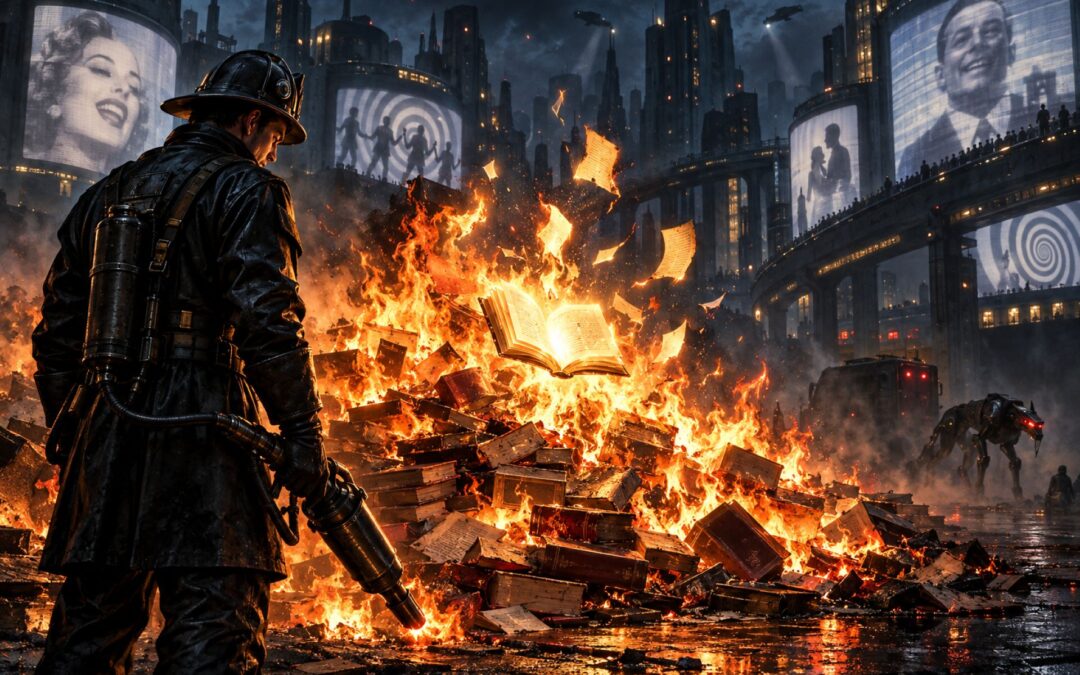
In Ray Bradbury’s Fahrenheit 451, firemen do not extinguish fires. They start them. Their job is to find forbidden books, burn them, and destroy the homes of people who refuse to live without them. Most citizens have stopped questioning this arrangement because they inhabit a society saturated with entertainment, speed, distraction, and the promise of uninterrupted happiness. Reading has become suspicious, serious conversation is unusual, and independent thought is increasingly difficult to sustain.
Published in 1953, Fahrenheit 451 is one of the most influential works of dystopian fiction. Its central character, Guy Montag, begins as a fireman who takes pleasure in burning books. His transformation begins when he meets a young woman whose curiosity forces him to recognize how little he understands his own life. As Montag starts reading the books he once destroyed, he discovers that the institutions he serves are not merely restricting access to literature. They are helping preserve a civilization that has largely forgotten how to think, remember, question, or care.
Bradbury developed the novel from his earlier story The Fireman, expanding its treatment of censorship, intellectual conformity, and the people who challenge Montag’s assumptions. In his account of the novel’s creation, Bradbury described how the story grew from his concerns about cultural repression and the destruction of books. Yet the completed novel reaches beyond government censorship. It portrays a society in which entertainment, commercial pressures, intellectual laziness, fear of disagreement, and institutional violence reinforce one another.
The book’s lasting question is therefore not simply whether people should be allowed to read. It is whether freedom can survive when people lose the desire and ability to use it. Montag’s journey suggests that preserving knowledge requires more than rescuing printed pages: it demands attention, reflection, moral courage, and responsibility for what one learns.
Spoiler warning: This article covers the complete novel, including major character deaths, the destruction of the city, and the ending.

Part One: It Was a Pleasure to Burn
Fahrenheit 451 opens with Guy Montag enjoying his work as a fireman. In this unnamed American city of the future, buildings have long been made fireproof, and the fire department has assumed an entirely different function. Firemen now search for books and destroy them, using kerosene and flamethrowers to burn forbidden literature and the houses where it is hidden.
Montag takes pride in the spectacle. He enjoys the smell of kerosene, the sight of flames consuming paper, and the authority his uniform gives him. His profession has provided him with an identity so complete that he has never seriously examined its moral foundations.
One evening, while walking home from the firehouse, he encounters Clarisse McClellan, a seventeen-year-old girl who has recently moved into the neighborhood. Clarisse is immediately unlike anyone Montag ordinarily meets. She enjoys walking, observing nature, noticing people’s expressions, and asking questions that others regard as unnecessary or uncomfortable.
She talks about the smell of leaves, the appearance of the moon, and the peculiar habits of her family. Instead of remaining inside watching television, her relatives spend evenings talking together. Her uncle remembers a time when people could walk slowly, enjoy conversation, and pay attention to their surroundings without being considered abnormal.
Montag initially finds Clarisse amusing and strange, but her questions disturb him. She wonders whether firemen once put out fires rather than starting them, challenging what he has accepted as official history. More importantly, she asks whether he is happy.
The question unsettles him because he has never thought happiness required examination. He has assumed that his professional satisfaction and comfortable home are sufficient evidence of a successful life. After Clarisse leaves, however, he realizes that his cheerful expression conceals an emptiness he has refused to acknowledge.
Returning home, Montag discovers his wife, Mildred, unconscious after taking an excessive quantity of sleeping pills. He calls for medical assistance, but the people who arrive are technicians rather than doctors. Using specialized machines, they pump the contents of her stomach and replace her blood.
The technicians treat the situation with professional indifference. Cases like Mildred’s are so common that emergency treatment has become routine. They explain that their equipment is designed to handle precisely this kind of problem and soon leave for another appointment.
By morning, Mildred behaves as though nothing serious has occurred. She does not remember taking the pills and dismisses Montag’s attempts to discuss the event. Instead, she returns her attention to the enormous television screens that dominate their home.
These screens are central to Mildred’s existence. She participates in interactive television programs involving fictional characters she calls her family. She wants Montag to buy another television wall so that the room can become an even more immersive environment. The cost would represent a substantial portion of his earnings, but Mildred considers the additional entertainment essential.
Even when the screens are not operating, Mildred frequently wears tiny Seashell radios in her ears. Their constant sounds prevent ordinary conversation and separate her from the immediate world. Montag begins to recognize that he and his wife occupy the same house without sharing a meaningful life.
He becomes particularly troubled when he realizes that neither of them can remember where they first met. A marriage that should contain years of shared experiences seems to have left almost nothing emotionally memorable. Mildred has become so absorbed in artificial relationships that Montag can barely reach her.
His encounters with Clarisse continue over the following days. She asks why people race through the countryside without noticing flowers, animals, or landscapes. She points out that billboards have been lengthened to accommodate motorists traveling too quickly to read ordinary advertisements.
Clarisse also explains why she is considered antisocial at school. Rather than encouraging discussion, her education consists largely of passive instruction, standardized activities, and compulsory social participation. She observes that young people are frequently violent, reckless, and uninterested in genuine relationships.
Her behavior reverses the ordinary meaning of sociability. Clarisse is called antisocial precisely because she wants meaningful human contact, while people who spend their time consuming entertainment or participating in meaningless group activities are regarded as normal.
In one encounter, Clarisse rubs a dandelion against Montag’s chin to see whether he is in love. When the result disappoints her, Montag protests that he must love Mildred because they are married. The apparently childish experiment nevertheless unsettles him. It raises another question that his comfortable routines cannot answer.
At the firehouse, Montag encounters a different source of anxiety: the Mechanical Hound. This eight-legged robotic creature can track human beings through chemical identification and kill them using a needle that injects a powerful substance. The device ordinarily rests in the firehouse, where its artificial movements fascinate the other firemen.
Montag suspects that the Hound dislikes him. When he approaches, it responds threateningly, and he begins to wonder whether someone has programmed it to recognize his scent. Captain Beatty, his superior, dismisses the concern, but Montag’s fear persists.
The Mechanical Hound represents a form of institutional power that no longer requires human judgment. Once given a target, it can pursue and destroy that person without hesitation, compassion, or moral uncertainty. Its hostility also suggests that Montag’s private doubts may already have attracted attention.
Clarisse eventually stops appearing on their usual walking route. Montag notices her absence but receives little explanation until Mildred casually mentions that the girl may have been struck by a speeding car. She adds that the McClellan family has moved away.
The information shocks Montag, partly because Mildred treats the possibility of a young woman’s death as trivial. Clarisse had briefly awakened his curiosity about the world, and now even her disappearance seems to confirm the society’s indifference toward individual lives. The novel does not directly show Clarisse’s death, so her fate remains based on what Mildred reports.
Montag’s growing unease becomes a moral crisis during a fire alarm. The firefighters arrive at a house containing an extensive collection of books, but its elderly owner refuses to leave.
Usually the firemen expect the occupants to surrender or flee while the authorities destroy their possessions. This woman instead insists upon remaining with the books she has devoted her life to collecting. She invokes the words associated with the Protestant martyrs Hugh Latimer and Nicholas Ridley, who were burned for their religious convictions.
While searching the house, Montag finds himself secretly taking a book. The action feels almost involuntary, as though his hand has acted before his conscious mind can approve or reject the decision.
The firefighters prepare to burn the house. They attempt to remove the woman, but she refuses to abandon her library. Rather than submit to their authority, she sets the fire herself and dies with her books.
For Montag, the incident changes everything. He has burned countless books without wondering what they contained, but he cannot understand why someone would choose death rather than live without them. Her sacrifice suggests that literature contains something more important than the meaningless objects he has been trained to destroy.
He returns home carrying both the stolen book and the memory of her death. The smell of kerosene has become unbearable, and the satisfaction he once took in his profession has disappeared. He begins to regard his work not as a public service but as participation in deliberate destruction.
Montag tells Mildred about the woman, hoping she will understand why he is disturbed. Mildred cannot grasp the significance of the event. She is more concerned about Montag missing work and the consequences his absence might have for their household.
Montag also learns more about Clarisse’s reported death. His anxiety intensifies as he recognizes how quickly society erases people who do not fit its expectations.
He refuses to go to the firehouse, claiming illness. Captain Beatty visits him at home, apparently anticipating this crisis. Beatty explains that most firemen occasionally become curious about books, but that curiosity usually disappears once they understand why literature was eliminated.
Beatty then provides an extended history of their society’s transformation.
As technology developed and populations expanded, entertainment became faster, shorter, and simpler. Books were condensed, serious intellectual disagreements became increasingly unwelcome, and people demanded material that would not challenge their assumptions or make them uncomfortable.
According to Beatty, the process did not begin with a single government suddenly outlawing literature. Commercial pressures, mass preferences, and the fear of offending different groups gradually stripped cultural products of complexity. People increasingly wanted immediate pleasure rather than difficult thought.
Books became troublesome because they presented contradictory ideas, demanded intellectual effort, and exposed differences between people. In a society committed to making everyone feel equally satisfied, these differences came to be treated as dangerous.
The firemen’s role was to complete this transformation. By destroying books, they removed a source of uncertainty, conflict, and unhappiness. Beatty presents censorship as a form of social protection, arguing that the public benefits when disturbing ideas are eliminated.
Montag listens, but his experience with the old woman prevents him from accepting the explanation. Beatty’s account describes why a society might reject books, yet it does not explain why their destruction should require terror, humiliation, and death.
After Beatty leaves, Montag reveals a secret to Mildred. He has been stealing books from fires for some time and hiding them inside their home. What happened at the old woman’s house was not his first transgression, although it was the event that made him confront its meaning.
He brings out the hidden collection and asks Mildred to help him read. He proposes that they spend time examining the books before deciding whether to destroy them or keep them.
Mildred is frightened. She understands that possession of the books could expose them to investigation and punishment, and she wants their ordinary life restored. Montag insists that they need to discover why people have valued literature enough to risk their lives for it.
The first part ends with Montag and Mildred beginning to confront the forbidden books. Montag has not yet become knowledgeable or capable of organized resistance. He has simply reached a point where continuing to obey without understanding has become impossible.
Part Two: The Sieve and the Sand
The second part follows Montag’s attempts to turn curiosity into understanding. Having rescued books from destruction, he discovers that reading them is far more difficult than merely possessing them.
Montag and Mildred sit among the volumes he has hidden, but they respond very differently. Mildred is anxious about being caught and impatient to return to her television programs. Montag tries to read with the urgency of someone who believes that the answer to his entire life must be hidden somewhere in the pages.
He is disappointed by how difficult the process feels. The words contain unfamiliar references, conflicting arguments, and ideas he cannot immediately connect to his experience. Although he knows that something important is missing from his life, he cannot yet explain precisely what books might restore.
Mildred’s resistance makes the task more frustrating. She worries that their home and entertainment will be taken away, while Montag struggles to convince her that their apparent security is not worth preserving if it depends upon ignorance.
Montag remembers a man he met in a park approximately a year earlier. The man, Faber, had once been a professor of English literature. During their conversation, Montag suspected that Faber might possess a book, but he had chosen not to report him.
The memory now seems important. Faber appeared to understand literature as something more than an unlawful collection of printed objects, and Montag believes he may be able to explain what the books contain.
Montag telephones Faber and asks whether any copies of the Bible remain. Faber becomes alarmed by the questions and terminates the conversation, fearing that the call may be an attempt to identify or trap him.
Montag nevertheless decides to visit him. He takes a Bible from his collection, hoping that the book will provide both evidence of his sincerity and a reason for Faber to cooperate.
During the journey, Montag attempts to memorize a passage from scripture while riding the subway. An advertisement for Denham’s Dentifrice repeatedly interrupts his concentration, its jingle drowning out the words he is trying to retain.
The scene triggers a childhood memory. As a boy, he had tried to fill a sieve with sand, an impossible task because the grains escaped through the holes as quickly as he poured them in. Now he feels that the contents of books are escaping his mind in the same way.
The title The Sieve and the Sand captures this crisis. Montag wants knowledge immediately, yet his habits of attention have been shaped by a culture that prevents sustained reflection. He has discovered the value of intellectual concentration before developing the ability to practice it.
When Montag arrives at Faber’s home, the former professor initially refuses to trust him. Faber knows that firemen ordinarily destroy books and that an unexpected visitor carrying forbidden literature could bring serious consequences.
Montag eventually convinces him that his confusion is genuine. He explains the death of the old woman, his dissatisfaction with Mildred, and his sense that ordinary life has become hollow.
Faber responds by explaining that the value of books does not lie in paper, printing, or the physical form of the object. Books matter because they can preserve details of human experience, complicated ideas, and uncomfortable truths that simplified entertainment excludes.
He identifies three conditions necessary for meaningful intellectual life.
The first is access to valuable information. Literature can provide the texture and complexity of reality, allowing readers to encounter experiences and perspectives beyond their immediate surroundings. This does not mean that every book is valuable or that truth can appear only in printed form.
The second is leisure. People need uninterrupted time to examine what they encounter, compare ideas, reconsider assumptions, and form judgments. Without reflection, even valuable information remains little more than a temporary sensation.
The third is the freedom to act upon what one learns. Knowledge becomes meaningful when people can use it to change their lives, relationships, and institutions. A society that permits information but prevents people from responding to it has not achieved genuine intellectual freedom.
Faber’s explanation gives Montag a clearer understanding of what his civilization has lost. Its people lack not only books but also the attention necessary to understand complex material and the independence required to act upon it.
Montag wants to begin resisting immediately. He proposes hiding books in the houses of firemen and then reporting those houses to the authorities. If enough firemen become targets of their own institution, perhaps the system will lose public confidence.
Faber doubts the effectiveness and morality of such a plan. The firemen are only one part of a much larger society that has abandoned intellectual independence. Destroying an institution without changing public attitudes might accomplish very little.
Faber also confesses his own failures. He recognized the disappearance of intellectual freedom but did little to resist while meaningful opposition was still possible. His fear and passivity allowed the process to continue.
Although reluctant, he eventually agrees to help Montag. They discuss the possibility of reproducing books, and Faber mentions contacts who might assist with printing. Resistance begins to take shape as a practical problem rather than an expression of personal anger.
Faber gives Montag a small communication device that fits inside his ear. Through it, the professor will be able to hear Montag’s surroundings and speak privately to him. The device allows Faber to guide Montag while remaining physically distant from danger.
Montag returns home, where Mildred is preparing to entertain two friends, Mrs. Phelps and Mrs. Bowles. The women gather around the television screens and begin discussing their lives with disturbing casualness.
Mrs. Phelps refers to her husband’s departure for military service but expresses little concern. War is treated as an ordinary inconvenience, something expected to end quickly and without serious consequences for people like themselves.
Their conversation moves through marriage, children, and politics. The women describe relationships with little emotional depth and discuss political candidates largely according to superficial impressions of their appearances and personalities.
Montag is appalled by their indifference. He sees the conversation as evidence that people have become incapable of considering matters involving human suffering, public responsibility, or genuine feeling.
Faber advises him to remain quiet. The women have not asked for a confrontation, and attacking their beliefs may only reinforce their hostility toward books.
Montag nevertheless becomes increasingly angry. He retrieves a volume of poetry and decides to read aloud, ignoring Mildred’s efforts to dismiss the situation as a harmless joke.
He chooses Matthew Arnold’s “Dover Beach,” a poem that contrasts the beauty of the world with the loss of certainty and the suffering of human beings. Its themes of spiritual emptiness and the need for genuine love echo the novel’s depiction of modern life.
The reading produces a powerful reaction. Mrs. Phelps begins crying, although she cannot fully explain why the poem has affected her. Mrs. Bowles becomes angry and accuses poetry of creating unnecessary misery.
Rather than helping the women understand their emotions, Montag attacks their empty lives and superficial attitudes. The gathering ends badly, with the guests departing in distress.
The scene shows both the power and the limitations of literature. The poem reaches feelings that the women’s ordinary entertainment has kept buried, but Montag’s aggressive presentation prevents the experience from developing into reflection or understanding.
He has begun to appreciate the importance of serious thought without learning how to communicate it responsibly.
Faber rebukes him through the listening device, recognizing that Montag’s behavior may expose them both to danger. Montag also understands that his impulsiveness has damaged whatever possibility existed for meaningful conversation.
He returns to the firehouse, where Captain Beatty appears ready for him. Beatty begins quoting from numerous literary works, using their contradictions to undermine Montag’s confidence in books.
Instead of pretending that literature contains no ideas, Beatty demonstrates that he knows it extremely well. He cites authors against other authors, exposes conflicting conclusions, and presents books as a source of confusion rather than wisdom.
His performance is deliberately overwhelming. Montag, already struggling to interpret what he has read, finds himself unable to answer the contradictions Beatty produces.
Through the hidden communication device, Faber tries to reassure him and provide guidance. Beatty’s attack nevertheless reveals the fragility of Montag’s new convictions: he knows that books matter but has not yet developed the intellectual confidence to explain why.
The confrontation ends when a fire alarm sounds. The firefighters board their vehicle and travel to the reported address.
When they stop, Montag sees that they have arrived outside his own house. His private rebellion has become an official target, and the conflict he hoped to manage through secrecy is about to become unavoidable.
Part Three: Burning Bright
The final part begins with Montag facing the institution he once served. The fire truck has stopped outside his home, and Captain Beatty orders him to confront the consequences of possessing forbidden books.
Mildred emerges carrying a suitcase. Rather than trying to save Montag or discuss what has happened, she hurries toward a waiting taxi. Her attention remains fixed on the destruction of the house and the television family inside it.
Montag realizes that their marriage has already collapsed emotionally. Mildred’s departure merely makes the separation visible. Her most urgent concern is the loss of the artificial environment around which she has organized her life.
Beatty explains that the authorities received reports concerning Montag’s books. Mildred had informed them, and her friends had also contributed to the suspicion surrounding the household.
The captain orders Montag to burn his own home. Instead of being allowed to stand aside while the other firefighters carry out the destruction, he must personally eliminate the possessions that once represented his comfortable existence.
Montag uses the flamethrower to destroy the rooms, furniture, and television walls. The burning of the parlor is particularly significant because the screens had dominated his marriage and symbolized the emotional captivity of his domestic life.
Yet the destruction is not a simple act of liberation. Montag is acting under coercion, and his fury increasingly threatens to overwhelm his judgment. He has lost his home, his marriage, his profession, and the possibility of returning quietly to his former existence.
After the burning, Beatty intends to arrest him. He discovers the communication device in Montag’s ear and realizes that another person has been helping him. Beatty threatens to trace the connection and identify Faber.
The threat pushes Montag into violence. He turns the flamethrower on Beatty and burns him to death.
Montag then confronts the Mechanical Hound. The machine attacks, injecting a substance that temporarily disables part of his leg, but Montag manages to destroy it with the flamethrower.
The two other firemen are incapacitated during the confrontation, leaving Montag able to escape. He is now not merely a suspected reader but a fugitive responsible for killing his commanding officer.
As he flees, Montag begins questioning what has happened. He wonders whether Beatty deliberately provoked his own death, perhaps because the captain could no longer tolerate the contradictions of his existence.
This possibility is never confirmed. It is an interpretation that occurs to Montag after the killing, not an established explanation of Beatty’s motives.
Montag’s flight through the city becomes increasingly desperate. The effects of the Hound’s attack make movement painful, and he must avoid being discovered by the authorities.
At one point, a car filled with reckless young people nearly strikes him. He escapes by falling out of its path, but the experience reminds him of Clarisse’s reported death.
The encounter connects the society’s casual recreational violence with the systematic violence of the fire department. Ordinary citizens have become so detached from the value of human life that attempting to hit pedestrians can become an amusement.
Montag still has books with him, and his anger drives him toward another questionable act. He enters the home of Black, a fellow fireman, and hides books there before reporting their presence to the authorities.
The action imitates the system he has come to oppose. By manufacturing evidence against another household, Montag uses the machinery of persecution to punish someone associated with his former profession.
His rebellion has therefore not yet become a consistently ethical alternative to the society’s cruelty. He has rejected its ideology while retaining some of its methods.
Montag eventually reaches Faber’s house and explains what has happened. Faber understands that the authorities will be searching for him and that remaining in the city is too dangerous.
The professor helps Montag prepare for escape, attempting to reduce the traces that might allow the Mechanical Hound to follow him. He also describes his own intention to travel toward St. Louis, where he hopes to contact a former printer.
Faber instructs Montag to reach the river and follow the abandoned railway tracks into the countryside. The route offers a chance to escape the city and perhaps encounter people who still preserve forbidden knowledge.
Montag leaves, while Faber prepares to abandon the safety of his home and take a more active role in preserving literature. Their separation marks the end of their immediate partnership but not necessarily the end of Faber’s efforts.
Meanwhile, the authorities transform Montag’s escape into a televised spectacle. Helicopters, search teams, cameras, and another Mechanical Hound are mobilized to pursue him.
The chase becomes public entertainment, with viewers encouraged to participate by watching for the fugitive. The state turns a serious act of violence and resistance into another program designed to hold the population’s attention.
Montag reaches the river and enters the water. Floating downstream allows him to evade the Hound’s pursuit and remove himself from the immediate reach of the city.
His experience in the river differs sharply from everything that has preceded it. Instead of artificial light, advertisements, engines, and mechanical voices, he encounters darkness, moving water, natural sounds, and the open sky.
For the first time, he begins to experience the natural world without immediately translating it into something to control or destroy. The movement of the river also gives him time to reflect upon the events that have transformed his life.
After leaving the water, Montag follows the abandoned railway line through the countryside. The tracks suggest a connection to an older civilization whose neglected routes may still lead toward surviving forms of knowledge.
Eventually, he sees a small fire and encounters a group of men gathered around it. Their leader, Granger, welcomes him and reveals that they have been watching the televised pursuit.
The authorities are about to complete the broadcast, but the group knows something the audience does not. Montag has escaped, and the police cannot allow the public spectacle to end without a successful capture.
Rather than admit failure, the authorities identify another man walking alone and present him as Montag. The Mechanical Hound kills the stranger while the television broadcast declares the fugitive dead.
The public receives the conclusion it has been trained to expect. The state preserves its appearance of omnipotence by sacrificing an innocent person and replacing reality with a convincing televised narrative.
For Montag, the incident confirms how thoroughly the society manipulates information. The audience is not merely denied the truth; it is given an emotionally satisfying substitute.
Granger introduces Montag to the men in his group. They appear to be ordinary wanderers, but each has committed important literary or philosophical works to memory.
Some preserve individual books, while others have memorized portions of larger texts. Their knowledge includes religious writings, philosophy, literature, and the intellectual traditions of different civilizations.
The men explain that they do not necessarily keep physical books because doing so would expose them to immediate detection. Instead, they have become living repositories of the works they hope future generations may recover.
Their identities are linked to what they remember. A person who has memorized Plato or another author can help preserve that writer’s work even if all available printed copies disappear.
This preservation project is fragile. Human memory is imperfect, individuals can die, and the survival of ideas depends upon communication between generations. Granger and his companions nevertheless believe that maintaining the possibility of cultural recovery is worth the effort.
Montag realizes that he remembers passages from the Bible, including material from Ecclesiastes and Revelation. What earlier seemed impossible during his desperate attempt to memorize scripture has become part of his potential contribution.
Granger’s group does not expect to overthrow the authorities immediately. Its members are waiting for conditions under which their knowledge may again become useful. They understand themselves as preserving possibilities rather than achieving a complete victory.
Their conversation is interrupted by the war that has been approaching throughout the novel.
Aircraft pass overhead, and the city is suddenly destroyed in a devastating attack. The speed of the catastrophe contrasts with the slow, often unnoticed cultural decline that made the society vulnerable.
Montag survives in the countryside with Granger’s group. He imagines Mildred facing the final moments of destruction, perhaps still separated from reality by the television world. The narrative does not independently establish the precise fate of every person he has known.
The city’s destruction forces Montag to consider what has been lost. The catastrophe has killed countless people, including many who had never understood the conditions governing their lives.
Granger responds by recalling his grandfather, a man who built things, worked with his hands, and left tangible evidence of care for other people. He explains that a person’s importance can be measured partly by what that person contributes to the world beyond himself.
The memory provides a different standard of achievement from the one that governed Montag’s former life. Burning books produced spectacular destruction, but Granger’s grandfather created objects and relationships that continued to matter after his death.
Granger also introduces the image of the phoenix, the mythical bird that is consumed by fire and then rises again from its ashes.
He compares humanity to the phoenix because civilizations repeatedly destroy themselves and attempt to begin again. Yet the comparison is not entirely reassuring. Human beings possess the possibility of remembering their mistakes, which means they might eventually escape the cycle.
The group decides to return toward the ruined city and help the survivors rebuild. They cannot restore the dead or reverse the destruction, but they may be able to contribute something different to whatever comes next.
As they walk, Montag remembers passages from Ecclesiastes about the changing seasons of human life and from Revelation about healing. The biblical language brings together destruction, renewal, memory, and responsibility.
The novel ends without showing the reconstruction of civilization. Montag has moved from burning books to preserving their contents, but the future remains uncertain.
What has changed is his understanding of the task ahead. He no longer seeks knowledge merely to escape his own unhappiness. He has begun to recognize that knowledge matters because of what people might responsibly create with it.
The World of Fahrenheit 451: Institutions, Technology, and Everyday Life
Bradbury’s dystopia is built around a society that has reorganized everyday life to minimize reflection and discomfort. Its institutions do not simply forbid particular opinions. They create an environment in which sustained intellectual activity becomes unusual, socially inconvenient, and eventually dangerous.
The most visible institution is the fire department. Because buildings are supposedly fireproof, firemen have become agents of destruction rather than protection. Their uniforms, vehicles, alarms, and professional routines preserve the familiar appearance of public service while reversing its purpose.
This reversal helps normalize their authority. Montag initially identifies so completely with the fire department that he cannot imagine its procedures being illegitimate. The institution has supplied not merely his employment but also his understanding of history, citizenship, and duty.
Book prohibition is enforced through searches, denunciations, property destruction, and intimidation. Ordinary people can inform on neighbors or relatives, while the threat of losing one’s home discourages anyone from preserving literature.
The Mechanical Hound gives the system a particularly frightening instrument. Programmed to track specific chemical characteristics, it combines surveillance, identification, pursuit, and punishment in a machine that cannot question its instructions.
Yet the Hound’s existence does not mean every citizen is under continuous visible control. The more effective mechanism is that most people accept the surrounding order as normal. Individuals who challenge it can be isolated socially long before the state intervenes directly.
Education reinforces these conditions. Clarisse describes schools that emphasize activity, rapid instruction, conformity, and social adjustment rather than dialogue and independent judgment. Her desire to ask questions makes her suspicious in an environment where thinking critically is treated as a behavioral problem.
Popular culture further limits opportunities for reflection. Immersive television, constant audio entertainment, and aggressive advertising occupy the senses almost continuously. People are encouraged to react immediately rather than examine what they encounter.
The physical environment reflects the same preference for speed. Motorists travel too quickly to appreciate the countryside, and outdoor advertisements are designed for brief, rapid consumption. Ordinary walking and observation become signs of eccentricity.
Domestic life is similarly transformed. Mildred’s parlor is organized around its television walls, while her marriage lacks the attention necessary for genuine intimacy. The technologies that supposedly connect her to other people instead deepen her separation from those physically present.
Politics continues to exist, but public engagement appears superficial. Mildred’s friends discuss political candidates according to appearance and charm rather than policies or consequences, suggesting a culture in which democratic judgment has been reduced to impressions.
War forms another constant background pressure. Military aircraft pass overhead, preparations for conflict are common, and citizens appear remarkably detached from the possibility of mass destruction. The state’s ability to dominate attention does not guarantee its ability to protect society from catastrophe.
Bradbury does not provide a detailed history of the country’s government, economy, or constitutional arrangements. Nor does he fully explain how every institution became subordinate to the firemen’s ideology. His world is constructed selectively to expose the relationship between intellectual surrender and coercive power.
That selectivity gives the setting its clarity but also limits its political realism. Fahrenheit 451 functions more convincingly as a concentrated warning about social and institutional tendencies than as a comprehensive prediction of how a particular future government would operate.
Guy Montag and the People Who Change Him
The characters in Fahrenheit 451 represent different responses to a society that discourages reflection, but their significance cannot be reduced entirely to symbols. Montag’s relationships reveal competing models of happiness, authority, intellectual freedom, and human responsibility.
Clarisse teaches him to notice his own experience, Mildred exposes the emptiness of his domestic life, Beatty defends the institution he serves, Faber explains what knowledge requires, and Granger offers a constructive alternative to destruction. The secondary figures deepen these contrasts: the old woman demonstrates conviction through sacrifice, Mildred’s friends reveal the costs of emotional avoidance, and the other firemen show the ease with which institutional violence becomes routine.
Guy Montag: Awakening, Anger, and Responsibility
Guy Montag begins as someone whose identity depends upon obedience. His satisfaction comes from performing his work efficiently and enjoying the authority granted to him by the fire department. He has accepted the institution’s account of history without asking whether it is true.
Clarisse’s questions disturb him because they demand self-examination rather than immediate compliance. When she asks whether he is happy, she exposes the difference between an emotion he claims to possess and an experience he has never consciously evaluated.
Mildred’s overdose deepens that uncertainty. Montag’s comfortable home contains a marriage so emotionally empty that his wife’s near-death experience becomes almost impossible to discuss. His private dissatisfaction begins to appear connected to the wider social order rather than merely to a failed relationship.
The old woman’s death produces the decisive moral rupture. Montag can no longer regard book burning as the destruction of meaningless objects. He has witnessed a human being treat literature as something worth dying for, and the discrepancy between her conviction and his profession becomes unbearable.
His initial response is confused and impatient. He steals books but does not understand them, seeks Faber’s help without knowing what assistance he needs, and imagines drastic political action before considering its consequences.
This immaturity is visible in the scene with Mildred’s friends. Montag rightly recognizes their indifference toward suffering and public responsibility, but he attempts to force awareness upon them through humiliation and emotional shock. Their distress becomes evidence of his failure to communicate rather than proof of his intellectual superiority.
His violence creates an even more serious contradiction. Killing Beatty may be understandable in the context of coercion and the threat to Faber, but it does not become morally uncomplicated because Montag is opposing a repressive institution. Planting books in Black’s house is more clearly retaliatory, reproducing the same machinery of denunciation that victimized Montag.
His development therefore involves recognizing more than the injustice of censorship. He must learn the difference between possessing knowledge, reacting angrily to injustice, and acting constructively on what he understands.
The river and Granger’s community provide the conditions for this later transformation. Montag begins listening rather than demanding immediate answers, and he discovers a form of resistance based on preservation and responsibility rather than spectacular confrontation.
By the end, he is not presented as a fully enlightened hero. He is a damaged survivor who has begun to understand that intellectual freedom must serve something beyond his personal need for meaning.
Clarisse McClellan: Curiosity and the Lost Art of Attention
Clarisse McClellan appears only during the opening portion of the novel, yet her influence shapes everything that follows. She does not attempt to persuade Montag through formal arguments about censorship or political freedom. Instead, she asks questions that reveal how little attention he pays to his surroundings and feelings.
Her curiosity is practical and sensory. She observes leaves, flowers, weather, conversations, and ordinary human behavior, demonstrating an openness that the wider society regards as strange.
Clarisse’s family provides an alternative model of social life. Its members gather to talk, exchange memories, and question accepted customs. Their apparent eccentricity suggests that meaningful connection has become so uncommon that it is treated almost as a threat.
Her conversations expose Montag’s emotional condition before he possesses the vocabulary to describe it. She notices that he laughs too quickly, answers without thinking, and appears to accept happiness as something automatically provided by his circumstances.
Clarisse also challenges official history by mentioning that firemen once extinguished fires. Her questions show that recovering freedom begins with examining what society presents as obvious.
Her reported death is important precisely because she never becomes part of an organized resistance. She demonstrates how an independent, observant individual can be endangered by a culture that values speed, conformity, and indifference.
As a character, however, Clarisse is also idealized. She represents curiosity, attentiveness, and human warmth so consistently that the novel gives her relatively little psychological contradiction. Her importance lies chiefly in the transformation she provokes rather than in an extensive independent story.
Mildred Montag: Entertainment, Denial, and Failed Intimacy
Mildred represents the emotional consequences of a society organized around distraction. She appears to have access to everything her culture promises will produce happiness: entertainment, comfort, consumer technology, and freedom from difficult intellectual responsibilities.
Yet her overdose suggests that these conditions have not created genuine contentment. Her subsequent refusal or inability to remember the incident prevents a clear explanation of her state of mind, but it makes the contradiction between apparent happiness and private distress impossible to ignore.
Her television family has become more emotionally important than the people around her. She devotes attention and resources to fictional relationships while showing little curiosity about her husband’s experiences or the consequences of his changing beliefs.
The failure of their marriage is especially visible in their inability to remember their first meeting. Their shared life has become a collection of routines without the emotional attention necessary to make those experiences meaningful.
Mildred’s dependence on entertainment also shapes her moral choices. She fears losing the house and television screens more than she fears Montag’s intellectual or emotional collapse. When his books threaten her security, she reports him to the authorities.
Her betrayal can be read as cowardice and complicity, but it also reflects the way the society has trained her to understand danger. Books represent punishment, disruption, and the loss of everything she has been taught to value.
Bradbury gives Mildred moments of distress but limited opportunities for sustained self-examination. She is convincing as a representation of alienated domestic life, though less fully developed as an individual whose past, desires, and contradictions exist independently of Montag’s awakening.
Captain Beatty: Learning, Contradiction, and Control
Captain Beatty is the novel’s most intellectually complex defender of censorship. Unlike Mildred and most ordinary citizens, he possesses extensive knowledge of literature and can use quotations with remarkable confidence.
His familiarity with books makes him more dangerous rather than more tolerant. He understands that literature contains contradictions, competing interpretations, disturbing ideas, and challenges to social consensus. He uses these characteristics to justify eliminating it.
Beatty’s explanation of censorship is sophisticated because it does not depend entirely upon a crude picture of government oppression. He argues that the public gradually abandoned complexity and that the authorities fulfilled a demand for intellectual comfort.
There is an element of plausibility in his argument. Popular entertainment can encourage simplification, and people sometimes avoid information that challenges their beliefs. Yet Beatty converts these observations into a justification for systematic coercion.
His treatment of Montag reveals his mastery of psychological pressure. He recognizes the younger fireman’s uncertainty and overwhelms him with the very literary knowledge Montag is attempting to acquire.
By quoting contradictory authors, Beatty suggests that books cannot guide anyone toward truth because they disagree. The argument confuses intellectual difficulty with intellectual worthlessness. Contradiction may require judgment, but it does not demonstrate that judgment is unnecessary or impossible.
Beatty’s own position is deeply contradictory. He has the education required to understand literature but directs his abilities toward eliminating the conditions under which others might acquire similar knowledge.
His death introduces a final ambiguity. Montag speculates that Beatty may have deliberately provoked him because he no longer wished to live. The possibility fits the character’s bitterness, but the novel does not conclusively establish such a motive.
Beatty remains disturbing because intellectual sophistication has not made him humane. His character disproves the simplistic assumption that knowledge automatically produces virtue.
Faber and Granger: Two Models of Intellectual Resistance
Faber and Granger offer different responses to the disappearance of intellectual freedom. Both value books, but they differ in their willingness to act and in the forms of resistance they consider possible.
Faber is a former professor who understands the significance of literature but has retreated into fear. He recognizes that he failed to defend intellectual life while opposition might still have been effective.
His explanation of meaningful information, leisure, and the freedom to act supplies the novel’s clearest theory of why books matter. Yet his own life demonstrates the problem with knowledge that remains passive. He understands the danger but has avoided confronting it.
Montag’s arrival forces him to reconsider that failure. By developing the communication device, assisting Montag, and planning contact with a printer, Faber begins moving from private regret toward practical action.
Nevertheless, he is not presented as a fearless revolutionary. His caution is often sensible, especially when Montag proposes reckless schemes that could endanger others without weakening the larger system.
Granger represents a more patient and communal response. Rather than preserving books as forbidden possessions or attacking individual firemen, his group distributes knowledge across human memory and waits for the possibility of renewal.
The group’s members cooperate without requiring a single heroic leader. Their intellectual identities depend upon what they preserve for others, not upon public recognition or individual status.
Granger’s recollection of his grandfather gives this philosophy an ethical foundation. A meaningful life leaves something valuable behind, whether through books, craftsmanship, relationships, or acts of care.
The contrast between Faber and Granger is not absolute. Faber provides the conceptual foundations for meaningful learning, while Granger demonstrates a social practice that may sustain it. Together, they show that intellectual resistance requires both understanding and collective responsibility.
Their methods remain uncertain. Memorized books can be forgotten, and preserving literature does not guarantee that future societies will use it wisely. Yet their work offers a constructive alternative to the destructive institutions Montag has abandoned.
How Censorship Takes Hold
The censorship system in Fahrenheit 451 is more complicated than a government suddenly deciding to prohibit books. Captain Beatty describes a gradual transformation in which public preferences, commercial incentives, educational changes, and social anxieties create an environment increasingly hostile to serious thought.
According to his explanation, cultural material became shorter and simpler as entertainment industries competed for attention. Complex ideas were reduced to summaries, difficult subjects were avoided, and intellectual effort came to seem unnecessary.
At the same time, disagreement became undesirable. People who encountered offensive, unsettling, or contradictory ideas increasingly demanded their removal. Beatty describes the multiplication of objections as a reason literature gradually lost its complexity.
Eventually, censorship became an organized institutional function. Firemen enforced the disappearance of books through searches, threats, and destruction, converting a cultural preference for comfort into a system of coercive power.
This progression distinguishes Fahrenheit 451 from dystopias that explain oppression entirely through the ambitions of an authoritarian ruler. Bradbury suggests that citizens can participate in creating the conditions of their own intellectual subordination.
In a 2007 interview about the novel’s interpretation, Bradbury emphasized that television and declining interest in literature were central to his concerns. He objected to treating the work exclusively as a warning about government censorship.
His explanation highlights an essential part of the novel, but it does not eliminate the importance of state violence. The narrative repeatedly shows that the authorities use surveillance, public intimidation, and lethal force to maintain their control.
Cultural disinterest and coercion therefore reinforce one another. As fewer people value books, resistance to their destruction weakens. As the state makes reading dangerous, opportunities to rediscover their value diminish.
Beatty’s account also requires skepticism because he is not a neutral historian. He leads the institution responsible for repression and has every reason to portray censorship as the natural result of public demands rather than an abuse of authority.
His claims about equality are especially troubling. He suggests that suppressing intellectual differences makes people happier because no one must confront the possibility that another person possesses greater knowledge or ability.
This argument substitutes sameness for equality. A society can seek equal dignity and opportunity without requiring intellectual uniformity, and the existence of disagreement does not establish that disagreement must be abolished.
The novel’s most persuasive insight is that censorship becomes easier when people have already lost the habits necessary to recognize its consequences. Its weaker implication is that the desire for comfort or social harmony can, by itself, adequately explain the disappearance of intellectual freedom.
Real systems of repression involve institutions, incentives, ideologies, and conflicts that Beatty’s simplified history does not fully represent. Bradbury’s purpose, however, is less to provide a comprehensive political theory than to show how the surrender of intellectual independence can make coercion appear normal.
Entertainment, Happiness, and Human Isolation
Entertainment in Fahrenheit 451 is not merely a collection of harmless diversions. It has become the organizing principle of social life, shaping how people spend their time, understand relationships, experience emotions, and respond to public events.
Mildred’s television walls provide the clearest example. Their immersive programs encourage her to regard fictional characters as family members while neglecting her actual husband. She experiences the appearance of participation without the reciprocal obligations of a genuine relationship.
Her Seashell radios extend the process beyond the television room. Continuous audio stimulation follows her into bed, replacing conversation and silence with artificial companionship.
The effect is not simply that Mildred spends too much time using technology. Her entertainment prevents her from facing difficult emotions, including the despair suggested by her overdose and the emptiness of her marriage.
The technicians who treat her reveal how normalized this suffering has become. They possess equipment capable of managing the immediate physical emergency, but neither their procedures nor the surrounding culture creates a meaningful opportunity to examine its causes.
Montag’s inability to remember where he first met Mildred demonstrates another consequence. Their lives have been filled with stimulation but emptied of the sustained attention through which experiences become personally significant.
The conversation with Mrs. Phelps and Mrs. Bowles extends this criticism into social and political life. Their indifference toward war and their superficial discussion of elections show how the pursuit of effortless amusement can undermine collective judgment.
Their reactions to “Dover Beach” reveal that emotional experience has not disappeared completely. Mrs. Phelps cries because the poem reaches feelings she cannot readily articulate, while Mrs. Bowles reacts angrily because the experience disrupts her sense of security.
The problem is not that these characters lack the capacity to feel. They have become accustomed to environments that discourage them from understanding or dwelling upon their feelings.
Clarisse offers the most direct contrast. Her pleasures are simple: walking, observing nature, talking with relatives, and listening carefully to other people. She demonstrates that a meaningful life need not depend upon constant excitement.
Her family also provides a different model of companionship. Its members create relationships through attention and conversation rather than simulated participation.
The novel’s criticism is therefore more precise than a blanket rejection of technology. Faber uses a technological device to assist Montag, showing that tools can support intellectual freedom as well as restrict it.
What Bradbury questions is a culture that substitutes stimulation for understanding and convenience for genuine human engagement. The danger arises when entertainment becomes so dominant that people no longer possess the time, inclination, or emotional resilience to confront reality.
Books, Knowledge, Memory, and the Freedom to Act
Although Fahrenheit 451 is famous for depicting the destruction of books, its deeper argument concerns the relationship between information, understanding, and moral action. Bradbury repeatedly challenges the assumption that printed literature automatically makes people wise.
Faber’s explanation provides the central framework. He argues that meaningful intellectual life requires valuable information, enough leisure to examine it, and the freedom to act upon what one learns.
The first condition concerns the quality of experience preserved in books. Literature can capture conflicting perspectives, difficult emotions, complex ideas, and details of human existence that simplified entertainment tends to remove.
This does not mean that books possess a magical quality unavailable to other media. Faber explicitly suggests that what matters is the substance they can preserve, not the physical object itself.
The second condition is sustained reflection. Montag’s experience on the subway illustrates what happens when people encounter valuable information without the attention necessary to absorb it.
He tries desperately to memorize scripture, but advertisements repeatedly interrupt him. His struggle resembles the childhood attempt to hold sand in a sieve: information passes through his mind without becoming meaningful knowledge.
His impatience also exposes a broader misunderstanding. He initially expects books to provide immediate solutions to his unhappiness, as though reading were another product capable of delivering satisfaction on demand.
Faber instead describes learning as a process requiring time, uncertainty, reconsideration, and effort. Difficult ideas do not become worthless because they resist instant comprehension.
The third condition is the freedom to act. A person who understands injustice but is prevented from responding remains intellectually constrained, even if books are technically available.
Faber’s own life demonstrates another limitation. He possesses knowledge and understands the dangers of his society, but fear has kept him from acting upon his convictions.
Beatty provides the opposite warning. He knows literature well enough to manipulate it, yet his knowledge serves repression rather than liberation. Intelligence and education do not guarantee ethical judgment.
The old woman’s sacrifice introduces a different possibility: literature may help people develop convictions strong enough to resist coercion. Her willingness to die with her books forces Montag to recognize that reading can matter beyond entertainment or private comfort.
Yet the scene does not establish that every sacrifice for a belief is justified. Its importance lies in the contrast between her seriousness and the habitual indifference of the firemen.
Granger’s group extends the argument from individual learning to cultural memory. By memorizing literary works, its members preserve knowledge for people who may live after the oppressive system disappears.
Their project also reveals that books are valuable partly because human beings can transmit meaning across generations. The physical destruction of libraries need not eliminate every idea they contain, provided people retain the commitment and capacity to remember.
The novel ultimately moves beyond the defense of books as possessions. Knowledge becomes valuable when it is understood, preserved, questioned, and used responsibly in the world.
Violence, War, and the Failure to Care
Violence permeates the world of Fahrenheit 451, appearing in both extraordinary acts of state repression and ordinary recreational behavior. The novel portrays these forms of violence as connected by a weakening concern for human life.
The Mechanical Hound embodies organized violence stripped of conscience. Its ability to identify, pursue, and kill people is treated as a technical achievement rather than an ethical problem.
The firemen similarly transform destruction into professional routine. Their work has recognizable procedures and institutional legitimacy, which allows Montag to participate without initially confronting the suffering involved.
The old woman’s death destroys that separation between professional duty and human consequences. By refusing to leave her books, she forces the firefighters to witness the moral reality of an occupation they have learned to regard as ordinary.
Outside official institutions, citizens exhibit comparable indifference. Clarisse describes reckless driving and violent behavior among her peers, while Montag later narrowly escapes being struck by teenagers using a car as an instrument of amusement.
The possible connection between Clarisse’s disappearance and such behavior makes recreational violence more than a background detail. A society that discourages attention and empathy has difficulty recognizing other people as vulnerable individuals.
The response to Mildred’s overdose reveals a quieter version of the same problem. The technicians are capable of preserving her life, but their indifference suggests that restoring physical functioning has replaced concern for emotional suffering.
War provides the largest expression of this moral failure. The city continues pursuing entertainment while military conflict approaches, and ordinary citizens show little interest in examining the possible consequences.
The final bombing exposes the fragility of a civilization that has tried to insulate itself from discomfort. Neither constant stimulation nor institutional control can prevent catastrophic destruction.
Montag is not exempt from the moral problems he recognizes. He kills Beatty, damages others during his escape, and deliberately plants books in another fireman’s house. His awareness of injustice develops faster than his capacity for responsible action.
That contradiction prevents the novel from becoming a simple celebration of rebellion. Rejecting an oppressive system is necessary, but it does not automatically eliminate the habits of violence acquired within it.
Granger’s recollection of his grandfather offers a different standard. Rather than measuring life through power or destruction, he emphasizes what a person creates and leaves behind for others.
The novel’s ethical movement therefore runs from indifference and destruction toward attention and contribution. Its hope depends not merely upon surviving violence but upon learning to organize human life around something more constructive.
Fire, the Mechanical Hound, and Other Symbols
Fire is the novel’s central symbol, but its meaning changes substantially from beginning to end. At first, Montag experiences it as pleasure, power, and professional identity. Burning books allows him to participate in a spectacle that appears to demonstrate the authority of his civilization.
Fire also represents the enforced disappearance of memory. When the firemen burn a house, they destroy more than printed objects. They eliminate evidence of independent thought, personal conviction, and alternative understandings of the world.
The old woman’s death transforms this imagery. She uses fire herself, turning the state’s preferred instrument of intimidation into an expression of refusal. Her sacrifice reveals that destruction cannot automatically control the meaning people attach to their lives.
Later, Montag uses a flamethrower to destroy his own home and kill Beatty. These acts combine coercion, revenge, desperation, and liberation, making fire morally unstable rather than simply good or evil.
When Montag encounters Granger’s group, he discovers another kind of fire. The men gather around a small campfire that provides warmth, companionship, and light rather than destruction.
This change is especially important because the element itself has not changed. What changes is the human purpose governing its use. Fire can destroy knowledge, but it can also sustain a community that preserves it.
The salamander, associated with the firemen’s insignia and equipment, draws upon the traditional belief that the creature could survive flames. It reflects the firefighters’ apparent intimacy with an element that destroys the possessions and lives of others.
The phoenix appears both within the firemen’s symbolic world and in Granger’s final reflections. In mythology, the bird rises again after being consumed by fire, making it an image of destruction and renewal.
Granger complicates the metaphor by observing that humanity repeatedly destroys itself but has the capacity to remember previous catastrophes. Unlike a bird following a mythical cycle, human beings might eventually learn enough to avoid repeating the same mistakes.
The Mechanical Hound represents a different relationship between humanity and technology. Its animal form imitates life, but its behavior follows programming rather than instinct, empathy, or judgment.
As an instrument of surveillance and punishment, it converts living human beings into targets identified through chemical characteristics. Its apparent hostility toward Montag reinforces the sense that the state’s machinery can threaten individuals even before their opposition becomes public.
The Hound also contrasts with the natural world that Montag gradually rediscovers. Mechanical movement and programmed pursuit dominate the city, while animals, plants, and natural sounds become associated with experiences beyond institutional control.
The sieve and sand symbolize Montag’s early difficulty understanding literature. His attempt to force information into an unprepared mind fails because meaningful learning requires sustained attention rather than urgent accumulation.
The image also captures the relationship between culture and memory. A society that constantly interrupts thought may possess enormous quantities of information while retaining very little of its meaning.
Water becomes important during Montag’s escape. Entering the river separates him physically from the city, disrupts the Hound’s pursuit, and provides an environment in which he can begin reflecting without continuous artificial stimulation.
The river suggests purification and transition, but it does not erase Montag’s responsibility for his earlier actions. Its importance lies in creating the possibility of change rather than granting immediate innocence.
Mirrors appear in Granger’s reflections about what a rebuilt society might need. Their significance is connected to self-examination: people must learn to recognize themselves clearly rather than hide behind comforting images.
This idea returns to Clarisse’s earliest questions. She forces Montag to examine his happiness, while Granger suggests that entire civilizations may need a comparable capacity for self-recognition.
The television walls provide an opposing image. They surround viewers with artificial experiences that appear intimate but often prevent genuine self-awareness or human connection.
Bradbury’s symbols are powerful because they recur in changing circumstances. Fire begins as a source of pleasure and authority but eventually becomes associated with community and renewal. Water begins as an escape route but also creates the conditions for reflection.
The symbols do not operate as a rigid code in which every object has only one meaning. Their significance emerges from the characters’ changing relationships to the world and from the contrast between destructive and constructive uses of human power.
Poems, Biblical Images, and Literary Allusions
Literary and religious allusions serve several purposes in Fahrenheit 451. They connect the fictional society to older traditions of thought, reveal how language can preserve experience, and demonstrate the difference between understanding literature and merely possessing its words.
The elderly woman’s reference to Hugh Latimer and Nicholas Ridley is among the most significant historical allusions. The two Protestant reformers were burned in the sixteenth century for their religious beliefs, and the woman’s invocation of their martyrdom places her own sacrifice within a history of resistance to coercion.
The reference establishes that book burning is not simply an imagined future practice. It recalls earlier conflicts over who may possess, interpret, and defend ideas.
Montag does not initially understand the historical meaning of the woman’s words. Their significance emerges gradually as he attempts to discover why literature inspires such conviction.
Matthew Arnold’s “Dover Beach” occupies a different position in the story. The poem confronts the loss of certainty and the vulnerability of human relationships in a world that no longer offers stable consolation.
When Montag reads it to Mildred’s friends, its emotional force breaks through their habitual detachment. Mrs. Phelps begins crying, suggesting that serious literature can awaken feelings a culture of constant entertainment has encouraged people to suppress.
The episode also exposes the limitations of literature when removed from a context of understanding. Montag uses the poem impulsively, and the women’s emotional reactions do not develop into meaningful conversation.
Beatty’s literary quotations present another contradiction. He is familiar with many authors but uses their words to ridicule knowledge and intimidate Montag.
His performances demonstrate that quotation is not equivalent to understanding. Literary fragments can be selected, distorted, and arranged to support almost any conclusion when the speaker has no commitment to intellectual honesty.
Biblical language appears throughout Montag’s movement toward understanding. His attempt to memorize scripture on the subway reveals the difficulty of concentration in a society dominated by interruption.
Near the ending, Ecclesiastes provides language about the seasons of human existence, while Revelation introduces the image of healing after devastation. These references give Montag a vocabulary for understanding loss, renewal, and the responsibility of rebuilding.
The final religious imagery does not establish that the survivors have achieved redemption. It expresses the possibility that humanity might respond differently to suffering if it preserves memory and learns from the past.
The book-preservers extend the significance of allusion beyond a few recognized works. By carrying literature and philosophy in memory, they embody the idea that civilization depends upon a continuing conversation between generations.
Bradbury’s literary references therefore serve two opposing functions. Used honestly, they preserve complex experiences and make reflection possible. Used manipulatively, as Beatty demonstrates, they can become instruments of confusion and control.
Bradbury’s Style, Structure, and Narrative Perspective
Bradbury writes Fahrenheit 451 in a close third-person perspective that follows Montag’s perceptions and changing understanding. Readers generally discover the society through his experiences rather than through a detached explanation of its institutions.
This perspective makes the opening particularly effective. Montag initially sees fire as beautiful and satisfying because his identity has been shaped by the profession. As his doubts develop, the same sights and smells become associated with fear, guilt, and destruction.
The narrative therefore allows the reader’s experience of the world to change alongside the protagonist’s. Information that seemed ordinary at first gradually acquires threatening implications.
Bradbury’s prose is intensely figurative. He repeatedly compares machines, buildings, natural objects, and human bodies through vivid images that make ordinary scenes feel strange or menacing.
The Mechanical Hound becomes frightening not simply because it is dangerous, but because its metallic behavior imitates animal life without possessing the qualities normally associated with living creatures.
The television rooms similarly become environments that seem to swallow their occupants. Their visual and auditory intensity creates an impression of artificial life that overwhelms quieter human experiences.
Bradbury often uses dense sensory description to contrast different settings. The city is filled with artificial light, noise, speed, and manufactured stimulation, while the countryside offers water, darkness, stars, vegetation, and natural sounds.
These contrasts are more than decorative. They reinforce the book’s concern with attention by making the reader notice differences that Montag has been trained to ignore.
Dialogue is frequently argumentative and theatrical. Beatty delivers extended explanations of society, Faber offers concentrated philosophical observations, and Clarisse asks questions designed to unsettle apparently obvious assumptions.
This approach gives the novel intellectual clarity, although it sometimes makes characters sound like representatives of ideas rather than people engaged in spontaneous conversation.
The three-part structure closely follows Montag’s development. It Was a Pleasure to Burn exposes the failure of his former values and produces his first conscious rebellion.
The Sieve and the Sand examines the difficulty of transforming curiosity into understanding. Montag discovers that rejecting ignorance is not the same as possessing knowledge or the wisdom to use it.
Burning Bright brings his conflict with the authorities to a violent climax and then moves beyond confrontation toward survival, preservation, and the possibility of reconstruction.
The titles themselves reflect the novel’s larger symbolic progression. Fire begins as professional pleasure, while the sieve and sand represent intellectual frustration. The final return to burning connects the destruction of Montag’s former life with the broader destruction and possible renewal of civilization.
The pacing accelerates substantially in the final part. Early conversations allow Montag’s doubts to accumulate, while the burning of his house, the killing of Beatty, and the pursuit through the city occur in rapid succession.
This acceleration produces suspense and gives the novel a powerful narrative climax. It also compresses some developments that might have benefited from greater psychological or political elaboration.
Bradbury’s style is best understood as lyrical and allegorical rather than narrowly realistic. His images and dramatic contrasts are designed to communicate emotional and intellectual experience with unusual intensity.
The resulting prose is often memorable, although its density and theatricality may feel excessive to readers who prefer restrained description and psychologically naturalistic dialogue.
The Ending Explained: Destruction and the Possibility of Renewal
The ending of Fahrenheit 451 combines personal transformation with collective catastrophe. Montag escapes the city and finds people committed to preserving literature, but the society he has known is destroyed before he can participate in any organized effort to reform it.
The destruction occurs during a war that has remained in the background throughout the novel. The city is attacked from the air and devastated in a remarkably short period of time.
Montag survives because he has already fled into the countryside. Granger and the other book-preservers also remain alive, leaving them among the people who may be able to contribute to reconstruction.
The narrative does not provide a complete list of survivors or confirm the individual circumstances of everyone who remained in the city. Montag imagines Mildred facing the catastrophe, but his thoughts should not be mistaken for an independently witnessed account of her death.
The destruction reveals the ultimate inadequacy of the society’s promise of happiness. Its citizens have been encouraged to avoid difficult information, but refusing to confront reality has not prevented reality from destroying their world.
The government’s spectacular pursuit of Montag also becomes irrelevant. The authorities can manufacture a televised victory over a fugitive, but their control over public perception cannot protect the population from military catastrophe.
Granger’s group survives through a different relationship with time and knowledge. Rather than devoting itself to immediate entertainment, it has preserved literature for a future that may not arrive within the members’ own lifetimes.
This commitment gives the survivors a purpose after the bombing. They cannot reverse the catastrophe, but they can help restore some of the intellectual and cultural resources necessary for a different civilization.
Granger’s memory of his grandfather supplies the ending’s most personal ethical idea. His grandfather’s importance lay not simply in what he knew or believed, but in the things he made and the benefits his work brought to others.
The recollection offers Montag a new understanding of human achievement. His former profession was devoted to destruction, while the life Granger remembers was meaningful because it left something constructive behind.
The phoenix provides the ending’s central image. In mythology, the bird is consumed by fire and rises again from its ashes, suggesting the possibility of life emerging after destruction.
Granger’s interpretation is hopeful but qualified. Human beings repeatedly destroy their civilizations and attempt to rebuild them, yet unlike the mythical bird, they possess the capacity to remember what happened previously.
Memory therefore creates the possibility of progress, but not a guarantee of it. A society can survive catastrophe and still repeat the beliefs and behaviors that produced its downfall.
This distinction is essential to the ending. The destruction of the city does not automatically establish the moral superiority of the survivors or ensure that the next civilization will be wiser.
Granger’s group preserves literature, but it must eventually do more than reproduce old texts. The ideas within those works will need to be interpreted, questioned, and applied to the difficult realities of reconstruction.
Montag’s final recollection of Ecclesiastes connects human experience to the passage of time. The scriptural language suggests that destruction and rebuilding belong to a larger cycle of change, loss, and renewal.
The reference to Revelation introduces an image of healing that extends beyond individual recovery. It imagines the possibility that knowledge and human effort might help repair a wounded community.
These passages do not transform the ending into a declaration that everything will be restored. They express hope while leaving the actual work of reconstruction unfinished.
The ending also changes the significance of Montag’s earlier experiences. Clarisse’s questions initiated a private awakening, the old woman’s sacrifice revealed the moral seriousness of knowledge, and Faber explained the conditions necessary for meaningful understanding.
Granger’s community brings those lessons together in a form of collective responsibility. Montag has moved from questioning his personal happiness to recognizing obligations toward people he has never met.
There is nevertheless a structural limitation to the conclusion. The catastrophic bombing removes the existing social order without requiring the intellectual resistance to defeat it through persuasion, organization, or political reform.
This allows Bradbury to conclude with the possibility of renewal while leaving the practical difficulties of dismantling censorship largely unexplored. The ending is powerful as an allegorical transformation but less satisfying as a realistic account of social change.
Its final meaning is therefore neither simple optimism nor complete despair. Civilization has destroyed itself, but the survivors retain knowledge, memory, and the possibility of acting differently.
The novel closes at the moment when intellectual freedom must become something more demanding than the possession of books. The question is no longer whether literature can survive destruction, but whether the people who preserve it can use its lessons to create a more humane world.
Critical Review: What Fahrenheit 451 Achieves and Where It Falls Short
Fahrenheit 451 remains a powerful work of dystopian fiction because it transforms abstract questions about intellectual freedom into an urgent personal narrative. Rather than beginning with a political manifesto, Bradbury introduces a man who enjoys burning books and allows the reader to witness the gradual destruction of his certainty.
The novel’s most effective achievement is the connection between Montag’s personal crisis and the larger culture surrounding him. His dissatisfaction with his marriage, his growing curiosity, and his disgust with his profession are not isolated experiences. They reveal the consequences of a society that has systematically discouraged serious reflection.
Bradbury’s imaginative details make that society immediately recognizable. The Mechanical Hound, immersive television walls, constant advertising, institutional book burning, and manipulated televised pursuit are memorable because each illustrates a different way human judgment can be displaced or controlled.
The world-building is especially effective when Bradbury reveals its institutions through ordinary behavior. Mildred’s dependence on entertainment conveys more about the social order than a lengthy official explanation would, while Clarisse’s apparently eccentric habits show how thoroughly everyday expectations have changed.
The novel is also more intellectually complicated than its popular reputation sometimes suggests. It does not simply argue that books are good and censorship is bad.
Faber explicitly distinguishes meaningful knowledge from the physical possession of books, while Beatty demonstrates that a learned person can use literature to defend repression. Montag’s impulsive behavior further reveals that intellectual awakening does not automatically produce moral wisdom.
These contradictions give the book continuing value. They suggest that freedom requires habits of judgment and responsibility that cannot be secured merely by allowing information to circulate.
Bradbury’s prose provides much of the novel’s emotional force. His descriptions of fire, mechanical violence, artificial entertainment, and the natural world give the narrative a poetic intensity that distinguishes it from more straightforward political allegories.
The opening is particularly strong because it establishes Montag’s professional satisfaction before undermining it. The reversal of the fireman’s familiar social role creates immediate curiosity, while Clarisse’s questions reveal the protagonist’s inner emptiness with considerable economy.
The old woman’s death is another exceptionally effective scene. It forces Montag to confront the human consequences of his work without requiring the narrator to explain the moral argument directly.
Beatty is arguably the novel’s most compelling supporting character because his intelligence complicates the conflict. He understands books but rejects their value, exposing the difference between intellectual sophistication and ethical responsibility.
Nevertheless, his long explanations can also feel convenient. Beatty provides an unusually concentrated account of the society’s development, allowing Bradbury to communicate a broad cultural argument through a single character.
This technique is effective for allegory but less convincing as naturalistic dialogue. It also creates a problem of reliability: readers must decide how much of Beatty’s account accurately describes the world and how much reflects his ideological need to defend it.
Character development is uneven. Montag undergoes a recognizable transformation, but some supporting figures exist primarily to embody contrasting responses to modern civilization.
Clarisse is memorable and emotionally influential, yet her idealized curiosity leaves relatively little room for contradiction or development. Mildred is more psychologically disturbing, particularly because of her overdose and denial, but the novel does not explore her emotional life with the depth it might have received.
Mrs. Phelps and Mrs. Bowles are even more clearly satirical figures. Their superficial conversations illuminate the culture’s deficiencies, but their limited individuality sometimes makes Bradbury’s criticism feel directed at simplified examples rather than fully imagined people.
This weakness is particularly noticeable in the treatment of women. The central female characters function largely as catalysts, warnings, or illustrations of cultural decline, while Faber and Granger receive greater opportunities to explain the novel’s constructive philosophy.
The society’s political structure is similarly schematic. Bradbury provides powerful glimpses of education, entertainment, surveillance, and state violence but little detailed explanation of how these institutions are organized or maintained.
The absence of political detail does not necessarily undermine the book’s purpose. Dystopian allegories often rely on selective world-building to make a particular danger visible. Yet readers seeking a fully developed model of authoritarian power may find the society less persuasive than its memorable imagery initially suggests.
The censorship argument also has limitations. Beatty’s emphasis on intellectual simplification and the avoidance of disagreement raises legitimate concerns, but it does not fully explain why commercial pressures or public discomfort would necessarily culminate in organized book burning.
The novel is strongest when it shows the interaction between voluntary distraction and coercive authority. It is less convincing when its account of cultural decline approaches the suggestion that intellectual freedom disappeared principally because ordinary people preferred entertainment and comfort.
Its treatment of technology requires comparable qualification. The book’s images of artificial stimulation remain suggestive, but technology itself is not inherently responsible for emotional isolation or the abandonment of critical thought.
Faber’s communication device demonstrates that technology can support resistance, while the book-preservers remind readers that preserving knowledge is a human practice rather than a property of one medium.
Montag’s characterization also produces a tension that Bradbury does not entirely resolve. His growing awareness makes him sympathetic, but he commits serious acts of violence and deliberately exposes another household to persecution.
The novel acknowledges some of his anger and confusion, yet the rapid final movement leaves limited room for examining the moral consequences of those decisions. His escape toward Granger’s community partly replaces ethical reckoning with symbolic renewal.
The ending is similarly divided between literary power and narrative convenience. The bombing gives the novel an unforgettable image of civilization destroying itself, and the survivors’ return offers a compelling expression of hope.
Yet the destruction also eliminates the existing political order without requiring Bradbury to explain how organized resistance might challenge it. The book ends before the hardest questions of reconstruction become unavoidable.
None of these limitations erases the novel’s achievement. Its purpose is to confront readers with the consequences of surrendering attention, memory, and independent judgment, and its concentrated structure makes that confrontation unusually forceful.
The history of the book itself adds an important irony. In George R. Guffey’s examination of the altered Ballantine editions, he documented how versions of the novel intended for school use were modified to remove language considered objectionable. A work criticizing the suppression of literature had itself become subject to the pressures it portrayed.
That history reinforces the continuing importance of the novel without making every aspect of its argument unquestionable. Literary influence and critical accuracy are different standards, and Fahrenheit 451 deserves to be examined according to both.
Its lasting achievement is the clarity with which it dramatizes a troubling possibility: a society may retain extraordinary technological capabilities while losing the cultural habits necessary to use them wisely.
The book is not a complete theory of censorship, education, media, or political power. It is an imaginative warning that makes readers reconsider how those forces interact within individual lives.
Its weaknesses are substantial enough to matter, particularly in characterization and political explanation, but they do not destroy its central project. Bradbury’s combination of narrative urgency, vivid imagery, and intellectual provocation remains unusually effective.
Who Should Read Fahrenheit 451 Today?
Fahrenheit 451 is especially rewarding for readers interested in dystopian fiction, the relationship between technology and human attention, the suppression of ideas, and the ethical responsibilities that accompany knowledge. Its relatively concentrated narrative makes its central conflicts accessible, while its symbolism and philosophical tensions support much deeper interpretation.
Readers who appreciate lyrical prose and emotionally charged allegory will find much to admire in Bradbury’s writing. Those who prefer restrained language, psychologically detailed supporting characters, or a fully developed political system may be less satisfied by its stylized dialogue and selective world-building.
The novel is worth reading not because every prediction or explanation it offers is correct, but because it asks questions that remain difficult to dismiss. What happens when entertainment becomes a substitute for experience? Can intellectual freedom survive without curiosity and sustained attention? Does knowing that something is wrong create an obligation to resist it?
Montag’s transformation offers no easy solution. Saving books does not automatically make him wise, and surviving the destruction of his society does not guarantee that a better one will emerge. What he eventually discovers is that knowledge becomes meaningful through reflection, memory, human connection, and responsible action.
That is the novel’s strongest and most enduring insight. Fahrenheit 451 is ultimately about more than the right to preserve books. It is about preserving the human capacities that make books—and the freedom to read them—worth defending.
Last Updated on October 9, 2026 by Aseem Gupta