
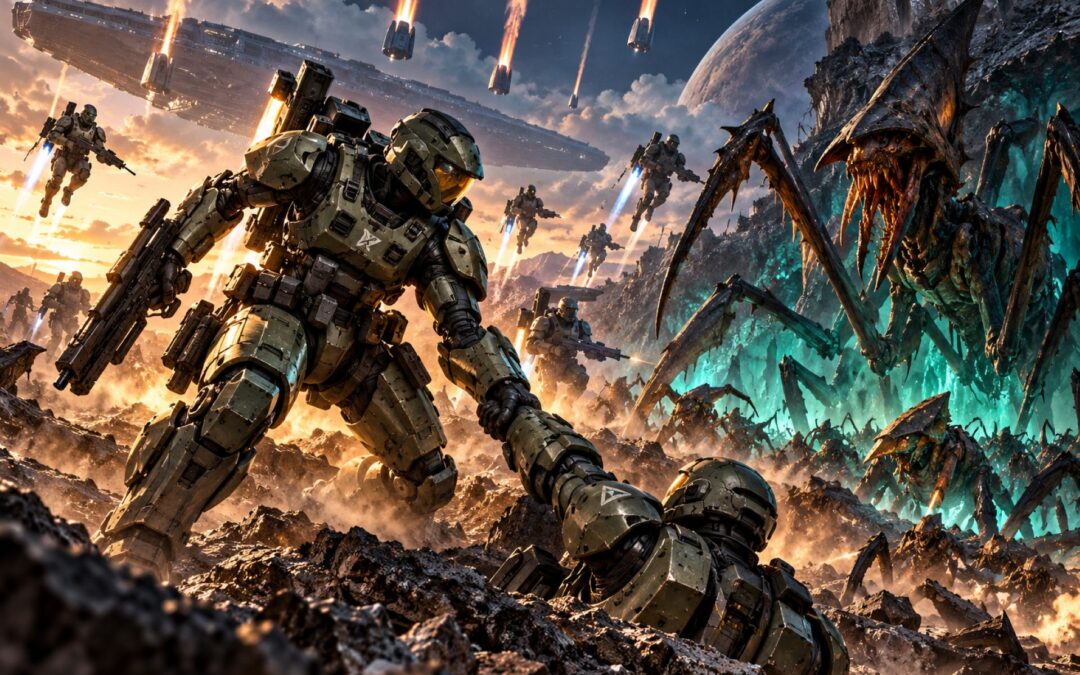
Starship Troopers, Robert A. Heinlein’s 1959 science-fiction novel, follows a young man who joins the armed forces of a future human civilization and gradually becomes a professional soldier. His education takes him from an affluent civilian household through brutal military training, interstellar combat, and officer school, until he commands soldiers in a war against an alien civilization. Alongside that transformation, Heinlein constructs a political society in which the right to vote and hold public office depends upon completing a period of voluntary Federal Service.
The novel combines unusually detailed military science fiction with arguments about citizenship, violence, discipline, moral responsibility, and the obligations individuals owe their communities. Its protagonist, Juan “Johnnie” Rico, initially understands very little about these subjects. As his experiences change him, his instructors explain the philosophical foundations of the society he serves. The resulting narrative invites readers to admire the responsibility developed through service while raising more difficult questions about whether those qualities justify restricting political power.
Originally published by G. P. Putnam’s Sons after an abbreviated serialization under the title Starship Soldier, the book became one of the most influential works of military science fiction. The Heinlein Archives’ manuscript records document its development and publication history, while the 1960 Hugo Awards records confirm its recognition as Best Novel. Its enduring reputation reflects both its military imagination and the disagreements surrounding its political philosophy.
Spoiler Warning: This article covers the complete novel, including major character deaths, plot revelations, philosophical arguments, and the ending.

The First Drop: An Assault on the Skinnies
Johnnie Rico begins his story aboard the Rodger Young, a Federation troop transport preparing to deploy its Mobile Infantry against an alien civilization nicknamed the Skinnies. Although Rico has already become an experienced soldier, he still experiences intense fear before every combat drop. Medical treatments, hypnotic conditioning, extensive training, and repeated missions have not eliminated that reaction.
The soldiers prepare under Sergeant Jelal, known informally as Jelly, who is temporarily commanding their platoon. The unit previously belonged to Lieutenant Rasczak, whose death continues to shape its identity. Their preparation includes detailed equipment inspections, instructions for the mission, and reminders about responsibilities to fellow soldiers. Once they enter their individual capsules, they will be launched from the ship toward the planet’s surface.
The Mobile Infantry’s equipment makes this operation possible. Each soldier wears a powered combat suit that enhances strength, mobility, communications, and protection. The suits carry sophisticated weapons, while the drop capsules use protective layers, decoys, and controlled descent systems to help soldiers survive planetary insertion.
The mission is a punitive raid intended to damage the Skinnies’ military capacity and influence their participation in the wider conflict. The Mobile Infantry is not attempting to occupy the planet permanently. Instead, the soldiers must strike selected targets, demonstrate their destructive capabilities, and withdraw before enemy resistance can overwhelm them.
After landing, Rico uses his suit’s jumping ability to move rapidly through the urban landscape. He follows a predetermined pattern of destruction, attacking important facilities and deploying specialized explosives. His movements are coordinated with other soldiers, but combat conditions still require him to make independent decisions.
One of these decisions nearly becomes a catastrophe. Rico attacks a building without fully understanding its purpose, only afterward recognizing that it might have contained civilians or other unintended victims. The incident illustrates the uncertainty of combat and the limitations of even the most advanced military technology. Rico is fortunate that his assigned weapon was appropriate to the circumstances, but his relief does not erase the danger created by incomplete information.
As the operation approaches its end, the platoon receives instructions to withdraw. The soldiers must reach their rendezvous while continuing to evade hostile fire and account for every member of the unit. The carefully planned assault becomes more desperate when Rico learns that Dizzy Flores has been wounded.
Rico and Ace, another member of the platoon, move to retrieve Flores. Their rescue effort requires them to expose themselves to danger while carrying an incapacitated comrade toward extraction. They succeed in recovering him, and the Rodger Young’s Navy crew manages a difficult pickup under demanding conditions.
The rescue nevertheless ends in tragedy. Flores dies before the ship can save him.
This opening establishes several important facts about Rico’s world. Individual soldiers possess extraordinary destructive power, but their survival depends on teamwork, disciplined coordination, and the willingness of others to risk their lives for them. The Mobile Infantry’s technology has changed how wars are fought without eliminating fear, uncertainty, or death.
The novel then moves backward to explain how Rico became one of these soldiers.
Enlistment: A Choice Against Family Expectations
Before joining Federal Service, Rico is a privileged young man whose future appears secure. His family is wealthy, his father expects him to enter civilian business, and he has little practical understanding of military life. He is approaching graduation alongside his close friend Carl and their classmate Carmen Ibañez.
Carl is interested in scientific and technological work connected to the armed forces. Carmen wants to become a spacecraft pilot, a career requiring unusual mathematical ability, physical coordination, and aptitude. Rico has no comparable professional ambition. His interest in joining Federal Service develops partly because his friends are considering it and partly because he wants to make an independent decision.
His father strongly opposes the idea. Having built a comfortable life outside politics and government service, he sees enlistment as an unnecessary sacrifice of opportunity. Rico can pursue higher education, business, travel, or other civilian pleasures without enduring military discipline or exposing himself to danger.
The argument reflects the distinction between civilians and citizens in the Terran Federation. Civilians retain broad personal and economic freedoms but cannot vote or hold certain political offices. Those privileges are reserved for individuals who complete Federal Service and receive the franchise after leaving active service.
Rico has encountered this system through History and Moral Philosophy, a compulsory school subject taught by Jean V. Dubois. An elderly veteran with a formidable personality and a physical disability, Dubois challenges conventional assumptions about freedom, responsibility, and government. Rico remembers his instruction without yet appreciating its significance.
At the recruiting office, Rico, Carl, and Carmen encounter a disabled veteran whose appearance is designed to confront applicants with the possible consequences of service. Rather than encouraging enlistment, the authorities attempt to discourage anyone motivated by romantic fantasies of military glory.
The recruiter explains that Federal Service is voluntary and that applicants must be accepted even when they cannot qualify for conventional combat assignments. Service involves a commitment to undertake work assigned by the Federation, including dangerous, difficult, or unpleasant duties. Its political reward is not conditional on joining an elite unit.
This principle coexists with a rigorous selection system for specialized occupations. Applicants may express preferences, but their assignment depends on their qualifications and the Federation’s needs.
Carmen performs exceptionally well in the tests required for naval aviation. Carl has the aptitude for scientific work. Rico, by contrast, discovers that his abilities do not qualify him for the glamorous assignments he would prefer.
He is offered opportunities outside the Mobile Infantry, including work associated with other specialized fields, but these prove unsuitable or unavailable. The military eventually assigns him to the infantry, a prospect he had hardly imagined when considering enlistment.
His decision also separates him from his family. His father regards it as a rejection of the opportunities and values he has tried to provide. Rico’s mother is more sympathetic but cannot repair the disagreement.
Rico takes the service oath and leaves civilian life with little idea of what awaits him.
The importance of his decision lies partly in its uncertainty. Rico does not enlist because he has developed a sophisticated theory of citizenship, nor does he possess a settled commitment to lifelong military service. He is a young man making a choice whose full consequences he does not understand.
Boot Camp: Zim’s Lessons in Survival and Obedience
Rico begins basic training at Camp Arthur Currie, where the Mobile Infantry subjects recruits to a demanding program designed to eliminate those who cannot meet its requirements. The training is deliberately exhausting, physically dangerous, and psychologically unsettling.
His principal instructor is Career Ship’s Sergeant Charles Zim, an intimidating professional whose authority initially appears inseparable from humiliation and punishment. Zim expects immediate responses, absolute attention, and exceptional physical endurance. He treats ordinary civilian assumptions about fairness, comfort, and personal dignity as potential weaknesses.
During his first encounters with the recruits, Zim deliberately provokes them. Several larger men assume that their size or previous fighting experience will allow them to challenge him. Instead, he demonstrates superior skill, speed, and judgment, overwhelming opponents who underestimate him.
The most revealing confrontation involves Shujumi, a recruit with extensive martial-arts training. Unlike those who challenge Zim through pride or anger, Shujumi possesses genuine expertise. His encounter with the instructor shows that the Mobile Infantry respects demonstrated competence, although that respect operates within a strict hierarchy.
Zim’s purpose becomes clearer as training progresses. An infantryman in powered armor has the ability to inflict enormous destruction, but that capability becomes dangerous unless accompanied by judgment, coordination, and reliable obedience. A soldier who responds impulsively to fear or provocation may endanger an entire unit.
The physical program is punishing. Recruits undertake long marches, demanding exercises, survival training, and constant inspections. They receive little opportunity for rest and are required to perform difficult tasks even when exhausted.
Rico gradually recognizes that the program is organized to force unsuitable volunteers to leave. The instructors do not need to retain everyone who enters. In fact, retaining soldiers who cannot withstand operational pressures would endanger those who depend upon them.
This logic becomes painfully concrete during a demanding endurance exercise. The recruits must continue marching under difficult conditions while maintaining the discipline necessary to function as a unit. Some men prove physically incapable of completing the course, but others demonstrate extraordinary determination despite their limitations.
Two recruits, including Breckinridge, die during the exercise. Their deaths are treated with solemn military honors, emphasizing that the institution recognizes sacrifice even when it occurs before a soldier reaches combat.
Rico is disturbed by the experience. He cannot easily distinguish between necessary hardship and needless cruelty, particularly when the training itself can kill the people it is supposed to prepare.
The problem becomes sharper in the case of Ted Hendrick.
Hendrick questions the emphasis placed on hand-to-hand combat and other apparently obsolete skills. He believes advanced weapons should make such techniques unnecessary. Zim explains that soldiers must remain capable of fighting when equipment fails or circumstances prevent the use of sophisticated weapons.
During a later exercise involving live weapons, Hendrick disobeys an instruction to remain motionless. His behavior creates a potentially lethal situation because the instructors must rely on recruits following orders precisely. Zim physically corrects him, and Hendrick responds by striking the sergeant.
Hendrick believes he has been treated unfairly. He appeals to Captain Frankel, expecting the commanding officer to recognize an abuse of authority.
Frankel instead explains the distinction between civilian and military relationships. In ordinary civilian life, striking another person may be judged according to questions of provocation and self-defense. In a military organization, striking a superior officer or instructor threatens the command system upon which everyone depends.
Frankel also clarifies the significance of the instructors’ authority. The batons they carry are not ornamental; they visibly identify instructors and provide a means of correction. Their use is regulated, but recruits are expected to accept lawful correction.
Hendrick refuses to accept the administrative consequences and insists on a formal trial. His decision produces a field court-martial, during which the authorities establish the sequence of his disobedience and physical assault.
He is found guilty and sentenced to ten lashes and a Bad Conduct Discharge.
Rico witnesses the punishment. Its severity disturbs him so deeply that he faints, although he later discovers that several other recruits react similarly.
Hendrick’s removal marks a turning point in Rico’s understanding of the institution. He has witnessed the consequences of treating military command as though it were merely another argument between individuals.
Yet the experience does not immediately make him a believer. Instead, it brings him close to resigning.
Rico begins questioning the value of remaining in a system that subjects him to constant hardship and humiliation. His civilian future still exists, and he could return to it by admitting that he is unwilling to continue.
An overheard conversation between Zim and Frankel changes his perspective. Rico discovers that the instructors are intensely concerned about the men they train and that their responsibilities are more complicated than their harsh public behavior suggests.
Zim is troubled by Hendrick’s failure. Frankel, far from being an indifferent disciplinarian, understands the emotional and professional costs borne by instructors who must prepare inexperienced people for circumstances in which mistakes kill.
The conversation reveals that the instructors have obligations to the recruits as well as authority over them. Their severity is supposed to serve the recruits’ eventual survival, not provide personal satisfaction.
A letter from Rico’s mother produces a different kind of pressure. It reminds him of the family he has left behind and the continuing pain caused by his father’s disapproval.
Then a second letter arrives, this one from Dubois.
His former teacher congratulates him for enduring the difficult stages of training and reveals that he himself served as an officer. Rico had known Dubois primarily as an unpleasant classroom authority, but the letter forces him to reconsider the man’s personal history and the seriousness of his teaching.
Rico recalls a classroom discussion concerning value and sacrifice. Dubois had argued that a thing’s importance cannot be understood solely through its monetary price. The effort, deprivation, or sacrifice involved in obtaining or defending something can fundamentally affect its significance to the individual.
That argument now makes sense in a way it did not during school. Rico has invested months of effort in becoming a soldier, and quitting would mean abandoning something he has come to value through experience.
The transformation is gradual rather than absolute. He does not suddenly enjoy every aspect of training, but he stops measuring its demands exclusively against the comforts he once possessed.
He has crossed the psychological barrier that the instructors intended him to overcome.
Powered Armor, Discipline, and Graduation
With the most basic stages of training behind him, Rico begins learning to operate the powered armor that makes the Mobile Infantry such a formidable combat organization.
The suits amplify a soldier’s muscular movements, allowing him to run, leap, carry equipment, and fight with abilities far beyond those of an unassisted human. The operator does not simply issue abstract commands to a machine. Instead, the suit responds to the movements of his body, translating ordinary physical actions into much greater mechanical force.
An armored soldier can travel across considerable distances through powered jumps, cross obstacles that would stop ordinary infantry, and carry powerful weapons while maintaining mobility.
The armor also provides environmental protection and advanced sensory systems. Different models are designed for different tactical responsibilities, including reconnaissance, assault, and command. Communication systems allow soldiers to exchange information through selected channels without overwhelming every member of the unit with unnecessary traffic.
Operating this equipment requires considerable training. A soldier must learn the suit’s physical responses until controlling it becomes nearly instinctive. Tactical decisions must then be made while moving rapidly, monitoring multiple sources of information, and identifying friendly positions.
During one simulated combat exercise, Rico makes a dangerous mistake.
His unit is withdrawing under training conditions when an instructor disables the power to another soldier’s suit. Rico is expected to react as though the immobilized man faces genuine danger.
Instead, he concentrates on his own movement and the simulated tactical situation. He fails to appreciate quickly enough that a powerless soldier may be unable to escape the effects of friendly weapons or enemy attack.
The mistake exposes a deficiency that technical proficiency cannot solve. Rico has learned to operate his suit, but he has not consistently learned to regard another soldier’s survival as an immediate personal responsibility.
Captain Frankel treats the incident seriously. Rico could face a formal disciplinary proceeding with consequences for his military career, but the authorities permit an administrative punishment that allows him to remain in training.
He receives five lashes.
The punishment is physically painful and humiliating. Rico also understands that he has narrowly avoided dismissal from the Mobile Infantry. Unlike Hendrick, he accepts responsibility rather than contesting the legitimacy of the correction.
His instructors and fellow recruits do not subsequently treat him as permanently disgraced. The disciplinary record will not follow him after training, and he is expected to learn from the mistake and continue.
The distinction matters because the institution presents punishment as a corrective measure rather than an irreversible judgment about a person’s character.
The following chapter expands the subject from military offenses to the Federation’s wider criminal justice system.
A deserter named Dillinger has committed serious crimes after abandoning the service, including the killing of a young girl. Because he remains legally connected to the military, the authorities assume responsibility for his punishment.
His execution affects Rico deeply. The condemned man is presented as someone whose actions have placed him outside acceptable human conduct, yet Rico must still confront the reality of an institution deliberately killing a person.
The episode reminds him of another discussion in Dubois’s classroom.
Dubois had challenged a student’s assumptions about the treatment of juvenile offenders. He argued that earlier societies had confused compassion with an unwillingness to establish effective consequences for harmful behavior.
His teaching used the analogy of training an animal. A puppy must learn the difference between acceptable and unacceptable actions through consequences it can understand. According to Dubois, human beings similarly develop moral habits through training, experience, and deliberate education.
He also rejected the assumption that people possess a fully formed moral sense from birth. In his account, ethical behavior develops from the instinct for survival as individuals learn that their own well-being depends upon others.
The lessons provide Rico with a framework for understanding the Federation’s punishments, although the validity of Dubois’s claims remains a separate question.
Military training then moves into its final stages.
The recruits travel to a specialized training camp in the Canadian Rockies, where instruction becomes increasingly individualized and demanding. Rico must demonstrate competence with sophisticated equipment, tactical exercises, and orbital deployment procedures.
During a period of leave in Vancouver, he discovers how much his relationship with civilian society has changed.
The city’s disorder, casual behavior, and unfamiliar routines now seem strange to him. He encounters civilians who mock military personnel and assume that their training and sacrifices deserve little respect.
A confrontation develops into a brief fight. Rico and his companions disable their opponents with techniques learned during training, revealing how thoroughly their reflexes have changed.
The episode also exposes the growing distance between Rico’s former identity and his present one. He recognizes attitudes in the civilians that resemble his own earlier behavior, but he no longer identifies with them.
The final qualification tests involve orbital drops and the fear associated with being launched toward a planet in an individual capsule. Even after extensive preparation, Rico finds the experience frightening. He learns that competence does not require the absence of fear.
When the training ends, only a small fraction of the original recruits have graduated. Rico’s regiment began with 2,009 men and produces 187 graduates, while others have resigned, been discharged, failed to qualify, or died.
Rico is now a trained Mobile Infantry soldier.
He regards graduation as the greatest achievement of his life so far. The experience has given him a new identity, a new community, and a standard of competence he could scarcely have imagined when he enlisted.
Combat will soon reveal how much remains for him to learn.
Klendathu, Buenos Aires, and Rasczak’s Roughnecks
By the time Rico completes training, the Terran Federation’s conflict with the Arachnids has developed into an interstellar war.
The transition has not been simple or immediate. Hostilities originally involve scattered incidents, colonial conflicts, and political tensions, with humans and alien civilizations pursuing overlapping territorial and strategic interests.
Rico has little knowledge of these developments while undergoing basic training. The military deliberately concentrates recruits on their immediate responsibilities, leaving larger political and strategic decisions to higher authorities.
The destruction of Buenos Aires becomes the defining public catastrophe of the war. The Arachnid attack kills enormous numbers of people and forces the Federation to confront the scale of its enemy’s destructive capabilities.
Rico initially hears the news without understanding its personal significance. Although the disaster horrifies him, he is physically and emotionally separated from civilian life, and he has not yet learned the fate of his own family.
The Federation responds with Operation Bughouse, a massive assault on Klendathu, the Arachnids’ home planet.
The operation is intended to strike a decisive blow against the enemy. Human forces possess formidable spacecraft, nuclear weapons, and technologically sophisticated infantry, but their plans depend upon assumptions about the enemy that prove disastrously inadequate.
Rico participates as an inexperienced infantryman attached to a more seasoned soldier, Dutch Bamburger.
Their task is to remain together while carrying out assignments under combat conditions. Rico depends heavily on Dutch’s judgment because the veteran understands the practical realities of fighting that training cannot fully reproduce.
The assault begins going wrong almost immediately.
Federation ships encounter serious resistance, deployments become confused, communications deteriorate, and units lose contact with their commanders. Some troop transports are destroyed before they can complete their launches.
The Arachnids prove capable of operating in circumstances for which the Federation has not prepared. Their subterranean defenses allow them to emerge unexpectedly, attack human soldiers from concealed positions, and retreat into underground systems.
Rico experiences the battle largely as a struggle to follow orders while surviving successive emergencies. He has little reliable knowledge of the wider military situation.
Dutch is killed when an Arachnid emerges from beneath the ground directly in his path.
Rico survives, but the battle ends in disaster for the Federation. Its losses are catastrophic, and Operation Bughouse fails to achieve the victory its planners expected.
The experience also teaches Rico something about technological superiority. The Federation can destroy enormous areas of a planet with advanced weapons, but destruction alone does not necessarily accomplish its strategic objectives.
The Arachnids occupy multiple worlds and possess underground organizations capable of surviving attacks that devastate the surface. A campaign that simply kills large numbers of enemy workers and warriors may leave their command structure and reproductive capacity intact.
After the defeat, Rico is reassigned to Rasczak’s Roughnecks aboard the Rodger Young.
The unit has a distinctive internal culture. Its commanding officer, Lieutenant Rasczak, commands extraordinary respect, while Sergeant Jelal manages the day-to-day discipline and care of the soldiers.
Rasczak’s authority does not depend upon constant displays of rank. His men obey him because they trust his competence and believe he will accept the same dangers he requires them to face.
Jelal complements this authority through practical supervision. He maintains standards, distributes responsibilities, handles problems, and ensures that the soldiers are prepared for their missions.
For Rico, joining the Roughnecks provides something his training unit could not fully offer: membership in an experienced fighting organization with established traditions and shared memories.
The soldiers’ loyalty extends beyond formal orders. They regard their unit as an enduring community whose members owe one another protection and support.
Rico’s experience of the war becomes deeply personal when he finally learns that his mother died in the destruction of Buenos Aires.
The information reaches him through family correspondence, long after the attack itself. Her death destroys the possibility of returning to the family situation he remembers from before enlistment.
An aunt’s communication also leaves him feeling blamed, or at least judged, for the choices that separated him from his family.
This grief coincides with the continuing losses suffered by the Roughnecks.
Lieutenant Rasczak eventually dies during an operation while attempting to save members of his platoon. His death demonstrates the responsibilities he has consistently demanded from his soldiers.
Jelal assumes command and preserves the unit’s identity. Rather than allowing the men to collapse under the loss of their leader, he continues to organize them according to the habits and expectations Rasczak established.
The Roughnecks retain their original name as a tribute to him.
Rico experiences this period as one of the most important in his life. Although he complains about routine demands and suffers the loss of people he admires, he finds satisfaction in belonging to a competent organization whose members understand their obligations to one another.
The opening raid against the Skinnies takes place during this stage of his military development, when Jelal commands the platoon and Rico has become one of its experienced soldiers.
Strategic Warfare and the Decision to Stay
The narrative returns to the aftermath of the Skinny raid, where the death of Dizzy Flores remains fresh in Rico’s mind.
Despite his grief, the ordinary routines of military life resume almost immediately. The soldiers must inspect and repair their powered armor, replace damaged equipment, maintain weapons, complete assignments, and prepare for the next operation.
The work between battles is demanding, even though outsiders may assume that soldiers spend most of their time waiting. A short combat mission can require extensive preparation, while damaged suits and specialized systems consume enormous amounts of technical labor.
Rico is promoted to corporal and becomes assistant section leader, receiving responsibilities that bring him into closer contact with experienced noncommissioned officers.
His promotion creates an awkward problem involving Ace, a capable soldier who is senior to Rico in experience and rank. Rico recognizes that Ace may feel overlooked and that unresolved resentment could become dangerous during combat.
Rather than relying entirely on his formal authority, Rico approaches Ace and offers him the more senior responsibility. Ace refuses, explaining that he does not want the burdens of the position and believes Rico is better suited to it.
The conversation resolves their tension. It also teaches Rico that command requires understanding the people who serve under an officer or noncommissioned officer, rather than treating rank as a substitute for judgment.
Meanwhile, the wider war continues to change.
The Federation increasingly recognizes that the Arachnids cannot be defeated through indiscriminate destruction alone. Their society consists of specialized castes, including workers, warriors, reproductive organisms, and intelligent command organisms.
Their reproductive capacity allows them to replace enormous numbers of expendable fighters. Underground settlements protect important parts of their civilization from surface bombardment, while their organizational structure gives them tactical advantages in certain environments.
The Federation must therefore reconsider what victory means.
Destroying workers and warriors may inflict damage without eliminating the ability of an Arachnid colony to continue fighting. Human forces begin placing greater emphasis on reaching command structures, collecting intelligence, and capturing valuable prisoners.
The war also involves diplomacy.
The Skinnies have initially been associated with the Arachnids, creating a wider alignment against humanity. Federation operations, including the opening raid, form part of an effort to alter that situation. Eventually the Skinnies change sides, improving the Federation’s strategic position.
Rico knows relatively little about the political negotiations behind these developments. He understands their practical consequences more clearly: fewer hostile forces, improved intelligence, and new opportunities for military action.
The Federation also learns more about the Arachnids’ underground habitats and the dangers involved in attacking them. Raids below the surface become essential but extremely hazardous because soldiers lose many advantages provided by powered armor.
Rico’s professional development continues as the military adapts.
During a visit to Sanctuary, an important Federation base and rest center, Ace asks him whether he has considered becoming a career soldier.
The question surprises Rico. He originally intended to complete his required term of service and return to civilian life. Remaining in the Mobile Infantry indefinitely had never been part of his original plan.
Ace points out that Rico possesses qualities that might make him an effective senior noncommissioned officer or candidate for a commission. His growing competence, willingness to accept responsibility, and ability to handle difficult situations distinguish him from soldiers who merely endure their assignments.
The suggestion forces Rico to reconsider his future. He has learned to respect the service, values the Roughnecks, and finds meaning in work that once seemed intolerable.
He eventually decides to pursue a military career and apply for Officer Candidate School.
When he reaches the administrative authorities, he discovers that the required paperwork is already prepared. Sergeant Jelal has anticipated the decision, revealing how closely his superiors have observed his development.
Rico is no longer simply completing an obligation undertaken during adolescence. He is choosing to remain in the organization and accept greater responsibility for others.
Officer Candidate School and the Veteran Franchise
Officer Candidate School presents Rico with another demanding transition. He has already established himself as a competent enlisted soldier, but becoming an officer requires abilities beyond those needed to survive and perform effectively within a platoon.
He must now learn to make decisions affecting other soldiers, understand complicated military operations, and accept responsibility for the consequences of his orders.
Before these lessons begin in earnest, he experiences an extraordinary reunion.
A Mobile Infantry corporal approaches Rico and reveals himself to be his father.
Rico is astonished. His father had opposed his enlistment so strongly that their relationship appeared permanently damaged. Now the older man is serving in the very organization he had dismissed as an unnecessary and inferior occupation.
Their conversation explains how the transformation occurred.
Following the destruction of Buenos Aires and the death of Rico’s mother, his father reassessed his life. He reveals that even before the catastrophe he had been profoundly dissatisfied despite his material success.
Rico’s enlistment had unsettled him because it represented a willingness to pursue obligations beyond personal comfort and private achievement. His son’s decision exposed doubts he had not fully acknowledged about his own choices.
His wife’s death accelerated the crisis, although he insists that revenge was not his only motivation. He wanted to undertake work he regarded as meaningful and had come to recognize that Rico’s decision required more courage and seriousness than he had originally admitted.
The elder Rico enlisted, completed basic training, and entered the Mobile Infantry. He participated in the fighting on Klendathu, where his unit suffered devastating casualties, and eventually reached corporal rank.
The reunion reverses their earlier relationship. Rico had left home as a son defying his father’s expectations. He now meets him as a fellow soldier whose experience has changed both their understanding of responsibility and their relationship with one another.
The conversation is emotional but also practical. They speak as servicemen with different ranks, assignments, and obligations. Their affection does not eliminate the institutional rules governing their conduct.
Rico also encounters Carmen again.
She has succeeded in entering the Navy and is developing her career as a spacecraft pilot. Her competence and confidence demonstrate that Federal Service includes specialized paths very different from infantry combat.
Rico notices changes in her appearance, including her closely cropped hair, which reflects the practical demands of operating in spacecraft under free-fall conditions. Their reunion is affectionate, but it does not recreate their earlier relationship as students.
Both have acquired separate professional identities, responsibilities, and experiences.
They also share the knowledge that Carl has died. Their former school friend was killed when the Arachnids attacked a Federation research installation on Pluto.
The news reinforces the war’s reach across different branches of service. Scientific research, naval operations, and infantry combat all expose participants to danger.
Officer training itself is intellectually demanding.
Rico must master mathematics, military administration, tactics, leadership, and the practical organization of combat units. Instruction often comes from disabled veterans whose physical limitations prevent further combat service but do not diminish their knowledge or teaching ability.
The school treats competence as a combination of technical understanding and judgment. An officer cannot rely exclusively on courage, rank, or the confidence that comes from previous battlefield experience.
One of Rico’s most significant instructors is Major Reid, who teaches History and Moral Philosophy.
Reid is blind but intellectually formidable. He challenges candidates through questions that expose weaknesses in their assumptions, demanding precise answers and rejecting unsupported guesses.
His classes develop the political history of the Terran Federation.
According to the official account, earlier political systems collapsed after a period of international conflict, institutional failure, and social disorder. The Treaty of New Delhi and the mishandling of prisoners of war form part of the background to this breakdown.
In the resulting instability, groups of military veterans assumed responsibility for restoring order. Reid describes an early example in Aberdeen, Scotland, where former soldiers organized to suppress looting and violence.
These veterans initially restricted decision-making authority to members of their own group because they trusted one another more than civilians who had not shared their experiences. Over time, similar practices became institutionalized and developed into the constitutional principles of the Federation.
The franchise was gradually based on completing voluntary Federal Service.
Reid’s central claim is that political power should belong to individuals who have demonstrated a willingness to place the welfare of society above personal advantage.
His argument does not depend on veterans being inherently more intelligent than civilians. He explicitly rejects that explanation.
He also rejects the idea that former servicemen necessarily become more disciplined or law-abiding after returning to civilian life. Veterans may commit crimes at rates comparable to civilians.
The difference, he argues, is that citizens have voluntarily undergone difficult service, accepting inconvenience, personal risk, and obligations they could have avoided. They have demonstrated an ability to recognize interests beyond their immediate personal benefit.
Active servicemen themselves cannot exercise the franchise while serving. Political participation follows completed service, separating the exercise of sovereignty from an active military career.
Reid also explains that the Federation’s voting qualification does not depend upon wealth, racial background, religion, sex, or inherited social position. Anyone willing to perform qualifying service is entitled to the opportunity.
The distinction remains fundamental: political equality exists among those who have completed the required service, while civilians who have not completed it remain excluded from voting and holding political office.
Reid claims that this system produces exceptional political stability, personal liberty, and social prosperity. In his account, restricting sovereignty to those who have demonstrated responsibility prevents the failures of earlier democracies.
These discussions become central to Rico’s education because officers must understand the political purposes served by their use of force.
Colonel Nielssen develops the practical meaning of responsibility during a meeting with Rico and other candidates, including Hassan and Byrd.
He explains the demanding nature of officer leadership and the consequences of incompetence. An officer may make decisions under uncertain circumstances, but he cannot transfer responsibility for those decisions to the soldiers who obey them.
The institution therefore places enormous demands on those who hold commissions.
Rico is prepared for a temporary combat appointment, during which his performance will determine whether he deserves a permanent commission.
The assignment will test whether he can translate the principles discussed in classrooms into effective leadership under enemy fire.
Operation Royalty: Command Tested Underground
Rico receives a probationary posting to the First Platoon of Captain Blackstone’s Blackguards aboard the troop transport Tours.
His temporary position gives him command responsibility while placing him under the supervision of experienced officers and noncommissioned officers. The arrangement allows the military to evaluate his competence in real combat rather than relying solely on examinations.
Captain Blackstone, commonly called Blackie, introduces him to the practical difficulties of leadership.
The Mobile Infantry uses relatively few commissioned officers for the number of soldiers it deploys. Experienced noncommissioned officers perform much of the organizational work that keeps units functioning, making the relationship between officers and sergeants particularly important.
Rico must learn to rely on their experience without surrendering his own responsibility.
Blackstone emphasizes that the commander remains accountable for decisions, even when those decisions are influenced by advice from subordinates. Listening is essential, but indecision can be more dangerous than an imperfect order issued promptly.
The problem becomes apparent when Rico evaluates the organization of his platoon.
One of his experienced men, Brumby, has been performing responsibilities associated with a higher rank without receiving the appropriate promotion. Rico initially considers changing the arrangement because he has not personally observed Brumby in combat.
Blackstone challenges this reasoning. The previous commander and the platoon’s experienced soldiers already possess knowledge about Brumby’s abilities, and Rico has no evidence that their judgment is mistaken.
Rico recognizes the error and recommends Brumby for promotion.
The episode teaches him to distinguish leadership from the need to display authority. Making unnecessary changes can damage an effective organization, particularly when a new commander does not yet understand its members.
Rico’s daily responsibilities also reveal how much administration accompanies military command. Equipment maintenance, personnel assignments, inspections, training, reports, and logistical questions compete for his attention.
An officer who neglects these duties may create disasters long before enemy contact occurs.
The Blackguards are preparing for Operation Royalty, a large-scale attack on an Arachnid-held planet designated Planet P.
The operation differs fundamentally from the failed invasion of Klendathu.
Federation commanders now recognize that killing vast numbers of workers and warriors does not necessarily weaken the Arachnids’ underlying political and military organization. The most valuable objectives are the intelligent organisms that direct the colony.
The Arachnids possess specialized castes. Workers perform necessary labor, warriors fight, and the intelligent brain organisms coordinate activities that less capable members cannot undertake independently.
The Federation has previously captured workers and warriors and studied their physiology. Those investigations have helped scientists develop weapons specifically suited to Arachnid biology.
However, the humans have not successfully captured living brain organisms.
Such prisoners might provide invaluable intelligence about the enemy’s organization and intentions. They might also possess exchange value if the Arachnids are willing to trade human prisoners for members of their command caste.
Operation Royalty is therefore designed around capture rather than unrestricted destruction.
This objective makes the fighting especially dangerous. Soldiers cannot simply destroy every underground settlement with nuclear weapons or other indiscriminate attacks. They must preserve potential prisoners while preventing enemy forces from escaping or counterattacking.
Rico’s platoon is assigned to a specific area within the larger operation. He must establish positions, deploy patrols, maintain contact with adjacent units, and respond to developments without losing control of his assigned force.
The drop begins with the normal hazards of combat insertion, followed by the difficulty of establishing a secure perimeter on unfamiliar terrain.
Rico sends scouts to identify the boundaries of his area and directs his soldiers to positions from which they can detect underground movement.
The surrounding landscape offers few reliable clues about what lies beneath it. Arachnid tunnels and entrances can remain concealed until enemy forces emerge.
Rico’s equipment provides radiation measurements, range-finding capabilities, and communication systems, but these tools cannot substitute for understanding the terrain.
He discovers suspicious underground features and reports them through the chain of command. The information must be integrated into the wider operation without assuming that his local observations reveal the entire enemy plan.
The Arachnids respond with complicated tactical movements.
At one point, large numbers of workers emerge into the open and are slaughtered by Federation troops. The action initially appears to be a breakthrough or desperate attempt to resist the assault.
Rico and other observers gradually recognize that the apparent attack may be a diversion.
The Arachnids are deliberately sacrificing relatively expendable organisms to conceal movements elsewhere. Their willingness to use workers in this manner reflects the different value assigned to individuals within their specialized society.
The situation becomes increasingly confused as fighting breaks out in multiple locations.
Rico must decide how to distribute his men while preserving communications, maintaining defensive positions, and preventing the enemy from isolating sections of the platoon.
His platoon sergeant moves underground after recognizing that the enemy is attempting a more significant maneuver than the surface attacks suggest.
Other soldiers follow or attempt to provide assistance, creating a dangerous situation in which small groups become separated inside the tunnel system.
Rico faces a difficult choice. He can preserve his assigned surface position and wait for clarification, or he can intervene to rescue men whose situation is becoming increasingly desperate.
He must also consider whether abandoning positions will expose adjacent units to danger.
The decision requires precisely the kind of judgment his instructors have attempted to develop. He cannot save everyone by acting impulsively, but neither can he treat the men underground as expendable.
Rico eventually enters the tunnels with part of his force.
The underground environment removes many advantages normally associated with powered armor. Soldiers cannot use their full jumping mobility, their weapons may be unsuitable for enclosed spaces, and communications become unreliable.
Explosives and flamethrowers pose risks to friendly soldiers as well as enemies. Narrow passages prevent the easy deployment of large formations, while unexpected intersections complicate navigation.
Rico must choose which passages to defend and which to investigate. Guarding every intersection would gradually consume his available soldiers, leaving too few men to accomplish the mission.
The dangers become immediate when the platoon encounters fierce Arachnid resistance.
Combat takes place at short range, with soldiers fighting in confined spaces where their equipment cannot always be used as intended. Human troops have to rely on physical strength, close-combat techniques, and the coordination learned during training.
The fighting produces serious casualties.
Brumby is killed, along with other soldiers who have followed the advance underground. Their deaths are especially painful because Rico has only recently taken responsibility for their leadership and professional development.
Despite these losses, the surviving men continue toward their trapped platoon sergeant.
They eventually reach the location where he has been fighting and discover that he has captured a living brain Bug.
The achievement is enormously important. The entire operation has been designed to secure this kind of prisoner, and the sergeant’s decision to enter the tunnel system has placed him in the position to accomplish the objective.
Rico experiences a moment of triumph despite the losses suffered by his platoon.
Almost immediately, however, enemy action causes part of the tunnel structure to collapse. Falling material injures Rico, ending his direct participation in Operation Royalty.
The larger operation produces mixed results. The Federation captures several brain organisms and obtains valuable specimens for study, but the casualties are severe. The captured brains do not survive long enough for the prisoner exchanges the planners had hoped might become possible.
Rico later learns more about the decisions made during the battle, including why his platoon sergeant moved underground and how accurately the man had interpreted the Arachnids’ intentions.
The sergeant receives a battlefield commission for his achievement.
Only then does Rico reveal his identity.
His platoon sergeant was Charles Zim, the demanding instructor who had once overseen his basic training.
The revelation connects Rico’s earliest military experiences with his first major test of officer leadership. Zim has continued serving in circumstances where his exceptional abilities can be used directly against the enemy, while Rico has risen from inexperienced recruit to a man responsible for commanding other soldiers.
Rico’s admiration for Zim is accompanied by doubts about his own performance.
He knows that his platoon suffered heavy casualties and that his command decisions were imperfect. The fact that the operation accomplished an important objective does not eliminate his responsibility for the men who died.
His injuries require extended treatment and recovery. During this period, he worries that the military will conclude he lacks the judgment necessary for a permanent commission.
He returns to study, particularly mathematics, and eventually receives reassurance that his performance has been accepted.
With help from his instructors and colleagues, he completes the remaining requirements and graduates from Officer Candidate School.
The personal consequences of Operation Royalty are substantial. Zim receives recognition for his actions, Rico becomes a commissioned officer, and both men carry forward the institutional traditions that shaped them.
Rico is assigned back to his old unit, the Rodger Young, fulfilling his desire to return to the soldiers among whom he first became an experienced infantryman.
During the closing portions of the chapter, another detail changes how readers understand his identity. Rico reveals that Tagalog is his native language, establishing a connection to Filipino linguistic and cultural heritage that his earlier narration had not explicitly identified.
The chapter leaves him with a permanent commission, a new responsibility, and an opportunity to lead the unit that once taught him what military service meant.
Rico’s Roughnecks and the Return to Klendathu
The final chapter begins after Rico has assumed command of the platoon once known as Rasczak’s Roughnecks.
The unit is now Rico’s Roughnecks, marking the completion of his transformation from recruit to commander. His responsibilities resemble those once carried by the officers he admired, including the duty to prepare inexperienced soldiers for situations in which their decisions may determine whether others live or die.
Rico has an officer candidate named Bearpaw temporarily attached to the platoon. He instructs the younger man before the drop, explaining that he should remain close, avoid interfering with the established organization, and rely on the experience of the platoon sergeant if Rico is killed.
The advice echoes the lessons Rico received from his own instructors and commanders.
The mission ahead is another operation against Klendathu.
Unlike the earlier catastrophic invasion, the Federation now has a specific reason to avoid indiscriminate destruction. Human prisoners remain in Arachnid hands, and the military intends to recover them.
Rico explains that the soldiers must land, hold their assigned territory, and continue fighting while supplies and reinforcements arrive. They cannot expect immediate extraction after a brief raid.
He also assures his soldiers that the Federation remains committed to recovering captured servicemen. The men held by the Arachnids, including personnel associated with the Swamp Fox and Montgomery, are depending on that commitment.
The mission therefore extends the novel’s recurring concern with obligations to comrades beyond immediate personal safety.
Rico conducts the final inspections, checking his soldiers’ equipment even though his experienced platoon sergeant has already done so.
He knows that the inspections reassure his men as well as confirm their readiness. Command requires visible attention to details that subordinates already understand.
A letter from Jelal provides another emotional connection to Rico’s earlier service. Jelal reports that his new artificial legs are functioning well and sends encouragement to the platoon.
The message preserves the continuity between past and present leadership.
As the drop approaches, Rico begins trembling.
His experience and professional authority have not eliminated fear. He can manage it more effectively, but he remains the same human being who felt terrified before the mission described in the opening chapter.
Then his platoon sergeant places an arm around him and offers reassurance.
The sergeant is Rico’s father.
The relationship that began in opposition has now become an intimate professional partnership. His father serves under his command while providing the emotional steadiness Rico needs before battle.
Rico responds affectionately, and the two prepare for deployment.
Once sealed into his capsule, he reports the platoon’s readiness to the bridge. The novel closes with the familiar military ballad associated with the Rodger Young and the Infantry.
The outcome of the mission is unknown. The war continues, the prisoners have not yet been rescued, and Rico’s future remains uncertain.
His personal development, however, has reached its conclusion. He has become the kind of officer whose guidance and judgment other soldiers depend upon.
The Terran Federation and the Price of Citizenship
The Terran Federation is built around a distinction between the freedoms enjoyed by civilians and the political authority reserved for citizens. Heinlein presents a society in which individuals can pursue business, accumulate wealth, raise families, and enjoy extensive personal liberty without joining Federal Service. Political power, however, is restricted to people who have completed a qualifying period of service.
This arrangement differs from a straightforward military dictatorship. The Federation does not require every person to serve, and active military personnel do not automatically possess voting rights. Individuals acquire the franchise after completing Federal Service, rather than through their immediate position in the armed forces.
The system is intended to prevent people from wielding political authority without demonstrating an understanding of obligations beyond personal interest. Its advocates argue that voluntary service provides evidence of a willingness to accept hardship, danger, and sacrifice for the larger community.
The distinction between Federal Service and military service is important. Rico’s own experiences are overwhelmingly military, but the novel acknowledges noncombatant assignments and opportunities for people who cannot perform conventional combat duties. Major Reid specifically notes that many veterans in peacetime have served in noncombatant auxiliary roles and nevertheless qualify for political participation.
The issue has produced substantial disagreement among critics. The Heinlein Society’s discussion of Federal Service records both the argument that the system is essentially military and Heinlein’s later insistence that its eligibility requirements extend far beyond combat. The broader interpretation fits explicit passages in the novel, although the narrative gives relatively little sustained attention to those alternative forms of service.
The Federation also presents its franchise as universally accessible. Qualifying service is not officially restricted by wealth, religion, inherited status, sex, or racial background. The state is obligated to provide an opportunity to serve, even when an applicant’s physical condition prevents ordinary military assignments.
That principle gives the system a kind of formal equality. An individual born into a wealthy family cannot simply purchase the franchise, while someone without money or social influence can acquire it through service. Rico’s father possesses considerable economic power but initially has no political authority because he has chosen to remain outside Federal Service.
The system’s defenders regard this as a correction to earlier democracies that distributed voting rights without testing civic responsibility. Major Reid argues that mere age, wealth, or intelligence cannot establish a person’s fitness to govern. An intelligent individual may act selfishly, while someone with modest intellectual abilities may possess a strong sense of obligation.
The Federation’s official history presents its origins as practical rather than theoretical. Veterans restored order after earlier governments collapsed, and restrictions initially adopted out of necessity gradually became permanent institutions. The franchise system emerged from the belief that people who had accepted personal risk for society could be trusted with decisions affecting its future.
This account contains several assumptions that require examination. It treats the veterans’ original restoration of order as evidence that their political successors should retain authority. It also assumes that the willingness to complete service reliably predicts responsible behavior in political life.
The novel provides much stronger evidence for the first half of this proposition than for the second. Rico becomes more disciplined, competent, and considerate through his military experiences. His development makes a persuasive case that demanding service can transform an immature individual into a responsible professional.
Whether those qualities necessarily produce better political judgment is less certain. An effective infantry officer must make decisions under pressure, evaluate military information, and protect subordinates. Political leadership additionally requires judgment about economics, civil liberties, competing public interests, institutional accountability, and the peaceful resolution of disagreements.
Heinlein’s Federation claims that its citizens perform better in these matters than earlier political classes. Yet the reader receives relatively little independent evidence of the system’s civilian administration or its handling of political dissent.
The society may therefore be understood as a political experiment whose stated success is much more fully articulated than demonstrated. Rico’s personal experience supplies the emotional credibility of its values, while the institutions themselves remain partly dependent on the explanations offered by their defenders.
Moral Philosophy: Violence, Value, and Sacrifice
The political institutions of Starship Troopers depend upon a moral philosophy that connects survival, sacrifice, and responsibility. Heinlein introduces its principal arguments through Dubois’s classroom discussions and returns to them during Rico’s military training and officer education.
One of the most controversial ideas concerns violence. Dubois argues that physical force has repeatedly determined historical outcomes and that political systems ultimately depend upon the ability to defend their decisions. He rejects the comforting assumption that superior ideals, moral declarations, or peaceful intentions can always overcome organized aggression.
The argument is introduced through historical reasoning. Governments may negotiate, establish laws, or appeal to principles, but they must still confront opponents willing to use force. A society unable or unwilling to defend itself may discover that its preferred moral arrangements cannot survive.
Heinlein’s fictional war provides an environment in which this principle appears plausible. The Arachnids are capable of destroying human cities, attacking colonies, and killing civilians. The Federation’s survival requires military organization, technological preparation, and the willingness of individuals to fight.
The novel nevertheless distinguishes violence as an instrument from violence pursued for its own sake. Effective military operations should serve defined political and strategic objectives. The distinction becomes important when commanders realize that destroying large numbers of Arachnids will not necessarily end the war.
The purpose of military force must be understood before that force can be applied intelligently.
Dubois’s broader philosophical argument concerns value. During a classroom discussion, he challenges conventional theories about the relationship between prices, effort, and personal desires. His examples suggest that the importance people assign to an object or experience often depends upon the effort or sacrifice required to obtain it.
Rico initially finds these discussions irritating. Having grown up with substantial material comfort, he has rarely been forced to pursue something through sustained hardship.
Basic training changes the meaning of Dubois’s argument. Rico discovers that completing the program matters intensely to him precisely because it demands so much effort. The value he attaches to becoming a trained soldier grows as he confronts the possibility of failure.
Yet sacrifice alone cannot determine moral value. People can endure hardship for destructive causes, and the willingness to suffer does not prove that the objective being pursued is beneficial. Heinlein’s argument is most convincing when sacrifice is connected to identifiable responsibilities, such as protecting endangered comrades or accepting the burdens of command.
The novel also develops an account of moral responsibility as an expansion of the instinct for self-preservation.
Dubois argues that human beings begin with an interest in their own survival and gradually learn to recognize the importance of others. Family obligations extend personal concern beyond the individual, while social responsibility extends it toward larger communities.
In its most developed form, this responsibility requires individuals to place collective survival above immediate personal benefit.
Rico’s experiences provide several examples. His training requires him to act as part of a unit, even when cooperation limits his freedom of movement. During combat, he must consider the safety of other soldiers before making decisions about his own survival.
The rescue of Dizzy Flores is especially important. Rico and Ace expose themselves to danger to recover a wounded comrade whose survival is uncertain. Their actions cannot be explained entirely through calculations of immediate personal advantage.
A related example appears in Operation Royalty, when soldiers enter dangerous underground passages to recover comrades who have become trapped.
These incidents demonstrate forms of solidarity that the novel treats as genuine moral achievements. The willingness to assist another person under dangerous circumstances expresses a commitment that goes beyond obedience to written regulations.
Robert Wood’s scholarly examination of the relationship between pedagogy, militarism, and political society in Starship Troopers identifies education as a central mechanism through which the Federation develops the kind of people its institutions require. Rico’s transformation can be understood as the progressive enlargement of his obligations from himself to his comrades and ultimately to the political community.
The difficulty emerges when this moral development is treated as proof of the Federation’s entire political philosophy.
Learning to protect fellow soldiers is an identifiable accomplishment. Acquiring the right to govern millions of strangers through that experience requires an additional argument about political competence.
Heinlein tends to present those two propositions as closely related, although they are not identical.
Punishment, Conditioning, and the Manufacture of Virtue
The Federation’s educational system assumes that moral character can be developed through properly organized experiences, including carefully administered punishment. This belief connects the schoolroom, basic training, the military justice system, and the wider criminal law.
Dubois rejects the idea that human beings naturally possess a complete understanding of right and wrong. He argues that moral conduct must be learned through consequences, explanation, and repeated experience. The individual gradually connects harmful actions with outcomes that discourage their repetition.
His analogy involving the training of a puppy expresses the principle in its simplest form. An animal cannot be expected to understand a complex moral lecture, but it can learn that particular behavior produces unpleasant consequences. Dubois extends this reasoning to human childhood, insisting that early and effective correction can prevent more serious misconduct later.
The argument reflects a strong belief in behavioral conditioning. Proper institutions should shape the habits through which individuals eventually develop self-control.
Rico’s basic training provides the clearest practical demonstration of this philosophy.
Zim does not allow recruits to discover every consequence of their mistakes through real combat, because many would die before learning. Instead, he creates controlled situations in which failure produces immediate correction while the consequences remain survivable.
The severe attrition of basic training serves a different purpose. It removes individuals who cannot or will not accept the demands of the organization. The institution would rather lose recruits during training than retain soldiers whose unreliability might kill others.
Hendrick’s court-martial reveals the coercive side of this philosophy. His disobedience during a dangerous exercise creates a genuine threat to military safety, and his assault on Zim undermines the authority of the instructor responsible for controlling that danger.
The punishment is intended to reinforce a rule upon which the entire organization depends.
Yet the severity of the sentence raises a question about proportionality. Hendrick receives ten lashes and a Bad Conduct Discharge, consequences that extend well beyond an ordinary reprimand.
The novel presents this outcome as justified by the special requirements of military service. It does not devote comparable attention to whether alternative disciplinary methods might have achieved the same legitimate objectives with less violence.
Rico’s own punishment is more closely connected to a specific failure of responsibility. When he neglects an immobilized comrade during an exercise, the authorities treat his mistake as evidence that he has not yet internalized the duty to protect others.
His five lashes are designed to make that lesson unforgettable.
The institution also limits the lasting consequences of the punishment. Rico’s training record is eventually cleared, and the instructors continue treating him as a recruit capable of improvement.
This distinction strengthens the novel’s conception of punishment as correction rather than permanent moral condemnation.
Dillinger’s execution takes the philosophy into more troubling territory.
Dillinger has committed severe crimes, and Rico accepts that his actions require the harshest consequences. The Federation presents punishment as both a means of defending society and a demonstration that harmful conduct produces predictable results.
However, an execution cannot reform the individual who receives it. Its function must instead involve incapacitation, deterrence, retribution, or some combination of these purposes.
Dubois’s broad explanation of punishment does not fully resolve the moral differences among those goals.
The Federation also presents its penal arrangements as scientifically effective, suggesting that earlier societies tolerated crime because they relied on mistaken theories of human behavior. Yet the novel offers little systematic evidence by which readers can evaluate these claims.
The account’s confidence is part of its ideological construction. Its teachers speak as though questions that remain heavily contested in political philosophy, psychology, and criminal justice have been conclusively answered.
Wood’s analysis of the Federation’s educational system emphasizes the way disciplinary institutions shape subjects who internalize its preferred values. That interpretation helps explain both the attraction and the danger of the model.
A carefully structured environment can develop competence, responsibility, and self-control. But the same mechanisms can also train individuals to accept established authority without examining whether that authority deserves obedience.
Heinlein gives considerable attention to protecting soldiers against incompetent leaders. The larger question of how an entire political system protects citizens against misguided institutions receives less scrutiny.
The Mobile Infantry and Heinlein’s Technology of War
Powered armor is the novel’s most influential technological invention, but Heinlein’s treatment of it is distinctive because he explains how the equipment affects the entire organization of combat.
A Mobile Infantry suit operates as an extension of the soldier’s body. It amplifies muscular movements through powered mechanisms, allowing the wearer to perform actions beyond ordinary human capabilities without requiring separate commands for every motion.
A trained operator can move rapidly across a battlefield, make enormous jumps, carry heavy weapons, and survive environmental conditions that would incapacitate an unprotected person.
The suit’s enhanced mobility changes the relationship between an individual soldier and the territory he occupies. An infantryman can cover distances and attack targets that would traditionally require vehicles, artillery support, or larger formations.
The equipment also provides sophisticated communications, sensory assistance, and protection. Different suit configurations are suited to reconnaissance, assault, and command responsibilities, allowing units to combine capabilities according to their mission.
Heinlein is particularly interested in the practical interface between operator and machine. The suit must respond quickly enough that its movements become instinctive, but its power creates serious dangers if the wearer lacks coordination or judgment.
A careless action can become destructive simply because the machine amplifies it.
The orbital capsule system complements this mobility. Individual soldiers can be launched from troop transports and dispersed over a planetary surface, reducing their vulnerability to attacks against concentrated landing forces.
Protective layers and decoys help conceal their descent, while precise timing and coordination are necessary for the formation to reassemble on the ground.
The system makes the Mobile Infantry exceptionally flexible, but it does not eliminate the need for conventional military principles.
Soldiers must still maintain formations, coordinate fire, secure positions, manage ammunition, and recover casualties. The immense distances between star systems also make logistics, maintenance, and preparation central to successful operations.
The relationship between the Navy and Mobile Infantry reinforces these constraints.
Naval crews operate the spacecraft that transport and deploy infantry units, while the soldiers conduct the surface operations that spacecraft alone cannot always accomplish. Neither branch can perform its larger strategic role effectively without the other.
The evacuation of the Skinny raid demonstrates this interdependence. Rico and Ace may succeed in recovering Dizzy, but the operation depends upon the Navy’s ability to bring the Rodger Young into position for extraction.
Heinlein gives comparable attention to the structure of military command.
The Mobile Infantry relies on experienced noncommissioned officers because its dispersed formations require local initiative, specialized knowledge, and effective supervision. A platoon commander may hold formal authority, but he cannot manage every detail or replace the accumulated experience of his sergeants.
Rico learns this during his first posting as an officer. Blackstone expects him to make decisions, but he also expects him to respect the people whose practical knowledge makes those decisions possible.
The battles against the Arachnids reveal the limits of the technology.
Powered armor is extraordinarily effective on open ground, but underground tunnels restrict movement, communications, and the use of heavy weapons. The soldier remains vulnerable when the physical environment prevents him from exploiting the suit’s advantages.
Heinlein’s technological imagination is strongest where equipment creates new possibilities without abolishing familiar problems. Soldiers still experience exhaustion, fear, confusion, logistical constraints, and the consequences of poor leadership.
The machinery changes their capabilities. It does not change the need for professional judgment.
The Bugs, the Skinnies, and the Morality of Survival
The alien civilizations of Starship Troopers are presented primarily through their military and political relationships with humanity.
The Arachnids, commonly called Bugs, possess a social organization fundamentally different from the individualistic human societies familiar to Rico. Their colonies include specialized castes performing distinct functions, and the value assigned to individual organisms varies according to their contribution to the collective.
Workers perform labor, warriors conduct combat operations, reproductive organisms sustain the population, and intelligent brain organisms provide direction.
The arrangement allows Arachnid forces to absorb casualties that would be devastating to a human army. Enormous numbers of workers and warriors can be sacrificed without necessarily destroying the colony’s capacity to function.
This creates a strategic problem for the Federation.
Human commanders initially approach the enemy partly through assumptions derived from fighting other human societies. They expect that sufficient destruction will produce political or military collapse.
The failed assault on Klendathu exposes the inadequacy of that expectation.
The Arachnids’ underground organization protects vital facilities and command organisms, while their capacity for reproduction allows them to replace fighters on a remarkable scale.
The Federation must therefore identify which parts of the enemy society actually control its decisions.
Operation Royalty follows from that analysis. Capturing a brain organism may provide more strategic value than killing thousands of workers because the captive might reveal information or become an object of negotiation.
The operation also demonstrates the limitations of military intelligence. Human commanders possess enough knowledge to identify the importance of the brain caste, but they cannot fully predict how the Arachnids will react to an assault on their command structure.
The enemy’s use of expendable workers as decoys during the operation reveals a tactical intelligence capable of manipulating human expectations.
The Skinnies occupy a different position in the narrative.
They are initially aligned with the Arachnids, making them opponents of the Federation. However, their allegiance proves changeable, and they eventually cooperate with humanity.
Their changing position shows that the interstellar war is not a simple division between humans and an undifferentiated alien enemy. Alliances, political interests, and strategic pressure influence relationships among civilizations.
The opening raid against the Skinnies must be understood within this context. It is intended to demonstrate the Federation’s capacity to inflict damage and alter the political calculation of an opposing civilization.
The operation also exposes the disturbing implications of coercive diplomacy. Military destruction is used to influence political choices, and the distinction between legitimate pressure and excessive violence depends upon assumptions about necessity and proportionality.
The novel’s treatment of the Arachnids raises an even more difficult ethical problem.
The human characters interpret the conflict largely as a struggle for survival. Buenos Aires has been destroyed, human colonies have suffered attacks, and prisoners remain in enemy hands. These events provide strong reasons for the Federation to defend itself.
Yet the narrative gives readers little direct access to Arachnid political intentions or moral reasoning.
The Bugs are intelligent enough to conduct sophisticated military operations and maintain a complex society, but their motivations are generally inferred from behavior rather than explained through an independent perspective.
That limitation matters because the novel makes large moral claims about warfare and collective survival. The reader understands why Rico considers the enemy dangerous, but cannot independently reconstruct the complete history of competing territorial claims or determine how the Arachnids understand the conflict.
Heinlein’s portrayal of alien society is therefore effective as military world-building while remaining deliberately restricted as political world-building.
The Federation’s soldiers need to defeat an enemy whose behavior threatens their communities. The reader, however, is not required to accept every military judgment as a complete account of the war’s causes and ethical possibilities.
Johnnie Rico and the People Who Make Him a Soldier
Rico’s development depends upon a network of relationships that gradually changes his understanding of maturity, authority, and obligation. He does not become an effective soldier through exceptional natural talent. Instead, other people identify weaknesses in his character, challenge his assumptions, and give him opportunities to acquire responsibilities he initially feels incapable of carrying.
The novel’s major supporting characters serve different instructional purposes. Some embody the values Rico is expected to adopt, while others reveal the costs, tensions, and limitations of the military life he chooses. Their influence becomes most apparent when Rico begins reproducing their behavior in his own role as a commander.
Rico, His Father, and the Problem of Maturity
Rico begins the novel as an intelligent but comparatively immature young man. His decisions are strongly influenced by immediate desires, social relationships, and the wish to establish independence from his father.
He has inherited economic security without acquiring a clear sense of what he wants to accomplish. Federal Service initially attracts him partly because it allows him to make a choice that is distinctly his own.
His father represents the values of successful civilian life. He believes that wealth, professional achievement, and family continuity provide sufficient purpose, and he does not understand why his son would willingly abandon those advantages.
The disagreement is therefore more complicated than a conventional conflict between an authoritarian parent and a rebellious child.
Both men initially misunderstand the other’s values. Rico assumes that his father’s opposition arises from an inability to appreciate courage or independence, while his father regards enlistment as a childish attraction to military spectacle.
Their later reunion reveals how incomplete these judgments were.
The elder Rico’s enlistment demonstrates that moral development is not limited to youth. He has already achieved considerable worldly success, but he recognizes that his life has become personally unsatisfying.
His son’s choice forces him to confront an alternative understanding of responsibility. Following the loss of his wife, he decides to undertake the service he once dismissed.
The reversal becomes complete when father and son serve in the same platoon.
Rico now holds the authority of a commissioned officer, while his father serves as his experienced platoon sergeant. The arrangement might appear to reverse their family hierarchy, but their final interaction reveals a more subtle relationship.
His father can provide emotional reassurance without undermining Rico’s command. Rico can accept that reassurance without surrendering his professional responsibilities.
Their reconciliation expresses one of the novel’s most convincing accounts of maturity: independence does not require rejecting affection, and authority does not eliminate the need for support.
Zim, Dubois, Rasczak, and Jelal as Teachers
Jean V. Dubois supplies the intellectual vocabulary through which Rico later interprets military experience. His classroom lessons concern responsibility, value, violence, and political obligation, but Rico initially regards them as abstract exercises imposed by an unpleasant teacher.
Only after entering Federal Service does Rico begin to understand their practical implications. Dubois’s letter provides the emotional bridge between the classroom and Rico’s new life, revealing that the teacher’s authority rests partly upon personal experience.
Zim performs a different function.
His instruction begins with physical training and enforced obedience, but its deeper purpose is to develop reliable behavior under dangerous conditions. Rico learns that Zim’s severity is connected to the instructor’s responsibility for preparing recruits who may otherwise die through preventable mistakes.
The discovery that Zim later serves as Rico’s platoon sergeant during Operation Royalty complicates the relationship. The instructor is not merely someone who imposes rules on inexperienced soldiers. He remains a highly capable serviceman willing to accept the same dangers for which he trained others.
Lieutenant Rasczak provides Rico with his first sustained example of battlefield command.
Rasczak’s authority depends upon professional competence, personal courage, and the confidence his men place in him. He is admired because he takes responsibility for their welfare and does not separate leadership from the dangers of combat.
His death while attempting to recover comrades confirms those values through action.
Sergeant Jelal demonstrates the equally important work of maintaining an organization.
He supervises equipment, discipline, training, assignments, and the countless practical details that allow soldiers to function effectively. After Rasczak dies, Jelal preserves the unit’s identity without attempting to replace the dead lieutenant’s personal standing.
Together, these men teach Rico that military leadership is not a single quality. It requires intellectual understanding, technical competence, emotional steadiness, practical organization, and a willingness to accept responsibility for other people’s lives.
Carmen, Carl, Ace, and the Wider Military Community
Carmen and Carl connect Rico’s military development to the civilian world he leaves behind. Both enter Federal Service for reasons more clearly connected to their abilities and interests than Rico’s original motives.
Carl pursues scientific work, demonstrating that the Federation’s defense depends upon research and technical expertise as well as armed combat. His death during an attack on the Pluto installation reveals that those occupations can carry serious risks.
Carmen follows a different path into naval aviation. Her success depends upon intelligence, coordination, mathematical ability, and sustained professional training.
Her later reunion with Rico shows how service has changed both of them. They retain affection for one another, but their lives no longer revolve around the expectations or attractions of their schooldays.
Ace represents another aspect of Rico’s development.
Initially, Rico finds the relationship difficult because Ace possesses greater experience and does not immediately accept his younger superior’s authority. Their conversation about section leadership reveals that practical cooperation requires honesty and an understanding of individual motivation.
Ace’s encouragement also helps Rico consider a long-term military career.
Other comrades supply experiences that differ from those offered by the major mentors. Shujumi reveals the value of specialized skill, Dutch provides an example of experienced battlefield competence, and Dizzy Flores’s death gives Rico an enduring memory of the cost of service.
Brumby becomes important when Rico must make decisions about another soldier’s professional future. His later death emphasizes the burden that command places upon an officer who has personally evaluated and promoted his men.
The collective effect of these relationships explains why Rico repeatedly associates his achievements with the people who helped him. His development is personal, but it is also inseparable from the organization that trained and supported him.
Race, Gender, and the Boundaries of Inclusion
Heinlein’s future society formally rejects several traditional restrictions on political participation. The Federation presents the franchise as accessible regardless of race, religious identity, inherited wealth, sex, or family background, provided an individual completes the required service.
The commitment to formal inclusion is particularly notable in a novel published in 1959, when racial discrimination and unequal access to political rights remained major features of many contemporary societies.
Rico’s identity contributes to this dimension of the book.
For much of the narrative, the reader receives little explicit information about his ethnicity. His first-person narration emphasizes his training, relationships, and duties rather than describing his appearance or background.
Near the end, he reveals that Tagalog is his native language.
The detail establishes his connection to Filipino linguistic and cultural heritage while disrupting any assumption that a conventional English-language military protagonist must belong to a particular racial or national background.
It also reflects Heinlein’s tendency to delay information about character identity when that information is not necessary to the immediate narrative.
The novel’s claims about racial equality, however, must be distinguished from the treatment of gender.
Women can enter Federal Service and hold important responsibilities. Carmen’s success as a naval pilot demonstrates that the Federation recognizes female technical ability and permits women to occupy demanding professional positions.
The novel also presents women in important naval roles, particularly in the operation of spacecraft.
Nevertheless, the Mobile Infantry is depicted as an overwhelmingly masculine institution. Rico’s training, combat experience, professional relationships, and political education take place almost entirely among men.
Women appear less frequently as independent participants in the central narrative and more often through their relationships to male soldiers or through specialized assignments outside infantry combat.
This division reflects both the military assumptions of the novel’s historical period and Heinlein’s particular interests as a writer.
It would be inaccurate to conclude that the Federation formally excludes women from citizenship, since the text explicitly rejects such a restriction. It is equally inaccurate to treat its declared equality as proof that the narrative distributes attention or institutional opportunities without gendered assumptions.
Carmen is capable and professionally successful, but she receives far less development than Rico’s male instructors and comrades.
A similar distinction applies to civilians.
The Federation protects civilians and permits them extensive personal freedom, yet Rico’s narration increasingly associates civilian behavior with softness, disorder, or limited understanding of responsibility.
The novel sometimes acknowledges the value of civilian activity, particularly in commerce, research, and production. Its emotional priorities, however, rest overwhelmingly with those who have entered the institutions of service.
This imbalance influences the reader’s perception of the political system.
Formal eligibility may be universal, but the narrative gives its fullest moral recognition to those who undergo military training and accept combat obligations. The resulting society is more inclusive in some respects than its institutional structure might initially suggest, while remaining selective about whose experiences are allowed to carry the most authority.
The Drop, the Rodger Young, and the Novel’s Symbols
The recurring combat drop is the novel’s most important structural and symbolic event.
Rico begins by admitting his fear before a mission, and the same reaction returns near the end when he prepares to lead his own platoon. His increased competence has not eliminated anxiety, but he has learned to perform his duties despite it.
The repetition presents courage as disciplined action under danger rather than an emotional condition in which fear disappears.
Powered armor develops a related idea.
The suits turn individual infantrymen into extraordinarily capable weapons, yet the soldiers remain dependent on technical maintenance, communications, tactical coordination, and rescue by comrades.
The contrast is significant. A soldier may possess immense mechanical strength while remaining physically and emotionally vulnerable.
The armor therefore embodies the novel’s insistence that individual capability acquires its proper purpose within a larger community.
Military rank also carries symbolic importance.
At first, Rico encounters rank primarily as the power to issue orders and impose punishment. Gradually he discovers that higher authority creates more demanding obligations toward those who must obey.
The transition from enlisted soldier to officer changes the meaning of rank in his own life. Instead of measuring authority by the privileges it provides, he learns to measure it by the consequences for which its holder becomes accountable.
The Rodger Young is another central symbol.
The ship bears the name of Private Rodger W. Young, an American soldier who died during the Second World War while attacking an enemy machine-gun position to allow his comrades to escape.
The historical note accompanying the novel recounts Young’s actions and connects his sacrifice to the traditions celebrated by the futuristic Mobile Infantry.
The recurring ballad associated with his name, written by Frank Loesser, reinforces this connection. The soldiers aboard the Rodger Young understand their own service through a historical memory of an infantryman who accepted extraordinary personal danger for others.
The ship’s name therefore represents a moral ideal rather than simply commemorating a military hero.
Heinlein also uses epigraphs drawn from religious texts, historical documents, military sayings, and literature.
These references create a long intellectual and cultural tradition behind the arguments advanced within the novel. Biblical passages concerning responsibility appear alongside reflections on warfare, authority, sacrifice, and political freedom.
The final chapter’s religious epigraphs are especially significant because they emphasize obligations toward endangered individuals.
Rico’s mission to rescue human prisoners is thereby connected to a wider moral principle: collective responsibility includes the duty to protect or recover those who have become vulnerable.
The recurring symbols are most effective when connected to specific actions. The name Rodger Young matters because soldiers repeatedly risk their lives for comrades, while the drop matters because Rico continues to face fear despite acquiring increasing authority.
The Nonlinear Plot and the Authority of Rico’s Voice
Starship Troopers is structured as a retrospective first-person narrative rather than a straightforward chronological adventure.
The novel begins after Rico has completed training and experienced substantial combat. Readers encounter him as an established soldier before learning about his privileged childhood, uncertain enlistment, or struggles during basic training.
This opening gives the military world immediate credibility.
The first chapter explains weapons, procedures, ranks, and tactical responsibilities through someone who already understands them. Rico does not need to justify every practice because he regards most of them as ordinary features of his profession.
Once the novel returns to his earlier life, the reader must reconstruct how the inexperienced young man became the competent narrator introduced in the opening.
That contrast organizes the coming-of-age story.
The narrative continues moving between remembered incidents and explanations offered from Rico’s more experienced perspective. He sometimes admits that he did not understand events while they were occurring or that his later knowledge has changed how he interprets them.
These admissions produce a degree of credibility because they acknowledge the limitations of immediate battlefield experience.
Rico’s narration also contains humor, exaggeration, irritation, and affectionate memories of military life. He frequently complains about conditions while revealing that he has become deeply attached to the institution responsible for them.
His informal voice makes highly technical passages more accessible.
Heinlein provides detailed explanations of powered armor, orbital deployment, military administration, and Arachnid organization without abandoning the perspective of a soldier who uses these systems.
The method works especially well when technological information is connected to practical problems. Rico explains equipment because readers need to understand how it affects his ability to move, fight, communicate, or survive.
The philosophical passages operate differently.
Dubois and Reid frequently deliver extended explanations of history, politics, psychology, and moral theory. Their discussions interrupt the action to present arguments that receive relatively little opposition from comparably knowledgeable characters.
Rico often begins these exchanges confused and ends them accepting the instructor’s reasoning or remembering the lesson as a later source of understanding.
This structure gives the teachers considerable rhetorical authority.
They are presented as intelligent, experienced, and capable of dismantling poorly prepared objections. Their students usually lack the knowledge necessary to challenge them effectively.
The result is a novel in which some of the most consequential political claims are established through classroom performance rather than through a balanced dramatic confrontation between competing positions.
That approach makes Rico an effective vehicle for Heinlein’s arguments, but it also limits the independence of his viewpoint.
He is capable of observing practical problems and questioning his immediate circumstances, yet he rarely develops sustained opposition to the broader institutions that educate him.
His understanding of civilian life also becomes narrower as his military identity strengthens.
The reader receives detailed access to the Mobile Infantry’s routines, traditions, relationships, and professional standards, but comparatively little direct observation of the Federation’s ordinary political institutions.
Heinlein’s prose reflects these priorities.
Combat scenes are often energetic, technically precise, and attentive to the uncertainties of communication and battlefield movement. Training passages combine humor with institutional detail. Political discussions are more declarative, with instructors frequently presenting conclusions as though they were the results of established scientific reasoning.
The resulting unevenness is both a strength and a limitation.
The changes in narrative rhythm allow Heinlein to create a detailed professional world and advance an ambitious political argument. They also interrupt the momentum of the military story, sometimes placing extensive intellectual explanations where readers might expect further dramatic development.
The form remains closely connected to the book’s purpose. Rico’s education is the narrative, and the novel’s digressions reproduce the process through which he acquires the values he eventually teaches to others.
Why the Ending Is a Beginning
The ending completes Rico’s personal transformation while leaving the wider military conflict unresolved.
When the story began, he was already a trained soldier experiencing fear before an assault. The reader subsequently discovered how he entered service, endured training, survived combat, lost comrades, and earned a commission.
By the final chapter, he commands the unit that once provided his own professional education.
The change is visible in the way he addresses Bearpaw, the inexperienced officer candidate assigned to his platoon. Rico now provides instructions similar to those he once received from veteran commanders.
He is not simply repeating military procedures. He is accepting responsibility for transmitting the knowledge and habits upon which the next generation of soldiers will depend.
The relationship with his father gives the ending its emotional force.
Their original disagreement concerned whether military service possessed sufficient value to justify abandoning a comfortable civilian future. By the conclusion, the elder Rico has entered the Mobile Infantry and become his son’s platoon sergeant.
The arrangement resolves their personal conflict without erasing the differences between family affection and professional responsibility.
His father’s reassurance before the final drop also shows that maturity does not eliminate vulnerability. Rico remains frightened, but he has learned to function despite fear.
The final mission returns the soldiers to Klendathu, the location of the Federation’s earlier disastrous defeat. This time, their objective includes rescuing human prisoners, reflecting the novel’s emphasis on obligations that continue even when recovery requires considerable sacrifice.
The campaign itself remains unfinished.
Heinlein does not reveal whether Rico’s platoon succeeds, whether the prisoners survive, or whether the Federation eventually defeats the Arachnids.
The conclusion instead establishes that Rico has become capable of carrying out the duties previously performed by his mentors.
The story ends at the beginning of another military operation because the institution’s responsibilities continue beyond the development of any one individual.
The Achievement and Limits of Heinlein’s Military Imagination
The greatest achievement of Starship Troopers is its detailed portrayal of military life as a specialized profession requiring judgment, endurance, technical competence, and collective responsibility.
Heinlein gives comparatively little attention to glamorous individual heroism. His soldiers perform inspections, maintain equipment, study procedures, obey orders, complain about routine demands, and occasionally experience brief periods of extreme danger.
This distribution of attention creates a convincing professional world.
The novel understands that military organizations depend upon countless activities that remain invisible in simplified adventure stories. A successful combat operation requires maintenance crews, navigation, communications, logistics, instructors, and experienced noncommissioned officers whose contributions are not always reflected in formal rank.
The Mobile Infantry’s powered armor remains one of the book’s most influential inventions because Heinlein imagines its operational implications rather than treating it as a convenient source of superior weapons.
The equipment changes mobility, tactics, formations, and the relationship between individual soldiers and larger units. Its limitations also create plausible difficulties when operations move underground or when communications fail.
The opening assault and Operation Royalty demonstrate the strength of this approach.
Both sequences involve clear tactical objectives, recognizable constraints, and decisions whose consequences follow from the circumstances established by the narrative. The reader can understand why the soldiers act as they do even when their technology is speculative.
Heinlein also portrays the psychological development of professional competence with considerable effectiveness.
Rico’s growth depends on repeated correction, experience, and the gradual acceptance of responsibilities he once resented. He does not become a brilliant strategist overnight, nor does his promotion eliminate the need to rely on more experienced subordinates.
His relationship with his father provides the novel’s strongest emotional development.
The father’s eventual enlistment might have seemed implausibly convenient in a less carefully prepared story. Here it emerges from his earlier dissatisfaction, the family rupture, the loss of his wife, and the recognition that his son’s values deserve serious consideration.
Their final partnership gives the novel a personal resolution that the unfinished war cannot provide.
The supporting characters are less consistently developed.
Zim, Dubois, Rasczak, and Jelal are memorable because they possess distinct forms of authority, but they function primarily as examples of virtues Rico must acquire. The reader learns less about their private doubts, contradictions, or experiences outside the institution.
Carmen, Carl, Ace, and other secondary figures contribute important developments without receiving equally substantial psychological attention.
The narrative’s intellectual ambition also affects its pacing.
Extended philosophical lectures sometimes displace dramatic action, particularly when instructors explain ideas that the surrounding narrative has already made reasonably clear.
The approach can be stimulating because the book confronts questions rarely treated so explicitly in conventional military adventure fiction. It can also feel overly didactic when the teachers’ confident answers leave little room for genuine intellectual uncertainty.
The novel’s strongest passages demonstrate responsibility through difficult decisions. Its less convincing passages sometimes treat assertions about responsibility as though they have already been established by those demonstrations.
These limitations do not erase its literary achievement. They identify the tension created by a work that attempts to function simultaneously as a military Bildungsroman, speculative political argument, and technically detailed account of interstellar warfare.
Can Service Prove Fitness to Rule?
The central philosophical weakness of Starship Troopers concerns the relationship between voluntary service and political authority.
The Federation’s franchise system rests on a morally attractive principle: people who exercise power over others should understand that authority carries obligations beyond personal advantage.
Heinlein develops this idea through Rico’s training and leadership.
Rico becomes a better soldier when he recognizes that the consequences of his behavior extend beyond himself. He develops sounder judgment when he learns to listen to experienced subordinates, and he becomes more responsible when he accepts that other soldiers may die because of his decisions.
These developments provide convincing evidence that service can cultivate important moral qualities.
The difficulty lies in treating those qualities as sufficient grounds for political exclusion.
A person who has successfully completed Federal Service has demonstrated something meaningful about willingness and commitment. That achievement does not necessarily establish superior knowledge of public policy, economic organization, competing civil interests, or the responsibilities associated with governing a diverse population.
Conversely, a civilian who has never entered Federal Service may possess considerable concern for the wider community.
Parents, teachers, medical workers, business owners, researchers, and other civilians may accept significant obligations without completing the Federation’s formal qualification.
The novel acknowledges the existence of responsible civilian activity but gives little sustained attention to whether these obligations could provide alternative evidence of civic virtue.
Its political argument also contains a problem of institutional self-validation.
The Federation’s teachers explain that its system works because citizens have demonstrated responsibility. The proof offered for that success consists largely of the teachers’ own descriptions of the Federation’s stability and prosperity.
The reader seldom encounters detailed independent evidence of its political administration.
If the society’s governing institutions were less successful than their defenders believed, the novel offers limited information about how ordinary civilians could challenge their decisions through established political processes.
The difference between authority and accountability therefore remains important.
A military officer can be disciplined or removed within a hierarchy, and Rico’s story demonstrates the importance of such mechanisms. A political system requires additional safeguards because its decisions affect people who may have little control over the governing institution.
The exclusion of civilians from voting creates a particularly significant difficulty.
Although the Federation does not automatically deprive civilians of economic freedom or personal security, it denies them a direct role in selecting the political authorities who make binding decisions about their lives.
This restriction may be understood as a deliberate exchange: the individual retains broad private liberty while accepting limited political influence unless willing to serve.
Whether that exchange is legitimate depends upon questions the novel does not conclusively resolve, including the relationship between political rights and obligations, the fairness of the qualification process, and the possibility that service itself might encourage particular political attitudes.
The book’s defense of corporal punishment raises comparable concerns.
The instructors argue that punishment develops self-control and prevents more serious failures. In some situations, especially those involving immediate military danger, rapid correction is clearly important.
But the effectiveness of discipline does not establish that severe physical punishment is necessary or preferable to alternatives. Nor does a person’s willingness to accept punishment prove that every institutional rule is just.
These unresolved questions help explain the novel’s polarized reception.
Some readers interpret the Federation as an authoritarian or militaristic society whose ideals subordinate individual judgment to the state. Others regard it as a highly unusual constitutional system that combines extensive personal freedom with an earned political franchise.
Dennis E. Showalter’s essay, “Heinlein’s ‘Starship Troopers’: An Exercise in Rehabilitation,” argues against classifying the Federation as fascist in the scholarly sense. He points to the absence of several characteristic institutions associated with historical fascism, including a ruling party, a charismatic supreme leader, and a formal system of racial exclusion.
Those distinctions matter.
The presence of harsh discipline, military honor, and restrictive political qualifications does not by itself establish that a fictional society reproduces a specific historical ideology.
However, rejecting the fascist classification does not settle every criticism of the Federation.
Its institutions can still be challenged for restricting political participation, treating military experience as a privileged source of moral authority, and presenting coercive punishment as a scientifically reliable method of education.
The competing interpretations also depend upon different definitions of militarism.
If militarism means an armed force that pursues institutional power for its own benefit, the Mobile Infantry’s emphasis on efficiency, sacrifice, and professional obligation complicates the accusation.
If militarism includes elevating military values above alternative civilian forms of life, the novel provides stronger evidence for the criticism.
Its emotional and intellectual priorities repeatedly favor soldiers and veterans, while civilians often appear as people who misunderstand the demands of collective survival.
The novel’s racial inclusiveness and voluntary service requirements further complicate any simple ideological classification.
Rather than fitting neatly into a single political category, Heinlein’s society combines restrictive franchise rules, strong individual liberties, universal opportunities for qualifying service, harsh discipline, and a deep respect for military professionalism.
Its unusual combination of principles is part of what makes the book worth examining.
The most persuasive critical distinction is between the moral development the narrative demonstrates and the political conclusions its instructors draw from that development.
Rico’s experiences offer a compelling account of how responsibility can emerge through disciplined service. They do not conclusively prove that citizens who have completed such service should possess political rights denied to everyone else.
The novel remains intellectually valuable because the gap between these propositions invites serious reflection, even when Heinlein’s characters speak as though the problem has been resolved.
Legacy, Controversy, and the Very Different Film
Starship Troopers has remained influential because it helped establish a model of military science fiction in which advanced technology, realistic organizational detail, and sustained political argument operate together.
Its description of powered armor has influenced later fictional treatments of mechanized infantry, while its attention to command structures, training, logistics, and the experiences of ordinary soldiers helped define expectations within the genre.
The novel’s recognition with the 1960 Hugo Award reflects the importance attached to its technical imagination and distinctive approach to military storytelling.
Its influence also extends to later science fiction that examines war from more skeptical perspectives.
Joe Haldeman’s The Forever War is frequently compared with Heinlein’s novel because both examine interstellar combat and military life, although their approaches to authority, alienation, and warfare differ significantly. Haldeman has clarified in an interview about his work that his novel was not conceived as a direct response to Starship Troopers.
The comparison remains useful as a way of understanding how writers can employ related fictional situations to explore very different attitudes toward military service.
The most prominent adaptation is Paul Verhoeven’s 1997 film, also titled Starship Troopers.
Although the film borrows names, the war against the Arachnids, and several broad narrative elements, its political approach differs dramatically from Heinlein’s novel.
Verhoeven uses exaggeration, propaganda imagery, spectacle, and satire to expose the disturbing implications of militarized ideology. The film invites viewers to question the society whose military adventures it depicts, often by making its characters and institutions appear enthusiastic about assumptions the audience should find troubling.
As the British Film Institute’s discussion of the adaptation explains, the film transforms the material into a satirical treatment of militarism and imperial violence.
The differences extend to the characters and events.
The film’s relationships, dramatic conflicts, battle sequences, and treatment of supporting figures cannot be substituted for those of the novel. Its visual emphasis on mass infantry combat also differs from Heinlein’s detailed concept of highly mobile soldiers operating in powered armor.
Readers who know only the film may therefore approach the novel with expectations that the original work does not satisfy.
Heinlein’s book is more sympathetic toward the Federation’s military institutions and more explicit in defending the philosophical principles underlying them. Its critique, where one can be developed, arises largely from examining the implications and limits of those principles rather than from an obviously satirical narrative voice.
The adaptation has nevertheless helped sustain public interest in the novel and intensified the arguments surrounding its political meaning.
These debates are unlikely to disappear because the book deliberately connects difficult moral questions to attractive experiences of competence, loyalty, sacrifice, and personal growth.
Its continuing importance rests on that combination of literary invention and ideological controversy.
Who Should Read Starship Troopers Today?
Starship Troopers remains a rewarding novel for readers interested in military science fiction, speculative technology, political philosophy, and the formation of professional character. Its detailed portrayal of powered armor, infantry training, and battlefield organization retains much of its imaginative force, while Rico’s progression from inexperienced recruit to responsible commander provides a coherent and satisfying personal narrative.
Readers who prefer continuous action may find the extended philosophical discussions intrusive. Those expecting morally ambiguous characters or detailed perspectives from opposing civilizations may also find the narrative narrower than its ambitious political subject suggests. Its instructors possess considerable rhetorical authority, and the fictional society’s claimed success receives less independent examination than the military organization at the center of the story.
The book is especially valuable when read critically. Heinlein demonstrates how responsibility can be cultivated through hardship, cooperation, and obligations to others, but the novel’s success as a story of military development does not require accepting its proposed franchise system as an ideal political arrangement.
Rico’s ending expresses the work’s strongest moral insight. He has learned that leadership means accepting responsibility for people whose lives may depend upon his judgment, and his final relationship with his father gives that understanding a deeply personal form.
The Federation’s larger political claims remain open to debate. The novel’s lasting achievement is that its fictional world makes those questions difficult to dismiss, even when its arguments do not fully resolve them.
Last Updated on October 10, 2026 by Aseem Gupta