
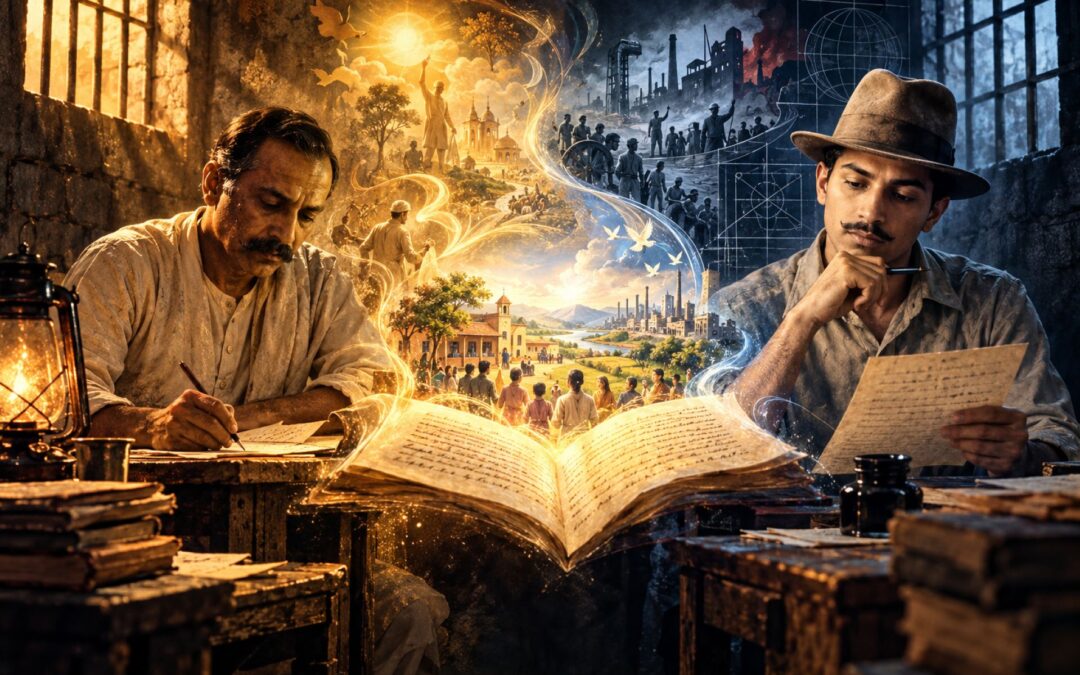
In 1931, while awaiting execution in a British colonial prison, Bhagat Singh was asked to write an introduction to a poem whose philosophical outlook he fundamentally disagreed with. The poet was Lala Ram Saran Das, a veteran revolutionary who had spent years in prison for his involvement in India’s struggle against British rule. His work, The Dreamland, imagined a better society through a combination of religious philosophy, revolutionary idealism, and proposals for social reconstruction.
Bhagat Singh accepted the invitation but made his disagreements explicit. He was an atheist and materialist, whereas Ram Saran Das understood the world through spiritual and metaphysical ideas. Yet Bhagat Singh believed the poem addressed an important weakness in revolutionary politics: the tendency to concentrate on overthrowing oppressive governments without adequately explaining what should replace them.
Revolutionaries in Dialogue: Lala Ram Saran Das and Shaheed Bhagat Singh, edited by Malvinderjit Singh Waraich and published by Unistar Books in 2007, brings this intellectual encounter into a broader historical setting. The collection preserves the relationship between Das’s revolutionary poetry and Bhagat Singh’s critical introduction, alongside biographical testimony, retrospective material, and historical documents concerning the revolutionary movement.
The result is a distinctive account of two generations of Indian revolutionaries who shared a commitment to political freedom while approaching religion, socialism, violence, and social transformation from different philosophical positions. Their exchange raises questions extending beyond the struggle against British rule: what kind of society should a revolution create, and how can revolutionaries reconcile their ultimate ideals with the methods required to achieve them?

Why This Dialogue Was Preserved
The central historical relationship in Revolutionaries in Dialogue developed between two men whose revolutionary experiences were separated by a generation. Ram Saran Das belonged to the earlier anti-colonial underground associated with the Ghadar movement and the revolutionary conspiracies of the First World War. Bhagat Singh emerged from the political environment of the 1920s and became associated with the Hindustan Socialist Republican Association, whose programme increasingly emphasised socialism and the transformation of economic and political institutions.
Their relationship was unusual because the older revolutionary invited the younger man to introduce his literary work, despite knowing that their philosophical convictions differed. Bhagat Singh did not conceal these differences or offer the conventional praise expected from an introductory essay. Instead, he examined the poem as a political document, accepting some of its social proposals while challenging its assumptions about religion and revolutionary methods.
Waraich’s collection preserves this exchange as part of a wider historical record. The 2007 edition published by Unistar Books combines literary, autobiographical, and documentary material associated with the two revolutionaries. Its significance therefore extends beyond the introduction, which had circulated independently for many years while the complete poem remained difficult for readers to obtain.
The editor’s account of his work describes the central exchange as one between an atheist and a mystic. This framing captures the difference between Bhagat Singh’s materialist philosophy and Das’s religious idealism, but the dialogue is more complicated than a disagreement about God’s existence.
Both men were concerned with the political future of India and the construction of a society without exploitation. Their differences involved the nature of reality, the function of religion, the role of political power, and the relationship between revolutionary action and social education.
The collection also restores attention to Ram Saran Das himself. His years of imprisonment, participation in revolutionary organisations, and experiences with colonial prosecutions provide a historical background that is easily overlooked when his poem is discussed only as an occasion for explaining Bhagat Singh’s philosophy.
The book’s distinctive contribution is the preservation of disagreement within a shared revolutionary tradition. Rather than presenting the movement as ideologically uniform, its central documents reveal the changing political and philosophical concerns of revolutionaries who confronted different historical circumstances.
Ram Saran Das and the Earlier Revolutionary Generation
Lala Ram Saran Das Talwar was born in Kapurthala, Punjab, on 24 August 1888. He belonged to an earlier generation of Indian revolutionaries whose political commitments developed before the emergence of Bhagat Singh as a nationally recognised figure.
According to Bhagat Singh’s account, Das entered organised revolutionary activity in Punjab in 1908 through contact with an underground revolutionary from Bengal. This placed him within a political environment shaped by secret associations, resistance to British colonial rule, and the influence of revolutionary movements operating across different regions of India.
The revolutionary organisations of this period generally rejected the belief that constitutional petitions and gradual administrative reforms would be sufficient to end colonial domination. Many activists regarded British authority as dependent upon coercion and believed that resistance would require underground organisation, political agitation, and potentially armed rebellion.
Das subsequently became associated with the Ghadar movement, which developed among Indian expatriates, particularly in North America, and sought to overthrow British rule. The Ghadar revolutionaries attempted to mobilise Indians internationally and encourage rebellion within India, especially during the First World War, when Britain was engaged in a major European conflict.
The movement possessed a comparatively explicit political objective. As Bhagat Singh later observed, the Ghadar Party drew inspiration from republican institutions and sought to replace colonial government with a republic. That objective distinguished it, in his assessment, from revolutionary organisations whose political ambitions were defined primarily through opposition to foreign rulers.
Das’s involvement exposed him to the colonial government’s campaign against revolutionary conspiracies. In 1915, he was convicted in the first Lahore Conspiracy Case and sentenced to death. His sentence was subsequently commuted to transportation for life.
The commutation spared him execution but subjected him to prolonged incarceration. He experienced imprisonment in the Andamans and in prisons elsewhere in British India, including the southern penal institutions associated with the composition of The Dreamland.
These experiences became central to his later writing. Prison separated him from his family, restricted his activities, and exposed him to the psychological difficulties of confinement over many years.
Bhagat Singh’s introduction states that Das endured approximately fourteen years of imprisonment. It also identifies the pressure created when other prisoners secured release by giving undertakings to the authorities. For someone committed to revolutionary principles, the possibility of freedom could become inseparable from the fear of abandoning those principles.
Following his release in the 1920s, Das established contact with Bhagat Singh, Sukhdev, and other members of the younger revolutionary generation. His involvement with the revolutionary movement brought him into the political environment surrounding the Hindustan Socialist Republican Association.
The relationship between the generations was important because the younger revolutionaries increasingly developed political ideas different from those associated with their predecessors. Whereas many earlier revolutionaries combined republican nationalism with religious idealism, Bhagat Singh’s later writings expressed a more explicitly materialist and socialist understanding of political transformation.
Das was subsequently arrested in connection with the later Lahore conspiracy proceedings. Biographical material accompanying Bhagat Singh’s introduction records that he accepted the authorities’ offer of pardon in exchange for cooperation, then retracted his statement. The subsequent proceedings included a conviction for perjury, with the sentence reduced on appeal.
These events introduce difficult questions concerning coercion, imprisonment, personal responsibility, and the reliability of testimony produced during colonial prosecutions. They also show why a revolutionary’s life cannot always be understood through simple categories of courage and betrayal.
The circumstances of an approver’s statement, its retraction, and subsequent punishment require attention to the original legal record rather than assumptions about what a person must have intended.
Das survived into independent India and died in 1963. His later recollections therefore connect the revolutionary struggles of the early twentieth century with the historical reassessment of those events after independence.
Waraich’s collection places this relatively neglected life alongside Bhagat Singh’s more familiar political writings. It offers a way to understand the revolutionary movement through the experiences of individuals whose contributions were significant without producing the same enduring public recognition.
Prison, Family, and the Writing of The Dreamland
The Dreamland emerged from the psychological and intellectual conditions of prolonged imprisonment. Ram Saran Das composed the work in verse while confined in southern India, with accounts identifying Salem Central Prison in the Madras Presidency as its place of composition.
The circumstances matter because the poem’s ideal society was imagined by a man whose immediate world was defined by confinement, separation, and uncertainty. Its religious language and vision of social harmony arose alongside intensely personal experiences of suffering.
Bhagat Singh’s introduction provides an unusually direct interpretation of these conditions. Writing from his own condemned cell, he argues that life imprisonment could impose a burden more difficult to endure than the anticipation of execution.
His reasoning rests on the prolonged character of imprisonment. A death sentence imposes the knowledge of an approaching end, while a life sentence may require a prisoner to confront years of isolation, frustrated hope, and repeated uncertainty about release.
For Das, these conditions were intensified by memories of his wife, children, and friends. The emotional difficulty was not simply that he missed them. His attachments also exposed him to the temptation to abandon revolutionary commitment in exchange for the possibility of returning to ordinary life.
Bhagat Singh identifies this conflict in the opening of the poem, where familiar human relationships are described through disturbing imagery. The people ordinarily associated with affection and companionship appear as threatening entanglements.
The image should not be interpreted as evidence that Das hated his family. Within the psychological circumstances described by Bhagat Singh, it expresses the anguish of someone who experiences love and attachment as sources of vulnerability.
To remember family was to confront what imprisonment had taken away. To imagine reunion was also to consider the possibility of securing release through concessions that might contradict earlier political commitments.
The poem’s religious philosophy offered a way of responding to this conflict.
Das turned toward prayer, devotion, and a view of worldly existence as transient or illusory. Such ideas could reduce the apparent importance of immediate suffering by locating human experience within a larger spiritual reality.
Bhagat Singh connected this tendency to the mystical traditions of Indian philosophy, particularly ideas associated with the unreality or impermanence of the phenomenal world.
He rejected the philosophical assumptions involved but recognised their psychological significance. Religious contemplation could offer consolation to a prisoner struggling with loneliness and discouragement.
The poem therefore begins from a recognisably human problem before developing its political vision. The author must confront the suffering of his own circumstances before imagining a society in which suffering might be reduced through different institutions and relationships.
This movement from personal distress to social imagination gives The Dreamland its historical interest.
The work was neither an ordinary prison diary nor a political manifesto written entirely in argumentative prose. Its poetic form allowed Das to combine emotional experience, spiritual aspiration, and institutional proposals within an imagined world.
The surviving commentary establishes the importance of these themes, although it does not provide a complete stanza-by-stanza record of the poem. Its identifiable development nevertheless shows a revolutionary attempting to preserve his commitment by giving positive form to the society for which he had sacrificed his freedom.
The Dreamland’s Imagined Society
The political importance of The Dreamland lies in its attempt to describe a society beyond colonial oppression and existing social inequalities.
Bhagat Singh considered this a significant achievement because revolutionary movements often concentrated on removing existing rulers without adequately defining the institutions that should replace them. Das’s poem offered a positive vision rather than limiting itself to the denunciation of an oppressive political order.
Its imagined society combines spiritual assumptions with proposals concerning education, labour, justice, military organisation, and international relations. These subjects show that the poem is concerned with the practical organisation of social life, even though its overall philosophy remains religious and idealist.
The philosophical foundation appears near the beginning. Das invokes God and a conception of worldly existence influenced by traditions of Indian metaphysical thought. The phenomenal world is presented through ideas associated with illusion, transience, and the distinction between spiritual reality and material appearances.
Such a perspective can be understood as an attempt to make suffering bearable, but it also provides a moral foundation for imagining a world less governed by selfishness and conflict.
The ideal society is therefore connected to a transformation in human consciousness. Its inhabitants are expected to develop attitudes and relationships different from those associated with existing political and economic institutions.
Education occupies an important place within this vision.
Das advocates free education and imagines a society in which intellectual development is not restricted by conventional social distinctions. Bhagat Singh regards this proposal favourably and compares it with educational arrangements associated with socialist policies in Soviet Russia.
The significance of education extends beyond literacy or professional training. In an egalitarian society, education would help people participate in collective life and understand the principles underlying social organisation.
A society could not become genuinely cooperative merely because its government adopted a different name. Its members would need opportunities to develop the knowledge and habits required to sustain different relationships.
The poem also addresses the distinction between intellectual and manual labour.
In many societies, people engaged in intellectual or administrative work enjoy greater prestige than those performing physical labour. This hierarchy can reinforce wider divisions of class and status.
Bhagat Singh interprets Das’s ideal in relation to socialist aspirations, arguing that intellectual work remains productive but should not automatically confer superiority over manual work.
The issue is not whether different occupations require different skills. It concerns whether such differences justify treating people as inherently unequal.
A further part of the imagined society concerns crime and punishment.
Das had extensive firsthand experience of imprisonment, and his proposals reflect that background. Bhagat Singh notes the poem’s familiarity with categories of prison labour and its rejection of punishment understood primarily as retaliation.
The proposed alternative is rehabilitative justice.
Instead of treating offenders simply as people who deserve suffering, a reformed system would examine the possibility of changing their behaviour and restoring their relationship with society.
This would require institutions designed for education and reform rather than humiliation and cruelty. The purpose of confinement would change accordingly.
Bhagat Singh gives this aspect of the poem particularly strong approval. He considers the treatment of crime one of its most advanced social ideas, partly because Das’s prison experiences give the subject a practical urgency.
The imagined society also addresses war.
A world organised around economic cooperation and the elimination of exploitation would, in this conception, reduce the causes of conflict between nations.
War would no longer be driven by the desire to acquire territory, markets, prestige, or imperial advantage. The military institutions associated with existing political systems might become unnecessary as the social and economic causes of conflict diminished.
Bhagat Singh recognises that such a condition could not be achieved immediately. He discusses the possibility of armies remaining necessary during a transitional period, particularly when a revolutionary society faced threats from hostile states.
The poem’s treatment of international relations extends toward the idea of a world federation.
Das’s vision suggests that humanity should develop institutions capable of overcoming narrow national rivalries. Bhagat Singh praises the poem’s criticism of the League of Nations, which he regards as inadequate to the political problems of its time.
The international dimension is important because the ideal society is not conceived merely as an independent India repeating the competitive behaviour of existing states.
The most consequential question concerns how such a society could be established.
In a footnote associated with stanza 571 or 572, depending on the textual numbering, Das argues that the ideal social order cannot simply be imposed through violent revolution. It must develop through gradual change and the education of the population.
This argument places human development at the centre of social transformation.
A government might introduce new policies, but people would also need to acquire the knowledge, commitments, and relationships necessary for those policies to function.
Bhagat Singh accepts the underlying concern while questioning whether gradual education alone can overcome institutions committed to preserving existing inequalities.
The poem thus presents two related objectives: the creation of a better institutional order and the development of people capable of living within it.
Its surviving arguments do not establish a complete, internally consistent programme for achieving every proposed reform. Nevertheless, they show an attempt to imagine the constructive work of revolution rather than concentrating exclusively on the destruction of an existing government.
Bhagat Singh’s Introduction: Appreciation and Disagreement
Bhagat Singh begins his introduction with an explanation of why he considers himself an unusual choice for the task.
He describes his lack of formal qualifications as a literary critic and states that he does not intend to judge the poem’s metre or determine its position within national literature. His interest is political, and he proposes to examine the work from that perspective.
He then identifies a more substantial difficulty.
The conventional author of an introduction generally supports the work being introduced. Bhagat Singh, however, disagrees with Das on several important matters, and Das already knows this.
He therefore admits that his contribution may function as criticism rather than endorsement. This opening establishes intellectual disagreement as the central feature of the relationship.
The complete text of Bhagat Singh’s Introduction to Dreamland reveals that his first major concern is the absence of sufficiently clear political objectives within revolutionary movements.
He argues that many nationalist organisations define their aims through opposition to British rule without explaining the social arrangements they intend to establish afterward.
The distinction is fundamental to his conception of revolution.
Replacing existing rulers or securing limited reforms does not necessarily transform the structure of society. Revolution requires a programme for constructing a different political and social order.
Bhagat Singh distinguishes between political reformers, more radical nationalists, and revolutionaries who employ extreme methods. He argues that the willingness to use force does not, by itself, establish a revolutionary programme.
A movement might employ violence while seeking relatively limited political changes. Conversely, a movement committed to fundamental social reconstruction must define its objectives beyond the immediate confrontation with an existing government.
He credits the Ghadar Party with articulating a republican political objective and regards Das’s poem as a further attempt to describe the society revolutionaries should seek to establish.
This is the basis of his appreciation.
Bhagat Singh does not regard the poem as important because he agrees with every proposal. He values it because it addresses a problem that revolutionary activity cannot permanently avoid: the relationship between overthrowing an oppressive order and constructing something better.
The introduction then turns toward the author’s historical circumstances.
Bhagat Singh recalls Das’s early revolutionary involvement, conviction in 1915, commuted death sentence, and prolonged imprisonment. He describes the psychological pressures that shaped the poem, including isolation, discouragement, and memories of family.
The comparison with his own situation is striking.
Bhagat Singh was himself awaiting execution, yet he argues that the accumulated burden of life imprisonment may exceed the suffering associated with a death sentence.
This observation gives the discussion an unusual intimacy. He is interpreting the work of another prisoner while confronting his own approaching death.
The poem’s mystical philosophy becomes intelligible within this setting.
Bhagat Singh explains how prayer and religious contemplation may offer relief from despair. He nevertheless rejects the philosophical explanation of reality that accompanies those practices.
Das’s conception is described as teleological and metaphysical, whereas Bhagat Singh identifies his own position as materialist and causal.
The disagreement concerns the way events should be explained.
A teleological interpretation understands existence through purposes or intended ends. A causal interpretation seeks to explain events through the conditions and processes that produce them.
Bhagat Singh therefore objects to the idea that material existence can be adequately understood through spiritual intention or the claim that the visible world is fundamentally illusory.
Yet he refuses to dismiss the poem’s religious language merely because he rejects its philosophy.
He recognises the emotional and literary significance of mysticism, particularly for someone enduring the pressures of imprisonment. Its power to console and encourage can be acknowledged without accepting its metaphysical claims.
He also understands the ideas historically. Das belongs to an earlier revolutionary generation whose intellectual environment differed from that of the younger socialists.
The introduction subsequently turns toward the institutional arrangements of the imagined society.
Bhagat Singh approves of Das’s proposals concerning education. He sees educational development as indispensable to social transformation and connects the proposal with contemporary socialist experiments.
He also discusses the distinction between intellectual and manual labour, rejecting the assumption that mental work should confer a superior social position.
These observations reveal his interest in the everyday organisation of an egalitarian society.
His strongest approval is reserved for the poem’s treatment of crime and punishment.
He recognises that Das’s years in prison have given him direct knowledge of penal institutions. The poem’s emphasis on reform rather than revenge corresponds to Bhagat Singh’s belief that punishment should aim at reclaiming offenders.
Prisons, in this view, should function as institutions of rehabilitation rather than places organised primarily around suffering.
The argument addresses a practical problem of social reconstruction. Even a society committed to equality would need institutions to respond to harmful behaviour, and the principles governing those institutions would reveal the character of the political order.
Bhagat Singh next considers war and international relations.
He discusses the prospect of a society in which economic exploitation and imperial ambition no longer produce the same incentives for war. He also recognises that military institutions may remain necessary during the transition toward socialism.
Soviet Russia provides his principal contemporary comparison. He observes that a socialist government may still require military organisation to defend itself against hostile political systems.
This introduces a distinction between the desired future and the conditions prevailing during the process of reaching it.
The final major disagreement concerns revolutionary methods.
Das suggests that an ideal society cannot be imposed from outside through violence. It must develop gradually through the education of the people.
Bhagat Singh accepts that social transformation requires changes in consciousness, habits, and relationships. He does not believe an egalitarian society can be created simply by ordering people to behave differently.
However, he argues that the existing government and capitalist institutions are unlikely to support educational programmes intended to undermine their own power.
If such institutions suppress attempts at social transformation, education alone may not provide a sufficient strategy.
The revolutionaries therefore seek to acquire political power and establish a government capable of supporting mass education and social reconstruction.
Bhagat Singh distinguishes the struggle for power from the constructive work that follows. The former may involve coercion or force, while the latter requires sustained educational and institutional development.
He interprets Das’s argument sympathetically, suggesting that their disagreement may be smaller than the wording initially indicates.
This interpretation does not remove every tension between them. It shows Bhagat Singh attempting to reconcile the poem’s emphasis on gradual development with his belief that political power must first be transformed.
The introduction concludes by returning to the historical value of the work.
Bhagat Singh does not demand revisions to eliminate the ideas with which he disagrees. He believes the poem should preserve the outlook of an earlier generation, allowing younger revolutionaries to understand and evaluate it.
His final recommendation is that readers approach the poem critically, question its assumptions, and use it to develop their own political understanding.
This conclusion is essential to the character of the exchange. Bhagat Singh’s response does not claim authority by suppressing disagreement. It treats disagreement as a necessary part of revolutionary education.
Ram Saran Das’s Later Preface and the Unfinished Dialogue
The exchange preserved in Waraich’s collection extends beyond Bhagat Singh’s introduction.
Ram Saran Das survived the colonial period and lived for more than a decade after Indian independence. His later reflections therefore emerged from historical circumstances substantially different from those in which The Dreamland and its introduction were written.
An independent review of the 2007 collection confirms that the volume includes a preface written by Das after independence. The reviewer describes it as responding to questions raised by Bhagat Singh’s introduction.
This makes the collection’s title particularly appropriate.
The original relationship was already a dialogue in the intellectual sense: Das presented a vision of society, and Bhagat Singh examined it through agreement and criticism.
The later preface adds a retrospective dimension. Das could consider his earlier work after the end of British colonial rule and after the death of the younger revolutionary whose criticism had become an important part of the poem’s historical identity.
The passage of time also changed the significance of their exchange.
For Bhagat Singh, revolution remained an immediate political struggle whose outcome was uncertain. For Das writing after independence, the colonial government had been removed, although the social and economic transformation imagined by revolutionaries remained a separate question.
This difference in historical perspective is important, but the precise arguments of Das’s retrospective response cannot be established from the independently available descriptions.
It would therefore be misleading to claim that he accepted or rejected particular criticisms, altered his religious philosophy, or revised his theory of revolutionary methods without examining the preface itself.
What can be established is the importance of preserving his response.
Without it, the exchange might appear one-sided: the older revolutionary produces a poem, and Bhagat Singh supplies the interpretation through which subsequent readers encounter it.
The inclusion of Das’s later words gives the original author an opportunity to reconsider the dialogue and complicates the tendency to treat Bhagat Singh’s introduction as the final judgment on the work.
The Memoirs and Documentary Appendices
The collection’s historical value extends beyond its central literary exchange. It also preserves material concerning Ram Saran Das’s revolutionary activities, personal recollections, and the colonial investigations and prosecutions in which he became involved.
The memoir component is particularly important because Das occupied a position connecting the Ghadar-era revolutionary movement with the later generation associated with Bhagat Singh and Sukhdev.
His experiences included underground political activity, conviction in the first Lahore Conspiracy Case, prolonged incarceration, and later association with younger revolutionaries.
These events can be established through biographical accounts, but a memoir offers a different kind of evidence.
Autobiographical writing reveals how a participant remembers particular events, explains decisions, interprets relationships, and assigns meaning to experiences after they have occurred.
Such testimony is historically valuable precisely because it is personal. It can preserve details absent from official records while also reflecting selective memory, changing judgments, and the desire to explain controversial actions.
This distinction is relevant to the later legal proceedings involving Das.
Accounts associated with Bhagat Singh’s introduction record that Das accepted a pardon in connection with his cooperation with the authorities, subsequently retracted his statement, and faced a perjury conviction.
These events cannot be evaluated adequately without examining the original testimony and the conditions under which it was produced.
The collection’s documentary appendices potentially provide important context for such questions.
The available bibliographic contents identify an appendix containing a pamphlet recovered from Ram Saran Das and another containing material from the Lahore conspiracy proceedings.
A recovered pamphlet may help establish the political activities, networks, or documentary evidence associated with a revolutionary prosecution. Court proceedings may preserve testimony, official allegations, contradictions, or explanations that require comparison with later recollections.
However, the titles alone do not establish what the individual documents prove.
The proceedings must be understood as records produced within a colonial legal system concerned with suppressing revolutionary organisations. They may contain valuable factual information, but the descriptions and accusations of officials should not automatically be accepted as neutral historical judgments.
Similarly, a memoir written after the events may challenge official interpretations without necessarily settling every factual disagreement.
The relationship between different kinds of evidence is therefore central to the collection’s potential value.
An additional feature of the published volume is the presence of multiple numbered appendices and a second part identified in its limited contents listing. Several of these documentary units are not sufficiently described in accessible bibliographic sources to permit a reliable individual summary.
Their presence nevertheless establishes that the collection is more than a reprint of The Dreamland and Bhagat Singh’s introduction.
Waraich’s editorial undertaking also involves recovering and arranging historical records concerning an individual whose role in the independence movement is less familiar than that of Bhagat Singh.
The strength of this approach depends on the quality of documentary selection, attribution, historical explanation, and the relationship established between sources.
These are particularly important when a collection combines personal memories with records originating from criminal investigations.
For readers of revolutionary history, the documentary material offers an opportunity to examine the past through different kinds of testimony. The resulting picture is potentially more complicated than the heroic narratives through which revolutionary figures are often remembered.
Mysticism, Materialism, and the Meaning of Revolution
The principal philosophical disagreement between Ram Saran Das and Bhagat Singh concerns how reality should be understood and how human beings might transform it.
Das’s ideal society emerges from a worldview shaped by religious and mystical assumptions. Bhagat Singh approaches the same problem through materialism, seeking explanations based on observable conditions and causal relationships.
These differences become clearer when examined through the intellectual foundations of each position.
A mystical interpretation may understand worldly suffering through a distinction between temporary material appearances and a deeper spiritual reality. Human fulfilment can consequently involve overcoming attachment to immediate experiences and developing a different relationship with existence.
For an imprisoned revolutionary, this outlook could provide consolation.
Separation from family, physical confinement, and the prospect of spending the remainder of one’s life in prison might become more bearable if suffering were understood within a larger spiritual framework.
Bhagat Singh acknowledges this psychological function even though he rejects the metaphysical assumptions involved.
His materialism begins from a different premise.
Human suffering must be explained through material conditions, institutions, and social relationships rather than through purposes attributed to supernatural forces.
Economic exploitation, for example, requires an examination of property relations, labour, political authority, and the interests protected by existing institutions.
The difference between teleological and causal explanation therefore has political consequences.
A teleological interpretation looks for purpose or direction in the order of existence. A causal interpretation asks what conditions produce a particular outcome and what changes would be necessary to produce a different one.
Bhagat Singh considers the second approach more suitable for understanding the historical problems of revolution.
Yet his response to Das is more sophisticated than a simple rejection of religious thought.
He recognises that the poem expresses genuine aspirations for social equality and human improvement. Its religious foundation does not prevent it from proposing institutions compatible with important socialist objectives.
Indeed, Bhagat Singh agrees with aspects of the poem’s treatment of education, labour, punishment, and international cooperation.
This shows that philosophical disagreement does not necessarily establish complete disagreement over political ends.
The same institutional proposal can be justified through different intellectual traditions.
Das might imagine a more harmonious society through spiritual and moral transformation. Bhagat Singh might support similar arrangements because of their relationship to economic equality, human development, and material conditions.
The agreement becomes unstable when the discussion turns to political methods.
If social improvement depends primarily on spiritual or educational development, gradual transformation may appear sufficient. If existing institutions actively defend economic exploitation, obtaining political power becomes a more urgent requirement.
The disagreement is therefore connected to different explanations of how social change occurs.
Another distinction concerns the relationship between historical development and intellectual judgment.
Bhagat Singh recognises that Das belonged to a revolutionary generation shaped by different political experiences and philosophical influences. He resists demanding that the earlier writer adopt every position developed by later socialists.
The historical importance of The Dreamland partly depends upon its preserving those older ideas.
This approach also helps explain Bhagat Singh’s treatment of books more generally.
J. Daniel Elam’s scholarly discussion of Bhagat Singh’s reading practices and political criticism emphasises that reading was an active intellectual practice involving disagreement rather than passive acceptance.
Bhagat Singh’s introduction demonstrates that approach directly. He does not merely identify a set of correct revolutionary ideas and dismiss everything else.
He examines the circumstances in which the poem was written, recognises the value of its proposals, identifies conceptual disagreements, and encourages readers to form independent judgments.
This is an important quality of the exchange.
A shared commitment to political transformation does not require identical philosophical beliefs. The difficulty is determining which disagreements affect the practical objectives of a movement and which can coexist within a broader struggle.
Revolutionaries in Dialogue preserves an instance in which two participants in the revolutionary tradition confronted that problem through literary and political criticism.
Education, Punishment, Work, and World Federation
The institutional proposals discussed in The Dreamland reveal the constructive dimension of revolutionary politics.
The poem’s imagined society concerns more than the removal of foreign rulers. It asks how education, economic activity, criminal justice, and relations between political communities should operate within a different social order.
Education is central because institutional change alone cannot guarantee changes in social behaviour.
A society committed to equality requires people capable of understanding its principles and participating in collective decisions. Education is therefore connected to citizenship, political consciousness, and the development of relationships not organised around inherited privilege.
Bhagat Singh welcomes Das’s proposal for free education.
He considers educational development essential to socialist transformation and refers to contemporary developments in Soviet Russia as an example of a government attempting to reorganise social institutions.
These comparisons reflect his political understanding in the early 1930s. They should be distinguished from a comprehensive assessment of the Soviet educational system or its later development.
The relationship between intellectual and manual labour raises another issue.
In many social systems, occupations associated with formal education, administration, or intellectual activity receive greater prestige than physically demanding forms of work.
This can create a hierarchy between people whose contributions are differently valued despite their collective importance.
The socialist ideal discussed by Bhagat Singh does not require denying that different kinds of work exist. It challenges the assumption that intellectual labour makes a person inherently superior to someone performing manual labour.
Such a change would affect education, workplace relationships, social status, and the distribution of respect within everyday life.
The poem’s approach to crime and punishment is especially significant because of Das’s personal experience of imprisonment.
His knowledge of prison labour and penal discipline provided a practical background for questioning the purpose of punishment.
Retributive justice is concerned with imposing suffering in response to wrongdoing. Rehabilitative justice places greater emphasis on changing behaviour and enabling offenders to return to society.
Bhagat Singh strongly favours the second principle.
He argues that prisons should become institutions of reform rather than environments organised around cruelty and degradation.
The proposal raises questions extending beyond the treatment of individual prisoners. If the social order itself produces deprivation and harmful behaviour, a system of justice concerned with rehabilitation must examine those underlying conditions.
That reasoning fits the wider revolutionary aspiration to reconstruct society rather than merely replace its political leadership.
Nevertheless, rehabilitation is an ideal requiring institutions capable of protecting society while treating offenders humanely. The surviving discussion does not establish a complete administrative system for resolving every conflict between those objectives.
The poem’s treatment of war extends its social vision beyond national boundaries.
If economic exploitation and imperial competition contribute to international conflict, a society organised around cooperation might reduce the causes of war.
Bhagat Singh discusses the possibility that military institutions could eventually become unnecessary, while recognising that revolutionary governments might face threats during periods of transition.
This creates a distinction between the ultimate aim of peaceful international relations and the immediate requirements of political survival.
The idea of a world federation develops the same concern at the international level.
A federation of cooperating political communities could potentially replace the rivalry of imperial powers with institutions based on common interests.
Bhagat Singh praises Das’s criticism of the League of Nations, which he considers inadequate to the problem of preventing war and overcoming the inequalities of the existing international order.
These proposals should be understood as elements of a projected society rather than fully specified institutional plans.
Their importance lies in the questions they raise about the purpose of revolution.
A revolution committed to human welfare must consider how people learn, work, respond to wrongdoing, and relate to communities beyond their own country.
The poem’s attempt to imagine such arrangements explains why Bhagat Singh regarded it as politically valuable despite his philosophical disagreements.
Political Violence, Revolution, and Social Change
The disagreement over revolutionary methods brings the central political problem of The Dreamland into sharper focus.
Das argues that an ideal society cannot simply be imposed through violence. It must develop gradually as people acquire the knowledge, convictions, and social habits necessary to sustain it.
Bhagat Singh accepts the importance of this argument but considers it incomplete.
The question is whether an existing political system will permit the educational and social developments that threaten its own foundations.
A colonial government may tolerate certain reforms while suppressing organisations seeking to overthrow its authority. Similarly, economic groups benefiting from existing property relations may resist efforts to transform those relations.
For Bhagat Singh, these conditions make the struggle for political power an indispensable part of revolutionary strategy.
He distinguishes between gaining power and constructing the desired social order.
The former concerns the removal or transformation of institutions that prevent revolutionary change. The latter involves education, social organisation, and the gradual development of new relationships.
This distinction helps explain why he does not interpret Das’s rejection of an externally imposed society as a complete abandonment of revolution.
A government might possess the means to introduce reforms, but it cannot automatically create the social consciousness required for an egalitarian society to function.
Conversely, political education may not be sufficient if existing authorities actively suppress organisations attempting to transform society.
Bhagat Singh therefore proposes a sequence in which revolutionary forces acquire political power and then use the resources of government for constructive social development.
His position does not imply that every objective can be accomplished through force. He explicitly recognises that social reconstruction requires methods different from those used to challenge an entrenched political order.
Nevertheless, the argument contains tensions.
A revolutionary government claiming to educate the population could itself become coercive, particularly if opposition were treated as an obstacle to be crushed.
The relationship between a promised egalitarian future and the exercise of concentrated political power therefore requires critical examination.
The introduction does not provide a complete institutional solution to this problem.
It also does not demonstrate that the revolutionary movement possessed the organisational capacity to establish the kind of government Bhagat Singh imagined.
What it does provide is a clear distinction between the immediate struggle against an existing political system and the sustained work necessary to create a different society.
The distinction is particularly relevant because revolutionary movements are frequently judged through their most dramatic actions.
Armed resistance may generate publicity, challenge authority, or express political opposition. It does not, by itself, explain how education should function, how economic relations should be reorganised, or how institutions of justice should operate.
Das’s poem requires readers to confront those constructive questions.
Bhagat Singh’s introduction insists that answering them must be accompanied by an explanation of how political power can be transformed.
Their disagreement is therefore narrower than a simple opposition between violence and nonviolence, but it remains substantial.
Both recognise that a new society cannot be created through destruction alone. They differ in the emphasis placed on political power, educational development, and the relationship between these processes.
Revolutionary Friendship Across Generations
The relationship between Ram Saran Das and Bhagat Singh offers a distinctive example of intellectual exchange within India’s revolutionary movement.
Das was an older activist who had endured imprisonment and participated in revolutionary activities long before Bhagat Singh became prominent. His experiences belonged to the formative period of the Ghadar movement and earlier underground organisations.
Bhagat Singh represented a younger generation whose political thinking had increasingly developed toward socialism and materialism.
The difference in age and experience could have encouraged a relationship based primarily on seniority. Instead, the surviving exchange reveals an older revolutionary willing to invite criticism from a younger colleague.
Bhagat Singh’s response is equally revealing.
He does not treat Das’s invitation as an obligation to praise the work unconditionally. He openly states his disagreements and questions the political assumptions underlying the poem.
Yet he consistently acknowledges the importance of Das’s sacrifices and the circumstances in which the poem was produced.
This combination of respect and criticism gives the relationship its particular character.
It also challenges the idea that revolutionary solidarity necessarily required complete ideological uniformity.
The two men could share a history of opposition to British rule while disagreeing about religion, political strategy, and the philosophical foundations of social change.
Their common commitment made disagreement possible without automatically converting it into hostility.
The contrast between their prison experiences deepens the relationship.
Das had endured years of imprisonment, while Bhagat Singh wrote from a condemned cell. Both understood confinement as something more immediate than an abstract political subject.
Bhagat Singh’s discussion of the psychological burden of life imprisonment therefore carries a particular significance. He recognises that the older revolutionary’s experience differed from his own and that the poem’s philosophical character was inseparable from those conditions.
The preservation of this exchange also has a historical consequence.
Bhagat Singh’s public image often dominates accounts of the revolutionary movement, leaving comparatively little room for the intellectual contributions of other activists.
Waraich’s collection reverses that tendency to some extent by placing Das’s work and historical experiences at the centre of the discussion.
Bhagat Singh remains important, but his role is that of a participant in an exchange rather than its sole subject.
How the Collection Builds Its Historical Argument
Revolutionaries in Dialogue belongs to a form of historical publication in which original writings and documents carry much of the intellectual substance.
The editor’s role involves more than explaining the subject. It includes recovering materials, establishing their historical relevance, arranging them meaningfully, and giving readers access to sources that may otherwise remain scattered or difficult to obtain.
This is particularly important for The Dreamland.
Bhagat Singh’s introduction circulated independently, allowing readers to encounter his philosophical and political arguments without necessarily having access to the poem he was discussing.
That separation creates an interpretive problem.
An introduction written as criticism depends upon the work it examines. When the original text is unavailable, readers may begin treating the critic’s selection of examples as though it represents the complete contents.
Publishing the poem alongside the introduction restores the possibility of examining their relationship more directly.
It also changes the position of Ram Saran Das.
He becomes more than the subject of Bhagat Singh’s remarks. His own literary work can be considered as an expression of revolutionary experience and political imagination.
The later preface introduces a further dimension by allowing the historical author to respond retrospectively.
Memoir material and documentary appendices extend the collection beyond literary criticism. They connect the philosophical exchange to criminal prosecutions, underground revolutionary activity, imprisonment, and the broader networks within which the two men operated.
These different kinds of writing require different methods of interpretation.
A poem can reveal the ideals and emotional experiences of its author without necessarily recording historical events with documentary precision.
An introduction can explain the political positions of its writer while also reflecting the rhetorical purpose of supporting and criticising another person’s work.
A memoir provides personal testimony shaped by memory and hindsight.
A court document records statements produced under legal and political circumstances that affect their meaning.
Bringing these materials together can produce a richer understanding of historical experience than any one type of source offers independently.
However, the editorial arrangement must allow readers to distinguish these forms.
Chronology, attribution, document provenance, and the circumstances of composition are essential to understanding their relationship.
The accessible contents confirm that Waraich’s volume includes multiple appendices and material from the Lahore conspiracy proceedings. They do not establish every editorial decision through which these sources are organised or interpreted.
The significance of the collection therefore rests on a demonstrable achievement and a corresponding critical question.
Its recovery of the central literary exchange gives readers access to an important relationship between revolutionary generations. The full effectiveness of its documentary construction depends on how accurately and clearly the edition contextualises the remaining materials.
The Historical and Literary Value of Revolutionaries in Dialogue
The most distinctive achievement of Revolutionaries in Dialogue is its recovery of an intellectual relationship that complicates familiar narratives of India’s revolutionary movement.
Its central documents reveal revolutionaries concerned with political ideas, literary expression, personal suffering, and the practical construction of a different society.
The collection is particularly valuable because it restores attention to Ram Saran Das.
His long imprisonment and earlier revolutionary involvement place him within a generation whose experiences shaped the movement before Bhagat Singh’s political emergence.
His poem reveals an attempt to preserve revolutionary purpose through spiritual reflection and the imagination of a future social order.
This gives The Dreamland significance as both political literature and a response to imprisonment.
The poem’s importance does not depend solely on whether its philosophy is accepted. It also lies in the questions it raises about the constructive purpose of revolution.
Education, punishment, work, and international cooperation are not the subjects most readily associated with underground revolutionary activity. Their presence reveals an interest in the organisation of everyday life after political transformation.
Bhagat Singh’s introduction gives these questions additional force.
His criticism identifies the limitations of mystical explanations while recognising that the poem addresses genuine political problems.
The resulting intellectual exchange is valuable because neither writer’s contribution can be reduced to the other’s.
Das offers a vision of an ideal society shaped by his experience and beliefs. Bhagat Singh examines that vision from a materialist perspective and develops arguments about political power and socialist reconstruction.
The relationship also demonstrates an approach to political reading that is often absent from simplified representations of ideological commitment.
Bhagat Singh does not require readers to accept an entire work because its author belongs to the revolutionary movement. Nor does he dismiss it because he disagrees with its philosophical foundations.
He encourages critical engagement.
That distinction is an important strength of the surviving introduction, and its inclusion gives the collection a clear intellectual purpose.
The work’s documentary character provides another potential strength.
Memoirs and records associated with revolutionary prosecutions may preserve information about activists who are otherwise overshadowed by more famous figures.
The collection also creates opportunities to compare personal recollections, political statements, and official documents.
Such comparisons are essential when examining events involving underground organisations, colonial policing, imprisonment, and contested testimony.
Nevertheless, documentary recovery is not equivalent to complete historical explanation.
The value of a collected document depends partly upon its identification, provenance, accuracy, and relationship to other evidence.
Memoirs require particular caution because recollection is shaped by later experience. Legal records require attention to the circumstances under which testimony was produced.
The proceedings involving Ram Saran Das illustrate the importance of this distinction.
His reported acceptance and subsequent retraction of an approver’s statement raises questions that cannot be answered responsibly through admiration for his revolutionary past or condemnation of his temporary cooperation with the authorities.
A historically useful collection should enable readers to investigate those circumstances and distinguish contemporary evidence from retrospective interpretation.
There are also limitations inherent in the book’s central intellectual exchange.
Bhagat Singh’s introduction provides a detailed political criticism of The Dreamland, but it does not constitute an exhaustive independent account of the poem’s literary qualities.
He explicitly disclaims the authority to judge its metre and formal position within literature.
His observations are therefore most valuable as evidence of political interpretation and intellectual disagreement.
They cannot substitute for a direct assessment of the poem’s complete imagery, structure, rhythm, and literary development.
The same distinction applies to Das’s retrospective preface. Its inclusion is historically important, but an adequate evaluation of how the dialogue developed would require examining the precise arguments he made after independence.
The accessible evidence establishes the preface’s existence and responsive character, not the full extent of its philosophical contribution.
Consequently, the collection’s strongest demonstrable achievement is the preservation of the relationship between the poem and Bhagat Singh’s criticism.
Its complete literary and editorial achievement cannot be judged solely through the introduction and partial bibliographic evidence.
The broader philosophical issues also deserve critical scrutiny.
Das’s emphasis on gradual education recognises that institutions cannot create an egalitarian society without changes in human behaviour and understanding. However, the proposal raises the question of how such education could proceed under authorities hostile to revolutionary objectives.
Bhagat Singh’s response identifies that political obstacle but introduces a different difficulty.
A revolutionary government possessing concentrated power might attempt to transform society through institutions that become coercive themselves.
The relationship between political authority and human emancipation therefore remains unresolved by the distinction between acquiring power and using it constructively.
This is not necessarily a failure of the historical exchange. It is a sign that the questions being discussed extend beyond what a short introduction or utopian poem can conclusively settle.
The two writers were examining problems that require political theory, institutional design, and historical experience.
The collection is also useful for understanding changes within revolutionary nationalism.
Das’s spiritual idealism and Bhagat Singh’s materialism show how activists committed to similar political objectives could arrive at different explanations of human suffering and social change.
The movement’s ideological development was therefore neither perfectly uniform nor entirely disconnected from its earlier traditions.
Bhagat Singh’s willingness to preserve Das’s philosophical position helps establish this continuity.
He recognises that the poem records the ideas of an earlier generation and argues that its historical value would be diminished if it were altered merely to conform to later beliefs.
The collection’s continuing relevance lies in this relationship between historical preservation and intellectual criticism.
Readers can examine revolutionary thought as an evolving conversation rather than a fixed body of doctrine.
The strongest reason to value Revolutionaries in Dialogue is therefore the quality of the questions its central texts preserve. The relationship between revolutionary ends and means, the role of education, the function of political power, and the relationship between philosophical belief and social ideals remain subjects of serious historical and intellectual interest.
Who Should Read Revolutionaries in Dialogue?
Revolutionaries in Dialogue is particularly suitable for readers interested in India’s revolutionary independence movement, the Ghadar tradition, Bhagat Singh’s political philosophy, and the historical literature produced by political prisoners.
Its central exchange offers a perspective different from conventional biographies or histories organised around major revolutionary actions. It examines how revolutionaries attempted to define the future society they hoped to create and how their ideas changed across generations.
Readers interested primarily in Bhagat Singh will find his introduction especially valuable because it reveals his willingness to engage critically with a philosophical position he rejected. Those interested in lesser-known participants in the independence movement will find Ram Saran Das’s experiences and writings important for understanding an earlier revolutionary generation.
The collection is more specialised than a general introduction to Indian independence. Its historical documents, prison literature, and philosophical disagreements require attention to the circumstances in which the texts were written.
Its central value, however, is readily understandable. Ram Saran Das imagined an ideal society through poetry shaped by imprisonment and spiritual conviction. Bhagat Singh examined that vision through materialist political criticism while recognising the importance of preserving its original character.
Their relationship shows that revolutionary commitment did not eliminate disagreement over religion, political power, or the methods of social transformation. On the contrary, those disagreements formed part of the intellectual history of the movement itself.
Waraich’s collection preserves this conversation and gives renewed attention to a revolutionary whose personal experiences and writings illuminate the history surrounding Bhagat Singh. For readers seeking to understand how India’s revolutionaries thought about the society they wanted to build, it offers a distinctive and historically significant body of material.
Last Updated on October 10, 2026 by Aseem Gupta