
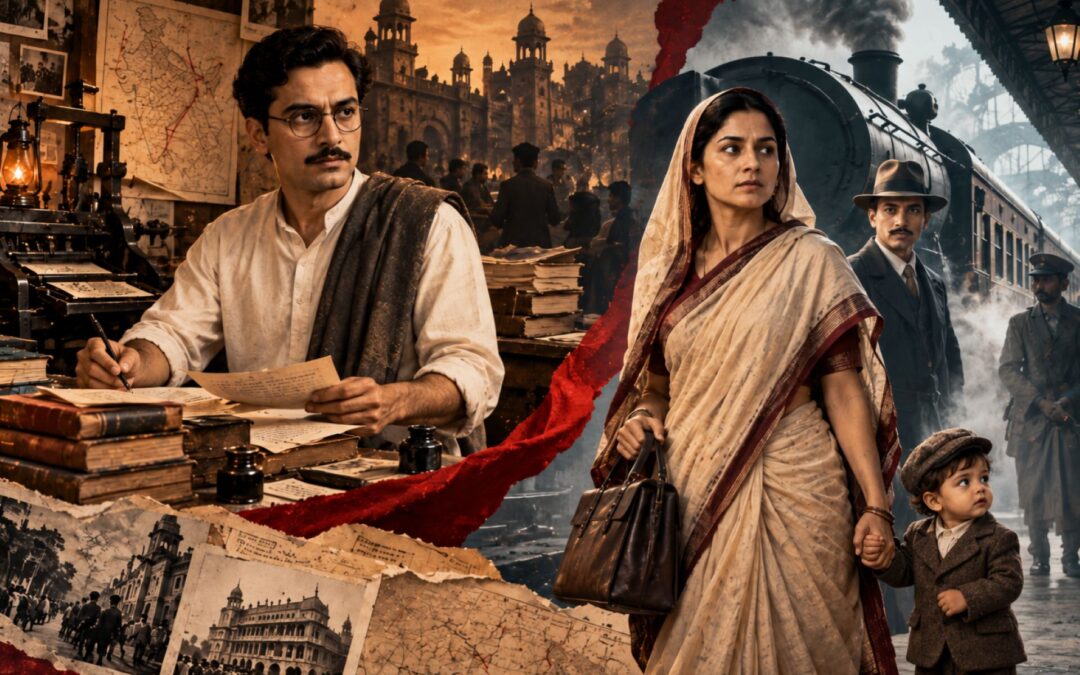
In December 1928, Bhagat Singh needed to escape Lahore after participating in the killing of British police officer John Saunders. The city was under surveillance, and a young man travelling alone risked immediate suspicion. Durga Devi Vohra, a married woman with a young child, agreed to accompany him, presenting herself as his wife while he travelled in disguise. The plan worked, helping one of India’s most wanted revolutionaries evade the colonial police.
Durga Devi’s husband, Bhagwati Charan Vohra, was himself an important figure in the revolutionary movement. He helped organise political activities, contributed money and intellectual work, and participated in clandestine operations. He died in 1930 during preparations to rescue imprisoned comrades, but Durga Devi continued her own revolutionary activities and lived until 1999.
In Bhai and Bhabi of Shahid Bhagat Singh: A Biography of Bhagwati Charan Vohra and Durga Bhabi, Malwinder Jit Singh Waraich brings attention to this revolutionary couple. Published by Unistar Books in 2012, the biography draws heavily upon historical extracts, anecdotes, and recollections to recover the lives of two individuals whose contributions have often been overshadowed by Bhagat Singh’s fame.
Their story connects the intellectual work of revolutionary organisations with the less visible activities that sustained them: money, accommodation, communication, trusted relationships, and the willingness to assume personal risks. It also reveals how the struggle against colonial rule affected marriage, parenthood, loyalty, and the everyday lives of people involved in underground politics.

Why Waraich Calls Them Bhai and Bhabi
The title refers to the affectionate names by which Bhagwati Charan Vohra and Durga Devi were known among their revolutionary associates. Bhagwati Charan was commonly called Bhagwati Bhai, while Durga Devi became Durga Bhabi. The terms expressed familiarity and trust within a political network whose members frequently depended upon one another for shelter, resources, and personal assistance.
These relationships were more substantial than ordinary friendship. Underground revolutionaries lived with the possibility of arrest, surveillance, imprisonment, and death. They often moved between temporary residences, entrusted confidential information to associates, and relied upon one another during emergencies.
The family terminology reflected the intimacy created by these circumstances. It could also conceal important differences in the responsibilities assigned to men and women within the movement.
Waraich’s 2012 biography, recorded in the WorldCat library catalogue, takes the couple as its central subject. Its title identifies them through Bhagat Singh, but their historical significance extends well beyond that association.
Bhagwati Charan was involved in revolutionary organising and political writing before the most celebrated events of Bhagat Singh’s career. Durga Devi participated in clandestine operations, helped sustain revolutionary networks, and continued political activity after her husband’s death.
The book’s form is also important. An independent review published in 2016 describes it as substantially a compilation of extracts from other works, historical anecdotes, and recollections rather than a continuously written narrative biography.
This approach places testimony and historical memory near the centre of the work. It can preserve voices that might otherwise be neglected, but it also requires readers to distinguish remembered incidents from independently established facts.
The resulting account concerns a partnership within the revolutionary movement while giving each member of the couple a separate historical trajectory. Those trajectories remained closely connected until Bhagwati Charan’s death in 1930, after which Durga Devi’s life continued through new political circumstances and eventually into independent India.
Family Origins, Marriage, and Education
Bhagwati Charan Vohra and Durga Devi came from families with relatively comfortable economic circumstances. This distinguished them from many Indians whose political choices were constrained by immediate material insecurity, although wealth did not protect the couple from the consequences of revolutionary involvement.
Their family histories were also shaped by migration and cultural adaptation. A published description of Waraich’s book reproduces Durga Devi’s recollection that both families traced their ancestry to Gujarati Brahmins who had settled in Agra generations earlier.
By the time of their marriage, the families had adopted many of the linguistic and social practices of their surroundings. Their identities therefore reflected the movement of families across regions rather than a simple identification with one provincial culture.
Bhagwati Charan was born in the early twentieth century, with Malwinder Jit Singh Waraich’s independently published biographical work giving Agra and 1903 as his birthplace and birth year. Some historical catalogues record 1904, so the precise year should be treated with caution.
His father, Shiv Charan Vohra, held a prominent position in the railway administration and received the colonial honorary title of Rai Sahib. The family had access to financial resources and social standing that could have supported a comfortable professional life for Bhagwati Charan.
Instead, he became increasingly involved in anti-colonial politics.
Bhagwati Charan and Durga Devi married when they were young, in accordance with the prevailing practices of their social environment. Durga Devi, born in 1907, subsequently continued her education and developed intellectual and political interests of her own.
Their early marriage did not immediately produce the equal political partnership associated with their later history. The relationship developed as Bhagwati Charan became involved in revolutionary activity and Durga Devi encountered the people, ideas, and responsibilities connected with his political commitments.
Education played an important part in this development.
Bhagwati Charan became associated with National College in Lahore, an institution established as an alternative to colonial educational structures and connected with nationalist political activity.
The college brought together young people interested in history, politics, literature, and the possibility of revolutionary transformation. It provided an environment in which political debates could develop outside the official assumptions of British-controlled institutions.
Durga Devi’s educational experience followed a different path. She pursued learning while also navigating the expectations placed upon a married woman and later a mother. Her development demonstrates that political participation did not necessarily begin through the same institutional channels available to men.
The family’s economic circumstances also became politically significant.
Money could support printing, travel, rented accommodation, and assistance to underground activists. Yet using family resources for clandestine politics exposed the household to police searches, confiscation, and the loss of financial security.
The couple’s comfortable beginnings therefore provide an important contrast with the material uncertainties of their later life. Their involvement in revolutionary politics transformed the purpose for which their resources, household, and personal relationships were used.
From National College to Revolutionary Organisation
Bhagwati Charan’s political development occurred during a period when Indian nationalists were debating whether British rule could be challenged through constitutional methods, mass non-cooperation, or underground revolutionary activity.
He was influenced by the Non-Cooperation Movement associated with Mahatma Gandhi. When that movement was suspended in 1922, some young activists became dissatisfied with the limits of existing nationalist strategies.
Bhagwati Charan entered an intellectual environment in Lahore where such disagreements were discussed extensively.
National College became an important setting for his political education. He encountered students and activists who questioned colonial authority and examined revolutionary movements in India and abroad.
His associations included Bhagat Singh, Sukhdev, and other figures who later played prominent roles in the Hindustan Republican Association and the Hindustan Socialist Republican Association.
Bhagwati Charan’s contemporaries remembered him as an avid reader and an effective political writer. His interests extended beyond the immediate circumstances of individual revolutionary actions.
He studied revolutionary history, political ideology, and the organisational problems involved in opposing colonial power.
Waraich’s independently published account of Bhagwati Charan Vohra assembles recollections describing his intellectual reputation among revolutionary associates.
These testimonies portray a man whose importance arose partly from his capacity to formulate political arguments, communicate ideas, and maintain relationships across different revolutionary circles.
The Hindustan Republican Association offered one organisational setting for these interests.
Established during the 1920s, the HRA sought to replace British colonial rule with a republican political system. Its programme included democratic and egalitarian commitments that later developed into a more explicit socialist orientation.
The Kakori train action of August 1925, followed by prosecutions and executions, severely weakened the organisation’s leadership. The surviving revolutionaries faced the practical problem of restoring communications, obtaining funds, and developing a coherent political strategy.
Bhagwati Charan became involved in this environment of organisational reconstruction.
He also participated in the Naujawan Bharat Sabha, which sought to mobilise young people through public political activity.
The Sabha differed from a secret revolutionary organisation because it could communicate political objectives through meetings, literature, and public mobilisation.
Bhagwati Charan is associated with the drafting of its 1928 manifesto, undertaken in consultation with Bhagat Singh. The document addressed the political responsibilities of young Indians and the importance of organised resistance to colonial domination.
His ability to formulate such statements became one of his most significant contributions.
When the revolutionary movement adopted the name Hindustan Socialist Republican Association in 1928, it expressed a stronger commitment to socialist ideas and the transformation of economic relationships.
Bhagwati Charan belonged to the political environment in which these ideas developed, although the extent of every individual’s agreement on socialist theory cannot be assumed.
His interests combined revolutionary nationalism, organisational discipline, propaganda, and increasingly radical criticism of colonial and economic power.
Contemporary recollections also suggest that he preferred substantive organisational activity to prominent public recognition.
This should not be converted into an unquestionable statement about his private motives. It does, however, help explain why his intellectual and logistical contributions were less visible than the actions of revolutionaries whose arrests and trials drew national attention.
Partners in the Lahore Underground
The Vohra household became an important part of the revolutionary network operating around Lahore.
Underground political activity depended upon far more than dramatic public actions. Revolutionaries needed places to meet, money for travel and printing, secure means of communication, and trustworthy associates willing to assist people avoiding arrest.
A residence could become a meeting place, temporary refuge, or point through which information and resources moved.
Bhagwati Charan’s financial circumstances made him valuable to the movement. He contributed money to revolutionary work and helped support activities that could not easily be financed through public collections.
His home also became associated with the circulation of revolutionary literature.
Waraich’s historical essays describe foreign political writings and correspondence passing through Bhagwati Charan’s address. Such activity reflected the interest of Indian revolutionaries in political developments outside India, particularly socialist and communist movements.
These connections also created risks.
A household receiving political literature or accommodating underground activists could attract police attention. The authorities could search private rooms, seize papers, investigate visitors, and treat ordinary domestic relationships as possible evidence of criminal conspiracy.
Durga Devi’s participation developed within this setting.
She provided hospitality, communicated with political associates, assisted in practical arrangements, and increasingly undertook responsibilities that required personal judgment.
The home and the political organisation were consequently difficult to separate.
A visitor might arrive as a family acquaintance while also carrying political information. A journey could serve a personal purpose while concealing an organisational task.
Family resources could be used for revolutionary activity, exposing the household to financial losses that affected both partners and their child.
The responsibilities were not always distributed equally.
Bhagwati Charan’s political writing and relationships with revolutionary organisers gave him a position within predominantly male networks. Durga Devi’s access to those networks initially depended in part upon her marriage, even as her practical experience and political confidence developed.
Her participation should therefore be understood as a process rather than as an identity conferred automatically by being the wife of a revolutionary.
The importance of the household became especially clear when the movement faced police pressure.
During the late 1920s, revolutionary associates increasingly required safe accommodation and assistance moving between cities. The Vohra home offered a point of contact within that network.
The couple’s partnership combined different kinds of work, some publicly recognised and others easily overlooked.
Bhagwati Charan’s writing and organisational activity contributed to the movement’s political direction. Durga Devi’s logistical work helped make clandestine activity possible in practice.
Their roles were connected, but neither can be understood adequately as a mere extension of the other.
The Saunders Case and Escape from Lahore
The most celebrated episode in Durga Devi’s revolutionary life occurred after the killing of British police officer John Saunders in Lahore on 17 December 1928.
The killing followed the death of nationalist leader Lala Lajpat Rai, who had been injured during a police lathi charge at a protest against the Simon Commission.
Bhagat Singh and his associates intended to retaliate against police superintendent James Scott, whom they held responsible for the repression of the demonstration. Instead, they killed assistant superintendent Saunders.
The action immediately intensified police searches.
Bhagat Singh and other participants needed to avoid identification and leave Lahore before the authorities could locate them. Travelling alone or in the company of known revolutionaries would have increased the danger.
The escape plan relied upon an unexpected form of disguise.
Durga Devi agreed to accompany Bhagat Singh and present herself as his wife. Her young son, Sachindra, known as Shachi, travelled with them, while Rajguru assumed the appearance of a servant.
This arrangement transformed the apparent identity of the group.
Instead of looking like wanted political fugitives, they resembled a respectable travelling family accompanied by domestic assistance.
The plan exploited the colonial police’s expectations about the appearance and behaviour of revolutionary suspects.
Bhagat Singh changed his physical appearance to make recognition more difficult. The group’s clothing, manner of travel, and assumed relationships reinforced the deception.
Durga Devi’s participation was indispensable because she supplied credibility that could not have been achieved through Bhagat Singh’s disguise alone.
Her decision was also personally consequential.
She was a young mother travelling with her child while accompanying a wanted revolutionary. If the disguise failed, she faced the possibility of arrest or violence, while her child would also be exposed to the danger.
Contemporary accounts differ on minor details of the arrangements, including the amount of money available for the journey. What matters to the established sequence is that funds, companions, and disguises were coordinated to move Bhagat Singh safely out of Lahore.
In Waraich’s independently published account, Bhagwati Charan was away from Lahore at the time, staying in Calcutta. Before leaving, he had made money available to Durga Devi for assistance to revolutionary associates.
Sukhdev approached her with the proposal to accompany a fugitive. Durga Devi accepted after learning that the operation involved serious danger.
The group travelled from Lahore by train, with Bhagat Singh and Durga Devi occupying first-class accommodation and Rajguru travelling separately in the guise of a servant.
Rajguru left the party at Lucknow, while Bhagat Singh and Durga Devi continued toward Calcutta.
A message was sent ahead, allowing associates to prepare for their arrival.
Bhagwati Charan and Sushila Didi were among those who met the travellers when they reached their destination, according to Waraich’s collected recollections.
The operation succeeded in removing Bhagat Singh from the immediate danger of police searches in Lahore.
Historian Kama Maclean’s research is especially valuable in explaining the significance of this episode. Her study of Durga Devi’s revolutionary activities demonstrates how the assumptions governing colonial surveillance could be manipulated by women acting within revolutionary networks.
The authorities expected dangerous anti-colonial activists to appear primarily as suspicious young men. A woman travelling with her husband and child appeared to belong to an ordinary domestic setting rather than a clandestine political operation.
The disguise therefore depended upon conventions of gender and respectability.
Durga Devi did not simply conceal Bhagat Singh by standing beside him. She actively inhabited a role that allowed him to escape detection.
The episode also reveals the relationship between family life and revolutionary strategy.
Her son became part of the appearance of normality upon which the operation depended. An ordinary family relationship was transformed into a means of resisting police surveillance.
That transformation did not eliminate the danger. It made the risk less visible to the authorities.
The success of the escape established Durga Devi’s reputation within the revolutionary movement, but it was not the culmination of her political life. She subsequently undertook responsibilities that no longer depended upon pretending to be someone’s wife.
The Philosophy of the Bomb and Revolutionary Ideology
Bhagwati Charan’s role as a political writer was among his most important contributions to the revolutionary movement.
The movement associated with Bhagat Singh is often remembered through acts involving weapons and explosives, but its members also produced manifestos, political statements, and arguments explaining their objectives.
Such writings were necessary because an underground organisation could not rely solely upon spectacular actions to establish political legitimacy or attract supporters.
Bhagwati Charan contributed to this intellectual work through revolutionary propaganda and organisational statements.
His involvement with the Naujawan Bharat Sabha manifesto reflected the effort to communicate political ideas to young Indians.
The Sabha sought to encourage political consciousness, organisation, and participation in the struggle against colonial domination.
Its objectives extended beyond opposition to particular British officials. The movement increasingly connected national independence with questions of social equality and economic exploitation.
These concerns became more pronounced with the development of the Hindustan Socialist Republican Association.
The word Socialist in the organisation’s name indicated an ambition to transform the economic and social arrangements associated with exploitation.
Bhagwati Charan’s political writing belonged to this broader effort to define revolution as something more substantial than a change of rulers.
His best-known contribution, Philosophy of the Bomb, emerged from a confrontation over revolutionary methods.
In December 1929, members of the revolutionary organisation attempted to attack the train carrying Viceroy Lord Irwin. An explosion damaged the train, but the Viceroy survived.
The incident prompted criticism from Mahatma Gandhi, who condemned the use of political violence.
Bhagwati Charan subsequently wrote a response defending revolutionary force against colonial domination.
The Government of India’s historical account of Philosophy of the Bomb identifies Vohra as its author and places the document within this controversy.
The manifesto challenges Gandhi’s argument that nonviolent moral resistance provides the appropriate method for confronting colonial power.
Its reasoning begins from the claim that British authority rests upon coercion and is therefore unlikely to disappear through appeals to conscience alone.
The revolutionaries contend that organised resistance may require force when confronted by an oppressive political system.
However, the document also attempts to distinguish revolutionary violence from violence pursued for its own sake.
Its authorship and political context demonstrate a movement concerned with justifying its actions through an articulated objective.
The argument requires critical distinction between what the revolutionaries believed and what their actions established historically.
A manifesto may explain why its author regarded violence as necessary without proving that violence was strategically effective, morally justified in every circumstance, or supported by the population.
This matters because revolutionary actions sometimes injured or killed people who were not the intended political targets.
The December 1929 train attack, for example, did not kill the Viceroy but caused a fatality.
The historical consequences of such actions must be examined alongside the political reasoning offered in their defence.
Bhagwati Charan’s writing nevertheless reveals a level of ideological engagement that is easily overlooked when his historical reputation is reduced to the circumstances of his death.
He was concerned with propaganda, organisational objectives, and the political meaning assigned to revolutionary force.
His writings help explain why contemporaries regarded him as an important intellectual figure within the movement.
Suspicion, Exclusion, and Reconciliation
Underground revolutionary organisations faced a persistent problem: their survival depended upon secrecy, but secrecy also made it difficult to distinguish legitimate caution from suspicion unsupported by evidence.
Bhagwati Charan became the subject of accusations that he was secretly working for the colonial police.
These allegations damaged his standing among revolutionary associates and complicated his participation in organisational affairs.
The controversy is examined in detail in Waraich’s separately published study, Bhagwati Charan Vohra Under Suspicion: July 1928 to November 1929.
The study draws upon recollections attributed to revolutionary participants, including Yashpal and Sukhdev Raj.
These accounts connect the development of suspicion with disagreements over organisational activity, finances, authority, and revolutionary strategy.
Bhagwati Charan had contributed resources and wanted the organisation to act more decisively. He became frustrated when political leaders appeared unwilling to advance plans intended to assist imprisoned comrades.
The disagreement brought him into conflict with Jai Chander Vidyalankar, a respected teacher associated with National College and the revolutionary network.
According to recollections assembled by Waraich, disputes involving the collection and use of funds contributed to deteriorating relations.
One striking episode concerned gold bangles offered by Sushila Didi to raise money for revolutionary work.
The recollection describes disagreements over how the bangles should be disposed of and whether people connected with the movement were making comparable sacrifices.
Such incidents might ordinarily have produced arguments about financial responsibility. Within an underground organisation, however, personal mistrust could rapidly acquire a more dangerous meaning.
Bhagwati Charan was accused of being connected with the Criminal Investigation Department.
The accusation placed him in a difficult position because his activities were already known to many associates, while the alleged evidence remained unclear.
His access to revolutionary communications and foreign political literature became material through which opponents could construct suspicions.
Even his comfortable family background could be invoked against him.
The circumstances demonstrate how clandestine organisations can become vulnerable to accusations that are difficult to verify.
A member might be excluded from important discussions while simultaneously being accused of knowing too much about the organisation.
Bhagat Singh himself was affected by the controversy.
Yashpal’s retrospective account describes the conflict between Bhagat Singh’s personal trust in Bhagwati Charan and the suspicion expressed by others within the movement.
The recollection includes severe expressions of frustration, but these should be treated as remembered testimony rather than independently verified records of private intention.
The resulting atmosphere was damaging to organisational cooperation.
Some revolutionaries became reluctant to share information with Bhagwati Charan or work alongside him. Others continued to maintain personal contact while attempting to determine whether the accusations had any factual basis.
One episode in Waraich’s assembled material describes Yashpal searching the Vohra residence while Bhagwati Charan was absent.
Durga Devi offered hospitality to Yashpal, who used the opportunity to examine the house and its papers for evidence of police collaboration.
He reported finding no incriminating material.
The incident is revealing because the domestic trust associated with the Vohra household became entangled with the organisation’s internal suspicion.
A house that provided refuge and assistance could also become the setting for an investigation conducted by an associate.
The available recollections support the conclusion that the accusations caused considerable harm to Bhagwati Charan and contributed to internal divisions. They do not justify treating every retrospective claim about the motives of his opponents as established fact.
The controversy eventually moved toward reconciliation.
Revolutionaries who had worked with Bhagwati Charan continued to assess his activities, while trusted intermediaries helped restore communication with Chandrashekhar Azad.
Waraich’s accounts describe renewed confidence in Bhagwati Charan after efforts to identify evidence of betrayal failed.
A meeting between Azad and Bhagwati Charan helped restore cooperation at a time when the revolutionary organisation was under severe pressure from arrests and prosecutions.
The significance of the episode extends beyond one man’s reputation.
The HSRA needed secrecy to survive, but mistrust weakened the relationships upon which that secrecy depended.
The controversy illustrates how revolutionary organisations could be damaged internally even without direct intervention by colonial police.
The Rescue Plan and Vohra’s Death
By 1930, the revolutionary movement had suffered extensive disruption through arrests, investigations, and criminal prosecutions.
Bhagat Singh and Batukeshwar Dutt had been imprisoned following the Central Legislative Assembly bombing of April 1929, while other revolutionaries faced prosecution in the Lahore Conspiracy Case.
Chandrashekhar Azad and associates who remained outside prison attempted to preserve the organisation and develop plans to rescue imprisoned comrades.
Bhagwati Charan became involved in these efforts.
His intellectual and organisational abilities were important because the movement required coordination after losing access to several of its leading figures.
The plan to rescue Bhagat Singh and Dutt involved an armed operation intended to overcome the security arrangements surrounding their detention and movement.
The revolutionaries considered the use of explosive devices as part of those preparations.
Bhagwati Charan participated in the testing of explosives intended for the operation.
On 28 May 1930, while testing a device near the Ravi River, he was fatally injured when it detonated unexpectedly.
The accident ended his life at a relatively young age and deprived the revolutionary movement of an important organiser and political writer.
Its consequences were particularly severe for Durga Devi.
She lost her husband while the colonial government continued its pursuit of revolutionary activists. Their young son also lost his father, leaving Durga Devi to manage family responsibilities amid political uncertainty.
The death also disrupted the organisation’s rescue preparations.
Plans involving explosives, clandestine transport, and coordination among associates depended upon individuals who could operate reliably under pressure.
Bhagwati Charan’s absence created difficulties for a movement already weakened by imprisonment and internal conflict.
Nevertheless, the accident does not establish what would have happened had he survived.
The proposed rescue was dangerous, and its success depended upon circumstances that cannot be reconstructed with certainty.
His death also shaped the way later generations remembered him.
Popular accounts often identify Bhagwati Charan through the fatal explosion, turning an event near the end of his life into its defining episode.
This emphasis can obscure the political writing, financial assistance, and organisational work through which he had contributed to the movement over several years.
A complete historical assessment must hold these different aspects together.
He participated in dangerous revolutionary operations, defended the political use of force, and died during preparations involving explosives. He also helped formulate political ideas and sustain an organisation whose ambitions extended beyond individual armed actions.
For Durga Devi, his death marked a turning point but not the end of revolutionary involvement.
Her subsequent activities demonstrate that her political identity had developed beyond the role of an associate’s wife.
Durga Bhabi’s Underground Campaign After 1930
Durga Devi’s life after Bhagwati Charan’s death is essential to understanding her place in revolutionary history.
Her husband had been central to her early contact with political networks, but she did not withdraw from them when he died.
Instead, she continued participating in clandestine activities during a period of growing pressure on the HSRA.
Her political work included maintaining contacts, moving between safe houses, assisting other revolutionaries, and taking part in operations directed against colonial authority.
These activities involved different kinds of risks from those associated with her earlier household responsibilities.
A woman providing shelter to fugitives could be investigated for conspiracy. Carrying communications or moving between cities could expose underground networks. Participating in armed action involved the possibility of prosecution, injury, or death.
Durga Devi faced these dangers while also responsible for her young son.
This combination of obligations makes her continued participation historically significant.
Widowhood was often associated with strong expectations concerning women’s conduct and domestic withdrawal. Durga Devi’s decisions did not follow a simple model of retreat from public life.
Her involvement also developed at a time when revolutionary organisations were suffering from arrests and the loss of important members.
The remaining activists needed trusted associates capable of maintaining connections across different cities.
Durga Devi’s previous experience made her familiar with the movement’s methods and personnel.
She had already participated in an operation requiring secrecy, disguise, and personal judgment. Those capabilities remained valuable when the organisation sought to continue its activities after 1930.
Her work should not be interpreted solely as an expression of grief or a desire to honour her husband’s memory.
Although his death undoubtedly changed her circumstances, the historical record demonstrates that she had political commitments and practical experience predating the accident.
Her subsequent actions reveal a participant whose relationship with revolutionary politics had become independent.
This distinction is particularly important because popular accounts frequently preserve the story of Bhagat Singh’s escape while overlooking the activities through which Durga Devi continued to challenge colonial authority.
Her later participation included an armed operation in Bombay, an episode that demands attention both because of her role and because of its consequences.
The Lamington Road Shooting and Its Consequences
On 8 October 1930, Durga Devi participated in a shooting near the Lamington Road police station in Bombay.
The incident occurred after death sentences had been announced against Bhagat Singh, Sukhdev, and Rajguru, but before the three revolutionaries were executed in March 1931.
This chronology matters because the operation is sometimes incorrectly described as retaliation for executions that had not yet taken place.
The revolutionary participants were angered by colonial repression and the sentences imposed on their comrades.
Their initial discussions involved the possibility of attacking Punjab governor Sir Malcolm Hailey.
The operation that ultimately occurred, however, involved firing upon a European couple outside a police station in Bombay.
The intended political target and the people actually injured were therefore not the same.
According to historical material examined by Kama Maclean, a police sergeant, identified as Sergeant Taylor, was injured in the hand. His wife sustained several wounds to her leg.
The shots were fired from a passing vehicle, and contemporary witnesses reported multiple attackers.
The operation immediately produced a police investigation.
Information concerning the vehicle enabled investigators to identify individuals connected with the attack. Subsequent testimony raised questions about the identities and precise roles of those present.
Maclean notes differences between later recollections and the prosecution’s reconstruction, including discrepancies concerning the occupants of the vehicle.
These differences are important because underground participants used aliases and could later remember events differently from the authorities investigating them.
The colonial press treated the shooting as an unusual and alarming act, partly because a woman had allegedly participated directly.
Durga Devi’s involvement challenged conventional expectations about women’s political roles.
Women were familiar participants in public nationalist activity, but their participation in armed attacks was treated differently by colonial observers.
The incident therefore reveals the interaction between gendered assumptions and revolutionary conduct.
However, Durga Devi’s political significance does not remove the need to examine the attack’s victims and consequences.
The injured couple were not simply interchangeable symbols of colonial authority. They were individuals who suffered injuries during an operation intended to communicate political resistance.
A serious historical account must preserve that distinction.
The investigation led to proceedings against suspected participants, but the resulting case did not produce convictions.
The absence of convictions does not establish that the shooting did not occur, just as police allegations do not automatically prove the guilt of every person accused.
The event illustrates the difficulties of reconstructing clandestine political activity through press reports, legal proceedings, and retrospective testimony.
For Durga Devi’s biography, it is a decisive episode because it demonstrates the extent to which her political activity had developed beyond logistical assistance.
She was no longer acting primarily within the protection of an assumed domestic identity.
Her participation in the operation placed her directly within the history of armed anti-colonial activity, with all the strategic, legal, and ethical questions such activity involved.
Political Work, Teaching, and Later Life
Durga Devi lived for nearly seven decades after Bhagwati Charan’s death, and her later life cannot be treated as a brief epilogue to the revolutionary movement.
The years following the Lamington Road shooting remained politically unsettled.
Colonial authorities continued investigating revolutionary networks, while the movement itself suffered further losses through arrests and deaths.
Bhagat Singh, Sukhdev, and Rajguru were executed on 23 March 1931. Chandrashekhar Azad had died in a confrontation with police the previous month.
These events transformed the organisation within which Durga Devi had worked.
The people who had provided leadership, intellectual direction, and practical coordination were increasingly absent.
Durga Devi nevertheless remained connected with nationalist political activity.
Her later experiences included periods of detention and restrictions imposed by colonial authorities.
She also participated in political campaigns connected with the larger independence movement.
As revolutionary organisations declined or changed character, some of their former members became involved in other political institutions.
Durga Devi’s later associations included Congress political work.
This development reflected a wider transformation in India’s nationalist politics during the 1930s, when underground activism, public mass movements, and emerging political parties offered different possibilities for participation.
Her subsequent interest in teaching provided another important direction.
Education had been part of her life before the most intense period of clandestine activity, and she later returned to it as a central occupation.
After independence, she became associated with educational work in Lucknow, including a Montessori school.
This work is significant because it continued her involvement in public life under circumstances very different from those of the colonial period.
Education required sustained organisational commitment, practical administration, and attention to children’s development.
It also placed her within the social reconstruction of an independent country whose political future earlier revolutionaries had attempted to shape.
Her later life demonstrates that political commitment can change its institutional expression without necessarily disappearing.
The underground activities of the 1920s and early 1930s were shaped by colonial repression and the immediate objective of independence. Educational work after independence addressed different problems.
Yet historians should be cautious about presenting the later career as though it fulfilled every political objective of the earlier revolutionary movement.
Durga Devi’s educational activity does not prove that the socialist transformation envisioned by the HSRA had been achieved.
It demonstrates that she continued contributing to public life after the political conditions of revolutionary activity had changed.
She also lived during decades in which public memory increasingly concentrated on a small number of celebrated revolutionary figures.
Her own reputation was often associated primarily with the railway escape involving Bhagat Singh.
This selective remembrance obscured the wider range of her activities, including clandestine coordination, direct participation in armed operations, and her later educational work.
Durga Devi died in 1999.
Her life spanned colonial India, the revolutionary struggles of the interwar period, independence, and more than fifty years of the Indian republic.
The contrast with her husband’s early death creates an unusual structure for a joint biography.
Bhagwati Charan’s story ends within the revolutionary movement’s most intense period. Durga Devi’s continues long enough to reveal how a participant in that movement adapted to a transformed political world.
Two Revolutionaries and a Marriage of Shared Commitment
The marriage of Bhagwati Charan and Durga Devi was an important foundation for their political work, but it should not be interpreted as a relationship in which both partners always performed identical functions.
Bhagwati Charan entered revolutionary politics through education, intellectual associations, and political organisations. His resources and writing abilities made him useful to underground networks.
Durga Devi developed her role partly through the household and the relationships formed around it.
This difference reflected the social expectations governing access to political institutions.
Men could participate in student politics, public debate, and underground organisations more readily than many married women. Women were often expected to sustain domestic life while men pursued political commitments outside the home.
The Vohra household complicated that division.
It provided accommodation, communications, financial resources, and assistance to revolutionaries.
Domestic responsibilities therefore became connected with political activity.
However, it would be misleading to describe the household simply as an instrument controlled by Bhagwati Charan.
Durga Devi undertook practical decisions and accepted substantial risks of her own.
The Lahore escape provides the clearest example. Her husband was not present in Lahore when she agreed to assist Bhagat Singh, and the operation depended upon her willingness to accompany a wanted revolutionary while taking her child along.
This required judgment under uncertain circumstances.
The choice also reveals the importance of trust within their marriage.
Bhagwati Charan’s financial support for comrades and Durga Devi’s willingness to assume risks suggest a household in which revolutionary commitments affected both partners.
Their political work nevertheless exposed them to unequal consequences.
Bhagwati Charan’s ability to travel, write, and organise depended partly upon domestic arrangements that Durga Devi helped sustain.
Durga Devi, meanwhile, had to navigate the responsibilities associated with motherhood while participating in operations that challenged prevailing expectations of women’s conduct.
The couple’s comfortable background further complicates a simple narrative of personal sacrifice.
They possessed resources that made certain political activities possible, including financial support for comrades and access to relatively secure accommodation.
Those resources were also vulnerable to police searches, confiscation, and the pressures of underground life.
After Bhagwati Charan’s death, Durga Devi’s choices demonstrated that her political identity had not depended entirely upon marriage.
She continued acting within revolutionary networks despite losing the person through whom she had initially developed many of her contacts.
The partnership is therefore best understood as a relationship that enabled political participation while also containing differences in opportunity, recognition, and responsibility.
This interpretation preserves their shared commitment without erasing the distinct paths through which each became involved in the movement.
Women, Disguise, and the Contradictions of HSRA Politics
Durga Devi’s revolutionary career reveals contradictions in the gender assumptions of both colonial policing and underground nationalist organisations.
The colonial authorities viewed women through social expectations that could make their political activities less visible.
A married woman travelling with a child appeared more likely to be engaged in ordinary domestic life than in an operation intended to protect a wanted revolutionary.
The Lahore escape succeeded partly because Durga Devi could exploit those assumptions.
Her apparent conformity to the role of a respectable wife concealed her participation in an act of political resistance.
The operation demonstrates that the social categories used to limit women’s independence could also create unexpected opportunities.
Women could carry information, provide shelter, and move within domestic or familial settings that attracted less immediate suspicion than groups of young men.
Yet this advantage rested upon the same assumptions that restricted women’s public political status.
The revolutionary movement itself was affected by those conventions.
The HSRA’s membership, leadership, and public reputation were overwhelmingly associated with men.
Women often entered its networks through family relationships, personal acquaintances, or responsibilities that resembled conventional domestic service.
Their activities could be indispensable while remaining inadequately recognised as political work.
Durga Devi’s career complicates this pattern because her responsibilities changed over time.
She began with activities closely connected to household and family networks, participated in clandestine travel, and subsequently became involved in operations that required a more openly political role.
The Lamington Road shooting demonstrates this development.
The incident challenged the assumption that women were confined to providing assistance behind the scenes.
At the same time, it reveals another possible limitation in the way women’s revolutionary contributions are remembered.
If Durga Devi is recognised as politically significant only because she participated in an armed attack, the importance of her earlier organisational and logistical work may again be obscured.
That work was politically consequential even when it resembled ordinary domestic activity.
Accommodation, money, messages, secrecy, and trust were necessary to the functioning of clandestine networks.
Maclean’s historical interpretation is valuable because it restores these activities to the analysis of revolutionary politics.
It also questions the assumption that women’s participation can be understood entirely through the political programmes articulated by male leaders.
Durga Devi’s experiences demonstrate that women could use, negotiate, and challenge the roles assigned to them.
The implications extend beyond the revolutionary movement.
Histories organised primarily around arrests, trials, and public speeches tend to privilege activities more frequently associated with men.
A fuller account must examine the social relationships and practical labour that allowed those visible actions to occur.
Waraich’s choice to place Durga Devi alongside her husband provides an opportunity to recover that wider history.
Whether the biography fully achieves it depends upon the extent to which her activities receive independent treatment rather than remaining attached to episodes involving better-known male revolutionaries.
Writing, Violence, and the Meaning of Revolutionary Service
Bhagwati Charan’s political career raises questions about the relationship between intellectual work and revolutionary action.
He was remembered by associates as a reader, writer, organiser, and propagandist, yet he also participated in operations involving explosives.
These activities should be examined together because revolutionary organisations needed both political arguments and practical methods of resistance.
Political manifestos helped define objectives, attract supporters, and explain organisational decisions.
Underground operations attempted to challenge colonial authority through actions whose immediate effects could be physical, political, or symbolic.
Bhagwati Charan’s work crossed these boundaries.
His association with the Naujawan Bharat Sabha manifesto reflected a concern with communicating political objectives to young Indians.
The Sabha sought to build political consciousness beyond the membership of a secret revolutionary organisation.
The HSRA’s developing socialist programme also required ideas about economic exploitation, political power, and the future structure of society.
These intellectual commitments gave meaning to revolutionary organisation, but they did not settle the question of legitimate political methods.
Philosophy of the Bomb addressed that problem by defending the use of force against colonial domination.
Its argument rested on the revolutionaries’ belief that British rule was maintained through coercion and that armed resistance could contribute to its removal.
However, the political effectiveness of violent action cannot be established solely through the arguments offered by those carrying it out.
Operations might draw attention to colonial repression while also producing casualties, strengthening police surveillance, or weakening the organisations responsible.
The Viceroy train attack illustrates this difficulty.
The revolutionaries failed to kill the intended target, but the explosion caused a fatality.
The consequences cannot be understood adequately through the symbolic purpose of the operation alone.
Bhagwati Charan’s own death reveals another form of cost.
His involvement in preparing an armed rescue operation ended his life and removed an important organiser from a movement already experiencing severe repression.
His death was a consequence of the practical risks associated with the methods the organisation employed.
This does not negate the significance of his writing or organisational contributions.
It requires historians to distinguish revolutionary ideals from the outcomes of particular actions.
The same principle applies to Durga Devi.
Her logistical work, successful participation in the Lahore escape, and later armed activity involved different methods and produced different consequences.
A serious historical account should not impose one undifferentiated category of revolutionary service upon them.
The couple’s work demonstrates that anti-colonial resistance included writing, political education, financial support, concealment, communication, and physical confrontation.
Its history requires examining how these activities related to one another and what consequences followed from their use.
Witnesses, Recollections, and the Structure of Waraich’s Biography
The historical method of Bhai and Bhabi of Shahid Bhagat Singh is an important part of its identity.
The book is associated with Malwinder Jit Singh Waraich’s larger effort to recover material concerning revolutionaries who participated in the independence movement but received less sustained attention than its most famous figures.
Waraich draws extensively upon recollections and historical extracts, preserving accounts by people connected with the revolutionary organisations.
This method can be especially valuable when the subjects belonged to underground networks.
Secret organisations often avoided creating records that could expose their members. Documents were destroyed, names were concealed, and participants used aliases.
As a result, later historians frequently depend upon memoirs, interviews, legal proceedings, and fragmentary correspondence.
These sources preserve details that would otherwise disappear.
Waraich’s independently published essays demonstrate how participant testimony can illuminate organisational relationships.
His account of Bhagwati Charan’s period under suspicion, for example, draws upon recollections that describe disputes over money, accusations of collaboration, searches for evidence, and attempts to restore trust.
The material is valuable because it records the uncertainties and conflicts within a movement sometimes remembered as uniformly united.
Yet such recollections also require careful interpretation.
A participant recalling events decades later may remember the sequence imperfectly, emphasise certain relationships, or reinterpret decisions in light of subsequent events.
Personal testimony should therefore be compared with contemporary documents whenever possible.
Police records present different difficulties.
They may establish dates, arrests, charges, and statements, but they were produced by institutions seeking to investigate or suppress revolutionary activity.
Their descriptions of political motives and organisational relationships cannot automatically be treated as impartial.
The historian must therefore work between sources with different purposes and limitations.
A compiled biography has the advantage of preserving several perspectives rather than allowing one continuous authorial voice to dominate.
However, it can also become fragmented when extracts are presented without sufficient explanation of their origins or relationship to the larger narrative.
The independent 2016 review of Waraich’s biography makes precisely this criticism.
The reviewer considers the couple’s story worth reading but argues that the book resembles a collection of extracts, anecdotes, and reminiscences more than a fully developed biography.
This assessment is significant because the demands of historical compilation and biographical explanation are not identical.
Preserving an eyewitness account establishes access to testimony. A biography must also explain how that testimony fits into the subject’s life, what circumstances produced the event described, and how competing accounts should be assessed.
The strongest documentary biographies accomplish both tasks.
They allow historical witnesses to speak while providing a sufficiently clear interpretive structure for readers to understand the evidence.
Waraich’s use of photographs and other illustrated material potentially strengthens the work’s documentary character.
However, the available bibliographic record confirms the presence of illustrated plates without establishing the subjects of every image or the context supplied by their captions.
The collection’s value can therefore be assessed more securely through its identifiable purpose and documented reliance upon historical testimony than through detailed claims about the arrangement of every chapter.
Its method raises an important question for readers: whether recovering neglected material is sufficient to make a biography successful, or whether the writer must also build a coherent account that evaluates and connects the sources.
The answer depends upon the purpose of the work.
As a repository of recollections, a compilation may be useful even when its narrative is uneven. As a biography intended to explain two lives from beginning to end, the same fragmentation can make the work less satisfying.
What the Biography Recovers—and Where It Falls Short
The principal historical value of Bhai and Bhabi of Shahid Bhagat Singh lies in its decision to centre two revolutionaries whose contributions are often remembered primarily through their relationship with Bhagat Singh.
Bhagwati Charan Vohra helped sustain the movement through political writing, organisation, financial support, and clandestine activity. Durga Devi Vohra provided assistance to revolutionary associates, participated in major operations, and continued political work after her husband’s death.
A joint biography creates the opportunity to examine both careers without treating either person merely as a supporting figure.
This is particularly valuable in Bhagwati Charan’s case.
His historical reputation is frequently associated with two episodes: the authorship of Philosophy of the Bomb and his death during explosive testing in May 1930.
Neither episode is sufficient to explain his wider contributions.
The testimony assembled in Waraich’s historical work reveals an organiser concerned with propaganda, political education, money, and relationships within the revolutionary movement.
His intellectual role helps explain how political organisations developed arguments to justify their objectives and actions.
The period of internal suspicion also deserves attention.
Accounts of revolutionary organisations often concentrate on solidarity, courage, and sacrifice. The controversy surrounding Bhagwati Charan reveals disagreements, ambition, mistrust, and uncertainty within those organisations.
This material is historically valuable because it complicates simplified depictions of underground political life.
It also demonstrates the importance of analysing the sources through which such stories survive.
Waraich’s reliance upon recollections can preserve details of conflicts that were not fully documented at the time.
Yet those recollections may also contain later interpretations of motives and relationships.
A strong historical biography should preserve the testimony while distinguishing what participants remembered from what independent evidence establishes.
Durga Devi’s inclusion is another important contribution.
Her most famous activity was the successful escape operation following the Saunders killing. That event demonstrates considerable personal initiative, but it should not be allowed to define the entire significance of her life.
Her subsequent involvement in clandestine activity, the Lamington Road shooting, later political work, and educational career reveal a much longer historical trajectory.
A book devoted to both spouses offers an opportunity to explain how that trajectory developed.
It can also challenge the tendency to treat women’s revolutionary contributions as secondary domestic assistance.
The historical importance of accommodation, communication, fundraising, and concealment becomes clearer when these activities are examined as necessary parts of political organisation.
Durga Devi’s participation demonstrates that domestic circumstances could become resources for political resistance.
However, the strength of the historical subject does not automatically establish the quality of the biography.
The most substantial available criticism concerns Waraich’s method of assembling extracts and recollections.
A collection of historical testimony can provide valuable material without giving readers a fully integrated account of the lives being examined.
Biographical explanation requires more than identifying incidents.
It must establish the chronology of decisions, explain changing relationships, connect personal circumstances with political developments, and evaluate evidence that may be incomplete or contradictory.
The firsthand review of Waraich’s book suggests that the volume does not consistently achieve this integration.
That criticism should be taken seriously, although it remains the judgment of one reader rather than proof concerning the effectiveness of every section.
The reliance upon recollections also creates questions about source reliability.
Accounts of the Lahore escape differ in some details, including the money available for the journey. Other episodes, particularly internal disputes within the HSRA, depend substantially upon later testimony.
These differences need not invalidate the historical narrative.
They do require the writer to distinguish verified events from reconstructed details and contested explanations.
The treatment of Bhagwati Charan’s alleged police connections provides a particularly demanding example.
The available testimony strongly suggests that suspicion damaged his relationships and organisational position, while efforts to discover evidence did not establish the accusation.
However, the motives attributed to those who spread the allegations are often preserved through accounts written by people with their own loyalties and disagreements.
A careful historian should explain the controversy without treating every retrospective interpretation as an uncontested fact.
Durga Devi’s political agency raises another question of completeness.
A biography using the title Bhai and Bhabi may preserve the affectionate familial identity by which she was known, but it also risks defining her through relationships with men.
Her work as an organiser and participant in revolutionary operations must therefore receive independent attention.
Kama Maclean’s later scholarship provides an especially useful perspective because it examines Durga Devi beyond the Lahore escape and considers the gendered assumptions shaping both revolutionary activity and colonial surveillance.
This does not mean that Waraich’s biography should be judged by requiring it to reproduce Maclean’s later interpretation.
It does mean that a contemporary critical assessment can compare the historical questions emphasised by different approaches.
Maclean’s study asks how women’s activities were enabled or constrained by political and social expectations. Waraich’s recoverable biographical project concentrates more directly on preserving the lives and recollections of the revolutionary couple.
The approaches can complement one another.
Waraich’s documentary recovery may provide historical material for readers interested in the movement’s participants, while later scholarship can subject that material to different analytical questions.
Another limitation concerns the uneven duration of the two lives.
Bhagwati Charan died in 1930, during the revolutionary movement’s most intense period. Durga Devi lived until 1999, participating in political and educational work under circumstances far removed from the clandestine struggles of the 1920s.
A joint biography must therefore resist allowing the dramatic earlier period to dominate the entire account.
Durga Devi’s later decades are important because they show what became of someone whose political identity was formed through revolutionary activity but whose life continued into independent India.
Without this later progression, her biography would risk ending where her husband’s ends.
The ethical treatment of revolutionary violence is equally important.
The political objectives of anti-colonial activists can be explained sympathetically without suppressing the consequences of their methods.
The attempted attack on the Viceroy’s train resulted in a death, while the Lamington Road shooting injured individuals who were not the original intended target.
These consequences belong to the historical record.
A biography that focuses exclusively on intentions, courage, and sacrifice risks producing an incomplete account of political action.
The fairest assessment of Waraich’s identifiable project is therefore qualified.
The decision to preserve the lives and recollections of Bhagwati Charan and Durga Devi addresses an important gap in popular revolutionary history. The available firsthand reception suggests, however, that the book’s reliance on compiled material may prevent it from functioning as a consistently integrated narrative biography.
Its documentary value and its literary or explanatory completeness should be judged separately.
For readers willing to work through extracts and recollections, the book offers a historically useful route into the experiences of the revolutionary movement’s less celebrated participants. Those seeking a seamless, analytically integrated biography may find its method less satisfactory.
Is Bhai and Bhabi of Shahid Bhagat Singh Worth Reading?
Bhai and Bhabi of Shahid Bhagat Singh is worth considering for readers interested in India’s revolutionary independence movement, the Hindustan Socialist Republican Association, Bhagat Singh’s associates, and the participation of women in anti-colonial politics.
Its greatest importance lies in its choice of subjects. Bhagwati Charan Vohra contributed substantially to the political and organisational work of the revolutionary movement, while Durga Devi Vohra developed a career that extended beyond the celebrated Lahore escape and continued into independent India.
Their experiences reveal activities that are often difficult to see in histories centred upon arrests, executions, and dramatic public actions. Revolutionary organisations also depended upon money, writing, accommodation, trust, communications, and the labour of people whose contributions did not always produce public recognition.
Waraich’s reliance upon historical recollections can help preserve these dimensions. Its principal limitation, according to the available firsthand review, is that the material is not always integrated into a continuous biographical narrative.
Readers looking for a detailed documentary introduction to the couple may therefore find the book valuable, particularly when read alongside more recent scholarship on Durga Devi’s independent political work. Readers seeking a fully synthesised account of both lives should recognise that the book’s compiled form may require them to make connections that a more analytical biography would explain directly.
The deeper significance of the subject lies in the difference between the two historical trajectories. Bhagwati Charan died while participating in revolutionary preparations in 1930; Durga Devi survived into a country that achieved the independence for which they had struggled, eventually directing much of her energy toward education.
Understanding them together, while preserving their separate contributions, produces a fuller account of the people and relationships that sustained India’s revolutionary movement.
Last Updated on October 10, 2026 by Aseem Gupta