
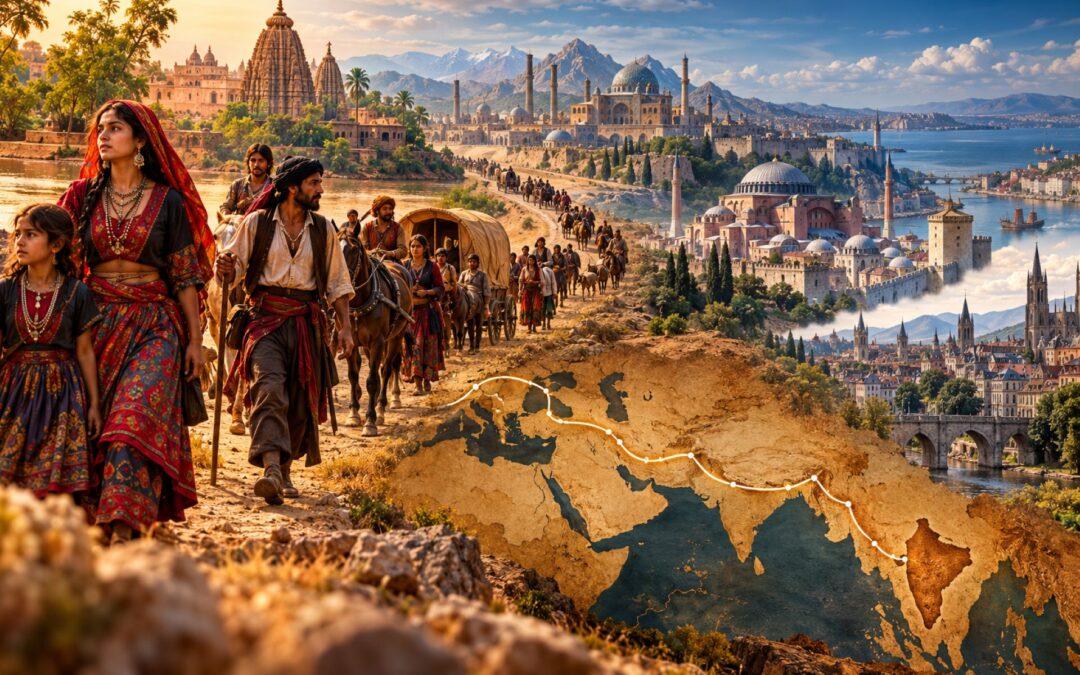
Across Europe, communities known as Roma and Sinti have lived for centuries, developing distinct languages, traditions, occupations, and relationships with the societies around them. Yet for much of European history, their origins remained a mystery to outsiders. Some believed they had come from Egypt, others associated them with distant parts of Asia, and many treated them as foreigners regardless of how long their families had lived in Europe.
The answer eventually emerged from an unexpected source: their language. Scholars discovered that Romani was closely related to languages spoken in India, revealing an ancestral connection that modern genetic research would later reinforce. The ancestors of Europe’s Romani communities had travelled westward from the Indian subcontinent, passing through regions associated with Persia and the Byzantine Empire before becoming established across Europe.
But identifying their homeland is easier than reconstructing their departure. The earliest stages of this migration are poorly documented, and historians continue to debate when different movements occurred, what circumstances encouraged them, and how communities changed along the way. Understanding the Romani journey therefore requires separating what linguistic and genetic evidence establishes from the stories, assumptions, and later historical interpretations surrounding it.
Who Are the Roma and Sinti?
The Roma are a diverse population of communities whose ancestors migrated from the Indian subcontinent into Europe. Today, Romani communities live across Europe and beyond, with distinct regional identities shaped by centuries of settlement, movement, interaction, and cultural change.
The word Rom is associated with a self-designation in Romani, while Roma is commonly used as a plural and as a broader collective term. However, not everyone included under that umbrella necessarily identifies in exactly the same way. Communities have their own histories, names, dialects, and understandings of belonging.
The Sinti, traditionally associated especially with German-speaking and neighbouring regions of Europe, are one such community. They share historical and linguistic connections with other Romani populations while maintaining distinctive identities and traditions. Some prefer the designation Sinti rather than being described simply as Roma, making it important to respect these differences instead of treating all communities as interchangeable.
Other historical and regional names include Kalderash, Lovara, and numerous local designations. These reflect different community histories, occupations, migration experiences, and linguistic developments. As the Encyclopedia of the History of Roma explains, the history of these populations cannot be reduced to a single undifferentiated ethnic or cultural group.
European outsiders historically used the term Gypsy, which became widespread partly because of the mistaken belief that these communities originated in Egypt. In English, the word is often regarded as offensive because of its long association with stereotypes, discrimination, and persecution, although usage and individual preferences vary. Roma, Romani, and specific community names are generally more appropriate when discussing the peoples themselves.
The Egyptian explanation was not entirely a matter of outsiders inventing a story. Some historical accounts and traditions associated Romani travellers with Egypt, and claims of Egyptian origin circulated in medieval Europe. Such identities could influence how newcomers were received, sometimes allowing groups to present themselves as pilgrims or travellers entitled to protection. They nevertheless tell us more about medieval perceptions and strategies of belonging than about the population’s distant ancestry.
Another common misunderstanding is that all Roma are nomads. Although mobility and itinerant occupations have played important roles in some communities, many Romani families have lived in permanent settlements for generations. Romani identity is not defined by continual movement, and the histories of Roma should not be confused with those of every other travelling population in Europe.
These distinctions matter because the ancestors of contemporary Romani communities did not arrive in Europe as a single uniform people whose identity remained unchanged. Their history involved separation, interaction, adaptation, and the formation of new communities. What connects them is an important shared ancestral and linguistic heritage, not an identical way of life.
The Indian Roots Revealed by Language and DNA
The strongest evidence for the Indian origins of the Romani people comes from language. For centuries, European observers had struggled to explain where Romani communities came from because their historical records offered few reliable answers. During the eighteenth century, however, comparisons between Romani speech and languages of the Indian subcontinent began revealing connections that could not reasonably be dismissed as coincidence.
Romani belongs to the Indo-Aryan branch of the Indo-European language family, which also includes languages such as Hindi, Punjabi, Bengali, and Marathi. Its relationship with the languages of South Asia is visible not merely in isolated words but also in grammatical structures and inherited vocabulary. These deeper features provide considerably stronger evidence of common linguistic ancestry than a handful of borrowed expressions would.
Scholars examining Romani found similarities involving ordinary elements of language, including words associated with everyday life and grammatical patterns inherited from earlier Indo-Aryan speech. Such correspondences indicated that Romani had developed from a linguistic tradition rooted in the Indian subcontinent. The language had subsequently changed through contact with numerous other populations during its westward movement.
This discovery transformed the historical question. Instead of asking whether the Roma might have originated in Egypt or another vaguely defined eastern country, researchers could investigate the path by which an Indo-Aryan language reached Europe.
Historical linguists, including scholars such as Yaron Matras, have examined how the changing vocabulary and structure of Romani preserve evidence of these encounters. Iranian, Armenian, and Greek influences are particularly relevant because they help reconstruct stages of contact between Romani-speaking populations and societies encountered during their migration.
Loanwords alone cannot produce a complete itinerary. A community might acquire vocabulary through prolonged settlement, trade, multilingual environments, or contact with neighbouring populations. Nevertheless, when linguistic patterns are considered together, they provide a broad account of movement that is consistent with the historical geography of western Asia and southeastern Europe.
Modern genetics has strengthened the Indian-origin conclusion. A 2012 genome-wide study of European Romani populations by Isabel Mendizabal and colleagues examined genetic variation across thirteen Romani groups. Its findings supported a shared ancestral origin associated with north or northwestern India, followed by migration toward Europe and subsequent interaction with other populations.
The researchers estimated a founding population whose ancestry could be traced back approximately 1,500 years and identified later demographic expansion within Europe beginning roughly 900 years ago. These are estimates derived from genetic models rather than dates recorded by contemporary witnesses. They should not be interpreted as proving that all Romani ancestors departed India in one year or under the authority of a particular ruler.
Genetic research also reveals that European Romani communities experienced population admixture after leaving South Asia. This is consistent with centuries of interaction and settlement along their migration routes. Different communities eventually developed distinctive population histories while retaining evidence of shared ancestry.
Language and genetics thus support one another without answering precisely the same questions. Linguistics helps identify ancestral language relationships and significant cultural contacts. Genetics reveals patterns of shared ancestry, population separation, and admixture. Neither can independently establish what an individual community was thinking when it migrated or which political event caused its departure.
The strongest conclusion is therefore substantial but appropriately limited: the ancestors of European Romani communities originated in the Indian subcontinent, probably in its northern or northwestern regions, and travelled westward through a prolonged process of migration and cultural interaction.
Why Did Romani Ancestors Leave India?
The reasons behind the Romani migration are considerably harder to establish than its geographical origins. Historical accounts often connect the movement to warfare, enslavement, political instability, or the search for livelihoods. All are plausible influences in particular historical settings, but the surviving evidence does not support one universally accepted explanation.
Northwestern India experienced major political and military transformations during the centuries in which the ancestors of Romani populations may have begun moving west. These developments created conditions under which displacement, service to travelling courts or armies, and movement along commercial networks could occur.
One important episode was the Arab conquest of Sindh in the early eighth century. In 711–712 CE, forces associated with the Umayyad Caliphate, led by Muhammad ibn Qasim, established control over significant parts of the region. The conquest involved warfare, changes in political authority, and the incorporation of Sindh into wider networks connecting South Asia with western Asia.
It would be reasonable to investigate whether these disruptions contributed to migrations from the region. What cannot be established is the claim that the Sinti specifically departed Sindh during the seventh or eighth century and formed a distinct migration wave that can be traced directly to the conquest.
Even the supposed etymological relationship between Sinti and Sindh is uncertain. Research into the historical origin of the name Sinti has challenged the assumption that the community’s name proves its descent from a particular geographical region. A resemblance between names cannot substitute for evidence of population movement, and the emergence of a later European community identity should not automatically be projected into early medieval India.
Another frequently proposed explanation involves the Ghaznavid dynasty, which ruled an empire centred in parts of present-day Afghanistan and surrounding regions. Around the beginning of the eleventh century, Mahmud of Ghazni launched repeated military campaigns into northern India. These expeditions involved plunder, warfare, and significant political consequences for affected territories.
The broader history of these campaigns belongs to the Ghaznavid incursions into northern India, which formed part of the changing relationship between the subcontinent and Central Asia. Armies, merchants, religious figures, administrators, and skilled workers crossed these frontiers through both voluntary and coercive movements.
Some interpretations associate the Romani departure with Mahmud’s invasions, suggesting that people were displaced, taken westward, or recruited into the activities surrounding his military campaigns. The historical circumstances make such proposals worth considering, but there is no sufficiently direct evidence demonstrating that Mahmud’s expeditions caused the migration of the ancestors of all European Roma.
The chronological problem is especially important. Genetic estimates concern population ancestry and demographic events that may have unfolded over several centuries. Connecting those estimates to an individual military campaign requires independent historical evidence, not merely an approximate correspondence between dates.
Livelihoods offer another possible explanation. Mobile groups supplying services such as metalworking, animal care, transport, music, or performance could find opportunities in regions connected by trade routes, political courts, and military campaigns. Skills that could be practised in different settlements might have made continued movement economically possible.
However, it would be misleading to assume that the ancestors of the Roma already constituted one clearly defined occupational community in India. Medieval South Asia contained many communities with different livelihoods and social positions. Similar occupations among some later Romani populations do not prove that every ancestral group belonged to the same profession or social category.
The relationship between mobility and military service also requires care. Expanding states needed craftspeople, animal handlers, transport workers, and other specialists, and some communities could become involved in those networks. Such participation does not establish that the entire Romani migration was a military movement or that its participants willingly served particular rulers.
Economic opportunity may have been as significant as political disruption. Movement westward could connect skilled families with new patrons and markets, while movement along established routes might encourage further migration over generations. The decision to continue travelling need not have been made once by a single community for a single reason.
The Council of Europe’s Roma history materials provide a useful framework for understanding the migration as a historical reconstruction rather than a fully documented expedition. The evidence points toward a broad sequence of movement from South Asia through western Asia and into Europe, while leaving important questions about the earliest causes unresolved.
The most defensible explanation is that the Romani migration developed within a world of political conflict, economic connections, and human mobility. Warfare and displacement may have influenced the process, but they cannot be treated as a complete explanation without stronger evidence.
The Journey Through Persia and Byzantium
After leaving the Indian subcontinent, the ancestors of European Romani communities moved through territories associated with the Iranian world and eventually the Byzantine Empire. This route is reconstructed partly through linguistic evidence, since written documents identifying particular migrating Romani groups become more informative only in later periods.
The Iranian world was an important zone of contact between South Asia, Central Asia, the Caucasus, and the Middle East. For centuries, its cities, trade networks, courts, and political institutions connected populations speaking many different languages. The history of these interactions formed part of the wider development of Persian civilization, in which successive empires and regional societies exchanged people, goods, and cultural practices.
Romani contains vocabulary showing contact with Iranian languages, although the extent and circumstances of that contact cannot be converted into a precise number of years spent in Persia. Linguistic evidence indicates historical relationships, not a preserved travel diary.
Persian literary tradition also contains an intriguing story about musicians arriving from India. In the Shahnameh, the great Persian epic composed by Ferdowsi, King Bahram V is associated with a request for Indian musicians to entertain his subjects. The commonly cited version of the legend refers to 10,000 musicians, sometimes connected with groups described as Luri.
As discussed in Encyclopaedia Iranica’s treatment of the Gypsies of Persia, this tradition became part of the historical discussion surrounding Indian-origin populations in the Iranian world. It is nevertheless a literary account, not a contemporary census or reliable record of an identifiable Romani migration.
The story is significant because it reflects an enduring association between Indian musicians and Persian society. It cannot demonstrate that the musicians described were the ancestors of European Roma, that they migrated in precisely the manner recounted, or that music was the principal occupation of every ancestral Romani community.
Names such as Luri, Dom, and Lom appear in discussions of populations with historical connections to South Asia. Some communities associated with these names have linguistic and cultural histories that invite comparison with Romani populations. Yet similar names, professions, or distant linguistic relationships do not establish that all these groups were identical or followed the same migration route.
The passage through the Caucasus and surrounding regions is another important part of the reconstruction. Armenian linguistic influence in Romani suggests meaningful historical contact with Armenian-speaking populations. The precise settlements, routes, and length of residence remain difficult to determine because the surviving evidence is incomplete.
The Byzantine Empire represents an especially significant stage. Romani contains a substantial Greek linguistic layer, indicating that ancestors of European Romani speakers spent an important period in contact with Greek-speaking society. This contact helps explain why the Balkans later became so important in Romani settlement and movement throughout Europe.
The Byzantine world also provides written material that historians have sometimes connected with early Romani populations. One prominent example involves references to people called Athinganoi or related forms. Certain accounts associated these people with unusual religious practices, divination, ritual separation, or magical abilities.
Identifying these references is complicated. The term Athinganoi was also applied to a religious group in Byzantine society, meaning that early references cannot automatically be interpreted as descriptions of Roma or Sinti. Later interpretations may have attached existing stories about religious outsiders and supposed magical powers to Romani populations.
The association with magic therefore requires historical explanation rather than acceptance. Descriptions of fortune-telling and supernatural abilities often reveal how outsiders understood, misunderstood, or stereotyped unfamiliar communities. They are not evidence that Romani migrants possessed extraordinary powers or shared one system of religious belief.
Religious adaptation was another part of the journey. Across different regions, Romani communities encountered Christianity, Islam, and other traditions, eventually adopting or participating in the religious practices of surrounding societies in diverse ways. Some communities preserved distinctive customs concerning family life, ritual boundaries, and social relationships, but these should not all be interpreted as unchanged survivals of ancient Indian religion.
The connection between South Asian ancestry and later European cultural practices is real, yet it was mediated by centuries of change. Communities adapted to new languages, religious institutions, economic arrangements, and political environments while maintaining elements of shared identity.
What can be reconstructed is a broad westward corridor involving the Iranian world, Armenian-speaking regions, and the Greek-speaking Byzantine sphere. The evidence does not establish a single uninterrupted journey in which every later Romani community travelled together.
From the Balkans Into the Rest of Europe
The Balkans became a major centre of Romani history because of their position within the Byzantine and later Ottoman worlds. Greek linguistic influence points to an important earlier period of contact, while medieval records provide increasingly clear evidence of Romani communities living in southeastern Europe.
By the later Middle Ages, communities identifiable as Roma appeared in records associated with the Balkans and other parts of Europe. Their movements took place across a politically fragmented region containing Byzantine territories, emerging regional states, Venetian possessions, and expanding Ottoman authority.
The rise of the Ottoman Empire during the fourteenth and fifteenth centuries transformed southeastern Europe. Ottoman expansion changed political boundaries, military obligations, taxation, landholding arrangements, and relations among religious communities. These developments formed part of the environment in which Romani populations lived and moved.
It is tempting to explain the entire westward migration as a flight from the Ottomans, but the evidence does not justify such a simple account. Some communities may have sought safety from warfare or political pressure, while others remained in Ottoman territories for generations. Different groups experienced different economic opportunities and restrictions under changing governments.
Ottoman rule also provided administrative settings in which Romani populations could be identified and taxed as distinct communities. Religious affiliation influenced legal and fiscal obligations, but conversion to Islam did not produce one uniform experience. Muslim and Christian Roma continued to live within Ottoman society, sometimes subject to policies directed at their social position as well as their religion.
In regions governed by Byzantine successors, Venetian authorities, or other local rulers, Romani communities could also form relationships with military institutions, landholders, and urban economies. Their work might include metalworking, animal care, trade, or services useful to armies and settlements. Some records associate particular communities or leaders with obligations to provide military assistance in exchange for local privileges or protection.
These arrangements demonstrate that Romani people were not simply passing through societies without participating in them. They could become embedded in local economies and political relationships, even while facing discrimination or restrictions on their activities.
The Peloponnese in southern Greece was one important centre of settlement. Medieval accounts refer to Romani populations in areas connected with Venetian and Byzantine political influence, including the region around Methoni. Such records help reconstruct the presence of Romani communities before their wider appearance across other European regions.
During the fourteenth and fifteenth centuries, records increasingly document Roma in Central and Western Europe. Communities appeared in territories associated with present-day Hungary, Germany, France, Italy, Spain, and other regions. Subsequent migrations and settlement patterns contributed to their presence across much of the continent, including northern Europe.
Their arrival did not constitute a single coordinated movement. Different groups entered different regions at different times, sometimes presenting themselves as travellers, pilgrims, or people holding letters of protection. Their treatment depended on the political authorities, religious assumptions, economic interests, and local circumstances they encountered.
Occupational flexibility could help communities maintain themselves during periods of movement. Metalworking and the production of practical goods, including tools and horseshoes, were associated with some Romani craftspeople. Others participated in music, performance, trade, transport, or animal-related activities.
These occupations are part of Romani economic history, but none defines all Romani people. Particular crafts could become associated with particular communities because of regional specialisation, inherited skills, available opportunities, or restrictions imposed by local authorities. Such patterns changed over time as families settled, moved, and entered different kinds of work.
The resulting European Romani population was increasingly diverse. Different communities developed their own dialects, religious affiliations, economic relationships, and regional identities. Their Indian ancestry remained an important historical connection, but their European histories were already becoming distinct.
Slavery, Exclusion, and Forced Assimilation
Romani settlement in Europe was accompanied by periods of acceptance, economic cooperation, suspicion, discrimination, and severe persecution. Their treatment varied greatly among regions and over time, making it misleading to describe Europe as having followed one consistent policy toward them.
One of the most destructive institutions was the enslavement of Roma in the Romanian principalities of Wallachia and Moldavia. The earliest surviving documentary references include a Wallachian record from 1385 associated with the transfer of forty Romani families to a monastery.
Such records reveal a system in which people could be treated as inheritable property, transferred among owners, and subjected to restrictions on their freedom. Enslavement developed into a long-lasting institution involving princely, ecclesiastical, and private ownership. It continued in these territories until its abolition in the nineteenth century.
The documented history of Romani enslavement in the Romanian lands is particularly important because it demonstrates that Romani persecution was not limited to prejudice or exclusion from ordinary occupations. In some European societies, it became embedded in law, property relations, and hereditary social status.
Elsewhere, Romani communities faced expulsion orders, restrictions on settlement, surveillance, and discriminatory punishment. Authorities frequently associated travelling populations with criminality, religious suspicion, or disorder. Such assumptions could expose families to collective punishment without evidence of individual wrongdoing.
Itinerancy played a role in these perceptions. Settled communities and increasingly regulated states often viewed mobile populations as difficult to supervise or incorporate into local systems of taxation, residence, and labour. Travelling groups could be blamed for theft or other offences, with suspicion directed at an entire community rather than specific individuals.
Economic competition contributed to tensions in some places. Skilled Romani craftspeople could find work in occupations also controlled or regulated by established guilds and local trades. Restrictions on their activities sometimes reflected attempts to protect local economic privileges as well as broader social prejudice.
Religious difference and superstition supplied further justifications for exclusion. Stories associated Romani people with fortune-telling, witchcraft, or unfamiliar ritual practices, and some hostile traditions connected Romani blacksmiths with the nails used in the crucifixion of Jesus. Such stories reveal the way prejudice could incorporate religious mythology into ordinary social and economic conflict.
These stereotypes did not arise from one cause or operate identically everywhere. Religious authorities, governments, guilds, landowners, and local residents could have different interests in either accommodating or excluding Romani communities. The same population might be economically useful in one setting and severely persecuted in another.
The growth of more centralized states eventually created another form of pressure: forced assimilation. Authorities increasingly sought to regulate how minority communities lived, travelled, worked, spoke, and raised their children.
In the eighteenth-century Habsburg monarchy, policies associated with Empress Maria Theresa attempted to transform Romani populations into subjects conforming to the state’s preferred social norms. Measures included restrictions on mobility and traditional ways of life, pressure to abandon distinctive customs, and the removal of Romani children from their families for upbringing outside their communities.
These policies were presented by authorities as attempts at social reform or integration, but they relied on coercion and denied Romani families the right to preserve their identities. The Council of Europe’s examination of historical anti-Roma persecution places such measures within a wider history of exclusion that European societies have often failed to acknowledge adequately.
Romani communities nevertheless maintained family connections, languages, customary practices, and local forms of solidarity. Their survival did not depend on complete isolation from surrounding populations. Rather, they continually negotiated relationships with wider society while preserving identities that states and institutions sometimes attempted to suppress.
The Nazi Genocide of Roma and Sinti
The persecution of Roma and Sinti reached a particularly devastating stage under Nazi rule. Nazi racial ideology categorized them as an undesirable population and subjected them to increasingly systematic discrimination, surveillance, exclusion, and violence.
The Nazi regime did not invent European anti-Roma prejudice. It built upon older stereotypes and discriminatory practices while incorporating them into an increasingly radical system of racial persecution. Romani families were targeted through policies involving registration, restrictions on movement, exclusion from social life, and forced sterilization.
During the Second World War, persecution escalated into genocide. Roma and Sinti were imprisoned, deported, subjected to forced labour, and murdered through mass shootings and in concentration and killing camps. Nazi Germany and collaborating authorities participated in these crimes across occupied Europe, although the timing and forms of persecution varied among territories.
The murder of Roma and Sinti formed part of the wider system of Nazi racial violence, but their experiences require recognition in their own right. As the United States Holocaust Memorial Museum documents in its history of the genocide of European Roma, historians estimate that at least 250,000 and possibly as many as 500,000 Roma were murdered under Nazi rule and its allies.
Exact figures remain uncertain because population records were incomplete and documentation of many killings was limited or destroyed. Presenting a single precise death toll would imply a certainty that the surviving evidence does not support.
The genocide devastated families and communities, including Sinti populations in Central Europe and Roma living across eastern and southeastern regions. Its consequences continued after the war through loss of relatives, disrupted traditions, displacement, and the difficulty survivors faced in obtaining recognition and justice.
This persecution belongs within the broader history of World War II, but it cannot be understood solely as a secondary consequence of military conflict. It was rooted in racial ideology and institutionalized discrimination, carried out against people whose communities had already formed part of European society for centuries.
Recognition and remembrance of the genocide are therefore essential to Romani history. They challenge the tendency to treat the suffering of Roma and Sinti as peripheral to Europe’s twentieth-century experience, rather than as a central part of the continent’s history of racial persecution.
A European People With Indian Roots
The Romani journey from India to Europe created communities whose cultural identities reflect both shared ancestry and centuries of change. Their history did not stop when they reached the Balkans or spread farther into Europe. Settlement, political transformation, religious adaptation, economic development, and continued movement all contributed to the formation of distinctive Romani societies.
Language remains one of the clearest signs of their shared heritage. Romani preserves an Indo-Aryan foundation while containing vocabulary acquired through historical contact with Iranian, Armenian, Greek, Slavic, Germanic, Romance, and other linguistic environments. Different dialects reflect the communities and regions in which they developed.
This linguistic diversity is evidence of historical interaction rather than the disappearance of cultural identity. Romani communities could maintain a recognizable linguistic inheritance while incorporating words, expressions, and other features from neighbouring populations. Many Roma also speak the majority languages of the countries in which they live, and patterns of Romani-language transmission vary among communities.
Religion shows similar diversity. Romani populations include Christians belonging to different churches, Muslims, and people with other religious affiliations. Local belief, family traditions, and communal practices have developed within these wider religious environments.
Some communities maintain customs concerning purity, social boundaries, marriage, or kinship that researchers have compared with South Asian practices. Such comparisons must be approached carefully because similar traditions can develop through different historical processes. It would be inaccurate to assume that contemporary Romani customs represent an unchanged survival of a particular ancient Indian caste or religious system.
Music is another area in which Romani communities have made significant contributions to European cultural life. Romani performers and musicians have influenced regional traditions in different parts of the continent, developing styles through interaction with local audiences, instruments, and musical practices.
These contributions should be recognized without turning musical ability into an ethnic characteristic attributed to every individual. Romani societies have always included people pursuing many different livelihoods, just as other European societies have.
Centuries of discrimination have also influenced how Romani identity is represented. Popular depictions have alternated between romanticizing the supposed freedom of wandering people and portraying Roma as threatening outsiders. Both perspectives reduce diverse communities to stereotypes, obscuring their actual social and historical experiences.
The continuing association of Roma with perpetual migration is particularly misleading. For many families, ancestral movement from India is a distant historical event rather than a description of contemporary life. Their communities have belonged to European regions for hundreds of years, developing relationships with local languages, institutions, economies, and cultures.
This does not make their Indian heritage less significant. The linguistic and genetic connections reveal an extraordinary chapter in the movement of peoples across Eurasia and help explain how communities with distant shared roots developed distinctive identities in different societies.
It does, however, change the meaning of the question of where Roma belong. Their ancestors’ origins in India and their long presence in Europe are not competing claims. Both are essential parts of the same history.
The Romani migration was not a single expedition whose participants left behind a complete record of their journey. It unfolded through movements and encounters that can now be reconstructed only partially, using language, genetics, historical documents, and the traditions preserved by later communities.
What is firmly established is that the ancestors of Europe’s Romani populations came from the Indian subcontinent, travelled westward through regions connected to the Iranian and Byzantine worlds, and became part of European societies many centuries ago. What remains uncertain is the precise combination of political upheaval, economic opportunity, displacement, and personal decisions that initiated and sustained those movements.
Recognizing that uncertainty does not diminish the significance of the journey. It allows the history to be understood without reducing it to a single conquest, a legendary migration of musicians, or the idea of a people forever destined to wander. The Roma and Sinti are descendants of an extraordinary movement across Eurasia, but they are also peoples whose identities, cultures, and histories have been shaped by centuries of European life.
Last Updated on October 30, 2026 by Aseem Gupta