
Reading Time: 27 Minutes
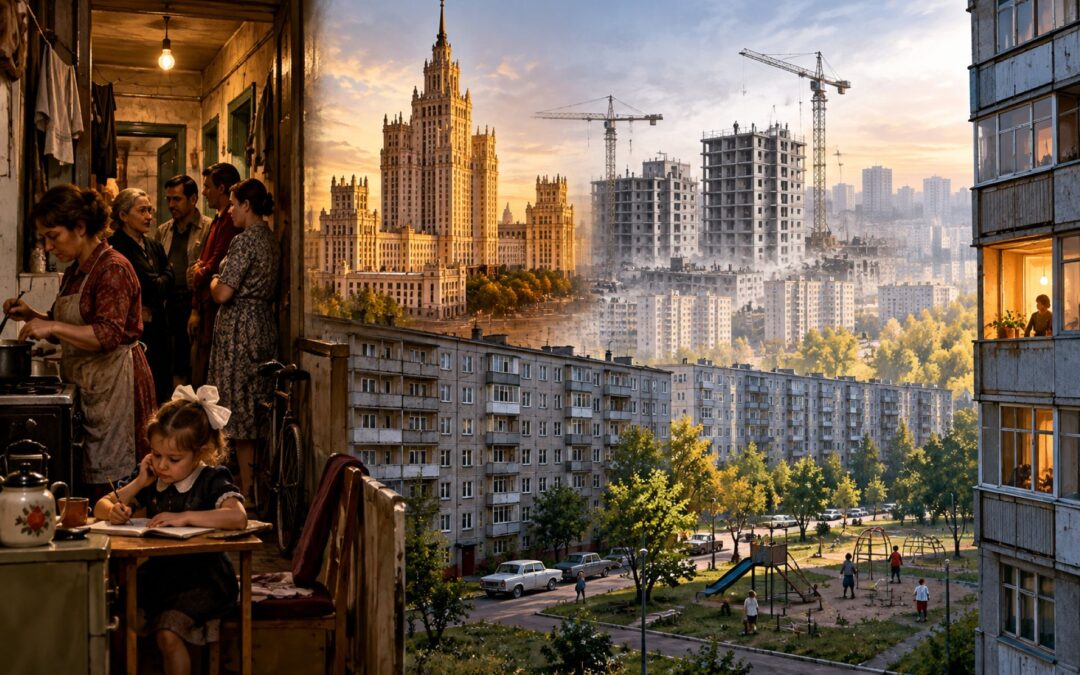
Walk through Moscow, and you can see several generations of Soviet history without visiting a museum. In the city centre, monumental apartment buildings stand behind imposing facades, with decorative columns, high ceilings, and architectural details designed to convey power and prestige. Travel farther into the residential districts, and the landscape changes to rows of modest five-storey buildings, often made from prefabricated concrete panels. Beyond them rise taller apartment blocks, some stretching sixteen storeys into the sky, with repetitive windows and balconies that seem to continue indefinitely.
These buildings represent different periods in Soviet history, but their differences go beyond architecture. Each reflects a particular government’s ideas about housing, economic development, social equality, and the relationship between individuals and the state. The grand buildings associated with Joseph Stalin, the compact apartments constructed under Nikita Khrushchev, and the taller residential blocks of Leonid Brezhnev’s era were responses to different problems and priorities.
Yet understanding Soviet housing requires more than identifying its buildings. In a country where the government controlled much of the housing supply, obtaining an apartment often meant navigating waiting lists, workplace recommendations, eligibility rules, and administrative procedures. A family’s occupation, connections, household composition, and place in the bureaucratic system could determine where it lived and how much space it received.
The Soviet Union eventually succeeded in moving millions of people out of overcrowded communal accommodation and into separate family apartments. It also created an urban landscape that continues to shape cities decades after the country’s collapse. But the same system that made housing remarkably affordable could leave families waiting years for better accommodation, revealing the complicated relationship between housing as a social right and housing as a scarce resource.
From Tsarist Overcrowding to the Bolshevik Housing Revolution
The Soviet housing problem began long before the Soviet Union existed. During the nineteenth century, the Russian Empire remained predominantly agricultural, even as industrial development attracted growing numbers of people to major cities. Moscow, Saint Petersburg, and other industrial centres expanded, but the supply of adequate urban housing struggled to keep pace with the influx of workers.
For many working-class families, city life involved crowded rooms, poorly maintained buildings, and inadequate sanitation. Workers frequently lived in barracks, dormitories, subdivided apartments, or rented rooms shared with other people. Running water, modern plumbing, reliable heating, and private bathrooms were far from universal, particularly among poorer residents.
These conditions reflected the broader inequalities of imperial Russian society. Wealthy property owners could occupy spacious urban residences, while workers and their families often devoted considerable portions of their incomes to inferior accommodation. Industrial growth created employment, but it did not automatically produce the housing or infrastructure needed to support an expanding urban population.
Housing dissatisfaction formed part of the wider political and economic unrest that culminated in the Russian Revolution of 1917. The February Revolution forced Tsar Nicholas II to abdicate, but the Provisional Government struggled to resolve the country’s worsening problems while Russia remained involved in the First World War. In October, the Bolsheviks led by Vladimir Lenin seized power and began attempting to reorganize Russian society around socialist principles.
Housing presented an immediate challenge. The Bolsheviks rejected the idea that access to adequate accommodation should depend entirely on private wealth, and their early policies sought to redistribute urban residential space. Large privately owned buildings were subjected to nationalization or municipal control, while housing authorities attempted to accommodate additional households within existing properties.
The policies introduced in 1918 expanded the municipalization of urban housing and gave local authorities greater control over how residential space was distributed. Large apartments could be subdivided, with rooms assigned to households that previously lacked adequate accommodation. The objective was to make better use of existing buildings while reducing the extreme inequalities inherited from the imperial system.
However, it would be inaccurate to conclude that the Bolsheviks eliminated all private housing ownership. As Alexander Kalyukin and Sebastian Kohl explain in their historical study of Russian urban housing, personally owned housing persisted through the Soviet period, although its significance varied across cities and decades. The Soviet housing system eventually encompassed state and municipal housing, accommodation administered by enterprises, cooperative apartments, and personally owned dwellings.
This distinction matters because the Soviet government controlled much of the urban housing system without becoming the sole owner of every home. Its power came from a combination of property ownership, administrative allocation, construction policy, and regulation.
Redistributing existing accommodation also had an obvious limitation. Dividing a large apartment between several families increased the number of households it could accommodate, but it did not create additional kitchens, bathrooms, or living space. As industrialization continued and urban populations grew, the Soviet government would confront a problem that redistribution alone could never solve: the country needed to build an enormous number of new homes.
Communal Apartments: The Early Soviet Solution to a Housing Crisis
One of the most distinctive features of early Soviet urban life was the kommunalka, or communal apartment. Rather than assigning an entire apartment to a single household, authorities allocated individual rooms to different families. Residents shared facilities such as kitchens, bathrooms, toilets, hallways, and sometimes storage areas.
A large apartment that previously accommodated one relatively wealthy household might now house several unrelated families. Each family generally treated its allocated room as its private living space, using it for sleeping, eating, studying, entertaining visitors, and storing possessions. Shared facilities remained communal, creating constant interaction between residents whose habits, personalities, and circumstances could differ considerably.
The arrangement served both practical and ideological purposes. Practically, it allowed authorities to accommodate more households in existing urban buildings without waiting for large-scale construction. Ideologically, it fitted a revolutionary society attempting to challenge inherited class distinctions and develop more collective forms of living.
Yet communal apartments were not simply comfortable expressions of socialist cooperation. Many residents entered them because there was nowhere else to go, and overcrowding could make daily life difficult. A family with several children might occupy a single room, while several households competed for access to one kitchen or bathroom.
Ordinary domestic activities consequently required negotiation. Cooking dinner could involve waiting for another family to finish using the stove, while cleaning responsibilities, noise, visitors, storage, and the use of common spaces could become sources of disagreement. Residents developed informal arrangements and schedules, but these depended on relationships that were not always harmonious.
Privacy was another persistent problem. The separation between one household and another might amount to little more than a closed door, while activity in shared spaces made it difficult to avoid neighbours. Families could overhear arguments, observe each other’s routines, and become involved in disputes that might have remained private in separate apartments.
The situation could become particularly uncomfortable when a former property owner remained in a building that had been subdivided. People who once controlled their entire residence might find themselves occupying a fraction of it alongside families assigned there by housing authorities. Such arrangements exposed the tension between revolutionary redistribution and established expectations about ownership, status, and domestic independence.
Communal living nevertheless represented an improvement for some households. A family moving from an overcrowded barracks or poorly equipped lodging might gain a more secure room in a substantial apartment building with access to facilities it previously lacked. The experience depended greatly on the accommodation a household had occupied before receiving its new space.
Alongside communal apartments, Soviet planners experimented with purpose-built collective housing. During the 1920s, architectural movements such as constructivism emphasized functional design, industrial materials, and buildings intended to reflect a transformed society. Some experimental residential projects incorporated communal kitchens, dining rooms, laundries, and shared recreational facilities, challenging conventional assumptions about the organization of domestic life.
These experiments were not representative of every Soviet residential building. Much of the population continued living in older housing, worker dormitories, barracks, or conventional apartments, and the ambitious communal architecture of the revolutionary period was only one part of a much more varied housing landscape.
Importantly, state-provided accommodation was not necessarily free. Residents of public housing generally paid regulated rents, while utilities and maintenance were supported through various forms of public subsidy. Housing costs were often relatively low compared with household incomes, although conditions, charges, and arrangements changed over time.
The government also exercised considerable control over domestic infrastructure. District heating systems, for example, supplied warmth to multiple buildings according to centrally organized arrangements rather than allowing every household complete control over its own heating. Such systems could provide important conveniences while limiting residents’ individual choices.
The fundamental problem remained the shortage of suitable living space. Communal apartments allowed cities to absorb additional households, but they often did so by concentrating more people within buildings that were already occupied. As the Soviet Union accelerated industrial development, the number of people seeking urban housing continued to grow faster than the availability of comfortable, self-contained apartments.
Stalin’s Monumental Apartments and the Housing Divide
When Joseph Stalin consolidated power after Lenin’s death in 1924, the Soviet Union entered a period of rapid industrial transformation. The government’s economic priorities increasingly centred on heavy industry, infrastructure, machinery, and military production. Urban populations expanded as workers moved to industrial centres, adding further pressure to a housing system that was already struggling.
Architecture also underwent an important transformation. The experimental modernism associated with parts of the revolutionary period gradually gave way to monumental buildings designed to project authority, stability, and Soviet achievement. Neoclassical details, symmetrical facades, decorative ornamentation, and imposing proportions became prominent features of prestigious public and residential construction.
Apartment buildings associated with this architectural period became known as Stalinkas. Many were constructed using brick or other durable materials, with relatively substantial walls, generous ceiling heights, large windows, and carefully designed facades. More prestigious examples offered spacious rooms, comfortable kitchens, and architectural features that distinguished them sharply from the crowded communal accommodation familiar to many Soviet citizens.
These buildings expressed an important contradiction in the Soviet project. Although official ideology emphasized the abolition of class privilege, the Soviet state continued to distinguish between occupations, institutions, and individuals when distributing scarce benefits. Housing became one of the most visible rewards available to those considered important to the country’s political, military, intellectual, and industrial development.
Senior Communist Party officials, military commanders, prominent scientists, and other influential individuals could receive access to especially desirable apartments. Their accommodation might be located in prestigious central districts and offer considerably more space and comfort than the homes available to ordinary workers. Political position and institutional influence could therefore affect living conditions even in a society formally committed to equality.
However, not every Stalin-era apartment building was luxurious or reserved for the elite. The historical study of Moscow’s mass housing development distinguishes prestigious Stalinist buildings from simpler residential construction intended for a broader population. Working-class housing could employ plainer designs, smaller rooms, fewer amenities, and less expensive construction methods.
The term Stalinka consequently describes a broad architectural period rather than a single guaranteed standard of accommodation. A prestigious apartment in central Moscow and a modest Stalin-era residential building near an industrial enterprise could differ substantially in quality, location, and facilities. Even within the same architectural tradition, social and institutional hierarchy remained visible.
The larger problem was that relatively expensive construction could not satisfy the Soviet Union’s growing demand for housing. Monumental brick buildings required substantial materials, labour, and construction time, while heavy industrial investment competed with residential development for resources. Housing was important to the state, but it did not consistently receive priority over industrial and strategic objectives.
The Second World War made the situation dramatically worse. Following Germany’s invasion of the Soviet Union in 1941, enormous resources were redirected toward military production and the war effort. Cities, towns, factories, and residential districts suffered extensive destruction, while population displacement and wartime losses transformed living arrangements across the country.
Reconstruction began before the war had fully ended and continued afterward, but the destruction had compounded existing shortages. Many urban families remained in communal apartments, temporary accommodation, or overcrowded housing long after the fighting stopped. Returning soldiers, displaced people, and growing industrial workforces increased the pressure on the available residential stock.
The Soviet Union emerged from the war as a major global power, yet its civilian living standards lagged behind its military and industrial achievements. During the developing period of postwar superpower competition, housing, consumer goods, public infrastructure, and defence all competed for investment within a centrally planned economy.
By the time Stalin died in 1953, the Soviet state had created impressive industrial capacity and a recognizable monumental architectural language, but it had not solved the everyday housing shortage. For millions of families, the promise of a separate apartment remained distant.
The next Soviet leadership would attempt to address the crisis by reversing the architectural priorities that had produced some of the country’s most prestigious buildings.
Khrushchev’s Mass-Housing Breakthrough
Nikita Khrushchev inherited a housing system in which enormous numbers of families still occupied shared rooms, communal apartments, dormitories, and other inadequate accommodation. The problem was no longer simply whether the government could redistribute existing homes more effectively. It needed a construction programme capable of producing residential buildings on an unprecedented scale.
Khrushchev’s response marked one of the most consequential changes in Soviet domestic life. Instead of emphasizing monumental design, architectural ornamentation, and prestigious construction, the government increasingly prioritized speed, standardization, affordability, and the production of separate apartments for ordinary families.
A decisive policy shift came in 1955, when Soviet authorities issued a decree criticizing architectural excesses in design and construction. Decorative features that increased costs without improving essential functionality were discouraged, and standardized designs became increasingly important. The broader mass-housing programme announced in 1957 gave this approach a major political and practical purpose.
The objective was to expand access to individual family apartments rather than leave households indefinitely in communal accommodation. Where the Stalinist architectural tradition had often emphasized grandeur, Khrushchev-era mass housing emphasized the number of families that could be rehoused with the resources available.
Industrialized construction made this ambition more realistic. Instead of relying entirely on traditional building techniques, factories produced standardized structural components that could be transported to construction sites and assembled into repetitive residential designs. Prefabricated reinforced-concrete panels became particularly associated with the period, although some housing series continued to use brick and other construction methods.
Standardization reduced the need to design every building individually. Repeated floor plans, structural systems, windows, staircases, and service arrangements allowed construction organizations to use familiar procedures and equipment across many projects. This helped the Soviet state expand housing output while controlling costs and simplifying production.
The most recognizable product of this policy was the Khrushchevka, a relatively modest apartment building frequently constructed with five storeys. The height was an important economic compromise. Keeping buildings within the range that generally did not require passenger elevators under contemporary Soviet standards reduced construction costs and allowed scarce resources to be devoted to additional housing.
Inside, the apartments were compact and functional. A typical building might contain one-room, two-room, and three-room apartments, with the number referring to principal habitable rooms rather than the modern distinction between bedrooms and living rooms. Kitchens were often small, corridors limited, and bathrooms designed to use as little space as practical.
Layouts differed between building series, but the general philosophy was consistent. Space-saving design took precedence over spacious rooms or elaborate interiors, and some apartments included passage rooms that residents had to cross to reach other spaces. Ceilings were generally lower than those in prestigious Stalin-era buildings, while balconies and other features varied by series.
By later standards, these apartments could seem extremely small. Yet their significance becomes clearer when compared with the accommodation many residents previously occupied. A family that had shared a kitchen and toilet with several unrelated households might now have its own kitchen, bathroom, and front door.
This was more than a change in architectural design. A separate apartment created opportunities for family privacy, independent domestic routines, and greater control over everyday life. Parents could raise children without sharing essential facilities with neighbours, while households gained spaces that more clearly belonged to their own family.
The psychological importance of this transition should not be underestimated. A relatively cramped apartment could still represent a major improvement when it replaced a single room in a communal dwelling. What appeared architecturally austere from the outside could feel like a considerable increase in comfort and personal independence to the people receiving it.
Modern domestic infrastructure contributed to these improvements. Many Khrushchev-era apartment buildings incorporated indoor plumbing, sewage connections, central heating, and private sanitary facilities. Their availability and reliability varied, but the programme helped expand access to amenities that had previously been unavailable to substantial sections of the urban population.
Industrialized housing also benefited from the Soviet Union’s existing manufacturing capacity. The heavy industrial development pursued in earlier decades had created factories, machinery, transport networks, and technical expertise that could be redirected toward large-scale residential production. Khrushchev’s government applied these capabilities to a problem that directly affected everyday living standards.
The programme dramatically expanded housing construction and enabled millions of people to move into separate apartments over the following decades. Its achievement was not simply the number of buildings completed, but the transformation of private family accommodation from an exceptional advantage into a much more widely attainable standard of urban life.
However, rapid production involved compromises. Some prefabricated buildings developed problems with insulation, sound transmission, construction quality, or maintenance. Small kitchens and bathrooms became recurring sources of inconvenience, especially as households acquired more possessions and expectations about domestic comfort increased.
Standardization also produced remarkably repetitive urban landscapes. Buildings of similar height, appearance, and layout appeared across different Soviet cities, even though their climates, local conditions, and populations differed. Designs were adapted in various ways, but the emphasis on repeated building series inevitably limited architectural diversity.
These limitations were visible from the beginning, yet they do not erase the programme’s achievements. The Khrushchevka was never intended to compete with the finest Stalin-era apartment on luxury or ornamentation. It was designed to provide a large population with individual accommodation using the materials, labour, and construction capacity available.
Khrushchev’s mass-housing programme therefore represented a fundamental change in Soviet priorities. It moved the emphasis from prestigious residential architecture toward the industrial production of everyday domestic space, transforming both the physical appearance of Soviet cities and the lives of millions of their inhabitants.
The Mikrorayon: Planning Entire Neighborhoods Around Apartment Blocks
Building enormous numbers of apartments created another problem: where should they be located, and how should residents access the services necessary for daily life? Soviet planners understood that a collection of residential buildings did not automatically create a functioning neighborhood. Housing had to be connected to schools, shops, transport, recreation, and other essential infrastructure.
One influential response was the mikrorayon, commonly translated as microdistrict. This was a planned residential unit intended to provide many everyday services within convenient walking distance. Rather than allowing new housing to develop through unrelated individual projects, planners attempted to organize buildings and public facilities as parts of a coordinated urban environment.
A microdistrict typically combined residential buildings with facilities such as schools, kindergartens, playgrounds, small shops, and green spaces. Larger administrative or residential districts could contain several microdistricts, with additional services available at a broader neighborhood level. The precise population, physical size, and arrangement varied according to planning standards, location, and period.
The organizing idea was that residents should not need to travel across the city for every ordinary activity. Children could attend nearby schools, families could purchase everyday necessities locally, and residents could use shared outdoor spaces without making lengthy journeys. More specialized facilities could serve several microdistricts rather than being duplicated in every small residential area.
This approach reflected the Soviet state’s preference for coordinating urban development through public planning. Residential construction, social services, transport infrastructure, and recreation could be considered together rather than being determined exclusively by separate landowners or commercial developers.
The research on Soviet microdistrict commercial centres illustrates how retail facilities and neighborhood services were incorporated into planned residential environments. Shops were not simply incidental additions to an apartment district; they formed part of a broader effort to organize daily life around a network of accessible public amenities.
Public transportation was equally important. Buses, trams, trolleybuses, metro systems, and other transport services connected residential areas with workplaces, city centres, and specialized facilities. In an industrial economy where employment locations and residential districts were frequently planned through different institutional arrangements, these connections mattered greatly.
The underlying principles also belonged to a wider international history of twentieth-century urban planning. Modernist planners in many countries explored the separation of traffic from residential areas, access to public green space, neighborhood-scale services, and the organization of large housing estates. Soviet microdistrict planning developed its own institutional characteristics within this broader movement.
In theory, the result was a functional community where residents enjoyed relatively convenient access to essential services. In practice, implementation was uneven. Residential buildings could be completed before shops, public facilities, or transport infrastructure were ready, leaving inhabitants of new estates dependent on distant services.
The quality of planning also depended on local geography, investment, construction capacity, and administrative decisions. Some neighborhoods developed into well-connected residential communities with established schools and green spaces. Others suffered from inadequate services, inconvenient layouts, or monotonous environments that offered few distinctive public spaces.
As buildings aged and cities expanded, differences between the original plan and actual neighborhood life became increasingly apparent. Residents adapted buildings and shared spaces to their needs, while commercial activity and public transport arrangements changed over time.
Nevertheless, the mikrorayon became one of the defining features of Soviet urban development. Its influence can still be seen in the arrangement of apartment blocks, courtyards, pedestrian routes, schools, and neighborhood services across many cities of the former Soviet Union.
The Soviet housing programme was therefore not merely an exercise in constructing apartments. It was also an attempt to shape the wider environment in which people lived, travelled, raised children, and interacted with their communities.
How Soviet Citizens Actually Got an Apartment
The appearance of Soviet apartment buildings explains only part of the housing system. An equally important question is how an individual or family obtained the right to occupy one.
For much of the Soviet period, access to state and municipal housing was determined through administrative allocation rather than ordinary market transactions. People did not generally select an available state apartment, negotiate a purchase price, and become its owners in the way buyers might in a conventional property market. Instead, households sought recognition as eligible for housing and entered systems designed to distribute limited accommodation.
The principle was that housing should be allocated according to social need. In practice, determining that need required rules, records, measurements, officials, and institutional decisions. The result was an extensive administrative process in which families attempted to establish that their existing accommodation was inadequate and that they qualified for improved housing.
Local authorities and housing administrators considered factors such as the number of household members, the amount of living space they occupied, and whether their accommodation met applicable standards. Soviet rules frequently used per-person living-space norms when evaluating housing needs, although the precise standards and procedures differed across places and periods.
A household living in particularly cramped circumstances might qualify for inclusion on a waiting list. However, joining a queue did not mean that an apartment was immediately available. The number of eligible households could substantially exceed the number of homes being completed or released for allocation.
The government consequently had to determine not only who needed housing but also who should receive it first. Priority could be influenced by household circumstances, professional responsibilities, institutional categories, and specific legal or administrative provisions. Different authorities and enterprises operated within overlapping systems, making Soviet housing allocation more complicated than a single nationwide waiting list.
The research on housing queues in Khrushchev-era Novosibirsk demonstrates how scarcity created disputes over entitlement and fairness. People did not necessarily disagree with the idea that housing should be distributed according to need. They disagreed over whose need was greatest, who deserved priority, and whether officials applied the rules consistently.
Employment was particularly important. Soviet industrial enterprises, government institutions, and other organizations could administer housing allocations for their workers. A person employed by a strategically significant enterprise might therefore have access to housing opportunities different from those available through ordinary municipal channels.
This relationship between employment and accommodation gave housing a role beyond providing shelter. It could help enterprises recruit or retain employees, encourage workers to remain in particular locations, and reward individuals considered important to institutional objectives. A person’s workplace might consequently influence both their housing prospects and their willingness to change jobs.
Political position and professional status could provide further advantages. Officials, military personnel, specialists, and employees of influential institutions sometimes received preferential access to desirable accommodation. The distribution of apartments thus reflected the priorities and hierarchies of Soviet institutions even though housing was officially treated as a social provision.
None of this means that every allocation resulted from corruption or that ordinary workers were excluded from decent housing. Millions of Soviet households obtained separate apartments through the system, and formal eligibility rules remained important. The difficulty was that limited supply created opportunities for preferential treatment, administrative discretion, and disputes over fairness.
Personal networks could also matter. In a system where officials controlled valuable allocations and administrative decisions, knowing someone who could provide information, accelerate paperwork, or influence an outcome might offer an advantage. Informal connections, favours, and sometimes bribery operated alongside formal procedures, although their importance varied between institutions and circumstances.
Receiving an allocation involved more than simply being told that an apartment was available. Soviet housing administration used documentary procedures governing eligibility, allocation, inspection, and occupancy. Housing orders, including documents associated with viewing or occupying accommodation, helped establish the resident’s right to use a particular dwelling.
The distinction between occupancy rights and ownership is essential. A household allocated a state apartment generally received the right to live there under the applicable tenancy arrangements, not unrestricted ownership of the property. Residents could enjoy substantial security of tenure while remaining subject to regulations governing registration, household membership, exchanges, and the use of the accommodation.
Residence registration introduced another layer of complexity. The Soviet propiska system linked people to officially recognized places of residence and could affect their ability to live or work in particular cities. Restrictions were especially significant in highly desirable urban centres, where housing shortages made unrestricted migration politically and administratively difficult.
As a result, finding employment, securing housing, and obtaining residence registration could become interconnected problems. A person wishing to move to a major city might need an institutional route that made both employment and lawful residence possible. Housing was therefore part of a broader system governing population movement and access to urban opportunities.
State tenancy was not the only way to obtain an apartment. Housing cooperatives offered another route, generally involving financial contributions from members toward the construction or acquisition of residential accommodation. These arrangements differed from ordinary allocation because households needed the resources required to participate and could still face restrictions or waiting periods.
Cooperative housing could provide opportunities for households able to afford its costs, but it did not constitute an unrestricted private property market. Soviet regulations continued to shape construction, financing, membership, occupancy, and transfer rights. Access to cooperative accommodation therefore introduced another distinction between families with different financial and institutional resources.
Even after successfully obtaining an apartment, a household’s housing problems might not be over. Apartments were often allocated according to the household’s circumstances at a particular moment, but families changed over time. Children grew older, relatives moved in, marriages took place, and households expanded beyond the capacity of their original accommodation.
A young couple might begin married life in the home of one partner’s parents because separate accommodation was unavailable. Several generations could consequently share an apartment designed for a much smaller family. Although these arrangements were often more comfortable than sharing facilities with unrelated households, they could still place considerable pressure on domestic relationships.
Divorce created additional difficulties. When former spouses could not obtain separate accommodation, they might remain in the same apartment while attempting to resolve their housing situation. The lack of readily available alternatives could make decisions that were already emotionally difficult considerably more complicated.
Families seeking additional space often had to re-enter administrative processes and establish that their changed circumstances justified another allocation. The presence of a new child or a larger household did not automatically result in immediate access to a larger apartment. Once again, demand for accommodation competed with the limited supply available.
Apartment exchanges offered an alternative. Soviet residents could seek other households interested in exchanging occupancy rights, allowing people to rearrange their accommodation without relying exclusively on the allocation of newly constructed apartments. Advertisements and personal networks helped residents identify possible exchanges.
A successful exchange required more than finding two households willing to trade places. Authorities had to approve the arrangements, applicable occupancy rules had to be satisfied, and the necessary documents had to be processed. Complicated exchanges involving several households could be particularly difficult to coordinate, although they sometimes provided solutions that waiting lists could not deliver quickly.
The existence of housing exchanges illustrates the adaptability of Soviet residents. Even within a system where the state controlled much of the housing supply, people actively searched for ways to improve their circumstances. They negotiated, exchanged information, cultivated contacts, and navigated institutional rules in pursuit of accommodation better suited to their needs.
The defining characteristic of Soviet housing was therefore not that people lacked any agency over where they lived. Rather, their choices operated within a framework of administrative eligibility, limited availability, institutional privilege, and legal restrictions.
This distinction helps explain the contradictions of the system. Housing could be inexpensive and relatively secure once obtained, yet extremely difficult to acquire in the first place. An apartment could be a major improvement in living standards while remaining too small for a growing family.
Soviet housing policy reduced the importance of purchasing power in access to much public accommodation, but it could not eliminate scarcity. Instead, shortages were mediated through waiting time, administrative decisions, occupational advantages, personal networks, and the willingness of families to tolerate cramped conditions.
Understanding this process is essential because it reveals what the Soviet housing system meant in everyday life. The buildings established the physical possibilities of accommodation, but the bureaucracy determined how those possibilities were distributed among the population.
Brezhnevkas and the Limits of the Housing System
When Leonid Brezhnev replaced Khrushchev in 1964, the Soviet Union had already established industrialized residential construction as a central feature of urban development. The new leadership did not abandon that approach. Instead, housing production continued through successive building programmes, with increasing attention to apartment layouts, building height, and improvements in everyday comfort.
The residential buildings associated with this period became widely known as Brezhnevkas. The term generally refers to apartment buildings constructed using designs prevalent during the Brezhnev era, although it does not identify one standardized architectural model. Different regions, construction organizations, and building series produced considerable variation.
One of the most visible developments was the construction of taller apartment buildings. Whereas many Khrushchevkas had been limited to five storeys, later Soviet residential construction increasingly included nine-storey, twelve-storey, and even taller buildings. Elevators became important features of these developments, allowing more apartments to be accommodated on a given area of urban land.
The taller buildings also reflected changing construction capabilities. Prefabricated panels remained common, but building systems and designs continued to evolve. Some projects used brick or combined materials, while regional adaptations responded to differences in climate, construction resources, and local planning conditions.
Apartment layouts also improved in many later housing series. Rooms were often arranged to provide greater separation and privacy, reducing the inconvenience of passage rooms that served as routes between different parts of an apartment. Corridors, kitchens, bathrooms, and storage arrangements were redesigned in various series to make domestic space more practical.
Some buildings incorporated additional amenities, including rubbish chutes and more extensive elevator arrangements. The precise facilities depended on building height and design, and improvements were not universal. Nevertheless, many later apartment buildings offered residents a higher standard of convenience than the compact housing of the earliest mass-construction programmes.
The benefits of these developments were real, but they did not eliminate the problems created by housing shortages. Population growth, urban migration, and household formation continued to generate demand for accommodation. The Soviet Union could construct large numbers of new apartments while still struggling to provide every household with the amount and type of space it wanted.
Nor did the expansion of mass housing remove institutional privilege. Access to especially desirable locations, larger apartments, or higher-quality buildings could still depend on occupation and institutional influence. The housing system remained formally oriented toward social provision while producing substantial differences in actual living conditions.
It would nevertheless be misleading to imagine a rigid hierarchy in which every communal apartment was occupied by an unskilled worker, every Khrushchevka by a poorer household, and every Stalinka by a senior official. Soviet residents occupied buildings through many different historical and administrative arrangements. The relationship between housing type and social position was significant but never perfectly uniform.
Older Stalin-era apartments could remain highly desirable because of their location, ceiling height, room sizes, or construction quality. At the same time, a newer apartment in a well-planned residential district might offer better facilities or greater convenience than an older property. Desirability depended on the particular building and household rather than the architectural label alone.
Maintenance created another important difference between the promise and reality of Soviet housing. Buildings required continuing investment in roofs, heating systems, plumbing, stairwells, elevators, and external structures. When maintenance was inadequate, even relatively recent housing could become uncomfortable or deteriorate prematurely.
Standardized construction also carried long-term disadvantages. Poor insulation or soundproofing in some building series could affect daily comfort, while repetitive layouts and limited apartment sizes became less attractive as expectations rose. What had represented a major advance during the first postwar housing programmes increasingly appeared inadequate to households seeking additional space and better amenities.
The Brezhnev years consequently represented both continuity and change. Millions of Soviet citizens continued moving into separate apartments, and new residential districts expanded the urban landscape. Yet the underlying difficulties of scarcity, bureaucratic allocation, unequal access, and the mismatch between standardized apartments and changing family needs remained unresolved.
By the later Soviet period, the country had transformed the everyday meaning of urban housing without fully achieving its promise of equitable and adequate accommodation for everyone. The system’s achievements were substantial, but the practical limitations had become deeply embedded in the cities and institutions it created.
Privatization, Renovation, and the Soviet Housing Legacy
The dissolution of the Soviet Union in 1991 fundamentally changed the legal and economic arrangements governing residential property. Under the Soviet system, many urban households had occupied state or municipal apartments without owning them outright. Post-Soviet housing reforms created opportunities for residents to acquire ownership of apartments they had previously occupied as tenants.
Privatization transformed large numbers of households into property owners. Apartments that had once been allocated and regulated through public institutions could become privately owned assets, capable of being inherited, sold, or otherwise transferred under the new legal framework. Housing increasingly became part of a market economy rather than remaining primarily a service distributed through state administration.
However, privatization did not instantly change the physical environment. The apartment buildings, courtyards, roads, schools, and infrastructure constructed under Soviet planning remained in place. Residents might now own their individual apartments, but they continued living within buildings and neighborhoods designed for a different political and economic system.
The transition also introduced new responsibilities and difficulties. Ownership of an apartment did not eliminate the need to maintain its building, replace aging infrastructure, or manage shared spaces. Residents, management organizations, and public authorities had to confront questions about maintenance financing, responsibility, and the condition of increasingly old residential stock.
Housing markets also began producing new forms of inequality. A household that acquired a centrally located, spacious apartment could possess an asset of considerable value, while another that privatized a small apartment in a less desirable district might have fewer financial advantages. The distribution of Soviet accommodation therefore continued to influence economic circumstances after the Soviet Union itself disappeared.
Many Soviet-era buildings nevertheless remained useful and habitable. Repairs, improvements, replacement windows, upgraded facilities, and other renovations extended the lives of numerous apartment blocks. Residents adapted their homes to changing expectations, demonstrating that standardized housing could be modified and maintained well beyond the political system that had produced it.
The long-term future of some older buildings has become a major issue in Moscow. In 2017, the city launched an extensive residential renovation programme intended to replace thousands of aging apartment buildings with newer accommodation. Many of the affected properties belong to the generations of relatively modest housing associated with Khrushchev-era construction.
The programme aims to address aging structures, outdated facilities, and the limitations of older apartment layouts. By replacing lower-rise buildings with modern residential developments, city authorities also seek to reorganize portions of the urban housing stock and provide updated accommodation.
The scale of the programme is substantial. According to Interfax’s report on Moscow’s renovation programme published on 28 October 2026, the programme encompasses 5,176 buildings and approximately one million residents. During the first nine months of 2026, residents of 217 older buildings completed relocation paperwork, with 190 of those buildings fully vacated and relocation from the remaining 27 still in progress.
These figures demonstrate that the transformation of Moscow’s Soviet housing stock is an ongoing process rather than a completed project. They also reveal the challenge of replacing residential environments that have accommodated generations of inhabitants.
For some residents, relocation offers the prospect of modern plumbing, improved accessibility, larger or more practical living arrangements, and the conveniences of newer construction. An aging apartment with maintenance problems may be difficult to improve sufficiently, particularly when important building systems require extensive investment. Replacement housing can therefore represent a genuine improvement in living conditions.
Other residents view the changes differently. A household may have occupied the same apartment for decades, developed close relationships with neighbours, and invested considerable money and effort in improving its home. Even when replacement accommodation offers modern facilities, relocation can disrupt established routines and weaken the sense of belonging associated with a familiar neighborhood.
Concerns can extend beyond the apartment itself. Residents may worry about changes to building density, access to green space, local facilities, transport, or the character of their surroundings. The prospect of leaving an established community can make redevelopment controversial even when the stated objective is to improve housing quality.
This conflict reflects an enduring tension in urban planning. Governments and developers may evaluate residential buildings in terms of construction quality, efficiency, density, and future investment. Residents also evaluate them through memory, relationships, convenience, and the accumulated experience of living in a particular place.
The Soviet housing legacy extends far beyond Moscow. Apartment blocks, planned residential districts, and associated public infrastructure remain prominent across Russia and other former Soviet republics. Similar building systems and planning approaches also influenced residential development in numerous countries across Central and Eastern Europe.
Their condition today varies enormously. Some buildings have undergone extensive modernization, while others suffer from deteriorating infrastructure or inadequate maintenance. Differences in location, ownership arrangements, economic circumstances, and public investment increasingly shape how these neighborhoods function.
What makes the Soviet housing legacy especially significant is the scale of its influence. Residential districts constructed to address twentieth-century shortages still shape where people live, how they travel, the services they can access, and the physical organization of entire cities. Decisions made under a centrally planned economy continue to affect households living under very different political and economic conditions.
The buildings also preserve the contradictions of the Soviet experiment. They represent a system that expanded access to independent family accommodation on an enormous scale while struggling with allocation, inequality, flexibility, and maintenance. Their continued use and redevelopment show that the consequences of housing policy can endure long after the institutions responsible for it have disappeared.
Soviet housing was never simply a collection of concrete apartment blocks. It was an attempt to make residential accommodation a central component of social organization, industrial development, and the state’s responsibilities toward its citizens. The government used redistribution, subsidized rents, standardized construction, and planned neighborhoods to address housing needs on a scale that profoundly transformed urban life.
The results cannot be reduced to either success or failure. Millions of families gained separate apartments, private facilities, and more secure living arrangements than earlier generations had known. At the same time, waiting lists, occupational privileges, administrative restrictions, and shortages meant that access to desirable housing remained unequal and often frustrating.
Understanding how Soviet housing worked requires recognizing both realities. The apartment buildings were products of architectural choices and construction technologies, but they were also shaped by political priorities and bureaucratic decisions about who should live where. Their continuing presence offers a reminder that housing policy does more than determine the appearance of cities: it influences the everyday possibilities, relationships, and living conditions of the people who inhabit them.
Last Updated on November 1, 2026 by Aseem Gupta