
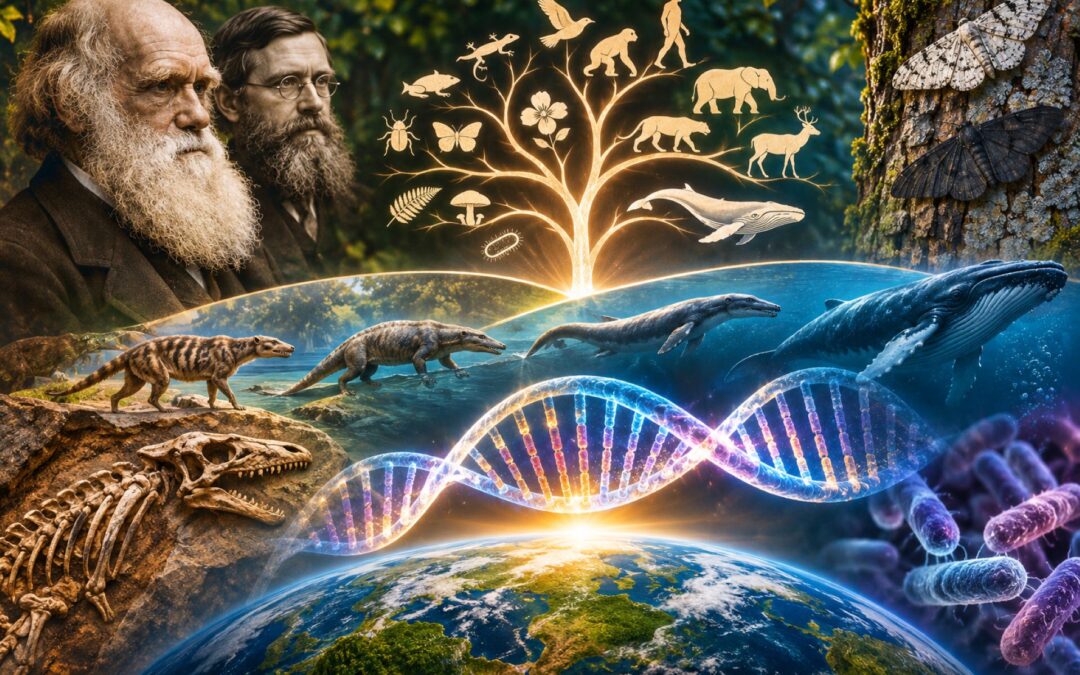
A whale’s flipper contains bones arranged much like those in a human arm. A moth that blends into a tree trunk may have a better chance of escaping a hungry bird. And bacteria that survive an antibiotic can give rise to populations that are increasingly difficult to treat. These facts seem unrelated until we ask what connects them: how living organisms inherit their features, adapt to changing conditions, and diverge from common ancestors.
The fossil record makes the question even more intriguing. Rocks preserve creatures unlike any alive today, alongside recognisable ancestors and relatives of modern animals. Species appear, change, diversify, and disappear. Evolution explains these patterns through processes operating across generations, without requiring any organism to anticipate what its descendants will need. To understand how evolution works, we can begin with a kind of selection that humans have practised for thousands of years.
From Selective Breeding to Darwin and Wallace
For much of recorded history, people assumed that species were permanent kinds of living things. Yet animal breeders and farmers had long been changing the characteristics of domesticated populations. A breeder who repeatedly chooses dogs with a particular temperament, or saves seeds from plants with desirable traits, can influence what becomes common in later generations. The individual animals or plants do not transform because someone wants them to; individuals with inherited characteristics are chosen to reproduce.
Consider the remarkable variety of vegetables derived from wild cabbage, Brassica oleracea. Through generations of cultivation and selection for different features, people developed familiar forms including broccoli, kale, cauliflower, and kohlrabi. These are varieties of a shared ancestral species, not proof that every cultivated variety is a separate species. The same principle runs through the history of Indigenous American crop domestication, in which farmers deliberately selected plants suited to their needs and environments.
During the nineteenth century, fossils and comparative anatomy made the idea of permanently fixed species harder to sustain. Researchers encountered extinct organisms, noticed structural similarities across different animals, and began reconstructing a history of life far older than recorded human history. The challenge was not simply to show that living things had changed. It was to identify a credible mechanism explaining how useful adaptations could accumulate without anyone directing them.
Charles Darwin gathered observations during his voyage aboard HMS Beagle from 1831 to 1836 and spent years developing an explanation. Alfred Russel Wallace independently arrived at a closely related account of natural selection. Their contributions were jointly presented to the Linnean Society on 1 July 1858. Darwin then developed the argument at length in On the Origin of Species, first published on 24 November 1859.
The analogy with breeding was powerful but had a crucial difference. In artificial selection, people decide which inherited features they want to encourage. In nature, no gardener makes those choices. Local conditions determine which differences tend to help organisms survive and leave descendants. Darwin and Wallace recognised that this undirected filtering of inherited variation could produce the appearance of intricate design.
What Natural Selection Actually Selects
Natural selection requires several things to happen together. Individuals in a population vary: some are taller, darker, quicker, more disease-resistant, or better able to use certain foods. Some of those differences are heritable, meaning they can be passed from parents to offspring. Individuals also differ in how successfully they survive and reproduce. When a heritable characteristic consistently contributes to greater reproductive success in a particular environment, it can become more common over generations.
Imagine a population of leaf-eating animals on an isolated island. As their numbers increase, leaves close to the ground become scarce. Some animals happen to be taller than others because of inherited variation. If taller individuals can reach more food, remain healthier, and produce more surviving offspring, the genes associated with greater height may spread through the population. Their offspring will not all be identical, but over many generations the population’s average characteristics may shift.
This is a hypothetical illustration, not a claim about a particular real island. It also does not mean that the tallest animal always wins. A tall body might require more energy, become a disadvantage during drought, or make an animal easier for predators to spot. What counts as an advantage depends on circumstances. Natural selection does not recognise a universally superior trait; it favours characteristics through their effects on reproduction under prevailing conditions.
As OpenStax’s explanation of evolution makes clear, biologists use fitness to describe an organism’s relative success in contributing genes to subsequent generations. The term does not simply mean physical strength, good health, or a long lifespan. An animal can survive for many years but leave no offspring, while a smaller or less imposing individual may pass on more of its inherited characteristics. Survival is often important precisely because it creates opportunities for reproduction.
Where does the variation come from? Mutations introduce changes into genetic material, while sexual reproduction reshuffles existing variants through processes including recombination. Many mutations have little effect, some are harmful, and some become advantageous under particular conditions. Mutations do not arise because an organism needs a particular improvement. Selection works on variation that has arisen without knowledge of future requirements.
Natural selection is also not the only evolutionary mechanism. Genetic drift changes the frequency of inherited variants through chance, especially in small populations. Gene flow moves genetic variants between populations when individuals migrate and reproduce. Mutation continually introduces new variation. Together, these processes explain why evolutionary history involves more than a steady march towards increasingly well-adapted organisms.
The important distinction is between the fate of an individual and the evolution of a population. An animal does not evolve a longer neck during its lifetime simply by stretching for leaves. What can evolve is the distribution of inherited neck lengths among its descendants. Some shifts can occur quickly; others accumulate over thousands or millions of generations. Evolution has no target height, no predetermined destination, and no guarantee that a useful trait will remain useful forever.
Evolution Happening Before Our Eyes
Evolution is sometimes presented as something so slow that nobody could observe it. That misses how rapidly inherited characteristics can change when selection is strong and generations are short. Two particularly revealing examples involve British moths and microscopic organisms that reproduce far faster than humans do.
The peppered moth occurs in light and dark forms. Before heavy industrial pollution, pale moths were often better concealed on lighter, lichen-covered tree surfaces, making them less conspicuous to birds. As soot darkened many trees during Britain’s Industrial Revolution, darker moths gained an advantage in affected areas. Birds were more likely to notice and eat moths that stood out against their resting backgrounds, allowing better-camouflaged variants to contribute more offspring.
As pollution declined and habitats changed, the balance shifted again in many places. The crucial point is not that an individual moth turned black or white in response to its surroundings. Different inherited colour variants were already present, and their proportions changed across generations. The Natural History Museum’s account of industrial melanism illustrates how a change in the environment can reverse the direction of selection.
Antibiotic resistance provides another example, with direct implications for medicine. Bacterial populations can contain resistant variants before treatment begins, owing to mutations or resistance genes acquired from other bacteria. An antibiotic may kill susceptible cells while leaving resistant ones alive. Those survivors can multiply, making resistance more common among the bacteria that remain. Resistance genes may also spread between bacteria through horizontal gene transfer, which adds another route beyond ordinary parent-to-offspring inheritance.
Antibiotics do not instruct bacteria to invent precisely the defences they need. Instead, treatment creates a powerful selective pressure that favours organisms possessing or acquiring effective resistance. This is why appropriate antibiotic use matters and why resistance remains an evolutionary challenge rather than a problem that can necessarily be solved once and for all. Evolution is not limited to ancient fossils; it is visible in changes to populations living around and within us.
Reconstructing Evolution Through Fossils and Anatomy
Direct observation of short-term selection is compelling, but it cannot by itself reveal changes stretching across tens of millions of years. To understand those transformations, scientists combine fossils with geology, comparative anatomy, and genetic evidence. Whales provide one of the clearest examples because their living bodies preserve striking clues to an ancestry on land.
Whales breathe air, nurse their young, and belong to the mammals, even though their streamlined bodies resemble those of fish. Inside a whale’s flipper lie bones corresponding to the upper arm, forearm, wrist, and fingers of other mammals. Deep within the body, whales also retain reduced pelvic structures. These are not random features: they make sense as modifications of a body plan inherited from land-dwelling ancestors.
Fossils help fill in the historical sequence. Early cetacean relatives such as Pakicetus, living roughly 50 million years ago, still possessed limbs suited to supporting the body on land. Other fossil forms show combinations of features associated with movement on land and in water. Over time, the forelimbs became specialised for steering and swimming, the body became better suited to aquatic movement, and the hind limbs were greatly reduced. Modern whales did not descend from one of today’s terrestrial mammals; both living and extinct forms belong to a much larger branching history.
The evidence is not merely that a fossil looks halfway between two living animals. Scientists examine detailed skeletal features, place specimens in dated geological layers, and compare the relationships suggested by anatomy with those recovered from DNA. Smithsonian Ocean’s account of whale evolution describes how fossil discoveries reveal the transition from terrestrial mammals to increasingly aquatic cetaceans. Geological context and radiometric dating help establish when different forms lived, even when exact ages retain uncertainty.
These comparisons also explain homology: similarities inherited from shared ancestry. The forelimb bones of a human, bat, whale, and many other vertebrates follow a recognisable underlying arrangement despite serving very different purposes. The structures were not independently invented from scratch for grasping, flying, or swimming. Descendant lineages modified anatomical material they had inherited.
Evolution can also leave structures with reduced or altered functions, often called vestigial structures. Human muscles associated with moving the external ears are far less important to hearing than the movable ears of many other mammals. Whale pelvic bones are greatly diminished compared with the pelvis of a walking mammal, yet they can still serve as attachment points for reproductive muscles. Vestigial therefore does not necessarily mean useless. It means a structure has changed substantially from its ancestral condition.
The fossil record is incomplete because preservation is rare and uneven. It does not provide an uninterrupted photograph of every generation. Its strength comes from the way independent discoveries repeatedly fit into a coherent chronology of branching relationships and anatomical change. The pattern also predicts what kinds of intermediate features researchers might find in rocks of particular ages.
How One Species Becomes Two
Changes within a population explain adaptation, but they raise another question: how does one ancestral lineage give rise to different species? One important route begins when populations become separated and no longer exchange genes freely. Different environments, mutations, selection pressures, and chance changes can gradually pull them in different directions.
Return to the hypothetical island. Suppose a small group of the leaf-eating animals crosses to the other side, where food is plentiful near the ground but predators make exposed, slow-moving animals vulnerable. Smaller, more agile individuals may leave more offspring there, while the original population continues to face competition for high leaves. Other characteristics, including hearing, behaviour, and body shape, might also diverge if they affect reproduction. This illustration shows how the same starting population could follow different evolutionary paths.
Geographical separation is not automatically enough to create new species. Initially, individuals from the two groups might still reproduce successfully if reunited. Over many generations, however, genetic differences can accumulate, mating behaviours may change, or hybrids may become less viable or fertile. Once barriers to successful reproduction are sufficiently strong, biologists may recognise distinct species. This is a common form of allopatric speciation, though new species can also arise without complete geographical isolation.
The boundaries are not always sharp. Horses, donkeys, and zebras share evolutionary ancestry and can sometimes produce hybrids, but many such offspring are sterile or have reduced fertility. Their relationships demonstrate that occasional mating does not automatically erase the biological distinctions between lineages. Scientists also use different species concepts for organisms that reproduce asexually or for extinct species known only from fossils.
Speciation produces a branching tree, not a ladder in which one kind of organism climbs towards another. When a lineage splits, its descendants can each continue evolving, persist for long periods, or become extinct. Millions of such divergences and losses help explain why Earth contains such extraordinary biological diversity and why species with very different appearances can nevertheless share ancient ancestors.
Tracing the Tree of Life Through DNA and Development
The history of life cannot be reconstructed from fossils alone. Living organisms carry records of ancestry in their genes, anatomy, and patterns of development. These lines of evidence are especially powerful when they point independently towards similar evolutionary relationships. Researchers can compare DNA and protein sequences, identify shared inherited changes, and construct phylogenetic trees that represent hypotheses about where evolutionary lineages branched.
Related species often share many genetic sequences because they inherited them from common ancestors. Differences accumulate through mutation and other evolutionary processes, allowing scientists to investigate which species are more closely related. These estimates are not simple calculations in which a fixed percentage of matching DNA supplies an exact split date. Different regions of the genome evolve differently, and reconstructed relationships are evaluated alongside fossils and other evidence.
Humans offer a familiar example. We share a relatively recent common ancestor with chimpanzees and bonobos, probably living around six to eight million years ago. Humans did not evolve from the chimpanzees alive today; instead, the ancestors of modern humans and the ancestors of living chimpanzees followed separate branches after their divergence. Smithsonian Human Origins explains how genetic comparisons help reconstruct those relationships and place our species within the wider primate family.
Nor was human evolution a simple progression from one predecessor to modern people. Several human lineages existed during different periods, and some overlapped. Neanderthals, for example, were close relatives rather than unfinished versions of us, and genetic evidence reveals interbreeding between some ancient human populations. Many lineages eventually became extinct, while Homo sapiens survives. The precise placement of fossil populations continues to be investigated, but the branching character of human evolution is well established.
Development provides another set of clues. Vertebrate embryos share important features and developmental pathways inherited from deep common ancestry, including structures that are modified into different adult forms. Humans develop a transient embryonic tail that contributes to the formation of the coccyx. However, embryos of all vertebrates are not literally identical at an early stage, and embryonic development does not replay evolutionary history in a neat sequence. Similarities in development are informative because they reveal inherited biological architecture, not because every embryo passes through the adult forms of its ancestors.
The same reasoning extends across birds, reptiles, and mammals. Their limbs, genetic instructions, and developmental processes display patterns consistent with a shared vertebrate ancestry, even though later evolution produced wings, claws, hands, and flippers. Molecular evidence can also clarify relationships when outward appearance is misleading. A whale resembles a fish in overall shape because both move through water, but its anatomy and genetic relationships place it firmly among mammals.
If we keep tracing branches backward, we eventually approach the last universal common ancestor, or LUCA, of living cellular life. LUCA was not necessarily the first living organism or a lone individual; the term refers to an ancestral population from which the cellular organisms alive today ultimately descend. A 2024 study reconstructing LUCA’s nature and age estimated that it lived approximately 4.2 billion years ago. That estimate depends on models and assumptions and should not be mistaken for a directly observed date.
How life itself first began remains a separate and unresolved question. Evolutionary theory explains what happens when systems capable of inheritance, variation, and differential reproduction exist; it does not by itself tell us exactly how the first such systems arose. Nor does evolutionary history describe an inevitable ascent towards complexity. Some lineages become more elaborate, others simplify, and countless microorganisms remain extraordinarily successful without developing large bodies or brains. The tree of life is a record of diversification, adaptation, contingency, and extinction, not a march towards a predetermined ideal.
Why Evolution Is a Scientific Theory, Not a Guess
In everyday speech, a theory can mean an uncertain hunch. In science, a theory is a well-supported explanatory framework that brings together observations, evidence, and testable predictions. Evolutionary theory explains why organisms show nested patterns of genetic similarity, why fossils appear in particular geological sequences, why inherited structures are modified across related species, and why populations respond to selection pressures.
Scientists continue to investigate the timing of particular divergences, the relationships among ancient species, and the relative influence of natural selection, drift, and other processes. Those open questions are not evidence that biological evolution is a baseless idea. They are the kinds of questions a productive scientific framework makes it possible to examine. The overwhelming agreement that life has evolved is compatible with ongoing debate over individual evolutionary histories and mechanisms.
This understanding also has practical consequences. Public health researchers study the evolution of pathogens and antibiotic resistance. Conservation biologists use genetic diversity and population histories to assess threats to species. Agricultural scientists examine how pests develop resistance and how inherited traits change in cultivated populations. These applications work because evolution describes measurable processes rather than simply offering a story about the distant past.
Every living species is a present-day branch of a much older history, not a finished product occupying a fixed place in nature. Natural selection helps explain how inherited traits spread; fossils, anatomy, genetics, and development help reveal where lineages came from; and speciation explains how those lineages separate. Together, these processes show how the immense variety of life can emerge through change across generations, without foresight, design goals, or any single final destination.
Last Updated on November 1, 2026 by Aseem Gupta