
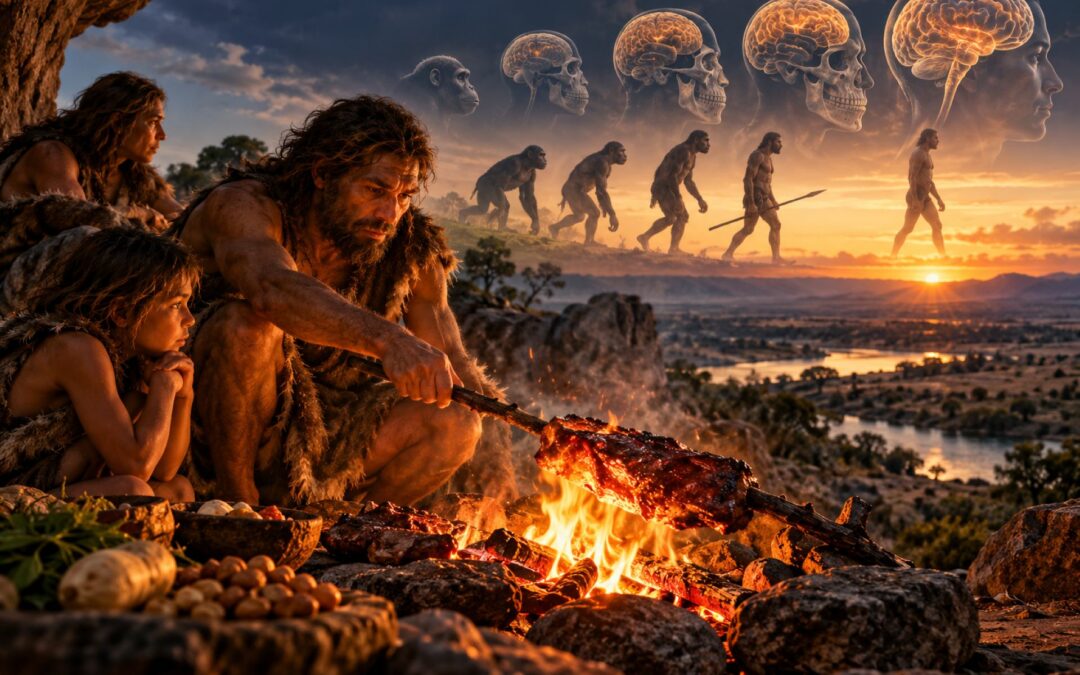
The human brain is an extraordinary organ, but it comes with an extraordinary appetite. Despite accounting for only a small fraction of our body weight, it consumes roughly a fifth of the energy used by an adult at rest. Maintaining such an expensive organ requires a reliable supply of energy, yet humans have relatively small teeth, modest jaws, and a digestive system that is considerably less suited to processing large quantities of tough, fibrous food than those of our closest ape relatives.
This presents an intriguing evolutionary puzzle. Chimpanzees spend much of their waking lives finding, chewing, and digesting food, while humans can obtain substantial amounts of energy from meals that require relatively little effort to eat. Somehow, our ancestors developed bodies capable of supporting increasingly large brains without devoting an equally enormous share of their lives to feeding.
For decades, scientists have investigated how hunting, meat consumption, stone tools, cooperation, and changes in diet contributed to this transformation. Primatologist Richard Wrangham proposed another explanation in his 2009 book Catching Fire: How Cooking Made Us Human. He argued that the ability to cook food was not merely a useful innovation adopted by humans after they had evolved. Cooking may have been one of the developments that made our evolution possible in the first place.
The argument is compelling because cooking changes much more than the taste of food. It changes how much energy our bodies can extract, how much effort digestion requires, and potentially how much time remains for activities beyond eating. But demonstrating that cooking was beneficial is different from proving that it caused the emergence of recognizably human bodies and minds. Understanding the distinction is essential to answering whether cooking really made us human.
Why the Raw-Food Question Matters
Humans are unusual among animals because cooking is a routine part of how we obtain nourishment. Other species can manipulate food, and some possess cognitive abilities relevant to food preparation, but no other known species systematically uses controlled heat to prepare its meals in the way humans do. Across cultures, the particular ingredients and techniques vary enormously, yet cooked foods occupy a central place in human diets.
This distinction raises an evolutionary question. Are we simply animals that discovered a convenient way to improve our meals, or have our bodies become so adapted to food preparation that living entirely on uncooked foods presents unusual difficulties?
The answer begins with the difference between food that contains calories and food from which the body can actually obtain those calories. Raw plants can contain substantial amounts of energy, but their cellular structures may make some of that energy difficult to access. Tough meat demands chewing and digestive effort, while many uncooked starchy foods are less readily digested than their cooked equivalents. Our ancestors therefore needed not only to find sufficient food but also to obtain enough usable energy from it.
Modern raw-food diets offer an imperfect but informative comparison. People following these diets may consume fruits, vegetables, nuts, seeds, and other uncooked foods, often with considerable variety. Such diets can be compatible with particular health goals, but they may also make it difficult to obtain sufficient energy, depending on their composition and restrictiveness.
A 1999 study examining the consequences of long-term raw-food diets investigated body weight and menstrual function among people who consumed substantial proportions of their food uncooked. Researchers found that stricter adherence to raw-food diets was associated with lower body weight and a greater frequency of menstrual irregularities. Among women younger than 45, approximately 30% reported partial or complete absence of menstruation, with problems more common among those consuming the highest proportions of raw food.
These findings matter because reproductive function is sensitive to energy availability. When the body experiences sustained energy deficiency, it may reduce expenditure on processes that are not immediately necessary for survival. Menstrual disruption can be one consequence, although reproductive health is influenced by many other factors and cannot be explained by diet alone.
The study does not establish that raw foods inevitably cause weight loss or infertility. It was observational, participants selected their own diets, and modern raw-food practices differ considerably from the diets available to prehistoric populations. Nevertheless, the results illustrate why obtaining sufficient energy is especially important when evaluating a proposed ancestral way of eating.
For early humans, the evolutionary stakes were substantial. A dietary strategy that improved growth, physical condition, reproductive success, and the ability to provision offspring could provide advantages over many generations. Even modest improvements in energy availability might eventually influence which physical characteristics became more common within a population.
This does not mean that humans are incapable of surviving on uncooked food. People can obtain substantial nourishment from appropriately selected raw foods, and cooking is not the only way to increase food accessibility. The important question is whether regular food preparation made survival and reproduction sufficiently easier to change the direction of human evolution.
There is also an intriguing distinction between the ability to understand cooking and the practice of cooking itself. Experiments with chimpanzees have shown that they can prefer cooked food and demonstrate some abilities relevant to choosing or waiting for prepared food. What they lack is the habitual technological system that allows humans to obtain, control, and apply heat to ingredients.
Human cooking therefore appears to represent more than a simple preference for something that tastes better. It combines biological advantages with learned behaviour and technological knowledge, creating a relationship between food and survival that is unusual in the animal kingdom.
How Cooking Changes the Energy We Get from Food
The central claim behind Wrangham’s hypothesis is that cooking increases the amount of usable energy humans can obtain from many foods. Two meals may contain similar quantities of protein, fat, and carbohydrate when measured chemically, yet provide different amounts of energy to the body depending on how their ingredients have been prepared.
This happens because eating is only the beginning of obtaining nourishment. Food must be broken into smaller pieces, exposed to digestive enzymes, and processed until nutrients can be absorbed. The more difficult those steps are, the more energy and effort the body may have to expend, and the greater the possibility that some nutrients will pass through without being fully absorbed.
Consider a starchy plant food such as a tuber. Much of its carbohydrate is stored inside cells and in tightly organised starch granules. When heated with sufficient moisture, starch undergoes a process called gelatinisation, in which its structure changes and becomes more accessible to digestive enzymes. As a result, a cooked tuber can provide readily available energy that would be harder to extract from the same food in its raw state.
Heating also changes proteins. The complex structures of protein molecules can unfold during cooking, making them more accessible to digestive enzymes under many conditions. Cooking may also soften connective tissues in meat, although the effects depend on temperature, duration, moisture, and the particular food involved.
These transformations are not universal improvements. Excessive heating can make some foods tougher, damage heat-sensitive nutrients, or produce undesirable chemical compounds. Cooking also consumes fuel and requires time and labour, so its overall benefits depend on the circumstances. Wrangham’s evolutionary argument concerns the advantages that preparation could provide across a useful range of foods, not the claim that every cooked ingredient is automatically superior to its raw equivalent.
The distinction between total calories and available energy is particularly important. A laboratory can determine a food’s gross energy content by measuring the heat released when it is burned, but human digestion is not equivalent to burning food in a laboratory. The body encounters physical structures, chemical barriers, microbes, and digestive limitations that affect how much energy is ultimately available.
In experiments examining the energetic consequences of thermal and nonthermal food processing, Rachel Carmody, Richard Wrangham, and their colleagues investigated how preparation affected the energy animals obtained from food. Using mice fed differently prepared meat and starchy foods, they found that cooking produced energetic advantages that could not be understood simply by comparing the foods’ nominal calorie contents.
The experiments provided support for a crucial part of Wrangham’s reasoning: cooking can increase the energy an animal obtains from an ingredient even when the underlying food material remains essentially the same. The findings do not establish exactly how much energy prehistoric humans gained, nor do experiments on mice reproduce the complete conditions of human evolution. They do, however, demonstrate a biological mechanism that makes the hypothesis plausible.
Cooking is only one way of achieving such benefits. Cutting, crushing, pounding, and grinding can also break down food structures before they enter the mouth. A piece of meat sliced into small portions requires less mechanical effort to chew than an equally large unprocessed piece, while a crushed plant may expose more of its internal material to digestion.
These techniques illustrate a broader evolutionary possibility: our ancestors increasingly moved some of the work of food processing outside their bodies. Rather than relying entirely on teeth, jaws, stomachs, and intestines, they used their hands, tools, and eventually fire to make food easier to consume.
The consequences extend beyond what happens during an individual meal. If a population regularly obtains more energy from its available food, that energy can potentially support growth, reproduction, physical activity, and the maintenance of metabolically demanding tissues. Natural selection may then favour traits that would be difficult to sustain under a less energy-rich dietary regime.
This is why the cooking hypothesis matters to human evolution. Wrangham is not simply arguing that heated food was pleasant or convenient. He is proposing that cooking altered the relationship between dietary resources and biological expenditure so profoundly that it helped change the kinds of bodies our ancestors could evolve.
The most intriguing proposed consequence concerns an organ that requires an enormous amount of energy yet is responsible for many of the capacities we consider distinctly human: the brain.
Why Homo erectus Is Central to the Cooking Hypothesis
Approximately 1.9 million years ago, members of the human evolutionary lineage began displaying a combination of characteristics that differed substantially from those of earlier hominins. Among the most important developments were changes in body proportions, locomotion, teeth, jaws, and brain size. Fossils commonly associated with early Homo erectus reveal a form of humanity increasingly adapted to travelling across landscapes rather than living with the same combination of climbing and terrestrial abilities seen in earlier relatives.
Wrangham regarded this evolutionary transformation as particularly significant because it suggested a change in how our ancestors obtained and used energy. To understand his argument, it helps to compare Homo erectus with earlier members of the genus Homo, including fossils traditionally classified as Homo habilis.
Homo habilis is generally associated with smaller bodies and relatively modest brains compared with later humans. Its anatomical features retain important similarities with earlier hominins, and scientists continue to debate how the various fossils assigned to this species relate to one another and to later members of the human lineage. The transition to Homo erectus should therefore not be imagined as one clearly identified species suddenly transforming into another.
Nevertheless, the appearance of Homo erectus marks a significant stage in human evolution. Its body proportions became more similar to those of modern humans, with relatively long legs and adaptations associated with efficient terrestrial movement. Its populations also expanded beyond Africa, demonstrating an ability to exploit environments across parts of Eurasia.
Brain size increased substantially across this evolutionary history, although the fossil record reveals variation rather than one uniform transformation. Larger brains offered potential advantages for learning, memory, social behaviour, and flexible responses to environmental challenges. They also created an energetic problem because neural tissue is expensive to maintain.
Wrangham’s reasoning begins with that problem. If early humans were developing larger brains and more active bodies, they needed a way to support greater energy demands. At the same time, changes in teeth, jaws, and facial anatomy suggest that the mechanical demands of feeding were also changing.
Compared with many earlier hominins, Homo erectus possessed dental and facial characteristics consistent with a reduced dependence on prolonged chewing of difficult foods. The interpretation is not straightforward because tooth size, facial anatomy, body size, and dietary adaptations do not all change together or follow one simple evolutionary trajectory. Even so, the broader pattern suggests an important shift in food selection or processing.
Wrangham proposed that habitual cooking could explain these developments together. Heating food would make many ingredients easier to chew and digest, potentially reducing the advantages of maintaining particularly large teeth, powerful jaws, and an extensive digestive system. The additional energy obtained from prepared foods could then help support the demands of a larger brain.
This argument connects with the expensive-tissue hypothesis, originally associated with Leslie Aiello and Peter Wheeler. The hypothesis begins with the observation that different organs have different energetic costs. Brains and digestive tissues are both metabolically demanding, so changes in the resources devoted to one system might influence what is available to another.
In its familiar form, the hypothesis suggests that improvements in diet quality allowed the digestive system to become smaller while freeing resources for an expanding brain. Wrangham connected cooking to this proposed trade-off by arguing that easily digested meals could reduce the evolutionary need for an energetically expensive gut.
There is an important limitation, however. Scientists cannot directly measure the digestive organs of Homo erectus, because soft tissues generally do not survive in the fossil record. Claims about ancient gut size depend on indirect anatomical reasoning and comparisons with living primates, rather than preserved prehistoric intestines.
The simplest brain–gut trade-off is also not universally supported by comparative research. Different species can accommodate large brains through several energetic strategies, and the relationship between digestive anatomy and brain size is more complicated than a direct exchange between two organs.
Yet this complication does not make Wrangham’s broader insight irrelevant. Whether or not a smaller gut literally financed a larger brain, a reliable increase in accessible dietary energy could still have supported the evolution of energetically demanding traits. The cooking hypothesis does not stand or fall entirely on the strongest version of the expensive-tissue argument.
The timing remains the greatest difficulty. If cooking was responsible for the appearance of Homo erectus, habitual cooking would need to have begun sufficiently early to influence that evolutionary transition. The archaeological record does not currently establish that cooking was widespread approximately 1.9 million years ago.
Wrangham therefore uses anatomy to infer the existence of a dietary transformation that archaeology has not yet directly demonstrated at the required date. The inference is interesting because several anatomical changes point toward altered feeding behaviour, but it remains an inference rather than a confirmed account of what happened.
The history of Homo erectus is consequently central to the theory for two reasons. It provides the evolutionary transformation that cooking might help explain, while also exposing the difference between a persuasive biological argument and direct evidence for the technology that supposedly produced it.
The Archaeological Search for the First Cooking Fires
Finding the first evidence of cooking is much more difficult than finding a stone tool. Stone can survive underground for millions of years, while wood, food scraps, ash, and other materials associated with cooking are often destroyed or dispersed. Even where traces of burning remain, scientists must determine whether they resulted from deliberate human behaviour or a naturally occurring fire.
This creates several distinct archaeological questions. Did ancient hominins encounter and exploit naturally occurring fires? Could they maintain and control flames once obtained? Were they deliberately heating food, and could they eventually start fires whenever they needed them?
These abilities are related, but they are not identical. A population might use burning wood collected after a wildfire without knowing how to ignite new fuel, while another might maintain a hearth for warmth or protection without necessarily depending on cooked meals.
One of the most important archaeological sites for early fire use is Wonderwerk Cave in South Africa. Researchers examining ancient deposits identified burned bones and plant remains within sedimentary layers dated to approximately one million years ago. The findings are particularly significant because microscopic analysis helped establish that the burned material was present in the cave’s ancient deposits rather than simply being the result of a much later disturbance.
The research identifying evidence of fire at Wonderwerk Cave strengthened the case that early hominins were using fire long before the appearance of our own species. The location of the remains inside a cave also makes a simple explanation involving a passing grassland fire less satisfactory, although reconstructing exactly how individual fires were obtained and managed remains difficult.
Wonderwerk is not direct evidence of cooking. The burned material establishes an association with fire, but it does not demonstrate that hominins were routinely heating meals or that cooking had become essential to their survival. The distinction matters because the cooking hypothesis requires more than occasional access to heat.
A major advance came from Gesher Benot Ya’aqov, an archaeological site in present-day Israel. Researchers examining fish remains discovered evidence suggesting that hominins deliberately heated fish approximately 780,000 years ago. The interpretation rested on the characteristics of preserved fish teeth and their archaeological context, allowing scientists to investigate the temperatures to which the remains had been exposed.
The 2022 study identifying evidence of fish cooking approximately 780,000 years ago provided particularly important support for the antiquity of prepared meals. Rather than merely establishing that a fire had burned somewhere near human activity, the evidence connected controlled heating with a specific food resource.
The discovery also demonstrates that prehistoric diets could be more varied than simplified accounts of early human hunting suggest. Aquatic resources formed part of the food available to some ancient populations, and the ability to cook fish would have created another way to obtain nourishment from local environments.
The finding does not mean that everyone living 780,000 years ago regularly cooked fish, nor does it prove that cooking began at that site. Archaeological discoveries identify behaviours that occurred at particular places and times. They rarely establish the first moment when an activity was invented or show how widely it had spread.
Another major distinction concerns the ability to produce fire deliberately. For a population that depended on flames, learning to ignite fuel without waiting for a natural fire would have transformed the reliability of the technology. Yet the earliest use of fire could have preceded dependable fire-making techniques by a considerable period.
Research published in December 2025 presented evidence of deliberate fire-making at Barnham in England, dated to approximately 400,000 years ago. The interpretation draws on an association of heated sediments, heat-altered flint tools, and fragments of pyrite, an iron sulphide mineral that can produce sparks when struck appropriately against suitable materials.
The Barnham evidence matters because it potentially moves the discussion beyond the use and preservation of existing flames. It suggests that some ancient hominins possessed the technical knowledge to create fire through deliberate action, making access to heat less dependent on unpredictable natural events.
However, Barnham does not represent the earliest known use of fire or the oldest evidence of cooking. Its importance lies in the distinct problem of intentional ignition. Treating all three achievements as the same technological milestone would obscure what archaeology actually demonstrates.
The chronological difficulty for Wrangham’s hypothesis remains considerable. Homo erectus appeared roughly 1.9 million years ago, while some of the strongest preserved evidence of controlled fire and deliberate cooking comes from substantially later periods. This leaves a large interval between the anatomical changes that Wrangham seeks to explain and the clearest archaeological demonstrations of the proposed behaviour.
That gap does not prove early cooking was absent. Fires leave fragile traces, sites are preserved unevenly, and many prehistoric activities may never be recoverable. A technology could have existed long before its oldest surviving archaeological evidence, particularly if it initially depended on temporary fires rather than permanent hearths.
The reverse caution is equally important. Archaeological preservation problems cannot automatically be used to assume that cooking began whenever a biological theory requires it to have begun. Without suitable evidence, an early origin remains possible rather than established.
The developing archaeological record therefore supports a carefully qualified conclusion. Ancient humans and their relatives were using fire long before Homo sapiens appeared, cooking food hundreds of thousands of years ago, and eventually developing techniques for deliberate ignition. What remains uncertain is how far back habitual cooking extends and whether it began early enough to explain the first major transformations associated with Homo erectus.
How Fire and Cooking May Have Changed Human Life
The possible consequences of cooking extend beyond the amount of energy obtained from a meal. By changing how food was prepared, consumed, and shared, cooking may also have influenced the organisation of everyday life among early humans.
One of the simplest advantages concerns time. Chimpanzees can spend several hours each day chewing, particularly when consuming fibrous plant foods that demand extensive mechanical processing. Humans generally spend a much smaller proportion of their waking hours chewing, although the precise difference depends on diet, food preparation, and lifestyle.
Wrangham argues that reducing this burden created opportunities for other activities. Time previously devoted to obtaining and processing nourishment through chewing could instead become available for travelling, making tools, maintaining relationships, caring for offspring, and cooperating with other members of a group. Cooking did not automatically produce these behaviours, but it could have altered the practical constraints within which they developed.
Food preparation also changes the relationship between adults and children. Young children have limited chewing abilities and require foods suited to their developing digestive systems. Softened, prepared foods could potentially make it easier to provide nourishment during the transition away from exclusive milk feeding.
This does not establish that cooking caused a particular evolutionary shift in weaning age. Infant feeding strategies are influenced by growth, maternal condition, food availability, social support, and other biological factors. Nevertheless, easier access to suitable foods could plausibly have contributed to the flexibility of human childcare.
Cooking may also have increased the importance of cooperation. Preparing a meal with fire requires obtaining fuel, managing heat, protecting food from burning, and maintaining access to a location where cooking can take place. Depending on the circumstances, these activities can encourage coordination and create opportunities for food sharing.
The social consequences are particularly interesting because food is not merely a biological resource in human societies. Meals become occasions for exchanging information, maintaining relationships, distributing resources, and reinforcing obligations. It is possible that some of these associations developed alongside the growing importance of cooking.
Wrangham went further by proposing that cooking influenced the formation of households, divisions of labour, and eventually relationships between men and women. Such explanations are much harder to verify archaeologically, and they risk projecting particular social arrangements into a distant past for which direct evidence is limited. They should therefore be treated as speculative extensions of the theory, not established facts about the origin of marriage or gender roles.
Fire itself offered advantages separate from cooking. A controlled flame could provide warmth, help deter some animals, and make particular environments easier to occupy. These benefits could potentially support movement into cooler habitats and changes in patterns of activity.
However, it would be a mistake to conclude that fire explains every distinctive feature of the human body. The evolution of reduced body hair, for example, involves competing hypotheses concerning thermoregulation and other selective pressures. Access to warmth does not demonstrate that fire caused humans to become comparatively hairless.
The broader significance is that food preparation and fire may have helped our ancestors modify the conditions under which they lived. Rather than adapting only through inherited changes in anatomy, hominins increasingly used behaviour and technology to alter the environments they experienced.
This interaction between biology, technology, and cooperation eventually became fundamental to the wider history of human civilization. Long before cities, agriculture, or written language, human survival depended on learned techniques, shared knowledge, and the ability to use available resources in increasingly flexible ways.
Cooking fits naturally into that longer transformation. Its importance may lie not in creating one particular human institution, but in showing how a learned behaviour could change the biological and social conditions under which subsequent generations developed.
What the Cooking Hypothesis Still Cannot Prove
Wrangham’s hypothesis brings together several observations that are difficult to ignore. Cooking can improve access to energy, humans possess unusual feeding adaptations, and major changes in anatomy occurred during early human evolution. The question is whether these observations establish that cooking caused the anatomical transformations associated with Homo erectus.
The main difficulty is that several developments could explain parts of the same evidence. Meat consumption, stone-tool technology, dietary diversity, changes in foraging behaviour, and food sharing may all have influenced the energy available to early humans. Cooking could have contributed to these changes without necessarily being the first or most important cause.
One alternative explanation concerns mechanical processing. Before humans developed reliable cooking techniques, stone tools were already available for cutting, slicing, and pounding food. These techniques could reduce chewing requirements without requiring access to fire.
In research examining meat consumption and Lower Palaeolithic food-processing techniques, Katherine Zink and Daniel Lieberman investigated how eating meat and mechanically processing foods affected chewing demands. Their experiments demonstrated that combining meat consumption with techniques such as slicing and pounding could substantially reduce the amount of chewing required to process a diet.
The results matter because one of the anatomical changes associated with human evolution is a reduction in the size and mechanical demands of the chewing apparatus. If tools and dietary changes could produce a similar reduction in feeding effort, smaller teeth and jaws cannot independently establish that cooking was responsible.
This does not make mechanical processing and cooking mutually exclusive explanations. Cutting meat into smaller pieces could improve access to its nutrients, while heating it might create further advantages. Early humans could have developed several complementary methods of processing food over long periods rather than making one transformative discovery.
Meat consumption presents another important possibility. Animal foods can provide concentrated sources of energy and nutrients, and changing access to these resources may have supported some of the energetic demands associated with larger bodies and brains. However, the evolutionary importance of meat cannot be reduced to a simple claim that hunting automatically produced intelligence.
The available evidence points toward a complicated dietary history involving changing food resources, technologies, environments, and social behaviour. Different populations probably faced different nutritional opportunities and constraints. It is therefore reasonable to investigate cooking as one major component of a broader transformation rather than assuming it displaced every earlier explanation.
The expensive-tissue hypothesis also requires careful assessment. The idea that energy saved through a smaller digestive system could help support a larger brain offers an elegant account of the relationship between diet and anatomy. Yet elegance is not evidence that the proposed trade-off occurred in the specific way described.
A comparative study by Ana Navarrete and colleagues examining the energetics of brain-size evolution challenged the prediction that larger brains should generally be associated with smaller digestive systems. Their analysis did not find the expected negative relationship between brain and digestive-tract mass across the mammals examined, weakening the simple version of the expensive-tissue explanation.
The implication is not that dietary energy was unimportant. Brain evolution could depend on several physiological and behavioural adjustments, including changes in food quality, energy expenditure, body composition, and the ability of social groups to obtain and distribute resources. A larger brain might be supported through multiple overlapping strategies rather than a direct exchange of digestive tissue for neural tissue.
This distinction also clarifies what experimental evidence can demonstrate. Studies showing that cooking increases usable energy provide strong support for a biological mechanism. They do not establish that natural selection favoured larger brains because of cooking, or determine the point in prehistory when this process began.
Archaeological evidence creates a second major limitation. The transition associated with early Homo erectus occurred substantially earlier than the clearest surviving evidence of actual cooking. Although the absence of preserved traces cannot exclude earlier food preparation, an explanation that depends on cooking beginning before the available evidence must remain provisional.
Wrangham himself examined this tension in his 2017 reassessment of the control of fire in the Paleolithic. His argument continued to emphasize the biological case for early cooking while engaging with the difficulty of reconstructing its archaeological chronology. The disagreement concerns not whether cooking has benefits, but how confidently those benefits can be connected to particular evolutionary changes.
Scientists must also distinguish between a trait that makes cooking useful and a trait that evolved because cooking already existed. Larger brains could have helped hominins develop more sophisticated food-processing behaviour, while better food processing could subsequently have supported further changes in brain size. Such feedback processes are harder to reconstruct than a simple sequence in which cooking appears first and intelligence follows.
Evolutionary changes rarely depend on one isolated cause. A population might begin consuming more meat, develop more effective tools, spend less time chewing, obtain greater energy from food, and gradually become better at exploiting fire. Each development could influence the advantages of the others.
That possibility offers a way to reconcile several important findings without erasing their differences. Mechanical processing can explain some reductions in chewing demand, changes in diet can increase available energy, and cooking can produce further digestive advantages. The anatomical and behavioural consequences could then emerge through overlapping processes operating across many generations.
The strength of the cooking hypothesis is that it identifies a genuine and potentially powerful relationship between technology and biology. Its weakness is that the evidence does not yet allow scientists to isolate cooking as the decisive cause of the transformation that produced Homo erectus.
A defensible conclusion therefore needs several levels of certainty. Cooking improves energy availability from many foods, and ancient hominins were cooking long before our species emerged. It is also plausible that habitual cooking influenced human anatomy, brain evolution, and patterns of social life. What remains unproven is that cooking alone caused those changes or that it began at precisely the point required by Wrangham’s strongest evolutionary interpretation.
The distinction does not diminish the importance of the theory. Instead, it identifies the questions that future discoveries must answer: when cooking became habitual, how widely it was practiced, which species depended on it, and how its benefits interacted with other changes in early human diets and behaviour.
Did cooking make us human? There is good reason to believe it helped, but the evidence does not support treating it as the single invention that separated humanity from its ancestors. Cooking changed the nutritional possibilities available to ancient hominins, and those changes could have influenced the evolution of bodies, brains, and everyday behaviour.
Wrangham’s contribution was to recognise that food preparation might belong near the centre of the human evolutionary story rather than appearing as an incidental achievement of an already intelligent species. His hypothesis connects something ordinary in modern life with the fundamental biological problem of obtaining enough energy to sustain a demanding body.
The precise origins and evolutionary consequences of cooking remain open questions, but its broader significance is difficult to dismiss. Our ancestors did not merely adapt to the foods their environments provided. They increasingly learned to transform those foods before eating them, changing what their bodies could obtain from the same resources. Cooking may not explain everything that made humans distinctive, but it illustrates one of the most consequential developments in our evolutionary history: the growing ability to use technology to change the conditions of our own survival.
Last Updated on October 29, 2026 by Aseem Gupta