
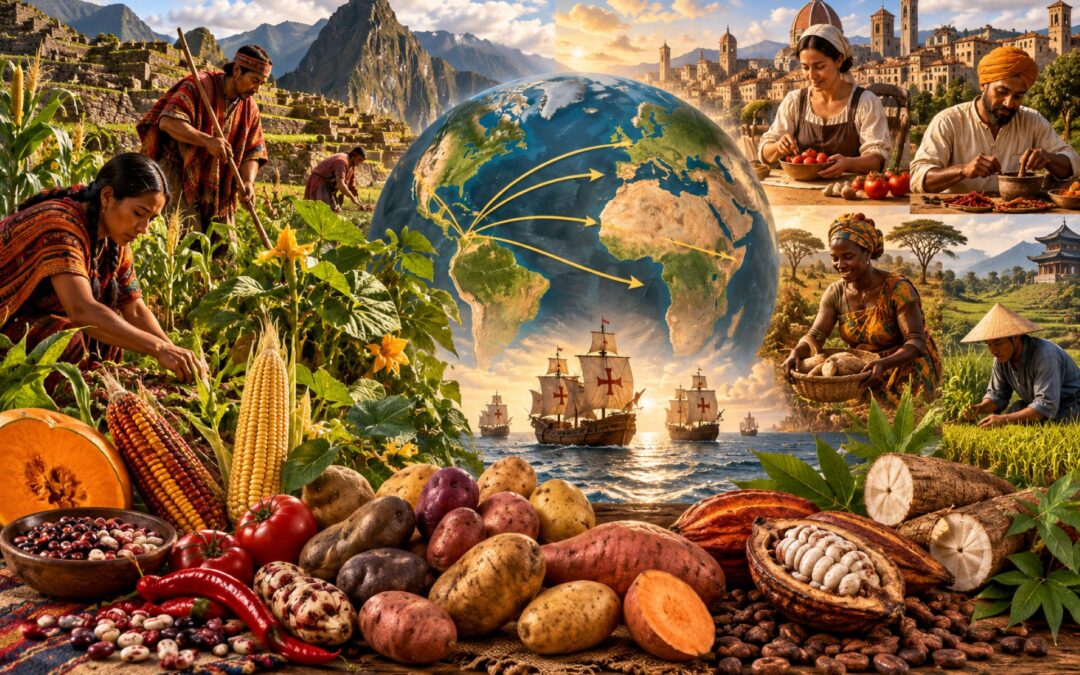
Imagine Italian pasta without tomato sauce, Indian curry without chillies, Irish stew without potatoes, or Belgian confectionery without chocolate. These foods are so deeply associated with their respective countries that it is difficult to imagine their cuisines without them. Yet none of these ingredients originated in Europe or Asia. They all came from the Americas, where Indigenous peoples had cultivated, adapted, and transformed them long before they became familiar to the rest of the world.
Their influence extended far beyond the dinner table. Potatoes helped support Europe’s growing population, maize and cassava became essential crops across Africa, and sweet potatoes expanded farming opportunities in parts of Asia. These plants changed where people could grow food, how much they could produce, and what kinds of societies their agricultural systems could sustain.
The story is usually told through the voyages of European explorers, the expansion of colonial empires, and the trading networks that connected distant continents after 1492. Far less attention is given to the farmers who made those exchanges possible. For thousands of years, Indigenous American communities had been selecting seeds, developing crops, experimenting with growing conditions, and managing difficult environments. Their accumulated knowledge helped reshape global agriculture, even as the societies responsible for it endured conquest, dispossession, and exploitation.
Before 1492: A World of Different Food Systems
Before sustained contact between the Americas and Afro-Eurasia, the world’s major agricultural regions depended on very different collections of crops. These differences were the product of geography, climate, ecology, and thousands of years of human experimentation. Farmers everywhere had developed ways to exploit their local environments, but the plants available to them placed important limits on where and how food could be produced.
Much of Europe’s agricultural economy depended on cereals such as wheat, barley, rye, and oats. Wheat was especially important around the Mediterranean, where it had sustained civilizations for millennia. Farther north, farmers relied on combinations of grains suited to shorter growing seasons, cooler temperatures, and different soil conditions. Agricultural productivity varied enormously, and communities remained vulnerable to unfavorable weather, crop disease, warfare, and interruptions in food distribution.
In Asia, rice supported extraordinarily productive agricultural systems, particularly in regions with suitable temperatures and adequate water. China also cultivated millet, wheat, and other crops, while South Asian agriculture drew on a wide range of grains, pulses, vegetables, and locally adapted plants. Irrigation, intensive cultivation, terracing, and sophisticated farming techniques enabled many Asian societies to sustain large populations long before American crops arrived.
Africa possessed its own extensive agricultural traditions. Sorghum, pearl millet, African rice, and other domesticated plants supported communities across diverse ecological zones. Farmers adapted their techniques to environments ranging from the Sahel to the tropical forests and highlands. These indigenous crops were important achievements in their own right, although their suitability varied across regions.
The fundamental challenge was that no crop could thrive everywhere. Rice generally required conditions very different from those needed by wheat or sorghum. Some grains struggled in waterlogged soils, while others were vulnerable to prolonged drought. Mountain slopes, marginal soils, and regions with unpredictable growing seasons presented additional difficulties. Even productive agricultural societies could face serious shortages when the weather disrupted their principal crops.
The consequences could be devastating. Europe experienced repeated famines throughout the medieval and early modern periods, including the Great Famine of 1315–1317, which affected large parts of northern Europe. Famines also struck Asian and African societies, although their causes and severity differed considerably. Food shortages reflected not simply how much grain existed, but also whether people could obtain it, how markets functioned, and whether political institutions could respond to crises.
Across the Atlantic, Indigenous American societies had developed a different set of agricultural resources. Maize, potatoes, cassava, beans, squash, sweet potatoes, tomatoes, and numerous other plants had been domesticated or extensively cultivated in the Americas. These crops did not eliminate agricultural uncertainty, but their diversity offered possibilities that farmers elsewhere had not yet encountered. When they eventually spread across the oceans, they expanded the world’s agricultural options in ways that would have lasting consequences.
How Indigenous Farmers Developed Crops for Difficult Environments
The agricultural achievements of Indigenous Americans were not simply a matter of discovering useful wild plants. Domestication required generations of observation, experimentation, and deliberate selection. Farmers saved seeds and planting material from plants exhibiting desirable characteristics, gradually changing the crops themselves while learning how to cultivate them under different environmental conditions.
Maize is among the clearest examples of this transformation. Its wild ancestor, teosinte, bears little resemblance to the large, densely packed ears of modern maize. Through a long process of human selection beginning in Mesoamerica, Indigenous farmers developed plants with larger edible structures, more accessible kernels, and characteristics that made cultivation increasingly productive. What began as a wild grass eventually became one of the world’s most important cereal crops.
The achievement did not end with domestication. As maize spread through different parts of the Americas, farmers developed varieties adapted to local climates, elevations, rainfall patterns, and growing seasons. Some matured relatively quickly, making them useful in regions with short summers. Others were suited to warmer environments or longer agricultural cycles. Over generations, farming communities created a remarkable range of maize varieties capable of supporting very different societies.
The potato underwent a similarly consequential transformation in the Andes. Wild potatoes existed in environments where cold temperatures, difficult terrain, and other ecological pressures demanded considerable adaptability. Many wild relatives also contain naturally occurring toxic compounds, making the selection and preparation of edible varieties an important part of their agricultural history. Indigenous Andean communities developed cultivated potatoes suited to a wide range of elevations and growing conditions.
The scale of this diversity remains remarkable. The International Potato Center documents more than 4,000 native potato varieties associated with the Andean region, reflecting a long history of cultivation and selection. These potatoes vary in shape, color, size, texture, nutritional characteristics, and environmental requirements. Such diversity represents a valuable agricultural resource, not merely an interesting collection of unusual vegetables.
Different varieties could perform better under different conditions. A potato suited to one altitude might struggle at another, while plants tolerant of particular temperatures or moisture conditions could offer an alternative when other varieties failed. Maintaining multiple varieties helped farming communities manage uncertainty and reduce the risks associated with depending on a narrow selection of crops.
Andean farmers also transformed the landscapes in which they worked. The mountains presented extraordinary challenges: steep slopes, thin soils, variable rainfall, intense sunlight, and substantial temperature differences over relatively short distances. Rather than treating these conditions as permanent barriers, communities developed systems that made difficult terrain productive.
Terraced farming was central to this achievement. Farmers constructed stepped agricultural platforms that created more manageable planting surfaces along mountain slopes. Carefully designed structures could reduce erosion, improve soil management, and regulate the movement of water. Depending on their construction and location, terraces could also moderate growing conditions and help protect crops against environmental stress.
These techniques developed over many centuries and were used by several Andean societies before the rise of the Inka Empire. The Inka inherited, extended, and coordinated existing agricultural knowledge across a vast territory. Their achievements included the integration of cultivation, irrigation, transportation, storage, and administration into systems capable of supporting communities across extremely varied environments.
The Smithsonian’s research on Inka agricultural and water-management innovations illustrates how engineering and environmental knowledge worked together. Terraces were not simply stone walls holding back soil. Their effectiveness depended on construction methods, water control, drainage, and an understanding of local growing conditions.
Andean agricultural experimentation also involved cultivating crops across different elevations and ecological zones. The striking agricultural terraces at Moray in Peru are frequently associated with experimentation under varying microclimatic conditions, although their exact historical functions remain debated. The broader achievement is better established: Andean peoples developed agricultural systems that exploited differences in altitude, temperature, and moisture rather than relying on uniform growing conditions.
Agricultural innovation took a different form in parts of Mesoamerica and North America. Farmers developed cultivation systems in which several crops grew together, allowing different plants to perform complementary functions. One of the best-known examples is the combination of maize, beans, and squash, commonly called the Three Sisters.
In this system, maize provides a vertical structure around which climbing beans can grow. Squash spreads across the ground, where its broad leaves help shade the soil, suppress weeds, and reduce moisture loss. Beans form relationships with nitrogen-fixing bacteria, contributing to the wider nutrient cycle of the agricultural system. The benefits depend on the particular varieties, soil conditions, and management practices involved, rather than occurring automatically in every field.
The National Park Service’s explanation of the Three Sisters cultivation system demonstrates how these plants could complement one another. Their relationship was agricultural as well as nutritional. Maize supplied carbohydrates, beans contributed protein and other nutrients, and squash added further dietary variety. Together, they supported diets with a broader nutritional foundation than any one crop alone.
Related intercropping systems appeared across different Indigenous societies, although their precise arrangements varied. In Mesoamerica, the milpa developed as a managed agricultural system that could include maize, beans, squash, chillies, and other plants. It was not simply a field containing three crops, but part of a wider body of knowledge concerning soil, vegetation, cultivation cycles, and local ecology.
These practices reveal a principle that modern agriculture continues to confront: productivity and resilience are not always achieved by maximizing the performance of one plant in isolation. Crop diversity, complementary cultivation, environmental adaptation, and careful resource management can also contribute to reliable food production.
Indigenous American farmers were therefore engaged in activities recognizable today as plant breeding, ecological management, and agricultural engineering. They did not possess modern genetic laboratories, but they understood that plants could be changed through selection and that different environments rewarded different characteristics. Their achievements accumulated through observation and experience across many generations.
How the Columbian Exchange Carried American Crops Around the World
The agricultural innovations of the Americas remained largely separated from the major farming systems of Europe, Africa, and Asia until sustained transatlantic contact began in the late fifteenth century. Columbus’s arrival in the Caribbean in 1492 initiated a period of expanding European exploration, conquest, settlement, and commercial exchange. One consequence was the movement of plants, animals, microorganisms, and people between regions that had previously developed largely distinct biological environments.
Historians call this process the Columbian Exchange. Its effects reached far beyond the territories conquered by European powers. Crops cultivated in the Americas entered trading networks that connected Atlantic ports, Mediterranean markets, African coastal communities, and eventually much of Asia. Plants were transported through shipping routes, colonial settlements, missionary networks, commercial exchanges, and the movements of ordinary people.
American crops did not spread simply because Europeans recognized their value and distributed them everywhere. Their adoption was usually gradual, uneven, and dependent on local circumstances. Farmers had to determine whether unfamiliar plants could survive in their soils and climates, how they should be cultivated, and whether they offered meaningful advantages over existing crops. New foods also had to overcome differences in taste, agricultural traditions, and social expectations.
Some crops initially remained curiosities or specialist products. Others became increasingly important because they could be cultivated on land unsuitable for established staples or could complement existing agricultural systems. As farmers adapted them to local needs, these plants acquired new varieties, preparation methods, and cultural meanings.
The exchange also moved in the opposite direction. Wheat, sugarcane, horses, cattle, sheep, and numerous other organisms entered American environments. Their arrival transformed landscapes, economies, transportation, and ways of life. Some Indigenous communities incorporated introduced animals and crops into their societies, while European colonizers reorganized vast territories around plantations, ranching, and commercial agriculture.
These transformations occurred under profoundly unequal conditions. European conquest brought political domination, forced labor, dispossession, and devastating demographic losses among Indigenous American populations. Epidemic diseases introduced through transoceanic contact were particularly destructive, although warfare, coercion, displacement, and social disruption also contributed to the catastrophe.
The spread of American crops therefore cannot be understood as an uncomplicated story of progress. The same historical processes that made new foods available across the world inflicted enormous suffering on many of the communities whose ancestors had developed them. European merchants and colonial institutions frequently profited from plants and knowledge originating in Indigenous societies, often without recognizing those societies’ contributions.
Nor did every transoceanic movement begin in 1492. Earlier contacts, including Norse voyages to North America and evidence of interactions involving Polynesian and Native American populations, complicate any absolute division between previously isolated worlds. Nevertheless, the sustained exchange that followed European Atlantic expansion was different in scale, intensity, and long-term global consequences.
By carrying American crops into new environments, the Columbian Exchange enlarged the range of plants available to farmers across multiple continents. That expansion would become especially significant when populations began growing more rapidly and societies searched for ways to produce food on land that had previously offered limited agricultural opportunities.
How the Potato Transformed Europe’s Population and Economy
Few American crops had consequences as far-reaching for Europe as the potato. Before its introduction, European farmers depended heavily on cereals and other established food plants. These supported large populations, but their yields and reliability depended on local conditions, available technology, and the success of annual harvests.
The potato offered a different agricultural opportunity. Rather than producing edible grain above ground, it stores energy in underground tubers. Under suitable conditions, potatoes can produce large quantities of edible food per unit of land, making them particularly valuable where agricultural space is limited or farming families need to support many people from relatively small holdings.
Potatoes also have different growing requirements from major cereal crops. They can perform well in cool climates and in some conditions where growing grain is more difficult. Their suitability is not universal, and they remain vulnerable to frost, excessive moisture, pests, and disease. Nevertheless, they expanded the agricultural possibilities available to farmers in many European regions.
Spanish contact with the Andes brought potatoes into European awareness during the sixteenth century. Their spread was not immediate. Different communities adopted them at different times, sometimes treating them as unfamiliar garden plants before recognizing their value as food crops. Cultivation expanded substantially in parts of Europe during the seventeenth and eighteenth centuries, with regional differences continuing long afterward.
The introduction of potatoes mattered because agricultural productivity affects more than the amount of food on a household table. When farming becomes more productive, a given area of land may support additional people. Under favorable economic and institutional conditions, agricultural surpluses can also make it possible for a larger share of the population to pursue activities outside farming.
These relationships help explain why historians and economists have examined potatoes as a factor in Europe’s demographic and economic transformation. The most influential quantitative investigation is Nathan Nunn and Nancy Qian’s study of the potato’s contribution to population growth and urbanization, published in The Quarterly Journal of Economics in 2011.
The researchers examined differences in land suitability for potato cultivation and changes in population and urbanization after the crop’s introduction. Their findings suggest that potatoes made a substantial contribution to long-term development. They estimated that potatoes accounted for approximately one-quarter of the increase in Old World population and urbanization over the period from 1700 to 1900.
That estimate is important because it moves beyond colorful historical speculation. It offers an empirical argument that the arrival of a new crop affected population growth and economic development on a considerable scale. At the same time, the figure is a model-based estimate, not a direct historical count, and it should not be interpreted as proving that potatoes explain every major European transformation.
Europe’s population also grew because of changes in agricultural practices, commerce, public institutions, disease environments, mortality, and other economic and social conditions. Industrialization depended on technological development, access to energy, investment, markets, labor organization, and political circumstances. Potatoes contributed to the environment in which these changes occurred, but they were not a sufficient cause of the Industrial Revolution or Europe’s overseas empires.
Ireland provides an especially revealing example of both the potato’s benefits and its dangers.
The crop became deeply embedded in Irish agriculture because it could supply substantial quantities of food from relatively small plots. For many poorer households, potatoes were an essential part of survival in a rural economy characterized by unequal landownership, tenancy, and poverty. When combined with milk or other available foods, potatoes could form part of a reasonably nourishing diet despite severe material deprivation.
As potato cultivation expanded, Ireland experienced considerable population growth. Its population reached approximately 8.2 million in the 1841 census, reflecting a long period of demographic expansion. The potato was not the only reason for that growth, but its ability to support large families on limited land was an important contributing factor.
Yet the same dependence created extraordinary vulnerability. Many poorer households relied heavily on a relatively narrow range of potato varieties, including the widely cultivated Lumper. A crop that could sustain large populations when harvests succeeded could expose those populations to disaster when harvests failed repeatedly.
In the 1840s, the potato disease caused by Phytophthora infestans devastated harvests across Ireland. The resulting Great Famine brought mass death, emigration, and profound social disruption. Its consequences cannot be explained by crop disease alone: poverty, land tenure, unequal access to food, government policies, and failures of relief shaped how the agricultural crisis became a humanitarian catastrophe.
Ireland demonstrates why agricultural abundance and food security are not identical. A highly productive crop can support population growth while leaving people exposed to concentrated risks. Whether food systems remain resilient depends on crop diversity, economic conditions, political institutions, and the ability of communities to withstand shocks.
The potato’s broader European history follows the same principle. It expanded food-production possibilities and supported demographic change, but it did not abolish famine or eliminate agricultural uncertainty. Its greatest historical contribution was to widen the range of resources available to European societies, enabling developments that depended on many other conditions.
How Maize, Cassava, and Sweet Potatoes Changed Africa and Asia
The agricultural consequences of American crops were not confined to Europe. Across Africa and Asia, maize, cassava, sweet potatoes, and other introduced plants became integrated into existing farming systems. Their significance depended on how well they complemented local crops, what environments they could exploit, and how farmers adapted them to regional conditions.
Africa illustrates the importance of this adaptation particularly clearly. Long before sustained Atlantic contact, African communities had developed sophisticated agricultural traditions based on sorghum, millet, African rice, yams, legumes, and numerous other plants. These crops supported diverse societies, and their cultivation reflected extensive knowledge of local ecological conditions.
The arrival of maize introduced another important cereal into that agricultural landscape. Originating in the Americas, maize spread through trade and exchange after the beginning of sustained transatlantic contact. Its adoption differed across regions, with some communities incorporating it relatively early while others continued relying primarily on established staples.
Maize became important partly because it could produce useful harvests under a wide range of growing conditions, provided suitable varieties and adequate resources were available. Farmers could cultivate it alongside other crops or integrate it into agricultural systems previously organized around different staples. In some regions, its productivity and suitability encouraged significant changes in cropping patterns.
These changes were neither immediate nor uniform. Maize did not simply replace African agriculture with a superior foreign system. Local farmers selected varieties, developed cultivation practices, and incorporated maize into regional food cultures according to their needs. The historical significance lies in the interaction between the introduced crop and existing agricultural knowledge.
Cassava followed a different path to prominence. Native to tropical South America, cassava was carried across the Atlantic and gradually became established in several African regions. Its value came partly from its ability to tolerate periods of water stress and produce edible roots under conditions that could be difficult for some other staple crops.
Cassava also offered flexibility in harvesting. Unlike crops that must be collected within a narrow period after maturity, cassava roots can often remain in the ground for some time, depending on the variety and environmental conditions. This characteristic makes cultivation valuable for households seeking flexibility in food production and consumption.
The crop is not without disadvantages. Certain cassava varieties contain cyanogenic compounds that require appropriate processing to reduce toxicity. Cassava roots are also relatively low in protein, making dietary diversity important where they form a major staple. Communities developed processing techniques and food traditions that allowed cassava to become an important part of regional diets.
The FAO’s account of the world cassava economy explains the crop’s American origins and its growing importance across tropical regions, particularly in Africa. Its adoption expanded the food options available to farmers facing uncertain rainfall, limited resources, or difficult growing conditions.
Cassava eventually became essential to the diets and livelihoods of millions of people, particularly in parts of Central and West Africa. Nigeria emerged as a major global producer, while the crop became important in food processing, household agriculture, and commercial markets across the continent.
Maize and cassava contributed to agricultural expansion and food security, but neither made African societies immune to drought, famine, or economic disruption. Their historical importance is better understood as an expansion of agricultural possibilities. Farmers gained additional crops that could be combined with existing systems, offering opportunities to adapt production to changing conditions.
In Asia, sweet potatoes and maize also became valuable additions to established agriculture. China provides one of the most consequential examples because its large population depended on intensive cultivation across environments ranging from productive river valleys to hillsides and less favorable soils.
Rice had long been important in southern China, while wheat, millet, and other crops supported different agricultural regions. These systems were highly developed before American plants arrived. The introduction of new crops nevertheless offered farmers additional opportunities, particularly where established staples were difficult to cultivate.
Sweet potatoes reached China through overseas contacts during the late Ming period, although the exact chronology and routes of introduction are more complicated than a single arrival date suggests. Historical accounts describe different pathways involving maritime trade, movement through Southeast Asia, and exchanges with overseas Chinese communities.
Scholarly research on the multiple historical routes by which sweet potatoes entered China shows why a familiar story of one person introducing one crop can be misleading. The spread of an agricultural plant may involve repeated introductions, regional experimentation, and gradual adaptation rather than one decisive event.
Sweet potatoes offered particular advantages in some upland and marginal environments. Their cultivation allowed farmers to exploit land that was not necessarily suitable for intensive rice production. Maize also became important in parts of China’s agricultural frontier, especially as cultivation expanded into different ecological zones.
These crops contributed to changing agricultural patterns during the Ming and Qing periods. They formed part of a larger history involving land reclamation, population movement, commercial development, intensified farming, and demographic growth. Their importance was substantial, but attempts to explain China’s growing population through American crops alone would overlook the long-standing productivity of Chinese agricultural systems.
The deeper historical foundations of the region’s population are explored in why India and China developed such large populations. Fertile river basins, established farming traditions, intensive cultivation, political organization, and long periods of demographic accumulation all mattered. American crops added new possibilities to those existing foundations rather than creating them from nothing.
Across Africa and Asia, a similar process repeatedly occurred. A crop developed in one part of the world entered a different agricultural environment, where local communities evaluated it, adapted it, and incorporated it into their livelihoods. The eventual transformation depended on both the original domestication work of Indigenous American farmers and the subsequent knowledge of farmers elsewhere.
How American Crops Became Essential to Global Cuisines
The worldwide influence of American agriculture is perhaps easiest to recognize through the foods people eat every day. Many dishes now regarded as traditional national specialties depend on ingredients that were unknown in their present culinary environments before sustained contact with the Americas.
Italian cuisine provides an obvious example. Tomatoes originated in the Americas and entered Europe after transatlantic exchange began. They were not immediately transformed into the familiar sauces associated with modern Italian cooking. Their adoption unfolded gradually, as cooks experimented with the ingredient and incorporated it into local preparations.
Today, tomatoes are so closely associated with Italian food that pasta and pizza without tomato-based preparations can seem unusual. Yet these culinary traditions existed and evolved before the widespread adoption of tomatoes. What people now consider timeless Italian flavor emerged through historical change and adaptation.
Chilli peppers underwent an equally striking transformation. Originating in the Americas, they spread through maritime and commercial networks that connected Europe, Africa, and Asia. Portuguese trading routes contributed to their movement into South Asia, where they eventually became central to numerous regional cuisines.
Modern Indian cooking makes extensive use of red and green chillies, but these ingredients were not part of ancient Indian agriculture. Indian culinary traditions had already developed complex methods of seasoning food through black pepper, ginger, and many other spices. The adoption of American chillies expanded the available flavor palette, and regional cooks developed preparations that made them integral to Indian food.
Chillies also transformed cuisines in China and Southeast Asia, including dishes associated with Sichuan and neighboring regions. Their familiar pungency is distinct from that of Sichuan peppercorns, which are native to Asia and produce a characteristic tingling sensation. Together, these ingredients helped create combinations of flavor that are now strongly associated with particular regional cuisines.
Chocolate followed a different trajectory. Indigenous American communities had cultivated cacao and developed elaborate ways of preparing and consuming it long before Europeans encountered the plant. Its transformation into sweetened chocolate, industrial confectionery, and a worldwide commercial product involved centuries of technological, cultural, and economic change.
That larger story, from Indigenous cacao cultivation to modern manufacturing and trade, is examined in the history of chocolate. It illustrates how an agricultural product can retain its biological origins while undergoing extraordinary transformations in preparation, consumption, and cultural meaning.
Vanilla, another American-origin ingredient, became important in desserts and confectionery across much of the world. Popcorn, tortilla-based foods, and numerous preparations involving maize also reflect the global influence of plants cultivated by Indigenous societies. The modern food industry would look remarkably different without these ingredients.
Not every movement of American crops depended on European expansion. Sweet potatoes were cultivated in parts of Polynesia before sustained European contact, raising important questions about earlier transpacific movement and exchange. Archaeological, botanical, linguistic, and genetic findings contribute to the debate, but the details of particular voyages and the crop’s dispersal remain complex.
The evidence and competing explanations are examined in Polynesian navigation and possible pre-Columbian contact with America. This history is a reminder that agricultural plants sometimes moved through networks and encounters that conventional European-centered accounts overlook.
The remarkable feature of these culinary transformations is how completely introduced ingredients became part of local identities. Communities did not simply preserve American foods in their original forms. They incorporated new plants into existing techniques, tastes, and traditions, producing cuisines that eventually came to seem inseparable from their countries of adoption.
Guano: How an Andean Fertilizer Became a Global Commodity
The worldwide influence of Indigenous American agriculture extended beyond the crops themselves. One of the most consequential agricultural resources associated with the Andean world was guano, a natural fertilizer made from accumulated bird excrement. Its history reveals another way in which knowledge developed in the Americas became important to international agriculture and commerce.
Along parts of the Peruvian coast, seabirds congregate in enormous numbers. The region’s rich marine environment supports large populations of fish, which in turn sustain bird colonies. Over long periods, bird droppings accumulated on coastal islands and other sites, sometimes forming substantial deposits.
These deposits were valuable because they contained nutrients important for plant growth, particularly nitrogen and phosphorus compounds. When incorporated into agricultural soils, suitable guano could improve fertility and help replenish nutrients depleted through cultivation. Its usefulness was especially significant in farming environments where maintaining productive soils required careful resource management.
Indigenous Andean communities understood guano’s agricultural value long before it became an international commodity. Farmers used natural fertilizers as part of wider systems of crop cultivation, irrigation, and environmental management. Guano was particularly important along the Peruvian coast, where the availability of seabird deposits created a valuable connection between marine ecosystems and inland agricultural production.
Historical chronicles also describe Inka protections for guano-producing seabirds and their nesting grounds. Some accounts claim that killing birds or disturbing their breeding areas could attract extremely severe penalties, including death. These reports are often repeated as evidence of early conservation practices, although their precise legal application and reliability should be treated cautiously because they derive from historical accounts rather than comprehensive surviving administrative records.
What matters beyond the details of those penalties is the recognition that guano was a resource worth managing. Protecting seabird colonies helped maintain the conditions under which valuable fertilizer deposits could accumulate. This demonstrated an understanding of how agricultural productivity could depend on resources and ecological relationships far beyond the cultivated field.
For centuries, guano use remained closely associated with regions where these deposits could be accessed and transported. Its international significance expanded dramatically during the nineteenth century, when European and American agricultural interests became increasingly attracted to concentrated natural fertilizers.
The reason was straightforward. As populations grew and commercial agriculture expanded, maintaining soil fertility became a pressing economic problem. Intensive cultivation removed nutrients from fields through repeated harvests, while farmers needed methods of replenishing those losses. Traditional manures and other soil-management practices remained important, but concentrated fertilizers offered additional possibilities.
Peruvian guano became commercially valuable because it could be transported to distant agricultural markets and applied to productive farmland. Its trade expanded rapidly during the nineteenth century, connecting the islands of the Peruvian coast to farms and ports across the Atlantic world.
The Smithsonian’s account of the nineteenth-century guano trade describes how an agricultural material with longstanding use in Peru became an object of international commercial competition. Guano’s value was not limited to its immediate effects on individual farms. It also reflected the growing importance of agricultural inputs in economies seeking higher and more reliable production.
For Peru, guano exports became a major source of government revenue during the nineteenth century. Large quantities of fertilizer were extracted and shipped overseas, supporting a period of considerable export income. The scale of the trade tied Peru’s public finances and international economic relationships to a natural resource that had accumulated over generations.
That dependence came with important vulnerabilities. The deposits were finite, their extraction involved difficult and often exploitative labor conditions, and the revenue they generated was subject to political and commercial pressures. Guano wealth could finance state activity, but it also encouraged competition over resource control and exposure to changes in international demand.
The United States became increasingly interested in securing access to guano supplies. This interest contributed to the passage of the Guano Islands Act in 1856, which provided a legal mechanism through which American citizens could claim certain unoccupied, unclaimed islands containing guano deposits, subject to specified conditions.
The law illustrates how an agricultural input could become a matter of international politics. Remote islands acquired economic and strategic significance because their deposits could supply valuable fertilizer. What had begun as a resource managed by coastal Andean societies had become part of a wider system of commercial expansion and territorial claims.
Intensive extraction also affected the environments from which guano was obtained. Seabird colonies depended on suitable nesting areas, access to marine food resources, and relatively undisturbed ecological conditions. Removing accumulated deposits and expanding human activity around breeding sites created pressures that differed considerably from traditional local use.
The guano boom formed an important stage in the development of commercially supplied agricultural fertilizers, but it should not be confused with the twentieth-century Green Revolution. That later transformation involved combinations of high-yielding crop varieties, synthetic fertilizers, irrigation, pesticides, machinery, and changing agricultural institutions. The nineteenth-century guano trade belonged to an earlier process in which farmers and governments increasingly sought external sources of nutrients to sustain or expand production.
The connection between these developments is historical rather than technological inevitability. Guano did not independently create modern industrial agriculture, just as potatoes did not independently create the Industrial Revolution. Nevertheless, both demonstrate how agricultural resources originating in the Americas entered global systems and contributed to changes far beyond their places of origin.
Guano also reveals the complicated relationship between knowledge and commercial power. Indigenous Andean communities had recognized and exploited the fertilizer’s value for generations. Its subsequent international commercialization generated revenue, supported agricultural production, and encouraged political expansion, but the resulting benefits were not necessarily distributed among the communities whose predecessors had developed the original practices.
The history of Indigenous American agriculture is therefore larger than the history of particular food crops. It includes the management of soils, water, biodiversity, landscapes, and natural nutrient cycles. Those achievements became foundations upon which later societies built, frequently without acknowledging the people who first developed the knowledge.
Long before tomatoes became Italian, chillies became Indian, potatoes became Irish, or chocolate became Belgian, Indigenous American farmers had spent generations turning wild plants into productive crops. They created varieties suited to difficult environments, developed complementary cultivation systems, managed mountain landscapes, and recognized the agricultural value of natural resources such as guano.
When these crops and resources travelled around the world, they changed the possibilities available to farmers and consumers across multiple continents. Their influence was profound, but it unfolded alongside other agricultural innovations, demographic changes, commercial networks, and political institutions. The same global processes that spread these benefits also involved conquest, forced labor, environmental disruption, and the dispossession of Indigenous societies.
Modern agriculture is the product of many civilizations and countless generations of accumulated knowledge. The contribution of Indigenous American farmers occupies a particularly important place in that history. Much of the food grown, traded, prepared, and consumed around the world today owes its existence to agricultural innovations developed in the Americas long before the world became globally connected.
Last Updated on October 30, 2026 by Aseem Gupta