
Reading Time: 13 Minutes
North Korea occupies a peculiar place in the world’s imagination. Its leaders are celebrated in enormous portraits, independent journalism is virtually nonexistent, political dissent can lead to imprisonment, and power has passed through three generations of the same family. The country has become shorthand for a dictatorship that wants to control not just government but everyday life.
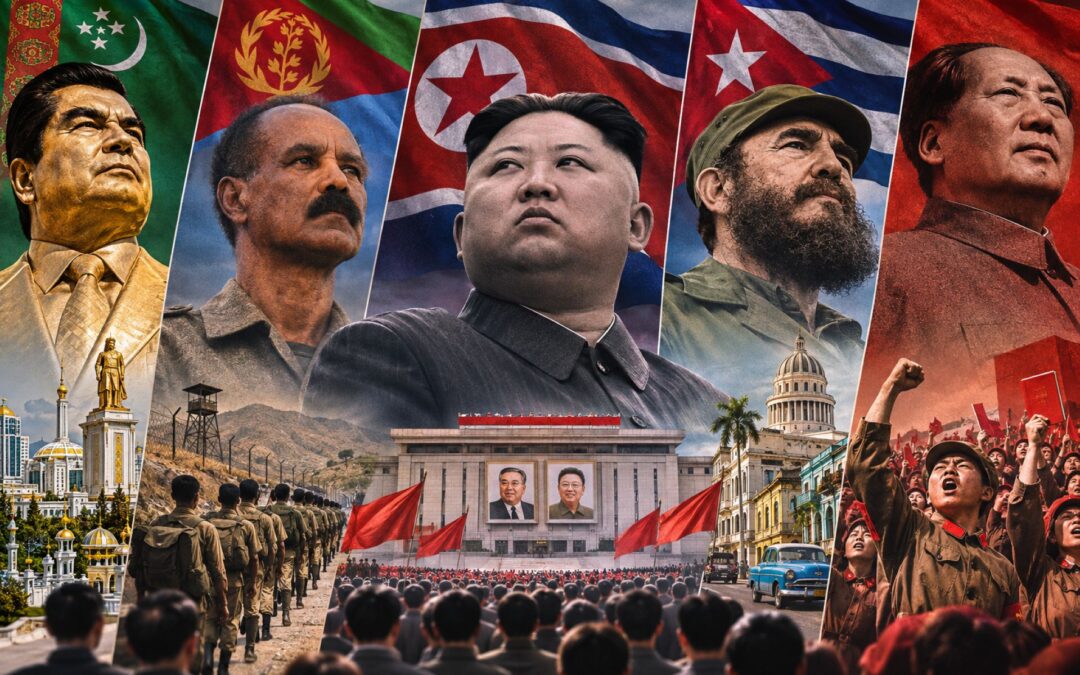
Yet North Korea is not the only place where rulers have built systems around unquestionable authority. Turkmenistan has erected monuments to presidents who renamed the calendar. Eritrea turned a struggle for independence into decades of government without national elections. Cuba combines communist one-party rule with an economy and society more connected to the outside world. And Mao Zedong’s China offers a disturbing historical example of what happens when loyalty to a leader becomes a public obligation.
Calling these countries “other North Koreas” makes for a memorable comparison, but it also raises a more interesting question: how can governments with such different histories develop similar methods of control, and where does the comparison begin to break down?
What Makes a Country Another North Korea?
To understand the comparison, it helps to separate the unusual features of North Korea from the political machinery underneath them. The history of North Korea explains how Kim Il Sung transformed a Soviet-backed communist state into a political order in which loyalty to the ruling family became inseparable from loyalty to the nation. His son Kim Jong Il inherited power in 1994, followed by grandson Kim Jong Un in 2011.
The leadership’s portraits and slogans are only the visible part of that system. State institutions supervise the press, restrict independent organization, monitor political behavior, and impose severe penalties on suspected dissent. The government also controls movement, access to outside information, and many aspects of economic and social life. Public enthusiasm is difficult to distinguish from compliance when refusing to participate can be dangerous.
An authoritarian government concentrates power and sharply limits political competition. A totalitarian system goes further in its ambitions, attempting to subordinate society, culture, and private belief to an official political project. These are analytical descriptions rather than simple boxes, and a country can display different degrees of control across different parts of life.
The distinctions matter. A leader’s portrait does not, by itself, make a country North Korea. Neither does a single ruling party, a closed border, or an extravagant monument. The more revealing questions are whether citizens can organize against the government, report independently, leave freely, challenge state decisions, and change their leaders without risking punishment.
The comparison is not merely rhetorical. In its Freedom in the World assessments, Freedom House places North Korea, Turkmenistan, Eritrea, and Cuba among the countries where political rights and civil liberties are severely restricted. But similarly poor assessments conceal different systems of power: hereditary socialism in Pyongyang, presidential family rule in Ashgabat, militarized liberation politics in Asmara, and institutionalized communist-party control in Havana.
Turkmenistan: Where the Leader Becomes the State
A visitor arriving in Ashgabat, Turkmenistan’s capital, encounters broad avenues, white-marble buildings, immaculate ceremonial spaces, and monumental statues. Some celebrate national history. Others reflect the remarkable prominence of the country’s rulers. The spectacle is especially striking in a state where information is tightly controlled and the everyday circumstances of ordinary citizens are difficult to establish independently.
When Turkmenistan became independent after the Soviet Union’s collapse in 1991, Saparmurat Niyazov was already its most powerful politician. He had led the republic’s Communist Party since 1985 and used independence to concentrate authority around himself. By 1999, he had been declared president for life.
Niyazov adopted the title Turkmenbashi, or Leader of the Turkmen, and constructed a personality cult that reached far beyond official portraits. Gold-colored statues celebrated him, while schools and public institutions promoted the Ruhnama, a book published under his name combining national mythology, moral instruction, history, and political guidance. Knowledge of its contents became important in examinations and public life.
Then he decided that the calendar needed improvement. In 2002, January was renamed Turkmenbashi, April became Gurbansoltan after his mother, and September became Ruhnama. Even the days of the week received new official names. The changes were real, although they were reversed in 2008, after Niyazov’s death.
His interventions extended into personal appearance and entertainment. Authorities targeted young men’s long hair and beards; opera and ballet were banned; restrictions on recorded performances reached even celebrations such as weddings. Reports about dogs, karaoke, or video games are sometimes repeated as if every alleged prohibition were a permanent nationwide law, but the evidence and scope of those particular claims are less clear. The documented policies are extraordinary enough without exaggeration.
Niyazov died in December 2006, but Turkmenistan did not become an open political system. His successor, Gurbanguly Berdimuhamedow, reversed certain symbolic excesses while developing a personality cult of his own. Official media portrayed him as an accomplished athlete, horseman, driver, and musician. He acquired the title Arkadag, commonly translated as Protector, while portraits, monuments, and official praise continued.
In March 2022, Gurbanguly’s son Serdar became president after an election lacking genuine competition. The father retained substantial influence, later acquiring the formal status of National Leader. As Chatham House explained during the succession, the presidency had changed hands without producing independent political institutions capable of restraining the ruling family.
This concentration of authority exists alongside enormous natural-gas wealth. Export revenues have helped finance prestige construction in Ashgabat, while credible reporting describes hardship and shortages elsewhere. Turkmenistan also maintains a declared policy of permanent neutrality, but neutrality abroad does not require censorship at home. Human Rights Watch’s 2026 reporting documents travel restrictions, harassment of critics, political imprisonment, and severe limitations on independent media and internet access.
Turkmenistan resembles North Korea in its personality cults, controlled information, and increasingly dynastic leadership. Yet its economy is deeply tied to international gas trade, and its ideological message relies more on national identity and presidential grandeur than on North Korea’s particular revolutionary doctrine. The resemblance lies in how power is protected, not in every aspect of how the country operates.
Eritrea: The Independence Movement That Became a Dictatorship
Eritrea’s story begins with a promise almost opposite to dictatorship: national liberation. Situated on the Red Sea in the Horn of Africa, it fought a long struggle to separate from Ethiopia. After decades of war, Eritrean forces achieved effective independence in 1991, and a 1993 referendum confirmed overwhelming public support for statehood.
The movement’s leader, Isaias Afwerki, became president of the new country. He was a central figure in the Eritrean People’s Liberation Front, whose military organization and sacrifices helped secure independence. For a population emerging from conflict, a strong government promising unity and reconstruction initially had understandable appeal.
But the habits of a revolutionary army did not disappear when the war ended. The former liberation movement became the People’s Front for Democracy and Justice, the country’s only permitted political party. Rival parties were not allowed to compete for power, and Afwerki remained president without a national presidential election.
The constitution is a particularly revealing example of the distance between promises and reality. Eritrea actually ratified a constitution in 1997. Contrary to the claim that the country never had one, the problem is that the document was never put into effect. National elections were repeatedly postponed, with the conflict against Ethiopia from 1998 to 2000 invoked as a reason to delay political change.
In 2001, senior officials who had called for reform were arrested, while independent newspapers were shut down and journalists detained. Some of those prisoners disappeared into a detention system where families could not learn their fate. According to Human Rights Watch’s 2026 account, Eritrea still had no independent domestic media or legal opposition parties, and enforced disappearances remained a serious problem.
If Turkmenistan’s most conspicuous symbols of control are portraits and monuments, Eritrea’s are uniforms and the national-service system. The law envisaged 18 months of service, including military training and national duties. Following the renewed war with Ethiopia, however, service was extended indefinitely in practice, with many people spending years or decades under military or government assignments.
The consequences extend well beyond the armed forces. Conscripts can be placed in civilian work with low pay, severely restricted freedom to choose their employment, and punishments for disobedience. Young people face pressure as they approach the end of school, and some families have seen multiple generations unable to plan independent lives. Allegations documented by international human-rights investigators include forced labor, torture, sexual violence, and punishment of relatives of people who evade service.
Eritrea’s government has justified tight security by pointing to genuine regional threats, particularly its history of war and tense relations with Ethiopia. Geography and conflict matter: a small state with a long, contested border faces security pressures unlike those of an island country such as Cuba. Yet an enduring security threat does not explain why opposition parties, independent newspapers, and meaningful constitutional limits must remain absent indefinitely.
Afwerki offered an unusually stark glimpse of his thinking in a 2008 interview. Asked about elections, he suggested Eritrea might wait another three or four decades, perhaps longer. A later United Nations inquiry recorded those remarks, and US government reporting from 2008 separately described the continued postponement of elections and widespread abuses. What was presented as a temporary revolutionary leadership had become a system without a credible timetable for political transition.
Eritrea’s population includes large Christian and Muslim communities, making the country’s religious landscape more varied than outsiders sometimes assume. That diversity has not translated into broad religious liberty. Authorities recognize only certain faith communities, and people associated with unrecognized groups have faced detention and restrictions.
Thousands have chosen flight despite the dangerous routes through neighboring countries and beyond. Those departures represent more than a search for higher wages: for many, they are an attempt to escape indefinite service, surveillance, and a future whose most important decisions remain in the hands of the state.
Eritrea shares North Korea’s hostility toward independent political organization, intense controls on information, and extensive coercion. But it has no hereditary ruling dynasty or comparable cult of a succession of family leaders. Its distinctive political logic comes from the transformation of a victorious liberation movement into a permanent security state.
Cuba: Communist Rule Without Complete Isolation
Cuba initially appears to offer the closest ideological comparison with North Korea. Both emerged from revolutionary projects that promised a new socialist order. Both developed one-party political systems, restricted independent opposition, and treated criticism of the state as a potential threat to the revolution itself.
After Fidel Castro’s revolutionary forces overthrew Fulgencio Batista in 1959, Cuba’s government consolidated power, aligned with the Soviet Union, and nationalized major sectors of the economy. The revolution achieved widely recognized gains in literacy and public health, while political competition narrowed and opponents faced imprisonment, exile, or restrictions. Those realities belong in the same history rather than being treated as mutually exclusive.
Cuba has elections, but they do not provide a route for opposition parties to replace the Communist Party in government. Article 5 of the 2019 Cuban constitution establishes the Communist Party as the leading political force of society and the state. The Inter-Parliamentary Union’s electoral record describes the country’s institutional voting arrangements, which should not be confused with open multiparty competition.
Unlike North Korea, however, Cuba has long been exposed to foreign visitors, international cultural exchange, and significant migration. Tourists arrive in Havana, Cubans have relatives abroad, and private economic activity has expanded in phases. The country is not physically sealed off from the world, even though authorities retain powerful tools for restricting information, travel, and political organization.
The leadership also changed differently. Fidel ceded formal presidential authority to his brother Raúl, who later gave way to Miguel Díaz-Canel. The latter is not a Castro family member, although the Communist Party has retained political supremacy. This is institutional continuity rather than the multigenerational hereditary succession that defines North Korea’s leadership.
Economic reforms make the contrast still clearer. Cuba permitted more self-employment, authorized private businesses, and allowed some private commerce and imports. These steps have created visible differences between state shops and privately supplied goods, but they have also exposed inequalities in access to money, foreign currency, and overseas relatives. The state has sometimes tightened regulations after liberalizing them, so economic change has been uneven rather than a steady march toward a market economy.
Political freedom has not expanded in step with these economic openings. The large demonstrations of July 2021 were followed by arrests and prosecutions. Human Rights Watch reported in 2026 that many protesters and other critics remained imprisoned, while shortages of food, medicine, and electricity contributed to renewed expressions of public anger.
The United States’ decades-long embargo complicates Cuba’s economic choices and has imposed real costs, while restrictions imposed by Cuba’s own government have also constrained production and ordinary economic initiative. Neither explanation cancels the other. It is possible to criticize sanctions for worsening hardship and also criticize the Cuban state for suppressing peaceful dissent.
This is why describing Cuba as another North Korea is both useful and misleading. The political systems share important restrictions, but Cuba has a different pattern of tourism, commercial relations, emigration, social life, and leadership succession. Its relative openness to visitors or small businesses should not be mistaken for democracy, just as its one-party constitution should not erase every difference between the two countries.
Mao’s China: The Historical Precedent
The fourth example belongs to history rather than the present day. Under Mao Zedong, China developed an enormous personality cult, intense ideological campaigns, and forms of political mobilization that could turn ordinary citizens into enforcers of official orthodoxy. Understanding this period also helps explain both the attraction and the danger of the claim that North Korea simply copied Mao’s China.
After the Communist victory in 1949, Mao helped establish a centralized one-party state. Political campaigns targeted former landowners, alleged counterrevolutionaries, and people accused of opposing socialism. Later, his Great Leap Forward attempted to accelerate development through forced collectivization and mass mobilization, contributing to a catastrophic famine.
The most dramatic episode came in 1966, when Mao launched the Cultural Revolution. He feared that senior Communist leaders and parts of society were abandoning revolutionary principles. By calling on young people to challenge supposedly entrenched authorities, he created a movement that threatened officials and institutions within the state he already led.
Students formed groups known as Red Guards, carrying Mao’s quotations and declaring their loyalty to him. Posters, rallies, denunciations, and public accusations became part of political life. Teachers could be humiliated by their own students; party officials could be denounced as enemies; intellectuals and ordinary families could be attacked because of their backgrounds, possessions, or suspected beliefs.
The campaign against the Four Olds—old ideas, old culture, old customs, and old habits—gave the movement an especially destructive cultural mission. Temples, books, artworks, religious objects, and family heirlooms became targets. The UK National Archives’ account of the Cultural Revolution describes how Mao mobilized youth against institutions and symbols deemed incompatible with revolutionary ideals.
The repression was not limited to a simple division between loyalists and opponents. Competing Red Guard and rebel organizations began accusing one another of insufficient loyalty to Mao. Groups that claimed to defend the same leader fought over universities, factories, government offices, and control of entire cities. The question was no longer merely who opposed Mao, but who had the authority to define what loyalty to Mao meant.
The violence escalated during 1967 and 1968. Local armed forces sometimes backed rival factions, and soldiers could become entangled in struggles that central authorities were trying to manage. This was not simply a case of Mao issuing a permanent instruction that the army should stand aside. Research by Dong Guoqiang and Andrew G. Walder shows how military commanders’ shifting decisions contributed to factional warfare, rather than consistently ending it.
In some places, rival groups amassed firearms and other weapons, producing conflicts that resembled local civil wars. Civilians, students, officials, and soldiers found themselves trapped in a political environment where today’s demonstration of loyalty could become tomorrow’s evidence of betrayal. Eventually, military intervention and new governing structures curtailed much of the open factional fighting, but political campaigns and persecution continued.
Mao’s death in September 1976 was followed by the arrest of the Gang of Four and the eventual dismantling of much of the Cultural Revolution’s ideological program. Under Deng Xiaoping and subsequent leaders, China’s economic and political development took a different course: market-oriented reforms changed daily life and the country’s international relationships, while the Communist Party retained its monopoly on political power.
The parallel with North Korea is real in the cult of leadership, ideological enforcement, denunciation, and harsh punishment of dissent. But the two political systems did not develop through a single act of imitation. North Korea’s institutions were also shaped by Japanese colonialism, Soviet influence, the Korean War, the doctrine of Juche, and Kim Il Sung’s consolidation of a hereditary ruling line. Mao’s China illustrates a related danger, not a complete explanation for North Korea’s origins.
What These Regimes Share—and What Makes Them Different
Across these cases, the most important similarity is that independent sources of authority are treated as threats. A free newspaper might contradict the official story; an opposition party could offer a different future; an independent court could challenge arbitrary detention; and a citizen able to leave or criticize without fear would be less dependent on the government. Each system has therefore developed ways to restrict some or all of these alternatives.
The methods differ. North Korea attaches state legitimacy to the Kim family and revolutionary ideology. Turkmenistan makes presidential prestige and control of resource wealth central to public life. Eritrea extends the discipline of a liberation army into civilian existence. Cuba relies on the enduring institutional authority of its Communist Party. Mao’s Cultural Revolution went further in mobilizing rival groups of citizens to police one another’s ideological purity, sometimes with catastrophic consequences.
Their relationships with the wider world also vary. Turkmenistan sells energy abroad while controlling domestic information and travel. Eritrea’s regional conflicts have reinforced militarization and isolation, although it is not completely cut off from diplomacy or trade. Cuba receives visitors and maintains international connections despite its political restrictions and economic crisis. North Korea combines severe domestic controls with a highly strategic set of external relationships, especially where its security is concerned.
Even the personality cult has different functions. In Turkmenistan, monuments, public performances, and official titles project the leader as the source of national progress. In North Korea, reverence for the ruling family supports a claim of inherited revolutionary legitimacy. In Eritrea, the leadership draws heavily on the authority of the independence struggle, with the coercive power of national service carrying more significance than extravagant statues. Cuba’s political symbolism centers on the revolution, its founding leaders, and the party rather than a formal hereditary dynasty.
None of these differences makes repression less serious for the people experiencing it. They do, however, explain why a single nickname cannot substitute for understanding a country’s politics. The question is not whether its ruler seems eccentric, or whether a tourist can enter, or whether a government describes itself as socialist. It is how authority is maintained, what institutions can challenge it, and what happens to people who refuse to comply.
North Korea remains an unusually extreme example of concentrated, hereditary political power. But the stories of Turkmenistan, Eritrea, Cuba, and Mao-era China show that the machinery of unaccountable rule can be assembled from very different materials: natural-resource wealth, military sacrifice, revolutionary ideology, nationalism, or personal devotion to a leader. Some governments build monuments; others demand years of service or public declarations of faith. What connects them is the steady narrowing of the space in which citizens can think, speak, organize, and choose without permission.
Last Updated on November 5, 2026 by Aseem Gupta