
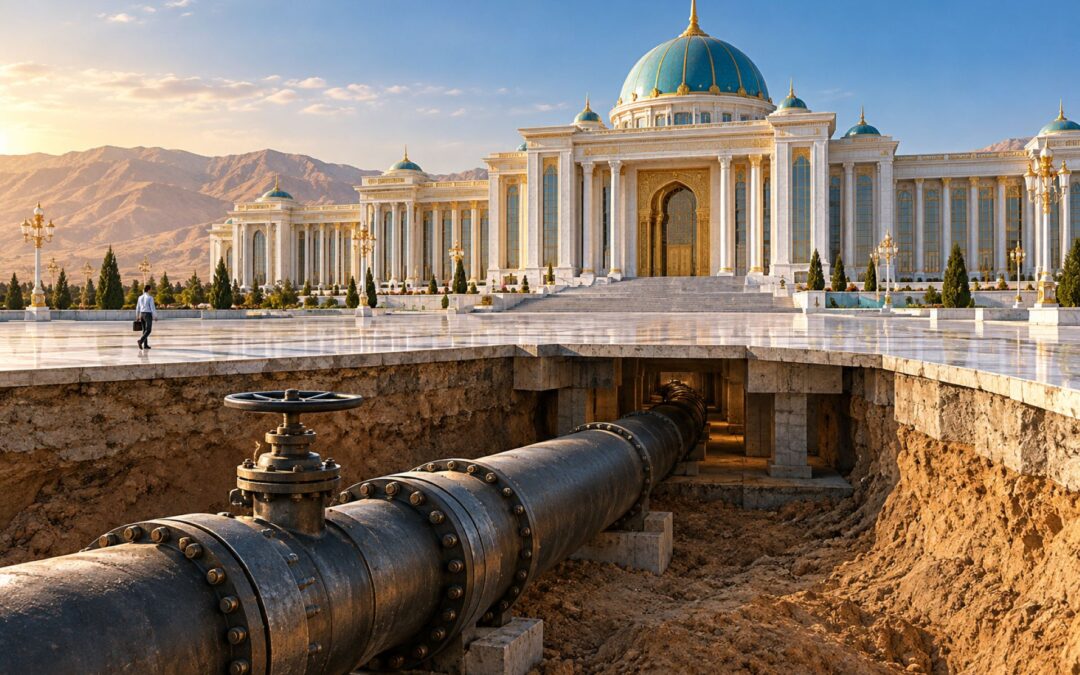
In the middle of Central Asia, surrounded by vast deserts, stands one of the world’s most unusual capitals. Ashgabat, the capital of Turkmenistan, is filled with gleaming white marble buildings, enormous golden statues, monumental government complexes, and immaculate avenues that can appear almost deserted. Billions of dollars have gone into transforming the city into a symbol of national prosperity, yet much of the country remains economically constrained, and its citizens live under one of the world’s most restrictive political systems.
The contradiction is particularly striking because Turkmenistan is not a country without resources. It possesses the world’s fourth-largest proven natural gas reserves and earns substantial export revenue from selling its energy abroad. Its rulers have had opportunities to turn that wealth into a diversified economy, modern public services, and greater prosperity for the population. Instead, political power has remained concentrated in the hands of a small governing elite, with the presidency passing from father to son.
What makes Turkmenistan remarkable is not simply its bizarre monuments or the eccentricities of its leaders. It is the political system behind them: a government that uses resource wealth, propaganda, state control, and repression to preserve its authority. Understanding how that system developed, why it continues to function, and whether it can ever meaningfully change reveals a country far more complicated than its reputation suggests.
Why Turkmenistan Is So Difficult to See
Turkmenistan occupies a strategically important but geographically isolated position in Central Asia. It borders Kazakhstan, Uzbekistan, Afghanistan, Iran, and the Caspian Sea, while the Karakum Desert covers most of its territory. Its location connects several important regions, but reaching the country and learning what happens inside it can be unusually difficult.
Foreign visitors generally face a restrictive visa system, and conventional tourist trips are commonly organized through authorized agencies with approved itineraries and local guides. Independent travel is much more difficult than in most neighboring countries. Journalists face additional obstacles because the government tightly controls foreign reporting and the information that reaches its citizens.
The restrictions are not merely bureaucratic inconveniences. They form part of a broader political environment in which the state has historically sought to control how Turkmenistan is presented to outsiders. Organized tours can provide access to spectacular monuments, museums, official historical narratives, and carefully maintained public spaces while revealing much less about political opposition, provincial poverty, or the treatment of prisoners.
Turkmenistan’s isolation is often associated with its policy of permanent neutrality, but the two should not be confused. After independence, the government adopted a neutral foreign-policy position that received formal recognition through a United Nations resolution in December 1995. Neutrality means that Turkmenistan has committed itself to a particular international diplomatic posture; it does not inherently require restrictions on journalism, internet access, or ordinary foreign travel.
The authorities have defended elements of their isolation as necessary for stability and national security. Turkmenistan borders Afghanistan, and officials have pointed to threats such as militant activity and cross-border trafficking. Maintaining distance from competing regional powers has also helped the government preserve considerable diplomatic flexibility.
Yet this foreign-policy rationale cannot adequately explain the restrictions placed on domestic political expression. Those restrictions reflect the country’s authoritarian institutions rather than any necessary consequence of neutrality.
The result is a country where outside observers encounter unusual difficulties establishing even basic facts. Independent journalists often work from abroad, relying on local contacts, leaked documents, and accounts from people who have left the country. Government statistics cannot always be independently checked, while citizens who speak openly about sensitive issues may expose themselves or their families to serious consequences.
Turkmenistan is therefore not entirely invisible, but the available picture is fragmented. Understanding why requires examining how the political system was built.
From Soviet Republic to Family Rule
Modern Turkmenistan emerged from the collapse of the Soviet Union in 1991, but its political institutions did not begin from scratch. Under Soviet rule, the Turkmen Soviet Socialist Republic was governed through the Communist Party, whose leadership operated within a centralized political system dominated by Moscow.
Saparmurat Niyazov became the republic’s Communist Party leader in 1985. In 1990, he assumed the newly created presidency, winning an uncontested election. When Turkmenistan became independent the following year, he was already positioned to dominate the new state.
Rather than dismantling Soviet-style political centralization, Niyazov adapted it to personal rule. Opposition organizations faced severe restrictions, meaningful political competition disappeared, and official institutions increasingly revolved around the president. In 1999, the country’s legislature declared him president for life, removing even the formal expectation of a future presidential succession.
His government presented political unity and stability as essential achievements of independence. In practice, however, the concentration of power meant that important decisions could depend heavily on the president’s personal preferences, while independent institutions capable of challenging those decisions remained weak or nonexistent.
Niyazov died in December 2006. His death created an unusual succession problem because the entire political system had been designed around a leader who was supposedly indispensable.
The eventual beneficiary was Gurbanguly Berdimuhamedow, a former dentist and senior official who had served as health minister and deputy chairman of the cabinet. He became acting president and subsequently won the 2007 presidential election in a political environment without meaningful opposition competition.
Berd ýöymuhamedow, more commonly written as Berdimuhamedow, initially encouraged speculation that Turkmenistan might move away from the most extravagant features of Niyazov’s rule. Some of his predecessor’s policies were reversed, and the new administration projected an image of modernization.
Nevertheless, the underlying structure of government remained authoritarian. Berdimuhamedow consolidated his own authority, strengthened the role of his family, and developed a personality cult of his own. Official media frequently portrayed him participating in sports, driving racing cars, demonstrating professional skills, and displaying musical talents.
His electoral victories were similarly overwhelming. Official results gave him approximately 97% of the vote in 2012 and nearly 98% in 2017, figures that reflected tightly controlled political competition rather than evidence of genuinely free elections.
In March 2022, Gurbanguly transferred the presidency to his son, Serdar Berdimuhamedow, following another election that international observers did not regard as genuinely competitive.
The succession was especially significant because Gurbanguly did not simply disappear from public life. As political analyst Annette Bohr explained in her Chatham House assessment of Turkmenistan’s dynastic succession, the arrangement created an unusual system in which a former president continued exercising substantial influence while his son occupied the country’s highest executive office.
In 2023, Gurbanguly received the status of National Leader of the Turkmen People and became chairman of the Halk Maslahaty, or People’s Council, an influential state body. The arrangement preserved a formal political role for the elder Berdimuhamedow while allowing Serdar to exercise presidential authority.
This makes Turkmenistan’s political system more than an ordinary dictatorship built around one individual. It has become a form of dynastic authoritarianism in which power, prestige, institutional access, and political succession are closely associated with one family.
The division of authority between father and son is not completely transparent. Serdar controls the presidency and has made important appointments, while Gurbanguly continues to wield considerable public and institutional influence. The arrangement demonstrates how political succession can be managed without transferring power to genuinely independent institutions.
The Ruhnama and the Cult of the Leader
Under Saparmurat Niyazov, political loyalty became inseparable from an elaborate campaign to portray the president as the embodiment of the Turkmen nation. He adopted the title Turkmenbashi, commonly translated as Leader of the Turkmen, and surrounded himself with monuments, official ceremonies, and an increasingly grandiose national mythology.
The most distinctive expression of this personality cult was the Ruhnama, a book published under Niyazov’s name that combined national history, moral instruction, cultural identity, political ideology, and spiritual reflection. Rather than remaining an ordinary literary or political work, it was elevated into an instrument of state education and public loyalty.
The Ruhnama became compulsory reading in schools and universities. Knowledge of its contents was required in various examinations, including some connected to professional qualifications and driving licenses. Its influence extended beyond education into official ceremonies, government institutions, and the country’s public spaces.
Niyazov even renamed months of the year and days of the week. January became associated with Turkmenbashi, while September was renamed Ruhnama. These changes were eventually reversed under his successor, but they demonstrated how thoroughly the government could attempt to reorganize public life around the leader’s image.
The book itself became a monumental object. Ashgabat acquired an enormous monument dedicated to the Ruhnama, and copies were prominently displayed in important public and religious settings. In 2005, an edition was reportedly carried into space aboard a Russian rocket, turning an already remarkable propaganda project into an international curiosity.
These policies are often remembered for their absurdity, but their political implications were more serious. Making the leader’s writings compulsory in education transformed expressions of personal loyalty into requirements for participation in institutions that should have operated independently of the president.
Niyazov’s concentration of authority also affected matters far removed from propaganda. In 2005, he announced plans to close hospitals outside Ashgabat, arguing that people requiring specialist medical treatment could travel to the capital. Human rights and medical organizations condemned the proposal because of the consequences it could have for people living far from the city. The announcement illustrates the danger of policy being dictated through personal authority, although it should not be confused with proof that every proposed closure was fully implemented.
The succession to Gurbanguly Berdimuhamedow did not end the practice of celebrating the head of state. Instead, the government developed a new image around its second president, emphasizing his athletic ability, leadership, accomplishments, and personal interests.
Horses became an especially prominent symbol. The prized Akhal-Teke breed occupies an important place in Turkmen culture, and the government incorporated it into official national imagery. Under Gurbanguly, horse racing, equestrian displays, and elaborate horse-themed monuments also became closely associated with presidential prestige.
Serdar’s accession brought another transition in official portraiture, with his image appearing across government buildings and public institutions. His father’s continued prominence, however, means that the country’s symbolic political landscape still reflects two generations of the ruling family.
It would be misleading to assume that ordinary Turkmen citizens necessarily believe everything promoted by state media. In a political environment where open criticism can carry serious risks, public expressions of loyalty may reflect prudence, institutional pressure, or the absence of alternatives rather than genuine conviction.
The essential purpose of the personality cult is not simply to persuade citizens that the president is extraordinary. It also establishes loyalty to the leadership as an expected part of political and professional life, making the boundary between the state and its rulers increasingly difficult to distinguish.
Ashgabat: The White Marble Showcase
If the personality cult explains how Turkmenistan’s rulers present themselves, Ashgabat demonstrates how they have chosen to present their country.
The capital has been transformed through decades of state-led construction into an architectural showcase dominated by white marble, broad avenues, landscaped spaces, massive public buildings, and carefully arranged monuments. Entire districts appear designed around visual symmetry and monumental scale, creating an urban landscape quite different from the older residential and commercial areas found in most cities.
The construction became a defining feature of both Niyazov’s and Gurbanguly Berdimuhamedow’s presidencies. Ashgabat’s appearance was intended to communicate prosperity, national achievement, and the state’s capacity to undertake extraordinary projects.
The city has acquired numerous Guinness World Records, including recognition for its concentration of white marble-clad buildings. Its attractions have included a giant indoor Ferris wheel, monumental carpets, elaborate ceremonial spaces, and purpose-built sporting facilities.
The government has also promoted a remarkably uniform appearance on the city’s roads. Restrictions and official preferences favoring white vehicles have been widely reported, contributing to Ashgabat’s distinctive visual identity. Although the details and enforcement of these rules have varied, they illustrate the authorities’ willingness to extend aesthetic preferences into everyday urban life.
One of the most expensive examples of the capital’s development was the sporting infrastructure constructed for the 2017 Asian Indoor and Martial Arts Games. The Ashgabat Olympic Complex reportedly cost around $5 billion and included extensive stadiums, training facilities, accommodation, transport infrastructure, and other specialized venues.
For a country with significant needs in healthcare, agriculture, transport, and regional infrastructure, such expenditure raises obvious questions about public priorities. Human Rights Watch highlighted the contrast between the lavish preparations for the sporting event and the country’s repressive political environment.
The complex was not the only project associated with national prestige. Ashgabat has been filled with monumental statues of political leaders, elaborate ceremonial buildings, and architecture that emphasizes scale and symbolism. The city can feel less like an urban environment developed gradually around residents’ needs and more like an official vision of what national prosperity should look like.
Yet describing Ashgabat as nothing more than an empty stage would also be inaccurate. The capital has functioning neighborhoods, bazaars, shopping malls, universities, businesses, and social spaces. Some residents enjoy considerable material comfort, and a segment of society participates in consumer activities familiar elsewhere in the world.
There are also practical reasons why certain monumental districts can appear deserted, including extreme summer heat and the design of large ceremonial spaces with relatively limited pedestrian activity.
The problem is therefore not that Ashgabat has no genuine urban life. It is that enormous resources have been devoted to a particular vision of national grandeur while evidence from other parts of the country points to persistent problems with infrastructure and public services.
Prestige construction can serve several purposes simultaneously. It provides visible symbols of government achievement, creates opportunities for politically connected contractors, concentrates investment near the seat of power, and reinforces the idea that national development is the product of presidential leadership.
These projects may also provide useful infrastructure, employment, and economic activity. However, their benefits cannot be judged solely by their appearance or construction cost. The more important questions concern their long-term usefulness, operating expenses, accessibility, and opportunity cost.
Ashgabat’s marble skyline is therefore neither a complete illusion nor reliable evidence of broadly distributed prosperity. It is a highly visible expression of a political economy in which the state controls extraordinary resources and decides where those resources will be displayed.
How Natural Gas Finances the Dictatorship
Turkmenistan’s political system would be difficult to understand without its enormous natural gas reserves. The country possesses the world’s fourth-largest proven reserves, making it one of the most resource-rich states in Central Asia. Natural gas exports provide the government with a substantial source of foreign currency and have financed much of the construction and state spending associated with its leaders.
According to the World Bank’s assessment of Turkmenistan’s economy, natural gas, oil, and petroleum products accounted for approximately 84.9% of the country’s merchandise exports in 2024. State-owned enterprises remain central to economic activity, while economic diversification, fiscal transparency, and private-sector development continue to present significant challenges.
This resource dependence has far-reaching political implications. Governments normally collect revenue through a combination of taxation, business activity, trade, and other economic sources. When a substantial share of national wealth comes from exporting resources controlled by the state, the government can gain access to large revenues without depending as heavily on a broad, independent domestic private economy.
That does not automatically produce dictatorship. Resource-rich democracies also exist, and the political consequences of natural-resource wealth depend on institutions, accountability, and the distribution of economic power. In Turkmenistan, however, gas wealth operates within a system where the leadership faces few meaningful checks on its authority.
The state plays a dominant role in the energy sector, and the government has considerable influence over investment, contracts, employment, and access to economic opportunities. Control over these decisions can give political leaders leverage over powerful officials, business figures, and institutions whose interests are connected to the continuation of the existing system.
A construction contract, senior government appointment, favorable business arrangement, or privileged access to foreign currency can all become valuable sources of economic advantage. When these opportunities depend heavily on relationships with the political leadership, powerful insiders have incentives to preserve the arrangements that benefit them.
This is one reason spectacular public construction cannot be understood only as presidential vanity. Large state projects can also distribute revenue through networks of contractors, officials, suppliers, and politically connected businesses. Their political significance may extend beyond whether the resulting building is useful to ordinary citizens.
The precise financial benefits received by individual members of Turkmenistan’s elite are difficult to establish because government finances and major commercial arrangements remain opaque. Nevertheless, the combination of concentrated state ownership, limited transparency, and systemic corruption documented by independent observers provides strong reasons to scrutinize how resource revenues are allocated.
Turkmenistan’s dependence on external energy customers creates another vulnerability.
China has become the dominant destination for Turkmen natural gas exports, receiving supplies through pipelines crossing Central Asia. This relationship provides Turkmenistan with a major market for its most valuable resource while supporting China’s effort to diversify its energy supplies.
But reliance on a major customer can limit an exporter’s flexibility. Without enough alternative pipelines and buyers, Turkmenistan cannot easily redirect large quantities of gas when commercial or political circumstances change.
The country’s vast reserves also do not translate automatically into unlimited production. Developing gas fields requires substantial capital, specialized technology, pipelines, processing infrastructure, and long-term purchase agreements. Turkmenistan’s ability to expand production therefore depends partly on foreign investment and access to new markets.
In February 2026, Gurbanguly Berdimuhamedow publicly identified export diversification as a primary objective, reflecting the government’s awareness of the problem. Reuters reported on the government’s effort to find additional markets, including alternative pipeline routes that could reduce dependence on existing buyers.
One longstanding proposal is the Turkmenistan–Afghanistan–Pakistan–India pipeline, commonly known as TAPI. In principle, it could connect Turkmen gas fields to large markets in South Asia, including India. In practice, the project has faced difficult financing, security, engineering, and political challenges, especially along the route through Afghanistan.
Construction activity in Afghanistan has continued, including work reported during 2026, but progress on individual sections must not be confused with an operational international pipeline. Until new infrastructure is completed and commercially viable, Turkmenistan’s ability to diversify its gas exports will remain constrained.
The country’s foreign-exchange system creates another distinction between its apparent wealth and the conditions experienced by ordinary people.
Turkmenistan maintains an official exchange rate of 3.5 manat to the US dollar, but access to foreign currency at that rate has been tightly restricted. An unofficial market has operated at substantially different rates, with the gap fluctuating over time.
This creates difficulties for businesses that need to import equipment or goods, as well as for citizens attempting to travel or make foreign payments. It also complicates comparisons between local wages and prices expressed in US dollars.
Someone whose salary appears relatively comfortable when converted at the official exchange rate may have much less international purchasing power if foreign currency is unavailable at that rate. Conversely, people and businesses with privileged access to officially priced dollars may enjoy opportunities unavailable to the wider population.
Such arrangements can encourage arbitrage, corruption, and unequal access to imported goods. They also make the headline figures used to describe the economy less informative than they initially appear.
The government has maintained subsidies and price controls for certain essential goods and services, and natural-resource wealth has supported material benefits for sections of the population. It would be inaccurate to suggest that every dollar of gas revenue disappears into monuments or private fortunes.
Nevertheless, state subsidies alone do not establish that the economic system is delivering sustainable prosperity. A resource-rich country also needs productive employment, reliable public services, competitive businesses, transparent institutions, and opportunities that do not depend excessively on political connections.
The World Bank has emphasized Turkmenistan’s difficulty converting hydrocarbon wealth into more diversified and inclusive growth. State-owned enterprises continue to dominate major sectors, while agriculture suffers from low productivity, water scarcity, and deteriorating soil quality.
These problems help explain why the economy can contain both genuine resource wealth and serious development weaknesses.
The political importance of natural gas lies in the way it strengthens an already centralized system. Export income gives the government resources to finance public spending, reward important supporters, maintain institutions, and undertake highly visible projects. At the same time, weak accountability makes it difficult for citizens to determine whether those resources are being managed in their interests.
The result is not an economy without money, but one in which extraordinary national wealth does not necessarily translate into broadly shared economic independence.
The Country Beyond the Capital
The differences between Ashgabat and provincial Turkmenistan become clearer when the focus shifts away from ceremonial buildings and monumental construction.
Outside the capital, many communities depend on agriculture, public-sector employment, small businesses, and family support. Conditions vary across regions, and it would be inaccurate to describe the entire country as uniformly impoverished. Nevertheless, independent reporting has documented significant difficulties involving employment, access to goods, infrastructure, healthcare, and essential services.
In some provincial communities, residents have reported problems with drinking-water supplies, electricity, road maintenance, and the availability of medical treatment. These accounts are difficult to quantify nationally because independent surveys and transparent administrative statistics are limited. They nevertheless challenge the impression of comprehensive development created by the government’s most visible projects.
Healthcare provides an especially important example. Niyazov’s controversial proposals to centralize medical services reflected the danger of making public-health decisions through personal political authority. Although subsequent governments have invested in healthcare infrastructure, especially in the capital, the quality and accessibility of services remain difficult to assess independently.
Available World Bank development indicators for Turkmenistan also require careful interpretation. Economic output per person places the country above many poorer states, but those figures do not show how equally income is distributed or how effectively public services function.
The country’s agricultural economy reveals another side of the relationship between government authority and ordinary life.
Cotton has been an important crop since the Soviet period, when Central Asian agriculture was reorganized around large-scale irrigation and state production targets. That development produced serious long-term environmental consequences, including contributions to the Aral Sea disaster, one of the most devastating examples of environmental degradation associated with Soviet agricultural planning.
Independent Turkmenistan inherited much of this agricultural infrastructure and the importance of cotton production. The government has continued to exercise substantial control over agricultural output, creating a system in which production targets can place direct pressure on workers and local officials.
The most serious criticism concerns forced labor.
For years, human rights organizations have documented cases in which public-sector employees were ordered to participate in cotton harvesting or pressured to pay substitutes. Teachers, healthcare workers, and other government employees have reportedly been mobilized for agricultural work unrelated to their normal jobs, with threats of punishment or dismissal for refusing.
The coercive system also affects families and communities. When people are compelled to harvest cotton or finance replacement workers, the costs extend beyond lost wages. Schools, healthcare services, household finances, and personal freedom can all be affected.
In May 2026, the Cotton Campaign published findings from monitoring the 2025 harvest. Its investigation found that state-imposed forced labor remained widespread and systematic, despite earlier indications that the government might reduce compulsory mobilization.
The investigation also raised concerns about children’s involvement in cotton production. These findings are important because they demonstrate how coercion can operate through ordinary administrative institutions rather than only through police or prisons.
Turkmenistan has engaged with the International Labour Organization, and officials have presented steps toward reform as evidence of improvement. That engagement matters, but the existence of reform discussions does not prove that coercive practices have ended. Independent observations and credible assessments of actual working conditions remain essential.
Cotton production also connects Turkmenistan’s domestic practices with international markets. Raw cotton and textile products can move through intermediate processing and manufacturing locations before reaching consumers abroad. This makes the origins and working conditions behind finished products difficult to trace.
Economic pressures extend beyond agriculture. Independent accounts describe citizens seeking employment opportunities in countries such as Turkey and Russia, with money sent home becoming important for some families.
Emigration, however, is not always straightforward. Citizens may encounter travel restrictions, administrative barriers, or difficulties obtaining documents. Internal movement can also be regulated through residency arrangements, limiting people’s ability to relocate freely to places offering better opportunities.
These restrictions reinforce the broader pattern of state control. A person dissatisfied with local economic conditions may face obstacles both to moving elsewhere within Turkmenistan and to pursuing employment abroad.
The country nevertheless has active communities, educational institutions, markets, cultural traditions, and private enterprise. Its citizens are not merely subjects of a strange government. They make decisions, support families, pursue opportunities, and adapt to difficult circumstances.
The central development problem is that many of those choices take place within an economy where the state exercises extraordinary influence over employment, resources, and freedom of movement.
The Machinery of Fear and Silence
Economic dependence and official propaganda help explain Turkmenistan’s political system, but they do not fully explain why organized opposition remains so weak. For that, it is necessary to examine the institutions responsible for controlling political activity and discouraging dissent.
Turkmenistan possesses extensive security and law-enforcement structures, while political organizations, independent media, and civil society groups operate under severe restrictions. Critical journalism is particularly dangerous, and independent reporting on sensitive subjects often depends on people working anonymously or from abroad.
The country’s political institutions provide few realistic avenues for replacing the government through elections. In its Freedom in the World 2026 assessment, Freedom House gave Turkmenistan a score of just 1 out of 100, placing it among the world’s most politically repressive states.
The assessment found that meaningful political rights are effectively absent, with almost no protection for independent journalism, opposition activity, public assembly, or freedom from political surveillance.
This environment changes how people behave even when they are not directly targeted by the authorities. Citizens may avoid discussing politics openly, criticize government decisions only in private, or distance themselves from individuals suspected of opposition activity.
Exiled journalist Ruslan Myatiev, associated with the independent outlet Turkmen.news, has described an extensive network of surveillance and informants. His accounts suggest that ordinary workplaces and state institutions can become environments in which people worry that political remarks will be reported to the security services.
The precise size and reach of such networks cannot be independently measured, but their reported presence contributes to a broader climate of insecurity. Political repression does not require every citizen to be watched continuously; the possibility of surveillance can be enough to encourage widespread self-censorship.
The consequences for outspoken critics can be severe.
Human Rights Watch’s World Report 2026 documents politically motivated prosecutions, persecution of activists, restrictions on freedom of movement, and cases involving people who have disappeared within the prison system.
Some prisoners have been held without meaningful contact with their families or independent legal representatives, leaving relatives unable to establish their whereabouts or conditions of detention. The report also describes continuing concerns about torture, ill-treatment, and accountability for abuses.
Ovadan Depe, a high-security prison outside Ashgabat, has become particularly associated with allegations of incommunicado detention and severe abuse. It illustrates the extreme consequences that can follow political conflict with the authorities, although independent access to such facilities is highly restricted.
Repression is not confined to the country’s borders. Government critics living abroad have reported surveillance, harassment, threats against relatives, and pressure associated with their political activities.
Restrictions on passports and international travel can further affect citizens outside Turkmenistan. Human Rights Watch has documented cases in which people were required to return home to renew documents or were prevented from leaving after returning.
The government’s efforts to control information are equally important. Independent domestic media outlets cannot operate freely, and access to social media platforms, foreign news services, and websites has been heavily restricted.
Internet connections can be slow, unreliable, and subject to censorship. Virtual private networks allow some citizens to bypass restrictions, but their availability and effectiveness vary, and using them does not eliminate the risks associated with sensitive political activity.
The persistence of internet censorship should not be mistaken for complete informational isolation. Many Turkmen citizens are aware of international events, foreign cultures, and living conditions elsewhere. Online communication, migration, personal networks, and imported media provide avenues through which information can circulate.
What the political system restricts most effectively is not necessarily knowledge itself, but the freedom to turn that knowledge into organized public action.
A population can understand that conditions elsewhere are different while still lacking independent institutions, legal protection, and safe opportunities to demand change. The state’s coercive capacity makes the personal risks of collective political action exceptionally high.
That is the essential role of repression in Turkmenistan’s governing system: it protects the concentration of political and economic authority by making organized challenges difficult, dangerous, and institutionally unsupported.
The Problem With Turkmenistan’s Official Numbers
One of the greatest challenges in understanding Turkmenistan is deciding which statistics can be trusted.
The government publishes economic figures, demographic information, and reports of national development, but independent verification is often limited. Important indicators such as poverty, household income, migration, and the distribution of wealth are either unavailable, incomplete, or difficult to reconcile with external estimates.
The problem is particularly visible in measurements of economic output.
The World Bank’s country overview reports GDP per capita of approximately $9,166 for 2024, placing Turkmenistan in the upper-middle-income category. That figure describes estimated national output divided by population; it does not mean that a typical Turkmen citizen earns that amount or possesses equivalent purchasing power.
GDP figures can vary across reporting years, revisions, statistical methodologies, and exchange-rate assumptions. Turkmenistan’s substantial difference between official and unofficial foreign-exchange rates makes simple dollar comparisons especially problematic.
The country’s state-dominated economy creates additional transparency concerns because independent researchers have limited access to the information needed to examine public accounts, state enterprises, and household conditions.
Population statistics are similarly contested.
According to the government’s official 2022 population and housing census, Turkmenistan had 7,057,841 residents as of December 17 that year. The census also reported that a little over half the population lived in rural areas.
Independent reporting has questioned whether official population figures adequately account for emigration. Some unofficial estimates have suggested a population substantially below the government’s published totals, but their methodologies and underlying evidence are not sufficiently transparent to establish a definitive alternative number.
External institutions also publish different demographic estimates, reflecting variations in data sources and assumptions. These discrepancies should encourage caution rather than justify choosing whichever figure appears most dramatic.
The scale of emigration is especially difficult to determine. People leave for economic and personal reasons, but limited administrative transparency makes it challenging to distinguish temporary workers, permanent emigrants, and residents whose registration status does not reflect where they actually live.
A similar problem affects attempts to measure poverty or the availability of healthcare and other services. Reports from individual communities can reveal serious hardship, yet they cannot automatically establish how widespread a particular problem is across the entire country.
The uncertainty does not mean that independent accounts should be dismissed or that official figures must be accepted without question. It means the available evidence has to be interpreted with appropriate limits.
Statistical opacity also has political consequences. When reliable information is scarce, citizens cannot easily evaluate government performance, identify the distribution of public resources, or compare official promises with measurable outcomes.
In that sense, unreliable and incomplete data are not merely obstacles for foreign researchers. They also make meaningful domestic accountability more difficult.
Can Turkmenistan Open Without Changing Its Regime?
The succession from Gurbanguly Berdimuhamedow to Serdar Berdimuhamedow raised a question that remains unresolved: could a new generation of leadership gradually change Turkmenistan without dismantling the system that brought it to power?
There have been indications of limited change since Serdar became president in 2022. He has pursued diplomatic engagement, made government appointments, and supported an official agenda emphasizing economic modernization and international cooperation.
The government has also expressed interest in simplifying visa procedures, expanding foreign investment, developing private enterprise, and advancing its relationship with the World Trade Organization.
These initiatives suggest recognition that the existing economic model faces limitations. Heavy dependence on natural gas, restricted currency access, weak competition, and the dominance of state-owned enterprises make it difficult to develop a more diverse and productive economy.
In May 2026, Reuters reported signs of a cautious opening in Turkmenistan, drawing on rare unescorted reporting from inside the country.
Its journalists encountered emerging businesses, including an e-commerce operation providing services that would be ordinary in many other economies but remain relatively novel in Turkmenistan. They also described increased everyday use of digital technology, social media accessed through VPNs, and changing cultural interests among younger residents.
Such observations complicate the image of a society completely frozen in time. Turkmenistan has never been entirely disconnected from the modern world, and some parts of its economy and social life are evolving.
Yet the Reuters investigation also emphasized that political authority remained tightly controlled. Changes in business activity and consumer behavior do not necessarily create the institutions required for political accountability.
That distinction is crucial because economic modernization and political liberalization are not identical processes.
A government can permit additional businesses, encourage foreign trade, and introduce new technologies while continuing to suppress opposition parties, restrict journalism, and control public institutions. Authoritarian systems can change their economic practices without becoming democracies.
The same distinction applies to changes within the ruling family.
Serdar has made personnel decisions that some observers interpret as attempts to establish a more independent governing circle. In February 2026, senior officials were replaced, including the national security minister, an appointment of particular political significance because the security apparatus plays a central role in maintaining state authority.
Personnel changes may alter the balance of influence among powerful officials. However, replacing one group of trusted appointees with another does not demonstrate that institutions have become independent of the presidency or that citizens enjoy greater political freedoms.
Gurbanguly’s continuing public role further complicates the situation. The elder Berdimuhamedow retains considerable prestige and institutional influence, while his son controls the presidency and exercises formal executive responsibilities.
Outside observers cannot confidently determine every aspect of their private relationship or the precise distribution of authority within the ruling elite. Public appointments, official ceremonies, and government statements provide clues, but they do not reveal the complete internal workings of an unusually secretive political system.
The more important question may be whether either generation has an incentive to alter the system’s foundations.
For many influential figures, the existing arrangements provide access to employment, contracts, status, protection, and economic opportunities. A genuinely transparent political and economic system would introduce competition and scrutiny that could threaten some of those advantages.
Independent courts could investigate decisions currently protected by political influence. A free press could examine government contracts and public spending. Competitive elections could create the possibility that the ruling family might lose authority, while independent businesses could become less dependent on the approval of powerful officials.
These changes could benefit ordinary citizens and support long-term development, but they would also challenge the system of privileges and political security enjoyed by those already close to power.
This creates a difficult problem for an authoritarian leadership contemplating reform.
Restricting economic change may preserve familiar patterns of control but risks making the country less competitive and increasingly dependent on natural-resource exports. Encouraging modernization may improve economic performance, create new opportunities, and strengthen international partnerships, but it could also produce individuals and institutions with greater independence from the state.
The dilemma becomes sharper when reform extends beyond commercial activity into political rights. Allowing citizens to organize, criticize government decisions, and demand accountability could fundamentally change the relationship between rulers and society.
Turkmenistan’s leadership has particular historical reasons to understand these risks. The collapse of the Soviet Union demonstrated that attempts to reform a centralized political system can produce developments that its leaders neither intended nor controlled.
However, Soviet history should not be treated as proof that meaningful reform in Turkmenistan would necessarily bring immediate political collapse. Countries experience different transitions, and gradual economic change can coexist with authoritarian government for extended periods.
There is also no guarantee that a younger president will pursue greater political openness simply because he belongs to another generation. Serdar’s education and international experience may influence his outlook, but they do not establish his commitment to democratic institutions or independent civil society.
The future will depend partly on how the ruling elite balances the advantages of continuity against the economic costs of maintaining the present model. External conditions, including gas demand, investment opportunities, regional security, and the development of new pipelines, will also influence those calculations.
For now, modest changes in business activity, tourism, technology, or diplomatic engagement should be recognized for what they are without being mistaken for evidence of democratic transformation.
Turkmenistan can become more economically connected to the outside world while remaining politically authoritarian. Whether that limited opening eventually creates pressure for deeper institutional change remains uncertain.
The country therefore faces a dilemma rooted in the structure of its own political success. The institutions that have preserved concentrated power for decades may also prevent the broader modernization its leaders increasingly recognize as necessary.
Turkmenistan’s extraordinary capital offers a revealing image of this contradiction. Its marble buildings and monumental avenues demonstrate that the state possesses substantial resources and the capacity to mobilize them for ambitious projects. Yet that capacity has not been matched by institutions allowing citizens to independently scrutinize government decisions, control the distribution of public wealth, or replace their leaders through meaningful political competition.
The country’s future is not predetermined by its past or by the size of its natural gas reserves. It has the financial resources, geographic opportunities, and human potential to develop beyond its present constraints, but doing so would require more than impressive construction projects or selective economic reforms.
Ultimately, Turkmenistan’s central challenge is not simply how to become wealthier or more connected to the outside world. It is whether a political system built to protect concentrated authority can create the transparency, accountability, and independence necessary for its people to share more fully in the country’s considerable wealth.
Last Updated on October 18, 2026 by Aseem Gupta