
Reading Time: 20 Minutes
On 17 April 1975, exhausted residents of Phnom Penh watched black-clad Khmer Rouge fighters enter Cambodia’s capital. After years of civil war, the arrival of the victorious rebels might have meant that families could finally stop fleeing, soldiers could put down their weapons, and ordinary life could begin again. Instead, within hours, armed men ordered the city’s inhabitants to leave. Hospital patients were pushed out of wards, children followed parents into crowded roads, and people who expected to return home soon discovered that there was no home to return to.
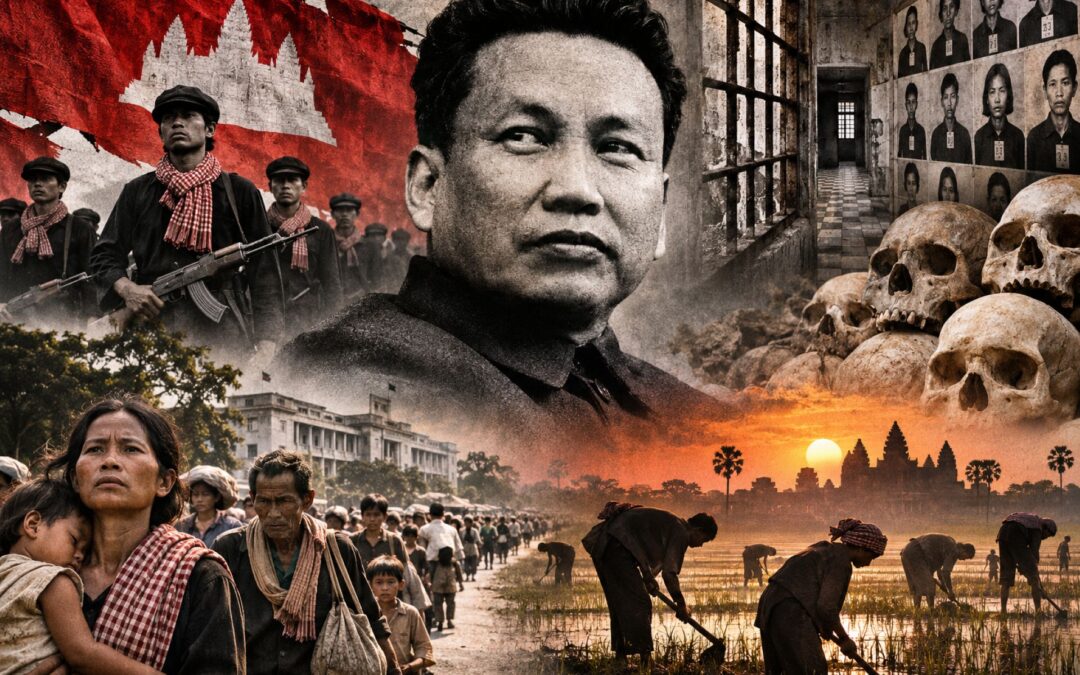
The evacuation began a catastrophe almost without parallel in modern Cambodia’s history. During the next three years, eight months, and twenty days, the Khmer Rouge tried to remake the country into an isolated agricultural society. An estimated 1.5 million to two million people died from executions, starvation, disease, exhaustion, and the consequences of policies enforced through terror. Behind this transformation stood a leader born Saloth Sar, better known to history as Pol Pot.
How did a privileged, French-educated Cambodian revolutionary come to preside over such destruction? The answer lies not only in his beliefs, but in the wars that brought him to power, the institutions his movement created, and the increasingly violent search for enemies when its promises proved impossible to fulfil.
From Saloth Sar to Pol Pot: An Unlikely Revolutionary
Pol Pot was born Saloth Sar in Cambodia’s Kampong Thom province, traditionally dated to 19 May 1925, although some biographical accounts give 1928. His family was relatively prosperous, and relatives had connections to the royal palace in Phnom Penh. The boy who would eventually condemn urban privilege and intellectual distinction was therefore not raised as a dispossessed peasant. He had opportunities for education and social advancement that most Cambodians could never have expected.
He spent time in Buddhist religious education and attended French-language schools in Phnom Penh, later moving into technical studies. In 1949, he received a scholarship to continue his education in Paris. There he encountered an expatriate Cambodian student circle whose members would later become important figures in the Khmer Rouge, including Ieng Sary, and became involved with communist politics associated with the French Communist Party.
France offered more than lectures and examinations. It was a place where students from colonies could question imperial rule, argue about nationalism and revolution, and watch the Soviet Union and the newly established People’s Republic of China reshape international politics. Saloth Sar became absorbed in political organising while neglecting his technical course. He eventually lost his scholarship and returned to Cambodia in 1953 without obtaining a degree. This is better documented than colourful stories claiming that he failed because he could not understand Marx’s writings.
His intellectual influences were neither a straightforward reading of Karl Marx nor an exact copy of a single foreign revolution. Communist ideas reached him through French political networks, Cambodian comrades, and examples of revolutionary states. Maoist approaches to peasant mobilisation, collectivisation and rapid transformation became especially important, although the eventual Cambodian experiment took its own extreme form. Pol Pot was not simply following instructions from Beijing or Moscow; he and his associates made choices shaped by Cambodian nationalism, party secrecy and their understanding of the country’s past.
Back home, independence did not produce political calm. Prince Norodom Sihanouk dominated public life, while Cambodian communists operated under pressure and frequently in clandestine networks. Saloth Sar worked as a teacher for a time, a detail that makes the regime’s subsequent persecution of many educators particularly striking. Within the communist movement, he built alliances and gained influence, eventually becoming its party secretary in 1963.
He later retreated into rural bases as government pressure increased, helping transform a secretive political organisation into an armed revolutionary movement. The group came to be widely known as the Khmer Rouge, or Red Khmer. Its leadership cultivated anonymity; followers often knew senior figures by revolutionary titles rather than personal biographies. Saloth Sar would become Brother Number One, while his public identity as Pol Pot became more familiar after the movement had taken power.
The Extraordinary Chambers in the Courts of Cambodia’s biographical record traces his ascent through the party and his later role in decisions involving persecution and war. But biography alone cannot explain why his relatively small revolutionary movement was able to conquer a country. That requires understanding how Cambodia became engulfed by conflicts beyond its borders and divisions within them.
How Cambodia’s Civil War Brought the Khmer Rouge to Power
Cambodia had been part of France’s colonial empire in Southeast Asia, first under a protectorate and then within French Indochina. It gained independence in 1953 under Sihanouk, who sought to preserve national sovereignty while powerful neighbours fought over the future of Vietnam. Neutrality was attractive for a small country that could not afford to become a battleground, but it became harder to maintain as the regional war expanded.
North Vietnamese and Vietnamese communist forces operated in border regions of Cambodia and used routes through Cambodian territory. Their presence compromised Phnom Penh’s control over parts of the countryside and drew the attention of American planners fighting communist forces in Vietnam. Meanwhile, Sihanouk’s domestic rule combined popular legitimacy with political repression, leaving opponents across the ideological spectrum dissatisfied. Cambodian communism developed out of these local disputes as well as the larger Cold War.
American bombing of Cambodian territory began before the 1970 coup, and the air war escalated sharply under President Richard Nixon. Washington sought to strike Vietnamese communist sanctuaries and supply networks, but the consequences reached Cambodian villages, fields and communities. Civilians were killed, homes were destroyed, and fear and displacement deepened the instability of rural life. The Yale Genocide Studies Program’s research collection on the US bombing brings together scholarship and documentary evidence about this campaign.
In March 1970, General Lon Nol and his allies removed Sihanouk while the prince was abroad. The new Khmer Republic aligned more closely with the United States and confronted communist forces. Sihanouk, now in exile, entered an alliance with the Khmer Rouge, giving insurgents a powerful symbol to appeal to rural Cambodians who remained loyal to the prince. North Vietnamese military involvement, Cambodian factional rivalries, and American and South Vietnamese operations further widened the conflict.
The bombing campaign was one factor that helped the Khmer Rouge recruit and expand, especially in places where villagers had suffered. It would nevertheless be misleading to suggest that American air strikes alone created the movement or determined its eventual victory. Communist organisers had already been active for years, Sihanouk’s changing position mattered, and the Lon Nol government struggled with corruption, military weakness, displacement and declining authority. The insurgency also employed coercion in the areas it controlled.
The country was being pulled apart by overlapping wars. The Vietnam War and the contest over Indochina produced borders that were difficult to keep outside the battlefield, while Cambodia’s internal struggle acquired its own destructive momentum. Refugees crowded into Phnom Penh as government control contracted and supply conditions deteriorated. For many residents, the capital was a refuge, however precarious, from fighting in the countryside.
By 1975, Khmer Rouge forces had surrounded the city and undermined its supply routes. Lon Nol departed before the final collapse, and the remaining government could no longer hold out. When the insurgents entered Phnom Penh on 17 April, some people initially welcomed them because the fighting seemed to be over. The movement had won the civil war, but its leaders did not intend to restore the Cambodia that had existed before it.
17 April 1975: Phnom Penh Falls and Society Is Emptied
The Khmer Rouge victory immediately exposed the difference between ordinary expectations of peace and the leadership’s revolutionary plan. Armed cadres instructed approximately two million people to evacuate Phnom Penh. Many were told that the departure was temporary or necessary because an American attack was imminent. In reality, the regime intended to dismantle the city’s social and economic life and redistribute its population into the countryside.
Families had little opportunity to prepare. Crowds carried small bundles through the heat, while soldiers directed them onto roads out of the capital. The sick and elderly could not simply remain behind: medical facilities were emptied, and even patients requiring treatment were forced to move. Some people died during the marches; others became separated from relatives they would never see again. Similar evacuations occurred in other urban centres as the new authorities consolidated power.
The experience of mechanic Chum Mey makes the violence of this policy tangible. He later testified that Khmer Rouge soldiers ordered his family out of Phnom Penh on 17 April, claiming the Americans were about to bomb the city. On the journey towards Prek Kdam, his young son died after suffering diarrhoea and fever without access to medicine. The loss occurred before Chum Mey himself would be imprisoned in one of the regime’s most notorious detention centres.
The United States Holocaust Memorial Museum’s account of Cambodia in 1975–1979 documents how the evacuation led into forced labour and an attempt to establish a self-sufficient agrarian state. Being pushed out of Phnom Penh was not merely a change of address. It meant losing access to possessions, employment, medical care, neighbours, and any reliable means of deciding where one’s family would live.
People from the cities were often classified as new people, treated as less trustworthy than residents of areas controlled by the revolution before victory. A professional identity or connection to the previous government could suddenly become dangerous. Some evacuees tried to hide their education, occupation or past relationships, while others discovered that even a harmless answer to a question could invite suspicion.
The period is commonly called Year Zero, an evocative description of a revolution determined to erase much of the social order that preceded it. It should not, however, be taken as proof that Pol Pot instituted a literal new calendar starting at zero. Historians have shown that Khmer Rouge leaders still invoked Cambodian history, particularly Angkor, and did not officially replace the calendar in that fashion. The metaphor captures the scale of the intended social break without being a precise description of state timekeeping.
For civilians walking out of the capital, such distinctions were not immediately visible. What mattered was that the city they knew had disappeared behind them, and that obedience to armed strangers had become the condition for survival.
The Khmer Rouge’s Attempt to Rebuild Cambodia from Zero
The Khmer Rouge sought an extraordinarily rapid transformation into a classless, agricultural, self-reliant society. Its leaders distrusted markets, private wealth, cities, religious authority, foreign influence and the social distinctions they associated with the old order. They abolished ordinary currency circulation and private trading, dismantled many existing institutions and organised people into agricultural cooperatives and work brigades. Their vision did not eliminate the state; it concentrated extraordinary power in a party apparatus that claimed to act for everyone.
The governing organisation was frequently referred to as Angkar, meaning the Organisation. To many Cambodians, the word represented a distant, nearly anonymous authority whose decisions could not safely be questioned. Local cadres decided where families lived, what work they performed, what food they received and whether allegations against them would be investigated. The apparent impersonality of Angkar made responsibility harder to locate and fear harder to escape.
For urban evacuees, the division between new people and base people could shape the amount of trust, food and freedom they received. Base people were generally associated with rural communities already under revolutionary control, while new people were viewed as potentially contaminated by the former society. Yet the distinction was not a reliable guarantee of safety. Long-standing supporters of the movement could be denounced, and people of every background suffered under impossible demands.
Daily life revolved around production quotas. Men, women and children worked in rice paddies, on irrigation canals, at dams and in other labour projects, often for exhausting hours and with inadequate tools or food. The government expected agricultural output to rise dramatically even as forced relocation, disrupted expertise and overwork undermined productivity. When yields fell short, local officials could conceal failures, exaggerate harvests or blame supposed saboteurs. Their reports then helped preserve the leadership’s unrealistic expectations.
Food distribution exposed the cruelty of the system particularly clearly. In many cooperatives, meals were communal, and families no longer controlled the grain they had helped grow. A worker who spent the day labouring in the fields might receive only thin rice gruel while hearing demands to work harder. Illness, exhaustion and malnutrition weakened people who were then judged for their inability to meet production targets. Starvation was not simply an unfortunate natural shortage; it was aggravated by political decisions about labour, distribution, surveillance and punishment.
Family relationships were also subject to political intervention. Children could be separated from parents for work or political training, marriages were sometimes arranged or forced, and personal loyalty was supposed to be subordinate to the revolution. Private conversations could appear suspicious, while public criticism of officials could carry lethal consequences. Spouses and relatives sometimes had to calculate whether speaking openly would endanger one another.
The regime attacked Cambodian religious and cultural life. Buddhist monasteries were closed or repurposed, many monks were forced to leave religious life, and religious practice was repressed. The Cham Muslim minority endured severe restrictions and persecution; ethnic Vietnamese people were expelled or murdered, and other minorities suffered coercive assimilation and violence. These experiences were not interchangeable, and later judicial proceedings distinguished crimes against humanity from specific acts legally established as genocide.
Education offers a revealing example of how popular images can simplify the regime’s cruelty. Teachers, educated professionals and people associated with French-language schooling were indeed vulnerable. Many hid their qualifications or avoided signs of their former lives, including speaking foreign languages or wearing glasses. But the familiar claim that every person with spectacles was automatically executed is not a reliable description of policy. The regime maintained propaganda publications, trained selected children and required many officials to keep records. Yale’s study of literacy and education under the Khmer Rouge shows that the leadership opposed forms of knowledge it regarded as politically suspect, not literacy as an abstract ability.
The contrast with Pol Pot’s own life was extraordinary. He had studied abroad, read foreign political ideas, moved in educated circles, worked as a teacher and benefited from a comparatively privileged background. Yet the state he led made those same characteristics potentially incriminating for ordinary citizens. This hypocrisy was inseparable from a more important fact: authorities reserved the power to decide which experience counted as revolutionary service and which counted as evidence of betrayal.
A system promising equality thus developed rigid hierarchies of political trust. Those at the top demanded obedience and sacrifice; those below were exposed to arbitrary classifications they could neither understand fully nor challenge. As social and economic results deteriorated, the leadership increasingly treated the failure of its experiment as proof that hidden enemies remained among the people.
S-21, Choeung Ek and the Machinery of Terror
The Khmer Rouge’s violence was not confined to hunger and forced labour. Across Cambodia, security centres detained people accused of disloyalty, collaboration with foreign powers or resistance to revolutionary policies. Some prisoners were former officials or soldiers, others were ordinary civilians, and growing numbers were themselves members of the Khmer Rouge. Accusation could be sufficient to begin a process that almost never allowed the accused to establish innocence.
The most notorious centre was Security Prison 21, or S-21, in Phnom Penh. The regime converted a high school compound at Tuol Sleng into a secret prison. Classrooms became small cells or crowded detention rooms; windows were secured with bars and wire; offices served interrogators and record-keepers. A place once associated with examinations and schoolchildren became one of the country’s principal institutions of torture and execution. The Tuol Sleng Genocide Museum’s history of the site records this physical transformation and the prison’s role in the wider security apparatus.
A prisoner’s arrival could begin with blindfolding, photographing and the recording of a biography. Personal belongings were confiscated, and detainees were shackled in cells or larger rooms where they slept on bare floors. Speaking, moving, relieving oneself or asking for water could require permission. Prisoners received extremely limited food, endured filthy conditions and had little access to medical care. Disease and weakness were additional instruments of suffering even before interrogation began.
The prison operated on an especially destructive assumption: arrest indicated guilt, and interrogation existed to produce its documentary confirmation. Staff demanded confessions describing membership in invented conspiracies, often involving the CIA, the KGB or Vietnamese intelligence. Beatings, electric shocks and other forms of torture were used to secure statements. A confession extracted this way was not evidence that the accused had committed a crime; it was evidence of how the institution manufactured stories that satisfied its superiors.
The process could consume whole networks of people. Prisoners were compelled to name colleagues, friends, relatives or imagined handlers, whose names might then trigger further arrests and interrogations. Each new confession offered another supposed explanation for the revolution’s disappointments and another set of targets. The bureaucracy preserved photographs, lists and written statements, creating a chilling paper trail of violence. These records are invaluable to historians and courts precisely because the allegations inside them are often false.
S-21 eventually came under the direction of Kaing Guek Eav, known as Duch. He supervised its staff and interrogations as part of a security structure answerable to senior authorities. Many prisoners were taken from the prison to Choeung Ek, an execution site outside Phnom Penh, where killing and burial could take place away from the central compound. The term killing fields describes multiple sites across Cambodia, not a single location, and it must not be confused with the claim that every person who died under Khmer Rouge rule was executed there.
The experiences of the few survivors reveal the machinery more clearly than a catalogue of cruelties could. Vann Nath, a painter arrested in 1977, arrived at S-21 in early 1978 and was eventually assigned to produce portraits of Khmer Rouge leaders. His skill helped keep him alive, but it did not shield him from watching the suffering around him or fearing that he would be killed if his work displeased his captors. His later paintings showed scenes of imprisonment and abuse, turning personal memory into testimony for generations who had not witnessed the prison.
Chum Mey survived because he could repair equipment, including machines needed by the prison. He later described days of interrogation, beatings and electric shocks before he gave a false confession. He was one of the rare detainees whose practical abilities caused officials to keep him alive. Painter Bou Meng likewise survived through work that the guards considered useful, although his wife disappeared after their arrest. These were exceptional escapes within a system in which thousands entered and very few emerged.
Accounts differ on the precise number of S-21 prisoners because records are incomplete and identification methods vary. The Cambodian tribunal established conservative minimums of more than ten thousand detainees and more than eleven thousand executions at or near the centre, while museum and historical estimates can be higher. Even the minimum numbers indicate an institution devoted overwhelmingly to destruction rather than imprisonment in any ordinary legal sense.
Families were not exempt. The logic of guilt by association led to the detention and killing of relatives, including children, because authorities feared survivors might later seek revenge or maintain alleged hostile connections. This was one of the regime’s most devastating features: an accusation against one person could become a sentence for an entire family. Those who managed to live through Tuol Sleng carried not only bodily injuries but grief and uncertainty over everyone who had vanished.
Purges, Paranoia and the War with Vietnam
The promise that removing enemies would bring prosperity created a deadly trap. When rice production failed, local administrators reported shortages, or people resisted unbearable conditions, senior leaders often interpreted the problem as sabotage rather than evidence that their policies were destructive. The same suspicion was applied to the movement’s own officials. A person who had helped arrest others could be arrested in turn, and the accusations used against that person were often indistinguishable from accusations previously made against civilians.
Purges moved through the party, military, provincial administrations and security networks. Former comrades were accused of serving foreign intelligence agencies or conspiring against Angkar, then taken to interrogation centres where torture produced the expected confessions. The result was a self-reinforcing system: every allegation produced new names, which seemed to confirm that hidden conspiracies were widespread. Fear encouraged obedience and opportunistic denunciation, while eliminating experienced officials further weakened the state.
The Eastern Zone, bordering Vietnam, became a particular target as relations between the two communist neighbours deteriorated. Khmer Rouge leaders suspected local cadres of Vietnamese sympathies, and violent purges swept through the region. People who had served the revolution could find themselves condemned because of where they worked or whom they knew. Pol Pot’s leadership used a language of purification to justify widening repression, but the more enemies it claimed to uncover, the less secure the regime became.
The hostility to Vietnam also had a history beyond ideological differences. Cambodian nationalists had long feared the loss of territory and political independence to larger neighbours, and Khmer Rouge leaders turned those anxieties into an aggressive account of national betrayal. Despite both governments claiming communist legitimacy, they increasingly viewed each other as enemies. Border clashes intensified into Khmer Rouge raids and killings of Vietnamese civilians, while Cambodia’s persecution of ethnic Vietnamese residents deepened the conflict.
Vietnam responded with military pressure and, in December 1978, launched a full-scale invasion alongside Cambodian opponents of Pol Pot who had sought refuge across the border. Khmer Rouge troops, weakened by internal purges, inadequate logistics and the wider damage inflicted on society, were unable to stop the offensive. On 7 January 1979, Vietnamese forces entered Phnom Penh, and the central Khmer Rouge government collapsed.
The victory ended nationwide Khmer Rouge rule, but it did not instantly end Cambodia’s suffering. The country had lost enormous numbers of people, institutions and skilled workers, while survivors faced malnutrition, displacement and the task of finding missing relatives. Vietnam helped install a new government, which opponents denounced as dependent on an occupying foreign power. The wider Cold War struggle ensured that Cambodia’s humanitarian disaster would remain entangled with rivalry among states that often valued strategic alignment over the experiences of Cambodian civilians.
The Regime Falls, but Pol Pot Escapes Justice
When Vietnamese troops took Phnom Penh, Pol Pot and senior Khmer Rouge figures fled toward western Cambodia and border areas near Thailand. They had lost control of the capital and most of the population, but they retained armed followers and continued a guerrilla war. Their survival was partly a consequence of difficult terrain and border politics, and partly a consequence of international divisions that prevented a straightforward settlement.
Vietnam was closely aligned with the Soviet Union, while China bitterly opposed Vietnamese influence in Indochina. Beijing had supported the Khmer Rouge during its rule and continued to provide important assistance after its overthrow. The United States also opposed Vietnam’s occupation and backed diplomatic arrangements designed to prevent Hanoi from consolidating its position. That did not mean Washington and Beijing adopted identical policies, or that every form of support to anti-Vietnamese Cambodian forces was direct military aid to Pol Pot’s organisation.
The dispute was visible at the United Nations. After 1979, the ousted Democratic Kampuchea delegation retained Cambodia’s UN representation despite the existence of a different government in Phnom Penh. A later coalition, formed in 1982 and led nominally by Sihanouk, brought together the Khmer Rouge and two noncommunist resistance groups and held the seat until the 1991 peace settlement. The distinction matters: saying simply that the Khmer Rouge itself remained the unchanging recognised government until the 1990s conceals the shifts in representation and alliance. Ramses Amer’s study of the UN representation dispute over Kampuchea explains the diplomatic contest that kept the question unresolved for years.
Cold War calculations also shaped the treatment of refugees, sanctions, relief and recognition. Many governments condemned Khmer Rouge atrocities while resisting the Vietnamese-backed administration that replaced it. This was not a simple case of the world uniformly endorsing Pol Pot; it was a case in which competing international interests obstructed a unified response to crimes that had already become widely known.
The 1991 Paris Peace Agreements opened a route toward elections and a new political settlement. International peacekeeping and the restoration of Cambodian political institutions changed the wider conflict, but Khmer Rouge factions continued to resist and gradually lost territory, followers and cohesion. Pol Pot remained influential within the movement long after the regime whose policies he directed had disappeared.
In 1997, internal Khmer Rouge rivals turned against him after another wave of factional violence that included the killing of his former associate Son Sen and members of Sen’s family. Pol Pot was subjected to a proceeding organised by his own movement and placed under confinement. It was not an independent court of law and did not constitute a serious judicial reckoning with the atrocities of 1975–1979. He died on 15 April 1998 in a Khmer Rouge-controlled area near the Thai border, never having faced an international criminal trial.
Accountability came slowly for some surviving leaders. A special Cambodian court supported by the United Nations, the Extraordinary Chambers in the Courts of Cambodia, eventually prosecuted former officials. Duch was convicted for his role at S-21, while cases involving Nuon Chea and Khieu Samphan addressed forced population movements, work sites, security centres, internal purges and genocide against particular minority groups. The judicial record of Case 002/02 establishes crimes through evidence and legal findings rather than the simplified claim that every death under the regime fell into one identical legal category.
These prosecutions could not return the dead or reach Pol Pot himself. They did, however, challenge the decades in which the suffering of Cambodia’s citizens had been overshadowed by debates about whether Hanoi, Beijing, Moscow or Washington should prevail in Southeast Asia.
How Many Died—and What Cambodia Has Remembered
The scale of the Khmer Rouge catastrophe is clear; its precise death toll is not. Estimates commonly range from approximately 1.5 million to two million deaths during the period from April 1975 to January 1979, though particular demographic studies produce figures outside or within narrower bands. Yale’s Cambodian Genocide Program, for example, cites approximately 1.7 million deaths, around 21 percent of Cambodia’s population. Other institutions use higher population-loss estimates. Such differences arise from uncertain population baselines, incomplete records, migration, war losses, and different methods of reconstructing what happened.
It is also necessary to distinguish causes of death. Many people were deliberately executed in security centres, villages or mass-killing sites. Others died because forced labour, inadequate rations, preventable diseases and the destruction of medical services made survival impossible. These categories are analytically distinct but often causally connected: policy-induced starvation and lethal working conditions were not accidents unrelated to the decisions of the people in power.
A claim that almost 1.5 million people were executed in the killing fields misrepresents the evidence by treating the broad death toll as a count of direct killings. Conversely, focusing only on bodies found in mass graves overlooks those who died slowly in cooperatives or on marches and were buried without detailed records. A responsible account must hold both forms of destruction in view rather than choosing whichever yields the most dramatic number.
The same caution applies to calling Pol Pot the single deadliest dictator in history. Comparing a ruler’s estimated victims with the population of the territory he controlled may illuminate the intensity of a catastrophe, but it is not a scientific ranking. It matters which years are counted, whether war deaths are included, how responsibility is attributed, and what population is used as the denominator. Neither a single percentage nor a comparison with Hitler, Stalin or Mao can explain the particular mechanisms of Cambodia’s catastrophe.
The term Cambodian genocide is widely used for the Khmer Rouge era, but the legal categories deserve precision. The tribunal found crimes against humanity involving the broader Cambodian population and genocide in relation to persecution of the ethnic Vietnamese and Cham Muslim groups. Genocide in international law requires an intent to destroy, in whole or in part, a protected national, ethnic, racial or religious group. The narrower legal finding does not diminish the severity of mass murder, forced labour or extermination experienced by other Cambodians.
Memory has taken many forms. At Tuol Sleng, preserved cells, photographs and prisoner registers record the lives that the regime treated as disposable. At Choeung Ek and other memorial sites, graves and human remains make the scale of violence physically present. Some burial places continue to reveal fragments of the dead after rain or erosion, reminders that the work of identification and remembrance is unfinished.
Survivors have also preserved experiences that official files could never capture. Vann Nath’s paintings and testimony describe what imprisonment felt like from inside; Chum Mey’s account records both the forced evacuation of his family and the ordeal of interrogation. The Documentation Center of Cambodia and other institutions have collected documents, interviews and local histories, allowing Cambodians to investigate losses that were once obscured by fear, secrecy or political dispute. These efforts matter especially when later generations inherit questions their parents or grandparents found too painful to answer.
Cambodia’s recovery involved rebuilding education, family networks, religious practice, economic institutions and political life, all of which the regime had damaged. Yet survival and reconstruction were not evidence that the harm had ended cleanly in January 1979. The losses were carried into the following decades through trauma, interrupted schooling, missing relatives, damaged trust and disputes over responsibility.
Pol Pot promised that Cambodia would become self-sufficient, equal and prosperous. Instead, the leaders who claimed to liberate ordinary people placed nearly every aspect of their existence under coercive control, destroyed institutions that sustained daily life, and answered failure with ever more persecution. The disaster was not simply the story of one man’s cruelty, even though his responsibility was central. It was the result of revolutionary certainty joined to unchecked authority, civil war, administrative fear and a system that turned disagreement and disappointment into evidence of an enemy.
The meaning of the killing fields lies in the people who disappeared there and in those who died far from any execution site, exhausted by work or deprived of food and medicine. Remembering them requires more than a contest over whose dictatorship was deadliest. It requires understanding how a promise to build a new society became a justification for destroying the people it was supposed to serve.
Last Updated on November 5, 2026 by Aseem Gupta