
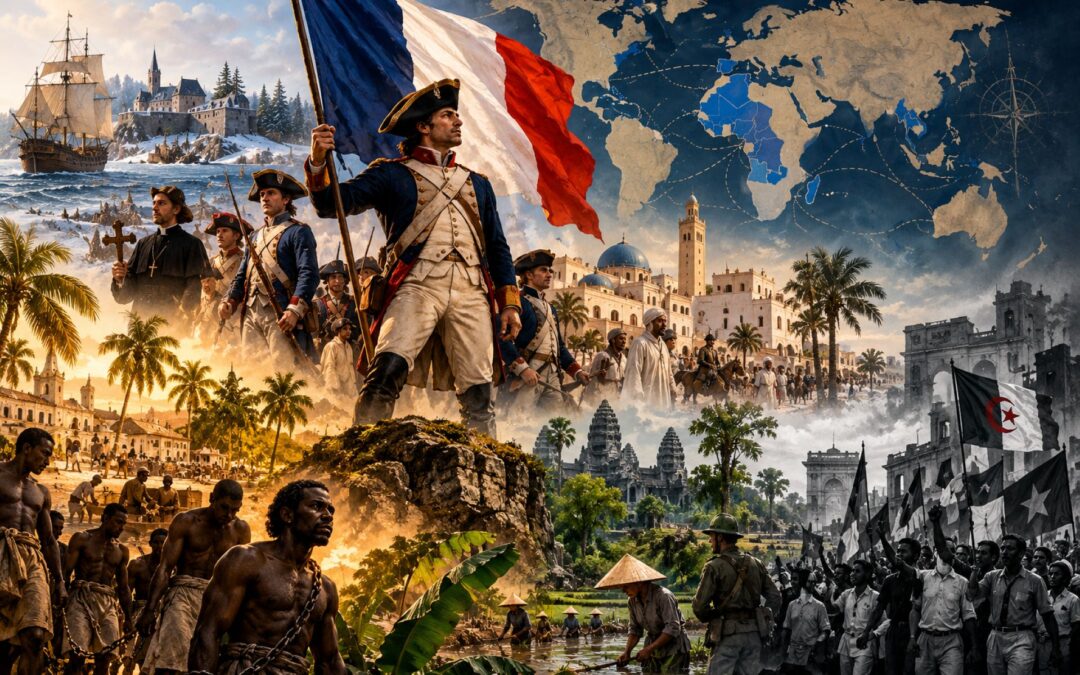
France is usually imagined as a European country stretching from the Atlantic Ocean to the Mediterranean Sea, with the island of Corsica lying just off its southeastern coast. Yet the territory of modern France extends far beyond Europe. French-administered lands can be found in the Caribbean, South America, the Indian Ocean, the Pacific and the North Atlantic, thousands of kilometres from Paris. These scattered territories are the surviving components of an overseas presence that developed over more than four centuries.
At its greatest extent, the French colonial empire was the second-largest colonial empire in the world, surpassed only by Britain’s. French possessions covered enormous portions of Africa, stretched across Southeast Asia, included valuable Caribbean plantation colonies and reached into the Pacific. Earlier, French explorers, settlers and traders had claimed territories across much of North America, from Canada and the Great Lakes to the Mississippi Valley and the Gulf of Mexico.
This global empire did not emerge from a single plan. It developed through commercial expeditions, trading companies, military conquests, religious ambitions, diplomatic agreements and competition with other European powers. Nor did it disappear in one catastrophic defeat. France lost much of its first colonial empire during the eighteenth century, constructed a larger second empire during the nineteenth, and gradually relinquished most of its overseas possessions through wars, nationalist movements and political negotiations during the twentieth.
Understanding the history of the French colonial empire therefore requires more than following changing borders on a map. It means examining how France acquired overseas power, what made its colonies valuable, how colonial authority affected the people who lived under it, and why a system that appeared so extensive eventually became impossible to sustain.
Early French Exploration and the Colonies That Failed
France entered the age of overseas exploration with considerable advantages. By the beginning of the sixteenth century, it possessed a large population, substantial agricultural wealth and one of Europe’s most powerful monarchies. Spain and Portugal were already building profitable overseas networks, and French rulers recognized that maritime exploration might open access to valuable resources, commercial opportunities and new routes to Asian markets.
In 1524, King Francis I sponsored an Atlantic expedition led by the Italian navigator Giovanni da Verrazzano. Sailing along the eastern coastline of North America, Verrazzano explored areas extending from the southeastern coast of the present-day United States toward Newfoundland. His voyage helped Europeans develop a better geographical understanding of the Atlantic coast, but it established no permanent French colony.
A decade later, Jacques Cartier undertook the first of three voyages to northeastern North America. In 1534, he explored the Gulf of St. Lawrence, and during his second expedition in 1535–1536, he travelled up the St. Lawrence River, reaching Indigenous settlements near present-day Quebec and Montreal. Cartier claimed territory for France, but the land was already inhabited by Indigenous communities with established political, economic and cultural systems.
Cartier’s third voyage, beginning in 1541, attempted to establish a permanent settlement near present-day Quebec City. The venture struggled with harsh conditions, inadequate supplies and deteriorating relations with local Indigenous populations. It was abandoned in 1543, leaving France with geographical knowledge and territorial ambitions but no durable colonial foothold.
Other French expeditions were equally unsuccessful. In 1555, Nicolas Durand de Villegagnon established a French settlement in Guanabara Bay, near present-day Rio de Janeiro. Known as France Antarctique, it attracted French Protestants as well as Catholics, but internal religious disputes and Portuguese military pressure undermined the colony. Portuguese forces destroyed the remaining French stronghold in 1567.
Religious conflict also influenced French ventures in North America. Admiral Gaspard de Coligny supported efforts to establish settlements that could provide opportunities for French Protestants, known as Huguenots, who faced increasing persecution at home. Jean Ribault established Charlesfort in present-day South Carolina in 1562, while René Goulaine de Laudonnière founded Fort Caroline near present-day Jacksonville, Florida, in 1564. The first settlement was abandoned, and Spanish forces destroyed Fort Caroline in 1565.
These failures demonstrated that claiming overseas territory was considerably easier than controlling it. Colonies required reliable supplies, investment, military protection, commercial opportunities and workable relationships with the people already living there. France’s own Wars of Religion, beginning in 1562, further reduced the monarchy’s ability to support distant settlements. For much of the sixteenth century, French overseas expansion remained a collection of disconnected ventures rather than an organized imperial project.
New France: Fur Trade, Indigenous Alliances and Continental Claims
France’s first durable overseas empire began to develop during the early seventeenth century, when commercial opportunities in North America attracted greater royal attention. European demand for fish and animal pelts made the northern Atlantic and the St. Lawrence region especially appealing. Beaver fur was particularly valuable because it could be processed into felt used in fashionable European hats.
French merchants established trading relationships along the St. Lawrence, including at Tadoussac, where a trading post appeared in 1600. In 1605, Pierre Dugua de Mons and Samuel de Champlain established Port-Royal in Acadia, in present-day Nova Scotia. Three years later, Champlain founded Quebec, creating a settlement that would become the administrative and commercial centre of New France.
Unlike the English colonies developing farther south, New France initially attracted relatively few permanent European settlers. Its economic foundations rested heavily on the fur trade, which required access to Indigenous trading networks extending deep into the continent. French merchants depended upon Indigenous expertise, transportation routes, geographical knowledge and commercial relationships to obtain valuable pelts.
This dependence made diplomacy essential. Champlain developed alliances with several Indigenous nations, including the Wendat and Algonquin peoples, whose relationships with French traders were influenced by their own political and commercial interests. These alliances also drew France into existing regional rivalries, particularly conflicts involving the Haudenosaunee Confederacy. Indigenous nations were not simply auxiliaries in European imperial competition; they negotiated, resisted, adapted and pursued their own objectives.
The French monarchy gradually attempted to establish greater control over colonial development. In 1627, Cardinal Richelieu created the Company of One Hundred Associates, which received extensive commercial privileges and responsibility for encouraging settlement. The company was expected to expand the colonial economy and increase European migration, although warfare, financial difficulties and the challenges of transatlantic settlement limited its success.
New communities nevertheless emerged along the St. Lawrence. Trois-Rivières was established in 1634, and Montreal followed in 1642. Missionaries, traders, colonial officials and settlers expanded the French presence, while the fur trade continued to connect these settlements to the Great Lakes and beyond.
In 1663, Louis XIV brought New France under more direct royal administration. French troops were dispatched to strengthen colonial security, and government policies encouraged further immigration. One particularly notable initiative involved the Filles du Roi, or King’s Daughters, approximately 800 women whose migration was supported by the monarchy between 1663 and 1673. Their arrival contributed to family formation and population growth in the colony.
Yet the demographic gap between French and British North America remained enormous. As the Bibliothèque nationale de France explains in its history of early French imperial policy, New France had approximately 70,000 European colonists around the time of the Treaty of Paris in 1763, compared with roughly 1.3 million inhabitants in Britain’s thirteen mainland colonies. French territorial ambitions were therefore vastly greater than the population available to defend and develop them.
Exploration meanwhile continued westward and southward. In 1673, Louis Jolliet and the Jesuit missionary Jacques Marquette travelled along the Mississippi River, reaching the vicinity of the Arkansas River before turning back. Their expedition helped establish that the Mississippi flowed toward the Gulf of Mexico rather than the Pacific Ocean.
In 1682, René-Robert Cavelier, Sieur de La Salle, reached the Mississippi’s mouth and claimed the enormous river basin for Louis XIV, naming it Louisiana. French settlements and trading posts subsequently appeared along the river system, including at important strategic locations connecting Canada with the Gulf Coast.
On European maps, these claims created the appearance of a vast French-controlled corridor across North America. In practice, effective French authority was concentrated in settlements, forts, trading posts and particular commercial relationships. Much of the territory remained under Indigenous control, and French influence frequently depended on cooperation with nations whose political independence had not disappeared merely because a European monarch claimed sovereignty over their lands.
The Caribbean Plantation Economy and French Atlantic Slavery
While New France depended heavily on fur trading and Indigenous alliances, France’s Caribbean colonies developed around a different economic model. Tropical islands offered conditions suitable for cultivating sugarcane, tobacco, coffee and other commodities that commanded high prices in European markets. Their relatively small geographical size concealed their extraordinary commercial value.
French settlement in the Caribbean began during the 1620s, including a presence on Saint Kitts established by Pierre Belain d’Esnambuc. French trading companies subsequently promoted expansion into islands such as Martinique and Guadeloupe. Control of individual islands changed through war and diplomacy, and French influence across the Caribbean remained uneven.
The most valuable French colony eventually emerged on the western part of Hispaniola. French buccaneers and settlers established communities there during the seventeenth century, and Spain formally recognized French possession of the territory under the Treaty of Ryswick in 1697. Known as Saint-Domingue, the colony developed into one of the world’s most productive sugar and coffee exporters during the eighteenth century.
Its prosperity depended on slavery. Plantation owners imported enormous numbers of enslaved Africans who were forced to work under exhausting and frequently lethal conditions. Sugar production demanded intensive labour, particularly during harvesting and processing, while plantation discipline relied on physical punishment, restrictions on movement and the constant threat of violence.
The wealth generated by these plantations extended far beyond their owners. Merchants, shipowners, insurers, financiers and refiners participated in commercial networks connecting the Caribbean, Africa and Europe. Colonial exports supported economic activity in French Atlantic ports, while the trade in enslaved people created profits for those involved in transporting and selling human beings.
French participation in the Atlantic slave trade also encouraged the development of commercial and military positions on the West African coast. Trading establishments around Senegal, including Saint-Louis and Gorée, became connected to wider Atlantic commerce. These settlements did not initially give France control over extensive inland territories, but they established relationships and strategic footholds that would become significant during later African expansion.
The French monarchy formalized important aspects of colonial slavery through legislation, including the Code Noir of 1685. Although its provisions addressed the treatment, religious instruction and legal position of enslaved people, the code fundamentally accepted human beings as property and reinforced the authority of slaveholders. Colonial practice could be even more brutal than the regulations themselves.
Plantation societies were never socially uniform. Enslaved Africans and their descendants resisted through escape, the preservation of cultural practices, everyday defiance and organized rebellion. Free people of colour occupied varied positions within colonial hierarchies, and disputes over political and civil rights increasingly exposed tensions within the system.
By the late eighteenth century, Saint-Domingue had become an essential source of French colonial wealth. Yet its economic success rested upon deep social inequality and coercion, creating conditions that would eventually produce one of the most consequential revolutions in Atlantic history.
Trading Across Africa, India and the Indian Ocean
French imperial ambitions also extended eastward, toward the established commercial networks of the Indian Ocean and Asia. European merchants had long valued Indian textiles, Chinese porcelain, Southeast Asian spices and other goods that could be exchanged profitably across distant markets. The challenge was gaining access to trade routes and commercial privileges already controlled by powerful states and experienced merchant communities.
France’s early attempts to enter Asian trade were less successful than those of Portugal, the Dutch Republic and England. French commercial ventures appeared during the early seventeenth century, but the decisive institutional development came in 1664, when Jean-Baptiste Colbert established the French East India Company under Louis XIV.
The company received royal privileges and was expected to compete with established European trading corporations. Its operations nevertheless faced substantial challenges, including inadequate capital, expensive voyages, military competition and the difficulty of securing advantageous relationships with Asian rulers.
French trading establishments eventually developed along the Indian coastline. Pondicherry became an important French centre during the 1670s, while Chandernagore emerged as a significant commercial settlement in Bengal. Other establishments, including Mahé, Karikal and Yanaon, would contribute to the French presence in India.
These settlements operated within the far larger commercial world of the Indian subcontinent. Indian merchants, rulers, bankers and manufacturers controlled resources and networks that European companies needed. France could establish a fortified trading post or obtain commercial concessions without possessing sovereignty over the surrounding region.
The distinction matters because European expansion into Asia initially depended upon access to commercial systems that were already sophisticated and profitable. French companies were participants and competitors within these systems before European military and political intervention transformed the balance of power.
French activity also developed across the western Indian Ocean. Settlements and commercial establishments appeared on Madagascar and the Mascarene Islands during the seventeenth century. Bourbon, later renamed Réunion, became a permanent French possession, while the island known as Île de France, now Mauritius, emerged as an important naval and trading base.
Together, these Atlantic and Indian Ocean ventures gave France a geographically dispersed collection of possessions. Some were plantation colonies, others were military stations or trading settlements, and still others were vast territorial claims supported by relatively small populations. Their different economic structures would become especially important when France confronted another expanding maritime power: Britain.
The Wars With Britain That Broke the First Empire
By the beginning of the eighteenth century, France and Britain were competing across several interconnected regions. Their rivalry involved more than territory. It concerned naval power, commercial access, control of strategic ports, European alliances and the ability to support overseas colonies during prolonged wars.
The War of the Spanish Succession, fought from 1701 to 1714, produced one of the first major reversals for French colonial ambitions. Under the Treaty of Utrecht in 1713, France ceded important North American possessions and rights to Britain, including Acadia, Newfoundland and territories associated with Hudson Bay. France also relinquished its claims to Saint Kitts.
These losses weakened French strategic positions but did not destroy New France. Quebec, Montreal and the St. Lawrence settlements remained under French control, while the wider network of French trading relationships continued across the interior of North America.
The War of the Austrian Succession, which lasted from 1740 to 1748, brought further fighting between Britain and France. Colonial confrontations occurred in North America and India, but the Treaty of Aix-la-Chapelle largely restored territories captured during the war. Neither power achieved a decisive long-term settlement, leaving their commercial and territorial rivalries unresolved.
The next conflict proved far more destructive. During the early 1750s, French and British claims collided in the Ohio Valley, where British colonists and land speculators sought access to territories that French officials regarded as essential to connecting Canada with Louisiana. Indigenous nations possessed their own claims and political interests, complicating the ambitions of both European powers.
In 1754, a young George Washington commanded Virginia forces involved in fighting against French troops. These clashes helped trigger the French and Indian War in North America, which became part of the wider Seven Years’ War after European hostilities expanded in 1756.
The conflict extended across Europe, North America, the Caribbean, West Africa and India. France initially achieved important successes, but Britain’s naval strength, financial resources and growing military advantage gradually changed the balance. British forces captured Quebec in 1759 and Montreal in 1760, effectively ending French rule over Canada.
The decisive settlement came with the Treaty of Paris in 1763. France surrendered Canada and its remaining mainland North American possessions east of the Mississippi, except for New Orleans and its immediate surroundings, which passed to Spain under the arrangements surrounding the war. Spain had already received French claims to Louisiana west of the Mississippi through a secret agreement in 1762.
The terms reflected economic calculations as well as military defeat. France retained important Caribbean plantation colonies, including Martinique and Guadeloupe, whose sugar production made them highly valuable. French commercial establishments in India were also restored under restrictions that curtailed France’s ability to challenge British political and military dominance there.
For Britain, the settlement represented a transformative imperial victory. Its expanding influence across North America and India would become central to the subsequent development of the British Empire. For France, the treaty exposed the vulnerability of an enormous colonial system that possessed relatively few settlers, depended on difficult supply routes and confronted an increasingly powerful naval rival.
The outcome also profoundly affected Indigenous nations. France’s withdrawal altered diplomatic relationships and eliminated one of the competing European powers with which some Indigenous communities had negotiated. British settlers and colonial authorities subsequently increased pressure for western expansion, intensifying disputes over Indigenous lands.
The first French colonial empire had not disappeared completely. France still possessed Caribbean islands, Indian trading establishments, holdings in South America and other overseas territories. What collapsed in 1763 was its ambition to exercise comparable territorial power across continental North America, leaving Britain as the dominant European colonial force in much of the region.
The Haitian Revolution, Napoleon and the Sale of Louisiana
France’s colonial position underwent another dramatic transformation during the revolutionary and Napoleonic periods. The French Revolution began in 1789 with demands for political representation, legal equality and fundamental changes to the monarchy. Its principles raised difficult questions for an overseas empire in which colonial prosperity depended heavily on racial hierarchy and slavery.
These contradictions were most explosive in Saint-Domingue. The colony’s enslaved majority faced extreme exploitation, while white planters and free people of colour struggled over political privileges and the meaning of revolutionary citizenship. In August 1791, a massive uprising began among enslaved people in the northern plantation districts.
The rebellion expanded into a complex conflict involving enslaved and formerly enslaved people, colonial authorities, rival European powers and leaders with different political objectives. Revolutionary France abolished slavery in its colonies in 1794, but the struggle over political authority and the future of Saint-Domingue continued.
Toussaint Louverture emerged as one of the most influential revolutionary commanders. He consolidated military and political power over much of the colony while maintaining a complicated relationship with the French Republic. His authority challenged the assumption that Paris could dictate colonial policy without accommodating the demands of people who had fought for emancipation.
When Napoleon Bonaparte seized power in France in 1799, he inherited both the opportunities and the instability created by these events. Napoleon hoped to restore French overseas strength, including the commercial system centred on the Caribbean. He also regained France’s claim to Louisiana through the Treaty of San Ildefonso in 1800, when Spain agreed to return the territory.
Napoleon’s plans depended upon reasserting French control over Saint-Domingue. In 1802, he dispatched a major expedition commanded by General Charles Leclerc to remove Louverture’s independent authority and restore French government. Louverture was captured and deported to France, where he died in captivity in 1803.
The expedition nevertheless failed to secure the colony. Disease devastated French forces, while resistance intensified as the prospect of restored slavery became increasingly apparent. Napoleon had re-established slavery in certain other French colonies in 1802, and the fear of losing emancipation became a powerful force behind the final struggle for independence.
Under leaders including Jean-Jacques Dessalines, revolutionary forces defeated the French army. Haiti declared independence on 1 January 1804, becoming the first independent state established through a successful revolt of enslaved people against a European colonial power.
The significance of the Haitian Revolution and its defeat of French colonial rule extended far beyond the Caribbean. It demonstrated that enslaved people could destroy an enormously profitable plantation system, challenge European military power and create an independent country. France did not formally recognize Haiti until 1825, when recognition was imposed under the condition of a deeply burdensome indemnity to former French slaveholders.
The loss of Saint-Domingue also undermined Napoleon’s ambitions in North America. Without a secure Caribbean base and with another war against Britain looming, maintaining and defending the Louisiana territory became increasingly difficult. Selling the territory offered France money and removed a possession it could struggle to protect.
In 1803, France agreed to transfer Louisiana to the United States for $15 million. According to the Louisiana Purchase Treaty preserved by the US National Archives, the transaction involved approximately 828,000 square miles and nearly doubled the size of the United States. The territory contained numerous Indigenous nations whose lands were transferred between governments without their consent.
Napoleon’s subsequent conflicts across Europe placed further pressure on France’s overseas possessions. British naval power made isolated colonies vulnerable, and British forces occupied several French territories during the Napoleonic period. Although many were restored after Napoleon’s final defeat, Britain retained possessions including Mauritius, Seychelles, Saint Lucia and Tobago.
The wider Napoleonic Wars and the collapse of Napoleon’s European empire therefore had lasting consequences beyond Europe. By 1815, France had lost its continental North American ambitions, failed to recover Saint-Domingue and surrendered additional maritime possessions. Its first great phase of colonial expansion had effectively ended, but French imperial ambitions had not disappeared.
The Second Empire: Conquest Across Africa, Asia and the Pacific
The second French colonial empire emerged during the nineteenth century under circumstances very different from those that had shaped New France. Industrialization, growing international trade, nationalist competition and expanding European military capabilities encouraged a new period of overseas conquest. French governments also regarded colonial expansion as a means of restoring international prestige after the defeats of the preceding century.
The decisive beginning came in 1830, when French forces invaded Algeria. The expedition initially targeted the Ottoman-linked Regency of Algiers, but occupation expanded into a prolonged attempt to control the surrounding territory. Military campaigns continued for decades, confronting resistance led by figures including Emir Abdelkader and numerous local communities.
The conquest involved extensive violence, population displacement, destruction of agricultural resources and the disruption of established political structures. French authorities gradually confiscated or appropriated land and encouraged European settlement, creating a colonial society in which settlers acquired political and economic advantages over much of the Indigenous Muslim population.
In 1848, France divided northern Algeria into administrative departments, giving the territory an institutional relationship with metropolitan France that distinguished it from many other colonies. This did not mean that the colonized population enjoyed equal citizenship or political rights. Algeria became one of the clearest examples of the gap between French claims of national integration and the inequalities of colonial rule.
Expansion across the rest of Africa followed several different paths. Senegal developed as an important French administrative and commercial centre, while military expeditions and political agreements extended French influence into the interior of West Africa. France established a protectorate over Tunisia in 1881, strengthening its strategic position in North Africa.
During the late nineteenth-century Scramble for Africa, European governments rapidly expanded their claims over African territories. France participated aggressively in this competition, seeking control over trade routes, resources, military corridors and territories connecting its existing possessions.
French West Africa was organized as a federation in 1895 and underwent further administrative consolidation during the following decade. It eventually incorporated territories corresponding to modern Senegal, Mauritania, Mali, Guinea, Côte d’Ivoire, Niger, Burkina Faso and Benin. The federation was governed through a colonial administrative system that connected individual territories to central authorities while preserving important differences among them.
French expansion also reached into Central Africa. Expeditions, treaties and military campaigns established control over territories corresponding to modern Gabon, the Republic of the Congo, Chad and the Central African Republic. These possessions were eventually organized into French Equatorial Africa, formally established as a federation in 1910.
The scale of France’s territorial claims should not obscure the difficulties of controlling these regions. Colonial officials depended upon military forces, local intermediaries, African soldiers and negotiated arrangements with existing authorities. Some communities resisted conquest through armed struggle; others pursued alliances or accommodation according to local circumstances.
French authorities also expanded their control over Madagascar, which was annexed in 1896 after military intervention. In the Horn of Africa, France consolidated its position around the Gulf of Tadjoura and the port of Djibouti, creating French Somaliland. These possessions provided access to strategic sea routes and commercial opportunities extending toward the Red Sea and Indian Ocean.
In 1912, France established a protectorate over most of Morocco, while Spain obtained control of separate zones. Together with Algeria and Tunisia, Morocco completed the principal geographical foundations of France’s North African empire, although the political arrangements governing the three territories differed considerably.
Africa was not the only focus of renewed French imperial ambition. During the nineteenth century, France expanded into Southeast Asia, where political competition, commercial ambitions and the protection of Catholic missionaries provided recurring justifications for intervention.
In 1858, French and Spanish forces attacked Tourane, now Da Nang, beginning a campaign that gradually expanded French control over Vietnamese territory. French forces subsequently captured Saigon, and treaties imposed upon the Vietnamese court transferred parts of southern Vietnam to France. The region became the colony of Cochinchina, while French influence extended over Annam and Tonkin through later military and diplomatic interventions.
France also established a protectorate over Cambodia in 1863. In 1887, Cochinchina, Annam, Tonkin and Cambodia were brought together within the Indochinese Union. Laos became part of the French colonial system in 1893, following French pressure on Siam.
These territories contained societies with established political traditions, agricultural economies, religious institutions and commercial networks. Colonial rule introduced new administrative divisions, infrastructure and economic arrangements, but it also restricted political sovereignty and generated movements opposing foreign domination.
French ambitions extended into the Pacific as well. New Caledonia was annexed in 1853 and became a significant settler colony and penal destination. France established a protectorate over Tahiti in 1842 and formally annexed the kingdom in 1880, while additional island groups came under French authority through agreements and coercive interventions.
By the beginning of the twentieth century, the second empire had become an enormous collection of colonies, protectorates and other dependent territories. France exercised authority over large portions of North, West and Central Africa, substantial areas of Southeast Asia, islands across the Indian and Pacific Oceans, and possessions in the Caribbean and South America.
As the historical account of the French colonial empire in Larousse demonstrates, this expansion occurred across different political regimes and through varied methods of conquest and administration. The common feature was the extension of French power over societies whose populations usually had little meaningful influence over the decisions that placed them under colonial rule.
How France Governed and Profited From Its Colonies
The geographical scale of the second French colonial empire can obscure how differently its territories were governed. France did not administer Algeria, Senegal, Vietnam, Madagascar and Tahiti through one identical system. Political arrangements depended upon the history of conquest, the number and influence of European settlers, economic interests, local institutions and the decisions of successive French governments.
Algeria occupied an especially distinctive position. Its northern territories were organized as French departments, and large numbers of European settlers established communities that exercised substantial influence over colonial politics. Yet most Indigenous Muslim Algerians were subject to discriminatory legal and political arrangements that denied them equality with European settlers.
Elsewhere, colonial governments frequently operated through appointed governors, military officers and administrative officials. French West Africa and French Equatorial Africa were divided into territories connected through federations, while protectorates such as Tunisia and Morocco retained local rulers whose authority operated under French supervision.
These arrangements allowed France to exercise political influence without always replacing every existing institution. In some protectorates, traditional authorities continued performing administrative functions, but important decisions concerning foreign relations, military affairs and economic policy remained subject to French control.
Economic priorities varied across the empire. Plantation agriculture, mining, timber extraction and commercial crops generated exports that connected colonial territories to French and international markets. Ports, railways, roads and administrative centres were developed to facilitate transport, commercial activity, government control and military movement.
Such infrastructure could produce lasting economic changes, but its distribution frequently reflected colonial priorities rather than the needs of local populations. Transport networks might connect mines or plantations to coastal ports more effectively than they connected neighbouring communities to one another. The benefits of development were also distributed unequally among settlers, commercial interests, colonial governments and the populations providing land and labour.
Taxation became another important instrument of colonial rule. Colonial authorities imposed direct and indirect taxes that could force households into cash-based economic activity, wage labour or the production of marketable crops. In some territories, compulsory labour obligations supplied workers for infrastructure and other state projects, while concessionary companies received extensive rights to exploit resources.
Legal distinctions reinforced these economic arrangements. The indigénat, a system of special regulations and administrative penalties applied to colonial subjects in various territories, allowed officials to impose restrictions and punishments outside the ordinary legal protections available to many French citizens. Its application varied across time and place, but it illustrated the inequality embedded within colonial administration.
French governments frequently justified expansion through the idea of a mission civilisatrice, or civilizing mission. Supporters argued that France had a responsibility to spread education, language, modern institutions and supposedly universal principles of civilization. The rhetoric drew upon aspects of French republican thought, but it coexisted with restrictions on political participation and the systematic subordination of colonized peoples.
Education became one expression of this contradiction. French-language schools trained some colonial subjects for administrative and professional roles, creating opportunities for particular individuals and social groups. Access remained uneven, however, and colonial educational systems often prioritized producing a limited number of intermediaries rather than guaranteeing broad political or educational equality.
French colonial policy also contained tensions between assimilation and association. Assimilation proposed that colonial subjects might eventually adopt French institutions and culture, while association accepted the continued existence of local traditions under French political authority. Neither approach necessarily involved recognizing the right of colonized societies to determine their own political future.
Colonized populations responded in different ways. Some individuals used colonial schools, courts and political institutions to seek greater rights, while others rejected the legitimacy of foreign rule. Workers resisted economic exploitation, religious and community leaders defended local authority, and nationalist movements increasingly connected demands for reform with demands for sovereignty.
The French colonial empire therefore cannot be understood simply as an extensive collection of territories on a map. It was a system of unequal political relationships through which France exercised power over diverse societies, extracted resources and labour, and attempted to reconcile claims of universal civilization with institutions designed to preserve colonial domination.
The World Wars and the Last Expansion of French Colonial Power
By the outbreak of the First World War in 1914, the French colonial empire was one of the largest political systems on the planet. Its possessions supplied agricultural commodities, minerals, military recruits and strategic bases. The war revealed how deeply France had come to depend upon the resources and populations of its overseas territories.
French authorities recruited hundreds of thousands of soldiers and workers from colonial possessions, particularly from North and West Africa, Madagascar and Indochina. African soldiers often served in units commonly described as tirailleurs, although colonial military formations differed by region and were not socially or ethnically uniform.
These troops participated in major campaigns, including battles on the Western Front. Colonial soldiers fought alongside metropolitan French forces and suffered heavy casualties under conditions shaped by military discipline, racial prejudice and the unequal political relationships of the empire. Colonial workers also contributed to wartime production, transport and other essential services.
The war created contradictory consequences. Military service exposed many colonial subjects to experiences beyond their home territories and sometimes encouraged demands for greater recognition, political rights and fair treatment. At the same time, colonial governments continued to exercise extensive authority over recruitment, labour and political activity.
France emerged from World War I among the victorious powers, and the collapse of Germany’s overseas empire and the Ottoman Empire created opportunities for additional territorial influence. France obtained League of Nations mandates over Syria and Lebanon, along with mandates over much of Cameroon and Togo, formerly German colonies.
Mandates were not formally identical to traditional colonies. They were established under an international system that described the administering powers as holding responsibilities toward the populations concerned. In practice, France exercised extensive political and military authority, and local opposition sometimes produced major confrontations.
The empire reached its greatest geographical extent in the interwar period, covering approximately 13 million square kilometres when its diverse territories and dependencies are counted. Its size made France a major imperial power, but territorial expansion did not eliminate the political pressures developing within colonized societies.
The Second World War exposed these vulnerabilities far more dramatically. France’s defeat by Germany in 1940 divided the empire between authorities loyal to the Vichy government and supporters of the Free French movement led by Charles de Gaulle. Different colonies shifted allegiance at different times, becoming involved in the wider military struggle.
Colonial territories supplied soldiers, resources and strategic bases to the Free French war effort, while colonial troops participated in campaigns across Africa, Italy and Western Europe. Their contribution to France’s liberation was substantial, even though postwar recognition and political equality remained deeply contested.
The war also undermined European claims to unquestioned imperial superiority. France’s defeat in 1940 weakened its prestige, while Japanese expansion into Southeast Asia exposed the vulnerability of colonial administration. Nationalist movements recognized opportunities created by the disruption of European authority.
In 1944, de Gaulle convened the Brazzaville Conference to consider the future of France’s colonial territories. The conference proposed reforms, including improvements in political representation and social conditions, but it did not endorse general colonial independence. French leaders hoped that a reformed imperial system could survive the war and preserve France’s international influence.
For many colonized people, however, limited reform was no longer sufficient. The language of liberation and national self-determination used during the war increasingly collided with France’s determination to maintain overseas political control. The empire emerged from 1945 territorially extensive but facing mounting challenges to its legitimacy and durability.
Decolonization: How the Empire Unravelled
The collapse of the second French colonial empire did not occur through one decision or a uniform process. Some territories gained independence through political negotiations, others experienced prolonged warfare, and still others maintained constitutional relationships with France. The outcome depended upon local nationalist movements, colonial institutions, international pressures and the political choices made in Paris.
France attempted to preserve an imperial relationship after World War II through the French Union, established under the Constitution of 1946. The new framework recognized changes in the political status of overseas populations and promised a more inclusive relationship, but French authorities continued to retain decisive powers across much of the colonial system.
In Indochina, the contradiction between reform and continued imperial authority rapidly became a military crisis. Japanese occupation during World War II had severely weakened French control, and the Japanese surrender in August 1945 created opportunities for Vietnamese nationalists. Ho Chi Minh and the Viet Minh declared Vietnamese independence in September 1945, but France attempted to restore its authority.
Negotiations failed, and full-scale fighting began in late 1946. The First Indochina War pitted French forces and their local allies against the Viet Minh, whose struggle combined Vietnamese nationalism with communist political organization. The conflict increasingly became entangled with the Cold War, as China and the Soviet Union supported the Viet Minh while the United States provided substantial assistance to France.
The decisive confrontation occurred at Dien Bien Phu in northwestern Vietnam. French commanders established a fortified position intended to draw Viet Minh forces into a battle where conventional military resources would provide an advantage. Instead, Viet Minh forces under General Võ Nguyên Giáp surrounded the position and used artillery, logistics and sustained attacks to overwhelm the French defenders.
On 7 May 1954, the French garrison surrendered. As the US Office of the Historian’s account of Dien Bien Phu and the fall of French Indochina explains, the defeat accelerated the diplomatic settlement that ended France’s attempt to maintain colonial military control over Vietnam.
The Geneva arrangements of 1954 established a temporary division of Vietnam near the seventeenth parallel, while Cambodia and Laos followed separate paths toward sovereignty. French colonial withdrawal did not resolve the struggle over Vietnam’s political future, and the country subsequently became the centre of a much larger war involving North Vietnam, South Vietnam and the United States.
France faced another major challenge in Madagascar, where a nationalist uprising began in 1947. French forces suppressed the rebellion through extensive military operations and repression. The violence demonstrated that the promise of postwar political reform could coexist with a willingness to use overwhelming force against movements challenging French authority.
The most politically consequential decolonization conflict for France emerged in Algeria. Unlike most other colonial territories, Algeria contained a large European settler population and had been incorporated into the French administrative system as departments. Many settlers regarded continued French sovereignty as essential to their political and economic position.
In November 1954, the National Liberation Front, or FLN, launched an armed struggle for Algerian independence. What followed was a brutal war involving guerrilla attacks, French military operations, torture, collective punishment, displacement and violence against civilians.
The conflict divided French society and destabilized the government of the Fourth Republic. The Algerian crisis contributed to Charles de Gaulle’s return to power in 1958 and the establishment of the Fifth Republic. Although de Gaulle initially operated within a political environment committed to preserving French Algeria, he eventually recognized that continued colonial rule could not provide a sustainable settlement.
Opposition to independence remained fierce, especially among militant settler organizations and sections of the French military. The war produced deep social divisions, substantial loss of life and the displacement of populations associated with the colonial system.
The Évian Accords of March 1962 created the framework for a ceasefire and the transition toward independence. Following a referendum, Algeria became independent in July 1962, ending 132 years of French rule. The consequences of the conflict continued to shape relationships among France, Algeria, former settlers, veterans and communities connected to both countries.
Elsewhere in Africa, decolonization followed different trajectories. Tunisia and Morocco gained independence in 1956, while Guinea rejected membership in the proposed French Community and became independent in 1958. The Fifth Republic’s constitutional arrangements attempted to redefine relationships between France and its overseas territories, but they did not prevent the rapid movement toward sovereignty.
The year 1960 became a defining moment. Numerous territories of French West Africa and French Equatorial Africa gained independence, including Senegal, Mali, Côte d’Ivoire, Niger, Chad, Gabon, the Central African Republic and the Republic of the Congo. Madagascar also became independent that year.
These transitions were shaped by negotiations, nationalist organization and changing political calculations, but they did not erase all forms of French influence. Newly independent states retained varying degrees of economic, diplomatic, military and cultural connection with France. Some relationships reflected negotiated cooperation, while others generated criticism concerning continued dependence and unequal power.
Decolonization also continued after the principal African independence wave. The Comoros became independent in 1975, although Mayotte remained under French administration following a disputed political separation. French Somaliland became the independent state of Djibouti in 1977, while the former French territory of the Afars and the Issas had already experienced decades of political debate over its future.
The United Nations chronology of former Trust and Non-Self-Governing Territories demonstrates how widely the dates and forms of political change varied. Independence, constitutional integration and changes in territorial status were distinct outcomes rather than interchangeable stages of one process.
By the final decades of the twentieth century, the enormous second French colonial empire had ceased to exist as a system of direct rule over most of Africa and Southeast Asia. Its dissolution reflected the combined force of nationalist movements, military defeats, international changes and the growing difficulty of defending colonial domination within a political order increasingly committed to sovereign equality.
Overseas France and the Empire’s Continuing Legacy
The disappearance of France’s vast colonial empires did not mean the end of its overseas territories. Several possessions remained within the French Republic, but their constitutional arrangements developed in different directions. Some became departments and regions integrated into the French state, while others received distinctive forms of autonomy or special institutional status.
According to the French Ministry of Education’s April 2026 overview of overseas territories, France identifies twelve overseas territories with differing legal arrangements. Approximately 2.3 million people live in these territories under the official demographic figures cited for January 2026, although estimates depend upon the precise geographical and administrative categories used.
Guadeloupe and Réunion are overseas departments and regions. Martinique, French Guiana and Mayotte have arrangements combining departmental and regional responsibilities within single territorial structures. These territories participate in the constitutional system of the French Republic, although their geographical conditions and administrative circumstances differ from those of metropolitan France.
Other possessions have distinct legal arrangements. French Polynesia, Saint-Pierre and Miquelon, Saint-Martin, Saint-Barthélemy and Wallis and Futuna possess forms of overseas collectivity status, while the French Southern and Antarctic Lands have a special administrative structure and no permanent ordinary resident population. New Caledonia has a distinctive constitutional status reflecting its particular political history.
The geographical diversity of overseas France is striking. French Guiana lies on the northern coast of South America, bordering Brazil and Suriname. Réunion and Mayotte are located in the Indian Ocean, while French Polynesia and New Caledonia extend France’s presence across the Pacific. Saint-Pierre and Miquelon lie close to Newfoundland in the North Atlantic, recalling the geographical setting of France’s earliest North American ventures.
These territories also give France an extensive maritime presence. Overseas islands and coastlines contribute to a vast exclusive economic zone, providing interests in marine resources, environmental management, shipping routes and strategic geography. Yet contemporary territorial status is not simply a continuation of colonial rule under another name; it involves different constitutional institutions, citizenship arrangements, local governments and ongoing political choices.
Questions of self-determination remain important in several territories. New Caledonia has experienced a long and complex political struggle involving independence movements, communities favouring continued association with France, negotiations over autonomy and disputes concerning electoral and institutional arrangements.
French Polynesia also contains differing political perspectives on autonomy, independence and its relationship with France. Both New Caledonia and French Polynesia appear on the United Nations list of Non-Self-Governing Territories, indicating that their political futures remain connected to international discussions of decolonization.
The history of the French colonial empire also survives through institutions and language far beyond territories that remain French. In former colonies across Africa, the Caribbean and Asia, French legal practices, educational systems, administrative traditions and cultural institutions have influenced the development of independent states. These inheritances vary considerably and coexist with local languages, traditions and institutions that predate colonial rule.
French remains an important language of government, education, diplomacy, commerce and literature across parts of Africa and elsewhere. Yet its spread cannot be treated simply as proof of the continuing cultural dominance of metropolitan France. Formerly colonized societies have developed their own forms of Francophone expression, transforming French through local histories, linguistic influences and independent cultural production.
The Organisation internationale de la Francophonie estimated in its 2026 report on the French language worldwide that approximately 396 million people speak French. Its updated methodology includes certain younger schoolchildren in countries where French has an official or educational role, making comparisons with older estimates dependent upon how speakers are counted. About 65 percent of the estimated global Francophone population lives in Africa, demonstrating the continent’s central place in the language’s contemporary development.
The relationship between France and its former colonies also remains politically contested. Economic agreements, military cooperation, migration, citizenship, historical memory and disputes over colonial violence continue to affect diplomatic relationships. In some countries, French cultural and institutional connections are valued; in others, they are challenged as reminders of unequal power or obstacles to greater autonomy.
These debates do not have one uniform outcome. Former colonies have pursued different political and economic paths, while overseas French territories continue to make decisions within varied constitutional frameworks. Their populations cannot be reduced to a single attitude toward France, colonial history or independence.
The French colonial empire was once a global political structure sustained by conquest, commerce, slavery, settlement and unequal sovereignty. Its territorial expansion and eventual dissolution transformed societies across several continents, leaving consequences that did not disappear when colonial governments withdrew.
The contrast between France’s former empire and its present overseas possessions reveals how profoundly its international position has changed. France no longer controls the vast territories it once governed in Africa, North America and Asia, but its historical influence remains visible in languages, institutions, political relationships and unresolved questions of identity and sovereignty.
The lasting significance of the French colonial empire lies not simply in how much territory France once claimed, but in how imperial power reshaped the lives and political futures of the people who lived within those territories. Its history is one of expansion and defeat, economic ambition and exploitation, collaboration and resistance, and ultimately the struggle of colonized societies to determine their own future.
What remains is not one uniform imperial legacy. It is a complicated international inheritance, shaped both by the institutions France imposed and by the choices made by the societies that transformed, resisted or moved beyond them.
Last Updated on October 30, 2026 by Aseem Gupta