
Reading Time: 19 Minutes
Imagine walking down a street while paying attention not only to cars and people, but also to the possibility of crushing an insect beneath your feet. Now imagine carrying a small broom to clear the path, avoiding meals after dark, and taking care that even your breathing does not injure tiny forms of life. For some Jain ascetics, these are not eccentric gestures. They are expressions of an extraordinarily demanding moral commitment: avoid harming living beings as far as humanly possible.
That commitment helps explain why many Jains avoid meat, eggs, and certain vegetables, why monks and nuns may give up possessions and ordinary comforts, and why some Digambara monks renounce clothing itself. Yet the restrictions make little sense in isolation. Behind them lies an account of what a soul is, why it suffers, how actions bind it to repeated lives, and what it would mean to become completely free.
Jainism is one of India’s oldest surviving religious traditions. It shares ideas such as karma, rebirth, and liberation with other Indian religions, but develops them in its own distinctive ways. Its ideal is not simply to lead a respectable life or secure a favourable next birth. It is to end the cycle of rebirth altogether, through a transformation in how one understands and treats the world.
Who Were the Jinas, and Where Did Jainism Come From?
The name Jain comes from Jina, meaning a spiritual victor: someone who has conquered anger, greed, pride, attachment, and the other passions that bind the soul. A Jina is also called a Tirthankara, literally a maker of a ford. Picture the cycle of births and deaths as a dangerous river. A Tirthankara finds a crossing and shows others how to reach the other bank. The image is important because these teachers do not simply rescue believers; they demonstrate a path that must be followed through personal effort.
Jain tradition honours 24 Tirthankaras in the present cycle of time. The first, Rishabhanatha or Adinatha, occupies a foundational place in sacred tradition. The twenty-third, Parshvanatha, is associated with an earlier ascetic community, while the twenty-fourth, Mahavira, is the teacher most closely connected with Jainism’s historically recognizable development. Jains understand the teachings as eternal, renewed by successive enlightened teachers, rather than as a religion invented by one man.
Mahavira is traditionally portrayed as a man who renounced family life and possessions, practised prolonged ascetic discipline, attained perfect knowledge, and taught others the way to liberation. Traditional Jain chronologies give precise dates for his life, but scholars dispute the chronology and his exact relationship in time to Gautama Buddha. Placing him broadly in the sixth or fifth century BCE is more defensible than insisting he certainly preceded the Buddha by a particular number of decades.
That was an era of profound intellectual ferment in ancient India. Expanding towns, trade networks, kingdoms, and ascetic communities created space for arguments about sacrifice, moral responsibility, the nature of the self, and whether existence involved repeated births. Jainism belonged to the wider shramana world of renunciation and debate, alongside the movements from which Buddhism emerged. It developed independently rather than as an offshoot of Buddhism or a mere branch of Hinduism.
The distinction matters. Where some Hindu philosophical schools describe the individual self in relation to an ultimate reality, Jainism maintains the existence of innumerable individual souls. Where Buddhism famously questions the idea of a permanent individual self, Jainism places the enduring soul at the centre of its account of liberation. The Jainpedia introduction to Jainism makes clear that the Jinas’ teachings unite these ideas with an exacting way of life.
Jain accounts of Mahavira’s life also embody the religious ideal they describe. He is remembered not merely as someone who taught restraint to other people, but as someone who undertook difficult austerities, endured discomfort without retaliation, and progressively relinquished dependence on external things. This traditional portrait matters even where its precise historical details cannot be independently established: for Jain believers, the authority of an enlightened teacher rests in the discipline and liberation that his life exemplifies, not in a supernatural power to create or govern the universe.
The Soul, Karma, and the Problem of Rebirth
To understand Jainism, begin with a claim that changes how the world looks: living beings possess jiva, an enduring soul or conscious principle. Humans are not exceptional in possessing souls. Animals, plants, and beings too small to notice also count as living in Jain thought, though Jain classifications of life do not simply mirror modern biology. A soul is inherently capable of knowledge, perception, energy, and bliss, but ordinary existence conceals those capacities.
Everything without consciousness belongs broadly to ajiva, the nonliving side of reality. The Jain universe is therefore not an arrangement of creatures created by a divine ruler for human use. It consists of living and nonliving realities that have always existed. A human life is only one temporary arrangement in a much longer history of a particular soul.
That history is called samsara, the cycle of birth, death, and rebirth. A soul may enter different forms of existence according to its karma. A pleasant life might seem preferable to a difficult one, but for Jainism neither resolves the deeper problem: every embodied condition is impermanent, and the soul remains caught in another round of desire, action, suffering, and death. Even becoming a heavenly being would not amount to permanent freedom.
Karma is often described casually as a moral law in which good deeds bring good consequences and bad deeds bring bad ones. Jain philosophy offers a more elaborate explanation. In its metaphysical system, karma is an extremely subtle form of matter that becomes associated with the soul. This is a religious and philosophical account, not a scientific claim that physical instruments have detected karmic particles. The Jainpedia account of karmic matter describes the different ways karma affects knowledge, experiences, embodiment, and future rebirth.
Imagine a clean piece of cloth exposed to dust. Dust may settle on it, but if the cloth is damp, particles cling more stubbornly. The soul is the cloth, karmic matter is the dust, and passions such as anger, deceit, pride, greed, and possessiveness provide the moisture that intensifies the bond. The analogy explains why Jain ethics considers not only what a person does but also the attachment or hostility accompanying the action.
Some karma is regarded as favourable and may bring pleasure, prosperity, or a desirable rebirth. Other karma may produce pain or less favourable conditions. But both maintain the relationship between soul and embodied existence. This contrasts with Buddhist teachings on karma and liberation, which likewise connect action and rebirth but do not posit the same eternal individual soul coated with subtle karmic matter. The religions share a vocabulary developed in ancient India without sharing identical explanations of what travels through rebirth or what ultimately becomes free.
A golden chain is more attractive than an iron one; it is still a chain. The ultimate task is therefore not merely to collect better karma, but to stop attracting new karma and remove what is already bound to the soul.
The result is moksha, liberation. A fully liberated soul no longer returns to embodied existence; its inherent knowledge and bliss are unobstructed. Jain tradition locates such souls in the highest region of the cosmos. This goal explains the severity of certain ascetic disciplines: renunciation is not meant to earn admiration, but to eliminate the causes of bondage, including attachment to the very things most people spend their lives pursuing.
The Three Jewels and the Seven Tattvas
If karma binds the soul, how can a person loosen that bond? Jain teachings answer with the Three Jewels, also called the three gems or ratnatraya: right faith or vision (samyag-darshana), right knowledge (samyag-jnana), and right conduct (samyak-charitra). They are not three independent shortcuts. Each supports the others, joining an accurate understanding of existence to the disciplined behaviour necessary for liberation.
Right faith is not simply believing whatever a religious authority says. It is a sound orientation toward reality and confidence in the path shown by the enlightened teachers. Right knowledge develops that orientation into a clear understanding of the nature of souls, karma, and release, traditionally through teaching, reflection, and scripture. Right conduct turns understanding into choices that limit attachment and harm. Knowing that violence creates bondage while continuing to inflict needless harm would leave the central problem untouched.
The framework becomes more precise in the seven tattvas, or fundamental truths. The first two describe what exists: jiva, living soul, and ajiva, nonliving reality. A third, asrava, means the influx of karmic matter toward the soul through activity. The fourth, bandha, is bondage: the binding of that karma to the soul, shaped especially by passions and attachment.
The remaining truths explain how escape becomes possible. Samvara means stopping or restraining further karmic influx. Nirjara is the shedding of karma already accumulated, aided by ethical discipline, restraint, austerity, and spiritual practice. Finally, moksha is the soul’s release when the causes and residue of bondage have ended. The distinction between samvara and nirjara is crucial: preventing new dust from settling on the cloth is not the same task as cleaning away what is already there. Jain discipline is designed to do both, and that is why a change of intention alone does not complete the spiritual journey.
Some Jain presentations expand this scheme to nine categories by distinguishing meritorious and demeritorious karma, but the sevenfold arrangement gives the essential sequence.
These are not merely seven terms to memorise. They form a causal account: a soul exists; its activities bring karma into contact with it; passions bind karma to it; disciplined living interrupts the process; accumulated karma is removed; and liberation becomes possible. The philosophical structure is set out in Jainpedia’s explanation of Jain beliefs, alongside the wider tradition of Jain reasoning about the soul.
Consider a moment of anger. A person may recognise the emotion, choose not to speak cruelly, and later work to weaken the resentment behind it. In ordinary ethical language, that is self-control. In Jain terms, it also illustrates how knowledge and conduct can help restrain new karmic bondage and address the passions sustaining it. The Three Jewels describe an entire way of seeing and acting, not simply a creed recited in a temple.
Ahimsa and the Five Great Vows
The most recognizable Jain principle is ahimsa, usually translated as nonviolence or non-harm. Many people understand nonviolence as refusing to assault or kill another person. Jainism extends the concern to animals, plants, and other living beings and asks people to consider injury caused by thought, speech, action, or carelessness. The injunction often expressed as ahimsa paramo dharmah presents nonviolence as the highest religious duty.
Ahimsa is the first of five great vows, the mahavratas. The second, satya, requires truthfulness, while also recognizing that speech should not be used carelessly to harm. The third, asteya, rejects taking what has not been given, including dishonest acquisition. The fourth, brahmacharya, requires complete celibacy of ascetics and sexual restraint or fidelity within the ordinary household path. The fifth, aparigraha, rejects possessiveness and attachment, whether to goods, prestige, relationships, or comforts.
The vows reinforce one another. Greed can encourage theft; attachment can prompt dishonesty; anger can turn speech into an instrument of violence. Even truthfulness involves discernment: telling the literal truth in a way calculated to humiliate someone may conflict with the spirit of ahimsa, while an easy lie might protect one’s comfort at another person’s expense. Jain ethical reasoning therefore asks about motives and consequences as well as the outward form of an act.
Even a possession that appears harmless may generate fear of losing it, resentment toward rivals, or exploitation of others. Jain restraint therefore targets both outward behaviour and the passions beneath it. It is an attempt to prevent karmic bondage at its source.
Nonviolence becomes most visible in food. Jains are traditionally vegetarian, and eggs are generally excluded. Many avoid honey because obtaining it can harm bees. A number of Jain dietary traditions also reject root vegetables such as potatoes, onions, garlic, and certain other underground foods. The issue is not merely that pulling up a plant kills it; Jain classifications also associate particular underground foods with extensive forms of life, and digging or harvesting them can injure other organisms.
The details vary by community, household, sect, season, and degree of observance. Some avoid eating after sunset to reduce the risk of accidentally consuming tiny creatures when visibility is poor. Certain fermented foods and intoxicants are restricted because of concerns about living organisms, impairment, and loss of self-control; this does not mean every Jain follows one identical menu. The Jainpedia discussion of nonviolence distinguishes especially stringent monastic discipline from the limitations and responsibilities of lay life.
The underlying principle reaches beyond the dining table. A monk or nun might carefully examine a place before sitting, sweep a path to displace small creatures, or strain water according to the order’s discipline. Such actions can appear disproportionate if one measures only visible suffering. From within Jain thought, however, the lives of easily overlooked beings also matter, and unthinking habits can accumulate consequences even without a conscious wish to hurt.
Absolute harmlessness is practically impossible for anyone who eats, moves, or builds a home. Jain traditions are aware of this difficulty. Their answer is not that householders should abandon every responsibility immediately, but that people can reduce avoidable harm while pursuing progressively greater self-restraint. For mendicants the vows are exceptionally strict; for laypeople they are scaled to the realities of earning a living and caring for others. The difference lies in how far an individual can responsibly take the same ethical principles.
Anekantavada: Why Reality Has Many Sides
Imagine several blind people encountering an elephant for the first time. One touches its broad side and declares that an elephant must resemble a wall. Another grips a leg and says it is obviously like a pillar. A third handles the tail and insists it is a rope, while someone examining an ear describes a fan. A person touching the trunk finds something flexible and powerful, quite unlike the descriptions offered by the others.
Each observer has touched the same animal. None is necessarily lying, and each has encountered something real. Yet each mistakes one part for the whole, so their confident declarations become mutually incompatible. The story is associated with the Jain principle of anekantavada, the doctrine that reality has many aspects and that no ordinary, limited standpoint should be confused with an exhaustive description of it.
This is not a claim that a wall, pillar, fan, and rope are equally accurate descriptions of an entire elephant. Their claims are only conditionally useful when one knows which part was examined. Nor does anekantavada require abandoning truth. It warns that a statement may be valid from one perspective but incomplete or misleading when presented as universally sufficient. The Harvard Pluralism Project’s account of anekantavada places the idea in India’s long history of philosophical debate.
Jain thinkers developed related methods of reasoning, including syadvada, the practice of qualifying assertions with a phrase approximately meaning “from a certain standpoint.” Its classical sevenfold formulation explores different ways a proposition can be affirmed, denied, or described as inexpressible, depending on the conditions of judgment. Consider saying that a clay pot is permanent. As matter undergoing change, it plainly is not permanent in the same way at every moment; yet its constituent substance and its identity over a short interval may be discussed from different standpoints. Qualified statements allow philosophers to examine these aspects without mistaking a partial account for a complete one.
The point is not that contradiction stops mattering, but that context and qualification matter whenever a finite observer attempts to describe a complex world.
There is an ethical consequence as well as a philosophical one. If one’s own viewpoint may be partial, contempt for every rival position becomes harder to justify. This can encourage intellectual humility and restraint in argument, qualities that some Jains connect with nonviolence in speech and thought. Yet tolerance does not mean that Jain tradition considers all religious claims correct, or that the traditions within Jainism lack sharp disagreements. It means that disagreement should begin with recognition of the limits of one’s own perspective.
Monks, Nuns, and the Everyday Life of Jains
The difference between an ideal and its everyday practice becomes especially clear in Jain communities. Those who formally renounce ordinary life take the five great vows in their demanding monastic form. Laywomen and laymen may follow the anuvratas, lesser or limited vows, while remaining responsible for families, livelihoods, and civic life. These are real religious commitments, not merely casual suggestions; their scope differs because the circumstances of a householder and a renunciant differ.
A Jain mendicant may give up an independent home, personal income, elaborate possessions, and sexual relations. In many orders, monks and nuns move between settlements on foot, relying on householders for suitable food offered according to detailed rules. They must avoid encouraging harm simply to obtain a preferred meal. Wandering itself is regulated, and many mendicants remain in one place during the rainy season, when travelling could endanger more small forms of life.
The little broom carried by some ascetics is a vivid symbol of deliberate movement. It may be used to clear insects before sitting or stepping, rather than brushing them away roughly. Some Svetambara traditions use a cloth over the mouth to reduce the possibility of injuring tiny airborne life and to cultivate care in speech; other ascetics do not wear one routinely. Rules concerning bathing, cooking, transport, food inspection, and possessions also differ across monastic traditions. Turning one order’s practice into a rule for every Jain would obscure that diversity.
The point is not that monks and nuns live in constant fear of microscopic creatures. Their discipline is meant to develop awareness and reduce attachment: each meal, movement, conversation, and material need becomes an occasion to practise restraint. Fasting, meditation, confession, repentance, scriptural study, and other austerities form part of this discipline. Jainpedia’s overview of monks and nuns explains how initiation, monastic equipment, wandering, and the rules of different orders shape the mendicant life.
Renunciation also creates dependence on those who remain in the world. Householders provide food and other permitted support, while mendicants offer instruction, spiritual example, and opportunities for religious learning. Jain tradition speaks of a fourfold community comprising monks, nuns, laymen, and laywomen. Women have long held significant places in monastic life, and nuns form substantial communities; their numbers and religious authority, however, vary across sects and historical periods.
For householders, nonviolence might govern food choices, employment, business dealings, charity, and the treatment of animals. The challenge is especially practical in work: agriculture, construction, manufacturing, trade, medicine, and travel all involve some interaction with living things. A householder has to distinguish unavoidable necessities from unnecessary injury, and can seek livelihoods and methods that reduce harm. This is a more realistic account of Jain lay ethics than imagining that nonviolence simply means choosing one approved profession.
Truthfulness and non-stealing take concrete form in keeping agreements, dealing fairly with customers, and resisting fraud. Aparigraha does not necessarily forbid ownership; it challenges endless accumulation and the idea that a person’s value increases with possessions. Giving to animal shelters, educational institutions, hospitals, libraries, relief efforts, and religious establishments can be part of the ethical life of Jain communities.
Jains have played notable roles in trade, finance, scholarship, and philanthropy, partly within historical networks that favoured commercial livelihoods over occupations involving extensive killing. That history should not be turned into a claim that all Jains are wealthy merchants, or that every Jain household observes ascetic rules equally. Like any living religious community, Jain society contains differences of region, means, language, family practice, and personal commitment.
Religious life also includes festivals and shared rituals. Paryushana, especially important among Svetambaras, emphasizes reflection, restraint, forgiveness, and renewal; Digambara traditions observe related periods of intensified religious practice, including Das Lakshana. The practice of seeking and offering forgiveness makes the ethical ideal social rather than merely individual. Those who will never become monks or nuns in this lifetime can still understand themselves as participants in the same long spiritual journey.
The Jain Universe and a Religion Without a Creator God
Jainism has a detailed vision of the cosmos, but no creator deity who brings the universe into existence. Reality has neither a first moment of creation nor a final destruction imposed by a supreme ruler. Souls, matter, space, and the other fundamental conditions of existence are understood to be beginningless. This makes the Jain universe a moral and metaphysical order governed by karma, rather than a world administered by divine rewards and punishments.
The inhabited universe, or loka, is commonly represented in an hourglass-like form with a broad upper region, a narrow middle, and a broad lower region. The middle world contains the human realm and other forms of life. Above it are heavenly worlds occupied by celestial beings, while below lie seven infernal levels. Beyond the inhabited universe is an expanse of empty, non-world space. The elaborate Jain account of the universe maps these regions to explain the possibilities and limits of rebirth.
Four broad destinies, or gatis, organize embodied existence: human beings, nonhuman living beings such as animals and plants, heavenly beings, and hell-beings. Rebirth is determined by karma, not by a judge handing down a sentence. Heavenly existence may be delightful, but even the gods eventually exhaust the karma sustaining it. Infernal experiences are painful and temporary in the same cosmological sense: when that condition ends, the soul may be reborn again.
At the summit of the loka lies the realm of liberated souls, frequently called siddha-shila or siddha-loka. Souls that have attained moksha remain there in their perfected state, free from bodies, desires, karmic bondage, and further rebirth. This differs from living in a paradise granted by a creator. Liberation is the consequence of removing bondage, not the favour of a divine benefactor.
Why, then, do Jains visit temples, bow before sacred images, or recite prayers? The Tirthankaras and perfected souls are revered as models of liberation and objects of spiritual devotion. They are not generally understood as interventionist creators who will rearrange worldly events because someone requests it. Worship can express gratitude, admiration, aspiration, and concentration upon qualities the devotee hopes to cultivate. Some traditions also honour attendant and protective deities, but such beings remain within the karmic universe rather than replacing the ideal of liberation.
This creates an important contrast with some forms of Hindu religious thought and practice, in which devotion may centre on a supreme divine being. Jain practice can contain elaborate ritual and sacred imagery while maintaining that liberation ultimately depends on the soul’s own transformation. Religious devotion and disciplined effort therefore coexist without requiring a creator god.
Digambara and Svetambara: Different Paths of Renunciation
The two major Jain traditions are Digambara, meaning “sky-clad,” and Svetambara, meaning “white-clad.” Their names refer to one highly visible difference in the ideal of monastic renunciation. Digambara male ascetics at the highest level of complete renunciation may give up clothing entirely, treating even a garment as a possession. Svetambara monks and nuns generally wear simple white clothing, while teaching that renunciation involves abandoning attachment rather than necessarily abandoning every external object.
The disagreement is not merely about modesty or dress. If possession of clothing obstructs perfect renunciation, what does that imply for people who cannot or do not practise nudity? Traditional Digambara doctrine holds that women cannot attain final liberation in a female body and must be reborn male to complete the highest path. Svetambara doctrine rejects that restriction and affirms that women can attain liberation. These differences arise from wider views about embodiment, monastic discipline, and the nature of spiritual perfection.
The debate also shapes how the traditions remember the Tirthankaras. Svetambaras identify Malli, the nineteenth Tirthankara, as a woman; Digambaras regard Mallinatha as male. Their accounts of scripture differ as well: Svetambaras preserve a canon of texts that Digambaras generally do not accept as the original surviving teachings, and Digambara traditions have their own authoritative textual inheritance. Worship practices, images, monastic equipment, and subtraditions also vary within and across these major divisions.
The controversy over women is examined in Padmanabh S. Jaini’s scholarly study Gender and Salvation: Jaina Debates on the Spiritual Liberation of Women. It shows why the issue cannot be reduced to an amusing disagreement about naked monks: it concerns who can complete the religious path, how sacred ideals are embodied, and what counts as true non-possession.
Neither Digambara nor Svetambara communities are internally uniform. Some Jain groups favour temple images and elaborate worship, while others emphasize scripture, meditation, or non-image-based devotion. Their distinctions are substantial, but they share recognition of the Tirthankaras, the importance of karma and liberation, and the centrality of ethical restraint. Describing the sects accurately means holding their common commitments and real disagreements together.
Jain Symbols and the Continuing Influence of Jainism
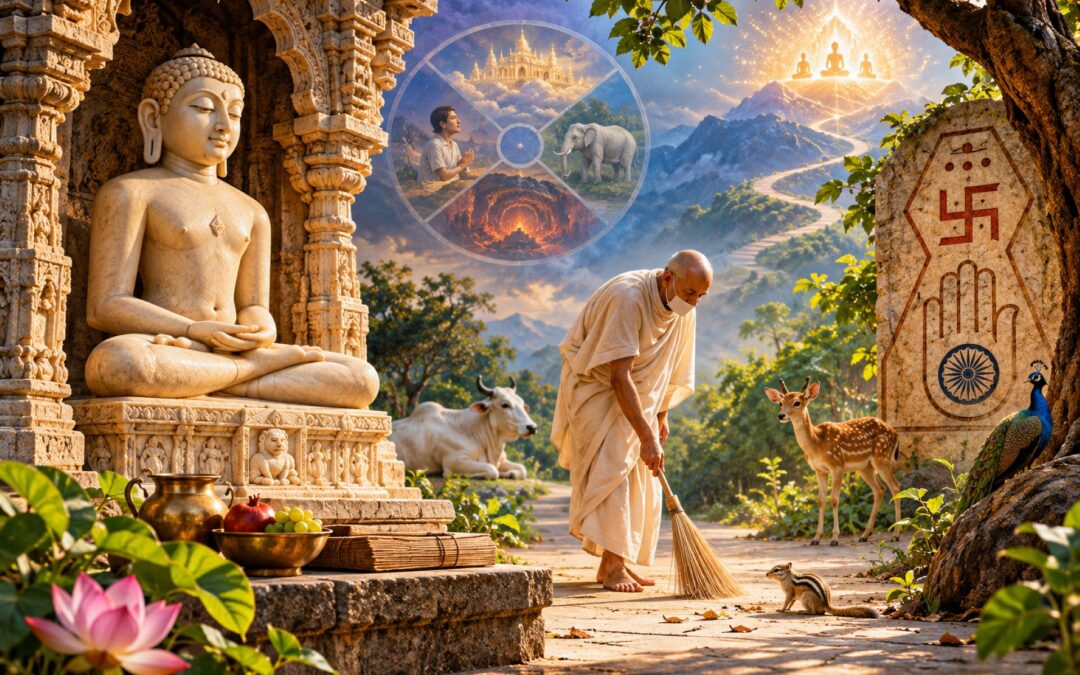
A modern Jain emblem brings many of these ideas into one image. Adopted as a widely recognized communal symbol during commemorations of Mahavira’s 2,500th nirvana anniversary in 1974–75, its outline recalls the traditional shape of the inhabited cosmos. The hand at its centre conveys restraint and nonviolence; its palm commonly bears the word ahimsa, sometimes accompanied by a wheel. Three dots represent the Three Jewels, and the crescent with a dot above signifies the realm and state of liberated souls.
The swastika in the emblem has an ancient Indian religious history, long predating its appropriation by the Nazis. In the Jain context, its four arms represent the four states of embodied rebirth: human, nonhuman, heavenly, and infernal. Its meaning is therefore tied to samsara, not to racial ideology. The inscription parasparopagraho jivanam, commonly rendered as “all life is bound together by mutual support and interdependence,” expresses a complementary vision of the relationship among living beings. The elements are explained in the Harvard Pluralism Project’s account of the Jain symbol.
Jain ideas have influenced ethical discussion far beyond the numerical size of the community. They also appear in distinctive visual and literary traditions, from representations of the Tirthankaras in temples to diagrams intended to teach the structure of the cosmos. Art in this setting is not merely decorative: an image of a motionless liberated teacher or a chart showing successive destinations of rebirth can invite reflection on an otherwise difficult philosophy.
Jain commitments to vegetarianism and animal protection have helped sustain institutions such as shelters for injured or abandoned creatures, while the principle of non-possession has encouraged charitable giving and reflection on wealth. Jain patrons and scholars also contributed to India’s intellectual, artistic, and mercantile history. These influences unfolded through interactions with many other religious and social traditions rather than in isolation.
Mahatma Gandhi’s commitment to nonviolence is a familiar point of connection, but it would be misleading to say that Jainism simply invented Gandhian politics. Gandhi drew from Hindu texts, Christianity, Tolstoy, Ruskin, personal experiments, and encounters with multiple teachers. Among the formative figures was the Gujarati thinker and spiritual guide Shrimad Rajchandra, also known as Raychand, who had close connections with Jain thought. A scholarly discussion of Gandhi’s spiritual formation and his experiments with disciplined nonviolence helps locate Jain influence within this wider intellectual life.
The contemporary appeal of Jain ethics also reaches questions about animal welfare, consumption, and environmental responsibility. Ahimsa asks whether apparently insignificant lives should count in our decisions, while aparigraha asks whether endlessly acquiring more can ever satisfy us. Anekantavada adds a reminder that other perspectives may expose limits in our understanding. These are meaningful points of dialogue with modern concerns, although ancient Jain cosmology and contemporary ecology offer different kinds of explanations and should not be treated as interchangeable scientific theories.
A tension remains at the heart of the tradition: any embodied life entails some harm, yet Jain ethics sets the reduction of harm at the centre of spiritual progress. It answers the impossibility of perfect harmlessness not by dismissing the ideal, but by distinguishing levels of discipline and encouraging increasingly careful conduct. This is why a layperson giving food to a mendicant, a monk inspecting a path, and a philosopher qualifying an argument can all be understood as participating in the same religious project.
For Jainism, the world is neither a storehouse created solely for human consumption nor a problem that can be solved simply by behaving politely. It is a community of living beings whose actions have consequences, and a setting in which the soul may learn to loosen the attachments binding it to repeated lives. The broom, the vow, the carefully chosen meal, and the willingness to listen to another viewpoint are all expressions of that deeper vision. Liberation may be extraordinarily difficult, but the path toward it begins with an equally demanding thought: other lives matter, and our freedom depends on how carefully we live among them.
Last Updated on November 7, 2026 by Aseem Gupta