
Reading Time: 18 Minutes
How can a religion speak of one ultimate reality and worship countless gods? Why do some Hindus seek liberation from worldly life while others regard family, wealth, and pleasure as legitimate goals? And how can traditions with different scriptures, rituals, and philosophical disagreements still belong to the same religion?
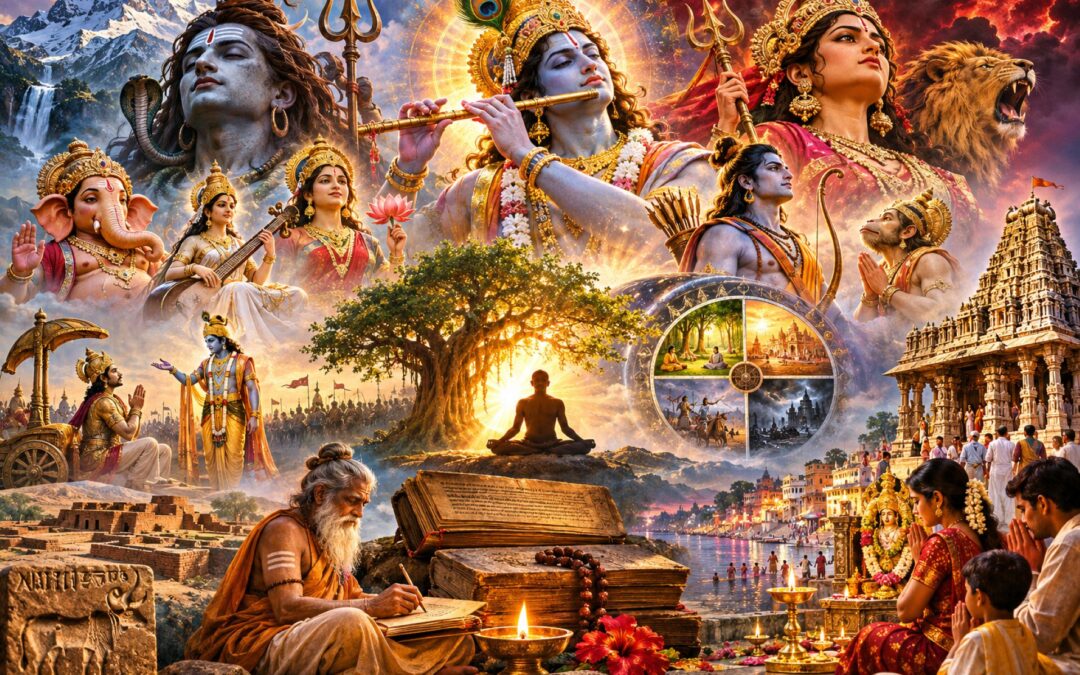
These questions point to what makes Hinduism both fascinating and difficult to summarize. It has no single founder, no central authority defining one compulsory creed, and no equivalent of a lone sacred book that settles every dispute. Yet ideas such as dharma, karma, rebirth, and liberation have connected communities across centuries, while stories of Krishna, Shiva, Devi, Rama, and Ganesha remain part of everyday religious life.
Hinduism is often called Sanatana Dharma, the eternal way or enduring order. Some describe it as a way of life, but it is also unmistakably a religion, with worship, ritual, scripture, and festivals. Understanding it requires exploring relationships between ideas, stories, and practices—and the differences within them.
Where Did Hinduism Come From?
Hinduism emerged in the Indian subcontinent over a very long period. Calling it one of the oldest living religious traditions is reasonable; assigning it a precise birthday is not. Its practices developed through encounters among communities, ritual traditions, local deities, philosophical schools, and devotional movements rather than through one founding revelation.
Even the name tells part of this story. The Sanskrit word Sindhu designated the Indus River, and Old Persian forms rendered the initial sound as h, producing Hindu. Related geographical labels later passed through Greek usage and contributed to the name India. Originally, such terms identified a region and its inhabitants more readily than one religious identity; the modern umbrella category developed much later. Hindu worshippers across history might identify themselves more specifically by their deity, sect, teacher, locality, or lineage.
The Harappan civilization, famous for cities such as Mohenjo-daro, preceded the oldest surviving Vedic hymns. Some archaeological objects resemble later Hindu symbols. But the Harappan script remains undeciphered, and no one can confidently reconstruct its theology. As Oxford’s archaeological overview of Hinduism explains, proposed direct connections are intriguing but often tenuous. It is misleading to describe Hinduism as the simple merger of a fully known Harappan religion with another fully formed faith.
During the second millennium BCE, communities speaking Indo-Aryan languages entered northwestern South Asia and interacted with established populations. Religious poetry preserved in Vedic Sanskrit celebrated figures such as Agni, the fire deity, Indra, associated with storms and martial power, and Varuna, linked with cosmic order. Sacrifices, recitation, and obligations between humans and divine powers became important features of Vedic religious life. This was not identical to every form of Hindu worship recognizable today.
Over subsequent centuries, agricultural expansion, new kingdoms, ascetic movements, philosophical debates, regional cults, and devotion to major deities reshaped the religious landscape. The Upanishads explored ultimate reality and the self; epics and Puranas carried stories into wider communities; temples and devotional traditions developed varied forms. The broader history of India places these transformations alongside political and social changes. Hinduism’s continuity lies in the transmission and reinterpretation of traditions, not in every believer having held the same beliefs since antiquity.
Brahman, Atman, Karma, Rebirth, and Moksha
Many Hindu traditions begin with questions that are as philosophical as they are religious: What is real? What remains when a body dies? Why do actions matter beyond their immediate consequences? What, if anything, could end suffering and repeated existence?
In influential Upanishadic and Vedanta traditions, Brahman names ultimate reality: the foundation of existence that cannot be reduced to one object among others. Brahman should not be confused with Brahma, the deity associated with creation. Some thinkers understand Brahman as beyond attributes and form; others describe ultimate reality personally, as the supreme God possessing infinite qualities. The answer depends on the philosophical school.
Atman is often translated as self, but that does not mean ordinary personality, personal preferences, or ego. An influential way to imagine its relationship with Brahman is to picture the ocean and its drops. A drop appears separate while it travels, but its nature is never independent of the water from which it comes. In Advaita Vedanta, the deepest self and Brahman are ultimately not two separate realities; ignorance makes them appear divided.
That metaphor is illuminating, but it does not express every Hindu philosophy. Vishishtadvaita teaches a qualified unity in which individual selves remain meaningfully distinct while inseparable from the supreme reality. Dvaita insists on a real distinction between individual souls and God. Other traditions investigate consciousness, matter, liberation, or divine grace in different ways. The assumption that every Hindu simply wants an individual soul to dissolve into an impersonal ocean erases these differences.
Karma, literally associated with action, describes moral consequences that can shape future experience, including across lifetimes. Karma is not merely a scoreboard where an invisible judge awards points for every good deed and punishment for every bad one. Its interpretation varies, and it should not be used to conclude that somebody experiencing poverty, illness, or oppression somehow deserves it.
Samsara refers to the recurring cycle of birth, death, and rebirth. The circumstances of rebirth are commonly connected to karma, but the details differ by philosophical and devotional tradition. Rebirth also means that a single human lifetime need not be the whole horizon of moral responsibility or spiritual growth. What appears temporary from one life’s perspective becomes part of a larger account of existence.
Moksha is liberation from this cycle and from the ignorance or bondage that sustains it. Its paths include insight, devotion, divine grace, and disciplined practice. The famous Upanishadic prayer asking to be led from the unreal to the real captures a recurring aspiration: not simply to have a better next life, but to understand and overcome what keeps one bound. The Hindu American Foundation’s introduction to Hindu philosophy offers a useful overview of these shared concepts and the disagreements surrounding them.
Dharma and the Four Goals of Human Life
If karma asks what follows from an action, dharma asks what makes an action right or appropriate in the first place. It can mean duty, ethical conduct, justice, law, social responsibility, or the order that sustains the world. None of these English translations captures the entire idea. Dharma often concerns the relationship between a person’s situation, their obligations to others, and the consequences of what they choose.
Traditional examples make the idea concrete. A king must protect the people rather than merely enjoy royal privilege. A parent has responsibilities toward a child; a student toward learning; a teacher toward those being taught. Religious stories sometimes speak of animals and natural beings following their own characteristic nature, such as a lion hunting for food. These examples express the sense that the world contains different roles, not that every existing social hierarchy is automatically just.
Dharma can also be difficult because obligations collide. The Bhagavad Gita begins with the warrior Arjuna looking across a battlefield and recognizing teachers, relatives, and friends among those he may have to kill. Refusing battle seems compassionate; fighting may also seem necessary to resist wrongdoing and fulfill his responsibilities. Krishna’s response is not a simple command to enjoy violence. The dialogue explores action, attachment, knowledge, devotion, and the painful demands of moral responsibility.
Hindu thought also recognizes four broad goals of human life, called purusharthas. Dharma is righteous conduct; artha includes livelihood, material prosperity, and the resources necessary for life; kama encompasses pleasure, affection, beauty, love, and enjoyment; and moksha concerns spiritual liberation. The point is not that wealth and pleasure are inherently corrupt, but that they need to be pursued in ways consistent with ethical responsibilities. As the Metropolitan Museum’s account of Hinduism and Hindu art notes, even temple imagery can reflect these different goals.
Alongside these legitimate aims, some teachings identify six inner enemies or shadripu. They are kama as uncontrolled craving or lust, krodha as anger, lobha as greed, moha as deluded attachment, mada as arrogance or intoxication with power, and matsarya as envy. The repetition of kama is instructive: pleasure as a human aim is not identical to desire that controls judgment and harms others. Spiritual discipline involves understanding the difference rather than declaring every ordinary enjoyment wrong.
The Vedas, Upanishads, Bhagavad Gita, and Hindu Epics
Hinduism has an enormous religious literature, but these works do not all occupy the same place in every tradition. A common distinction is between shruti, meaning what has been heard or revealed, and smriti, what is remembered or transmitted through tradition. The Vedas, including the principal Upanishads, belong to shruti; many epics, Puranas, and instructional texts belong to smriti. In practice, a beloved devotional story may shape a worshipper’s life more directly than a Vedic passage they have never personally read.
The four Vedas have distinctive characteristics. The Rigveda preserves hymns praising deities and exploring reality, sacrifice, prosperity, conflict, and the cosmos. Its creation hymns do not always offer confident answers. These poems also reveal something of their composers’ ritual world, though they are not chronicles.
The Yajurveda is closely associated with the words and formulas used in sacrificial rituals, coordinating spoken recitation with ceremonial action. The Samaveda draws heavily on Rigvedic verses but arranges material for melodic chanting, making sound and performance especially central. It would be a mistake to imagine it as simply a modern songbook, yet musical recitation distinguishes its ritual function.
The Atharvaveda may surprise readers expecting only lofty philosophy. It includes hymns and formulas concerned with illness, protection, domestic life, prosperity, enemies, healing, and danger, along with more speculative and religious material. Charms for attracting affection or warding off misfortune coexist with prayers and reflections on existence. The assortment offers a revealing glimpse of the practical fears and hopes of ancient communities; it should not be treated as an instruction manual recommending harmful spells today.
The Brahmanas elaborate ritual meaning and procedure; the Aranyakas reflect on ritual symbolism. The early Upanishads began developing within this wider textual world during the first millennium BCE, though different Upanishads belong to very different periods. They asked whether a person is merely a body, a stream of thoughts, or something more fundamental. Their teachers and students debate knowledge, death, consciousness, and the relationship between atman and Brahman, often through conversations and memorable analogies rather than commandments.
The Puranas form another vast literary world. Eighteen are commonly recognized as major Puranas, though their texts have changed over time and numerous other Puranas exist. They preserve genealogies, cosmological stories, sacred geography, divine adventures, religious instruction, and accounts of rituals. Their religious importance lies partly in making theological ideas vivid through narrative: a god rescues the world, a goddess defeats a demon, or a devotee discovers that loyalty matters more than outward status.
The Bhagavad Gita appears within the Mahabharata but has also become an immensely influential text in its own right. Arjuna’s hesitation before the Kurukshetra war gives Krishna the occasion to explain disciplined action, insight into the self, devotion, and acting without obsession over the rewards. The conversation does not eliminate the ethical tension of war. Rather, it places difficult worldly choices inside a broader spiritual framework.
The Ramayana follows Rama, whose anticipated coronation becomes a fourteen-year exile. Sita accompanies him, Ravana abducts her, and Rama joins forces with Hanuman and the vanaras to reach Lanka and defeat her captor. Its best-known adventures are inseparable from questions about loyalty, kingship, family duty, and the suffering those obligations can produce. The complete treatment of Valmiki’s Ramayana explores the epic beyond its familiar rescue story, including its troubling later episodes.
The Mahabharata, one of the world’s longest epic poems, recounts a devastating struggle between the Pandavas and Kauravas. Its world contains betrayal, gambling, exile, vows, divine weapons, friendship, love, grief, and an immense war whose survivors must live with its consequences. The full Mahabharata analysis shows why its central theme is not simply that good defeats evil: even those pursuing a just cause repeatedly face morally compromised choices. Together, the two epics have kept arguments about dharma alive across generations and innumerable retellings.
The Hindu Gods and the Stories Behind Them
For someone encountering Hindu temples, the number of gods can be bewildering. But a shrine with many deities need not express belief in unrelated competing gods. Some Hindus understand different divine forms as expressions of one ultimate reality, while others worship a supreme personal God alongside other divine beings. Still others belong to goddess-centred traditions or philosophical systems that resist either description.
A useful starting distinction is between Brahman and Brahma. Brahman is ultimate reality in important philosophical traditions; Brahma is a personal deity associated with creating the cosmos. Brahma is often portrayed with four faces looking in different directions, evoking comprehensive vision and the four Vedas, and sometimes carrying a book or manuscripts representing sacred knowledge. His mount is usually a hamsa, conventionally depicted as a swan or goose, while Saraswati, associated with learning, music, and speech, is frequently named as his consort.
Brahma, Vishnu, and Shiva are sometimes grouped as the Trimurti: creation, preservation, and dissolution. It is not a framework followed by every Hindu tradition. A devotee of Vishnu may regard Vishnu as the source of all creation, not merely the middle manager responsible for maintenance. The same is true, in different theological language, of worshippers who consider Shiva or the Goddess supreme.
Vishnu is often represented as the sustaining protector of cosmic order. His chakra, a discus weapon, can signify the power to defeat forces threatening dharma; his shankha, or conch, is sounded in auspicious and martial settings. He commonly carries a mace and lotus as well and is pictured with Garuda, a mighty eagle-like being, as his vehicle. Lakshmi, goddess of fortune and prosperity, is closely associated with him, while Bhudevi represents the Earth in several Vaishnava traditions.
One reason Vishnu occupies such an important place in popular storytelling is the idea of the avatar, literally a descent. When the balance of the world is endangered, Vishnu may manifest in a form suited to restoring order. Rama and Krishna are among his most widely revered avatars, though traditions differ about the number and status of divine manifestations. Krishna may be a child whose mischief delights devotees, a beloved cowherd playing his flute, a kingly strategist, or the teacher who reveals profound truths to Arjuna.
The story of Varaha makes the idea of divine intervention unforgettable. In a familiar version, the Earth has been submerged beneath cosmic waters by a destructive being. Vishnu takes the form of a powerful boar, descends into the depths, raises the Earth on his tusks, and restores it to its rightful place. The boar form shows that divine protection need not be human.
Shiva combines qualities that can look contradictory until they are considered together. He is an ascetic absorbed in meditation and a householder associated with Parvati and their children. He is linked with destruction, but that destruction can clear the way for renewal. His trident, matted hair, crescent moon, serpent, and bull Nandi make him identifiable in sculpture, while the third eye on his forehead represents extraordinary insight and, in many stories, devastating power when opened.
As Nataraja, Shiva dances within a ring of flame, expressing cosmic movement, the passing of forms, and the possibility of liberation. His role extends beyond simply ending the universe. Shiva’s dance unites energies of creation and dissolution, while his lifted foot and gestures promise release from ignorance. The Metropolitan Museum’s guide to recognizing Hindu deities explains how these attributes and gestures communicate stories without written labels.
Parvati is not merely a supporting character in Shiva’s household. She is worshipped in different forms and traditions as a powerful goddess, while Sati appears in important narratives about Shiva’s earlier consort and the goddess’s rebirth. Their sons are also widely revered: Kartikeya, known in southern India especially as Murugan, is associated with warfare, victory, and youthful divine power; Ganesha is the elephant-headed deity invoked before new ventures and important ceremonies.
Ganesha’s unusual appearance has several traditional explanations. In one familiar story, Parvati creates a child and asks him to guard her privacy. Shiva, arriving without recognizing the child, is refused entry and cuts off his head in the ensuing confrontation. When the truth emerges, Shiva restores the child to life with an elephant’s head. The story moves from an apparent family disaster to reconciliation, and Ganesha becomes beloved as a remover of obstacles and lord of beginnings; versions differ in their details.
Goddesses cannot be defined only through male gods. Shakti describes divine power, and in Shakta traditions Devi may be the supreme reality itself. As Durga, she fights Mahishasura, the buffalo demon whom other gods cannot defeat; as Kali, she displays fierce forms of transformative power. Lakshmi, Saraswati, Parvati, Durga, and Kali are distinct yet interconnected in varying traditions, which allows the divine feminine to be nurturing, intellectual, prosperous, protective, terrifying, and ultimate without fitting one narrow role.
Deities have recognizable vahanas, or vehicles, as well as symbolic objects: Nandi accompanies Shiva, Garuda carries Vishnu, a mouse accompanies Ganesha, and the peacock is linked with Murugan. Such details give devotional art its own language. Each image teaches a story or principle rather than depicting a place on an official divine chart.
How Hindus Worship and Why Traditions Differ
Hindu religious life is not conducted solely through philosophical debate or the reading of ancient Sanskrit texts. A family may light a lamp before a home shrine, offer flowers or food to a deity, recite a prayer, celebrate a festival, or travel to a temple. These acts establish a relationship with the divine through attention, memory, gratitude, and devotion, even when the worshipper has never studied a systematic philosophical school.
Puja is a broad term for worship, often involving offerings, prayers, incense, lamps, or gestures of reverence. At temples, devotees may seek darshan, the auspicious encounter of seeing and being seen by the deity through a consecrated image. Ritual objects are not necessarily treated as independent gods made of stone or metal; for many worshippers, they are sites of divine presence and opportunities for relationship. Pilgrimage to sacred rivers, cities, mountains, and temples gives religious geography a similarly personal meaning.
Different communities organize this relationship differently. Vaishnavas focus devotion upon Vishnu and his forms, especially Krishna and Rama. Shaivas centre Shiva, sometimes understanding him as supreme and sometimes following distinctive ritual or philosophical schools. Shaktas worship Devi or Shakti as ultimate, and goddess worship can place divine feminine power at the centre of the cosmos rather than at its margins.
Smarta traditions are often associated with an inclusive mode of worship in which several major deities may be honoured, commonly through panchayatana practice. The set often includes Shiva, Vishnu, Devi, Surya, and Ganesha, though family traditions and local preferences differ. It is inaccurate to say Smartas follow the Puranas instead of the Vedas. Their traditions often place considerable value on Vedic authority and Advaita Vedanta alongside later worship and devotional texts.
Spiritual paths differ too. Bhakti emphasizes devotion; jnana, knowledge; karma yoga, disciplined action; and raja yoga, meditation. These are useful descriptions, not isolated highways on which every Hindu must choose exactly one lane. A person may worship Krishna, meditate, perform family obligations, study a text, and participate in public festivals within the same lifetime.
Philosophical schools also disagree with one another more deeply than differences in preferred gods suggest. Nyaya develops reasoning and debate; Samkhya examines consciousness and material nature; Yoga emphasizes disciplined practice; and Vedanta contains different interpretations of the Upanishads. The emergence of Buddhism in the wider intellectual world of ancient India shows how questions about suffering, selfhood, and liberation inspired arguments that sometimes crossed, and sometimes challenged, Vedic boundaries. Hinduism’s diversity is therefore not an absence of serious ideas but the consequence of multiple sustained traditions of thinking and worship.
Hindu Cosmology and the Four Yugas
Many Hindu cosmological traditions describe time as recurring cycles rather than one unrepeatable march from creation toward an absolute final ending. The world emerges, changes, declines, dissolves, and is renewed on scales that dwarf ordinary human history. These are religious and mythological frameworks, not measurements established by modern astronomy or geological science.
One influential scheme names four ages, or yugas: Satya or Krita Yuga, Treta Yuga, Dvapara Yuga, and Kali Yuga. In the classical calculation, their durations descend in a ratio of four to three to two to one, together forming a mahayuga of 4.32 million human years. Satya Yuga represents the fullest expression of dharma, while later ages progressively lose moral and spiritual stability. Traditional accounts commonly place the present world in Kali Yuga, marked by discord and diminished righteousness.
Mahayugas form larger cycles associated with the days and nights of Brahma. The end of Kali Yuga need not mean that all reality is instantly annihilated; in many accounts it leads to renewal and another sequence of ages, while larger dissolutions belong to larger cycles. Equally, Hindu communities differ over whether to read these enormous numbers literally, symbolically, or within particular devotional interpretations.
The underlying idea connects cosmology with ethics. A decline in dharma affects the world, and divine intervention—such as an avatar’s arrival—may restore a damaged order. The yugas thus provide both a cosmic story and a way for religious thinkers to reflect on the condition of human society.
Hinduism and the Caste System
No explanation of Hinduism is complete without addressing caste, but the subject is often distorted by two opposite simplifications. One says caste is the single essence of Hinduism and has never changed. The other insists caste originally meant nothing more than freely chosen jobs and only became hereditary because of one later book. Neither describes the complicated relationship among sacred texts, social institutions, political power, and lived Indian history.
The most famous textual framework is varna, a fourfold classification of society. Brahmins are associated with priesthood, teaching, and ritual learning; Kshatriyas with rulership and warfare; Vaishyas with agriculture, herding, and commerce; and Shudras with labour and service. In a celebrated hymn of the Rigveda, a cosmic being called Purusha is sacrificed, and these groups emerge symbolically from his mouth, arms, thighs, and feet. The image presents a religious model of an ordered society, not a census of every community that existed when the hymn was composed.
The Bhagavad Gita also refers to a fourfold social order connected with qualities and actions. Some modern readings emphasize the language of personal capacities to argue for a nonhereditary understanding of varna. Yet other influential Sanskrit texts explicitly describe inherited rank, restrictions, and unequal privileges, while the actual historical relationship between vocation, lineage, and status varied. There is no reliable evidence for a single long period in which everyone could freely switch caste until one ruler or author suddenly forbade it.
Everyday caste relations have historically involved jati, referring to communities often associated with birth, marriage networks, local ranking, shared customs, and sometimes occupations. There are thousands of jatis, and their boundaries have not always aligned neatly with the four varnas. A trader’s local community, a farming group, or an artisan caste could occupy different social positions in different regions. The Encyclopedia of Religion’s discussion of varna and jati is useful precisely because it separates a textual ideal from the much more complicated social structure.
The Manusmriti, also known as the Manava Dharmashastra or Laws of Manu, is an important prescriptive text within a broader genre of literature about dharma. It discusses conduct, authority, marriage, inheritance, ritual status, and social roles, often privileging Brahmins and endorsing restrictions tied to birth and gender. It was not the first text to classify society and did not operate as a uniformly enforced statute book for everyone in India. Scholarly dating generally places its composition around the early centuries CE, rather than confidently in the fifth century BCE; Oxford’s history of Dharmashastra literature places it within an evolving tradition of legal and religious prescription.
The inequalities were not merely theoretical. Ideas of ritual purity and pollution helped justify distinctions over food, water, physical contact, religious access, occupations, residence, and marriage. Communities associated with activities such as leatherworking, removing waste, handling the dead, or other stigmatized labour were often subjected to exclusion. People condemned as “untouchable” could be denied entry to temples or common facilities and exposed to humiliation and violence. The contemporary term Dalit, used by many who have experienced caste oppression, expresses a political and social identity shaped partly by resistance to that history.
Caste developed differently across regions as rulers, landholders, religious movements, and occupational changes affected hierarchies. Bhakti saints and reformers sometimes challenged inherited privilege or emphasized devotion across social boundaries, though such teachings did not automatically abolish caste discrimination. British colonial censuses and administrative practices further categorized and sometimes hardened identities that had previously operated through more varied local arrangements.
India’s Constitution prohibits caste discrimination and Article 17 abolishes untouchability. Laws and affirmative-action policies seek to address historical disadvantage, while Dalit movements, reformers, scholars, and activists have demanded greater equality. B. R. Ambedkar, himself born into a community subjected to untouchability, became an influential critic of caste oppression and a central figure in framing India’s Constitution. Legal equality, however, does not by itself dissolve inherited social boundaries.
Marriage illustrates that tension. People from different castes attend the same universities, work together, form friendships, and increasingly build lives outside traditional occupations, particularly in many urban settings. Yet marriage remains strongly shaped by family and caste preferences. A Pew Research Center survey of attitudes toward caste found that a majority of Indian respondents regarded preventing marriage outside their community’s caste as very important, with major differences among regions. Its findings describe reported social attitudes in the survey period, not a fixed rule about every Hindu or every Indian.
Caste is also found among communities of other Indian religions, sometimes despite doctrines rejecting hereditary spiritual rank. Nor should caste be treated as the only force shaping Hindu history: devotion, philosophical debate, family traditions, regional cultures, and religious reform have interacted with it in different and sometimes opposing ways.
A teaching that every being contains or reflects the divine can inspire equality, while inherited institutions may deny it in practice. Understanding Hinduism requires taking both the moral resources of its traditions and the harms justified through some of their interpretations seriously, without pretending that either side cancels the other.
Hinduism is held together neither by one unchanging doctrine nor by the absence of any shared foundations. Its traditions return repeatedly to questions of reality, responsibility, desire, suffering, devotion, and liberation, even when they reach different answers. A prayer before Ganesha, a discussion of the Upanishads, Krishna’s counsel to Arjuna, and a goddess festival may belong to very different kinds of religious experience, but each participates in a long conversation about human life and the divine.
That conversation has included philosophical invention, poetry, ritual, extraordinary stories, social hierarchy, challenges to hierarchy, and countless adaptations across places and generations. To understand Hinduism is therefore to recognize both continuity and disagreement: enduring ideas do not require identical interpretations, and a shared religious inheritance does not make every historical practice beyond criticism. Its complexity is not a problem to be edited away. It is part of what the tradition actually is.
Last Updated on November 7, 2026 by Aseem Gupta