
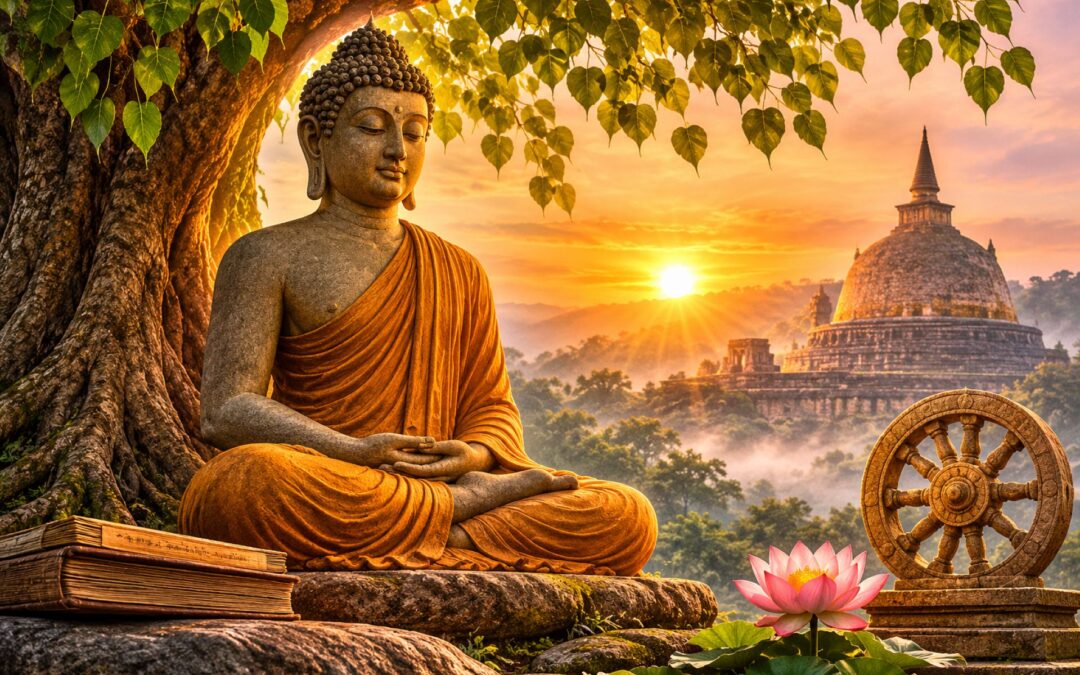
More than 2,500 years ago, a religious movement emerged in northern India around a question that remains familiar to almost everyone: why do human beings suffer, even when they seem to have everything they want? Its teachings would eventually spread across Asia, inspire extraordinary philosophical traditions, and become the foundation of one of the world’s major religions. That movement was Buddhism.
At its centre is Siddhartha Gautama, remembered as the Buddha, or the Awakened One. According to Buddhist tradition, he abandoned a privileged life to understand why human existence is marked by ageing, illness, loss, and death. His search led him to develop teachings that connected suffering to craving and ignorance, and liberation to wisdom, ethical conduct, and disciplined awareness.
Buddhism is more than a philosophy of personal happiness or a collection of meditation techniques. It is a diverse religious tradition concerned with the nature of existence, moral responsibility, rebirth, and the possibility of liberation. Understanding it requires exploring both the Buddha’s life and the teachings that generations of Buddhists preserved, interpreted, and developed.
The World in Which Buddhism Began
Buddhism emerged in northern India during the first millennium BCE, generally associated with the fifth century BCE. The precise dates of the historical Buddha remain disputed, partly because the earliest Buddhist teachings were transmitted orally for generations before being written down.
The society into which Buddhism emerged was undergoing significant changes. Agricultural expansion and growing settlements supported the development of kingdoms, commercial networks, and urban communities across the Gangetic Plain. Political authority was divided among monarchies, aristocratic republics, and competing regional powers.
This was also a period of intense religious and philosophical experimentation. Vedic traditions emphasized ritual, sacrifice, and inherited forms of religious authority, while various renunciant movements questioned conventional social obligations and explored alternative paths to spiritual liberation. Teachers debated the nature of consciousness, the consequences of human actions, the possibility of rebirth, and whether suffering could be overcome.
These debates formed part of the religious and intellectual world of ancient India, where Buddhism and Jainism developed alongside other philosophical and ascetic traditions. Both Buddhism and Jainism questioned whether liberation depended on ritual status or hereditary privilege, although they developed different understandings of the self, karma, and the discipline required for liberation.
Siddhartha Gautama belonged to this environment. Buddhist tradition associates him with the Shakya community near the Himalayan foothills, in a region extending across parts of present-day Nepal and northern India. While historical scholarship generally accepts that a religious teacher remembered as the Buddha lived and taught in this broad setting, much of his detailed biography comes from religious narratives developed and preserved over time.
That distinction matters because the Buddha’s traditional life story serves two purposes. It describes the origins of Buddhism while also illustrating the spiritual problems his teachings were intended to address.
The Life of Siddhartha Gautama: From Privilege to Awakening
According to Buddhist tradition, Siddhartha Gautama was born in Lumbini, in present-day Nepal. His father was Suddhodana, a prominent leader of the Shakya community, and his mother was Maya. Later religious biographies frequently portray his father as a king and Siddhartha as a prince, although the political organization of the Shakyas was probably more complicated than the image of a conventional hereditary monarchy suggests.
The miraculous circumstances surrounding his birth became an important part of Buddhist sacred biography. Some accounts describe Maya giving birth painlessly from her right side, while others emphasize supernatural signs announcing the arrival of an extraordinary child. These stories express the Buddha’s religious significance rather than providing details that historians can independently establish.
Another famous episode concerns Asita, an elderly ascetic who supposedly examined the infant Siddhartha. According to the prophecy, the child would become either a powerful universal ruler or a great spiritual teacher. Suddhodana, determined that his son should inherit worldly authority, supposedly tried to prevent him from encountering anything that might inspire religious renunciation.
The resulting story presents Siddhartha growing up surrounded by comfort, luxury, and carefully controlled surroundings. His father allegedly protected him from signs of sickness, ageing, death, and deprivation. The sheltered palace becomes a symbol of an important human illusion: the belief that comfort and prosperity can permanently separate us from life’s unavoidable difficulties.
Traditional biographies also describe Siddhartha marrying Yashodhara and becoming the father of a son named Rahula. Some versions place his marriage around the age of sixteen, while others emphasize the emotional attachment that made renunciation difficult. Although the precise details cannot be independently verified, the presence of a wife and child makes the story more complicated than a simple rejection of wealth.
The decisive transformation comes through the Four Sights.
According to the familiar account, Siddhartha eventually persuaded his father to let him travel beyond the palace. During these journeys, accompanied by his charioteer, traditionally named Channa or Chandaka, he encountered four experiences that overturned his understanding of life.
First, he saw an elderly man and realized that ageing was unavoidable. Then he encountered someone suffering from illness and understood that the human body was vulnerable to disease. His third encounter was with a corpse, confronting him with the certainty of death.
The fourth sight was different. Siddhartha encountered a wandering ascetic who had renounced conventional possessions and social ambitions in pursuit of spiritual understanding. Here was someone who acknowledged life’s suffering but believed that a disciplined search might lead beyond it.
These four encounters became foundational elements of Buddhist biography. Their historical details are uncertain, but their philosophical meaning is clear: wealth, youth, physical health, and family attachments cannot guarantee lasting security because everything we depend upon is subject to change.
Tradition generally places Siddhartha’s departure from home at the age of twenty-nine. Leaving his privileged surroundings and family behind, he became a wandering seeker determined to understand suffering and discover whether liberation was possible.
His decision raises an uncomfortable question that the traditional story does not entirely resolve. Siddhartha’s spiritual search involved leaving behind people who depended upon him, including Yashodhara and Rahula. Buddhist accounts usually interpret this departure as a sacrifice made for a larger spiritual purpose, but the episode also reveals the tension between family obligations and religious renunciation.
Siddhartha initially studied under established meditation teachers, learning contemplative disciplines intended to transform consciousness. Although he developed considerable meditative skill, he reportedly concluded that these practices had not resolved the fundamental problem of suffering and rebirth.
He then turned toward extreme asceticism.
For several years, traditionally described as six, Siddhartha practised severe physical deprivation alongside other ascetics. He restricted his food, subjected his body to hardship, and attempted to overcome attachment through increasingly demanding forms of self-denial.
His reasoning reflected a wider ascetic belief that bodily desires and comforts could obstruct spiritual liberation. Yet the experience eventually convinced him that weakening the body did not automatically produce wisdom. Starvation and exhaustion could make sustained awareness more difficult rather than bring the mind closer to enlightenment.
According to tradition, Siddhartha abandoned his extreme fasting and accepted nourishment, often described as milk-rice offered by a woman. His five ascetic companions interpreted this decision as a surrender of spiritual discipline and departed in disappointment.
For Siddhartha, however, it represented a decisive insight.
The path toward liberation did not require either the pursuit of pleasure or the deliberate destruction of bodily well-being. Both indulgence and self-mortification could become forms of attachment. He began to develop what Buddhism would call the Middle Way.
Siddhartha subsequently meditated beneath a fig tree at Bodh Gaya, determined to remain until he attained awakening. Traditional accounts describe an extended period of meditation, often given as forty-nine days, during which he confronted temptation, fear, and the forces that sustain ignorance. Some narratives personify these obstacles through Mara, a figure representing the powers that obstruct enlightenment.
At the age of approximately thirty-five, according to the conventional chronology, Siddhartha attained enlightenment and became the Buddha.
The tree became known as the Bodhi Tree, and Bodh Gaya remains among Buddhism’s most important pilgrimage destinations. The religious complex surrounding the Mahabodhi Temple commemorates the place traditionally associated with the Buddha’s awakening.
Enlightenment did not mark the end of his story. After initially considering whether his realization could be communicated to others, the Buddha decided to teach.
He travelled to the Deer Park at Sarnath, near present-day Varanasi, where he encountered the five ascetics who had previously abandoned him. There, according to Buddhist tradition, he delivered his first teaching, explaining the Middle Way and the Four Noble Truths.
The five ascetics became his first disciples, forming the beginning of the Sangha, the Buddhist monastic community. The Sangha would become one of the principal institutions through which Buddhist teachings were preserved and transmitted.
For approximately forty-five years, according to traditional chronology, the Buddha travelled through northern India teaching monks, householders, rulers, merchants, and other listeners. His teachings attracted followers from different social backgrounds, and Buddhist traditions also record the establishment of a community of ordained women, although women’s admission and status were accompanied by institutional restrictions and remain subjects of historical and religious discussion.
The Buddha is traditionally said to have died around the age of eighty near Kushinagar. Buddhist traditions describe his death as parinirvana, the final passing away of an awakened person who is no longer subject to rebirth.
His body was cremated, and his relics became objects of veneration. Stupas, monuments associated with sacred relics and Buddhist remembrance, eventually became important centres of pilgrimage and religious activity.
The historical details of this biography cannot all be verified, as scholarship on the historical Buddha makes clear. Nevertheless, the narrative captures the central movement of his teaching: the discovery that ordinary forms of security are impermanent, followed by a disciplined search for a more fundamental kind of freedom.
The Four Noble Truths: Buddhism’s Answer to Suffering
The Four Noble Truths form one of the most recognizable foundations of Buddhist teaching. They organize the Buddha’s understanding of the human condition around four connected questions: what is suffering, why does it arise, can it end, and what leads to its ending?
The first truth concerns dukkha, a Pali term commonly translated as suffering. However, the English word does not capture its full meaning. Dukkha also includes dissatisfaction, unease, frustration, and the inability of ordinary experiences to provide permanent fulfillment.
Buddhism does not teach that every moment of life is miserable or that happiness is an illusion. Pleasure, affection, achievement, and joy are genuine experiences. The difficulty is that they are conditional and impermanent, making them unreliable foundations for lasting security.
Ageing, illness, and death illustrate the obvious forms of suffering. Separation from loved ones, failure to obtain what we desire, and the loss of circumstances we depend upon reveal other dimensions. Even enjoyable experiences become sources of anxiety when we desperately want them to continue.
The second Noble Truth explains the origin of suffering through craving, often expressed by the term tanha. Human beings become attached to pleasurable experiences, desired identities, possessions, relationships, and expectations about how the world should behave. Because these conditions inevitably change, craving creates frustration and continued dissatisfaction.
This does not mean that Buddhism condemns every preference, ambition, or intention. Wanting to care for one’s family, develop a skill, or relieve another person’s suffering is not automatically the same as craving. The problem arises when desire becomes compulsive attachment, especially when our sense of happiness depends upon controlling things that cannot remain under our control.
Consider someone who achieves an important professional ambition. The accomplishment may bring genuine satisfaction, but that satisfaction can quickly give way to anxiety about maintaining status, obtaining a promotion, or avoiding failure. The external achievement has changed the person’s circumstances without necessarily eliminating the tendency to crave another achievement.
Buddhist teaching therefore asks us to examine not only what we want but also how we relate to wanting itself.
The third Noble Truth offers the possibility of liberation. If suffering is sustained by craving and the ignorance underlying it, then the cessation of craving and ignorance makes liberation possible. This cessation is associated with nirvana, the ultimate goal of Buddhist practice.
Nirvana should not be understood as the destruction of every feeling or the disappearance of all meaningful intentions. Rather, it concerns freedom from the compulsive craving, hatred, and delusion that sustain suffering. A liberated person can still act with compassion, understanding, and concern for others without being governed by possessive attachment.
The fourth Noble Truth explains the path leading to this liberation. It is the Noble Eightfold Path, an interconnected system of wisdom, ethical behaviour, and mental cultivation.
In the Dhammacakkappavattana Sutta, traditionally associated with the Buddha’s first teaching, the Middle Way and Four Noble Truths appear as parts of a coherent spiritual framework. The Buddha’s insight is not simply that suffering exists, but that it has causes that can be understood and addressed through disciplined practice.
The truths are therefore neither a pessimistic declaration nor a promise that difficult experiences will disappear. They describe a transformation in how human beings understand and respond to the changing conditions of existence.
The Noble Eightfold Path and the Middle Way
The Noble Eightfold Path explains how Buddhist practitioners cultivate the understanding and discipline associated with liberation. It develops the Middle Way that the Buddha discovered after rejecting both indulgence in pleasure and extreme physical deprivation.
Although the path contains eight elements, they are not eight consecutive tasks completed one after another. Each supports and influences the others. Ethical behaviour helps create conditions for meditation, meditation strengthens awareness, and deeper understanding influences how a person speaks, acts, and makes decisions.
Traditionally, the eight factors are grouped into three interconnected areas of training: wisdom, ethical conduct, and mental discipline. This grouping makes their relationship easier to understand without reducing the path to a checklist of personal-development habits.
Wisdom — Right View and Right Intention
The first element is Right View, also translated as Right Understanding.
Right View means developing an accurate understanding of reality, particularly the Four Noble Truths and the relationship between actions, intentions, and their consequences. It includes recognizing impermanence, understanding the nature of suffering, and seeing how craving and ignorance shape human experience.
At an introductory level, Right View means examining the assumptions through which we interpret the world. We often behave as though material possessions, physical health, relationships, and personal identities will remain stable indefinitely. Buddhist understanding challenges that expectation without denying that these things can have genuine value.
Right View is also connected to moral responsibility. Actions motivated by greed, hostility, and confusion have consequences, while actions rooted in understanding and compassion create different conditions for ourselves and others.
The second element is Right Intention, sometimes called Right Resolve.
Right Intention concerns the motivations that guide our actions. Buddhist teaching emphasizes intentions associated with renunciation, goodwill, and harmlessness rather than greed, ill will, and cruelty.
Someone might perform an apparently generous action because they genuinely care about another person’s welfare. Another person might perform the same action to manipulate someone, earn admiration, or establish a sense of superiority. The outward behaviour may look similar, but the intentions differ considerably.
Right Intention asks practitioners to examine these underlying motivations. It does not require eliminating ordinary goals or becoming indifferent to other people. Instead, it encourages actions that are less dominated by possessiveness, resentment, and the desire to cause harm.
Right View and Right Intention reinforce one another. Understanding how attachment generates suffering can change what we intend, while cultivating compassionate intentions can make it easier to examine our perceptions without defensiveness or hostility.
Ethical Conduct — Right Speech, Right Action, and Right Livelihood
The next three elements concern how Buddhist understanding becomes visible in relationships, behaviour, and economic activity.
The third element is Right Speech.
Right Speech emphasizes avoiding falsehood, malicious or divisive communication, harsh speech, and pointless or harmful chatter. Buddhist ethics encourages speaking truthfully, constructively, and with attention to the consequences of one’s words.
This is more demanding than simply avoiding lies. A technically truthful statement may still be deliberately cruel, unnecessarily divisive, or intended to humiliate someone. Conversely, compassionate speech should not become an excuse for deception or concealing important information.
Right Speech therefore involves both honesty and judgment. The practitioner considers whether a statement is truthful, useful, appropriately timed, and consistent with goodwill.
The fourth element is Right Action.
Right Action concerns conduct that avoids harming living beings and respects the well-being and legitimate interests of others. Its ethical foundations include refraining from killing, stealing, and sexual misconduct.
These commitments are closely related to the Five Precepts, a familiar foundation of Buddhist lay ethics. The precepts involve voluntarily undertaking training to refrain from killing living beings, taking what has not been given, sexual misconduct, false speech, and intoxicants that lead to heedlessness.
The Five Precepts are not exactly equivalent to commandments issued by a creator god. Buddhism generally understands them as ethical training commitments intended to reduce harm, develop restraint, and create conditions favourable to wisdom and liberation.
Their importance extends beyond the immediate consequences of individual actions. Repeatedly behaving with restraint, honesty, and compassion helps establish habits that influence how the mind responds to temptation, anger, and fear.
The fifth element is Right Livelihood.
Right Livelihood applies Buddhist ethical commitments to the way people earn their living. It asks practitioners to consider whether their occupations depend upon deception, exploitation, violence, or activities that cause serious harm.
Traditional Buddhist teachings identify certain trades as inappropriate for lay followers, including commerce in weapons, living beings, meat, intoxicants, and poisons. These examples reflect the wider principle that economic success does not automatically justify the harm caused in obtaining it.
The application of Right Livelihood can be complicated because occupations differ in their circumstances and consequences. Buddhist traditions have developed varying interpretations of particular kinds of work, but the underlying question remains consistent: can a person support themselves without deliberately cultivating or profiting from significant harm?
Together, Right Speech, Right Action, and Right Livelihood make ethical conduct indispensable to Buddhist practice. Meditation cannot be treated as a substitute for responsibility toward other people.
As explained in scholarly treatments of ethical discipline in Indian Buddhism, the Buddhist path connects moral cultivation with the broader objective of transforming the causes of suffering.
Mental Discipline — Right Effort, Right Mindfulness, and Right Concentration
The final three elements concern the cultivation of the mind.
The sixth element is Right Effort.
Right Effort involves deliberately working with mental habits and emotional states. Traditional explanations describe four related activities: preventing unwholesome states from arising, abandoning those that have arisen, cultivating wholesome states that are absent, and maintaining or strengthening wholesome states already present.
An unwholesome mental state might involve intense resentment, harmful greed, or a desire to injure someone. A wholesome state might involve generosity, compassion, clarity, or patient attention.
Right Effort does not mean forcing constant optimism or refusing to acknowledge uncomfortable emotions. It means learning to recognize mental tendencies and responding in ways that reduce harmful patterns while encouraging beneficial ones.
The seventh element is Right Mindfulness.
Mindfulness involves sustained, attentive awareness of experience, including the body, feelings, mental states, and patterns of thought. Rather than reacting automatically, practitioners learn to observe experiences as they arise and pass away.
Imagine feeling angry during a disagreement. Without awareness, anger may immediately shape speech and behaviour, producing accusations or insults. Mindfulness creates the possibility of recognizing anger as a changing mental state rather than treating it as an unquestionable command to act.
Modern discussions frequently describe mindfulness as living in the present moment. That description captures part of its function, but traditional Buddhist mindfulness involves more than present-moment awareness. It operates within a broader ethical and philosophical framework concerned with understanding experience and reducing attachment.
The eighth element is Right Concentration.
Right Concentration concerns the development of a stable, collected mind capable of sustained attention. In classical Buddhist contexts, it is particularly associated with meditative absorption and the disciplined cultivation of focused awareness.
Ordinary concentration can be directed toward almost anything, including harmful or selfish pursuits. Buddhist Right Concentration is different because it belongs within the Eightfold Path and is supported by ethical conduct, appropriate intention, and understanding.
Meditation practices can help reduce distraction and develop mental stability, but their purpose within traditional Buddhism is not limited to relaxation or improved productivity. Concentration supports insight by allowing practitioners to observe experience with greater steadiness and clarity.
The relationship among the eight factors is essential. Ethical conduct reduces the disturbance caused by harmful actions, mental discipline strengthens the capacity for awareness, and wisdom helps practitioners understand what their experiences reveal about suffering and attachment.
The Eightfold Path is therefore not simply a collection of eight good habits. It is a coordinated approach to transforming understanding, intention, conduct, and consciousness in pursuit of liberation.
Impermanence, Karma, Rebirth, and Nirvana
The Four Noble Truths and Eightfold Path become easier to understand when placed within Buddhism’s wider account of existence. Several interconnected ideas explain why ordinary experiences are unreliable foundations for permanent happiness and why liberation requires more than improved behaviour.
One is anicca, commonly translated as impermanence.
Buddhism teaches that conditioned things arise through causes and circumstances and are subject to change. Physical bodies age, relationships evolve, emotions fluctuate, and political or economic arrangements eventually transform. Even apparently stable aspects of personal identity depend upon changing processes.
Impermanence does not mean that nothing matters or that valuable experiences should be rejected. Rather, it challenges the expectation that temporary conditions can provide unconditional security.
Closely related is anatta, the doctrine of non-self.
Buddhist teaching questions the existence of a permanent, independent, unchanging essence that constitutes the individual. Instead, human experience is conventionally analyzed through five aggregates: physical form, feeling, perception, mental formations, and consciousness.
These aggregates are not fixed possessions controlled by an eternal inner observer. They are changing processes that arise through causes and conditions.
Non-self does not simply mean that people do not exist. Buddhism recognizes conventional individuals who experience suffering, make decisions, form relationships, and bear moral responsibility. Its argument concerns whether an enduring, independently existing self can be found beneath the changing processes of experience.
The philosophical implications are complex, and Buddhist traditions have interpreted them differently. Scholarly discussions of mind and personal identity in Indian Buddhist philosophy show why non-self is a substantive philosophical doctrine rather than a slogan about abandoning one’s ego.
Another foundational concept is karma.
In Buddhism, karma is fundamentally concerned with intentional action and its consequences. Actions shaped by greed, hatred, and ignorance contribute to different patterns of experience from actions rooted in generosity, compassion, and understanding.
Karma should not be reduced to the popular idea that good things immediately happen to good people and bad things immediately happen to bad people. Traditional Buddhist accounts involve complicated relationships between intentions, actions, consequences, and the conditions shaping future experience.
Karma also connects to rebirth and samsara, the continuing cycle of conditioned existence. Buddhist traditions generally teach that beings remain subject to rebirth while ignorance and craving continue to sustain that process.
This creates an apparent puzzle. If Buddhism rejects an eternal, unchanging self, what continues from one life to another?
The traditional answer does not require the migration of a permanent soul. Instead, Buddhist explanations emphasize causal continuity: successive experiences and lives are connected through conditions and consequences without depending upon an identical, unchanging essence.
Different Buddhist philosophical schools have developed detailed accounts of this continuity. The important introductory distinction is that Buddhism rejects both the idea of an eternal independent self and the assumption that moral and experiential continuity therefore becomes meaningless.
The ultimate goal is nirvana, or nibbana in Pali.
Nirvana is traditionally associated with the extinguishing of greed, hatred, and delusion, the forces that sustain suffering and rebirth. The term is often connected with the image of a flame going out, but the metaphor should not be mistaken for a simple claim that liberation means annihilation or unconsciousness.
Nor does nirvana require eliminating compassion, wisdom, or every purposeful intention. Buddhist traditions describe awakened individuals as capable of teaching and helping others without being controlled by the craving and ignorance from which they have been liberated.
These ideas reveal the deeper ambition of Buddhism. Its teachings are not merely intended to help people cope with everyday frustrations. They address the conditions of existence itself and the possibility of freedom from the processes that perpetuate suffering.
Theravada, Mahayana, and Vajrayana Buddhism
Buddhism did not remain a single, institutionally uniform tradition after the Buddha’s death. Over centuries, differences in interpretation, religious practice, philosophical emphasis, monastic institutions, and cultural circumstances contributed to the development of multiple schools.
Three broad traditions are commonly distinguished today: Theravada, Mahayana, and Vajrayana. These categories are useful for understanding Buddhist diversity, but they should not be treated as completely isolated religions with unrelated teachings.
Theravada, meaning the Teaching of the Elders, is the oldest surviving major Buddhist school. It has strong historical roots in Sri Lanka and remains particularly influential in Thailand, Myanmar, Cambodia, Laos, and neighbouring regions.
Theravada places considerable importance on teachings preserved in the Pali Canon, monastic discipline, meditation, ethical conduct, and the cultivation of wisdom. Its classical ideal of liberation is the arahant, an awakened individual who has overcome the defilements responsible for suffering and rebirth.
The historical Buddha occupies a central position as an enlightened teacher who discovered and taught the path. Although Theravada contains extensive ritual, devotional, and cosmological traditions, its teachings strongly emphasize the possibility of liberation through disciplined spiritual cultivation.
It would be misleading, however, to say that only monks can make meaningful spiritual progress or attain enlightenment within Theravada. Monastic life offers a particularly supportive environment for intensive practice, but lay followers participate in ethical training, meditation, generosity, and religious learning. Traditional accounts also recognize significant spiritual attainments among lay disciples.
Mahayana, meaning the Great Vehicle, developed through movements and textual traditions that emerged over several centuries. It became particularly influential in China, Korea, Japan, Vietnam, and other parts of East Asia.
Mahayana places special emphasis on the bodhisattva ideal. A bodhisattva seeks complete Buddhahood while cultivating wisdom and compassion for the benefit of all sentient beings.
This ideal is sometimes described as an enlightened person delaying nirvana to help others. That description captures an aspect of the tradition’s emphasis on compassion, but it oversimplifies the relationship between Buddhahood, liberation, and the bodhisattva path. In Mahayana, wisdom and compassion develop together as part of the aspiration to awaken fully for the benefit of others.
Mahayana also developed extensive philosophical traditions concerning emptiness, dependent origination, and the nature of reality. Emptiness does not mean that nothing exists or that moral behaviour is irrelevant. It concerns the absence of independent, self-sufficient existence in phenomena that arise through interdependent conditions.
Mahayana includes diverse schools rather than one uniform system of practice.
Zen Buddhism, developed from the Chinese Chan tradition, places particular importance on meditation and direct insight. The Indian monk Bodhidharma and the development of Chan Buddhism became central to later narratives about the origins of this tradition, although his historical life is difficult to reconstruct independently of religious legend.
Pure Land traditions emphasize devotion to Amitabha Buddha and aspirations associated with rebirth in his Pure Land. These practices demonstrate that Mahayana Buddhism includes devotional approaches alongside meditation and philosophical inquiry.
Vajrayana, often described as the Diamond Vehicle or Thunderbolt Vehicle, is another major Buddhist tradition. It is closely connected to Mahayana philosophy and the bodhisattva ideal, but incorporates distinctive ritual and contemplative methods commonly associated with Buddhist tantra.
Vajrayana practices may include mantras, mandalas, visualization, ritual symbolism, and advanced meditation methods transmitted within teacher-disciple relationships. Certain practices traditionally require specific initiation and instruction rather than being undertaken independently.
Vajrayana became particularly influential in Tibet, Bhutan, Nepal, Mongolia, and parts of the Himalayan region. Related forms of esoteric Buddhism also developed elsewhere in Asia, including Japan.
The three traditions therefore differ in important ways, including their texts, religious institutions, philosophical systems, and approaches to practice. Yet they share central commitments to overcoming ignorance and suffering through wisdom, ethical cultivation, and spiritual discipline.
Their differences should not be reduced to the claim that Theravada is only for monks, Mahayana is for ordinary people, and Vajrayana is simply a more mystical form of Buddhism. Each contains complex relationships between monastic and lay life, meditation and devotion, philosophical understanding and religious practice.
Buddhist diversity reflects centuries of interpretation and adaptation rather than the abandonment of every common foundation.
How Buddhism Spread Across Asia—and Where It Stands Today
Buddhism began in northern India but gradually became a religion extending across much of Asia. Its expansion depended upon the movement of monks and teachers, commercial exchange, political patronage, translation, and the willingness of communities to adapt Buddhist practices to local circumstances.
Royal support played an important role in several periods. During the third century BCE, the Mauryan emperor Ashoka became one of Buddhism’s most consequential patrons. His inscriptions expressed concern with ethical government, religious respect, and the consequences of violence, while Buddhist traditions subsequently celebrated his support for the Sangha and the wider dissemination of Buddhist teachings.
The relationship between Ashoka’s patronage of Buddhism and the religion’s expansion was substantial, although later accounts of missionary activity sometimes combine historical developments with religious memory. Buddhism’s spread cannot be attributed to one ruler or one centrally organized campaign.
Sri Lanka became an important centre of Buddhist learning and preservation, while Buddhist communities also expanded through mainland Southeast Asia. Over time, Theravada Buddhism acquired particularly strong institutional and cultural influence across several Southeast Asian kingdoms.
Other networks carried Buddhism north and east through Central Asia. Merchants, monks, translators, and pilgrims travelled along the interconnected routes commonly called the Silk Roads, linking Indian Buddhist centres with oasis kingdoms and Chinese communities.
The transmission of Buddhism between India and China involved far more than transporting religious texts. Buddhist scriptures had to be translated into unfamiliar languages, philosophical concepts explained within different intellectual traditions, and religious institutions adapted to changing social and political environments.
From China, Buddhism spread into Korea and Japan, where it developed distinctive artistic, philosophical, and devotional traditions. Tibetan Buddhism, meanwhile, grew through exchanges involving India, Nepal, Tibet, and neighbouring regions, later exercising considerable religious influence in Mongolia.
As Buddhism expanded, temples, monasteries, sacred images, pilgrimage networks, and ritual practices became important features of cultural life. The religion’s ability to adapt helped explain both its geographical reach and the diversity of its surviving traditions.
Measuring Buddhism’s present-day population is more complicated than simply counting everyone influenced by Buddhist culture.
According to Pew Research Center’s global estimates of Buddhist population change, approximately 324 million people identified as Buddhist in 2020, representing about 4.1% of the world’s population. Around 98% of self-identified Buddhists lived in the Asia-Pacific region, with Thailand recording the largest estimated Buddhist population under Pew’s methodology.
These figures differ considerably from older estimates that placed the global Buddhist population near half a billion. Part of the difficulty is that many people, particularly in East Asia, participate in Buddhist practices or hold Buddhist-influenced beliefs without identifying Buddhism as their formal religion.
Religious identification, cultural influence, and participation in Buddhist traditions are therefore different measures. The available population estimates describe affiliation under particular survey and census methods rather than establishing the exact number of people whose lives are shaped by Buddhism.
Despite those measurement difficulties, Buddhism remains a major religious and philosophical tradition with an influence extending far beyond formal membership. Its teachings have shaped literature, art, political ideals, ethical systems, and contemplative practices across different societies.
The questions that gave Buddhism its earliest identity remain central to its continuing significance. Human beings still confront impermanence, loss, dissatisfaction, and the limits of worldly security, even as the cultures and institutions surrounding them change.
Buddhism’s distinctive response is to treat suffering as something whose causes can be understood rather than merely endured. The Four Noble Truths explain the problem, while the Noble Eightfold Path connects understanding to ethical conduct and disciplined mental cultivation.
Across Theravada, Mahayana, Vajrayana, and their many schools, Buddhists have developed different interpretations of what awakening involves and how the path should be practised. Yet the relationship between wisdom, compassion, and liberation remains a defining concern.
The enduring significance of Buddhism lies in that relationship: the possibility that understanding the changing nature of existence can transform how human beings experience suffering, relate to others, and pursue freedom.
Last Updated on October 29, 2026 by Aseem Gupta