
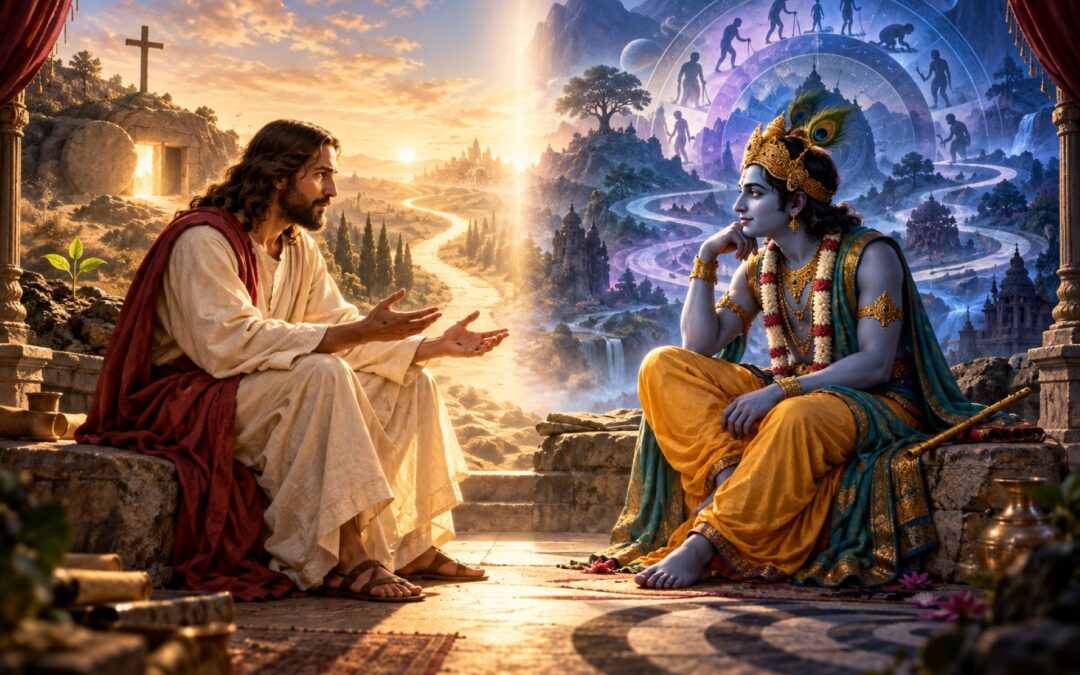
Ravi Zacharias’s New Birth or Rebirth?: Jesus Talks with Krishna is built around an irresistible thought experiment: what would happen if Jesus and Krishna could sit down together and explain, question, and challenge each other’s teachings? The premise promises comparison, but the book is not a neutral dialogue between Christianity and Hinduism. It is a compact work of evangelical Christian apologetics in which Zacharias writes both sides of an imagined theological debate and steadily directs that debate toward a Christian conclusion.
That distinction matters because the book does two different things at once. It gives a clear and often memorable account of how Zacharias understood the fundamental differences between Christianity and Hindu traditions, especially over karma, reincarnation, salvation, grace, revelation, sacrifice, and the nature of God. At the same time, it presents Hinduism through a composite version of Krishna assembled from the Bhagavad Gita, other Hindu scriptures, later devotional traditions, contemporary teachers, ritual practices, and Zacharias’s own interpretations, which means that its value as comparative religion has to be assessed separately from its effectiveness as Christian apologetics.
The book is short, but its argument is cumulative. Its title is the organizing question: is humanity’s spiritual problem answered by rebirth, in the sense of karma and repeated existence, or by the Christian new birth, in which God changes and reconciles the individual through Christ? Zacharias begins with religious exclusivity, moves through Hindu concepts and stories, intensifies the dispute around suffering and salvation, and ends by making historical reality itself the final dividing line between Jesus and Krishna.
This article covers the complete argument and ending, including Subramaniam’s conversion, Krishna’s disappearance, and Zacharias’s final contrast between shadow and reality.

How New Birth or Rebirth? Sets Up the Debate
Zacharias begins by rejecting the popular claim that religions are fundamentally the same and differ only in superficial details. His position is almost the reverse: religions may sometimes resemble one another superficially, but their deepest claims about God, humanity, salvation, death, morality, and ultimate reality are often incompatible. If one religion teaches reincarnation and another teaches one earthly life followed by judgment, for example, both teachings cannot describe the same process in the same sense.
He also acknowledges from the beginning that Hinduism is unusually difficult to compress. He describes it as complex and warns that a short dialogue cannot encompass everything within it. His stated method is therefore to concentrate on what he considers the strongest and most consequential differences between the teachings associated with Krishna and those of Jesus, rather than finding an obviously eccentric Hindu belief and defeating an easy target.
To stage the comparison, Zacharias creates four voices. Jesus and Krishna are the central interlocutors, but neither voice is independent of the author: Zacharias writes their words. Subramaniam is presented as a real Hindu convert to Christianity whose spiritual experience provides the emotional frame, while Richard is a fictional visitor to India who asks the sort of elementary questions an unfamiliar Western reader might ask.
The prologue opens with Richard and Subramaniam driving toward Mathura, the city associated with Krishna. The apparently comic danger of Indian traffic gives Zacharias an early metaphor that will return at the end: a highway can be called divided while people behave as though the division does not exist. The joke initially concerns driving, but the book eventually uses similar imagery to argue that refusing to distinguish truth from falsehood can be spiritually dangerous.
Subramaniam then explains the religious world in which he was raised. Born into a Brahman family, he describes naming ceremonies, purity restrictions, ancestral obligations, and the upanayana, the sacred-thread initiation through which a boy becomes “twice-born.” This is Zacharias’s first deliberate use of the language of birth. Subramaniam has already experienced a ritual “second birth” within his inherited religion before Christianity later offers him what the book presents as an entirely different kind of new birth.
The prologue mixes exposition with criticism. Subramaniam describes caste categories, ritual purity, a sacred mantra, and the division of family life by religious status and gender. He tells Richard that the initiation creates a new identity and that the mantra entrusted to him is supposed to cleanse sin when repeated. Zacharias is already preparing the later contrast between ritual or inherited status and the Christian claim that spiritual transformation cannot be secured by ceremony.
When the travellers reach Mathura, the range of subjects expands rapidly. Subramaniam talks about Krishna devotion, temples, widows, karma, the reverence shown to cows, the Vedas, the Upanishads, the epics, the Bhagavad Gita, divine manifestations, and reincarnation. Some of these explanations are important to Zacharias’s later case, but some also contain errors or overgeneralizations that the article will examine separately rather than interrupting every stage of the summary.
Subramaniam’s personal story supplies the bridge from Hindu background to Christian apologetics. As a student, he begins asking questions about what he has inherited. He leaves home, encounters a silent swami in a cave, spends time meditating there, and is eventually told by the swami that he must continue his search elsewhere. Later, alone in the cave, Subramaniam says that he hears a voice telling him to follow.
Soon afterward, according to the story, he encounters a man who tells him about Jesus. Subramaniam comes to interpret wrongdoing not simply as ignorance or karmic failure but as sin against a holy God, and he embraces the Christian message of Christ as the one who removes that sin. His conversion costs him his relationship with his family and community, but he describes gaining a spiritual certainty he had not previously possessed.
That experience produces the book’s central imaginative device. Subramaniam begins wondering what Jesus and Krishna would say if they could actually confront each other. Sitting in a pasture and metaphorically “leaning into the curtain” behind ordinary reality, he imagines the two figures appearing: Jesus in white with the wounds of crucifixion visible, Krishna as the youthful divine prince with his flute.
The conversation that follows is therefore already framed through a convert’s memory. Krishna does not arrive as an independent Hindu theologian, and Jesus does not arrive as an independent historical reconstruction. Both appear within a Christian apologetic imagination whose intended question is not merely “How are these traditions different?” but “Why did Subramaniam come to regard one of them as true?”
The Complete Dialogue: Jesus, Krishna, and the Question of Salvation
The main body of New Birth or Rebirth? is one continuous imagined exchange rather than a sequence of conventional chapters. Its movement is nevertheless highly organized: the discussion begins with identity and revelation, passes through ethics, karma, caste, liberation, reincarnation, ritual, and sacrifice, and finally arrives at grace, resurrection, and historical truth. The following divisions describe those movements; they are not chapter titles supplied by Zacharias.
The debate is also deliberately cumulative. Questions that initially seem separate—whether Arjuna should fight, whether chanting transforms consciousness, why cows are sacred, how one attains moksha, whether suffering comes from previous lives, what sacrifice means—are eventually made to converge on Zacharias’s central Christian claim that human beings need reconciliation with a personal God rather than another religious technique for ascending toward ultimate reality.
Identity, Incarnation, and Whether Religious Stories Must Be Historical
Krishna begins by acknowledging Jesus as a remarkable teacher associated with divine power, while Jesus responds in the Socratic style Zacharias often favors: instead of accepting the category offered to him, he asks questions about who Krishna is and what he claims. Krishna describes existence as something like a cosmic play. Human beings are actors on a stage, their visible lives are temporary roles, and the deeper reality stands behind the curtain.
Jesus immediately presses on the implications of that metaphor. In Zacharias’s presentation, Krishna’s universe risks making human action part of a predetermined drama, whereas Jesus insists on choice, will, and genuine moral decision. The argument between drama and decision remains largely latent at first, but the imagery of actors, curtain, backstage reality, and audience becomes one of the book’s structural motifs.
When Krishna asks Jesus to identify himself, Zacharias gives Jesus the biblical divine formula “I AM.” Krishna, by contrast, explains himself through the Bhagavad Gita and the larger network of Hindu stories surrounding Krishna and Vishnu. He acknowledges that there are different portrayals of Krishna across Hindu literature but chooses to speak primarily as the Krishna of the Gita, while still drawing on traditions beyond that text whenever the dialogue requires them.
Krishna then summarizes the dynastic conflict behind the Mahabharata. Pandu’s sons, the Pandavas, are opposed by the Kauravas, the sons of the blind Dhritarashtra, with Duryodhana determined to control the kingdom. Krishna’s appearance in the narrative is connected to the conflict that culminates at Kurukshetra, where Arjuna must decide whether he can fight people to whom he is bound by blood and affection.
The conversation quickly exposes the importance Zacharias assigns to the distinction between myth and history. Subramaniam interrupts when Krishna recounts extraordinary stories, including the miraculous origin of Dhritarashtra’s hundred sons. Rather than treating such material simply as sacred narrative, Subramaniam asks how one is supposed to separate historical fact from religious story.
Jesus sides with the questioner. He argues that accumulated tradition can cover truth rather than clarify it, and the dialogue begins moving toward a criterion that will dominate the ending: religious claims should not receive immunity from historical inquiry merely because they are sacred. Zacharias will ultimately make Christianity’s claimed grounding in the life, death, and resurrection of Jesus the decisive contrast with what he presents as the mythic instability of Krishna.
Krishna responds by describing his own divine manifestations and sacred stories. The dialogue ranges through Vishnu, Brahma, Shiva, Lakshmi, Ganesh, and other material from Hindu mythology. These excursions create color and allow Zacharias to dramatize how bewildering Hindu religious literature can appear to a reader approaching it as though it were one unified system, but that very compression later becomes one of the book’s methodological problems.
Subramaniam eventually emerges from behind the curtain and joins the conversation openly. This is more than a small dramatic development. Once he enters, Krishna no longer debates only Zacharias’s Jesus; he must also answer the complaints of a former insider who already regards the tradition as inadequate.
Arjuna, the Battlefield, Karma, and the Soul
The debate becomes more focused when Jesus asks where Krishna’s teaching is most authoritatively represented. Krishna identifies the Bhagavad Gita, which allows Jesus to turn directly to its battlefield setting. The IIT Kanpur Gita Supersite confirms the basic context Zacharias is invoking: the Gita is an 18-chapter dialogue within the Mahabharata, spoken just before the battle as Arjuna looks across at relatives, teachers, and other people he would have to fight.
In the book, Krishna explains that Arjuna is a warrior and therefore has a duty associated with his station. Arjuna recoils from killing his relatives, but Krishna teaches him not to identify the enduring self with the mortal body and urges him to perform his duty without attachment to the results. Zacharias seizes on the difference between the destructible body and enduring soul because it allows him to connect warfare, reincarnation, and moral responsibility.
Jesus asks how killing can be defended if living things participate in divine reality. Krishna answers through duty: Arjuna is not being invited to indulge private violence but to fulfill his warrior obligation within the order to which he belongs. The body is temporary, while the deeper self is not destroyed by bodily death.
Zacharias then pivots sharply from human warfare to animal life. Krishna objects to Christian meat-eating, drawing particularly on statements attributed to A. C. Bhaktivedanta Swami Prabhupada, the founder of the International Society for Krishna Consciousness. Subramaniam responds aggressively, quoting Prabhupada’s warning that meat-eaters may be reborn as carnivorous animals and ridiculing the idea that this forms a coherent moral system.
The Christian side of the dialogue frames the issue as a contradiction. If Arjuna may kill human opponents because bodies are temporary, why should killing animals for food be categorically condemned? If rebirth as an animal can be a punishment, in what sense can animal and human existence simultaneously be treated as spiritually equivalent? Zacharias uses these questions to argue that Hindu accounts of souls, rebirth, and animal sanctity do not fit together cleanly.
The argument is rhetorically effective inside the book because it forces several claims into direct collision. Yet it also illustrates the comparative method that later needs qualification. The Gita’s account of Arjuna’s duty in a just-war setting, broader Hindu theories of rebirth, Vaishnava vegetarian ethics, and Prabhupada’s twentieth-century teaching are treated almost as if they were clauses in a single systematic creed. That produces a neat debate, but Hindu traditions developed these claims in different textual and interpretive contexts.
The cow becomes a particularly vivid case. Krishna appeals to its usefulness: milk, agricultural labor, dung, ghee, and its role in sustaining life. Jesus replies that usefulness does not justify worship because all those benefits depend on a wider chain of causes—farmer, land, grain, strength, nature, and ultimately the Creator. Zacharias therefore makes the cow argument another version of his recurring charge that religion can mistake an instrument of blessing for the source of blessing.
Subramaniam reinforces the criticism by extending the logic. If usefulness makes something worthy of sacred reverence, then oil, agriculture, human reproduction, and many other conditions of life could be treated similarly. Jesus’s answer is that created things should be cared for without confusing creation with the God who creates and sustains it.
The exchange is not merely a digression about vegetarianism. It gives Zacharias an opportunity to define the Christian anthropology he will use throughout the rest of the book: animals have value because they are creatures of God, but humans have a distinctive status because they are made for moral relationship with God. Hindu accounts of rebirth are then criticized partly because Zacharias believes they blur this distinction.
Cows, Chanting, Krishna’s Stories, and the Problem of Revelation
As Jesus, Krishna, and Subramaniam move through Mathura, the city itself becomes part of the argument. Sacred animals, beggars, temples, widows, dirt, rituals, and chanting surround the speakers, allowing Zacharias to turn observations of social conditions into religious questions. Jesus complains that elaborate ideas of ritual purity coexist with visible human misery and asks why animals can appear more protected than impoverished people.
Krishna answers by turning toward chanting. He describes sacred sound, Om, and the transformative power attributed to repeated divine names. He then tells a story in which the repetition of “Mara” becomes the name “Rama,” and a sinful man is transformed through chanting. Zacharias uses the episode to contrast devotional repetition with the biblical prohibition on taking God’s name vainly and with his Christian claim that sounds themselves do not possess a magical power to cleanse the heart.
Krishna’s defense is more substantial than simple superstition within the dialogue. He argues that ordinary consciousness has been clouded by involvement with the material world and that chanting divine names can awaken a higher consciousness already latent within the person. It is precisely this idea of spiritual transformation through devotional practice that leads Jesus to call Krishna’s teaching a dangerous half-truth: it recognizes the need for purification but, in Zacharias’s view, locates the remedy in the wrong place.
Subramaniam asks whether the two figures can first acknowledge similarities, but Jesus repeatedly resists allowing similarity to determine the comparison. Zacharias’s governing idea is that resemblance can become misleading when two systems use similar vocabulary while giving that vocabulary different metaphysical meanings. Sacrifice, incarnation, devotion, salvation, divine presence, and spiritual rebirth can sound alike without functioning alike.
The dialogue then returns to Krishna traditions that Zacharias finds especially difficult to reconcile with philosophical Hinduism. Subramaniam brings up the tradition of Krishna’s thousands of wives and Prabhupada’s presentation of Krishna as simultaneously present in each wife’s palace. Krishna answers partly by distinguishing stages and forms of revelation and by treating some material as lila, divine play.
That answer creates another opening for the Christian critique. Subramaniam complains that whenever Hindu sources conflict or become difficult, they can seemingly be reclassified: one teaching is higher revelation, another is symbolic, another belongs to an earlier stage, another is later devotion, and another is simply play. He argues that a tradition becomes difficult to test if apparently incompatible claims can always be relocated to different levels.
The deeper issue here is the nature of revelation. Krishna’s fictional voice presents a tradition capable of accommodating numerous forms, paths, stories, and levels of understanding. Zacharias’s Jesus treats that flexibility as epistemically dangerous because revelation, in his view, should clarify truth rather than multiply incompatible forms of it.
This is one of the places where the book’s strongest and weakest tendencies coexist. Zacharias asks a legitimate comparative question about what happens when religious traditions contain divergent texts and interpretations. Yet he often treats Hindu plurality as evidence against Hindu truth while presenting the diversity inside Christianity much less extensively, an asymmetry that becomes especially visible when the dialogue later discusses salvation and atonement.
Moksha, Yoga, Caste, and the Paths of Liberation
The dialogue next moves toward the different paths associated with liberation. Krishna recalls one of the important preliminaries to the Kurukshetra war: both Arjuna and Duryodhana seek his aid, but Krishna offers a choice between himself unarmed and his military forces. Arjuna chooses Krishna’s presence, while Duryodhana takes the army. Zacharias appreciates the spiritual force of this story because it values presence over power, and it becomes one of the few moments where Jesus explicitly recognizes something in Krishna’s teaching as approaching Christian truth.
The discussion then turns toward Brahman, atman, and moksha. In Zacharias’s presentation, the Upanishadic goal is described as the realization that the individual self ultimately belongs to or merges into an impersonal absolute. Krishna illustrates this with the image of a seed that seems empty when split, using it to suggest that visible individuality is not ultimate.
Jesus counters with a personalist account of God. The Christian God is not an impersonal metaphysical absolute but an infinite personal Creator who knows and loves human beings. Zacharias therefore places one of the deepest differences in the book at the level of ultimate reality itself: whether salvation means transcending individuality into an impersonal absolute or entering reconciled relationship with a personal God.
Krishna complicates this apparent opposition by presenting himself as personal divinity. He explains the major paths toward liberation in terms of jnana, knowledge; karma, disciplined action; and bhakti, devotion and love. He portrays himself as transcending earlier revelation and gathering multiple forms of divinity into himself, so that devotion can be directed personally toward Krishna even if other philosophical strands speak about Brahman differently.
Subramaniam notices the tension. If ultimate reality is impersonal, how can Krishna be personally worshipped as supreme? If different Hindu systems make different claims about the relationship between self and ultimate reality, which account controls the meaning of liberation? Zacharias treats these differences as evidence of instability, although Hindu philosophers themselves have spent centuries arguing precisely over these questions.
Caste enters the discussion through karma and liberation. Krishna says that people from any caste may attain moksha, but Jesus objects that karmic explanations can still be used to interpret a low social position as the consequence of a previous life. The argument therefore distinguishes equality at the level of ultimate liberation from inequality within embodied social existence.
Krishna also explains yoga in a wider sense than modern physical exercise. The dialogue refers to disciplined action, detachment, surrender, renunciation, knowledge, meditation, and devotion. The central practical instruction is not simply to perform good works but to act without attachment to their fruits, controlling desire and ego while moving toward liberation.
The rich young ruler from the Gospels then becomes Zacharias’s Christian counterexample. Jesus tells the story of the man who asks what he must do to inherit eternal life. The commandments expose the inadequacy of the man’s conception of goodness, and the instruction to give up his wealth and follow Jesus becomes decisive because the final command is not merely to renounce possessions or follow a path; it is to follow a person.
Krishna initially sees a resemblance to renunciatory teaching, but Zacharias makes the distinction explicit. A Buddha-like instruction might be characterized as renouncing possessions and following a path. The Jesus of the book says to renounce what obstructs discipleship and then follow him. That distinction between a path and a person prepares the central Christian claim of the final third of the book.
Reincarnation, Suffering, and the “First Birth” Problem
Reincarnation becomes the explicit center of the book when Krishna claims that Jesus himself appears to teach it. The example is the man born blind in the Gospel of John. Jesus’s disciples ask whether the man’s blindness results from his own sin or his parents’ sin, and Krishna interprets the possibility of the man’s own responsibility before birth as an opening toward reincarnation.
Zacharias’s Jesus rejects the inference. He emphasizes that the Gospel answer denies both proposed explanations: the man’s blindness is not presented as a punishment for his personal sin or his parents’ sin. The episode therefore becomes a critique of the assumption that individual suffering must correspond directly to an individual moral offense.
Subramaniam extends the argument from one biblical story to Indian suffering. He points to disease, blindness, poverty, and disability and asks what happens if karmic reasoning is used to interpret such conditions as deserved consequences of previous lives. In his view, that logic risks turning tragedy into evidence against the sufferer.
Jesus offers a different Christian account. Human suffering belongs to a world alienated from God, but not every individual misfortune can be traced to a specific personal offense. Zacharias thereby distinguishes a general doctrine of a fallen or disordered human condition from a scheme in which an individual’s present circumstances are treated as consequences of actions in previous lives.
The book then presents one of its most memorable objections to reincarnation. Subramaniam asks: if he is currently experiencing consequences from a previous existence, what was he paying for in his first life? If every morally significant life requires an earlier life to explain its condition, the explanation appears either to regress indefinitely or to require an initial state not explained by previous karma.
Krishna’s response in the dialogue is deliberately unsatisfying. He appeals to the limits of the human mind and says some things remain hidden. Subramaniam regards this as evasion rather than mystery because the unresolved question concerns the mechanism that is supposed to explain moral consequences.
A second objection concerns memory and moral learning. Zacharias asks what educational purpose karmic consequences can serve if people generally do not remember the actions for which they are supposedly experiencing those consequences. If suffering is punishment or repayment, the individual may neither know what act caused it nor know what specific correction is required.
These are real philosophical questions, but the book often assumes a single punitive model of karma. Different Hindu, Buddhist, and Jain traditions have developed more complex understandings of causation, moral continuity, ignorance, attachment, rebirth, and liberation. Even within the dialogue, Krishna’s attempt to connect all of them gives Zacharias an easier target than a school-specific account would provide.
The conversation briefly addresses Buddhism as well. Jesus distinguishes Buddhist rebirth from the survival of an enduring individual self and notes Buddhism’s rejection of the kind of personal divine devotion being attributed to Krishna. This is one of the moments where the book itself recognizes that traditions commonly grouped as “Eastern religions” do not teach one doctrine of reincarnation.
Still, Zacharias’s conclusion is firm: the Christian alternative is a linear conception of life rather than an endless sequence of embodiments. One earthly life is followed by judgment, and the central spiritual question is therefore not what form one may take next but whether reconciliation with God occurs in this life.
The Kali Temple, Sacrifice, and the Christian Claim of Grace
The debate shifts imaginatively from Mathura to Calcutta and the Kali temple. Zacharias uses this sequence to move from karma and suffering toward ritual sacrifice. The speakers pass people whom the book describes as physically and spiritually needy, and Jesus warns against attributing their condition simplistically to karmic debt.
William Carey and the history of sati enter the conversation at this point. Jesus credits Carey and Indian reformers with opposing the immolation of widows, but the book makes an exaggerated numerical claim about the number of victims, which requires correction later. For the moment, the rhetorical purpose is clear: Zacharias wants to show how beliefs about duty, suffering, religious authority, and social order can have real consequences.
The group then watches a goat being sacrificed at a temple. Subramaniam is sent to ask a priest why worshippers mark themselves with the animal’s blood, and the priest dismisses the question. Zacharias turns the encounter into an indictment of ritual whose meaning has ceased to be intelligible even to those administering it.
Jesus’s criticism is not simply that ritual exists. He contrasts meaningful remembrance with ceremonies that become detached from explanation and moral accountability. Religious leaders, he argues, can exploit authority, money, sacred buildings, and inherited practice when ordinary believers are discouraged from asking what their actions mean.
The goat sacrifice also returns the conversation to an earlier tension. If the cow is protected because it sustains life, the goat also sustains human life through milk and yet can be sacrificed. Zacharias uses that juxtaposition to intensify his larger claim that isolated rules and inherited sacred statuses do not amount to a coherent account of God, humanity, and salvation.
At this point, Jesus tells Krishna that he has come close to the truth because Krishna has spoken about sacrifice. Krishna describes himself as both recipient and ultimate meaning of sacrificial devotion. Jesus presses the question further: in what actual sense has Krishna become a sacrifice that reconciles humanity and God?
The dialogue now turns decisively Christian. Zacharias’s Jesus argues that the fundamental problem is not insufficient religious effort but estrangement from God. Moral conduct, asceticism, rituals, renunciation, pilgrimage, spiritual disciplines, and social rank cannot by themselves overcome that separation because the human heart cannot repair itself through achievement.
This is where the title’s “new birth” enters fully. Zacharias argues that a person must first be redeemed rather than first becoming righteous enough to deserve redemption. The Christian new birth is an act of divine initiative through the Holy Spirit that produces a transformed desire for righteousness rather than a reward earned after sufficient spiritual performance.
Jesus then identifies himself as the sacrifice that Krishna’s language only anticipates. In the book’s evangelical theology, Christ enters history specifically to die for sin and reconcile human beings to God. The distance between humanity and God is bridged from God’s side rather than crossed through the accumulation of works, knowledge, ritual merit, ascetic purification, or repeated lives.
Krishna replies that Hindu spiritual teaching offers flexibility: different seekers can follow different paths according to capacity. Knowledge may suit some, disciplined works others, devotion others still. He quotes an ideal of detachment, control of desire, meditation, renunciation of ego, and freedom from possessiveness as a way toward Brahman.
Subramaniam answers that such demands are nearly impossible. Jesus goes further, arguing that perfection cannot be obtained by law-keeping at all. The deepest religious danger, in Zacharias’s account, is therefore not obvious wickedness but spiritual pride—the belief that discipline, moral achievement, religious status, or cultural inheritance gives a person a claim upon God.
The comparison culminates in the difference between a way and a person. Krishna offers paths, disciplines, stages, and modes of realization. Jesus says that Christianity does not ultimately offer a religious technique by which people climb toward God; it offers Christ himself, relationship with God, and the indwelling Holy Spirit.
That is the book’s strongest formulation of its central thesis. Rebirth describes a process through which beings move repeatedly within the moral structure of existence. New birth describes an intervention in which, according to Zacharias, God gives a person a new spiritual life that cannot be produced by the person’s own religious effort.
The Final Test: Resurrection, History, Shadow, and Light
Krishna eventually turns the argument back against Jesus by raising the suffering of Jews. If God revealed himself specially to Israel, why did members of that people continue to suffer and die? Zacharias’s Jesus answers through a theology of responsibility proportional to revelation: greater knowledge of God entails greater accountability, and biblical history itself contains judgment when revelation is rejected.
This is one of the more difficult passages in the book because a sweeping theological explanation of Jewish suffering can raise serious historical and ethical problems if treated as a general explanation of what Jews have endured. The dialogue does not develop those problems. Instead, the point serves Zacharias’s broader contention that divine revelation brings both grace and accountability.
Subramaniam then notices linguistic resemblances among religious names. Krishna and Christ sound superficially similar; Brahma can remind an English-speaking listener of Abraham. Jesus adds another comparison, linking Jupiter, Zeus Pater, and Dyaus Pitar through related linguistic roots. The underlying argument is that different cultures may preserve partial echoes of an older awareness of God even when their religious systems diverge.
Krishna objects that Jesus’s emphasis on differences divides people. Jesus responds that truth necessarily excludes contradiction: the very assertion that differences should not matter itself distinguishes a true proposition from a false one. For Zacharias, peaceful coexistence does not require pretending that incompatible beliefs are equivalent.
The debate then returns to death. Krishna asks a direct question: if Christ’s death truly defeats sin and death, why do Christians still die? Jesus answers with the book’s most important metaphor.
A truck casts a shadow across the road. Being struck by the truck and passing through its shadow are not remotely equivalent, although the shadow is real. Jesus explains that in the gospel, as Zacharias understands it, divine judgment falls upon Christ so that believers still undergo physical death but no longer bear its ultimate penalty.
The shadow metaphor then absorbs much of the book’s earlier imagery. Death remains painful; Christianity does not pretend bereavement is unreal. Jesus refers to weeping at Lazarus’s tomb even though Lazarus is about to be raised, emphasizing that hope in resurrection does not abolish grief.
Resurrection becomes crucial because Zacharias does not want Christian salvation to mean merely that the soul escapes embodiment. The gospel is presented as victory over death grounded in an event: Jesus dies and rises. His disciples’ willingness to suffer is treated as evidence of their conviction that the resurrection was real.
The conversation therefore arrives at its final criterion: historicity. Jesus asks Krishna whether he actually lived as the figure described in the sacred stories. Krishna replies that, from his own perspective, this question does not matter. Subramaniam responds that various Hindu intellectuals have interpreted Krishna in ways that do not depend upon establishing every narrative claim as ordinary history.
For Zacharias, that difference is decisive. His Jesus insists that Christianity stands or falls with claimed historical acts—birth, ministry, crucifixion, resurrection—and with identifiable places such as Jerusalem and Bethlehem. Religious truth cannot retreat entirely into symbolic or mythic significance when the religion itself makes historical claims.
Subramaniam then announces the conclusion toward which the dialogue has been moving. Krishna, he says, is at best a shadow; in Jesus he has found reality. Krishna disappears from the conversation, and Jesus explains the disappearance through the theatrical metaphor established near the beginning: the play is over.
The final paragraphs combine nearly every major image in the book. Krishna’s lila becomes an inadequate play; the stage empties; the shadow that seemed substantial is dispelled by light; the sun becomes a pun on the Christian Son; and the earlier divided highway becomes another image for the danger of erasing genuine distinctions. Richard and Subramaniam return from the imagined conversation convinced that Christianity provides the reality of which other religious insights are only fragments or shadows.
The dialogue therefore ends exactly where Zacharias intended it to end. The argument against reincarnation has widened into an argument against impersonal ultimate reality, religious pluralism, salvation through spiritual disciplines, myth detached from history, and any account of sacrifice that does not culminate in Christ. “New birth” is no longer merely one alternative doctrine among several; it has become Zacharias’s name for the entire Christian answer to the system he has constructed as its rival.
The Book’s Central Contrast: New Birth Versus Rebirth
The title can initially make New Birth or Rebirth? sound like a book narrowly concerned with reincarnation. In fact, the distinction between the two kinds of “birth” becomes shorthand for two different pictures of existence. Rebirth belongs to a universe in which actions have consequences across lives and liberation requires release from the continuing cycle; new birth belongs to Zacharias’s Christian universe in which each person has one earthly life, stands accountable before a personal God, and can receive spiritual transformation through divine grace.
Karma is central because it gives the book a concept of moral causation against which Christian grace can be contrasted. Zacharias presents karmic existence as a structure in which actions generate consequences and present circumstances may reflect earlier actions. The Christian account he offers also insists on moral responsibility, but it denies that individuals repair their standing before God by accumulating better moral outcomes across repeated lives.
This is why grace matters more to Zacharias than simply disproving reincarnation. A system of rebirth can still leave the person engaged in a long process of self-purification, discipline, knowledge, devotion, detachment, or repayment. Zacharias’s new birth begins with the opposite proposition: the person cannot generate the required reconciliation and must receive what God provides.
The difference also affects the understanding of time. The Krishna of the dialogue associates existence with repeated appearances and the recurring drama of embodiment. Jesus describes human history as linear: creation, earthly life, moral decision, death, judgment, and ultimate fulfillment. Whether either scheme is philosophically convincing is a separate question, but they cannot simply be merged without losing what each claims.
The difference between avatar and incarnation serves a similar function. Hindu traditions speak in multiple ways about divine manifestation, and Krishna can be understood as an avatar of Vishnu or, within some Krishna traditions, as supreme divinity itself. Zacharias’s Christianity presents the incarnation of Christ not as one manifestation among a recurring series but as a unique entry of God into history directed toward reconciliation through death and resurrection.
Salvation also differs in its final shape. Moksha generally concerns liberation from the conditions binding beings to samsara, although Hindu traditions disagree significantly about what liberation entails and about the relation between the self and the divine. Zacharias’s Christianity instead emphasizes forgiveness, renewed relationship with God, resurrection, and eternal personal existence rather than escape from an endless cycle of rebirth.
Some of the book’s contrasts are therefore genuinely important. The Bhagavad Gita itself develops questions of action, knowledge, devotion, detachment, self, Brahman, divine manifestation, and liberation in a setting radically different from New Testament teachings about one life, resurrection, judgment, and salvation through Christ. Treating the religions as though their deepest teachings say essentially the same thing would erase significant differences.
Where Zacharias goes further is in arguing that the Christian scheme solves problems the Hindu one cannot. The first-birth objection asks how karmic responsibility begins. The memory objection asks what corrective moral purpose punishment has when the supposed source of present suffering is unknown. The social objection asks whether karmic explanations can make existing suffering appear deserved. The personalist objection asks whether an impersonal ultimate can ground love, moral obligation, or personal relationship.
These arguments vary in strength because they depend on which Hindu philosophical system is being discussed. A sophisticated Hindu account does not necessarily describe karma as a cosmic courtroom handing out intelligible punishments, nor do all schools understand liberation as absorption into an impersonal absolute. A critique that succeeds against one conception of karma or one form of Vedanta does not automatically defeat every Hindu account of rebirth.
The Christian side also rests on substantial premises. Zacharias treats the existence of a personal Creator, the authority of Christian scripture, human sin, Christ’s unique incarnation, the efficacy of the cross, and the resurrection as interconnected truths. The dialogue argues from those premises effectively, but the fictional victory of Jesus cannot itself establish them.
The same qualification applies to atonement. Zacharias presents a recognizably evangelical account in which human sin creates a separation that Christ’s sacrificial death resolves. Christian theology is broader than that one formulation: the Stanford Encyclopedia of Philosophy’s discussion of Christian atonement notes that Christianity has produced multiple accounts of how Christ’s saving work operates rather than one universally defined mechanism.
The strongest version of Zacharias’s argument is therefore not “Hinduism teaches works while Christianity teaches grace,” which is too crude. Bhakti traditions can speak powerfully of divine grace, surrender, and loving devotion, while Christianity contains demanding disciplines of its own. The sharper contrast is that Zacharias locates saving initiative decisively in the historical person and work of Christ and rejects every path that can be understood as ultimately sufficient apart from him.
That is why the rich young ruler matters so much to the dialogue. Renunciation is not enough. Moral achievement is not enough. Spiritual knowledge is not enough. The person must follow Christ because, in Zacharias’s theology, salvation is inseparable from who Christ is.
The title therefore contains the architecture of the whole book. Rebirth represents Zacharias’s picture of humanity moving through a religious system in search of liberation. New birth represents his claim that God comes toward humanity and creates the transformation that humanity cannot achieve for itself.
How Zacharias Represents Hinduism
Any fair reading of New Birth or Rebirth? has to distinguish two questions. The first is whether Zacharias accurately presents his own Christian convictions, and the answer is generally yes: the book is unusually clear about the evangelical theology it wants to defend. The second is whether the figure called “Krishna” provides an equally reliable account of Hindu traditions, and that answer is much more qualified.
The problem is not that Hinduism may never be criticized from a Christian perspective. Zacharias is entitled to argue that doctrines are false and that incompatible claims cannot all be true. The deeper problem is methodological: the book repeatedly moves among texts, practices, schools, myths, philosophical systems, social customs, and modern religious movements without consistently distinguishing which form of Hinduism is being challenged at a given moment.
The Gita, Vedanta, Bhakti, and the Problem of a Single “Hindu” System
The book sometimes speaks as if Hinduism moves straightforwardly from the Vedas to an impersonal Brahman, then to Krishna, reincarnation, caste, cow veneration, temple sacrifice, yoga, and modern Krishna Consciousness. Historically and theologically, the relationships are far less simple. Hinduism encompasses multiple overlapping traditions that debate the nature of Brahman, the status of the world, the reality of individual selves, the identity of God, the function of devotion, and the meaning of liberation.
That diversity matters most when Zacharias repeatedly describes Hindu ultimate reality as impersonal. Such a description can fit important strands of Advaita Vedanta when carefully stated, but it cannot stand as a definition of Hindu theology in general. The St Andrews Encyclopaedia of Theology’s account of bhakti traditions describes a wide field in which Krishna, Rama, Vishnu, Shiva, Devi, and other forms of divinity can become objects of deeply personal devotion, while different Vedantic traditions interpret the relation between self and God in sharply different ways.
Even the terms saguna and nirguna do not divide Hinduism neatly into “personal God” and “impersonal absolute.” Theological traditions can describe a personal Lord as transcending ordinary worldly attributes, while devotion directed toward the divine may coexist with philosophical language about Brahman that does not resemble Christian personalism. Zacharias sees a contradiction where many Hindu thinkers see distinctions between levels or modes of describing ultimate reality.
The Bhagavad Gita itself resists simple reduction. It brings action, knowledge, meditation, devotion, duty, renunciation, selfhood, divine manifestation, and liberation into a sustained conversation. Different interpreters have consequently emphasized different parts of the text, which is why traditions associated with Shankara, Ramanuja, Madhva, Vallabha, and others can appeal to the Gita while developing significantly different metaphysical systems.
Zacharias sometimes treats such interpretive plurality as proof that Hindu revelation cannot provide stable truth. That criticism raises a legitimate epistemological question, but it needs to be applied consistently. Christianity also possesses competing interpretive traditions concerning salvation, sacraments, priesthood, free will, predestination, biblical interpretation, church authority, atonement, and the relation between faith and works.
The same problem arises with bhakti. Zacharias’s Krishna offers devotion as one spiritual path among others, and the book then places that beside Christian relationship with a personal God. Yet Krishna bhakti can itself be explicitly relational, emotional, grace-centered, and intensely personal. That does not make it equivalent to Christianity, but it means the contrast cannot responsibly be reduced to “impersonal religious system versus personal Christian relationship.”
The treatment of caste also requires precision. Hindu social history undeniably contains caste hierarchy, and religious ideas have been used to justify it. Yet caste cannot be mapped onto a single universally accepted theological formula, and traditions of bhakti have also produced critiques of inherited religious status and communities that emphasize forms of spiritual equality.
The book is strongest when it identifies actual doctrinal disagreement rather than trying to make all Hindu materials collapse into one contradiction. Christian resurrection and samsaric rebirth are genuinely different. The unique incarnation claimed for Christ and recurring theories of avatar are genuinely different. Christian theological claims about grace and many Hindu theories of karma operate within different conceptions of the human problem.
It becomes weaker when difference is demonstrated by making Hinduism answer for every statement or practice that has ever existed beneath the Hindu umbrella. A religion containing multiple schools should be criticized school by school or claim by claim, not defeated by treating every internal disagreement as though it were one person contradicting himself.
Krishna as Zacharias’s Debate Opponent
The book’s most important structural fact is also the easiest to forget while reading: Krishna never speaks for himself. Every question, concession, weak answer, joke, admission, and philosophical retreat has been chosen by Ravi Zacharias.
That is inevitable in an imagined dialogue, and it does not automatically make the form illegitimate. Philosophers and religious writers have used fictional conversations for centuries. A dialogue can clarify opposing assumptions more effectively than abstract exposition if the author represents each side at its strongest.
The difficulty is that New Birth or Rebirth? does not consistently give Krishna that strength. The fictional Krishna frequently accepts formulations that make Zacharias’s next objection easy to deliver. At important moments he answers sophisticated challenges by retreating to mystery, play, flexible revelation, or a position that the Christian side can immediately expose as inconsistent.
The dialogue therefore creates an unusual evidentiary problem. Jesus’s victory inside the drama demonstrates that Zacharias has constructed a Christian argument capable of defeating the Hindu argument he has constructed. It does not demonstrate that equally sophisticated Hindu philosophers or theologians would accept Krishna’s premises or respond in the same way.
Subramaniam intensifies the imbalance because the debate now contains two committed Christian voices against Krishna. Richard is ostensibly more neutral, but he mainly receives explanations rather than developing a sustained challenge to Christianity. Krishna is therefore the only character who must defend a tradition under hostile examination while the Christian framework controls the questions.
A documented Vaishnava reaction makes this objection explicit. In a Vaishnava review that discusses Zacharias’s book, the reviewer describes Zacharias’s Krishna as a straw-man caricature and contrasts the book unfavorably with a different Christian–Krishna dialogue that attempts greater balance. That review comes from a committed Hindu perspective and should not be treated as neutral authority, but the criticism aligns with a structural feature visible in the book itself.
The representational problem is particularly clear when Krishna has to account simultaneously for Advaita-like impersonalism, personal devotion to Krishna, Vedic sacrifice, Puranic stories, the Laws of Manu, caste, modern ISKCON teaching, cow protection, temple ritual, and general Hindu social practice. No single historical theologian would necessarily combine those elements exactly as Zacharias’s character does.
A stronger apologetic book could still have reached a Christian conclusion while giving Hindu interlocutors more formidable responses. It might have let a Vaishnava answer as a Vaishnava, an Advaitin answer as an Advaitin, and a Gita commentator answer from a clearly defined interpretive tradition. Zacharias instead gains dramatic simplicity at the cost of comparative precision.
That does not erase the real disagreements he identifies. It changes the weight his victory can bear. New Birth or Rebirth? can tell us a great deal about why Ravi Zacharias rejected Hindu theological claims; it cannot by itself tell us that the best Hindu arguments have been defeated.
Jesus, Krishna, Subramaniam, and Richard as Rhetorical Characters
The four speakers do more than deliver information. Each has a distinct rhetorical function, and understanding those functions explains why the book is easy to read despite dealing with complex theology.
Jesus occupies the position of ultimate authority. He is patient, witty, compassionate, confident, and almost never intellectually cornered. When Krishna presents a problem, Jesus either reframes it or uses it to expose a deeper distinction. Zacharias frequently has him ask questions rather than deliver lectures, which gives the impression that the opposing position is undermining itself through examination.
That characterization draws on biblical scenes in which Jesus answers questions with questions, but much of the actual dialogue is necessarily Zacharias’s invention. The book therefore needs to be read carefully whenever “Jesus says” something that is not a direct biblical teaching. The character represents Zacharias’s synthesis of Christian theology spoken in a voice modeled on the Gospels.
Krishna is more unstable as a character. He can be charming and intellectually agile, and he occasionally exposes vulnerabilities in the Christian case, such as asking why Christians still die or how Jewish suffering fits Christian claims about revelation. Yet he also functions as a container for an enormous range of Hindu ideas and is repeatedly made to concede that Zacharias has identified a contradiction.
That combination makes him dramatically useful but theologically artificial. He is Krishna of the Gita, Krishna of later Puranic narratives, Krishna of modern ISKCON, spokesperson for Vedantic metaphysics, defender of caste, defender of cow sanctity, interpreter of temple ritual, and representative of “Hinduism” in general. His character is less an individual voice than a device allowing Zacharias to put the entire religious tradition into one chair.
Subramaniam is the emotional center. He does not merely compare abstract doctrines; he has lived inside the system being criticized. He remembers rituals, carries grievances, understands vocabulary, challenges Krishna with the intensity of someone who believes he has escaped error, and interprets Christian teaching through the experience of conversion.
His presence gives the book a testimonial dimension that Jesus alone could not provide. Jesus can explain why Christianity is true within the argument, but Subramaniam demonstrates what accepting it is supposed to do to an individual life. His family estrangement also gives the theme of exclusive truth a personal cost rather than leaving it at the level of logic.
Yet Subramaniam’s role creates another asymmetry. Because the former insider has already converted, almost every memory of Hindu practice appears in retrospect through disappointment. Readers rarely encounter a practicing Hindu character describing why those practices remain meaningful from within the tradition.
Richard is the audience surrogate. His ignorance creates opportunities for definitions and background information, and his humor prevents the dialogue from becoming a sequence of theological speeches. He also occupies the symbolic position of the person “behind the curtain,” listening and perhaps moving gradually toward a decision.
Together the four characters make the book function almost like a stage play. Jesus supplies authority, Krishna supplies opposition, Subramaniam supplies testimony, and Richard supplies curiosity. The structure is efficient, but it also reveals why the debate cannot be mistaken for a transcript of genuine interfaith encounter: every role has been assigned by the same playwright.
Stage, Curtain, Sacrifice, Shadow, and Light: The Book’s Recurring Images
Zacharias organizes the book with recurring images more carefully than its conversational style initially suggests. The most important begins with Krishna’s lila, the idea of divine play. Krishna describes visible existence as a stage on which beings appear in temporary roles while a deeper reality lies behind the curtain.
The curtain first separates surface experience from ultimate reality. Subramaniam “leans” into it to overhear Jesus and Krishna, which turns spiritual inquiry into an attempt to see backstage. Richard remains further away, making him the less committed listener who has not yet entered the deepest level of the conversation.
Zacharias gradually turns Krishna’s theatrical metaphor against him. If everything visible is merely play, what becomes of historical truth, moral responsibility, suffering, and actual divine action? By the end, Krishna disappears precisely because the “play” is over, while Jesus remains as the figure Zacharias identifies with concrete history.
Sacrifice develops in parallel. The prologue contains ritual and purity; the dialogue discusses Vedic sacrifice; the group witnesses the goat sacrifice; Krishna describes himself as the sacrifice; and Jesus finally claims that his own death supplies what the other sacrificial systems only anticipate. The motif therefore moves from religious practice to Zacharias’s theology of the cross.
Birth works in the same cumulative way. Subramaniam experiences biological birth, naming, the upanayana or second birth, belief in repeated rebirth, and eventually Christian new birth. The book’s title is thus embedded in his biography before it becomes an abstract theological distinction.
The road imagery also matters. The opening journey takes place on a supposedly divided highway whose divisions drivers ignore. Near the end, Richard remembers it as a metaphor for blurred distinctions between truth and fiction. Zacharias’s larger claim is that lines may be inconvenient, but erasing them does not remove the realities they mark.
Shadow and light finally absorb the earlier motifs. The truck’s shadow illustrates death after Christ’s atonement; Platonic shadows become inadequate glimpses of goodness; Krishna himself is judged a shadow rather than reality; and Jesus becomes the light that dispels the shadow. Zacharias even uses the English homophone of “sun” and “Son” to intensify the final Christian symbolism.
The projector image adds one final layer. Light carries an image, but a screen makes the image visible. Subramaniam treats the fragments of religious insight as beams whose full pattern becomes intelligible only in Christ. Whatever one thinks of the theology, the image demonstrates that the conclusion is not an isolated declaration: it gathers the book’s stage, curtain, play, shadow, light, and revelation metaphors into one ending.
Style and Structure: Why the Imagined Dialogue Works—and Where It Distorts
The most immediate strength of New Birth or Rebirth? is accessibility. Zacharias wants to discuss karma, atman, Brahman, moksha, yoga, caste, bhakti, incarnation, atonement, judgment, resurrection, and revelation without writing a conventional comparative-theology textbook. The dialogue allows him to define a concept exactly when a character needs it and then test it through another character’s question.
Humor helps enormously. Dangerous driving, food names, stolen sunglasses, cultural misunderstandings, playful exchanges between Jesus and Krishna, and Subramaniam’s impatience keep dense material moving. The jokes also humanize figures who could otherwise sound like abstract theological systems speaking at each other.
The travelogue element gives the book physical texture. Mathura is not just a subject in a paragraph; the speakers move through temples, animals, widows, streets, beggars, chanting, and crowds. The imagined Calcutta sequence similarly turns ritual sacrifice into a scene rather than a proposition.
This technique also creates problems because description and argument frequently blur. A beggar outside a temple, a sacred cow, a dismissive priest, or a poor widow becomes evidence inside a theological dispute. Vivid examples can illuminate an argument, but they do not necessarily establish broad causal claims about the religious tradition around them.
The dialogue also makes selective sourcing less obvious than it would be in a formal essay. Zacharias’s notes cite biblical passages, the Bhagavad Gita, Laws of Manu, Prabhupada, and other materials, but the characters move quickly enough that sources from different periods and schools can seem as though they belong to one continuous system. A conventional scholarly structure would force more explanation of why a nineteenth- or twentieth-century teacher is being used to interpret an ancient text, or why a social custom is being treated as a necessary implication of a metaphysical doctrine.
The format favors rhetorical momentum over sustained counterargument. Jesus can ask three questions in succession, Subramaniam can add a personal objection, and Krishna can be made to struggle for an answer. Readers experience the force of the critique before they have time to ask whether another Hindu interpreter would accept the premises.
That is not automatically a flaw if the work is classified correctly. As apologetic drama, the asymmetry is part of the genre: Zacharias is defending Christianity. The distortion occurs when the fictional exchange is taken to demonstrate that the rival tradition has received a comprehensive or representative hearing.
The book’s structure is nevertheless quite disciplined. The prologue establishes birth, caste, karma, religious authority, and conversion; the early debate establishes revelation and identity; the middle sections test moral coherence and the paths of liberation; the Kali sequence introduces sacrifice; and the final movement develops new birth, grace, death, resurrection, and historical reality.
The ending is especially effective as construction. The stage metaphor introduced by Krishna is appropriated by Jesus, and the shadow imagery from the truck becomes an epistemological judgment upon Krishna himself. Zacharias does not merely announce that Christianity wins; he makes Krishna’s own imagery participate in the defeat.
There is a cost to that elegance. The literary structure can make a contested argument feel more conclusive than it is. Because Zacharias controls setup, objection, response, image, and final scene, the form gives Christian claims narrative inevitability that independent comparative analysis would still have to earn.
Accuracy Problems and Claims That Need Qualification
Theological disagreement should not be confused with factual error. Zacharias is free to reject reincarnation, deny that Krishna is divine, defend Christian exclusivity, criticize Hindu philosophy, and argue for the resurrection; readers may accept or reject those positions. A different problem arises when the book misidentifies texts, compresses distinct traditions into one doctrine, or makes historical claims stronger than the available evidence supports.
Those issues matter more here than they might in a purely devotional work because Zacharias explicitly presents the dialogue as a serious comparison of truth claims. If a book asks readers to test religions rigorously, factual accuracy becomes part of its own standard.
The Mahabharata, Ramayana, Valmiki, and the Twelve-Day War
Some errors are basic. In the prologue, Subramaniam says that the Mahabharata contains the Ramayana and the Bhagavad Gita. The latter is correct: the Gita is embedded in the Mahabharata. The former is not. The Mahabharata and Ramayana are separate Sanskrit epics, not one contained inside the other.
The Valmiki story is also confused. Zacharias has Krishna describe Valmiki as the transformed thief who eventually wrote the Mahabharata. Valmiki is traditionally associated with the Ramayana, while the Mahabharata is traditionally associated with Vyasa. Traditions concerning the historical composition of both epics are much more complicated than simple single-author attribution, but the book’s specific identification is still wrong.
The dialogue additionally says that the great war lasted twelve days. The received Mahabharata battle narrative extends through eighteen days. That mistake does not affect Zacharias’s Christian doctrine, but it is awkward in a book in which Krishna is supposedly explaining his own epic setting.
The accumulation matters more than any single mistake. Zacharias repeatedly insists that religious claims should be tested rather than protected by reverence, and he ultimately makes historical reliability one of Christianity’s advantages. Errors in elementary descriptions of the rival texts therefore weaken his comparative credibility on his own terms.
They also show the danger of compressing an enormous textual tradition into a short apologetic exchange. A reader unfamiliar with Hindu literature has little way to distinguish what comes from the Gita, what comes from the Mahabharata more broadly, what belongs to the Ramayana, what belongs to Puranic tradition, and what comes from much later interpreters.
The solution is not to abandon criticism but to sharpen it. Zacharias’s central comparison would have been stronger if every argument against the Gita had been tied directly to an identifiable teaching in the Gita, while later Krishna traditions were treated separately rather than blended into the same voice.
Theological Generalisations About Hinduism and Christianity
The largest theological overstatement is the claim that Hindu ultimate reality is simply impersonal. That description captures some influential Hindu philosophies but fails to capture many others. The diversity documented in scholarship on bhakti includes traditions in which ultimate divinity is understood through personal forms and intensely relational devotion.
This is particularly important in a book about Krishna. For many Krishna devotees, the ultimate divine is not an impersonal absolute reluctantly clothed in a temporary personality for ordinary worshippers. Krishna can be understood as the supreme personal reality, and liberation can be conceived not as erasure of personal distinction but as loving relation to God.
Vedanta itself is not one doctrine. Advaita, Vishishtadvaita, Dvaita, and other schools disagree about the relation among Brahman, individual selves, and the world. Zacharias occasionally acknowledges multiple schools but still lets his Krishna speak as though all of them can be reduced to one developing revelation.
The portrayal of bhakti as merely one adaptable path also understates traditions in which devotion is not an optional lower route but the supreme means and end. The fact that Hindu traditions offer multiple pathways does raise questions about their relationship, but the existence of plurality is not itself a contradiction unless incompatible claims are being asserted in the same sense.
The treatment of caste likewise mixes important criticism with overgeneralization. Ideas of karma have historically been connected to social hierarchy, and Hindu texts have been used to defend status distinctions. Yet Hindu traditions have also contained anti-caste saints, devotional movements, reformers, and theological resources that resist reducing spiritual worth to inherited status.
Christianity receives less internal differentiation. Zacharias’s Jesus declares that no priest is necessary for access to God and frames institutional religion largely as a system of intermediaries, rules, buildings, and power. That reflects an evangelical Protestant outlook more directly than Christianity as a whole, since Catholic, Orthodox, Anglican, and other traditions give sacramental and priestly structures theological significance.
The same applies to salvation. Zacharias presents Christ’s death primarily as bearing the judgment due to sinners and reconciling them to God. That is an important Christian model, but the history of Christian theories of atonement includes satisfaction, substitutionary, ransom or Christus Victor, moral-exemplar, theosis, and other approaches to how Christ’s life, death, and resurrection save.
None of those qualifications make Christianity and Hinduism secretly identical. They make the comparison more exact. The real disagreement remains large even after the overgeneralizations are removed.
Sati, Dyaus Pitar, and Other Historical Claims
The most conspicuous numerical problem appears when the book discusses sati. Zacharias’s Jesus speaks of the forced suicides of “millions” of widows. The practice of sati was real, serious, and the subject of major reform efforts, but that particular numerical claim is not supported by the surviving quantitative record.
The British Library’s India Office archival material on sati preserves colonial-era returns documenting cases in the Bengal Presidency. Such records have important limitations and cannot provide a complete count across all of Indian history, but the surviving figures do not justify presenting “millions” as an established historical total.
Qualification here should not be mistaken for minimization. One does not need an inflated number to regard widow immolation as a grave practice. In fact, precision strengthens the moral case by separating documented historical criticism from rhetorical exaggeration.
The Carey passage also compresses social reform into a Christian missionary narrative. William Carey participated in campaigns against sati, but major Indian reformers were essential participants in the intellectual and political struggle over the practice. The book briefly acknowledges Indian reformers, yet its larger rhetoric naturally centers Christian intervention because the scene is being used as part of Christian apologetics.
Another error appears in the linguistic discussion near the end. Zacharias’s Jesus calls Dyaus Pitar Babylonian. He is not. Dyaus Pitar is a Vedic sky deity, and his name belongs to the Indo-European linguistic family that also lies behind Greek Zeus and Latin Jupiter.
The underlying linguistic connection is therefore more interesting than the book’s description allows. The resemblance among those names does reflect deep Indo-European linguistic history, but incorrectly relocating Dyaus Pitar to Babylon confuses language families and religious cultures.
Other claims deserve caution even where they cannot be cleanly categorized as simple errors. The historical Krishna is a difficult subject involving textual development, archaeology, religious memory, and distinctions between proving that Krishna traditions existed, establishing a historical figure behind them, and confirming the supernatural narratives attributed to Krishna. The book compresses those questions into a contrast with Jesus that is rhetorically cleaner than the historical issues themselves.
The same is true of Christianity. That Jerusalem, Bethlehem, and other places exist does not by itself prove the resurrection or every theological claim made in the Gospels. Geographic and historical anchoring can make a religious claim open to historical investigation, which is important, but historical location and supernatural verification are not identical.
This distinction is crucial because Zacharias’s final argument depends so heavily on “history versus shadow.” His strongest point is that Christianity makes consequential historical claims and therefore exposes itself to historical scrutiny. His weaker move is treating the mere historical character of the claim as though it automatically establishes the claim’s truth.
Critical Review: What New Birth or Rebirth? Achieves and Where It Falls Short
On its own terms, New Birth or Rebirth? has several real strengths. It is concise without being conceptually empty, highly readable, and built around an effective dramatic idea. Readers with little experience of comparative religion can understand why karma, samsara, moksha, incarnation, grace, judgment, and resurrection are not interchangeable concepts merely because different religions sometimes use similar moral or spiritual language.
Zacharias is particularly effective when challenging vague religious pluralism. The proposition that contradictory doctrines can all be true in the same sense is not made more coherent by politeness. A religion teaching repeated rebirth and a religion teaching one life followed by resurrection and judgment differ at a fundamental level, and serious interfaith respect requires acknowledging rather than concealing that difference.
The book also gives its Christian position a clear internal logic. Humanity is separated from a personal God by sin; moral and religious achievement cannot repair that relationship; God acts through Christ; the cross provides reconciliation; the Holy Spirit gives new spiritual life; resurrection defeats the ultimate power of death; and historical revelation anchors the whole claim. Whether readers accept that theology, they can see how its pieces fit together.
The new-birth versus rebirth contrast is therefore the book’s strongest contribution. Zacharias understands that reincarnation is not merely an exotic theory about what happens after death. It belongs to a wider account of moral causation, human identity, spiritual practice, and liberation. His Christian alternative is likewise more than a competing afterlife theory; it is an account of grace, personhood, history, and relationship with God.
The recurring imagery makes the argument memorable. The curtain, stage, sacred birth, sacrifice, divided road, truck, shadow, and light all converge rather than appearing as disconnected illustrations. The final transformation of Krishna’s idea of lila into the claim that Krishna disappears when the “play” ends is rhetorically skillful even when one disagrees with the argument.
The book is less successful as character writing. Jesus, Krishna, Subramaniam, and Richard have recognizable functions, but none is psychologically complex in the way a novelistic character would be. That limitation is not severe because the work is closer to a theological fable than a novel, and its characters exist primarily to carry ideas.
Its larger weakness is comparative fairness. Zacharias explicitly says he wants to engage strong versions of opposing beliefs, yet the fictional Krishna often accepts formulations that knowledgeable Hindu thinkers would contest. The author therefore appears to meet a strong opponent while still retaining complete control over how strong that opponent is allowed to become.
This matters most in the treatment of Hindu diversity. Advaita, bhakti, Gita theology, Puranic narrative, caste, popular ritual, modern ISKCON, cow protection, and temple sacrifice can all legitimately be examined, but combining them into one composite speaker creates contradictions partly because the traditions themselves do not constitute one systematic theology.
The same standard is not applied equally to Christianity. Zacharias’s Jesus represents a largely evangelical Protestant synthesis without having to answer for Catholic sacramentalism, Orthodox theosis, historical Christian disagreements over predestination, conflicting approaches to biblical interpretation, or the long diversity of atonement theories. Hindu plurality becomes a problem to explain; Christian plurality is largely kept offstage.
That asymmetry does not automatically refute Zacharias’s conclusions, but it weakens the force of the debate. If the purpose is simply to state why an evangelical Christian rejects Hindu beliefs, the method works. If the purpose is to demonstrate that the strongest Hindu positions have been fairly heard and answered, it does not.
The factual mistakes deepen that problem. Confusing the Ramayana and Mahabharata, assigning the Mahabharata to Valmiki, misstating the battle’s duration, misidentifying Dyaus Pitar, and exaggerating sati numbers are not devastating to the Christian gospel Zacharias defends. They are damaging to the authority of a book that repeatedly calls readers to test rival truth claims carefully.
The treatment of social suffering also requires caution. Zacharias makes a morally important point when he resists telling people with disabilities, illness, or poverty that their condition can simply be interpreted as deserved payment for prior wrongdoing. Yet the book sometimes proceeds from abuses or popular interpretations of karma to conclusions about Hindu philosophy in general without establishing that every relevant tradition makes the same move.
Its critique of ritual has a similar double edge. A priest who cannot or will not explain a ceremony provides a powerful scene about religious authority detached from understanding. But one priest’s response does not establish that the ritual has no theological interpretation, any more than an ignorant Christian minister would prove that Christian sacraments or liturgy are meaningless.
Historicity is perhaps the most intellectually significant part of the conclusion. Zacharias is right that historical religions can make claims whose truth partly depends on events having occurred. Christianity’s resurrection claim is not merely an inspirational metaphor within orthodox Christianity; if the event did not occur, something central to the faith changes.
Yet the book moves too quickly from “Christianity makes historical claims” to “Christianity therefore possesses historical reality in a way Krishna traditions do not.” The actual historical case for the resurrection has to be argued rather than supplied by dramatic contrast, and questions about Krishna’s historicity are more complex than simply classifying him as a fictional shadow.
The book also deserves a fair distinction between apologetics and comparative religion. Apologetics is allowed to persuade. Zacharias does not owe readers a conclusion of agnosticism, and there is nothing inherently dishonest about writing a Christian book arguing that Christianity is true.
What apologetics does owe readers is accurate representation of what it rejects. A persuasive case becomes stronger, not weaker, when opponents are described carefully enough that adherents can recognize themselves. New Birth or Rebirth? frequently falls below that standard, which is its most serious limitation.
Does that limitation destroy the entire project? No. The book still succeeds as an unusually clear map of Ravi Zacharias’s own evangelical understanding of the difference between Christianity and Hindu traditions. Readers can learn how he connects exclusivity, grace, atonement, one earthly life, resurrection, and historical revelation, and they can see why he regarded reincarnation and Christian new birth as fundamentally opposed.
But the limitation substantially weakens the book as an argument against Hinduism. Zacharias has not simply discovered a Krishna waiting to be questioned; he has constructed the Krishna who will answer him. Once that is recognized, the debate’s dramatic victory becomes evidence of the author’s apologetic design rather than proof that Hindu theology has been decisively refuted.
Its fairest overall assessment therefore depends on the category in which it is placed. As a short evangelical apologetic dialogue, it is clear, energetic, memorable, and thematically well constructed. As a reliable introduction to the Bhagavad Gita or Hindu theology, it is inadequate. As balanced comparative religion, it is too selective and inaccurate to stand on its own.
Is New Birth or Rebirth? Still Worth Reading?
New Birth or Rebirth? remains useful when readers know what kind of book they are reading. It is valuable for understanding Ravi Zacharias’s apologetic method, for seeing how one influential evangelical Christian writer framed Hindu–Christian disagreement, and for examining the theological contrast he draws between karmic rebirth and spiritual new birth.
Christian readers may also find it useful as a prompt to take doctrinal differences seriously. The book correctly resists a form of pluralism that achieves harmony by emptying religions of their actual claims. Respectful conversation does not require pretending that resurrection and reincarnation, grace and karma, or incarnation and avatar mean the same thing.
Those same readers should not rely on the book as their principal introduction to Hinduism. Its accounts of Hindu concepts need to be supplemented by the Bhagavad Gita itself, Hindu interpreters from different traditions, and scholarship that distinguishes among Vedanta, bhakti, epic and Puranic religion, ritual practice, and modern movements. The book becomes more useful when treated as one Christian participant in a conversation rather than as the final transcript of the conversation.
For Hindu readers or students of comparative religion, the book may be more valuable as an object of analysis than as a fair presentation of Hindu doctrine. Its imagined Krishna reveals which aspects of Hindu traditions Zacharias found most difficult or objectionable, but not necessarily how the strongest Hindu interlocutor would formulate or defend those beliefs.
The final question is therefore not simply whether New Birth or Rebirth? is “worth reading.” It is worth reading for a specific purpose: to understand a compact and rhetorically effective evangelical argument that Christianity and Hindu traditions make fundamentally different claims about salvation, human identity, divine reality, and history. It should not be read as though its Christian victory were the result of a neutral debate.
Zacharias’s deepest insight is that genuine religious differences matter. The book’s deepest weakness is that taking those differences seriously requires representing them more accurately than he sometimes does. Its most productive legacy is therefore not the claim that Jesus has defeated Krishna in an imaginary conversation, but the harder challenge implicit in its own premise: if competing worldviews deserve serious examination, then each must be allowed to speak in a form strong enough to make the examination real.
Last Updated on September 30, 2026 by Aseem Gupta