
Reading Time: 22 Minutes
Islam is often discussed through the headlines it generates: arguments about the veil, controversies over religious law, conflicts in the Middle East, or the extraordinary spectacle of millions of pilgrims gathering in Mecca. Yet none of these, on its own, explains what the religion means to the people who follow it. A Muslim praying before sunrise in Indonesia, a student studying the Quran in Morocco, and a family breaking their Ramadan fast in India may share fundamental convictions while living very different lives.
To understand Islam, we need to look beyond both stereotypes and the idea that every Muslim believes or practices exactly the same things. Islam has a recognisable foundation: belief in one God, a revelation associated with the Prophet Muhammad, moral accountability, and practices intended to connect worship with everyday life. Around that foundation, more than fourteen centuries of scholarship, culture, disagreement, and historical change have produced a remarkably diverse tradition.
What Islam Means and Where Muslims Live
The Arabic word Islam is commonly understood as submission or surrender to God, while a Muslim is one who submits to God. Both words belong to an Arabic root also associated with peace and well-being. The everyday greeting as-salamu alaykum, meaning “peace be upon you,” reflects that linguistic relationship, although the religion’s meaning cannot be reduced to a simple equation between obedience and peace.
Muslims call God Allah, the ordinary Arabic word for God, which Arabic-speaking Christians and Jews also use. This does not refer to a separate deity peculiar to Muslims. Islam belongs to the Abrahamic religious family alongside Judaism and Christianity, while differing from both in important teachings about revelation, prophecy and Jesus.
It is also a global religion, not an ethnic group. According to Pew Research Center’s estimates of global Muslim population change, approximately 2.02 billion people identified as Muslim in 2020, representing about 25.6% of humanity. Those are figures for 2020, not a continuously updated count. Muslims live across Africa, Asia, Europe, the Americas and Oceania, and the majority are not Arabs.
Indonesia had the world’s largest Muslim population in those estimates. Pakistan, India and Bangladesh together contained hundreds of millions more, while Iran, Turkey, Nigeria and many other countries developed their own distinct Muslim traditions. A country need not have a Muslim majority to possess a large Muslim community; India’s population illustrates that distinction especially clearly.
The words Arab and Muslim are therefore not interchangeable. An Arab may be Christian, while a Muslim may be Indonesian, Persian, Turkish, Nigerian or Indian without being Arab. Their historical overlap is important, but the difference between Arab ethnicity and Muslim religious identity is fundamental to understanding Islam’s geographical reach.
Muhammad and the Beginnings of Islam
Islam emerged in western Arabia during the seventh century, a region connected to the trading networks and religious worlds of the Byzantine and Sasanian empires. Arabia was not uniformly polytheistic. Its communities included worshippers of several deities as well as Jews, Christians and others who understood divinity in different ways. Mecca was an important sanctuary and commercial centre, although the details of its economy and the role of pilgrimage in its prosperity are debated by historians.
At the heart of Mecca stood the Kaaba, a sanctuary associated in Islamic tradition with Abraham and his son Ishmael. Before Islam, it was connected to Arabian religious practices and sacred images. The Quraysh, the tribe to which Muhammad belonged, held an influential position in the city and its sanctuary. Later Islamic accounts describe Muhammad’s mission as a challenge both to idolatry and to forms of social injustice within this setting. A useful historical introduction to the rise and message of Islam places those events alongside the wider religious and political changes of late antiquity.
Muhammad is traditionally said to have been born around 570 CE. His father died before his birth and his mother during his childhood, leaving him to be raised by relatives. As an adult, he became involved in commerce and married Khadija, a respected merchant who was also his first supporter. Her role matters: the emergence of Islam was not simply the work of a solitary preacher detached from family and community.
According to Islamic tradition, Muhammad sometimes withdrew to the Cave of Hira outside Mecca for contemplation. Around 610, when he was about forty, he experienced the first revelation through the angel Gabriel, known in Arabic as Jibril. He came to understand himself as God’s messenger, called to warn his community, proclaim divine unity and remind people of their obligations to others. Muslims believe that revelations continued over approximately twenty-three years and form the Quran. The first revelation is traditionally associated with Ramadan, later remembered as the month in which the Quran began to descend. The emphasis on reciting, learning and remembering God’s words helps explain why spoken revelation was central to the movement from its earliest days.
His message rejected the worship of other gods and challenged social habits that left vulnerable people exposed to exploitation. The call was religious and social at once: worship belonged to God alone, while wealth and influence did not entitle someone to disregard the vulnerable. Giving to the needy, keeping promises and acting fairly became expressions of faith rather than optional acts of generosity. The Quran repeatedly condemns neglect of orphans, dishonest treatment of others, arrogance based on wealth and the killing of infant girls. The earliest Muslim community included people of differing social positions, and some converts—particularly those lacking influential protectors—faced severe hostility. The historical portraits of figures such as Bilal, an enslaved man remembered for enduring persecution and later calling believers to prayer, give that struggle a human dimension. Other early Muslims came from influential families, so the movement cannot be described as exclusively an uprising of the poor. The familiar story of Muhammad’s life comes primarily through Muslim biographical and religious traditions recorded and organised after his death, so individual episodes require appropriate historical caution.
Opposition intensified as the movement grew. Some early believers sought refuge across the Red Sea in the Christian kingdom of Aksum, where later traditions describe the ruler granting them protection. Muhammad and his followers eventually left Mecca for Yathrib, later known as Medina, in 622. This migration, the Hijra, became the starting point of the Islamic calendar—not because Islam began only then, but because a persecuted religious movement became an organised community with public responsibilities. As a lunar calendar, the Islamic year is shorter than the solar year: Ramadan and other religious dates therefore move through the seasons of the Gregorian calendar rather than remaining tied to a fixed civil month.
In Medina, Muhammad acted as religious teacher, arbitrator and political leader. The community developed relationships and disputes with local Arab and Jewish groups and faced armed conflict with the Meccan Quraysh. Battles such as Badr in 624 and Uhud in 625 were followed by further confrontations and negotiations. It would be inaccurate to suggest that early Islam maintained an absolute ban on violence and then simply abandoned it: Quranic passages addressing warfare emerged in particular circumstances, while later jurists developed more elaborate rules governing combat, noncombatants, prisoners and treaties.
Islamic ethical teachings include strong warnings against unjust killing and mistreatment. One often-cited passage, Quran 5:32, compares taking a life unjustly with killing all humankind, within a verse framed as a decree upon the Children of Israel and containing important qualifications. The passage expresses the gravity of taking human life, but it should not be quoted as though the surrounding context or the history of Islamic legal reasoning did not exist.
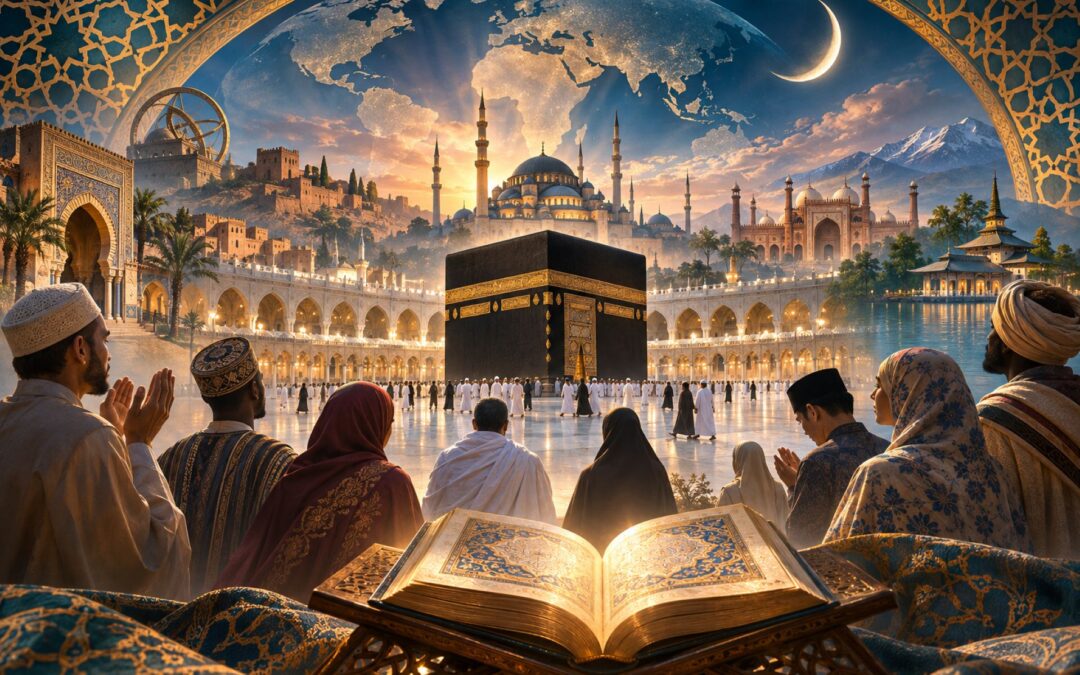
A truce at Hudaybiyyah in 628 helped alter the balance between the Muslims and Mecca. In 630 Muhammad returned to the city with a substantial following, and Mecca submitted with relatively little fighting, though accounts differ in detail. Islamic tradition describes the removal of idols from the Kaaba and its rededication to worship of the one God. The sanctuary became the focal point toward which Muslims would pray, even though worship was directed to God rather than to the building. The Kaaba had already served as a place of pilgrimage, but in Islamic understanding its significance was now tied to Abrahamic monotheism. Its sacred status and its position at the centre of pilgrimage would connect generations of believers far beyond Arabia.
Muhammad died in 632. By then the movement had transformed much of Arabia, but it had not settled every question about leadership after him. Abu Bakr emerged as the first caliph, or successor in leadership, while disagreements over the claims of Muhammad’s cousin and son-in-law Ali contributed over time to the development of Sunni and Shia traditions. The later history of Islamic empires followed political paths that extended far beyond Muhammad’s original community, carrying Islamic institutions across Africa, Asia and parts of Europe through conquest, migration, trade and teaching. Yet military expansion and religious conversion were not the same event. Many populations under Muslim rulers remained Christian, Jewish, Zoroastrian or otherwise non-Muslim for generations, while traders, migrants and teachers helped Islam take root in regions such as maritime Southeast Asia without a single uniform process of conquest. Islam spread through human networks as well as governments.
What Muslims Believe About God, Prophets, and the Afterlife
The foundation of Islamic belief is tawhid, God’s absolute oneness. God is understood as creator, sustainer, all-knowing, powerful, just and merciful, without partners or equals. Worshipping another being as divine—or treating created things as if they possessed God’s unique status—is associated with shirk, a profound theological error. Islam does not ordinarily depict God as a human figure or regard God as having a biological sex, even though masculine grammatical language is commonly used in scripture and prayer.
In Islamic teaching, the world has moral purpose. The Quran tells the story of Adam and his spouse, describes humanity as originating from a common beginning, and repeatedly insists that wealth, ancestry and status cannot substitute for righteousness. Muslims have interpreted creation accounts and the relation between divine determination and human choice in different ways. Yet responsibility remains central: human beings are answerable for how they use the lives entrusted to them. Islamic creeds also give important places to angels, who carry out divine commands, and to divine decree, or qadar. How God’s knowledge and will relate to meaningful human freedom has generated centuries of serious theological disagreement, not merely one standard answer.
Muhammad is not the only prophet recognised by Islam. The Quran speaks of Noah, Abraham, Moses, David, Solomon, Jesus and many others as bearers of divine guidance. Jesus, known as Isa, is honoured as the Messiah and a great prophet, while his mother Mary, or Maryam, occupies a distinguished place in the Quran. Islam rejects the mainstream Christian understanding of Jesus as divine and does not accept the Trinity; these are major differences despite shared biblical figures and stories.
Muslims believe that God revealed guidance before the Quran, including the Torah associated with Moses and the Gospel associated with Jesus. Islamic views of how those earlier revelations relate to surviving Jewish and Christian scriptures differ, but Muhammad is generally understood as the final prophet and the Quran as the final authoritative revelation. That combination of shared ancestry and disagreement becomes clearer alongside the distinctive covenant, scriptures and practice explored in Judaism.
Another foundational belief is resurrection and judgment. The Quran portrays earthly existence as limited and insists that human actions, intentions, injustice and generosity matter beyond death. Individuals will be judged by God, whose justice and mercy are both emphasised. Paradise is described through images of gardens, flowing water, peace and abundance; hell through warnings of loss, punishment and estrangement from divine mercy.
Descriptions of the bridge over hell, often called al-Sirat, are especially prominent in Hadith and later religious teaching. They should not be confused with a single, detailed Quranic itinerary that all Muslims interpret identically. Muslims have differed over the fate of grave sinners, intercession, the duration of punishment and the relationship between faith, deeds and mercy. The common theme is that no earthly privilege removes moral accountability. Some influential Sunni teachings hold that sinful believers may ultimately be released from hell through divine mercy or intercession; other Muslim positions differ over the fate of particular groups and the meaning of eternal punishment. It would be misleading to present universal eventual salvation as a belief shared by all Muslims.
The Quran, Hadith, and Religious Authority
The Quran occupies a unique place in Muslim life because Muslims regard it as God’s revealed speech, conveyed to Muhammad in Arabic. The name is related to recitation, and its sound remains an essential part of religious experience. People hear Quranic passages in prayer, study them with teachers, memorise them and reflect upon their meaning in translation, though translations are not generally treated as identical to the Arabic original.
The Quran has 114 chapters, called surahs, containing verses known as ayat. Apart from the opening chapter, the collection is broadly arranged with longer chapters earlier and shorter ones later, rather than as a continuous account of Muhammad’s life. It moves among legal and moral guidance, stories of prophets, warnings, prayers, descriptions of the natural world and reflections on God’s mercy. Understanding a verse can therefore require attention to its chapter, language, interpretation and the circumstances in which it has traditionally been understood. The text is regularly recited aloud, and a person who memorises the entire Quran is traditionally honoured as a hafiz or hafiza. These practices show why learning the Quran is not limited to silently reading a printed book.
Muslim tradition holds that Muhammad recited revelations to his followers, some of whom memorised passages while others recorded them in writing. Accounts of compilation associate the preservation and standardisation of the written text especially with the early caliphal period, including the reign of Uthman. Historians study manuscripts, inscriptions and literary traditions to understand that process; the devotional claim of divine preservation and the historical study of textual transmission answer different questions.
The Quran does not give detailed instructions for every circumstance in Muslim life. Many verses address communities facing decisions about worship, family, commerce and conflict, while others invite reflection rather than prescribing a precise rule. For that reason, translation alone seldom resolves every interpretive question: readers also confront Arabic vocabulary, the relation between passages and the authority of inherited explanations. The Sunnah refers broadly to the normative example of Muhammad, and Hadith are reports of his words, actions or approvals, transmitted through successive narrators and eventually gathered into collections. Some were written down early, but major canonical compilations were assembled generations after Muhammad. Scholars assessed chains of transmission, known as isnad, and the contents of reports, or matn, using methods that developed over time.
Reports receive different authenticity judgments, such as sound, fair or weak, and scholars can disagree about individual narrations. Sunni and Shia traditions draw upon partly different collections and authorities; some Muslims also question how strongly Hadith should shape practice. Popular claims about the exact rewards of paradise, for example, cannot be settled by declaring every report about them either unquestionably authentic or uniformly rejected. Responsible discussion distinguishes what the Quran says from what later narrations and commentators say.
Authority in Islam is consequently more complex than the claim that it has “no priests.” Most Muslims can pray directly to God without a priest as an intermediary, but imams, jurists, theologians, teachers and institutions hold varying kinds of religious influence. Their authority differs among communities, and none represents every Muslim. Religious learning has always involved argument about texts, methods and the boundaries of legitimate interpretation.
The question of depicting Muhammad illustrates that diversity. The Quran contains no explicit blanket prohibition on drawing him, but Hadith and broader religious concerns about images have shaped many traditions of aniconism. Historically, some illustrated Persianate and other Muslim manuscripts represented Muhammad, sometimes with his face veiled or a flame-like halo. Many Muslims today regard such depictions as inappropriate or deeply offensive, while practices and opinions are not uniform. Respect for believers and recognition of artistic history can coexist without pretending the controversy has one simple answer. Offence and disagreement over depictions also provide no justification for intimidation or violence, a distinction that should not be obscured when the issue enters public debate.
The Five Pillars of Islam
Religious belief is meant to shape conduct, not remain an abstract statement. In Sunni teaching, the Five Pillars describe fundamental practices that give Islamic life a shared rhythm. Shia traditions recognise the central importance of these acts too, though their formal classification of religious obligations is not always identical. The Five Pillars of Islam provide a useful starting point for understanding what religious commitment looks like in everyday life.
The first is the shahada, the declaration that there is no god but God and Muhammad is God’s messenger. It expresses monotheism and recognition of Muhammad’s mission in a remarkably compact form. Someone entering Islam may pronounce it as a profession of faith, but a person’s Muslim identity and religious life cannot be reduced to a mechanical utterance detached from understanding or intention.
The second is salat, the prescribed ritual prayer performed at five daily times in the dominant Sunni and many other Muslim traditions. The regular cycle interrupts work, travel and ordinary routines, repeatedly redirecting attention to God. The five prayers are associated with dawn, midday, afternoon, sunset and night, although calculation methods and local circumstances affect exact times. They can be performed individually, while prayer in congregation adds a social dimension to what is also an intensely personal act. Prayer involves prescribed recitations and bodily movements, including standing, bowing and prostrating. Arabic plays a central role, even for Muslims whose everyday language is something entirely different.
Before praying, worshippers normally perform wudu, ritual purification involving washing the face, arms and feet and wiping the head. Muslims pray facing the qibla, the direction of the Kaaba in Mecca, making a shared point of orientation possible across enormous geographical distances. Mosques are organised to indicate that direction, often with a mihrab, a niche in the qibla wall, while prayer may also take place at home, at work or elsewhere in a suitably clean setting. Congregational Friday prayer has particular communal importance.
The third pillar, zakat, makes concern for others part of religious obligation. It is often described as a charitable payment, though in classical law it is a structured duty on certain types of wealth above specified thresholds, rather than a flat tax on every possession. A commonly cited rate is 2.5% for qualifying monetary wealth held for the required period; other assets and circumstances have different rules. The Quran identifies categories of recipients, including people in need, and the practice connects personal possessions with responsibilities beyond the household.
Voluntary giving, or sadaqah, extends that ethic beyond compulsory calculation. Muslims may donate money, support relatives, feed neighbours or contribute to community organisations. Charity’s importance does not mean that every proposed estimate of total worldwide Muslim giving is reliable, nor that poverty disappears in societies where zakat is widely observed. The principle is more enduring than an impressive but poorly supported global number.
The fourth pillar is sawm, most visibly observed through fasting during Ramadan, the ninth month of the Islamic lunar calendar. From dawn until sunset, fasting Muslims abstain from food, drink and sexual activity, while also being encouraged to restrain anger, dishonesty and harmful conduct. Smoking is likewise avoided during the fasting hours. The pre-dawn meal, suhoor, and the sunset meal, iftar, shape household routines and bring families, friends and communities together at different ends of the day. The fast is not simply a demonstration of endurance: it encourages self-discipline, gratitude, worship, attention to hunger and concern for people whose deprivation is not voluntary.
Religious obligations also recognise human vulnerability. People who are ill, travelling or otherwise covered by recognised exemptions may postpone or be excused from fasting under applicable rules; menstruating women do not fast on those days and generally make them up later. Pregnancy, nursing, chronic illness and old age can involve further provisions that vary with circumstances and legal interpretation. Ramadan culminates in Eid al-Fitr, a celebration marked by communal prayer, visits, shared meals and a required charitable giving associated with the festival.
The fifth pillar, hajj, is pilgrimage to Mecca during specified days of the lunar month of Dhu al-Hijjah. It is required once in a lifetime of Muslims who possess the necessary physical and financial means. The pilgrimage includes entering a state of consecration called ihram, circling the Kaaba, moving between Safa and Marwa, standing at Arafat and completing other prescribed rites. These practices connect worshippers to narratives about Abraham, Hagar and Ishmael as preserved in Islamic tradition.
Hajj creates an unusual experience of collective religious identity. Pilgrims from many languages, nationalities and economic circumstances gather at the same sacred locations and perform recognisable common rites. The ideal of equality is powerful, even though access, travel costs and lived experiences are not identical. Alongside the Five Pillars, countless other practices—learning, hospitality, family responsibilities, commercial honesty and care for neighbours—shape the daily expression of Islam. Muslims also observe different festivals and commemorations beyond the two major Eids, depending on their communities. The significance of a particular practice is not always captured by a formal list of obligatory acts.
Sunni, Shia, and the Diversity Within Islam
The largest division within Islam developed around the question of leadership after Muhammad’s death. Abu Bakr became the first caliph, followed by Umar, Uthman and Ali. Sunni Muslims generally regard these four as the rightly guided caliphs, although historical disputes during their reigns were sometimes bitter. Shia Muslims understand Ali, Muhammad’s cousin and son-in-law, as the rightful successor and give special authority to leaders from the Prophet’s family. The distinction is tied to different memories of Muhammad’s statements, relationships and final years; each tradition has developed arguments about what those events established. Simply describing the beginning as an ordinary vote conceals those religious questions.
This was never merely a dispute over who won a single election. Over generations, arguments about succession became disagreements about the nature of legitimate religious guidance, the status of the Imams and the interpretation of inherited teachings. The death of Husayn, Ali’s son and Muhammad’s grandson, at Karbala in 680 became a particularly significant event in Shia memory, commemorated during Ashura as a symbol of suffering and resistance to injustice.
Sunni Muslims constitute the large majority of the world’s Muslims, while Shia Muslims form a substantial minority, often estimated at roughly one-tenth to one-eighth of the total, depending on definitions and survey limitations. Shia communities include Twelver and Ismaili traditions, while Ibadi Islam has a distinct history and is especially associated with Oman. Sufi paths of spirituality are not simply a third sect: mystical practice can be found across different Muslim communities, and some Muslims approach it critically.
Neither “Sunni” nor “Shia” describes a uniform culture or a single political position. Muslims also differ by school of law, theology, language, region, upbringing, degree of observance and personal conviction. Some disagreements concern major doctrines; others concern how to pray, calculate religious duties or interpret a passage. Recognising those differences does not erase the beliefs and practices that connect the communities. Daily religious life can also be shaped by the Hanafi, Maliki, Shafi’i and Hanbali Sunni legal schools, as well as Shia jurisprudential traditions. A disagreement over a detail of ritual or legal interpretation need not imply that one participant considers the other outside Islam.
Women, Modesty, and the Debate Over Veiling
Questions about Muslim women often become debates about clothing before anyone considers the women’s own experiences. Yet clothing is only one part of a much larger religious and social history involving education, property, marriage, family obligations and interpretations of authority. The Quran addresses both men and women as morally accountable people and calls for modest conduct, while later legal and social traditions have developed differing rules about what that requires.
The garments frequently grouped together as “the veil” are not identical. A hijab commonly refers today to a headscarf covering hair and neck, though the term has broader meanings in religious discussion. A niqab covers the face apart from the eyes; a chador is a large cloak associated especially with Iran; and a burqa can describe different covering garments, including the full-body, face-screened covering associated with Afghanistan. Local names, styles and customs vary considerably.
Muslim women may wear these garments out of devotion, modesty, identity, family tradition, social expectation or some combination of reasons. Others do not cover their hair at all. Religious scholars disagree about the precise requirements of Quranic passages and Hadith, particularly about covering the face. Political rules add another dimension: both forced veiling and restrictions on religious dress can curtail women’s ability to make decisions about their own bodies and public participation.
The historical record is more complex than a claim that veiling was either invented by Islam or copied intact from one neighbouring culture. Practices of female covering and status distinctions existed in parts of the ancient Near East and Mediterranean before Islam, but they changed through Muslim societies and acquired different meanings. One must distinguish the social history of clothing from the textual arguments Muslims make about it today.
Islamic scripture and law gave women recognised claims in areas such as inheritance, marriage payments and property ownership, although rights, legal procedures and their practical enforcement varied by time and place. These developments should be described in historical context rather than as proof of complete modern gender equality. For example, Quran 4:11 sets out inheritance shares that in certain relationships assign a son twice a daughter’s share; other inheritance arrangements depend on which relatives survive.
Marriage and divorce rules have also varied across juristic schools and modern legal systems. Women’s education and scholarship have important historical precedents, including women who transmitted Hadith, but opportunities have never been uniform across all Muslim societies. Pew’s comparative research on Muslim views of women documents substantial variation in attitudes toward veiling and other gender questions. Any useful explanation must leave space for conservative, reformist and other voices, including disagreements among Muslim women themselves. Groups such as Musawah argue for gender justice through engagement with Islamic legal reasoning and changing social conditions, while other Muslims challenge their conclusions as departures from established jurisprudence. The debate concerns not only what scripture says, but also who interprets it and how religious ideals should inform enforceable law.
Halal, Food, and Everyday Conduct
The word halal means permissible, while haram means forbidden. They refer to much more than a menu: actions, financial dealings, personal relationships and other conduct may also be evaluated through Islamic ethical and legal frameworks. In food discussions, the clearest widely recognised prohibitions include pork, blood as food and intoxicating alcohol, together with restrictions on how certain animals may be slaughtered.
A permissible species is not always enough to make meat halal. Traditional rules generally require specified slaughter procedures and the invocation of God’s name, with differences among legal schools over details and exceptional circumstances. Compassion toward animals is an important theme in Islamic ethical teaching, but it is misleading to promise that a particular method necessarily guarantees instantaneous or painless death. Animal-welfare standards and the treatment of stunning are subjects of contemporary religious and scientific debate.
Dietary lists circulating online can be excessively absolute. Scholars differ about some animals and seafood, and Yale’s overview of Muslim dietary restrictions notes variations in practice. Muslims may also differ in how they evaluate ingredients, food processing, restaurants and certification systems. The wider purpose is to connect ordinary consumption with religious commitments, not to imply that every Muslim follows an identical checklist. Islamic teachings concerning animals also extend beyond whether meat is lawful: stories and ethical injunctions encourage kindness to creatures, condemn needless suffering and present mercy as a moral virtue. The spiritual importance of those principles does not remove the need for honest scrutiny of real slaughter practices.
What Sharia Actually Means
Few Islamic terms are more frequently discussed—or more poorly defined—than sharia. The Arabic word evokes a path, traditionally explained through the image of a way leading to water. In religious thought, it refers broadly to God’s guidance for human life: worship, moral responsibilities, relations with others and the pursuit of a just order. Translating it only as “law” can conceal that wider ethical meaning, but describing it as nothing more than personal spirituality makes the opposite mistake.
A crucial distinction is between sharia as the divine ideal and fiqh as human understanding of legal and ethical obligations. Jurists interpret the Quran and Sunnah using methods that can include consensus, analogy and forms of independent reasoning. Their conclusions may differ according to the evidence they accept and the procedures they use. The scholarly account of sharia and Islamic law helps explain why Islamic jurisprudence is a developing intellectual tradition rather than one unchanging code handed down in a single book.
Consider prayer. The Quran requires worship, but detailed rules about its performance have been elaborated through inherited example and jurisprudence. The same interpretive process applies to fasting, commercial agreements, marriage, divorce, inheritance and other parts of life. What one community regards as a settled rule may be disputed by another, and the fact that an opinion belongs to classical jurisprudence does not make it identical to an explicit verse of the Quran.
Islamic legal scholarship has also addressed public administration, punishment and war. Some of its doctrines were enforced by rulers and courts; others governed ritual practice or moral behaviour without resembling modern legislation. Different legal schools developed methods and rulings, while actual societies frequently combined juristic principles with local custom, royal regulations and political realities. To say that sharia has never operated as enforceable law would therefore be as inaccurate as claiming that every Muslim society followed the same religious criminal code.
Muslim thinkers have articulated purposes of the law that include protecting life, religion, intellect, family or lineage, and property. These often-discussed maqasid provide one way of evaluating legal rules, although the framework has its own history and competing interpretations. They can inform arguments for reform as well as arguments for preserving established legal traditions. What counts as justice, and who possesses the authority to decide, remains a central disagreement.
Economic ethics offers a familiar illustration. The prohibition of riba has been understood by most contemporary Islamic jurists to encompass conventional interest-bearing loans, though arguments continue over the classification of particular transactions and the design of Islamic financial products. Zakat, prohibitions on fraud and expectations of fair dealing similarly connect religious morality with economic life. It is not accurate to say that Muslims are forbidden from making money through commerce; trade and lawful profit have long been central to Muslim societies.
Modern states use the language of sharia in very different ways. Some incorporate selected family-law rules, others regulate finance or criminal matters, and some movements claim sweeping authority to impose their interpretation of Islam. Muslims debate these projects vigorously, including their implications for women’s rights, religious minorities, civil liberties and democratic government. The abuses of extremist organisations should be neither excused as inevitable expressions of Islam nor used to pretend difficult legal and political controversies do not exist. There is no single contemporary Muslim position on whether, or how extensively, a government should legislate from religious sources. Views range from advocacy of explicitly Islamic political institutions to arguments for a secular state that protects the freedom of religious life.
These arguments are not an unfortunate modern addition to an otherwise interpretation-free religion. They follow from a continuing question: how should revelation guide people living in circumstances that change? The history of Islamic jurisprudence, theology and intellectual debate shows how scholars, rulers, philosophers, mystics and reformers have offered competing answers for centuries.
Islam is consequently both more recognisable and more varied than the headlines suggest. Its central commitments—to one God, revelation, worship, charity and accountability—give Muslims across the world a shared religious language. But the meaning of living faithfully has been worked out in different societies, through inherited practice, argument, personal devotion and sometimes political struggle.
Understanding Islam does not require pretending those disagreements disappear, or treating its most controversial manifestations as the whole religion. It requires seeing the relationship between the foundation and the long history of human attempts to interpret it: a tradition held together by common reference points, yet continually shaped by the people who live within it.
Last Updated on November 9, 2026 by Aseem Gupta