
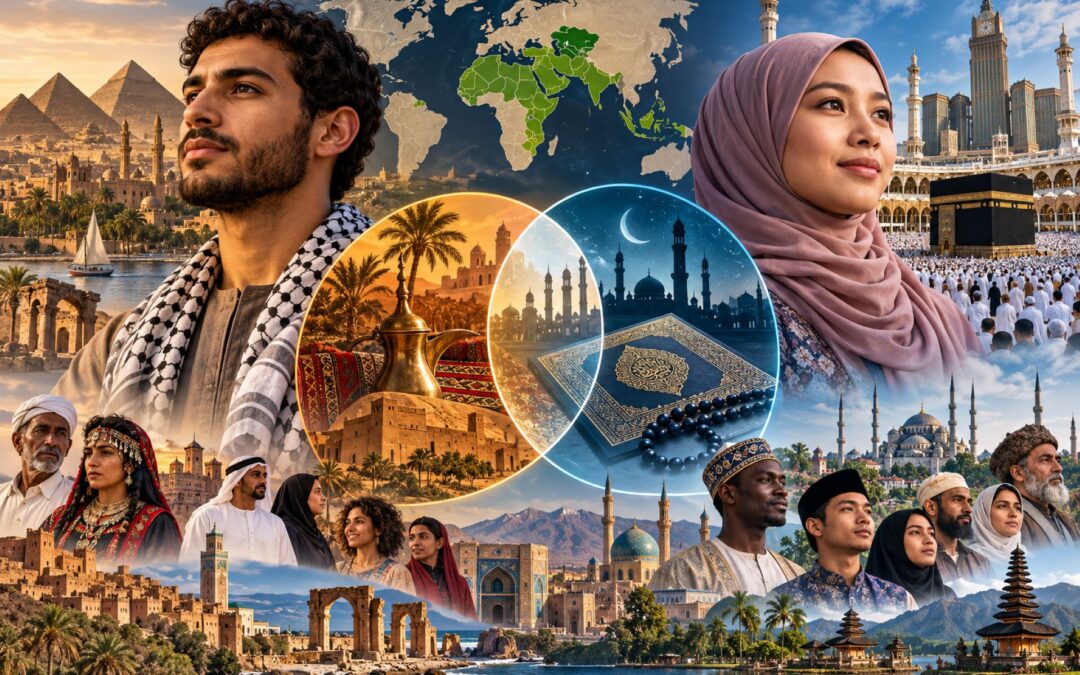
The words Arab and Muslim are frequently used as though they mean the same thing. News reports describe conflicts in the Middle East as Arab conflicts, discussions about Islam focus heavily on Arab countries, and people sometimes assume that someone who speaks Arabic must be Muslim. These associations are understandable, given the historical relationship between Arabs and Islam, but they create a misleading picture of both identities.
Consider two people: an Arab Christian from Lebanon and a Muslim from Indonesia. The first is Arab but not Muslim, while the second is Muslim but not Arab. Both identities can also belong to the same person, as they do for millions of Arab Muslims across the Middle East and North Africa.
The difference becomes clearer once we separate ethnicity, language, culture, nationality, and religion. Arab identity existed long before Islam emerged, and Islam eventually spread far beyond the societies where Arabic originated. Their histories became deeply intertwined, but the Arab world and the Muslim world are not interchangeable.
Arab and Muslim Are Two Different Identities
The fundamental difference between Arab and Muslim is that Arab is primarily an ethnolinguistic and cultural identity, while Muslim is a religious identity. The first concerns a person’s relationship to Arab peoples, languages, heritage, and culture. The second concerns their identification with Islam, a religion that originated in seventh-century Arabia.
An Arab is generally someone who identifies with the Arab cultural and linguistic world, often through family heritage, community, language, or upbringing. Arabic is an important unifying feature, but it is not an absolute requirement. Someone raised outside the Arab world may still identify as Arab through ancestry and cultural belonging, while another person born in an Arab country may belong to a different ethnic community.
A Muslim, by contrast, is someone who follows or identifies with Islam. Muslims can belong to virtually any ethnic group, speak any language, and live anywhere in the world. An Indonesian Muslim, a Turkish Muslim, an Iranian Muslim, and an Egyptian Muslim share a religious identity without necessarily sharing an ethnic or linguistic one.
These categories are therefore neither mutually exclusive nor identical. A person can be Arab and Muslim, Arab and Christian, non-Arab and Muslim, or neither Arab nor Muslim. The distinction is comparable to the difference between identifying someone as ethnically Indian and identifying them as Hindu: the two may overlap frequently, but one does not automatically establish the other.
The confusion arises because Islam emerged among Arabic-speaking communities and profoundly influenced Arab history. Arabic subsequently became the language of Islam’s central scripture, while Arab-led empires carried the religion across vast territories. Understanding that relationship requires examining an important historical fact: Arabs existed long before Muslims did.
Arab Identity Began Long Before Islam
The Arab identity is considerably older than Islam. One of the earliest recorded references to Arabs appears in Assyrian records from 853 BCE, more than fourteen centuries before the emergence of Islam. The term initially referred to populations associated with Arabia and surrounding regions, although its meaning, geographic scope, and cultural associations changed considerably over time.
Ancient Arabian societies were not culturally or politically uniform. The peninsula contained communities with different tribal affiliations, languages, political arrangements, and religious traditions. Some worshipped multiple deities, while others followed forms of Judaism, Christianity, or other monotheistic traditions.
Christianity had established an important presence among several Arab communities before Muhammad’s lifetime. The Ghassanids, for example, were an Arab Christian political confederation associated with the Byzantine Empire. As accounts of pre-Islamic Arabia and the rise of Islam explain, Arabia was connected to the wider religious and political struggles of the Byzantine and Sasanian worlds rather than existing in isolation.
Jewish communities also lived across the Arabian Peninsula, including in settlements such as Yathrib, later known as Medina. Some were closely integrated into Arabian tribal society, although it would be misleading to assume that every Jewish community shared the same ethnic identity. The important point is that Arab and Arabian societies were religiously diverse before Islam appeared.
Islam emerged in the early seventh century through the teachings of Muhammad, who was born in Mecca around 570 CE. According to Islamic tradition, he began receiving revelations around 610, calling people to worship one God and live according to divine guidance. Following his migration to Medina in 622, he became the leader of a growing religious and political community. By his death in 632, Islam had become an established force in Arabia.
Under the Rashidun caliphs and subsequent Umayyad and Abbasid dynasties, Muslim-ruled territories expanded dramatically. Arab-led armies conquered the Sasanian Empire and substantial Byzantine territories, while later campaigns and political developments extended Muslim rule across North Africa, the Iberian Peninsula, and parts of Central and South Asia. The Umayyad Caliphate became one of the largest territorial empires of its era.
However, the spread of Muslim political power did not mean that everyone under these governments immediately became Muslim or Arab. Conquered populations often retained their languages, religions, and cultural practices for generations. Conversion to Islam and the adoption of Arabic developed at different speeds, influenced by government, commerce, social relationships, religious institutions, and changing cultural prestige.
This distinction explains why some regions became predominantly Arabic-speaking while others adopted Islam without losing their older linguistic identities. Iran, for example, became a predominantly Muslim society while preserving and transforming its Persian language and cultural heritage. Islam spread across many communities, but their participation in a shared religion did not erase their separate histories.
Who Belongs to the Arab World Today?
The modern Arab world is generally understood as the collection of countries and societies connected by Arabic language, cultural traditions, and a shared sense of Arab historical identity. It stretches across North Africa and Western Asia, reaching from the Atlantic Ocean to the Arabian Peninsula and parts of the Horn of Africa.
A commonly used political definition comes from the League of Arab States, usually called the Arab League. Founded in 1945, the organization has 22 member states:
Algeria, Bahrain, Comoros, Djibouti, Egypt, Iraq, Jordan, Kuwait, Lebanon, Libya, Mauritania, Morocco, Oman, Palestine, Qatar, Saudi Arabia, Somalia, Sudan, Syria, Tunisia, the United Arab Emirates, and Yemen.
These countries form an enormous and geographically diverse region. Some, such as Saudi Arabia, Oman, and Yemen, occupy the Arabian Peninsula, while Algeria, Morocco, Tunisia, Libya, and Egypt form a substantial part of North Africa. Others, including Somalia, Djibouti, and Comoros, demonstrate that the political Arab world extends beyond the areas people usually associate with the Middle East.
However, membership in the Arab League does not mean that every citizen of a member country is ethnically Arab. The organization represents states, not individual ethnic identities. Its membership is useful for understanding the modern political Arab world, but it cannot serve as a universal definition of Arab ancestry or cultural belonging.
Arabic provides an important connection among these societies, although the language itself is far from uniform. Modern Standard Arabic is used widely in formal writing, education, broadcasting, government, and other official contexts. Everyday conversations, however, generally take place in regional varieties that differ in pronunciation, vocabulary, grammar, and sometimes mutual intelligibility.
These varieties are often grouped broadly into Maghrebi Arabic in western North Africa and Mashriqi Arabic in the eastern Arab world. Egyptian, Levantine, Gulf, Iraqi, and other regional forms have their own characteristics, while spoken Arabic in Morocco can differ considerably from varieties used in Iraq or Saudi Arabia. The western-eastern distinction is helpful for orientation, but it does not capture the full linguistic diversity of Arabic.
The Arab world also contains many languages that are not varieties of Arabic. Morocco provides a particularly important example because its constitutional provisions recognize both Arabic and Amazigh as official languages. Amazigh communities have their own linguistic and cultural histories, and their identities cannot simply be reduced to an Arab classification.
Similarly, Somali is central to life in Somalia, Comorian languages are widely spoken in Comoros, and Kurdish communities maintain distinct linguistic and cultural identities in parts of Iraq and Syria. Nubian, Armenian, Assyrian, and several other communities also form part of the region’s historical and contemporary diversity. Some individuals identify with both an Arab national culture and a separate ethnic heritage, while others emphasize their non-Arab identity.
These distinctions are especially important when considering countries commonly confused with the Arab world.
Iran is not an Arab country. Its predominant language, Persian or Farsi, belongs to the Iranian branch of the Indo-European language family rather than the Semitic language family to which Arabic belongs. The country contains multiple ethnic and linguistic communities, including an Arab minority, but its national and historical identity is not predominantly Arab. Its long experience of Persian cultural development under and after Arab Muslim rule illustrates why adopting Islam does not necessarily mean adopting Arab identity.
Turkey, Pakistan, and Afghanistan are also not Arab countries. Turkish is a Turkic language; Pakistan is linguistically diverse, with Urdu, Punjabi, Sindhi, Pashto, and other languages; and Afghanistan has major languages including Dari and Pashto. Some of these languages use writing systems derived from Arabic script and contain Arabic loanwords, but that does not make them forms of Arabic.
It is also important to distinguish the Arab world from the Middle East. The Middle East is a geographic and geopolitical designation that includes several non-Arab countries, notably Iran and Turkey. Meanwhile, much of the Arab world’s population lives in North Africa, a region that is sometimes overlooked when people associate Arab identity exclusively with the Arabian Peninsula.
Ultimately, the Arab world is united by significant linguistic, cultural, and historical connections without being ethnically homogeneous. Arab identity remains meaningful precisely because people can share a broader cultural belonging while maintaining different nationalities, local languages, religious traditions, and personal understandings of their heritage.
What Makes Someone Muslim?
A Muslim is someone who identifies with Islam, a monotheistic religion whose foundational teachings are associated with the Prophet Muhammad and the Quran. Unlike an ethnic identity, Muslim identity is not restricted to a particular ancestry, country, or language. People may be raised within Muslim families and communities or embrace Islam through conversion.
The central declaration of Islamic faith is the shahada, which affirms that there is no god but God and that Muhammad is God’s messenger. It expresses the fundamental religious commitment around which Islamic belief and communal identity are organized. Although Muslims differ in their interpretations and practices, this profession of faith occupies a foundational position.
In Sunni Islamic teaching, religious life is commonly organized around the Five Pillars of Islam. These are the declaration of faith (shahada), the five daily prayers (salat), obligatory charity (zakat), fasting during Ramadan (sawm), and pilgrimage to Mecca (hajj) for those physically and financially able to undertake it.
These pillars describe central religious obligations, not a simple checklist for deciding whether someone belongs to the Muslim community. Individual Muslims vary in religious observance, knowledge, interpretation, and personal circumstances. Islamic traditions also differ in how they organize and explain religious duties, so the familiar five-pillar formulation should not be treated as an exhaustive description of every Muslim theological tradition.
Islam contains considerable internal diversity. Sunni and Shia are its two largest branches, with differences rooted partly in disputes over political and religious authority following Muhammad’s death in 632. Those historical disagreements developed into distinct traditions of scholarship, religious institutions, legal interpretation, and communal practice.
Sunni Muslims constitute the majority of the global Muslim population, while Shia communities are especially important in countries such as Iran, Iraq, Azerbaijan, and Bahrain, as well as in parts of Lebanon, Yemen, and elsewhere. These countries are not internally uniform, and their religious populations cannot be understood entirely through a Sunni-versus-Shia division.
Other Islamic traditions also exist. Ibadi Islam, particularly associated with Oman, has its own historical development and intellectual traditions. Ismaili communities belong to a branch of Shia Islam, while Alawite identity has a complex historical relationship with Shia traditions. The Druze faith emerged in an Islamic historical environment but developed into a distinct religious tradition and should not simply be classified as another Muslim denomination.
The development of different schools of Islamic thought demonstrates that Islam has never been intellectually or institutionally uniform. Muslims have debated questions of religious authority, law, theology, spirituality, and political leadership for centuries, producing traditions that differ while remaining connected to Islam’s foundational history.
Despite these differences, Islam is a religious identity that crosses ethnic and national boundaries. A Muslim in Indonesia does not become Arab by practicing Islam, just as an Arab who follows Christianity does not cease to belong to Arab culture because of their religion. The distinction becomes even clearer when examining where Muslims actually live.
Where the World’s Muslims Actually Live
Although Islam originated in Arabia, most Muslims today live outside the Arab world. This is one of the most important facts for understanding why Arab and Muslim cannot be treated as interchangeable categories.
According to Pew Research Center’s global religious population estimates, published in June 2025, approximately 2.0 billion Muslims lived worldwide in 2020. This represented roughly one-quarter of the world’s population at that time, making Islam the second-largest religion after Christianity.
The geographic distribution is particularly revealing. Approximately 59% of the world’s Muslims lived in the Asia-Pacific region in 2020. This means the largest share of the global Muslim population was concentrated not in the Arabian Peninsula or North Africa, but across regions containing some of the world’s most populous countries.
Indonesia provides the clearest example. With approximately 239 million Muslims in 2020, it had the largest Muslim population of any country. Indonesia is a Southeast Asian nation with its own languages, ethnic communities, and cultural traditions. Its people are not considered Arabs merely because Islam is the country’s predominant religion.
Pakistan, India, and Bangladesh also have enormous Muslim populations. Pakistan and Bangladesh are Muslim-majority countries, while India has a Hindu-majority population alongside one of the largest Muslim communities anywhere in the world. Religious demography therefore cannot be understood solely by identifying which countries have Muslim-majority populations.
Islam has a substantial presence throughout Central Asia, across parts of sub-Saharan Africa, and in countries such as Turkey and Iran. Historical Muslim communities also exist in the Balkans, including Bosnia and Herzegovina, Albania, and Kosovo. China, Europe, and the Americas contain further Muslim communities with diverse ethnic, linguistic, and historical backgrounds.
Pew’s 2020 estimates identified 53 countries and territories with Muslim-majority populations. This figure refers specifically to places where Muslims constitute more than half the population. It should not be confused with the membership of the Organization of Islamic Cooperation, which includes countries on political and diplomatic criteria rather than an identical population threshold.
The Arab world is also much larger than the Arabian Peninsula alone. North African countries such as Egypt, Algeria, Morocco, and Sudan account for substantial portions of the broader region’s population. Any comparison that concentrates exclusively on Saudi Arabia and its immediate neighbours will underestimate the geographic reach and demographic importance of Arab societies.
The World Bank’s Arab World population data puts the region’s population at approximately 503.4 million in 2025. However, this is a total for residents of the countries included in the World Bank’s regional classification, not an ethnic census of Arabs. It includes residents from different ethnic, linguistic, and religious backgrounds and therefore cannot be directly compared with the global Muslim population as though both statistics measured ethnic groups.
The broader conclusion remains clear without relying on misleading percentages. Most Arabs are Muslim, but the worldwide Muslim population extends far beyond the Arab world. The distinction is not marginal: the global geography of Islam includes major societies whose languages, histories, and ethnic identities developed independently of Arab identity.
Where Arab and Muslim Identities Overlap—and Where They Don’t
The relationship between Arab and Muslim becomes easiest to understand through actual communities rather than abstract definitions. Both identities are meaningful, but they describe different aspects of a person’s background or beliefs.
An Arab Muslim might be a Sunni Muslim from Saudi Arabia, a Shia Muslim from Iraq, or a Muslim from Morocco who identifies with Arab language and culture. These individuals share a religious identity and some form of Arab cultural belonging, although their national histories, social customs, and religious practices may differ considerably.
An Arab Christian shares an Arab cultural or linguistic identity without following Islam. Arab Christian communities have long histories in Lebanon, Syria, Palestine, Jordan, Iraq, and other parts of the Middle East. Their traditions include Greek Orthodox, Greek Catholic, Maronite, Syriac, and other churches, with distinctive liturgical histories and cultural practices.
Egypt provides a more nuanced example. Many Coptic Christians speak Arabic as their everyday language, but their understanding of ethnic identity varies. Some may identify as Arab, while others emphasize a specifically Egyptian or Coptic heritage. Speaking Arabic or holding Egyptian nationality does not settle how every individual understands their ancestry and culture.
This illustrates why identifying Arabs purely through birthplace creates problems. Arab League countries contain communities whose histories predate the formation of modern Arab national identities. Some identify with broader Arab culture, some maintain distinct ethnic identities, and others combine several forms of belonging.
The opposite situation is equally common: millions of Muslims have no Arab ethnic heritage. Indonesian, Pakistani, Bengali, Turkish, Persian, Bosnian, and many African Muslims maintain their own languages and cultural traditions. They may read the Quran in Arabic, use Arabic expressions in worship, and travel to Mecca for pilgrimage, but religious participation does not transform their ethnic identities.
Arabic occupies a special position in Islam because it is the language of the Quran and important parts of Muslim worship. Yet using Arabic for religious purposes is different from speaking it as a native language or identifying with Arab culture. An Indonesian Muslim who recites Quranic verses in Arabic is no more automatically Arab than a Christian who studies scripture in Greek or Latin becomes ethnically Greek or Roman.
The Arab diaspora makes the distinction even more interesting because Arab identity can survive migration, language change, and religious diversity.
Brazil is a particularly revealing example. The country has a large population descended from immigrants who arrived from the Middle East, especially Lebanon and Syria. Their descendants have become part of Brazilian society while maintaining different degrees of connection to their ancestral cultures.
A survey of Arabs and people of Arab descent in Brazil, released in 2020 using earlier fieldwork, estimated approximately 11.61 million people with Arab ancestry. The figure should be understood as a survey-based estimate of ancestry and identification, not an exact contemporary count of people who speak Arabic or personally identify as ethnically Arab.
Many people of Arab descent in Brazil are Christian, reflecting the religious backgrounds of substantial historical migrant communities. Others are Muslim or follow different religious traditions. Some descendants retain Arabic language and cultural practices, while others speak Portuguese exclusively and experience their Arab heritage primarily through family history, food, community institutions, or cultural memory.
Brazil has also participated in the Arab League’s international relationships as an observer rather than a member state. That connection reflects diplomatic and historical ties, not a suggestion that Brazil itself is an Arab country. Its population demonstrates how Arab ancestry can extend well beyond the borders of the modern Arab world without requiring a corresponding Muslim religious identity.
These examples also show why religion, ethnicity, language, and nationality should not be inferred from appearance. There is no single Arab appearance or Muslim appearance. Both populations contain people with varied physical characteristics shaped by centuries of migration, intermarriage, settlement, and cultural exchange.
The terms become more useful when treated as different ways of describing identity rather than competing labels for the same population. A person may simultaneously be Brazilian by nationality, Arab by ancestry or cultural identification, and Muslim or Christian by religion. Another might be Iraqi by nationality, Kurdish by ethnicity, and Muslim by religion. None of those descriptions automatically cancels the others.
The difference between Arab and Muslim is therefore straightforward, even though the communities themselves are diverse and historically interconnected. Arab describes an ethnolinguistic and cultural identity; Muslim describes a relationship to Islam. Neither identity can reliably be determined by someone’s appearance, citizenship, native language, or assumptions about where their religion originated.
Confusing the two erases non-Muslim Arabs and overlooks the enormous diversity of Muslims outside the Arab world. Understanding their distinction does not require separating Arab history from Islamic history; the two have influenced each other profoundly for fourteen centuries. It requires recognizing that a shared history does not make ethnicity and religion the same thing.
Last Updated on October 29, 2026 by Aseem Gupta