
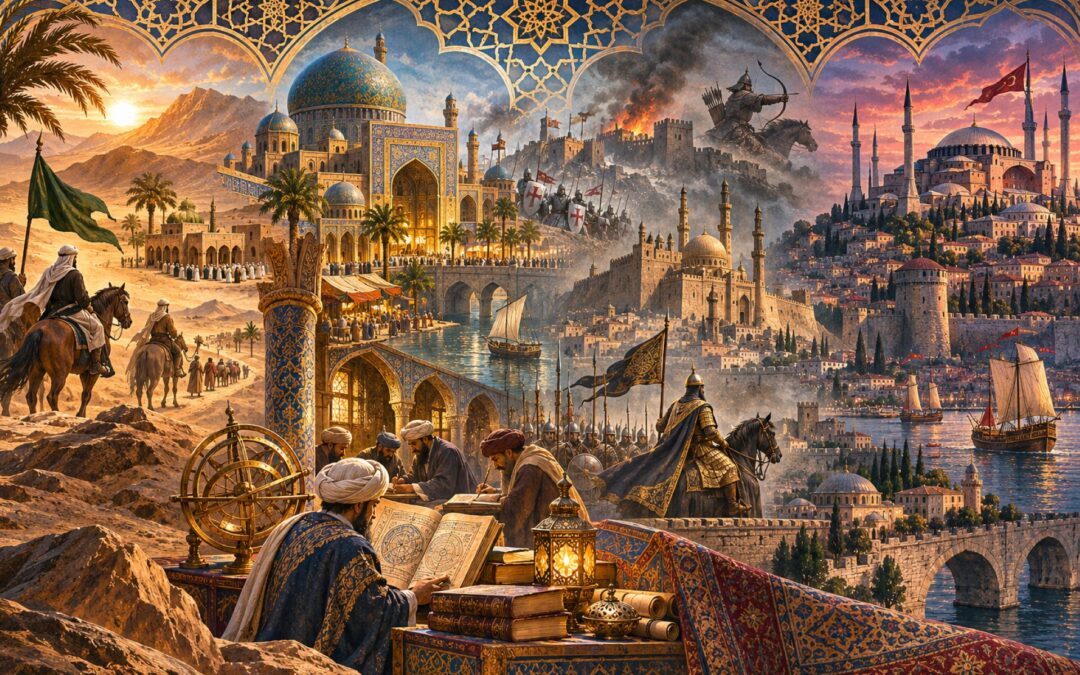
In 632, the death of Muhammad left a growing religious and political community in Arabia with a question its founder had not resolved to everyone’s satisfaction: who should lead it next? Less than a century later, the rulers who succeeded him commanded territories stretching from the Iberian Peninsula to the frontiers of Central Asia. Their power appeared astonishing, but the unity of that empire would prove much harder to preserve than its armies had found conquest.
Over the following centuries, the history of Islamic empires became a history of competing answers to that original question. Caliphs claimed leadership of the Muslim community while generals, governors, sultans, and rival dynasties increasingly exercised power in their own right. Baghdad flourished as an intellectual centre and fell to Mongol armies; Cairo hosted competing and later largely symbolic caliphal institutions; and the Ottomans eventually built an empire that outlasted the medieval political order from which it emerged.
These were not successive incarnations of a single state, nor were they exclusively Arab. What connected them was a changing set of religious ideas, political institutions, trade networks, scholarly traditions, and claims to legitimate authority. Understanding their history means following both the rulers who won territory and the institutions that survived when those rulers fell.
From Late Antique Arabia to Muhammad’s Muslim Community
Islam arose in a world already shaped by centuries of imperial rivalry. To Arabia’s northwest, the Byzantine Empire governed an extensive Christian state centred on Constantinople. To its northeast, the Sasanian Empire ruled Iran and Mesopotamia, sustaining an Iranian imperial tradition in which Zoroastrian religious institutions held an influential position. Their rulers fought repeatedly over frontiers, fortresses, commercial routes, and access to wealthy provinces, with Syria and Mesopotamia especially exposed to warfare.
The Arabian Peninsula was neither a uniform desert society nor an isolated territory awaiting a new religion. Pastoral communities maintained tribal alliances and competed for water and grazing land, while agricultural settlements, ports, and trading towns supported other ways of life. The western Arabian towns of Mecca and Yathrib belonged to a wider world of commerce, pilgrimage, and regional politics, even though the scale and organization of particular pre-Islamic trade networks remain debated. In the south, Yemen had its own complex history of kingdoms and interaction with the powers across the Red Sea.
Religious life was similarly varied. Different Arabian communities worshipped multiple deities, while Jewish and Christian traditions had established important presences in and around the peninsula. Arab Christian groups maintained relationships with Byzantium, and other communities were linked to Persian power. The appearance of Islam therefore belongs to the religious and political transformations of late antiquity in the wider history of the Middle East, not to a story in which Arabia suddenly encountered monotheism for the first time.
Muhammad was born in Mecca around 570. According to Islamic tradition, he began receiving divine revelations around 610, proclaiming the worship of one God, the coming judgment, moral responsibility, care for the vulnerable, and obligations within the community. These revelations eventually formed the Qur’an, Islam’s central scripture. Muhammad’s preaching attracted followers but also provoked opposition among groups whose social position and religious commitments differed from those of the growing movement.
In 622, Muhammad and his followers migrated to Yathrib, later called Medina. This journey, the Hijra, became the starting point of the Islamic calendar, but its political significance was as important as its later commemorative role. In Medina, Muhammad led a community that negotiated alliances, organized collective responsibilities, and confronted military threats. The emerging Muslim movement was no longer simply a group of believers gathering around a preacher; it was also developing the means to govern and defend itself.
The following decade involved conflict with Meccan opponents, changing relations among Arabian groups, and the expansion of Muhammad’s political authority. Mecca came under his control in 630, and by his death in 632 much of western Arabia recognized the new community’s leadership, although the nature and stability of its wider alliances varied. Islam had established a religious identity, a set of shared practices, and a political community. It had not established an uncontested rule for deciding who should inherit Muhammad’s authority.
That uncertainty matters because subsequent rulers could not simply become another prophet. Muhammad was regarded by Muslims as the final prophet, and the authority of his successors therefore required different justification. The next leaders would have to organize government, taxation, diplomacy, warfare, and communal life while claiming continuity with a religious mission whose founding figure could not be replaced.
The Rashidun Caliphs: Conquest and the Dispute Over Succession
After Muhammad’s death, influential members of the Muslim community recognized Abu Bakr as leader. He became the first caliph, a term commonly understood as successor or deputy, though its meaning and the office’s responsibilities evolved over time. His selection was not accepted as the only legitimate outcome by everyone associated with Muhammad. Competing views of leadership, including the claims associated with Muhammad’s cousin and son-in-law Ali, would acquire enduring importance.
Abu Bakr faced an immediate political problem. Several Arabian groups rejected the authority of Medina, withheld obligations, or followed other prophetic claimants. The campaigns traditionally called the Ridda wars helped reassert control across the peninsula and established that the new leadership intended to exercise political authority beyond Muhammad’s personal alliances. Abu Bakr died in 634, but the community he led had already become more firmly organized around a governing centre.
Under Umar, the second caliph, Muslim armies advanced into territories governed by Byzantium and the Sasanians. Byzantine forces suffered major defeats in Syria, including at the Battle of Yarmouk in 636, while the Sasanian military position was weakened at al-Qadisiyyah and in subsequent campaigns. Jerusalem came under Muslim rule in the late 630s, and Egypt was conquered in the early 640s. In Iran, a series of defeats eventually destroyed the Sasanian monarchy; its final king, Yazdegerd III, died in 651.
The speed of expansion demands explanation rather than awe alone. Byzantine and Sasanian governments had spent decades exhausting resources in near-continuous conflict, and some provincial elites had grievances against imperial rulers. Muslim armies also developed effective command arrangements, mobile forces, and ways of negotiating with defeated cities. But the inhabitants of conquered lands did not act as one bloc: some resisted, others reached agreements, and many adapted to whoever could guarantee order and taxation arrangements.
Conquest did not mean immediate conversion or the replacement of every local institution. Christians remained numerous in Syria and Egypt, while Zoroastrian communities continued across Iran; Jewish and other religious groups likewise lived under the new rulers. Arabic gradually gained administrative prominence, but Greek, Coptic, Persian, and other languages persisted. The distinction between Arab and Muslim identities is essential here: Arab-led armies established political control over populations that were neither uniformly Arab nor initially Muslim.
Running this new empire required increasingly elaborate arrangements. Garrison towns such as Kufa, Basra, and Fustat became military and administrative centres, while officials managed revenue, distributions to soldiers, and relationships with existing landholders. Non-Muslim subjects could receive recognized protection and maintain religious institutions, but the resulting arrangements involved unequal legal and fiscal positions. Policies varied over time and place; neither effortless harmony nor universal forced conversion describes the lived experience of imperial rule.
Political disputes intensified under Uthman, the third caliph. Criticism of appointments and the distribution of authority developed into rebellion, and he was killed in 656. Ali then became caliph amid contested loyalties, leading to the First Fitna, or civil war, in which Muslim forces fought one another. His struggle with Muawiya, the powerful governor of Syria, exposed the difficulty of reconciling religious legitimacy, regional military power, and the practical ability to govern.
Ali was assassinated in 661, and Muawiya established the Umayyad dynasty. The conflicts did not immediately produce two fully formed religious denominations with every later doctrine already defined. Over generations, however, the question of who possessed legitimate leadership contributed to the distinction between Sunni traditions, which developed around particular understandings of communal authority and precedent, and Shia traditions, which gave special authority to Ali and the Prophet’s family. The killing of Ali’s son Husayn at Karbala in 680 became a defining event in Shia memory, connecting political defeat with ideas of sacrifice and rightful leadership.
These changes reveal why the early caliphate should not be treated as a fixed constitutional model. As Ira Lapidus’s history of the caliphate to 750 makes clear, the office took shape amid changing circumstances of communal leadership, conquest, administrative growth, and dynastic conflict. Its holders governed an empire of exceptional breadth, but no durable agreement had emerged about where political authority ultimately belonged.
The Umayyads: An Arab Dynasty from Damascus to Iberia
Muawiya’s accession in 661 marked a decisive change in the caliphate’s political structure. The Umayyads ruled from Damascus, drawing upon Syria’s military forces and administrative resources, and increasingly treated succession as an affair of the ruling dynasty. This did not erase religious claims or the importance of the wider Muslim community. It did mean that a caliph now resembled an imperial monarch in ways that differentiated the Umayyad state from the earlier leadership centred in Medina.
The dynasty faced immediate challenges from those who rejected its legitimacy. After Muawiya’s death, rival claims and rebellions helped trigger the Second Fitna, a further period of civil war. The death of Husayn at Karbala in 680 belonged to this struggle and acquired significance far beyond its immediate military setting. Eventually, the Umayyad ruler Abd al-Malik reunited much of the empire and strengthened institutions capable of surviving local and dynastic crises.
Expansion continued across several frontiers, but the people conducting it were diverse. Arab and increasingly Islamized North African forces advanced into the Iberian Peninsula in 711, overthrowing much of the Visigothic kingdom and establishing the territory known as al-Andalus. Elsewhere, armies pushed into Central Asia and toward the northwestern Indian subcontinent. The empire’s extent was extraordinary, although borders were rarely as clearly controlled as a modern political map suggests, and military reach did not necessarily mean stable rule everywhere.
Muslim forces also campaigned beyond the Pyrenees. In 732, a Frankish army led by Charles Martel defeated a Muslim force near Tours or Poitiers, an event that later acquired the reputation of having saved Christian Europe from conquest. That sweeping conclusion goes beyond the evidence. As scholarship on the construction of Tours as a world-historical turning point explains, subsequent narratives invested the battle with meanings not established by the campaign itself. Muslim political positions in parts of southern Gaul continued for a time, and the frontier evolved through many conflicts and agreements.
Umayyad rule was also transformed from within. Abd al-Malik’s reign saw the increasingly systematic use of Arabic in administration and the development of an imperial coinage that expressed the dynasty’s religious and political identity. Jerusalem’s Dome of the Rock, completed in the late seventh century, provided an imposing architectural statement of Muslim rule and devotion. These initiatives helped distinguish the state from the Byzantine and Sasanian systems whose territory and institutions it had inherited.
Yet the empire could not govern through religious symbolism or conquest alone. Taxes from agricultural regions, provincial military arrangements, negotiation with local elites, and long-distance correspondence remained essential. Many officials drew upon established administrative experience, and new institutions adapted older practices rather than appearing fully developed from nothing. The relationship between imperial government and non-Muslim communities depended upon local conditions, legal obligations, and political demands that shifted over time.
A further tension concerned status within the growing Muslim community. Arab tribal and military elites occupied privileged positions in many settings, while some non-Arab converts—often called mawali in this context—resented unequal treatment or expectations inconsistent with their religious membership. Regional factions, disputes over military payments, and loyalty to rival claimants compounded these grievances. It would be too simple to describe the dynasty’s collapse as the result of one argument about ethnicity or religious purity; its opponents assembled a coalition of complaints and ambitions.
The rebellion that overthrew the dynasty drew especially important support from Khurasan, in the empire’s eastern territories. In 750, the Abbasid movement defeated the ruling Umayyad power in the central caliphate. One Umayyad survivor, Abd al-Rahman, eventually established an independent emirate in Córdoba in 756, ensuring that Umayyad rule continued in Iberia under a different political arrangement. Its later caliphal claims and the long history of Muslim Iberia and the Reconquista show that the fall of one dynasty’s eastern capital did not end every branch of its political tradition.
The Umayyad experience exposed a recurring contradiction. Conquest helped create a Muslim world extending across many languages, peoples, and traditions, but imperial governance continued to privilege particular families and political networks. The Abbasids promised a different kind of legitimacy and built their power farther east. Their success would make the caliphate more culturally inclusive in some important respects, even as the problem of controlling an enormous empire grew more difficult.
The Abbasids: Baghdad and the Remaking of Islamic Civilization
The Abbasid Revolution of 750 did more than replace one ruling family with another. The new dynasty claimed a close connection to Muhammad’s wider family and drew strength from eastern regions where Arab and non-Arab Muslims had become dissatisfied with Umayyad rule. Its success reflected religious claims, military organisation, rivalries among elites, and the possibilities of building a different imperial coalition. The centre of political gravity shifted toward Mesopotamia, where the administrative traditions of earlier Iranian and Near Eastern empires remained influential.
In 762, Caliph al-Mansur founded Baghdad on the Tigris. Its location connected fertile Mesopotamian agricultural regions to commercial routes extending toward Iran, Central Asia, the Mediterranean, and the Indian Ocean. A purpose-built capital allowed the rulers to organise administration around their own court, while the city’s expanding markets attracted merchants and artisans. Baghdad became a place where imperial revenue, commercial wealth, and opportunities for patronage reinforced one another.
The Abbasid state still required armies, tax collectors, governors, and negotiations with provincial elites. Its caliphs governed through elaborate court institutions and officials whose skills often drew upon Persian bureaucratic traditions as well as earlier Islamic practice. Wealth and power were unequally distributed, and rural producers supplied much of the revenue that sustained urban life. The empire’s achievement cannot be reduced to the image of an enlightened capital detached from the political and social costs of imperial government.
At the height of Baghdad’s prominence, especially during and after the reign of Harun al-Rashid, the city became associated with extraordinary intellectual and artistic activity. Scholars and translators worked with Greek philosophical and medical texts, often through Syriac Christian learning traditions, while Indian astronomy and mathematics contributed to new inquiries. Persian literature, political ethics, and courtly practices also influenced the cultural world of the Abbasids. Arabic served as a common language of much scholarship without making every contributor ethnically Arab or personally Muslim.
The translation movement did not merely preserve the achievements of older civilizations. Scholars questioned inherited authorities, applied mathematical procedures to new problems, developed medical discussions from clinical observation, and refined methods of astronomical calculation. Al-Khwarizmi’s mathematical writings contributed to the development of algebra and the transmission of calculation techniques associated with Indian numerals. Physicians such as al-Razi, and later intellectual figures across the wider Islamic world, helped create traditions whose influence would extend into Europe and beyond.
The term Islamic Golden Age can be useful, but it risks suggesting a single uniform interval in which scholarship flourished everywhere under uninterrupted official support. Intellectual centres changed, and religious, philosophical, and political debates were often contentious. Libraries, private patrons, courts, medical institutions, and networks of teachers all mattered. What united these different activities was not one government-directed programme but the circulation of people, texts, resources, and questions across a connected world.
Artistic production likewise reveals the complexity of Abbasid culture. Baghdad and Samarra supported architecture, decorative arts, ceramics, textiles, and manuscript traditions whose techniques travelled widely. The Metropolitan Museum of Art’s account of Abbasid artistic development places those achievements within the broader movement of styles and craftsmanship across Islamic territories. Artisans drew upon established Near Eastern practices even as courts and communities developed recognisable new forms.
Not all of this activity centred on Baghdad. Cities in Iran, Central Asia, North Africa, and al-Andalus developed their own commercial and scholarly networks, sometimes under rulers whose political interests competed directly with those of the Abbasids. Long-distance exchanges encouraged the movement of paper, books, practical techniques, and scientific ideas. The circulation of knowledge through these connections helps explain why intellectual traditions could endure even when an individual ruler or capital lost power.
The Abbasid caliphs nevertheless faced persistent problems of succession and military control. Court factions struggled over appointments, while rival heirs sometimes mobilised armies against one another. The civil war following Harun al-Rashid’s death, involving his sons al-Amin and al-Mamun, was especially destructive for Baghdad and exposed the fragility beneath imperial prestige. Later caliphs increasingly relied on military groups whose commanders became powerful participants in palace politics.
The creation and expansion of Samarra as a caliphal residence during the ninth century reflected, among other matters, the need to manage tensions between the court’s military forces and Baghdad’s population. Turkish military personnel acquired positions of influence, but their growing importance did not represent a single organised takeover by an entire ethnic people. These were shifting networks of soldiers, patrons, commanders, and rulers whose fortunes depended on court politics and military resources. The caliph’s position could remain exalted while his actual freedom to govern narrowed.
Fiscal strains, local rebellions, distance, and the ambitions of provincial dynasties further weakened central control. Some governors collected revenue, commanded troops, and negotiated foreign relations in ways that made them rulers in practice, whatever titles they adopted. Political fragmentation did not occur in one sudden collapse; it was uneven, reversible in places, and shaped by different regional circumstances. An empire that had presented itself as the centre of the Muslim world increasingly shared that world with governments it could not command.
This was the Abbasid paradox. Baghdad helped build an enduring transregional civilisation, yet the political institutions sustaining its early imperial supremacy could not indefinitely contain the diversity and competing interests that civilisation encompassed. Religious scholarship, trade, literature, and shared legal traditions acquired lives beyond the reach of a single caliph. As the next dynasties emerged, the question was no longer simply who inherited the caliphate but what power the person holding that title actually possessed.
When Caliphs Lost Power: Buyids, Fatimids, and Rival Claims
By the ninth and tenth centuries, the political map of the Islamic world no longer matched the ideal of an empire directed from one capital. Independent and semi-independent rulers governed important regions while Abbasid caliphs continued claiming an exceptional position within Sunni Muslim political life. Some provincial dynasties acknowledged the caliph in ceremonial forms yet collected their own revenues and waged their own wars. Others rejected his authority and developed competing claims to religious leadership altogether.
The transformation had begun through numerous regional developments rather than one decisive rebellion. In Egypt, the Tulunids established substantial autonomy in the late ninth century. In Iran and Central Asia, dynasties such as the Saffarids and Samanids asserted political independence while participating in broader Islamic cultural networks. Their courts could support Islamic scholarship and Persian literature without accepting direct administration from Baghdad. Military independence and religious identification were no longer inseparable.
This separation proved particularly important for Persian cultural history. The Arab conquest had ended the Sasanian monarchy but had not eliminated Iranian languages, administrative knowledge, or local identities. Under Muslim dynasties, New Persian developed into a major language of literature and court culture, generally written in a modified Arabic script. Persianate forms of political thought, poetry, and bureaucracy eventually influenced rulers far beyond Iran itself. The changing imperial traditions of Persia show why cultural continuity cannot be measured simply by asking which dynasty controlled the royal palace.
The Buyids offered an especially striking example of the distinction between power and legitimacy. Originating from the Iranian world, Buyid rulers expanded their authority over parts of western Iran and Iraq, entering Baghdad in 945. They controlled military and governmental power in the Abbasid capital while leaving the caliph in place. The caliph could continue to confer or embody religious legitimacy even though commanders and rulers outside his household determined many practical decisions.
The arrangement was neither a straightforward restoration of Persian monarchy nor a simple conquest of Islam by outsiders. The Buyids belonged to Muslim political society and used existing institutions for their own purposes. Their connections to Shia traditions also complicated their relationship with the Sunni Abbasid caliph, whose continued presence could nevertheless serve their interests. As the history of the Buyids illustrates, military control and caliphal recognition became parts of a negotiated political order, not a single indivisible office.
Other rulers went further by claiming the caliphate for themselves. The Fatimid dynasty emerged in North Africa in 909, drawing on Ismaili Shia ideas of legitimate leadership through the Prophet’s family. Its rulers challenged Abbasid claims not simply as provincial governors seeking independence but as rival leaders possessing a different understanding of religious authority. The resulting competition was ideological, diplomatic, and military, involving more than disagreement about a name or ceremonial title.
In 969, Fatimid forces conquered Egypt, where their government established Cairo as its new centre. The city developed into a major political, commercial, and intellectual capital, with the foundation of al-Azhar among the dynasty’s lasting institutional legacies. Fatimid rulers supported networks of Ismaili teaching and missionary activity, seeking influence among communities far beyond the territory they directly administered. The Fatimid caliphate’s history demonstrates how a claim to sacred leadership could support a competing imperial project with its own bureaucracy, army, and cultural institutions.
Economic geography was central to that competition. Egypt’s agricultural production provided rulers with substantial revenue, while its position connected Mediterranean markets, Red Sea routes, and commerce across the Indian Ocean. Control over resources enabled the Fatimids to support armies and urban life, but it did not guarantee stability. Succession disputes, military factions, economic crises, and opposition from rival powers repeatedly tested the regime.
A third claim to caliphal authority emerged in Iberia. After the Abbasid Revolution, Abd al-Rahman I had established an independent Umayyad emirate at Córdoba in 756. His descendants initially ruled without claiming the caliphal title, but Abd al-Rahman III declared himself caliph in 929, in a political environment shaped by the rivalry between Baghdad and the Fatimids. The resulting picture was unmistakably plural: different rulers claimed universal or exceptional leadership while commanding different territories and political constituencies.
The presence of several caliphates did not mean that ordinary Muslims everywhere experienced permanent doctrinal warfare. Traders crossed boundaries, jurists developed local traditions, scholars exchanged manuscripts, and dynasties entered alliances shaped by immediate political interests. Courts could compete bitterly over legitimacy while participating in related languages of law, philosophy, learning, and commercial life. Even within Sunni and Shia communities, institutions and interpretations differed over time and place.
A caliph’s name might still appear in the Friday sermon, or khutba, and on coins as a public sign of allegiance, but those symbols could conceal substantial political independence. Officials determined who collected taxes, appointed judges, commanded fortresses, and negotiated with neighbouring states. Caliphal legitimacy could strengthen a ruler’s claim, yet the ability to enforce decisions required material power. The distinction was never perfectly fixed, but it became essential to understanding medieval Islamic governance.
It is tempting to describe this period as a decline from an earlier unity. That language captures the loss of centralized Abbasid control but obscures the development of powerful regional courts, intellectual centres, and political institutions. The Samanids promoted Persian literary culture, the Fatimids developed Cairo, and Córdoba became an influential centre in western Europe. Political rivalry could produce violence and instability, but it also dispersed patronage and authority across a much larger network of cities.
The Abbasids themselves did not disappear. Their title retained religious and historical prestige long after they lost the capacity to command every major Muslim ruler. This made the office useful to military dynasties seeking recognition from a respected institution whose ruler possessed limited independent force. The expanding Seljuk state would develop that relationship into an influential model of sultanic power: a ruler who governed and fought while publicly recognising a caliph who represented a higher religious continuity.
The Seljuks: Turkic Sultans and the Transformation of Anatolia
The Seljuks arose from Turkic-speaking populations whose movements had long connected Central Asia to the Islamic world. Turkic groups were never a single homogeneous people following one migration route or sharing one political purpose. Some lived in pastoral confederations, others entered settled societies, and many served as soldiers in the armies of neighbouring states. Over time, increasing numbers embraced Islam and developed relationships with Persianate institutions and culture.
A lineage associated with Seljuk gave its name to a ruling dynasty that expanded into Iran during the eleventh century. Its leaders combined military strength with the skills of administrators, scholars, and officials experienced in governing settled populations. Persian became important in courtly and bureaucratic life, even as rulers drew prestige from Turkic military traditions and Sunni Islamic affiliation. The resulting state was a political synthesis, not the replacement of one entire civilisation by another.
In 1055, the Seljuk ruler Tughril entered Baghdad. He did not abolish the Abbasid caliphate or proclaim himself its religious replacement. Instead, his authority was presented in part as protection of the Sunni caliph against rival powers, including the Buyids. The arrangement helped elevate the political role of the sultan, a title increasingly associated with the exercise of military and governmental authority, while the caliph continued to embody a distinctive source of legitimacy.
This did not amount to a neat division between an entirely spiritual caliph and an entirely secular sultan. Both positions carried religious and political meanings, and their holders sometimes competed over appointments, jurisdiction, and prestige. Yet it expressed a fundamental development: the highest-profile ruler of an Islamic state did not necessarily need to be the caliph. Sovereignty could be exercised through dynasties claiming to protect a religious order whose universal leadership remained elsewhere.
The Seljuk Empire reached considerable power under Alp Arslan and Malik Shah. Its armies campaigned in Iran, the Caucasus, and Byzantine territory, while officials supported taxation, provincial government, and religious institutions. The celebrated vizier Nizam al-Mulk helped articulate ideals of administration and patronage; institutions associated with the Nizamiyya schools became part of a wider landscape of Sunni scholarship. These arrangements could strengthen the state but did not eliminate rival claimants, military factions, or courtly intrigue.
In 1071, Alp Arslan defeated Byzantine emperor Romanos IV Diogenes at Manzikert in eastern Anatolia. The emperor’s capture was a major humiliation for Byzantium, and the defeat contributed to political struggles that weakened its control over eastern provinces. But the notion that all of Anatolia instantly became Turkish or Muslim after a single battle is untenable. The historical significance of Manzikert lies partly in the sequence of Byzantine instability, Turkic settlement, and regional competition that followed it, not in an instantaneous transformation of the whole peninsula.
Turkic leaders and settlers established new positions across Anatolia during the following decades. Some communities negotiated with local elites, while others seized land or fought rival rulers; Christian and Muslim populations continued living in changing political arrangements. The Sultanate of Rum emerged as a major Anatolian state, with centres such as Konya developing institutions of government and commerce. Its culture combined Turkic, Persian, Islamic, and pre-existing Anatolian influences.
The larger Seljuk political system also fragmented after successive rulers died and regional dynasties asserted autonomy. The persistence of shared administrative and religious traditions did not require one state to control every province. In Syria and northern Mesopotamia, competing Seljuk-related rulers faced the Byzantine Empire, local Muslim rivals, and eventually incoming Crusader armies. These divisions helped shape the crisis that confronted the eastern Mediterranean from the end of the eleventh century.
The Seljuks therefore mark a change more lasting than their territorial map. They made the relationship between caliphal prestige and sultanic power a central feature of Islamic government, while their expansion helped create the political and cultural setting in which later Anatolian dynasties developed. Centuries later, the Ottoman principality would emerge from that world, inheriting institutions and ambitions shaped by earlier Turkic and Persianate states.
Crusades, Saladin, and a Fragmented Middle East
When Pope Urban II called for an expedition to the eastern Mediterranean in 1095, he was responding partly to Byzantine requests for assistance against Turkish forces. The Crusades emerged from Latin Christian religious ideas, papal ambitions, and the circumstances of European society, but their eventual course was shaped by the political divisions of the region they entered. There was no single Muslim government capable of responding for every city and dynasty from Anatolia to Egypt.
In 1099, Crusader forces captured Jerusalem, killing many Muslim and Jewish inhabitants and establishing a Latin Christian kingdom. Other Crusader states developed around Antioch, Edessa, and Tripoli. Their survival depended on fortified territories, access to Mediterranean shipping, reinforcements, and diplomacy with neighbouring rulers. Muslim states sometimes fought the newcomers and sometimes fought one another, while alliances did not consistently follow religious boundaries.
The Abbasid caliph in Baghdad retained prestige but did not command a unified military response. In Syria and northern Mesopotamia, leaders associated with the Seljuk political world competed for territory and authority. The fragmentation allowed the Crusader states to endure, although it also created opportunities for rulers who could consolidate larger military coalitions. The loss of Edessa in 1144 to Zengi’s forces demonstrated that the Latin states were far from secure.
Zengi’s successor Nur al-Din strengthened Muslim power in Syria and drew upon religious language to justify resistance to the Crusaders. Egypt became increasingly important because its fertile agricultural lands, cities, and trade networks could sustain substantial military resources. At the time, it was governed by the weakening Fatimid caliphate, whose Ismaili claims to leadership remained distinct from those of the Sunni Abbasids. The political future of Egypt would therefore determine more than which army could defend Jerusalem.
Saladin, a Kurdish commander who rose through campaigns involving Egypt, became vizier under the Fatimids in 1169. In 1171 he ended the Fatimid caliphate, bringing Egypt into an order that recognized Abbasid Sunni legitimacy, while he and his successors established the Ayyubid dynasty. Saladin subsequently extended his authority across much of Syria through a combination of warfare, diplomacy, and agreements with local elites. His achievement was not the reunification of every Muslim territory, but the creation of a power base capable of confronting the Crusader states more effectively.
In 1187, Saladin defeated a Crusader army at Hattin and recovered Jerusalem after its surrender in October. The loss provoked further expeditions from Europe, and the conflict continued across subsequent generations. Saladin’s political consolidation was therefore neither an absolute end to the Crusades nor proof that religion alone determined events. The wider history of the Crusades includes the shifting alliances, diplomatic settlements, and rivalries that complicate any image of two permanently unified civilisations facing each other.
Ayyubid authority itself fragmented among Saladin’s successors, who competed for control of Egypt, Syria, and neighbouring territories. Farther east, the Khwarazmian Empire had become a major power in Iran and Central Asia, inheriting regions once dominated by Seljuk rulers. Its rise introduced another military competitor into an already fractured political landscape. Soon the Khwarazmian state would face a force that disrupted existing kingdoms across Eurasia: the Mongols.
The Mongol Invasions and the Fall of Baghdad
The expansion launched by Genghis Khan in the early thirteenth century transformed the political geography of Eurasia. Mongol commanders built forces capable of coordinated movement over enormous distances, combining cavalry warfare, intelligence gathering, psychological pressure, and the integration of conquered military skills. Their campaigns were not confined to one religious frontier. Muslim, Christian, Buddhist, and other societies faced armies whose aims were imperial submission, security, and access to resources.
The Khwarazmian Empire became a major target after relations with the Mongols collapsed. Mongol campaigns beginning in 1219 overwhelmed important centres in Central Asia and Iran, destroying armies and devastating cities that resisted. Some settlements negotiated survival, while others experienced massacres, enslavement, and destruction of agricultural and commercial infrastructure. Medieval chronicles supply dramatic casualty numbers, but their precision is often doubtful; the scale of disruption is nevertheless beyond serious dispute.
These conquests undermined political systems that had previously connected Iran, Iraq, and neighbouring regions. Refugees, military groups, and displaced rulers moved westward, bringing the consequences of Mongol expansion into the affairs of the Ayyubids and Crusader states. Trade networks could be broken by warfare and later redirected by new imperial arrangements. The Mongols were therefore not simply another dynasty seeking Baghdad; they represented a military system capable of overturning multiple regional orders at once.
In the middle of the century, Hulagu, a grandson of Genghis Khan, led a major Mongol campaign into the Middle East. By then the Abbasid caliph in Baghdad had long exercised less authority than the rulers of the empire’s early centuries, but he still occupied an office of immense symbolic importance. Baghdad remained a major city with commercial, religious, and scholarly institutions. Its prestige was considerable, even if it no longer directed the affairs of the entire Muslim world.
Hulagu’s forces besieged Baghdad in 1258, and the city fell in February. The conquest involved extensive killing, plunder, and destruction; the caliph al-Mustasim was killed, bringing the Abbasid dynasty’s effective rule in Baghdad to an end. Popular retellings sometimes describe books being thrown into the Tigris until the river turned black with ink, or a caliph being trampled inside a carpet. Such stories should not be accepted as precise descriptions of established events merely because they capture the horror associated with the sack.
The event was a genuine political catastrophe. The Abbasids had linked the history of the caliphate to Baghdad for almost five centuries, and their defeat shattered an institution that had remained symbolically central despite its decline in practical power. Yet Baghdad’s destruction did not erase all learning across the Islamic world, nor did it abruptly halt medicine, philosophy, mathematics, or literature. Other intellectual centres remained active, and new patrons supported scholarship under different political regimes.
Even in Baghdad, scholarly and cultural life did not disappear permanently. Research on libraries and the transmission of knowledge in Ilkhanid Baghdad demonstrates that books, intellectual networks, and institutions continued to matter after the conquest. Recognising continuity does not minimise the devastation. It distinguishes a city’s enormous losses from a claim that an entire civilisation ceased to think or create.
Hulagu’s armies advanced into Syria, confronting political powers whose military responses differed from those of the Abbasid court. The Mongols had dismantled a long-standing centre of Islamic legitimacy, but they had not conquered every important Muslim state. Egypt remained under a formidable new ruling establishment, and the confrontation between that establishment and Mongol forces would shape the next political order of the Middle East.
Mamluks, Ilkhanids, and Timurids: Power After the Mongols
The Mamluk Sultanate originated in the military institutions of medieval Egypt, where rulers recruited enslaved young men from regions including the Eurasian steppe and trained them for professional military service. Such soldiers could attain high office through patronage, military skill, and personal networks. Over time, powerful commanders developed the capacity to determine successions and control the state itself. Their rise should not be confused with the simple claim that an unorganised collection of enslaved soldiers seized a throne; Mamluk authority depended on sophisticated military households and administrative institutions.
In 1250, amid the weakening of Ayyubid rule and pressure from Crusader armies, Mamluk leaders established control over Egypt. The new rulers inherited the country’s valuable agricultural resources and administrative traditions, along with the task of defending its regional position. Their military system was highly specialised, but it also required taxation, urban administration, legal officials, and connections with local elites. Egyptian government remained more than the private possession of the men who commanded its cavalry.
In 1260, an Egyptian army commanded by Sultan Qutuz, with Baybars playing an important role, confronted Mongol forces at Ain Jalut in Palestine. The Mamluk victory prevented the immediate extension of Mongol control into Egypt and transformed the regional balance. It did not mean that every Mongol army had been destroyed or that the Mongols never fought again in the Middle East. Rather, it showed that an expanding Mongol power could be resisted by an organised state with sufficient military resources and leadership.
Baybars soon became sultan and consolidated Mamluk rule over Egypt and Syria. He campaigned against Crusader fortresses, cultivated alliances, and used the resources of his territories to support sustained military pressure. The capture of Antioch in 1268 marked a major reversal for the Latin states, and later Mamluk rulers continued the campaign until Acre fell in 1291. Their power rested on long-term state capacity as much as on individual battlefield victories.
The Mamluks also addressed the vacuum left by the destruction of the Abbasid caliphate in Baghdad. Baybars installed a member of the Abbasid family as caliph in Cairo in 1261, restoring a symbol of Sunni legitimacy while leaving actual military and political authority with the Mamluk sultan. The arrangement exposed how deeply caliphal prestige had become detached from the ability to rule independently. It also made Cairo an important institutional successor to Baghdad without recreating the old Abbasid empire.
Mamluk rule persisted for more than two centuries, passing through phases commonly described as Turkish and Circassian. Internal succession struggles, elite competition, and economic difficulties challenged the system, but its rulers also sponsored architecture, scholarship, charitable foundations, and urban commerce. Egypt and Syria remained integral to Mediterranean and Red Sea networks. The caliph’s symbolic status did not prevent the sultanate from developing its own political traditions and priorities.
In Iran and Iraq, meanwhile, the Mongols established the Ilkhanate under Hulagu and his successors. Early Ilkhanid rulers did not all share the religion of the Muslim-majority populations they governed, and their court incorporated several religious traditions. Governing agricultural cities, taxing trade, and maintaining administration required cooperation with local officials, especially Persian bureaucrats. The conquerors gradually adapted elements of the Iranian and Islamic political systems they had displaced.
Conversion to Islam became particularly significant under Ghazan, who took power in 1295. The change did not erase Mongol political identities, but it reshaped relations between rulers, religious institutions, and their subjects. Ilkhanid patronage encouraged artistic and literary developments, while connections across Mongol-ruled territories facilitated movement of people, technologies, and ideas. The art of the Ilkhanid period reflects the interaction of Iranian, Islamic, and wider Eurasian influences.
After the Ilkhanate fragmented during the fourteenth century, rival powers competed across Iran and surrounding lands. Timur, a conqueror whose power base lay in Central Asia, assembled a vast empire through campaigns marked by both impressive military organization and terrible violence. Cities that resisted could suffer massacres and destruction, even as Timurid courts later supported historians, poets, architects, and scholars. Samarkand and other urban centres acquired distinctive importance within the cultural world created by Timurid patronage.
Timur’s armies also defeated the Ottomans at Ankara in 1402, temporarily disrupting a dynasty rising in Anatolia. Yet his empire did not establish a lasting unified government over the entire Islamic world. The region continued to contain competing political systems: Mamluks in Egypt and Syria, changing Iranian dynasties, Central Asian rulers, and Turkish principalities. This fragmentation created the conditions under which one frontier dynasty could gradually build an empire large enough to outlast nearly all of its medieval rivals.
The Ottoman Ascendancy and the End of the Caliphate
The Ottoman dynasty emerged in northwestern Anatolia around the turn of the fourteenth century, within a landscape of Turkish principalities, weakening Byzantine authority, and political traditions inherited from the Seljuks. Osman I is conventionally treated as its founder, though the often-cited date of 1299 should not be mistaken for a securely documented founding ceremony. The early dynasty built power through frontier warfare, alliances, settlement, and the absorption of neighbouring communities. Its state grew gradually, acquiring the administrative skills needed to govern towns and agricultural territories rather than relying indefinitely on raids.
Osman’s successors extended Ottoman rule across western Anatolia and into southeastern Europe. Bursa became an important early centre, while the acquisition of territory around Gallipoli during the fourteenth century provided access to the Balkans. Ottoman expansion involved conquest but also tributary arrangements, political marriages, negotiated submissions, and alliances with local elites. The dynasty increasingly governed Christian as well as Muslim populations, and its institutions developed within this diversity rather than after it had disappeared.
The defeat of Sultan Bayezid I by Timur at Ankara in 1402 nearly broke Ottoman political unity. Bayezid was captured, and rival dynastic claimants fought an extended civil war. The eventual reunification under Mehmed I demonstrated that Ottoman power depended on structures and relationships capable of surviving an extraordinary military setback. Later rulers resumed expansion, confronted Balkan coalitions, and made the Byzantine capital their central objective.
In 1453, Mehmed II’s forces besieged and captured Constantinople. The conquest ended the Byzantine Empire as a sovereign state and brought a strategically important city between Europe and Asia under Ottoman rule. Mehmed used the city as an imperial capital, encouraged resettlement, promoted commerce, and adopted forms of political legitimacy that connected Islamic sovereignty with the inheritance of Roman imperial authority. The Ottomans were not simply another Seljuk principality enlarged by warfare; they had become rulers of a major multiethnic empire.
Ottoman institutions reflected the varied demands of that empire. The sultan’s household, military establishment, provincial officials, judges, religious foundations, and fiscal administrators worked through arrangements that changed across centuries. Christian and Jewish communities maintained important institutions under recognised but unequal forms of imperial rule, while Muslim religious scholars and courts helped articulate legal authority. Later descriptions of a timeless and uniform millet system can mislead, because arrangements among religious communities and the state evolved considerably over time.
The most consequential expansion into the Arab Middle East occurred under Selim I. After defeating the Safavid ruler Shah Ismail at Chaldiran in 1514, Selim turned toward the Mamluk Sultanate. Ottoman victories in 1516 and 1517 brought Syria and Egypt under Ottoman authority, while relationships with the Hejaz strengthened the dynasty’s influence over Mecca and Medina. Cairo’s conquest ended Mamluk sovereign rule, although Mamluk elites remained important within Egypt’s subsequent administration.
These victories greatly increased Ottoman resources and religious prestige. They also encouraged later accounts in which the last Abbasid caliph in Cairo formally transferred the caliphate to Selim in 1517. That ceremony, however, is not established by reliable contemporary evidence. Scholarship on the Ottoman sultan-caliph tradition shows why the dynasty’s claims must be understood through their longer political and religious development, rather than treating a single disputed handover as the source of all subsequent legitimacy.
The Ottoman rulers increasingly occupied a prominent position in the Sunni Muslim world, but they did not lead a unified global Muslim state. Iran was ruled by the Safavids, who had established Twelver Shiism as a defining institution of their dynasty. Their rivalry with the Ottomans concerned territory, trade, dynastic interests, and religious authority, especially across Iraq, the Caucasus, and eastern Anatolia. In South Asia, the Mughal Empire developed another substantial Muslim ruling tradition within a predominantly non-Muslim and culturally diverse population.
These empires are sometimes grouped as gunpowder empires because firearms, artillery, and siege technologies contributed to their military success. The label identifies an important shared dimension but does not fully explain their political longevity or differences. Revenue systems, agricultural production, administrative skill, diplomacy, and the ability to command loyalty remained indispensable. Nor did the presence of several powerful Muslim-ruled empires restore the idea of one government speaking politically for all Muslims.
The Ottoman state persisted into the modern era through repeated adaptation. Its rulers confronted European military competition, shifting trade relationships, provincial challenges, nationalist movements, and debates about reform. During the nineteenth century, reforms associated with the Tanzimat sought to strengthen institutions and redefine the obligations of subjects, while political struggles raised questions about constitutional government and imperial identity. The empire was neither unchanged for centuries nor engaged in an uninterrupted, inevitable decline from a supposedly perfect classical moment.
War brought the decisive rupture. The Ottoman Empire entered the First World War on the side of the Central Powers and suffered defeat; the subsequent occupation and partition proposals threatened its surviving political order. Turkish nationalists under Mustafa Kemal led a struggle that culminated in the establishment of the Republic of Turkey in 1923. The sultanate had already been abolished in 1922, separating the Ottoman monarchy from the caliphal title that remained temporarily with Abdülmecid II.
On 3 March 1924, Turkey’s Grand National Assembly abolished the caliphate, an event documented in the official Turkish chronology of 1924. The decision ended the final Ottoman caliphal institution, though it did not settle every later debate about religious leadership among Muslims elsewhere. It also did not mean that religious learning, political movements, or Muslim communities ceased to exist outside the structures of a caliphate. The title had survived through centuries in which its practical meaning had changed repeatedly; now the Turkish republic chose not to retain it.
The full history of the Ottoman Empire encompasses military, social, cultural, and political developments far beyond its place in the succession of Islamic ruling systems. Within that longer succession, its achievement was to transform an Anatolian frontier principality into a durable imperial state that combined inherited institutions with new forms of sovereignty. The abolition of its caliphal office in 1924 gave the history of the classical and Ottoman caliphates a definite institutional ending, even as the historical influence of those empires continued.
The first caliphs had inherited an expanding community whose religious founder could not be replaced. Their successors built enormous empires, but neither shared faith nor inherited prestige ensured that armies, revenues, and political loyalties would remain under one ruler. The Buyids could command Baghdad while recognising an Abbasid caliph; the Fatimids could establish a rival caliphate in Cairo; Seljuk and Mamluk sultans could govern while drawing legitimacy from a caliph who lacked independent military power. The Ottomans inherited that complicated history rather than simply receiving an unchanged office from the seventh century.
That is what makes the history of Islamic empires more than a procession of spectacular conquests and defeats. Across dynastic upheavals, trade routes, schools of law, literary languages, scholarly institutions, and religious communities continued to connect peoples who lived under different states. Islamic civilisation was never identical to a single ruler or political border. Its political institutions changed profoundly, while the cultures and traditions they helped shape remained capable of renewal beyond the fall of any one empire.
Last Updated on November 1, 2026 by Aseem Gupta