
Reading Time: 18 Minutes
In March 2018, Toys “R” Us announced that it would close or sell its remaining stores in the United States. The retailer that had filled childhoods with towering shelves of action figures, dolls, board games and bicycles was preparing to disappear from American shopping streets. More than 30,000 employees faced losing their jobs, and the company’s founder, Charles Lazarus, died just a week after the liquidation announcement.
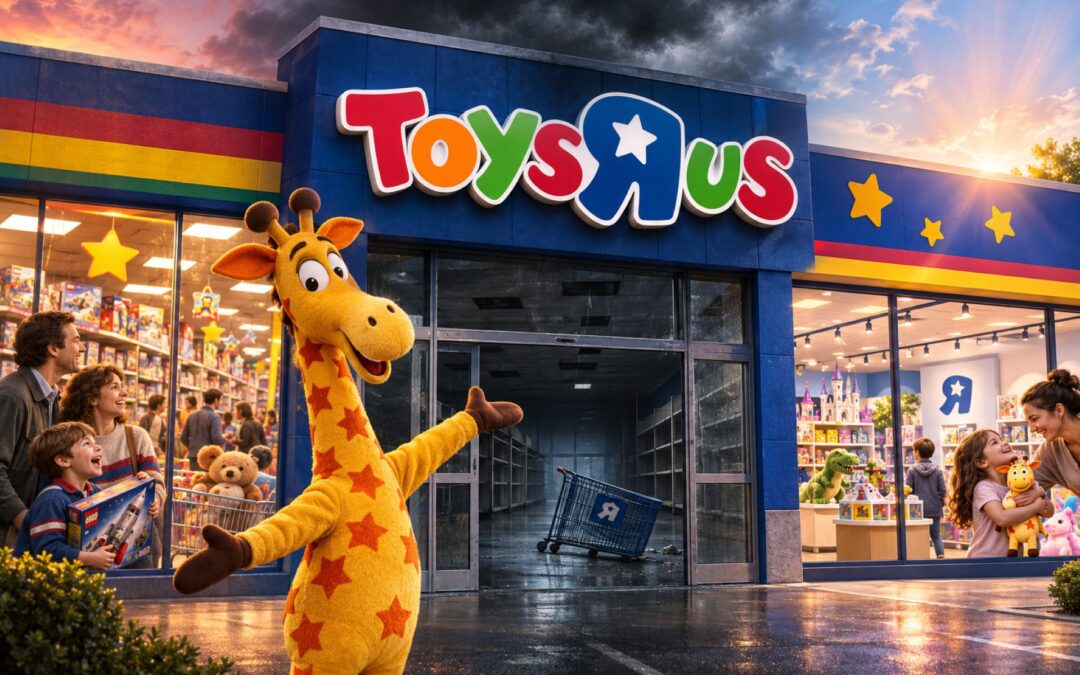
Then, in September 2026, a company carrying the Toys “R” Us name announced plans to open 120 new standalone American stores for the holiday season. Geoffrey the Giraffe was back, although the business behind him was profoundly different. Understanding the difference means looking beyond the familiar explanation that Amazon destroyed another traditional retailer.
Toys “R” Us had formidable competitors and genuine strategic weaknesses. But its final years were also defined by a debt burden so large that, in one financial year, almost all its operating earnings were matched by interest expense. Its history is a story of retail ingenuity, decisions that became constraints, a financial structure that magnified risk and a brand that proved easier to rescue than the stores that made it famous.
From Baby Furniture to America’s Toy Supermarket
Charles Lazarus returned from service in the Second World War to an America experiencing a remarkable surge in births. New parents needed cribs, high chairs, prams and everything else that came with raising children. Lazarus saw an opportunity in Washington, D.C., where his father had operated a bicycle business. As a historical corporate account filed with the SEC records, he opened a baby-furniture shop called Children’s Bargain Town in 1948, building his customer base around the rapidly expanding post-war family.
Furniture presented a problem that became obvious once the business was running. A family might buy an expensive crib, but it would not necessarily need another for years. Toys were different. Children outgrew them, broke them, developed new interests and wanted new ones at birthdays and Christmas. A parent could be an occasional furniture customer but a recurring toy customer, and Lazarus gradually shifted his attention toward the products people came back to buy.
By 1957, he was ready to give toys a store of their own. In Rockville, Maryland, he opened the first store under the Toys “R” Us name, taking an approach that was strikingly different from the small independent toy shops and seasonal department-store departments of the period. His stores were large, brightly stocked and organised for self-service. Families could browse enormous selections throughout the year, instead of waiting for a few holiday weeks when stores devoted extra space to toys.
The format borrowed from supermarkets: offer choice, make products easy to find, buy in volume and encourage customers to fill their baskets. A store might stock more than 18,000 different toys, far beyond what most neighbourhood competitors could carry. What looked like a playful business was also a disciplined system for turning scale into purchasing power. Greater selection drew families in; their spending justified more inventory; and the growing chain became an increasingly important customer for manufacturers.
Even the name was designed to be noticed. Lazarus used a shortened, memorable version of the business name, with a backward R that looked as though a child had written it. The company’s advertising also developed a giraffe character, originally known as Dr. G. Raffe. By the mid-1960s, he had evolved into Geoffrey the Giraffe, a mascot who would eventually become almost inseparable from the brand. Later, the company’s television commercials and its catchy song about never wanting to grow up gave children a reason to recognise the store before they were old enough to choose where their parents shopped.
Expansion demanded capital. In 1966, when Lazarus had four stores in the Washington area generating roughly $12 million in annual sales, he sold the business to Interstate Department Stores for about $7.5 million and remained in charge of the toy operation. The transaction might have made Toys “R” Us a modest division inside a larger retail group. Instead, it produced one of the stranger reversals in American retail history.
Interstate ran into serious financial trouble and entered bankruptcy proceedings in 1974. Its traditional businesses struggled, but the toy chain was valuable enough to form the foundation of the reorganised company. In 1978, the business emerged as Toys “R” Us, Inc., with Lazarus leading a public company whose identity now came from what had once been a subsidiary. The parent had failed; the toy business had survived and taken its place.
For the next decade, scale became an extraordinary advantage. Manufacturers wanted access to Toys “R” Us shelves, and the chain could shape which products received nationwide attention. It promoted traffic-generating bargains, including inexpensive diapers that encouraged parents to enter a store where toys offered more opportunities to spend. By 1990, estimates placed its share of the American toy market at roughly 25.4 percent. The retailer that had disrupted small toy shops seemed to have made itself indispensable. Yet the same formula that had overwhelmed independent competitors would soon be turned against it.
How Walmart Challenged the Toy King
Toys “R” Us had built an empire by offering families more toys in one place than almost anyone else could. Walmart did not need to copy the model. It already sold groceries, clothing, household goods and countless other products to customers who visited regularly, and it could treat popular toys as one more reason to bring those shoppers through the door.
Around 1990, Walmart increasingly promoted headline toys at aggressively low prices, sometimes accepting very thin margins to generate traffic. Toys “R” Us had used cheap diapers to encourage spending elsewhere in its stores. Now a much larger general retailer was applying similar logic to toys themselves. If parents could buy a coveted action figure or game console on a routine Walmart trip, a separate journey to the toy superstore became less necessary.
That difference in shopping habits mattered as much as the price tag. A toy specialist depended on customers making a deliberate visit, and an especially large share of its sales came during the holiday season. A superstore could spread store rent, staff and distribution costs across many categories and earn money from the rest of the shopping trolley even when a discounted toy yielded little profit. Target added another formidable alternative. By the end of the 1990s, Walmart had overtaken Toys “R” Us as America’s largest toy seller.
The threat was not that families suddenly disliked toys or forgot the giraffe. It was that specialist selection no longer guaranteed the lowest price or the most convenient purchase. Large, ageing stores could feel less inviting than they once had, and a reputation for abundant inventory did not compensate for weak service, untidy shelves or toys missing at the moment customers wanted them. Toys “R” Us still had recognised brands, international operations and its Babies “R” Us business, but its old advantages were becoming more expensive to maintain.
A second change was taking place beyond the physical shop. Video games had made electronics an important part of the toy business, yet digital distribution would progressively move some entertainment spending away from shelves and towards downloads and online accounts. Online retail was also changing how customers compared prices and found products. Toys “R” Us was not doomed the instant the internet appeared; it still sold enormous volumes of merchandise. But its future required expensive adaptation at precisely the moment its traditional competitive position was weakening.
The Amazon Partnership That Sacrificed Independence
In 2000, Amazon was an ambitious online business rather than the all-purpose retail giant it would become. Toys “R” Us understood that customers increasingly wanted to shop on the internet, but building reliable e-commerce technology, fulfilment and distribution capability was neither cheap nor simple. Instead of developing the whole operation on its own, it entered a ten-year strategic alliance with Amazon.
The arrangement had an appealing logic. Toys “R” Us would provide toys, games and baby products, together with product knowledge, brand recognition and merchandising relationships. Amazon would operate the co-branded online shopping experience and provide technological and logistical services. Toys “R” Us customers visiting its web address would be directed into an Amazon-powered environment, giving the toy retailer rapid access to capabilities it would otherwise have had to create and maintain.
The price was substantial. The agreement included a reported $50 million annual payment, alongside additional service fees and commissions. More important than the immediate fee was control: Amazon had significant influence over the customer’s online shopping experience. What initially looked like an efficient outsourcing decision also tied the growth of Toys “R” Us online retail to a company with ambitions to sell many of the same products itself.
Conflict emerged when other sellers began offering toys and baby merchandise on Amazon. Toys “R” Us believed that the presence of those merchants violated the exclusivity it had purchased. Amazon countered that Toys “R” Us had failed to keep enough products available under the agreement. The dispute became litigation in 2004. As the New Jersey appellate court later explained, a trial court terminated the alliance in 2006, and the case continued through appeals before Amazon paid $51 million in a 2009 settlement.
Winning the right to walk away did not restore the intervening years. Toys “R” Us had lost valuable time during which it might have built a more independent relationship with customers, improved its own systems and learned from early online mistakes. It subsequently developed its online business and acquired eToys assets, so it is inaccurate to say it simply abandoned the internet. But the partnership illustrates the difficulty of financing digital change while an established operation is already under attack.
That dilemma echoes Blockbuster’s struggle to respond to a changing market. Recognising a new distribution channel was only the beginning; the harder task was making the investment and organisational changes necessary to compete on new terms. For Toys “R” Us, the question would soon become even more complicated because the company was about to change hands.
The $6.6 Billion Buyout That Changed the Balance Sheet
By 2004, Toys “R” Us remained a large international retailer, but flat sales and falling profits had created pressure for a new direction. The board explored strategic alternatives, including a sale. The eventual buyers were not toy companies. They were private-equity firms Bain Capital and Kohlberg Kravis Roberts, usually known as KKR, and real-estate investor Vornado Realty Trust.
Under the agreement announced on 17 March 2005, shareholders were offered $26.75 per share in a transaction valued at approximately $6.6 billion, plus the assumption of existing debt. The acquisition closed on 21 July, leaving the three investors with equal ownership stakes. Vornado brought a particular interest in the company’s extensive retail property footprint, while the entire group saw value in its brands, overseas businesses and established customer relationships.
To understand why the deal became so controversial, it helps to distinguish the price of buying a company from the money its new owners contribute. In a leveraged buyout, investors finance part of the acquisition with their own equity and most of it with borrowing. The acquired company then carries much of that new debt and is expected to produce enough cash to service it. The investment can succeed if the company grows or becomes more efficient. It becomes dangerous when operating performance falters, because the interest and repayment commitments do not vanish when customers spend less.
The Toys “R” Us consortium contributed around $1.3 billion in equity, with borrowing financing much of the remainder. Bankruptcy documents later described approximately $5.3 billion of debt in the acquisition structure, much of it secured against company assets. Before the buyout, Toys “R” Us had substantial cash and comparatively modest debt: in the last full pre-deal year, it ended with approximately $2.2 billion in cash and generated roughly $477 million after capital spending. Afterward, the operating business had a far heavier balance sheet and obligations that would shape its decisions for years.
Interest expense shows the scale of the transformation. It had been about $130 million before the acquisition, then climbed to around $394 million in the period immediately after it. Servicing the financing consumed hundreds of millions of dollars each year. Those payments came ahead of discretionary store renovations, technology projects and other investments that might have helped the retailer confront its competitors. The debt did not prohibit such spending, but it narrowed the room for error and made each major decision harder to finance.
The acquisition also generated fees for the owners. The financing arrangements included approximately $81 million in transaction-related payments at closing, while an advisory agreement provided for annual fees that began at $15 million and increased over time. The Private Equity Stakeholder Project’s account argues that the sponsors received large payments through fees, interest and related transactions, with critics putting the total in the vicinity of $470 million before bankruptcy. Such totals need careful reading: fees received for advisory work are not the same thing as interest on a loan, and neither should automatically be described as profits from the equity stake.
The owners disputed the claim that they deliberately stripped a healthy retailer. KKR said it lost its entire investment in the business, including roughly $418 million of equity, and did not want the stores liquidated. That loss was real. The critics’ response was that an equity loss for investors does not erase the cash payments the operating company made or the consequences for employees. Both observations can be true without establishing that every private-equity acquisition produces the same result.
A leveraged buyout can work well when a business has resilient cash flow, when investment remains possible and when the debt burden is manageable. Other retailers have continued operating successfully after heavily financed acquisitions. Toys “R” Us, however, was a retailer already facing aggressive price competition, a costly store network, difficult seasonal demand and a rapidly changing online market. The capital structure chosen for the acquisition made precisely that environment more hazardous.
It is also too simple to imagine that every dollar of interest would otherwise have become a dollar of profitable investment. Store upgrades or an improved website might have failed, and competitors would still have been formidable. The more defensible argument is that the debt burden greatly reduced Toys “R” Us’s ability to experiment, recover from mistakes and withstand unexpected shocks. That distinction becomes crucial when the company reaches its final Christmas seasons.
Twelve Years of Trying to Adapt Under Debt
The decade after the buyout was not twelve years of complete inaction. Toys “R” Us invested in online retail, expanded some international operations and experimented with changing its stores. In 2009, it acquired assets associated with eToys, an earlier e-commerce rival that had itself run into financial trouble. The purchase reflected an effort to strengthen the company’s digital presence after the Amazon partnership had ended.
It also tried to make shopping more convenient for families with children of different ages. A programme of combined Toys “R” Us and Babies “R” Us locations put toys and baby products alongside each other, hoping to capture a customer’s spending from pregnancy through childhood. In 2010, the company outlined roughly $400 million in planned capital expenditures, including improvements to its physical locations. These were real attempts to modernise an established retailer, but they required money and time while debt service remained substantial.
In May 2010, the company filed plans to return to public ownership. An initial public offering could potentially have raised capital, allowed investors to sell shares and supported a restructuring of its finances. The offering was delayed and ultimately withdrawn in March 2013 amid difficult market conditions. Toys “R” Us remained privately held, and the expensive financing structure stayed in place.
Meanwhile, the shopping experience became an increasingly visible weakness. Maintaining enormous stores was costly, and customers who could buy popular toys cheaply at Walmart or with a few clicks online needed a compelling reason to travel to a specialist location. Video game sales also became less dependable as entertainment shifted toward digital distribution. In 2012, entertainment sales at US stores fell by about 11 percent, while comparable sales at American toy stores declined roughly 4.5 percent.
The pressure sometimes produced unusual responses. In December 2013, just eight days before Christmas, Toys “R” Us announced that its stores would remain open for 87 consecutive hours. Shoppers could theoretically buy a last-minute gift at three in the morning. The marathon opening offered convenience and publicity, but it could not solve the fundamental problem of making expensive stores profitable for the rest of the year.
The company’s fiscal 2016 financial statements bring the tension into focus. Toys “R” Us generated $11.54 billion in worldwide net sales and reported $460 million in operating earnings. Its interest expense was $457 million. After interest income, taxes and other items, the financial year ended with a $29 million net loss. It had still spent money on capital projects, and operating earnings are not the same as cash freely available to invest. The earnings figure also included some nonrecurring gains, which makes it unsuitable as a clean measure of recurring cash flow. Nevertheless, the closeness of those figures conveys the crushing scale of the debt burden.
The company was not a small retailer that customers had collectively stopped visiting. It remained a vast seller of toys and baby products, but it lacked much of the financial resilience a business of that size might otherwise have enjoyed. Refinancings, including exchanges of notes due in 2017 and 2018, bought time without eliminating the underlying problem. Toys “R” Us still needed a strong holiday season, reliable suppliers and confidence from its lenders. Soon it would struggle to secure all three.
Bankruptcy, a Failed Christmas, and Liquidation
In September 2017, reports circulated that Toys “R” Us was considering bankruptcy protection. Suppliers who might ordinarily have extended credit began worrying about whether they would be paid. Some sought tighter terms or assurances before shipping merchandise, an especially dangerous development for a toy retailer approaching the most important sales period of the year. A company can have a recognisable brand and millions of customers yet suffer a sudden crisis if the businesses stocking its shelves lose confidence in it.
On 18 September 2017, Toys “R” Us filed for Chapter 11 bankruptcy protection. The company carried approximately $4.9 billion in debt and had arranged roughly $3 billion in debtor-in-possession financing intended to keep operations running during restructuring. Chapter 11 did not automatically mean liquidation. It was a legal process through which the retailer hoped to reorganise its obligations while stores stayed open, employees continued working and customers continued shopping.
For management, this distinction was essential. The initial message was that Toys “R” Us would continue selling toys and honouring its commitments to customers. Chief executive Dave Brandon characterised the challenge chiefly as a balance-sheet problem, while also acknowledging that the company had fallen behind competitors in store maintenance and presentation. Plans included tens of millions of dollars of store improvements. With the holiday season approaching, however, the restructuring timetable allowed little margin for another disappointment.
Christmas was disappointing. Reports indicated a sharp decline in holiday sales at North American stores, with one analyst estimating a fall of more than 10 percent. Poor execution, weak availability of important products and anxious suppliers aggravated a business that already depended heavily on seasonal performance. In January 2018, the retailer announced plans to close as many as 182 US stores, approximately a fifth of its American estate, while attempting to preserve the rest.
That rescue did not hold. On 14 March, the company sought bankruptcy-court permission to close all 744 remaining US retail stores, shut distribution centres and wind down the relevant operations. The next day, it publicly announced its US store-closure and winding-down plan. What had begun as an attempt to reorganise a heavily indebted retailer turned into a liquidation of its core American store business. The last locations closed in June.
Why did the court-supervised rescue become a shutdown? The poor Christmas season weakened the case for maintaining the business as it stood, while debt and supplier concerns constrained the available options. Reports also described tensions between secured lenders, some of whom preferred to recover value through liquidation rather than continue financing an uncertain turnaround. KKR later maintained that liquidation had not been the sponsors’ intention. The decision was not adequately explained by treating one lender, executive or investor as the single villain.
The human consequences were immense. More than 30,000 workers lost their jobs as the American operation closed. Many were told they would receive no severance payments, and former employees organised protests calling on the private-equity owners to provide assistance. The demand highlighted a painful asymmetry: lenders and investors could debate claims on the remaining assets, while shop-floor employees faced the immediate loss of wages and the possibility of leaving after years of service without a financial cushion.
In November 2018, Bain Capital and KKR announced a combined $20 million financial-assistance fund for eligible former workers. It was a substantial response but below the approximately $75 million sought by campaigners. Charles Lazarus had died on 22 March 2018, just a week after the liquidation announcement, and never saw the eventual attempts to resurrect the retail name. The US stores were gone, but the broader Toys “R” Us identity—and several international businesses with different circumstances—had not been erased.
The Brand That Survived the Stores
A shop is more than its sign, but a famous sign can survive a shop. The American liquidation disposed of inventory, closed leases and ended much of the original retail operation. It did not make the Toys “R” Us name, its familiar lettering or Geoffrey the Giraffe worthless. Those intellectual-property assets retained potential value for anyone who believed families would still respond to the brand.
The company’s secured creditors eventually took control of important brand rights, which passed into a new enterprise, Tru Kids, in early 2019. Tru Kids tried to give the retailer a different physical presence through smaller outlets, pop-up formats and arrangements with other businesses, including Target. Early efforts struggled, and the COVID-19 pandemic added another obstacle. By January 2021, the last two stores from an early US revival attempt had closed.
Later that year, brand-management company WHP Global acquired a controlling stake in Tru Kids. Rather than reconstruct the old nationwide big-box chain, the new strategy relied on partnerships, licensing and a variety of retail formats. A two-storey flagship opened at the American Dream shopping centre in New Jersey in December 2021, while a relationship with Macy’s introduced Toys “R” Us sections inside hundreds of existing department stores.
That arrangement fundamentally changed the economics. A branded section in somebody else’s store does not need the same independent lease, checkout system or full nationwide operating infrastructure as a giant purpose-built toy warehouse. It gives Toys “R” Us access to customers already visiting another retailer while allowing the partners to share, allocate or manage operating responsibilities. The trade-off is less direct control over the overall shopping experience and dependence on the performance of other businesses.
The business found another unlikely home inside Navy Exchanges serving American military communities. A partnership launched in 2024 expanded to more locations, and on 17 October 2026 branded toy sections opened at military exchanges in Japan and Sicily, including Yokosuka, Sasebo and Atsugi. Geoffrey appeared at Yokosuka, although the toy sections were operated inside existing exchange stores rather than staffed as independent Toys “R” Us outlets. It was a vivid demonstration of how far the name could travel without the old retail structure.
The larger headline had arrived the previous month. In September 2026, Toys “R” Us announced a partnership with Go! Retail Group to open 120 new US standalone stores for the holiday season, aiming to bring the number of such stores to about 160. The planned format was generally smaller than the old big boxes, and reports described short leases, some of only twelve months. Selected stores were also expected to offer candy shops, cafés and spaces for launches or events, reflecting an effort to turn toy shopping into an experience rather than a purely functional transaction.
The expansion announcement is evidence of ambition, not proof that all 120 stores were already open or that the new approach would be profitable. Short-term leases can reduce long-term commitments, but they also introduce renewal uncertainty and may make a toy store especially dependent on the holiday rush. The company is additionally banking on nostalgia, collectibles and adult enthusiasts, not only parents buying toys for children. Whether those interests sustain year-round demand is an open commercial question.
Nor should every worldwide Toys “R” Us-branded operation be treated as one company. International retailers and licensing partners have had different owners, histories and financial challenges. The American return is best understood as a new business organised around an inherited name and distribution relationships, not a restoration of the entire company that Lazarus once led.
The contrast is striking. The original toy empire invested in enormous permanent stores, controlled the shopping environment and tried to justify its infrastructure with vast assortments and repeat family visits. The newer incarnation is experimenting with smaller spaces, store-within-store arrangements, flexible property commitments and licensing. It is attempting to preserve customers’ affection for the brand without recreating the expensive financial and physical structure that made the old retailer so difficult to rescue.
Toys “R” Us was not killed by a single invention, competitor or investor. Walmart undermined its price advantage, Amazon transformed shopping habits, and digital entertainment changed what customers bought. Its own strategic choices left it behind, while the leveraged buyout imposed a financial burden that made adaptation more difficult. Supplier anxiety, a weak holiday season and decisions by creditors then turned an attempted restructuring into liquidation.
There is still an important difference between a business that could not survive and a brand that people continued to recognise. In the 1970s, Toys “R” Us had emerged from its parent’s bankruptcy as the valuable surviving operation. Four decades later, the operating stores disappeared while the name, logo and giraffe remained available for reuse. The newest version may yet build a durable business, but that outcome cannot be guaranteed by nostalgia or an expansion announcement. The most enduring lesson of Toys “R” Us is that a famous brand can outlive the economic system that created it—and that even a large, beloved retailer needs enough room to change.
Last Updated on November 10, 2026 by Aseem Gupta