
Reading Time: 35 Minutes
On 19 November 2013, Nokia shareholders gathered in Helsinki to approve a decision that would have seemed almost unimaginable a few years earlier. The Finnish company was selling the mobile-phone business that had made it one of the world’s most recognisable brands. More than 99% of the votes cast supported the transaction with Microsoft, bringing Nokia closer to the end of its extraordinary reign as a handset manufacturer.
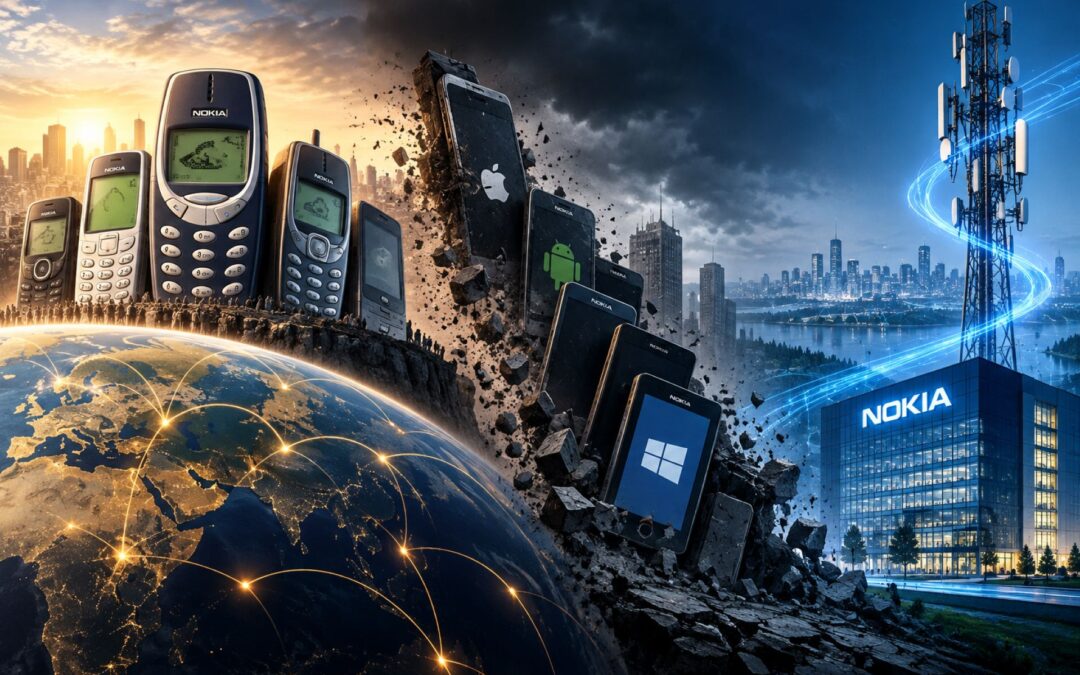
Only six years earlier, Nokia had estimated that it controlled 40% of the global mobile-phone market in the final quarter of 2007. Its devices were everywhere, from European business districts to small towns in developing countries. Its ringtone was instantly recognisable, its most popular models had sold hundreds of millions of units, and its influence extended deep into Finland’s economy. Yet by 2014, Nokia had lost control of the consumer business it had dominated for more than a decade.
The story is often reduced to a simple explanation: Apple introduced the iPhone, Nokia failed to innovate, and an industry leader disappeared. That account overlooks how technologically capable Nokia already was, how extensively it attempted to respond, and why its efforts repeatedly fell short. It also overlooks something more fundamental: Nokia Corporation never disappeared. The company that lost the smartphone war had spent nearly 150 years moving between industries, and its survival would depend on another transformation.
From Paper Mills to a Finnish Industrial Powerhouse
Nokia’s origins lie in nineteenth-century Finland, where its founder was concerned with producing paper rather than transmitting information. In 1865, mining engineer Fredrik Idestam established a wood-pulp mill beside the Tammerkoski Rapids in Tampere. The location provided the water power needed to process timber into pulp, an increasingly valuable raw material as industrialisation expanded demand for paper. Three years later, Idestam opened another mill near the Nokianvirta River, close to the town of Nokia.
The second location eventually supplied the name that would become familiar to billions of consumers. In 1871, Idestam and Leo Mechelin established Nokia Ab as a joint-stock company. Its original business remained firmly rooted in forestry and paper manufacturing, although Mechelin subsequently advocated broader industrial development, including electricity generation. The company was part of an expanding Finnish industrial economy in which natural resources, mechanical production and electrical infrastructure were becoming increasingly important.
Two other businesses would eventually become central to that history. Finnish Rubber Works was founded in 1898, with Eduard Polón serving as its managing director. It manufactured rubber products such as footwear and later expanded into tyres and other industrial goods. Finnish Cable Works, established in 1912, produced cables for electrical installations, power distribution and telephone networks.
Although these businesses initially had separate identities, they were developing expertise in materials, manufacturing and electrical infrastructure that would become relevant to the future corporation. Finnish Rubber Works acquired control of Nokia Ab in 1918, and by 1922, the rubber, paper and cable businesses were connected through common ownership. They nevertheless remained legally distinct for decades, operating in different industrial markets while sharing important financial and organisational relationships.
In 1967, Nokia Ab, Finnish Rubber Works and Finnish Cable Works formally merged to create the modern Nokia Corporation. The new conglomerate manufactured paper, rubber products, cables and a growing range of electronics. Its activities eventually extended into televisions, computers and other consumer and industrial technologies. Nokia’s product portfolio was so diverse that the company could manufacture everyday household goods while simultaneously developing advanced electrical and communications equipment.
The range of products was unusual for a business that would eventually become synonymous with mobile phones. Nokia produced rubber boots and car tyres, developed television and electronics operations, and continued manufacturing paper products. The company was not created around one technological invention or a single consumer market. It had developed through a succession of industrial opportunities, acquisitions and changes in strategy.
The cable business provided a particularly important connection to telecommunications. Supplying equipment for electrical and telephone networks gave Nokia experience with communications infrastructure before mobile phones became commercially important. Its developing electronics capabilities provided another foundation, including work on radio communications and specialised electronic equipment. Together, these activities made telecommunications a plausible field for expansion as radio technology advanced.
This industrial history matters because Nokia’s later transformation was not its first. As the historical development of Nokia demonstrates, the company had repeatedly entered new markets without abandoning every capability developed in the previous one. Experience in electrical systems, engineering, manufacturing and communications created opportunities that were not obvious from its original paper business.
Nevertheless, changing industries by adding new products was different from reorganising the entire corporation around a single commercial priority. For much of its history, Nokia could expand into another sector while retaining older operations. Its eventual commitment to mobile telecommunications would require a more concentrated strategy, and its later smartphone crisis would demand an even more difficult transformation: changing the technologies and organisational processes at the centre of an already successful business.
How Nokia Became the World’s Biggest Mobile-Phone Maker
Nokia’s entry into mobile communications occurred while cellular telephony was still expensive, cumbersome and largely associated with professional users. In 1979, Nokia joined Finnish electronics manufacturer Salora to establish Mobira, a venture focused on mobile radio and telephone equipment. The Nordic countries were developing a shared cellular communications system known as the Nordic Mobile Telephone network, or NMT. Unlike fixed-line telephones, NMT used radio connections between handsets and network base stations, allowing customers to make calls while travelling through areas with coverage.
The Nordic approach created an attractive opportunity for equipment manufacturers. Cooperation around common technical standards allowed compatible devices to operate across participating markets, reducing the limitations imposed by individual national systems. For a company based in a relatively small country, the prospect of serving several markets through shared technology was especially significant. Nokia could develop equipment for an expanding communications network rather than confine itself to Finland’s domestic telephone users.
In 1982, Mobira introduced the Mobira Senator, an early car phone designed for NMT networks. It offered an important improvement over a telephone permanently connected to an office or home, but it was hardly a convenient handheld device. Much of the equipment remained installed inside the vehicle, and its bulk and power requirements limited how it could be used. Nevertheless, the underlying attraction was clear: customers could communicate while moving between locations, making the telephone increasingly independent of a fixed building.
Nokia continued reducing the size of its mobile equipment during the 1980s. The Mobira Talkman helped move cellular communications beyond equipment permanently installed in cars, while the Mobira Cityman, launched in 1987, represented a major step towards a genuinely handheld telephone. The Cityman remained large and expensive by later standards, but its portability was remarkable at a time when mobile communication was still unfamiliar to most people.
The Cityman also received an extraordinary publicity opportunity. During a visit to Helsinki in 1987, Soviet leader Mikhail Gorbachev was photographed using the handset to make a call to Moscow. The image placed an unfamiliar Finnish telecommunications product in the hands of one of the world’s most recognisable political figures. The device became so closely associated with the incident that it acquired the nickname Gorba.
The photograph mattered because mobile phones were still trying to establish their place in public life. Most people had never used one, and the technology’s expense and size made it seem remote from ordinary consumers. The Mobira Cityman and its association with Gorbachev demonstrated something that technical advertisements could not communicate as immediately: a powerful public figure could make a telephone call while standing away from a conventional telephone line.
The next major development was GSM, the digital mobile communications standard adopted across Europe and eventually many other markets. GSM improved the prospects for international compatibility and allowed manufacturers to develop devices for a much larger market. Nokia participated in the development of GSM technology and supplied network equipment as well as handsets. It was increasingly building capabilities on both sides of the telecommunications business.
On 1 July 1991, former Finnish Prime Minister Harri Holkeri made the first official GSM call over the commercial Radiolinja network using Nokia equipment. The call, made from Helsinki to Kaarina Suonio in Tampere, marked an important milestone in the development of digital mobile communications. Successful test calls had occurred earlier, but the public demonstration helped establish that the emerging system could support practical commercial service.
The Nokia 1011, introduced in 1992, became one of the first mass-produced GSM handsets. It was bulky by modern standards, with a small display and physical keypad, but represented a decisive movement towards digital mobile communication as a consumer product. GSM’s eventual international adoption provided Nokia with a much larger potential market than the Nordic analog systems on which its earlier products had depended.
That same year, Jorma Ollila became Nokia’s chief executive. He inherited a diversified business whose industrial activities competed for management attention and investment. Rather than continue treating telecommunications as one activity among many, Ollila made it the centre of Nokia’s corporate strategy. The company gradually divested businesses that did not support this direction, concentrating resources on mobile phones and communications networks.
This concentration transformed Nokia’s competitive position. Instead of spreading investment across unrelated products, it could build specialised capabilities in handset design, radio engineering, manufacturing and global distribution. Its growing production volumes helped it purchase components, improve factory efficiency and bring new models to market across different price categories. The company developed advantages that extended far beyond the technical specifications of any individual phone.
By 1998, Nokia had overtaken Motorola to become the world’s largest mobile-phone manufacturer. Its leadership expanded as cellular services spread through both wealthy and emerging markets. Nokia understood that customers did not all need the most technologically advanced handset. Many wanted an affordable phone with reliable reception, a readable screen, familiar menus, a dependable battery and a design that could withstand everyday use.
Those requirements shaped some of Nokia’s most recognisable products. The Nokia 2110, introduced in 1994, helped popularise the melody that became known as the Nokia Tune, adapted from Francisco Tárrega’s guitar composition Gran Vals. The company’s Connecting People slogan captured the central promise of its products: communication would become more personal, portable and accessible. Nokia was increasingly associated not merely with a manufacturer but with the everyday experience of owning a mobile phone.
Games also made the devices memorable. Snake appeared on Nokia phones in 1997, with later versions, including Snake II, becoming closely associated with the brand. A small screen and keypad could now provide entertainment between calls and messages. These details were modest individually, but they made Nokia products familiar and appealing to customers who might otherwise have regarded a mobile telephone as purely functional equipment.
The Nokia 3310, introduced in 2000, became a cultural icon associated with durability, accessibility and simplicity. Nokia’s closely related 3310 and 3330 models are credited with combined sales of approximately 126 million units. Their commercial success reflected the appeal of devices that performed essential functions without requiring customers to understand complicated technology. The 3310’s reputation for toughness subsequently developed a life of its own in popular culture, although its significance was commercial long before it became an internet joke.
The Nokia 1100, released in 2003, achieved an even larger scale. Designed as a basic, affordable handset, it offered familiar controls and practical features without the expense of a sophisticated smartphone. Its simplicity made it especially attractive in emerging markets, where affordability, reliability and ease of use mattered enormously. According to Guinness World Records, the Nokia 1100 shipped more than 250 million units, making it one of the best-selling consumer electronic products in history.
Nokia’s product strategy illustrates an important aspect of product differentiation in the early mobile-phone market. Distinctive designs and features could attract attention, but reliability, familiar controls and distribution helped convert interest into repeated purchases. Nokia could produce sophisticated devices for wealthier customers while simultaneously selling inexpensive models to people purchasing their first mobile phones.
This success had consequences far beyond Nokia’s customers. Around the turn of the millennium, the company became extraordinarily important to Finland’s national economy. European Commission analysis estimated that Nokia directly contributed approximately 3–4% of Finnish GDP during this period, while also accounting for a substantial share of national exports and private research spending. The company’s importance extended into engineering education, suppliers, employment and national confidence.
Finland was not economically dependent on Nokia alone, and much of the company’s handset manufacturing occurred outside the country. Nevertheless, its global success generated considerable value at home and created a powerful association between Finnish technological capability and the Nokia brand. For a country with a relatively small population, the emergence of a world-leading telecommunications corporation had unusual economic and symbolic importance.
Nokia’s financial results continued strengthening as the mobile-phone market expanded. In 2007, the company sold approximately 437 million mobile devices and recorded €51.1 billion in annual net sales. Its fourth-quarter financial results estimated a worldwide handset market share of 40%, reflecting the extraordinary scale of its commercial leadership.
Nokia’s greatest achievement was not inventing a single revolutionary handset. It was making mobile communication practical and accessible at an enormous scale. Its factories, distribution relationships, engineering expertise and brand recognition provided competitive advantages that were extremely difficult for other manufacturers to reproduce.
Even in 2008, after Apple had introduced the iPhone, Nokia remained the world’s largest handset manufacturer. According to Gartner’s worldwide mobile-phone market figures, Nokia sold approximately 472.3 million devices and held about 38.6% of the global market. Those figures measure mobile phones overall, including conventional feature phones, rather than smartphones alone.
The distinction became increasingly important. Nokia remained extraordinarily successful in the market it had helped create even as another market was beginning to redefine the industry. Its advantages were genuine, but the significance of a mobile phone was changing. Customers would increasingly judge devices not merely by their ability to make calls and send messages but by the software, applications and online services available through them.
The Smartphone Revolution Changed the Rules
Nokia did not enter the smartphone era as a company unfamiliar with advanced mobile computing. It had experimented with combining telephone functions and computing capabilities long before Apple introduced the iPhone. The Nokia 9000 Communicator, launched in 1996, incorporated features associated with a personal digital assistant, including email and productivity functions. Later devices offered cameras, internet access, multimedia functions and increasingly sophisticated software.
The Nokia 7650, introduced in 2002, was among the company’s early camera-equipped smartphones. Nokia also experimented with different interfaces, touch-enabled devices and mobile internet products during the years preceding the iPhone. The Nokia 7710, announced in 2004, featured a touchscreen, while the Nokia 770 Internet Tablet, introduced in 2005, offered a touchscreen-based internet experience without conventional cellular calling capabilities. These products demonstrated that Nokia was actively exploring the possibilities of handheld computing.
The Nokia N95, released in 2007, represented one of the company’s most impressive smartphones. It combined a five-megapixel camera, GPS navigation, multimedia playback, internet connectivity and a substantial range of other functions. For customers who evaluated a device through a checklist of hardware capabilities, the N95 could appear more advanced than the original iPhone in several respects. It was a sophisticated product from an engineering organisation with considerable mobile-computing experience.
This helps explain why Apple’s emergence did not immediately look like a threat capable of overturning Nokia’s leadership. Nokia’s existing business was enormously profitable and expanding, while Apple had only recently entered the handset market. Apple reported approximately 1.39 million iPhones sold during fiscal 2007, following the product’s commercial introduction in late June. That was tiny compared with Nokia’s approximately 437 million handset sales during calendar 2007, although the figures cover different reporting periods.
The contrast in Apple’s early iPhone sales and Nokia’s enormous handset volumes illustrates the difficulty of recognising a technological transition while the existing market still rewards the incumbent. Nokia’s established business had excellent reasons to concentrate on the products and capabilities generating its revenue. The danger was that those same measurements could obscure changes in what customers would eventually value most.
For much of the earlier smartphone era, Nokia had relied on Symbian, an operating system developed for mobile devices with constrained processing power, memory and battery capacity. Those restrictions mattered when mobile hardware was relatively limited. Symbian allowed phones to perform increasingly complicated tasks without the power consumption or hardware requirements associated with desktop computing. Its engineering strengths helped Nokia deliver advanced features during a period when mobile computing was still developing.
However, an operating system optimised for earlier devices was not automatically ideal for the next generation of smartphones. Symbian had evolved through different user-interface implementations, software versions and development arrangements. Nokia’s S60 interface became especially important, but the broader Symbian ecosystem also included approaches that were not fully interchangeable. This fragmentation complicated development and made it harder to provide customers and software developers with a consistent experience across devices.
Apple’s introduction of the iPhone in January 2007 brought these issues into sharper focus. The original iPhone was not necessarily superior to Nokia’s advanced handsets in every technical feature. Its significance lay in the way Apple designed the screen, interface and core functions as a coherent experience. Large areas of the display responded directly to touch, allowing customers to browse websites, navigate photographs and select functions through familiar gestures rather than relying primarily on keypads and complicated menus.
This represented more than the removal of physical buttons. Apple had placed direct interaction with software at the centre of the product. Customers did not need to understand the internal organisation of the operating system to accomplish basic tasks. The interface made advanced computing functions feel accessible, reducing the distinction between a telephone and a small personal computer.
The launch of Apple’s App Store in 2008 extended that approach beyond the capabilities installed on the device at purchase. Customers could discover applications through a central marketplace, while developers gained a common distribution channel and access to an expanding audience. The phone became a platform capable of acquiring new functions throughout its useful life. A customer purchasing a smartphone was increasingly choosing not only a device but also a continuing relationship with its software ecosystem.
Android entered the commercial market in 2008 with a different organisational model. Rather than reserve its operating system for one manufacturer’s products, Google made Android available to multiple handset manufacturers. Companies could compete through hardware, pricing, industrial design and distribution while developing around a shared software platform. Google’s online services and the expanding Android application ecosystem helped create a powerful alternative to Apple’s more tightly integrated approach.
These developments changed the economics of smartphone competition. A platform became more attractive to customers as useful applications accumulated, while a growing customer base encouraged more developers to build applications for that platform. This positive feedback could strengthen established software ecosystems and make life harder for smaller competitors. A manufacturer could produce an excellent handset and still struggle if customers could not obtain the applications and services they increasingly expected.
The changing structure of the smartphone industry therefore placed operating systems and software platforms at the centre of competition. Hardware continued to matter, but its commercial value became more closely tied to software compatibility, developer participation and service integration. Nokia’s expertise in physical devices remained valuable, yet it no longer guaranteed that the company’s phones would offer the most attractive overall experience.
This shift also weakened some of Nokia’s traditional advantages. Its ability to offer many models at different prices had previously helped it serve an enormous customer base. In a software-driven market, however, maintaining numerous device variants could introduce additional development and compatibility problems. The company needed to combine the flexibility of its handset portfolio with a much more unified software experience.
Nokia recognised that internet services were becoming central to the business. In 2007, it introduced Ovi as a brand intended to bring services such as maps, music, content sharing and synchronisation closer to its devices. The initiative demonstrated an effort to extend Nokia’s relationship with customers beyond the original handset purchase. Yet identifying the importance of services was different from developing a seamless ecosystem capable of competing with Apple and Android.
The smartphone revolution was therefore not simply a transition from physical buttons to touchscreens. It was a change in where competitive advantage was created and how that advantage accumulated. Nokia had become dominant by producing reliable devices at tremendous scale. The new competition rewarded companies capable of coordinating hardware, operating systems, applications, developers and online services into an experience customers preferred to competing alternatives.
Why Nokia’s Software Strategy Failed to Catch Up
Nokia’s central difficulty was not a complete absence of technological ambition. Between 2007 and 2010, the company invested in several initiatives intended to strengthen its smartphone position. It continued developing Symbian, expanded its internet services, established an application marketplace and pursued a more modern operating-system platform. These projects addressed genuine weaknesses, but they also reflected a company trying to maintain its successful existing business while constructing a different future.
Symbian presented the most immediate problem. Its architecture had been developed under constraints that no longer defined the leading edge of smartphone design. Supporting different interfaces, versions and device requirements made substantial changes difficult to coordinate. Developers faced additional complexity when applications needed to operate across incompatible or differently configured devices, while customers encountered inconsistent software experiences under the same Nokia brand.
The problem extended beyond individual applications. An operating system shapes how people move between functions, access information, manage media and interact with online services. When customers repeatedly encounter confusing menus, slow responses or inconsistent controls, powerful hardware cannot always compensate. Nokia could improve a camera, battery or display without necessarily resolving the frustration created by the surrounding software.
In 2008, Nokia announced plans to acquire the remaining shares in Symbian Limited and support the platform through the Symbian Foundation. The strategy was intended to broaden participation, reduce barriers to adoption and strengthen Symbian’s position against emerging competitors. Nokia was trying to preserve the advantages of an established operating system while giving it a more sustainable future. Yet the transition also required coordination among developers, manufacturers and organisations whose priorities were not necessarily identical.
Meanwhile, Nokia continued releasing touchscreen devices and updating Symbian. The Nokia 5800 XpressMusic, introduced in 2008, represented a substantial touchscreen effort, and the Nokia N97 followed in 2009 with ambitions to combine advanced smartphone functions and a more flexible interface. Later, Symbian^3 offered improvements to touchscreen operation and multimedia capabilities, including through the Nokia N8. These devices demonstrated continuing technical development, but incremental improvements did not fully resolve the broader problem of delivering a modern, consistent software experience.
Nokia’s Ovi initiative faced related challenges. The company had introduced the brand in 2007 to organise internet services around its phones, and the Ovi Store followed in 2009 as an application distribution platform. Maps, music, content and synchronisation were important elements of the strategy. The difficulty was turning these separate offerings into a coherent customer experience that could compete with platforms whose application distribution and software interfaces were rapidly becoming central attractions.
A company can introduce a store without immediately creating a thriving application ecosystem. Developers must find its tools practical, customers must find its applications useful, and the commercial opportunity must justify the effort required to support the platform. When development is more complicated or the audience appears less commercially promising, software producers may prioritise competing systems. Nokia had the advantage of a substantial installed customer base, but the value of that audience was weakened by software fragmentation and uncertainty about the platform’s direction.
Another major initiative emerged from Nokia’s work on Linux-based operating systems. In February 2010, Nokia and Intel announced MeeGo, a new open-source software platform combining Nokia’s Maemo project with Intel’s Moblin development. MeeGo was intended to support a range of computing devices and provide a more modern foundation for future products. Its development also involved efforts to improve application creation and portability, including through the Qt software framework.
MeeGo offered an opportunity to move beyond some of Symbian’s historical limitations. However, it introduced another complex programme into an organisation already trying to improve its existing smartphones, manage numerous devices and expand its online services. Nokia now had to sustain current sales while developing a credible successor platform that was not yet ready to replace the established business at scale. The longer this transition continued, the more difficult it became to present a clear and convincing software strategy to customers and developers.
This was a problem of timing as much as technological direction. Apple and Android manufacturers were improving products, expanding application catalogues and attracting developers while Nokia worked on several potential solutions. Every delay in establishing a consistent platform gave competing ecosystems more opportunities to grow. The market did not suspend its development while Nokia reorganised its software ambitions.
Technical fragmentation was only one part of the explanation. Nokia had developed strong managerial and engineering processes around producing complex physical devices in large numbers. Delivering successive handset models required disciplined manufacturing, component procurement, reliability testing and coordination with mobile operators. Those capabilities remained valuable, but rapidly evolving software required an organisational environment in which problems could be identified early, priorities adjusted and development decisions coordinated across teams.
Research into Nokia’s smartphone failure suggests that these organisational processes were not functioning effectively enough. Timo Vuori and Quy Huy examined how fear and communication problems influenced decision-making inside the company. Their work, discussed in INSEAD’s analysis of how Nokia contributed to its own decline, identifies a pattern in which senior managers experienced pressure from competitors while middle managers feared the consequences of delivering unwelcome information.
Under those conditions, communication could become distorted. Managers concerned about reporting delays or technical difficulties might present development progress more favourably than circumstances justified. Senior executives could then make strategic commitments based on expectations that development teams were unlikely to meet. The resulting gap between promised outcomes and actual capabilities made it harder to coordinate projects and respond realistically to competitors.
This matters because an organisation can possess excellent technical talent while making poor decisions about how that talent is deployed. A software team may understand that a feature cannot be delivered reliably within a proposed schedule, but that knowledge becomes less useful if senior managers do not receive or act upon it. A product programme that appears successful through internal presentations may be falling further behind external competitors. In a rapidly changing market, delays in acknowledging problems can be as damaging as the problems themselves.
These findings should not be interpreted as proof that every Nokia executive deliberately concealed information or that organisational fear alone destroyed the company. The research draws substantially on retrospective accounts of a complicated period, and Nokia’s failure also reflected external competition, technical constraints and changing customer expectations. Its importance lies in showing how internal behaviour can compound technological problems. Even capable engineers and substantial research budgets are insufficient when the organisation struggles to communicate problems accurately and act on them collectively.
The interaction between Nokia’s software challenges and its organisational structure created a particularly difficult cycle. Fragmented development made schedules and compatibility harder to manage, while pressure to deliver competitive products encouraged optimistic commitments. Delayed or imperfect products then weakened customer confidence and increased management pressure. Nokia’s multiple software initiatives were intended to break this cycle, but coordinating them became another demanding task.
Nokia was therefore attempting a difficult transition while continuing to operate an enormous global handset business. Its existing products still served millions of customers, and abandoning them prematurely would threaten current revenue. Yet investing heavily in the established platform could also divert resources from its successor. Every possible decision carried significant commercial risks.
By 2010, Nokia still possessed enormous engineering resources, a recognised brand and substantial market presence. It had also demonstrated that it understood many elements of the smartphone challenge. What remained unresolved was whether the company could convert its different initiatives into one competitive platform quickly enough. That uncertainty became central to the next leadership transition.
The Burning Platform, Windows Phone, and the Microsoft Sale
Olli-Pekka Kallasvuo became Nokia’s chief executive in 2006, shortly before Apple introduced the iPhone. His leadership period encompassed the company’s efforts to develop Symbian, launch Ovi and pursue a successor operating system. By 2010, however, Nokia faced increasing pressure from competitors whose software ecosystems were expanding rapidly. The company remained a major handset manufacturer, but its ability to determine the future direction of the smartphone market had weakened.
In September 2010, Stephen Elop succeeded Kallasvuo as Nokia’s chief executive. Elop had previously worked at Microsoft, making him an unusual choice for a company historically associated with Finnish management and engineering culture. He became Nokia’s first non-Finnish chief executive and arrived with a mandate to improve the company’s competitive position. His leadership would lead to one of the most consequential platform decisions in Nokia’s history.
In February 2011, Elop circulated an internal message that became famous as the burning platform memo. The document described a man standing on an oil platform surrounded by flames, forced to choose between remaining in danger and jumping into uncertain waters. Elop used the metaphor to communicate the urgency of Nokia’s position. He argued that the company faced serious competitive threats and needed changes extending beyond improvements to existing products.
The memo subsequently became public, creating an unusually visible account of Nokia’s internal difficulties. Its language was striking because it came from the chief executive of a company that still sold an enormous number of mobile phones. Rather than merely promising a new product, Elop acknowledged substantial problems in the company’s existing strategy and execution. The message also raised questions about the future of Symbian before Nokia had established a successful replacement.
That same month, Nokia and Microsoft announced a broad strategic partnership. Windows Phone would become Nokia’s principal smartphone operating system, replacing Symbian in that role. Nokia would contribute its handset engineering, design, distribution and mobile expertise, while Microsoft would supply the software platform and associated services. The companies intended to create a competitive third ecosystem alongside those led by Apple and Google.
The partnership had a strategic rationale. Nokia could concentrate more attention on handset development and integration while relying on Microsoft to provide the software foundation. Microsoft’s resources and established software capabilities offered the prospect of building an alternative platform with sufficient scale to attract customers and developers. Windows Phone also offered a way to distinguish Nokia’s products from the increasingly crowded market of Android manufacturers.
Choosing Android would have involved different risks. The operating system already had substantial momentum, but several manufacturers were competing through it, creating intense pressure around handset design, pricing and differentiation. Nokia would have needed to establish a compelling reason for customers to purchase its Android products instead of alternatives from companies such as Samsung or HTC. Joining the Android ecosystem might have reduced some software-development burdens, but it would not automatically have restored Nokia’s commercial leadership.
Continuing with MeeGo also presented uncertainty. Nokia had invested in the platform, and it offered the prospect of greater independence over software development. However, building a modern operating system and attracting developers demanded considerable time, coordination and resources. Nokia needed a competitive response while its existing smartphone business was already under pressure. The eventual Windows Phone decision reflected management’s assessment of these competing risks, not the absence of other conceivable strategies.
Nevertheless, the Microsoft partnership introduced a particularly dangerous transition period. Symbian phones remained commercially important, but customers and developers now knew that Nokia intended to move its future smartphone business towards Windows Phone. Buyers considering an expensive Symbian handset had reasons to question how much future support and application development it would receive. Developers faced similar uncertainty about which platform deserved their investment.
This transition problem is sometimes described through the Osborne effect, in which announcing a replacement can undermine demand for an existing product before its successor is ready. Nokia’s situation is also sometimes described as the Elop effect, attributing a particularly sharp decline to the combination of the burning platform memo and the Windows Phone announcement. These labels identify plausible mechanisms, but neither establishes that Nokia’s entire smartphone collapse was caused by one communication or management decision.
Symbian already faced substantial competitive pressure before February 2011. Its technical difficulties, fragmented development and weakening position against iOS and Android had been building for years. Nokia’s announcement could increase uncertainty surrounding the platform without being the original cause of its declining competitiveness. The timing of the strategic change added another burden to an already challenging recovery.
The first Nokia Lumia smartphones reached customers later in 2011. Their industrial design and the distinctive Windows Phone interface offered a visibly different experience from older Symbian devices. Nokia continued developing the Lumia range and attempted to establish a position through design, photography, navigation and integration with Microsoft’s services. Yet an attractive handset could not immediately overcome the application and ecosystem disadvantages faced by Windows Phone.
Developers had limited resources and commercial incentives. Many already prioritised iOS and Android because those platforms offered large, growing audiences. Supporting Windows Phone required additional work whose expected returns could be uncertain. Consumers, meanwhile, could encounter missing applications or differences in functionality that made the platform less attractive despite Nokia’s hardware quality.
The problem reinforced itself. A small user base made developers less enthusiastic about investing in Windows Phone, while a weaker application catalogue made potential customers less willing to purchase its devices. Microsoft and Nokia could improve the appearance and functionality of Lumia handsets, but building a competitive software ecosystem required the coordinated participation of many independent businesses.
Further complications arose as Microsoft developed the operating system. The transition from Windows Phone 7 to Windows Phone 8 introduced new technical capabilities but also created compatibility limitations for earlier devices. Customers and developers had to navigate another platform transition while Nokia was attempting to build confidence in its new strategy. Lumia sales grew from a relatively small base, but their expansion was insufficient to compensate quickly for the contraction of Nokia’s established smartphone business.
Nokia’s financial position consequently came under increasing pressure. The company had to support product development, marketing and restructuring while fighting competitors whose ecosystems were already established. Its traditional manufacturing and distribution strengths still mattered, but they could not independently generate the developer participation and software momentum necessary to transform Windows Phone into a leading platform.
The changing market became particularly visible in 2012, when Samsung overtook Nokia in worldwide mobile-phone shipments. Nokia had held the leading position since 1998, making the loss of that ranking a powerful symbol of the industry’s transformation. Samsung benefited from the growing importance of Android smartphones while also competing across different handset price categories.
Nokia’s difficulties were reflected in its financial condition and credit ratings. In April 2012, Standard & Poor’s lowered Nokia’s long-term credit rating into speculative-grade territory, followed by other rating-agency downgrades during the year. The deterioration reflected concerns about the company’s profitability, cash flow and ability to complete its smartphone transition successfully. A corporation that had once dominated the industry was now confronting the financial consequences of losing its competitive position.
The company also faced a difficult operational adjustment. Production capacity and staffing levels developed for a much larger handset business could no longer be sustained under the same commercial assumptions. Nokia announced restructuring measures, factory closures and job reductions as it attempted to reduce costs while funding its remaining smartphone ambitions. These decisions had consequences not only for corporate financial statements but also for the people and communities dependent on Nokia’s operations.
In September 2013, Nokia announced an agreement to sell substantially all of its Devices & Services business to Microsoft. The announced transaction was valued at approximately €5.44 billion, including arrangements relating to Nokia’s patent portfolio. Nokia had failed to restore the competitiveness and profitability of its handset operations, while Microsoft sought closer integration between its mobile operating system and the hardware business that depended on it.
The proposed transaction required shareholder approval. On 19 November 2013, Nokia held an extraordinary general meeting in Helsinki at which shareholders considered the sale. According to the company’s formal announcement of the vote, more than 99% of the votes cast supported the transaction. The overwhelming approval demonstrated that shareholders regarded the proposed sale as preferable to continuing the existing handset strategy under Nokia’s ownership.
After regulatory and other completion processes, Nokia finalised the sale on 25 April 2014. The agreement had initially contemplated approximately 32,000 employees transferring to Microsoft, but the completed transaction involved roughly 25,000. The difference reflected changes in the transaction’s final scope and arrangements. Stephen Elop subsequently returned to Microsoft, taking on responsibilities connected with the acquired devices business.
The transaction marked the end of Nokia Corporation’s ownership of the handset business that had made its name globally famous. Microsoft acquired the principal devices operation, while Nokia retained its telecommunications infrastructure business, important intellectual-property assets and other activities. The company was not being liquidated, and its patents were not simply transferred wholesale as part of an unrestricted sale.
The story did not end with Microsoft acquiring the business. The software and application challenges that had undermined Lumia’s competitiveness did not disappear because the devices division changed ownership. Microsoft continued pursuing its mobile ambitions, but Windows Phone remained commercially disadvantaged against the much larger ecosystems surrounding Android and iOS.
In July 2015, Microsoft acknowledged the severity of the problem through a major restructuring announcement. The company said it would record an impairment charge of approximately $7.6 billion related to assets associated with the Nokia Devices & Services acquisition. It also announced plans to reduce up to 7,800 positions, primarily in the phone business, alongside further restructuring expenses. The official Microsoft announcement made clear that the acquired operation had not fulfilled the commercial expectations attached to it.
The size of the impairment was especially striking because it exceeded the headline dollar value commonly associated with Microsoft’s original acquisition. However, an accounting impairment does not mean the acquired business was literally worth nothing or that the entire charge represented an equivalent cash payment. It reflected a reassessment of the value recorded for assets and goodwill associated with the acquisition. The commercial implication was nevertheless unmistakable: Microsoft’s attempt to establish a major smartphone hardware business through Nokia had not succeeded.
The Windows Phone decision therefore deserves scrutiny because of its risks, execution and timing, while Microsoft’s subsequent experience demonstrates how difficult the underlying market problem had become. Nokia’s decline followed several years of mounting competition, software fragmentation and organisational difficulties. The 2011 partnership failed to reverse those trends, and Microsoft’s ownership did not produce the recovery that both companies had hoped to achieve.
When Nokia’s Collapse Reached Salo
Nokia’s decline was not experienced only through falling market share, financial losses or strategic announcements. In Finland, the company’s handset operations supported manufacturing jobs, specialist engineering work and economic activity in communities closely associated with its growth. Salo, a town in southwestern Finland, was one of the places where the consequences became particularly visible. Nokia’s international success had created local employment and skills that were difficult to replace when production contracted.
The company’s connection with Finland was especially significant because Nokia had played such a prominent role in the country’s modern economic development. Its success had supported engineers, factory workers, suppliers and associated services while contributing to national confidence in Finnish technological expertise. The decline of handset manufacturing therefore represented more than the loss of employment at one industrial facility. It weakened a network of economic relationships that had developed around the company over many years.
A contemporary account helps illustrate the human dimension. In April 2012, Associated Press reporting on Salo’s uncertain economic future described the circumstances of former Nokia technician Tomi Marjuaho. He had taken a severance package in 2010 after leaving the company but continued struggling to find suitable employment and replace the income his household had depended upon. The payment provided temporary financial support, but it did not solve the longer-term problem of finding another regular wage.
Marjuaho’s experience occurred before Nokia announced its next major round of restructuring. It illustrates a distinction that employment statistics alone cannot capture: a worker’s departure from a company and the restoration of financial security are separate events. Manufacturing employment can provide stable incomes, specialised professional identities and connections to a local economy. When those positions disappear, workers may find that their experience does not translate immediately into comparable opportunities nearby.
In June 2012, Nokia announced plans to reduce its global workforce by as many as 10,000 positions by the end of 2013 as part of a broader restructuring programme. The proposals included closing its handset manufacturing facility in Salo while retaining research and development activities there. The distinction between production and development reflected Nokia’s changing operational priorities, but it did not preserve the factory employment associated with assembling devices. Manufacturing operations in Salo ended in 2012, bringing an important chapter of Finnish handset production to a close.
The restructuring was part of a wider effort to reduce costs and adjust Nokia’s operations to a smaller handset business. The company could no longer maintain every factory, product-development activity or staffing commitment created during its years of rapid expansion. Yet reducing expenses also carried costs of its own, including the loss of experienced workers and disruption to communities that had helped sustain the company’s growth.
The effects were not identical for every employee. Some workers had different skills, severance arrangements or employment opportunities, while others faced prolonged uncertainty. The broader economic consequences also extended beyond Nokia’s direct workforce to suppliers, service businesses and households connected to local spending. These outcomes should not be reduced to a single former employee’s experience, but individual accounts provide context that aggregate restructuring figures cannot.
Salo demonstrates why Nokia’s smartphone failure mattered beyond the technology industry. The company’s earlier success had connected local communities to an enormous global market, making their prosperity partly dependent on decisions and competitive developments occurring far beyond Finland. When Nokia lost its position, the costs were distributed across people who had played no direct role in choosing Symbian, MeeGo or Windows Phone. The corporate transformation that followed would preserve Nokia as a business, but it could not automatically restore the manufacturing economy built around its old handset operations.
How Nokia Reinvented Itself After Mobile Phones
The sale of Nokia’s handset business was a dramatic break with its recent past, but it did not leave the company without substantial operations. Nokia had continued developing and supplying telecommunications networks throughout its years of handset dominance. Its customers included mobile operators and other organisations purchasing the equipment necessary to transmit calls, data and internet traffic. Unlike consumer handsets, these systems were largely invisible to the people using them, even though they formed essential parts of modern communications infrastructure.
Nokia’s network business had its own history of consolidation. In 2007, Nokia and Siemens established Nokia Siemens Networks, combining important telecommunications equipment operations. Nokia subsequently acquired Siemens’ stake in 2013, gaining full control of the venture. As the consumer handset business moved towards Microsoft, this infrastructure operation became the foundation for the corporation’s next phase.
The network market differed significantly from consumer mobile phones. Equipment manufacturers competed for major contracts with telecommunications operators, whose purchasing decisions involved coverage, capacity, reliability, operating costs and long-term support. Building networks required expertise in radio technology, software, standards and the integration of complex systems. Nokia already possessed many of these capabilities, giving it a substantial operating business that could continue independently of its former handset division.
Nokia also retained something less visible but commercially important: intellectual property accumulated through decades of research and participation in telecommunications standards. Mobile devices operate through extensive systems of technical standards that allow equipment from different manufacturers to communicate. Some of the inventions necessary to implement those standards are protected by patents, enabling their owners to receive licensing payments from manufacturers that use the technology.
The economic value of these patents did not disappear when Nokia stopped producing its own consumer handsets. Manufacturers continued building phones and other connected devices using technologies covered by Nokia’s intellectual property. Through its licensing arrangements, Nokia could benefit from inventions developed during its years of intensive mobile research even when the devices themselves were manufactured by other companies.
This distinction helps explain why the Microsoft sale did not amount to selling everything Nokia had created. The transaction transferred substantial handset operations and included specific patent-licensing arrangements, but Nokia retained ownership of important intellectual-property assets. The continuing value of those assets helped support research and provided a revenue stream separate from the business of manufacturing phones.
Nokia’s patent portfolio subsequently expanded through additional research and standardisation work. By 2025, the company reported more than 26,000 patent families, including thousands associated with technologies essential to 5G. A patent family groups related patent applications protecting an invention across different jurisdictions, so the figure should not be confused with the number of individual patents. Nokia’s portfolio covered areas extending beyond conventional mobile telephony into multimedia, connected devices and emerging communications technologies.
Nokia Technologies, the business responsible for managing and licensing much of this intellectual property, recorded approximately €1.5 billion in net sales during 2025. The figure represented revenue associated with the segment’s licensing activities and should not be interpreted as income from a single category of smartphone patents. Its significance was that Nokia could continue earning substantial commercial returns from research even after losing the consumer-device market in which many of those inventions had first been deployed.
The company also strengthened its infrastructure business through a major acquisition. In April 2015, Nokia announced an agreement to acquire Alcatel-Lucent in an all-stock transaction valued at approximately €15.6 billion. The companies began combined operations in January 2016, creating a broader telecommunications infrastructure supplier with expertise spanning mobile and fixed networks, internet routing and optical communications.
The acquisition brought Bell Labs into Nokia’s organisation. The research institution had an extensive history of contributions to telecommunications and computing, giving Nokia access to important scientific and engineering capabilities. More broadly, Alcatel-Lucent helped expand the company’s range of technologies beyond mobile radio systems. Nokia could now address a wider set of infrastructure requirements associated with the networks connecting households, businesses, data centres and telecommunications operators.
This transformation was not simply an attempt to abandon a failed business and pursue something unfamiliar. Network infrastructure had been part of Nokia’s operations for decades, and earlier corporate decisions had helped establish its position in that market. The handset sale allowed the company to concentrate more heavily on an activity in which it already possessed relevant expertise. Its history of diversification and restructuring had once again created the possibility of a different corporate future.
Meanwhile, the familiar Nokia name continued appearing on mobile phones, although the ownership arrangements were substantially different. In 2016, the Finnish company HMD Global announced arrangements to bring Nokia-branded mobile devices to market. HMD was an independent business operating under licensing agreements, not a restoration of Nokia Corporation’s former handset division. The distinction was important because consumers could encounter a Nokia-branded phone without purchasing a device manufactured and marketed by the original corporation.
In 2017, HMD introduced devices including the Android-based Nokia 6 and a redesigned version of the Nokia 3310. The Nokia 6 represented the brand’s participation in the modern Android smartphone market, while the revived 3310 drew on memories of Nokia’s earlier handset success. Both demonstrated the continuing commercial recognition attached to the Nokia name. However, a licensing arrangement is not the same as rebuilding the industrial, organisational and commercial structure that once made Nokia the world’s largest handset manufacturer.
Nokia Corporation’s main strategic direction remained focused on telecommunications technology. Its operations supported mobile networks, fixed communications infrastructure, routing, optical transmission and related services. The arrival of 5G increased the complexity of network systems and created demand for equipment capable of supporting more data-intensive applications. At the same time, competition from other major telecommunications equipment suppliers required continuing investment in research, software and engineering.
The company’s infrastructure strategy evolved as network technologies and customer requirements changed. In February 2025, Nokia completed its acquisition of Infinera, expanding its position in optical networking. Optical communications had become especially important as data centres, cloud services and increasingly demanding computing workloads required greater network capacity. The acquisition strengthened Nokia’s participation in technologies connecting large concentrations of computing equipment as well as conventional telecommunications networks.
One of the more unusual illustrations of Nokia’s continuing technical ambitions emerged through its work with Intuitive Machines on lunar communications. Nokia Bell Labs developed a compact cellular network intended to demonstrate that technologies familiar from terrestrial mobile networks could also support communication between equipment operating on the Moon. The project formed part of efforts to develop infrastructure for increasingly complex lunar exploration missions.
The idea was ambitious but practical. A future lunar expedition involving multiple vehicles, instruments and astronauts would need reliable ways to exchange data across the surface. Rather than inventing an entirely unfamiliar communications system, Nokia sought to adapt established 4G LTE technology to the severe constraints of space exploration. The equipment had to be compact, power-efficient and capable of operating under extremely demanding environmental conditions.
In March 2025, the network equipment reached the lunar surface aboard Intuitive Machines’ Athena lander. The landing conditions created serious difficulties, including limitations on available power. Nevertheless, Nokia’s network system powered on, responded to commands and demonstrated that important components could operate as intended. The system remained operational for approximately 25 minutes during the available power window.
The experiment did not achieve every planned objective. The intended cellular connection between the network equipment and a separate device could not be established because conditions following the landing prevented the equipment from operating together as planned. Nokia therefore did not complete the first intended cellular call on the Moon, even though the network hardware itself successfully operated for a limited period.
The lunar network mission results published by Nokia illustrate the difference between demonstrating a technology’s components and completing every objective of a complex engineering experiment. The project nevertheless represented an extraordinary contrast with the company’s industrial origins. A business that began grinding wood into pulp beside a Finnish river was now developing communications equipment intended for another world.
By October 2026, Nokia’s reporting reflected a corporation organised around Network Infrastructure and Mobile Infrastructure rather than consumer handset manufacturing. According to its third-quarter 2026 interim report, the company generated approximately €5.154 billion in quarterly net sales. That revenue came from a fundamentally different business from the one that had previously made Nokia phones everyday consumer products.
The transformation did not remove the ordinary challenges of industrial competition. Telecommunications infrastructure requires substantial research investment, and customer purchasing decisions can be affected by network spending cycles, technology transitions, regulation and geopolitical developments. Nokia must continue competing with established suppliers and emerging alternatives while developing products that meet increasingly complex technical requirements. Its survival does not mean that future success is guaranteed.
Nevertheless, Nokia’s continued operations change the meaning of its familiar rise-and-fall story. The company lost control of the consumer product category through which most people knew it, but retained and expanded capabilities in another part of the communications industry. Its brand remained recognisable through licensing, while its principal commercial identity shifted towards the infrastructure that allows communications services to function.
This outcome also reveals the limits of treating companies as though they were synonymous with their most successful products. Nokia had been a paper manufacturer before it became associated with rubber products, and an industrial conglomerate before it became a mobile-phone leader. Its infrastructure business existed alongside its handset empire and eventually became the foundation for corporate survival. The company was not rescued by nostalgia for its old phones; it continued through assets, expertise and markets that consumers had rarely associated with its name.
Nokia’s history is ultimately a story of changing competitive advantages. Manufacturing excellence, distribution, reliability and usable hardware enabled the company to dominate conventional mobile telephony. Those strengths became insufficient when operating systems, applications and developer ecosystems acquired greater importance. Nokia attempted to respond, but technical fragmentation, organisational weaknesses, execution difficulties and the risks of its platform transition prevented it from sustaining handset leadership.
The consequences were substantial. Nokia lost its defining consumer business, Microsoft acquired the handset operations, and communities such as Salo experienced the disruption of jobs and industrial activity connected to the company’s earlier success. Microsoft’s later impairment demonstrated that the difficulties surrounding the handset business were not easily resolved through a change in ownership. Yet Nokia Corporation continued developing technologies essential to modern communications, extending its infrastructure business through acquisitions, patents and research.
The company that began beside a Finnish river in 1865 is no longer the mobile-phone manufacturer that dominated the early 2000s. Its history demonstrates both how an established leader can lose a market when the basis of competition changes and how a corporation can survive by concentrating on different capabilities. Nokia did not win the smartphone war, but the engineering expertise, intellectual property and network technologies accumulated during its rise ensured that the company’s history did not end with the phones it lost.
Last Updated on November 5, 2026 by Aseem Gupta