
Reading Time: 18 Minutes
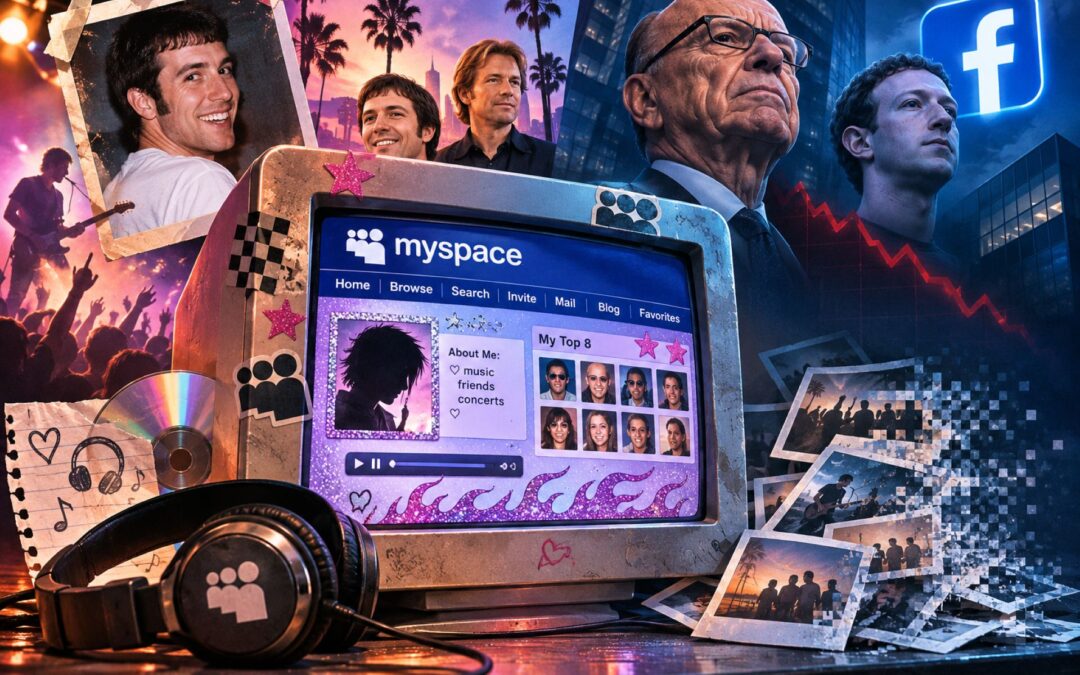
In July 2005, Rupert Murdoch’s News Corporation agreed to pay $580 million for Intermix Media, the company that owned MySpace. Within a year, MySpace had become one of the most heavily visited destinations on the American internet, attracting a generation that treated its profiles as extensions of their personalities. In June 2011, News Corporation sold the social network to the advertising company Specific Media for a reported $35 million. The two transactions did not involve precisely identical corporate assets, but the collapse in value was unmistakable.
There is an easy explanation for this reversal: Facebook arrived with a cleaner website, and MySpace failed to keep up. Yet that account overlooks why people loved MySpace in the first place, how musicians built audiences there, and why decisions that once encouraged explosive growth eventually became liabilities. It also misses an ending that unfolded years after the sale, when MySpace revealed that enormous quantities of music and other personal media had been lost. To understand its fall, it helps to begin with what made the site so compelling when social networking was still an unfamiliar idea.
The Birth of MySpace: A Faster, Freer Alternative to Friendster
MySpace emerged in Los Angeles in August 2003, when the internet was becoming more social but the rules of online identity were still unsettled. Blogs allowed people to publish their thoughts, instant messaging kept friends in conversation, and websites such as Friendster were experimenting with online networks built around personal profiles. The promise was attractive: instead of visiting unrelated pages, users could navigate a web of people they knew, or wanted to know.
Friendster had attracted enormous attention after launching in 2002, but its popularity exposed problems. Its service could be slow, and its enforcement of profile rules frustrated users who enjoyed fictional identities, bands, playful personas and other forms of experimentation. The site’s ambition to reproduce recognizable real-life relationships did not always match the way people wanted to behave online. For a competitor willing to make fewer demands, that mismatch created an opening.
The opportunity caught the attention of employees at eUniverse, an internet marketing business whose methods included the aggressive advertising and email campaigns associated with the era. Chris DeWolfe and Tom Anderson became the most recognizable figures behind MySpace, although other members of the founding and technical teams were essential to its creation. They understood something that the early social web was teaching its operators: attracting people was only the beginning; a growing network also needed to make joining and participating feel effortless.
The first MySpace service was developed at remarkable speed. Accounts of its early construction often describe a roughly ten-day effort, a useful illustration of the urgency surrounding the project rather than a complete account of everything required to launch and maintain it. The team borrowed familiar features from emerging social networks but placed greater emphasis on speed, accessibility and letting users express themselves. MySpace did not invent the social profile or the online community. Its innovation was combining them in a way that large numbers of ordinary users found inviting.
Anderson supplied the platform with an unusually recognizable human face. New members commonly discovered that their first friend was already there: Tom, smiling out of a profile photograph. It was both an onboarding device and a small piece of theater. Someone who had just arrived in a seemingly empty network was immediately shown what a connection looked like, and the man behind the service became a familiar presence on millions of screens.
The company’s marketing experience helped it reach people quickly, while its open approach gave those people reasons to recruit others. A profile became more interesting when friends could visit it, leave messages and respond. Those interactions made MySpace different from a static personal homepage: every invitation added another person whose activity could make the site worth revisiting. The system fed on social connections, but it would soon develop another attraction that its early rivals had underestimated.
When Your MySpace Profile Became Your Online Identity
MySpace offered users something approaching control over their personal corner of the internet. A profile could include photographs, interests, personal descriptions, favorite music and lists of friends, but it did not have to look like everybody else’s page. Users discovered that HTML and styling code could transform backgrounds, fonts, layouts and other elements. Sites offering ready-made designs sprang up to serve people who wanted the results without learning how the code worked.
The outcome was a spectacularly untidy landscape. Glittering graphics floated across pages, colors clashed, text could be almost impossible to read, and music sometimes started playing before a visitor had found the photographs. Some pages were playful works of personal design; others seemed to test how much noise a browser could endure. Yet judging them by conventional standards of elegance misses the attraction. For teenagers who had little control over their physical surroundings, a page they could rebuild overnight was a place to declare who they were, or who they wanted to become.
That freedom made the act of viewing a profile revealing. Someone’s chosen song, embarrassing background or carefully assembled collection of photographs could communicate tastes and loyalties more quickly than a formal description. The internet had already offered ways to publish personal websites, but MySpace placed that expressive activity inside a network where classmates, friends, romantic interests and strangers might actually come to look. The audience was part of the design.
MySpace also made relationships unusually public. Its celebrated Top Eight displayed a user’s selected friends in a prominent order, inviting scrutiny over who had been included and who had been pushed aside. Changing those positions could create disputes beyond the screen, especially among school friends who interpreted an apparently minor rearrangement as a statement about loyalty. What looked like a simple interface feature could acquire emotional significance because everybody involved could see it.
Friend counts produced another kind of competition. A growing total suggested popularity, status or influence, even when many of those connections were people a user barely knew. The urge to collect contacts encouraged exploration and helped the network expand, but it also made attention itself into a visible score. Some people cultivated an audience; others felt pressure to perform for one. The platform gave users the power to present themselves while supplying numbers by which their performances could be judged.
How MySpace Changed Music Discovery and Youth Culture
Music was central to the experience of MySpace rather than a decorative feature added around it. Artists could create pages, upload recordings, list upcoming performances and communicate directly with listeners. Fans could discover a track, add an artist as a friend, share a link or place a song on their own profile. A band playing small venues could make itself visible beyond its home city without first securing a national marketing campaign.
For musicians, this changed what a public presence could mean. Before social platforms became essential promotional channels, independent artists often depended on local performances, physical demos, specialist magazines, radio programmers and personal relationships with promoters. MySpace did not eliminate those routes, but it gave artists an accessible place where recordings, announcements and a growing audience could come together. Listeners were not simply receiving advertisements; they were exchanging music with one another and signaling their musical identities through the artists they followed.
The story of Sheffield’s Arctic Monkeys became one of MySpace’s defining legends. Early songs circulated among fans online, helping build excitement around a group that would soon become a major British success. The simplified version says that the band uploaded its music to MySpace and was discovered because the website made it famous. That is too neat. Contemporary reporting on how the Arctic Monkeys’ recordings circulated described a more complicated process in which fans did much of the sharing, and representatives challenged the idea that the group’s success was simply the outcome of a deliberate MySpace strategy.
Lily Allen supplied another recognizable example of how emerging artists could communicate through the site. Her online presence, song uploads and growing attention helped illustrate the appeal of direct access between performers and listeners. MySpace worked especially well when fans already felt motivated to pass music along. It was not a machine that automatically turned an unknown musician into a star; it was an environment in which discovery and enthusiasm could move through social relationships at a speed older promotional channels rarely matched.
The benefits extended into the less glamorous machinery of live music. Promoters could find performers, venues could advertise shows, artists could display recordings to potential collaborators, and fans could learn which acts were coming to town. A page gathered functions that had previously been scattered across flyers, address books, websites and personal correspondence. For many smaller acts, maintaining a MySpace presence became a practical part of being a working musician rather than a fashionable extra.
There was a cultural difference between discovering music on MySpace and consuming it through a conventional catalogue. A song might reach someone because it belonged to a friend, accompanied a profile or circulated through a community devoted to a particular scene. The music acquired context from the people sharing it. The platform became a meeting place for performers, audiences and identities, and that gave it a role in youth culture that visitor numbers alone cannot measure.
MySpace tried to develop that strength into a more formal music business, including a major-label-backed MySpace Music venture in 2008. But the later effort arrived as the wider social-networking market was changing. The site’s musical identity would endure longer than its position as the default place to keep up with friends, creating a difficult question for its owners: was MySpace primarily a social network, an entertainment destination, or a place to sell advertising around both?
Rupert Murdoch’s $580 Million Bet on the Future of the Internet
The rapid expansion caught the attention of media companies that feared losing younger audiences to the internet. News Corporation, controlled by Rupert Murdoch, had built its influence in newspapers, television and entertainment. Buying a fast-growing social platform offered access to habits that traditional media organizations could observe but did not control. A generation was spending time making and sharing content on a site that did not need television schedules or newspaper distribution to reach it.
An enduring story from the period holds that MySpace had an opportunity to buy Facebook before Facebook became its great rival. In Julia Angwin’s reporting on MySpace’s early history, discussions between MySpace leadership and Mark Zuckerberg entered the larger account of the companies’ competition, including a reported $75 million valuation or asking price. The precise circumstances are not as firmly documented as the tale is often told, and there is an important difference between a conversation about a possible sale and a formal offer that MySpace definitively rejected. Still, the anecdote captures how uncertain the relative positions of the two services appeared in the mid-2000s.
On 18 July 2005, News Corporation announced an agreement to acquire Intermix Media for approximately $580 million. Intermix owned MySpace, so the transaction gave Murdoch control of one of the most promising social destinations on the web. It was a remarkable price for a business that had existed for less than two years, but it made sense to a buyer who viewed online attention as the foundation of the next media economy. Owning the relationship with users seemed more valuable than merely buying advertisements to reach them.
At first, the gamble looked inspired. MySpace continued adding members at enormous speed, and its hundred-millionth registered account was reported in August 2006. The number signified a milestone in registration, not a count of people visiting regularly, but it demonstrated how far the service had traveled from its Los Angeles origins. For teenagers and young adults, a MySpace address could be as recognizable a form of introduction as an email address.
In July 2006, traffic measurements showed MySpace surpassing individual Google and Yahoo domains in the American market. The contemporary page-visit rankings made dramatic headlines, but the measurement needs care: visits to particular websites were not the same as unduplicated visitors across all the services owned by Google or Yahoo. MySpace had not become larger than every aspect of those companies. It had nevertheless become a destination that could compete with some of the internet’s most established names for repeated attention.
This was the same broad period in which other early internet leaders were struggling with the economics of their own reach. Yahoo, for instance, had built an enormously popular portal before confronting the way search technology and advertising markets were changing. Its longer history, explored in the rise and fall of Yahoo, reveals a related but distinct problem: commanding an audience did not guarantee that the business serving it would remain the best way to meet users’ evolving needs. MySpace faced a version of that problem at greater speed.
News Corporation also secured a deal that appeared to validate its purchase almost immediately. In August 2006, Google announced a search and advertising agreement with Fox Interactive Media, the News Corporation division that included MySpace. The agreement provided for a minimum of $900 million in revenue-sharing payments over the 2007–2010 period, subject to conditions such as traffic commitments. Crucially, it covered a collection of Fox Interactive Media properties rather than constituting an unconditional $900 million payment solely for MySpace.
The agreement had an obvious attraction. MySpace brought large numbers of people together, Google possessed expertise in matching advertising to online activity, and News Corporation could turn growth into substantial revenue without developing every advertising technology itself. The minimum-payment structure gave executives a powerful reason to maintain the volume of traffic on which the commercial arrangement depended. A network that had grown by encouraging spontaneous activity now sat inside a media corporation charged with delivering predictable financial results.
That tension became increasingly important. Features that made the site appealing did not always produce immediate advertising revenue, and the design of the experience was complicated by the desire to display more commercial material. Former insiders have described pressure to prioritize monetization and measurable traffic over improvements that might have made the product easier to use. The Google agreement alone did not determine every decision, but it belonged to a broader shift in which MySpace’s value to its owners was measured heavily by the attention that could be sold.
The Problems MySpace Could No Longer Ignore
MySpace’s greatest attraction also made it hard to maintain. Allowing people to customize profiles created an exceptionally varied environment, but every unusual layout or embedded element could make a page slower, harder to navigate or more difficult to display reliably. Music that played automatically was charming when a visitor liked the song and infuriating when several browser tabs began making noise at once. The platform offered freedom without always providing enough structure to protect a consistent experience.
The problem became more consequential as the audience grew. A service visited by millions of people cannot rely only on the excitement of its early adopters; it must also work for users who simply want to communicate without wrestling with the interface. A new member arriving through a friend might encounter cluttered pages, confusing navigation or a collection of advertisements and widgets before reaching what mattered. The inventive disorder of MySpace’s youth was less appealing when competitors offered a faster route to the same social purpose.
Spam and fraudulent behavior added another layer of friction. Fake accounts, automated solicitations, deceptive messages and malicious links exploited a system that encouraged users to connect widely. Profiles could be compromised and used to spread unwanted promotions, while comment areas became targets for advertisers and scammers. These were not problems unique to MySpace, but the openness of its culture and the scale of the network made them especially visible.
Safety concerns posed a different challenge. Parents and journalists worried about teenagers communicating with strangers, exposing personal information or encountering predatory behavior. Some coverage was sensational, and public alarm should not be confused with proof that every feared danger was widespread. Yet the questions were serious: a platform built around public identity and accessible profiles had responsibilities that were difficult to discharge through growth tactics alone. Its operators needed moderation, privacy controls and trustworthy reporting systems as much as they needed ways to recruit more members.
Behind the visible clutter lay organizational difficulties. MySpace began as a fast-moving product shaped by a small team, but it became part of a larger company with advertising targets, reporting lines and competing business priorities. Improvements to security, infrastructure, usability and the social experience could be expensive and difficult to measure against short-term revenue. Former executives, including Sean Percival, have pointed to the effect of managerial decisions and commercial demands on the company’s capacity to innovate. Their accounts offer insight, although a former insider’s interpretation is not proof of a single universal explanation.
The company’s ambitions also became less clear. Was its primary purpose to offer individually decorated profiles, help friends communicate, provide a launchpad for musicians, or attract an audience for entertainment advertising? All four could coexist for a time, but each invited different decisions about where engineers and managers should concentrate their effort. When an established company tries to defend every successful feature at once, it can struggle to decide which parts of the product deserve protection and which must change.
It would be misleading to imagine that MySpace simply refused to improve itself. The service introduced new tools, adjusted its design, pursued music partnerships and later attempted more sweeping redesigns. But those changes had to operate inside an increasingly complicated product and a business whose early success had rewarded its existing approach. The issue was not merely that managers overlooked an obvious problem. Their incentives, technical inheritance and competing goals made coherent change harder just as a rival was making a different idea of social networking seem natural.
How Facebook Overtook MySpace
Facebook began in February 2004 as a service for Harvard students, then spread to other colleges before widening its membership. That restricted beginning shaped its culture. Profiles generally used real identities and connections were anchored, especially at first, in institutions and people users could recognize. Where MySpace encouraged a person to decorate a public stage, Facebook initially offered something closer to a continuously updated directory of a familiar community.
The distinction was visible on the screen. Facebook’s pages were deliberately consistent, with limited opportunities to alter their appearance. This sacrificed much of the expressive freedom associated with MySpace, but it also meant users could move from one profile to another without learning a new layout each time. The information they sought was more predictable, and the service could focus engineering effort on a shared structure rather than accommodating countless individual modifications.
Facebook did more than simplify profiles. Its News Feed, introduced in 2006, reorganized social activity into an ongoing stream of updates from connections. Initially controversial because it made previously scattered information suddenly prominent, the feature changed the habit of visiting a network. Instead of checking individual pages to discover what friends had done, users could open the service and encounter a selection of activity immediately. Social networking became less dependent on the effort of browsing from profile to profile.
That design encouraged frequent return visits. Each comment, new photograph or change in a friend’s activity could make the network feel alive even when the user had not deliberately sought out that person’s page. Facebook also expanded access beyond colleges in 2006, giving more groups a reason to join. Its growth depended on a combination of product decisions, widening availability and the familiar pressure to be wherever one’s friends were already gathering.
The competitive shift can be dated in stages rather than reduced to a single moment when MySpace stopped mattering. In April 2008, Facebook moved ahead of MySpace in worldwide unique visitors, according to measurements reported by Comscore in its account of global social-networking growth. Both services still commanded enormous audiences; the crossover showed that Facebook had established a broader international position. In May 2009, Facebook surpassed MySpace in the United States as well, taking the lead in the market where MySpace had first become a phenomenon.
These comparisons measure audiences, not the emotional attachment of every member or the exact number of accounts closed. People used more than one social network, sometimes for different reasons, and musicians did not abandon MySpace on the same timetable as friends sharing everyday updates. Nevertheless, social networks possess a particular vulnerability: the value of participation depends substantially on the other people present. A profile can remain technically intact while becoming less useful if friends stop visiting and replying.
That dynamic helps explain why repeated redesigns struggled to reverse the trend. A company could make its pages cleaner and faster, but it could not easily recreate the social routines that had migrated elsewhere. Facebook had made the act of keeping up with other people feel increasingly automatic, while MySpace was fighting to retain an audience whose attention was fragmenting. The transition was gradual, uneven and influenced by many decisions, but once it gathered momentum, each loss made the next one harder to prevent.
The $35 Million Sale and the Disappearance of a Digital Generation
By the end of the 2000s, MySpace was no longer the default home of online social life that it had appeared to be only a few years earlier. Declining traffic undermined advertising prospects, and the business responded with rounds of cuts. In 2009, hundreds of employees lost their jobs as management reduced costs and tried to reshape the service. The layoffs were more than evidence of a financial problem: they also reduced the company’s capacity to rebuild itself while competition continued to intensify.
MySpace attempted to reposition itself around music and entertainment, areas in which its brand retained recognition. That strategy had some logic. The company could not simply recreate Facebook’s social network, and its ties with performers supplied a distinctive identity. But an entertainment destination was a narrower proposition than being the place where an entire circle of friends routinely connected. Redesigning the website did not solve the problem of persuading audiences to return, particularly when their everyday communication had developed habits elsewhere.
In January 2011, MySpace announced another major workforce reduction, eliminating almost half of its remaining positions. News Corporation was searching for an exit, and potential buyers knew the business was struggling. A company that had once seemed capable of owning the future of youth media was now a difficult asset whose continued losses reduced its appeal. The distance between the ambitions of 2005 and the market’s judgment in 2011 was extraordinary.
On 29 June 2011, News Corporation agreed to sell MySpace to Specific Media for a reported $35 million. The advertising company acquired the service with an ambition to rebuild it, while pop star Justin Timberlake took an ownership interest and became associated with plans for a music-focused revival. Timberlake’s involvement was particularly striking because he had recently portrayed Sean Parker, the Napster co-founder and early Facebook president, in the film The Social Network. It was a headline-grabbing association, but celebrity attention could not restore the millions of daily social interactions that had moved elsewhere.
The sale price was roughly six percent of the $580 million News Corporation had agreed to pay for Intermix Media six years earlier. Because the original acquisition involved Intermix and the later sale concerned MySpace after years of corporate and operating changes, the difference should not be mistaken for a precise investment-return calculation. It still conveyed the scale of the reversal. Murdoch, who had hoped to secure a commanding position in internet media, later acknowledged publicly that his company had badly mishandled MySpace.
The reinvention did not produce a return to dominance. MySpace continued under new ownership and passed through later corporate transactions, including Time Inc.’s acquisition of Viant, the company formerly known as Specific Media, in 2016. Its recognizable name survived, and a music-and-entertainment identity remained part of its presentation. But survival was not the same as a recovery of its former role. The site persisted without again becoming the social center that its early members had known.
Then came a loss that was different from the financial collapse. In March 2019, MySpace acknowledged that a server migration had left material uploaded before 2016 unavailable, including photographs, videos and music. Contemporary coverage of the missing MySpace recordings and media described an estimated 50 million songs from about 14 million artists among the affected material. The precise inventory of what disappeared was difficult to establish, but the cultural significance was clear: an extraordinary collection of independent music and personal memory had become inaccessible.
For well-known performers, a lost MySpace recording might have survived elsewhere. For a small band that recorded a few demos, played local gigs and never secured a lasting distribution deal, a MySpace page might have been the only widely accessible record of its music. Old photographs and videos had similar value to people who had never thought of their teenage profiles as historical archives. A service once treated as a temporary place to share daily life had quietly become a repository of things that existed nowhere else.
Not everything vanished. Digital preservation projects had saved portions of the material, and the Internet Archive’s MySpace Dragon Hoard made nearly half a million recovered songs from an earlier period available again. That rescue mattered enormously to the artists and listeners whose recordings it recovered, but it represented only a fraction of the estimated losses. The episode exposed a difficult truth about commercial platforms: users may create the culture, yet its long-term survival can depend on decisions about servers, ownership and maintenance over which they have little control.
MySpace’s story therefore has two different endings. As a business, it was defeated when competitors built stronger reasons for people to return and its own organization struggled to respond. As a cultural phenomenon, it lasted in memories, musical careers, online habits and fragments of an archive that preservationists could still recover. The digital lives people created there proved more enduring than the company’s hold on the market, but less secure than many had assumed.
MySpace was neither a failed imitation of Facebook nor an inevitable casualty of technological progress. It helped make public profiles, social connections, online self-expression and artist-to-fan communication ordinary features of internet life. Its owners struggled to balance that creative freedom with usability, trust, revenue and the shifting habits of its audience. The site lost its place at the center of social networking, but the ideas and relationships it helped popularize did not disappear with it. What proved far more fragile was the assumption that a company collecting a generation’s memories would also preserve them.
Last Updated on November 10, 2026 by Aseem Gupta