
Reading Time: 17 Minutes
In December 2012, Eastman Kodak reached an agreement to monetise a portfolio of digital-imaging patents for approximately $525 million. The buyers and licensees included some of the technology companies shaping a world of smartphones, digital photographs and online sharing. Kodak, which had helped establish modern photography and produced an early digital camera decades earlier, needed the transaction as it worked through bankruptcy.
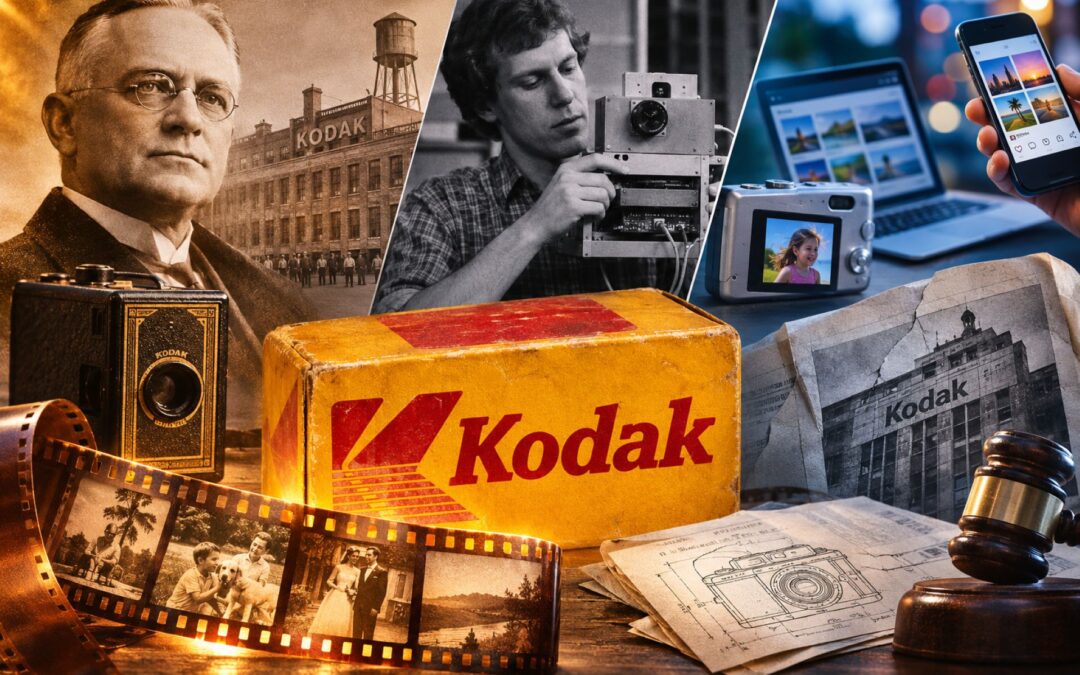
It was an extraordinary reversal. For generations, Kodak had supplied the film that preserved holidays, family gatherings, weddings and childhoods. Its yellow boxes were familiar around the world, its laboratories were admired, and its factories helped sustain Rochester, New York. Yet the company that made taking photographs easy found itself struggling to earn money in a world where photographs no longer required film.
The familiar explanation is that Kodak invented digital photography, ignored the invention and paid the price. That story contains a compelling irony, but it misses much of what happened. Kodak did recognise the technology, invested in it and even led the American digital-camera market. Its deeper difficulty was finding a business that could replace the extraordinarily profitable one it had built.
How George Eastman Made Photography for Everyone
In the late nineteenth century, photography required commitment. A photographer might transport a bulky camera, glass plates, chemicals and equipment for preparing or developing images. Wet-plate photography could demand that plates be coated, exposed and processed while still wet. The results could be remarkable, but making a photograph was hardly a casual activity for someone on holiday.
George Eastman encountered the inconvenience while preparing for a trip in 1878. A young bank clerk in Rochester, he began experimenting with ways to simplify the process, working after his regular hours with photographic emulsions and equipment. His initial work concentrated on dry plates, which freed photographers from some of the most demanding steps of wet-plate processing. He then helped develop ways to coat photographic materials consistently and manufacture them in quantity.
Eastman established a photographic manufacturing business in 1880 and, with Henry Strong, organised the Eastman Dry Plate Company in 1881. Flexible roll film would become central to his ambitions: instead of carrying and changing individual glass plates, a camera could hold a succession of exposures. The Kodak brand appeared in 1888, while the formal Eastman Kodak Company name followed in 1892. Those distinctions matter because Kodak’s consumer breakthrough came from a business already developing photographic materials, not from a company that sprang into existence with a single camera.
The original Kodak camera, introduced in 1888, was a small, leather-covered box selling for $25 and preloaded for 100 exposures. It did not ask its owner to understand chemical processing or carefully adjust a complicated collection of camera settings. When the roll was finished, the owner sent the entire camera to Rochester. For $10, the company developed the photographs, made prints, loaded fresh film and returned the camera with the pictures.
Eastman’s slogan explained the arrangement better than a technical manual could: “You press the button, we do the rest.” The American Chemical Society’s history of Eastman’s photographic system shows how the camera, film, processing and distribution network worked as a connected innovation. Eastman had not merely made the equipment easier to operate; he had moved the difficult work away from the customer.
Even $25 was substantial money for many households. In 1900, the Brownie carried the idea further with a simple camera priced at just $1. Kodak advertised it in ways that made photography approachable to children and families, extending the market well beyond the enthusiasts who had previously mastered photographic technique. The low-cost camera did not eliminate the need for film or processing, but it removed a major barrier to becoming a photographer.
That changed what people considered worth recording. A portrait no longer had to be a formal studio occasion; a picnic, a pet, a birthday or a friend could become a photograph. Soldiers could carry images of home, parents could preserve ordinary moments in their children’s lives, and albums gradually became personal histories. Eastman’s achievement was both technological and social: photography became something people did, not simply a specialised service they purchased.
The Film Empire Built Around Every Photograph
The accessible camera created a remarkable commercial system. Kodak could earn money when someone bought a camera, but it could earn more over the years that person kept taking photographs. Each new roll required manufacturing and distribution; exposed film needed development; the finished image often required paper and chemical processing. A camera sold once could generate many subsequent purchases.
It was similar to the razor-and-blades model, though Kodak’s position was never absolute. Other manufacturers made cameras, film and photographic supplies, and professional photographers had their own equipment and preferences. Nevertheless, a customer using a competitor’s camera could still buy Kodak film, and a customer using Kodak film could still depend on Kodak-branded processing materials. Its advantage was the breadth of the photographic system, not exclusive ownership of every photograph.
Film manufacturing also rewarded scale and expertise. Producing consistent light-sensitive material meant controlling chemistry, coatings and manufacturing conditions with extraordinary precision. Defects that were almost invisible during production could ruin an image months later. Kodak invested in specialised equipment, research laboratories and production plants whose costs were difficult for smaller competitors to match. Once that network was established, the recurring sales of consumables could provide attractive margins.
The brand became inseparable from the ritual of taking pictures. Kodak advertised photography as a way to preserve happiness and family memory, while its familiar yellow packaging made film easy to recognise in shops. The phrase “Kodak moment” captured an idea that went beyond a purchase: the most important thing about the product was what it helped people remember. It served amateur, professional, medical and motion-picture photography.
Rochester felt the scale of the success. Kodak’s factories were major employers, and the company and the Eastman family supported civic, cultural and educational institutions. At its employment peak in 1988, Kodak had roughly 145,000 workers worldwide, an enormous workforce built around the manufacture and processing of images.
The business became a symbol of American industrial strength. Kodak joined the Dow Jones Industrial Average in 1930, and its research effort extended well beyond everyday colour film. Through much of the twentieth century, it held a dominant share of the American consumer-film market. Frequently repeated figures of around 90% of US film sales describe the scale of that dominance, although market share varied by period and category and should not be mistaken for a permanent worldwide monopoly.
The empire’s vulnerability was concealed in its success. Kodak’s expensive plants, distribution arrangements, technical expertise and habitual customer purchases were valuable because photography depended on physical materials. If photographs could be captured, viewed, copied and shared without those materials, the company would retain its scientific knowledge but lose much of the recurring demand that made the system so profitable.
Fujifilm Challenges an American Institution
Kodak’s position was under pressure even before digital cameras became everyday products. Japanese manufacturers, particularly Fujifilm, competed for the profitable market in photographic film. Fujifilm offered consumers and retailers another established source of colour film and photographic materials, challenged Kodak on price and distribution, and sought greater visibility outside Japan.
The competition became unmistakable at the 1984 Los Angeles Olympic Games. Fujifilm secured an official sponsorship position in Kodak’s home market, supplying photographic film and processing services. Kodak had long associated itself with major sporting events, so Fujifilm’s visibility carried significance beyond immediate film sales.
There is a temptation to turn the sponsorship into a single decisive battle in which Kodak lost the future. Its importance was more practical. A company accustomed to brand recognition and distribution advantages was facing a rival willing to invest heavily in building its own reputation. Customers had choices, and retailers could use those choices to negotiate. Kodak responded through its own advertising, relationships and subsequent Olympic involvement, but the old assumption that consumers would naturally prefer the familiar yellow box was becoming less secure.
Fujifilm’s challenge also illustrates that the photographic industry was not standing still while Kodak invented digital devices. Competitors were developing products and capabilities of their own. Fujifilm would later enter digital imaging while expanding into other areas that drew on its skills in materials and chemistry. Kodak’s coming crisis therefore involved both a technological transition and competition for businesses that still existed during that transition.
The Digital Camera Kodak Built in 1975
In 1974, a young electrical engineer named Steven Sasson was working in Kodak’s apparatus research laboratory in Rochester. His supervisor, Gareth Lloyd, asked him to investigate a newly available electronic imaging device from Fairchild Semiconductor. The component was a charge-coupled device, or CCD: an image sensor that could convert light into electrical information. Rather than improve a chemical film, Sasson decided to see whether the information could be captured, stored and displayed electronically.
He assembled a prototype from available parts, including a lens and optical components adapted from Kodak equipment, a Fairchild CCD, an analogue-to-digital converter and electronic memory. An audio cassette recorder stored the resulting data on magnetic tape. The contraption weighed about 3.6 kilograms, ran on batteries and looked more like an improvised laboratory instrument than something a family would bring on holiday.
On 12 December 1975, Sasson photographed Kodak laboratory technician Joy Marshall. The sensor captured an image in roughly 50 milliseconds, but transferring its digital information to the cassette took around 23 seconds. Then the tape had to be moved to a separate playback device connected to a television. In other words, the system could take a picture without film, but neither taking it nor seeing the result was convenient by consumer standards.
The image was black and white and measured just 100 by 100 pixels, equivalent to 0.01 megapixels. The first playback was hardly flattering: the system reproduced dark regions better than intermediate tones, and Marshall’s face was difficult to make out. In Sasson’s recollection, she observed that the picture needed work. The moment is memorable precisely because it was so ordinary. The first demonstration of a future mass-market technology produced a technically significant but visibly poor portrait.
Sasson kept improving the equipment, and he and Lloyd received a patent for an electronic still-camera system in 1978. IEEE Spectrum’s account of the prototype describes both the ingenuity of the apparatus and the limitations of its early images. It was an important demonstration of an electronic photographic system, not the first time anyone had experimented with electronic imaging or the completed consumer digital camera of later decades.
When Sasson showed Kodak managers what he had built, the implications were unsettling. The invention offered a way to make photographs without a consumable film roll. Sasson later recalled a reaction often paraphrased as “That’s cute, but don’t tell anyone about it.” The line conveys the tension he remembered, but it should not be treated as a verbatim, universally documented statement by all Kodak executives. Their questions also concerned how long it would take the technology to produce photographs good enough for customers to want.
That was not a foolish question in 1975. Digital storage, processing power, displays and image sensors were costly and limited. A family’s film camera produced far better photographs without requiring a television, cassette playback system or computer. Sasson himself anticipated that image resolution might not approach consumer expectations until the 1990s, giving the company reason to see digital photography as a long-term possibility rather than an immediate replacement.
Kodak did not leave the issue entirely to intuition. An internal assessment in 1981 examined electronic photography and anticipated that the technology could seriously challenge film during the following decade. The forecast was neither a perfect countdown to Kodak’s bankruptcy nor an instruction that could eliminate commercial uncertainty. It nevertheless showed that the company understood the broad direction of change remarkably early. The question was what to do while film continued to earn most of the money.
Why Kodak’s Digital Success Wasn’t Enough
The claim that Kodak ignored digital photography becomes difficult to sustain when its actual products are considered. Its laboratories developed advanced sensors, including an early megapixel CCD in 1986, while engineers built systems for professional and consumer markets. Kodak collaborated on a professional digital camera system in 1991 and continued to introduce electronic imaging equipment during the 1990s. The company that invented an early digital-camera prototype had not abandoned the field.
Kodak also experimented with ways to combine the old and new worlds. Its Photo CD system allowed customers to have film images digitised and stored on discs, which could then be viewed electronically. Retail imaging kiosks offered another route between digital files and printed photographs. These products were technically sophisticated responses to real customer needs, but their economic logic often still involved film processing, printing or another service in Kodak’s existing network.
The underlying dilemma was that producing a digital photograph did not necessarily create a second transaction. With film, taking more pictures meant buying more rolls and processing more exposures. A digital camera could store hundreds of pictures on reusable media, and the owner could view or delete them without buying anything else. A customer who loved digital photography might take far more pictures while spending much less on Kodak consumables.
Yet resisting digital would not have saved the film business. As image quality improved and prices fell, consumers had strong reasons to change. A digital photograph could be inspected immediately, shared more easily and reproduced without another developing cycle. The correct business response was not as simple as continuing to sell film, but selling digital cameras created a very different kind of company with different competitors and margins.
Kodak demonstrated considerable commercial success in that new market. Its EasyShare range made digital photography easier for ordinary consumers through accessible controls, docks, software and printing options. In 2004 and 2005, Kodak was the leading seller of digital cameras in the United States. That fact alone overturns the picture of a business that never entered the digital era: Kodak could make devices consumers wanted and distribute them at scale.
But market share was not the same as profit. Consumer electronics attracted rivals such as Canon and Sony, whose camera and electronics capabilities, pricing strategies and product cycles created intense competition. Digital devices improved rapidly, making older models less valuable and pushing manufacturers to release new products frequently. Kodak had to invest in design, components, marketing and distribution while consumers expected prices to keep falling.
A crucial timing problem made the transition harder. Kodak began serious electronic imaging work long before the mass market existed. There were years when investing in digital technology was expensive but the eventual revenue remained uncertain. When consumer demand finally accelerated, many competitors were already present, limiting the profits Kodak could expect from its early research. Its digital imaging operations eventually reached operating milestones, but the returns did not recreate the margins and recurring purchases of the film franchise.
The broader corporate history also complicates the standard account. Kodak recognised that its central market was maturing and pursued other growth opportunities, including copiers and pharmaceuticals. It invested heavily in Sterling Drug in 1988, hoping to apply its chemical expertise to another substantial industry. Those ventures demanded capital, generated mixed returns and were later sold or reorganised as Kodak refocused on photography. The company was searching for a successor to film, not merely refusing to look beyond it.
A detailed study of Kodak’s strategic renewal in Business History Review describes decades of investment in innovation, diversification and digital products. Its findings make the story more interesting than a simple cautionary tale about a secret camera. Kodak confronted uncertainty over when demand would change, the high cost of developing new businesses and the possibility that an early technical advantage would not translate into durable commercial returns.
Executives nevertheless faced a difficult choice between defending film earnings, investing in products that undermined those earnings and satisfying shareholders. Some decisions were poorly timed or insufficiently rewarding; recognising a threat was not the same as successfully replacing a business.
Kodak subsequently returned to the appeal of recurring consumable revenue through inkjet printing. Under chief executive Antonio Pérez, a former Hewlett-Packard executive, the company launched consumer inkjet printers in 2007. The hope was that inexpensive hardware and continuing demand for ink could replicate some of film’s economics. It was not an irrational idea in an era when households printed digital photographs, but Kodak entered a competitive market that was itself changing.
The story bears a useful comparison with Nokia’s struggle to adapt to the smartphone era. Technical expertise and substantial product development were not enough when consumers, competitors and the profit structure of an industry were changing together. Kodak’s problem was not the absence of innovation; it was the widening gap between innovation and a sustainable business model.
The Online Photo Revolution and the End of Film
Kodak had another possible route into the digital future: helping people organise, share and preserve photographs after they had taken them. In June 2001, it acquired Ofoto for approximately $58 million. The service offered private online image storage, sharing, editing tools and ways to order prints and photographic merchandise. Kodak was experimenting with online photography well before smartphones made social photo sharing a daily habit.
The acquisition fitted Kodak’s strengths. A photograph stored online could become a print, a card, an album or another purchased product. Kodak knew how to turn personal memories into physical objects, and its customers already trusted the brand with pictures that mattered to them. In its filings describing the Ofoto acquisition, the company presented online services as a way to expand digital photography and photographic purchases together.
The business later operated as Kodak Gallery. It was a genuine online photo service, not simply a website that pretended the internet did not exist. Nevertheless, its commercial emphasis remained tied to photo printing and related merchandise. As people increasingly shared images through social networks and mobile applications, the most important interaction with a photograph no longer necessarily involved ordering a physical copy.
It is tempting to compare Ofoto directly with Instagram. In 2012, Facebook announced a roughly $1 billion acquisition of Instagram while Kodak’s online gallery assets were being sold for a fraction of that amount. But the services were designed around different products and behaviours. Ofoto offered storage, private sharing and print ordering; Instagram developed around a mobile-first social network, followers and public circulation. Kodak’s early presence in online photography did not guarantee it could have created the latter business.
Kodak Gallery’s transaction was also narrower than the dramatic claim that Kodak sold a whole social-media future for $24 million. Shutterfly acquired specified gallery assets for $23.8 million through the bankruptcy process, with particular value attached to the customer relationships and transfer of images. Shutterfly’s 2012 annual filing sets out the transaction and its accounting treatment.
Meanwhile, the phone became the most serious threat to the standalone camera. Early camera phones put a lens in a device people already carried. Smartphones then combined better cameras, bright screens, wireless networks, editing tools and immediate sharing. Their convenience undermined compact digital cameras just as those cameras had undermined film. Even a company successful at selling conventional digital cameras now faced another change in what consumers wanted.
The consequences reached beyond camera hardware. The ability to view pictures instantly on a phone reduced the practical need for prints, while social sharing offered a way to distribute images without photographic paper or postage. The old business rewarded each photograph with the sale of materials or processing. The new world rewarded connectivity, software platforms and services, fields where Kodak’s advantages were less secure.
Bankruptcy, Patents, and the Price of Reinvention
As film demand declined after 2000, Kodak had to manage a painful double expense. It needed money to develop replacement products and businesses while also paying to close or reduce operations designed for a much larger market in film. Factories, laboratories, distribution networks and worker obligations could not be turned off as quickly as customers changed their habits.
In Rochester, the contraction was visible in shuttered facilities and disappearing jobs. Kodak’s manufacturing campus had once represented stability for families dependent on film production. Its contraction affected suppliers, neighbouring businesses and civic life. In those communities Kodak had organised much more than photographs.
The financial pressures accumulated through the 2000s. Sales of older photographic products weakened, newer businesses required investment, and restructuring consumed resources. Kodak also faced obligations to employees and retirees, legal costs and uncertainty over how much value it could realise from its extensive patents. By late 2011, the company’s stock had collapsed from its former heights and its ability to continue without financial protection was in question.
On 19 January 2012, Eastman Kodak filed for Chapter 11 bankruptcy protection in the United States. Court documents listed roughly $5.1 billion in assets and $6.8 billion in liabilities, though such figures are accounting snapshots rather than a simple measure of the company’s market value. Chapter 11 was a process for restructuring under court supervision, not an announcement that every Kodak business would close. It nonetheless marked the end of the company’s old industrial order.
One of the most valuable remaining assets was intellectual property. Kodak’s engineers had accumulated patents covering technologies involved in capturing, processing, managing and sharing images. Those innovations were relevant far beyond Kodak’s own cameras, which made them attractive to companies building phones, software and digital-image services. The patent portfolio became a possible source of much-needed cash during restructuring.
In December 2012, Kodak announced arrangements expected to generate approximately $525 million from transactions involving its digital-imaging patents. Intellectual Ventures and RPX helped organise the arrangements, with a group of twelve licensees that included Apple, Google, Microsoft, Samsung, Facebook, Amazon, Fujifilm and other major technology companies. The participation of firms associated with the new image-sharing economy gave the transaction obvious symbolic power.
Yet the details were more complicated than selling every invention to a consortium. Kodak agreed to transfer a portfolio of roughly 1,100 digital-imaging patents while granting and retaining specified licence rights, resolving disputes and making related agreements. Its filing on the patent monetisation arrangements describes how different parties acquired ownership or licensing interests. Kodak retained other patents and continued to use technology needed for its remaining operations.
The price was far lower than some earlier expectations for the portfolio, although comparisons with preliminary valuations do not establish that the patents could actually have sold for those amounts. The more important point was what the money represented: a company once able to fund massive research programmes from film profits was using the products of that research to finance survival and reorganisation.
For former employees, the consequences were less abstract. Restructuring affected jobs, benefits and expectations built over decades of service, while retirees followed court proceedings that could influence their financial security. The famous name could survive where an individual factory or career could not. Those losses belonged to the lives of people who had helped create Kodak’s success.
What Remained of Kodak
Kodak emerged from Chapter 11 on 3 September 2013 as a smaller company with a different commercial focus. Its consumer-camera empire was gone, and it concentrated increasingly on technologies used in commercial printing, packaging, publishing and industrial applications. The reorganisation ended the bankruptcy proceeding but did not restore the old business or the extraordinary reach Kodak once enjoyed.
The company still had capabilities developed during its film era. Precision coating, advanced materials, colour science, chemistry and complex manufacturing did not stop being useful because households stopped buying rolls of film. These capabilities could serve commercial printing equipment and supplies, speciality materials and other technical markets. Kodak had to sell them to different customers and compete on different terms, but they were real operating businesses rather than mere uses of a nostalgic brand.
Photographic film also survived in particular markets. Some motion-picture directors, including Christopher Nolan and Quentin Tarantino, continued to value the look and working process of shooting on film, helping sustain demand for specialised motion-picture stocks. Kodak continued producing film for cinema and other purposes even after mass consumer photography moved decisively toward digital devices. The familiar consumer Kodak name also appeared on products made or sold through licensing arrangements, which should not be confused with Kodak’s industrial operations.
An additional distinction matters: Kodak Alaris, established through the restructuring of former Kodak businesses, is not the same corporate entity as today’s Eastman Kodak. The continuing availability of Kodak-branded film, photo products and services therefore cannot be explained simply by treating every item bearing the name as a product of the reorganised company. The brand’s legacy is spread across operating businesses, separate companies and licensing relationships.
Kodak remains far smaller than the old industrial giant, but it has not disappeared. In its third-quarter 2026 financial results, Eastman Kodak reported revenue of $276 million, including business in printing and advanced materials and chemicals. The company had approximately 3,500 employees at the end of 2025. These figures concern the reorganised business, not the old consumer-film empire. They are evidence of survival and reinvention on more modest terms.
The tragedy of Kodak is therefore not that its engineers failed to imagine the future. Steven Sasson’s camera did imagine one part of it in 1975, and generations of Kodak scientists and managers spent enormous resources pursuing new forms of imaging. Their work was often inventive and, at times, commercially successful. What could not be easily replaced was the economic arrangement that turned millions of ordinary photographs into continuing sales of film, paper and processing.
Kodak’s history shows how difficult it can be to sustain an established enterprise when the technology supporting its profits changes. An incumbent can see the threat, invest in the right field and even lead a new product market without finding returns that support its inherited organisation. The company that told customers to press the button while it did the rest helped make photography universal; eventually, much of the rest could happen without it. Kodak survived that transformation, but the empire built on doing the rest did not.
Last Updated on November 10, 2026 by Aseem Gupta