
Reading Time: 18 Minutes
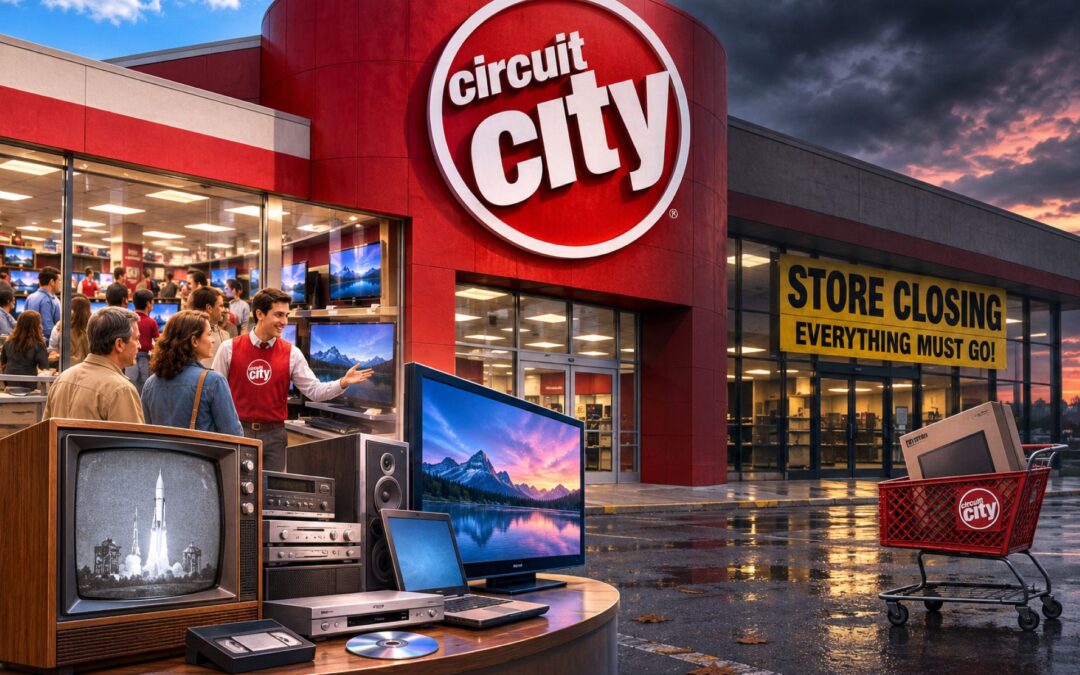
On 16 January 2009, Circuit City announced that it was giving up. After months of deteriorating sales, failed rescue efforts and desperate negotiations with creditors, the American electronics retailer would liquidate its remaining 567 stores. Tens of thousands of employees faced the loss of their jobs. For customers who had bought their first television, stereo or computer beneath its red signs, the announcement meant the disappearance of a familiar part of American shopping.
The ending was extraordinary because the business had once seemed so well positioned for the future. From a single television shop in Richmond, Virginia, Circuit City had grown into one of the country’s largest electronics chains, with hundreds of superstores and billions of dollars in annual sales. It had helped teach ordinary households how to choose and use technologies that were changing daily life. Yet it could not survive the changes of the 2000s, and its last stores closed on 8 March 2009.
The easy explanation is that online shopping killed another old-fashioned retailer. But Circuit City’s decline began long before the financial crisis delivered the final blow, and the internet was only one of several pressures. Its history is also about the way a company can gradually weaken the qualities that made customers choose it in the first place.
The Television Store That Began with a Haircut
The story begins in 1949 with Samuel Wurtzel, a New York businessman visiting Richmond, Virginia. According to the company’s often-repeated founding story, Wurtzel learned from a barber that a local television station was preparing to begin broadcasting. He recognized a commercial opportunity in that small piece of news. Once families could receive television programmes, they would need somewhere to buy the sets that brought those programmes into their homes.
Television was still a novelty for many Americans. Early sets were expensive, bulky pieces of furniture, their small black-and-white screens enclosed in wooden cabinets. Owning one meant purchasing unfamiliar technology whose value was difficult to judge from a description in a newspaper. Customers wanted to see the picture, understand the controls and know what would happen if the equipment failed.
Wurtzel moved his family to Richmond and established a store on West Broad Street called Wards. The name came from the initials of family members: Wurtzel, Alan, Ruth, David and Samuel. It was a small operation, but its timing was almost ideal. Television broadcasting and ownership were expanding, and an independent merchant who understood both the product and the customer’s uncertainty could establish a relationship that lasted beyond the original sale.
A television purchase was often a major household decision. People might compare models, ask whether a set would work well in their neighborhood and want reassurance about installation or repairs. A shop that simply handed over a box was offering less than one that explained what was inside it and remained available when something went wrong. Wards built its early reputation around selection, competitive prices and the support that made complicated products less intimidating.
Through the 1950s and 1960s, the company expanded as televisions became more common and the market for home audio equipment grew. Its stores sold recognized brands and provided service as well as merchandise. The business eventually expressed its promise through four words beginning with S: selection, savings, service and satisfaction. Its employees became associated with the phrase “the plug-in people,” a reminder that helping people use their purchases could be as important as selling them.
When Samuel’s son Alan Wurtzel took over as president in 1972, he inherited a successful regional retailer rather than an empty slate. The family had already demonstrated that electronics could support a durable customer relationship. Alan’s task was to determine how that relationship might survive at a much larger scale, as suburban America demanded more products and more convenient places to buy them.
How Wards Invented the Electronics Superstore
The postwar spread of suburban housing transformed the geography of shopping. Families with cars increasingly wanted to make a single trip to a large store rather than visit several small specialists. At the same time, electronics were proliferating: color televisions, stereo systems, tape decks and later video recorders made the average household’s shopping list both longer and more technically complicated.
Alan Wurtzel saw that the familiar specialist shop could be rebuilt on the scale of a warehouse. A larger showroom could offer more brands and models, while bulk purchasing and efficient stock handling could support attractive prices. Customers could compare products in person and take home a purchase without waiting for a special order. The format sought to unite the credibility of a specialist with the convenience and price advantages of mass retailing.
The transition did not happen in one launch. Wards opened its Loading Dock discount-superstore format in 1974, and the Circuit City name began appearing on stores in 1977. The more fully developed Circuit City Superstore emerged in 1981, combining the expansive showroom and warehouse model with a recognizable national identity. The company changed its corporate name to Circuit City Stores in 1984 as its expansion continued. Its company history traces these stages of development and the subsequent move into businesses beyond electronics.
Inside a successful superstore, the appeal was immediate. A wall of televisions allowed shoppers to compare picture quality; rows of audio equipment promised different sounds and prices; boxed products and inventory areas suggested that the advertised choice was actually available. Later, computers and gaming systems offered further reasons to visit. The store became a place to experience technology before committing to a substantial purchase.
Yet the huge showroom was only half of the formula. A shopper could stand in front of two televisions that looked similar and still have little idea which was a better choice. Trained salespeople explained features and trade-offs, answered technical questions and made high-priced purchases feel less risky. Repair departments and service arrangements reinforced the belief that the retailer would not disappear from the relationship once money changed hands.
That expertise was expensive to develop and maintain, but it distinguished Circuit City from a warehouse full of anonymous boxes. The retailer benefited when consumers found technology confusing: a knowledgeable employee could turn uncertainty into confidence and confidence into a sale. The model was particularly powerful when a new consumer technology arrived and there were few other convenient places to see it demonstrated.
As the red signs spread across American suburbs during the 1980s and 1990s, Circuit City became one of the defining names in consumer electronics. It was a destination for households buying VCRs, camcorders, stereos and home computers. At its height the chain had more than 700 stores, and by the 2000s annual revenue exceeded $12 billion. Its vast estate made the business appear permanent, but scale also meant that thousands of employees, costly premises and enormous volumes of stock had to be supported every day.
The Rivals and Technology That Changed the Shopping Trip
Circuit City did not suddenly encounter competition when internet shopping became popular. Best Buy, a Minnesota-based chain, had developed a formidable alternative to the traditional high-pressure electronics showroom. Its large stores offered broad selection and competitive pricing while moving toward an operating model that was less dependent on individual sales commissions. For shoppers who wanted to browse without feeling pursued, that experience could be appealing.
Walmart exerted a different kind of pressure. Its enormous purchasing volume and ability to sell electronics alongside groceries and household goods made televisions and other products vulnerable to relentless price comparison. An electronics specialist needed a reason for the customer to make an additional trip, particularly when a mass-market retailer offered a recognizable brand at a low advertised price. Circuit City could not assume that expertise alone would justify every price difference.
Meanwhile, the nature of product information was changing. During the early superstore years, many customers needed a salesperson to explain why one model differed from another. By the 2000s, manufacturer websites, specialist publications, discussion forums and customer reviews made technical comparisons available at home. Someone could learn the terminology, narrow the choices and discover competing prices before stepping into a shop.
That shift did not immediately make physical stores irrelevant. Many people still wanted to see a screen, hear speakers, take a product home at once or receive assistance with installation. But it reduced the retailer’s control over the buying decision. A customer who arrived already knowing the desired model could compare prices quickly and leave if another seller was cheaper. The store still paid for the demonstration space and staff even when a different business completed the sale.
Flat-panel televisions illustrated the danger. They drew buyers into electronics stores and initially commanded high prices, yet manufacturing advances and intensified competition drove selling prices downward. Lower prices could increase the number of televisions sold while reducing the money earned on each one. The retailer still carried inventory, paid wages and maintained a large showroom, so a growing market did not automatically produce healthier profits.
Circuit City was especially exposed because televisions represented an important part of its merchandise mix. A promotion that appeared successful to a shopper might have left the retailer with a narrow contribution after purchasing and operating costs. The problem was not simply that customers no longer wanted electronics. They wanted more capable electronics at steadily better prices, and an increasing number of competitors could offer them.
There was a strategic dilemma beneath these market changes. Circuit City could try to match cheaper competitors by reducing costs, or it could protect the service and expertise that made visiting a specialist worthwhile. It attempted elements of both, often while changing its product mix and store operations. Over time, those choices left it struggling to offer a clear advantage against rivals that were either cheaper, easier to shop or better adapted to changing consumer habits.
The Strategic Bets That Weakened the Business
One of Circuit City’s most revealing experiments was Divx, short for Digital Video Express. Introduced in 1998 as an alternative to conventional DVD rental, Divx promised the convenience of purchasing a low-cost disc that could be watched during a 48-hour window beginning with its first use. A customer could keep the disc instead of returning it to a rental store, but further viewing generally required another payment. The system needed a compatible player and a connection to a telephone line to manage the viewing authorization.
From the company’s perspective, this was a way to capture a lucrative role in home entertainment as video technology changed. If shoppers bought discs and compatible players from Circuit City, the retailer could participate in a continuing stream of viewing transactions rather than simply make a one-time hardware sale. The idea also appeared to solve a familiar inconvenience: nobody had to rush back to a rental counter to avoid late fees.
The disadvantages were obvious to many consumers. An ordinary DVD could be purchased, borrowed, rented or played again without the same special authorization system. Divx added conditions to a physical disc that buyers could hold in their hands, and it asked them to invest in a restricted format during a period of competing technologies. Some Hollywood studios supported the experiment, but other companies and influential video enthusiasts opposed it. It never achieved the broad acceptance necessary for the model to work.
Circuit City abandoned Divx in 1999. The company’s annual financial disclosures recorded an approximately $114 million after-tax loss on disposal of the business, distinct from the costs already incurred in running it. The episode was costly, but its significance went beyond the immediate write-off. Management had devoted resources and attention to a proprietary system that customers largely declined to embrace, at a time when straightforward DVD ownership was becoming attractive.
A separate strategic shift followed in 2000, when Circuit City stopped selling major household appliances. Refrigerators, washing machines and other large appliances consumed substantial floor space and had their own delivery and service requirements. Management wanted to devote more space and attention to categories such as computers, entertainment equipment and emerging digital products. There was a defensible logic to emphasizing goods that seemed to be growing faster, but the move also surrendered a reason for customers to visit and narrowed the range of purchases a family could make at the chain.
The appliance decision mattered because it changed more than a merchandise list. Circuit City had once aspired to be a broad destination for the technologies of domestic life. Removing major appliances made it more dependent on products whose prices could decline quickly and whose features became easier to compare across competing retailers. It also reduced opportunities to serve customers seeking a complete household purchase rather than a single gadget. Whether appliances would have saved the company is unknowable; giving them up certainly altered its competitive position.
Not every venture outside the core business was a failure. Circuit City helped launch CarMax in 1993, bringing a more transparent, fixed-price approach to used-car retailing. CarMax expanded and eventually became an independent publicly traded company through a separation completed in 2002. The contrast with Divx is important: Circuit City was capable of originating a business that succeeded beyond the electronics stores. Its problem was not a complete inability to innovate, but an uneven record of choosing which innovations would strengthen the retailer customers actually visited.
These decisions also demonstrate why a corporate collapse should not be reduced to one disastrous bet. Divx, the appliance exit and CarMax were different projects with different outcomes and justifications. Their relevance lies in the broader picture of a company searching for growth while the economic foundation of its core stores was becoming more fragile. By the time management turned aggressively to labor costs, it was confronting competitive problems that no single merchandise initiative had resolved.
When Cost Cutting Replaced Customer Expertise
The value of trained employees had always been central to Circuit City’s proposition, but it was also a significant expense. Sales commissions rewarded staff for successful transactions and could encourage them to develop detailed product knowledge. They could also create pressure on shoppers and complicate labor costs. As competitors adopted different approaches, Circuit City began questioning whether its traditional compensation system was worth preserving.
In February 2003, the company eliminated its commissioned sales structure in favor of hourly pay. The change was accompanied by the elimination of approximately 3,900 commissioned sales positions, part of a broader restructuring reported by the industry publication TWICE. In principle, customers might benefit from staff who were less financially dependent on closing a sale. Yet the transition also disrupted a workforce whose experience had been built under the old model, and the company needed to replace lost expertise through training and retention.
Four years later, it made a different and more visibly controversial decision. In March 2007, Circuit City announced that roughly 3,400 comparatively highly paid store employees would lose their jobs because their wages exceeded the levels the company wanted to pay for those positions. The company planned to hire replacements at lower rates and told affected workers they could apply for employment again after ten weeks. The contemporary Washington Post account of the dismissals captured how unusual it was for a major retailer to identify accumulated pay itself as a reason for termination.
For an experienced salesperson, the message was difficult to miss. Years spent learning products, answering customer questions and building a career could make an employee more expensive—and therefore more vulnerable. The policy did not establish that every dismissed worker was a star performer; pay and skill are not identical measures. But targeting higher wages inevitably risked removing employees whose familiarity with products, systems and customers could not be replaced simply by filling an empty shift on the roster.
Imagine the customer who had come to the same store for a decade and knew there was someone on the floor who could explain the difference between two complicated televisions. That relationship was not visible on a payroll spreadsheet. It depended on experience, confidence and the employee’s willingness to spend time with a hesitant buyer. When the experienced person disappeared, the customer still saw the same sign and the same product displays, but the reason to choose that store could be weaker.
The savings were meant to make an uncompetitive operating model more sustainable. Labor costs matter in retail, and a chain losing customers cannot ignore them. The difficulty is that customer-facing labor is not always interchangeable with an ordinary overhead expense. Eliminating knowledgeable staff may lower the wage bill immediately while increasing the chance that a valuable purchase is delayed, mishandled or made somewhere else.
There were also consequences for those who remained. Employees could reasonably wonder whether learning more and earning more would ultimately work against them. Store managers had to maintain service standards while coping with departures, recruitment and training. The company had once invited customers to trust the people behind its products; its personnel decisions made that promise harder to deliver consistently.
Comparable-store sales then deteriorated sharply. During December 2007, Circuit City reported a decline of 11.4% across its comparable stores, with an even larger decline in its domestic operations. The figure was alarming in a holiday period when electronics chains depended on strong consumer spending. But it would be misleading to attribute the entire fall to the layoffs: Best Buy, Walmart, online competition, merchandise pricing, product availability and broader consumer conditions were already shaping the market.
The staffing decision is therefore best understood as an accelerant rather than a complete explanation. It weakened a form of differentiation at precisely the moment Circuit City most needed something its cheaper competitors could not easily reproduce. The resemblance to the later challenges of RadioShack’s neighborhood electronics stores is instructive: technical assistance can be part of what a specialist sells, even when it never appears as a separate item on the receipt.
The Financial Crisis Turns a Slow Decline into a Cash Emergency
By the start of 2008, Circuit City’s financial problems were more serious than a bad quarter. Its sales remained enormous in absolute terms, but size could not compensate for weakening profitability and declining customer traffic. The company’s fiscal 2008 annual report documented the deterioration and described risks facing its operations. A business with thousands of employees and hundreds of large stores needed a dependable flow of cash to keep the system functioning.
Consumer-electronics retailing was especially demanding because stores had to buy valuable merchandise before customers paid for it. Televisions and computers absorbed cash while sitting in warehouses or on display, and a product left unsold could quickly lose value as manufacturers introduced new models or cut prices. The retailer relied not only on sales receipts but also on arrangements with suppliers, financial institutions and credit providers to bridge the gap between ordering goods and selling them.
Those arrangements depended on confidence. A supplier might ship merchandise under payment terms because it expected the retailer to remain solvent. A lender might advance money against qualifying inventory and other assets because it believed those assets could support repayment. As sales weakened, losses rose and the value of unsold products became uncertain, everyone involved had an incentive to reduce exposure. Unfortunately for the retailer, each defensive decision could make the next one more damaging.
The financial crisis of 2008 intensified this cycle. The failure of major financial institutions and the sudden distrust spreading through credit markets made lenders and suppliers much more cautious. Circuit City’s existing problems became far harder to manage in an environment where obtaining short-term financing was difficult even for healthier firms. The broader mechanics of that disruption are covered in the history of the 2008 financial crisis, but its effect on Circuit City was painfully concrete: stock could not reach shelves unless someone was willing to finance it.
Suppliers and their credit insurers became concerned that goods delivered today might never be paid for. Some tightened terms or demanded faster payment, while restrictions on credit support made ordinary purchases harder to arrange. At the same time, borrowing availability depended partly on the value and eligibility of the assets supporting the retailer’s credit facility. A business short of merchandise could lose sales, and lost sales made it still less attractive to the institutions it needed to keep merchandise flowing.
This was the trap facing Circuit City ahead of the crucial holiday shopping season. The stores required compelling stock and competitive prices to persuade customers to visit. But procuring that stock required money, and deteriorating sales and financial conditions reduced access to money. A retailer cannot easily trade its way out of trouble when the mechanisms that supply its inventory are breaking down.
Management had little time to stabilize the situation. Chief executive Philip Schoonover left in September 2008 amid severe pressure on the business. Restructuring and possible rescue arrangements were discussed, but a buyer would have needed confidence in both the stores’ prospects and their financing. The chain still had a well-known brand, customers and physical assets; what it increasingly lacked was a credible path through the months ahead.
On 3 November 2008, Circuit City announced plans to close 155 underperforming stores. Its corporate announcement to the Securities and Exchange Commission described escalating pressures involving vendors, payment terms and credit availability. The closures came before—not after—the bankruptcy filing. They were an attempt to cut the company’s exposure and preserve enough of the remaining business to continue operating.
A week later, on 10 November, Circuit City filed for Chapter 11 bankruptcy protection. Chapter 11 was not the same thing as an immediate liquidation; it gave the business a legal framework to try to reorganize while maintaining operations. But legal protection could not create consumer demand, reassure every supplier or guarantee that new financing would appear. The store-closing plan and bankruptcy filing were two stages of a rescue effort that was running out of room to succeed.
The timing could scarcely have been worse. Holiday sales represented the retailer’s opportunity to generate cash, yet customers hearing the word “bankruptcy” had reasons to worry about returns, warranties and gift cards. Suppliers had reasons to be cautious about extending more credit, while potential acquirers faced a collapsing economy and a deeply troubled retail format. Circuit City entered the most important selling season of the year carrying the cost of its old business without the confidence needed to sustain it.
The Last 567 Stores: Liquidation and Its Human Cost
The Chapter 11 filing did not immediately end Circuit City. The remaining stores continued to operate while executives and advisers searched for a buyer or a restructuring plan that would keep some version of the chain alive. There was an obvious reason to try: Circuit City still possessed recognizable stores, established locations, supplier relationships and a name familiar to millions of households. Bankruptcy might have been a chance to make that footprint smaller and more financially viable.
But December offered little relief. Consumers were anxious about jobs and spending, Circuit City had to persuade shoppers that purchases and after-sales services would be handled, and its operational difficulties had not disappeared. Any rescue required more than someone buying an attractive brand. It required enough capital and supplier cooperation to finance actual inventory and payroll through a difficult recovery.
On 16 January 2009, the company announced that its search had failed and it would liquidate. The decision covered the 567 remaining stores. Liquidation sales would turn merchandise, shelving and other assets into cash to satisfy creditors as far as possible, but they would not preserve Circuit City as a national retailer. Workers who had spent years learning its products and serving its customers now faced a very different task: helping empty the business they had helped build.
There was a strange reversal in the final weeks. The stores that once promised an abundant future of new devices advertised their own disappearance. Shoppers inspected discounted televisions and computers while shelves grew bare and fixtures were offered for sale. Even people who had not visited in years might come in for a bargain or out of curiosity, producing crowds that could no longer save the company. A closing sale is not evidence that the business could have survived at ordinary prices.
The consequences extended beyond the customers who would need a different place to buy electronics. Approximately 34,000 employees were affected by the liquidation, from sales floors and service counters to warehouses and offices. The job losses landed during an economic downturn that made finding replacement work difficult. For longtime staff, the loss was not just a wage; it was also the disappearance of routines, professional knowledge and relationships built over many years.
On 8 March 2009, the last Circuit City stores closed. A contemporary Associated Press account of the final day described the culmination of the chain’s downward spiral. Sixty years after Samuel Wurtzel had recognized an opportunity in an emerging television market, the original retailer had run out of opportunities to remain open. The red signs still existed for a time, but the company behind them no longer operated the stores Americans had known.
What Remained of Circuit City—and What Really Killed It
The Circuit City name survived the liquidation even though the original retail business did not. Systemax acquired the brand and related online assets in 2009 and used the name for internet commerce. Subsequent owners pursued efforts to relaunch the identity, including a new ecommerce presence in 2018. Those ventures reflected the value of a recognized trademark, not the return of the old network of staffed electronics superstores.
The more consequential legacy is the combination of forces behind the collapse. Best Buy and Walmart challenged Circuit City’s prices and shopping experience; online information weakened the store’s exclusive role as a technology guide; and changing product economics squeezed margins. Decisions about Divx, appliances and staffing added risks or removed potential advantages. Then the financial crisis struck a business that increasingly depended on outsiders continuing to extend credit.
It would be too simple to insist that Circuit City was healthy until it fired experienced employees, or that those employees alone could have saved it. Its problems were structural and financial as well as managerial. But the 2003 and 2007 workforce decisions reveal how management addressed those problems, and why the response could undermine the customer proposition the company had spent decades building.
Samuel Wurtzel’s first shop had succeeded by bringing unfamiliar technology into people’s homes with a measure of reassurance. The superstore format made that promise bigger, but it never entirely replaced the need for people who could help customers make sense of their choices. Circuit City’s downfall showed how difficult it can be to compete on both price and service when a business under pressure begins treating the expertise behind its service as a dispensable cost. Its doors finally closed because many pressures converged; its tragedy was that some of the qualities that might have helped it endure had already been weakened from within.
Last Updated on November 10, 2026 by Aseem Gupta