
Reading Time: 27 Minutes
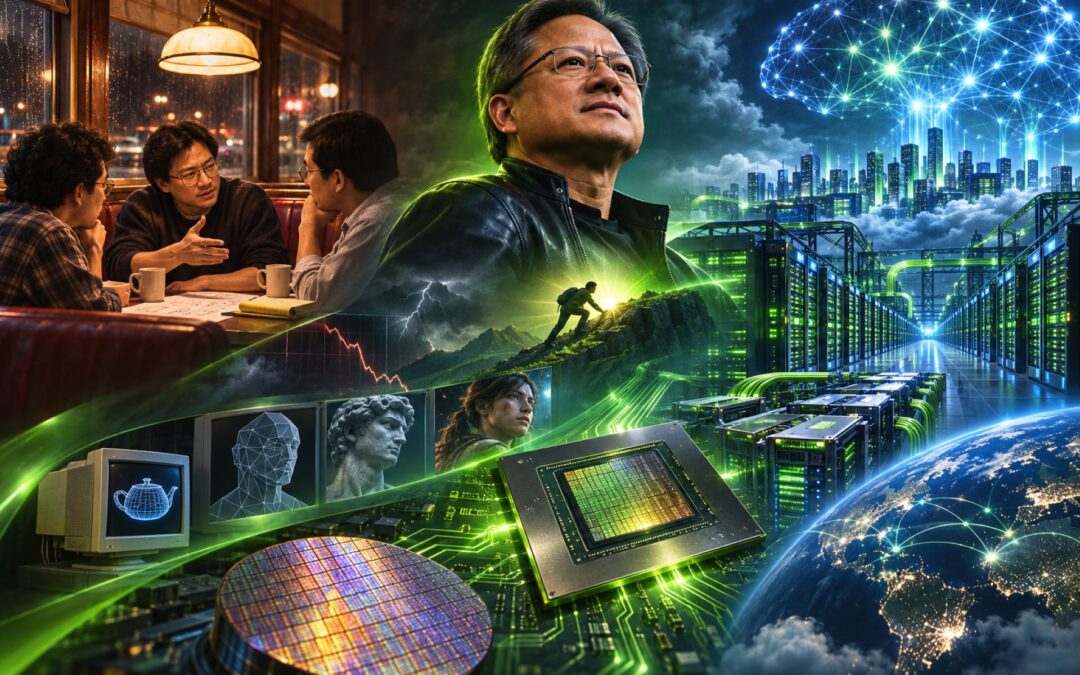
In 1993, three engineers met at a Denny’s restaurant in San Jose, California, to discuss an idea that could easily have disappeared into Silicon Valley’s crowded semiconductor industry. One of them, Jensen Huang, had worked at Denny’s as a teenager, clearing tables and learning how a busy kitchen operated. He returned not as an employee but as a prospective founder, with Chris Malachowsky and Curtis Priem beside him and a conviction that computers were about to become much more visual.
Their company, Nvidia, came dangerously close to disappearing. Its first major chip failed to establish the market the founders had imagined. A gaming-console contract threatened to trap its engineers in the wrong technology. Huang later recalled moments when the business had little more than weeks of financial breathing room. The company survived by abandoning an architecture, racing to release a replacement and then investing in another technology whose customers barely existed.
Three decades later, Nvidia had become essential to the artificial-intelligence boom. In October 2025, it became the first publicly traded company to reach a market valuation of $5 trillion. In fiscal 2026, it generated nearly $216 billion in revenue, almost eight times its fiscal 2023 sales. Its technology sat inside the data centres used to train and operate some of the world’s most powerful AI systems.
The transformation was not the result of a single lucky invention. Nvidia learned to manufacture better chips, built software that made those chips useful far beyond gaming, and assembled an entire computing platform around them. Yet that success also created fresh vulnerabilities: giant customers looking for alternatives, governments restricting trade, enormous infrastructure bills and, by November 2026, an unexpected change at the top. The story of Nvidia is therefore both a study of how technological advantages accumulate and a reminder that none is guaranteed to last.
The Founding of Nvidia in 1993
Jensen Huang was born in Taiwan and moved to the United States as a child. His early years included time away from his parents as he adjusted to life in a new country, before he developed an interest in electronics and engineering. He studied electrical engineering at Oregon State University and later earned a master’s degree at Stanford. Before founding Nvidia, he worked at Advanced Micro Devices and LSI Logic, gaining experience in the semiconductor industry at a moment when the personal computer was becoming a mass-market product.
His eventual partners brought complementary expertise. Chris Malachowsky and Curtis Priem had worked at Sun Microsystems, a company associated with powerful computer workstations. They understood graphics hardware, systems design and the demands of professional computing. Huang brought knowledge of chip businesses, product development and the commercial side of engineering. Together, they were looking for a technology that would matter as personal computers became more capable.
The opportunity was three-dimensional graphics. Early PCs could display text, pictures and relatively simple games, but convincing real-time 3D worlds demanded far more calculation. Every moving object required the computer to determine geometry, perspective, colour, texture and what should appear in front of what. General-purpose central processors could perform these operations, but doing them while also running the rest of the computer imposed severe limitations.
A specialised graphics processor could take over much of that work. If games and multimedia applications became more sophisticated, demand for graphics acceleration might grow alongside them. It was a plausible insight, but not a guaranteed business. The founders did not know precisely which graphics technology developers would standardise on or how many rival manufacturers would survive the coming shakeout.
The often-retold Denny’s meeting captured the company’s informal origins without itself being a complete explanation of how it was formed. Nvidia’s corporate history dates its founding to 5 April 1993. Silicon Valley was already full of talented engineers, chip startups and investors willing to consider ambitious computer ideas. Having a promising concept was easier than persuading customers to adopt an unfamiliar chip, funding expensive manufacturing and delivering new products quickly enough to stay relevant.
Sequoia Capital became one of Nvidia’s early backers. Venture financing mattered because semiconductor design was an unusually unforgiving business: engineers could spend months or years developing a chip before discovering whether it worked as intended. Unlike software, an error in manufactured silicon might require a costly redesign and another production cycle. A young company could run out of cash before a technically impressive product ever reached customers.
The company’s name reflected the founders’ sense of technological possibility. The letters NV grew out of the working shorthand for ‘next version’, while the final name also evoked invidia, the Latin word for envy. The implied ambition was competitive: build graphics technology that other companies would wish they had. Before Nvidia could make anyone envious, however, it needed to learn a painful lesson about the difference between inventing technology and building technology that a market will use.
The Chip That Almost Destroyed Nvidia
Nvidia’s first major product, the NV1, arrived in 1995. It combined three-dimensional graphics with sound and game-control functions, an ambitious all-in-one approach in an era when PCs often relied on separate components. The chip was intended to help turn the computer into a richer entertainment machine. Its problem was not simply that it lacked features or performance; Nvidia had made a fundamental bet about how three-dimensional images should be represented.
The NV1 used an approach built around curved surfaces and quadrilateral primitives rather than the triangle-based methods that were becoming dominant. Both approaches were attempts to represent three-dimensional objects on a two-dimensional screen. Developers, however, needed their game engines, graphics instructions and hardware to work together. As Microsoft developed DirectX and its Direct3D graphics interface, the industry increasingly organised around a model Nvidia’s architecture did not naturally support.
That mismatch was devastating. Developers had little incentive to write special versions of their games for a chip that operated differently from the emerging standard. Even if the NV1 could produce attractive images in software written for it, the total library of compatible games mattered more than isolated technical demonstrations. Nvidia had designed a product for the direction it thought graphics should take, while the broader ecosystem was moving elsewhere.
The company was also working with Sega, the Japanese gaming giant behind arcade successes such as Virtua Fighter and Daytona USA. Sega wanted help developing technology for a future console, and Nvidia’s NV2 work followed the same basic architectural direction as the NV1. For a struggling startup, a console contract offered a potentially important customer and a valuable stream of income. For the engineers, however, it risked committing the next two years to a design philosophy they increasingly believed was wrong.
Huang’s account of this period, preserved in Sequoia Capital’s oral history of Nvidia, captures the impossible choice. Completing the Sega project might keep money flowing temporarily but leave Nvidia behind the PC graphics market. Abandoning it could allow an architectural reset but also deprive the company of revenue it needed to survive. Either path appeared capable of ending the business.
Huang travelled to explain the situation to Sega executive Shoichiro Irimajiri. In Huang’s recollection, he argued that finishing the chip would damage both companies because the industry was turning toward a different graphics approach. He asked to be released from the project while retaining the money Nvidia needed to complete its pivot. Irimajiri agreed to terms that reportedly left Nvidia with roughly $5 million in payments despite the cancellation of the development work.
It was an unusually generous outcome, and the distinction matters. The story is sometimes simplified into Sega ‘investing $5 million’ in a struggling Nvidia. Huang’s detailed retelling instead describes Sega continuing to honour a financial commitment after allowing Nvidia out of the contract. Whatever label is attached to the arrangement, the practical consequence was clear: a customer gave the young company breathing room it might otherwise have lost.
Money alone would not solve the technical problem. Nvidia now needed a chip compatible with the graphics interfaces developers actually used, and it needed that chip before the remaining cash disappeared. Huang cut staffing and directed the company’s resources toward a replacement design, the NV3, better known as the RIVA 128. The startup could no longer afford a sequence of leisurely prototypes and corrections.
Normally, a chip company designs a circuit, manufactures a sample, tests it, fixes its mistakes and then commissions another version. That cycle can take many months. Huang’s team did not have enough money for repeated attempts, so it tried to shift as much testing as possible before the first manufacturing run. The engineers obtained a hardware-emulation system from Icos, a company that had gone out of business, and used the machine to simulate how the new design would behave. The equipment allowed software work and debugging to advance before physical chips existed.
According to Huang, the RIVA 128 worked on its first major fabrication attempt. Launched in 1997, it was fast, compatible with the direction of PC games and commercially successful. Sequoia’s account says Nvidia sold approximately a million units in its first four months. The result bought more than short-term survival: it demonstrated a way to develop hardware at a faster cadence than competitors and convinced the company that speed, compatibility and disciplined execution could compensate for a lack of resources.
The NV1 failure is sometimes retold as a comforting lesson about persistence. Its actual lesson was more demanding. Nvidia survived because it acknowledged that a technically ingenious choice had become commercially untenable, asked a powerful partner to accept an extraordinary compromise, radically changed its engineering methods and delivered a working replacement under pressure. A stubborn refusal to abandon the original architecture would have been fatal. The willingness to abandon one bet became the condition for making a much larger bet later.
From Graphics Cards to the GPU Revolution
The RIVA 128 did not make Nvidia the permanent winner of PC graphics. Rivals still competed fiercely, and graphics cards were becoming a demanding business in which performance improvements were quickly matched. Nvidia had to develop chips, drivers and relationships with game developers while preparing the next generation of hardware almost as soon as the previous one reached stores. What the rescue made possible was a sustained cycle of releases rather than one miraculous product.
The company’s public listing marked a new stage. Nvidia went public on 22 January 1999 at $12 a share, gaining access to public investors and becoming more visible in the semiconductor market. An IPO was not proof that its technology would dominate, but it gave the company a stronger financial base from which to pursue a demanding product roadmap. The challenge was to make 3D graphics sophisticated enough that consumers would actively seek out faster hardware.
In 1999, Nvidia introduced the GeForce 256, announcing it in August and bringing products to market later that year. It advertised the chip as the world’s first graphics processing unit, or GPU. There had been graphics accelerators before the GeForce, and the claim was partly a matter of terminology and product positioning. Nevertheless, the GPU label caught on because it described an increasingly important distinction between the general-purpose CPU and a processor designed for graphics workloads.
The GeForce 256 could perform hardware transform and lighting calculations that previously often consumed CPU resources. Transform operations helped convert the positions of objects in a three-dimensional scene into the perspective seen by the player. Lighting calculations helped determine how surfaces appeared under different light sources. Moving this work onto specialised hardware made increasingly elaborate games possible without demanding an equally dramatic increase in the main processor’s workload.
A graphics card also required more than clever silicon. It needed drivers that translated instructions from applications into commands the hardware understood, reliable compatibility with Windows and popular games, and the ability to deliver consistent frame rates. Players noticed whether a game looked smooth, whether effects worked correctly and whether a newer card justified its price. Nvidia’s efforts to release frequent improvements made it increasingly influential in deciding what performance game makers could assume from consumer PCs.
The company expanded its reach through a deal to provide graphics technology for Microsoft’s original Xbox. Nvidia secured the relationship in 2000, and the console launched in 2001. Microsoft was entering a market already dominated by experienced console makers, and the arrangement brought Nvidia’s technology into living rooms that might never contain a dedicated gaming PC. It also demonstrated an irony: the company nearly undone by a mismatch with Microsoft’s graphics direction was now supplying hardware for Microsoft’s own games console.
Success was not uninterrupted. Graphics manufacturers competed on price, speed, manufacturing processes and proprietary features. New games often forced consumers to confront the limitations of older cards, while developers could not simply abandon everyone whose hardware lagged behind. Nvidia had to support established customers and introduce ambitious new features simultaneously. Those pressures helped make close coordination between hardware engineers and software developers an ordinary part of its business.
Over time, Nvidia’s graphics products advanced beyond the fixed-function capabilities associated with the original GeForce 256. Programmable shading became increasingly important, allowing developers to specify more of how surfaces, light and visual effects should behave. The broader shift toward more flexible graphics processors had implications far beyond games. A machine designed to perform many similar operations on pixels and vertices was becoming a large collection of programmable computing resources.
Gaming remained central to Nvidia’s identity for years, and its commercial success funded the engineering required to pursue new opportunities. Yet the most important future customer would not be a person buying a graphics card to play a better-looking game. It would be a researcher who wanted a very large number of mathematical operations performed quickly, often without displaying a single pixel.
CUDA: The Gamble That Changed Nvidia’s Future
A traditional CPU is designed to handle a wide variety of tasks, including complex instructions that must be executed in particular sequences. A GPU makes a different trade-off. Much of its power comes from executing many similar operations in parallel, distributing work across numerous processing units rather than prioritising a small number of sophisticated sequential tasks. The architecture developed because rendering images repeatedly requires calculations on large collections of pixels, points and surfaces.
Consider a simulation calculating how millions of particles move. Many of the particles may be governed by similar mathematical rules, and the same type of calculation must be repeated across the dataset. A GPU can assign large groups of those calculations to separate processing units and work on them simultaneously. This does not make GPUs universally faster than CPUs: tasks with complicated dependencies, limited parallelism or heavy control logic may still be better suited to other processors. But for suitable workloads, the speed advantage can be enormous.
Scientists recognised the possibility before Nvidia had an accessible general-purpose programming platform. Some researchers purchased gaming graphics cards and devised ingenious ways of using graphics functions to run non-graphics calculations. In one recollection from Nvidia’s early history, Huang described visiting a researcher at National Taiwan University who had assembled an improvised computing system from GeForce cards, shelves and household fans. The scientist wanted far more processing power than conventional research equipment would have made affordable.
That kind of improvisation revealed demand but also exposed a major barrier. Using a chip through graphics-oriented programming interfaces meant expressing scientific problems in the language of graphics operations, a cumbersome and restrictive process. Most researchers were not graphics programmers. Even when they could obtain a significant speedup, replicating a specialised workaround across different projects or generations of hardware was difficult.
In 2006, Nvidia unveiled CUDA, its Compute Unified Device Architecture, with programming tools that became available as the platform developed. CUDA made it possible to write software for Nvidia GPUs using concepts familiar to general-purpose programmers. Researchers could use GPUs to perform calculations in areas such as molecular modelling, medical imaging, seismic analysis, financial simulations and other computationally intensive fields without disguising every problem as a graphics task.
The software layer was as important as the chips beneath it. A scientist considering a GPU needed documentation, libraries, debugging tools and examples, not merely a faster processor on a specification sheet. As researchers experimented, Nvidia could improve its tools and add capabilities suited to broader computing needs. Universities provided an especially valuable environment because students and researchers who learned CUDA could carry those habits into laboratories, startups and eventually major companies.
The gamble was expensive. Nvidia was supporting programmers, building software infrastructure and adding computing capabilities that ordinary gamers might not value enough to pay extra for. The new markets were small and uncertain, while conventional graphics products already faced intense competition. It was reasonable for investors to question whether spending heavily on non-gaming applications would generate an adequate return. The criticism should not be confused with a proven calculation that CUDA alone caused a particular shortfall in profit; Nvidia’s financial results reflected many simultaneous pressures.
Those pressures became much more severe during the 2008 financial crisis. Demand weakened, semiconductor businesses faced inventory and pricing problems, and Nvidia’s shares suffered a steep decline of roughly three-quarters from earlier highs. A falling stock price did not mean CUDA had failed technologically, but it made the company’s investment choices harder to defend. Spending on a platform without obvious mass-market customers was particularly difficult when the established business was under strain.
Huang and Nvidia’s engineers continued to develop CUDA. The company did not simply sell computing hardware and hope users would figure out the rest. It cultivated a developer ecosystem in which programming interfaces, optimised libraries and growing familiarity made the chips more valuable with each generation. That was a different strategy from winning a single graphics benchmark. A better chip might attract purchases for a year; a widely used programming platform could influence choices for much longer.
There was a genuine commercial risk in committing early. Plenty of technically interesting platforms fail to attract enough developers to justify their cost, and parallel computing was not an automatic guarantee that artificial intelligence would become a huge market. CUDA became an extraordinarily successful investment because a series of developments in algorithms, data availability, research and eventually customer demand made massive parallel computation increasingly valuable. Nvidia could not control the timing of all those developments. It could only build a platform that would be ready if they arrived.
How Nvidia Helped Unlock the AI Revolution
Artificial neural networks were not invented in the 2010s. Researchers had spent decades exploring systems that learn patterns from data by adjusting large numbers of numerical parameters. Their practical success depended on more than promising theories, however. Training increasingly ambitious networks required large datasets, effective algorithms and enough computing power to process repeated calculations within a manageable period. For a long time, one or more of those ingredients was insufficient.
By the early 2010s, digital images and other datasets were becoming much more plentiful, while improvements in model training made deeper networks more useful. GPUs provided another essential ingredient. Training a neural network involves large numbers of mathematical operations on arrays of values; many can be executed in parallel. Instead of needing a specialised supercomputer that few laboratories could afford, researchers could make substantial progress with graphics processors originally marketed to gamers.
The turning point came at the 2012 ImageNet Large Scale Visual Recognition Challenge, an influential competition in which algorithms attempted to identify objects in images. Geoffrey Hinton and his University of Toronto students Alex Krizhevsky and Ilya Sutskever developed a deep convolutional neural network known as AlexNet. Krizhevsky trained the model using two Nvidia GTX 580 graphics cards, showing how consumer gaming hardware could support research that changed a major field.
The results were striking. The team’s system achieved a 15.3% top-five classification error rate, compared with 26.2% for the second-place entry. In this measurement, a prediction counted as correct if the right category appeared among the model’s five highest-ranked answers. The improvement demonstrated that a deep neural network, trained with suitable data and substantial computation, could outperform the leading alternatives by a wide margin. The researchers’ original AlexNet paper described the model and the techniques used to train it.
The breakthrough did not prove that GPUs alone had created modern AI. The neural-network architecture, the data, the optimisation methods and the researchers’ work were indispensable. Nor had deep learning previously been completely useless: it already had successful applications, even if many researchers remained sceptical about its broader potential. AlexNet changed expectations by producing an improvement too large to ignore in a highly visible task.
That mattered to Nvidia in two ways. First, it gave researchers a compelling reason to purchase more parallel-computing hardware. Second, it created demand for software tools and libraries that could make deep learning easier to develop and repeat. Nvidia had spent years constructing a platform before many of its most influential future users knew they needed one. The same CUDA ecosystem that had supported scientific simulations could now help accelerate a rapidly expanding branch of artificial intelligence.
As AI projects grew, individual graphics cards became insufficient. Research laboratories wanted systems that could combine multiple processors, store enormous datasets, and move information between chips efficiently. The challenge was no longer just to make one GPU fast. It was to turn many GPUs into a reliable computing system that scientists could use without becoming experts in every detail of server architecture.
On 5 April 2016, Nvidia introduced the DGX-1, an integrated system built specifically for deep learning. It packaged accelerators, associated hardware and software together, reducing some of the complexity involved in setting up a capable AI research environment. Nvidia presented it as a powerful alternative to assembling and configuring a much larger collection of conventional servers for suitable workloads.
Huang later recalled personally delivering an early DGX-1 to OpenAI, then a young research laboratory in San Francisco. The scene captures how different Nvidia’s ambitions had become from its original graphics-card business: instead of showcasing a game, its founder was bringing a specialised computing system to people trying to develop advanced machine intelligence. OpenAI did not single-handedly create Nvidia’s AI opportunity, and that one delivery did not cause ChatGPT to emerge six years later. It did, however, illustrate a growing relationship between the company supplying the computing infrastructure and the laboratories pushing AI capabilities forward.
During the following years, AI’s demand for hardware expanded as researchers trained larger models and businesses explored applications in language, vision, recommendation systems and other fields. Nvidia’s data-centre business grew, although gaming remained prominent in the public image of the company. That balance changed dramatically when AI moved from a technical research frontier to a consumer and corporate priority.
How ChatGPT Turned Nvidia into a Trillion-Dollar Company
When OpenAI released ChatGPT in November 2022, it gave millions of people a direct way to experience a technology that had largely been discussed inside research laboratories and specialist businesses. Its ability to answer questions, draft text and perform an expanding range of language tasks quickly attracted extraordinary attention. The apparent accessibility of the product disguised an infrastructure problem: the systems behind it required immense amounts of computation to develop and continued to consume computing resources every time people used them.
Training and inference create different demands. During training, computers process huge datasets and repeatedly adjust the parameters that determine a model’s behaviour. Many powerful accelerators must work together for extended periods. Inference begins after training, when a model responds to a user’s request; that computation may be smaller than an entire training run, but it occurs repeatedly across large numbers of users. As adoption grows, inference can become an enormous continuing expense, particularly for more complicated tasks.
The technology industry responded with a race to obtain computing capacity. Microsoft, Google, Amazon, Meta and other major companies invested in their own models, cloud platforms and AI services. New AI developers and specialised cloud providers also sought access to high-performance accelerators. The industry had to purchase not just individual chips but complete installations with memory, networking, cooling, power and the software needed to operate everything together.
Nvidia entered that race with hardware already optimised for the relevant mathematics and a software platform that many researchers knew. Its GPUs were not the only processors capable of running AI, but switching to an alternative often required substantial engineering work. Demand grew faster than manufacturers and system builders could respond, and the most sought-after accelerators became difficult to obtain quickly. Supply constraints reinforced the importance of securing capacity and long-term relationships with suppliers.
The change appeared in Nvidia’s financial statements. The company reported fiscal 2023 revenue of $26.97 billion, for a year ending in January 2023, before the full commercial effect of the generative-AI boom had arrived. Over the following three fiscal years, revenue expanded rapidly as data-centre customers invested on an unprecedented scale.
The stock market attached increasingly extraordinary values to that opportunity. Nvidia crossed a $1 trillion market capitalisation in May 2023, $2 trillion in February 2024, $3 trillion in June 2024 and $4 trillion in July 2025. On 29 October 2025, it became the first company to reach a $5 trillion valuation. Each milestone reflected the market price investors were willing to pay for Nvidia’s shares, multiplied by the shares outstanding; none was a measure of cash held by the company or money earned in a particular year.
By fiscal 2026, annual revenue had reached $215.94 billion, with approximately $193.7 billion coming from Data Center activities. The fiscal year ended in January 2026, and Nvidia reported the results in February. The increase was staggering for a company once identified primarily with PC gaming, and it also changed the mix of its business. AI-related infrastructure rather than graphics cards for individual consumers had become the main engine of growth.
Nvidia’s profitability was striking, but the details matter. Its fiscal 2026 GAAP gross margin was 71.1%, meaning revenue exceeded the direct costs associated with producing and delivering its goods and services by that proportion. The fourth-quarter GAAP gross margin was 75.0%. Neither percentage was the annual net profit margin: net profit also reflects operating expenses, taxes and other items. Nvidia nonetheless earned about $120 billion in GAAP net income for the full fiscal year, illustrating how much economic value the rapid expansion generated.
Such figures encouraged customers to accelerate purchasing while also attracting competition. A valuable accelerator could help a cloud provider sell computing services, and delays in receiving equipment could delay the customer’s own AI business. Yet ordering the newest hardware does not guarantee that a data centre will be profitable. The providers purchasing Nvidia systems must ultimately earn sufficient revenue from enterprises, researchers, developers and ordinary users to justify their capital spending.
ChatGPT did not invent Nvidia’s computing strategy or create its entire AI customer base. It accelerated an adoption cycle for which Nvidia was already unusually well prepared. The resulting revenue boom turned a long-running engineering wager into one of the most dramatic changes in corporate scale in modern technology history, while linking Nvidia’s future more closely than ever to other companies’ expectations about AI demand.
Nvidia’s Competitive Advantage Goes Beyond Its Chips
Nvidia’s position is easy to misunderstand if its products are viewed only as unusually fast processors. Semiconductor performance matters, but a customer building a large computing system cares about how easily that performance can be accessed, how reliably thousands of chips work together and how expensive it is to adapt existing software. Nvidia’s advantage emerged from the interaction of hardware, programming tools and an expanding community of people who knew how to use both.
CUDA is central to that system. Researchers and developers write code that relies on Nvidia’s programming interfaces, optimised libraries and other software tools. Over time, teams build applications, training pipelines and deployment practices around those tools. A competitor might offer a cheaper accelerator or excel at a particular task, yet switching could still require translating software, rechecking results, retraining staff and rebuilding operational systems. Those costs can matter almost as much as the purchase price of the chip.
The advantage is not an absolute lock. Software can be rewritten, frameworks can support multiple hardware platforms, and customers with sufficient engineering resources can reduce dependence on one supplier. Nvidia must keep improving its products and software to justify the premium it charges. Its installed base helps it compete, but the same installed base gives rivals an incentive to develop more portable alternatives.
At the scale of modern AI installations, networking is equally important. Imagine thousands of accelerators attempting to train one large model. Each must perform its own calculations, but they also need to exchange intermediate results and synchronise their work. A slow connection can leave expensive computing hardware waiting for information, undermining the benefit of purchasing more processors. System performance therefore depends on how quickly and reliably data moves between chips and servers.
Nvidia addressed that problem partly through its $7 billion acquisition of Mellanox in April 2020. Mellanox specialised in high-performance networking technologies used to connect computing systems. The purchase strengthened Nvidia’s ability to supply processors and the infrastructure that links them, making the company more influential in the design of whole data-centre systems rather than just individual cards.
The strategy extended across accelerators, memory arrangements, networking equipment, systems, programming libraries and software. Nvidia could help customers purchase a more integrated computing environment, with components designed to work together. This reduced some engineering and integration burdens while giving Nvidia more opportunities to capture value across a deployment. The company was increasingly selling a platform rather than a single device.
Integration also created difficult questions for customers. Depending on one supplier for chips, software and networking can simplify deployment, but it can increase bargaining power for that supplier and make replacement costly. Some organisations may accept those trade-offs because the system performs well and can be deployed quickly. Others may invest heavily in internal chip design or alternative software precisely because they want more control over price, supply and future decisions.
Nvidia’s competitive position therefore rests on more than possessing the highest-performing chip at a given moment. It depends on the usefulness of an entire ecosystem, reinforced by developers, customers, libraries and interconnecting technologies. The more important that ecosystem becomes to the AI industry, however, the more determined other companies become to weaken their dependence on it.
The Risks Behind Nvidia’s AI Empire
Nvidia has experienced enough reversals to know that extraordinary demand can disappear. In 2018, the collapse in cryptocurrency-related activity exposed the vulnerability of parts of the graphics-card market. Mining demand had helped absorb GPUs, and when that activity weakened, the supply chain faced excess inventory and falling expectations. Nvidia’s shares declined sharply. The episode showed how difficult it can be to distinguish durable end-user demand from purchasing driven by a temporary economic boom.
The company also learned that technological ambition does not guarantee regulatory permission. In 2020, Nvidia announced an agreement to acquire Arm from SoftBank in a transaction initially valued at about $40 billion. Arm’s processor designs and intellectual property were used across much of the electronics industry, including by businesses that competed with Nvidia. Authorities worried that ownership by one powerful chipmaker could harm rivals’ access to Arm technology. Nvidia and SoftBank terminated the acquisition in February 2022 after encountering substantial regulatory opposition.
Export controls have created a more direct constraint. Beginning in August 2022, the United States imposed restrictions aimed at advanced semiconductor and computing exports to China, followed by further changes in subsequent years. Nvidia had to adapt products, licensing arrangements and forecasts to shifting rules. China had been an important potential customer for sophisticated data-centre hardware, but regulatory limits and Chinese government actions made it increasingly difficult to serve that market competitively.
The company’s 2026 regulatory disclosures described the effect of restrictions on products such as the H20 and H200. They included inventory-related charges, constrained shipments and warnings about the long-term competitive consequences of being unable to participate fully in China’s data-centre market. Export controls can limit immediate sales, but they can also encourage customers and governments to invest in alternative suppliers and domestic technology ecosystems that remain competitive after restrictions change.
Customer concentration creates another vulnerability. A relatively small collection of technology giants and specialised cloud providers accounts for much of the demand for Nvidia’s advanced AI systems. In its fiscal 2026 annual reporting, Nvidia disclosed that one direct customer represented 22% of total revenue and another represented 14%. Those figures do not identify every final user, because hardware may pass through manufacturers and other intermediaries, but they illustrate the stakes of a slowdown at a handful of major buyers.
Some of those buyers are developing alternatives. Google has invested in its Tensor Processing Units, while Amazon, Microsoft and others have pursued proprietary accelerator designs or software strategies that could reduce their reliance on Nvidia. AMD and other semiconductor companies are also competing for AI workloads. Custom chips need not outperform Nvidia’s most flexible GPUs at everything to matter. If a customer can run a large, predictable class of inference tasks more cheaply on its own hardware, that may be sufficient reason to shift part of its spending.
There is also a financial concern about the way the AI boom is funded. Nvidia has entered investment and commercial relationships with businesses that purchase or deploy its hardware. Similar connections exist among cloud providers, AI developers and infrastructure financiers. A chip supplier may invest in an AI company, that company may purchase computing services, and a cloud provider may use the expected revenue to buy more chips. The transactions can involve genuine goods, services and payments without establishing that end users will ultimately generate enough demand to sustain the entire cycle.
That distinction is fundamental to OpenAI’s infrastructure financing. An announced investment is not necessarily cash already transferred, and a multiyear capacity target is not identical to a guaranteed purchase obligation. Critics worry that capital moving among mutually dependent businesses can magnify reported growth and investor confidence before the downstream economics are established. Supporters argue that the spending reflects real adoption of an important technology and that infrastructure must be built ahead of demand. Both arguments require attention to actual contracts and realised customer revenue, not just headline investment figures.
Physical infrastructure can become a bottleneck even when buyers have the money and desire to expand. A large AI data centre needs suitable land, buildings, high-bandwidth communications, cooling systems and reliable supplies of electricity. Grid connections and power-generation projects often take longer to complete than orders for computing equipment. If a facility cannot obtain electricity or bring its cooling systems online, the accelerators inside it cannot begin generating the expected revenue on schedule.
The economic tension becomes visible in Oracle’s data-centre expansion, where very large customer commitments must be matched by construction spending, financing and actual delivery of computing capacity. A backlog of future business does not automatically translate into cash today, and expensive hardware can become outdated before a project achieves its expected returns. Nvidia benefits when equipment is purchased, but the sustainability of future purchases depends partly on the financial health of those operating the installations.
Stock-market volatility reflects these unresolved questions. Nvidia has suffered substantial price swings despite rapid sales growth, including pronounced weakness in early November 2026 as enthusiasm for AI-related shares fluctuated. A stock decline does not establish that the underlying technology has stopped improving; equally, excellent current earnings do not prove that high growth and unusually strong margins can continue forever. The company’s valuation exposes investors to assumptions about spending, competitive advantage and profits many years into the future.
None of these risks implies that Nvidia’s products will suddenly become irrelevant. Its customers still need large amounts of computation, and its software and integrated systems remain formidable. The critical distinction is between the success of artificial intelligence as a technology and the profitability of every organisation financing the infrastructure around it. AI could become indispensable while individual chip suppliers, cloud operators or investors earn less than they currently expect.
Nvidia After Jensen Huang: Can Its Dominance Last?
For most of its history, Nvidia had one constant that distinguished it from many large technology companies: Jensen Huang remained its chief executive from the beginning. He led the business through the NV1 failure, the RIVA rescue, the expansion of PC gaming and the difficult years when CUDA appeared to be an expensive project with no obvious mass market. His continued presence did not make every decision correct, but it gave the company unusual continuity in its understanding of why long-term platform investments mattered.
That continuity helped Nvidia take risks that might have been harder for a succession of leaders to sustain. A chief executive rewarded mainly for the next few quarters could be tempted to reduce spending on software developers or research applications that produced little immediate revenue. Huang was able to argue repeatedly that the company was building capabilities for markets that were barely visible. The eventual success of CUDA made that patience look prescient, although hindsight can conceal how uncertain the outcome once was.
Founder leadership came with limitations of its own. A company dependent on one person’s judgment may struggle when that person is unavailable, while shareholders and customers need to understand how major decisions are made and challenged. Nvidia’s growth had also made it more complicated than the company Huang founded. Its future depended on vast engineering teams, manufacturing partners, international regulatory relationships, software communities, major customers and a global supply chain. No single executive could personally supervise every part of that system.
In November 2026, that long period of continuity ended abruptly. Nvidia’s board accepted Huang’s resignation as president, chief executive and director on 11 November, and the company announced the change the following day. Its filing with the US Securities and Exchange Commission confirmed that Colette Kress, Nvidia’s chief financial officer since 2013, had been appointed interim chief executive while a search for a permanent successor began. Harvey C. Jones became chair of the board.
The official filing establishes the change in leadership and its effective date; it does not, by itself, establish every allegation or explanation circulating in contemporaneous coverage of Huang’s departure. Those distinctions are important in a moment of intense speculation. Kress brought long experience of Nvidia’s finances and business transformation, while the board emphasised continuity in operations and the technology roadmap. Whether the eventual permanent chief executive could preserve Nvidia’s technical culture and commercial relationships remained an open question.
The transition raised several separate issues. Investors had to consider whether strategic decisions would continue at the same pace, whether major customers would see any change in negotiations and whether the company could retain the people whose work sustained its advantage. They also had to distinguish the possible loss of confidence associated with a famous founder’s departure from changes in the actual capabilities of Nvidia’s products. A processor does not become slower because a chief executive leaves; a long-term product strategy, however, can be affected by changes in leadership and organisational priorities.
The underlying business entered that transition with formidable strengths. Nvidia had a large base of developers familiar with CUDA, sophisticated accelerator designs, high-performance networking and an important role in systems used across the AI industry. Its challenge was to keep improving that platform while increasingly powerful customers developed their own chips, export controls limited some markets and enormous data-centre projects faced financial and physical constraints. The competitive landscape would not become less demanding simply because Nvidia had already built an enormous lead.
The story also cautions against treating the company’s past as a formula that can be repeated on command. The Sega rescue depended partly on another executive agreeing to an unusual concession. CUDA succeeded because a long, uncertain investment eventually met breakthroughs in deep learning and a growing supply of data. ChatGPT accelerated demand at a moment when Nvidia had relevant hardware, software and relationships already in place. Skill and persistence mattered enormously, but timing, partners and developments beyond Nvidia’s control mattered too.
That brings the story back to the Denny’s booth. In 1993, three engineers imagined better graphics for personal computers; they could not have mapped the precise route from an unsuccessful multimedia chip to neural networks trained across vast data centres. Their company survived by changing direction when necessary and committing to a computing platform before its eventual importance was obvious. Nvidia’s rise shows what can happen when a business remains capable of surviving long enough for a difficult technological bet to find its market. Its next chapter will test something different: whether a company can preserve the advantages of that bet after its founder has stepped aside and the entire industry has begun trying to catch up.
Last Updated on November 15, 2026 by Aseem Gupta