Reading Time: 20 Minutes
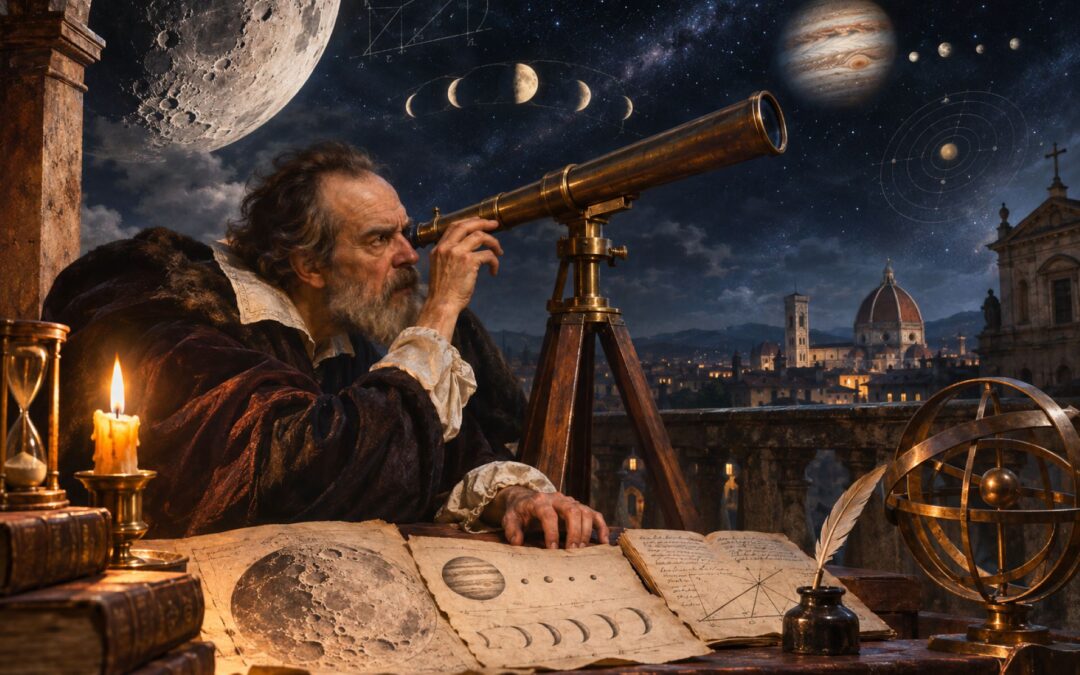
On 7 January 1610, Galileo Galilei pointed a telescope towards Jupiter and noticed three tiny lights beside it. He drew a circle for the planet and marked the lights as dots. They looked like ordinary stars, until he returned the following night and found them in different positions. Instead of discarding the first drawing, he kept it and made another.
Over successive nights, the changing arrangement revealed something startling: the lights stayed close to Jupiter because they were moving around it. What began as a handful of marks on paper would become evidence that the heavens were more complicated than established accounts allowed.
Galileo’s career would take him from university classrooms to a grand duke’s court and eventually before the Roman Inquisition. Yet his achievement was larger than the astronomical controversy that made him famous. By making observation, carefully devised experiments and mathematical argument answer to one another, he helped change what it meant to investigate the natural world.
From Pisa to Padua: A Mathematician Takes Shape
Galileo was born in Pisa on 15 February 1564, the eldest child of Vincenzo Galilei and Giulia Ammannati. His father was a musician and music theorist who investigated how the length and tension of strings affected the notes they produced. To study a sounding string is to connect an experience—the pitch one hears—with something measurable: a length, a weight or a ratio. That interplay between perception and quantity would become familiar territory for his son.
The family moved to Florence while Galileo was young. In 1581, he entered the University of Pisa intending to study medicine, a profession that offered financial security. But he found himself increasingly drawn towards mathematics, where a geometrical demonstration could connect a set of assumptions with a precise conclusion. Mathematics was also useful outside books: it could explain the operation of machines and the properties of structures.
Galileo left university without earning a degree. He supported himself through private teaching and pursued mathematical problems until, in 1589, he obtained an appointment at Pisa. Such posts were not especially lucrative, and scholars depended on a mixture of salaries, tutoring, publications and patrons. Galileo’s intellectual interests and his practical need to make a living developed together.
In 1592, he moved to the University of Padua, within the Venetian Republic. He remained there for eighteen years, teaching mathematics and mechanics to students whose interests often included surveying, fortification and military engineering. Venice was a commercial and maritime power: accurate measurements and useful instruments had obvious value to merchants, officials and soldiers.
Padua gave Galileo the relative stability and intellectual room to experiment, although his financial responsibilities remained substantial. He helped relatives, taught private pupils and pursued paid work alongside research. The popular image of an isolated thinker gazing at stars leaves out the working mathematician who needed customers, students and the goodwill of influential people.
Falling Bodies and the Mathematics of Motion
One question occupied Galileo long before he became famous as an astronomer: how do falling objects move? Traditional Aristotelian accounts were commonly understood to imply that heavier bodies fell faster than lighter ones. Everyday experience appeared to support the claim. A stone reaches the ground before a feather, but the comparison overlooks the enormous effect of air resistance on the feather.
The best-known story places Galileo at Pisa’s Leaning Tower, dropping unequal weights before an audience to expose the error. The story survives chiefly through a biography written later by his pupil Vincenzo Viviani, rather than a contemporary report of the demonstration. Historians therefore debate its details, and it should not be presented as an unquestionably documented public experiment. Galileo’s writings provide a more secure record of the intellectual problem he confronted.
His reasoning could be devastatingly simple. Imagine tying together a heavy object and a lighter one. If the lighter object naturally falls more slowly, it should retard the heavier object’s descent. But their combined weight is greater than the weight of the heavy object alone, so the very same rule predicts that the pair should fall faster. The assumption leads to incompatible answers, suggesting that weight cannot determine falling speed in the straightforward way claimed.
Reasoning alone, however, did not tell Galileo exactly how an object accelerated. The difficulty was measurement: a ball dropped from a modest height reaches the ground too quickly for the clocks of his day to record successive stages reliably. He found a way of slowing the phenomenon without abandoning the underlying question. A ball rolling down a shallow incline gained speed much more gradually than a freely falling ball.
In a procedure he later described, he used a carefully made groove in a long board to guide a rolling ball. He marked distances along its path and measured the time taken to reach them. One method involved allowing water to flow from a vessel during each run, then weighing the collected water. The quantity of water served as a measure of elapsed time, enabling repeated comparisons even without a modern stopwatch.
The pattern he investigated was precise. Starting from rest under constant acceleration, the distance travelled is proportional to the square of the elapsed time. If one second corresponds to a certain distance, two seconds correspond to four times that distance and three seconds to nine times the distance, under the same ideal conditions. The key claim was not merely that an object becomes faster, but that its changing motion follows a mathematical relationship.
These were not frictionless experiments. Balls rubbed against wooden grooves; flowing water varied; measurements had uncertainties. Galileo’s achievement was to adjust the physical setup until a regularity could be distinguished from the disturbances surrounding it. His surviving notes also show that these ideas took shape over time, not in a single perfect experiment.
The same combination of mathematics and practical work shaped his career at Padua. He developed and sold a geometric and military compass, a calculating instrument used for tasks such as proportional measurements and technical computations, and taught customers how to operate it. Its commercial success helped supplement his academic income. Here again, abstract relationships could be put to work through a tangible device.
His household was complicated. Galileo had a relationship with Marina Gamba, with whom he had three children: Virginia, Livia and Vincenzo. The daughters later entered a convent near Florence; Virginia became Sister Maria Celeste. The letters she eventually exchanged with her father preserve the intimate, practical concerns that existed alongside his public scientific arguments.
The Telescope and the Search for Patronage
In 1609, news reached Galileo of a Dutch optical device that made distant objects appear closer. He had not invented the first telescope. What he did was reproduce the principle, improve the instrument and recognize possibilities extending well beyond its original uses. A skilfully arranged combination of lenses could turn a modest novelty into a valuable aid to observation.
He demonstrated an improved telescope to Venetian officials from a high vantage point. Its practical appeal required little explanation: ships approaching a harbour might be spotted before they were visible to the unaided eye. That could help in commerce, coastal defence and navigation. Venetian authorities rewarded Galileo with more favourable employment terms, showing how quickly scientific craftsmanship could translate into political and financial advantage.
But there was another direction in which to point the instrument. The telescope could be aimed upward, towards objects whose apparent stability and perfection had long figured in European natural philosophy. Doing so required more than curiosity. Early telescopes had narrow fields of view, imperfect lenses and images that could be difficult to interpret, particularly when the target was a faint point of light.
A blurred image might reflect an imperfect instrument rather than a feature of the heavens. Skeptical observers therefore had a reasonable question: how could anyone know that the telescope revealed real objects rather than distortions introduced by its glass? Galileo would have to connect what he saw with repeatable patterns that other observers could test.
His reputation also depended on persuading people with the means to support him. Galileo understood that a compelling discovery could be offered as a symbolic gift to a powerful family, attracting a post in which scholarly prestige and material security reinforced each other. His most consequential astronomical observations arrived at a moment when his professional ambitions were ready to meet them.
Jupiter’s Moons and a New Sky
The Moon was among Galileo’s earliest celestial targets. Through the telescope, the boundary between its illuminated and dark regions appeared jagged rather than smooth. Bright points sometimes appeared inside the dark area and later joined the general illumination. Galileo reasoned by analogy with dawn on Earth: mountaintops catch sunlight before the surrounding valleys do. The Moon, he argued, had elevations and depressions rather than an immaculately polished surface.
That conclusion challenged the influential distinction between the changeable, imperfect Earth and supposedly more perfect celestial regions. The instrument also transformed the Milky Way. A faint streak of light across the sky resolved into a multitude of stars, while other stars became visible where the unaided eye had shown darkness. The universe was visibly richer than the familiar catalogue of naked-eye objects suggested.
Then came Jupiter. On 7 January 1610, Galileo recorded three lights near the planet, initially identifying them as fixed stars. On subsequent nights their configuration changed, yet they stayed close to Jupiter instead of remaining fixed against the stellar background. Sometimes one disappeared from view, consistent with a small body passing behind the planet or becoming hidden in front of it. Soon he had observed four companions.
Each individual sketch was inconclusive. The series mattered because the drawings could be compared. If Jupiter merely drifted past background stars, their changing separation would eventually take them away from it. Instead, the little lights repeatedly changed sides while remaining bound to the same brilliant planet. The most economical explanation was that four bodies revolved around Jupiter.
The discovery had a specific theoretical force. A common objection to the Copernican system was that if Earth moved around the Sun, it could not carry the Moon with it. Jupiter showed a moving planet accompanied by orbiting bodies. This did not prove that Earth itself circled the Sun, but it destroyed the assumption that every heavenly body must revolve directly around Earth.
In March 1610, Galileo published Sidereus Nuncius, or The Starry Messenger. Its lunar illustrations and sequences of observations invited readers to examine evidence rather than accept a proclamation on trust. His accounts travelled further than his telescope could, although readers still needed functioning instruments and considerable patience to confirm what he described.
Galileo called Jupiter’s companions the Medicean stars, honouring Tuscany’s ruling Medici family. He was, in effect, offering celestial discoveries as an extraordinary form of patronage gift. By the summer of 1610, he had left Padua to become mathematician and philosopher to Grand Duke Cosimo II de’ Medici in Florence. The post increased his standing and freed him from much routine university teaching, while placing him closer to the politics of a court.
Support for his claims did not depend indefinitely on his personal authority. Other astronomers learned to use telescopes effectively and saw similar phenomena. Jesuit mathematicians at the Roman College confirmed important observations, and Galileo received an enthusiastic reception in Rome in 1611. He became associated with the Accademia dei Lincei, whose scholars helped publicize his work. For the moment, leading members of the Catholic intellectual world were among those acknowledging his discoveries.
Venus, Sunspots and Rival Models of the Universe
Jupiter undermined one assumption about how the heavens must be arranged. Venus offered a different kind of test: a sequence of changing shapes that could distinguish between competing planetary systems. Galileo saw Venus passing from a thin crescent to a much fuller illuminated disc. Its apparent size also varied, with a larger crescent when it was relatively near Earth and a smaller, fuller disc when it was farther away.
The geometry is easier to understand with a ball and a lamp. The lamp represents the Sun; the ball represents Venus. As the ball changes position relative to an observer and the lamp, the visible portion of its illuminated surface changes. When Venus is on the near side of the Sun, we see relatively little of its sunlit face; when it moves to the far side, we can see much more of it.
The traditional Ptolemaic arrangement placed Venus in a relationship to Earth and the Sun that did not allow the complete set of phases Galileo observed. The discovery ruled out that conventional configuration. It gave astronomers something especially valuable: not just another curious object, but evidence capable of eliminating a particular explanation.
Yet alternatives remained. In the Copernican system, Earth and the other planets orbit the Sun. In Tycho Brahe’s geoheliocentric arrangement, Earth stays stationary, the Sun circles Earth and the other planets circle the Sun. Both could account for the phases of Venus; both could accommodate moons revolving around Jupiter. Galileo favoured Copernicus, but the telescope had not conclusively decided between these two broader arrangements.
Other observations further complicated the picture of perfect and unchanging heavens. Dark markings on the Sun could be followed across its visible disc, and Galileo published his arguments about them in 1613. Observers could safely study a projected solar image rather than stare directly at the Sun. By comparing drawings from successive days, they could track spots moving across the surface.
The Jesuit astronomer Christoph Scheiner proposed that the markings might be small bodies passing in front of the Sun. Galileo argued that their changing shapes, their apparent narrowing near the edge and their irregular development were more consistent with features on or near the solar surface, carried round by the Sun’s rotation. It was a dispute about how to interpret observations, not simply a contest between someone who looked and someone who refused to look.
Galileo was not the only person investigating sunspots, and priority and interpretation became sources of friction. Still, the cumulative picture was difficult to reconcile with an entirely flawless celestial realm. The Moon was rugged, Jupiter possessed companions, Venus had changing phases and the Sun displayed alterations of its own.
What made these results powerful was their unequal reach. They could decisively expose flaws in certain traditional claims without settling every remaining question. Galileo knew that his observations strengthened the case for a transformed astronomy. He was less willing to accept how much uncertainty still surrounded the motion of Earth itself.
Why Earth’s Motion Was Difficult to Prove
The most familiar evidence against Earth’s movement came from ordinary experience. Stand on the ground and it feels still. Drop a stone from a tower and it falls near the foot of the tower rather than flying dramatically away. If Earth spins, why do the stone, the tower and everyone watching appear to remain in step?
Galileo answered with an argument that anticipates an important principle of mechanics. Imagine a ship moving smoothly at a constant speed across calm water. Below deck, where the passengers cannot see the shore, flies circle, fish swim in a bowl and drops of water fall into a narrow container. The movement of the ship does not make these ordinary activities behave as though everything is being left behind.
The reason is shared motion. The fish, the falling water, the air inside the cabin and the observer are all carried along with the ship. A dropped object retains its horizontal motion while it falls. Only looking outside or detecting a change in the vessel’s movement would reveal its motion relative to the shore.
This thought experiment undermined the claim that movement must always be directly perceptible to the people sharing it. It did not establish that Earth was moving. Motion relative to an external reference and evidence for the particular motion of our planet were two different questions, and Galileo’s reasoning addressed them differently.
A particularly persistent problem was stellar parallax. If Earth moved around the Sun, nearby stars ought to shift slightly against much more distant ones as the observing position changed during the year. Astronomers had searched for such changes without finding them. Copernicans could reply that the stars were extraordinarily far away, making the shifts too small to detect, but Galileo could not produce the missing measurement.
This distinction between answering an objection and demonstrating a theory mattered enormously. His moving-ship argument made a rotating Earth physically plausible in a way traditional reasoning had resisted. His telescope damaged some geocentric models. Yet the positive proof needed to distinguish Copernican motion from every viable rival remained incomplete.
Scripture, Copernicanism and the Warning of 1616
The controversy was not confined to astronomy. Biblical passages could be read as depicting an immobile Earth or a Sun that moved across the heavens. If the Copernican arrangement were physically true, how should those passages be understood? Galileo regarded the question as one of interpretation, not a demand that faith simply be discarded.
In 1613, after his former student Benedetto Castelli reported a discussion at the Tuscan court, Galileo wrote to him about the relationship between scriptural language and natural evidence. He developed related ideas in a longer letter to Grand Duchess Christina. Scripture, he argued, often spoke in terms intelligible to ordinary readers; questions about the physical mechanisms of nature required close attention to observation and rigorous demonstration.
Galileo was a Catholic addressing other Catholics. His opponents included scholars who accepted the reliability of many telescopic discoveries, yet doubted that these established Earth’s motion. Behind their disagreement lay a second issue: who had authority to revise interpretations traditionally associated with theology when evidence about nature was disputed?
By 1616, Roman authorities regarded the teaching that Earth moved and the Sun stood still as unacceptable when asserted as physical fact. Copernicus’s On the Revolutions of the Heavenly Spheres was suspended pending correction. Cardinal Robert Bellarmine informed Galileo that he could no longer hold or defend the condemned Copernican proposition.
The record also contains a more restrictive instruction, apparently forbidding him from teaching or discussing it in any way. Historians have examined the circumstances, wording and legal force of that document, which later became crucial in Galileo’s trial. It would be misleading to pretend the surviving evidence removes every difficulty of interpretation.
For a time Galileo continued other scientific work. In The Assayer, published in 1623, he defended mathematically informed investigation of nature and participated in a dispute about comets and physical explanations. His larger intellectual position was that the natural world could be investigated through quantities and demonstrable relations. Even so, mathematical elegance was not a guarantee that each particular explanation he preferred was right.
The Dialogue and Galileo’s Mistaken Theory of Tides
In 1623, Galileo’s acquaintance Maffeo Barberini became Pope Urban VIII. Barberini had expressed admiration for Galileo, and the scientist found encouragement in the new papacy. The change appeared to create room for a book examining the major competing systems of the universe, provided that Earth’s motion was treated as a hypothesis rather than an established, permissible doctrine.
The result was the Dialogue Concerning the Two Chief World Systems, published in Florence in 1632. Galileo wrote in Italian, reaching readers beyond the smaller community accustomed to scholarly Latin. The book unfolded as four days of conversation among three characters. Salviati supplied many arguments Galileo favoured; Simplicio defended traditional natural philosophy; Sagredo listened and weighed their claims with curiosity and intelligence.
The conversational form made a technical debate unusually lively. Readers could follow a challenge, a response and a further objection instead of being presented with a bare theorem. It also made Galileo’s sympathies unmistakable. Although framed as a comparison, the most resourceful and persuasive reasoning generally came from the character defending the Copernican position.
Galileo considered the tides an especially promising physical demonstration of Earth’s movement. Think of water in a basin when the basin accelerates or changes direction: the water shifts relative to its container. Galileo proposed that the combined effects of Earth’s daily rotation and annual revolution could make the oceans surge in a comparable way. Unlike a distant stellar measurement, the tides were an everyday terrestrial phenomenon that appeared capable of revealing the planet’s motions.
The explanation was mistaken. Tides are driven principally by differences in the Moon’s gravitational influence across Earth, with an additional contribution from the Sun. The shape and depth of ocean basins, coastlines and local conditions modify the timing and magnitude of what people observe. Galileo’s account struggled to explain the observed rhythms, yet he trusted it as a strong argument for the Copernican system.
The irony is central to his biography. He had exposed weaknesses in traditional explanations by asking what observations actually discriminated between them. But he also treated his own unsuccessful tidal mechanism as more compelling than the evidence warranted. A thinker can be profoundly influential in developing better methods while applying them imperfectly in a particular case.
The Dialogue passed through censorship procedures and received permission to appear, but publication did not end the dispute over what Galileo had been authorized to argue. Its balance was contentious, and Roman authorities soon stopped its distribution. Galileo was ordered to Rome to answer whether he had defended an account of the universe he had previously been instructed not to uphold.
The Trial of 1633
Galileo arrived in Rome in February 1633, approaching seventy and in poor health. He was not treated like an ordinary prisoner throughout the proceedings. His status and influential supporters enabled him to stay for substantial periods at the Tuscan ambassador’s residence, although he also spent time in rooms belonging to the Inquisition. Those advantages did not remove the risk posed by the accusations.
The court examined two connected matters: the arguments of the Dialogue and Galileo’s obligations under the 1616 warning. He presented a certificate from Bellarmine stating that he had been notified he could not hold or defend the Copernican proposition. The judges had a separate record describing a stronger prohibition, raising questions about precisely what he had been told and what he later disclosed when seeking permission to publish.
Galileo maintained that he had presented rival positions for discussion and had understood himself to be acting within the prescribed limits. His interrogators pressed him on whether the book had in practice encouraged readers to accept the movement of Earth. Under questioning, he conceded that his presentation might have made certain arguments appear more convincing than he intended, and he offered to add material addressing that impression.
A work designed to let readers judge a debate had become evidence of its author’s intentions. The difference between explaining an argument and effectively promoting it was no longer a matter Galileo could settle by insisting on his own description of the book. The judges controlled the legal interpretation, and their judgment would determine what he could publish and where he could live.
On 22 June 1633, the tribunal found Galileo vehemently suspected of heresy. He was required to abjure the condemned propositions, and the Dialogue was prohibited. Galileo knelt and pronounced the formal recantation. His sentence included imprisonment, which was subsequently administered as a form of house arrest.
The famous story that he quietly muttered, “And yet it moves,” after recanting is unsupported by contemporary evidence and belongs to later legend. The documentary record is more revealing than the theatrical line. The authorities could compel a public renunciation, restrict movement and suppress a book within their jurisdiction; they could not make the underlying astronomical questions disappear.
It is equally misleading to treat the trial as proof that every Catholic thinker rejected scientific observation. Jesuit astronomers had confirmed Galileo’s findings, and his own supporters included religious scholars and influential Church figures. The conflict involved evidence, scriptural interpretation, institutional jurisdiction and a specific history of orders and permissions. Its human cost was nonetheless plain: Galileo had lost control over his freedom and his public defence of a theory he believed.
House Arrest, Maria Celeste and Two New Sciences
While Galileo was in Rome and later in Siena, correspondence connected him with his daughter Maria Celeste at her convent near Florence. Her letters dealt not only with affection but with illnesses, supplies, messengers and uncertainties about where he might be permitted to live. They show the practical strain of separation more clearly than a summary of his sentence can.
In a letter dated 18 November 1633, Maria Celeste acknowledged receiving four apricots and mentioned distributing them among neighbours. It is a small detail, but it brings the household into focus. During a controversy about the structure of the universe, father and daughter were still exchanging food, messages and reassurance across unpredictable distances.
In December 1633, Galileo obtained permission to live at his villa in Arcetri, near Florence and close to the convent. The reunion of their neighbourhoods was brief. Maria Celeste died in April 1634, leaving Galileo without the daughter whose letters had maintained a close connection during his ordeal. His health deteriorated over subsequent years, and his declining eyesight eventually gave way to blindness.
His scientific work did not cease. With the assistance of visitors and collaborators, he continued to develop material drawn from decades of investigations. In 1638, a book appeared in Leiden, outside the reach of the Italian publication restrictions: Discourses and Mathematical Demonstrations Relating to Two New Sciences, usually called Two New Sciences.
The work returned to the conversational format of earlier publications, but its principal objects were familiar earthly things: beams, ropes, falling weights and projectiles. One of its sciences concerned the strength of materials. Imagine a small wooden beam and then a much larger beam made by multiplying every dimension by the same factor. The larger beam has more material and is, in one sense, stronger. But its own weight increases with volume, while the areas through which stresses are carried increase at a different rate.
For a threefold increase in each dimension, volume and weight rise twenty-sevenfold, while comparable cross-sectional areas rise ninefold. A structure that supports itself at a small scale may therefore fail at a larger scale even if it has exactly the same shape and material. Builders already knew that enlarging a model could create difficulties; Galileo’s geometry helped explain why size itself mattered.
The second science concerned motion. Galileo organized arguments about accelerated falling bodies and how different motions could be combined. Picture a pebble rolling off the edge of a table. It continues moving horizontally while gravity makes it accelerate downward. Ignoring air resistance, the horizontal component is steady and the vertical distance fallen grows with the square of time.
Combine those two relationships and the projectile traces a parabola. What initially appears to be one complicated curved motion can be understood as the superposition of two simpler motions. The method echoed Galileo’s ship-cabin reasoning: an object can retain one aspect of its movement while taking part in another. These ideas became foundational to later mechanics, even though Galileo lacked Newton’s more general account of forces and gravity.
In the later book, Galileo revisited topics he had studied before the telescope made him famous. That continuity matters. His astronomical discoveries were dramatic, but his investigation of how objects move and how physical structures behave was no secondary hobby. He had spent much of his life searching for relationships that held across carefully defined circumstances, even when real materials and measurements were imperfect.
Galileo’s Legacy: From Newton to Stellar Parallax
Galileo died at Arcetri on 8 January 1642, aged seventy-seven. His final years were restricted, but his discoveries and arguments circulated through students, correspondents and printed works. Neither the ban on the Dialogue nor the sentence against him could halt the wider effort to understand celestial and terrestrial motion mathematically.
Later in the seventeenth century, Isaac Newton developed a more comprehensive framework linking the motion of falling objects with the motion of celestial bodies. Galileo’s analysis of acceleration and projectile trajectories became part of a broader mechanics that included laws of motion and universal gravitation. Newton’s achievement did not erase Galileo’s; it revealed how far some of his questions and methods could be extended.
A key astronomical test took much longer. Galileo’s contemporaries had searched unsuccessfully for stellar parallax, the tiny apparent shift of nearby stars caused by Earth’s yearly change of position. In 1838, Friedrich Bessel obtained a successful measurement for the star 61 Cygni, one of the first reliable measurements of the effect. The measurement of stellar distances transformed what had once been an objection into a tool for investigating the scale of the universe.
Galileo did not possess that evidence. He did possess observations that refuted some inherited models, reasoning that weakened certain objections to Earth’s motion, and experimental and mathematical approaches that others could refine. He also left examples of overconfidence, most strikingly his mistaken account of the tides. His legacy is more instructive when these limitations remain visible.
Return to the sketches of Jupiter from January 1610. A single page of dots is hardly a model of the universe. Place it beside the next night’s page, and a question appears; add more nights, and the pattern becomes harder to dismiss. Galileo first regarded the lights as stars, then revised his explanation because the observations demanded something better.
Jupiter still looks like a bright point to the unaided eye. Through a suitable telescope, its moons can be seen changing positions just as they did four centuries ago. The enduring lesson is not that a bold scientist always knows the right answer. It is that a claim about nature gains strength when someone else can look again, compare the evidence and find out whether the pattern holds.
Last Updated on November 25, 2026 by Aseem Gupta