
Reading Time: 26 Minutes
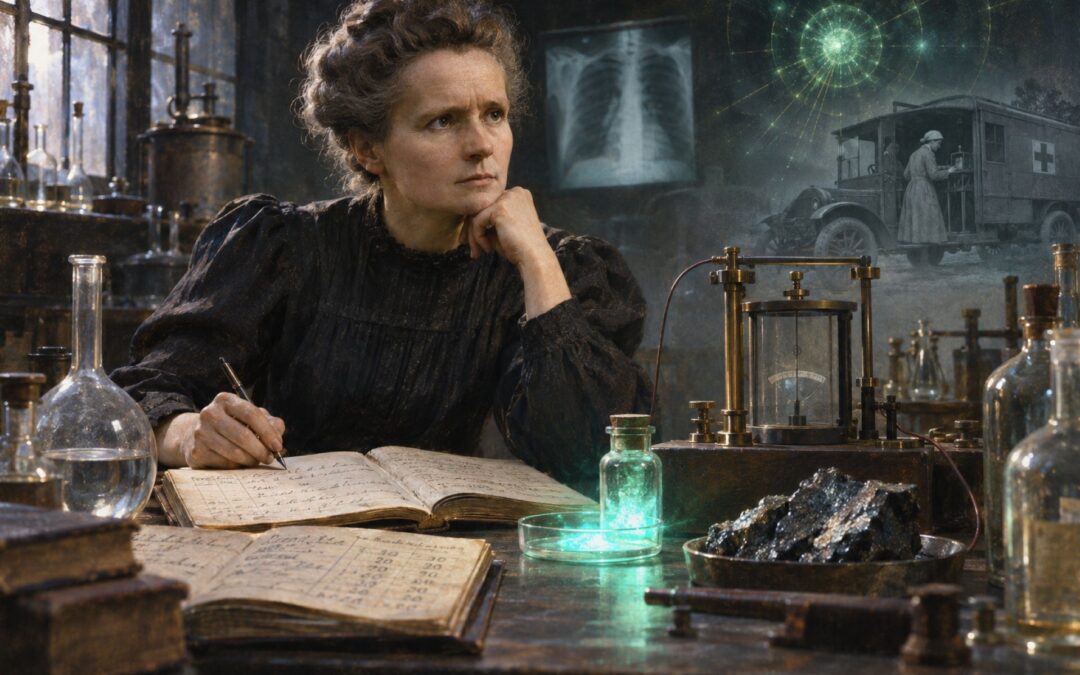
Some of the laboratory notebooks kept by Marie and Pierre Curie are unusual historical documents. Their pages contain the ordinary traces of scientific work—columns of figures, calculations, experimental notes—and also residual radioactive contamination from the substances their authors handled. More than a century later, the Bibliothèque nationale de France treats these records as both intellectual evidence and material objects requiring informed conservation.
The numbers in those notebooks tell a story that begins with a puzzle. Uranium was known to emit invisible rays, but a particular ore produced a much stronger electrical signal than its uranium content seemed capable of explaining. Was the apparatus mistaken? Did the ore’s physical form somehow increase the effect? Or did it contain something nobody had yet identified?
Marie Curie took the last possibility seriously enough to pursue it through years of exacting experiments. The results changed the periodic table, challenged assumptions about atoms and helped establish an entirely new field of science. Yet the woman behind those measurements also lived through political restrictions, financial hardship, extraordinary professional recognition, devastating personal loss and a world war. Understanding her legacy means following both the experiments and the life that made them possible.
Growing Up in Partitioned Poland
Marie Curie was born Maria Salomea Skłodowska on 7 November 1867 in Warsaw, then part of the Russian Empire. Poland had been divided among neighbouring powers in the late eighteenth century, and the authorities in Russian-controlled Warsaw sought to limit expressions of Polish national identity. Education was not simply a matter of textbooks and examinations. Language, history and even what could be said openly in a classroom were politically sensitive.
The Skłodowski household placed enormous value on learning. Maria’s father, Władysław, taught mathematics and physics, while her mother, Bronisława, had run a girls’ school. Scientific instruments and intellectual conversation were familiar features of family life, though that did not protect the children from hardship. Her father faced professional setbacks under the political system, and the family endured serious financial pressure.
Loss arrived early. Maria’s older sister Zofia died of typhus, and her mother died of tuberculosis in 1878, when Maria was ten. The surviving family remained committed to education. Maria excelled at school, completing her secondary studies with a gold medal, but academic success could not remove the barrier awaiting her: the university in Warsaw did not admit women.
She continued learning through informal educational networks, including the clandestine institutions often grouped under the name Flying University. Such gatherings offered subjects and intellectual opportunities that the official system restricted. They also represented a form of cultural independence, allowing Polish students to study beyond the limits set by imperial authorities.
Maria and her elder sister Bronisława, known as Bronya, devised a practical arrangement. Bronya wanted to study medicine in Paris, and Maria wanted a scientific education. Maria would work and send money to support Bronya first; after completing her studies and establishing herself, Bronya would help Maria come to France. The plan demanded years of patience, not a dramatic single act of defiance.
Maria worked as a governess, teaching children in other people’s homes while saving for an uncertain future. During a period in the countryside, she also helped educate local children whose access to schooling was limited. She read mathematics, physics and other subjects in whatever time remained after her duties. Study was an act of persistence conducted around paid work rather than in the sheltered routine of a university.
When she returned to Warsaw, she gained experience in a small laboratory at the Museum of Industry and Agriculture. That opportunity mattered because science on paper and science at a bench are different things. Measurements can wander, materials can refuse to behave as expected, and instruments reveal their limitations only through use. Maria was acquiring the habits she would later depend on: careful observation, repetition and the willingness to investigate an inconvenient result.
Paris, Pierre Curie, and a Scientific Partnership
In 1891, at the age of twenty-four, Maria finally travelled to Paris. She enrolled at the Sorbonne, the University of Paris, and adopted the French form of her name, Marie. Initially she stayed with Bronya and her husband, but eventually moved nearer the university to concentrate on her courses. The freedom to pursue science came with severe material constraints.
Her lodgings were small and sometimes bitterly cold. Food and heating competed with books and other necessities, while lectures demanded advanced work in a language she had not grown up speaking. She had to make up parts of her preparation even as she followed a demanding curriculum. The discipline developed through years of solitary study became one of her greatest assets.
In 1893, she finished first in her physics degree examination. A mathematics degree followed in 1894. These results demonstrated more than perseverance: she had become an accomplished scientist in her own right before she ever began the research for which she would be famous. A subsequent project investigating the magnetic properties of different steels brought her into contact with the practical problem of finding adequate laboratory space.
A fellow scientist introduced her to Pierre Curie, a respected physicist known for experimental precision. Pierre and his brother Jacques had discovered piezoelectricity: certain crystals develop an electrical charge when mechanical pressure is applied. Their work enabled sensitive instruments capable of measuring remarkably small electrical effects. Pierre also studied magnetism, giving him interests that overlapped with Marie’s own research.
The connection was intellectual as well as personal. The two recognised in each other a preference for investigation over ceremony, and they married in July 1895. They did not establish an extravagant household. Bicycles became both recreation and a means of travel, and their honeymoon included journeys through the French countryside. It is an appealing image, but it also conveys how comfortably science and ordinary companionship fitted together in their marriage.
Their first daughter, Irène, was born in 1897, followed by Ève in 1904. Marie’s work therefore unfolded alongside the obligations of family life, with help from relatives and others. Her scientific identity did not begin with her marriage, nor did it disappear into a joint enterprise. She chose the problem that launched the radioactivity research; Pierre later joined it and brought complementary experimental expertise. The distinction matters because their partnership was unusually productive precisely because both contributed independently valuable skills.
By the time Marie was preparing a doctoral thesis, physics had produced two startling discoveries. They offered a research question that was still open, and she had access to a method that might make it answerable.
Turning Invisible Rays into Measurements
In 1895, Wilhelm Conrad Röntgen discovered X-rays, an invisible form of radiation capable of passing through some materials that block ordinary light. Early radiographs revealed bones inside a living hand. The effect was astonishing to the public, but for physicists the deeper challenge was understanding what these rays were and how they interacted with matter.
The following year, Henri Becquerel investigated uranium compounds and found that they could darken photographic plates even when the plates were shielded from visible light. Crucially, the effect did not depend on keeping the uranium compounds exposed to sunlight. The material appeared to emit radiation spontaneously. Becquerel had uncovered a property that did not fit comfortably within familiar explanations of light or chemical reactions.
A photographic plate could demonstrate that something had happened, but Marie needed to compare one substance quantitatively with another. A plate’s darkening depended on exposure conditions and demanded time to develop. Marie instead studied another effect of the rays: they made the surrounding air weakly conductive. Radiation could ionise molecules, producing electrically charged particles that permitted a tiny current to pass between electrodes.
Using a sensitive electrometer based on the work of Pierre and Jacques Curie, she measured this current. The instrument did not identify the radiation’s complete nature or reveal a new element automatically. It supplied a repeatable quantity, allowing her to compare samples under controlled conditions and track whether a chemical operation had increased or decreased activity. In a field where the phenomenon itself was barely understood, this was a decisive methodological advantage.
Marie tested uranium in different compounds and physical forms. She found that the activity was related to the amount of uranium present rather than to the particular chemical combination in which it was held. A uranium compound did not stop emitting merely because it was altered in ways that would change ordinary chemical or physical properties. This suggested that the effect belonged to the uranium atoms themselves.
The conclusion needs historical context. Chemists commonly treated atoms as stable units that could be rearranged during reactions but not transformed into other elements by normal chemical processes. If atoms produced energy and particles continuously, then something within those supposedly durable building blocks demanded explanation. Marie’s measurements did not by themselves provide the later theory of nuclear structure, but they helped make that theory necessary.
She also found that thorium compounds emitted similar radiation. The German physicist Gerhard Carl Schmidt independently reported thorium’s activity around the same period. The observation mattered because uranium was no longer an isolated curiosity. Marie adopted the term radioactivity for the property she was investigating, helping establish a common language for the rapidly developing field.
Later work by Ernest Rutherford and Frederick Soddy would show that radioactive substances can transform into other elements as they decay. This was different from heating or dissolving a compound, where the chemical elements ordinarily remain identifiable among the products. Radioactive transformation changed the identity of an atom itself. Marie’s work was not the complete explanation of that transformation; it provided some of the rigorous measurements that made the questions more precise.
Those measurements became especially powerful when she examined minerals containing uranium. Certain natural samples displayed an activity so strong that known uranium could not readily account for it. The difference was not a minor detail to smooth over. It was a reason to ask whether a familiar-looking rock might contain an unfamiliar element.
The Pitchblende Puzzle and the Discovery of Two Elements
Pitchblende, a dense uranium-rich ore, proved more radioactive than expected. Marie also investigated a mineral known as chalcolite, a copper uranium phosphate. If the activity depended only on uranium and other already identified radioactive components, the electrical measurements should have followed the quantities of those components. They did not.
She tested an alternative explanation by comparing natural chalcolite with an artificially prepared version made from known constituents. The synthetic material showed the activity expected from its ingredients, while the natural mineral remained unusually active. This comparison weakened the suggestion that the crystal structure or chemical arrangement itself caused the excess signal. Something present in the natural material, even in a very small amount, seemed responsible.
The hypothesis was daring but experimentally manageable: the ore contained an unknown substance far more radioactive than uranium. Conventional chemical analysis might fail to detect it because the quantity was minute. Yet a fraction of the ore carrying the unknown substance would reveal itself through heightened electrical activity. In effect, radioactivity became a tracer that could guide the search for matter otherwise too scarce to recognise.
Pierre joined Marie in this investigation. The pair separated ore into different chemical fractions and measured the radioactivity of each one. At every stage, the central question was which fraction retained the unexpectedly strong signal. As ordinary components were removed, the activity could become concentrated among materials with related chemical behaviour. The procedure combined classical analytical chemistry with a new physical test.
In July 1898, the Curies announced evidence for a new element, which they named polonium in honour of Marie’s homeland. Poland did not exist as an independent state at the time; the choice carried a political and personal meaning without altering the scientific criteria for identifying the element. The proposed element appeared in a fraction behaving chemically like bismuth, and its unusual radioactivity was central to the claim.
Their investigations did not stop there. Another strongly radioactive fraction behaved differently, indicating that the ore might contain a second new element. Working with the chemist Gustave Bémont, Marie and Pierre developed further evidence. The spectroscopist Eugène Demarçay observed a spectral line associated with their preparation that did not correspond to a known element. In December 1898, the researchers announced radium, drawing its name from the Latin word for ray.
These announcements are sometimes presented as if two new metals had simply emerged from a laboratory vessel. That misses the important distinction between detecting an element and obtaining it in a pure, visible form. In 1898, evidence from radioactivity, chemical behaviour and, for radium, spectroscopy justified the identification of previously unknown substances. The team still lacked enough purified radium material to establish all of its chemical and physical properties with confidence.
Their approach also showed why independent types of evidence matter. A strong electrical reading might suggest something unusual but could, by itself, raise questions about the apparatus. Chemical separations established consistent behaviour, while spectral evidence gave another kind of fingerprint. The accumulating agreement among methods turned an unexpected measurement into a defensible claim about the composition of matter.
Marie had discovered that nature contained extraordinarily active substances in quantities too small for ordinary detection. Proving exactly what those substances were would require more than an inspired hypothesis. It would demand years of repetitive work with quantities of raw material almost absurdly large compared with the product being sought.
From a Leaking Shed to Pure Radium
The Curies carried out much of their early radioactivity research under conditions far removed from a purpose-built scientific institute. They worked in a former shed with inadequate heating and ventilation and a roof that did not reliably keep out the weather. Their environment made already difficult procedures slower, more uncomfortable and potentially more hazardous. Marie nevertheless wanted to establish the chemical identity of radium beyond reasonable doubt.
Pitchblende was costly, but waste remaining after uranium extraction still contained radioactive constituents that interested the Curies. They obtained large quantities of residue from processing operations at Joachimsthal, in what was then Austria-Hungary and is now Jáchymov in the Czech Republic. Industrial sources helped make the material available, though transporting it and processing it created a formidable practical undertaking.
Marie spent long periods treating the residues chemically. Material was dissolved, precipitated, separated and repeatedly crystallised as she tried to enrich the fraction containing radium. Each operation had to be followed by measurements; otherwise, it would be difficult to know whether the sought-after element had been concentrated or inadvertently discarded. Pierre focused increasingly on the physical study of the radiation and the properties of the preparations, although the broader project remained collaborative.
The scale of the imbalance was striking. Tons of starting material might yield only a tiny amount of a purified radium compound. The point was not to produce an impressive quantity for display but to obtain a preparation sufficiently well characterised to test the element’s atomic weight and other properties. This required consistency over many stages and the ability to account for changes in measurements that might look disappointingly small from one day to the next.
Marie later recalled seeing a faint luminosity from certain preparations when entering the laboratory after dark. The image of glowing substances in a shadowed shed has become a familiar part of the Curie story. It was also a reminder that the materials had unfamiliar effects. Their radiation could act on air, photographic emulsions and living tissue even when no glow was visible and no immediate sensation warned of exposure.
By 1902, Marie had obtained enough purified radium chloride to determine an atomic weight for radium. This was an essential advance in the effort to establish radium’s place among the chemical elements. Her result gave other chemists a number to evaluate alongside spectral observations and the chemical behaviour of radium preparations. It took her far beyond the original inference that an ore contained something unusually active.
In 1903, she defended her doctoral thesis, bringing together experimental work that had developed from comparing uranium compounds into a systematic investigation of radioactivity and new elements. Her findings supported the view that radioactivity was associated with atoms, while other researchers were beginning to work out the nature of atomic transformation. The emerging picture was more radical than any individual experiment had initially suggested.
An additional milestone followed in 1910, when Marie and the chemist André-Louis Debierne isolated radium in metallic form. This achievement should not be confused with either the announcement of radium in 1898 or the purification of radium chloride and atomic-weight determination in 1902. The three events answered different questions: did an unknown element exist, could its chemical identity be characterised, and could the element itself be obtained as a metal?
The history of the Curie experiments illustrates how discovery often operates in stages rather than as a single dramatic moment. Marie’s original readings mattered because she did not dismiss them; the subsequent separation work mattered because she refused to let a promising signal substitute for proof. The combination of physical measurement and painstaking chemistry gave the new field an unusually firm experimental foundation.
The First Nobel Prize and the Loss of Pierre
The research attracted international attention, and in 1903 the Nobel Prize in Physics brought the Curies worldwide recognition. But the recognition did not arrive without conflict. Important early nominations from the French scientific establishment named Henri Becquerel and Pierre Curie without including Marie, despite her central role in initiating and conducting the research.
The Swedish mathematician Gösta Mittag-Leffler alerted Pierre to the omission. Pierre made clear that Marie’s contribution deserved formal recognition, and the history of the Nobel deliberations also shows the importance of the nomination process rather than a simple last-minute change of heart. The Nobel committee ultimately awarded half the prize to Becquerel for his discovery of spontaneous radioactivity and shared the other half between Marie and Pierre for their research on radiation phenomena.
Marie became the first woman to receive a Nobel Prize. Neither she nor Pierre travelled to Stockholm for the 1903 ceremony, partly because of illness and the pressures of their work. They made the journey in 1905, when Pierre delivered the Nobel lecture. He distinguished the investigations Marie had begun independently from the work they later pursued together, giving public acknowledgement to her scientific initiative.
Pierre also recognised that radioactivity brought risks as well as opportunities. By 1901, he had deliberately placed a radium preparation against his arm and recorded the resulting injury. Researchers were already investigating the possible medical uses of radiation’s ability to damage tissue, while the long-term consequences of sustained exposure remained poorly understood. The promise of treatment and the danger of injury developed side by side.
Fame helped bring resources that the Curies had long lacked. Pierre received a professorship at the University of Paris and laboratory support, while Marie was appointed chief of laboratory with a salary. They had two daughters, Irène and Ève, and a household suddenly exposed to the curiosity of journalists and photographers. Years earlier, obtaining a suitable room had been a struggle; now maintaining privacy and uninterrupted working time became difficult.
On 19 April 1906, Pierre died after a street accident in Paris. He was struck and crushed beneath a horse-drawn vehicle while crossing in wet conditions. He was forty-six. The event ended a marriage, a partnership in experimental science and the daily relationship through which Marie had organised much of her adult life.
She kept a private journal addressed to Pierre, recording grief that was not dissolved by scientific honours or professional responsibilities. Yet the laboratory, students and unfinished investigations still required decisions. Marie faced the challenge of continuing a scientific programme once closely associated in the public mind with two names, while raising two young daughters after the sudden death of their father.
The university offered her responsibility for Pierre’s course. Accepting it meant stepping into a position no woman had previously occupied there in quite the same way. Her response to loss was not an instant return to ordinary life; it was the gradual continuation of work under circumstances radically altered by his absence.
The Sorbonne, the Academy, and a Second Nobel Prize
On 5 November 1906, students crowded into a lecture hall at the Sorbonne to hear Marie Curie continue the course previously taught by Pierre. She did not turn the occasion into a memorial speech. According to accounts of the day, she began with the scientific material where her husband’s teaching had left off. It was a striking demonstration of continuity, but the circumstances were unprecedented: a woman was teaching in a professorial role at one of France’s most prestigious universities.
Marie was appointed to the chair in her own right in 1908, becoming the university’s first woman professor. She also assumed leadership of an expanding research programme. This was an institutional change as well as a personal milestone. She could train young scientists, organise investigations and make decisions about facilities without relying on the formal position of a husband or collaborator.
Such authority did not mean that the scientific establishment had become free of prejudice. In 1911, Marie stood for election to the French Academy of Sciences but lost narrowly. The contest drew attention far beyond her qualifications. Some commentators argued openly about whether women belonged in the academy, while others treated her foreign birth as a reason to question her place in French intellectual life. Her achievements were being assessed through arguments that had little bearing on the measurements she had made.
That same year, private letters concerning her relationship with the physicist Paul Langevin reached the press. Marie was a widow, while Langevin was married but separated from his wife. The resulting scandal combined sensational reporting with attacks on Marie’s sex and Polish origins. Her personal life became a public controversy at precisely the moment when scientific honours should have brought a measure of security.
Sweden announced that she would receive the 1911 Nobel Prize in Chemistry. Unlike the 1903 award, shared with two other scientists, this prize recognised Marie individually for her contributions to the discovery of polonium and radium, the isolation of radium and the study of its nature and compounds. She was now the first person to win two Nobel Prizes, and the two awards recognised related but distinct achievements.
Svante Arrhenius, an influential Swedish scientist, suggested that she avoid the ceremony while the controversy continued. Marie rejected the principle that press accusations about her private conduct should determine recognition of scientific work. She travelled to Stockholm and delivered her lecture. Her response did not make the scandal disappear, but it established that her right to scientific recognition rested on the evidence and discoveries for which she was being honoured.
The contrast between the two Nobel experiences is revealing. In 1903, her contributions had required an intervention to ensure they were properly acknowledged in the nomination process. In 1911, her scientific standing was unmistakable, yet public opinion still threatened to obscure it. She continued research through both episodes, even as the pressures took a personal toll.
Her next ambitions went beyond individual discoveries. Paris was preparing a dedicated institute where physics, chemistry and medical research could develop around radioactivity. At last, she had the prospect of more suitable laboratories, collaborators and resources than the old shed had offered. Then a crisis far larger than the scientific community changed what those facilities and her expertise would be needed for.
The Little Curies and the X-Ray War
When the First World War began in 1914, the new institute’s work was disrupted as staff left for military service. France faced enormous numbers of wounded soldiers, and hospitals urgently needed ways to identify broken bones and locate fragments of bullets or shrapnel. Surgeons could sometimes explore wounds physically, but an accurate X-ray image could reveal injuries that were otherwise difficult to assess and make operations more precise.
The technology already existed. The problem was getting it to where patients needed treatment and keeping it functioning under wartime conditions. A hospital might lack an X-ray apparatus, have no reliable source of electricity or be short of trained operators. A machine in Paris was of limited use to a surgeon working near the front, and an apparatus delivered without instruction could quickly become another piece of unusable equipment.
Marie applied her scientific knowledge to this logistical challenge. She helped secure vehicles fitted with X-ray apparatus and worked out practical arrangements for generating electrical power and operating the equipment away from established radiology departments. A vehicle could carry the essential elements of a small imaging room to a hospital that would otherwise have no access to the service. The mobile units came to be known as petites Curies, or Little Curies.
She did not simply endorse the project from a laboratory office. Marie learned to drive and familiarised herself with maintaining the machines, troubleshooting faults and setting up the equipment under difficult conditions. Roads, weather, equipment failures and pressure on medical staff all mattered. A technically excellent radiograph was useful only when it could be produced in time and interpreted in a clinical setting.
Her elder daughter Irène was seventeen when the war began. She trained in radiological work and helped operate equipment, contributing to an effort that was demanding for people with substantial scientific knowledge, let alone newly trained volunteers. Mother and daughter worked to make the service effective beyond the limited number of places they could visit personally.
The programme expanded beyond mobile vehicles. Marie helped establish radiology facilities in hospitals and trained operators to use X-ray apparatus correctly. Teaching was essential: a method that depended on one expert arriving in person could never reach enough wounded men. By spreading practical competence, she multiplied the usefulness of the available machines and staff.
The development of wartime mobile radiology shows a different side of her scientific achievement. In the radium laboratory, she had pursued an increasingly exact answer to a question about matter. During the war, she had to help a surgical service obtain trustworthy images repeatedly, often without ideal equipment or working conditions. Both tasks demanded attention to measurement, but the consequences of failure were much more immediate in a hospital.
X-rays and radioactive decay should not be conflated. Wartime imaging equipment generated X-rays electrically, rather than relying on the spontaneous emissions of radium. Marie’s expertise in radiation and instrumentation made her capable of organising the service, while the practical result depended on a different physical process. Recognising that distinction makes her contribution more impressive, not less: she understood how to apply specialised knowledge to an adjacent technology with urgent human value.
The work was also dangerous by modern standards. Early radiologists often operated without the protective procedures that later became routine, exposing themselves to repeated radiation doses. Wartime conditions amplified the difficulty of monitoring risks. Marie’s programme improved the treatment of wounded soldiers, but the experience also belongs to the history of how medical applications advanced before occupational safety standards had fully developed.
When the armistice came in 1918, Marie returned her attention to building lasting scientific and medical institutions. The war had demonstrated that radiation research would matter not only to physics and chemistry but also to the organisation of healthcare, specialist training and public resources.
Building the Radium Institutes—and Finding the Radium
The Radium Institute in Paris, later central to the development of the Institut Curie, brought together two fields that increasingly needed each other. Marie directed the laboratory devoted to physical and chemical investigations of radioactivity. The physician Claudius Regaud oversaw complementary biological and medical research, including studies of how radiation affected tissue and how it might be used against cancer.
The institutional arrangement was important. A physicist could measure radiation with great precision but would not necessarily know how a tumour responded to a particular exposure. A physician understood clinical aims but needed reliable physical measurements to help control the treatment. Developing effective applications required both kinds of expertise, along with specialised equipment and trained personnel.
Radium remained exceptionally scarce and expensive. Its value as a research material was obvious to those trying to study its behaviour or develop medical techniques, but laboratories could not simply order unlimited supplies. The enormous effort required to obtain small quantities from ore imposed an ongoing constraint. Marie’s scientific reputation had grown, yet securing material for the next generation of work was still a practical challenge.
In 1920, the American journalist Marie Mattingly Meloney, widely known as Missy, visited Curie in Paris. She asked what would be most useful to her research. Rather than requesting personal luxury, Marie identified radium as a priority. Meloney responded by organising an American fundraising campaign, drawing support from women’s organisations, individual donors and larger contributors to purchase one gram of the element for scientific use.
The campaign made Curie an object of widespread public admiration in the United States. In 1921, she travelled there with both daughters, Irène and Ève, and attended receptions, ceremonies and events at universities and other institutions. At the White House, President Warren G. Harding formally presented the gift associated with the fundraising effort. Behind the publicity was a question Marie considered essential: ensuring that the radium would be available for scientific work, rather than treated merely as a personal possession.
The 1921 American donation illustrates the unusual position radium occupied. It was a substance measured in tiny quantities yet valuable enough to mobilise a national public campaign and a presidential ceremony. For researchers, a gram could support investigations impossible with smaller samples. The gift also required attention to calibration and standards if results from different laboratories were to be comparable.
Marie returned to the United States in 1929, seeking support for an institute in her native Warsaw. The project brought her scientific career back into contact with the city where university restrictions had once forced her to study informally and plan an education abroad. The Warsaw Radium Institute opened in 1932, with Bronya serving as its first director.
The sisters’ story had come full circle in a concrete, institutional sense. As young women, Maria had worked to pay for Bronya’s medical studies, trusting that the arrangement would eventually allow her to reach Paris. Decades later, they were helping establish a centre for research and treatment in Warsaw. The outcome was not simply symbolic: it created opportunities for patients, researchers and physicians that had not been available when the sisters first imagined studying abroad.
Marie remained committed to training scientists and to the wider circulation of scientific knowledge. She had earlier declined to patent the process for isolating radium, preferring that other researchers be able to work with the findings. Yet openness did not eliminate the high cost of equipment or the scarcity of materials. Much of her later career involved the unglamorous work of building capacity so that discoveries would lead to sustained investigation rather than remain dependent on one laboratory.
The institutional legacy of Marie Curie therefore extends beyond the fame of polonium and radium. Her laboratories helped bring physical science into a continuing relationship with medicine. Research programmes, trained personnel and methods for comparing results could outlast an individual scientist and keep producing new knowledge after the circumstances of the original discovery had changed.
The Price of Exposure and the Next Generation
Even during the earliest years of radium research, investigators had clues that radiation could injure the body. Pierre’s deliberate exposure of his arm produced a burn, and others working with radioactive substances reported skin damage. Such observations encouraged early attempts to use radiation to destroy diseased tissue, including tumours. But a treatment’s potential usefulness did not make indiscriminate exposure safe.
The distinction between a carefully planned medical dose and uncontrolled contact with radioactive material took time to establish in practice. Radiation can be absorbed without immediate pain or other warning signs, and effects may develop after the exposure has ended. People accustomed to judging danger through heat, smell or visible injury could underestimate a hazard that was often imperceptible at the moment it occurred.
Public enthusiasm sometimes moved faster than scientific understanding. Radium became a fashionable selling point, attached to products making extravagant claims about health, vitality and rejuvenation. Its novelty and association with celebrated scientists gave it commercial appeal. The same era also produced serious research into cancer treatment, but the prestige of laboratory discovery could be misused to promote products unsupported by sound medical evidence.
Marie herself had worked for many years around radioactive substances under conditions that would now call for stringent controls. She had handled preparations in inadequate laboratories and had been involved in wartime radiology before modern protective standards were established. The developing science of radiation safety came from an accumulating record of experiments, injuries, occupational illnesses and carefully studied cases.
Her health deteriorated during her later years. She developed cataracts and underwent several operations, while exhaustion and illness increasingly restricted her work. In 1934, she entered a sanatorium in the French Alps. She died there on 4 July at the age of sixty-six. The reported cause was aplastic anaemia, a disorder in which the bone marrow fails to produce sufficient new blood cells.
Long-term radiation exposure is widely regarded as a likely contributor to her illness, though it is important not to claim that the full medical history can be reconstructed with absolute certainty. She had encountered a range of potentially hazardous exposures over decades, and their cumulative effects were not understood when much of the work took place. Her death has become a powerful cautionary example, but it should not obscure the substantial differences between historical working conditions and regulated modern uses of radiation.
The future of the field was already developing within her own family. Irène Curie and her husband, Frédéric Joliot, demonstrated artificial radioactivity in 1934. They showed that certain materials could be made radioactive through bombardment with particles and would continue emitting radiation afterward. This opened a route to producing radioactive isotopes deliberately rather than depending entirely on naturally occurring radioactive sources.
Marie lived long enough to learn of their achievement. Irène and Frédéric received the Nobel Prize in Chemistry in 1935, after her death. The discovery was distinct from Marie’s own identification of naturally radioactive elements, yet it built on a scientific world she had helped create. Radioactivity had moved from something researchers detected in minerals to a phenomenon they could induce and investigate systematically.
The medical possibilities were significant. Radioisotopes could eventually be chosen for particular physical and chemical characteristics, then used to trace substances through biological systems or deliver radiation to selected targets. Those applications required increasingly sophisticated knowledge of dose, exposure pathways and health effects. The history of radiation became a history of both technical power and the need to exercise it carefully.
What Marie Curie Changed in Science and Medicine
Marie Curie’s discoveries are sometimes reduced to two additions to the periodic table and an unprecedented pair of Nobel Prizes. Those achievements are substantial, but they do not capture the full change her work helped bring about. By examining radiation as a measurable property of matter, she supplied evidence that atoms contained physical processes more complex than conventional chemistry had described.
Her experiments connected phenomena that had initially seemed puzzling or isolated. Becquerel had established that uranium could emit rays spontaneously; Curie showed that activity could be measured systematically and that other substances, including thorium and previously unknown elements, displayed it. Rutherford, Soddy and many later investigators developed explanations for decay, transformation and atomic structure. Scientific progress depended on an expanding body of compatible findings, not on a single person producing every answer.
The consequences reached well beyond the research laboratory. Radioactive isotopes became tools for examining processes that ordinary observation could not reveal. Tracers could show where a material travels, while instruments could detect tiny quantities of a substance without requiring a large visible sample. Later nuclear medicine and imaging techniques built on principles of measurable radioactive decay, though the technologies involved differ greatly from those available in Curie’s lifetime.
Radiation therapy also developed into a specialised medical discipline. Clinicians learned to direct doses toward tumours while limiting exposure to nearby healthy tissue, with outcomes depending on the type of radiation, the disease and the planning method. This was a long process of clinical and physical innovation rather than a direct consequence of one early radium experiment. The research institutes associated with Curie helped establish the collaboration such developments require.
Her career changed assumptions about who could lead scientific work. She became the first female Nobel laureate, the first woman professor at the University of Paris and the first person awarded Nobel Prizes in two different scientific categories. These distinctions mattered not because they exempted her from ordinary scientific scrutiny, but because the recognition came despite institutions that often treated her gender or nationality as relevant to her qualifications.
Her example also resists a simple heroic story. She did not make her discoveries alone, and she relied on Pierre, laboratory collaborators, chemical specialists, institutions and funding networks. Her public reputation could overshadow such collective work, even as her own contributions had once been underestimated. A balanced account recognises her extraordinary individual achievement while showing how scientific progress grows through collaboration and critical testing.
In 1995, the remains of Marie and Pierre Curie were transferred to the Panthéon in Paris. Marie was the first woman honoured there on the basis of her own achievements. The ceremony was a national recognition of a scientist whose early education had been obstructed by state restrictions and whose later career had repeatedly tested the boundaries of established institutions.
The most enduring monument, however, may be less dramatic than a tomb or a prize. It lies in the habit of asking what a measurement actually demonstrates, comparing alternatives, following an unexpected signal and refusing to treat a first promising result as the end of an investigation. From radioactivity to medical imaging and nuclear science, the exact technologies have changed enormously. The demand for evidence has not.
The old notebooks bring that achievement into focus. Their figures show work proceeding one reading at a time; their physical contamination reminds us that the newly discovered phenomena also carried risks that the investigators did not yet fully understand. The pages preserve a remarkable combination of intellectual precision and historical circumstance.
Marie Curie began with a mineral that behaved differently from what its known ingredients seemed to predict. She could have treated the excess signal as a nuisance, or accepted an explanation that made the numbers easier to ignore. Instead, she made the anomaly the centre of an investigation and kept measuring until the evidence pointed to something new. That willingness to follow a stubborn result is as much a part of her legacy as the names polonium and radium.
Last Updated on November 25, 2026 by Aseem Gupta