
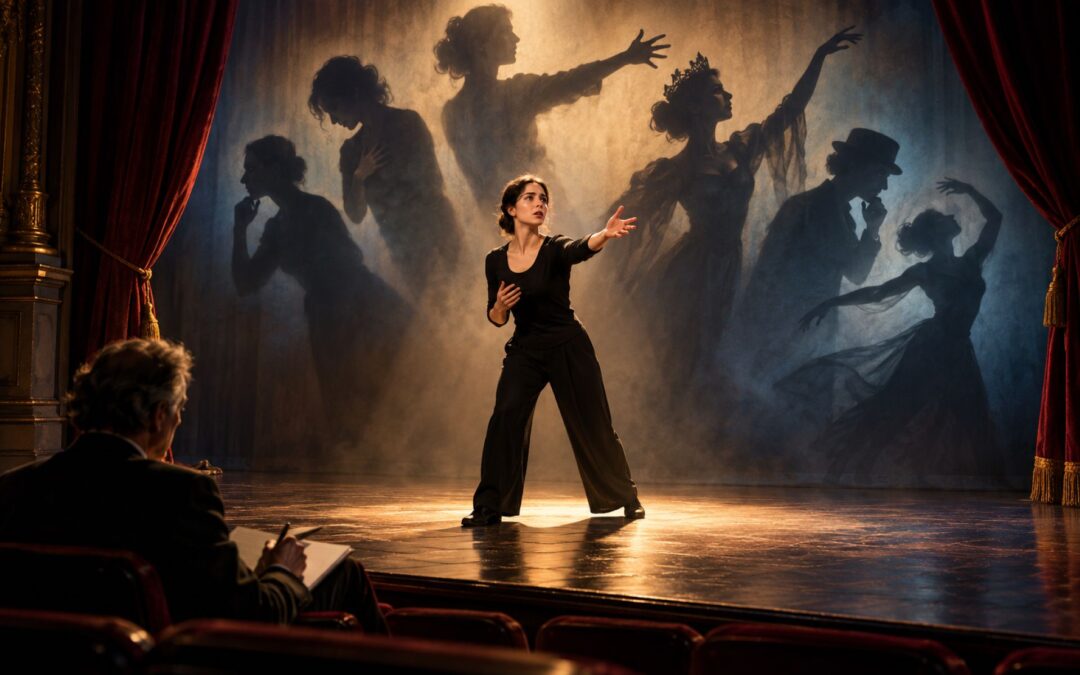
An aspiring actress visits a theatre teacher, convinced that her enthusiasm and a successful school performance of King Lear have prepared her for the stage. Within minutes, he exposes how little she understands about acting. She can reproduce dramatic gestures, raise her voice, and imitate powerful emotions, but she cannot explain what she is doing or why. Her failure raises the question that Richard Boleslavsky explores throughout Acting: The First Six Lessons: how does an actor learn to create a believable human experience deliberately, rather than merely imitate its outward appearance?
First published in 1933, Boleslavsky’s book develops its answer through six conversations between an experienced teacher and a young actress called the Creature. Their meetings, spread across an extended period of training and professional work, address concentration, emotional memory, dramatic action, characterization, observation, and rhythm. Each lesson begins with a practical difficulty and develops into an examination of the actor’s craft.
Boleslavsky distinguishes artistic talent from the technique through which talent becomes useful. He believes that natural ability cannot simply be manufactured, but that the actor’s body, senses, intelligence, imagination, emotional responsiveness, and will can be educated through disciplined practice. The six lessons show how these capacities support one another, while the Creature’s development gives the instructional material the shape of a continuing story.

Concentration: Learning to Attend to an Imagined World
The first lesson begins when an eighteen-year-old aspiring actress arrives at the teacher’s room and asks to study dramatic art. She declares her love for the theatre and explains that she has already acted successfully at school. Her proudest achievement was playing the title role in Shakespeare’s King Lear, a performance praised by her professor, friends, and Aunt Mary.
The teacher is unimpressed by these endorsements. He asks how she performed Lear’s furious address to the storm, and she describes an elaborate arrangement of gestures: standing in a particular position, raising her head, stretching her arms, shaking her fists, laughing sarcastically, and shouting the words. Her entire understanding of the speech consists of physical and vocal effects that someone else instructed her to reproduce.
When he asks her to speak the words plainly, preserving their meaning without the rehearsed display, she cannot manage it. She knows how to signal Lear’s anger but has not learned to communicate the thought that produces it. Her performance is consequently disconnected from any convincing inner necessity.
The teacher attacks her theatrical pretensions so severely that she begins to fear she may never become an actress. When he suggests that she might be unsuited to the profession, she struggles to control her distress. A genuine tear appears, and she insists that she will continue acting because she cannot imagine another life.
This response changes the teacher’s attitude. For the first time, he sees an emotional experience emerging naturally from her circumstances rather than from a prescribed set of gestures. Her disappointment and determination accomplish something that her school performance did not: they reveal a human being genuinely affected by an immediate problem.
He agrees to begin her education, but first she must understand the difference between theatrical enthusiasm and artistic technique.
Boleslavsky introduces concentration through examples drawn from other professions. A sailor navigating dangerous waters, a scientist working through a microscope, and an architect solving a structural problem all direct their attention toward definite tasks. Their work demands sustained concentration, sometimes under conditions of extreme difficulty.
An actor requires the same capacity, but the object of attention is often materially absent. The sailor has a compass, the scientist a microscope, and the architect a drawing. The actor may have to attend to an imaginary sound, respond to an absent person, or experience feelings belonging to circumstances that do not exist outside the play.
During preparation, actors study their own inner lives and the behavior of other people. During performance, they must make imagined circumstances sufficiently convincing to guide their actions. Concentration therefore means more than ignoring distractions. It is the deliberate organization of attention around an experience the actor must help create.
The teacher compares elementary actor training to the musical scales a pianist must practice before attempting a difficult composition. For actors, the equivalent foundation is control over the five senses: sight, hearing, smell, touch, and taste.
He asks the Creature to listen to an imaginary mouse scratching in a corner. She responds with exaggerated movements of her ears and head that suggest what listening should look like. He then asks her to imagine a large orchestra performing a march from Verdi’s Aida. Although these sounds are entirely different in scale and character, her outward responses show little meaningful distinction.
The problem is that she is performing the appearance of listening instead of organizing her attention around a specific auditory experience. The imagined mouse should create one kind of expectation and response; the orchestra should create another. Neither requires arbitrary movements designed to reassure spectators that the actress is listening.
Boleslavsky argues that these apparently simple exercises demand extensive training. The actor must learn to perceive imagined sensory circumstances with increasing precision and then allow those circumstances to influence behavior. A believable reaction begins with the actor’s attention, not with an imposed facial expression.
The teacher also insists that the actor’s concentration must be strong enough to command the audience’s attention. If an actress listens convincingly to an imaginary departing car, spectators should become interested in the significance of that departure. The actor’s engagement with the situation gives the audience a reason to attend to it as well.
The lesson concludes with a broader account of the actor’s education.
The first dimension is physical training. Boleslavsky prescribes regular work in gymnastics, dance, fencing, breathing, voice production, diction, singing, pantomime, and related disciplines. He recommends approximately ninety minutes of daily physical practice over an initial period of two years, followed by continued maintenance. The purpose is to develop an instrument capable of obeying the actor’s artistic intentions without unnecessary physical resistance.
The second dimension is intellectual and cultural education. Actors should understand literature, painting, sculpture, music, history, and the artistic traditions from which dramatic characters emerge. A performer interpreting Shakespeare, Molière, or Goethe needs more than memorized dialogue; the character belongs to a world of ideas, customs, and expressive conventions that the actor must understand.
The third and most demanding dimension is the education of the actor’s inner life. Boleslavsky includes control of imagined sensory experiences, memory of feeling, imagination, observation, willpower, emotional expression, humor, and the capacity to understand tragedy. These faculties develop through experience and exercise rather than through a few instructions delivered in a classroom.
His insistence on natural talent remains an important qualification. He believes training can develop artistic ability but cannot create talent where none exists. Whether that distinction can be established as firmly as he suggests is debatable, but its immediate instructional purpose is clear: no amount of enthusiasm can substitute for the patient development of skill.
By the end of the first conversation, the Creature has acquired no impressive new performance trick. Instead, she has discovered the extent of the work she must undertake and the need to begin with the most elementary components of acting.
Memory of Emotion: Recreating Feeling From Lived Experience
Approximately a year later, the Creature returns to her teacher with markedly improved physical control and self-confidence. She has spent the intervening months practicing concentration, learning to manage her body, and paying closer attention to her surroundings. Her progress is evident, but a new theatrical problem has exposed the limits of her preparation.
She has been rehearsing a role for several days and fears that the director may replace her. Although she understands the circumstances of the scene and can execute the required physical movements, her performance lacks something essential. The director’s instructions to speak louder, feel more, or alter her delivery do not solve the difficulty.
Her character is a young woman who has an opportunity to leave an impoverished home and enter the household of a wealthy benefactor. The arrangement promises education, travel, social advancement, beautiful surroundings, and experiences she has never enjoyed. She longs to accept, but leaving means separating from the mother she loves.
The actress understands both sides of the conflict. Her difficulty lies in creating a convincing state in which excitement about a desirable future coexists with sorrow about the separation.
The teacher introduces what he calls memory of emotion, or affective memory. Drawing upon the work of French psychologist Théodule Ribot, he argues that experiences leave emotional impressions that can later become accessible through circumstances associated with them.
To explain the idea, he tells a story about a married couple whose courtship involved a memorable evening in a cucumber patch. During a nervous and joyful conversation about their future, they ate fresh cucumbers together. Years later, after marriage, children, disagreements, and ordinary domestic troubles, cucumbers retained an unexpected power to restore their former tenderness.
Their daughter notices that serving cucumbers often helps reconcile her parents after a quarrel. The teacher explains that the familiar sensory object brings them back toward an emotional condition associated with an earlier period of their lives.
The story illustrates the proposed connection between outward circumstances and inward experience. Something apparently trivial may carry emotional significance because of the history attached to it.
The Creature initially understands the idea as a requirement to memorize feelings. Her teacher corrects her. He does not want her to label an emotion and force it into existence. He wants her to discover how remembered circumstances may help recreate a condition in which the desired feeling becomes available.
He then asks whether she has ever experienced happiness and sadness together. She remembers departing on her first journey abroad while her brother, who could not accompany her, remained behind.
Rather than asking her to reproduce the exact sensation of that farewell, the teacher instructs her to describe everything that happened. She must begin with leaving home, then reconstruct the taxi journey, her clothing, her brother’s appearance, the weather, the harbor, the other passengers, and the sounds and smells surrounding their departure.
This attention to external detail is crucial. By concentrating on what happened, she avoids the unproductive effort to command herself directly to feel sorrow or excitement.
Initially, her description is precise but emotionally detached. Gradually, as she remembers the journey more vividly, particular details recover their significance. She recalls worrying about being late, hurrying toward the ship, boarding it, and seeing her brother below.
Her excitement about the journey returns alongside her reluctance to leave him. The teacher observes that her physical expression, voice, and attention begin changing without the artificial preparation that previously frustrated her.
At the point when both feelings are active, he asks her to begin the speech from her play. The fictional scene involves a mother rather than a brother, but the underlying emotional situation is comparable: the attraction of a new future conflicts with affection for someone who must be left behind.
Boleslavsky’s essential principle is that the actor may use a personally experienced emotional condition as material for an entirely different fictional circumstance. The actor does not have to confuse the real person with the fictional one. The remembered experience provides a foundation from which imagination constructs another relationship.
The teacher insists that such work requires repetition. Recovering a useful emotional condition once does not mean it will return reliably whenever required. Just as musicians practice until a passage becomes familiar, actors must learn how to approach and reconstruct particular states with increasing economy.
He recommends that the Creature repeat the work privately, concentrating on the circumstances that gradually awaken the remembered experience. Over time, she may need fewer details to recover something similar. What initially requires a long process of recollection may eventually become accessible through a much smaller mental cue.
He also distinguishes creative transformation from imitation. The objective is not to reproduce the exact appearance of a past event, but to use its experiential material in a new artistic arrangement.
The Creature raises a further objection. What happens when a character experiences something the actor has never personally done? She asks how she could portray murder without ever having killed a person.
Boleslavsky responds with the ordinary experience of becoming irritated by a mosquito. An actor who has pursued an insect and struck it with the determination to destroy it possesses some experience of focused hostility and destructive intention. Imagination can enlarge and transform that limited impulse into material for a much more serious dramatic situation.
The example is deliberately disproportionate. Swatting a mosquito cannot reproduce the moral or psychological circumstances of murder, but it demonstrates his belief that an actor may identify smaller experiential equivalents and transform them through imagination.
The teacher also warns against searching for elaborate emotional preparation at every moment. Some passages are better served by direct action than by an attempt to construct an unusual inner state. Particularly significant scenes may demand greater emotional preparation, but the actor must understand how those moments fit within the larger work.
The Creature realizes that she has treated several important moments in her role without sufficient distinction from the surrounding material. Her renewed understanding gives her a way to work on them.
Boleslavsky ends by encouraging her to continue collecting experiences, observing her own responses, and preserving memories that may later serve her craft. The actor’s private life becomes an extensive reservoir of artistic material, though the book presents this as a trainable capacity rather than an excuse to abandon conscious preparation.
Dramatic Action: Building a Part Through Purposeful Verbs
The third conversation takes place during a walk through a park. The Creature is now working in sound films, but she resents the practical conditions of production. Cameras, microphones, lighting adjustments, and repeated interruptions prevent her from sustaining the emotional continuity she associates with theatre.
A scene may be filmed a few lines at a time, with long intervals between performances and no guarantee that the material will be recorded in narrative order. She believes these interruptions destroy the possibility of inspired acting.
Boleslavsky challenges her hostility toward the new medium. As they pass a fountain, he contrasts the preservation of sculpture with the fleeting nature of theatrical performance. The work of a sculptor remains available to later generations, while the gestures, voices, and interpretive achievements of great stage actors may disappear when those performers die.
He recalls celebrated actors whose performances cannot be fully recovered through written descriptions. Sound film, he argues, allows acting to be preserved through recorded image, movement, and voice. Its technical inconveniences should be understood alongside this extraordinary artistic possibility.
The Creature remains concerned about the effect of fragmentation upon her performance. Her teacher suggests that the difficulty reveals an incomplete understanding of dramatic action.
He asks her to describe a scene in which she must convince a man that she loves him while fearing the hostility of his father. She can state the general purpose clearly, but that single purpose has occupied several pages of dialogue without sufficient variation. She has been trying to sustain one overall intention without knowing how to develop its component actions.
Boleslavsky turns to a nearby tree to explain the structure he has in mind.
The trunk represents the main idea or governing action that supports the whole. The branches represent smaller actions that develop from this central purpose, while the foliage represents their visible expressive results. He assigns an important role to the director in determining the governing interpretation, to the actors in developing the subordinate actions, and to the author’s writing as the source nourishing the structure.
A production of The Taming of the Shrew, for example, might emphasize the characters’ struggle toward love despite their antagonistic temperaments. Another interpretation might emphasize male domination, while another might concentrate on the disruptive behavior of the female protagonist.
The same written play can consequently acquire different patterns of dramatic action. The governing interpretation affects what actors pursue during individual scenes, even when the dialogue remains unchanged.
To demonstrate how subordinate actions work, the teacher asks the Creature to treat their park conversation as though it were a short play. They identify its central movement: the discovery of a useful principle of acting through an energetic argument in an outdoor setting.
The Creature then reconstructs the things she has done during the conversation. She has complained about film production, rejected the teacher’s arguments, reproached him, expressed skepticism, challenged his examples, and gradually accepted his reasoning.
These are not merely emotional conditions or vocal inflections. They are identifiable actions that can be expressed through verbs.
A useful acting verb specifies what a character is attempting to accomplish. To accuse, persuade, comfort, threaten, challenge, conceal, or reassure someone is more playable than a vague instruction to sound dramatic or feel intensely.
Boleslavsky therefore emphasizes that the actor should define the action before deciding how its expression will sound. Vocal inflection emerges from what the character is trying to do, rather than functioning as a substitute for intention.
The teacher also explains that smaller actions need not occur in complete isolation. They may overlap, just as real human behavior involves several changing impulses. What matters is that the actor understands their distinctions and how they contribute to the larger movement.
He compares the structure to a string of beads. Each individual bead is recognizable and available, while the thread holds them together. An actor who understands the separate actions of a scene can begin at different points without losing the underlying purpose.
This explains why interrupted filming need not destroy an actor’s work. If the performer knows precisely what action belongs to a particular passage, the action can be prepared and executed even when surrounding dialogue is recorded elsewhere or at another time.
The principle also applies to long speeches. Boleslavsky observes that a passage such as Hamlet’s famous soliloquy may maintain a central dramatic problem over many lines. The difficulty is to keep that problem genuinely active rather than replace it with carefully arranged pauses and impressive vocal modulation.
He further emphasizes that action must respond to the person receiving it. The teacher admits that his own methods of persuasion vary according to his companion. When addressing the emotional, argumentative Creature, he sometimes uses sympathy or vivid imagery; another person might respond better to historical evidence or a more restrained argument.
The character’s intention therefore needs a responsive relationship with the other character. A performer cannot determine every action independently of what the partner says, does, or represents.
By the end of the conversation, the Creature can identify the sequence of actions through which she has argued with her teacher. He asks what she is doing at that very moment, and she recognizes that she is proving she understands and accepts his explanation.
Her recognition completes the demonstration. She has understood dramatic action by performing it in conversation before consciously identifying its technique.
Characterization: Making Ophelia a Particular Person
The fourth lesson begins outside a theatre where the Creature has been rehearsing an important role. She is exhausted and troubled. Although she believes she has followed her teacher’s instructions, the director and other members of the company remain dissatisfied with her performance.
The teacher enters the empty auditorium and watches her perform scenes from Shakespeare’s Hamlet. She is playing Ophelia, and she demonstrates a remarkable capacity to sustain imagined circumstances.
Without a scene partner visibly present, she listens to Hamlet’s implied responses, receives their emotional impact, and moves through affection, uncertainty, humiliation, anger, and despair. Her body responds to the changing situation, and her voice communicates increasingly powerful emotional experiences.
The teacher is impressed by her concentration, physical freedom, and command of feeling. He recognizes that she has developed the capacities introduced in the earlier lessons.
Nevertheless, he agrees with the company’s criticism.
Her performance is emotionally intense, but it lacks the distinct identity of Ophelia. She is portraying the suffering of a young woman in love without fully creating the particular woman Shakespeare has written.
This difference is the foundation of Boleslavsky’s fourth lesson.
Characterization requires the actor to transform personal resources into the specific physical, mental, and emotional life of another person. Sincerity alone cannot accomplish that transformation because many different characters can experience similar feelings.
The Creature initially assumes that costume and makeup will supply the missing individuality. Her teacher rejects this explanation. External appearance can reinforce an established character, but it cannot substitute for the disciplined work necessary to create one.
He begins with physical characterization. Ophelia belongs to a particular social environment, and her behavior must reflect the circumstances of that environment. She is a courtier’s daughter whose bearing, movements, and manners are shaped by expectations different from those governing a modern young actress.
Boleslavsky asks the Creature to study the paintings of artists including Botticelli, Leonardo da Vinci, Raphael, Van Dyck, and Reynolds. These works may provide models for the carriage of the head, placement of the hands, bodily posture, and expressive habits.
He draws attention to details that the Creature has overlooked. Her hands may be expressive and natural, but they resemble the hands of a contemporary young woman accustomed to modern leisure and domestic activities. They do not automatically communicate Ophelia’s historical and social identity.
The teacher does not insist that she copy a single painting or model. He recommends combining selected elements from different sources, including living people, artistic representations, and even patterns observed in nature.
A posture may come from a painting, a gesture from an acquaintance, and a quality of movement from an observed natural phenomenon. The actor’s task is to combine these elements until they belong to one coherent personality.
Such work requires extensive control over the body. A gesture that has been consciously studied must eventually become natural enough to occur without constant mechanical supervision.
Boleslavsky generally recommends developing physical characterization after the role’s inner structure has become clear. Otherwise, performers risk choosing external habits that do not belong to the character they are trying to create. He acknowledges that some actors work successfully in a different order, but considers his own sequence more reliable for students.
The next dimension is mental characterization.
Boleslavsky argues that actors must understand and express the quality of the playwright’s thinking. Shakespeare’s characters possess a particular intellectual rhythm, richness of language, and expressive capacity because they emerge from Shakespeare’s imagination.
He illustrates this through Juliet, whose extraordinary language about love exceeds what might be expected from a strictly realistic representation of an ordinary fourteen-year-old. If an actress tried to reduce Juliet’s mental life to a generalized image of adolescence, she might weaken the very qualities that make the character Shakespearean.
The actor must therefore avoid equating characterization with the superficial reproduction of age, status, or ordinary behavior. The author’s imaginative and intellectual world determines how the character thinks and speaks within the play.
Boleslavsky makes similar observations about George Bernard Shaw. A performer interpreting Shaw must understand the argumentative energy, intellectual provocation, and characteristic movement of thought present in his writing. Otherwise, the character may be psychologically plausible in a narrow sense while losing the distinctive quality of the drama.
Mental characterization consequently requires more than researching the character’s biography. It demands sensitivity to the author’s style and the way ideas become dramatic speech.
The third dimension concerns emotional characterization.
Once the character’s circumstances, physical identity, mental qualities, and sequence of actions have been established, the actor must discover freedom in emotional expression. Boleslavsky does not recommend adding theatrical ornament to produce individuality. He recommends finding and removing the obstacles that prevent the prepared character from responding naturally.
Those obstacles may include unnecessary muscular tension, misunderstood action, uncomfortable movement, inappropriate delivery, or dialogue that obstructs the intended emotional development.
He even considers circumstances in which an author may usefully modify a script to improve its theatrical expression. He recalls an example involving the actress Ann Harding, whose silent listening proved more effective than an extended verbal exchange. He also discusses theatrical cuts made with authorial permission.
These examples reveal that Boleslavsky treats dramatic writing as material that comes fully alive through performance. He values fidelity to the artistic purpose of a play, but does not regard every word as equally indispensable when the demands of theatrical action suggest otherwise.
The practical culmination of the lesson returns to Ophelia.
The Creature identifies a public exchange with Hamlet as particularly difficult. She initially defines her dramatic situation as being insulted by him, but her teacher argues that this description emphasizes what happens to Ophelia rather than what she tries to accomplish.
He proposes another action: to preserve her dignity.
Ophelia loves Hamlet, but she is also subject to the expectations of her family and the scrutiny of the court. Hamlet’s remarks may wound her, yet she cannot simply abandon the bearing and restraint associated with her position.
Under this interpretation, her emotional struggle gains a more precise dramatic form. She must withstand a painful public encounter while protecting her dignity. The strength of the performance emerges from the resistance she offers to humiliation, rather than from an unrestricted display of distress.
At that moment, an unexpected voice supplies Hamlet’s lines. The elderly doorman, who had previously admitted the teacher into the theatre, has been listening to the conversation.
The Creature responds to him, and the scene suddenly works. Her emotional expression becomes clearer and more controlled because her intention is specific. The doorman’s responses also give her a living partner whose actions influence her own.
Afterward, she is delighted by the apparent simplicity of what she has accomplished. Her teacher’s explanation has allowed her to move from general suffering toward character-specific behavior.
The doorman then reveals that he has spent decades working as an actor and studying important theatrical roles. He understands the problems the teacher describes because he encountered them throughout his career, often without possessing the technical clarity that might have helped him overcome them.
Now, with time to reflect, he recognizes many of his earlier mistakes. Unfortunately, age and circumstance have left him with few opportunities to apply what he has finally understood.
His appearance gives the lesson an emotional conclusion. The young actress is learning techniques that an older professional regrets not mastering when they could have changed his work. His experience reinforces Boleslavsky’s belief that talent and years of performance do not automatically produce complete technical understanding.
Observation: Turning Ordinary Life Into Acting Material
The fifth lesson takes place during tea with the Creature’s aunt, who appeared indirectly in the first conversation as one of the people who had praised her niece’s school performance.
The aunt is pleased by the Creature’s professional success and regular income, but she remains skeptical about the teacher’s elaborate training methods. She believes that performers improve by acting frequently and that an adequately talented person should simply take as many opportunities as possible.
Boleslavsky accepts the importance of practice but challenges the assumption that acting itself provides all the preparation an actor needs. He compares talent with a natural resource that must be cultivated before its possibilities can be fully realized.
To demonstrate his argument, he introduces an exercise involving the recollection and reenactment of ordinary behavior.
He asks the aunt to reproduce, silently and without using real objects, the actions she performed while preparing and serving a cup of tea only moments earlier. The task appears absurdly easy, and she agrees to attempt it.
Almost immediately, she becomes confused. She reaches with the wrong hand, forgets the sequence of objects, fails to reproduce the necessary movements accurately, and eventually reduces the procedure to a hurried imitation that omits important details.
The exercise reveals a distinction between performing an action habitually and remembering precisely how that action was performed. The aunt can serve tea competently because years of experience have made the activity familiar. Yet familiarity does not guarantee conscious observational memory.
The teacher asks the Creature to reconstruct what she observed.
Her account is strikingly detailed. She remembers the aunt’s expression, the way she looked toward the teapot, how she adjusted her sleeve, the moment she changed her grip, her treatment of the hot lid, the use of the strainer, the placement of the cup, and the particular movements involved in adding cream and sugar.
She also recalls the social behavior surrounding the task: the aunt’s smiles, glances, and reactions to the people at the table.
These details matter because they reveal personality through behavior. Preparing tea is a routine action, but the manner in which a person performs it expresses habits, preferences, physical limitations, expectations, and relationships.
Boleslavsky argues that actors need this kind of observational capacity because they must recreate human behavior under circumstances that differ from their everyday lives.
Observation develops visual memory, muscular memory, sensitivity to individual mannerisms, and the ability to recognize what makes one person’s behavior distinct from another’s. It also creates a store of physical and emotional details that can be used when preparing unfamiliar roles.
The teacher explains that an actor who relies entirely on observation during rehearsals may discover important gaps too late.
He recalls a production in which the Creature had to portray a blind girl in The Cricket on the Hearth. Her initial performance was not convincing, despite the work she had done on the role.
Together, teacher and student went looking for someone whose movements might help her understand the character’s physical behavior. They found a blind man and waited several hours before he left his location, then followed him to observe how he moved through his environment.
The experience gave them useful material, but the amount of time required was impractical. A working actor cannot expect to spend hours searching for a suitable example whenever an unfamiliar behavior appears in a role.
The Creature therefore developed a systematic observation routine.
For three months, she devoted one hour of each day to deliberately observing everything around her and another hour to remembering the previous day’s observations. When alone, she sometimes reenacted her own earlier actions to strengthen the relationship between attention, memory, and movement.
Initially, she attempted to record what she noticed. With continued practice, she found that attentive observation and recollection became increasingly habitual.
Boleslavsky presents this development as an accumulation of artistic resources. By noticing ordinary life more fully, actors create a reservoir of gestures, behaviors, expressions, and relationships available for later transformation.
The aunt remains doubtful. She considers the method artificial and insists that ordinary people do not spend their lives studying others in such a deliberate fashion.
The teacher changes the subject and asks about her sister, who has recently returned from abroad. The aunt immediately begins an extraordinarily detailed description of her sister’s clothing, including the hat, ribbon, colors, fabric, and decorative elements.
Her precision proves the teacher’s point. She possesses a well-developed capacity for observation, but it is concentrated in an area that interests her personally.
Actors, he argues, must expand that attention across human experience. What the aunt does naturally with clothes, a performer must learn to do with gestures, expressions, voices, relationships, and behavior.
The lesson closes without a dramatic conversion of the aunt into an admirer of systematic actor training. She has nevertheless demonstrated that observation is an ordinary human capacity capable of substantial cultivation.
Rhythm: Controlling Changes Rather Than Mere Speed
The final lesson begins when the Creature persuades her teacher to accompany her to the top of the Empire State Building early in the morning.
They stand above New York, looking across the immense city toward the surrounding landscape. The view has a powerful effect upon them, even though the Creature has already seen photographs of the city and has experienced Manhattan from other elevated viewpoints.
She challenges her teacher to explain why the actual experience is so different from what she anticipated.
Their discussion begins with the importance of conflict in dramatic action. Boleslavsky argues that a scene requires resistance, opposition, or some obstacle that makes the pursuit of an intention meaningful. Without such conflict, actions risk becoming static and dramatically uninteresting.
But conflict alone is insufficient. A play may contain important problems and still fail to engage an audience. What matters is how those problems unfold in performance.
Boleslavsky personifies this distinction as the difference between What and How.
To explain, he imagines guiding the Creature upward through the Empire State Building one floor at a time. At each level, he would describe the slight increase in height and the gradual modification of the surrounding view. Such a journey would communicate a considerable amount of information about the building.
The Creature is horrified by the prospect. She understands that reaching the observation deck through a slow succession of nearly identical explanations would destroy much of the experience’s emotional force.
Boleslavsky then reconstructs their actual journey.
They begin in the restless movement of the morning city. People hurry to work while vehicles, machinery, voices, horns, and street sounds contribute to an atmosphere of relentless activity. The teacher and student find themselves responding to this collective urgency through their walking pace, breathing, and speech.
Entering the building produces a sudden change. They are separated from the noise and pressure of the street, enclosed within an elevator, and transported rapidly upward. The transition interrupts the rhythm to which their bodies and attention have become accustomed.
When the elevator opens near the top, another transformation occurs. The confined interior gives way to immense open space, quiet, and an unobstructed view.
The experience is powerful because it involves a series of sharply contrasted conditions. Noise changes to relative silence, hurried horizontal movement to rapid vertical ascent, confinement to openness, and the pressure of urban life to a sense of distance and freedom.
The observation deck has not acquired its significance simply because the travelers know how high it stands. Its emotional effect emerges from the sequence of changes that brought them there.
Boleslavsky identifies this organization of change as rhythm.
He distinguishes rhythm from tempo, which he considers an insufficiently rich concept when used as a substitute for dramatic organization. Tempo describes relative speed, but rhythm concerns the patterned changes among elements and the relationships they create.
A performance can move quickly and remain monotonous if its actions, meanings, and emotional conditions do not change. Conversely, a comparatively slow scene can hold attention when its internal relationships develop with sufficient precision.
Boleslavsky attempts to define rhythm as an ordered arrangement of changes among the elements of an artwork, directed toward sustaining and progressively intensifying the spectator’s attention.
He admits that the definition is provisional. He has spent considerable time considering the subject and invites the Creature to challenge his formulation rather than accept it as final.
She questions how order can exist within a work representing chaos. He responds with Michelangelo’s ceiling frescoes in the Sistine Chapel. Their figures and forms may create an impression of enormous complexity, yet their relationships are composed deliberately rather than arranged at random.
The teacher then turns to Leonardo da Vinci’s The Last Supper. He draws attention to the different positions of the figures’ hands and the ways these gestures create visual relationships across the composition.
Although the painted gestures do not physically move, the viewer’s attention moves among them. Their differences produce a visual progression that Boleslavsky describes as rhythmic.
He further illustrates the idea through Thomas Gainsborough’s The Blue Boy. The variations in blue clothing guide attention toward the contrasting color and expressive significance of the boy’s face. Rhythm, in this interpretation, operates through relationships among visual elements rather than through movement alone.
These examples broaden the argument beyond acting. Boleslavsky wants rhythm to be understood as a principle of artistic arrangement that can apply to painting, sculpture, music, movement, language, and dramatic performance.
Returning to theatre, he criticizes actors who rely on speed and vocal intonation when they do not understand what to do with a scene.
He uses Petruchio’s speech describing Kate in The Taming of the Shrew to demonstrate how successive changes in description and attitude can make a long speech lively. A monotonous reading would obscure the verbal variations, while an interpretation attentive to the changing action can give the passage momentum.
He also invokes Claudius’s troubled soliloquy in Hamlet. The king’s movement through guilt, desire, hesitation, and moral conflict requires more than a simple choice between speaking quickly and slowly. The actor must understand the successive changes taking place within the thought.
The final part of the lesson considers how an actor develops rhythmic sensitivity.
Boleslavsky describes an initial level in which human beings experience rhythm through their own breathing, walking, speech, and emotions. A second level emerges when they respond to rhythms imposed by external circumstances and other people.
People adjust their pace while walking together, alter their speech in response to another speaker, and experience emotional changes prompted by relationships. These interactions require responsiveness to rhythms that do not originate entirely within themselves.
A third level involves creating and directing rhythm consciously. At this stage, the actor develops the capacity to organize changes for artistic purposes and influence the responses of others.
The teacher advises the Creature to begin by listening attentively to music, allowing changes in musical movement to affect her physical and emotional responsiveness. She should then extend the same sensitivity to other arts, everyday circumstances, and human behavior.
His discussion becomes increasingly expansive. He asks her to attend to the movements of waves, rivers, trees, city streets, and other people. The actor should cultivate sensitivity to changing conditions throughout life rather than restrict the idea of rhythm to rehearsed theatrical effects.
The Creature recognizes that these instructions will require considerable additional work. Her teacher reassures her that the developing technique will help her understand what action to pursue next.
The book ends as they leave the observation deck, descend in the elevator, and return to the busy street. Their bodies and attention adjust once again to the rhythm of the city.
That concluding movement demonstrates the principle they have just discussed. Having learned to recognize changes of rhythm, they reenter ordinary life and experience those changes consciously.
How the Six Lessons Form a Complete Training Method
Boleslavsky’s six lessons are arranged as successive stages in an actress’s development, but their underlying techniques function as a connected system.
Concentration provides the capacity to direct attention toward specific circumstances, including circumstances that exist only in imagination. Without it, the actor’s senses become unreliable artistic instruments, and attempts to create convincing emotional or physical experiences are easily replaced by generalized demonstrations.
Observation supplies the material toward which that trained attention can be directed. The actor notices differences in voices, gestures, relationships, environments, and behavior, then preserves those impressions through memory and practice.
Emotional memory introduces another use of accumulated experience. Instead of borrowing only physical details, the performer explores how remembered circumstances can support an emotional condition relevant to a fictional scene.
Dramatic action gives the resulting material purpose. The actor must know what the character wants and how each successive behavior attempts to accomplish that intention. Emotional preparation becomes dramatically productive when it contributes to the character’s conduct.
Characterization then demands greater specificity. A person may pursue the same objective as another person but do so in a radically different manner because of upbringing, physical habits, intellectual temperament, social position, or relationship to the circumstances.
Rhythm connects these elements through change. A performance develops as attention shifts, intentions meet resistance, emotions alter, and actions succeed or fail. The actor must recognize those transitions and participate in them with control and responsiveness.
Consider the Creature’s struggle with Ophelia. She needs concentration to respond convincingly to an imagined Hamlet, emotional resources to understand her attachment and suffering, and dramatic actions that organize the confrontation. She also needs a body and manner appropriate to the particular character, observations that distinguish Ophelia from herself, and sensitivity to the changes created by her partner’s speech.
No single lesson would be sufficient to solve the problem.
The sequence also reveals why Boleslavsky places such importance on preparation. Spontaneity does not arise because the performer has refused to plan. It becomes possible because developed skills allow the actor to respond without having to reconstruct every technical decision consciously.
There is, however, no rigid rehearsal sequence that every actor must follow. Boleslavsky acknowledges that physical characterization may sometimes precede complete emotional preparation, although he generally advises students to establish a role’s inner structure first.
The book’s strongest underlying principle is therefore the relationship between disciplined preparation and artistic freedom. Technique should eventually reduce the amount of effort required to perform convincingly, allowing the actor to respond to changing dramatic circumstances rather than remain preoccupied with mechanical execution.
The Teacher, the Creature, and the Drama of Learning
The instructional method becomes more convincing because the Creature develops as a character throughout the book.
At their first meeting, she relies upon the approval of other people and confuses her ability to reproduce theatrical effects with artistic accomplishment. Her enthusiasm is sincere, but she lacks the knowledge to evaluate her own performance.
Her teacher responds with deliberate severity. He challenges her assumptions, exposes the inadequacy of her preparation, and occasionally pushes her toward distress. His methods can seem unnecessarily harsh, but he also recognizes the importance of her determination and offers practical help once he understands that she is willing to work.
When she returns after a year, the balance between them has already changed. She has become physically more assured and has acquired enough practical experience to identify problems that cannot be solved by ordinary rehearsal instructions.
Her questions also become more sophisticated. She no longer asks whether the teacher can make her an actress. She asks how emotional memory operates, how dramatic action can survive interruptions, how characterization changes a performance, and how rhythm differs from tempo.
The relationship develops through disagreement as much as agreement. The Creature challenges his claims, resists his examples, and increasingly recognizes when his arguments contain a weakness or require further explanation.
The teacher sometimes acknowledges that her questions improve his thinking. By the final conversation, their discussion resembles a collaborative exploration more than a simple lecture delivered by an unquestionable authority.
This progression matters because it reflects the book’s stated understanding of dramatic action. The two characters repeatedly pursue different intentions, oppose each other’s arguments, and alter their behavior in response to resistance.
Their conversations are miniature dramatic scenes constructed around the very principles they explain.
The supporting characters strengthen this arrangement.
The aunt represents a familiar attitude toward acting: talent is natural, practical experience is sufficient, and elaborate technical instruction is unnecessary. Her confidence makes her an effective opponent, but the observation lesson also reveals that she possesses a genuine skill she has not recognized as systematic training.
She is not simply a foolish outsider. Her extraordinary memory for clothing demonstrates the teacher’s argument more effectively than an uninterrupted lecture could have done.
The doorman introduces a different perspective. He possesses decades of theatrical experience and recognizes the value of technical clarity because he understands what its absence cost him.
His regret complicates the suggestion that practical experience automatically produces mastery. A person can spend a professional lifetime encountering difficulties without developing a systematic understanding of their causes.
The doorman also creates a contrast between the Creature’s future and his own past. She is young enough to apply what she is learning, while he can now articulate solutions to problems that troubled him during his active career.
The teacher’s authority nevertheless deserves scrutiny. His sarcasm, emotional provocations, and demanding expectations reflect a model of artistic education in which the student is expected to endure discomfort and accept rigorous discipline. These methods make the dialogues entertaining, but their theatrical effectiveness does not establish that comparable severity is necessary or desirable in real teaching.
The Creature’s increasing independence offers the book’s more persuasive educational ideal. By the end, she is becoming capable of discovering, questioning, and refining artistic principles rather than merely repeating her instructor’s opinions.
Emotion, Action, Imagination, and the Limits of Control
One of the most important questions running through the book concerns the relationship between feeling and doing.
The emotional-memory lesson explains how an actor might prepare a particular inward condition. The dramatic-action lesson then insists that performance depends upon purposeful behavior. These principles can appear to compete, especially when the actor cannot reliably summon the intended emotion.
Boleslavsky does not treat feeling as a complete substitute for action. His warning against seeking a state of being when a scene requires something to be done indicates that he recognizes different dramatic problems demand different kinds of preparation.
The Creature’s departure scene illustrates the distinction. She needs to understand the attraction of her future and her affection for the person she is leaving. Emotional memory helps her recover a comparable condition from her own experience.
Yet the role still requires dramatic decisions: explaining her departure, responding to her mother’s reaction, perhaps justifying her choice or trying to reduce the pain she causes. Those actions determine how the inner conflict becomes visible through behavior.
The Ophelia lesson develops the relationship further. The Creature initially performs an extraordinary amount of suffering, but the emotional experience lacks the specific intention and individuality that would make it convincing as Ophelia’s.
When the teacher changes her action from receiving insult to preserving dignity, the scene becomes more dramatically precise. The adjustment does not require adding stronger emotions. It requires understanding what the character is attempting to accomplish under pressure.
This suggests that emotional intensity and dramatic truth cannot simply be equated. A performer may experience something powerful without producing an artistically appropriate response, while a carefully chosen action may create convincing emotion through the circumstances of its execution.
Imagination connects the two domains. Boleslavsky’s mosquito example does not claim that killing an insect is psychologically identical to killing a person. It proposes that an actor can recognize a smaller impulse and transform it through circumstances supplied by a fictional situation.
The technique therefore requires selection and transformation, not literal equivalence.
The difficulty lies in Boleslavsky’s confidence that such processes can become reliably available through practice. Repeated recollection may help some actors establish useful associations, but emotional responses are not necessarily reproducible with the precision of memorized physical movements.
Boleslavsky himself acknowledges that emotional preparation may fail, require repeated attempts, or take considerable time. Nevertheless, he often presents eventual mastery in unusually confident terms.
Later acting practitioners recognized the difficulty of explaining emotional memory as a purely verbal procedure. In his 1962 discussion of emotional memory in The Tulane Drama Review, Robert Lewis described it as a complicated area of technique that ultimately requires practical classroom work rather than definitions alone.
The psychological safety of such practices has also been debated, particularly when emotional-memory training becomes associated with revisiting distressing personal experiences. Eric Hetzler’s study of emotion memory’s reputation for danger examines how that reputation developed and asks what evidence supports it.
Neither a categorical endorsement nor a categorical condemnation accurately represents the complexity of the subject.
Boleslavsky’s own examples frequently draw on ordinary emotional situations: anticipation, affection, separation, irritation, and remembered happiness. His model does not require every actor to seek extreme suffering as a source of authenticity.
A reasonable interpretation of his method distinguishes useful personal associations from the assumption that an actor must expose themselves repeatedly to painful memories. Dramatic objectives, imagination, observation, and physical preparation provide additional resources for performance.
The most defensible feature of his approach is the insistence that the actor’s responses should arise from specific circumstances rather than generic emotional display. Whether those circumstances are constructed through memory, imagination, action, or collaboration will depend upon the demands of the role and the performer.
What Boleslavsky Means by Character, Author, and Audience
Boleslavsky’s account of characterization implies that acting is a collaboration among several artistic responsibilities.
The playwright creates the dramatic world, characters, language, and underlying relationships. The director establishes an interpretation that gives the production coherence. The actor creates the individual behavior through which the written character becomes present before an audience.
These responsibilities are related but not identical.
In the dramatic-action lesson, Boleslavsky assigns the governing idea of a production principally to the director. The actor develops the actions that make the interpretation visible, while the author’s material sustains the arrangement.
In characterization, the actor must understand the playwright’s intellectual style. Shakespeare’s language cannot simply be treated as the spontaneous speech of an ordinary historical person. Its distinctive rhythm and conceptual richness belong to the dramatic world Shakespeare creates.
The performer must therefore combine psychological truth with literary understanding.
This complicates the idea that realistic acting means reproducing everyday behavior exactly. A characterization may be convincing even when its language and expressive power exceed what would ordinarily be expected from someone of the fictional character’s age or circumstances.
Boleslavsky also gives the actor considerable responsibility for transforming written material into effective theatre. His discussion of cutting dialogue when silence communicates more powerfully shows that he does not regard the written text as an entirely self-sufficient performance.
There is a tension here between fidelity to authorial intention and the creative freedom of actors and directors. Boleslavsky generally values the play’s governing artistic purpose over mechanical adherence to its every formal feature.
His interpretation of Ophelia illustrates another consequence. The actress must recognize the character’s emotional predicament, but also the relationships of power surrounding her. Her response to Hamlet is shaped by her position at court, her affection for him, and her awareness that others are watching.
Boleslavsky’s choice to emphasize dignity produces one convincing dramatic reading. It is not the only interpretation available, but it demonstrates how a specific understanding of character can organize physical restraint, emotional conflict, and speech.
The audience completes the artistic relationship. Actors must create experiences sufficiently clear and compelling for spectators to follow without being told what the characters are supposed to feel.
The teacher’s concentration exercises and theory of rhythm both emphasize this responsibility. Performance is shaped by attention: the actor’s attention to the fictional circumstances and the audience’s attention to the changing dramatic situation.
Boleslavsky consequently presents acting as a form of artistic communication. The performer does not simply experience a feeling privately but creates a character whose behavior can communicate that experience through the medium of theatre.
Why the Book Reads Like a Play
Although Acting: The First Six Lessons is an instructional work, its presentation is distinctly dramatic.
The teacher narrates the encounters in the first person, introducing settings, describing gestures, and commenting upon the Creature’s expressions and behavior. Their exchanges include misunderstandings, jokes, reversals, challenges, and moments of genuine emotional significance.
These theatrical features are not incidental decorations. They allow Boleslavsky to demonstrate his ideas through situations rather than through abstract definitions alone.
The first scene, for example, is constructed around the Creature’s failure to communicate dramatic truth. The teacher’s refusal to accept her superficial performance creates an immediate emotional conflict, and her spontaneous response becomes the material of his demonstration.
The reader sees the principle emerge from an encounter before receiving its systematic explanation.
The setting of each lesson contributes to the teaching method.
The first meeting takes place in the relative privacy of the teacher’s room, where concentration can be introduced through elementary imaginary situations. The second conversation explores memory through personal experiences and the actress’s difficulties with a new role.
The park in the third lesson provides a living example of changing action during conversation. The teacher can use their argument, physical movement, and surrounding environment to explain dramatic structure.
The fourth lesson takes place in an empty theatre, allowing the Creature’s performance to become the central event. The unexpected participation of the doorman supplies the scene partner whose presence transforms her understanding.
The domestic setting of the fifth lesson makes ordinary behavior available for observation. A cup of tea becomes an unexpectedly complex arrangement of gestures and decisions.
The final lesson moves to the Empire State Building, where the contrast between a crowded city, a confined elevator, and an immense view supplies an experiential demonstration of rhythm.
The book’s organization therefore follows an instructional logic that is also a sequence of dramatic environments.
Humor plays an important role. The teacher’s severity is frequently countered by the Creature’s irreverence, while the aunt’s resistance turns an elementary observation exercise into a lively social encounter.
These exchanges prevent the technical discussion from becoming monotonous. They also embody Boleslavsky’s belief that dramatic action develops through conflict and changing responses.
The dialogues have limitations as instructional writing, however. The teacher often secures agreement through a particularly well-chosen example, and the Creature’s successful transformations occur within carefully constructed conversations. The reader does not observe the prolonged failures, uncertainties, and individual differences that would accompany actual instruction.
The form also gives the teacher a substantial advantage. He generally introduces problems for which he already possesses an explanation, while his student responds in ways that help reveal the intended conclusion.
Even so, the Creature becomes increasingly independent, and the later conversations allow her to question definitions more forcefully.
The result is a book whose literary design reinforces its pedagogy. Boleslavsky teaches acting by dramatizing the process of learning to act, making the relationship between technique and experience easier to understand than a collection of abstract instructions might have done.
Boleslavsky, Stanislavski, and the Origins of American Actor Training
Richard Boleslavsky was a Polish actor, director, and teacher whose professional development was closely connected with the Moscow Art Theatre and its First Studio.
His work belongs to the tradition associated with Konstantin Stanislavski, whose attempts to develop systematic approaches to acting transformed modern theatrical practice. The emphasis upon concentration, observation, imagination, emotional experience, and purposeful action reflects this intellectual and practical background.
Boleslavsky subsequently worked in the United States, where he became an important figure in the transmission of Stanislavski-influenced training. His association with the American Laboratory Theatre was particularly significant because it gave American actors access to forms of systematic instruction originating in the Russian theatre.
The importance of this relationship has been examined by Sergei Tcherkasski in his study of the development of the Stanislavsky system through Boleslavsky’s American lessons. The historical connection is substantial, but it should not obscure the differences among Boleslavsky’s own pedagogy, Stanislavski’s developing ideas, and the later American approaches commonly grouped under the label of Method acting.
Boleslavsky’s book appeared in 1933, as confirmed by the original publication record. Its date matters because it captures a particular stage in the discussion of acting technique, when systematic Russian approaches were becoming increasingly influential in American theatrical culture.
The six lessons are best understood as Boleslavsky’s own presentation of practical principles rather than a definitive statement of every element of Stanislavski’s teaching.
The distinction is especially important in relation to emotional memory. Later discussions of Method acting sometimes place this technique at the center of the entire tradition, despite major differences among teachers over the importance and practical use of personal experience.
Boleslavsky does devote an entire lesson to emotional memory, but he also insists upon dramatic action, physical characterization, observation, responsiveness, and rhythm. His conception of the actor cannot accurately be reduced to the pursuit of genuine private emotion.
The original book’s historical importance is also clearer when distinguished from later scholarly editions.
The familiar six-dialogue text was subsequently republished in an expanded Routledge edition edited by Rhonda Blair. That edition includes additional archival teaching materials from the American Laboratory Theatre, lectures by Boleslavsky, and writings concerning the work of Maria Ouspenskaya, his colleague in actor training.
Those materials broaden the historical record beyond the six conversations. They also demonstrate why the original book remains relevant to scholarship on the development of modern actor training.
Its influence is not simply that it preserved a set of exercises. It presented acting as a disciplined profession with a distinctive technical vocabulary and an educable relationship between inner experience, physical expression, and dramatic structure.
The work occupies an important position between broader artistic theories of acting and the practical concerns of performers confronting actual rehearsal problems. Its continuing readership reflects the usefulness of that position, even where subsequent theatrical practice has developed or challenged its assumptions.
Putting the Six Lessons Into Practice
Boleslavsky’s lessons are written as conversations, but many of their instructions can be understood as practical exercises. Their value lies in developing specific capacities rather than in producing impressive demonstrations during a single rehearsal.
The concentration lesson offers the clearest starting point. An actor can attend carefully to a real sound, then attempt to reconstruct its qualities in imagination. The imaginary mouse and orchestra exercise becomes useful when the performer stops attempting to look attentive and instead concentrates on the particular circumstances of the imagined sound.
Similar practice may be applied to other sensory experiences. The objective is to create specificity and consistency, not to force an elaborate emotional reaction.
Observation offers an equally concrete area of work. The actor can watch everyday activities, recall their sequence afterward, and discover how much detail escaped attention. Reconstructing a simple action such as pouring a drink, opening a door, or searching for an object can reveal differences between an approximate imitation and a detailed understanding of behavior.
Boleslavsky’s tea-serving demonstration is especially useful because it combines physical and social observation. The relevant details include not only which object a person touches but also hesitation, eye contact, changes of grip, and responses to others.
The original lesson encourages extensive observation of people in ordinary life. Contemporary readers can preserve its central purpose while respecting privacy and avoiding intrusive observation, particularly when studying strangers or people whose circumstances make them vulnerable.
Emotional memory requires greater care because its usefulness depends upon the particular performer and the circumstances of the work. Boleslavsky’s voyage example suggests beginning with the reconstruction of observable details rather than commanding an emotion directly.
Actors may explore ordinary experiences involving anticipation, pleasure, frustration, affection, or separation, then investigate whether elements of those experiences illuminate a fictional situation. Such exploration does not require deliberately reopening traumatic memories or treating personal distress as evidence of artistic seriousness.
Dramatic action can be practiced through script analysis.
Instead of marking a line with instructions such as angry, sad, or loud, the actor identifies what the character is trying to accomplish with the speech. The same line may become an attempt to reassure, conceal, persuade, challenge, or protect, depending upon the circumstances and the person receiving it.
Boleslavsky’s park conversation shows how this work can extend across a scene. The actor identifies a governing intention, then recognizes the smaller actions through which that intention develops or changes.
Characterization requires connecting these intentions to the individuality of the fictional person. A performer can research the character’s environment, study physical behavior, and explore how posture, gesture, movement, and speech reflect that person’s circumstances.
The purpose is not to assemble a collection of theatrical mannerisms. It is to incorporate details until they form one coherent character whose behavior appears internally justified.
The Ophelia example offers a particularly helpful diagnostic approach. When a passage feels artificial or unconvincing, the actor can examine whether the difficulty lies in physical discomfort, an unclear intention, an unsuitable expressive choice, or an inadequate understanding of the character’s circumstances.
Rhythm develops through sensitivity to changing relationships.
Boleslavsky recommends beginning with music, noticing how shifts in timing, intensity, and phrasing affect attention and feeling. Actors can extend that awareness to dialogue, physical movement, silence, and the alternating actions of scene partners.
The Petruchio example demonstrates why the objective is not merely to change speed. A speech becomes rhythmically varied when the performer understands the succession of attitudes and actions contained within it.
Taken together, these exercises suggest an ongoing discipline rather than a short preparatory routine. Some are suitable for individual practice, while others benefit from scene partners, teachers, and rehearsal conditions in which actions can be tested and adjusted.
Boleslavsky’s central practical proposition is that technique should become sufficiently familiar to support spontaneous performance. The performer prepares carefully so that attention can eventually remain on the character’s circumstances and relationships instead of becoming trapped in the mechanics of acting.
Where Boleslavsky’s Method Is Strongest—and Where It Falters
The greatest strength of Acting: The First Six Lessons is its ability to identify artistic problems that inexperienced actors frequently misunderstand.
The Creature’s failure as King Lear illustrates the danger of replacing thought and intention with theatrical gestures. Her difficulties with Ophelia demonstrate that emotionally convincing behavior may still lack the individuality required by a particular role. Her frustration with sound-film production reveals how incomplete command of dramatic action can make technical interruptions seem artistically disastrous.
These examples are effective because Boleslavsky does not begin with an abstract rule and merely attach an illustration afterward. He first establishes a recognizable problem, exposes the inadequacy of the actress’s assumptions, and then develops a technical explanation.
The dramatic-action lesson is especially strong.
Its distinction between general purpose and smaller playable actions remains clear and practical. The tree analogy provides a comprehensible structure, while the sequence of verbs identified during the park conversation shows how an actor can analyze complicated behavior without reducing it to emotional labels.
The technique also offers a meaningful answer to a real professional difficulty. An actor required to repeat a short section of a film scene can retain a precise dramatic intention even when the surrounding continuity has been interrupted.
The observation lesson is another major achievement. The tea-serving exercise makes an easily overlooked truth visible: habitual familiarity with behavior is different from the ability to observe, remember, and reproduce its individual details.
Boleslavsky’s discussion of physical characterization builds upon that insight. His concern with the individuality of hands, posture, manner, and movement prevents character creation from becoming a purely psychological exercise.
The Ophelia rehearsal is perhaps the book’s most complete illustration of technical development. The Creature already possesses concentration, bodily control, emotional responsiveness, and a general understanding of the role. The remaining problem is not insufficient effort but an inadequate organizing interpretation.
Changing her action to the preservation of dignity brings the earlier techniques into a coherent dramatic relationship.
The dialogue form also deserves praise. The teacher and Creature are sufficiently distinct to make the exchanges lively, and the recurring characters give the six lessons continuity. Humor prevents the technical discussions from becoming forbidding, while the doorman’s appearance gives emotional weight to the question of why an actor should study technique early.
Yet these qualities also produce limitations.
Because the examples are carefully arranged to demonstrate particular conclusions, the solutions often appear more decisive than comparable solutions would be in rehearsal. The Creature’s breakthroughs are persuasive within the dialogues, but they do not establish that every student would respond similarly to the same advice.
The book also varies considerably in procedural precision.
The observation lesson gives a recognizable training routine, and the dramatic-action lesson explains a concrete method of identifying intentions. Other sections, particularly those concerning emotional memory and rhythm, sometimes move from vivid examples to broad instructions that require considerable interpretation.
The Creature is told that practice will eventually make emotional states accessible with increasing ease. That possibility is understandable as a pedagogical aspiration, but the book does not provide convincing evidence that such access can be made reliable for every actor.
Its psychological language also reflects the period in which it was written. References to the soul, unconscious memory, and spiritual concentration contribute to Boleslavsky’s artistic philosophy, but should not be confused with precisely established scientific explanations.
The emotional-memory material remains valuable as a discussion of personal association, imagination, and experiential preparation. It is less convincing when interpreted as a universal mechanism by which actors can deliberately recreate complex feelings.
Boleslavsky’s understanding of natural talent is similarly open to question.
He repeatedly insists that talent must already exist and that training can only develop it. This distinction helps him emphasize the difference between education and artistic inspiration, but he does not explain how innate talent can be identified reliably or separated from opportunities, experience, and prior learning.
His ideal of professional dedication can also become excessively demanding. The opening lesson suggests that the serious artist must be willing to sacrifice almost everything for theatre, while later lessons portray disciplined self-education as an unending obligation.
The importance of commitment is clear, but the implication that artistic worth depends upon unlimited sacrifice is neither necessary nor sufficiently justified.
The teacher’s instructional style presents another difficulty. His ridicule, emotional pressure, and willingness to provoke distress sometimes produce dramatic breakthroughs, yet the book offers little consideration of alternative approaches that might suit students differently.
Its gendered language and occasional stereotypes also show their age. The Creature is repeatedly described through her youth, beauty, and emotional temperament, while the teacher’s broader comparisons sometimes rely upon cultural assumptions that contemporary readers should approach critically.
These features do not invalidate his observations about acting, but they complicate the presentation of his pedagogical authority.
The sixth lesson’s theory of rhythm is intellectually ambitious and less securely defined than the earlier techniques.
Boleslavsky’s distinction between rhythmic change and mere speed is perceptive. His account of the journey to the Empire State Building demonstrates how the organization of contrasting experiences can shape emotional response and attention.
The extension of that principle to every form of art, however, becomes increasingly expansive. The examples from painting and sculpture are suggestive, but they do not establish that all artistic experiences can be explained through one comprehensive definition.
Boleslavsky acknowledges this limitation himself by describing his definition as unfinished and inviting criticism.
The chapter is strongest when discussing the changing actions, relationships, and emphases that sustain dramatic interest. Its wider philosophical propositions are valuable as ways of thinking about artistic organization, but they should not be accepted as universal laws.
The book also leaves certain practical areas relatively underdeveloped. It does not offer a comprehensive programme for collaboration with scene partners, the detailed circumstances of contemporary screen production, or the broader range of techniques actors may require across different performance traditions.
This limitation is partly a consequence of its chosen form. Six dramatic conversations can introduce fundamental problems and demonstrate selected solutions, but cannot substitute for sustained practical training.
Its originality should also be evaluated appropriately. Boleslavsky was working within an existing tradition influenced by Stanislavski, and the importance of his book does not depend upon having invented every principle it discusses.
His distinctive achievement lies in the selection, arrangement, and vivid explanation of those principles through the professional development of a fictional student.
The fairest judgment is that Acting: The First Six Lessons remains an unusually effective introduction to the problems of acting technique, particularly concentration, purposeful action, observation, and characterization. Its weaker claims require interpretation and contextual judgment, but they do not undermine the practical force of its strongest teaching.
Is Acting: The First Six Lessons Worth Reading Today?
Acting: The First Six Lessons remains worth reading because it explains why convincing performance requires more than emotional intensity, natural talent, or the ability to reproduce impressive gestures. Boleslavsky repeatedly asks the actor to replace vague intentions with specific attention, informed choices, and deliberate preparation.
For beginning actors, the book is particularly valuable as an introduction to disciplined self-observation and the difference between pretending to experience something and allowing imagined circumstances to shape behavior. The discussions of concentration, action verbs, and physical characterization offer clear starting points for practical work.
Working actors may find the greatest value in the diagnosis of familiar performance problems: scenes that become monotonous, emotional responses that feel forced, characters who resemble the actor too closely, and rehearsals in which technical instructions fail to produce genuine dramatic change.
Directors and acting teachers can also benefit from the structure of the demonstrations. Boleslavsky shows how a productive question or a carefully chosen change of action can help a performer understand a role more clearly than repeated instructions about delivery.
The book is less suitable as a complete modern acting curriculum or an unquestionable psychological authority. Its treatment of emotional memory requires care, its educational assumptions can be severe, and some of its broader artistic claims remain speculative. Readers will gain more from it when the ideas are tested through practical work and considered alongside other acting approaches.
Its literary form is part of its continuing appeal. The Creature does not become an accomplished artist through a single revelation. She encounters new difficulties precisely because earlier training has made more sophisticated work possible.
The ending preserves that understanding. After six lessons, the teacher does not announce that her education is complete. He gives her further work, and she accepts the demands of continued development.
Boleslavsky’s lasting contribution is his explanation of acting as an activity that requires continuous judgment. The actor must attend, remember, imagine, act, observe, adjust, and respond to changing circumstances. The value of technique lies in making those choices increasingly available during performance.
The book remains a useful and historically important guide because it helps actors understand what they are trying to create, why familiar attempts often fail, and how thoughtful preparation can make artistic freedom more attainable.
Last Updated on October 12, 2026 by Aseem Gupta