
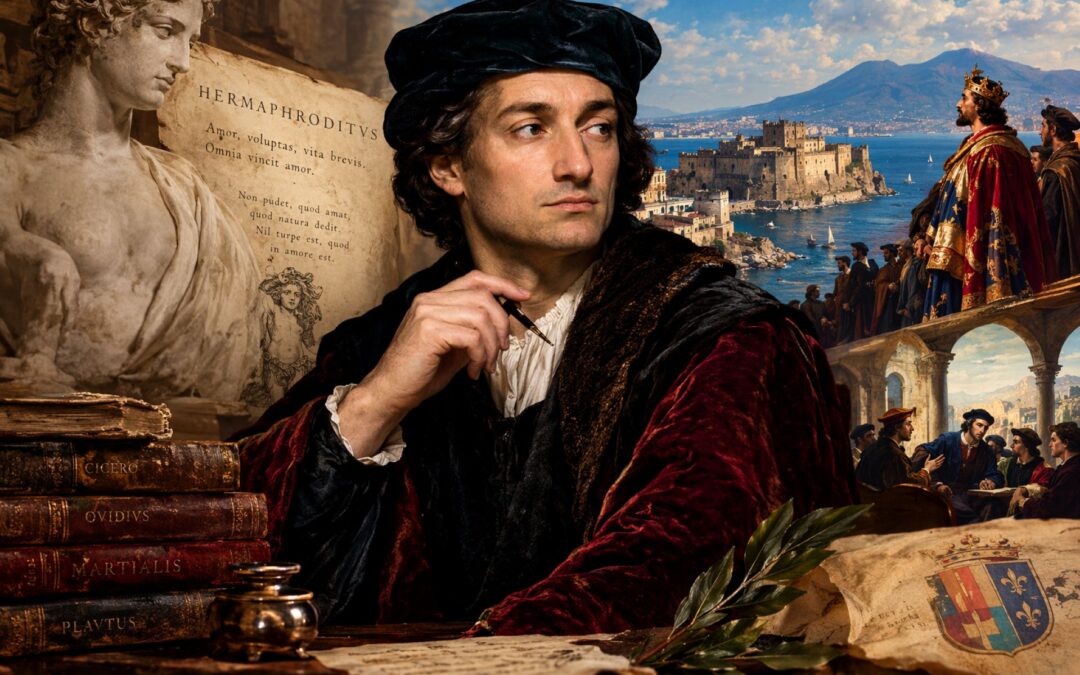
In fifteenth-century Italy, Antonio Beccadelli achieved literary fame by writing poetry that religious preachers considered scandalously obscene. His collection of Latin epigrams, Hermaphroditus, celebrated sexual desire, mocked social conventions, and revived aspects of ancient Roman literature that many Christian moralists considered unsuitable for respectable readers. The poems attracted fierce condemnation, but they also won him admirers among some of the most distinguished scholars of the Italian Renaissance.
Yet Beccadelli did not remain an outsider challenging respectable society. He became a celebrated court poet, a trusted royal adviser, an accomplished diplomat, and an influential figure in the intellectual life of Naples. Under Alfonso V of Aragon, he helped establish a courtly culture in which classical scholarship, literary talent, and political authority reinforced one another.
His career raises an intriguing question: how did a writer notorious for sexually explicit poetry become one of the respected intellectual figures of Renaissance Italy?
The answer reveals a world in which literary controversy could coexist with professional advancement, and where mastery of classical learning could open doors to political influence.
A Merchant’s Son Finds His Place Among Humanists
Antonio Beccadelli was born in Palermo, Sicily, in 1394, into a family originally from Bologna. His father intended him to pursue commerce, a practical occupation that promised financial security and social advancement. Beccadelli, however, developed a stronger interest in literature and scholarship, eventually abandoning the mercantile career that had been planned for him.
His nickname, Il Panormita, came from Panormus, the Latin name for Palermo. It would become the identity by which many of his contemporaries knew him, appearing in his writings and correspondence throughout his career.
Around 1419 or 1420, Beccadelli left Sicily for mainland Italy. His travels brought him into contact with an intellectual world increasingly devoted to recovering, studying, and imitating the literature of ancient Greece and Rome. Florence, Padua, Siena, and Bologna offered opportunities to meet scholars, obtain manuscripts, attend lectures, and establish relationships with potential patrons.
The humanist Giovanni Aurispa helped introduce him to influential circles, while Beccadelli may have studied under the celebrated Latin teacher Gasparino Barzizza during a brief stay in Padua. In Siena, he pursued legal studies under Nicola Tudisco, a distinguished jurist of Sicilian origin. Law offered a conventional path toward employment in government or administration, but Beccadelli was already increasingly committed to literary ambitions.
Renaissance humanism was not simply an enthusiasm for ancient books. Its scholars believed that the disciplined study of classical languages, rhetoric, history, and literature could cultivate intellectual ability and prepare educated men for public life. A command of elegant Latin was especially valuable because it served as a shared language for scholarship, diplomacy, government correspondence, and international intellectual exchange.
For an ambitious young man without an established position at a major court, literary skill could become a means of advancement. A successful poem might attract the attention of respected scholars, while a carefully composed letter could establish a useful relationship with a wealthy patron.
Beccadelli embraced this culture enthusiastically. He studied ancient authors not merely to understand their works but to develop his own literary identity. Rather than restricting himself to the elevated subjects of epic poetry or moral philosophy, he became particularly interested in Roman writers whose works combined elegance with humour, satire, sexuality, and everyday experience.
His early studies and movements are documented in Gianvito Resta’s biography of Antonio Beccadelli in the Dizionario Biografico degli Italiani. They show a young scholar moving between intellectual centres while seeking the reputation and connections that could sustain a professional literary career.
During his studies in Siena, Beccadelli began composing the collection that would transform his fortunes. Completed and circulated around 1425–1426, Hermaphroditus would make his name known throughout Italian humanist circles, though not always for reasons its admirers and critics agreed upon.
Hermaphroditus: The Poetry That Made His Name
Beccadelli’s Hermaphroditus was a collection of approximately eighty Latin epigrams arranged in two books. Its subject matter was frequently erotic, sometimes aggressively explicit, and often satirical. Rather than presenting a continuous story, the poems offered brief encounters, descriptions, jokes, observations, and portraits of people whose behaviour exposed the pleasures, absurdities, and contradictions of human life.
The collection drew heavily on ancient Roman literary traditions. Martial supplied an important model for witty, sharply constructed epigrams, while Catullus demonstrated how personal emotions and sexual themes could be expressed through sophisticated verse. Beccadelli also drew on Horace, Plautus, and the Priapea, a body of poems associated with the fertility god Priapus and characterised by deliberately explicit sexual language.
These influences mattered because Beccadelli was working within a culture that increasingly admired ancient literature as a source of stylistic excellence. Humanists were recovering classical texts and refining their Latin by studying Roman authors. However, the Roman literary inheritance included works that challenged the moral expectations of contemporary Christian society.
Hermaphroditus brought that tension into the open.
Its poems described sexual attraction, infidelity, bodily desire, prostitution, and different forms of erotic behaviour. Some employed deliberately vulgar imagery, while others relied on innuendo or comic exaggeration. Men and women appeared in situations that could be playful, embarrassing, indulgent, or morally ambiguous.
The title itself evoked sexual ambiguity and the variety of experiences represented in the poems. It should not, however, be interpreted as evidence that Beccadelli was expressing a modern theory of gender or sexual identity. The collection belongs to a distinctive literary culture in which classical references, provocative humour, and the performance of an author’s poetic personality were closely intertwined.
Its significance also extended beyond its explicit content. Beccadelli demonstrated considerable technical skill in composing Latin verse, particularly in the controlled rhythms and compact construction of elegiac couplets. He combined classical literary conventions with settings and personalities drawn from the social environments of contemporary Italian cities.
Students, scholars, lovers, and other recognisable human types appeared in these poems. Beccadelli used their encounters to produce comedy, sharp observation, and sometimes moments of melancholy. The resulting work was not simply a sequence of obscene jokes but an attempt to adapt the range of Roman epigrammatic poetry to the experiences and literary tastes of Renaissance Italy.
That ambition helped explain its immediate success.
Copies circulated among scholars, attracting admiration for Beccadelli’s command of Latin and his apparent willingness to imitate ancient writers without avoiding their more provocative subjects. Humanists who valued classical eloquence could appreciate the literary accomplishment even when they were uncomfortable with particular themes.
One example of this favourable reception survives in a letter written by the humanist Antonio da Pescia. The letter, examined in Luigi Silvano’s study of an admirer of Hermaphroditus, provides evidence that Beccadelli’s poetry received genuine praise among his contemporaries. Its success was therefore not limited to notoriety or the curiosity generated by condemnation.
Nevertheless, the collection provoked substantial hostility.
The Franciscan preacher Bernardino of Siena was among the religious figures who attacked the work, while other preachers, including Roberto da Lecce and Roberto da Sarteano, also condemned its sexual content. To such critics, the artistic imitation of ancient pagan literature could not justify writing that appeared to celebrate behaviour contrary to Christian morality.
The controversy exposed a genuine disagreement about the limits of literary freedom. Renaissance humanists admired antiquity, but they did not all agree that everything found in ancient literature deserved imitation. Some believed that elegant Latin poetry should remain compatible with Christian standards of conduct, while others defended the study and recreation of classical literary forms even when their content was indecorous.
Beccadelli’s poems raised the uncomfortable possibility that a work could be technically accomplished and morally objectionable at the same time.
The criticism was also entangled with intellectual rivalries. Figures such as Antonio da Rho attacked Beccadelli’s reputation, while accusations circulated concerning his conduct and character. These polemics were not always reliable accounts of his private life. Rival scholars frequently used personal allegations to discredit competitors, particularly when literary prestige and access to influential patrons were at stake.
Nor should the poems themselves be treated as straightforward autobiographical testimony. An erotic epigram could draw on personal experience, but it could also be an exercise in literary invention, a parody of an established classical model, or a deliberately exaggerated performance. The distinction between the author’s private behaviour and the persona created within his poetry is essential.
What makes the reception of Hermaphroditus historically revealing is that condemnation did not destroy Beccadelli’s career. His reputation remained sufficiently impressive to attract powerful supporters, and his literary abilities continued to provide opportunities for advancement.
The collection had demonstrated that he could command attention within the competitive republic of humanist letters. For Beccadelli, literary fame would become the foundation of a much broader professional life.
Fame, Feuds, and a Career at the Visconti Court
Following the success of Hermaphroditus, Beccadelli continued travelling between Italian intellectual centres. In 1427, he attempted to obtain a position at the Este court through the recommendation of the humanist Guarino Veronese, but the effort did not succeed. He subsequently returned to Florence and spent time in Rome, where he encountered important scholars, including Poggio Bracciolini and Lorenzo Valla.
These relationships illustrate the importance of personal networks within Renaissance humanism. Scholars exchanged manuscripts, recommended one another to patrons, debated questions of language and literature, and competed for appointments. Their correspondence could function simultaneously as intellectual discussion, social introduction, and professional self-promotion.
Competition, however, could become intensely personal.
Beccadelli’s relations with some fellow humanists deteriorated into disputes involving literary criticism, accusations, and questions of reputation. His conflicts with Lorenzo Valla and Antonio da Rho reflected a scholarly environment in which criticism could threaten not only intellectual standing but also access to employment.
In 1429, Beccadelli travelled to Pavia, where he hoped to establish himself at the court of Filippo Maria Visconti, Duke of Milan. With the assistance of the archbishop and humanist Bartolomeo della Capra, he secured an appointment as court poet in December that year. The position initially carried an annual salary of 400 gold florins, representing a considerable advancement from the uncertainty of his earlier travels.
His standing was further enhanced in May 1432 when Emperor Sigismund crowned him with a poet’s laurel at Parma. Such an honour publicly recognised literary accomplishment and associated its recipient with the classical tradition of celebrating distinguished poets.
Beccadelli also held teaching responsibilities at Pavia and continued his scholarly work. He devoted particular attention to the Roman playwright Plautus, studying available manuscripts and attempting to correct textual problems in several comedies. His projected philological work remained unfinished, but the effort demonstrates that his intellectual interests extended well beyond erotic poetry.
During this period, he assembled the Poematum et prosarum liber, a collection of poems, letters, and prose writings. The work presented a broader picture of his abilities, including literary criticism, praise, argument, and reflections on subjects such as friendship, solitude, and personal experience.
The collection also served a professional purpose. By gathering examples of his learning and stylistic accomplishment, Beccadelli could demonstrate his suitability for service under another patron. Renaissance literary collections often functioned as carefully constructed presentations of an author’s reputation rather than neutral records of everything he had written.
Despite the honours he received, his position at Pavia became increasingly unstable. Financial difficulties, reduced compensation, intellectual rivalries, and tensions surrounding his employment complicated his relationship with the Visconti establishment. An outbreak of plague also disrupted his circumstances, forcing him temporarily to seek refuge outside the city.
By early 1434, his prospects at the Milanese court had deteriorated. He was ready to seek a more secure and rewarding position elsewhere, and he found his opportunity in the service of Alfonso V of Aragon.
Alfonso V and the Making of Renaissance Naples
In 1434, Beccadelli entered the service of Alfonso V, King of Aragon, who would later become ruler of Naples. Alfonso, remembered as the Magnanimous, combined military ambition and political expansion with a pronounced enthusiasm for classical learning and humanist scholarship.
Beccadelli first joined him in Palermo, where he was appointed a royal counsellor. The relationship marked an important transformation in his career. Instead of depending primarily on literary fame and occasional academic employment, he became part of the administrative and diplomatic circle surrounding a powerful Mediterranean monarch.
Alfonso was engaged in a prolonged struggle to secure the Kingdom of Naples. Competing dynastic claims, shifting alliances, and conflict with the Angevin faction made the contest politically complicated. His eventual success would extend Aragonese influence across the western Mediterranean and establish a new centre of royal power in southern Italy.
Beccadelli participated in this struggle through duties that required much more than literary accomplishment. He accompanied Alfonso during military campaigns, undertook negotiations, handled official correspondence, and represented royal interests in diplomatic missions.
During the siege of Gaeta, he was entrusted with negotiations concerning the defenders’ surrender. He was subsequently sent to Florence and Siena to discourage an alliance with Genoa, whose involvement could threaten Alfonso’s objectives. He also performed administrative duties connected with royal finances and government.
These appointments demonstrate why a trained humanist could become useful to a Renaissance ruler. Diplomatic work demanded persuasive language, knowledge of political conventions, and the ability to compose authoritative correspondence. Beccadelli’s classical education provided skills directly relevant to the exercise of government.
His career was not simply that of a poet enjoying the generosity of a wealthy king. He was becoming an experienced royal servant whose literary and rhetorical abilities could be applied to practical political problems.
Alfonso conquered Naples in 1442 and made his ceremonial entry into the city in February 1443. Beccadelli was among those associated with the new royal court, where he obtained the position and recognition he had struggled to secure under the Visconti.
The Aragonese court soon became an important centre of Renaissance humanism. Alfonso patronised scholars, encouraged the study of classical literature, and cultivated an environment in which intellectual distinction contributed to the prestige of his monarchy.
This patronage served several purposes. Learned men provided administrative and diplomatic services, but they also wrote histories, poems, speeches, and biographies that presented the ruler in favourable terms. Classical learning became part of the language through which royal power could be explained, celebrated, and legitimised.
Beccadelli occupied a prominent place within this environment.
His responsibilities continued to include diplomatic assignments, sometimes involving sensitive regional relationships. In 1451, he travelled with other representatives, including Giovanni Pontano, to Florence and later visited Venice, where he delivered a Latin oration. In 1453, he undertook a mission to Genoa concerning an Italian alliance against the Ottoman threat.
Alfonso rewarded his service with honours and financial privileges. In 1450, Beccadelli received recognition as a citizen of Naples for life, reflecting his established standing within the kingdom.
Yet his contribution to the court extended beyond formal administration.
Beccadelli helped bring together scholars for conversations about poetry, rhetoric, classical literature, and intellectual questions. These gatherings reflected the humanist belief that learning developed through discussion, criticism, and the exchange of ideas among educated participants.
The circle associated with him became known as the Porticus Antonianus, a name connected with meetings held beneath the porticoes along what is now Via dei Tribunali in Naples. Its activities were not limited to solemn lectures. Discussions could be lively, competitive, and informal, with Beccadelli’s wit and conversational ability contributing to their appeal.
The group brought together intellectuals associated with the Aragonese court, although not every relationship was harmonious. Beccadelli maintained friendships with scholars such as Bartolomeo Facio and Giovanni Pontano, while his disputes with Lorenzo Valla and others demonstrated that scholarly rivalry remained part of courtly life.
Pontano eventually became especially important to the continuation and development of this intellectual community. The gatherings associated with Beccadelli helped provide the foundations for the institution later known as the Accademia Pontaniana, although its evolution should not be understood as a single formal founding event.
Its significance lay in establishing a durable intellectual network in Naples.
Renaissance humanism had already developed important centres in cities such as Florence, Rome, and other parts of northern and central Italy. Under Alfonso, Naples became increasingly connected with those wider scholarly communities, and Beccadelli helped facilitate that transformation.
He therefore exercised influence in two related capacities: as a royal servant participating in government and as a cultural organiser helping to establish the intellectual character of the Aragonese court.
The poet once condemned for his scandalous Latin verses had become a central figure in the relationship between scholarship and political authority.
The Writer Who Turned a King into an Ideal
Beccadelli’s mature literary career was closely associated with Alfonso V. His most significant work in the service of the king was De dictis et factis Alphonsi regis, completed around 1455.
The title translates approximately as On the Sayings and Deeds of King Alfonso. Divided into four books, it presents a collection of anecdotes, observations, and memorable statements intended to demonstrate the monarch’s admirable qualities.
Instead of writing a continuous chronological history of Alfonso’s reign, Beccadelli organised his material around examples of royal conduct. Individual episodes illustrated virtues such as justice, moderation, courage, generosity, wisdom, and good judgement.
This structure suited his established literary abilities. Just as the epigrams of Hermaphroditus had condensed vivid situations into short poetic forms, the royal anecdotes allowed him to communicate character through brief, memorable scenes.
The difference was the purpose of the writing.
Where his earlier collection had drawn attention through satire and sexual provocation, De dictis et factis presented its central subject as a model of exemplary kingship. Its anecdotes encouraged readers to understand Alfonso not merely as a successful ruler but as a cultivated prince whose personal virtues justified admiration.
The work belonged to a wider Renaissance tradition of using classical literary forms to shape the public image of political leaders. Humanist authors frequently drew on ancient examples of rulers, philosophers, and military commanders when presenting the achievements of contemporary patrons.
For Alfonso, association with classical ideals offered a form of cultural legitimacy. He was a foreign monarch ruling Naples after a difficult military conquest, and the presentation of his government as wise, generous, and learned helped strengthen the reputation of his court.
Beccadelli’s writing contributed to this effort by giving the king a recognisable moral personality.
The book should not, however, be approached as an impartial historical record. Its author was a close associate and beneficiary of Alfonso’s patronage, and its primary purpose was celebratory. The selection and arrangement of episodes reflected Beccadelli’s intention to emphasise the qualities he admired or wished others to admire.
That does not mean the entire work is historically worthless. Anecdotes could preserve details of speech, behaviour, courtly expectations, and contemporary political culture. Nevertheless, they require interpretation in light of the author’s relationship with his subject.
The distinction between evidence and praise is particularly important because De dictis et factis helped establish an enduring image of Alfonso as an ideal Renaissance ruler. The collection circulated widely and was translated into vernacular languages, extending its influence beyond scholars who could read Latin.
Beccadelli also composed Alphonsi Regis triumphus, a short prose work celebrating the king’s ceremonial entry into Naples in 1443. Together, these writings demonstrate how he employed literary talent to commemorate royal achievements and construct a favourable image of monarchy.
Alfonso acknowledged his service with substantial rewards. In 1455, he granted Beccadelli the Zisa palace in Palermo, a historic residence associated with Sicily’s earlier Muslim and Norman rulers. The gift symbolised the extraordinary distance Beccadelli had travelled from the young man whose father had intended him for a commercial career.
His rise also illustrates an important feature of Renaissance humanism: intellectual accomplishment could provide access to power, while powerful patrons could determine which forms of intellectual accomplishment received recognition and support.
Beccadelli had become influential not by abandoning literature, but by adapting his literary abilities to the needs of a royal court.
Surviving Alfonso and Leaving a Humanist Legacy
Alfonso V died in 1458, but Beccadelli’s privileged position at Naples survived the transition to his successor, Ferdinand I, also known as Ferrante.
Beccadelli continued serving the Aragonese monarchy through an increasingly difficult political period. Ferdinand faced opposition from powerful nobles and challenges to his authority, while the kingdom’s financial difficulties complicated the maintenance of its administration and court.
Beccadelli remained involved in diplomatic correspondence and political negotiations. In 1458, he undertook a mission to Milan involving Francesco Sforza, and he subsequently participated in discussions concerning the growing opposition to Ferdinand’s rule. His responsibilities included drafting communications to other Italian rulers and political authorities in support of the kingdom.
His relationship with the new monarch was not without tension. Financial pressures led to reductions in his compensation, and Beccadelli complained about his circumstances. At times, he appears to have considered leaving Naples, although later royal assistance helped restore their relationship.
His private life also underwent changes during his years of royal service. He had married Filippa during his earlier residence in Lombardy, and after her death, probably around 1455, he married Laura Arcella, a young noblewoman from Naples.
Despite the demands of political employment, Beccadelli continued his intellectual and literary activities. He maintained correspondence with scholars, participated in learned discussions, and worked on collections of letters intended to preserve his achievements and relationships.
His extensive correspondence is particularly important for understanding the humanist world in which he operated.
Letters connected scholars across different courts and cities, allowing them to exchange manuscripts, discuss literary questions, seek appointments, and maintain friendships. They also provided opportunities for authors to construct carefully managed accounts of their own lives.
Beccadelli arranged his correspondence into five collections, including letters associated with his earlier scholarly career and those composed in royal service. Some were revised or selected with an eye toward their eventual readership, meaning that they functioned both as historical documents and as literary works.
These collections offer evidence of his intellectual networks, professional ambitions, political responsibilities, and relationships with other humanists. They also demonstrate the importance of Latin correspondence as a distinctive literary form within Renaissance scholarship.
During his final years, Beccadelli began writing a biography of Ferdinand, the Liber rerum gestarum Ferdinandi Aragoniae. The project remained unfinished at his death, leaving a final example of his continuing commitment to recording and interpreting the achievements of the dynasty he served.
He died in Naples in January 1471, having spent more than three decades in the service of the Aragonese monarchy.
His influence nevertheless continued through the institutions, intellectual relationships, and writings associated with his career. Giovanni Pontano became a leading representative of Neapolitan humanism, and the scholarly circle that had developed around Beccadelli acquired a more enduring identity through the Accademia Pontaniana.
The academy helped preserve a tradition of intellectual exchange that extended beyond any single writer or patron. Its later prominence illustrates the significance of Beccadelli’s role in establishing the cultural foundations of Renaissance Naples.
His literary legacy was more complicated.
Hermaphroditus remained his most notorious work, attracting attention from later readers interested in Renaissance sexuality, classical imitation, and the history of censorship. Its explicit language influenced how Beccadelli was remembered, sometimes obscuring the breadth of his literary and political accomplishments.
Yet his historical importance cannot be measured by that collection alone. His writings on Alfonso helped shape the memory of a Renaissance monarch, his correspondence preserved valuable evidence of fifteenth-century intellectual culture, and his participation in the development of Neapolitan humanism connected literary scholarship with the practical world of government.
Beccadelli’s life demonstrates that Renaissance humanists could occupy several roles simultaneously. They were scholars and poets, but they could also become negotiators, administrators, political advisers, and architects of cultural reputation.
Antonio Beccadelli’s journey from Palermo to the court of Naples was remarkable not because he abandoned the provocative literary interests of his youth, but because he built a career in which scholarship, reputation, and political service continually reinforced one another. The same command of language that produced Hermaphroditus later enabled him to negotiate on behalf of kings and celebrate their achievements.
His life reveals the Renaissance as a world of competing values rather than a simple conflict between enlightened scholars and religious authorities. Classical learning could inspire artistic experimentation while supporting established political institutions, and controversial writers could become influential participants in the societies they appeared to challenge.
Beccadelli remains a revealing figure because his career brings these contradictions together. His lasting significance lies not only in the controversy he provoked, but in the part he played in transforming Naples into an important centre of Renaissance intellectual life.
Last Updated on October 29, 2026 by Aseem Gupta