
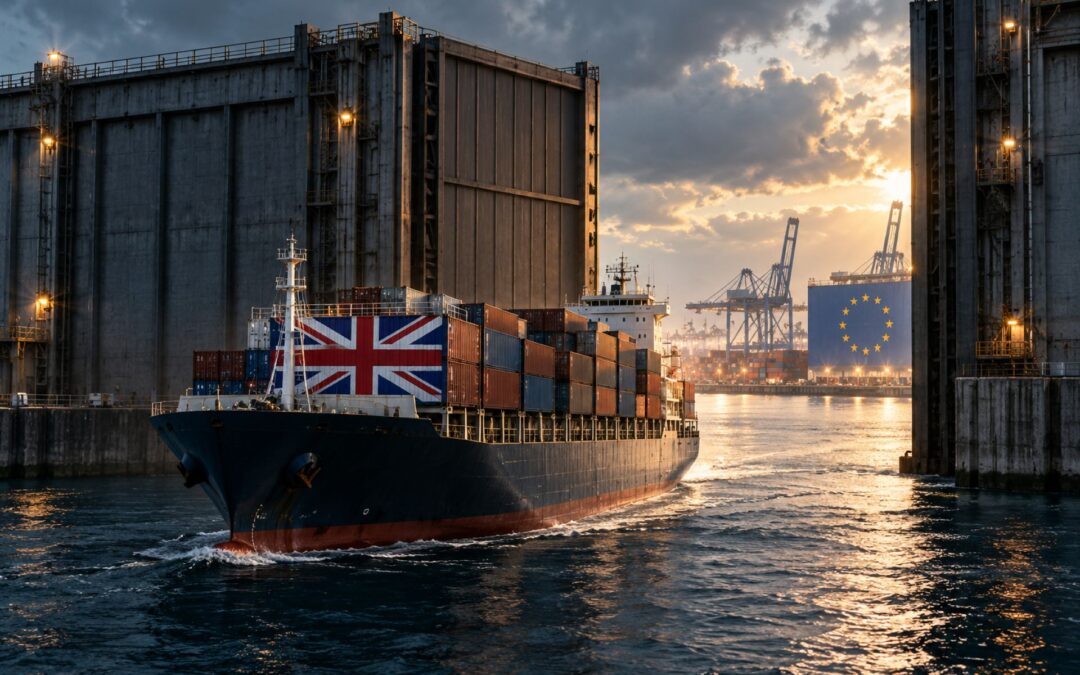
On 23 June 2016, Britain voted to leave the European Union. With 51.9% of voters supporting Leave, the referendum promised a historic transformation: greater control over Britain’s borders, laws, money and economic future. Ten years later, the country is still debating what that decision achieved and whether the benefits justified the costs.
The anniversary arrived amid another period of political upheaval. Keir Starmer resigned as prime minister in June 2026, less than two years after Labour’s landslide victory, and Andy Burnham took office the following month. Meanwhile, Britain was negotiating closer cooperation with the European Union, the very institution it had spent years disentangling itself from. A referendum presented as an opportunity to settle Britain’s relationship with Europe had instead created questions that remained unresolved a decade later.
The economic evidence has also become considerably clearer. New research suggests that Brexit has reduced trade, discouraged investment and left Britain’s economy smaller than it would otherwise have been. Yet Brexit was never solely an economic proposition. Supporters also wanted democratic sovereignty, an independent immigration system and the freedom to pursue policies that European membership had previously constrained.
Judging Brexit therefore requires more than comparing economic forecasts with political slogans. The meaningful question is what Britain actually gained through independence, what it sacrificed in the process, and whether the country has used its new powers to achieve the outcomes voters expected.
The Brexit Promise Was Never One Plan
The central difficulty with Brexit was that leaving the European Union meant different things to different supporters. For some, it was primarily about immigration and ending the automatic right of EU citizens to live and work in Britain. Others wanted Parliament to regain authority over British laws, escape European regulation, negotiate independent trade agreements or redirect money previously contributed to the EU budget toward domestic priorities such as the National Health Service.
These ambitions were not necessarily compatible. A country seeking unrestricted access to Europe’s single market would ordinarily need to accept common rules and, depending on the arrangement, freedom of movement. A country seeking complete regulatory independence would have to accept restrictions on that access. The referendum established that a narrow majority wanted to leave the EU, but it did not establish how much economic integration voters were prepared to sacrifice.
Several possible relationships existed. Norway participates in the European single market through the European Economic Area, accepting many common rules and freedom-of-movement obligations without belonging to the EU. Turkey maintains a customs union with the EU covering specified goods, although its arrangement does not provide the broader freedoms of single-market membership. Britain could have explored variations of these arrangements rather than pursuing extensive institutional separation.
Instead, British governments gradually moved toward a harder form of Brexit. Theresa May struggled to obtain parliamentary approval for her withdrawal agreement, and repeated political defeats eventually contributed to her resignation. Boris Johnson subsequently secured a revised withdrawal arrangement and negotiated the Trade and Cooperation Agreement, which established the framework for Britain’s future commercial relationship with Europe.
Britain formally left the European Union on 31 January 2020. However, it remained within the single market and customs union during a transition period that ended on 31 December 2020. The most consequential economic changes therefore arrived on 1 January 2021, when the new trading relationship began.
The agreement allowed qualifying goods to move between Britain and the EU without tariffs or quotas, but it did not preserve the frictionless conditions of membership. As the Office for Budget Responsibility’s analysis of Brexit makes clear, this reduction in economic integration is central to the expected long-term damage to British productivity.
The distinction matters because Brexit was not simply a choice between membership and independence. It was also a choice about the terms under which independence would operate. Britain secured greater freedom to determine its own policies, but the particular arrangement it pursued imposed economic costs that were neither unavoidable consequences of every conceivable Brexit model nor adequately explained during the referendum campaign.
How Brexit Made Trading With Europe Harder
Before Brexit, a British manufacturer selling goods to France, Germany or Italy operated within a highly integrated economic system. Companies did not ordinarily need customs declarations when moving goods between EU member states, and common product standards allowed businesses to serve customers across national borders without repeatedly demonstrating compliance with different regulatory systems.
The single market reduced more than tariffs. It eliminated many administrative obstacles that make international commerce expensive, unpredictable and time-consuming. A manufacturer could purchase components from several European countries, assemble a product in Britain and sell it elsewhere in Europe through supply chains designed around the relatively unrestricted movement of goods.
The Trade and Cooperation Agreement preserved tariff-free access for goods satisfying its conditions, but it reintroduced customs formalities, rules-of-origin requirements and regulatory barriers. Businesses had to demonstrate where products originated, prepare additional documentation and comply with procedures that had previously been unnecessary. Some products also became subject to sanitary, phytosanitary or technical conformity checks.
These requirements might appear manageable individually. Their economic effect becomes much more significant when repeated across thousands of shipments, particularly when products contain components sourced from several countries. Additional paperwork creates administrative costs, inspections introduce uncertainty, and delays can undermine supply chains organised around precise delivery schedules.
The consequences were particularly severe for smaller businesses.
A London School of Economics study using detailed customs records estimated that the Trade and Cooperation Agreement reduced Britain’s total goods exports by £27 billion, or 6.4%, in 2022 compared with what would have been expected without the new barriers. The research attributed this overall loss to a 13.2% reduction in goods exports to the EU.
The researchers also found that approximately 16,400 firms that had previously exported to EU markets stopped doing so after the agreement came into force. Among the smallest fifth of firms that continued exporting, the average value of EU exports fell by approximately 30%. By contrast, the study found no measurable negative export effect among its largest group of firms.
This difference reflects the economics of fixed costs. A multinational company shipping millions of pounds worth of goods can employ customs specialists, hire legal advisers and operate warehouses inside the European Union. The administrative expense becomes relatively small compared with the value of its sales.
A small British manufacturer selling specialised products to a handful of European customers faces a different calculation. Customs declarations, certification requirements and shipping delays can consume a substantial share of the profit on each order. Even if the product remains competitive, the extra administrative burden may make serving European customers commercially unattractive.
These barriers operate somewhat like a regressive tax on international trade. The rules apply to businesses regardless of their size, but their practical burden falls disproportionately on companies with fewer resources. The result is not simply lower sales; some firms abandon export markets entirely.
European customers also have alternatives. A German manufacturer choosing between a British component supplier and a comparable supplier located inside the single market may prefer the supplier facing fewer border complications. The British product does not have to become worse or more expensive to manufacture for its competitive position to deteriorate.
Over time, these individual decisions can change the structure of international supply chains. Businesses establish European distribution centres, reorganise procurement arrangements or shift certain activities closer to their customers. Once a supplier loses its position in a production network, regaining that business can be difficult even if future governments reduce the original barriers.
There is an important qualification. The LSE study did not find that the Trade and Cooperation Agreement reduced British firms’ exports to countries outside the EU. Its measured overall export loss came from declining sales to European customers. Broader supply-chain disruption remains a plausible mechanism, but it should not be confused with a demonstrated decline in every category of international trade.
Services experienced a different adjustment. Digital consulting, software and other services that can be delivered remotely continued to perform comparatively well, and Britain’s international services sector remains a major economic strength. However, regulated activities such as financial and legal services faced restrictions that a goods-focused trade agreement could not fully resolve.
The overall outcome was therefore uneven rather than universally disastrous. Many large businesses adapted, services retained important competitive advantages, and trade with Europe continued. Nevertheless, the new arrangements made participation in Britain’s largest neighbouring market more difficult, with the sharpest consequences concentrated among smaller exporters.
Could Global Britain Replace the European Market?
Supporters of Brexit argued that independent trade policy would allow Britain to develop stronger commercial relationships beyond Europe. Instead of negotiating through the EU, the government could establish agreements tailored to British industries, reduce tariffs with growing economies and strengthen its position in international markets.
Britain subsequently negotiated trade agreements with Australia and New Zealand, joined the Comprehensive and Progressive Agreement for Trans-Pacific Partnership (CPTPP), and concluded an important agreement with India. These arrangements represent genuine opportunities, particularly for companies seeking access to markets with different growth prospects and consumer demands.
The India agreement is especially significant because of the size and long-term potential of the Indian economy. It entered into force on 15 July 2026, creating opportunities for British exporters through lower tariffs, improved market access and provisions covering services and digital trade.
However, even the government’s own projections illustrate the limitations of using new agreements to compensate for lost European integration. Its economic impact assessment of the UK–India free trade agreement estimates that the deal will increase British GDP by approximately 0.13% in the long run, equivalent to about £4.8 billion annually relative to a scenario without the agreement.
That is a meaningful benefit, but considerably smaller than most estimates of Brexit’s overall economic cost. The figures are not directly interchangeable because they involve different models, assumptions and time horizons. They nevertheless demonstrate why a series of conventional trade agreements cannot easily recreate the advantages of deep integration with a large neighbouring economic market.
Geography plays an important role. European markets are relatively close to Britain, allowing manufacturers to move products repeatedly across borders as part of complex production processes. Shipping components between British and European factories is fundamentally different from transporting goods across continents.
There is also a difference between reducing trade barriers and participating in a single market. A free trade agreement can eliminate tariffs and improve access, but it rarely provides the same comprehensive regulatory framework, freedom of establishment or mutual recognition arrangements available within a deeply integrated economic area.
Independent trade agreements may generate valuable growth, diversification and strategic relationships in their own right. Their benefits should not be dismissed simply because they cannot fully offset Brexit’s costs. The problem was the expectation that access to distant markets could straightforwardly replace the economic advantages Britain already enjoyed with its nearest major trading partners.
The Investment Britain Never Received
The economic consequences of Brexit extend beyond goods crossing borders. One of its potentially most significant effects concerns business investment: the money companies spend building factories, developing technology, purchasing machinery, expanding operations and improving the productive capacity of the economy.
Investment decisions depend heavily on expectations about the future. Companies considering major projects need reasonable confidence about regulation, market access, supply chains and political stability. When Britain voted to leave the European Union without a settled plan for its future trading relationship, businesses faced years of uncertainty about the rules under which they would eventually operate.
For some companies, delaying investment was the rational response. A manufacturer considering a new production facility might wait until it knew whether products assembled in Britain could continue moving easily into European markets. A multinational corporation deciding where to establish a regional headquarters might favour an EU member state rather than accept the risk of future restrictions.
The damage from this process differs from the immediate effect of a tariff or customs fee. A company that decides not to build a factory does not generate a dramatic closure announcement or a visible wave of layoffs. Its potential jobs, output, supplier contracts and future tax contributions simply never materialise.
Researchers have attempted to measure these missing investments by comparing Britain’s actual economic performance with estimates of what might have happened without Brexit. A study published by the National Bureau of Economic Research and revised in June 2026 estimated that Brexit had reduced UK business investment by approximately 12–13% by the end of 2025 relative to its counterfactual scenario.
That estimate does not mean investment fell by 13% in absolute terms. It means the researchers believe investment was substantially below the level Britain might otherwise have achieved. Their analysis connects the shortfall to prolonged uncertainty, weaker demand, diverted management attention and resources being allocated less efficiently.
Foreign investment adds another dimension. Foreign direct investment involves lasting ownership or influence over businesses operating in another country, often through acquisitions, factories, research facilities or subsidiaries. Britain has historically attracted substantial international investment because of its business environment, financial institutions, skilled workforce and access to European markets.
Some discussions of Britain’s declining attractiveness cite a fall in its share of global foreign capital from 8.6% in 2015 to approximately 7% in 2025. These figures refer to a broader measure of cross-border financial claims, including portfolio investments and deposits, rather than foreign direct investment alone. They should therefore not be treated as a direct measurement of changes in FDI.
London’s financial industry provides a particularly revealing example of Brexit’s adjustment costs.
Before Brexit, British financial institutions benefited from passporting arrangements that allowed authorised firms to provide certain services across EU markets. Losing those rights required banks, insurers and other financial businesses to reconsider where they employed staff, held regulatory authorisations and conducted European operations.
A Reuters investigation into how Britain’s financial industry adapted after Brexit described the relocation of approximately 40,000 financial-sector jobs to European centres, including Paris, Dublin, Frankfurt and Amsterdam. European cities gained activities that might previously have remained concentrated in London.
Yet this did not destroy London’s position as a global financial centre. The city retained substantial strengths in international banking, asset management, professional services and financial technology. Many companies reorganised their European operations while continuing to maintain important activities in Britain.
This resilience matters because it distinguishes a loss of competitive advantage from the disappearance of an industry. Britain can remain internationally successful in finance while still being less successful than it might have been under a different relationship with Europe.
The deeper concern is the cumulative effect on productivity. Workers become more productive when businesses provide better equipment, more advanced technology, efficient infrastructure and greater access to capital. When investment grows more slowly than it otherwise would, the resulting gap can accumulate over many years.
Brexit’s investment costs therefore cannot be understood solely by examining businesses that closed or jobs that moved. They also include facilities not constructed, projects not undertaken and future productive capacity that Britain may have sacrificed without ever seeing it disappear.
How Much Did Brexit Actually Cost Britain?
Assessing Brexit’s overall economic cost is more complicated than adding up customs fees, lost exports and relocated jobs. Economists must estimate how Britain would have performed if it had remained in the European Union, then compare that hypothetical path with the economy that actually developed.
This is known as counterfactual analysis. It does not involve observing two versions of Britain directly; only one historical path actually occurred. Researchers instead use economic models, international comparisons, business surveys and historical relationships to estimate how different policies might have changed the outcome.
The distinction is essential because Britain’s economy continued growing after the referendum. Saying Brexit reduced GDP does not necessarily mean national output became smaller each year. It generally means output was lower than economists estimate it would have been without Brexit.
The Office for Budget Responsibility assumes that the post-Brexit trading relationship will ultimately leave British productivity approximately 4% below the level expected under continued EU membership. Productivity measures how much output an economy produces from its available labour and resources, making it an important determinant of wages and living standards.
The NBER researchers reached a somewhat larger conclusion about overall output. Their June 2026 revision estimated that Brexit had reduced UK GDP by approximately 6–8% by the end of 2025, while lowering productivity by 3–4% and employment by 3–4% relative to their estimated alternative path.
Bloomberg Economics offered a different assessment in June 2026, estimating an output loss of approximately 2–4%. Earlier assessments had produced larger headline monetary estimates, including figures approaching £100 billion or more in annual lost output. These estimates should be understood in the context of when they were calculated and what economic outcomes they attempted to measure.
Differences between these findings do not automatically mean one group of researchers is correct and the others are wrong. Models vary in how they construct the hypothetical economy, account for global events, isolate Brexit-related effects and measure changes in business behaviour.
The period after 2016 was unusually difficult for economic analysis. Britain experienced the COVID-19 pandemic, global supply-chain disruption, energy-price shocks, inflation and significant domestic political instability. Other developed economies also faced substantial economic problems, making it difficult to identify how much of Britain’s performance should be attributed specifically to Brexit.
Britain additionally entered the referendum with longstanding structural weaknesses. Productivity growth had already been disappointing after the global financial crisis, regional economic inequality was entrenched, and inadequate infrastructure and business investment were serious concerns. Brexit did not create all these problems, although it may have made some of them harder to overcome.
It is equally important to acknowledge what did not happen. The British economy did not experience an immediate collapse following the referendum, London remained an important financial centre, and many businesses successfully adapted to the new environment. Some predictions of rapid economic deterioration proved too pessimistic about the short-term adjustment.
However, avoiding a collapse is not the same as avoiding an economic loss. The central finding across multiple studies is that Britain’s economy appears weaker than it would otherwise have been, even if researchers disagree about the exact size of that difference.
The consequences extend beyond abstract GDP statistics. A smaller economy generates less potential tax revenue, restricts the resources available for public services and limits the government’s ability to respond to fiscal pressures. It can also translate into weaker real wages if slower investment and productivity growth reduce the value workers can produce.
Problems such as NHS waiting lists, housing shortages, public debt and high borrowing costs cannot reasonably be blamed entirely on Brexit. They have their own histories and causes. Nevertheless, an economy operating below its potential has fewer resources with which to address them.
That is why the most convincing economic criticism of Brexit is not that Britain suddenly became impoverished. It is that the decision appears to have imposed a lasting reduction in the country’s potential prosperity, making existing problems more difficult to solve.
Brexit Changed Immigration, But Not as Expected
Immigration was one of the most politically powerful arguments for leaving the European Union. During the referendum campaign, supporters of Brexit frequently presented freedom of movement as evidence that Britain had lost control over an important area of national policy.
EU membership allowed citizens of other member states to live and work in Britain under European freedom-of-movement rules. While governments retained powers over many other aspects of immigration, they could not impose ordinary nationality-based visa restrictions on EU citizens exercising those rights.
Brexit fundamentally changed that arrangement. Freedom of movement ended, and Britain introduced a points-based immigration system that applied to most prospective migrants from both EU and non-EU countries. The government could now establish work-visa requirements, salary thresholds, eligibility criteria and other restrictions through domestic policy.
In that legal sense, Brexit delivered an important part of its sovereignty promise. Immigration rules previously constrained by EU membership became matters for British political decision-making.
The outcome, however, was not the immediate reduction in overall immigration that many Leave supporters expected.
After free movement ended, immigration from the European Union declined sharply. At the same time, migration from outside Europe increased, partly reflecting demand for workers in sectors such as healthcare and social care, as well as substantial numbers of international students entering British universities.
The scale of this shift was remarkable. According to the Office for National Statistics’ revised long-term migration estimates, net migration reached a peak of approximately 944,000 in the year ending March 2023.
Net migration is the difference between the number of people entering a country for long-term residence and the number leaving. It is not the same as total immigration, because hundreds of thousands of people can arrive and depart within the same period.
The post-Brexit peak was far higher than the migration levels that had generated controversy before the referendum. It also illustrated how ending European freedom of movement did not eliminate Britain’s demand for overseas workers, students and other migrants.
The composition of immigration changed substantially. Greater numbers of migrants arrived from countries such as India, Nigeria and China, alongside people using humanitarian and family routes. Britain’s immigration system became less European in composition without automatically becoming smaller in scale.
Successive governments subsequently tightened the rules. Restrictions on international students bringing dependants, higher salary requirements for skilled workers and changes affecting care-sector recruitment contributed to a substantial reduction in new arrivals.
By the year ending December 2025, estimated net migration had fallen to approximately 171,000, almost half the revised figure for the preceding year. The number of non-EU nationals arriving for work-related reasons declined by 47% during 2025.
The contrast between the 2023 peak and the 2025 decline reveals the distinction between possessing control and using it consistently. Brexit gave Westminster far greater authority over immigration policy, but different governments exercised that authority in different ways, initially permitting substantial inflows and subsequently imposing tighter restrictions.
It would therefore be misleading to argue that Britain failed to gain immigration control simply because migration increased after Brexit. The British government acquired the ability to make choices that had previously been constrained. Whether those choices were successful is a separate political and economic question.
There are also practical trade-offs. Employers in healthcare, social care and other industries rely on international recruitment, while universities benefit from overseas students. Restrictions may reduce migration but can also create labour shortages, constrain institutions or affect economic growth.
Brexit changed who could enter Britain, under what rules and on whose authority. What it did not provide was an automatic solution to the conflicting demands of voters who wanted lower immigration and an economy that continued to rely on people arriving from abroad.
Did Taking Back Control Make Britain More Stable?
The political promise of Brexit was broader than immigration. Supporters argued that decisions affecting Britain should be made by elected British representatives rather than European institutions, restoring a clearer relationship between democratic accountability and government policy.
There was substance to this argument. Outside the EU, Britain could establish its own trade agreements, determine immigration rules and exercise greater regulatory discretion in areas previously governed by European law. Parliament and British institutions acquired powers that membership had restricted or required them to share.
However, national sovereignty does not eliminate economic interdependence or guarantee effective government. Independent countries must still negotiate treaties, comply with international commitments and account for the preferences of larger trading partners. A government may possess the legal authority to adopt a policy while facing considerable economic consequences if it exercises that power.
The decade following the referendum also brought extraordinary political instability.
David Cameron resigned after losing the referendum he had called. Theresa May was unable to secure parliamentary approval for her preferred Brexit arrangements and eventually lost the support needed to remain prime minister. Boris Johnson achieved Britain’s formal departure and negotiated its subsequent trade relationship, but his premiership ended amid scandals and a collapse in parliamentary confidence.
Liz Truss served only 49 days, resigning after her government’s economic programme triggered severe financial-market turmoil. Rishi Sunak subsequently led the Conservatives into their devastating 2024 general-election defeat, which brought Labour back to power under Keir Starmer.
Starmer was elected with a mandate to restore stability after years of Conservative upheaval. His own government nevertheless encountered substantial political difficulties, and he resigned in June 2026. Andy Burnham became Labour leader and prime minister the following month, adding another leadership change to Britain’s turbulent decade.
It would be inaccurate to attribute all these departures directly to Brexit. Johnson’s fall involved questions of conduct and political trust, Truss’s premiership collapsed over domestic economic decisions, and the Conservatives’ electoral defeat reflected numerous issues beyond Britain’s relationship with Europe.
Nevertheless, Brexit contributed to the political environment in which these events occurred. It divided established parties, reshaped electoral coalitions and generated recurring disagreements over the country’s economic and constitutional direction.
The growth of Reform UK demonstrates how the referendum’s political legacy continued beyond the formal withdrawal process. Emerging from the broader movement associated with Nigel Farage and the campaign to leave the EU, Reform attracted voters dissatisfied with immigration policy, mainstream parties and the perceived failure to deliver the changes Brexit had promised.
The party became an important electoral force, challenging the traditional dominance of Labour and the Conservatives. Its polling position fluctuated during 2026, and the strong national leads it enjoyed earlier in the year cannot simply be treated as its settled position in October.
These developments illustrate a paradox. Brexit was supposed to resolve a major national dispute by giving Britain greater control over its future. Yet disagreement about what that control should mean continued to divide parties and voters long after the country formally left the European Union.
The problem was not that sovereignty had failed to return. It was that sovereignty itself did not settle the competing economic interests, political priorities and social expectations that had motivated the referendum.
Britain could now make more decisions independently, but its governments still had to make those decisions successfully. The transfer of authority changed who was responsible for the country’s choices without making those choices any easier.
Why Britain Is Moving Closer to Europe Again
One of the most revealing developments of Brexit’s first decade has been Britain’s gradual reconsideration of its relationship with the European Union. After years of political debate focused on reducing European influence, British governments increasingly recognised the practical benefits of rebuilding cooperation.
This did not necessarily mean abandoning Brexit. It reflected the economic reality that Britain and Europe remained closely connected through trade, supply chains, energy markets, security relationships and the movement of people.
In May 2025, Keir Starmer’s government reached a new understanding with the European Union intended to improve relations and reduce some of the obstacles created by Brexit. The UK–EU Common Understanding established a framework for further negotiations involving food and agricultural trade, energy, security cooperation and mobility.
One important proposal concerned sanitary and phytosanitary rules, which govern the safety of food, animals and plants. Exporters of agricultural products face particularly demanding checks because governments must ensure that goods meet applicable health and safety standards.
Closer alignment between British and European requirements could simplify these procedures, reducing border inspections and administrative burdens. That would benefit businesses whose products move frequently between Britain and EU markets, especially in sectors where delays can be costly.
The political complication lies in how such alignment would operate.
Under the proposed arrangements, Britain would follow relevant European rules as they develop, rather than independently establishing different requirements in every covered area. This approach, known as dynamic alignment, can reduce the risk that regulatory differences create new trade barriers.
But it involves a sovereignty trade-off. Britain would gain easier access to certain European markets by accepting common rules in specified sectors, potentially including an institutional role for European legal oversight. Unlike an EU member state, however, Britain would not have the same voting rights in the institutions that make those rules.
For supporters of closer integration, this is a pragmatic exchange. Common standards can provide significant economic benefits, and some regulatory independence may be less valuable in practice than reliable access to major export markets.
For Brexit supporters who prioritise legislative autonomy, the arrangement raises a serious concern. Britain could find itself applying rules influenced or determined by European institutions without regaining the formal democratic representation that accompanied membership.
Other elements of the reset exposed similar compromises. Existing reciprocal arrangements allowing European fishing access to British waters were extended until 2038, while the two sides also pursued discussions about a youth experience scheme that could permit limited periods of residence and activity for eligible young people.
Such a scheme would not automatically recreate unrestricted freedom of movement. Its practical significance would depend on the eligibility rules, duration, numerical limits and conditions ultimately negotiated.
Nor did the May 2025 understanding itself complete all the proposed agreements. Many elements established directions for negotiation rather than immediately introducing a fully operational replacement for existing rules.
A House of Commons committee assessment of UK–EU relations a decade after the referendum examined the progress and limitations of these discussions. Its findings underline how difficult it remained to translate political commitments into practical arrangements capable of substantially reducing trade friction.
The relationship entered another phase after Andy Burnham became prime minister in July 2026. Burnham signalled a greater willingness to reconsider the terms of Britain’s relationship with Europe, although the government still faced domestic political constraints over questions such as single-market membership and the customs union.
In October 2026, Burnham called for renewed consideration of Britain’s relationship with the EU, reinforcing expectations of closer cooperation ahead of a summit scheduled for 20 November. Potential areas for discussion included food and agricultural trade, energy cooperation and arrangements affecting young people.
As of October 2026, these prospective agreements should not be confused with completed negotiations. The future summit represented an opportunity to make progress, not evidence that the proposed changes had already taken effect.
The wider political environment was also changing. Polling increasingly suggested that more Britons viewed Brexit negatively than positively, and support for rejoining the European Union had become substantial.
However, expressing regret about leaving is not the same as supporting a specific plan for rejoining. A new accession process would require negotiations with EU member states, agreement on the terms of membership and a credible political mandate within Britain.
Questions about budget contributions, regulatory obligations, immigration and potential expectations concerning the euro would have to be addressed. Britain could not simply assume that returning to the European Union would restore every element of its former membership on identical terms.
Even politicians who regard Brexit as economically damaging must consider whether reopening the membership question would generate another period of political conflict. Rejoining may be more popular in opinion surveys than the compromises required to make it happen.
Britain therefore faces a continuing strategic choice. It can prioritise independent regulation and trade policy while accepting the economic friction associated with greater separation. It can negotiate closer alignment with European institutions, sacrificing some policy discretion in exchange for improved access. Or it can reopen the larger question of membership, with all the domestic and international negotiations that would entail.
None of these options eliminates the underlying trade-off between autonomy and integration. They simply place different values on the benefits and constraints of each relationship.
That may be Brexit’s most enduring political consequence. Britain has recovered important powers, but exercising those powers has revealed the economic advantages of cooperation that membership previously provided. The renewed effort to rebuild European ties reflects a recognition that independence and interdependence are not opposites that can be permanently separated by a referendum.
Ten years after the vote, the evidence suggests that Brexit delivered meaningful legal sovereignty but failed to produce the broad economic gains that many supporters anticipated. Britain acquired greater control over immigration, regulation and trade policy, yet the economic costs of leaving the single market have been substantial, and governments have struggled to convert their new authority into consistently better outcomes.
The strongest criticism of Brexit is not that Britain ceased to function outside the European Union. Its economy continued operating, its institutions remained intact, and many businesses adapted successfully. The more consequential finding is that the country appears to have sacrificed part of its potential prosperity for political freedoms whose practical value depends on how effectively governments use them.
Whether that exchange was worthwhile ultimately involves a political judgement as well as an economic one. Voters who place exceptional importance on national self-government may assess the result differently from those who prioritise growth, wages and commercial integration. Yet the economic evidence places a significant burden on anyone claiming that Brexit made Britain more prosperous.
The referendum settled Britain’s immediate question of EU membership, but it could not eliminate the realities of geography, trade and shared economic interests. A decade later, Britain was still negotiating how closely it wanted to cooperate with Europe and how much independence it was prepared to exchange for the benefits of that cooperation. Brexit changed the institutions governing that relationship, but it did not remove the fundamental choices Britain must continue to make.
Last Updated on October 18, 2026 by Aseem Gupta