
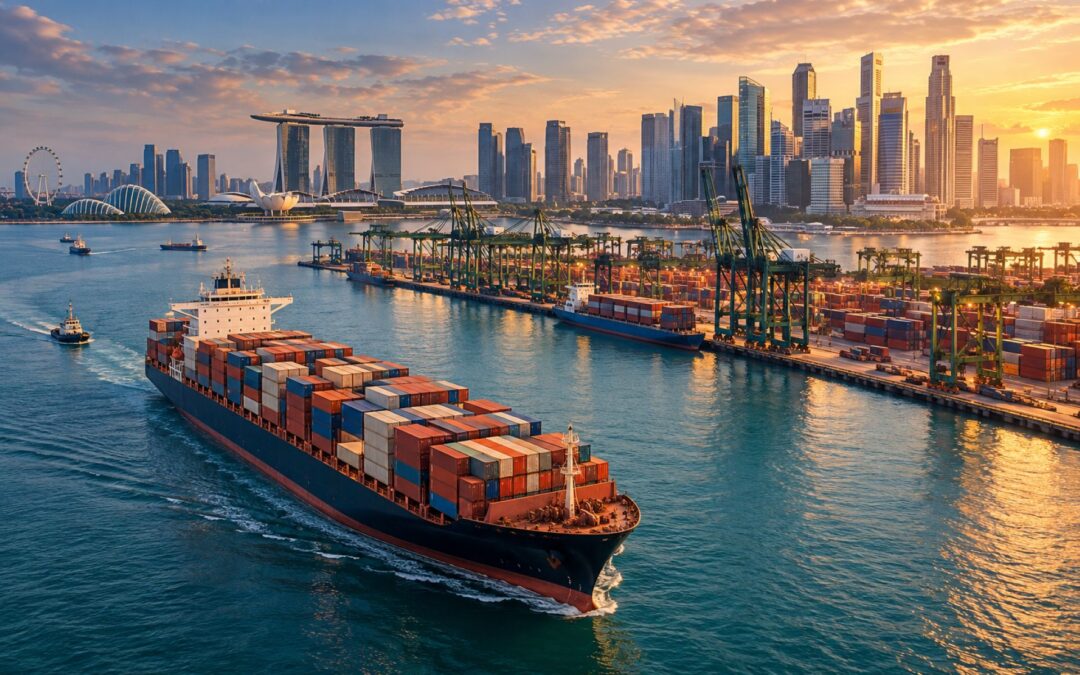
On 9 August 1965, Singapore became an independent country under circumstances few of its leaders had wanted. After less than two years as part of Malaysia, political conflict had made the union untenable. The newly independent island faced high unemployment, an uncertain economic future, limited military capabilities, and a population divided by ethnic and political tensions. Its leaders were responsible for building a viable country without the large domestic market or natural resources that many developing economies relied upon.
Six decades later, Singapore is one of the wealthiest countries in the world. Its economy encompasses advanced manufacturing, international finance, sophisticated infrastructure, and one of the world’s most important commercial ports. A country once worried about its ability to survive has become a place where multinational corporations establish major regional operations.
The transformation is often credited to Lee Kuan Yew’s leadership, strict governance, and willingness to make unpopular decisions. Those factors mattered, but they do not fully explain how Singapore became rich. Its success emerged from a combination of economic openness, government planning, institutional competence, foreign investment, workforce development, and social policies that reinforced one another over decades. Understanding that combination also reveals why Singapore’s achievements are extraordinary without necessarily providing a blueprint that every country can follow.
1965: A Country Forced to Survive
Singapore’s independence was the consequence of a failed political union rather than the culmination of a straightforward independence movement. The island had joined Malaysia on 16 September 1963, alongside Malaya, Sabah, and Sarawak. Singapore’s leaders believed that merger would provide access to a much larger domestic market while resolving some of the political and security uncertainties surrounding the territory’s future.
The economic argument was particularly important. Singapore had long prospered as a trading port, but its industrial sector was relatively underdeveloped, and unemployment remained a serious problem. A common market with Malaysia offered local manufacturers access to millions of potential customers, making industrial expansion more commercially attractive.
The arrangement soon encountered fundamental disagreements. Singapore’s People’s Action Party and Malaysia’s federal leadership clashed over political representation, economic arrangements, and competing ideas about the relationship between ethnicity and national identity. Communal tensions contributed to deadly riots in 1964, while disagreements over taxation and the proposed common market frustrated Singapore’s economic plans.
The political situation eventually became irreconcilable. As the National Library Board’s account of the Federation of Malaysia and Singapore’s separation documents, negotiations culminated in an agreement to separate, and Singapore became independent on 9 August 1965.
For Prime Minister Lee Kuan Yew, independence created an immediate problem of national survival. Singapore had no substantial agricultural hinterland, few natural resources, and limited capacity to defend itself. Its water supply depended heavily on arrangements with Malaysia, while Indonesia’s confrontation with the Malaysian federation had already demonstrated the region’s security risks.
The economic outlook was equally troubling. Industrial development was not creating employment quickly enough to absorb the growing workforce, and officials feared unemployment could rise beyond 14 percent by the end of 1966. Labour disputes, political unrest, and uncertainty about Singapore’s future made it difficult to persuade companies to invest.
Yet Singapore was not starting from nothing. Its location near the Strait of Malacca placed it along a major international shipping route, and British colonial rule had left behind port facilities, commercial institutions, administrative experience, and legal traditions. These were genuine advantages, even if they did not guarantee prosperity.
The challenge was to transform those inherited assets into the foundations of a much broader economy. Singapore could no longer assume that neighbouring territories would provide its principal market, and its own population was too small to sustain large-scale industrial development through domestic demand alone.
Lee’s government therefore had to reconsider the country’s economic future. Goh Keng Swee, who became one of Singapore’s most influential economic policymakers, was central to that process. The immediate question was not how Singapore could become a global financial centre, but how it could create enough productive employment to survive.
A World Market Instead of a Hinterland
Singapore’s original industrialisation strategy had been designed partly around the expectation of a Malaysian common market. When that market failed to materialise, the government faced a difficult choice. It could continue encouraging domestic industries to manufacture products for a small local population, or it could build industries capable of selling goods to customers across the world.
The government chose international markets.
This was a significant departure from the import-substitution strategies favoured by many developing countries during the postcolonial period. Such strategies commonly involved protecting domestic manufacturers from foreign competition while encouraging them to replace imported products with locally manufactured alternatives.
Import substitution could support industrial development where large domestic markets existed. Singapore’s problem was that its population could not generate sufficient demand to sustain the scale of manufacturing needed to create jobs. Protection alone could not solve the underlying shortage of customers.
Instead, Singapore pursued export-oriented industrialisation, encouraging companies to manufacture goods locally for sale abroad. The government’s development strategy after independence increasingly centred on attracting international companies that already possessed the capital, technology, managerial knowledge, and customer networks necessary to compete in global markets.
Foreign investment offered something more valuable than financing alone. A multinational corporation could bring established products, production methods, quality standards, and relationships with buyers. Singaporean workers could participate in international production without first having to create globally competitive companies from scratch.
This approach also reduced dependence on immediate regional cooperation. Singapore did not need every neighbouring government to support its industrial ambitions if companies operating on the island could ship their products directly to the United States, Europe, Japan, and other markets.
One important influence was Albert Winsemius, a Dutch economist who arrived in Singapore in 1960 as part of a United Nations industrial survey mission. Having worked on industrial development in the Netherlands after the Second World War, Winsemius understood the practical requirements of attracting investment and rebuilding economic activity.
His recommendations combined industrial development with political and commercial credibility. According to the National Library Board’s biography of Albert Winsemius and his economic advice, he even recommended retaining the statue of Stamford Raffles, the British colonial figure associated with Singapore’s establishment as a trading settlement.
The recommendation carried a message beyond the statue itself. Foreign investors wanted reassurance that Singapore’s government would respect commercial arrangements and maintain a predictable business environment. Preserving a visible symbol of its colonial past could signal continuity rather than hostility toward international commerce.
Winsemius subsequently worked with Lee Kuan Yew, Goh Keng Swee, Hon Sui Sen, and other officials. His role was important, but he was an adviser within a broader policymaking system rather than the sole architect of Singapore’s development.
The government complemented its international strategy with efforts to make Singapore an attractive place for businesses to operate. English became a common language for administration and international commerce, while the inherited legal framework provided a foundation for enforcing contracts and resolving commercial disputes.
Anti-corruption policy was another essential component. Singapore’s Corrupt Practices Investigation Bureau had existed since 1952, but the Prevention of Corruption Act enacted in 1960 strengthened its legal powers and established a framework for pursuing corruption in both the public and private sectors.
For businesses, these institutional arrangements had practical value. Companies deciding where to establish factories considered not only wages and taxes but also whether permissions would be granted predictably, infrastructure would function, and commercial agreements would be respected.
Singapore’s model was therefore not simply an embrace of unrestricted capitalism. The government used public institutions to construct the conditions under which international private investment could operate profitably. Its role was active, coordinated, and frequently interventionist, even as the economy remained deeply open to global business.
Jurong, Multinationals, and the Discipline of Execution
An economic strategy becomes meaningful only when it produces factories, jobs, skills, and goods that customers are willing to buy. Singapore’s leadership understood that attracting foreign companies required more than favourable speeches and investment incentives. Manufacturers needed land, electricity, roads, telecommunications, dependable administration, and workers capable of operating industrial equipment.
Jurong Industrial Estate became one of the most visible expressions of that approach.
The project had begun before independence, when Goh Keng Swee proposed transforming a largely rural and industrially undeveloped area in western Singapore into a manufacturing centre. Developing Jurong required extensive infrastructure construction, land preparation, and public expenditure before there was any guarantee that companies would occupy the facilities.
The decision involved substantial risk. Singapore had limited experience developing an industrial area on such a scale, and early interest from manufacturers was uncertain. Critics questioned whether the government was wasting money on factories that might remain empty.
Goh nevertheless considered the investment necessary. As the official history of Jurong’s transformation into an industrial town explains, the project was ready for industrial development by 1963, and National Iron and Steel Mills became its first factory tenant in 1964.
Jurong’s early development demonstrated why infrastructure had to precede demand. A manufacturer considering Singapore could not be expected to build an entire supporting environment independently. By preparing industrial land and essential services, the government reduced the cost, uncertainty, and time required for businesses to establish operations.
The Economic Development Board, established in 1961, was central to this process. Initially, the EDB combined investment promotion, industrial development, and financing responsibilities. Its officials actively sought investors, promoted Singapore’s advantages, and coordinated with government departments to overcome practical obstacles.
This was a different approach from waiting for companies to discover Singapore through ordinary market competition. Officials travelled abroad, identified potential investors, and attempted to persuade them that Singapore offered an efficient manufacturing location despite its uncertain political and economic future.
Early factories produced relatively simple goods, including garments, toys, and other labour-intensive products. These industries were not technologically sophisticated, but they provided employment for workers who lacked advanced qualifications. At a time when unemployment threatened social stability, the immediate value of industrialisation lay partly in creating jobs as quickly as possible.
By the late 1960s, however, Singapore was beginning to attract industries with greater technological potential.
American electronics manufacturers played an important role in this transition. National Semiconductor established operations in 1968, followed by other major companies, including Fairchild, Texas Instruments, Hewlett-Packard, and General Electric.
The arrival of these firms was significant because Singapore was entering international production networks that could grow beyond its domestic market. Electronics manufacturers brought machines, manufacturing procedures, technical expertise, and overseas customers. Their presence created opportunities for Singaporean workers to acquire industrial skills that could support more sophisticated activities later.
The EDB’s approach to National Semiconductor illustrates how administrative responsiveness became a competitive advantage. When company representatives indicated that production needed to begin quickly, Singaporean officials coordinated the necessary arrangements. Production was reportedly established within weeks, demonstrating that the country’s institutions could respond to commercial deadlines.
Texas Instruments also made an important investment decision in 1968, with manufacturing operations established the following year. The precise sequence of early semiconductor investments varies across historical accounts, but the larger development is clear: within a short period, Singapore attracted several internationally significant electronics companies.
Lee Kuan Yew later recounted a story involving Hewlett-Packard that captured the importance placed on practical problem-solving. According to his recollection, the company needed to move heavy equipment into a building but encountered a problem because the lift lacked a suitable power arrangement. Government officials worked to resolve the obstacle rather than allowing it to delay the investment indefinitely.
Whether every detail of such recollections can be independently established is less important than the administrative philosophy they illustrate. Singapore was attempting to compete not merely on low wages but on the reliability and speed with which businesses could begin operating.
The government reinforced this advantage through investment incentives. The Economic Expansion Incentives Act of 1967 introduced tax concessions designed to encourage industrial investment. At the same time, public agencies developed the infrastructure required to support expanding manufacturing activity.
In 1968, Singapore reorganised its economic institutions. The Jurong Town Corporation assumed responsibility for industrial infrastructure, while the Development Bank of Singapore took over important development-financing functions. The EDB could then concentrate more heavily on investment promotion and attracting international companies.
This institutional specialisation mattered because industrialisation involved several distinct tasks. Attracting an investor was different from providing factory land, financing business expansion, or training workers. Assigning these responsibilities to dedicated agencies allowed the government to coordinate a complex development process more effectively.
By late 1967, Jurong had already attracted substantial fixed investment and provided employment for thousands of workers. Over the following decades, the industrial estate became an increasingly important manufacturing centre rather than the abandoned experiment its early critics had feared.
The factories also generated effects beyond their immediate payrolls. Workers acquired technical experience, suppliers gained commercial opportunities, and public officials learned how to support increasingly demanding industries. Each successful investment helped reduce uncertainty for the next company considering Singapore.
This process was fundamental to the country’s economic rise. Foreign investment did not automatically create a prosperous society, but it provided a route through which Singapore could build productive capabilities much faster than relying exclusively on the gradual emergence of domestic manufacturers.
The achievement was not that the government correctly predicted every industry that would succeed. It was that Singapore developed institutions capable of attracting investment, responding to difficulties, and adapting as new opportunities emerged.
When Britain Left, Singapore Made the Bases Pay
Just as Singapore began making progress with industrialisation, another crisis threatened its economic foundations. Britain had maintained substantial military facilities on the island, and the presence of British forces supported thousands of civilian jobs and considerable commercial activity.
In 1967, the British government announced plans to withdraw its military forces from bases east of the Suez Canal. The following year, Britain accelerated the timetable, making clear that its withdrawal from Singapore would be completed by 1971.
The decision carried serious consequences. British military activities accounted for an estimated fifth of Singapore’s economy and supported more than 30,000 jobs. The withdrawal also threatened Singapore’s security at a time when its own armed forces were still developing.
The government could not prevent Britain from leaving, so it concentrated on reducing the resulting economic damage. As documented in the account of the British military withdrawal and conversion of military bases, Singapore established the Bases Economic Conversion Department under Hon Sui Sen to oversee the transition of military facilities into civilian uses.
The physical assets were substantial. Former military properties occupied large areas of land and contained docks, workshops, buildings, and other infrastructure that could support commercial activity if properly adapted.
The naval facilities at Sembawang became a commercial shipyard, providing a foundation for ship-repair and related maritime industries. Other former military properties were repurposed for economic development, recreation, and tourism, while facilities and land associated with Changi would eventually contribute to the area’s development as a major aviation centre.
The government also organised retraining programmes to help workers move into new industries. These programmes were important because employment in a military establishment did not automatically translate into the skills demanded by commercial manufacturers or shipyards.
Not every worker’s transition was immediate or effortless, and claims that every affected employee had secured a replacement job by a particular date require stronger evidence than the broad historical record provides. Nevertheless, the government succeeded in converting significant military assets into productive civilian infrastructure while continuing its wider industrial expansion.
Britain’s withdrawal also accelerated Singapore’s efforts to develop an independent defence capability. Israel provided military advice and assistance during the early years, helping Singapore establish institutions necessary for its security.
The connection between defence and economic development was direct. A country seeking long-term foreign investment needed investors to believe that its political independence and physical security would endure.
The British withdrawal therefore became a test of Singapore’s ability to adapt. Facilities that had once supported a colonial military presence were redirected toward commercial industries, while the prospect of losing employment and spending strengthened the urgency of attracting alternative economic activity.
The Price of Industrial Peace
Foreign companies could be attracted by tax incentives and modern industrial facilities, but those advantages meant less if production was regularly interrupted by strikes or political unrest. Labour relations consequently became one of the most consequential and controversial parts of Singapore’s development strategy.
The issue was especially complicated for Lee Kuan Yew because trade unions had played an important role in his political career. Before becoming prime minister, Lee had represented workers and unions in disputes against employers and colonial authorities. Organised labour was also closely connected to the political movements that helped bring the People’s Action Party to power.
During the early 1960s, however, industrial conflict was widespread. Singapore experienced 153 strikes between July 1961 and September 1962, reflecting tensions involving wages, working conditions, political rivalry, and competing trade-union organisations.
The government increasingly viewed some militant labour activity as a threat to economic development. Communist-influenced organisations also formed part of the political struggle surrounding the PAP, although it would be misleading to treat every labour grievance or strike as an attempt at political destabilisation.
Lee’s government responded by tightening the legal framework governing industrial relations. The historical record of Lee’s involvement with trade unions and labour reforms documents the transition from his earlier role as a union lawyer to the introduction of legislation restricting industrial action in 1968.
The Employment Act and amendments to industrial-relations legislation strengthened the government’s ability to regulate employment practices and labour disputes. Employers gained greater predictability, while unions faced tighter constraints on their ability to use strikes as a bargaining instrument.
A confrontation involving cleansing workers in 1967 illustrates the coercive side of this approach. In Lee’s retrospective account, he warned union leaders that a strike involving workers dependent on employment permits could have severe consequences for those workers’ jobs and ability to remain in Singapore.
The episode reflected a willingness to use state power aggressively when the government believed industrial action threatened essential services or national economic stability. It also raises difficult questions about the fairness of such methods, particularly when vulnerable workers possessed limited bargaining power.
The decline in industrial unrest was dramatic. By 1969, Singapore recorded no strikes or work stoppages, a striking contrast with the disruption of the early 1960s.
From the government’s perspective, this stability improved Singapore’s attractiveness to investors. Companies could make production commitments with greater confidence that factories would remain operational and contractual obligations could be fulfilled.
Yet industrial peace was not achieved entirely through legislation and confrontation. Singapore also developed a more cooperative framework involving the government, employers, and organised labour.
The National Trades Union Congress, established in 1961, increasingly became a partner in economic development rather than an institution primarily defined by confrontation with employers. This approach developed into tripartism, under which the three parties sought negotiated arrangements around employment, wages, and national economic objectives.
The National Wages Council, established in 1972, provided an important institutional expression of that model. It brought representatives of government, employers, and unions together to develop wage recommendations while considering employment conditions and the broader economy.
Tripartism helped align wage policy with Singapore’s industrial strategy. As the economy developed, wage recommendations and cooperation could support shifts toward more productive industries rather than allowing wage disputes to become persistent sources of instability.
The benefits were significant, but so were the compromises. Workers gained access to expanding employment opportunities and a framework for organised negotiation, while unions surrendered much of the confrontational independence that labour movements elsewhere considered essential.
It is therefore too simple to describe Singapore’s labour reforms either as an unquestionable victory for economic efficiency or as policies with no legitimate economic purpose. They helped establish industrial predictability, but they did so within a political system that placed substantial limits on worker militancy and independent collective action.
The economic consequences of stability can be examined alongside the distribution of power required to maintain it. Singapore’s experience demonstrates that labour institutions were central to its development, not that unrestricted government authority over workers is a universal requirement for economic growth.
Housing, Savings, and a Stake in the Nation
Singapore’s leaders did not believe that industrial development alone would produce a stable country. Employment mattered, but so did the conditions in which people lived, their ability to accumulate savings, and their confidence that economic progress would improve their families’ futures.
Housing was one of the most pressing problems. In the years surrounding independence, many Singaporeans lived in overcrowded buildings, informal settlements, or accommodation with inadequate facilities. Rapid population growth and limited affordable housing placed considerable pressure on the city.
The Housing and Development Board, established in 1960, undertook large-scale public housing construction. Its early priority was to provide decent accommodation quickly, replacing overcrowded and unsafe living conditions with planned residential estates equipped with essential services.
The scale of construction transformed Singapore’s urban environment. New housing estates incorporated roads, schools, public transport connections, markets, and community facilities. They were not merely collections of apartments but planned residential areas intended to support an expanding urban population.
Lee Kuan Yew also believed that widespread homeownership could strengthen social and political stability. Families who owned their homes would have a tangible stake in the country’s future, while housing security could make citizens more confident in the benefits of long-term development.
Financing this ambition required an institution that Singapore already possessed: the Central Provident Fund.
The CPF had been established in July 1955, before independence, as a compulsory retirement savings scheme. Workers contributed part of their wages to individual accounts, with employers also making contributions. The arrangement created a system of accumulated savings rather than relying entirely on retirement benefits paid from current government revenue.
Singapore subsequently expanded the purposes for which these savings could be used. As the Ministry of Manpower’s account of the evolution of CPF into housing and healthcare financing explains, CPF members were allowed to use their savings to purchase HDB flats from 1968. The system later permitted private-property purchases, while MediSave was introduced in 1984 to help finance healthcare expenses.
The connection between CPF and HDB was especially powerful. The government constructed housing on a large scale, while compulsory savings gave many working households a mechanism for financing their purchases. Instead of treating public housing exclusively as rental accommodation, Singapore developed a system in which widespread ownership became a central policy objective.
This did not mean the government withdrew from providing housing. The state remained deeply involved in land policy, development, construction, eligibility arrangements, and the financing framework. The resulting model combined public-sector provision with household ownership and compulsory savings.
The transformation is visible in Singapore’s modern housing statistics. According to the Department of Statistics’ resident household and homeownership data, 91.2 percent of resident households lived in owner-occupied accommodation in 2025, while 77.2 percent lived in HDB dwellings.
These figures measure different things. Not every owner-occupied home is an HDB flat, and not every household living in an HDB flat owns its accommodation. Nevertheless, the figures demonstrate the extraordinary scale of Singapore’s public-housing and homeownership systems.
The economic implications extended beyond providing shelter. Residential development improved sanitation and living conditions, while planned neighbourhoods helped accommodate an urban workforce. Homeownership also created household assets, although the value and practical security of those assets depend on financing arrangements, housing prices, and lease terms.
Singapore’s system is often described as an alternative to the welfare states that developed elsewhere. Lee was concerned about creating arrangements in which present benefits would impose unsustainable obligations on future taxpayers, and compulsory savings reflected his preference for individual financial responsibility.
However, Singapore did not eliminate public spending on social needs. The government financed substantial housing infrastructure, schools, hospitals, and other services while maintaining extensive regulatory control over the systems through which individuals saved and received support.
The model also created trade-offs. CPF contributions reduced the income workers could immediately spend, and using retirement savings to purchase housing could leave substantial personal wealth tied to residential property. Housing ownership therefore supported financial security in some respects while creating exposure to property values, lease duration, and retirement-financing needs.
Alongside housing and savings, education became another essential part of Singapore’s development model. Early labour-intensive factories could employ workers with relatively basic qualifications, but more sophisticated industries required technicians, engineers, managers, and workers capable of operating increasingly advanced equipment.
The government expanded schools, vocational programmes, technical training, and higher education to meet these needs. English also became an important common working language in a multilingual society, helping Singaporean employees communicate with international companies while the education system maintained the teaching of other languages.
These policies reinforced the industrial strategy. Foreign companies created demand for increasingly skilled labour, while the education and training system helped expand the supply of workers capable of meeting that demand.
Singapore’s social institutions were consequently not separate from its economic ambitions. Public housing, compulsory savings, education, and workforce development helped create the conditions under which industrial growth could become a sustained national transformation rather than a temporary expansion in factory employment.
From Factories to a Global Hub
Singapore’s initial manufacturing strategy helped address unemployment, but industries based primarily on inexpensive labour could not indefinitely sustain rising living standards. As the economy developed, wages increased and other countries offered lower-cost manufacturing locations. Singapore therefore needed to move toward activities capable of generating greater economic value.
Electronics provided one route for that transition. Early assembly operations connected Singapore to multinational supply chains, while subsequent investments supported more complex manufacturing, technical services, and higher-value industrial activities.
The government increasingly emphasised technical education, productivity, and industrial upgrading. Rather than attempting to preserve every labour-intensive industry, it encouraged investment in activities requiring more capital, technology, and specialised skills.
This was a demanding transition because manufacturing sophistication could not be created merely through government announcements. Companies needed trained workers, supporting infrastructure, reliable suppliers, and confidence that Singapore could sustain technically complex operations.
Over time, investments in these capabilities allowed Singapore to become an important manufacturing centre for electronics, semiconductors, chemicals, pharmaceuticals, and precision engineering. Its development illustrates how an economy can use relatively simple manufacturing as an entry point into more advanced industrial production.
Singapore’s maritime position also became increasingly valuable as the government modernised its infrastructure.
The island’s location near major shipping routes was an inherited geographic advantage, but geography alone could not guarantee that international trade would continue flowing through Singapore. Competing ports could attract shipping through better facilities, lower costs, or more efficient logistics.
Singapore invested in port operations, cargo handling, industrial terminals, and related infrastructure to maintain its position. Jurong Port supported the movement of industrial materials, while broader port development strengthened Singapore’s role as a major international trading and transshipment centre.
Oil refining was another example of turning commercial location into industrial activity. Singapore possessed no significant domestic crude-oil reserves, yet international energy companies established refineries that could receive imported oil, process it, and distribute petroleum products to regional and global markets.
Shell’s refinery on Pulau Bukom began operating in 1961, demonstrating that this industry was already developing before independence. Later expansion helped make petroleum refining and petrochemicals important parts of Singapore’s industrial economy.
The underlying advantage was not ownership of the raw material. It was the ability to connect supply, processing capacity, shipping infrastructure, and international demand within a reliable commercial environment.
Aviation developed through a similar combination of location and investment. As international air travel expanded, Singapore needed facilities capable of serving growing passenger and cargo movements.
The government decided to develop Changi Airport, which opened in 1981. The project involved extensive construction and planning, building on Singapore’s determination to maintain high standards of international connectivity.
Changi eventually became an important aviation hub, supporting tourism, trade, logistics, and the movement of business travellers. Its significance extended beyond the airport itself because efficient international connections made Singapore more attractive to companies managing operations throughout Southeast Asia.
Financial services developed alongside these commercial networks. Singapore established the Monetary Authority of Singapore in 1971 and expanded its role in international banking and financial activity.
Financial institutions were attracted by political stability, commercial demand, international connections, and the predictability of Singapore’s regulatory environment. As multinational corporations established operations in the city-state, they also generated demand for banking, foreign exchange, financing, insurance, and professional services.
Singapore’s financial institutions and public reserves eventually became another part of its economic credibility. The government’s ability to maintain fiscal and monetary stability complemented the commercial confidence created by its broader institutions.
This diversification mattered because it reduced Singapore’s dependence on any single form of economic activity. Manufacturing remained important, but the country developed a combination of industrial production, logistics, finance, aviation, and business services.
The transformation was cumulative. Its port helped attract trade, industry generated demand for infrastructure, skilled workers attracted sophisticated companies, and international connectivity strengthened the financial and commercial sectors.
By developing these interconnected capabilities, Singapore moved beyond the original objective of creating enough factories to reduce unemployment. It had become an economy whose value increasingly depended on the concentration of specialised skills, efficient infrastructure, and international business networks.
What Singapore’s Economic Miracle Explains—and What It Cannot
Singapore’s economic transformation is remarkable by almost any conventional measure. In 1960, its nominal GDP per capita was approximately US428.By1999,thefigurehadreachedroughlyUS21,800, reflecting decades of industrialisation, investment, and structural economic change.
The expansion continued well beyond the founding generation. According to the World Bank’s GDP-per-capita data for Singapore, nominal GDP per capita reached approximately US$98,814 in 2025, placing Singapore among the world’s highest-income economies.
These figures require interpretation. Nominal GDP per capita divides a country’s total economic output by its population and expresses the result in current US dollars. It does not indicate that every resident earns that amount, nor does it directly measure household wealth or the affordability of everyday life.
Exchange-rate movements and inflation also affect comparisons across different years. Nevertheless, the magnitude of Singapore’s development remains extraordinary, even when measured through broader changes in employment, infrastructure, living conditions, industrial sophistication, and economic capacity.
The more difficult question is how much of this achievement can be attributed to a particular development philosophy.
Lee Kuan Yew frequently emphasised pragmatism. His government was willing to modify policies when circumstances changed rather than remain committed to a particular economic doctrine regardless of the consequences.
Singapore’s approach to foreign investment illustrates that flexibility. The government embraced multinational companies when other developing countries were suspicious of foreign economic influence, but it also intervened extensively to prepare industrial land, develop public institutions, and shape the domestic workforce.
This combination complicates attempts to present Singapore as a triumph of either free-market capitalism or comprehensive state planning. International companies made important investment decisions, while public institutions created much of the environment that enabled those investments to succeed.
The government did not control every commercial outcome, but it actively tried to reduce the obstacles that could prevent productive investment. Its success depended partly on the ability to distinguish between areas where government coordination was useful and activities where private companies possessed stronger commercial capabilities.
Confidence was another important factor. Investors needed to believe that Singapore would remain politically secure, maintain reliable infrastructure, and respect commercial obligations. Citizens also needed confidence that the sacrifices involved in industrialisation, compulsory savings, and institutional reform would eventually improve their lives.
Yet confidence was not created through optimism alone. It developed as institutions demonstrated their ability to deliver functioning industrial facilities, credible economic policies, secure housing, and employment opportunities. Successful implementation made future promises more believable.
Long-term planning also played a significant role. Singapore’s government maintained considerable political continuity, allowing major infrastructure projects and institutional reforms to develop over periods longer than a typical electoral cycle.
However, continuity should not be confused with the absence of political accountability, nor does it prove that restrictions on political competition were necessary for growth. Governments can remain in power for long periods without developing effective institutions, just as competitive democracies can pursue successful long-term economic policies.
Singapore’s particular political arrangements gave its leaders considerable room to act, but the economic value of those arrangements depended on the quality of the decisions being made and the capacity to implement them.
The country’s development also reflected contributions from many people and institutions. Lee provided political leadership, but Goh Keng Swee helped shape economic and defence policy, Hon Sui Sen played important roles in industrial development and economic administration, and Albert Winsemius contributed international expertise.
Public servants translated strategies into programmes, while workers acquired skills and participated in the industries that emerged. Foreign firms supplied capital, technology, and market access. Reducing this collective process to the vision of a single exceptional leader understates how economic transformation actually occurs.
There are also important disagreements about the sources of Singapore’s growth.
In his influential study A Tale of Two Cities: Factor Accumulation and Technical Change in Hong Kong and Singapore, economist Alwyn Young examined the relative contributions of capital accumulation, labour, and productivity to the growth of the two economies.
Young found that much of Singapore’s rapid growth during the 1970s and 1980s could be explained by unusually extensive investment in physical and human capital rather than exceptionally rapid growth in total factor productivity. That measure attempts to capture improvements in output beyond what can be explained simply by using more labour and capital.
The distinction matters because an economy can grow rapidly by building factories, employing more workers, and investing heavily in equipment without necessarily achieving equally exceptional improvements in production efficiency.
Young’s findings do not mean Singapore’s economic transformation was illusory. Mobilising investment, educating workers, and shifting employment toward more productive sectors are themselves major achievements. His analysis instead challenges the assumption that the country’s early growth was evidence of an almost uniquely efficient economic system.
The study also focused on particular historical decades. It should not be treated as a complete explanation of Singapore’s subsequent development into advanced manufacturing and financial services.
The political and social costs of the development model are equally important.
Singapore’s government restricted industrial militancy and maintained extensive control over political activity, public expression, and civic organisation. Although elections continued, the People’s Action Party dominated the political system, and opposition groups faced significant institutional obstacles.
In its Freedom in the World 2026 assessment of Singapore, Freedom House classifies the country as Partly Free, highlighting restrictions on political competition and freedoms of expression, assembly, and association.
Singapore’s supporters argue that political stability, effective administration, and strong public institutions helped deliver material improvements in living standards. Critics question whether those achievements justified restrictions on political participation and personal freedom.
Both concerns deserve consideration, but they address different questions. Singapore’s economic success is observable; whether every political restriction contributed to that success is a separate proposition requiring evidence.
The country’s social outcomes also resist simple categorisation. High homeownership and extensive public infrastructure coexist with concerns about housing affordability, retirement financing, inequality, and the pressures associated with a highly competitive economy.
The Singapore Ministry of Finance’s 2026 analysis of income growth, inequality, and social mobility reports that real household incomes increased across the income distribution over the preceding decade, while lower-income households experienced comparatively stronger income growth.
It also reports a decline in measured income inequality after taxes and government transfers. The Gini coefficient based on household employment income after these adjustments fell from 0.409 in 2015 to 0.359 in 2025. At the same time, the government acknowledged continuing inequality pressures and signs that social mobility was becoming more difficult as the economy matured.
These findings show why Singapore should not be described as either an economy without significant social support or one in which prosperity has eliminated economic inequality. Its government continues to intervene in income distribution and social policy, even while emphasising savings, employment, and individual responsibility.
Finally, Singapore’s circumstances were unusually specific.
Its small territory allowed infrastructure and administrative systems to be coordinated across a concentrated urban economy. Its maritime position connected it to established commercial networks, while its inherited legal and administrative institutions gave policymakers a foundation on which to build.
The country also benefited from expanding international trade, the globalisation of manufacturing, and multinational companies searching for reliable production locations in Asia. Its strategic location and historical timing created opportunities that were not equally available to every developing country.
A large country with extensive rural regions, different political institutions, or a less advantageous commercial position cannot simply reproduce Singapore’s experience by copying its policies.
Nevertheless, the broader economic principles remain important. Singapore demonstrated the value of competent public institutions, predictable administration, international market access, sustained investment in infrastructure, and an education system capable of responding to changing industrial needs.
It also illustrated how economic development can become self-reinforcing. Early improvements in employment and infrastructure attracted investment, which created opportunities for more sophisticated production, which in turn justified further investment in skills and institutions.
The strongest lesson is therefore not that prosperity requires an authoritarian government, the rejection of welfare, or unquestioning obedience to visionary leaders. It is that economic opportunities become far more valuable when institutions can identify them, coordinate the necessary investments, and adapt as circumstances change.
In August 1965, Singapore’s leaders faced the immediate challenge of keeping a vulnerable new country economically and politically viable. They could not change its size, create natural resources, or control the decisions of neighbouring governments. They could, however, influence the quality of its institutions, the capabilities of its workforce, and the conditions under which international businesses operated.
Over the following decades, those choices helped transform Singapore from a trading port struggling with unemployment into a sophisticated global economy. Its success was neither inevitable nor the product of leadership alone, and its political compromises remain open to debate. What makes Singapore’s transformation exceptional is how deliberately it combined inherited advantages with newly developed capabilities, turning a precarious position into a remarkably durable source of prosperity.
Last Updated on October 18, 2026 by Aseem Gupta