

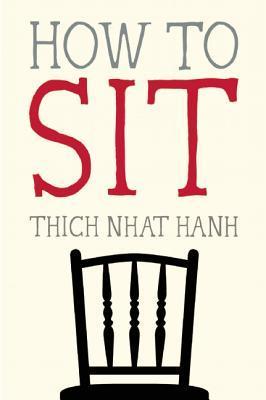
How to Sit looks almost too small to contain a philosophy of meditation. Published by Parallax Press as the first volume in Thich Nhat Hanh’s Mindfulness Essentials series, the book consists of 64 brief “Notes on Sitting” followed by five guided meditations. Many entries occupy little more than a page, and some communicate their point through a single image, anecdote, or instruction rather than through sustained argument.
That simplicity can be misleading. Thich Nhat Hanh is not merely explaining where to put the body or how to watch the breath. Sitting becomes the starting point for a wider account of what it means to stop compulsive activity, reunite body and mind, inhabit the present moment, observe difficult emotions without being consumed by them, see the habits that shape behavior, cultivate insight and compassion, and eventually question the idea of an isolated self. Plum Village describes the book as useful both for beginners and for experienced meditators returning to fundamentals, and that captures its unusual balance: the instructions are elementary, but the worldview behind them is not.
The book’s central movement is from presence to understanding. Breathing first stabilizes attention; attention makes calm possible; calm makes clearer seeing possible; clearer seeing can expose habit, suffering, and attachment; and that insight is supposed to make compassionate action more available. How to Sit therefore works best when read not as a collection of inspirational sayings but as a compact sequence in which very simple practices gradually open into an entire Buddhist approach to selfhood, suffering, freedom, and community.
From Breathing to Arriving Home
The opening instruction is deliberately basic: stop, sit, notice that breathing is happening, and distinguish the in-breath from the out-breath. Thich Nhat Hanh begins with what is already available rather than asking the reader to produce an altered state. Breath is not introduced as something to manipulate aggressively. It is the meeting point through which body and mind, often dispersed in different directions, can begin to settle together.
The first note, “Body, Mind, and Breath,” makes this integration explicit. Ordinary life often leaves the body in one place while the mind is elsewhere, occupied by plans, regret, anxiety, memory, or anticipation. Awareness of breathing brings attention back into immediate bodily experience. The point is less to command the breath than to accompany it, allowing mind, body, and respiration to become less fragmented.
“Peace Is Contagious” extends the effect beyond the individual. As the practitioner recognizes breathing, respiration may naturally become calmer, and bodily and mental agitation may soften with it. Thich Nhat Hanh then introduces one of the book’s recurring ideas: the quality cultivated in one person affects other people. Calm is therefore not treated as a private luxury but as something that changes the atmosphere of relationships.
“A Boat on the Ocean” makes that social claim concrete. A boat caught in dangerous conditions can become even less stable when everyone aboard panics, while one calm person may help the group respond more intelligently. Thich Nhat Hanh uses this image to introduce what he calls non-action: not inactivity in the sense of indifference, but the capacity to refrain from acting out of panic long enough for wiser action to become possible. The value of meditation already begins moving beyond personal relaxation.
“Doing Nothing” deepens the challenge to ordinary ideas about usefulness. Thich Nhat Hanh asks the reader to imagine trees simply existing in a forest without attempting to justify themselves through productivity. Sitting can have a similar quality. Instead of converting every minute into a project, the practitioner learns to notice bodily sensations, sounds, air, light, and simple aliveness without needing the moment to produce an achievement.
That prepares the book’s broader definition of meditation. In “Meditation,” sitting is not enough if the mind remains trapped in agitation, and formal posture is not necessary for every meditative moment. Meditation means stopping and looking deeply. Walking, cooking, brushing one’s teeth, or performing other ordinary activities can therefore become practice when they are done with genuine awareness.
“Don’t Just Do Something, Sit There” turns a familiar command upside down. The reversal is playful, but the argument is serious: activity carried out under the pressure of anger, anxiety, fear, or confusion tends to transmit those qualities into whatever follows. Sitting interrupts the automatic sequence between inner disturbance and outer action. In this framework, being peacefully present is not the opposite of contribution; it can be a condition for contributing without spreading one’s agitation.
A personal memory gives the idea a human form. In “The Monk on the Platform,” Thich Nhat Hanh recalls being a novice in Vietnam and seeing a Zen master simply sitting. What impresses him is not spectacle or mystical drama but the naturalness of the man’s presence. The encounter changes an idealized image of awakening into something embodied and potentially attainable: peaceful presence can exist in an ordinary human body.
“Doing Less” then applies the same principle even to spiritual life. Religious or charitable busyness is not automatically transformative if it is driven by ambition, judgment, grasping, or the need to accomplish more. The amount of activity matters less than the quality of mind brought to it. Meditation therefore challenges not only worldly productivity but also the possibility of becoming achievement-oriented about spirituality itself.
“Enjoy Your Breathing” supplies one of the book’s most basic practical instructions. The reader is asked to become aware of inhalation and exhalation and to stay close to the experience instead of using the breath merely as a tool for reaching another state. Breathing can itself be pleasant. It becomes an act of care rather than a hurdle on the way to enlightenment.
“The Joy of Meditation” sharpens this non-instrumental attitude. Thich Nhat Hanh compares meditation to simple pleasures that are valuable while they are occurring: eating something one enjoys or taking in a beautiful view. If sitting is practiced only to obtain enlightenment later, the present is reduced to a means. The book repeatedly resists that future-oriented mentality, insisting that meditation has already failed in one sense if the practitioner spends the entire session trying to escape the session.
“A Celebration” links breath to gratitude. Conscious breathing reveals that one is alive, and that recognition can transform an ordinary biological process into something worth appreciating. The tone remains practical rather than ceremonious, but a spiritual orientation becomes clearer: mindfulness is not only neutral observation. It can make basic existence vivid enough to be experienced as a gift.
“Following Our Breath” becomes more technically precise by explaining that mindfulness is always mindfulness of something. Breath is the chosen object, and the practitioner follows an inhalation through its full course and then does the same with exhalation. Attention is therefore not vague awareness. It has direction and continuity.
“Looking Deeply” adds the other half of Thich Nhat Hanh’s definition of meditation. Stopping calms the momentum of ordinary thought and action; looking deeply investigates what is actually happening. Meditation can therefore soothe, but it is also meant to reveal the character of bodily states, feelings, perceptions, relationships, and suffering.
“Meditation in Daily Life” prevents these instructions from becoming dependent on a cushion. One may be standing, walking, lying down, washing dishes, or moving through a normal day. The relevant question is whether awareness is present. Formal sitting is valuable partly because it strengthens a quality of attention that can later accompany life outside formal practice.
“Wisdom” introduces prajna, often translated as insight or wisdom. Deep looking is supposed to reveal the causes and conditions behind experiences such as resentment, fear, anger, hatred, or despair. If those states can be understood rather than merely obeyed, the practitioner gains more freedom in responding to them. Meditation is therefore moving from attention toward transformation.
“Why Sit?” returns to the immediate experience. Sitting with stability, relaxation, calm, and happiness nourishes the practitioner, but Thich Nhat Hanh again extends the effect outward. A person who becomes less reactive and more present changes how others encounter them. The book consistently refuses to separate inner practice completely from social consequence.
“The Moment of Enlightenment” introduces traditional Buddhist narrative more directly through Siddhartha Gautama’s awakening beneath the Bodhi tree. Thich Nhat Hanh presents sustained observation of body, feeling, and perception as part of the path to awakening. The episode is not developed as historical scholarship; it functions as a religious and contemplative frame connecting the reader’s modest act of sitting with the foundational story of Buddhism.
“The Non-Practice Practice” then warns against imitating the outward appearance of spirituality. Someone who tries to look like a meditator may be preoccupied with posture, solemnity, or identity rather than actual presence. Genuine practice becomes less performative as it deepens. The ideal is eventually to sit without continuously thinking, “I am now practicing meditation.”
“Arriving Home” expresses one of the book’s most important ideas. Meditation is not described as traveling toward a better state that exists elsewhere or later. Sitting is an arrival in the present, and the present is repeatedly described as a kind of home. The practitioner stops running mentally toward the future long enough to inhabit experience as it is.
“Freedom” completes this first major movement. The mind is often trapped by regret about the past or projects and anxieties concerning the future. Present-moment awareness does not erase memory or responsibility, but it loosens the grip of mental time. Freedom, in this early part of the book, means becoming capable of being where one actually is rather than remaining psychologically imprisoned by what has already happened or what might happen next.
How to Sit: Posture, Ease, and Letting Go
After establishing the attitude behind meditation, Thich Nhat Hanh becomes somewhat more practical about conditions for sitting. Even here, however, posture is never treated as an end in itself. The physical instructions are deliberately light because bodily stability matters mainly as a support for a relaxed and attentive state of mind.
“Nourish Yourself Wherever You Are” insists that ideal surroundings are unnecessary. A bus, train, workplace, or other imperfect environment can become a place of practice when attention returns to breathing and bodily presence. Meditation becomes portable, which reduces the temptation to postpone practice until life becomes quiet enough.
“Sitting Comfortably” contains the book’s clearest posture instruction. The spine should be reasonably straight so that the body is stable, but the practitioner should not become rigid. Relaxation and uprightness are presented as complementary rather than opposing qualities. A settled body gives the mind fewer unnecessary disturbances to fight.
“Under the Bodhi Tree” introduces the use of a gatha, a brief verse coordinated with breathing. The practitioner silently pairs words or images with inhalation and exhalation, using language to support attention rather than trigger further thought. The technique prepares the reader for the more elaborate guided meditations at the end of the book.
“Sitting in Prison” offers one of the book’s strongest illustrations of internal freedom. Thich Nhat Hanh tells of a Vietnamese nun imprisoned for social action who continues practicing by breathing and meditating discreetly. She eventually shares the practice with others around her. The story makes an important distinction: a person may lack external freedom while still cultivating some freedom in how fear, confinement, and suffering are met.
“Ease” turns back to the body. The practitioner can notice unnecessary muscular contraction, including tension in the face, and allow the body to soften. A gentle smile is introduced not as forced positivity but as one way of releasing habitual tightness. Meditation is supposed to become more comfortable, not a contest in enduring strain.
“What to Do” invokes the Soto Zen idea of simply sitting. The difficulty is that the mind habitually asks what meditation will produce and how soon. Thich Nhat Hanh treats that demand for results as part of the very restlessness meditation exposes. Waiting for enlightenment converts the present into a waiting room for the future.
“Letting Go” is one of the more developed practical teachings in the entire book. Thich Nhat Hanh does not ask the practitioner to attack difficult feelings immediately. First the body and mind are calmed and nourished. Once enough stability is present, an unpleasant feeling can be recognized, held in awareness, and examined more closely.
That investigation asks whether the feeling is caused by something actually happening now or whether an older wound, fear, belief, or burden is being activated. The purpose is not to deny the past but to discover what is still necessary in the present. Some suffering may require care and understanding; some may persist largely because the mind continues carrying what can now be released. Letting go is therefore presented as discernment rather than suppression.
“Smiling” returns to a very small bodily gesture. A relaxed smile can soften facial muscles and influence the general tone of the body. The instruction is intentionally modest. Thich Nhat Hanh is less interested in manufacturing happiness than in showing how bodily and mental states can support each other.
“Happiness” argues that conscious breathing and bodily ease can make simple aliveness available as a source of well-being. Meditation need not produce dramatic mystical experience to be worthwhile. Even a short period of genuine presence can be meaningful if the practitioner is actually there for it.
“Breathing Room” concludes this phase by recommending a regular place for sitting. A dedicated corner can acquire psychological significance because it becomes associated with stopping and returning. Yet the space is not supposed to become severe or intimidating. The point remains enjoyment, presence, and familiarity rather than austerity for its own sake.
The Bell, Habit Energy, and Learning to See Clearly
The middle of How to Sit begins turning from basic technique toward conditioning. Thich Nhat Hanh introduces practices such as listening to a bell, but the deeper subject is how attention can interrupt automatic behavior. Meditation becomes a way of noticing the forces that normally move through a person before conscious choice has much opportunity to intervene.
“Sitting with the Bell” presents the bell as a call back to the present. Rather than treating its sound as a command to become solemn, the practitioner listens and reconnects hearing with breathing. The bell externalizes a basic function of mindfulness: it interrupts mental momentum and reminds the practitioner to return.
“Inviting the Bell” gives the ritual more detail. Before producing the sound, the practitioner first breathes and settles. The bell can be touched lightly to produce a muted preliminary sound before being invited to ring fully. Even ringing the bell becomes practice because the action is performed with attention rather than mechanically.
“Listening to the Bell” expands the psychology behind this ritual. Thoughts, feelings, perceptions, and other mental formations arise in consciousness, and Thich Nhat Hanh often describes these possibilities as seeds. Rather than declaring war on unwanted states, the practitioner learns to recognize what has arisen and allow mindfulness to hold it.
The chapter also gestures toward the Buddhist analysis of the person into aggregates such as body, feelings, perceptions, mental formations, and consciousness. This begins destabilizing the common assumption that there is a single, separate, unchanging self standing behind experience. At this point the book does not pause for a systematic doctrinal explanation; it allows philosophical ideas to enter through practice.
“Accompanying Your Breath” returns to the bell’s practical role. When a sound interrupts thought or automatic activity, the practitioner can stop and accompany a few breaths. The larger lesson is that mindfulness requires repeated return. Distraction is not treated as proof of failure; remembering to come back is itself the exercise.
“Creating a Good Habit” recognizes that this repeated return can gradually become more natural. Regular sitting makes presence more familiar and decreases the sense that meditation is a special performance requiring heroic effort. The habit being cultivated is not striving for a distant spiritual achievement but repeatedly arriving where one already is.
“Habit Energy” then names the opposing force. Human beings inherit and develop patterns that seem to push behavior forward automatically: rushing, worrying, consuming, replaying conflict, seeking stimulation, or believing happiness will finally arrive after the next accomplishment. Thich Nhat Hanh calls this momentum habit energy. Meditation gives the practitioner a chance to recognize it while it is active.
Recognition matters because habit energy often feels identical with the self. A person says, in effect, “This is just how I am,” when the behavior may instead be a pattern learned through repetition, environment, family, or social conditions. Mindfulness creates a small separation between the appearance of an impulse and unquestioned obedience to it.
“On the Bus in India” gives the concept an intergenerational dimension. Thich Nhat Hanh describes traveling with a Dalit organizer who repeatedly becomes physically tense even when invited to relax. He interprets that tension in relation to inherited suffering, social oppression, and a deeply learned need to remain psychologically on the run. The anecdote should be read as Thich Nhat Hanh’s interpretation of one encounter rather than as a general explanation of Dalit experience, but it demonstrates how he connects bodily habit with historical and familial suffering.
“Seeing Clearly” compresses the practice into a simple sequence. Peaceful breathing helps calm the body and mind; calm creates better conditions for seeing accurately; clearer perception makes understanding possible; and understanding can make compassion more natural. The sequence is important because Thich Nhat Hanh does not treat calm as the final objective.
“Gifts of the Practice” names peace, clarity, compassion, and courage as interconnected fruits of sitting. Compassion is not sentimental softness in this account. Understanding another person’s suffering may make it possible to face fear, anger, or conflict with less hatred. Courage emerges from seeing more clearly rather than simply forcing oneself to be brave.
“Recognizing the Body” brings the sequence back to embodiment. People can spend large portions of life thinking while remaining relatively unaware of accumulated strain, pain, exhaustion, or tension. Conscious breathing helps reunite mental attention with physical experience. That recognition may allow some unnecessary contraction to release.
“Sitting Is a Practice and a Luxury” contrasts contemplative sitting with the enormous amount of sitting already present in modern life. One may sit at a desk, in front of a screen, or while consuming entertainment without actually resting. Deliberately doing nothing can therefore feel strangely extravagant in a culture organized around productivity and stimulation. Thich Nhat Hanh treats that apparent luxury as something human beings may actually need.
“What Is Essential” acknowledges that meditation can become boring or uncomfortable. The impulse to stop practicing when nothing interesting is happening is itself worth observing. If the practitioner remains present, layers of thought, old narratives, emotional reactions, and restlessness become easier to see. Repetition therefore begins to function as a method for exposing the very mind that wants novelty.
Feelings, Strong Emotions, and Looking Deeply
The next group of teachings addresses emotional life more directly. Thich Nhat Hanh does not promise that meditation will eliminate difficult feelings. Instead, he asks the practitioner to change the relationship to those feelings by recognizing them, locating them within a larger field of awareness, and remembering that they are temporary.
“A River of Feelings” describes experience in terms of pleasant, unpleasant, and neutral feelings. The river image matters because feelings are presented as events that move rather than permanent definitions of the person who experiences them. Naming a feeling helps the practitioner recognize it without immediately becoming identical with it.
Impermanence creates practical distance. If anger is recognized as anger rather than accepted as the whole self, it becomes possible to remember that anger arose under conditions and will change when conditions change. This does not make the feeling unreal. It changes the conclusion that its presence must dictate behavior.
“Weathering the Storm of Strong Emotions” develops the same principle through a storm metaphor. Intense fear, anger, grief, or despair can make the entire inner world appear to consist of that emotion. Thich Nhat Hanh asks the practitioner to remember that an emotional storm, however forceful, is not the whole person. Regular sitting is partly preparation for moments when that distinction becomes difficult to remember.
“Belly Breathing” offers an anchor during those storms. Instead of keeping attention entirely in racing thoughts or sensations around the head and chest, the practitioner brings awareness lower, toward the abdomen and the physical movement of breathing. Thich Nhat Hanh compares this to noticing the trunk of a tree rather than staring only at branches whipped by wind: the upper branches may move violently while the lower trunk remains comparatively stable.
The exercise is a contemplative grounding practice, not a guarantee that severe emotional distress can always be safely managed through breathing alone. That distinction becomes especially important when applying the book outside the relatively gentle instructional context in which Thich Nhat Hanh presents it.
“Neutral Feelings” challenges the assumption that only obviously pleasurable experiences matter. The absence of pain often passes unnoticed until pain appears. Thich Nhat Hanh uses the familiar example of appreciating the fact that one does not have a toothache. Mindfulness can therefore transform an overlooked neutral condition into conscious appreciation, not by changing the condition but by changing attention.
“Looking Deeply” then prevents the entire emotional program from collapsing into self-soothing. Calming the body and regulating attention are useful, but meditation becomes incomplete if it is used only as shelter from difficult realities. Once enough stability is present, the practitioner is expected to examine causes, conditions, attachments, perceptions, and patterns. Stopping without deep looking may provide relief; stopping combined with insight can produce transformation.
Taking Sitting into Everyday Life
The book now broadens the practice again. If meditation remains confined to a cushion, it risks becoming an isolated ritual disconnected from the situations in which awareness is most needed. The following notes show how the quality cultivated in sitting can move into ordinary work, travel, household activity, and brief pauses throughout the day.
“Bringing Our Sitting with Us into the World” makes this transition explicit. Mindfulness can accompany walking, speech, work, and contact with other people. Sitting is therefore training rather than retreat in the permanent sense. Its success is partly measured by whether attention remains available when formal meditation ends.
“The Stars Overhead” changes scale. A person sitting quietly is not only an individual enclosed within immediate problems but a living being on a planet beneath an immense cosmos. The image does not function as scientific argument. Its purpose is perspective: personal agitation can be held within a reality far larger than whatever thought currently feels absolute.
“Be Present Where You Are” makes freedom portable. One may be in an airport, station, riverbank, office, or prison and still experience some degree of presence. External circumstances matter greatly, but Thich Nhat Hanh repeatedly distinguishes them from the additional captivity created when attention is consumed by jealousy, anger, regret, or anticipation.
“A Flower Between Two Rocks” uses a tiny flower that may never be noticed as an image of intrinsic value. Peaceful sitting does not need witnesses to justify it. The metaphor also returns to the book’s suspicion of spiritual performance. A practice does not become valuable because other people admire it.
“Sitting and Mopping” brings non-striving into housework. Mopping a floor can become something to rush through because the mind treats the finished floor as the only valuable state. Thich Nhat Hanh asks the practitioner to experience the activity itself. The lesson is not that efficiency is bad but that a life lived entirely for the completion of tasks continually postpones living.
“Restoring Ourselves” describes ordinary consciousness as dispersed across plans, worries, conversations, screens, memories, and projects. Sitting gathers that scattered attention back into the body and breath. Even a few conscious breaths can interrupt dispersion and create a small experience of restoration.
“Spiritual Food” develops the nourishment metaphor. Regular sitting should not feel only like another duty on a crowded schedule. The practice is meant to feed stability, clarity, and emotional capacity. If it becomes nothing but self-imposed obligation, something important about its spirit has been lost.
“Counting the Breath” offers a simple concentration technique. A beginner can count completed breaths and restart when attention wanders or the count is lost. The exercise does not punish distraction. It makes distraction visible while giving attention an uncomplicated task to return to.
“Using a Clock” suggests another external support: the sound of a clock can be coordinated with breathing or used as a reminder to return. As with the bell, an ordinary sound becomes a mindfulness cue rather than background noise. The point is not dependence on equipment but training the capacity to remember.
“A Sitting Notebook” recommends recording thoughts, insights, images, or drawings connected with practice. The practitioner can write without immediately turning the notebook into a system of judgment or analysis, then revisit material later. The suggestion recognizes that meditation can produce observations worth preserving while still keeping the practice itself distinct from constant interpretation.
Ancestors, Sangha, and the End of the Separate Self
The final notes move decisively beyond a purely individual psychology. Earlier chapters sometimes sound compatible with a secular mindfulness manual, but Chapters 58–64 make the Buddhist framework much more explicit. Thich Nhat Hanh now asks the practitioner to understand identity through ancestry, spiritual lineage, non-separation, and collective practice.
“We Are a Stream” begins with biological and familial continuity. A person did not appear independently; parents, grandparents, and many earlier generations contributed to the body, dispositions, culture, and conditions that make the present person possible. Thich Nhat Hanh invites practitioners to imagine ancestors breathing with them, an exercise meant to loosen the feeling of being an isolated unit.
The “stream” metaphor expresses the larger idea. A human being is an ongoing continuation shaped by innumerable conditions rather than a sealed, permanent self. This teaching belongs to Thich Nhat Hanh’s wider philosophy of interbeing and non-separate existence, in which things exist through relationships rather than independently of them.
“Sitting with Our Spiritual Ancestors” expands ancestry beyond bloodlines. Thich Nhat Hanh suggests that practitioners may feel connected to spiritual figures and traditions that have nourished them, mentioning figures such as Moses, Jesus, and Muhammad. The inclusiveness is characteristic of his teaching. Buddhist practice is presented as capable of recognizing genuine spiritual inheritance across religious boundaries.
“Sitting Together” introduces Sangha, the Buddhist community of practice. Meditation with others can provide support that is difficult to generate alone. Thich Nhat Hanh describes group mindfulness as having a collective dimension: individual practitioners contribute their stability to the group while also receiving support from it.
This idea is developed further in his teaching on collective mindful energy, where communal practice is treated as more than simultaneous private meditation. The group becomes part of the conditions through which each person can settle, face suffering, and maintain attention.
“A Flock of Birds” gives the idea a physical metaphor. Birds flying in formation benefit from the pattern created by the whole flock. No single bird has to generate every condition for flight independently. Likewise, a practitioner within a stable community may find certain states easier to sustain because the surrounding group supports them.
“Helping Each Other” makes the relationship reciprocal. A calm practitioner is not merely consuming the atmosphere created by others but also contributing to it. Presence becomes communal infrastructure. One person’s steadiness can reduce the burden carried by another, while the group can hold an individual when that person’s own stability is temporarily weak.
“Helping a Friend” applies this to suffering. Someone overwhelmed by fear or despair may benefit simply from the presence of another person who can remain steady and attentive. Thich Nhat Hanh does not present complicated psychological intervention here; the emphasis is on companionship and non-panicked presence. In serious crises, such support should not be confused with professional mental-health care, but the underlying relational insight is clear: people often regulate emotion socially as well as individually.
“A Gardener Returning to the Garden” ends the Notes on Sitting with one of the book’s most effective metaphors. The body, feelings, emotions, and perceptions are like a garden that cannot be cared for while the gardener is absent. Meditation is the return. The practitioner does not destroy whatever has grown there but learns to recognize, tend, and transform it.
The Five Guided Meditations
The final five units convert the book’s ideas into longer practices. Thich Nhat Hanh makes extensive use of gathas: short phrases coordinated with inhalation and exhalation so that words support direct attention rather than becoming abstract commentary. These meditations move from simple joy through increasingly complex material involving Buddha-nature, childhood suffering, death, and eventually the reader’s ability to construct an individualized practice.
Guided Meditation: Joy
The first guided meditation develops through a series of breath-linked stages. The practitioner begins simply by recognizing inhalation and exhalation, then becomes more attentive to their length and quality. Breathing is gradually allowed to become deeper and slower without being forced. The aim is not maximal control but greater intimacy with the breathing process.
Later stages link breath with calm, ease, smiling, releasing, bodily awareness, and relaxation. The practitioner recognizes the body and offers it care rather than treating it as an obstacle to spiritual progress. The sequence culminates in dwelling in the present moment as something already capable of being experienced as wonderful.
This meditation summarizes much of the first half of the book in practical form. Attention produces calm; calm allows the body to soften; release makes pleasure more available; and awareness of the present becomes sufficient rather than merely preparatory. Joy, in this framework, is not excitement but ease in being fully present.
Guided Meditation: Sitting with the Buddha
The second meditation becomes explicitly devotional and philosophical. The practitioner imagines the Buddha breathing within or through the practitioner’s own body. At first there is still a distinction between “me” and “the Buddha,” but the exercise gradually weakens that division.
As the meditation progresses, the emphasis shifts from imagining another being to recognizing qualities associated with awakening within present experience. Eventually even the distinction between a separate breather and breathing begins to soften. Sitting is simply happening; breath is simply happening.
The exercise is one of the clearest experiential expressions of non-self in the book. Rather than arguing philosophically that the self lacks independent existence, Thich Nhat Hanh invites the practitioner to notice how much of ordinary experience occurs without a separate controller standing outside it. Readers from outside Buddhist traditions may interpret the Buddha imagery symbolically, devotionally, psychologically, or metaphysically, but the practice itself is designed to loosen the boundary between an isolated practitioner and the awakened qualities being contemplated.
Guided Meditation: Talking with Your Inner Child
The third meditation shifts toward childhood suffering. Thich Nhat Hanh suggests using two cushions so that the practitioner can move between an adult position and the imagined position of a younger self. The adult invites the child to speak about fear, anger, pain, loneliness, or experiences that may not have been fully expressed.
The exercise asks the practitioner not to rush immediately into correction or interpretation. The child is allowed to speak while the adult listens. After returning to breathing and stability, the adult can respond with reassurance, protection, and the knowledge that circumstances have changed.
The purpose is integration rather than erasure. The frightened or wounded child is not treated as something to eliminate but as a continuing part of present emotional life that can now be held differently. Memories that once belonged to a powerless child can be revisited from the perspective of an adult who may possess resources, safety, or understanding that were unavailable at the time.
The exercise can be emotionally significant, but the book gives it in a very compressed form. It should not be treated as equivalent to trauma therapy or assumed to be suitable for every person in every psychological condition. Its value within How to Sit lies in applying the book’s central method—recognize, remain present, care, and look deeply—to the relationship between past and present selves.
Guided Meditation: Sitting with Death
The fourth guided meditation is titled “Sitting with Death” in the body of the book, despite an apparent ebook table-of-contents error that labels it “Sitting with Depth.” Its subject is unmistakably mortality. Thich Nhat Hanh asks the practitioner to contemplate bodily impermanence rather than treating death as something that can remain permanently outside awareness.
The meditation then introduces a distinctly Buddhist interpretation of change. A cloud may cease to be a cloud but continue as rain, snow, water, or another form. In the same way, Thich Nhat Hanh argues that transformation should not automatically be understood as movement from absolute existence into absolute nothingness.
This is not a scientific demonstration that personal consciousness survives death. It belongs to the philosophical and spiritual framework of the book, where separate existence is already being questioned. If nothing exists completely by itself, then birth and death can be interpreted less as the creation and destruction of independent entities and more as transformations within networks of conditions.
The meditation is meant to reduce fear by altering the conceptual frame through which mortality is perceived. Whether a reader accepts that metaphysics will depend on prior philosophical or religious commitments. What is less dependent on doctrine is the practice of deliberately facing mortality rather than allowing fear of death to remain entirely unexamined.
Guided Meditation: Write Your Own
The final guided meditation transfers some authorship of the practice to the reader. Instead of supplying another fixed sequence, Thich Nhat Hanh teaches a basic structure for creating a personal gatha. An inhalation can be paired with something the practitioner wants to recognize or cultivate, while exhalation can be paired with release, relaxation, or expression.
The examples remain simple: noticing tension, allowing agitation to soften, becoming aware of sensory experience, or encouraging ease. The book therefore ends not with a grand doctrinal conclusion but with an adaptable tool. The reader has moved from receiving instructions to composing a practice suited to present conditions.
Being Before Doing: The Philosophy Behind the Practice
The most important philosophical tension in How to Sit is between being and doing. Thich Nhat Hanh repeatedly describes human beings as driven by projects, anxiety, obligation, ambition, and the assumption that value must be produced through activity. Meditation interrupts that momentum by asking a question modern life often avoids: what happens when nothing needs to be accomplished for a few minutes?
The answer is not supposed to be permanent withdrawal from responsibility. The boat metaphor early in the book already establishes the opposite logic: calm matters because action matters. Someone who reacts out of panic may intensify a crisis, while someone capable of remaining present may respond more effectively. Non-action is therefore better understood as freedom from compulsive action than as rejection of action altogether.
This distinction is essential because phrases such as “doing nothing” and “only sitting” can otherwise sound quietist. Thich Nhat Hanh’s own examples repeatedly bring meditation back into the world: the imprisoned nun, the frightened friend, the Dalit organizer, ordinary work, relationships, group practice, and the claim that peaceful presence influences others. Sitting is portrayed as preparation for engagement without being reduced to a technique for making engagement more efficient.
Aimlessness is the corresponding spiritual principle. Many forms of self-improvement tell the practitioner that the present self is insufficient and must labor toward a future version worthy of satisfaction. Thich Nhat Hanh does not deny growth, but he questions the psychological structure in which fulfillment is always postponed. If enlightenment becomes one more possession to acquire, meditation reproduces the same craving it was supposed to expose.
That is why “arriving home” matters so much. The language of arrival replaces the language of progress. A practitioner may still develop concentration, understanding, compassion, and skill, but those changes occur through fuller contact with present experience rather than through contempt for it. Practice becomes paradoxical: transformation is possible precisely because the practitioner temporarily stops demanding transformation.
Thich Nhat Hanh’s wider teaching on mindfulness, concentration, and insight helps clarify this apparent contradiction. “Just sitting” is not intellectual blankness. A mind that is no longer continuously chasing results may become capable of sustained observation, and sustained observation may reveal patterns that restless striving keeps hidden.
Freedom therefore changes meaning across the book. It begins as freedom from immediate distraction, regret, and anticipation. It later becomes freedom from automatic habit, emotional identification, and the assumption of a separate self. By the end, freedom is not radical independence but the ability to live consciously within interdependence.
Mindfulness, Concentration, Insight, and Emotional Transformation
Although How to Sit avoids systematic exposition, its practice has a recognizable internal structure. Mindfulness first places attention on something actually occurring: a breath, a bodily sensation, a sound, a feeling, an action. Concentration develops when attention stays with that object rather than being continuously carried away. Insight becomes possible when sustained attention reveals something about causes, patterns, impermanence, or relationships.
The book repeatedly warns against confusing mindfulness with forced control. The breath is observed rather than aggressively engineered. Feelings are recognized rather than suppressed. Thoughts and mental formations are noticed rather than treated as enemies that must be exterminated. This gentler stance is crucial to the practice because conflict with experience would simply create another layer of agitation.
Habit energy explains why observation can nevertheless be difficult. A repeated pattern acquires momentum and begins to feel natural. The urge to rush, react, worry, or seek stimulation may arise so quickly that behavior seems inevitable. Mindfulness inserts recognition into that sequence: the practitioner can notice that an impulse is happening before concluding that it must be followed.
The bell, breath counting, clock, posture, gathas, and designated sitting space are therefore all variations on one practical problem: remembering. The practitioner repeatedly forgets to be present and becomes absorbed in thought or habit. The tools create conditions in which remembering becomes easier. Their simplicity reflects an important assumption of the book: sophisticated insight depends on the apparently mundane ability to return.
Emotional practice follows the same structure. A strong feeling first needs to be recognized. If the practitioner is stable enough, breathing and bodily awareness can reduce total identification with the feeling. Only then does deeper investigation become realistic. Asking about origins while completely overwhelmed may simply produce more thought.
Impermanence is psychologically useful here because it changes the status of emotion. Anger can be intense without being permanent. Fear can dominate attention without becoming the totality of the self. A feeling is real, but it is also an event with causes and conditions.
Thich Nhat Hanh then links insight with compassion. Seeing that behavior arises through suffering, fear, conditioning, misunderstanding, and inherited patterns may reduce the impulse to interpret every harmful action as evidence of an independently evil self. Compassion does not require accepting harm. In the book’s logic, clearer understanding may actually produce greater courage because the practitioner can confront difficult realities without adding as much hatred or panic.
The model is strongest when understood as a contemplative sequence rather than a universal psychological prescription. It offers a disciplined way of relating to ordinary reactivity, stress, resentment, and emotional fluctuation. It becomes less adequate when assumed to be sufficient for every psychiatric condition, trauma response, or acute crisis.
Interbeing, Ancestors, Buddha-Nature, and Sangha
Readers approaching How to Sit primarily as a secular meditation manual may find the final third surprisingly philosophical. The early chapters can often be translated into language about attention and emotional regulation without much loss. The later chapters cannot. Ancestors, no separate self, Buddha-nature, Sangha, and the meditation on death belong to a recognizably Buddhist understanding of existence.
Interbeing is the central idea tying them together. A person depends on parents, food, air, culture, society, language, ecosystems, history, and innumerable other conditions. Nothing about an individual can be completely separated from what made that individual possible. Thich Nhat Hanh uses this relational fact as the experiential doorway into the stronger Buddhist claim that there is no independently existing self.
The ancestry meditations make the idea intimate. To say that ancestors continue in the practitioner is partly obvious: biological inheritance, family history, learned behavior, language, and culture all continue through later generations. Thich Nhat Hanh also gives the idea a spiritual dimension, inviting practitioners to experience continuity rather than merely understand it conceptually.
Spiritual ancestors extend that continuity beyond biological lineage. A person may be shaped by teachers, traditions, ethical exemplars, scriptures, communities, and figures from religions into which they were not born. Mentioning Moses, Jesus, and Muhammad alongside Buddhist practice reflects Thich Nhat Hanh’s characteristic refusal to make spiritual nourishment depend entirely on exclusive identity.
“Sitting with the Buddha” applies the same logic inwardly. The Buddha is initially imagined almost as another presence, but the exercise gradually erodes that separation. Awakened qualities are not approached solely as properties of a distant historical figure. The practitioner experiments with recognizing them as capacities that can manifest through present awareness.
This is where the idea of Buddha-nature enters experientially even when the book does not stop for a doctrinal lecture. The practitioner does not become the historical Buddha. Rather, qualities associated with awakening—presence, understanding, compassion, freedom from automatic grasping—are treated as possibilities that can arise within ordinary human life.
Sangha develops non-separation socially. Meditating with others makes visible the fact that practice never occurs in total isolation. Attention is affected by atmosphere, relationships, expectations, safety, and the behavior of those nearby. A stable community can make it easier to remain present, while one person’s calm can help stabilize another.
The flock-of-birds metaphor captures this without requiring complex theory. Individuals remain individuals, but their movement is supported by a pattern created collectively. The group is not merely an audience for private spiritual achievement. It becomes part of the practice itself.
The death meditation gives interbeing its most challenging application. If the self is not an isolated entity but a temporary configuration of conditions, death can be imagined as transformation rather than the disappearance of something that existed absolutely on its own. The cloud becomes rain; forms change while causal continuity remains.
Readers should distinguish levels of claim here. Interdependence in biological, ecological, psychological, and social life is observable. The metaphysical implications Thich Nhat Hanh draws from that interdependence belong to Buddhist philosophy and cannot simply be labeled scientific conclusions. The book remains most intellectually responsible when those levels are kept distinct rather than collapsed into each other.
Why the Book Repeats Itself: Structure, Metaphor, and Style
Read rapidly, How to Sit can seem repetitive. Breath, body, present moment, relaxation, stopping, and non-striving appear again and again. That repetition is partly a limitation, but it is also the book’s method. Thich Nhat Hanh is not building a conventional argument in which every chapter introduces a wholly new proposition. He is circling a small set of practices until they can be encountered from different angles.
The short-chapter form supports that intention. A reader can absorb one note and practice with it rather than processing dozens of pages of theory. The book behaves more like a sequence of contemplative prompts than a textbook. Its small units also mirror meditation itself: return, notice, forget, return again.
Second-person address gives the prose an intimate instructional quality. Thich Nhat Hanh rarely sounds as though he is trying to win an argument against an opponent. He invites the reader to test a posture, feel a breath, notice tension, listen to a bell, or observe a feeling. The style assumes that certain things are best understood experientially.
Metaphor does much of the explanatory work. The boat explains stabilizing presence; trees explain non-striving; the river explains feelings; the storm and tree trunk explain emotional grounding; the flower explains intrinsic value; the flock explains Sangha; the garden explains care for one’s inner life. These images reduce conceptual complexity without necessarily making the underlying ideas trivial.
Autobiographical and narrative examples serve a similar purpose. The monk on the platform embodies peaceful presence. The imprisoned nun embodies inward freedom under external restriction. The bus journey in India gives habit energy an intergenerational dimension. Thich Nhat Hanh repeatedly converts abstractions into scenes.
The style also moves fluidly between broadly accessible mindfulness language and explicitly Buddhist concepts. A reader can begin with breathing and posture before encountering prajna, the Buddha, aggregates, Sangha, non-self, and no-birth/no-death ideas. That sequencing lowers the entry barrier, though it can also allow deeper philosophical assumptions to arrive with less explanation than some readers may want.
Jason DeAntonis’s illustrations reinforce the book’s visual and pedagogical lightness rather than competing with it. The overall design belongs to the pocket-guide character of the Mindfulness Essentials series. The result is less like a systematic treatise than a portable practice companion.
The main cost of this design is compression. Complex subjects such as trauma, collective suffering, consciousness, non-self, death, and spiritual lineage sometimes receive only a few paragraphs. Readers already familiar with Thich Nhat Hanh’s broader work may experience the brevity as elegant distillation, while newcomers may occasionally encounter conclusions before receiving enough conceptual scaffolding to evaluate them.
What Meditation Research Supports—and What the Book Asks You to Take on Faith
A fair evaluation of How to Sit should neither dismiss its practices because they emerge from Buddhism nor validate its entire worldview by attaching the word “science” to meditation. The book contains practical contemplative exercises, psychological claims, health-adjacent claims, and metaphysical teachings. Those categories require different standards of evaluation.
The U.S. National Center for Complementary and Integrative Health’s overview of meditation and mindfulness reports evidence that mindfulness and meditation practices may be helpful for some conditions, including symptoms associated with anxiety and depression, while also emphasizing substantial variation in study quality, interventions, populations, and results. Meditation should not be treated as a universal replacement for conventional medical or psychological care.
That matters because How to Sit sometimes moves smoothly from gentle everyday distress into stronger emotional language. Watching a passing irritation and learning to survive overwhelming despair are not identical psychological tasks. The book’s instructions can offer useful contemplative tools, but the severity and causes of distress matter.
Breathing practices have also attracted empirical study. A 2023 meta-analysis of randomized controlled trials on breathwork found small-to-moderate associations with reductions in self-reported stress and symptoms of anxiety and depression. The authors nevertheless urged caution because of methodological limitations in parts of the literature.
That research provides reasonable context for the idea that deliberate attention to breathing can influence subjective stress and emotion. It does not establish that every breathing instruction in How to Sit has been individually tested, nor does it prove the book’s broader philosophical claims. Evidence concerning breathwork as a category should not be used as a shortcut to scientific endorsement of a specific spiritual system.
Safety also requires proportion. Meditation is often gentle, but it is not literally risk-free for every practitioner in every situation. NCCIH notes that adverse experiences have been reported and that safety research remains incomplete. Someone experiencing severe trauma symptoms, panic, suicidality, psychosis, or other serious mental-health difficulties may require support beyond solitary attention to breathing.
The “inner child” meditation illustrates why such distinctions matter. The exercise may help some readers approach childhood emotions with compassion, but How to Sit does not offer the assessment, containment procedures, therapeutic relationship, or individualized care associated with clinical trauma treatment. Its value should be recognized without assigning it a clinical status it does not claim or substantiate.
The explicitly Buddhist teachings belong to a different category again. Interbeing, no separate self, Buddha-nature, and the interpretation of death as transformation can be philosophically examined and experientially explored. They are not straightforward laboratory hypotheses. Their force depends partly on how a reader understands Buddhist metaphysics and the relationship between contemplative experience and claims about reality.
Keeping these distinctions intact actually strengthens the book. The practical instructions do not need metaphysical certainty to be useful, and the spiritual teachings do not become more profound by being mislabeled as scientific facts. How to Sit is most coherent when read simultaneously as a meditation manual and a condensed expression of Thich Nhat Hanh’s Buddhist worldview.
Critical Review: How Well Does How to Sit Work?
How to Sit succeeds exceptionally well at lowering the psychological barrier to meditation. There is almost nothing intimidating about its entry point. Sit down, notice breathing, relax unnecessary tension, and return when attention wanders. Readers who imagine meditation as a specialized achievement reserved for disciplined or spiritually advanced people are immediately given something manageable.
Its greatest strength is that simplicity does not remain superficial. The same practice that initially looks like attention to breathing gradually becomes a way of examining action, emotion, habit, identity, community, and mortality. The book expands without abandoning its original foundation. Breath remains relevant even when the subject has become death or intergenerational suffering.
Thich Nhat Hanh is particularly effective at dismantling achievement-oriented meditation. Many self-help systems quietly reproduce the anxiety they claim to solve by giving readers a new ideal self to chase. How to Sit repeatedly refuses that pattern. Enlightenment pursued as an acquisition can become another form of restlessness; meditation is valuable partly because it teaches the practitioner to stop postponing life.
The metaphors are another major strength. The boat, storm, tree, flower, flock, and garden are easy to remember without feeling merely ornamental. Each image compresses a practical insight that can be recalled when formal instructions are forgotten. This is one reason the book works well as a practice companion rather than only as a text to read once.
The book also avoids reducing meditation to private stress management. Its later movement toward compassion, Sangha, ancestry, and helping others gives the practice an ethical and relational dimension. Calm matters because people act from whatever qualities they cultivate. A meditation system concerned only with making individuals feel better would be significantly narrower.
The guided meditations provide useful variation. “Joy” consolidates the basic breathing practice; “Sitting with the Buddha” explores non-self and awakened qualities; the inner-child exercise applies mindfulness to personal history; the death meditation brings the philosophy of interbeing into confrontation with mortality; and “Write Your Own” ends by giving the reader a flexible method rather than another fixed script.
Yet the book’s virtues create some of its weaknesses. Its brevity means difficult subjects often receive far less explanation than they deserve. Habit energy, inherited suffering, non-self, collective mindfulness, childhood wounds, and death can each support entire books. Readers encountering them here for the first time may understand the direction of Thich Nhat Hanh’s teaching without fully understanding its philosophical basis or possible objections.
The title may also create false expectations. Anyone searching primarily for detailed posture instruction will find surprisingly little anatomy or technical discussion. There is no extensive treatment of cushions, chair height, knee position, mobility limitations, pain, alignment variations, or adapting posture to disability. Thich Nhat Hanh is much more interested in how to be while sitting than in providing a comprehensive biomechanics manual.
Repetition can become noticeable when the book is read straight through. Present moment, breath, smile, relaxation, non-striving, and stopping recur so frequently that some readers will feel they have already absorbed the point. The repetition makes more sense when the book is used as intended—a little at a time, with practice between readings—than when consumed as conventional expository nonfiction.
The treatment of strong emotional states is compassionate but underqualified. Advice to return to breathing, anchor attention in the abdomen, and remember that emotion is impermanent may be helpful during ordinary distress. It is not adequate guidance for every form of acute psychological suffering, and the book spends little time identifying those boundaries.
The same limitation applies to the inner-child meditation. Its basic logic is understandable: an adult can revisit childhood pain from a position of greater resources and compassion. But emotionally destabilizing memories are not always easy to contain once activated. A more comprehensive manual would say more about pacing, readiness, and when not to practice alone.
Some claims also move quickly between metaphorical, spiritual, and quasi-psychological registers. Language about ancestors living within us, mental seeds, collective energy, Buddha-nature, and death can be profoundly meaningful within Thich Nhat Hanh’s tradition, but the book rarely pauses to distinguish literal from metaphorical interpretation. Readers committed to a secular framework may therefore find the later chapters more demanding than the opening suggests.
None of these limitations damages the book’s central project. How to Sit is not pretending to be a clinical manual, neuroscience textbook, technical posture encyclopedia, or complete introduction to Buddhist philosophy. Its aim is smaller and in another sense more ambitious: to make a whole contemplative orientation accessible through the simplest possible act.
The book has also aged well because its critique of compulsive activity has become more rather than less recognizable. Constant connectivity, algorithmic distraction, work that follows people onto personal devices, and entertainment available at every idle moment make deliberate non-doing unusually difficult. Thich Nhat Hanh’s insistence that a person can sit without immediately converting time into productivity remains relevant even though the book does not need to discuss every modern technology explicitly.
Beginners who want a gentle introduction to mindfulness are likely to benefit most, especially if they are put off by technical meditation manuals. Readers already familiar with meditation may also find value in the book as a reminder of fundamentals: soften, breathe, stop striving, return, look deeply, and carry practice into ordinary life.
Readers seeking rigorous Buddhist philosophy will need more systematic sources. Those wanting a detailed posture manual, evidence-based clinical protocol, or comprehensive guide to trauma-sensitive meditation will also need something else. How to Sit works best when judged on its own terms—as a distilled practice book whose apparent smallness contains a surprisingly wide field of ideas.
The fairest evaluation is therefore strongly positive but specific. Thich Nhat Hanh does not provide everything a reader could want to know about meditation, and some of his most demanding philosophical and psychological claims are compressed almost to the point of being aphoristic. What he does provide is an unusually coherent demonstration that meditation can begin with nothing more dramatic than noticing a breath and still expand into questions of freedom, compassion, identity, community, and death.
The book’s enduring insight is not that sitting solves every problem. It is that people often meet their problems while absent from their own experience—carried by habit, anticipation, fear, or the pressure to act immediately. Sitting creates a small interruption in that machinery. Within that interruption, body and mind can meet again, feelings can be recognized before they become commands, and action can arise from something other than reflex.
That makes How to Sit especially worth reading for anyone who believes meditation must be complicated, mystical, or achievement-oriented before it can matter. Readers who want a complete technical or clinical system will outgrow it quickly, but that is not its failure. The book’s purpose is to restore seriousness to something almost embarrassingly simple: being present enough to know that you are sitting, breathing, and alive.
The larger promise of the book follows from that simplicity. Thich Nhat Hanh asks the reader to stop treating the present as merely the corridor leading to a more important future. Sitting becomes practice in discovering that life is not waiting somewhere else to begin. It is already occurring, and the first task is to become available to it.
Last Updated on October 6, 2026 by Aseem Gupta