
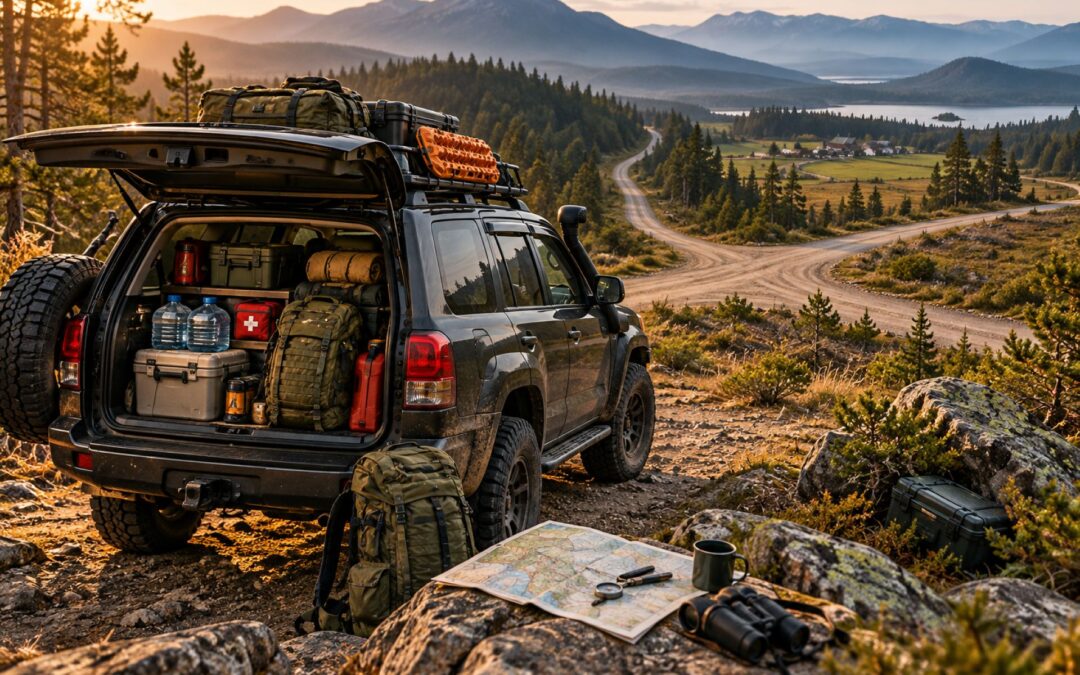
Published in 2013, Zac Lasson’s Build a Brilliant Bug Out Vehicle to Help You Survive takes one familiar idea from prepper culture—the 72-hour bug-out bag—and asks what happens when a backpack is no longer enough. His answer is to build preparedness in layers: plan where you might go, choose transportation capable of getting you there, keep portable essentials ready in case that transportation fails, use the vehicle to carry larger reserves, and place additional supplies at predetermined destinations.
That underlying system is considerably stronger than some of the individual technical recommendations Lasson makes. His advice about organization, redundancy, maintenance, maps, emergency supplies and having alternatives remains recognizable in modern emergency planning. Other claims—especially about diesel engines, homemade biodiesel, electromagnetic pulse damage, canned food, water requirements and the universal superiority of older 4x4s—need much more qualification today. The most useful way to read the book, therefore, is to separate its durable preparedness architecture from the specific 2013 assumptions built around it.

What Kind of Book Is Build a Brilliant Bug Out Vehicle to Help You Survive?
This is a short prescriptive preparedness handbook rather than a comprehensive survival manual. Lasson writes for readers who already understand, or are just discovering, the prepper concept of a bug-out bag: a portable collection of supplies intended to support a person for roughly 72 hours after leaving home. His purpose is to extend that idea by making a vehicle the next layer of preparation.
The book presents itself as a companion to Lasson’s earlier work on bug-out bags, and that relationship shapes its structure. He does not spend much time teaching wilderness survival, emergency medicine, navigation or mechanical repair in depth. Instead, he assumes that the reader wants a practical framework for choosing a vehicle, keeping it ready, loading it with more supplies than a person could carry and supporting it with caches at planned destinations.
Lasson repeatedly emphasizes brevity. He says that extra pages of filler would not improve anyone’s survival chances, so the book moves rapidly from definitions to recommendations and checklists. That makes it easy to read, but it also means that conclusions are often asserted more confidently than they are demonstrated. Personal experience, prepper convention, anecdotes and preference frequently substitute for systematic evidence.
The most important point is that the book is not really about finding one perfect survival vehicle. Its deeper organizing idea is layered redundancy. A person has a portable bag in case the vehicle must be abandoned. The vehicle carries more supplies in case a three-day bag is insufficient. Several destinations are planned in case one route or location becomes unusable. Caches provide another reserve if both the original supplies and the vehicle are lost. Seen that way, the book is less a buying guide than a compact system for preventing one failure from destroying the entire evacuation plan.
The Complete Bug-Out Plan: When to Leave and Where to Go
Lasson begins with the prepper worldview that makes a bug-out vehicle seem necessary. He defines preppers as people who prepare for circumstances in which familiar systems—shops, electricity, money, hospitals and public order—may stop functioning normally. His examples range from relatively plausible localized disasters such as hurricanes to much larger scenarios including pandemics, asteroid impacts and economic collapse.
The book uses the prepper abbreviation “SHTF,” meaning a situation in which ordinary life has broken down badly enough that established routines and institutions can no longer be relied upon. Lasson treats preparation as a form of risk management: nobody wants such events to occur, but he believes those who prepare in advance will have more options if they do. He pushes this argument much further at times, suggesting that well-prepared people will survive while the unprepared will not, and that conventional forms of wealth could become worthless in a major collapse while food, shelter, energy, resources and useful skills become the meaningful currency.
Some of his examples reveal both the appeal and weakness of this approach. Hurricanes demonstrate that a localized disaster can make normal life temporarily impossible without producing a global collapse. The 1918 influenza pandemic is invoked to show how infectious disease can become a worldwide crisis. The 2011 London riots serve as a warning about how quickly public order can deteriorate. Yet Lasson frequently moves from the possibility of disruption to predictions about widespread looting, food shortages and social breakdown without carefully distinguishing one type of emergency from another.
That distinction becomes central when he defines “bugging out.” To bug out is to leave home with your family and essential supplies because another location appears safer. Lasson argues that the timing cannot be reduced to an exact formula, but his bias is clear: he would rather leave unnecessarily and later return than wait until roads, danger or crowds make escape impossible.
Where someone lives affects that decision. A rural home may already provide relative isolation and safety, whereas an urban resident may face congestion, infrastructure failure and a larger population competing for resources. Lasson imagines economic crisis producing unemployment, hunger, looting and violence, while natural disasters can make a seemingly intact home unsafe because of structural damage, gas leaks, damaged water systems or deteriorating conditions in the surrounding area.
The next question is more practical: if you leave, where are you actually going? Lasson distinguishes between a distant long-term retreat for a catastrophic scenario and closer safe areas for temporary or localized emergencies. If a hurricane devastates one region while the rest of the country remains functional, travelling all the way to a hypothetical post-collapse retreat may make little sense. A nearer site may be sufficient until services recover.
He therefore recommends having options in different directions. Lasson describes three safe areas around his own town—north, southeast and west—so that the family can choose a route based on what has happened and where the danger lies. The important concept is not the number three but avoiding dependence on one destination and one route.
A vehicle expands this strategy. Someone on foot has a limited range and must carry every necessity. A prepared vehicle can reach a more distant safe location, move on if that location proves unsuitable and transport far more water, food, clothing and shelter than a person could realistically carry. Lasson views the traditional bug-out bag as a roughly 72-hour resource, while the vehicle can support a family for a week or substantially longer.
This produces the sequence on which the rest of the book depends. First decide that circumstances justify leaving. Then know where you might go. Only after those decisions does it make sense to choose the vehicle and fill it with equipment. Although the book later becomes heavily focused on gear, its underlying logic begins with geography and contingency rather than shopping.
Choosing and Setting Up the Bug-Out Vehicle
Lasson does not claim that one exact model suits everyone. Budget, passenger numbers, intended routes and the role the vehicle is expected to perform all matter. Even so, he quickly develops a strong preference for vehicles with substantial carrying capacity, rough-terrain capability and enough independence to keep moving when normal road conditions deteriorate.
His recommendations reflect both the practical demands of carrying emergency supplies and a more extreme assumption that a serious evacuation may require leaving normal roads altogether. That assumption shapes nearly every conclusion he reaches about vehicle type, drivetrain, fuel and repairability.
Vehicle Type, Capacity, and Mobility
An RV initially seems attractive because it combines transport, shelter and storage. Lasson nevertheless rejects it for most bug-out purposes because its size becomes a liability if roads are blocked or traffic is gridlocked. Even if a prepper intends to leave before everyone else, he argues, the plan should account for the possibility that an early departure is impossible.
At the opposite extreme, he regards an ordinary family car as insufficient. His imagined evacuation routes may involve rocks, sand, ice, water or other surfaces for which a conventional road car was not designed. From this he reaches one of the book’s more categorical conclusions: a pickup or a good 4×4 is the sensible solution.
Lasson personally prefers the 4×4 because most equipment can remain inside an enclosed cabin rather than in an exposed pickup bed. Four-wheel drive consumes more fuel, costs more and adds mechanical complexity, but he sees those disadvantages as acceptable because traction may become crucial if the vehicle leaves paved roads or becomes stuck.
He gives several model examples while insisting he has no commercial relationship with manufacturers. His British background makes Land Rover an obvious reference point, and he cites the British military’s historical use of the marque as evidence of suitability. He also points to Toyota pickups and Land Cruisers, invoking the well-known Top Gear attempt to destroy a Toyota pickup as an entertaining example of their reputation for toughness. Jeep Cherokees and Nissan Pathfinders are also named as plausible candidates.
A single person has another option: a dual-sport motorcycle. Lasson likes the motorcycle because it can move through congestion and operate on or off road. He recommends enough engine capacity for highway travel and acknowledges the obvious weakness—very little room for supplies. His proposed solution is to carry a bug-out bag and panniers while relying more heavily on caches placed along the evacuation system.
The chapter is therefore less about particular brands than about the trade-off between mobility and capacity. An RV maximizes capacity but sacrifices manoeuvrability. A motorcycle does the opposite. Lasson’s preferred 4×4 occupies the middle ground: enough room for a family and substantial supplies, combined with more freedom to cope with poor road conditions.
Age, Fuel, Transmission, Range, and Visibility
After choosing a general vehicle type, Lasson asks whether it should be a dedicated emergency vehicle or the family’s everyday transport. He is able to keep a separate bug-out vehicle permanently prepared and uses it for weekend hiking and camping. That keeps it in regular operation, cycles fuel and familiarizes his children with travelling in it.
A daily-use vehicle requires a different system because keeping it permanently packed may be impractical. Lasson recommends rigorous maintenance, keeping the fuel tank as full as reasonably possible and storing prepacked equipment in easy-to-lift boxes so the vehicle can be loaded rapidly. This is an early example of one of his better recurring principles: reduce the number of decisions and tasks that must be performed after the emergency has already begun.
Vehicle age becomes important because Lasson distrusts the increasing electronic complexity of modern cars. An older model, he argues, may be easier to understand and repair without specialist diagnostic equipment. He adds that a modern vehicle could theoretically be disabled by an electromagnetic pulse, making a well-maintained older vehicle preferable in a post-catastrophe scenario.
His strongest preference concerns fuel. Lasson argues that diesel is the clear choice, accepting somewhat higher purchase cost while claiming advantages in fuel economy, range and long-term fuel options. A central part of this case is his belief that biodiesel can be produced from used cooking oil with relatively little knowledge, potentially allowing the vehicle to remain useful after ordinary fuel supplies disappear.
He acknowledges that stored fuel itself creates problems. Carrying large quantities in containers introduces fire and safety risks, while stored fuel degrades over time. Lasson mentions fuel-stabilizing additives and contrasts fuel storage with his perception that vegetable oil offers a more durable long-term resource. This becomes part of a larger post-collapse argument rather than merely a comparison between present-day diesel and gasoline vehicles.
Hybrid, hydrogen and electric vehicles are dismissed outright. In 2013 Lasson simply does not regard them as viable bug-out platforms. He also prefers manual transmission because he sees it as mechanically simpler and believes it offers more driver control off road.
Range is treated as a planning problem rather than something to solve during evacuation. Lasson dislikes keeping jerry cans of gasoline or diesel inside the vehicle, so he wants each safe location to be reachable without refuelling. If the standard tank cannot comfortably cover the required distance, he suggests an auxiliary tank, while acknowledging that it takes away storage space.
Even color receives attention. Lasson wants a vehicle that attracts as little notice as possible and therefore favors ordinary, dull colors. Dark green and black appeal to him, although he notes that black is less attractive in very hot climates because the vehicle absorbs more heat. This detail illustrates his broader prepper instinct: the ideal vehicle should be capable without looking conspicuous.
What Lasson Says to Carry
The longest part of the book is not really a single vehicle checklist. It is a hierarchy of supplies, beginning with equipment that must remain portable and then expanding into what can be carried only because a vehicle removes the severe weight limits imposed by a backpack. Lasson repeatedly reminds readers that individual needs, family circumstances and local conditions should change the contents.
The governing rule is simple: the bug-out bag remains the emergency core even when the vehicle is packed with far more equipment. If the vehicle becomes stuck, breaks down, is damaged or must be abandoned, the occupants should be able to grab their bags and continue moving rather than discovering that every essential item has been scattered through the car.
The Bug-Out Bag
Lasson defines a bug-out bag as a pack containing what a person needs for about 72 hours. Each family member should have one, but load must reflect age and physical ability. A strong teenager can carry more than a small child, and Lasson repeatedly warns that a bag becomes useless if its owner cannot realistically move with it.
He favors a good waterproof hiking backpack designed to distribute weight effectively. Smaller children may require lighter daypacks rather than heavier framed packs. Lasson even trains with his own loaded bag so that its weight does not become an unpleasant surprise when it matters.
Water is the first problem because it is both indispensable and heavy. Lasson calculates roughly two litres per person per day for basic drinking, potentially three litres when walking, and immediately recognizes that three full days of water would create an unrealistic load, particularly for children. His solution is to carry some water in each individual pack, keep additional water in the vehicle and include purification tablets so the family can make use of other supplies if necessary.
Food follows the same principle of maximizing energy while minimizing weight. Lasson carries three days of rations made up of dry foods, dehydrated meals, survival bars, nuts, raisins, jerky, dried fruit, calorie-dense biscuits and similar items. He also packs tea, coffee or hot-chocolate sachets because he sees a warm drink as useful for both warmth and morale.
Small hiking stoves are carried so food and drinks can be heated. Lasson notes the objection that dehydrated meals consume drinking water, but he regards that as acceptable because the water ultimately enters the body with the food. His family can eat the meals from their original packaging, which keeps cooking equipment relatively simple, although spoons, forks and thermal mugs are still required.
Clothing is compacted with vacuum bags. Each person gets a change of clothes, underwear, multiple pairs of socks, warm layers and weather-specific headwear. Lasson stresses the importance of warm clothing and keeping feet dry, although the book contains a terminology error when discussing cold exposure, using “hyperthermia” in a context where hypothermia is clearly meant. Summer supplies include a sun hat, sunglasses and sunscreen.
Medical supplies begin with a commercially packed first-aid kit. Lasson adds ordinary pain relief, stronger medication, diarrhea treatment and whatever regular medicines family members depend upon. Although the basic bag is designed for three days, he suggests keeping about seven days of genuinely essential medication because being stranded longer than expected could have serious consequences.
He also adds multivitamins because he assumes calorie-focused survival food may not provide an ideal diet. More importantly, he later stresses that owning an elaborate first-aid kit means little if nobody has the skill to use it. Training, in his system, is supposed to accompany equipment.
Personal hygiene receives substantial attention for such a short book. Toilet paper, soap, toothbrush and toothpaste, a small towel, moist wipes, hand sanitizer, feminine hygiene supplies and bin liners are all included. Lasson’s examples are practical rather than glamorous, which is one reason the chapter works better than its more speculative sections: he is thinking about what several uncomfortable days would actually feel like.
Each family member also needs shelter and sleep equipment. Lasson carries lightweight tents, sleeping bags and emergency foil blankets. The bag must remain capable of supporting someone independently even though a larger family tent and extra bedding will later be stored in the vehicle.
The remaining portable equipment covers light, fire, tools, signaling, information and improvised repair. He includes an LED flashlight, a manually powered backup light, spare batteries and bulbs, a waterproof fire-starting kit, a quality multi-tool, signal flares, an emergency radio, paracord, duct tape and rope. He values redundancy even within categories, preferring a battery light plus a hand-powered option rather than trusting a single device.
Cash also forms part of the emergency kit. Lasson keeps small notes in each bag and additional money with the adults, reasoning that banking and card systems may fail or that immediate payment could solve problems such as accommodation or transport. He also keeps an unused credit card available because some crises will disrupt one area without destroying the wider financial system.
He acknowledges that no universal checklist can cover every household. A small sewing kit, a spare pair of glasses or water-treatment supplies may matter more to one reader than another. The limiting question remains whether the person assigned the bag can actually carry it.
Extra Vehicle Supplies
The vehicle is not supposed to cannibalize the portable bags. Lasson wants additional cooking equipment, food, water, clothing and other necessities stored separately so that the bags remain intact until they are genuinely needed. If someone must suddenly abandon the vehicle, there should be no need to reconstruct a bag from items currently being used around camp.
Organization matters as much as quantity. Lasson uses labelled, color-coded plastic boxes, assigning different colors to food, clothing and bedding, and hardware. His reasoning is psychological as well as logistical: emergencies create stress, and stress makes simple tasks harder. A well-organized vehicle reduces searching, remembering and decision-making.
Water is one of the main reasons to have the vehicle at all. Collapsible carriers can transport far more than a backpack without permanently consuming the same storage space when empty. Lasson keeps what he considers about seven additional days of water in the 4×4, thereby extending the family far beyond the portable three-day system.
Food is similarly expanded by roughly another week. Because weight is no longer as restrictive, he adds canned foods as well as the lighter dry and dehydrated provisions in the backpacks. Soups are favored because they are simple to heat, and the book gives the wonderfully mundane reminder to store the can opener with the cans rather than merely own one somewhere else.
Lasson also adds comfort food, especially because he is planning around children rather than hypothetical lone survivalists. Chips, candy and sugary drinks appear alongside more conventional emergency food. He rotates fresh potatoes through the vehicle for campfire cooking and describes serving them with baked beans, an example of how his family’s ordinary preferences shape the kit.
Extra clothing is stored in vacuum packs so only one set needs to be opened at a time. This preserves space and keeps the rest protected until required. A larger first-aid kit supplements those in the individual bags, and the vehicle carries additional paracord, duct tape, heavy rope and cable ties.
The larger load also allows the family to carry items that primarily improve comfort rather than immediate survival. Lasson stores spare, already broken-in boots so wet footwear can be changed and dried. Additional blankets, bedding and a large family tent provide warmer and more comfortable sleeping arrangements while leaving the lightweight tents in the bug-out bags untouched.
That distinction between survival and comfort is deliberate. Lasson does not see comfort as frivolous if poor sleep, wet clothing, boredom or distressed children can make an already difficult situation harder to manage. In this respect, the book treats preparedness as a human problem rather than merely an inventory of calories and tools.
Tools, Spares, and Finishing Items
Lasson’s philosophy becomes much more ambitious once he turns to hardware. A basic toolkit with common fasteners is only the beginning. He adds a heavy hammer, crowbar and miniature screwdriver set for electronics, along with spare batteries and charging leads for the devices the family expects to use.
The crowbar produces one of the book’s more questionable moments. Lasson imagines it being useful if a person desperately needs access to locked shelter and leaves the legal decision to the reader. The larger lesson is that he thinks in terms of improvisation after normal systems have failed, but the example also shows how quickly prepper scenarios can drift into assumptions that are inappropriate for ordinary emergency planning.
Mechanical redundancy goes much further. Lasson carries two spare tires, temporary puncture-repair products, belts, radiator hoses, spare bulbs, fuses, a radiator cap, fuel filter, fuel pump, motor oil, a charged battery, an alternator and even a complete gearbox. These parts are kept in locked roof storage, together with automotive tools.
He freely admits that such spares are worthless if the owner cannot fit them. Lasson considers himself reasonably mechanically capable and therefore carries a repair manual specific to his vehicle. At the long-term location he keeps still more spares, many acquired cheaply from scrap dealers, because his goal in a true collapse scenario is not merely to finish one evacuation but to keep the vehicle functioning for an extended period.
Climate-specific items such as snow chains, ice scrapers and shovels are supposed to be added where relevant. The idea is not that every reader should duplicate one exact inventory, but that local conditions should determine what failure modes deserve preparation.
His final miscellaneous equipment includes powerful spotlights, a fire extinguisher, a hard-backed road map, notepads, pencils, books, magazines and music for distraction. Fire-making supplies such as charcoal, dry wood and matches also appear. The book additionally lists weapons, including a crossbow, a firearm where the reader has one and a large knife, but it does not develop them into a serious tactical framework; they are simply included among the final items Lasson personally considers useful.
The result is an inventory that stretches from genuinely basic emergency equipment to supplies requiring considerable money, storage, maintenance and specialist competence. That excess is important to understanding the book. Lasson is not merely planning to reach a shelter after a storm; he is designing a vehicle that might remain useful when repair shops, fuel stations and ordinary supply chains no longer exist.
Caches and the Book’s Final Recommendations
Caches form the last layer of Lasson’s system. At each predetermined safe area, he hides a large sealed container of additional supplies. The purpose is not just to make the destination more comfortable but to ensure that reaching it still has value if the family has been forced to leave the vehicle behind.
His caches contain items such as canned food, a can opener, drink-making supplies, candy, soft drinks, blankets, spare batteries, insulating foam mats, books, playing cards, fire-starting materials, toilet paper and hygiene products. They are buried or concealed away from obvious public locations, with Lasson relying on memory and GPS to find them.
Water is handled separately because he wants to rotate it. He hides containers around each site rather than burying them permanently and periodically replaces the supply. The concept again reveals his preference for multiple independent reserves: supplies exist on the family, in the vehicle and at destinations.
Lasson acknowledges one obvious weakness—someone else could discover a cache—but does not spend much time on property rights, environmental conditions, access restrictions, theft, deterioration or the legal implications of burying equipment on land a person may not own. His focus is almost entirely on redundancy.
The “Final Word” is very short. A serious bug-out vehicle, Lasson says, represents a large financial commitment and may take years to build into something the owner finds satisfactory. The book then returns to promotional material for another Lasson product, leaving the substantive conclusion almost as soon as it begins.
The Preparedness System Behind the Book
Once the checklists are stripped away, Lasson has built a recognizable system for managing single points of failure. The bug-out bag answers the question, “What if I lose the vehicle?” The vehicle answers, “What if three days of portable supplies are not enough?” Alternative destinations answer, “What if my preferred destination or route is unsafe?” Caches answer, “What if I arrive without the supplies I expected to bring?”
That is a more coherent design than simply buying duplicate equipment. Redundancy is useful when the copies are independent enough that one failure does not destroy all of them. Lasson therefore keeps critical items in the individual packs even though equivalent items are available in the vehicle. Using vehicle supplies first preserves the portable bags as a fallback rather than gradually emptying the very system intended to survive vehicle loss.
The same logic explains his insistence that bags sit where they can be grabbed immediately. A perfectly stocked pack buried beneath hundreds of pounds of gear is not really a portable emergency system. Equipment has to be accessible at the moment the plan changes.
Color-coded boxes apply the same principle to cognition. Lasson understands that a frightened or exhausted person will not search and reason as efficiently as someone calmly packing in a garage. Labels, predictable locations and preassembled containers reduce the number of choices that must be made under pressure.
His use of multiple destinations is especially important because preparedness discussions can become excessively focused on possessions. A vehicle full of food is not much help without somewhere safe to go, and a brilliant destination is not useful if the only road to it is blocked. Lasson’s three-direction arrangement creates geographic redundancy in the same way that spare water and tools create material redundancy.
There is also a tension in the system. Every extra layer increases resilience, but it also increases cost, complexity and maintenance. Water must be rotated, food checked, medicines replaced, batteries monitored, vehicle parts maintained, caches inspected, destinations kept accessible and family members trained. Redundancy can become another source of failure if the owner accumulates more equipment than can realistically be managed.
The strongest version of Lasson’s idea is therefore not “more stuff is always better.” It is that important needs should not depend on one fragile assumption. If the only plan requires one car, one road, one fuel source, one destination and one bag stored at the bottom of the trunk, it contains several ways to fail at once.
What the Book Gets Right About Emergency Preparedness
Many of Lasson’s broad recommendations still overlap substantially with mainstream emergency-preparedness guidance. The difference is that modern public guidance generally begins with the hazards most likely to affect a particular household rather than with a generalized post-collapse scenario.
The American Red Cross guidance on making an emergency plan tells households to consider the emergencies most likely where they live, distinguish between circumstances that require sheltering in place and those that require evacuation, decide where they would go, establish a route and alternate routes, practice the plan, and keep maps available digitally and on paper. That is much closer to Lasson’s destination-first logic than the more theatrical elements of prepper culture might suggest.
His insistence on more than one route or safe destination is therefore one of the book’s durable insights. A planned destination could be a hotel, shelter, friend or relative rather than a hidden wilderness retreat, but the underlying question is the same: if leaving home becomes necessary, where will everyone actually go, and what happens if the first route cannot be used?
The same is true of emergency supplies. Current Red Cross emergency-kit guidance includes water, nonperishable food, flashlights, a radio, batteries, a first-aid kit, medication, hygiene supplies, a multipurpose tool, chargers, cash, emergency blankets and maps. Lasson includes nearly all of those categories, often in both a portable pack and a larger vehicle reserve.
His attention to household-specific needs is also sound. Lasson adjusts pack size for children, thinks about familiar food, medication, clothing and footwear, and explicitly says that no universal equipment list can fit everyone. Modern guidance makes the same general point by adding medical devices, supplies for infants, children and pets, spare glasses and other individualized requirements to the core kit.
The vehicle itself is also a reasonable place for emergency equipment even outside a bug-out context. NHTSA recommends planning routes and keeping an emergency roadside kit, particularly when severe weather can change travel conditions quickly. The modern interpretation is much narrower than Lasson’s post-collapse inventory, but the principle of maintaining a vehicle and stocking it for foreseeable problems remains sensible.
Lasson deserves particular credit for treating first-aid skill as more important than the appearance of an impressive medical kit. A large case of equipment does not create competence. The same applies to his repair tools: although his spare-parts collection is excessive for many readers, he at least recognizes that mechanical components matter only if someone knows how to diagnose and fit them.
Maintenance and rotation are another strength. Lasson rotates water, food, medication, batteries and even fresh potatoes rather than imagining that a packed vehicle can be forgotten indefinitely. He uses the emergency vehicle for ordinary camping trips to keep it running and to make the family familiar with it. Preparedness becomes an ongoing practice rather than a shopping spree completed once.
Even his inclusion of entertainment has merit. Books, cards, music and familiar food may seem trivial next to water or medicine, but emergencies are experienced by tired, frightened people rather than abstract survival machines. Keeping children occupied, preserving routine and improving sleep can matter greatly over several uncomfortable days.
The best parts of Lasson’s book therefore resemble conventional emergency planning more than extreme survivalism: know your hazards, know your destination, keep supplies portable, maintain transport, preserve several options and practice enough that the plan is usable under stress.
What Has Aged Poorly or Needs Qualification
The difficulty is that Lasson often moves from a good general principle to a specific technical claim with much more confidence than the evidence allows. A reader can accept the value of emergency water without accepting his exact quantities, or appreciate vehicle redundancy without accepting that diesel and a manual gearbox are universally superior.
This matters because preparedness advice is unusually sensitive to context. Climate, health, vehicle design, local hazards, road networks, fuel availability, regulations and household resources can change what is sensible. A short handbook written in 2013 cannot safely function as a permanent technical specification.
Water, Food, and Medical Supplies
Water demonstrates why the difference between a portable ration and a complete household emergency supply matters. Lasson estimates a minimum of roughly two litres of drinking water per person per day and suggests three litres if someone is walking. He also recognizes that carrying three full days of water in a backpack is extremely difficult, especially for children, which is why he distributes water between individual bags, the vehicle and stored supplies.
As a total emergency-storage benchmark, however, modern guidance is much higher because water is needed for more than drinking. The CDC recommends at least one gallon per person per day for three days, covering drinking, cooking, brushing teeth and other uses, with a two-week supply encouraged where possible. It also advises additional water for hot climates, illness, pregnancy and pets.
That does not make Lasson wrong to limit the weight inside a backpack. A gallon of water weighs more than eight pounds, making several days of water per person impractical for a portable pack. What it means is that a small carried ration must be understood as one part of the plan rather than the complete quantity a household may need.
The CDC also recommends rotating water stored in self-filled containers periodically and keeping it in appropriate food-grade containers away from heat, sunlight and toxic substances. Lasson already thinks in terms of rotation, which is a strength, but his hidden-cache system becomes much more demanding once temperature, container quality and contamination are considered.
His treatment of canned food contains a clearer error. In the cache chapter he states that canned goods effectively last forever, eliminating concern about spoilage. The USDA’s shelf-stable food guidance explicitly rejects that idea. Storage conditions, corrosion, damage and the acidity of the food all affect longevity; USDA guidance gives roughly 12–18 months for the best quality of many high-acid canned foods and about two to five years for many low-acid commercial canned products.
This is particularly important for caches exposed to environmental extremes. A can sitting for years in a cool pantry is not equivalent to one hidden where summer heat, moisture, freezing conditions, rust or accidental damage may affect the container. A cache that is never inspected contradicts Lasson’s otherwise sensible emphasis on rotation.
His medication discussion is more mixed. Lasson recommends carrying extra supplies of essential personal medicine and suggests roughly seven days for drugs that are genuinely life-sustaining. Current Red Cross emergency-kit recommendations also include a seven-day medication supply, so the underlying principle remains sound.
The weaker parts are his casual treatment of stronger prescription medication and his suggestion that a determined reader may find ways to obtain it. Medication storage, prescription access and appropriate use are medical matters rather than areas for improvisation. Similarly, a multivitamin may be easy to carry, but it does not transform an inadequate emergency diet into a nutritionally complete one.
His strongest medical point remains the least glamorous: training matters. An expensive trauma kit that no one understands can create false confidence, while modest supplies in trained hands may be much more useful.
Vehicles, Diesel, Biodiesel, and EMP
Lasson’s diesel argument is a good example of advice that mixes plausible considerations with unjustified absolutes. Diesel vehicles can offer advantages in particular applications, including range and fuel economy in some models, but the statement that diesel is simply the one correct choice is much too broad. Vehicle reliability and efficiency depend on the actual engine, drivetrain, load, maintenance history and intended use rather than the fuel label alone.
The biodiesel argument is even more simplified. Lasson presents the possibility of making fuel from used cooking oil as a major reason to choose diesel and implies that this capability can be acquired with relatively little education. That compresses fuel chemistry, quality control, vehicle compatibility and storage into a reassuringly easy scenario.
Current U.S. Department of Energy guidance on biodiesel blends illustrates the missing complexity. B5 blends are broadly compatible with diesel engines, and many current engines can use B20 or lower blends, but users are still advised to check manufacturer requirements. Higher biodiesel concentrations may raise issues involving material compatibility, warranties, cold-weather performance, filter clogging, energy content and storage.
Properly manufactured biodiesel is also not the same thing as simply having access to waste cooking oil. Lasson’s larger point—that a preparedness plan should consider future fuel availability—is reasonable, but turning that into a universal diesel recommendation gives readers much more certainty than the evidence supports.
His outright rejection of electric, hydrogen and hybrid vehicles has aged even more obviously because it is presented without a real comparative analysis. Whatever advantages or disadvantages particular technologies may have in a specific emergency, a 2013 assertion that they are categorically not options cannot be treated as a permanent rule. The correct comparison would depend on the hazards being planned for, required range, local infrastructure, home energy options, vehicle capability and actual evacuation routes.
The older-vehicle argument has more substance because simpler machines can sometimes be easier for an owner to understand and repair. Yet simplicity is only one aspect of reliability. An older vehicle may also have age-related deterioration, weaker safety systems, corrosion, worn components and limited parts availability. A well-maintained newer car and a neglected old 4×4 cannot sensibly be ranked by electronics alone.
EMP is the most interesting part because the evidence directly complicates Lasson’s intuition. The 2008 U.S. EMP Commission report describes tests on 37 cars from model years 1986 through 2002. Three running vehicles stopped at high simulated field strengths and needed to be restarted, one experienced dashboard-electronics damage, 25 showed nuisance effects such as blinking dashboard lights, and eight showed no anomalous response.
Those results do not prove that vehicles are immune to EMP, nor do they settle what would happen to the far more electronics-heavy vehicle fleet of today. They do show why the simple rule “modern vehicle fails, old vehicle survives” is too confident. The tested vehicles already contained substantial electronics, and catastrophic permanent failure was not universal.
There is another practical limitation. If an EMP were severe enough to disrupt electrical infrastructure, fuel distribution, communications and other systems, choosing one older vehicle would address only a small part of the problem. Lasson tends to isolate the vehicle from the wider systems on which fuel, roads, information and repair ultimately depend.
His manual-transmission preference deserves similar moderation. A manual gearbox may suit an owner who already knows how to use and repair it, but a theoretically simpler transmission is not an advantage if the actual drivers are uncomfortable operating the vehicle under stress. Familiarity, condition and reliability can matter more than ideological preference for mechanical simplicity.
Evacuation, Off-Road Assumptions, and Risk
Lasson treats early evacuation as generally preferable to waiting too long, and there is understandable logic behind avoiding a last-minute rush. The problem is that “leave early” cannot be separated from the hazard. Some emergencies require evacuation, while others may make sheltering in place safer, and official instructions can incorporate information about fires, floods, storms, road closures and danger zones that an individual household cannot see.
Modern Red Cross evacuation planning therefore begins with deciding what kinds of emergencies are likely, where the household would go, which route it would take and what alternative routes exist. Suggested destinations include hotels, relatives, friends and shelters. That is a more flexible framework than assuming every emergency sends the family toward a remote safe area.
Lasson’s heavy emphasis on off-road capability also needs perspective. Road debris and closures are genuine evacuation concerns, but attempting to bypass hazards with a 4×4 can create new risks. NHTSA warns drivers not to enter flooded roads and specifically emphasizes checking road conditions, closures and evacuation routes before travelling. Four-wheel drive does not make deep moving water, collapsed infrastructure or unsafe terrain harmless.
For many households, the best evacuation vehicle may simply be the reliable car they already maintain and know how to drive. Others may depend on public transportation, community assistance, relatives or accessible evacuation services rather than owning a dedicated off-road vehicle. Lasson’s system assumes money, parking space, mechanical skill and access to suitable safe locations that many readers do not possess.
Weight also creates a trade-off. More water, food, tools, spares, tents, bedding, fuel capacity and mechanical components can increase resilience, but they reduce available space and may affect vehicle handling and efficiency. The right inventory is therefore not the largest collection that physically fits. It is the set of supplies justified by the hazards, people, vehicle and destinations involved.
Evidence, Style, and Organization
Lasson writes as if he were talking directly to another prepper in a workshop or around a campfire. The tone is informal, personal and impatient with formality. He regularly refers to his own family, vehicle, camping habits, stored supplies and preferred solutions, which makes the book concrete even when it does not make it rigorous.
That conversational approach has real advantages. Instead of describing “logistical accessibility” in abstract language, Lasson says the bug-out bags should be placed where they can be grabbed immediately. Instead of offering a theory of cognitive load, he describes color-coded boxes so a stressed person can find food or clothing without searching. Instead of merely recommending supply rotation, he explains that the family uses older stored potatoes in ordinary cooking and replaces them with a fresh bag.
The weakness is that personal success quickly becomes general prescription. Lasson finds 4x4s useful, so ordinary cars become insufficient. He prefers diesel, so diesel becomes the obvious choice. He can repair a vehicle, so a gearbox and alternator become meaningful spares. He has access to safe areas suitable for caches, so hidden caches become a broadly applicable strategy.
Evidence is rarely developed beyond anecdote. The British military’s use of Land Rovers becomes an endorsement of the brand. A television program’s famous attempt to destroy a Toyota pickup reinforces Toyota’s reputation. Broader claims about societal breakdown, fuel, vehicles and technology receive little sourcing.
The prose also needed stronger editing. There are frequent grammatical mistakes, awkward sentences, inconsistent terminology and typographical errors. One notable example is the use of “hyperthermia” while discussing dangerous cold exposure, where “hypothermia” is plainly intended. None of these mistakes destroys the practical meaning, but collectively they reinforce the impression of a quickly produced handbook rather than a carefully verified technical manual.
Structure is stronger than sentence-level editing. The book generally progresses in a logical order from why someone might evacuate, to destinations, to vehicle choice, to configuration, to equipment, to caches. Chapter 7 then expands into a comprehensive inventory in a way that makes sense once the preceding chapters have established the role of the vehicle.
There is some repetition because ideas are explained in prose and then repeated in checklist form. For a practical field reference that can be useful; for continuous reading it sometimes feels padded despite Lasson’s stated hostility toward filler. Ironically, the book is so determined to be short that some points are repeated while more complex technical claims receive little explanation.
The promotional inserts are more damaging. An advertisement appears almost immediately after the introduction, and the brief final chapter turns back into another sales pitch. A commercial author can reasonably promote related work, but these interruptions weaken the seriousness of a book that repeatedly frames its subject in terms of life-or-death preparation.
The overall style is therefore highly accessible but not authoritative. It is easy to understand what Lasson personally does and why he thinks it works. It is much harder to know, from the book alone, whether a particular recommendation is technically sound, broadly applicable or supported by anything beyond prepper convention and personal experience.
Critical Review: Is Build a Brilliant Bug Out Vehicle Still Worth Reading?
As a 2013 preparedness handbook, Build a Brilliant Bug Out Vehicle to Help You Survive occupies an awkward position today. Too much of its specific vehicle and technical advice has dated for it to function as a dependable modern manual, yet its core planning framework remains more useful than its rough presentation might suggest.
The fairest evaluation is therefore not to ask whether every item on Lasson’s list should still be bought. It is to ask whether the book teaches a useful way of thinking about evacuation, equipment and failure—and whether readers can separate that contribution from the parts that need independent verification.
Strongest contribution
The strongest contribution is the layered relationship between the bug-out bag and the vehicle. Lasson never allows the larger platform to erase the smaller one. The vehicle is an expansion of capability, not a substitute for the equipment required if the occupants suddenly have to continue without it.
That simple principle produces several good decisions. Essential portable supplies remain together. Vehicle consumables are used first so the bags remain intact. Extra water and food can be carried without forcing a child to carry an impossible load. Larger shelter, bedding and repair equipment improve comfort and resilience while the minimal system stays portable.
The same thinking extends to destinations and caches. A person who depends on one route, one site and one stockpile is less prepared than the quantity of equipment might suggest. Lasson’s approach asks what happens after the first plan fails, which is exactly the question good contingency planning should ask.
His color-coded storage and emphasis on immediate accessibility are similarly practical. The objective is not merely to own everything but to be able to retrieve the right equipment when people are stressed, tired and making decisions quickly. That is a valuable idea far beyond prepper culture.
Major strengths
The book is unusually focused. It does not pretend to teach every survival skill and does not bury the vehicle concept beneath hundreds of pages of general preparedness material. A reader can understand Lasson’s whole system quickly.
Its progression is also strong. The book starts with the conditions that might trigger evacuation, then asks where the family will go before discussing what they will drive. Only after the vehicle has a purpose does Lasson begin filling it with equipment. Caches appear last because they make sense only after the destinations have been established.
Lasson is good at noticing mundane failure points. Can openers should be stored with cans. New boots should be broken in before an emergency. Batteries and medication expire. Bags must be positioned where they can be grabbed. Water and food should be rotated. A repair manual is more useful if it actually matches the vehicle.
His family perspective is another strength. He considers children’s carrying capacity, familiar food, comfort, entertainment, sleep and clothing rather than designing the entire system around a fit adult male travelling alone. Even when individual choices are debatable, the underlying attention to the people who will actually use the equipment is valuable.
The vehicle inventory is also impressively comprehensive for such a short book. Readers may decide that they need only a fraction of it, but Lasson does force them to think beyond the obvious trio of food, water and flashlight. Hygiene, medicine, maps, cash, bedding, repair equipment, footwear, communications and seasonal conditions all enter the plan.
Finally, the book correctly recognizes that preparedness is not finished when the equipment is purchased. Skills, maintenance, practice and rotation remain necessary. A family unfamiliar with its own vehicle, tent, packs, routes and medical kit is less prepared than one that has actually used them.
Major weaknesses
The largest weakness is evidence. Lasson writes with a confidence more appropriate to established technical facts than to personal preference. His pronouncements on vehicle type, diesel engines, biodiesel, EMP, transmission choice and social breakdown are often much stronger than the support offered for them.
That matters because the book markets itself as practical survival guidance. A mistake about the ideal color of a vehicle is trivial; a mistake about water requirements, medical supplies, fuel compatibility or the longevity of cached food can have real consequences. The book needed a clearer distinction between “this is how my family does it” and “this is broadly reliable advice.”
Affordability is another major limitation. A separate 4×4, complete individual bug-out bags, extra tents, large water reserves, a major first-aid kit, extensive tools, two spare tires, an alternator, battery, fuel components, gearbox, roof storage and several caches represent a substantial investment. Lasson acknowledges cost, but his system increasingly assumes resources that many households simply will not have.
Space creates the same problem. Urban readers—the people Lasson often suggests may be most likely to evacuate—are also among those least likely to possess a garage full of prepacked boxes, a dedicated emergency vehicle and several secluded locations where supplies can be stored.
The mechanical strategy becomes unrealistic for readers who lack substantial repair knowledge. Lasson at least recognizes this, but a complete gearbox sitting on a roof rack is not meaningful redundancy for a person who cannot diagnose drivetrain problems or install it. In many cases, carrying fewer parts and maintaining a reliable vehicle properly would be a more coherent use of money and weight.
The book is also thin on several subjects prominent in broader modern emergency planning. It says little about copies of essential documents, detailed family communications plans, the needs of pets, disability and accessibility requirements, official alerts or structured coordination with public evacuation systems. Its attention is directed toward independent survival rather than integration with the emergency resources that often remain available during real disasters.
Most importantly, the “doomsday” lens sometimes distorts ordinary emergency planning. A hurricane, wildfire, flood, earthquake, civil disturbance and long-term infrastructure collapse do not create the same decisions. Planning for all of them as variations on one generalized breakdown can lead readers to overprepare for cinematic scenarios while underthinking the most likely hazards in their own region.
Overall judgment
Build a Brilliant Bug Out Vehicle to Help You Survive is better as a book about preparedness architecture than as a book about vehicles. Its core system—portable essentials, additional vehicle supplies, several destinations, maintained transportation and further reserves—is logical and easy to understand. That framework can help a reader identify where a plan depends too heavily on one piece of equipment or one optimistic assumption.
Its technical authority is much weaker. Statements about canned food lasting forever, diesel being the only rational fuel, easy self-sufficiency through biodiesel, EMP vulnerability and the inherent unsuitability of alternative drivetrains should not be copied into a modern plan without verification. The book provides too little evidence to justify its strongest conclusions.
Its flaws do not completely undermine its purpose because the best part of that purpose is organizational rather than scientific. A reader does not have to buy Lasson’s preferred vehicle, store a gearbox or prepare for economic collapse to benefit from asking whether emergency equipment is accessible, whether the family can actually carry its bags, whether water and medication are rotated, whether several destinations exist and whether the plan survives the loss of the vehicle.
Readers already deeply involved in preparedness will probably find much of the equipment discussion familiar and some of the technical advice dated. Beginners interested specifically in vehicle-based evacuation may still find the book useful because it is short, concrete and forces them to think beyond a single backpack.
The right way to use it today is therefore selective. Read it for the logic of layered redundancy, the insistence on preparation before the emergency and the practical attention to organization. Use current authoritative guidance for water, food, medicine, evacuation decisions, vehicle safety and fuel compatibility, and treat Lasson’s more dramatic post-collapse prescriptions as the opinions of a prepper writing in 2013 rather than permanent rules.
A well-prepared vehicle can certainly expand a household’s options, but the enduring lesson of Lasson’s book is not that everyone needs the same 4×4 filled with the same equipment. It is that an emergency plan becomes stronger when losing one component does not destroy the whole system. For readers who keep that distinction in mind, Build a Brilliant Bug Out Vehicle to Help You Survive remains worth reading as a compact planning exercise—even though it should no longer be used as a stand-alone technical manual.
Last Updated on October 14, 2026 by Aseem Gupta