
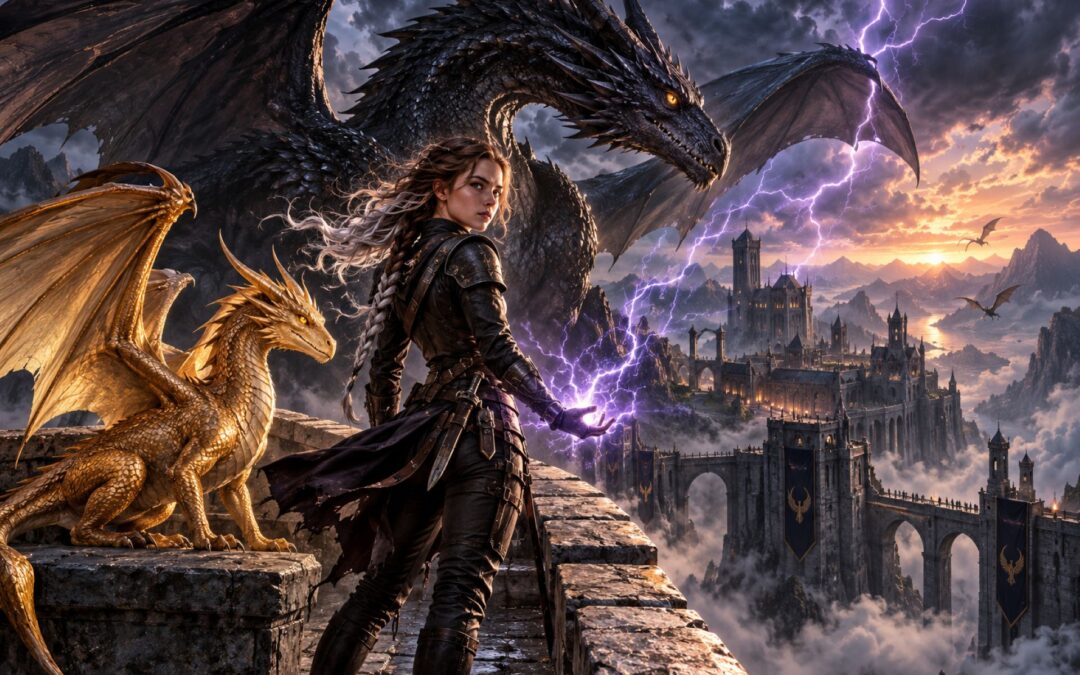
Fourth Wing by Rebecca Yarros follows Violet Sorrengail, a twenty-year-old woman who has spent her life preparing to become a scribe but is suddenly forced to enter Basgiath War College’s deadly Riders Quadrant. There, aspiring dragon riders must survive lethal examinations, ruthless competitors, and the unpredictable judgment of dragons powerful enough to kill them on sight. Violet has a chronic physical condition that makes the academy’s demands especially dangerous, and her mother’s military reputation ensures that some of her fellow cadets want her dead before she can prove herself.
Originally published in May 2023 by Entangled Publishing’s Red Tower Books imprint, the novel is the first installment of The Empyrean series. It combines military-academy fantasy, dragon magic, political intrigue, and an intense romance between Violet and Xaden Riorson, the son of a rebel leader executed by her mother. Their attraction develops within an institution that demands obedience, controls information, and treats young people’s deaths as an acceptable cost of producing soldiers.
The novel’s immediate appeal lies in Violet’s struggle to survive increasingly difficult trials. Yet her greatest challenge eventually becomes deciding whether the country she has been raised to defend deserves her unquestioning loyalty. As she gains magical power and grows closer to Xaden, she discovers that much of what she has learned about Navarre’s enemies, its rebellion, and its history may be false.
Spoiler Warning: This article contains a complete summary of Fourth Wing, including major character deaths, the romance, the true nature of Navarre’s war, and the ending.
Violet’s Conscription and the Deadly Parapet
Violet Sorrengail begins her story on Conscription Day, knowing that she may die before the day is over. She lives in the kingdom of Navarre, where Basgiath War College trains the soldiers, healers, scribes, and dragon riders who sustain the kingdom’s military power. Violet has spent her childhood preparing for the Scribe Quadrant, following the scholarly example of her late father. She knows history, languages, military geography, and the contents of countless books, but she has never been trained for the demands of combat.
Her mother, General Lilith Sorrengail, has overturned that future. As the commanding officer of Basgiath, Lilith insists that her youngest daughter enter the Riders Quadrant, even though Violet’s body is physically unsuited to its brutal selection process. Violet has fragile joints, suffers frequent injuries, and lives with pain that ordinary training cannot simply eliminate. Her older sister Mira, an accomplished dragon rider, is furious that their mother would expose her to such a dangerous environment.
Mira attempts to prepare Violet during the little time remaining. She makes Violet abandon unnecessarily heavy belongings, equips her with a protective vest fashioned from dragon scales, and provides advice about weapons, dangerous cadets, and surviving physical tests. She also reminds Violet of Brennan, their older brother, who supposedly died during the rebellion against Navarre. His loss continues to shape the family, especially because he was killed in the conflict that established their mother’s reputation.
The political danger is immediate. Years earlier, the Tyrrish rebellion was defeated, and its leaders were executed. Their surviving children were subsequently marked and compelled to serve in the Riders Quadrant. Many of these young people blame General Sorrengail for their parents’ deaths, making Violet an obvious target for retaliation.
Before candidates can even enter the quadrant, they must cross the parapet, a narrow stone bridge suspended above a deadly drop. The crossing offers almost no protection against wind, rain, or a momentary loss of balance. Candidates who fall are not rescued, and the military considers their deaths evidence that they were never capable of becoming riders.
While waiting, Violet meets Rhiannon Matthias, another candidate preparing for the crossing. Violet notices that Rhiannon’s footwear will provide better traction, while her own boots are more suitable for someone negotiating a narrow, slippery surface with unstable joints. They exchange boots, an early example of Violet’s ability to recognize practical advantages that stronger candidates might overlook.
She also encounters Jack Barlowe, an aggressive candidate who regards killing weaker competitors as acceptable. Jack makes his hostility clear, establishing himself as one of Violet’s most persistent threats. Another candidate, Dylan, falls to his death while attempting the parapet, demonstrating that even confidence and determination provide no guarantee of survival.
Violet’s crossing becomes the first significant test of her character. She cannot overpower the weather or ignore the physical dangers, so she concentrates on her footing, balance, and movements. Her determination matters, but so do her preparation and the decision to exchange footwear with Rhiannon. She survives by treating the crossing as a problem to solve rather than a contest of physical superiority.
On the other side, Violet enters the Riders Quadrant and discovers that surviving the parapet is only the beginning. The cadets are placed into military formations of wings, sections, and squads. Their lives will be governed by the Codex, an extensive body of regulations defining acceptable behavior, punishments, challenges, and responsibilities.
Violet’s childhood friend Dain Aetos is already a second-year rider and squad leader. He is shocked to see her and immediately tries to persuade her to transfer to the Scribe Quadrant. Dain believes he understands Violet’s physical limitations better than the military authorities do, but he also assumes that preserving her life requires removing her from the path she has been ordered to follow.
His concern initially appears comforting because he represents familiarity and safety. Violet has known him for years, and his protective instincts remind her of a world in which she was not continually being judged for her capacity to survive. Yet he repeatedly treats her wishes as less important than his assessment of what she can endure.
Her new wingleader creates a different problem. Xaden Riorson is the son of Fen Riorson, the executed leader of the Tyrrish rebellion. He is powerful, disciplined, feared by other cadets, and physically formidable. Violet assumes that he has every reason to hate her because her mother was instrumental in defeating the rebellion and punishing its leaders.
The situation places Violet between two men whose attitudes toward her seem irreconcilable. Dain wants to keep her safe by taking her out of danger, while Xaden appears capable of killing her if he chooses. Neither initially offers the kind of respect for her independent judgment that she needs.
The opening chapters also establish the Riders Quadrant’s peculiar relationship with death. Dragons descend upon the college, displaying their terrifying power and reminding the cadets that human military authority has limits. Riders may command tremendous respect throughout Navarre, but dragons choose whom they bond, and a dragon can incinerate someone it considers unsuitable.
Violet has crossed the parapet, but she remains physically vulnerable, politically exposed, and surrounded by people who doubt she should be there. Her first success gives her no special protection. Every subsequent day will require another reason to remain alive.
The Gauntlet, Presentation, and the Cost of Survival
Life inside the Riders Quadrant quickly reveals that Basgiath is organized around continual competition. Cadets are required to attend classes, participate in combat training, improve their physical abilities, and prepare for the possibility of bonding with dragons. Their progress is measured through evaluations that frequently end in injury or death.
Each morning, the names of dead cadets are read aloud. The death roll transforms individual tragedies into a recurring administrative procedure. For newcomers, the casualties are horrifying; for the institution, they are part of normal military life.
Violet’s academic strengths distinguish her almost immediately. During Battle Brief, instructors analyze military engagements and discuss threats to Navarre’s borders. Because Violet was educated by her father, she recognizes geographical details, strategic assumptions, and historical precedents that other cadets often overlook. Her knowledge makes her useful in the classroom, but it also emphasizes how different she is from recruits whose preparation has centered on combat.
In physical training, her disadvantages become painfully obvious. She faces opponents who are larger, stronger, and more accustomed to violence, and she frequently suffers injuries that require medical attention. During a sparring match, Imogen Cardulo, a rebellion-marked cadet with reason to resent the Sorrengail family, injures her badly enough that Dain must carry her to the Healer Quadrant.
There she encounters Nolon, a skilled mender capable of repairing serious physical damage. His abilities demonstrate the extraordinary medical possibilities available in Navarre, but they do not erase Violet’s underlying physical condition. Being healed after an injury does not mean that her joints become permanently stable or that future injuries cease to threaten her.
Dain responds by renewing his efforts to remove her from the quadrant. Violet understands why he is frightened, but leaving would mean accepting that others have the right to determine what she can attempt. She refuses to let his concern settle the question of her future.
Violet instead turns to the guidance Brennan left behind. His handwritten book of advice offers practical knowledge about surviving rider training, and its usefulness allows his influence to remain present long after his supposed death. She begins applying its recommendations alongside her own understanding of anatomy, chemistry, and strategy.
One of her most controversial methods involves poisoning opponents before scheduled challenges. She studies their habits and vulnerabilities, then uses carefully chosen substances to weaken them enough to make a fight more manageable. Rather than attempting to match their physical strength, she alters the conditions of the contest.
The strategy is ingenious, but it also reveals the moral compromises Basgiath encourages. Violet is not fighting in a peaceful environment where everyone respects conventional rules of fairness. Opponents may seriously injure or kill her, and the institution provides little assurance that she will be protected simply because she is physically disadvantaged.
Her poisoning nevertheless complicates any simple description of her as a morally innocent heroine. She deliberately harms opponents to improve her chances of survival. The difference between tactical intelligence and unethical manipulation becomes difficult to define in a system that already permits deadly violence.
Meanwhile, Violet learns more about Xaden and the rebellion-marked cadets. One night she discovers a gathering of the children of executed rebels, despite rules restricting their ability to assemble. Such meetings are especially threatening to Navarre because they allow young people with shared grievances to develop loyalties outside official military channels.
Xaden catches Violet observing the gathering. She expects him to exploit the opportunity to kill her or accuse her of spying, but he lets her leave. His decision does not make him trustworthy in her eyes, although it begins to undermine her assumption that he is simply waiting for a convenient moment to avenge his father.
Their relationship becomes more complicated when Xaden participates in her combat training. He recognizes that Violet cannot survive by fighting exactly as stronger cadets do and challenges her to find techniques that suit her capabilities. His instruction is demanding and often harsh, but it differs from Dain’s insistence that her limitations make success impossible.
The greatest physical test before dragon bonding is the Gauntlet. Built into a steep mountainside, it consists of a succession of obstacles designed to imitate the strength, balance, speed, and coordination necessary for riding dragons. Cadets must climb, swing, jump, and negotiate dangerous surfaces under conditions that leave little room for error.
Violet initially struggles badly. Her unstable joints and limited upper-body strength make certain obstacles especially difficult, and repeated attempts threaten to injure her further. She trains persistently, but straightforward improvements in strength are insufficient to overcome every problem.
Her eventual breakthrough comes from reconsidering how the obstacles must be completed. She studies the rules and identifies equipment that can help her negotiate the most dangerous portions of the course. By using a rope and dagger to compensate for her limitations, she finds an approach that the traditional training methods have not offered her.
Amber Mavis, a senior cadet, accuses Violet of cheating when she completes the Gauntlet. Violet responds by appealing to the precise language of the Codex, demonstrating that her use of permitted equipment does not violate the rules. Although she receives a penalty, her completion stands.
The episode is particularly important because Violet does not demand that the standards be lowered. She challenges the assumption that there is only one legitimate way to meet them. Her victory exposes how an institution may claim to reward ability while confusing ability with conformity to a conventional method.
Success at the Gauntlet makes her eligible for Presentation, when the surviving cadets walk before dragons willing to consider bonding. By this point, the number of candidates has already been substantially reduced. Those who remain must confront creatures that can reject them for reasons humans may not understand.
Dragons vary in size, color, temperament, and the kinds of danger they present. Some appear indifferent to the approaching humans; others are openly hostile. Violet’s extensive reading gives her valuable information about dragon behavior, but knowing the theory of a dangerous creature is different from standing within reach of its fire.
The cadets are required to maintain their composure as dragons inspect them. Those who offend or disappoint the creatures may be killed instantly. When a fellow cadet behaves contemptuously toward someone perceived as weak, the encounter demonstrates that dragons do not necessarily share the human military’s understanding of worthiness.
Violet also notices a small golden dragon that appears unusually vulnerable. Its presence raises questions because it is unlike the mature dragons that normally select riders. While other candidates are preoccupied with securing powerful bonds, Violet becomes concerned about the little dragon’s safety.
Presentation does not resolve her future. It prepares the cadets for Threshing, the event at which they must enter dragon territory and hope to be chosen. Violet knows that the next stage may kill her, but she has learned enough to recognize that surviving Basgiath requires judgment, resourcefulness, and the willingness to make decisions without guaranteed outcomes.
Threshing and the Two Dragon Bonds
Threshing is the decisive event separating cadets who might become dragon riders from those who never will. The candidates enter a wooded valley where dragons have gathered, hoping that a creature will choose to form a bond with them. Human desire plays a limited role in the process because dragons retain the authority to accept or reject potential riders.
Violet enters with little reason to expect that a powerful dragon will want her. She lacks the physical advantages that many candidates possess, and even if a dragon chooses her, she knows that remaining mounted during flight may prove impossible. Nevertheless, she continues looking for an opportunity rather than conceding defeat.
During her search, she discovers Jack Barlowe and other cadets threatening the small golden dragon she previously noticed. The creature appears incapable of defending itself against a coordinated attack. Jack’s willingness to kill it confirms the ruthlessness that Violet has observed since Conscription Day.
Violet faces a decision that the academy’s survival logic should make straightforward. Protecting the dragon will expose her to armed opponents who are already stronger than she is. Leaving it would allow her to continue searching for a potential bond without taking an unnecessary risk.
She chooses to intervene.
Her decision matters because she is not protecting the golden dragon to secure a predictable reward. She has no assurance that the dragon will bond with her or that any other dragon will regard her actions favorably. She sees a vulnerable creature being attacked and decides that its life matters more than her immediate tactical advantage.
The confrontation becomes dangerous almost immediately. Violet uses her daggers and defensive skills, but she cannot match multiple opponents in an open fight. Xaden appears nearby with his bonded dragon, Sgaeyl, and his presence alters the balance of the encounter. Nevertheless, the cadets’ confrontation reveals how little protection the academy’s regulations offer when someone is determined to kill.
The intervention attracts an unexpected observer: Tairn, a massive black dragon whose reputation places him among the most formidable dragons known to Navarre. He is regarded as exceptionally powerful and has a history that makes his decision to take another rider especially significant.
Tairn chooses Violet.
His choice astonishes the people around them because Violet does not resemble the conventional ideal of a rider. Even more surprisingly, Tairn makes it clear that his decision is deliberate. He values qualities that Violet has demonstrated under pressure, including her judgment and willingness to defend someone weaker than herself.
Bonding, however, does not solve the problem of actually riding him. When Tairn launches into the air, Violet struggles to hold on. His enormous size, powerful movements, and the force of flight overwhelm her physical grip, and she falls from his back.
Instead of allowing her to die, Tairn catches her in his claws. The rescue demonstrates that his commitment to the bond is real, but it also establishes the practical difficulties they must overcome together. Violet’s future will depend on learning to ride a dragon whose capabilities far exceed what her body can manage unaided.
After returning to the flight field, Violet encounters an even more astonishing development. The golden dragon she defended has also chosen to bond with her. Its full name is Andarnaurram, although it permits Violet to call it Andarna.
Bonding with two dragons is extraordinary enough to provoke immediate controversy. Senior military figures question whether such an arrangement can be permitted, and the situation requires intervention from the dragons’ own governing authority.
The dragons ultimately uphold both bonds. Their decision establishes an important distinction between human military administration and the Empyrean, the political community of dragons that governs matters concerning their species. Navarre depends upon dragon power, but its generals cannot simply overrule dragon decisions when those decisions inconvenience human institutions.
The double bond transforms Violet’s status. She is no longer a vulnerable cadet who has not yet proved herself worthy of a dragon. She is bonded to one of the most powerful dragons in the quadrant and to a second creature whose nature remains mysterious.
This achievement also creates extraordinary risks. Tairn has a mating bond with Sgaeyl, Xaden’s dragon. Because mated dragons cannot tolerate prolonged separation, the relationship establishes a practical and magical connection between Violet and Xaden regardless of their personal feelings.
They will need to coordinate their movements, understand their dragons’ needs, and contend with a bond that links them more closely than ordinary military hierarchy would require. The situation complicates Violet’s distrust of Xaden because avoidance is no longer a realistic option.
Dain sees the double bond differently. He believes Violet should select the apparently safer option and questions whether she can survive the demands of riding Tairn. His argument reflects his longstanding assumption that minimizing danger should take precedence over Violet’s ambitions.
Violet refuses to surrender the opportunity her dragons have given her. Her choice demonstrates that she is beginning to distinguish between reasonable concern and a demand that she accept another person’s definition of her limitations.
Dain eventually kisses her, fulfilling something Violet had wanted during their long friendship. Yet the encounter reveals that her feelings have changed. She no longer experiences the attraction she once imagined, and the emotional certainty attached to their earlier relationship has begun to disappear.
Meanwhile, Violet receives the privileges and responsibilities of a bonded cadet, including a private room and more specialized training. The independence feels welcome, but learning to ride Tairn remains physically punishing. His size and movements require adaptations that cannot be achieved through enthusiasm alone.
Her new position also changes the threats surrounding her. Other cadets resent her exceptional dragons, particularly those who believe that she has acquired power she does not deserve. Bonding has protected Violet from some dangers while making her the focus of others.
Threshing therefore resolves the immediate question of whether Violet can become a rider, but it opens a more difficult problem. She has been chosen by dragons who see value in her that her society routinely overlooks. She must now develop the competence to justify their trust without allowing the power they offer to consume her.
Betrayal Within Basgiath and the First Manifestation of Power
After Threshing, Violet’s daily life changes substantially. She must train with Tairn, develop the strength necessary to remain mounted, and prepare for the manifestation of a signet, the magical ability that can emerge when a bonded dragon begins channeling power to its rider. She also needs to learn how to defend herself against the increasingly serious threats created by her unusual position.
Her private room offers relief from crowded barracks, but isolation introduces a different vulnerability. Unbonded cadets resent those who have secured dragons and may view murder as a way to obtain another opportunity. Because Violet has bonded two dragons, she becomes an especially attractive target.
One night, attackers enter her room while she sleeps. They intend to kill her, and the assault is organized enough to suggest that someone with authority has helped them gain access. Violet fights desperately, but her physical disadvantages and the number of attackers leave her with little chance of surviving.
As a knife approaches her, an extraordinary event occurs. Andarna channels a power that temporarily stops time for everyone around Violet. The attackers become motionless, leaving her able to act while the people threatening her remain frozen.
The ability is unlike anything Violet has previously understood about dragon magic. It is also dangerous because Andarna is young, and channeling such power places considerable demands on her. Violet must keep the discovery secret, knowing that other people may try to exploit it or interfere with her second dragon bond.
Xaden intervenes during the attack, demonstrating his determination to protect her. His reaction is not that of a detached superior enforcing military rules. He is furious that someone has arranged an attempt on Violet’s life, and he becomes increasingly concerned about the people who might betray her from within the institution.
The attack exposes a serious weakness in Basgiath’s supposed meritocracy. Violet has survived the prescribed trials and earned a bond through the dragons’ own decisions, yet her success has made her vulnerable to illegal assassination. The institution’s promise that the strongest will survive offers little protection when powerful individuals manipulate the rules.
Evidence points toward Amber Mavis, who is accused of facilitating the attack. Amber’s position as a senior cadet makes the allegation especially serious because she possesses both access and authority over those below her.
Xaden brings the accusation before the assembled riders, insisting that Amber be held accountable. The process creates another confrontation between Violet’s desire for personal autonomy and Dain’s conviction that he must protect her through his own abilities.
Dain possesses a signet that allows him to read another person’s memories through physical contact. When he demands access to Violet’s recollection of the attack, she resists. Revealing the memory could expose Andarna’s secret power, and Violet believes that her own experiences should not become available to him simply because he wants to investigate.
His willingness to demand access troubles her. Dain regards his ability as a legitimate means of uncovering the truth, but Violet understands that memory-reading can also remove a person’s control over deeply private information.
The accusation against Amber is resolved through evidence presented with the dragons’ involvement. The wingleaders find her guilty of violating the rules by assisting an attack on a sleeping cadet. Tairn executes her, incinerating her in front of the assembled quadrant.
The punishment is swift and absolute. Violet survives, but the event reinforces the harsh moral environment in which she now lives. The institution permits cadets to endanger one another during sanctioned activities while responding with terrifying finality when certain formal boundaries are crossed.
After the attack, Liam Mairi becomes Violet’s protector. Like Xaden, Liam is the child of a rebel associated with the defeated uprising. His presence initially appears to be another consequence of Xaden’s desire to control the dangers surrounding her.
Yet Liam gradually becomes a genuine friend. He accompanies Violet during her visits to the Archives, repairs small practical inconveniences, and offers companionship without constantly treating her as incapable. His warmth and steadiness give Violet an opportunity to know a rebellion-marked cadet as a person rather than as a representative of an inherited political grievance.
Their friendship challenges the assumptions she has absorbed about the rebellion. Liam has endured punishment for actions committed by his parents, yet he demonstrates generosity and loyalty. His character makes the political division between supposedly trustworthy Navarrians and dangerous rebel descendants increasingly difficult to sustain.
Violet also begins noticing inconsistencies in the military information presented during Battle Brief. Her historical knowledge makes her sensitive to details that do not fit the official accounts. Rather than immediately conclude that the authorities are lying, she initially assumes that information must be classified or incomplete.
This response is significant because Violet still trusts the basic framework of Navarre’s institutions. She can recognize contradictions without yet imagining that the entire explanation of the war might be deliberately misleading.
As her bond with Tairn develops, he begins channeling greater power to her. Violet must learn grounding and shielding, techniques that allow riders to control the immense magical energy they receive through their dragons. Uncontrolled channeling can overwhelm the body and mind, making magical growth dangerous as well as empowering.
The developing bond also increases her connection to Xaden. Their dragons’ mating relationship allows intense emotional and magical proximity, and Violet and Xaden discover that they can communicate mentally. Their attraction becomes increasingly difficult to deny, especially when powerful emotions pass through the bonds.
A kiss marks an important change in their relationship, but it does not resolve their distrust. Xaden remains guarded about his past and his activities, while Violet understands that attraction cannot automatically make him safe to trust.
Her struggle to survive ordinary combat continues. During a challenge, Jack Barlowe uses his developing power to inflict terrible pain on her. Once again, Violet lacks the physical advantage necessary to defeat him through conventional force.
She has prepared for the possibility of fighting Jack by learning about his severe allergy to oranges. When the confrontation becomes life-threatening, she uses this knowledge against him. The strategy demonstrates her ability to turn seemingly minor information into an effective weapon.
The victory is characteristic of Violet’s methods. She studies people, identifies vulnerabilities, and acts before a physically superior opponent can exploit her weaknesses. Nevertheless, it also emphasizes how dangerous her environment remains. Her survival depends on knowing facts that other people might regard as irrelevant.
Xaden’s role in her life expands beyond occasional protection. He provides combat instruction and specially designed daggers that suit her fighting style, acknowledging that her weapons and techniques must be adapted to her requirements.
He also arranges practical training intended to strengthen the muscles and movements she will need during flight. Imogen becomes involved in this process, introducing a complicated relationship in which someone who initially resented Violet helps her develop the abilities necessary for survival.
By this point, Violet’s position within Basgiath has changed dramatically. She has powerful dragons, increasingly important friendships, a developing romantic attachment, and the beginnings of extraordinary magical power. Yet every improvement increases the responsibilities and dangers attached to her status.
The Squad Battle, Montserrat, and the Lightning Wielder
As the academic year progresses, Violet begins applying her abilities to problems larger than individual survival. Squad Battle requires cadets to compete through challenges that reward military competence, cooperation, and the ability to exploit an opponent’s weaknesses.
When her squad needs an advantage, Violet recognizes that information can be more useful than direct force. She proposes obtaining an up-to-date strategic map from her mother’s office, reasoning that a group with superior knowledge of military movements and vulnerabilities will be better positioned to succeed.
The resulting operation requires planning and collaboration. Violet uses her familiarity with Basgiath, her understanding of military administration, and the assistance of her squadmates to reach information that would normally be unavailable to first-year cadets.
The mission demonstrates how far she has progressed from the woman who barely survived her first physical examinations. Her intelligence is no longer valuable only as a means of compensating for physical limitations. It has become a capability that improves the performance of her entire unit.
The challenge also exposes the fragility of military secrets. Information that commanders believe to be secure can become accessible when someone understands institutional routines and overlooked weaknesses. This idea later assumes a darker significance when Violet discovers how much information Navarre has deliberately concealed.
A subsequent visit to Montserrat brings Violet into contact with a different aspect of military life. She reunites with Mira, encounters Rhiannon’s family, and temporarily experiences the ordinary domestic relationships that the Riders Quadrant has largely displaced.
The visit reminds her that the military exists within a wider society. Navarre’s outposts defend settlements where people have families, livelihoods, and everyday concerns. These civilians have little direct control over the strategic decisions made by generals and riders, even though they suffer the consequences when defenses fail.
Mira is relieved to see her younger sister alive but remains concerned about her dangerous position. Their conversations reveal the continuing tension between affection and autonomy. Mira understands the consequences of military service more thoroughly than Violet did at the beginning of the novel, yet she also recognizes that Violet has grown into responsibilities that cannot simply be taken away.
Violet’s relationships with Dain and Xaden continue developing under Mira’s scrutiny. Dain remains familiar and apparently dependable, while Xaden is associated with political danger and emotional uncertainty. Mira warns Violet that physical survival does not guarantee protection from betrayal or heartbreak.
Military exercises at Montserrat introduce another aspect of leadership. The cadets must consider how to respond to threats, how to deploy their abilities, and what risks commanders should accept. Violet’s growing understanding of tactics allows her to contribute more substantially than she could during her earliest weeks of training.
The outpost also demonstrates the limitations of dragon power. Navarre’s defensive system depends on wards, dragons, and riders, but these protections are not uniformly available everywhere. Areas near the borders remain vulnerable to attacks that officials describe in terms consistent with the kingdom’s established military narrative.
During the events surrounding Montserrat, Violet becomes increasingly aware of the mental connection between herself and Xaden. The bond is intimate because it allows them to communicate without speaking, but it also introduces questions about privacy and emotional control. Their dragons have created a relationship that neither rider chose independently.
The danger surrounding the outpost brings their competing protective instincts into sharper focus. Violet resents being removed from situations in which she believes she could help, while Xaden understands more clearly than she does how badly a battlefield can turn against inexperienced riders.
Their disagreement resembles Violet’s conflict with Dain, but the consequences are different. Xaden challenges her competence while continuing to help her develop it. Dain often responds to danger by insisting that she should not face it at all.
Violet receives an adapted saddle designed to help her remain mounted on Tairn during demanding flight maneuvers. The equipment represents an important practical solution to a problem that increased physical strength alone has not resolved. Tairn’s exceptional size and movement patterns require an arrangement that allows Violet to participate without continually risking an uncontrolled fall.
The saddle does not make flight effortless. She still needs balance, endurance, training, and the ability to manage sudden changes in direction. Yet it gives her a workable means of performing tasks previously considered beyond her capabilities.
During War Games, an aerial combat exercise escalates into a dangerous confrontation. Jack Barlowe again becomes a serious threat, this time endangering Liam. Violet recognizes that the situation may result in the death of someone she has come to trust.
Andarna’s time-stopping ability provides an opportunity to intervene. Violet acts under enormous emotional pressure, drawing upon the strength of her bond with Tairn as anger and fear overwhelm her.
Her signet finally manifests as lightning.
The power erupts with extraordinary force, striking a tower and destroying the structure beneath Jack. He falls amid the collapsing stone, and Violet believes that he has been killed. The surrounding cadets recognize that she has manifested a remarkably destructive ability, one that could eventually make her an exceptional military asset.
For Violet, however, the moment is not an uncomplicated victory. She has apparently killed a human being, even though Jack had repeatedly threatened her and others. The fact that he was dangerous does not prevent her from experiencing guilt, shock, and revulsion at what she has done.
Her response distinguishes her from the casual attitude toward death encouraged at Basgiath. She has learned to fight and recognizes that killing may become necessary, but she has not stopped treating a human death as morally consequential.
Xaden helps her confront these emotions. He understands that riders cannot allow grief or hesitation to paralyze them during combat, but he does not insist that she should feel nothing. He provides a private space in which she can acknowledge reactions that would be dangerous to display before hostile cadets.
Their emotional intimacy develops into physical intimacy. The attraction that has been building through sparring, dangerous encounters, arguments, and mutual protection becomes impossible for them to maintain at a distance.
Yet the physical relationship exposes unresolved differences in their expectations. Violet wants emotional honesty and a relationship she can understand, while Xaden remains reluctant to reveal everything about himself. His guardedness is particularly difficult for her because she has spent months trying to determine whether the son of the rebel leader genuinely cares for her.
Meanwhile, she begins formal training with Professor Carr to control her lightning. The raw power is immense, but directing it toward a specific target is another matter. During early exercises, she can summon spectacular strikes without reliably determining where they will land.
Carr warns her about burnout, the danger of drawing or releasing more magical energy than her body can safely manage. A strong dragon bond does not guarantee that a human rider can contain the power it provides. Violet must learn precision and restraint rather than assuming that greater destructive force will always solve her problems.
Her progress leaves her in a position that would have seemed impossible on Conscription Day. She has become a bonded rider with exceptional magical potential, survived powerful enemies, contributed to squad victories, and formed relationships that matter deeply to her.
Nevertheless, the story has also begun gathering unresolved questions. Violet’s growing power cannot explain missing military information, the secrecy surrounding Xaden’s activities, or the differences between official accounts of the war and details she has encountered during training.
Reunification Day and the Assignment to Athebyne
As Violet approaches the end of her first year, her attention increasingly moves beyond the immediate challenges of the academy. She has become more competent, but she has also noticed troubling inconsistencies in what she has been taught about Navarre’s history.
One important source is a book of fables associated with her childhood and her late father. The stories describe ancient dangers that seem to belong to folklore rather than modern military reality. Among them are accounts of venin, people who draw power directly from the earth, and wyvern, monstrous creatures linked to that corrupted magic.
Violet initially understands these stories as traditional explanations of supernatural evil. Her education has taught her that the kingdom’s principal external enemies are the gryphon fliers associated with Poromiel. Venin and wyvern belong to a different category of knowledge, one that seems too mythical to affect current military strategy.
Nevertheless, her father’s attention to books and historical material gives the stories a significance that ordinary children’s entertainment might not possess. Violet knows that written accounts can preserve information across generations, even when later authorities dismiss their contents.
Reunification Day further exposes the political importance of official history. The holiday commemorates Navarre’s victory over the rebellion and presents the suppression of the uprising as an achievement that preserved the kingdom’s unity.
For Violet, the celebration has a personal dimension because her mother helped defeat the rebels and Brennan reportedly died during the conflict. The ceremony publicly honors a version of events around which her family history has been organized.
Xaden experiences the day from the opposite position. His father was executed, and the rebellion-marked cadets continue to carry the consequences of their parents’ defeat. What Navarre celebrates as reunification represents family loss, humiliation, and state punishment to the children of the condemned rebels.
The contrast forces Violet to recognize that the same event can be remembered as victory by those in power and catastrophe by those who lost. She does not yet understand the full truth of the rebellion, but her relationship with Xaden makes the official celebration increasingly difficult to accept without question.
Their romantic relationship becomes more serious during this period. Violet feels herself falling in love, although Xaden’s reluctance to share certain information creates persistent uncertainty. She wants to trust him completely, but he maintains boundaries that she cannot explain.
One particularly significant scene returns Violet to the parapet. Earlier, the narrow crossing represented helplessness and the terrifying possibility that she would die before entering the Riders Quadrant. Now she crosses it voluntarily in an attempt to reach Xaden.
The circumstances remain dangerous, but her relationship with the parapet has changed. She is no longer someone whose movement is entirely dictated by institutional authority. She chooses to cross despite understanding the risk, demonstrating both her growing confidence and the strength of her attachment to Xaden.
Their intimacy is interrupted when the quadrant receives an urgent call to formation. The cadets initially fear that Navarre has been attacked, but the mobilization is revealed to be part of War Games.
The assignments require groups of riders to travel to designated outposts, testing their readiness for military deployment. Xaden is sent toward Athebyne, a remote location near the kingdom’s outer defenses. Because Tairn and Sgaeyl are mated, arrangements must account for the dragons’ need to remain sufficiently close to each other.
Violet accompanies Xaden, along with Liam and other members of the group. The assignment appears to be another military exercise, although the circumstances surrounding it are unusual.
Before departure, Dain confronts Violet about her relationship with Xaden. He continues to regard Xaden as dangerous and struggles to accept that Violet has chosen someone he distrusts. His farewell includes physical closeness that later becomes important for reasons Violet does not immediately understand.
The group flies toward Athebyne, traveling through territory that exposes the limits of Navarre’s protective wards. The distance from Basgiath makes the mission feel increasingly different from controlled training exercises.
The riders also pass landscapes shaped by the rebellion and Navarre’s defensive geography. For Xaden and other marked cadets, these territories carry personal and political memories that Violet has never fully understood.
When the group approaches Athebyne, the apparent military exercise begins to unravel. Two gryphon fliers arrive, and Violet expects the encounter to become hostile because she has been taught to regard such people as enemies.
Instead, Xaden recognizes them.
His behavior reveals that the meeting has been arranged and that he has a relationship with people whom Navarre’s military authorities treat as hostile combatants. Violet is stunned because Xaden has concealed this activity throughout their developing relationship.
The fliers explain that their communities face threats far worse than the border attacks described in Navarre’s official accounts. Venin are real, and the creatures associated with them have been attacking settlements outside the kingdom’s wards.
This revelation changes the meaning of Violet’s childhood fables. The stories she believed to be myths contain knowledge about an actual supernatural enemy. The military narrative she has studied so carefully has omitted an essential part of the war.
Xaden’s involvement becomes clearer as the conversation continues. He and other rebellion-marked riders have secretly provided assistance to people beyond Navarre’s borders. Their actions violate the kingdom’s official position, but they are motivated by the knowledge that civilians are being abandoned to a deadly threat.
Violet experiences the discovery as a personal betrayal. She has defended Xaden against the suspicions of her family and friends, built a relationship with him, and trusted him with intimate parts of herself. Learning that he has concealed a major political operation makes her question how much of their relationship has been genuine.
His reasons for secrecy are serious. Revealing the operation could endanger his companions, expose the marked cadets, and threaten the people they are trying to help. But the existence of legitimate risks does not erase Violet’s emotional response to being excluded from information that directly affects her life.
The group reaches the seemingly abandoned outpost and discovers that the assignment is more dangerous than expected. A message from Colonel Aetos, Dain’s father, makes clear that the situation has been arranged as a test of Xaden’s command under conditions that may prove fatal.
Violet recognizes the handwriting and begins connecting the assignment to Dain’s memory-reading ability. She realizes that he may have accessed information about Xaden’s movements through her without her permission, allowing his father to learn about the clandestine activity.
The possibility is devastating. Violet has unknowingly become a source of information that may have placed Xaden and his companions in danger. Dain’s repeated claims that he wants to protect her now appear inseparable from his willingness to override her privacy.
The group also discovers that a dangerous force is approaching. What began as a military examination has turned into a confrontation with enemies the cadets were never adequately trained or informed to fight.
Violet must decide whether to remain loyal to the version of Navarre’s history she has always accepted or trust the evidence directly before her. The decision is no longer theoretical because civilians and her companions may die if the riders refuse to respond.
The Battle of Resson and the Price of the Truth
The final battle takes place near Resson, a trading settlement vulnerable to attacks from beyond Navarre’s protected territory. The riders discover that venin and the wyvern they control are approaching, threatening both their group and nearby civilians.
Unlike the gryphon fliers who have been presented as Navarre’s enemies, the venin represent a different kind of threat. They possess dangerous magical abilities and draw power in a manner that violates the relationship between riders and dragons. Their use of wyvern gives them a terrifying aerial force capable of challenging dragon riders.
The riders must decide how to respond. Remaining at the outpost offers little guarantee of survival, and retreating could leave civilians exposed. The decision becomes a test of military judgment, personal loyalty, and moral responsibility.
Xaden faces competing obligations. He must protect the rebellion-marked riders who depend on him, preserve the secrecy of their activities, and consider whether intervention can save people who would otherwise be abandoned. The choice is made more difficult by the suspicion that Navarre’s authorities deliberately placed the group in danger.
Violet insists that the civilians cannot simply be left to die. Her position reflects the values that led her to defend Andarna during Threshing. Even when intervention endangers her own life, she refuses to treat the vulnerability of others as sufficient reason to abandon them.
The group chooses to fight.
The battle immediately demonstrates that training exercises at Basgiath are inadequate preparation for this enemy. The venin possess abilities the cadets have not been taught to counter, while their wyvern create dangers that differ from those posed by ordinary dragons or gryphons.
The riders must coordinate attacks while adapting to unfamiliar magical threats. Their dragons provide tremendous force, but the enemy’s supernatural abilities make established tactics unreliable.
Soleil is killed during the fighting, confirming how quickly experienced riders can die when confronting the venin. Her death is particularly important because it destroys the illusion that the group can simply rely on elite training and powerful dragons to overcome unfamiliar enemies.
The battle becomes increasingly desperate as wyvern attack from multiple directions. Xaden uses his shadows to fight and protect others, while Violet attempts to apply her lightning to targets whose movements and abilities she is still learning to understand.
Liam plays a critical role because his loyalty, skill, and willingness to protect others have made him one of Violet’s most dependable companions. He has become far more than the bodyguard Xaden initially assigned to her.
His dragon, Deigh, is killed during the battle, and Liam suffers fatal consequences. The destruction of their bond creates one of the novel’s most painful losses because Violet has witnessed Liam develop from a political stranger into a trusted friend.
Liam’s death devastates her. He had repeatedly protected her, accompanied her during ordinary activities, and treated her as someone worth knowing independently of her family name. His loss reveals the human cost of the conflict that Navarre’s authorities have concealed.
Violet’s grief intensifies her determination to defeat the attackers. She releases lightning against the wyvern, drawing on emotions that make her power both formidable and dangerous.
Yet indiscriminate destruction is insufficient. The enemy appears capable of maintaining large numbers of wyvern, and the riders cannot defeat every creature through direct confrontation without suffering catastrophic losses.
Violet begins reconsidering the relationship between the venin and the monsters they control. The knowledge preserved in her childhood fables becomes crucial because it describes how wyvern are created and sustained through unnatural magical power.
She discovers that killing a venin can cause the wyvern connected to that venin to die. The insight turns the battle from an apparently impossible contest against numerous monsters into a problem of identifying and eliminating the source of their power.
This is the same pattern of thinking Violet used during the Gauntlet and her earlier combat challenges. Instead of accepting the enemy’s apparent strength as an overwhelming fact, she searches for a structural vulnerability that can change the conditions of the fight.
The stakes are far higher, however, because the consequences extend beyond her own survival. Her insight offers the remaining riders a chance to save civilians, protect their dragons, and prevent the enemy from overwhelming the battlefield.
Violet herself becomes a target of the venin. During the confrontation, she suffers a wound from a poisoned weapon. The poison threatens her life and interferes with her physical and magical stability, leaving her increasingly vulnerable even as she continues fighting.
She nevertheless manages to use her lightning against a venin. The enemy’s death causes connected wyvern to fall, confirming the relationship she suspected and creating an opportunity for the defenders.
Xaden also fights a venin, using his shadows and weaponry to overcome an enemy whose magical capabilities would have seemed impossible under the official version of Navarre’s history.
The immediate threat is reduced, but the victory comes at a terrible price. Soleil is dead, Liam and Deigh are lost, other participants have suffered severe injuries, and Violet has been poisoned.
Her wound becomes increasingly dangerous as the battle ends. Exhaustion and the poison overwhelm her, and she falls from Tairn’s back.
Tairn attempts to rescue her, while Xaden desperately seeks a way to save her life. The dragons’ fear demonstrates how closely their survival is connected to the condition of their riders, and Violet’s death could have consequences extending beyond herself.
The group faces an impossible dilemma. Returning Violet to Basgiath may be too slow, while allowing her to die would be unbearable for Xaden and catastrophic for those connected through the dragon bonds.
Xaden chooses to seek help outside the ordinary military system. His decision reflects the existence of knowledge and allies that Violet had not known were available.
As she slips toward unconsciousness, Violet remains aware of the betrayal she believes led them into danger. She blames herself for failing to recognize Dain’s possible exploitation of her memories and for trusting people whose actions exposed her companions to the enemy.
Liam’s death weighs especially heavily on her. She has survived another ordeal, but this time the cost cannot be resolved through greater competence or a successful examination.
The battle completes Violet’s transition from a student struggling to survive institutional tests into a rider confronting the moral and political reality of war. She has defeated an enemy whose existence her government concealed, but she is no longer able to believe that victory and loyalty necessarily mean the same thing.
Xaden’s Perspective and Brennan’s Return
The final chapter changes narrators, moving from Violet’s first-person perspective into Xaden’s consciousness. The shift gives readers access to information that Violet could not provide while unconscious and allows the novel to reveal aspects of Xaden’s motives that he has kept hidden.
Violet has been brought to Aretia, the former center of the Tyrrish rebellion. The location is significant because Navarre’s official history treats it as a place associated with defeat and destruction, while Xaden’s actions reveal that the rebellion’s legacy is far from extinguished.
Xaden remains deeply anxious about Violet’s condition. His feelings are no longer limited to attraction, possessiveness, or concern created by the dragons’ connection. He recognizes that he loves her and fears that his secrecy may have destroyed the possibility of a relationship even if she survives.
His reflections also show how heavily Liam’s death affects him. Liam belonged to the group of rebellion-marked cadets for whom Xaden accepted responsibility. Protecting them has been part of his identity, and the loss of someone who trusted him challenges his confidence in his own decisions.
Violet eventually recovers, but she is not emotionally restored to the position she occupied before Athebyne. She understands that Xaden’s concealed activities were connected to real threats and that Navarre’s authorities have lied about the war. Nevertheless, she is furious that he withheld information while encouraging her to trust him.
Their conversation establishes a distinction between saving someone’s life and earning their trust. Xaden’s efforts to protect Violet do not make the secrecy disappear, and Violet refuses to allow romantic attachment to replace an honest reckoning with what happened.
Xaden recognizes that his political responsibilities made openness difficult. He was protecting information whose disclosure could endanger many people, including those who depended on him. Yet his position also forced Violet into a relationship in which important risks were hidden from her.
The chapter therefore leaves their romance unresolved rather than presenting survival as an automatic reconciliation. They remain emotionally attached, but Violet’s trust has been damaged, and Xaden must confront the consequences of his choices.
The final revelation concerns Violet’s recovery. She discovers that she has not merely been treated by an ordinary healer. She has been mended by someone with extraordinary skill and a personal connection to her past.
Brennan Sorrengail appears.
Violet’s older brother, believed to have died during the Tyrrish rebellion, is alive. He is involved with the people resisting Navarre’s official position, and his presence reveals that the story Violet has been taught about her family is profoundly incomplete.
The revelation changes the meaning of numerous earlier events. Brennan’s book of advice was not simply a surviving record of a dead brother’s affection. His supposed death shaped Violet’s understanding of the rebellion, her mother’s career, and the relationship between Navarre and its supposed enemies.
His survival means that even the personal history Violet considered unquestionable contains concealed truths.
The novel ends with Brennan welcoming Violet into the revolution. The immediate plot has reached a conclusion because Violet has survived her first year, bonded her dragons, manifested her signet, and endured an actual battle. Yet the political story has expanded dramatically.
Violet has moved from the center of Navarre’s military establishment into the company of people actively opposing its secrecy and priorities. Her future can no longer be defined simply by the question of whether she is strong enough to become a rider.
She must now determine what kind of rider she wants to become, whom she can trust, and what responsibilities follow from knowing the truth.
Navarre, Basgiath, and the Machinery of Military Power
The setting of Fourth Wing is organized around the relationship between military institutions, supernatural power, and political authority. Basgiath War College initially appears to be a dangerous but comprehensible academy whose brutal methods reflect the exceptional demands placed upon dragon riders. As the story develops, the institution becomes part of a larger system that controls which threats citizens recognize and whose suffering is considered worthy of protection.
Yarros introduces the world primarily through Violet’s experiences, making its rules understandable as they become relevant to her survival. This approach keeps the academy material immediate, although it delays a fuller understanding of Navarre’s political geography and the conflict beyond its borders.
The Quadrants, the Codex, and the War Games
Basgiath is divided into four principal quadrants: Riders, Infantry, Healers, and Scribes. Each serves a different function within Navarre’s military and administrative structure. The Riders Quadrant produces elite dragon riders, while the Infantry Quadrant trains soldiers, the Healers treat injuries, and the Scribes preserve and manage knowledge.
The Riders Quadrant occupies the most dangerous and prestigious position. Dragon riders possess military capabilities far exceeding those of ordinary soldiers, but their authority depends on surviving a training system in which death is accepted as a routine outcome.
The parapet provides the clearest introduction to this philosophy. Candidates must cross a dangerous structure before receiving meaningful military training, and those who fall are treated as unsuitable rather than as preventable casualties. The exercise demonstrates courage and physical coordination, but it also removes potential recruits for reasons that are not necessarily connected to their future performance in combat.
The Gauntlet extends the same logic. Its obstacles test qualities riders genuinely require, including balance, grip, speed, and adaptability. Yet Violet’s success demonstrates that the institution often confuses a conventional method of completing a task with the underlying capability the task is supposed to measure.
The Codex offers an appearance of order amid the violence. It defines authorized challenges, prohibited conduct, punishments, and military obligations, allowing riders to distinguish sanctioned aggression from wrongdoing. Violet’s argument over her Gauntlet equipment reveals that the regulations can protect cadets who understand them precisely.
Amber’s execution exposes the limitations of this formal structure. The academy tolerates considerable violence during sanctioned activities, but secretly arranging an attack on a sleeping cadet crosses a boundary that the leadership treats as intolerable. Her punishment demonstrates that the institution values rules and hierarchy even when it remains comparatively indifferent to the lives of its members.
This does not mean that every rule is meaningless. Some exist to preserve discipline, protect dragon bonds, or prevent threats that could destabilize the military. The problem is that the system’s acceptance of avoidable deaths is rarely subjected to the same scrutiny as violations of authority.
The War Games add another dimension to Basgiath’s training. Cadets must demonstrate teamwork, strategic thinking, and the capacity to function under pressure. Violet’s squad succeeds in part because she understands that superior information can change the outcome of a military encounter.
These exercises create a bridge between individual competition and organized warfare. The cadets are no longer attempting only to prove their personal worth. They must learn to protect companions, exploit intelligence, coordinate magical abilities, and make decisions that affect other people.
Yet the final assignment reveals how vulnerable military exercises become when senior authorities use them for purposes that extend beyond education. Colonel Aetos’s actions suggest that cadets and instructors can become instruments in larger political struggles without understanding the risks imposed upon them.
Basgiath therefore embodies a contradiction. It claims to produce independent, capable riders who can survive extreme conditions, but it operates through obedience, secrecy, and the normalization of death. Violet’s eventual growth depends partly on acquiring the skills the institution teaches and partly on rejecting its assumptions about how those skills should be used.
Poromiel, the Wards, and the Suppressed War
Navarre’s military identity is inseparable from its protective wards. These magical defenses help protect the kingdom from dangerous external threats, making the territory beyond their reach substantially more vulnerable.
The wards shape strategic geography because protection is unevenly distributed. Settlements within the defended area benefit from safeguards that distant communities and border regions cannot always rely upon. The distinction between inside and outside becomes important when Violet learns what is happening to civilians beyond Navarre’s secure territory.
Navarre’s official military narrative emphasizes hostility with Poromiel and the danger posed by gryphon fliers. Dragons and gryphons represent different forms of aerial military power, and riders are trained to understand their relationship principally through conflict.
The Tyrrish rebellion forms another major part of this political history. Navarre treats the rebellion as a threat to national unity, and its suppression has become the basis for public commemoration and institutional punishment. The children of the defeated leaders continue to carry rebellion relics, visible reminders that the state regards their parents’ actions as relevant to their own identities.
Xaden’s activities reveal that this official explanation is incomplete. Some people whom Navarre labels enemies are attempting to protect civilians from venin, a threat whose existence has been concealed or dismissed within the kingdom’s accepted history.
The revelation changes the moral significance of the borders. The wards protect Navarre, but they also allow its leaders to maintain a distinction between the lives considered their responsibility and those suffering outside the defenses.
The novel does not provide a complete account of every decision made by Navarre’s political leadership. Readers learn enough to understand that the official history is misleading and that military authorities have suppressed vital information, but many details about the kingdom’s broader strategy remain unresolved.
The political world-building is strongest when it directly affects Violet’s personal loyalties. She discovers that Liam, Xaden, and other rebellion-marked cadets have been punished for a struggle whose moral meaning was concealed from her. She also learns that her own family history has been shaped by the same secrecy.
Through these revelations, Navarre changes from the unquestioned homeland of a loyal military family into a state whose protective institutions may also perpetuate injustice.
Dragons, Signets, and the Limits of Power
Dragons are the defining supernatural presence in Fourth Wing, but they function as more than extraordinary animals enlisted in human warfare. They possess independent judgment, political authority, personal histories, and relationships that directly influence the lives of their riders. Their willingness to bond with humans creates military power, but it also places limits on human control.
The magic system develops through the interaction between dragons and riders. Power is not simply an individual talent that a cadet discovers through practice. It emerges through a relationship between beings with different abilities, vulnerabilities, and priorities.
Why Tairn and Andarna Choose Violet
Tairn’s decision to bond with Violet is the most important reversal of the academy’s assumptions about her worth. She has spent weeks being judged against physical standards that make her appear inferior to stronger candidates. When one of the most powerful dragons chooses her, those standards are exposed as an incomplete measure of rider potential.
His choice follows Violet’s defense of Andarna. Rather than allowing stronger cadets to kill a vulnerable dragon, she intervenes despite knowing that her chances of winning are poor. The action demonstrates courage, but it also reveals the kind of judgment she exercises when self-preservation conflicts with responsibility.
Tairn is demanding, impatient, and capable of terrifying violence. His relationship with Violet includes humor and irritation, particularly when her limitations interfere with flying. Yet he recognizes her intelligence and gradually becomes an essential partner in adapting to those limitations.
He does not behave like an obedient animal. He challenges Violet, makes decisions of his own, and treats the relationship as a bond between individuals with responsibilities to each other. His power gives her extraordinary opportunities, but he expects her to learn how to use them.
Andarna provides a contrasting presence. She is younger, smaller, and less physically imposing than the mature dragons. Her apparent vulnerability is central to the circumstances of their first encounter.
Her decision to bond with Violet establishes a relationship founded on protection and affection. She is also curious, independent, and sometimes impatient with the restrictions placed upon her because of her age.
Her unusual ability to stop time introduces a major complication into the magical system. The power offers Violet an extraordinary advantage during moments of danger, but it cannot be treated as an unlimited resource. Its use places strain on Andarna and creates questions about the consequences of employing abilities that mature dragons do not possess in the same way.
The double bond also places Violet in an unprecedented position. She must account for two different dragons with different needs, temperaments, and levels of maturity.
Through Tairn and Andarna, the novel complicates the relationship between physical strength and worthiness. A powerful dragon values Violet’s judgment, while a vulnerable dragon responds to her willingness to protect. Neither decision follows the hierarchy that Basgiath initially encourages its cadets to accept.
What Dragon Bonds Make Possible—and Dangerous
A dragon bond establishes a direct relationship through which a rider may gain access to magical power. Once that power begins channeling, the rider can manifest a signet, an ability shaped by the interaction between the dragon’s power and the rider’s nature.
Signets differ considerably. Xaden commands shadows, allowing him to manipulate darkness in combat and concealment. Dain possesses a memory-reading ability that makes physical contact potentially invasive. Other riders demonstrate skills connected to healing, movement, perception, and different forms of elemental or magical manipulation.
Violet’s lightning is especially formidable because it gives her destructive potential far beyond what her physical appearance suggests. The contrast is dramatic, but the power remains difficult to control. Her early training with Professor Carr demonstrates that producing a spectacular effect and producing the intended effect are different achievements.
The ability to channel also introduces the danger of burnout. Riders must manage the amount of power passing through them, because their bodies cannot safely contain limitless magical energy. Tairn’s strength therefore creates a challenge for Violet as well as an advantage.
The bond between dragons and riders is also a source of vulnerability. A rider’s death can have consequences for the bonded dragon, while a dragon’s death can kill its rider. These relationships make personal survival a concern extending beyond a single life.
Tairn and Sgaeyl’s mating bond complicates matters further. Their need to remain near each other means that Violet and Xaden cannot organize their lives as though their dragons were independent military resources. The relationship creates proximity, communication, and shared risks that affect the human romance.
Dragon communication also challenges conventional privacy. Violet can interact mentally with her dragons and, through the interconnected bonds, with Xaden. This form of intimacy can offer reassurance and tactical coordination, but it also means that emotions and information move through relationships that cannot be managed solely by ordinary social boundaries.
The venin reveal a different relationship with magic. Rather than relying upon a reciprocal dragon bond, they draw power directly from the earth. Their methods are associated with corruption, destructive ambition, and the unnatural creation or control of wyvern.
The distinction becomes strategically important at Resson. Violet discovers that wyvern are connected to the venin responsible for sustaining them. Eliminating a venin can therefore destroy numerous associated creatures, making knowledge of magical relationships more valuable than indiscriminate force.
Yarros’s magic system is most convincing when its mechanics produce practical consequences. Tairn’s size requires an adapted saddle, Andarna’s youth limits the use of her power, and lightning must be directed rather than merely summoned. Such constraints prevent magical abilities from functioning as effortless solutions to every problem.
Some elements remain deliberately mysterious, particularly the deeper nature of dragon society and the full rules governing venin. The novel establishes enough to make the final battle intelligible while leaving its broader supernatural history incomplete.
Violet Sorrengail’s Body, Intelligence, and Agency
Violet’s character is built around the tension between what her body can reliably endure and what other people assume those limitations mean about her value. She begins the novel with extensive intellectual preparation but little combat experience, making Basgiath an environment in which many of her existing strengths appear irrelevant.
Her physical condition is not a temporary injury. She experiences unstable joints, recurrent pain, dislocations, and vulnerability to damage throughout the novel. Even when healers repair particular injuries, the underlying difficulties remain.
Yarros has connected Violet’s characterization to her own experience with chronic illness. In an interview with ELLE about Ehlers-Danlos syndrome and disability representation, she discussed wanting to create a fantasy heroine whose body presented challenges similar to those she and her family had experienced. Although the author has identified Ehlers-Danlos syndrome and POTS as relevant conditions, the novel itself does not depend on Violet receiving those modern diagnostic labels.
The distinction matters because the story describes the experience of living with limitations rather than organizing Violet’s identity around a medical explanation. Her difficulties are visible through the way she moves, trains, suffers injuries, and plans for situations that stronger cadets approach without comparable preparation.
Her physical condition also shapes her relationship with authority. Mira and Dain both recognize genuine dangers that Violet sometimes underestimates, but their concern can become controlling when they assume that protecting her requires preventing her from making difficult choices.
Violet’s resistance to this treatment is not a denial that she has limitations. She understands those limitations intimately. She objects to the assumption that other people are entitled to decide which risks she may accept.
Her earliest successes arise from preparation and adaptation. Exchanging boots with Rhiannon helps her survive the parapet, while her knowledge of poisons allows her to manage dangerous opponents. During the Gauntlet, she studies the rules and develops a solution that uses permitted equipment rather than relying on physical capabilities she does not possess.
These victories make her intelligence visible as an active force in the story. She does not simply know more facts than her classmates. She recognizes relationships between information and action, translating academic knowledge into survival decisions.
Her intellectual background also makes her unusually sensitive to inconsistencies in military history. When briefings fail to match what she knows, she notices the discrepancy even before she is willing to question the authorities responsible for it.
This ability becomes more important as the novel progresses. The same habits that help her survive physical challenges eventually help her understand the connection between venin and wyvern. She identifies vulnerabilities within systems rather than attacking every obstacle through brute force.
Violet’s development also involves learning to accept assistance without equating it with weakness. Her dragons protect her, Xaden provides specialized training, and her friends support her during dangerous challenges. None of these relationships eliminates her agency when the assistance respects her ability to make choices.
The adapted saddle is especially revealing. It allows her to participate in difficult flight maneuvers through a practical modification rather than an unrealistic transformation of her body. Her success depends on cooperation, equipment, and training.
At the same time, the novel increasingly associates Violet’s personal importance with extraordinary magical power. Her lightning signet changes the way others regard her and provides moments of spectacular physical dominance. This creates an interesting tension with the earlier emphasis on intelligence and adaptation.
The strongest interpretation of her development is not that gaining lightning proves she was never truly vulnerable. Her physical difficulties remain, and the new power introduces dangers of its own. The ability expands her opportunities without removing her need for judgment, restraint, and assistance.
Her response to Jack’s apparent death demonstrates another dimension of her character. She has learned to defend herself, but she does not automatically adopt the institution’s indifference toward killing. She is troubled by the death of an enemy even when she has strong reasons to consider him dangerous.
At Resson, Violet makes a decision that places her moral judgment above the instructions and assumptions of the institution that trained her. She recognizes civilians as people who deserve protection regardless of Navarre’s political priorities.
Her greatest transformation therefore concerns independence of judgment. She begins by struggling to survive under rules established by others and ends by recognizing that those rules may themselves be unworthy of obedience.
Xaden Riorson’s Rebellion, Loyalty, and Concealment
Xaden Riorson enters the novel through Violet’s inherited political assumptions. As the son of Fen Riorson, the executed leader of the Tyrrish rebellion, he appears to have a direct reason to hate her family. His formidable reputation and command of shadows make him especially threatening.
Yet his behavior quickly complicates the expectation that he is motivated solely by revenge. He permits Violet to leave the gathering of rebellion-marked cadets, helps her improve her fighting skills, and repeatedly acts to protect her.
His responsibilities extend beyond his formal role as wingleader. The rebellion-marked cadets share a history of family loss, compulsory military service, and continuing suspicion. Xaden has become a figure of authority and protection within this group, making loyalty to them an important part of his identity.
His leadership is demanding but not purely coercive. He expects competence, courage, and discretion from those who follow him. Liam’s willingness to accept responsibility for Violet’s safety demonstrates the trust Xaden has developed among his companions.
Xaden’s scars and rebellion relic make his past visible even when he refuses to discuss it. His body carries evidence of state punishment, connecting personal suffering with Navarre’s political history.
His relationship with Sgaeyl also contributes to his characterization. She is powerful, independent, and unwilling to accommodate human sentiment simply because doing so would be convenient. Their bond reinforces Xaden’s authority while reminding readers that his strength depends upon a relationship he cannot fully command.
His attraction to Violet introduces a conflict that he initially tries to control through emotional distance. She is the daughter of a general associated with his father’s execution, and intimacy with her creates risks for his secret activities. He nevertheless develops genuine affection through their shared experiences and increasing trust.
One of his most important qualities is his recognition that Violet’s physical limitations do not define the limits of her potential. Rather than repeatedly insisting that she leave Basgiath, he provides training and equipment that help her become more capable.
His approach is not entirely free of controlling behavior. He sometimes withholds information or intervenes in situations without explaining his reasons, and his superior military position creates an imbalance that the romance does not completely eliminate.
The revelation of his covert assistance to people beyond Navarre’s borders changes the interpretation of his secrecy. Xaden is engaged in a struggle that the government would punish if discovered. His decisions are shaped by responsibilities to his companions and to civilians facing threats that Navarre’s leaders refuse to acknowledge.
These motives give his secrecy a defensible political explanation. Revealing information too freely could endanger many people, and Violet’s family connections make disclosure particularly risky.
Nevertheless, the relationship cannot be judged only according to Xaden’s intentions. He encourages Violet to trust him while concealing facts that affect her safety, political identity, and understanding of the people around her.
His secrecy also places her in a vulnerable position when Dain may have gained access to her memories. Violet cannot protect information that she does not understand she possesses, nor can she make fully informed choices about dangers deliberately kept from her.
At the ending, Xaden recognizes that saving Violet’s life does not restore the trust he has damaged. His love is genuine, but it cannot resolve every consequence of his political commitments.
He is most compelling as a character whose admirable loyalties create serious moral problems. His dedication to the marked cadets and threatened civilians explains why he acts as he does, but the cost of those choices falls partly upon people who have not agreed to bear it.
Dain Aetos and the Problem of Protective Control
Dain Aetos initially appears to offer the emotional security Violet lacks at Basgiath. Their childhood friendship gives him an intimate knowledge of her personality, physical difficulties, and long-held ambitions. He knows that she expected to become a scribe, and he fears that the Riders Quadrant will kill her.
His concern is not inherently unreasonable. Violet experiences serious injuries during training, and the academy’s casualty rate makes his warnings credible. The problem arises from the way Dain treats his own assessment as more authoritative than Violet’s decisions.
He repeatedly attempts to persuade her to transfer to the Scribe Quadrant, even after she has survived challenges that he believed impossible. Her accomplishments do not substantially alter his conviction that she should leave.
This attitude differs from ordinary caution because it denies the importance of her changing circumstances. Violet becomes stronger, learns new techniques, and develops effective adaptations, but Dain continues treating her as the person he knew before Conscription Day.
His attachment to military regulations reinforces the conflict. Dain believes that rules exist for legitimate reasons and tends to regard obedience as an essential part of responsible conduct. Violet increasingly recognizes that rules can be selectively enforced or used to preserve authority rather than protect people.
The contrast becomes especially significant when Dain demands access to her memories during Amber’s accusation. His signet gives him an unusual ability to extract information, but Violet does not accept that the existence of this ability grants him unrestricted permission to use it.
His insistence reveals the danger of confusing good intentions with moral entitlement. He believes that discovering the truth or protecting Violet can justify actions she does not consent to.
Dain’s jealousy of Xaden complicates his behavior further. He distrusts Xaden because of the rebellion, his reputation, and his association with Violet, but his objections also reflect the loss of his own expected place in her life.
The farewell before the Athebyne assignment becomes disturbing when Violet later realizes that Dain may have accessed information about Xaden through physical contact. The apparent disclosure of that information to Colonel Aetos suggests that her trust has been exploited.
The novel presents Dain as a warning about protection that becomes possessive. His concern may begin in affection, but it fails when he refuses to recognize Violet as someone capable of making decisions he dislikes.
His actions also demonstrate that betrayal does not always arrive through an obvious enemy. A familiar person who believes himself righteous may become dangerous precisely because he regards his own motives as sufficient justification.
Lilith, Mira, Brennan, and the Sorrengail Family
Violet’s family gives her a complicated inheritance of military authority, intellectual knowledge, grief, and expectations. Her parents represent different relationships with Navarre’s institutions. Her father was a scholar associated with the scribes, while her mother is one of the kingdom’s most powerful military commanders.
Violet’s education reflects her father’s influence. She learned to value books, history, languages, and the careful examination of information. This background gives her an intellectual identity that initially seems incompatible with becoming a dragon rider.
Lilith’s decision to force Violet into the Riders Quadrant appears harsh and potentially fatal. She recognizes the dangers her daughter will face but refuses to reverse the order. Her emotional distance makes it difficult for Violet to understand whether the decision reflects faith in her capabilities, concern about broader circumstances, or the expectations of military authority.
The novel does not fully explain all of Lilith’s motivations. What is clear is that her position as a general shapes the family relationship. She is accustomed to issuing orders whose consequences other people must endure, and that habit is especially painful when applied to her youngest daughter.
Mira provides a contrasting form of family authority. She openly challenges their mother and makes practical efforts to improve Violet’s chances of survival. Her protective equipment, training advice, and repeated warnings demonstrate genuine affection.
Yet Mira also struggles with the fact that Violet must eventually make decisions independently. She understands the military environment and recognizes dangers that Violet has not yet encountered, but her concern sometimes limits her willingness to acknowledge Violet’s developing competence.
The family’s grief centers on Brennan, whose supposed death during the Tyrrish rebellion has become an accepted part of their history. He is remembered as a talented rider and caring older brother whose advice continues to help Violet survive Basgiath.
His book of guidance provides a particularly intimate connection. Violet repeatedly consults information he left behind, allowing his knowledge to influence her choices even when she believes he is dead.
The final revelation that Brennan is alive transforms the family’s apparent history. Violet must reconsider the circumstances of his disappearance, the relationship between her family and the rebellion, and what different people may have known about his fate.
His survival also changes the meaning of her loyalty to Navarre. She has been taught to understand the rebellion as the conflict that killed her brother, yet Brennan is now revealed to be associated with those resisting the kingdom’s concealed policies.
The Sorrengail family therefore embodies the larger conflict between inherited allegiance and discovered truth. Violet’s love for her relatives remains important, but she can no longer assume that the history connecting them has been honestly presented.
Rhiannon, Liam, Imogen, and the Importance of Chosen Loyalty
Violet’s friendships provide an alternative to relationships organized around family authority or romantic attraction. They develop through shared danger, practical cooperation, and the recognition that survival often depends upon people who have no inherited obligation to help one another.
Rhiannon Matthias becomes important from the moment she and Violet prepare to cross the parapet. Their exchange of footwear establishes a pattern of cooperation that contrasts with the aggressive competition surrounding them. Rather than treating another candidate’s survival as a threat to her own, Rhiannon accepts an arrangement that benefits them both.
Their friendship develops through training, shared anxieties, and the repeated experience of watching classmates die. Rhiannon offers emotional support without assuming that Violet should abandon the Riders Quadrant. She recognizes Violet’s difficulties while continuing to treat her as a capable participant in their shared struggle.
The Squad Battle demonstrates the practical importance of such loyalty. Violet’s intelligence becomes useful because her companions trust her plan and contribute their own abilities. Success depends on cooperation rather than on a single exceptional individual.
Liam Mairi introduces another dimension because he belongs to the rebellion-marked group Violet initially fears. His assignment to protect her could easily have produced a relationship defined by obligation and resentment.
Instead, Liam becomes a source of warmth and friendship. His companionship during Violet’s visits to the Archives reveals a patient, generous personality, while his willingness to fight for her shows how deeply he values the people placed under his care.
His death at Resson is devastating because the novel has established him through ordinary acts of friendship as well as extraordinary danger. He is remembered as a person whose presence made Violet’s life more bearable, not simply as a warrior sacrificed to increase the stakes.
Imogen’s development follows a different trajectory. She initially treats Violet with hostility connected to the rebellion and her family’s actions. Her early violence demonstrates how inherited political grievances can shape relationships among young people who had no control over the original conflict.
As the story progresses, Imogen participates in Violet’s training and becomes a more dependable ally. The change does not require her to forget her history or dismiss the suffering experienced by the marked cadets. It emerges through shared responsibilities and the recognition that Violet is not identical to her mother’s political position.
Other cadets, including Ridoc, Sawyer, Garrick, and Bodhi, contribute to the network of relationships surrounding Violet and Xaden. Their personalities receive less sustained development, but their interactions provide humor, companionship, military coordination, and evidence that loyalty can be constructed through experience rather than inherited identity.
The friendships are important because they challenge Basgiath’s most ruthless assumptions. The academy encourages cadets to view one another as potential obstacles, yet its strongest relationships often emerge when people refuse to treat survival as a purely individual achievement.
From Enemies to Lovers: Attraction, Consent, and Trust
The romance between Violet and Xaden follows an enemies-to-lovers structure, but its conflict has an unusually concrete political foundation. Their families stand on opposite sides of a defeated rebellion, and Violet believes Xaden may have a legitimate reason to seek revenge against her.
Their initial attraction is therefore complicated by genuine danger. Xaden possesses military authority over Violet, extraordinary magical abilities, and a reputation for ruthlessness. Violet is a first-year cadet who has been ordered into an environment she is poorly prepared to survive.
The disparity makes their early encounters tense. Violet cannot confidently determine whether Xaden’s attention represents hostility, curiosity, attraction, or a calculated attempt to gain power over her.
The relationship begins changing when Xaden helps her train. His willingness to identify practical solutions distinguishes him from Dain’s repeated attempts to remove her from the quadrant. Violet increasingly recognizes that Xaden’s demanding expectations can express respect for her potential.
The dragon bonds create additional intimacy. Because Tairn and Sgaeyl are mated, Violet and Xaden cannot simply avoid one another. Their growing ability to communicate mentally also creates opportunities for connection beyond ordinary conversation.
This supernatural arrangement functions as a forced-proximity device, but it introduces questions about how freely the characters can manage their relationship. Their dragons’ needs affect where they can travel and how often they must cooperate.
Their attraction intensifies through sparring, dangerous encounters, arguments, and moments of protection. Violet notices Xaden’s physical confidence and disciplined control, while Xaden becomes increasingly attentive to her courage and intelligence.
The first major romantic developments do not eliminate their differences. Violet wants openness because the circumstances of their families make trust difficult. Xaden fears that revealing too much will endanger responsibilities he cannot abandon.
The result is a relationship in which genuine affection develops alongside incomplete knowledge. Violet can recognize Xaden’s concern without knowing everything that motivates his decisions.
Their physical intimacy marks an important step, but it does not settle their emotional expectations. Violet wants a relationship in which love and trust reinforce one another, while Xaden maintains boundaries surrounding his clandestine political work.
The romance becomes more complicated when Violet learns that his secrecy concerns real dangers beyond Navarre’s wards. He has been helping people whom her government regards as enemies, and his activities could result in severe punishment.
This discovery makes his silence more understandable but also more consequential. Violet has been making emotional and practical decisions without knowing that Xaden is involved in a hidden conflict capable of endangering them both.
The situation should not be judged as though the only question is whether Xaden loves her. The novel makes clear that he does. The more difficult issue is whether affection can coexist with decisions that deny a partner access to information directly affecting their safety and autonomy.
Violet’s reaction at Aretia gives the romantic conflict a seriousness that would be absent if she immediately forgave him. She acknowledges his efforts to save her and the reasons he concealed the truth, but she refuses to treat either as proof that trust has been restored.
The ending leaves their emotional future uncertain. Their attraction and love remain powerful, yet the relationship cannot continue unchanged because Violet now understands the political and personal consequences of secrecy.
The romance succeeds most strongly when it allows that conflict to remain difficult. Its physical intensity provides much of the novel’s immediate appeal, but its lasting significance depends on whether the characters can develop trust without requiring Violet to surrender her independence.
Violence, Compassion, and the Meaning of Strength
Basgiath encourages a definition of strength closely associated with endurance, physical dominance, and the willingness to use violence. Candidates must survive dangerous examinations, defeat opponents, and demonstrate that they can function in an environment where death is commonplace.
Violet’s presence challenges this definition because she lacks many of the physical advantages the institution appears to reward. Her survival demonstrates that intelligence, adaptability, and preparation can produce forms of competence overlooked by conventional standards.
The Gauntlet provides a practical example. Violet cannot complete every obstacle through the expected method, but she finds another way to meet the challenge. Her success does not require pretending that physical strength is irrelevant. It shows that the ability to solve problems may matter more than conforming to a narrow idea of how a capable rider should behave.
Threshing introduces a moral dimension. Violet’s decision to protect Andarna places compassion in direct conflict with personal survival. She acts because she believes allowing the golden dragon to be killed would be wrong, even though intervention exposes her to considerable danger.
Tairn’s subsequent choice suggests that this willingness to protect the vulnerable is itself a form of strength. The dragon recognizes a quality the academy’s competitive methods have not adequately measured.
Yet Violet’s growing abilities also make her capable of extraordinary destruction. Her lightning allows her to kill powerful opponents, and the final battle demonstrates that her magical force may become essential to military victory.
The novel therefore does not simply reject violence. Its world contains real enemies, and refusing to fight can result in the deaths of people who need protection. Violet must learn to distinguish necessary force from cruelty rather than treating every use of power as morally equivalent.
Her reaction to Jack’s apparent death illustrates this difficulty. She has strong reasons to fear and hate him, but she remains disturbed by the fact that she has apparently killed another person. Her discomfort prevents the event from becoming an uncomplicated celebration of revenge.
Liam’s death adds another dimension because it demonstrates that courage does not guarantee survival. He acts loyally and competently, yet the battlefield still destroys him. His fate challenges the academy’s implication that the strongest or most deserving people naturally survive.
The political revelation complicates the moral framework further. Navarre’s leaders claim to protect their own population while concealing a threat that devastates other communities. Their definition of responsibility appears narrower than the values they publicly associate with military service.
Violet’s decision to fight at Resson reflects a broader understanding of protection. She believes that civilians deserve assistance even when they live outside the boundaries of the nation she has been trained to defend.
The novel is not entirely consistent in its treatment of violence. Some deaths are presented as horrifying moral events, while others function as rapid demonstrations of danger or displays of magical superiority. This unevenness is partly a consequence of the book’s action-oriented style.
Nevertheless, its most convincing ethical distinction concerns the purpose and exercise of power. Violet becomes a stronger rider when she learns to fight effectively, but she becomes a more independent moral agent when she begins deciding for herself whom that power should protect.
The Scribes, the Archives, and the Control of History
Knowledge is one of the most consequential forms of power in Fourth Wing. Violet begins the novel believing that her education has prepared her to understand Navarre’s history and military responsibilities. Her father taught her to value books, research, and the preservation of written records, making the Scribe Quadrant appear to represent careful scholarship.
Her experiences gradually reveal that preserving information and controlling access to it can become closely related activities. The institution responsible for maintaining historical knowledge also operates within a political system that benefits from particular versions of the past.
Battle Brief provides an early example. Violet frequently recognizes details that other cadets overlook, but she also notices discrepancies between official accounts and information she remembers from her studies. Her first response is to assume that some material must be classified or unavailable to inexperienced riders.
This reaction demonstrates the strength of her inherited trust. She is willing to question particular details while continuing to believe that the larger system operates honestly.
The rebellion’s history is another example of information shaped by authority. Navarre presents the uprising as an attempt to fracture the kingdom, and its suppression becomes an occasion for celebration. The rebellion-marked cadets carry visible evidence of punishment, while their parents’ motives are understood primarily through the state’s account.
Violet’s relationships with Xaden and Liam introduce alternative perspectives. They have inherited the consequences of a conflict that the authorities describe in terms very different from their own experience.
The book of fables provides a more direct challenge to official knowledge. Stories about venin and wyvern appear to belong to an ancient supernatural tradition, but the final battle demonstrates that the threats described within them are real.
Their apparent status as folklore allows vital information to survive outside the authoritative military narrative. Violet’s academic habits make her capable of recognizing the connection when she encounters evidence that Navarre’s official history cannot explain.
The distinction between official records and suppressed knowledge becomes especially important at Resson. The riders discover that the kingdom’s supposed enemies have been confronting a supernatural threat that Navarre has not honestly acknowledged.
The revelation means that Violet’s education has been both valuable and incomplete. She has learned enough to analyze military strategy and recognize historical details, but she has not been given an accurate account of the conflict in which those skills will be used.
The novel’s framing device reinforces this concern with historical authority. Its introductory note presents the story as a transcription undertaken by Jesinia Neilwart, associated with the Scribe Quadrant. The framing suggests that the narrative itself exists through an act of preservation and interpretation.
This device raises an important question about whose version of events eventually becomes history. If official institutions can conceal the truth in Violet’s present, any later historical account may also depend on who controls the records and how faithfully they are transmitted.
The chapter epigraphs serve a related purpose. They draw upon regulations, correspondence, historical documents, and scholarly works that appear to belong to the fictional world’s documentary record.
At first, these excerpts provide background information and atmosphere. As the novel progresses, their relationship with the events becomes more complex, sometimes foreshadowing contradictions between accepted knowledge and what Violet eventually discovers.
The treatment of history is therefore central to the novel’s political meaning. Violet’s transformation does not involve rejecting scholarship or abandoning her father’s intellectual influence. She must learn to apply those skills against institutions that have claimed exclusive authority over the truth.
Parapets, Daggers, Scars, and Other Recurring Images
The novel uses several recurring objects and images to connect Violet’s physical experiences with her changing understanding of herself and the world. These motifs are generally straightforward rather than obscure, and their effectiveness comes from the way their significance changes as the story progresses.
The parapet is the clearest example. During Conscription Day, it represents an institution willing to expose candidates to death before they have received proper training. Violet approaches it with fear because a single mistake could end her life.
When she returns to the parapet later, she does so voluntarily. The danger remains, but her relationship with it has changed because she now possesses greater confidence and chooses the risk for her own reasons.
The parapet thus becomes a measure of developing agency. Its physical structure remains unchanged while Violet’s capacity to make decisions within dangerous circumstances becomes more substantial.
Her daggers are another recurring image. They are suited to her physical capabilities and allow her to defend herself without relying entirely on brute strength. Their usefulness reflects the importance of adaptation and preparation.
Xaden’s provision of specialized weapons also gives the daggers an emotional significance. They become evidence that someone who recognizes Violet’s limitations can respond by helping her develop effective methods rather than demanding that she abandon her ambitions.
The dragon-scale vest Mira provides serves a similar function. It is protective equipment intended for a person facing dangers that cannot be avoided simply through courage. Its practical usefulness connects sisterly affection with the recognition that survival often requires assistance.
Violet’s silver hair makes her visibly distinctive and contributes to the way other characters perceive her. Her appearance encourages assumptions about frailty, even though the connection between outward appearance and actual capability becomes increasingly unreliable.
The rebellion relics provide a more overtly political symbol. Marked cadets carry visible signs of their parents’ punishment, making political history impossible for them to escape. Their bodies become reminders of a conflict they did not personally initiate.
Xaden’s scars extend this idea by making state violence part of his personal identity. They provide evidence of suffering and responsibility that is present even when he refuses to explain his motives.
Books recur throughout the novel as carriers of knowledge that can survive death, political suppression, and institutional change. Brennan’s guide helps Violet navigate Basgiath, while her father’s fables preserve information that becomes essential during the final battle.
Both books demonstrate the practical consequences of intellectual inheritance. Written knowledge becomes useful when Violet applies it to circumstances its original authors may not have anticipated.
Dragon bonds also carry symbolic meaning, although they remain literal magical relationships with practical consequences. They connect freedom and dependence because riders gain extraordinary power while accepting responsibilities and vulnerabilities created by another living being.
The motifs are most effective when they remain grounded in the story’s action. The parapet matters because Violet crosses it; the daggers matter because she fights with them; and the fables matter because their information helps her understand the enemy at Resson.
Narrative Voice, Epigraphs, Pacing, and Foreshadowing
Fourth Wing is narrated primarily in the first-person present tense from Violet’s perspective. This choice places readers close to her immediate physical sensations, anxieties, attraction, injuries, and discoveries.
The narration is particularly effective during dangerous examinations because Violet frequently has limited time to assess her surroundings. Readers experience uncertainty alongside her, knowing only as much about the immediate danger as she is able to recognize.
Her voice is conversational, emotionally direct, and frequently marked by contemporary expressions. The style makes her accessible and helps sustain momentum through a long sequence of training challenges and romantic encounters.
It also creates an occasionally noticeable contrast with the military-fantasy setting. Some dialogue and internal commentary sound closer to contemporary romantic fiction than to a society with its own historical and linguistic traditions.
For readers who value immediacy, this approach is likely to be appealing. For those who expect a highly distinctive secondary-world narrative voice, the modern register may weaken the sense of cultural separation from the present.
The restricted viewpoint is essential to the novel’s mysteries. Violet initially accepts Navarre’s official history, so readers encounter the kingdom through the assumptions that shape her own understanding.
When contradictions emerge, they do not appear as evidence provided by an omniscient narrator. They arise through details Violet notices, conversations she overhears, stories she remembers, and actions by people whose motives remain concealed.
This perspective makes the revelation about the venin particularly effective. The reader has been encouraged to share Violet’s distinction between verified military knowledge and apparently mythical stories, making the discovery of their reality a challenge to the novel’s established understanding.
The structure also allows Xaden to remain mysterious. Violet sees his choices and emotional reactions without knowing all the information behind them. His secrecy sustains both romantic tension and political suspense.
The limitation is that important developments sometimes depend on information that other characters already possess but refuse to share. This can create effective dramatic tension, although repeated concealment risks making the plot feel artificially prolonged.
Yarros organizes much of the novel around escalating examinations. The parapet leads to training, the Gauntlet, Presentation, Threshing, signet development, Squad Battle, War Games, and eventually actual combat.
Each stage raises the stakes while demonstrating another aspect of Violet’s growth. The sequence creates strong forward momentum and allows the reader to measure progress through increasingly difficult challenges.
The structure also risks repetition. Violet is repeatedly placed in circumstances where stronger people underestimate her, danger becomes overwhelming, and an unconventional solution allows her to survive.
This pattern is satisfying when the solution follows from established knowledge or preparation. It becomes less convincing when the narrative appears to rely on conveniently timed assistance or an extraordinary new power.
The romance follows a parallel escalation. Attraction develops through antagonism, training, physical proximity, emotional vulnerability, and eventual intimacy. Its progression helps vary the pacing between combat sequences, although the intensity of Violet’s internal commentary can occasionally interrupt the development of the wider world.
The chapter epigraphs provide a different narrative rhythm. Their excerpts from fictional documents introduce historical information, military rules, and personal perspectives before the main narrative resumes.
Several of these extracts foreshadow later revelations or acquire new significance after Violet discovers the truth about Navarre. They encourage readers to pay attention to documents whose apparent authority may be misleading.
Jesinia’s transcription frame adds another layer. By presenting the narrative as a preserved account, it connects the storytelling process with the book’s repeated concern about historical memory and the manipulation of written evidence.
The final switch to Xaden’s perspective is a calculated structural departure. After spending the novel inside Violet’s limited understanding, readers briefly enter the consciousness of the man who has withheld so much information.
The shift confirms the depth of his feelings and provides context for Violet’s recovery while preserving unresolved questions about the broader revolution. It also prepares the final revelation concerning Brennan.
The structure is most successful when its different components reinforce one another. Violet’s academy experiences develop the abilities she needs at Resson, while her intellectual background allows her to recognize the political and magical implications of the battle.
Its principal weakness is the uneven distribution of world-building. The first part devotes extensive attention to training and romance, while several foundational political revelations arrive close together near the ending.
The resulting acceleration is exciting, but it leaves less room to examine the wider conflict than the academy’s internal struggles. The novel closes at precisely the point where its political world becomes most complicated.
The Ending Explained: Exposure, Survival, and Revolution
The ending of Fourth Wing transforms the apparent purpose of Violet’s first year. She entered Basgiath believing that she needed to survive the training required to defend Navarre. By the conclusion, she has learned that the military system preparing her for that duty has concealed essential information about the threat facing people beyond the kingdom’s borders.
The venin revelation is the central political and supernatural development. These enemies are real, they possess dangerous magic, and they use wyvern to attack settlements. Their existence contradicts the distinction Violet has been taught to make between credible military knowledge and fictional accounts of ancient threats.
Xaden’s clandestine activities acquire a different moral significance once the truth is revealed. His association with gryphon fliers is not simply evidence that he remains loyal to his father’s rebellion for personal reasons. He is participating in efforts to protect people whom Navarre’s authorities have effectively abandoned.
This does not resolve every question about the rebellion or the decisions made by Navarre’s leaders. The novel establishes that the official narrative is misleading, but it does not supply a complete and definitive political history of the conflict.
Dain’s involvement introduces a more personal form of betrayal. Violet recognizes that his ability to read memories may have allowed information about Xaden’s movements to reach Colonel Aetos. The possibility reveals how a relationship founded on familiarity and protection can become dangerous when one person assumes the right to control another’s private knowledge.
The events at Resson also change the meaning of Violet’s magical abilities. Her lightning initially appears as an exceptional weapon, but the battle demonstrates that knowledge and judgment remain essential. The decisive insight concerns the connection between venin and wyvern, not simply her ability to release greater destructive force.
Liam’s death prevents the victory from becoming emotionally uncomplicated. Violet saves lives and helps defeat a supernatural threat, but she cannot recover the friend who died protecting others. His loss makes the political revelation a matter of personal grief rather than abstract disagreement.
Her poisoning and recovery introduce another consequence of concealed knowledge. Xaden takes her to Aretia because help is available through the network associated with the revolution. The existence of such assistance demonstrates that the world outside Navarre’s official institutions is more developed than Violet had imagined.
The romantic relationship remains unresolved because Xaden’s devotion does not eliminate the problem of secrecy. Violet understands that he loves her, but she also recognizes that he repeatedly withheld information that affected her decisions.
Her refusal to forgive him immediately is important to the novel’s treatment of autonomy. She has spent the book resisting people who make decisions on her behalf, and accepting Xaden’s explanation without addressing the consequences would weaken that development.
Brennan’s return delivers the final and most personal revelation. His supposed death was one of the events around which Violet organized her understanding of her family and the rebellion. Discovering that he is alive means that a central element of her personal history must be reconsidered.
The book does not fully explain every circumstance surrounding Brennan’s survival. It establishes his existence, his ability to help save Violet, and his association with the revolution while leaving substantial questions for the continuing story.
The ending therefore operates as both a resolution and a beginning. Violet has survived the immediate challenges that defined her first year, but the knowledge she gains makes returning to her former beliefs impossible.
Its deeper significance concerns the relationship between independence and truth. Violet’s physical achievements have made her a capable rider, but her political education remains incomplete until she recognizes that the people who trained her may have controlled her understanding of the world.
The final revelation does not simply announce that Navarre has enemies within its borders. It shows Violet that the boundary between loyalty and betrayal has been drawn by authorities whose judgment she can no longer accept without question.
The Novel’s Greatest Strengths: Suspense, Dragons, and Emotional Stakes
The greatest achievement of Fourth Wing is its ability to sustain momentum through a long succession of dangers while keeping Violet’s development emotionally intelligible. The novel repeatedly gives readers a clear immediate objective, establishes why failure matters, and places obstacles between Violet and survival.
The parapet is an effective opening challenge because its mechanics are easy to understand. Violet must cross a narrow structure under dangerous conditions, and any mistake may kill her. The scene requires little supernatural explanation to generate tension.
The Gauntlet builds on that foundation by making her physical limitations part of a practical problem. Readers can understand why the obstacles are difficult for her, why ordinary training is insufficient, and how her unconventional approach changes the outcome.
This pattern continues through Threshing, where the danger becomes inseparable from moral choice. Violet’s decision to protect Andarna demonstrates character through action before the narrative rewards her with the extraordinary double bond.
The dragons are among the novel’s most successful elements. Tairn’s formidable personality, dry impatience, and gradually developing partnership with Violet create a relationship that is both entertaining and emotionally substantial. Andarna offers a contrasting combination of vulnerability, affection, curiosity, and unexpected power.
Their distinct personalities prevent dragon bonding from feeling like the acquisition of interchangeable magical equipment. Violet must respond to the needs and judgments of living beings whose priorities are not identical to her own.
The dialogue between Violet and her dragons also provides welcome humor. Tairn’s impatience with human behavior and Andarna’s youthful determination interrupt the intensity of physical danger and romance without removing the seriousness of the underlying situation.
Violet’s physical condition adds another source of tension because she cannot simply rely on strength or speed. Her successes are most satisfying when the narrative demonstrates the precise contribution of preparation, equipment, or intelligence.
The adapted saddle is an especially effective detail. It acknowledges that magical power and determination do not eliminate the need for practical accommodation, allowing Violet’s increasing competence to remain consistent with her physical difficulties.
The romance supplies much of the novel’s emotional momentum. Violet and Xaden have compelling reasons to distrust each other, and their growing intimacy develops through situations in which attraction must compete with genuine danger.
Their dragon-created proximity provides opportunities for conflict and cooperation, while Xaden’s secrecy sustains uncertainty about his motives. The relationship is strongest when these circumstances have consequences beyond physical attraction.
The supporting friendships also contribute to the emotional stakes. Rhiannon’s loyalty makes Violet’s first year more bearable, and Liam’s companionship creates a genuine attachment before his death. His loss is effective because he has been established through ordinary acts of friendship rather than introduced merely as a potential casualty.
The political revelation gives the story a larger purpose. The discovery of venin, the truth about Xaden’s activities, and Brennan’s return connect seemingly separate elements of Violet’s life into a more complicated narrative.
In its review of Fourth Wing, Publishers Weekly praised the novel’s combination of fantasy, romance, and personal development, particularly its ability to make the world accessible without overwhelming readers with explanation. That assessment identifies one of the novel’s most important commercial and narrative strengths: it allows readers to enter an unfamiliar setting through immediate, comprehensible conflicts.
Yarros does not require extensive study of Navarre’s history before the story becomes engaging. Readers first care whether Violet can survive the parapet, resist hostile cadets, and bond with a dragon. The larger political conflict becomes meaningful because it threatens characters whose experiences have already established an emotional connection.
The result is an unusually accessible fantasy adventure for readers who enjoy high stakes but do not want intricate political or magical explanations to dominate the opening chapters.
Its blend of familiar genre elements is also effective. Deadly academy challenges, exceptional magical abilities, forbidden attraction, rival factions, and concealed political truths are recognizable devices, but their combination gives the novel a strong sense of forward movement.
The book’s best sequences reveal character while advancing the action. Violet’s defense of Andarna, the successful completion of the Gauntlet, her reaction to Jack’s apparent death, and her decisions at Resson all develop her understanding of courage and responsibility through specific events.
Although some developments are convenient, the novel frequently succeeds in making those events emotionally satisfying. Its appeal depends on the reader’s investment in Violet’s survival, friendships, dragons, and romantic choices, and Yarros establishes that investment early enough to sustain the story through its more uneven passages.
The Novel’s Limitations: Structure, Characterization, and World-Building
The most substantial weakness of Fourth Wing concerns the credibility of Basgiath’s training system. The institution claims to exist because Navarre desperately needs highly capable dragon riders, yet it repeatedly kills or permits the deaths of potential recruits through examinations and internal violence that do not always demonstrate meaningful battlefield competence.
The parapet provides a memorable opening, but its military logic is questionable. Candidates die before receiving substantial training, and physical characteristics unrelated to tactical intelligence or magical potential may determine survival. A system facing serious external threats would have reasons to conserve recruits rather than discard them so casually.
The novel partially addresses this problem by portraying the Riders Quadrant as an institution whose traditions are brutal and whose priorities are distorted. Violet’s victories demonstrate that established methods may exclude talented people for the wrong reasons.
Even so, the wider military system does not always receive enough scrutiny to explain why such practices remain accepted despite their apparent inefficiency. The extreme mortality rate sometimes seems designed more to generate dramatic stakes than to support a convincing model of military education.
Another limitation concerns the accumulation of extraordinary events around Violet. She survives conditions that kill other cadets, bonds two dragons, receives exceptional magical power, develops a relationship with one of the most formidable riders, and repeatedly confronts threats of increasing importance.
Many of these developments are prepared through earlier scenes, particularly her intelligence and compassion. Nevertheless, the frequency with which she becomes the center of unprecedented events can weaken the impression that the world operates independently of her narrative importance.
Her opponents also occasionally lack sufficient depth. Jack Barlowe is effective as a source of danger because his aggression is immediate and persistent, but his characterization in this novel gives him comparatively little complexity beyond his willingness to harm Violet.
Amber Mavis similarly functions primarily as an antagonistic authority figure. Her actions lead to an important confrontation over the academy’s rules, but her motives are less developed than the consequences of her betrayal.
Dain receives more sustained attention, yet his refusal to recognize Violet’s growth becomes increasingly repetitive. His protective behavior serves the novel’s themes and distinguishes him from Xaden, but the consistency with which he makes the wrong judgment can reduce his psychological complexity.
These limitations are especially noticeable because the central dragons often feel more distinctive than some of the human characters. Tairn’s personality develops through dialogue, behavior, and independent judgment, while certain cadets remain defined primarily by their relationship to Violet’s survival.
The romance also relies heavily on repeated emotional conflict. Violet is intensely attracted to Xaden while remaining frustrated by his secrecy, and her internal narration returns frequently to the contrast between physical desire and uncertainty about trust.
The conflict is legitimate, but its repetition sometimes slows the development of other relationships and political questions. Certain exchanges revisit emotional positions that the reader already understands without substantially changing the circumstances.
Yarros’s contemporary narrative voice contributes to accessibility but can weaken the setting’s distinctiveness. The characters’ language often resembles modern romantic fiction, even when they are discussing military institutions, ancient dragons, or a society with its own political traditions.
The prose is particularly effective when describing immediate physical action. During the parapet crossing, dragon flights, and combat sequences, its directness helps readers understand danger without losing momentum.
It is less consistently effective when emotional intensity produces repeated declarations of attraction, frustration, or fear. The language occasionally emphasizes feelings that the surrounding events have already made clear.
The novel’s political world-building is another area where the rapid pacing creates limitations. Early chapters establish Basgiath in considerable practical detail, but the broader conflict involving Navarre, Poromiel, the rebellion, venin, and wyvern becomes fully visible relatively late.
This arrangement creates a powerful reversal because readers discover the concealed reality alongside Violet. However, it also means that the political stakes expand more rapidly than the institutions and history supporting them can be independently examined.
Some developments depend on characters withholding information for extended periods. Xaden’s secrecy has a plausible political explanation, but its usefulness to the plot is equally apparent. The narrative benefits from keeping Violet ignorant until the final assignment because the resulting revelation changes both the romance and her understanding of Navarre.
That choice creates suspense, but it can also make the progression feel overly dependent on a delayed conversation.
In its critical review of Fourth Wing, Kirkus Reviews questioned the depth of the characterization and world-building, arguing that the academy, romance, and external-conflict plots were not always fully integrated. The criticism is especially relevant to the book’s transition from extended training sequences to the comparatively compressed revelation of the larger war.
Yet the structural unevenness should be considered alongside the novel’s intended effects. By establishing Violet’s immediate experiences before expanding the political conflict, Yarros ensures that readers encounter the larger revelation through a character whose relationships and assumptions they already understand.
The same structure can therefore be described as both effective suspense construction and incomplete world-building. Its success depends partly on how much explanatory detail a reader expects from the opening novel of a fantasy series.
The ending introduces a related difficulty. Brennan’s appearance is emotionally powerful because it overturns a foundational fact of Violet’s family history, but the novel closes before providing a substantial explanation of how his survival became possible.
The cliffhanger is effective at encouraging continued interest in the series, although readers seeking a fully self-contained resolution may find the withheld information frustrating.
These weaknesses do not negate the novel’s strengths. They identify the trade-offs involved in prioritizing rapid emotional engagement, spectacular action, and an expanding series mystery over slower characterization and comprehensive political development.
The fairest assessment is that Fourth Wing is exceptionally efficient at generating narrative momentum but less rigorous in constructing a fully convincing military and political system.
Is Fourth Wing Worth Reading?
Fourth Wing is a compelling fantasy romance built around a heroine whose most important early advantages are intelligence, adaptability, and determination. Its deadly academy provides continuous suspense, while the dragons introduce relationships and magical possibilities that give the story its most distinctive personality.
Violet’s development is satisfying because her competence grows through identifiable decisions and practical adjustments. Her physical condition remains a meaningful part of her experience, and her best achievements demonstrate that effective strength can emerge through methods other than conventional physical dominance.
The romance with Xaden is intense and central to the book’s appeal. Their inherited hostility, forced proximity, and growing attachment create strong emotional tension, although the repeated reliance on secrecy sometimes makes the relationship more frustrating than psychologically complex.
The novel becomes more ambitious when its military-academy narrative expands into a story about propaganda, historical memory, and political responsibility. The revelation of Navarre’s concealed war changes the significance of the characters’ earlier loyalties and gives Violet a larger challenge than simply graduating from Basgiath.
Its limitations are real. The academy’s extreme brutality often strains credibility, some antagonists remain thinly characterized, and the broader political world receives less sustained development than the training and romance plots. Readers who prefer intricate military realism, restrained romantic prose, or fully explained magical systems may find these weaknesses difficult to overlook.
For readers who enjoy dragon-centered fantasy, dangerous competitions, strong romantic tension, rapid action, and emotionally consequential twists, however, Fourth Wing offers a highly engaging experience. It uses recognizable genre conventions with enough confidence and energy to make its lengthy sequence of trials and revelations consistently readable.
The novel’s most meaningful achievement lies in the relationship between Violet’s personal development and her changing understanding of power. She begins by trying to survive within an institution that appears to define her worth, then discovers that the institution itself has concealed truths she can no longer ignore.
By the ending, her greatest accomplishment is no longer simply that she has become an exceptional rider. She has acquired the knowledge and independence necessary to question whom her strength should serve. That unresolved choice gives Fourth Wing its larger significance and provides a convincing foundation for the story that follows.
Last Updated on October 15, 2026 by Aseem Gupta