
Reading Time: 16 Minutes
For most of the 2010s, Generation Z was the name attached to the newest internet trends, unfamiliar slang and the supposedly incomprehensible habits of young people. Then, almost overnight, the conversation changed. Suddenly there were complaints about Generation Alpha, children absorbed in tablets, and an animated series featuring singing toilets that adults could barely explain. Gen Z, which had spent years being criticised by older people, was discovering what it felt like to look at the next generation with suspicion.
The timing is revealing. Just as Generation Alpha began establishing a recognisable cultural presence, arguments about its intelligence, manners and future became increasingly dramatic. Some concerns deserve attention, particularly those involving education and technology. Others sound remarkably like things people have said about young people for centuries.
Understanding Generation Alpha therefore requires more than decoding memes or arguing over birth years. It means examining how youth culture passes from one generation to another, how childhood is being reshaped by digital technology, and why adults so often mistake unfamiliarity for decline.
Who Is Generation Alpha, Really?
Generation Alpha generally refers to the children born after Generation Z, but there is no official international authority responsible for deciding where one generation ends and the next begins. Researcher and consultant Mark McCrindle popularised the name and uses 2010 through 2024 as its birth-year range. Other researchers employ different boundaries; Pew Research Center, for example, has commonly defined Generation Z as people born from 1997 to 2012. A child born in 2011 might consequently be classified differently depending on whose framework is being used.
This is more than an argument about labels. As Pew Research Center explains in its guidance on generational research, sweeping claims about entire generations can obscure differences in age, experience and individual circumstances. Someone born at the beginning of a fifteen-year span will remember a very different childhood from someone born near its end. Countries also differ considerably in access to technology, schooling and economic opportunity.
Nevertheless, the label identifies a useful change in the environment in which many children are growing up. Millennials largely witnessed the rise of the consumer internet. Gen Z experienced smartphones and social media becoming everyday fixtures. Many children described as Gen Alpha have encountered touchscreens, streaming entertainment, video calls and algorithmic recommendations from their earliest years. Their first encounters with artificial intelligence may happen at school or at home rather than in an adult workplace.
The pandemic added another defining experience. For children of school age during COVID-19 restrictions, classrooms could suddenly become video calls, friendships were interrupted, and familiar routines disappeared. Younger children experienced disruptions at particularly sensitive moments in learning and social development. Yet even this experience varied: remote schooling, household resources and the length of closures were not the same everywhere.
Gen Alpha is not a single personality type or a uniform collection of children who love the same videos. It is a shorthand for people growing up during overlapping technological and social changes. The question is what those changes mean, not whether every child can be made to fit the label.
How Gen Z Inherited—and Is Passing On—Youth Culture
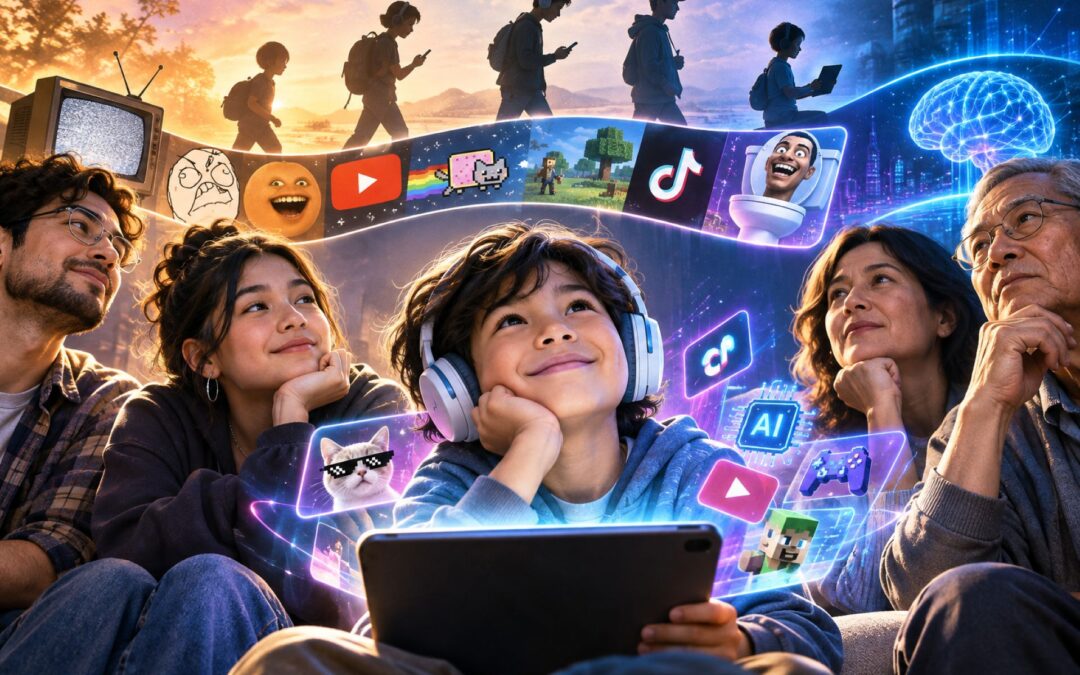
To understand Generation Alpha’s growing influence, it helps to remember a time when Gen Z was the younger audience rather than the generation creating the conversation. Around 2009, much of the internet’s emerging entertainment came from Millennials. Early YouTube personalities and comedy channels, along with rage comics, animated jokes and viral phenomena such as The Annoying Orange, formed a shared online playground. Children who would later be called Gen Z watched and repeated these jokes even though they had not invented them.
That distinction between participation and creation matters. Younger children do not enter a cultural vacuum and immediately produce their own completely original traditions. They inherit the music, games, humour, vocabulary and platforms established by those slightly older than them. At first they are an audience. As they become teenagers and gain the confidence, skills and independence to create, they begin altering what they inherited.
Through the 2010s, Gen Z increasingly influenced the rhythm and language of online life. Smartphone cameras, social networks, short-form videos and creator platforms made producing culture easier for young people who did not need access to traditional broadcasters or publishers. Teenagers could create jokes, fashion trends and performances that were shared far beyond their schools or neighbourhoods. Millennials did not stop making culture, but they no longer enjoyed the same association with whatever felt newest to teenagers.
A similar transition is taking place as Gen Alpha grows older. The young people who once seemed to be the final word on internet culture are becoming workers, university graduates and parents. Meanwhile, children raised on the content of Gen Z are starting to shape their own tastes. This is not proof that Gen Z’s influence ended in 2024 or that Gen Alpha officially took control in 2025. Cultural influence has no electoral term, and young adults continue to contribute to it long after a younger cohort emerges.
The transition is especially visible in slang. Words such as rizz, cap and gyatt are often grouped together as “Gen Alpha language,” even though their histories are more complicated. Expressions can originate in particular communities, become popular through older creators and then spread among younger audiences. Assigning every widely repeated word to the age group currently using it most enthusiastically erases the people and cultures from which it developed.
Much of what appears new is therefore inherited, adapted and made newly visible. A joke that entertained teenagers a decade earlier may return in a different format for children who have never encountered the original. The same process occurred when Gen Z adopted memes created by Millennials. It will happen again when Generation Beta, another proposed label, grows old enough to participate in the culture Alpha has helped create.
What changes is not simply the age of the people making jokes. Each transition occurs through a different set of technologies. Early YouTube required different habits from TikTok-style feeds, while interactive games, digital communities and AI tools create possibilities that older platforms did not. Those differences help explain why the next wave of culture can feel foreign even to people who were young only a few years earlier.
Skibidi Toilet and the Birth of a New Internet Culture
Few examples capture this handover as vividly as Skibidi Toilet. The animated YouTube series, created by Alexey Gerasimov under the name DaFuq!?Boom!, features human heads emerging from toilets and battling figures with cameras, televisions or speakers for heads. Its escalating conflicts, frantic movement and recurring visual jokes may appear nonsensical to someone encountering them without context. To its fans, they form a recognisable fictional world with its own characters and evolving conflicts.
The series grew rapidly in 2023 and became a cultural shorthand for the kind of entertainment associated with Generation Alpha. Yet its success is not evidence that everything about it was invented by Gen Alpha. Its creator belongs to an older cohort, and its aesthetics draw on traditions of internet remix culture, game-related animation, absurdist videos and computer-generated visual humour. Its younger audience adapted and amplified material that already had a history.
YouTube’s own discussion of emerging internet trends documented how the series developed into a participatory phenomenon rather than remaining an isolated animation. The videos encouraged viewers to follow an unfolding story, share interpretations, imitate characters and create related material. Their appeal depended partly on the culture formed around them, not merely on the strangeness of the first encounter.
Earlier generations had their own examples. Animated viral characters, surreal remixes and deliberately ridiculous short videos often seemed equally baffling to adults unfamiliar with their references. Skibidi Toilet is distinctive, but adults’ inability to understand why children enjoy it is hardly unprecedented. Something can be aesthetically strange, commercially successful and developmentally ordinary at the same time.
The more interesting point is how cultural ownership works. A creator can belong to one generation while an audience from another turns the creation into its own shared reference. Gen Alpha’s identity will become more distinct as more of its members create material themselves. For now, Skibidi Toilet illustrates a bridge between generations rather than a clean break separating them.
Why Every Generation Thinks the Next One Is Worse
The criticism directed at Gen Alpha follows a remarkably familiar script. Children supposedly lack discipline, cannot concentrate, disrespect adults and spend their time pursuing meaningless entertainment. New technology is accused of turning these problems into an unprecedented emergency. The details change, but the conclusion is predictable: childhood was better when the people making the complaint were children themselves.
Gen Z heard versions of this argument long before it began repeating them about Gen Alpha. Older commentators questioned its attention span, social habits and dependence on smartphones. Millennials were labelled entitled, self-absorbed and unwilling to work as previous generations had. Gen X was often portrayed as cynical or directionless, while Baby Boomers themselves faced accusations of selfishness, rebellion and declining morals when they were young. The popular stereotype applied to a cohort rarely resembles the entire range of people within it.
The pattern also reaches beyond the familiar modern labels. Concerns about young people’s manners, desire for comfort and unwillingness to respect elders appear in older literature and public commentary. One widely circulated passage attributes a complaint about luxurious, disrespectful children to Aristotle or Socrates. But the familiar wording is not an authentic quotation from either philosopher. Research into the quotation’s history traces it to a twentieth-century summary of supposed ancient attitudes, illustrating how an appealing story can be repeated until its attribution seems unquestionable.
There is, however, a genuine psychological question underneath the dubious quotation. Why do people who once resented criticism from their elders so readily adopt similar complaints when they grow older? Part of the answer involves selective memory. People remember childhood through emotionally important experiences, shared friendships and the technologies that first made the world feel exciting. Everyday boredom, conflict and foolish behaviour become less prominent in the retrospective picture.
Researchers John Protzko and Jonathan Schooler examined this tendency in a series of studies on the “kids these days” effect. Adults who considered themselves strong in particular qualities were more inclined to think young people were declining in those same qualities. The research also identified a role for biased perceptions of the past: people’s sense of how children used to behave was influenced by their present beliefs and self-assessments. Nostalgia alone does not explain every complaint, but it can make a comparison feel more objective than it really is.
Technological change gives these perceptions a convenient target. People who grew up without television could fear its influence; later generations questioned computers, video games, social networks and smartphones. Each group had reason to consider its own formative technology exciting or liberating while viewing the next unfamiliar development as excessive. A Millennial who remembers discovering the internet as an extraordinary new world may see a child’s immersion in AI-generated entertainment as a troubling departure from normal childhood.
That does not mean every complaint is mistaken. Adults can correctly identify real problems that affect young people. The error is moving from evidence about a particular risk to a sweeping verdict about millions of children. An alarming video of a toddler scrolling between screens tells us something about that moment; it cannot tell us what the child’s entire life looks like, how common the behaviour is or what kind of adult the child will become.
Calling an entire generation lazy or incapable also obscures the adults and institutions responsible for its environment. Children do not choose the technologies placed in their homes, the design of recommendation systems, the resources available to their schools or the disruption caused by a pandemic. Those decisions and conditions deserve scrutiny. Condemning the children themselves is much easier than understanding the world they have inherited.
The Real Challenges Facing Generation Alpha
Recognising the recurring nature of generational panic should not become an excuse to dismiss actual problems. Gen Alpha is growing up amid technological changes that previous generations did not experience in quite the same combination, and the pandemic disrupted schooling on a global scale. There are serious questions about what children are learning, how they spend their time and what healthy development should look like in an increasingly digital environment.
The evidence is more complicated than either the claim that Gen Alpha is doomed or the comforting assumption that every concern will fade away. Different problems have different causes, and improvements in one area do not prove that all children are thriving. Three commonly debated issues reveal why careful distinctions matter.
Pandemic Learning Loss and Uneven Recovery
For many children, the pandemic transformed school from a predictable daily routine into a series of interrupted lessons, remote assignments and uneven access to teachers. Some students had reliable devices, quiet rooms and adults available to help. Others shared a phone with family members, struggled with internet access or found that their schools could provide little instruction at all. The same disruption therefore produced very different educational experiences.
When classrooms reopened, it was tempting to assume students would quickly recover the lost ground. In some places, younger students did make significant progress as regular teaching resumed. But recovery was neither uniform nor automatic. The 2025 National Assessment of Educational Progress long-term trend results showed improvement for American nine-year-olds compared with earlier post-pandemic assessments, while achievement among thirteen-year-olds remained below pre-pandemic levels. Averages also concealed differences between higher- and lower-performing students.
Test scores are not the whole of childhood, yet foundational gaps matter. Difficulty reading fluently can make learning science or history harder; weak numerical understanding can create obstacles in later mathematics. Missing the period when a skill is normally taught does not mean it can never be acquired, but it may require deliberate support rather than simple optimism about children’s resilience.
It is also misleading to treat every Gen Alpha child as having suffered the same educational loss. The experience of a child beginning primary school during a strict lockdown differs from that of a child who was an infant or who attended a school able to maintain effective instruction. Countries’ closures, recovery programmes and outcomes varied substantially. The useful question is which children need which forms of help, not whether a generation can be declared academically ruined.
Do Children Still Need to Memorize Multiplication Tables?
A common accusation is that children no longer know skills adults learned automatically, especially multiplication tables. One response is that calculators are now everywhere, so memorising arithmetic is as obsolete as insisting everyone master a rarely used handwriting style. With artificial intelligence becoming more capable, perhaps children should spend their time learning to use new tools rather than remembering that eight times seven is fifty-six.
The argument identifies an important truth but draws the wrong conclusion. Schools should reconsider the purpose of what they teach as technology changes. Memorising a procedure without understanding it is not a reliable substitute for learning mathematics. Yet easy access to a calculator does not eliminate the value of basic numerical fluency any more than spell-checking eliminates the value of understanding language.
Knowing simple number relationships reduces the mental effort required to solve more complicated problems. A child who understands multiplication can estimate whether an answer is plausible, compare quantities and recognise when a device has been used incorrectly. National Academies guidance on mathematical proficiency distinguishes conceptual understanding, procedural fluency, strategic competence and reasoning as connected elements of learning. No single element can sensibly replace all the others.
AI literacy is important too. Children should eventually learn how to ask useful questions, check responses, protect personal information and understand the limitations of automated systems. But asking a chatbot for a solution is not the same as developing the judgment needed to assess it. Teaching multiplication and teaching responsible AI use are complementary educational goals, not competing visions of an intelligent generation.
Are iPad Kids Different from Television Kids?
The image of a child moving rapidly between videos on a tablet is powerful because it appears to confirm fears about attention, patience and parenting. Yet children have been entertained by screens for decades. Long before tablets existed, television occupied countless hours in family living rooms, and adults argued over whether cartoons and programming were replacing play, conversation and imagination. Screen-based entertainment is not new simply because it now fits into a child’s hands.
What is new is the combination of portability, interactivity and personalization. A television broadcast offered a limited schedule and a largely passive viewing experience. A smartphone or tablet can deliver an effectively endless stream of material selected by recommendation systems, with games and notifications available at any moment. One child may watch a thoughtful educational programme; another may spend the same amount of time rapidly switching between stimulating clips. Calling both experiences “screen time” hides important differences.
A 2025 Common Sense Media census of children aged eight and under found that digital media had become firmly embedded in the lives of young American children, with tablets and other connected devices commonly available at early ages. But averages do not reveal whether a particular child is learning, connecting with family, watching passively or missing needed sleep and physical activity. Context is essential before drawing developmental conclusions.
Research reinforces that point. Studies reviewed in JAMA Pediatrics suggest that outcomes vary with factors such as background television, the kinds of content children see and whether adults watch or interact with them. These associations should not be converted into claims that every extra minute causes predictable damage. Nor should the fact that many television-watching children grew into functioning adults be treated as proof that every current digital habit is harmless.
The American Academy of Pediatrics’ media guidance encourages families to consider the child, the content, the role of media in calming emotions, what it may be crowding out, and communication about its use. The practical aim is not merely to win an argument over a universal number of minutes. It is to protect sleep, physical play, relationships, learning and opportunities for children to manage boredom without immediately reaching for a device.
Adults are part of this equation. Tablets are sometimes used because parents are exhausted, childcare is expensive or digital entertainment is a convenient way to manage difficult moments. These pressures do not remove parental responsibility, but they help explain behaviour that is too easily dismissed as laziness. The same environment that invites children to keep scrolling also challenges adults’ own attention; the mechanisms are explored further in why we find it difficult to stop scrolling.
The responsible conclusion is neither that all iPad children are doomed nor that screen exposure deserves no concern. Technology should be judged according to what children do with it, what it replaces and how it interacts with the rest of their lives. A brief viral clip is a poor substitute for that assessment.
Are Generations Real, or Just Convenient Labels?
If generational boundaries are disputed and stereotypes are unreliable, why use generations at all? One useful analogy is colour. The visible spectrum changes gradually, but we still speak meaningfully about blue and green even when people disagree about precisely where one ends and the other begins. In a similar way, generational names can help us discuss broad differences in the experiences of people born at different times.
Someone who reached adolescence before widespread internet access faced different opportunities and constraints from someone who grew up with smartphones. A child attending school during the pandemic experienced something different from a child who finished school before it began. Recognising such differences does not require pretending that every member of a birth cohort thinks or behaves alike.
However, the colour analogy has limits. Colours refer to properties of light that can be measured, while the meaning attached to a generation depends on social choices, historical context and research methods. Dividing society into named cohorts can help organise a discussion, but the categories themselves do not explain why people behave differently. Calling someone a Zoomer does not establish that a particular opinion or habit was caused by the year of their birth.
Researchers distinguish several possible explanations. An age effect arises because people change as they grow older: teenagers and their parents may differ even if they share the same historical period. A period effect comes from events affecting people of many ages, such as a pandemic or a major technological shift. A cohort effect concerns experiences that may have a distinctive influence on people who encounter them at a particular life stage. Untangling these effects is difficult, especially when broad labels encourage confident conclusions from limited observations.
There are also major differences within generations. Wealth, geography, disability, family circumstances, language and access to education often shape a child’s experiences more directly than an arbitrary birth-year boundary. A Gen Alpha child with reliable broadband and access to AI tutoring does not inhabit the same digital world as a child struggling to obtain basic schooling. Neither experience should be treated as representative of all children born in a fifteen-year span.
Generational labels are therefore best used as maps, not verdicts. They highlight possible patterns and offer a convenient vocabulary for cultural change. They become misleading when we mistake them for fixed identities that determine intelligence, morality or the future of society.
Every Generation Inherits the World Before It
The most revealing thing about the debate over Gen Alpha may be how rarely it asks who created the conditions being criticised. Children did not build app stores, design recommendation algorithms or decide how schools should respond to a pandemic. They arrived in a world shaped by older people and learned to navigate the possibilities placed before them. When adults condemn younger generations for responding to that environment, they are also passing judgment on an inheritance they helped create.
That inheritance is not entirely negative. Earlier generations developed technologies that expanded access to knowledge, created new forms of communication and made it possible for young people to produce work that could once reach an audience only through established institutions. A teenager can now learn a skill, collaborate across countries and share a creative project without asking permission from a television station or publishing company. The same networks can expose children to misinformation, manipulation and unhealthy habits. Progress and risk often arrive together.
Human achievement is cumulative in other ways as well. Martin Luther King Jr. drew inspiration from Gandhi’s methods of nonviolent resistance, adapting those ideas to the American civil rights struggle. Scientists and inventors similarly build on discoveries, instruments and mistakes made before their time. These examples do not mean history advances automatically or that later generations are inherently wiser. They show that each generation begins with resources and problems it did not create on its own.
Parents, teachers, researchers, companies and governments therefore have a more useful responsibility than declaring Gen Alpha the best or worst generation. They can strengthen schools, create healthier digital environments, teach durable skills alongside new ones and give children opportunities to develop independence. They can also recognise their own susceptibility to nostalgia before interpreting every unfamiliar cultural practice as a warning sign.
Gen Alpha will eventually become the generation complaining about whatever children do next. Its members may recall their first online communities with affection and wonder why younger people are fascinated by some future technology they cannot immediately understand. What seems unprecedented today will become somebody else’s ordinary childhood.
The real test is not whether Gen Alpha resembles Millennials or Gen Z at the same age. It is whether society helps children grow into capable, curious and connected adults while responding seriously to the risks of their particular environment. Every generation inherits both achievements and mistakes, then contributes something to the world the next one receives. That makes generational change less a contest over who was better than an ongoing responsibility to leave something better behind.
Last Updated on November 5, 2026 by Aseem Gupta