
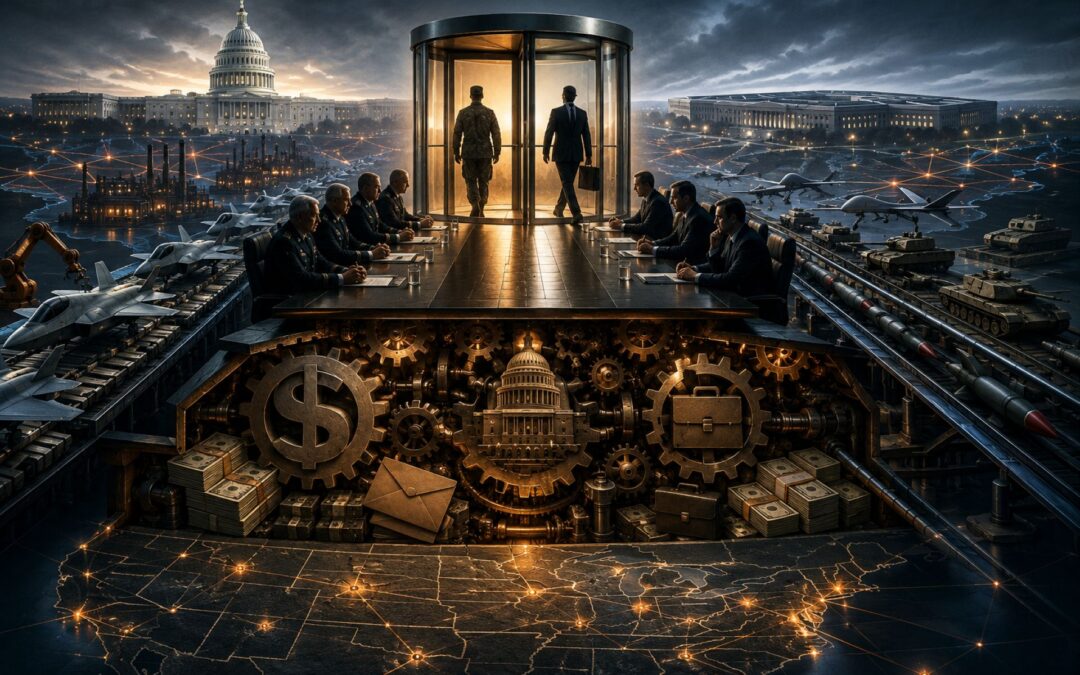
In January 2009, Barack Obama entered the White House promising to change how power worked in Washington.
One of his targets was the revolving door between government and private industry. Officials, he argued, should not be able to shape public policy, leave government, and immediately profit from the companies affected by their decisions. Nor should lobbyists be able to move into government and regulate the same industries they had recently represented.
Then came William J. Lynn III.
Lynn had previously overseen budgets and acquisitions at the Department of Defense before becoming a senior executive and registered lobbyist for Raytheon. Obama nevertheless selected him to become deputy secretary of defense. Because the appointment conflicted with the administration’s own ethics rules, Lynn required a waiver.
The decision exposed a problem much larger than one appointment.
The United States government depends heavily on people who understand weapons programmes, defence procurement, military technology and the Pentagon bureaucracy. Yet many of the people with that expertise have worked for—or expect eventually to work for—the companies seeking government contracts.
That tension sits at the heart of the US military-industrial complex.
It is not simply a group of weapons manufacturers secretly dictating foreign policy. It is a vast system of mutually reinforcing interests connecting the military, Congress, government agencies, contractors, lobbyists, investors, research institutions and communities whose jobs depend on defence spending.
The system developed over decades. World War II created an unprecedented partnership between government and industry. The Cold War made that partnership permanent. Post-Cold War consolidation reduced dozens of major contractors to a handful of dominant companies. Expensive weapons programmes created decades-long dependencies, while jobs, campaign contributions and the revolving door gave military spending political protection.
The result is a defence establishment capable of extraordinary technological and industrial achievements—but also one whose influence can be difficult to scrutinize, challenge or control.
What the Military-Industrial Complex Actually Is
The phrase “military-industrial complex” is often used as shorthand for arms companies or war profiteering. But the system is much broader than the corporations that manufacture aircraft, missiles, ships and weapons.
It includes the armed forces that define military requirements, the civilian officials who approve acquisition programmes, the members of Congress who authorize and fund them, the contractors that design and manufacture equipment, and the lobbyists who argue for particular budgets and policies.
It also includes universities conducting defence-funded research, think tanks producing national-security analysis, investment firms financing military technology, consultants advising both government and industry, and local economies that depend on military bases or manufacturing facilities.
No single institution controls this entire structure.
That is precisely why it is so powerful.
Its influence does not require a secret meeting where generals, politicians and executives collectively decide to start a war. The system operates through incentives. Each participant may pursue a goal that appears reasonable in isolation.
Military leaders want better equipment and greater readiness. Contractors want predictable revenue and profitable programmes. Politicians want jobs and investment in their districts. Government agencies want access to specialized knowledge. Former officials want lucrative careers after public service. Investors want exposure to a market backed by the spending power of the federal government.
Together, these incentives can create a system that continually favours higher spending, longer programmes and military solutions—even when no participant believes they are acting corruptly.
The military-industrial complex is therefore best understood not as a conspiracy, but as a durable political economy.
The Revolving Door Obama Could Not Close
Obama’s ethics pledge attempted to restrict the movement of lobbyists and officials between government and private industry.
The rules were more complicated than a universal two-year ban. They included recusals preventing appointees from working on certain matters connected to former employers, restrictions on issues recent lobbyists had handled and limits on lobbying the administration after leaving government. The pledge also allowed waivers when officials argued that an appointment served the public interest.
William Lynn became one of the earliest and most visible exceptions.
Lynn had served as under secretary of defense during the Clinton administration, where he worked on budgets and acquisition policy. He later joined Raytheon, one of the Pentagon’s largest contractors, eventually becoming a senior vice president and registered lobbyist.
When Obama nominated him as deputy secretary of defense, critics argued that the appointment contradicted the administration’s promise to change Washington’s culture. The administration responded that Lynn possessed expertise that would be difficult to replace.
Both arguments contained some truth.
A defence department managing complicated weapons systems and an enormous budget needs officials who understand procurement. But when the most qualified candidates repeatedly come from companies receiving Pentagon contracts, expertise and financial interest become difficult to separate.
Lynn served at the Pentagon until 2011 and later became chief executive of DRS Technologies, another major defence company.
His career was not an unusual anomaly. A Government Accountability Office investigation found that 14 major contractors employed 1,718 people in 2019 who had left senior or acquisition-related Department of Defense positions between 2014 and 2019. Those companies employed more than 37,000 former Defense Department personnel from the same departure cohort overall.
The revolving door persists because it solves immediate problems for everyone involved.
Government agencies obtain experienced officials. Contractors gain people who understand Pentagon priorities, procedures and relationships. Former public servants receive salaries that government cannot match.
The public, however, is left to wonder whether policy is being shaped entirely in the national interest—or partly by the career opportunities waiting on the other side of government service.
World War II Built a New Relationship Between Government and Industry
The United States had military suppliers, arsenals, shipyards and weapons manufacturers long before World War II. Private companies had produced firearms, ships, aircraft and other military equipment for generations.
What changed during World War II was not the existence of defence production, but its scale.
The war demanded the rapid construction of an industrial system capable of supplying millions of troops across several continents. Civilian factories were converted to military production. Automobile companies built aircraft, tanks and engines. Shipyards launched vessels at extraordinary speed. Universities and laboratories became part of the research effort.
The federal government did not merely purchase finished products from the market. It helped organize production, allocate raw materials, finance industrial expansion and coordinate supply chains.
Franklin D. Roosevelt created the War Production Board to direct this transformation. Government agencies developed close working relationships with corporate executives, engineers, scientists and factory managers. The distinction between public military planning and private industrial production became increasingly blurred.
This collaboration was essential to victory.
It also established habits, institutions and relationships that would survive the war.
In earlier conflicts, military demand had often risen sharply during wartime and declined after peace returned. Companies could return to civilian markets, while armies demobilized and government contracts disappeared.
World War II created something far larger: an industrial network designed to maintain continuous technological and production superiority.
When the war ended, the United States did demobilize millions of troops. But it did not return to its earlier relationship with military power.
A new geopolitical struggle had already begun.
The Cold War Made the Defence Economy Permanent
The confrontation with the Soviet Union transformed military production from an emergency activity into a permanent national commitment.
The United States maintained large standing armed forces, established military alliances around the world and invested heavily in nuclear weapons, bombers, submarines, missiles, surveillance systems and advanced aircraft.
The Korean War reinforced the belief that the country could not afford to dismantle its defence capacity after every conflict. Military readiness had to be maintained even during periods without direct great-power war.
For industry, this changed the economics of defence.
Companies could now specialize in military production with the expectation that government demand would continue. Boeing expanded its military aviation business. Lockheed became deeply involved in fighter aircraft, reconnaissance systems and missiles. General Dynamics developed around military platforms including submarines, aircraft and armoured vehicles.
Weapons also became more technically complex.
A rifle or truck could be manufactured by many companies with existing commercial capabilities. A nuclear submarine, intercontinental missile or high-performance fighter aircraft required specialized facilities, classified knowledge, dedicated engineers and long development periods.
This complexity made government more dependent on a smaller group of firms.
It also made defence programmes harder to stop. Once billions had been invested in a particular technology, abandoning it meant writing off years of research, retraining military personnel and finding an alternative supplier—if an alternative existed at all.
The Cold War therefore produced more than a larger military budget.
It created an ecosystem in which the government and defence industry increasingly required one another.
Eisenhower Warned About Necessary Power Becoming Unaccountable Power
Few people understood the importance of military strength better than Dwight D. Eisenhower.
He had served as Supreme Allied Commander during World War II, became NATO’s first supreme commander and spent eight years as president during some of the most dangerous years of the Cold War.
His warning about the military-industrial complex was not an argument for abolishing the armed forces or dismantling the defence industry.
In his farewell address on January 17, 1961, Eisenhower acknowledged that the United States required a permanent armaments industry. The country faced a powerful adversary, new technologies and global commitments that could not be managed through temporary wartime mobilization.
But he also recognized that something historically unusual had emerged.
The United States now possessed an enormous permanent military establishment tied to a large private industry. Its economic, political and intellectual influence reached into Congress, government agencies, universities and communities across the country.
Eisenhower feared that this combination could acquire “unwarranted influence,” whether deliberately sought or simply produced by the system’s accumulated power.
The distinction mattered.
A contractor did not need to bribe every politician. A general did not need to conspire with every executive. A member of Congress did not need to prefer war.
Influence could grow naturally because institutions, careers and local economies had become dependent on continued military spending.
Eisenhower was warning about momentum.
Once a powerful system becomes embedded in national life, it begins to shape what government considers necessary, realistic and politically possible.
The Pentagon’s “Last Supper” Created a More Concentrated Industry
The collapse of the Soviet Union appeared to challenge the entire system.
Without a rival superpower, US military spending declined as a share of the economy. Officials spoke of a “peace dividend,” while defence companies confronted the possibility that the government no longer needed so many suppliers.
In 1993, Defense Secretary Les Aspin and Deputy Secretary William Perry invited senior defence executives to a dinner that later became known as the Pentagon’s “Last Supper.”
The message was blunt: the industry needed to consolidate.
According to the Pentagon’s own history of defence acquisition, officials believed the United States had more contractors than the reduced post-Cold War budget could support. Larger companies, they hoped, would eliminate duplicated capacity, reduce overhead and preserve vital capabilities.
A wave of mergers followed.
Lockheed combined with Martin Marietta. Northrop acquired Grumman. Boeing absorbed McDonnell Douglas. Other companies merged, sold divisions or exited the defence market.
From a short-term financial perspective, the consolidation appeared rational. The government could not sustain every company built around Cold War levels of demand.
But consolidation created a new problem.
The Department of Defense later reported that the number of major aerospace and defence prime contractors had fallen from 51 to five. Suppliers of tactical missiles declined from 13 to three. The number of major fixed-wing aircraft suppliers fell from eight to three, while major satellite manufacturers declined from eight to four.
The government had reduced excess capacity.
It had also reduced competition.
Concentration Made the Pentagon Dependent on Its Suppliers
Competition is one of the basic tools governments use to control prices and improve performance.
When several companies can provide a product, the government can compare bids, reject poor performers and move business elsewhere. When only one or two companies possess the facilities, security clearances, data rights and technical experience needed to build a system, those options disappear.
Defence consolidation made the Pentagon increasingly dependent on a small group of contractors.
That dependence extends beyond the initial purchase.
Once a company develops a fighter aircraft, submarine, missile or radar system, it often remains involved for decades. The platform requires maintenance, replacement parts, software upgrades, training, testing and integration with new technologies.
Switching suppliers may be technically impossible or prohibitively expensive.
The original contractor may control proprietary designs, specialized tools and knowledge accumulated over years. Even when the government owns part of the technical data, another company may need enormous investment and time to reproduce the necessary capability.
The result is a form of vendor lock-in backed by national-security urgency.
The Pentagon cannot simply allow a submarine programme or missile supplier to fail in the way a consumer might stop buying from an unpopular brand. If a contractor provides a unique military capability, preserving that company may itself become a strategic necessity.
A 2022 Department of Defense report on competition acknowledged that consolidation had reduced competitive pressure and created risks for innovation, costs and supply-chain resilience.
The Government Accountability Office has similarly warned that the Pentagon needs better information about how mergers affect prices, capacity, innovation and the availability of alternative suppliers.
This reveals one of the central contradictions of the modern military-industrial complex.
The largest contractors are powerful partly because the government cannot afford to lose them.
Why Defence Contracting Does Not Work Like an Ordinary Market
Defence companies do not operate in a normal consumer market.
Their largest customer is usually the government. Their products may take decades to develop, have no civilian equivalent and require billions of dollars before anyone knows whether the technology will work as intended.
A smartphone company can release a product, observe customer demand and improve the next version. A company developing a new fighter aircraft may spend years solving engineering problems before producing a usable platform.
This uncertainty shapes the contracts the Pentagon uses.
Fixed-price contracts place more cost risk on the contractor. The company agrees to deliver a product for a specified amount and may absorb losses if expenses rise.
Cost-reimbursement contracts place more risk on the government. The contractor is repaid for allowable costs and receives an additional negotiated fee. Such contracts can be appropriate when development is too uncertain for companies to estimate expenses reliably.
However, they also create weaker incentives to control costs.
The transcript’s claim that contractors simply receive a fixed percentage of every additional dollar is misleading. The Federal Acquisition Regulation prohibits cost-plus-a-percentage-of-cost contracts, and many cost-reimbursement arrangements use fees that do not automatically increase with every cost overrun.
The broader incentive problem remains real.
When the government carries much of the financial risk, a contractor may face less pressure to reduce costs than a company operating in a competitive commercial market. When only one company can complete the project, the Pentagon may have little choice but to continue funding it.
Long development cycles also create political pressure.
By the time a troubled programme becomes visibly expensive, the government may already have invested billions of dollars, established bases, trained personnel and promised work to suppliers across the country.
Cancellation becomes an admission that years of spending produced no usable capability.
Continuing the programme can appear easier than accepting the loss.
The F-35 Shows How Long-Term Dependency Develops
The F-35 Joint Strike Fighter illustrates how technological ambition, industrial complexity and political commitment can combine to create an extraordinarily durable programme.
The aircraft was intended to replace several older platforms with three related variants serving the Air Force, Navy and Marine Corps. International partners joined the programme, while suppliers across the United States and allied countries became involved in production.
The strategy promised scale, interoperability and lower costs through shared technology.
Instead, the programme encountered development delays, software problems, design changes, maintenance challenges and rising sustainment expenses. Aircraft entered production while testing and development were still continuing, meaning some already-built planes later required modifications.
Yet the F-35 could not simply be discarded.
The United States and partner countries had designed future air forces around it. Pilots were being trained, bases upgraded and older aircraft retired. Hundreds of suppliers had become part of its industrial network.
By 2024, the Government Accountability Office estimated that the United States expected to spend more than $2 trillion acquiring and sustaining the F-35 fleet through 2088. Estimated sustainment costs alone had risen from roughly $1.1 trillion in 2018 to approximately $1.58 trillion in 2023.
Those figures do not mean the aircraft has no military value. The F-35 provides advanced sensors, stealth capabilities and information-sharing functions that older aircraft cannot easily reproduce.
The more important lesson is structural.
Once a government commits to a technically ambitious platform, builds its strategy around that platform and allows the contractor to accumulate unique knowledge, the relationship can last for generations.
The contractor is no longer merely selling an aircraft.
It becomes part of the country’s military infrastructure.
Defence Jobs Turn Military Spending Into Local Politics
Weapons programmes are not located in Washington alone.
They support factories, suppliers, maintenance depots, research facilities and military bases across the country. Each facility provides jobs, tax revenue and business for local communities.
This gives national military spending a local political identity.
A representative may have concerns about the Pentagon budget in theory but still defend a specific aircraft, ship or facility employing people in their district. A senator may criticize waste while arguing that a local military base is essential to national security.
Contractors understand this political geography.
Major programmes frequently involve suppliers spread across numerous states and congressional districts. Some of this distribution reflects genuine technical specialization. Different companies possess different facilities, skills and manufacturing capabilities.
But geographic distribution also creates political resilience.
The F-35 programme, for example, has supported direct and indirect employment across most of the United States. Cancelling it would therefore affect not only Lockheed Martin but also manufacturers, engineers and communities represented by dozens of members of Congress.
A programme with one factory is politically vulnerable.
A programme supporting workers across the country has a congressional coalition.
This is often described as pork-barrel politics, but the label can obscure the complexity involved. Defence employment is real. Communities can suffer when military facilities close. Skilled manufacturing capacity, once lost, may take years to rebuild.
The political problem arises when preserving jobs becomes indistinguishable from proving that a programme is strategically necessary.
At that point, defence policy is no longer shaped solely by what the military needs.
It is also shaped by what local economies cannot afford to lose.
Campaign Contributions Reinforce the Congressional Coalition
Defence companies do not rely only on jobs and supply chains. They also participate directly in the political system through campaign contributions and lobbying.
Their contributions frequently target lawmakers serving on the House and Senate Armed Services Committees, which play central roles in shaping defence policy and authorizing military budgets.
A Public Citizen analysis of the 2022 election cycle found that defence-sector employees and political action committees contributed approximately $10.2 million to members of the two committees before votes to increase the proposed 2023 Pentagon budget.
Lawmakers who voted for the increases received substantially more, on average, than those who voted against them.
That relationship is important, but it must be interpreted carefully.
Campaign data alone cannot prove that a contribution purchased a particular vote. Members representing defence-heavy districts may support higher military spending for ideological, strategic or local economic reasons and therefore naturally attract industry donations.
The influence often works through access rather than explicit exchange.
Companies support politicians who share their priorities. Those politicians meet executives and lobbyists, hear their policy arguments and rely on industry information when evaluating complex programmes.
Meanwhile, the public interest is diffuse.
A contractor may have millions or billions of dollars at stake in a specific decision and will organize accordingly. Individual taxpayers may each bear only a tiny share of the cost and have little reason to study the programme or contact Congress.
The groups receiving concentrated benefits therefore have a stronger incentive to influence policy than the much larger population carrying the dispersed cost.
This is not unique to defence.
But the scale of military spending and the secrecy surrounding national-security decisions make the imbalance especially consequential.
The Revolving Door Connects Public Authority and Private Opportunity
Campaign contributions influence the system from outside government. The revolving door influences it from within.
Former Pentagon officials, military officers and congressional staff members possess knowledge that defence companies value enormously.
They understand acquisition rules, budget cycles, military requirements and the informal relationships that determine how decisions move through government. They know which offices matter, which arguments persuade officials and which programmes are gaining institutional support.
Hiring them can give contractors a major advantage.
A Quincy Institute study found that 26 of the 32 four-star generals and admirals who retired between June 2018 and July 2023 later took positions connected to the arms industry. They became executives, board members, advisers, consultants, lobbyists or financiers.
Some former officials join traditional contractors. Others enter private equity, venture capital or consulting firms investing in military technology.
The movement also works in the opposite direction.
Industry executives and advisers enter government, where they may oversee policies affecting former employers or clients. Ethics rules can require recusals, divestment or waivers, but informal knowledge and professional relationships cannot be erased.
Not every person who moves through the revolving door acts improperly.
Former military officers may offer legitimate insight into battlefield requirements. Former procurement officials can help companies navigate complicated rules and deliver equipment more effectively. Industry experts entering government may understand technology better than career bureaucrats.
The danger is not that expertise crosses institutional boundaries.
The danger is that public service can become part of a private career strategy.
An official who expects to seek defence-industry employment may hesitate to alienate potential employers. Even without an explicit promise, the possibility of a future salary, board position or consulting contract can shape incentives.
A democratic government should not require proof of corruption before recognizing a conflict of interest.
Sometimes the appearance of dependence is itself damaging.
Does the Military-Industrial Complex Make War More Likely?
The military-industrial complex clearly benefits from sustained defence spending.
That does not prove that arms companies single-handedly cause American wars.
Countries enter conflicts for many reasons: security threats, alliance commitments, ideology, domestic politics, intelligence failures, presidential decisions, humanitarian arguments, bureaucratic competition and miscalculations by foreign governments.
Defence contractors do not control all these forces.
But the military-industrial complex can shape the environment in which decisions are made.
It can make military responses easier to imagine because the institutions, equipment and budgets already exist. It can create organized constituencies that benefit from higher spending. It can give contractors and former officials greater access to policymakers than anti-war groups or ordinary taxpayers possess.
It can also affect which threats receive attention.
Companies selling missile defence systems have reasons to emphasize missile threats. Shipbuilders benefit when naval competition becomes a priority. Cybersecurity contractors gain when governments view digital conflict as a central national-security challenge.
These threats may be entirely real.
The concern is that organizations with financial interests often possess more resources to define the problem—and propose the solution—than groups advocating diplomacy, restraint or non-military investment.
The system can influence policy in several ways:
- It makes military tools readily available while diplomatic capacity often receives fewer resources.
- It creates political costs for cancelling weapons programmes, even after strategic requirements change.
- It rewards officials who maintain good relationships with contractors and investors.
- It encourages threat assessments that justify long-term procurement.
- It normalizes rising military expenditure as the safest political position.
The influence is usually indirect.
A contractor does not need to demand a war. It only needs to support the budgets, doctrines and threat perceptions that keep demand for its products strong.
The result is not a government mechanically controlled by weapons companies.
It is a government operating inside a system where military expansion has powerful organized supporters, while restraint often does not.
Why the System Is So Difficult to Reform
Reforming the military-industrial complex is harder than simply cutting the defence budget or prohibiting officials from joining private companies.
The United States genuinely needs a functioning defence-industrial base.
Weapons, munitions, ships, aircraft and communication systems cannot be produced instantly after a crisis begins. Skilled workers, specialized facilities and complex supply chains must be maintained in advance.
Recent concerns about munitions shortages, shipbuilding delays and fragile suppliers demonstrate that enormous spending does not automatically produce sufficient industrial capacity.
The challenge is therefore not to destroy the relationship between government and industry.
It is to make that relationship more competitive, transparent and accountable.
Stronger merger scrutiny could prevent further concentration and examine whether proposed deals would eliminate essential suppliers. The Pentagon could secure broader rights to technical data and encourage open system architectures, making it easier for multiple companies to provide upgrades and components.
Acquisition agencies could also rebuild internal technical expertise.
When the government lacks engineers, cost analysts and programme managers capable of independently evaluating contractor claims, it becomes more dependent on the companies it is supposed to supervise.
Cooling-off periods and disclosure rules could be expanded for senior officials entering industries they recently oversaw. Ethics waivers could be made rarer and more transparent, while lobbying definitions could cover forms of influence that do not involve formally registered lobbyists.
Congress could demand clearer evidence before protecting programmes primarily because they support local jobs. Independent audits and more realistic cost estimates could expose failing projects earlier, before financial and political commitments become irreversible.
None of these reforms would eliminate conflict or self-interest.
They would create friction.
And friction is exactly what an entrenched system lacks. When contracts, careers, congressional interests and military plans all point in the same direction, decisions can acquire momentum before the public fully understands their consequences.
Reform means restoring the government’s ability to say no.
Eisenhower’s Warning Still Matters
The United States spent an estimated $997 billion on its military in 2024, more than any other country and roughly 37 percent of global military expenditure.
That spending supports forces stationed around the world, advanced technologies, nuclear deterrence, intelligence systems, alliances and military operations. It also supports one of the most powerful corporate and political ecosystems ever created.
The existence of that ecosystem does not mean every weapon is unnecessary, every contractor is corrupt or every military decision is driven by profit.
It means the country must continually ask who benefits, who decides and what alternatives were excluded before a policy appeared inevitable.
Eisenhower did not warn that military and industrial power would automatically destroy American democracy. He warned that such power could become dangerous if citizens and institutions stopped scrutinizing it.
His concern was not simply the amount of money involved.
It was the possibility that a system created to defend liberty could acquire enough influence to distort democratic choices.
More than six decades later, the military-industrial complex survives because it is woven into the structure of government itself. It provides expertise the Pentagon needs, jobs Congress wants, technologies the armed forces depend on and careers that officials find difficult to refuse.
Its power does not come from one company, one corrupt politician or one secret plan.
It comes from a system in which almost every major participant has a reason to keep the machinery moving.
The greatest danger is therefore not that the United States has a defence industry.
It is that the country may gradually lose the ability to distinguish genuine national-security needs from the momentum of the institutions built to serve them.
Last Updated on July 14, 2026 by Aseem Gupta