
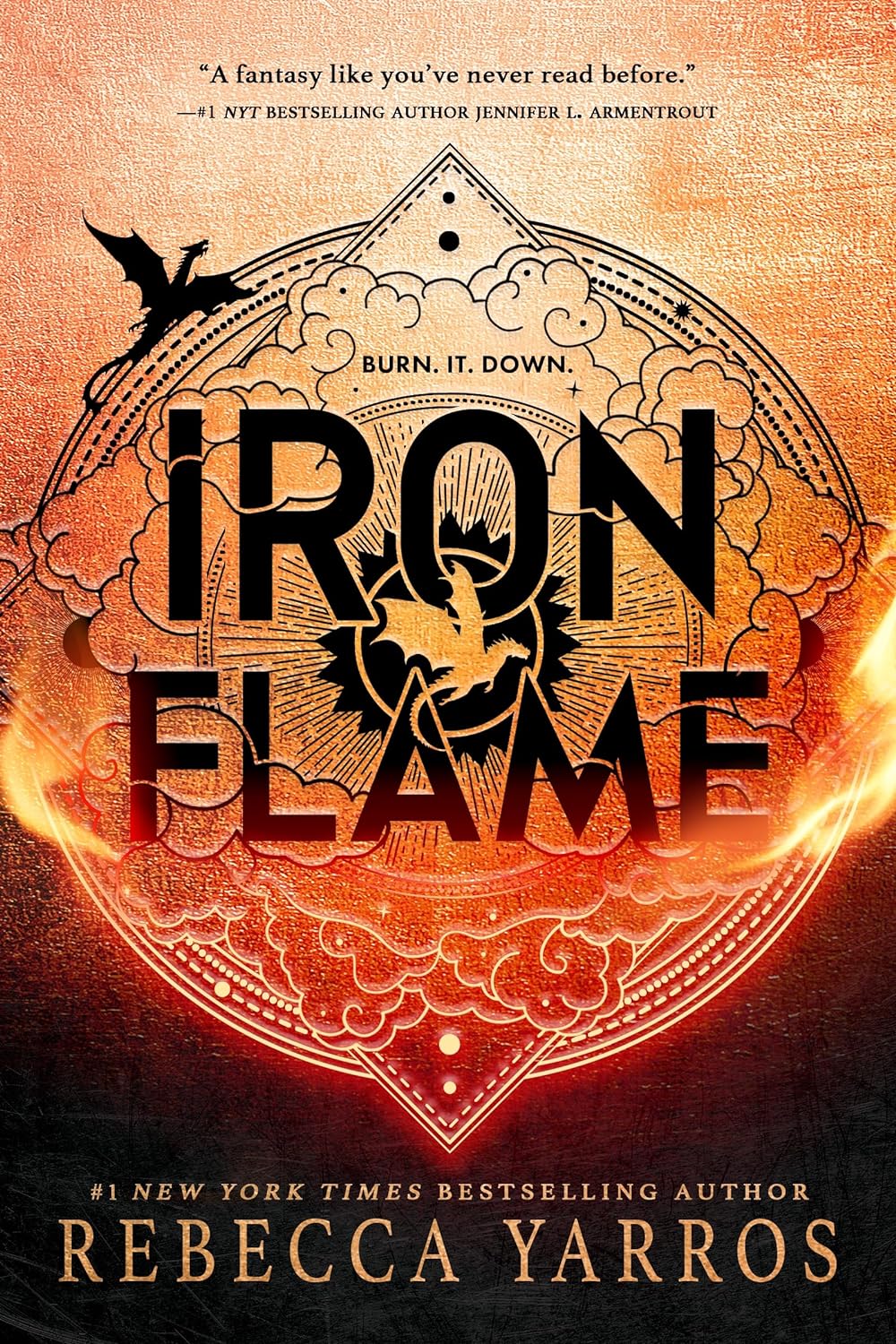
Rebecca Yarros’s Iron Flame, the second novel in The Empyrean series, continues Violet Sorrengail’s story after her first year at Basgiath War College. Published on November 7, 2023, by Red Tower Books, an imprint of Entangled Publishing, the novel expands the dangerous world introduced in Fourth Wing into a much larger conflict involving political deception, forbidden magic, military rebellion, and the survival of entire kingdoms.
Violet has discovered that the government she was raised to serve has concealed the existence of venin, powerful enemies who drain magic directly from the earth. She also knows that Xaden Riorson, the man she loves, has been secretly supplying weapons to people Navarre has abandoned. These discoveries place her in an impossible position: she must return to the military college that trained her, conceal what she knows from its authorities, and find a way to protect people whose lives depend on information she cannot safely reveal.
The novel follows Violet through an increasingly brutal second year, the collapse of her trust in Basgiath, the rebuilding of a resistance movement, and a desperate attempt to recover the magical knowledge needed to defeat the venin. Alongside these events, her relationship with Xaden becomes a continuing struggle over secrecy, emotional honesty, and the responsibilities that love creates.
Spoiler Warning: This article contains a complete summary of Iron Flame, including major deaths, the revelations about Andarna and Xaden, the final battle, and the ending. It also discusses significant events from Fourth Wing.
Aretia, Brennan, and the Return to Basgiath
Iron Flame begins shortly after the battle at Resson, where Violet learned that the creatures her country dismisses as mythical are real. Venin have been attacking settlements beyond Navarre’s protective wards, using forbidden magic to drain power from the earth and commanding wyvern, dangerous creatures resembling dragons. The Navarrian government has known about these enemies while concealing their existence from its own citizens and abandoning people outside its borders.
The revelations have already cost Violet dearly. Liam Mairi, a fellow rider and close friend who protected her throughout much of her first year, died at Resson. Violet herself was nearly killed by a poisoned venin blade before being carried to Aretia, the supposedly destroyed capital of Tyrrendor. There, she awakens to find her older brother Brennan alive, despite having believed for six years that he died during the Tyrrish rebellion.
Brennan has been serving the resistance under the name Aisereigh. A gifted mender and military officer, he survived the earlier conflict with the help of Naolin, Tairn’s previous rider, whose attempt to save him apparently cost Naolin his life. Brennan subsequently joined the effort to protect populations threatened by venin, accepting the personal cost of allowing his family to mourn him.
Violet is overwhelmed by the discovery. She remembers Brennan as a loving, protective brother, yet the man before her has become a senior figure in a movement she barely understands. His survival is a relief, but it also introduces another betrayal of trust: someone she loves has made a life-changing decision about what she deserves to know.
Brennan brings Violet into contact with Aretia’s Assembly, the governing council directing the resistance. Its members do not automatically welcome her. She is General Lilith Sorrengail’s daughter, and her mother played a significant role in suppressing the earlier rebellion. Although Xaden and Brennan defend her, members of the Assembly understandably question whether she can be trusted with their operations.
The meeting reveals the resistance’s practical difficulties. Aretia has secretly been rebuilt, but its defenses remain incomplete. Its inhabitants require weapons capable of killing venin, and producing those weapons depends on access to materials and specialized magical equipment. Viscount Tecarus, a powerful Poromielian nobleman, possesses a luminary that could help forge the necessary weapons, but negotiations with him have reached an impasse.
Violet learns that Aretia possesses an inactive wardstone. If the resistance could recreate the magic protecting Navarre, it might establish similar defenses outside the kingdom. Unfortunately, the knowledge required to activate the stone appears to have disappeared from ordinary historical records.
Violet proposes investigating the earliest accounts of Navarre’s wards. Her childhood training in the Scribe Quadrant has given her an unusual familiarity with languages, military history, and archival research, making her particularly suited to the problem. Brennan and Xaden recognise the value of her idea, although neither believes retrieving the information will be easy.
Meanwhile, Violet reunites with her dragons. Tairn remains the powerful black dragon whose bond allows her to wield lightning. Andarna, previously a small golden feathertail capable of stopping time, has grown enormously after entering an accelerated developmental stage. Her scales have darkened, her body has changed, and the ability to stop time is gone. She is also preparing for a prolonged period of sleep known as the Dreamless Sleep, leaving Violet uncertain about when she will next communicate with her.
Violet and Xaden must decide whether to remain in Aretia or return to Basgiath. Staying would expose the surviving riders and marked cadets to suspicion, while refusing to return could allow Navarre’s authorities to declare them deserters or traitors. Returning means entering an institution that has already demonstrated its willingness to sacrifice cadets for political purposes.
They choose to go back, concealing the truth about Resson and explaining their absence through a carefully constructed account of the battle. Their arrival interrupts an official announcement that Xaden has died, forcing the leadership to adjust its version of events.
General Sorrengail confronts the returning riders, while Colonel Aetos attempts to protect himself from responsibility for the assignment that placed Violet and her companions in danger. It becomes apparent that Aetos acted without the general’s full knowledge, although Violet cannot determine how much the senior leadership actually understands about the venin.
Dain Aetos, Violet’s former closest friend, remains deeply implicated in what happened. During the previous novel, his ability to retrieve memories through physical contact helped expose information that eventually reached his father. Violet now sees that his commitment to military rules made him susceptible to manipulation, and their friendship has been badly damaged.
The surviving first-year riders are promoted into their second year, while Xaden and the other graduating riders receive military postings. Xaden is assigned to Samara, an important border outpost, separating him from Violet and complicating their relationship. Because Tairn and Xaden’s dragon Sgaeyl are bonded mates, the separation cannot be treated as an ordinary military assignment. The riders and dragons must find ways to accommodate their connections without drawing unwanted attention.
Violet’s personal relationship with Xaden is equally complicated. She loves him, but discovering the existence of the revolution, Brennan’s survival, and the hidden venin war has made her question how much of their relationship was based on genuine mutual knowledge.
Xaden insists that revolutionary secrets are not his alone to disclose. Violet argues that she cannot make informed decisions while he withholds information affecting her safety and future. Neither position is entirely unreasonable, but they cannot agree on where necessary secrecy ends and betrayal begins.
Their disagreement remains unresolved when Violet begins her second year. She has survived the first year’s murderous training, but she is now a far more dangerous person in the eyes of Basgiath’s leadership: a capable rider who possesses knowledge the government has spent generations suppressing.
Varrish’s Regime and Violet’s Dangerous Secrets
The second year introduces a different kind of danger. Where first-year training rewarded cadets who survived physical challenges and bonded dragons, the advanced curriculum is intended to prepare riders for capture, interrogation, and the psychological demands of war.
Professor Grady introduces the Rider Survival Course, explaining that riders must learn how to operate when separated from their dragons and deprived of their powers. The training will involve navigation exercises, simulated imprisonment, and interrogations designed to test their resistance to coercion.
For Violet, these exercises have consequences beyond the curriculum. She possesses information about Aretia, Brennan, the venin, and Xaden’s military activities. If an interrogator discovers those secrets, the lives of many people could be endangered. She begins strengthening the mental shields that protect her thoughts and memories from intrusion.
The arrival of Major Burton Varrish makes her situation more dangerous. Varrish becomes vice commandant of the Riders Quadrant and quickly establishes himself as an authoritarian officer who values obedience over judgment. His willingness to use cruelty is demonstrated during Conscription Day, when incoming cadets cross the dangerous parapet.
Among the new candidates are Sloane Mairi, Liam’s younger sister, and Aaric Graycastle, who is secretly Prince Cam, a son of Navarre’s king. Sloane bears a rebellion relic and has been raised under the stigma attached to children of executed rebels. Aaric has concealed his royal identity because he intends to become a rider against his family’s wishes.
The ceremony turns deadly when Varrish’s orange dragon, Solas, attacks cadets who panic and flee. Several are killed, including Ciaran, and the violence establishes how little protection the institution offers even to its newest recruits. Tairn intervenes when Solas threatens Violet, demonstrating that Varrish’s authority over cadets does not extend to controlling every dragon.
Tairn’s intervention humiliates Varrish and creates a lasting conflict. The vice commandant cannot easily attack Violet while Tairn is protecting her, but he can exploit military rules, academic requirements, and disciplinary procedures to make her life increasingly difficult.
Violet also faces danger outside official training. She suspects that Colonel Aetos remains determined to eliminate anyone who knows what happened at Resson. During a combat challenge, a man attempts to assassinate her but instead kills Nadine, a fellow rider whose appearance causes the attacker to mistake her for Violet.
Violet kills the assassin, but Nadine’s death confirms that the danger now extends to people around her. She cannot determine the full structure of the conspiracy, and the military establishment provides little reason to believe that an investigation will protect her.
The atmosphere of uncertainty affects her relationship with Sloane. Liam’s sister blames Violet for Liam’s death and initially resists her attempts to help. Violet, carrying guilt over her friend’s sacrifice, refuses to abandon Sloane. She uses Liam’s letters and assistance from Imogen to help the younger cadet prepare for the brutal demands of rider training.
Sloane’s difficulties are more than an expression of resentment. She lacks experience with the combat methods expected at Basgiath and must survive among people who regard her family’s political history with suspicion. Violet understands that protecting Sloane cannot mean simply shielding her from every danger; she must help her acquire the skills necessary to survive independently.
At the same time, Violet begins investigating the historical origins of Navarre’s wards. She turns to Jesinia Neilwart, a friend training in the Scribe Quadrant, who can access records unavailable to ordinary riders. Their search focuses on the First Six, the earliest dragon riders credited with establishing the protective magical barrier around Navarre.
Violet’s investigation is complicated by the Archives’ restrictions. Materials concerning ancient ward magic are scarce, while requests for particular military records can attract disciplinary attention. Even apparently routine historical questions become dangerous when they approach information the authorities want hidden.
Her romance with Xaden continues through visits, arguments, and letters. Xaden begins sharing details of his past in writing, attempting to demonstrate that he is willing to let Violet know him as a person even when he cannot reveal every operation conducted by the resistance.
During a visit to Samara, Violet sees more of Navarre’s border defenses and learns about the magical alloy used in daggers capable of killing venin. Xaden explains that such weapons require the transfer of power through a process called imbuing. The resistance needs a luminary because making enough effective weapons is impossible with its existing equipment.
This knowledge changes Violet’s understanding of the war. Defeating venin requires more than powerful individual riders or courageous dragon attacks. It demands military infrastructure, specialized resources, and the recovery of magical techniques that Navarre has monopolized.
Varrish meanwhile demands that Violet produce Andarna for flight maneuvers, refusing to accept that the dragon is undergoing a necessary developmental sleep. When Violet cannot comply, he punishes her by forcing her to channel lightning beyond safe limits.
The exercise pushes Violet toward burnout, a potentially fatal condition caused by drawing or wielding more power than a rider can safely contain. Tairn intervenes, but the incident demonstrates how Varrish can turn ordinary training requirements into instruments of torture.
The conflict also exposes a significant difference between rider and dragon authority. Varrish treats a dragon’s needs as subordinate to his commands, whereas Tairn insists on the autonomy of his kind. Violet’s safety therefore depends partly on a relationship that Basgiath cannot fully control.
By this stage, Violet is fighting three interconnected battles. She must survive Varrish’s deliberate persecution, conceal information that could destroy the revolution, and discover the truth about the wards before the venin advance farther into defenseless territory.
Her greatest immediate weakness is that she is trying to manage these dangers while excluding almost everyone she trusts. The more she attempts to protect her friends through silence, the more isolated and vulnerable she becomes.
Survival Training, Censored History, and Fractured Trust
The survival course puts the second-year riders through exercises designed to remove the advantages they ordinarily receive from their dragons. Cadets are drugged to suppress their magical connections and placed in difficult terrain where they must navigate without the abilities on which they have come to depend.
Violet and her squad are assigned to cooperate with infantry cadets, a requirement that exposes longstanding divisions within Navarre’s military. The groups have different training, assumptions, and levels of familiarity with the landscape. Their maps contain contradictory information, making their task more difficult than the instructors acknowledge.
The exercise demonstrates how easily apparently authoritative information can become unreliable. Violet is accustomed to solving problems through preparation and study, but she finds that correct reasoning is impossible when the available materials are inaccurate. The cadets eventually require rescue after failing to reach their intended destination.
This experience parallels Violet’s investigation of the Archives. She increasingly suspects that Navarre’s historical record has been altered, particularly regarding attacks near its borders and the events surrounding the kingdom’s founding.
Professor Markham’s history lessons reinforce that suspicion. He uses reports of political unrest, military losses, and displaced Poromielians to demonstrate how governments can shape public opinion. Yet his lessons also reproduce the very techniques he describes, presenting information in ways that conceal the reality of the venin war.
Violet notices discrepancies between the official curriculum and what she personally witnessed at Resson. Accounts of attacks that should have been widely documented have disappeared or been rewritten, while the earliest histories survive only through later editions, translations, and authorized interpretations.
Jesinia’s assistance becomes indispensable. As a scribe, she has access to catalogues and restricted records that Violet cannot obtain through normal channels. However, helping Violet places Jesinia in danger because the Archives are a principal instrument through which Navarre controls its knowledge.
Their investigation suggests that the disappearance of information is systematic. Documents concerning the First Six and the original wards have not merely been misplaced. They have been restricted, altered, or separated from the records available to students.
Violet also struggles with the damage her secrecy causes to her friendship with Rhiannon. Rhiannon recognises that Violet is withholding something important and becomes increasingly frustrated by her unwillingness to explain her changed behaviour.
Unlike Violet’s relationship with Xaden, this disagreement cannot be explained by revolutionary command responsibilities. Rhiannon has repeatedly demonstrated her loyalty, and her abilities could help Violet avoid danger. Violet’s decision to exclude her is motivated by concern, but it also denies Rhiannon the opportunity to decide for herself what risks she is willing to accept.
The distinction becomes especially important as attacks against Violet continue. Her friends are already endangered by their association with her, regardless of whether they understand the cause. Keeping them uninformed may reduce their ability to recognise threats and defend themselves.
Varrish continues using Andarna’s absence as grounds for punishing Violet. During another confrontation, Tairn violently intervenes against Solas. The incident further exposes the tension between the college’s rigid command structure and the fact that dragons are independent beings with their own authority.
Outside Basgiath, Violet visits Mira at Samara. Her older sister is an experienced rider whose shielding signet is especially useful near Navarre’s borders. Mira understands the kingdom’s military defenses more thoroughly than Violet, and she explains aspects of the wards that will later prove essential.
Navarre’s protective barrier is sustained through wardstones and extends beyond the central source through a network of military outposts. Those outposts strengthen and extend the protected territory but do not independently create the kingdom’s foundational magic.
Violet attempts to persuade Mira that venin and wyvern are responsible for attacks beyond the wards. Mira initially resists the explanation, relying on the official knowledge she has accumulated through years of military service. The disagreement reveals how difficult it is for someone inside an institution to accept that its foundational account of reality may be false.
At the same time, reports of civilian suffering challenge the morality of Navarre’s defensive strategy. The country possesses military resources and magical protection unavailable to its neighbours. Its leadership has chosen to maintain its security while withholding knowledge of a threat that endangers everyone.
Violet’s conversations with Dain further complicate her understanding of her family and Xaden. She discovers that Lilith Sorrengail was responsible for the scars marking Xaden’s back, injuries connected to an agreement concerning the children of executed rebels.
Although Dain does not understand all the implications, the revelation establishes an undisclosed relationship between Violet’s mother and the man Violet loves. It also suggests that Xaden’s apparent freedom at Basgiath has depended on compromises and obligations Violet has never fully understood.
These developments prepare the novel’s central institutional crisis. Violet has evidence that her education is incomplete, her commanders are concealing military threats, and official procedures can be used to injure innocent cadets. Yet she remains inside the institution because its resources offer the best chance of discovering how the wards were created.
Her position is increasingly unstable. She must rely on people she distrusts, avoid exposing allies she desperately needs, and recognise that obedience to Basgiath is no longer equivalent to protecting Navarre.
Interrogation, Jack Barlowe, and the Poromielian Resistance
Violet’s second-year survival training becomes especially dangerous when she and her squad enter an interrogation exercise. The cadets are required to protect an assigned secret while instructors attempt to extract it through physical and psychological pressure.
The exercise takes place inside a concealed military facility designed for confinement and questioning. Although officially described as training, its methods include violence, intimidation, and the deliberate creation of fear.
Violet understands that her circumstances are different from those of her teammates. If an interrogator somehow obtains her real memories, the consequences will extend far beyond the success or failure of an academic assessment. Information about Brennan, Aretia, and the venin could expose the resistance to destruction.
Varrish appears during the interrogation and brings Dain with him. Since Dain’s signet allows him to retrieve memories through physical contact, his presence threatens to circumvent ordinary resistance to questioning.
Dain recognises Violet’s injuries and refuses to use his ability against her under Varrish’s orders. His refusal is important because it reveals a limit to his obedience. Although he has previously placed military rules above Violet’s trust, he is not willing to accept every order without judgment.
Varrish nevertheless continues the abuse, showing that an officer willing to misuse authority does not need a successful memory-reader to inflict harm. Violet’s friends are also subjected to violence, and the entire exercise exposes the cruelty concealed beneath Basgiath’s rhetoric about military readiness.
The squad eventually escapes, aided by cooperation and an unusual magical property of one of Violet’s daggers. She notices that a weapon reacts to the lock holding them inside, suggesting that magic can be embedded in objects in ways she has not yet been taught.
This discovery anticipates the importance of runes and enchanted weapons later in the novel. Violet does not immediately understand the mechanism, but the experience reveals that the boundaries of her magical education are as incomplete as her historical education.
The cadets’ ordeal also strengthens their bonds. They survive through cooperation rather than through the competitive individualism Basgiath often encourages. Their loyalty becomes a practical resource, not simply an emotional comfort.
Shortly afterward, Jack Barlowe unexpectedly returns. Jack was a violent antagonist during Violet’s first year and was believed to have died when she attacked him with lightning. His survival is explained through treatment by Nolon Colbersy, the experienced mender working at Basgiath.
Jack appears unusually calm and even helpful. His apparent transformation is difficult to reconcile with his earlier behaviour, but Violet has no immediate evidence explaining the change. The uncertainty surrounding his recovery becomes one of the novel’s long-running mysteries.
Nolon’s exhaustion also acquires significance. Violet notices that he seems overworked and increasingly strained, although she does not yet know the full nature of his activities.
Meanwhile, the military conflict outside Basgiath intensifies. When news of an attack on Samara reaches Violet, she fears that Xaden has been injured or killed. The limited information supplied through official channels makes her panic worse, and she rushes toward the outpost.
Xaden survives, though he has been wounded. Their reunion temporarily softens their disagreement as the immediate possibility of losing each other overwhelms their unresolved questions. Their physical intimacy confirms the strength of their attachment, but it does not settle the dispute about secrecy.
Xaden subsequently takes Violet on a clandestine mission involving the resistance’s weapons network. She meets Syrena Cordella and Catriona Cordella, Poromielian gryphon fliers connected to the effort to defend their threatened territory.
The meeting reveals that the resistance is attempting to supply anti-venin weapons to people outside Navarre. The operation depends on dangerous journeys, secret exchanges, and cooperation between groups whose political histories encourage mutual distrust.
Gryphon fliers possess different magical abilities from dragon riders, and their combat methods reflect their own military traditions. They are not simply weaker versions of Navarrian riders. Their experience fighting outside the wards gives them knowledge and practical needs that the people inside Navarre have often ignored.
Violet also discovers that Cat was previously romantically involved with Xaden. Cat remains interested in the political status associated with a possible marriage to Tyrrendor’s heir, and her familiarity with Xaden intensifies Violet’s insecurities.
The revelation is especially painful because Xaden has repeatedly insisted that Violet should trust him while withholding information about his own history. Violet sees Cat as another example of something important she was allowed to discover only when circumstances made concealment impossible.
The mission also exposes the importance of Viscount Tecarus, whose possession of a luminary gives him considerable bargaining power. He is willing to negotiate, but he demands a demonstration of Violet’s extraordinary lightning signet before providing what the resistance needs.
Back at Basgiath, Varrish continues searching for evidence against Xaden and Violet. During an encounter involving Xaden’s jacket, a concealed dagger threatens to reveal the weapons operation. Rhiannon uses her summoning signet to remove the weapon without attracting attention.
Her intervention changes Violet’s assessment of the risks surrounding disclosure. Rhiannon has already protected her from a threat she did not fully understand, and her actions demonstrate that exclusion has not kept her safe.
Violet finally begins recognising that sharing information can be an act of respect as well as a practical necessity. She cannot build an effective resistance by allowing only herself to understand what everyone else is being asked to risk.
The Journals of the First Six and Violet’s Torture
Violet decides to tell her closest friends what happened at Resson. She explains the existence of venin and wyvern, the government’s concealment of the threat, the secret weapons deliveries, and the reasons she has been investigating Navarre’s wards.
She does not reveal everything. Brennan’s survival and Aretia’s location remain concealed because those facts involve other people’s lives and responsibilities. Nevertheless, Violet shares enough for Rhiannon, Ridoc, and Sawyer to understand the danger surrounding them.
Their response validates her decision. Rather than abandoning her or insisting that she submit to the authorities, they begin looking for practical ways to help. The investigation becomes a collective effort involving riders with different talents and access to different resources.
Ridoc identifies a possibility that Violet has overlooked: the private journals of the First Six may be preserved in the royal vaults beneath Basgiath’s Archives. Those records could contain descriptions of the original wardstone ritual that later histories have suppressed.
Before the group can act, another assassination attempt demonstrates the urgency of their situation. Eya, a marked rider associated with the rebellion, is killed, and Violet narrowly escapes being thrown from a tower. Jack Barlowe unexpectedly intervenes against the attacker, adding to the mystery of his apparent rehabilitation.
The group now needs access to the royal vault. Because its protections recognise King Tauri’s bloodline, Aaric becomes indispensable. Although he has entered the Riders Quadrant under an assumed identity, he remains a royal prince and can bypass defenses that would stop other cadets.
Violet recruits Aaric despite the danger. His decision to help demonstrates that opposition to the government is not confined to children of executed rebels. Even someone born into Navarre’s ruling family can recognise that the concealment of the venin threatens the kingdom.
Jesinia assists with the Archives, where she understands the routes, schedules, catalogues, and protections that the riders must navigate. The operation requires precise coordination because being caught with the journals could be treated as treason.
The heist brings together several forms of expertise. Violet provides the historical purpose, Jesinia the archival knowledge, Aaric access to the restricted vault, and Xaden the ability to manipulate shadows during the escape. Other conspirators help manage timing, distractions, and the risks of exposure.
Inside the vault, Violet and Aaric find journals associated with Warrick and Lyra, two of the First Six. Enchanted protections make removing the books dangerous, and the rapidly closing vault creates the threat of imprisonment. The group escapes with the records only through coordinated action and Xaden’s intervention.
The recovered journals provide crucial but incomplete information. Violet begins working through Warrick’s account, attempting to translate instructions for activating a wardstone. References to ancient magical procedures, the First Six, and the necessary sources of power seem to offer a solution, but the wording remains difficult.
Before she can complete the investigation, Nolon drugs her. The substance interferes with her ability to communicate with her dragons and leaves her vulnerable to Varrish, who takes her prisoner.
The betrayal is devastating because Nolon previously appeared to be a healer whose responsibilities were to preserve life. His cooperation with Varrish demonstrates how medical authority can become another instrument of coercion when professional obligations are subordinated to military secrecy.
Varrish tortures Violet in an attempt to discover why she stole the journals and who else is involved. She refuses to identify her friends or betray the resistance, enduring severe injuries while struggling to maintain control of her thoughts.
During her imprisonment, Violet experiences Liam’s presence. He appears to comfort her, offering the reassurance she desperately needs while she suffers. The scene carries enormous emotional weight because Liam died protecting her, and she continues to feel responsible for his death.
The novel does not establish that Liam has literally returned from death. His appearance can be understood as Violet’s mind drawing on the memory of someone whose loyalty and courage remain important to her. The uncertainty does not diminish the scene’s significance: it shows how grief and affection can become psychological resources during extreme suffering.
Dain eventually enters the interrogation. Violet allows him to see the memories that reveal the truth about Resson, including the existence of venin and the government’s deception.
This experience breaks through the assumptions that have governed his conduct. Dain can no longer explain away Violet’s behaviour as disobedience or poor judgment. He sees direct evidence that the official account of the war is false and that Varrish is torturing someone to preserve that deception.
Dain turns against Varrish. His decision does not erase his earlier violations of Violet’s trust, but it represents a genuine moral reversal. For the first time, he openly places what he knows to be right above the demands of the institution he has spent his life obeying.
Xaden arrives to rescue Violet, and the confrontation ends with Varrish’s death. The immediate threat of interrogation is removed, but the political consequences cannot be contained.
General Sorrengail reveals an earlier agreement with Xaden. Following the executions associated with the Tyrrish rebellion, Xaden accepted responsibility for the surviving children of the rebels. Lilith’s involvement in the arrangement explains the scars on his back and why his admission to the Riders Quadrant was connected to obligations that Violet never understood.
The revelation changes Violet’s understanding of both characters. Her mother, despite participating in the suppression of the rebellion, made compromises to preserve the lives of its children. Xaden has been protecting those children while carrying responsibilities that extend far beyond his relationship with Violet.
Violet refuses to accept another settlement built on concealment. Rather than escaping with a small group and leaving the remaining cadets ignorant, she insists that they receive the truth about venin and the actions of their commanders.
Her demand is consequential because it changes the nature of the rebellion. Knowledge that once belonged to a small clandestine network becomes available to people who must decide whether to remain loyal to Basgiath or leave.
Many cadets and their allies choose to depart for Aretia. Several professors accompany them, making it possible to continue training outside Navarre’s official military system.
The exodus ends the first part of the novel. Violet has survived Varrish and recovered the journals, but the achievement has transformed her circumstances. She is no longer attempting to remain an obedient cadet while secretly helping a revolution. She has become an active participant in a movement challenging the government’s authority.
The departure also creates enormous new difficulties. Aretia must now house, train, equip, and protect a much larger force while preparing for a war that Navarre has spent generations refusing to acknowledge.
Aretia’s New Cadets and the Failed Wardstone Ritual
The second part of Iron Flame begins with the practical consequences of the mass departure from Basgiath. Aretia may be the resistance’s strongest refuge, but it was not prepared to become an alternative military academy almost overnight.
The Assembly worries about resources, security, and the loyalties of the newcomers. Many cadets have spent their entire lives accepting Navarre’s account of the Tyrrish rebellion. Their arrival therefore creates a difficult mixture of opportunity and danger for people who survived that rebellion.
Xaden insists that the new arrivals must be accommodated and trained. The resistance cannot afford to treat every former Basgiath cadet as a potential enemy, especially when the venin threat is growing.
Professors who left the college begin establishing an educational structure that can teach riders to fight the actual enemies they face. The curriculum differs from Basgiath’s because the new instructors can openly discuss venin, wyvern, and the forbidden knowledge needed to defeat them.
Violet’s personal circumstances also change when Andarna awakens from her Dreamless Sleep. Her growth has been dramatic, but the transformation has not left her physically unharmed. One wing has developed differently from the other, preventing her from carrying Violet in ordinary flight.
Andarna is frustrated by the limitation and resists being treated as fragile. She has grown more outspoken and independent, and her developing personality increasingly resembles that of an impatient adolescent determined to establish her own identity.
Violet must accept that bonding Andarna does not entitle her to demand that the dragon overcome every physical restriction. Their relationship becomes a negotiation between protection and autonomy, echoing Violet’s own struggles with people who attempt to control her for her supposed benefit.
The arrival of Mira provides another important family reunion. She discovers that Brennan is alive and reacts with a mixture of anger, disbelief, and relief. His survival does not automatically resolve the pain caused by years of concealment.
The Sorrengail siblings must now cooperate despite having developed profoundly different relationships with Navarre. Brennan has spent years opposing the government. Mira has served it as a professional rider. Violet has recently discovered that much of what she was taught was false.
Their shared affection does not erase those differences, but the growing venin threat gives them a common objective.
Violet returns to the problem of Aretia’s wardstone. Her preliminary translation of Warrick’s journal appears to require the blood of six powerful riders. Working from that interpretation, she and her allies arrange a ritual intended to activate the stone.
The attempt fails. No protective wards form around Aretia, even though the participants follow the instructions as they understand them.
The failure reveals a crucial limitation in Violet’s approach. She possesses exceptional linguistic and historical knowledge, but the surviving records are incomplete, and their meaning cannot always be established through a straightforward reading.
The possibility that Warrick’s account contains errors or deliberate omissions makes the investigation still more difficult. Violet must determine whether she has misunderstood the instructions or whether the source itself cannot be trusted.
Meanwhile, Professor Felix begins helping Violet develop better control over her lightning. Until this point, her signet has often been expressed through enormous bursts of destructive power, useful against powerful enemies but difficult to direct precisely.
Felix introduces a conduit that can absorb or channel power, allowing Violet to practise controlled releases without endangering everyone nearby. His lessons teach her that the difference between survival and disaster may depend less on how much magic she possesses than on how accurately she uses it.
The failed wardstone ritual leaves Aretia vulnerable, while news of venin attacks continues to worsen. Since the resistance still needs a reliable source of anti-venin weapons, Violet accompanies Brennan and Mira to negotiate with Tecarus.
She hopes to obtain the luminary that could transform Aretia’s ability to produce enchanted weapons. The mission instead becomes another demonstration of how dangerous it is to depend on someone who controls resources the resistance cannot replace.
Tecarus’s Venin Test and the Fliers’ Dangerous Journey
Viscount Tecarus occupies a powerful position because he possesses a luminary needed for the production of weapons capable of killing venin. He understands the value of that resource and refuses to provide it without extracting a substantial advantage.
His estate presents an appearance of wealth and sophistication, but the hospitality conceals a serious threat. Tecarus has arranged a test designed to determine whether Violet can wield lightning with the power and precision attributed to her.
The visit also brings Violet into closer contact with Cat, whose past relationship with Xaden remains a source of discomfort. Cat possesses a magical gift that intensifies emotions already present in another person. She exploits Violet’s jealousy and uncertainty, making it increasingly difficult for her to remain composed.
Cat’s ability does not simply invent feelings. Violet already fears that she knows too little about Xaden and may not occupy the secure place in his life that she wants. Cat amplifies those fears until they threaten Violet’s judgment.
Tecarus’s test is considerably more dangerous than a controlled demonstration. He releases a captive venin into an enclosed arena, forcing Violet to fight an enemy whose powers are especially dangerous when it can reach the ground.
The encounter exposes the horrifying nature of venin magic. By drawing power directly from the earth, the creature can strip life from the surrounding environment and threaten anyone caught within its reach.
Violet must use her lightning while avoiding the venin’s destructive abilities. Mira helps protect her, demonstrating the importance of her shielding signet. Violet eventually defeats the creature by using lightning in conjunction with the conditions of the arena, directing the attack through the wet ground.
The victory proves that Violet is capable of killing venin, but the test itself reveals Tecarus’s willingness to risk her life for his own advantage. Xaden is furious when he discovers what happened and nearly kills the viscount.
The confrontation leads to negotiations over the luminary, weapons, and the protection of Poromielian citizens. The resulting agreement allows the resistance to improve its weapons production while accepting responsibility for a group of gryphon fliers who need somewhere to continue their training.
This arrangement is important because it moves Aretia beyond a rebellion concerned primarily with Navarre. The resistance is becoming a coalition whose members have different national identities, military traditions, and political priorities.
Transporting the fliers to Aretia is difficult. The riders and gryphon fliers attempt to negotiate the dangerous Cliffs of Dralor, where the terrain and differences between their mounts create serious risks.
The journey exposes tensions between the groups. Riders are accustomed to the speed, size, and power of dragons, while fliers have learned to survive with creatures whose abilities and limitations are different. Each side possesses knowledge the other lacks, but neither is eager to admit dependence.
The crossing ends in tragedy when Luella dies despite attempts to save her. Her gryphon Cibbelair also dies, making the loss particularly painful for the fliers. What was intended as a demonstration of cooperation becomes another reminder that unfamiliar terrain and imperfect coordination can be fatal.
Before the survivors can fully recover, wyvern attack. The riders and fliers must fight alongside one another despite their disagreements, and Violet demonstrates greater control over her lightning during the battle.
The attack also reveals the strategic vulnerability of their alliance. Wyvern controlled by venin can pursue enemies and expose routes or positions that the resistance relies upon for security.
Luella’s death deepens resentment among the fliers, who have reason to question whether accepting Aretia’s protection has genuinely made them safer. The riders, meanwhile, must recognise that they cannot simply demand trust from people who have already lost friends and territory because of Navarre’s decisions.
The journey therefore produces a coalition in name before it has created one in practice. The participants have agreed to fight a common enemy, but learning to cooperate will require a more difficult process of changing habits, expectations, and loyalties.
Runes, Cat’s Rivalry, and Andarna’s Fight with Solas
Back in Aretia, the training programme expands to include magical knowledge that Basgiath either restricted or treated as unimportant. Professor Trissa introduces the cadets to runes, showing how magic can be embedded, stored, protected, and activated through carefully constructed symbols and objects.
Runes create possibilities beyond the immediate use of a rider’s signet. A properly prepared object can respond to particular conditions, preserve a protective effect, or release power after it has been created.
The lessons help Violet understand experiences she previously considered impossible, including the behaviour of her enchanted daggers. They also reveal how the resistance has used magical techniques to protect people who would otherwise be vulnerable to Navarre’s authorities.
Xaden explains the role of protective runes in weapons and the history of the rebellion relics. These marks are carried by children of executed rebels and have significant magical consequences, including interfering with General Melgren’s ability to foresee certain battles involving groups of marked riders.
The relics are therefore both visible signs of political punishment and unexpected sources of protection. What was intended to identify a group associated with treason has become part of the means by which its members can resist the government.
The integration of riders and gryphon fliers remains difficult. Their training includes sparring exercises that give each group an opportunity to test the other’s skills, often intensifying personal rivalries.
Cat challenges Violet and uses the encounter to attack her emotional confidence. She knows Xaden’s history and understands Violet’s discomfort with their former relationship. Her emotion-amplifying gift worsens Violet’s jealousy and anger until the confrontation threatens to become lethal.
Xaden intervenes before Violet seriously harms Cat. The incident forces Violet to acknowledge that her own insecurity can be exploited, while also exposing how unfairly Cat has chosen to use her abilities.
Cat’s behaviour is not simply motivated by romantic disappointment. Her relationship with Xaden carried political significance, and she continues to want the status associated with Tyrrendor’s leadership. Violet’s presence threatens an ambition that extends beyond personal affection.
The confrontation nevertheless creates a significant emotional crisis for Violet. She feels that Cat understands parts of Xaden’s life from which she remains excluded, reinforcing the suspicion that loving him has placed her in a relationship where she is continually discovering what she does not know.
Xaden attempts to reassure her during an intimate encounter in the throne room at Riorson House. The scene makes his commitment explicit: he has chosen Violet and does not intend to return to the political arrangement represented by Cat.
The physical intimacy is intense, but its narrative purpose is to address Violet’s uncertainty about her place in Xaden’s life. In Rebecca Yarros’s explanation of the throne-room scene, the author emphasises that it was designed to remove uncertainty about Xaden’s romantic choice rather than establish a genuine love triangle.
The distinction matters because the fundamental problem between Violet and Xaden is not whether he prefers Cat. It is whether Violet can trust someone who repeatedly asks for faith while keeping important information from her.
Their relationship improves temporarily, but the larger disagreement remains unresolved.
Elsewhere, Violet resumes working with Dain on the ancient journals. His knowledge of languages and historical records makes him useful in deciphering material that neither can understand alone.
Their cooperation marks another stage in Dain’s transformation. He no longer treats Violet’s knowledge as an unfortunate challenge to official authority. Instead, he actively assists her attempt to uncover information the authorities have concealed.
Their renewed partnership does not restore their previous closeness. Violet still remembers his earlier betrayal, and Dain cannot expect one courageous decision to erase the consequences. Nevertheless, they establish a working relationship based on shared purpose.
Felix continues developing Violet’s lightning control. She learns to use a conduit more effectively, directing power with greater precision rather than simply releasing the largest possible strike.
This training is crucial because the venin are becoming more numerous and dangerous. Against a large enemy force, an uncontrolled attack can waste valuable energy or endanger allies. Violet must learn to fight strategically rather than depend entirely on overwhelming force.
News from outside Aretia makes the situation more urgent. The fall of important Poromielian positions demonstrates the speed of the venin advance and the inadequacy of the resistance’s existing resources.
Violet eventually recognises a possible error in Warrick’s journal. A term previously interpreted as referring to blood should instead refer to breath. The correction changes the entire meaning of the wardstone instructions.
The ritual does not require the blood of six riders. It requires the breath of six dragons.
The discovery explains why the earlier attempt failed. Violet and the others were trying to reproduce an ancient magical procedure using the wrong source of power.
The correction also creates an ethical problem. Aretia’s wards, if successfully activated, may interfere with the magical abilities of gryphon fliers. The resistance has recently invited those fliers to train and fight alongside its riders, and erecting defenses that reduce their abilities could recreate some of the inequalities that made Navarre’s policies so objectionable.
Violet informs the relevant people about the risk. The discussion exposes how difficult it is to create a shared political project when a protective system benefits one group differently from another.
Training continues while preparations are made to activate the wardstone. During a rune-finding exercise in the mountains, Violet joins a group that includes Cat, Sloane, and Visia.
The exercise leads them into a cave containing magically protected objects. What should have been a test of observation and cooperation becomes another lethal encounter when Solas, Varrish’s dragon, attacks.
Solas has remained dangerous even after his rider’s death. His hostility reflects the fact that dragons possess their own memories, resentments, and capacity for violence. Killing Varrish did not remove every consequence of their conflict.
The trapped cadets struggle to survive in the confined space. Violet cannot depend on Tairn arriving immediately, and the attack threatens everyone nearby.
Andarna intervenes despite her physical limitations. Her courage and determination are decisive, and she succeeds in killing Solas. The confrontation demonstrates that her inability to carry Violet does not make her powerless or incapable of influencing a battle.
It also reveals an emerging magical development in Sloane. Her signet allows her to siphon power from others, a rare ability with enormous potential when combined with magical objects or people capable of storing and channeling energy.
Sloane’s emergence as a siphon becomes important later because she can transfer power in ways other riders cannot. At this stage, however, she is still learning to understand an ability whose consequences are not entirely predictable.
The aftermath brings another crisis between Violet and Xaden. Violet suspects that Xaden possesses a second signet because Sgaeyl previously bonded a rider from his family line.
Dragon-rider bonds have complex rules governing the manifestation of magical abilities, and repeated bonds within a family can produce unusual consequences. Since certain mental powers are forbidden and their wielders are executed, the possibility that Xaden has concealed another ability is dangerous.
Violet’s suspicion threatens the already fragile terms of their reconciliation. The question is no longer simply what Xaden has withheld about the revolution or his personal history. It is whether he possesses a power that could allow him to understand people’s intentions without their knowledge.
That possibility makes the next stage of their relationship particularly difficult. A man who repeatedly asks to be trusted may have been using an extraordinary method of evaluating other people’s trustworthiness while refusing to disclose that advantage.
The Unstable Wards and the Decision to Defend Basgiath
With the corrected translation of Warrick’s journal, the resistance prepares another attempt to activate Aretia’s wardstone. This time, representatives of the six known dragon dens participate.
The dragons breathe fire as required by the translated instructions. The wardstone responds, and magical defenses spread outward from Aretia.
The achievement appears to resolve one of the resistance’s most serious vulnerabilities. Venin and their wyvern can no longer attack the protected area as freely as before, and the newly established defenses provide a significant advantage.
Yet Violet notices that the result is incomplete. The wards do not behave exactly as Navarre’s original defenses do, particularly regarding the abilities of gryphon fliers. The protective system is active, but something is missing.
Her discovery is frustrating because the group appears to have followed Warrick’s instructions correctly. The possibility that the journal itself is inaccurate becomes increasingly difficult to dismiss.
At roughly the same time, Violet confronts Xaden about his second signet. He eventually admits that he possesses a form of inntinnsic ability: he can perceive intentions.
The distinction from ordinary mind-reading matters. Xaden does not simply listen to every thought someone forms. His ability allows him to recognise the intentions or underlying impulses directing a person’s actions, sometimes through impressions that resemble images.
Even in that form, the power is extraordinary and politically dangerous. Navarre executes riders whose signets allow them to intrude into other minds, fearing the consequences of abilities that can bypass secrecy and personal autonomy.
Xaden has concealed his signet because discovery could result in his death. His explanation is therefore understandable, but Violet is disturbed by the implications for their relationship.
She wants to know whether Xaden has used his power on her and how much of their history may have involved knowledge she did not realise he possessed. His concealment also raises questions about the relationship between protective secrecy and unfair advantage.
The revelation strains not only their bond but also the relationships among their dragons. Tairn and Sgaeyl share a deep connection, and Xaden’s secret exposes limits in what Violet has been permitted to know even within that magical network.
Soon afterward, General Melgren approaches the resistance with news of a catastrophic threat to Samara. He warns that venin forces are preparing an attack that could place Navarre’s defenses in serious danger.
The possibility of cooperating with Melgren creates a political crisis. He represents the military establishment that executed rebel leaders, concealed the venin threat, and abandoned civilians outside the kingdom’s wards.
Brennan and other members of the Assembly are unwilling to risk their forces defending a government that has treated them as enemies. Their refusal arises from years of sacrifice and betrayal, not simple indifference to civilian suffering.
Violet understands their anger but questions whether the distinction between the government and its people can survive the approaching disaster. Navarre contains civilians, cadets, and ordinary soldiers who do not deserve to die because of decisions made by its leaders.
Lilith Sorrengail accompanies Melgren, bringing Violet and her family into direct contact with the woman whose choices helped create the divisions among them.
Lilith discovers Brennan is alive. The revelation reopens years of grief and deception, but she does not allow the reunion to divert her from the military crisis. She also gives Violet access to Lyra’s journal, explaining that Warrick’s account of the original wards may not be reliable.
According to information connected to Violet’s father’s research, Warrick wanted Navarre to retain exclusive control over the protective magic, while Lyra believed the knowledge should be shared. Their disagreement suggests that the incomplete historical record may reflect a political struggle among the kingdom’s founders.
The recovered journal becomes crucial because it offers a second account of the same magical process. Violet now has reason to suspect that the earlier instructions were designed to preserve Navarre’s advantage rather than allow others to reproduce its defenses.
Further information about runestones found in wyvern also complicates the rebellion’s understanding of the enemy. The venin possess magical techniques and strategic capabilities that the riders have not fully accounted for.
Violet begins reconsidering Melgren’s warning. She examines the reported enemy movements and asks what would happen if Samara’s outer defenses were lost.
The answer reveals a weakness in Melgren’s apparent strategic logic. Losing the outpost would be disastrous for surrounding territory, but it would not necessarily destroy the central source of Navarre’s wards.
Violet realises that the venin may be using Samara as a diversion. Their true objective could be Basgiath, where the foundational wardstone protects the kingdom and where dragon hatching grounds are particularly important.
If the central wardstone is destroyed, the protective system could collapse, exposing Navarre to a full-scale attack.
The implication forces Violet to make a decision that the Assembly has refused to make collectively. Defending Basgiath means risking lives to save the institution that tortured her and lied to its students.
She nevertheless concludes that allowing the venin to destroy the college would sacrifice civilians and dragons who cannot be held responsible for the government’s crimes.
Violet and her allies return to Basgiath despite the resistance leadership’s refusal to commit its full forces. Their decision places the protection of people above the demand for political retaliation, but it also means entering the final battle without the complete resources Aretia could have supplied.
The Siege of Basgiath, Lilith’s Sacrifice, and Xaden’s Fate
Violet’s fears are confirmed when the returning riders discover Jack Barlowe at Basgiath’s wardstone. His presence reveals the significance of his unexpected survival and the strange transformation in his behaviour.
Jack has become venin. His earlier recovery was not evidence that he had abandoned his cruelty or transformed into a trustworthy person. He has been connected to a threat that Basgiath’s leadership failed to understand or contain.
In an act of deliberate sabotage, Jack kills his own dragon, Baide, and destroys the wardstone protecting Navarre.
The consequences are immediate and catastrophic. With the central stone broken, the magical defenses that have protected the kingdom for centuries collapse. Venin and wyvern can now advance into territory that had previously been inaccessible to them.
Jack’s betrayal changes the battle from a defensive response to a possible attack on Samara into an urgent fight for Basgiath’s survival. The government’s secretive management of the venin threat has allowed an enemy agent to reach the most important magical structure in the kingdom.
Dain uses his memory-reading ability to investigate Jack’s involvement and discovers information about how the enemy has been guided toward Basgiath. The revelations demonstrate that the attack was not simply a spontaneous military advance. It depended on planning, manipulation, and weaknesses within Navarre’s own institutions.
The defenders must improvise a strategy before the enemy force arrives in overwhelming numbers.
Brennan and other members of the resistance provide assistance, and the military forces at Basgiath are compelled to cooperate with people they previously considered traitors. The immediate need to preserve the wards becomes more important than the political divisions that have dominated the novel.
The plan depends on repairing the broken wardstone and restoring the magic that originally protected the kingdom. Brennan’s mending abilities offer a way to reconstruct the physical stone, but repairing its structure is only the beginning.
The wardstone must also receive sufficient magical power and be activated through the correct ritual. Violet’s research in Aretia gives the defenders a possible method, although the incomplete wards there suggest that important information is still missing.
The battle begins as venin and wyvern attack Basgiath. Dragons and riders engage the enemy in the air while defenders on the ground attempt to protect the college, its inhabitants, and access to the wardstone.
Lilith summons a powerful storm, using her signet to create the atmospheric conditions Violet needs for more effective lightning strikes. Their abilities combine in a way that reveals the enormous destructive potential of coordinated wielding.
Violet attacks enemy formations from the air, attempting to destroy wyvern before they can overwhelm the defenders. Her improved control allows her to direct lightning more effectively than she could earlier in the novel, but the scale of the assault threatens to exhaust even her considerable power.
The venin respond strategically. Their forces are organised, and powerful commanders direct the movement of lesser enemies. The defenders begin to realise that the initial wave is only part of a larger assault.
Violet encounters immediate danger when an enemy reaches Tairn’s back. Rhiannon intervenes, demonstrating the combat skills and loyalty that Violet once tried to protect through secrecy.
The battle also leaves Sawyer grievously injured when a wyvern attacks him. Violet risks herself to help save him, but his survival comes at the cost of a devastating injury that permanently changes his physical circumstances.
These casualties prevent the conflict from becoming an uncomplicated display of heroic victory. Even when the defenders successfully resist individual attacks, the cost is severe.
The venin show particular interest in capturing Violet alive. Their behaviour suggests that her power, role, or connection to the dragons makes her valuable to the enemy, although the complete reason remains unresolved.
As the battle continues, Andarna emerges from concealment to protect Violet. She attacks a venin, breathes fire, and kills him, demonstrating an ability Violet has been waiting to see since the dragon’s dramatic growth.
Andarna’s intervention also reveals the importance of her unusual appearance. Her scales can change colour, allowing her to conceal herself against different environments. What previously appeared to be an unpredictable developmental trait is connected to something much more consequential.
Meanwhile, Jesinia continues working with Lyra’s journal. Her translation reveals the crucial error in Warrick’s account: the complete activation ritual requires the breath of seven dragons, not six.
Violet initially struggles with the discovery because the known dragon world contains six established dens. Black, blue, green, orange, brown, and red dragons are the recognised varieties, and their representatives participated in Aretia’s incomplete activation.
The apparent impossibility becomes understandable when Violet recognises the significance of Andarna’s changing scales and unusual development.
Andarna belongs to a seventh dragon breed, one whose existence has been concealed or forgotten by the human historical record. Her identity explains why the earlier ward activation could generate protection without producing the complete effects of Navarre’s original magic.
The revelation also transforms the meaning of Andarna’s bond with Violet. Her choice to bond a rider with an unusual capacity for learning and questioning was more consequential than either initially understood.
Violet now possesses the missing knowledge, but the defenders still need sufficient power to activate Basgiath’s repaired wardstone.
She attempts to imbue the stone herself, directing extraordinary amounts of magical energy into it. The effort pushes her toward burnout, and she becomes willing to sacrifice her life if doing so will save the people fighting above her.
Lilith intervenes before Violet can complete that sacrifice.
The general understands the danger and recognises that Sloane’s newly manifested siphoning signet can transfer power into the stone more efficiently. She orders Sloane to draw energy from her and her dragon, Aimsir, and channel it into the wardstone.
Violet desperately tries to stop them. Her relationship with her mother has been difficult throughout her life, shaped by Lilith’s military severity, political compromises, and frequent unwillingness to explain her motives. Yet Violet cannot bear the prospect of watching her mother die.
Lilith chooses to sacrifice herself anyway. She believes that preserving Violet, her other children, and the people defending Basgiath is more important than her own survival.
Sloane performs the transfer, drawing the power required to complete the activation. Lilith dies, and the cost of restoring the wards becomes permanently bound to Violet’s understanding of her mother.
Andarna joins the representatives of the other six dragon dens in breathing fire to complete the ritual. The wardstone responds, restoring the magical protection that Jack destroyed.
The iron flame burning above the newly activated stone becomes the visible remnant of the successful restoration and the sacrifice that made it possible.
Across the battlefield, the effects are decisive. The restored wards disable or destroy the wyvern that depend on venin power, ending the immediate threat of annihilation.
Basgiath survives, but the victory is inseparable from loss. Lilith is dead, Sawyer has suffered a catastrophic injury, and many riders, dragons, and other defenders have been killed.
Violet and her siblings must confront their mother’s death without the opportunity to resolve all the conflicts that defined their relationships with her. Brennan and Mira have different histories with Lilith, but all three must now reconcile what she did as a general with what she ultimately chose to do as their mother.
The battle’s final revelation concerns Xaden.
While Violet worked to restore the wards, Xaden confronted an exceptionally powerful venin commander who had been pursuing him. The enemy overwhelmed Xaden, exploiting his exhaustion and inability to match the venin’s access to forbidden magic.
When Violet finds Xaden after the battle, he initially appears to have survived. But something about his behaviour is wrong. He is frightened in a way Violet has rarely seen, and he warns that she should fear him.
Violet notices a faint red ring developing around his eyes, the characteristic sign of someone who has begun channeling power directly from the earth.
Xaden has become venin.
The revelation transforms the apparent victory into a new personal catastrophe. Violet has helped restore the defenses against venin, but the person she loves has crossed the magical boundary separating ordinary wielders from the creatures those defenses are intended to repel.
The final chapter shifts into Xaden’s perspective and reveals what happened during his confrontation.
His opponent was not merely a powerful venin whom Xaden had misunderstood as a Sage. The enemy identifies himself as a general, indicating a level of authority and power far beyond what Xaden could withstand.
The general toys with Xaden as he approaches burnout, making clear that his shadow wielding and ordinary magical reserves are insufficient. He also understands that Xaden’s attachment to Violet creates a vulnerability that can be exploited.
The enemy threatens to reach Violet and drain her power. Through his bond with her, Xaden senses that she is preparing to sacrifice herself during the wardstone activation.
Already exhausted and unable to defeat the general using Sgaeyl’s magic, Xaden reaches for the power beneath him.
He channels directly from the earth, obtaining forbidden power despite Sgaeyl’s desperate warning. The decision allows him to resist the immediate threat, but it changes his magical condition.
After the battle, Xaden lies beside Violet, who is sleeping after the ordeal and her mother’s death. He knows that she loves him and is deeply afraid of what his transformation will mean for their future.
Unable to accept that the change may be permanent, he leaves her and visits Jack Barlowe, who is imprisoned at Basgiath.
Xaden demands to know whether there is a cure. Jack offers no reassuring answer, describing a condition in which controlling the hunger for greater power is possible but reversing the transformation is not something he knows how to accomplish.
The novel ends with Xaden facing the consequences of his decision. His love for Violet led him to draw on the same forbidden power that threatens the world she is trying to protect.
The military victory at Basgiath is therefore real but incomplete. Navarre’s wards have been restored, yet the people responsible for saving them now confront an enemy whose power has entered one of their closest relationships.
Navarre’s Borders, Poromiel, and the Politics of Hidden War
The political world of Iron Flame becomes more complicated than the relatively contained military environment of Fourth Wing. Basgiath remains important, but the novel increasingly concerns the relationship between national security, political legitimacy, and the treatment of people outside protected territory.
Navarre’s wards are central to its political order. They protect much of the kingdom from venin and wyvern while allowing its population to live without fully understanding the threat. The barrier is therefore a source of military security and a means of producing ignorance.
Citizens raised behind the wards learn that venin belong to myth, while people in neighboring regions experience their attacks as an immediate reality. This disparity allows Navarre’s government to present isolation as prudent defense rather than a choice with serious consequences for others.
The deception depends on institutional cooperation. Military commanders control operational information, while the Scribe Quadrant determines what history is preserved and taught. When reports of venin attacks are removed or reclassified, the public loses the evidence required to question official policy.
Professor Markham embodies this contradiction. He teaches students how propaganda works while participating in an educational system that manufactures an incomplete understanding of the war. His lessons reveal that knowing how information can be manipulated does not prevent someone from helping manipulate it.
The Archives perform a related function. They preserve knowledge, but access is restricted according to political and military priorities. Violet’s search for the First Six journals demonstrates that the existence of a document does not guarantee that the people who need it can consult it.
The story of Warrick and Lyra extends this problem into the kingdom’s foundation. Their disagreement over whether ward knowledge should be shared suggests that Navarre’s exclusive control of protection was contested from the beginning. The disappearance of crucial information may reflect the success of one political position over another, rather than the accidental loss of ancient techniques.
Tyrrendor’s history introduces a second form of political exclusion. The children of executed rebels enter the Riders Quadrant carrying marks that identify them with their parents’ alleged treason. Their opportunities are shaped by crimes they did not personally commit, and their treatment encourages them to question whether Navarre’s institutions deserve their loyalty.
Xaden’s responsibilities toward those children demonstrate the human consequences of collective punishment. His revolutionary work is motivated partly by the belief that they deserve lives not permanently determined by their parents’ actions.
Aretia offers an alternative political model, but Yarros does not present it as free from conflict. The Assembly disagrees about strategy, the limits of sacrifice, and the admission of former enemies. Its leaders are often understandably suspicious, yet that suspicion can interfere with the broader defense they hope to create.
The arrival of Basgiath’s defectors exposes this difficulty. Many of the newcomers have benefited from the institutions that persecuted the rebels, but some have also risked their lives by rejecting those institutions. The Assembly must distinguish genuine danger from inherited resentment.
The gryphon fliers create another challenge because they belong to communities that have suffered directly from Navarre’s refusal to intervene. They need military assistance but have little reason to trust Navarrian riders. Their presence forces the resistance to confront the practical meaning of an alliance extending beyond national boundaries.
Tecarus’s role illustrates the connection between political power and resources. His possession of a luminary gives him influence far beyond his personal military strength. The resistance cannot easily reject his conditions because it lacks the means to manufacture sufficient weapons independently.
His willingness to endanger Violet during the venin test demonstrates how bargaining power can become coercive when one party controls something essential to another’s survival.
Melgren represents another form of power: military authority supported by considerable magical strength and strategic experience. His warning about Samara is not necessarily fabricated, but his presentation of the threat serves the government’s immediate interests. Violet’s later reasoning exposes how strategically important details can be framed to encourage a particular response.
The decision to defend Basgiath complicates the novel’s political argument. Violet does not return because she has forgiven the government or accepted its historical account. She returns because allowing the venin to destroy the college would kill people who cannot reasonably be treated as responsible for every crime committed in Navarre’s name.
The distinction between protecting a population and endorsing its rulers becomes one of the novel’s most consequential ideas. Violet’s position allows her to oppose the government while refusing to abandon the people living under it.
The final battle demonstrates the practical necessity of cooperation. Former enemies must fight alongside one another because the venin threat cannot be overcome through political isolation. The restored wards preserve Navarre, but their activation depends on people whose knowledge and loyalty extend beyond its official institutions.
The political world-building is most successful when these ideas have direct consequences for the plot. The stolen journals, the luminary negotiations, and the decision to return to Basgiath all require characters to confront the relationship between knowledge, resources, and responsibility.
The novel offers less detail about the ordinary social and economic life of its kingdoms than about their military institutions. That limitation is understandable in a story focused on riders and war, but it sometimes makes the political conflict appear more dependent on the decisions of a few unusually powerful individuals than on the societies they supposedly represent.
Even so, the expansion beyond Basgiath gives the series a more substantial political setting. Violet’s growing awareness of the world makes it increasingly difficult for her to accept the boundaries within which she was raised.
Wards, Dragons, Signets, Runes, and the Rules of Magic
Magic in Iron Flame operates through several interconnected systems. Understanding their differences is essential because the central conflict depends on how power is obtained, transferred, restricted, and used.
Dragon riders ordinarily access magic through their bonds with dragons. The dragons possess their own power, and bonded humans learn to channel a portion of it. As the connection develops, a rider may manifest a signet, a distinctive magical ability related to that individual’s nature and the circumstances of the bond.
Violet’s primary signet allows her to wield lightning. Xaden’s familiar signet allows him to manipulate shadows, while Mira can create protective shields. Rhiannon can summon objects, Dain can access memories through touch, and Sloane eventually manifests the ability to siphon magical power.
Signets do not all work in the same manner. Their usefulness depends on the circumstances in which they are employed, the wielder’s control, and the demands placed on the source of power.
Violet’s lightning illustrates this distinction. Early in the novel, she can generate extraordinary destructive force but struggles to direct it precisely. Felix’s training teaches her how to use a conduit and release measured amounts of power, making her abilities more reliable.
Xaden’s second signet exposes another possibility within the dragon-rider system. Because Sgaeyl previously bonded a direct ancestor of his, he possesses an additional ability that allows him to perceive intentions.
This makes him a type of inntinnsic, a category of mental signet feared by Navarre’s military establishment. Riders who manifest forbidden mental powers can be executed, so Xaden has strong practical reasons for concealing his ability.
His signet also demonstrates that magic is politically regulated. The danger of a power is not determined solely by its destructive capacity. Authorities fear abilities that threaten secrecy or allow someone to access information they cannot otherwise control.
The dragon bonds themselves are more complex than ordinary military partnerships. Dragons possess intelligence, social hierarchies, independent motivations, and obligations to their own kind. They decide which humans to bond and can refuse to cooperate when human demands conflict with their priorities.
Tairn’s confrontations with Varrish and Solas reveal this independence. A military officer may command a rider, but the dragon is not simply another subordinate within the same chain of command.
The Empyrean governs important aspects of dragon society, although much of its internal deliberation remains inaccessible to humans. This creates another source of withheld knowledge in a novel already concerned with secrecy.
Dragons and humans cooperate partly because their interests overlap. The protection of dragon hatching grounds gives dragons a compelling reason to participate in the defense of territories threatened by venin.
The venin acquire magic through a fundamentally different process. Rather than receiving power through a dragon bond, they channel directly from the earth.
Their method can provide extraordinary strength, but it also drains the living environment and creates a hunger for additional power. Venin are therefore dangerous both because of what they can do to opponents and because their magic threatens the sources of life around them.
The physical consequences of channeling are reflected in their appearance, including the red-rimmed eyes that reveal Xaden’s transformation. Yet the full progression from the first act of forbidden channeling to the condition of a powerful venin is not comprehensively explained within this novel.
Wyvern form another crucial element of the enemy’s power. These creatures resemble dragons in some respects but have different origins and connections to venin magic.
They can be directed into battle and present a formidable threat to ordinary riders. Their dependence on venin power also creates a vulnerability: when the wards are restored at Basgiath, many enemy wyvern lose the magical support sustaining them.
The relationship between venin and wyvern is therefore strategically important. Defeating a powerful venin can affect creatures connected to that source of magic, while restoring a protective barrier can disrupt an entire attacking formation.
Navarre’s wards are the largest-scale magical system discussed in the novel. They depend on a central wardstone and a ritual involving sufficient stored power and the breath of dragons representing the necessary dens.
The kingdom’s original defenses were created by the First Six, whose surviving records became central to Violet’s investigation. The initial assumption that only six dragon representatives were required explains why the resistance’s first successful activation at Aretia produced incomplete protection.
Lyra’s journal reveals that the full process requires seven dragon breeds. Andarna’s identity provides the missing component, allowing the repaired Basgiath wardstone to generate the complete protective effect.
The difference between Aretia’s partial wards and Basgiath’s restored wards demonstrates that magical systems can depend on exact conditions even when most of the procedure appears correct. The failure of one requirement can change the result without preventing every visible effect.
Wards also have implications for gryphon magic. The full protections associated with Navarre interfere with abilities that are available to gryphon fliers outside the wards, making the creation of similar defenses politically complicated for a coalition involving both groups.
Gryphons are distinct from dragons. Their riders, usually called fliers, possess magical gifts and use different military techniques. The differences between their abilities and those of dragon riders shape the training conflicts that emerge in Aretia.
Runes introduce another important magical system. They allow power to be embedded in objects and released according to particular conditions. Properly constructed rune work can create protections, triggers, and effects that persist beyond the moment of their creation.
The resistance relies on rune knowledge for several purposes, including protective weapons and the magical arrangements associated with rebellion relics. This knowledge broadens the possibilities of magic beyond the abilities of any one rider.
Imbuing is related but distinct. It involves transferring power into a material or object so that the stored energy can be used for a particular purpose. Anti-venin weapons require specialized materials and magical power, and their manufacture is constrained by the resources available to the resistance.
The luminary sought from Tecarus is important because it enables the production of weapons on a scale the resistance could not otherwise achieve. The difficulty of obtaining it makes clear that magical warfare depends on industrial and logistical capabilities as well as individual talent.
Sloane’s siphoning signet is especially consequential because it allows power to be transferred from one source to another. Her ability becomes the means by which Lilith’s remaining power can be directed into the wardstone.
That final transfer demonstrates how different magical mechanisms can operate together: Brennan repairs the physical structure, Sloane provides the means of transferring energy, Lilith supplies the sacrifice, and the seven dragon breeds complete the activation.
The system is imaginative partly because its components create dependencies that individual characters cannot overcome through strength alone. Violet may be an exceptional lightning wielder, but she cannot reproduce Navarre’s wards without historical records, a scribe’s translation, dragon cooperation, and power supplied by others.
Some details remain uncertain. The precise origins of venin, the full history of the seventh dragon breed, and the ultimate limits of magical channeling are not resolved in Iron Flame. These unanswered questions are part of the continuing series rather than information that can responsibly be supplied through speculation.
The magical structure is most convincing when its rules produce genuine obstacles. It becomes less satisfying when important distinctions are explained only shortly before they become necessary to resolve a crisis. That tension is particularly visible in the sequence of wardstone revelations, where careful preparation and late-stage surprise operate simultaneously.
Violet’s Intelligence, Disability, and Changing Ideas of Strength
Violet’s development in Iron Flame continues the central contrast established in Fourth Wing: she possesses exceptional intellectual abilities but lives with physical limitations that make the demands of rider training unusually difficult.
Her joints are unstable, she experiences significant pain, and her body does not always tolerate the physical exertion expected of Basgiath’s cadets. These limitations do not disappear when she bonds powerful dragons or develops lightning wielding.
Instead, Violet survives through preparation, adaptation, training, and the willingness to exploit advantages that more physically imposing riders overlook.
Her earlier education in the Scribe Quadrant becomes increasingly important. She knows historical texts, studies languages, remembers details, and approaches problems through comparison and deduction. These abilities allow her to identify contradictions that other characters fail to notice.
The wardstone investigation is the clearest demonstration of her intellectual strengths. Violet does not solve the problem through a single moment of inspiration. She identifies missing information, recruits Jesinia, risks retrieving primary documents, tests an initial interpretation, and revises her conclusions when the ritual fails.
The process shows a character whose intelligence is practical rather than merely described. Her reasoning changes what the resistance can accomplish.
Violet’s physical training follows a similar pattern. She does not simply become strong enough to disregard every limitation. She works to improve balance, speed, endurance, and her ability to survive against opponents who may be stronger.
Her use of daggers, defensive tactics, and quick decisions reflects an understanding that successful combat does not always require matching an opponent’s physical advantages.
Felix’s training extends this principle into her signet. Violet initially treats enormous lightning strikes as evidence of what her power can accomplish, but she learns that destructive capacity without control can be dangerous.
The conduit allows her to develop precision, demonstrating that mastery depends on knowing when and how to release power rather than constantly increasing its scale.
Her development is also ethical. At the beginning of the novel, she is inclined to protect other people by withholding information or attempting to manage risks on their behalf.
This approach resembles the behaviour she resents in Xaden. Although her intentions are protective, her secrecy denies her friends the opportunity to participate in decisions affecting their lives.
Her eventual disclosure to Rhiannon, Ridoc, and Sawyer marks a significant change. Violet recognises that trust requires allowing capable people to understand danger and decide how to respond.
The decision has practical consequences. Her friends become active collaborators whose abilities help recover the journals and resist the threats surrounding her.
Violet also changes in her relationship with authority. Her first year taught her to survive within Basgiath’s rules, even when those rules were cruel. Her second year forces her to question whether obeying the institution is compatible with doing what it claims to exist for.
Her insistence on telling the cadets the truth is a decisive assertion of leadership. She rejects the idea that one person or a small group should decide everyone else’s future through selective disclosure.
Yet Violet retains a dangerous tendency to accept responsibility for other people’s survival. At the final wardstone, she attempts to channel enough power to save Basgiath even though she knows doing so may kill her.
This willingness reflects genuine courage, but it also reveals the limitations of her development. She has learned to trust others more fully, yet she remains capable of acting as though her own life is expendable when the stakes become overwhelming.
Lilith’s intervention exposes the emotional cost of that impulse. Violet must confront a situation in which someone she loves makes the same kind of sacrificial decision she was preparing to make herself.
Yarros presents Violet as capable without pretending that intelligence eliminates vulnerability. Her physical pain remains significant, her emotions can be manipulated, and her judgments are sometimes mistaken.
At times, however, Violet’s accumulation of extraordinary advantages threatens to undermine the narrative’s emphasis on adaptation. She possesses unusual dragon bonds, a powerful signet, exceptional historical knowledge, and connections central to the political conflict.
The challenge for the novel is to preserve the importance of her choices when so many important solutions depend on abilities or circumstances that make her unique.
Iron Flame largely maintains that balance by requiring Violet to collaborate with others. She cannot restore the wards alone, defeat every enemy, or preserve all the people she loves.
Her strongest development is therefore not simply becoming more powerful. It is learning that intelligence, courage, and leadership sometimes require trusting people whose choices she cannot control.
Xaden’s Double Loyalty and the Problem of Trust
Xaden Riorson occupies a particularly difficult position in Iron Flame. He is Violet’s lover, a former wingleader trained by Navarre, the heir associated with Tyrrendor’s rebellion, and a senior participant in the effort to supply weapons against the venin.
These responsibilities frequently conflict. Information useful to Violet may endanger the resistance, while decisions necessary for revolutionary security can damage the relationship he is trying to preserve.
His childhood and political history explain much of his behaviour. Following the execution of his father and other rebellion leaders, Xaden became responsible for protecting younger children marked by their parents’ actions.
His agreement with Lilith Sorrengail allowed those children to enter the Riders Quadrant, but it also placed a heavy personal burden upon him. He grew into adulthood carrying obligations that encouraged secrecy, emotional restraint, and the constant evaluation of danger.
These habits are understandable in someone who has survived political persecution. They become problematic when he applies them to a romantic relationship in which Violet expects mutual respect and informed choice.
Xaden often believes that withholding information protects Violet. Sometimes that belief has a reasonable foundation, since revealing the identities or locations of resistance members could expose others to execution.
But he also makes decisions about what Violet needs to know without fully acknowledging that those decisions affect her autonomy. His protective instincts can become a form of control when he assumes responsibility for managing risks she has not agreed to delegate.
Violet’s anger is therefore not simply a demand that Xaden abandon every revolutionary obligation. She wants to distinguish secrets that genuinely belong to other people from information necessary for understanding her own relationship and safety.
The disagreement becomes repetitive because they repeatedly approach it from different starting points. Xaden offers partial disclosures and asks Violet to trust his intentions, while Violet interprets the remaining gaps as evidence that he still refuses to treat her as an equal.
His relationship history with Cat intensifies the problem. The former arrangement carried political significance because marriage to Xaden would have offered Cat a position connected to Tyrrendor’s leadership.
For Violet, discovering the relationship after meeting Cat reinforces the fear that she is always learning important facts too late. Xaden regards the arrangement as settled and no longer romantically relevant, but Violet experiences the concealment as another breach of openness.
The throne-room encounter clarifies his romantic choice. He does not want Cat in Violet’s place, and his commitment is genuine. However, certainty about affection does not automatically resolve uncertainty about trust.
The revelation of his second signet makes the problem more serious.
Xaden can perceive intentions, giving him access to information that other people may not know he possesses. His power is not identical to unrestricted thought-reading, but it creates an imbalance whenever he uses it in interpersonal relationships.
His reason for concealing the signet is compelling. Navarre treats inntinnsic abilities as intolerably dangerous and can execute riders who manifest them. Revealing the power could jeopardise Xaden’s life and the resistance.
Nevertheless, Violet must confront the possibility that someone she loves has possessed an extraordinary way of evaluating her motives while refusing to share that fact.
The ethical question is complicated because Xaden’s ability is both an involuntary aspect of his magical identity and a capacity whose deliberate use requires responsibility. He cannot be expected to risk execution casually, but neither can he assume that concealment has no consequences for intimacy.
His conduct during the final battle extends the same conflict to a more dangerous scale.
When the venin general overwhelms him, Xaden faces the possibility that Violet will die while trying to save the people fighting at Basgiath. He has exhausted the power available through Sgaeyl and cannot defeat the enemy through ordinary means.
He chooses forbidden channeling because he believes it is the only way to protect Violet.
The decision is emotionally consistent with his history. He has repeatedly accepted personal costs to protect people he feels responsible for, and his greatest fear is losing someone he loves through his own failure.
Yet the act also creates a dangerous irony. To save Violet from venin, he becomes one.
His transformation does not prove that his love was insincere or that he consciously intended to betray her. It demonstrates that sincere motives can lead to catastrophic decisions when someone accepts unlimited personal responsibility for another person’s survival.
Xaden’s final visit to Jack reveals the extent of his fear. He is desperate for a cure because he understands that the consequences of his choice may threaten Violet more than the immediate enemy he defeated.
The novel ends before it can determine whether he will resist the hunger associated with venin power or whether his transformation can be reversed.
As a character, Xaden becomes more complicated in this sequel because his most admirable traits are inseparable from his most serious flaws. His loyalty, courage, and willingness to sacrifice are genuine, but his secrecy and tendency to make unilateral protective decisions can undermine the people he is trying to defend.
The ending therefore extends an existing character conflict rather than introducing an unrelated crisis. Xaden’s transformation is the ultimate consequence of a pattern in which love and protection become inseparable from control, secrecy, and the temptation to use greater power.
The Sorrengail Family, Dain, and Violet’s Chosen Allies
The Sorrengail family occupies a central place in Iron Flame because each surviving member has developed a different relationship with Navarre’s military establishment.
Lilith Sorrengail is a powerful general whose public identity is defined by discipline, authority, and loyalty to the kingdom. Her children have often experienced that loyalty as emotional distance or a willingness to place military demands above their personal needs.
Violet’s upbringing was shaped by the difference between her parents. Her father encouraged her intellectual interests and prepared her for the Scribe Quadrant, while Lilith ultimately required her to enter the Riders Quadrant.
Their relationship has therefore been marked by competing ideas about what Violet should become and how much danger she should be expected to endure.
Iron Flame complicates Lilith’s apparent severity. Her agreement with Xaden shows that she made significant compromises to preserve the lives of children whose parents were condemned as rebels.
This does not absolve her of participation in a government responsible for repression and secrecy. It establishes that her actions cannot be explained through an uncomplicated division between cruelty and affection.
Lilith’s final sacrifice is consistent with her determination to protect her children, even though she has often expressed that determination through difficult or damaging choices.
Her unsent correspondence and final actions reveal affection that Violet has struggled to recognise. Yet the tragedy of her death is partly that this recognition arrives after years in which the family could not communicate openly.
Brennan represents another kind of divided loyalty. His decision to let his family believe he was dead allowed him to support the resistance but caused enormous emotional harm.
He is capable, committed, and politically informed, but his experience has also made him reluctant to trust people who remain connected to Navarre’s military. His opposition to helping Melgren demonstrates how justified resentment can limit the willingness to cooperate against a common threat.
Mira initially occupies a more conventional military position. As an experienced rider, she has learned to depend on Navarre’s defenses and official understanding of the war.
Her resistance to Violet’s claims about venin is therefore understandable. Accepting the truth would mean recognising that her training and years of service have been built around important falsehoods.
Mira eventually helps defend people beyond the assumptions of her original loyalties. Her protective shielding becomes crucial during Tecarus’s test, and her contribution at Basgiath demonstrates that her military expertise remains valuable even after her political understanding changes.
The siblings’ relationships reveal how family affection can survive profound disagreements without making those disagreements irrelevant. Brennan, Mira, and Violet do not arrive at their understanding of the war through identical experiences.
Their mother’s death unites them in grief, but each has a different history to reconcile with the sacrifice.
Dain Aetos undergoes one of the novel’s clearest changes in moral judgment. In Fourth Wing, his commitment to rules and his willingness to use his memory-reading ability against Violet contributed to the betrayal that preceded Resson.
His actions were shaped by genuine concern and faith in military authority, but those motives did not remove the harm he caused.
During Violet’s interrogation, Dain sees evidence that the government has lied about the venin. The revelation forces him to choose between obedience to the institution and responsibility to someone he has wronged.
His decision to turn against Varrish gives him a more independent moral position. Later, his assistance with the journals shows that the change continues beyond one dramatic moment.
Violet does not automatically restore their previous friendship. Their cooperation develops through practical decisions, and the trust between them remains different from what it was before his betrayal.
Rhiannon offers an important contrast. She does not demand authority over Violet, but she does expect to be treated as someone capable of deciding whether to accept danger.
Her frustration with Violet’s secrecy is justified by her record of loyalty. When she removes the hidden dagger before Varrish can discover it, she demonstrates the practical value of trusting her abilities.
Rhiannon’s intervention during the final battle further confirms that her friendship is expressed through action rather than unconditional agreement.
Ridoc and Sawyer contribute to the same sense of chosen family. Ridoc’s humour provides relief in an environment filled with danger, but he also participates in the journal investigation and helps identify practical solutions.
Sawyer’s injury during the siege gives the war lasting consequences within Violet’s closest circle. His survival does not erase the severity of what happened or reduce him to a symbolic casualty.
Jesinia is particularly important because she provides access to forms of knowledge unavailable to riders. Her training as a scribe allows her to navigate the Archives, locate restricted records, and translate historical material.
The final discovery concerning Lyra’s journal depends on her expertise. Without Jesinia, Violet’s military abilities and dragon bonds would not be sufficient to recover the complete wardstone ritual.
Her role challenges the hierarchy that places battlefield strength above scholarly work. The novel repeatedly demonstrates that an army cannot solve every problem through combat.
Sloane Mairi brings another perspective to the consequences of the rebellion. She initially resents Violet because Liam died protecting her, and her grief makes it difficult to accept assistance from someone associated with that loss.
Her development involves learning the skills needed to survive at Basgiath and finding a place among people whose experiences differ from her own. Her siphoning signet eventually places her at the center of the wardstone activation, but she does not become important solely because of that power.
When Lilith orders Sloane to channel her remaining energy into the stone, Sloane participates in a decision whose emotional implications are especially painful. She is asked to help sacrifice the mother of someone she has resented while saving people connected to the same war that killed Liam.
Other supporting riders contribute to the resistance in different ways. Imogen helps train Sloane and brings extensive experience as a marked rider. Bodhi and Garrick are closely connected to Xaden’s revolutionary responsibilities, while Aaric’s royal identity makes the journal theft possible.
These characters make the political conflict feel broader than Violet’s personal experience. They possess distinct obligations and histories, even when the narrative does not always give them equal psychological depth.
The supporting cast is one of Iron Flame’s strengths because its members repeatedly affect the plot through particular skills and decisions. Its weakness is that the growing number of named characters sometimes leaves limited room for individual development before a crisis demands their participation.
The most successful relationships are those in which past actions continue to matter. Dain’s betrayal is not forgotten, Brennan’s concealment still hurts his siblings, and Lilith’s sacrifice does not erase her political responsibilities. This continuity gives the novel’s emotional conflicts greater credibility than simple declarations of loyalty could achieve.
Andarna and Tairn: Dragon Agency, Growth, and Sacrifice
Dragons are essential to Iron Flame because they are political and emotional actors rather than ordinary mounts. Their choices influence human warfare, the distribution of magical power, and the survival of the communities that depend on their protection.
Tairn embodies the authority and experience of an exceptionally powerful dragon. He is confident, intimidating, and frequently impatient with human foolishness, but his relationship with Violet is built on mutual recognition rather than simple obedience.
His protection matters because Violet faces opponents whose authority within Basgiath gives them opportunities to harm her. Varrish can manipulate military procedures, but he cannot compel Tairn to disregard threats to his rider.
Tairn’s relationship with Sgaeyl also shapes the human story. Their bond connects Violet and Xaden even when military assignments separate them, creating practical consequences for their relationship and the wider resistance.
The dragons’ connection does not mean that every secret is automatically shared with the humans they bond. Xaden’s concealed signet reveals that information can remain restricted even within relationships that appear exceptionally intimate.
Tairn’s protective instincts are often expressed through anger and sarcasm, but his confidence has limitations. He cannot control every decision Violet makes, and his considerable strength cannot defeat the entire venin threat.
Andarna undergoes a more dramatic transformation. At the beginning of the novel, Violet remembers her as a small golden feathertail whose ability to stop time provided a remarkable advantage during earlier dangers.
After her Dreamless Sleep, Andarna grows rapidly and loses that particular ability. Her body develops unevenly, leaving her unable to carry Violet in ordinary flight.
The physical change initially appears to represent a loss. Andarna has become larger and more capable in some respects while losing abilities that previously distinguished her from other dragons.
Her response is a mixture of frustration, stubbornness, and determination. She dislikes being excluded from danger and resists efforts to define her by what she cannot do.
Her adolescence gives the character a distinctive voice. She challenges Tairn, rejects restrictions, and insists on making decisions about her own participation in events.
Violet must learn that protecting Andarna cannot involve denying her independence. The dragon’s limitations are real, but they do not eliminate her capacity to act.
Andarna’s confrontation with Solas demonstrates the point. Despite the danger and her physical impairment, she intervenes to save Violet and the others, ultimately killing a dragon who has become a persistent threat.
Her involvement in the final battle further expands her role. She conceals herself through the unusual properties of her scales, attacks a venin, and reveals that she can breathe fire.
The revelation of her seventh-den identity reinterprets these earlier developments. Her appearance and behaviour are not merely unusual examples of ordinary dragon maturation. They reflect a lineage outside the six known dragon breeds.
The novel does not explain the entire history of that lineage. Andarna’s knowledge and decisions suggest that dragons have preserved secrets inaccessible to the human historical record, but the full circumstances remain unresolved.
Her choice to bond Violet gains additional significance because Violet’s intellectual training makes her unusually capable of recovering the knowledge required to activate the wards.
Andarna’s role in the final ritual is indispensable. Without her participation, the defenders could restore only an incomplete version of Navarre’s protective system.
This development makes her one of the novel’s most important characters, independent of her emotional relationship with Violet.
It also creates an interesting narrative tension. The revelation is prepared through Andarna’s unusual appearance, growth, and behaviour, but the precise importance of the seventh den becomes clear very close to the climax.
The solution is therefore both foreshadowed and surprisingly convenient. Its effectiveness depends on whether the reader accepts that dragon history has remained sufficiently concealed for Violet to discover its significance only when the wards are about to fail.
Tairn and Andarna together give Violet two different relationships with dragon power. Tairn offers experience, protection, and formidable strength. Andarna represents development, uncertainty, and the possibility that established knowledge about dragonkind is incomplete.
Their independence helps prevent the series’ central magical relationships from becoming mere extensions of Violet’s abilities. The dragons have their own priorities, vulnerabilities, and reasons to resist human control.
Cat, Gryphon Fliers, and the Difficult Work of Coalition
Catriona Cordella initially enters the novel as a source of romantic conflict. Her former relationship with Xaden and her familiarity with his political responsibilities make Violet feel excluded from an important part of his life.
Cat deliberately exploits that insecurity. She uses her emotion-amplifying gift to intensify feelings Violet already possesses, turning jealousy and uncertainty into anger that becomes difficult to control.
Her conduct is manipulative, and the danger created during their challenge cannot be dismissed as ordinary rivalry. Yet Cat’s motivations extend beyond wanting Xaden’s affection.
Her previous relationship with him carried political significance, and she remains interested in the influence associated with Tyrrendor’s leadership. Losing the possibility of a marriage alliance threatens an ambition that has shaped her expectations.
Understanding that ambition makes Cat more complicated than a stereotypical romantic antagonist. She is capable, politically motivated, and unwilling to accept that Violet’s relationship with Xaden should automatically determine her own future.
At the same time, the novel sometimes uses her rivalry with Violet in ways that narrow her characterization. The emotional competition can overshadow the political stakes that would otherwise make her position more interesting.
Cat becomes more consequential when the riders and fliers are forced to cooperate under dangerous circumstances. Her skills and willingness to fight matter independently of her romantic history.
The wider conflict between gryphon fliers and dragon riders has deeper roots. Navarre’s decision to conceal the venin threat and preserve its own protective wards has left Poromielian communities vulnerable.
Fliers have experienced attacks and losses that Navarrian riders were taught to regard as impossible. Their resentment is therefore grounded in political circumstances rather than simple rivalry between military groups.
The differences between dragons and gryphons also create practical difficulties. The two types of riders have developed distinct training methods, combat expectations, and understandings of acceptable risk.
The Cliffs of Dralor demonstrate how dangerous those differences can become when groups attempt to cooperate without sufficient mutual understanding. Luella’s death makes the consequences personal and immediate.
The integration at Aretia is difficult because neither side can simply abandon its history. Former Basgiath cadets carry assumptions inherited from Navarre, while fliers must decide whether to trust people associated with the government that abandoned them.
Their shared enemy does not automatically produce trust. Cooperation develops through training, negotiation, and situations in which survival requires each group to recognise the other’s capabilities.
The debate over activating Aretia’s wards gives the conflict a particularly concrete form. Riders want magical protection from venin and wyvern, but full wards can interfere with gryphon abilities. A defensive measure beneficial to one part of the coalition may disadvantage another.
Violet’s willingness to acknowledge this problem demonstrates the difference between building an alliance and demanding obedience. She cannot reasonably expect the fliers to accept the consequences without understanding what they are being asked to sacrifice.
By the final battle, the novel has begun transforming personal rivalry into practical solidarity. Cat and Violet remain distinct people with different ambitions, but their survival increasingly depends on cooperation rather than competition.
This development gives the flier storyline a useful political purpose. It demonstrates that defeating the venin requires more than adding another group of fighters to the resistance. It requires people to reconsider assumptions about who deserves protection, whose knowledge matters, and what obligations a genuine alliance creates.
Secrecy, Records, and the Ethics of Sacrifice
The major conflicts of Iron Flame repeatedly turn on the difference between withholding information for a defensible reason and using secrecy to control another person’s choices.
Navarre’s government provides the clearest institutional example. Its leaders conceal the existence of venin while preserving their own military and magical advantages. The concealment protects the appearance of stability but prevents citizens from understanding the war and its consequences.
The Scribe Quadrant sustains the deception by controlling records. Historical documents are restricted, later editions replace earlier testimony, and official accounts become substitutes for evidence.
Violet’s investigation demonstrates that reclaiming knowledge requires more than acquiring information. She must identify the sources, compare competing accounts, translate unfamiliar languages, and question the motives of people who preserved the records.
Warrick and Lyra represent different possibilities within the same historical tradition. Warrick’s apparent preference for protecting Navarre’s monopoly on ward magic contrasts with Lyra’s belief that the knowledge should be shared.
Their disagreement matters because the protection of one community has been built partly on denying similar protection to others.
The theme also operates within intimate relationships. Brennan’s decision to conceal his survival protects the resistance but causes years of grief. Xaden’s secrecy preserves revolutionary security while damaging Violet’s trust. Violet similarly withholds information from her friends because she fears exposing them to danger.
These examples do not establish that every secret is morally equivalent. A revolutionary leader protecting the identities of endangered colleagues faces different responsibilities from a government deceiving an entire population.
The novel is more interesting because its characters must continually negotiate these differences without access to an uncomplicated rule.
Violet’s disclosure to her friends is an important turning point because it demonstrates an alternative. By sharing information and allowing others to choose their involvement, she gains collaborators whose abilities strengthen the resistance.
The decision also changes the moral structure of her leadership. She accepts that protecting someone cannot always mean deciding what they are permitted to know.
Dain’s development reinforces this idea. His early faith in military rules allows him to participate in the concealment of truth without fully recognising what he is doing. When he sees evidence of venin and Varrish’s abuse, he must decide whether obedience remains defensible.
His decision to resist the command structure shows that loyalty can become destructive when it prevents independent moral judgment.
Sacrifice forms the second major strand of the novel’s ethical argument.
Liam’s death at Resson remains present through Violet’s guilt, Sloane’s resentment, and the letters he left behind. His sacrifice becomes part of the emotional history that shapes later decisions.
Lilith’s final act similarly involves choosing another person’s survival over her own. She gives her remaining power to the wardstone because she believes that preserving her children and the defenders of Basgiath matters more than continuing to live.
The act is admirable in its immediate purpose, but it does not erase the contradictions of her earlier career. Her willingness to die for her children coexists with years of decisions that contributed to the danger surrounding them.
Violet’s attempted self-sacrifice complicates the ideal further. She is prepared to burn out while restoring the wards, even though doing so would devastate the people who love her.
The scene suggests that heroic sacrifice can become dangerous when someone assumes that their own death is an acceptable solution before fully considering alternatives.
Xaden’s transformation presents the most disturbing variation. He sacrifices his existing relationship with magic to prevent Violet from dying, but his decision may create a danger that extends beyond himself.
The act has an immediate protective purpose and potentially catastrophic long-term consequences. His love provides a reason for the decision without guaranteeing that the decision was wise.
These examples reveal an unresolved tension in the novel’s treatment of sacrifice. Characters are repeatedly praised or emotionally validated for risking everything to protect others, yet the consequences of those decisions can reproduce the same patterns of secrecy and control they are struggling to overcome.
The novel does not fully resolve this contradiction. Instead, it ends with a character whose desperate attempt to preserve love may threaten the possibility of an ordinary future with the person he saved.
The recurring concern with records, truth, and sacrifice therefore leads to a broader question of responsibility. Good intentions do not remove the consequences of a decision, and loyalty becomes ethically difficult when one person claims the right to determine the risks another must accept.
Recurring Images, Epigraphs, and the Two-Part Narrative
Iron Flame uses a two-part structure that reflects Violet’s changing relationship with Navarre. The first part takes place largely within the institution that trained her, while the second follows the effort to build a military and political alternative outside its control.
This division has consequences for the novel’s atmosphere.
At Basgiath, Violet operates under surveillance, restricted access to information, and the constant possibility of punishment. Much of the tension depends on concealment: who knows the truth, which records can be found, and what happens if the wrong person discovers her activities.
At Aretia, the immediate problem changes. Violet no longer needs to pretend that venin are imaginary, but the resistance lacks the infrastructure, weapons, training, and political unity required to defeat them.
The shift moves the narrative from secrecy and institutional survival toward military preparation and coalition-building.
Both parts depend on the wardstone investigation, giving the novel a continuous central objective even as its locations and supporting conflicts change.
The structure also produces an imbalance. The first part develops an increasingly oppressive environment under Varrish, culminating in Violet’s torture and the dramatic departure from Basgiath. The second must establish new institutions, introduce additional characters, explain magical systems, and prepare a large battle.
As a result, the novel sometimes feels as though it begins a second major story after the first has already reached a substantial climax.
The first-person narration keeps the reader closely connected to Violet’s uncertainty. Since she does not know the truth about Xaden’s second signet, Jack’s condition, or the complete wardstone ritual, those discoveries occur alongside the reader’s developing understanding.
This restricted perspective supports suspense but also limits the amount of political and historical information the novel can communicate naturally. Important facts frequently arrive through conversations, letters, lessons, and recovered documents because Violet must learn them before the reader can.
The chapter epigraphs provide another method of distributing information. They draw on fictional military guides, historical records, correspondence, scholarly works, and other documents.
These excerpts often suggest that the official record is incomplete or that earlier generations understood events differently from the current government. They also create irony when a confident historical claim contradicts what Violet is discovering.
The use of documents is especially appropriate in a story about a protagonist trained as a scribe. Violet’s ability to read, compare, and interpret records repeatedly determines whether the resistance can act effectively.
Letters perform a more personal version of the same function. Xaden uses correspondence to reveal parts of his past, while Liam’s letters preserve his relationship with Sloane after his death.
Lilith’s unsent correspondence becomes particularly poignant because it reveals emotional truths that were not adequately communicated during her life.
The physical marks carried by characters form another recurring pattern. Rebellion relics identify the children of executed rebels, while Xaden’s scars testify to the responsibilities he accepted on their behalf.
These marks make political history visible on the body. They also demonstrate that punishment and obligation can endure long after the original conflict.
Dragon colouring becomes increasingly significant through Andarna. Her changing scales initially appear to be an unusual characteristic of her development, but the final revelation establishes their connection to a hidden lineage.
The ability to conceal herself visually parallels the wider pattern of hidden histories, although the novel does not require every instance of colour change to function as deliberate symbolism.
Lightning and storms connect Violet and Lilith in the final battle. Their abilities are distinct, but they become most effective when used together. The storm Lilith creates allows Violet’s lightning to reach its full destructive potential, giving their final cooperation a physical form before Lilith’s sacrifice.
The wardstone and iron flame carry the strongest symbolic weight. The stone represents collective protection built through ancient knowledge and cooperation among dragons and humans.
Its destruction exposes the kingdom to catastrophe, while its restoration requires knowledge withheld by history, the participation of an unrecognised dragon breed, and the sacrifice of a powerful general.
The iron flame therefore represents protection achieved through an act that cannot be undone. Its presence above the restored stone preserves the memory of Lilith’s death within the magical system she helped reactivate.
Yarros’s prose is generally direct, colloquial, and fast-moving. Violet’s narration includes sarcastic observations, contemporary expressions, and frequent emotional reactions that make her voice accessible even when the surrounding world contains elaborate magical terminology.
The dialogue often provides humour during dangerous situations, particularly through exchanges involving Tairn, Ridoc, and Violet herself. This humour helps maintain continuity with Fourth Wing while preventing the sequel’s increasingly grim military conflict from becoming entirely oppressive.
The same directness can sometimes flatten distinctions between different kinds of scenes. Romantic arguments, training exercises, political revelations, and mortal danger frequently share a similar rhythm of sharp exchanges and escalating emotional intensity.
The final chapter changes the narrative perspective to Xaden. Until then, readers have largely experienced his secrets through Violet’s uncertainty. His point of view reveals the precise circumstances under which he channels forbidden magic and confirms the fear driving his decision.
The shift is effective because it supplies information Violet cannot fully know while preserving the emotional consequences of her limited understanding.
It also changes the meaning of the closing pages. What initially appears to be a mysterious transformation becomes a decision made under extreme pressure, with motives that are recognisable from Xaden’s earlier characterization.
The Ending Explained: Seven Dragons and a New Venin
The ending of Iron Flame resolves the immediate threat to Basgiath while leaving the larger conflict with venin fundamentally unsettled. Its most important revelations concern the original wards, Andarna’s identity, Lilith’s motives, and the consequences of Xaden’s decision to channel forbidden magic.
The wardstone mystery begins with an apparent historical contradiction. Navarre’s foundational magic is attributed to the First Six, and Warrick’s journal appears to describe a ritual involving six sources of power.
Violet initially interprets those sources as riders, then corrects the translation to identify dragons. The revised procedure succeeds at Aretia only partially, revealing that even the improved interpretation remains incomplete.
Lyra’s journal supplies the missing information: the full ritual requires seven dragon breeds.
This discovery establishes that Navarre’s familiar account of the First Six is incomplete or selectively preserved. The original protective system depends on a form of dragon participation that later generations no longer recognise.
Andarna’s hidden identity provides the missing component. Her unusual colouring and ability to camouflage herself belong to a seventh dragon breed, making her indispensable to the ritual.
The revelation does not establish the complete history of her lineage. Readers know that Andarna is different from the six recognised breeds and that her participation allows the wards to be restored, but important questions about the disappearance or concealment of her kind remain unanswered.
The discovery also changes the interpretation of Violet’s relationship with Andarna. Their bond is no longer important only because Violet became the first rider known to bond two dragons. It connects someone unusually capable of recovering lost knowledge with a dragon whose existence is itself part of that lost history.
Lilith’s sacrifice completes the magical solution. The repaired wardstone requires power that Violet cannot safely provide on her own, and Sloane’s siphoning signet makes it possible to transfer the necessary energy from Lilith.
The general’s death is significant because it complicates the story’s judgment of her life. Lilith helped sustain Navarre’s military order, but she also protected the children of rebels and ultimately chose to save people who had every reason to distrust her.
Her final decision does not erase her earlier conduct. It demonstrates that a person can act courageously and lovingly while remaining responsible for difficult or damaging choices.
For Violet, the loss is especially painful because understanding arrives too late for reconciliation. She discovers how much her mother was prepared to sacrifice only when there is no longer an opportunity to rebuild their relationship.
The restoration of Basgiath’s wards is a genuine victory. It prevents the venin and wyvern from destroying the college and establishes that the ancient magical system can be recovered through correct knowledge and cooperation.
Yet the victory does not mean the venin threat has been eliminated. The enemy remains powerful beyond the wards, and its leaders have demonstrated considerable strategic intelligence.
Xaden’s transformation creates an additional problem because the threat is now present within a central relationship of the series.
His final chapter confirms that the powerful venin commander deliberately manipulated the circumstances of their confrontation. By exhausting Xaden and threatening Violet, the general placed him in a situation where forbidden power appeared to offer the only immediate solution.
The decision remains Xaden’s. He reaches into the earth and channels magic despite Sgaeyl’s warning.
His motive is recognisably loving, but the consequences threaten the principles and relationships he was attempting to preserve.
The transformation also raises questions about the nature of venin. If someone can begin channeling through a desperate decision rather than a long-standing desire for domination, the boundary between ordinary wielders and venin is more complicated than the military mythology surrounding them suggests.
Jack’s response to Xaden’s demand for a cure provides no certainty that the transformation can be reversed. His account emphasises control over the hunger for power rather than a reliable method of undoing the change.
However, Jack is not an infallible authority. His knowledge, motives, and honesty are all limited, and his statement should not be mistaken for definitive proof that no cure could exist.
Nolon’s correspondence also indicates that attempts to treat venin transformation have been unsuccessful. This makes the danger serious, but it still does not establish every possible limitation of the condition.
The ending therefore preserves several uncertainties: whether Xaden can resist the hunger associated with forbidden channeling, how his transformation will affect Sgaeyl and Violet, and whether the resistance can discover a way to reverse or manage his condition.
The emotional importance of the ending lies in the conflict between Xaden’s intentions and their consequences. He chooses forbidden power because he cannot bear to lose Violet, but the choice threatens to place an entirely new burden on their relationship.
The political story has reached a temporary resolution through cooperation and recovered knowledge. The personal story ends with a secret that may prove more dangerous than any Xaden has previously concealed.
This conclusion changes the meaning of his earlier arguments about protection. Throughout the novel, Xaden has defended secrecy and unilateral decisions when he believed other people’s safety required them. His final act demonstrates the greatest possible risk in that approach: a decision made out of love can transform the future of the person it was meant to protect.
What Iron Flame Achieves with Its Expanding Story
Iron Flame succeeds most clearly as an ambitious expansion of the world introduced in Fourth Wing. Where the first novel concentrates on Violet’s survival at Basgiath and the development of her dragon bonds, the sequel reveals a larger political and military conflict with consequences beyond the academy.
The discovery of Navarre’s deception changes the meaning of the earlier story. Training that initially appeared to prepare riders for an ordinary border conflict is now understood as part of a system concealing the true enemy.
Yarros makes that expansion effective by giving Violet practical reasons to investigate rather than allowing the world-building to remain abstract. The search for ward knowledge requires her to use her education, recruit allies, recover documents, and test historical accounts.
The result is a plot in which the protagonist’s intellectual abilities matter as much as her destructive power. Violet’s success depends on skills established before she became a dragon rider, preserving an important element of her identity.
The novel also develops the political consequences of the rebellion more effectively than a story concerned solely with overthrowing a corrupt government would require.
Aretia is not presented as an idealised alternative free from disagreement. Its leaders are divided, suspicious, and constrained by limited resources. Their reluctance to defend Navarre is understandable even when it threatens people who do not deserve abandonment.
The presence of gryphon fliers adds another perspective to the conflict. Their experiences make the consequences of Navarre’s isolationism concrete, while their integration into Aretia forces the resistance to confront its own assumptions.
The expansion of magical systems is another achievement. Runes, imbuing, conduits, wards, and additional signet abilities introduce complications that influence military strategy rather than functioning only as impressive powers.
The best magical developments emerge through established needs. Violet cannot simply destroy every enemy with lightning, so she must learn precision. Aretia needs protection, so she investigates the wards. The resistance needs weapons, so it negotiates for the luminary.
These problems create dependencies among characters and institutions. The final ward activation requires contributions from people whose skills differ considerably, reinforcing the novel’s emphasis on cooperation.
The character relationships also acquire more complexity. Dain’s transformation shows that someone responsible for a serious betrayal can change through confronting evidence and accepting responsibility. Lilith’s sacrifice complicates the reader’s judgment of her without requiring complete forgiveness.
Brennan’s survival is emotionally significant because it creates relief and resentment simultaneously. Violet has regained her brother, but she must confront the consequences of years in which he allowed her to believe he was dead.
Xaden becomes more complicated through the revelation of his second signet and his increasing willingness to make dangerous protective decisions. His transformation into venin is prepared by flaws visible throughout the novel, giving the cliffhanger a stronger character basis than a purely arbitrary twist would have supplied.
Andarna’s development is another successful element. Her physical changes and growing independence distinguish her from Tairn while making her central to the ultimate magical solution.
The novel also retains the immediate pleasures of its genre. Dragon battles, dangerous training, romantic tension, sharp dialogue, and dramatic reversals create sustained momentum.
Yarros is particularly effective at making action emotionally consequential when established characters suffer losses that persist. Liam’s death continues to affect Violet and Sloane, while Sawyer’s injury and Lilith’s sacrifice prevent the final victory from feeling cost-free.
These achievements make Iron Flame a substantial continuation of the series. It broadens the stakes without completely abandoning the intimate relationships that made Violet’s first year compelling.
Its strongest contribution is the way it connects personal loyalty with a larger struggle over knowledge and power. Characters repeatedly discover that protecting the people they love requires understanding political and magical systems far beyond their immediate relationships.
Where Pacing, Repetition, and World-Building Strain the Novel
The novel’s ambition also creates problems of structure and pacing. Its two major parts contain enough conflict, new information, and consequential events to sustain separate narrative movements, but the transition between them is not always smooth.
The first part builds toward Violet’s interrogation, Varrish’s death, and the mass departure from Basgiath. These events form a substantial climax because they resolve the immediate problem of her imprisonment within a hostile institution.
The second part then introduces a new military organisation, an expanded supporting cast, additional magical lessons, different political conflicts, and another sequence of escalating threats.
Although the two halves are connected through the wardstone investigation, the change can make the novel feel as though it begins again after reaching a natural turning point.
This structural concern is central to The Harvard Crimson’s criticism of the sequel, which argues that the two-part construction produces uneven pacing and weakens the continuity of the story.
There is merit in that criticism. Some training sequences and interpersonal disagreements consume considerable space without producing changes proportional to the time devoted to them.
However, the first half is not rendered meaningless by the final return to Basgiath. Violet’s experiences there establish the political deception, provide the journals, transform Dain’s allegiance, and lead to the creation of Aretia’s enlarged fighting force.
The problem is less that the early events lack consequences than that the narrative sometimes takes too long to connect them to the larger conflict.
The repeated arguments between Violet and Xaden create a similar difficulty.
Their disagreement about trust is important, and the distinction between revolutionary secrecy and romantic transparency is genuinely complicated. Yet several conversations return to the same emotional positions without significantly changing either character’s understanding.
Xaden offers partial disclosure, Violet becomes frustrated by what remains hidden, and their attraction temporarily softens the disagreement. The pattern can become predictable before the revelation of his second signet gives it a new dimension.
The throne-room scene clarifies Xaden’s romantic commitment, but it does not solve the fundamental problem. The novel sometimes treats emotional reassurance as a temporary substitute for addressing the underlying dispute.
This is particularly noticeable because the reader can understand both characters’ positions relatively early. Later repetitions need to add new information or consequences to justify their length, and not all of them do.
The Cat subplot creates another pacing issue. Her political ambitions and magical gift give her genuine narrative significance, but her rivalry with Violet occasionally relies on familiar romantic competition.
The story becomes stronger when Cat is treated as a capable flier with political objectives and weaker when her main purpose is to intensify Violet’s jealousy.
The treatment of secondary characters is similarly uneven. Rhiannon, Dain, Sloane, Jesinia, and several others make indispensable contributions, but the rapidly expanding cast means that some characters receive attention chiefly when they are needed for a particular operation, revelation, or casualty.
In its review of Iron Flame, Kirkus Reviews criticises the novel for repetition, questionable plot connections, and insufficient development of supporting characters.
Those criticisms identify real strains in the book’s construction. The frequency of assassination attempts, surprise interventions, recoveries, and abrupt revelations can make danger feel less organically connected to the world than it should.
Varrish provides an example. His cruelty establishes an oppressive atmosphere and creates serious consequences for Violet, but his role depends heavily on escalating punishment. Once the interrogation reaches its climax, he is removed comparatively quickly.
Jack’s return introduces a more interesting mystery, but his eventual betrayal depends on information that remains largely concealed until the final crisis. The revelation is effective as a surprise, although the narrative gives readers limited opportunity to understand the complete mechanism in advance.
The magic system presents a related problem. Many of its rules are inventive and strategically important, but the explanations sometimes arrive through concentrated lessons or conversations shortly before those rules become necessary.
The wardstone sequence is the clearest case. Violet’s first failed interpretation, the correction from blood to breath, and the eventual discovery of seven dragons create a satisfying pattern of investigation and revision.
Yet the final requirement is revealed immediately before the concluding activation, making the solution depend on a hidden dragon lineage whose full historical significance the novel has not established.
Andarna’s unusual development provides foreshadowing, so the revelation is not unsupported. Nevertheless, the speed with which the new information becomes decisive places considerable pressure on the reader’s willingness to accept the magical system.
The setting also contains unresolved questions about how the government has sustained its deception for so long. Navarre’s military and archival institutions are powerful, but the existence of refugees, attacks, secret weapons networks, and knowledgeable officers creates many opportunities for information to spread.
The novel provides mechanisms for censorship and intimidation, but the full scale of the cover-up sometimes strains credibility. Its political argument would be stronger with a clearer sense of how ordinary citizens, local authorities, and military personnel respond to contradictions in official accounts.
Yarros’s prose contributes to both the novel’s accessibility and its limitations. Violet’s contemporary voice is immediate and often entertaining, but its frequent sarcasm and heightened reactions can make very different emotional situations sound similar.
The same style that gives banter its appeal can occasionally weaken the distinction between adolescent rivalry, political crisis, and the trauma of war.
The romance also includes explicit sexual scenes that occupy an important place in Violet and Xaden’s relationship. Readers who enjoy romantic fantasy may find this integration satisfying, while those primarily interested in the political or magical conflict may experience it as another interruption in an already complicated narrative.
These shortcomings do not invalidate the novel’s achievements, but they affect how efficiently it develops them. The story contains substantial world-building and meaningful character changes, yet its accumulation of high-stakes events sometimes reduces the space available for quieter consequences.
The strongest moments occur when action grows directly from established choices: Violet trusting her friends, Dain defying Varrish, Lilith deciding to sacrifice herself, and Xaden reaching for forbidden power.
The weaker moments rely more heavily on repeated confrontation or delayed explanation to sustain tension.
A more disciplined structure could have preserved the central plot and emotional force while giving individual revelations greater weight. The problem is not simply that Iron Flame is long; it is that its narrative energy is distributed unevenly across the many conflicts it attempts to sustain.
Who Should Read Iron Flame and Why It Matters to the Series
Iron Flame is best suited to readers who enjoyed Fourth Wing and want a more expansive story involving political rebellion, dragon magic, military conflict, and an emotionally intense central romance. It retains the first novel’s accessible style and dangerous training environment while introducing more complicated allegiances and a much broader threat.
The book is difficult to approach as a standalone novel. It begins directly from the consequences of Fourth Wing, relies on relationships established there, and assumes familiarity with Violet’s dragon bonds, Liam’s death, and the original revelations about Xaden. Reading the series in order is essential to understanding the emotional stakes.
Readers who prefer tightly controlled pacing, restrained romantic conflict, and rigorously explained magic may find the sequel frustrating. Its length, repeated relationship arguments, rapid revelations, and extensive supporting cast occasionally weaken otherwise effective developments.
For readers comfortable with those features, the novel offers considerable rewards. Violet’s investigative abilities become increasingly important, the rebellion acquires a more substantial political purpose, and several relationships develop through decisions that have lasting consequences.
The ending is particularly important to the series because it transforms the nature of the central conflict. Violet has recovered knowledge capable of restoring the wards, but Xaden has become connected to the forbidden magic those wards are intended to resist.
Their relationship can no longer be understood only through questions of secrecy, emotional trust, or competing responsibilities. It now involves the possibility that an act of love has created a threat neither character knows how to overcome.
Iron Flame is an ambitious but uneven sequel, strongest when its magical mysteries, political tensions, and character decisions operate together. Its most meaningful achievement is showing how the struggle to protect others becomes more complicated when love, power, knowledge, and sacrifice demand different choices.
The novel closes with a victory that preserves a kingdom and a transformation that threatens the future of two people who helped save it. That combination gives the next stage of The Empyrean a compelling problem: whether the characters who challenged Navarre’s destructive use of secrecy and power can avoid reproducing those same failures when the danger becomes intensely personal.
Last Updated on October 15, 2026 by Aseem Gupta