
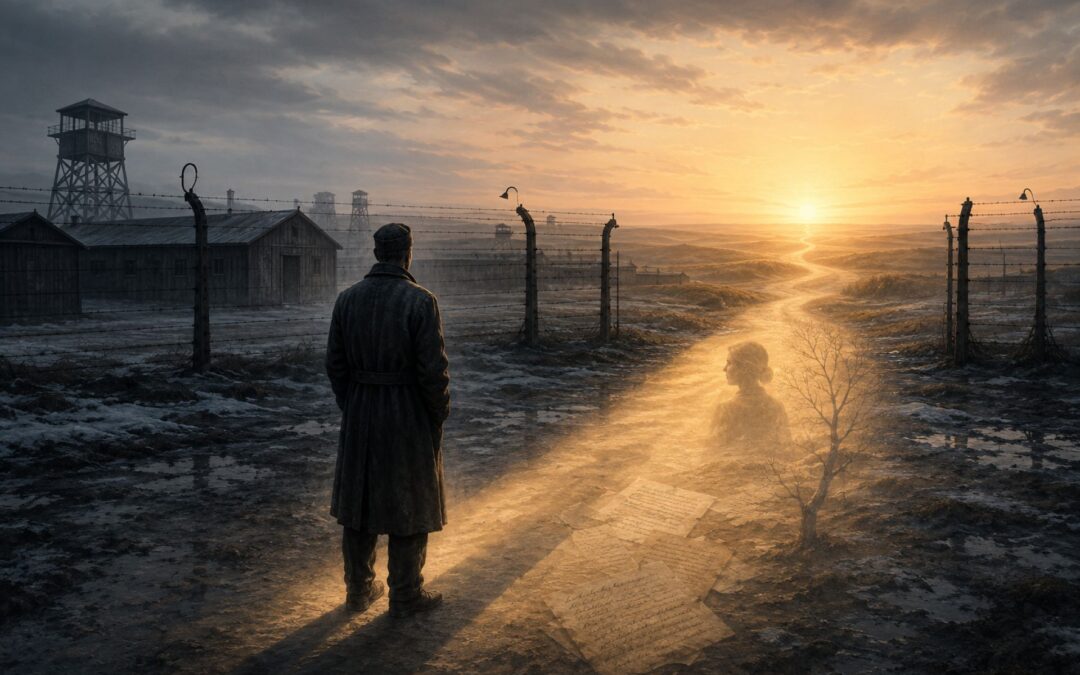
Few books have been reduced to their most quotable ideas as thoroughly as Viktor E. Frankl’s Man’s Search for Meaning. It is frequently presented as a book about staying positive, choosing one’s attitude, or discovering purpose through suffering. Those descriptions contain pieces of Frankl’s argument, but they can also distort it. The book itself is darker, more qualified, and more structurally complicated: a survivor’s account of concentration-camp psychology becomes an introduction to a meaning-centered form of psychotherapy, which is then extended into a philosophy of how human beings might respond to pain, guilt, and death.
Frankl’s central claim is not that people control what happens to them, that a sufficiently strong sense of purpose guarantees survival, or that suffering is inherently valuable. His deeper argument is that meaning remains possible under radically different conditions because it does not depend entirely on happiness, comfort, success, or external freedom. Meaning can be found in what a person creates, whom or what a person loves, and—only when suffering genuinely cannot be prevented or removed—in the stance a person takes toward that suffering. The corresponding moral demand is responsibility: life is not merely something from which humans request meaning, but something that continually confronts them with particular situations requiring particular answers.
That argument acquires its power from Frankl’s experience under Nazism, but the camp narrative is also where the book requires its greatest care. Frankl writes as a prisoner, psychiatrist, survivor, and retrospective interpreter at the same time. His testimony can illuminate one person’s psychological experience without proving universal laws about why some prisoners survived and others did not. Read with that distinction intact, Man’s Search for Meaning remains a remarkable book: not because every empirical claim has survived unchanged, but because its strongest ideas about dignity, responsibility, self-transcendence, and the difference between suffering and meaning remain harder and more humane than the motivational slogans often extracted from it.

How the Book Is Built: Memoir, Logotherapy, and Tragic Optimism
The 2006 Beacon Press edition brings together several layers written or added at different points in the book’s history. It contains Harold S. Kushner’s foreword, Frankl’s preface to the 1992 edition, Part I, “Experiences in a Concentration Camp,” Part II, “Logotherapy in a Nutshell,” the 1984 postscript “The Case for a Tragic Optimism,” and William J. Winslade’s afterword. The resulting book is not a single continuous memoir. It moves from testimony to psychotherapy and then from psychotherapy toward a broader existential philosophy.
The original German work appeared in 1946, soon after Frankl’s liberation and return to Vienna. He later explained that he wrote it rapidly and had initially imagined publishing it anonymously, partly because he wanted the experience rather than his personality to remain central. The autobiographical section was eventually supplemented by the exposition of logotherapy because readers wanted a clearer account of the psychological theory underlying the memoir. Later additions, especially “The Case for a Tragic Optimism,” allowed Frankl to restate and qualify his ideas after decades of clinical work and international reception.
It is important that logotherapy did not begin in Auschwitz. The Viktor Frankl Institute’s biographical chronology traces Frankl’s concern with meaning and values to his prewar medical and psychological work and records his use of the term logotherapy by 1926. Before deportation he had worked with suicidal young people, developed psychiatric programs, and begun formulating the meaning-centered ideas that would later become associated with his camp experience. The camps therefore did not create the theory from nothing. They subjected an already developing philosophy to conditions so extreme that Frankl later treated them as both experiential confirmation and moral testing ground.
His actual imprisonment was also more complicated than the popular description “Frankl survived Auschwitz” can suggest. He was deported first to Theresienstadt and later transported to Auschwitz-Birkenau, where he spent a relatively brief period before being transferred to labor camps associated with Dachau, including Kaufering and Türkheim. Part I does not narrate these movements as a conventional chronological autobiography. Frankl deliberately compresses locations and dates because he is primarily interested in recurring psychological states rather than reconstructing every stage of his imprisonment.
That choice shapes the whole book. Frankl divides camp psychology into three broad phases: the shock of admission, the apathy that develops during prolonged imprisonment, and the psychological difficulties that emerge after liberation. Within that framework he moves between personal memories, observations of other prisoners, clinical interpretations, moral reflections, and general statements about human behavior. The memoir therefore needs to be read as testimony filtered through psychological interpretation rather than as a complete historical account of the concentration-camp system.
Frankl’s 1992 preface also reveals how responsibility operated in his life before imprisonment. He had an opportunity to leave Nazi-controlled Austria for the United States, but doing so would have meant abandoning his elderly parents. After struggling with the decision, he interpreted a fragment of stone from a destroyed synagogue, bearing part of the commandment to honor one’s parents, as an answer to his dilemma. He allowed the visa to lapse and remained. Whatever one makes of the religious interpretation, the episode anticipates the book’s later insistence that meaning is concrete: it emerges through a particular person’s responsibility in a particular situation, not from an abstract formula that applies identically to everyone.
The book’s architecture can therefore be understood as a progression from experience to system and from system to mature qualification. Part I asks what prolonged dehumanization does to human beings and what, if anything, can remain psychologically or morally intact. Part II formalizes Frankl’s answer through the concepts of meaning, responsibility, self-transcendence, love, suffering, and therapeutic technique. The 1984 postscript then asks whether a person can affirm life without denying tragedy, and it supplies one of the book’s most important safeguards: suffering does not have to be sought, preserved, or admired. When it can be changed, the task is to change it.
The Complete Camp Narrative
Part I is not divided into conventional chapters, but it has a definite psychological progression. Frankl begins with admission into the camp system, follows the prisoner’s adaptation to prolonged deprivation, and ends by describing how liberation itself produces psychological problems for which years of fantasy about freedom have offered little preparation. The organizing principle is therefore not simply “what happened next,” but what happened to the prisoner’s inner life as abnormal conditions became normal.
This structure allows Frankl to combine narrative with observation, but it also means that his memories are selective. He is interested less in reconstructing every camp or date than in showing how shock becomes apathy, how apathy coexists with an intensified inner life, and why freedom does not instantly reverse the psychological transformations of captivity.
Phase One: Shock, Selection, and the Loss of the Former Self
Frankl begins by clarifying what kind of account he intends to write. He is not attempting to describe the greatest atrocities of the Holocaust, nor does he claim to speak for prominent prisoners or heroic figures. His focus is the ordinary prisoner and the accumulation of humiliations, privations, fears, compromises, and moments of inner resistance that defined daily life. He introduces himself not primarily as a famous psychiatrist but as prisoner 119,104, usually assigned to physical labor.
The arrival sequence at Auschwitz establishes the first psychological phase. After an exhausting railway journey, prisoners still cling to the possibility that circumstances may be less terrible than feared. Frankl calls this a “delusion of reprieve,” borrowing a psychiatric expression for the condemned person’s hope that punishment will somehow be cancelled at the last moment. Even when signs point toward catastrophe, the mind continues searching for exceptions.
Reality arrives through selection. Men and women are separated, and newly arrived prisoners are directed into different groups. Those judged able to work are temporarily preserved for forced labor; many of those judged unfit are sent to their deaths. The historical system behind Frankl’s account is well documented by the United States Holocaust Memorial Museum’s history of Auschwitz, which describes the arrival-ramp selections, registration of those selected for work, and murder in gas chambers of many others deemed incapable of labor.
Frankl survives the first selection, but admission continues through systematic stripping. Possessions disappear, clothes are removed, hair is shaved, privacy vanishes, and the ordinary markers through which a person recognizes social identity cease to matter. A prisoner becomes a number inside an institution designed to make individuality administratively irrelevant.
One loss is especially important to Frankl because it links his former identity to his future theory. Before imprisonment he had written a scientific manuscript containing ideas he hoped to preserve. He carries it with him until admission, when it is taken away. The manuscript represented intellectual work, future possibility, professional continuity, and the assumption that his earlier life still belonged to him. Its confiscation forces him to confront the possibility that almost nothing from that life can be carried forward physically.
Yet the first phase does not consist only of terror. Frankl notices strange bursts of curiosity and dark humor among new prisoners. People discover that they can survive physical conditions they would previously have considered impossible. They sleep crowded together, endure cold and filth, and adjust to a level of deprivation that would have seemed unthinkable in ordinary life. The discovery is not triumphant. It marks the beginning of adaptation to a world whose standards have been violently rewritten.
Suicidal thoughts are widespread because the apparent probability of survival is so low. Frankl decides on his first evening that he will not kill himself by “running into the wire,” the camp expression for touching the electrified fence. The decision is important to his later self-understanding, but even here he does not describe survival as secure. On the contrary, he knows that a prisoner may be killed by selection, disease, hunger, exhaustion, violence, or chance regardless of personal determination.
Advice from more experienced prisoners teaches newcomers how quickly appearance can become a survival issue. Looking sick, weak, or incapable of labor may place a prisoner in greater danger. The normal relationship between physical condition and social perception becomes brutally immediate: to look able to work is to appear temporarily useful to the camp system.
Shock eventually fades because the mind cannot sustain the same level of emotional horror indefinitely. Things that would once have produced intense reaction become familiar enough to be observed with detachment. That transition brings Frankl to the second and longest phase of camp psychology.
Phase Two: Apathy, Survival, and the Growth of an Inner Life
Apathy begins as a form of emotional self-protection. Prisoners witness beatings, sickness, corpses, frostbite, theft from the dead, humiliation, and random cruelty until the emotional response to each event becomes dulled. Frankl does not celebrate this deadening. He describes it as an adaptation that allows a person to continue functioning in circumstances where reacting fully to every horror might become psychologically impossible.
Physical pain and humiliation are closely connected, but they are not identical. Frankl repeatedly observes that the psychological injury of a blow can come from the contempt or injustice communicated through it. Being struck is terrible; being treated as though one’s existence has no human value adds another form of suffering. The camp therefore attacks dignity both materially and symbolically.
Hunger gradually occupies enormous mental space. Under chronic undernourishment, prisoners imagine meals, discuss recipes, calculate bread portions, and debate whether a ration should be consumed immediately or saved. Dreams may offer temporary visions of food and warmth only to make awakening more painful. Sexual desire diminishes, intellectual interests narrow, and irritability grows under the combined pressure of hunger, cold, sleep deprivation, illness, vermin, and labor.
Frankl’s account of these bodily realities matters because it prevents his later philosophy from being read as though human beings float above biology. The prisoners’ thoughts, emotions, attention, and behavior are visibly changed by physical deprivation. Whatever freedom Frankl later claims for the person exists within those pressures; it does not abolish them.
Camp society develops its own hierarchy. Ordinary prisoners occupy the most precarious position, while Capos and other privileged inmates may receive better food, easier work, or authority over others. Some become brutal. Frankl himself sometimes benefits from favorable relationships, including the attention of a Capo whose personal troubles he takes seriously. Better treatment or a more generous ladle of soup can have substantial consequences when deprivation is severe.
Such episodes also show how survival involves compromise, circumstance, social perception, and luck. Frankl does not present himself as a pure moral hero moving through the camps solely by strength of character. He maneuvers when he can, tries to avoid especially dangerous assignments, depends on small favors, and repeatedly confronts decisions whose consequences cannot be predicted.
At the same time, the collapse of ordinary external life sometimes intensifies the inner one. Frankl observes religious activity among prisoners and remembers moments of prayer or spiritual conversation. More personally, he discovers that memory, imagination, beauty, and love can create brief spaces that the camp does not completely control.
The most famous of these experiences concerns his wife. While marching through cold and darkness toward forced labor, Frankl turns inward to the image of her. He does not know whether she is alive, and the uncertainty is crucial: the experience of love no longer depends on physical proximity or even on certainty that the beloved still exists in the ordinary sense. What matters to him in that moment is the apprehension of another person in her uniqueness.
Later, Part II will transform this experience into a general proposition about love as a path to meaning. In the camp narrative, however, it remains more immediate. Thinking of his wife temporarily changes the quality of Frankl’s consciousness. The guards, cold, labor, and danger remain real, but they do not occupy the whole field of experience.
Nature can produce a similar expansion. Prisoners sometimes stop to notice a sunset or landscape with an intensity made stronger by deprivation. Art and entertainment survive in reduced forms as well. A makeshift performance or song cannot alter camp conditions, but it can briefly restore an experience not completely defined by them.
Humor performs a related function. Frankl deliberately tries to imagine absurd future situations in which habits learned in the camp might intrude into ordinary life. Humor does not erase suffering; it creates distance from it. For a moment the prisoner is not merely the object of circumstances but an observer capable of seeing those circumstances from another angle.
These experiences coexist with a radically altered scale of happiness. A transfer away from an especially feared camp can feel like deliverance. Sick quarters may provide temporary relief from harder labor. A place without a visible crematorium can seem almost fortunate. Frankl sometimes calls attention to this negative form of happiness: pleasure becomes not the presence of good conditions but the temporary absence of worse ones.
His work as a physician also becomes morally important. At one point Frankl volunteers to care for prisoners suffering from typhus. He knows the risk but reasons that if death is likely anyway, dying while performing meaningful work seems preferable to dying as an anonymous laborer. The decision anticipates his later argument that meaning often lies not in how one feels but in the responsibility one accepts.
That principle becomes sharper during an attempted escape. Frankl and another doctor develop a plan to leave, but before doing so Frankl returns to the sick prisoners in his care. The expression of a patient who thinks he is being abandoned disturbs him. Frankl eventually decides to remain, and he describes the decision as producing a kind of inner peace. The external situation has not improved, but uncertainty about his own responsibility has been resolved.
Camp existence also destroys privacy. Prisoners live constantly among others and learn that attracting attention can be dangerous. Yet the need for solitude does not disappear. Frankl recalls moments when even a brief interval away from the crowd becomes precious, suggesting that preservation of selfhood requires something beyond mere physical survival.
Decisions about transports and escape show the limits of rational control. Prisoners often do not know whether being moved will increase or reduce their chances of survival. A “rest camp” may be a euphemism for death, or it may genuinely be safer. Remaining behind may appear prudent and later prove disastrous. Frankl tells of prisoners who tried to manipulate fate and inadvertently placed themselves in greater danger, which leads him to invoke the story of Death in Teheran: an attempt to escape destiny becomes the means by which the expected meeting with death occurs.
The story captures an important tension in the book. Frankl believes human beings retain some freedom, but his narrative repeatedly shows that outcomes remain outside their control. One can choose an action without controlling what the transport contains, which guard is on duty, whether illness strikes, or which prisoner is selected.
Near the end of imprisonment Frankl and another man again contemplate escape, this time while working with corpses outside the camp. The arrival of Red Cross representatives and reports that the camp is under protection persuade them to abandon the plan. Soon afterward the SS orders an evacuation. Trucks take some prisoners away, while Frankl and his companion are left behind and initially believe they have lost another chance to survive.
The apparent misfortune turns out to be fortunate. They later learn that prisoners taken elsewhere were killed. The reversal reinforces a point running quietly against any simplistic interpretation of the memoir: survival cannot be retrospectively reduced to wise choices. Chance repeatedly intervenes.
Meanwhile, Frankl becomes increasingly interested in what happens when prisoners lose any orientation toward a future. Because no one knows when imprisonment will end, camp life becomes what he calls a “provisional existence” without a known limit. Time changes psychologically because ordinary plans—career, family, seasons, projects, appointments—no longer organize it.
A person who can no longer imagine any future may begin to experience the present as endless. Frankl believes this loss of future orientation can contribute to psychological and even physical collapse. His own countermeasure is striking: he imagines himself after the war standing before an audience and lecturing on the psychology of concentration-camp life. By seeing his suffering from the imagined perspective of a future observer, he makes the present part of an unfinished task rather than the whole of existence.
The technique is closely related to the lost manuscript. Frankl cannot preserve the original document, but the work itself can still exist as something awaiting him. At different points he reconstructs ideas mentally and later on scraps of paper. Future work becomes a reason that life may still require something from him.
Frankl also tells the story of a prisoner identified as F— who dreams that liberation will occur on a particular date. As the predicted day approaches without signs of freedom, the man’s hope collapses; he becomes ill and dies soon afterward. Frankl connects this experience with his observation of increased mortality around Christmas and New Year, when prisoners who had hoped to be home for the holidays confronted disappointment.
These episodes are important to his theory, but they need to be read at the correct evidentiary level. Frankl interprets them as evidence that hope and future orientation can affect physical endurance. They do not establish that loss of hope alone caused particular deaths, nor should they be turned into a rule that people who died lacked sufficient purpose.
Frankl’s philosophical argument nevertheless grows directly from such observations. He repeatedly invokes the idea that someone who has a “why” may be able to endure an extraordinary “how,” but he eventually reverses the usual question about life’s meaning. Instead of asking indefinitely what life can provide, the individual can understand each situation as a question being posed by life.
The answer is not verbal. It is given through responsibility. One prisoner may have a child waiting somewhere outside the camps. Another may have unfinished scientific work. Another may be responsible for the care of someone nearby. Because these responsibilities are different, Frankl rejects the notion that there can be one abstract meaning of life applicable in the same form to everyone.
During a particularly desperate period he is asked to speak to fellow prisoners. Frankl tries to remind them that some things have not been erased: possibilities may remain in the future, experiences already lived cannot be retroactively removed, and each person may still be responsible for something or someone. The scene resembles an improvised form of meaning-centered intervention under conditions where Frankl has almost none of the resources of ordinary psychotherapy.
His most controversial claim emerges from observations of prisoners who still comfort others, share food, or act with restraint even when conditions reward selfishness. Frankl concludes that the camp can constrain human freedom almost beyond recognition without eliminating every possibility of moral response. He describes a residual “spiritual freedom,” not as the power to change reality but as some remaining possibility of taking a position toward it.
He also complicates the moral geography of the camps. Some prisoners become brutal, especially those with privileged positions. Some guards are sadistic, others emotionally numbed, and a few occasionally act with unexpected kindness. Frankl therefore resists the idea that every individual within one group possesses the same moral character.
That observation requires historical care. It does not erase the fundamental asymmetry between Nazi perpetrators and the people imprisoned, exploited, and murdered by the Nazi system. Frankl’s point is about individual moral variation within human beings, not equivalence between those who created and enforced the camps and those subjected to them.
Eventually the front approaches. The camp is liberated, and the psychological problem changes completely. The prisoners have spent years imagining freedom, but when it arrives, the mind cannot immediately inhabit it.
Phase Three: Liberation, Depersonalization, Bitterness, and Disillusionment
Frankl’s account of liberation refuses the expected emotional climax. The prisoners walk beyond the camp and see fields, birds, sky, and ordinary landscapes, but many cannot feel the joy they had imagined. Freedom appears unreal because it has been rehearsed so many times in dreams that actual liberation resembles another dream from which a whistle might soon awaken them.
Frankl describes the condition as depersonalization. Reality has to become real again. Pleasure, like other psychological capacities weakened by prolonged deprivation, must be relearned.
The body adapts faster than the emotions. Released prisoners eat enormous quantities when food becomes available. They also feel an intense need to talk, as though years of accumulated experience demand release through speech. The pressure of enforced silence and incomprehension begins to move outward.
For Frankl, one turning point comes during a solitary walk through the countryside. In the natural world outside the camp he experiences a gradual recognition that imprisonment has actually ended. The moment has a spiritual quality, but it does not restore what has been lost. It marks the beginning of a new life rather than a return to the old one.
Liberation also creates moral danger. A person who has been treated unjustly for years may feel entitled to treat others unjustly in return. Frankl remembers a former prisoner expressing a desire for revenge and insists that suffering does not automatically make a person morally better. Release from oppression removes restraints without guaranteeing wisdom about how freedom should be used.
Two further experiences threaten the liberated prisoner: bitterness and disillusionment. Bitterness emerges when civilians respond superficially, insisting that they too suffered or that they did not know what was happening. After years of extreme experience, ordinary social responses can appear offensively inadequate.
Disillusionment cuts deeper because it concerns not other people’s insensitivity but reality itself. During imprisonment Frankl often encouraged people to imagine someone or something waiting for them. After liberation, some discover that the person they imagined returning to has died. The future that helped sustain them no longer exists in the form they expected.
This is where the memoir’s easy inspirational interpretation finally becomes impossible. Freedom does not repay suffering. Endurance does not guarantee reunion. There is no cosmic mechanism ensuring that the person who survives receives compensation proportional to what was endured.
Frankl ends Part I with a different kind of claim: after surviving the camp, a person may eventually reach a point at which there is nothing left to fear except God. The statement is less a declaration of victory than an acknowledgment that the scale by which ordinary fears are measured has been permanently altered. The camp has ended, but its psychological meaning must still be worked out. Part II is Frankl’s attempt to formulate the system through which he believes that work can be done.
Logotherapy in a Nutshell: The Complete Argument
Part II changes genre. The autobiographical narrator becomes a psychotherapist explaining a method, and the episodic structure of camp memory gives way to eighteen named conceptual sections. Frankl calls his approach logotherapy, from logos in the sense of meaning, and presents it as a psychotherapy focused less on excavating the past than on helping a person recognize meanings and responsibilities still awaiting fulfillment.
He frequently contrasts logotherapy with simplified versions of Freud and Adler. Where psychoanalysis is associated with the search for pleasure and individual psychology with striving for superiority or power, Frankl emphasizes a “will to meaning.” These contrasts are schematic rather than full accounts of either thinker, but they clarify the place Frankl wants logotherapy to occupy: a psychology in which meaning is not merely a disguise for some more fundamental drive.
The Will to Meaning, Existential Frustration, and Noögenic Neurosis
“The Will to Meaning” contains the central motivational claim of the system. Frankl argues that human beings do not merely invent reasons after the fact to justify instinctive behavior. They can genuinely be directed toward purposes, people, values, and tasks that matter in their own right.
Meaning, however, is not a single metaphysical slogan. It is personal and situational. The meaning available to one person at one moment may be different from what another person is called to do. This is why Frankl resists psychologies that automatically treat devotion to a cause, moral conviction, or love as a disguised expression of some supposedly deeper impulse.
The possibility of meaning also creates the possibility of existential frustration. A person can want a meaningful direction and fail to find one, lose an earlier one, or become trapped between competing responsibilities. Frankl uses existential in several related senses: the concrete reality of existence, the meaning of that existence, and the striving to find meaning.
Not every existential conflict should therefore be treated as mental illness. Frankl introduces the concept of the “noögenic neurosis” to describe distress arising from the specifically existential dimension rather than from conventional psychodynamic conflict. The terminology belongs to his system and is not a contemporary diagnostic category, but the underlying distinction remains understandable: a person can suffer because life genuinely presents a problem of value or direction, not merely because an unconscious symptom needs to be decoded.
His example of a diplomat illustrates the point. The man is dissatisfied with his career and has been receiving analytic treatment that interprets the problem through deeper psychological explanations. Frankl comes to believe that the man’s problem may be more straightforward and existential: he dislikes his work and wants another life. Therapy that insists on reducing the dissatisfaction to hidden pathology may prevent him from taking the actual decision seriously.
Frankl therefore refuses the assumption that all tension is unhealthy. Conflict over a meaningful task may be a sign that something important is at stake. The purpose of therapy is not always to eliminate discomfort; sometimes it is to help a person understand what the discomfort is demanding.
Noö-Dynamics and the Existential Vacuum
Frankl calls the productive tension between present reality and an unrealized meaning “noö-dynamics.” Mental health, in his view, does not require perfect equilibrium. A certain tension between what a person is and what that person is responsible for becoming can organize action.
The lost manuscript again becomes an example. Reconstructing or rewriting the work gives Frankl something beyond immediate survival toward which effort can be directed. The task is not valuable because it produces relaxation. It creates precisely the opposite: a demand that pulls the person forward.
This idea leads into the “existential vacuum,” one of Frankl’s most influential cultural diagnoses. He argues that human beings in modern societies have lost both strong instinctive guidance and many inherited traditions. People may therefore no longer know automatically what they must do, yet they have not necessarily learned how to determine what they ought to do.
The vacuum can express itself as boredom. It can also lead to conformity, in which a person does what everyone else is doing, or submission, in which a person does what someone else demands. Frankl extends the idea into discussions of retirement, unemployment, addiction, delinquency, and what he calls “Sunday neurosis,” the emptiness that becomes visible when routine work temporarily stops.
Some of the statistics and social correlations he uses to support these claims are dated and cannot simply be treated as current epidemiology. The conceptual point is broader than the numbers: people can suffer not only because they have too many demands, but because they experience too little reason for meeting them.
Responsibility and the Three Ways to Meaning
When Frankl asks about “the meaning of life,” he rejects the expectation that logotherapy will provide one universal answer. He compares the question to asking for the best move in chess without knowing the position on the board. A good move depends on the concrete situation.
Meaning therefore changes across people and moments. What matters is not an abstract definition but the appropriate response to the situation now present. This is why Frankl reverses the ordinary formulation: human beings should not only ask what they expect from life; they should understand themselves as being questioned by life.
The answer takes the form of responsibility. Frankl calls responsibleness the essence of existence because meaning becomes real only when it is enacted. A therapist cannot simply hand a patient a correct value system. One person may understand responsibility toward another person, another toward work, another toward conscience, and another toward God.
Frankl’s thought is therefore strongly anti-paternalistic at its best. Logotherapy is not supposed to tell everyone what the meaning of life is. It tries to awaken awareness that particular meanings exist and that the individual remains responsible for recognizing and fulfilling them.
Self-transcendence describes the direction of this process. Frankl argues that human beings flourish most fully when they are directed beyond themselves—toward a task, cause, person, or value. Self-actualization is more likely to occur as a consequence of such outward orientation than when pursued directly as an isolated goal.
From this foundation he identifies three principal routes to meaning. The first is creation or achievement: doing work, making something, performing an action, or fulfilling a task. The second is experience: encountering goodness, truth, beauty, nature, culture, or another person in love. The third concerns the attitude taken toward unavoidable suffering.
The first route is broader than employment. A meaningful deed can be professional, artistic, moral, practical, relational, or otherwise creative. What matters is that the person brings something into the world or responds to a task that would otherwise remain undone.
The second route receives its fullest expression in “The Meaning of Love.” Frankl treats love as an encounter with the uniqueness of another person. To love someone is not merely to experience pleasant emotion or sexual desire; it is to perceive another person as an irreplaceable individual and, at least in Frankl’s formulation, to see possibilities in that person that may not yet have been realized.
This section formalizes what the memoir had already dramatized through his wife. In the camp, love remained psychologically significant even without possession, proximity, or certainty about the beloved’s survival. Part II generalizes that experience into a claim about how human beings encounter meaning through one another.
“The Meaning of Suffering” is the most famous and most dangerous section to simplify. Frankl argues that when a situation cannot be changed, the remaining question may concern the person’s attitude toward it. He illustrates this with a physician devastated by the death of his wife. Frankl asks what would have happened if the husband had died first. The physician recognizes that his own grief has spared his wife from experiencing the grief of surviving him.
The loss has not become good. It has not been undone or compensated. What changes is the interpretive relationship to it: the suffering can be understood as the cost of having spared someone loved from bearing the same burden.
At this stage of the book Frankl can sometimes sound as though suffering possesses exceptional spiritual status. The later postscript supplies the necessary qualification. Suffering is not required for meaning, and no one should preserve suffering that can reasonably be removed. The attitudinal route becomes relevant only when action cannot change the underlying reality.
Super-Meaning, Transitoriness, and Human Dignity
The section “Meta-Clinical Problems” acknowledges that many questions arriving in psychotherapy are not purely medical. Patients ask whether life is worth living, how guilt can be borne, whether death nullifies achievement, or whether suffering has any meaning. Such questions belong partly to philosophy and religion, yet they can still affect psychological life.
“A Logodrama” illustrates how Frankl tries to work with them therapeutically. He describes a woman who has lost one child and is caring for another son with significant disabilities. By imaginatively viewing her life from its end, she is encouraged to see her care for her surviving son not merely as a burden imposed by tragedy but as something through which her life has acquired responsibility and achievement.
The example reveals both the appeal and the risk of Frankl’s method. It can help a person discover a value that was obscured by despair. Yet the therapist’s interpretive power is substantial, and the meaning reached in a particular case should not be converted into a moral demand that everyone in a similar situation understand suffering identically.
From the logodrama Frankl moves toward “super-meaning.” He argues that ultimate meaning may exceed human cognitive capacity. Just as a being with limited understanding might be unable to comprehend the larger context of its suffering, human beings may inhabit a reality whose final meaning cannot be reduced to what finite reason can grasp.
This is the point at which logotherapy opens most clearly toward religion. Frankl does not insist that therapists impose theological belief on patients. He argues instead that when a patient already possesses religious convictions, therapy need not exclude those convictions from the resources through which the person makes sense of life.
His example of a rabbi who lost his family in Auschwitz shows the approach. Frankl works within the rabbi’s religious framework rather than attempting to replace it with secular psychology. The therapeutic claim is that belief can carry meaning for someone who already inhabits it; that is different from scientifically proving the metaphysical content of the belief.
“Life’s Transitoriness” then turns to mortality. Frankl rejects the idea that passing time makes life meaningless. Possibilities disappear because moments cannot be repeated, but what has actually been done becomes part of the irrevocable past.
He describes the past almost as a storehouse. A younger person has many unrealized possibilities, while an older person may have fewer possibilities remaining but a larger accumulation of completed acts, loved relationships, endured difficulties, and fulfilled responsibilities. Mortality therefore increases the urgency of choice without rendering earlier choices worthless.
Paradoxical Intention, Dereflection, and the Rehumanization of Psychiatry
“Logotherapy as a Technique” is where Frankl becomes most explicitly clinical. He describes several self-reinforcing psychological mechanisms, especially anticipatory anxiety. A person fears that a symptom will occur; the fear increases arousal; the increased arousal makes the symptom more likely; the occurrence of the symptom then strengthens the original fear.
Hyper-intention produces a related problem. Someone tries so hard to force a desired state that the effort interferes with the state itself. Sleep, sexual performance, confidence, or spontaneous emotional responses are obvious examples because many such experiences become harder when monitored and commanded.
Hyper-reflection adds excessive self-observation. The person becomes preoccupied with whether a symptom is appearing, whether performance is adequate, or whether the desired internal state has arrived. Attention becomes trapped inside a loop of monitoring and reaction.
Frankl’s best-known intervention for such cycles is paradoxical intention. Instead of desperately trying to prevent the feared symptom, the patient deliberately wishes for or exaggerates it, usually with some humor. Someone afraid of sweating may intentionally try to sweat as much as possible; someone terrified of making a mistake may temporarily aim to make the mistake.
The technique creates psychological distance. Fear is no longer encountered solely as an involuntary force that must be avoided. By deliberately reversing the intention, the patient may interrupt the cycle through which anxiety amplifies itself.
Frankl offers cases involving sweating, stuttering, writer’s cramp, compulsive behavior, and insomnia. These examples illustrate the logic of the technique, but they should not be read as universal treatment instructions or as substitutes for contemporary assessment. His case descriptions are brief, historically situated, and often lack the methodological detail expected in modern clinical literature.
Dereflection addresses another pattern. Instead of directing even more attention toward the self, the person turns outward toward a task, another person, work, or meaning. The approach follows directly from self-transcendence: excessive monitoring can sometimes be reduced when attention becomes absorbed in something beyond the symptom.
Part II then moves back from technique to anthropology. Frankl describes a “collective neurosis” associated with widespread meaninglessness and argues that reductionist psychology can contribute to it if people come to see themselves as nothing more than products of mechanisms they cannot influence.
His “Critique of Pan-Determinism” is therefore crucial. Frankl does not deny heredity, environment, psychology, or social conditions. He denies that these exhaust the person.
The distinction matters because it provides the most careful version of his freedom claim. Human beings are not free from conditions. They may possess some freedom to take a position toward those conditions. Freedom is therefore limited, relational, and incomplete without responsibility.
This is the context for Frankl’s recurring suggestion that the Statue of Liberty on the American East Coast ought to be complemented by a Statue of Responsibility on the West Coast. Liberty without responsibility, in his view, can collapse into arbitrariness. The meaning of freedom lies partly in what one does with it.
“The Psychiatric Credo” extends the same principle to mental illness. Frankl resists reducing a person completely to a diagnosis. Severe disorder may constrain behavior and experience dramatically, but for him the human person possesses a dignity that is not identical with health, productivity, or social usefulness.
“Psychiatry Rehumanized” closes Part II with a plea to preserve the person behind the symptom. Psychology can explain mechanisms without pretending that mechanisms constitute the entire human being. Frankl’s larger fear is that a science devoted to explaining people may inadvertently strip them of the very personhood that makes care ethically significant.
The section ends by returning to the Holocaust. Human beings are capable of constructing institutions such as Auschwitz, but people placed inside those institutions can also display prayer, sacrifice, kindness, endurance, and moral resistance. Frankl’s point is not that dignity defeats machinery. It is that machinery does not fully define what the human person is.
The Case for a Tragic Optimism
The 1984 postscript is not an optional appendix to Frankl’s thought. It supplies the mature formulation of several ideas that can sound harsher or more absolute in the earlier sections, especially his claims about suffering and optimism. “Tragic optimism” means affirming the possibility of meaning while taking tragedy seriously rather than denying it.
Frankl organizes the problem around a “tragic triad”: pain, guilt, and death. These cannot all be eliminated from human existence. A philosophy that works only when suffering is absent, moral failure has never occurred, and death can be ignored would therefore be inadequate to life as it is actually lived.
Tragic optimism asks whether negative realities can be transformed without pretending that they are positive in themselves. Frankl proposes three corresponding possibilities: suffering may become an achievement in the way it is endured, guilt may become the starting point for moral change, and mortality may become a reason to act responsibly before opportunities disappear.
This is not the same as compulsory positivity. Frankl explicitly warns that optimism cannot simply be commanded. Happiness, faith, hope, and love become distorted when a person tries to manufacture them through force of will. The principle mirrors his earlier account of hyper-intention: some states are most likely to arise indirectly as consequences of engagement rather than as objects of direct pursuit.
Happiness therefore “ensues” in Frankl’s system rather than functioning as the highest goal. A meaningful life may contain happiness, but meaning is not invalidated when happiness is unavailable. This distinction is one reason the book remains especially powerful in contexts such as grief, chronic illness, irreversible loss, or moral responsibility, where promising happiness would be implausible or even insulting.
Frankl also returns to the existential vacuum and associates meaninglessness with depression, aggression, addiction, unemployment-related despair, and suicide. His examples and statistics come from the clinical and social-scientific literature available to him and vary greatly in evidentiary strength. The conceptual suggestion—that severe loss of meaning can interact with psychological distress—is plausible and continues to motivate research. The stronger implication that one factor supplies a broad causal explanation for multiple complex disorders requires much more caution.
Meaning remains situational throughout the postscript. Frankl compares human life to something whose total significance emerges through individual moments rather than from one abstract statement detached from circumstance. Conscience becomes the faculty through which a person tries to recognize the demand contained in the present situation, though Frankl acknowledges that conscience can be mistaken.
He then restates the three routes to meaning: creation or action, encounter or love, and the attitude taken toward unavoidable suffering. This repetition is important because it allows Frankl to emphasize what popular summaries often omit. The third route is not superior to the other two, and it does not mean people should seek suffering.
The example of Jerry Long makes the point concrete. After an accident leaves Long quadriplegic, Frankl describes him as someone who discovers purpose despite severe disability. The meaning does not lie in paralysis itself. It lies in what Long does within a reality he cannot reverse.
Frankl then states the ethical boundary explicitly: suffering is not necessary for meaning. If its cause can be removed, the appropriate response is to remove it. Accepting unnecessary suffering when effective action is available is not the achievement Frankl is praising.
This qualification fundamentally changes how the book should be used. A person trapped in abuse, preventable illness, political oppression, exploitation, or another alterable condition should not be told that the highest response is simply to adjust an attitude. Frankl’s attitudinal route begins where genuine possibilities for changing the situation end.
The second element of the tragic triad is guilt. Frankl refuses a determinism that would explain wrongdoing so completely through background and conditioning that personal responsibility disappears. To be guilty is to have done something that ought not to have been done, but recognition of guilt creates the possibility of becoming different.
He simultaneously rejects collective guilt. One person is not morally responsible for crimes merely because another member of the same nation, ethnicity, profession, or social group committed them. The principle is consistent with his broader emphasis on individual responsibility: responsibility must attach to what a particular person actually does.
The third element is death. Mortality prevents endless postponement. Opportunities disappear as time passes, but Frankl insists that realized meanings do not therefore vanish. What has been done, loved, endured, created, or learned becomes part of the completed past.
This view produces an unusual philosophy of aging. A life with fewer future possibilities need not be regarded as increasingly empty, because the past contains realities that are no longer merely possible. The person does not simply lose opportunities with age; the person also accumulates an irreversible history.
Frankl extends his account of dignity into medical ethics. He rejects the notion that human value depends on productivity or social usefulness because such a standard would make the worth of older people, disabled people, severely ill people, and psychiatric patients conditional. For him the human person cannot be reduced to economic contribution or measurable utility.
This is also the context for his criticism of “therapeutic nihilism,” the idea that a patient can become so thoroughly identified with pathology that there is no meaningful person left to address. Frankl’s language is historically situated, but the underlying ethical point is clear: a clinician should not confuse limited therapeutic success with absence of human worth.
Near the end he resists becoming the guru of an authoritarian school. Logotherapy, he argues, should be developed and adapted rather than preserved as a cult around its founder. The stance fits the broader logic of responsibility: meaning cannot be outsourced permanently to another person, even to a therapist.
The postscript ends at the largest possible scale. Auschwitz becomes an example of what human beings can do to one another; Hiroshima represents the destructive power available to modern civilization. The final problem is therefore not simply how to feel better. It is whether freedom, technology, institutions, and individual action will be accompanied by responsibility.
How the Memoir Becomes Logotherapy
The two principal halves of Man’s Search for Meaning are easier to understand when Part II is read as a conceptual reorganization of experiences already narrated in Part I. Frankl does not merely attach an unrelated psychotherapy manual to a Holocaust memoir. He repeatedly returns to the same experiences at different levels of abstraction.
The lost manuscript becomes an example of meaning through creation and unfinished work. Its importance lies not in the physical pages, which are confiscated, but in the task they represented. Frankl can lose the manuscript without losing the possibility that the work might someday be reconstructed.
His wife becomes the experiential foundation for meaning through love. In Part I, thinking of her allows Frankl to inhabit a relationship not reducible to current physical conditions. In Part II, that experience becomes the broader claim that love apprehends another person in his or her uniqueness.
Sunsets, landscapes, music, and moments of beauty become examples of meaning through experience. They matter because Frankl’s system is not restricted to achievement. A person can receive something meaningful from the world rather than only producing something in it.
His decision to care for sick prisoners becomes an example of responsibility and self-transcendence. The meaning appears when attention moves away from the question “How can I save myself?” toward the question “What am I responsible for here?” That does not guarantee safety, but it changes the structure of the decision.
The imagined future lecture becomes a practical expression of future orientation. Frankl converts present suffering into material belonging to a future task, thereby creating psychological distance from the immediacy of the camp. The same movement later appears in logotherapy whenever a person is encouraged to understand the present in relation to unfinished meaning.
Most importantly, unavoidable suffering becomes the experiential source for Frankl’s third route to meaning. Yet the memoir itself also shows why that idea needs boundaries. Prisoners constantly try to improve their chances, avoid dangerous assignments, obtain food, help the sick, and escape when possible. Frankl does not actually live according to a doctrine of passive acceptance; he adapts, negotiates, decides, and acts whenever action remains possible.
The camps therefore function as illustrations of logotherapy, not as its birthplace or experimental proof. Because Frankl’s meaning-centered psychology was already developing before his imprisonment, the relationship runs in both directions. His earlier theory helps him interpret the camps, while camp experience gives those ideas greater existential force.
That circularity is intellectually important. It explains both the book’s extraordinary coherence and one of its limitations. Frankl sees experiences through concepts he already values, then later presents those experiences as support for the concepts. The result can be psychologically illuminating without being neutral evidence.
Meaning, Freedom, and Responsibility
Three ideas hold Frankl’s system together: meaning, freedom, and responsibility. Meaning tells the person that something can still matter; freedom names whatever capacity remains for response; responsibility converts that capacity into action. Remove any one of the three and the system changes substantially.
The strength of Frankl’s thought lies partly in how tightly he connects them. Meaning without freedom would be irrelevant because the person could not respond to it. Freedom without meaning would lack direction. Responsibility without either would become mere obligation imposed from outside.
The Will to Meaning Is Not a Promise of Happiness
Frankl’s “will to meaning” is easiest to misunderstand when treated as another technique for maximizing personal satisfaction. His position is almost the reverse. The meaningful action may be difficult, painful, inconvenient, or emotionally unrewarding.
This is why he resists making happiness the direct goal of life. A person who loves someone, performs demanding work, raises a child, cares for a dying parent, serves a cause, or keeps a promise may experience happiness, but the value of the act does not depend on feeling happy while doing it.
Self-transcendence provides the mechanism. The person becomes most fully human by being directed toward something beyond the self. Frankl therefore distrusts excessive preoccupation with self-fulfillment when it turns the self into the sole object of attention.
This does not mean self-care or pleasure is wrong. It means that Frankl refuses to make subjective feeling the final measure of whether a life is meaningful. A good life may contain grief because love makes grief possible; effort because work matters; guilt because responsibility is real; and anxiety because an important choice has consequences.
The distinction is one reason Frankl remains compelling when conventional motivational advice fails. He does not promise that finding meaning will make pain disappear. He argues that pain and meaning can coexist.
The “Last Freedom”—and Its Limits
Frankl’s language about the freedom to choose one’s attitude is the most famous part of the book and the part most vulnerable to abuse. Read carelessly, it can imply that circumstances never determine psychological experience and that anyone who responds badly to trauma has simply failed to exercise sufficient inner freedom.
The book itself provides reasons to reject that reading. Frankl describes prisoners becoming apathetic because apathy protects them from unbearable emotional stimulation. He shows hunger narrowing consciousness, disease weakening judgment, fear producing indecision, sleep deprivation generating irritability, and camp hierarchy affecting survival. These are not illustrations of a mind untouched by circumstance.
His more precise claim appears in the critique of pan-determinism: human beings are not free from conditions but may retain some freedom to take a stand toward them. That formulation is significantly narrower. The camp limits options almost beyond recognition, yet Frankl believes it does not always dictate every final moral response.
Even this limited claim must be handled probabilistically rather than romantically. Severe coercion can damage cognition, emotion, agency, memory, personality, and decision-making. Different people possess different physical reserves, social connections, psychological histories, and accidental opportunities.
Frankl’s own survival narrative repeatedly admits the role of contingency. A transport that appears dangerous turns out to be safer. A failed evacuation prevents him from being killed elsewhere. A decision may matter enormously without the person knowing in advance whether it is the correct one.
Freedom in Man’s Search for Meaning is therefore most defensible when understood as a moral possibility rather than a guaranteed psychological capacity available in equal measure at every moment. Some people under terrible conditions still make choices that express care, courage, restraint, or loyalty. Their existence demonstrates that conditions do not mechanically produce one identical human response.
It does not follow that those who cannot make such choices are blameworthy. The strongest form of Frankl’s insight celebrates the possibility of agency without using that possibility to judge those whose agency was overwhelmed.
Responsibility Without Victim-Blaming
Responsibility enters Frankl’s system because freedom needs direction. Once a person asks not only “What do I want?” but “What does this situation require of me?”, meaning becomes ethical rather than merely psychological.
His visa decision provides an early example. Remaining with his parents exposed Frankl to extraordinary danger, and one should not convert his choice into a general rule about what anyone else under Nazi persecution should have done. The point is that he experienced the situation as a personal responsibility and acted according to it.
The same structure appears in the camps. A prisoner may experience responsibility toward a child, unfinished work, fellow patients, a beloved spouse, religious conscience, or future testimony. None of these responsibilities guarantees survival. They give survival, action, or endurance a direction.
This distinction is essential when Frankl discusses prisoners who lose hope. His argument can easily slide from “a sense of future meaning may help some people endure” into “people who died failed to maintain meaning.” The latter conclusion is neither ethically justified nor supported by the complexity of camp mortality.
The camps were systems of organized persecution, forced labor, starvation, disease, selection, and murder. Auschwitz-Birkenau functioned as both a concentration-camp complex and a major killing center. No theory of attitude can transform victims’ deaths into evidence of insufficient psychological strength.
Frankl’s distinction between “decent” and “indecent” people also requires the same care. His observation that individual prisoners, guards, and functionaries differed morally is compatible with recognizing individual complexity. It should not be used to flatten the historical distinction between persecutor and persecuted.
Responsibility works best in Frankl when applied inwardly: What remains mine to do? It becomes much less defensible when converted outwardly into a verdict on what another person should have been capable of doing under conditions one has not endured.
Love, Work, Suffering, and the Three Paths to Meaning
Frankl’s three routes to meaning are frequently summarized as a list, but the system becomes clearer when they are understood as different relationships between the person and reality. In creative meaning, something moves from the person into the world. In experiential meaning, something valuable in the world is encountered or received. In attitudinal meaning, the person confronts a reality that action cannot remove and decides how to relate to it.
The first route includes work but is larger than a career. Frankl’s own manuscript is the obvious example because professional thought gives him a future task, yet the underlying category includes any meaningful deed. Raising a child, keeping a commitment, creating art, repairing something, teaching, caring for someone, or contributing to a cause can all belong to the same structure.
Meaning through creation is therefore not identical with achievement culture. Frankl does not say that people acquire value by becoming productive enough. In fact, his later defense of dignity opposes measuring human worth by usefulness. Work becomes meaningful when it expresses responsibility, not when productivity becomes a test of whether a person deserves to exist.
Love belongs to the second route because the beloved is encountered rather than manufactured. Frankl’s account of his wife is powerful precisely because the relationship remains meaningful when he cannot control it. He cannot summon her into the camp, confirm her safety, or guarantee reunion.
The philosophical strength of this section lies in its refusal to identify love with possession. The beloved matters as a unique person rather than as a source of gratification. Even memory can preserve that relationship when physical presence has been taken away.
Frankl extends experiential meaning beyond interpersonal love. Beauty, art, nature, truth, and culture can also be received. A sunset glimpsed from a camp does not compensate for imprisonment, but it reveals that the prisoner’s consciousness is not exhausted by what the camp intends consciousness to contain.
The third route is the hardest because it concerns suffering. Frankl’s claim is not that pain automatically ennobles. People can be damaged, embittered, traumatized, or destroyed by suffering. His own account of liberation demonstrates that extreme suffering can continue shaping the person long after the external cause has ended.
The distinctive claim is narrower: when suffering cannot be removed, a person may still be able to determine what relationship to establish with it. The bereaved physician cannot reverse his wife’s death. Jerry Long cannot reverse the accident that caused paralysis. Their remaining freedom concerns interpretation, response, and whatever responsibilities remain possible.
This is where Frankl’s idea of tragic optimism becomes indispensable. Without it, “meaning in suffering” can sound like a moral command to accept conditions that should be changed. With it, the sequence is clear: alter what can be altered; only then confront what cannot.
That order also protects Frankl from a common misuse in workplaces, families, politics, and medicine. Asking someone to find meaning in exploitation while refusing to remove the exploitation is not logotherapy’s highest teaching. It confuses avoidable suffering with unavoidable suffering and shifts responsibility from those able to change a harmful situation onto the person being harmed by it.
Self-transcendence connects all three routes. Work directs the person toward a task. Love directs the person toward another being. Attitudinal meaning directs the person toward a value or way of being larger than immediate suffering.
Meaning is therefore not simply a pleasant story one tells oneself. Frankl wants it to have an objective quality: the situation contains possibilities and demands that are not entirely invented by preference. One may dispute that philosophical assumption, but it explains why responsibility carries so much weight in his system.
The three paths also prevent the book from making tragedy the sole route to depth. A meaningful life does not need catastrophe. It can be meaningful through creation and encounter under ordinary conditions, while the third route exists for the circumstances in which ordinary avenues have been radically restricted.
Narrative Method, Style, and Recurring Motifs
Man’s Search for Meaning achieves unusual accessibility by combining literary memoir, clinical observation, philosophical reflection, and therapeutic exposition without fully becoming any one of them. That hybridity is one reason the book has reached audiences far beyond psychiatry, but it also creates interpretive problems because statements drawn from different kinds of evidence can appear on the same page with similar authority.
Part I is thematically constructed rather than chronologically exhaustive. Frankl organizes memories around psychological phases and concepts, allowing him to move rapidly from one scene to another whenever both illustrate apathy, love, hope, responsibility, or adaptation. The approach gives the memoir conceptual momentum, but it also means the narrative is already an argument.
Frankl’s voice alternates between participant and observer. At one moment he is the prisoner who is hungry, beaten, frightened, or remembering his wife. In the next he becomes the psychiatrist interpreting what “the prisoner” experiences in general.
The shift is often rhetorically powerful because the reader experiences a scene and then receives Frankl’s attempt to explain it. Yet the shift can also make the boundary between personal testimony and generalized psychology difficult to see. “This happened to me” and “this is what happens to human beings” are different kinds of claims.
His treatment of atrocity is notably compressed. Frankl announces at the beginning that he is interested in the ordinary torments rather than compiling the most spectacular horrors. He therefore often passes rapidly over death, violence, and bodily degradation before concentrating on the psychological response they generate.
This restraint contributes to the book’s readability and may partly explain its enormous popular reach. It also gives individual episodes an almost parabolic quality: an event can seem to exist primarily for the conceptual insight Frankl extracts from it.
The clinical sections use a related technique. A short patient vignette establishes a problem, Frankl introduces a conceptual reversal, and the case changes. The stories are memorable because they embody concepts economically. They are less useful as rigorous clinical evidence because they rarely provide the longitudinal detail, diagnostic uncertainty, control comparisons, or methodological transparency expected in contemporary research.
Frankl’s prose frequently condenses complex arguments into aphoristic formulations. The strongest of these survive in memory because they turn philosophical distinctions into portable language: meaning versus happiness, freedom versus responsibility, self-transcendence versus excessive self-concern. This style is a major strength of the book, but aphorisms can sound more universal and certain than the underlying evidence warrants.
Repetition is another structural feature. The same ideas appear first as camp experiences, then as therapeutic concepts, and finally as parts of tragic optimism. In a short book the repetition can sometimes feel insistent, but it is not purposeless. Frankl is testing whether one conceptual structure can survive movement from extreme imprisonment to ordinary clinical life and then into general philosophy.
Several motifs help bind those levels together. Numbers and nakedness represent the stripping away of social identity. The lost manuscript represents both destruction and unfinished responsibility. Cigarettes become signs of privilege, exchange, and in certain situations surrender.
Barbed wire is literal infrastructure and also the boundary between physical captivity and whatever inner life remains inaccessible to the institution. Frankl’s wife embodies love that survives without possession. Sunsets and landscapes represent the persistence of experiential value under conditions designed to reduce life to biological survival.
The imagined future lecture turns time itself into a therapeutic resource. Instead of being trapped in an endless present, Frankl sees the present as something a future self may one day understand. The dying woman’s relationship to a tree similarly concentrates his interest in meaning that persists near death, though readers need not accept every metaphysical implication he draws from such scenes.
The past as a storehouse becomes another recurring image. Frankl refuses to define reality only by what remains possible. What has already been loved, done, suffered, or created cannot be transformed back into mere possibility.
Finally, freedom and responsibility function almost as paired motifs across the whole work. Freedom alone risks becoming empty choice; responsibility alone risks becoming oppressive duty. Frankl’s humanism depends on holding them together.
The style succeeds because it makes existential philosophy concrete. Rather than begin with abstract claims about freedom, Frankl shows decisions. Rather than define love first, he remembers his wife. Rather than construct a philosophical proof about mortality, he begins from irreversible loss.
Its limitation is the reverse side of the same strength. Because scenes are selected for their interpretive value, readers can easily treat them as confirmation of a theory that has already shaped the selection. That does not make the memoir false. It means the book should be read as interpretive testimony rather than transparent psychological data.
Evidence, Historical Limits, and What Has Aged
Evaluating Man’s Search for Meaning requires separating several kinds of claim that Frankl often places close together. A remembered camp experience is testimony. A statement about what prisoners generally experienced is a psychological generalization. A patient vignette is clinical observation. A statement about ultimate meaning is philosophy or metaphysics. A claim that an intervention reduces depression is empirical and requires systematic evidence.
The book is strongest when these categories are not forced to prove one another. Frankl’s experience can be existentially compelling without becoming an experiment, and a modern psychotherapy study can evaluate clinical outcomes without proving that life possesses an ultimate metaphysical meaning.
The Limits of the Camp Narrative as Historical Evidence
Frankl tells readers from the outset that Part I is selective. That admission should govern how the memoir is interpreted. He is writing about the psychological life of an ordinary prisoner as he understood it, not providing a complete history of Auschwitz, Dachau, Theresienstadt, forced labor, Nazi policy, or the Holocaust.
Independent historical context matters because the machinery surrounding Frankl’s personal experience was vastly larger than his narrative purpose. The United States Holocaust Memorial Museum’s account of Auschwitz documents a concentration-camp and killing-center system in which deportation, selection, forced labor, starvation, disease, abuse, gas chambers, and mass murder operated institutionally rather than as an accumulation of individual psychological events.
Frankl’s actual camp chronology also matters. His relatively brief time in Auschwitz-Birkenau is sometimes obscured by shorthand descriptions of him as an “Auschwitz survivor.” That description is not false, but it can imply that the whole camp narrative is a detailed memoir of Auschwitz when much of what he describes concerns other camps and is deliberately blended into a thematic account.
The more difficult question concerns Frankl’s psychological generalizations. Historian Timothy E. Pytell’s critique of Frankl’s Auschwitz interpretation argues that Frankl’s pre-existing intellectual commitments shaped the way he later presented camp experience and that the memoir can distort Auschwitz when treated as validation of his theory. The criticism deserves attention precisely because logotherapy clearly predates imprisonment.
The strongest version of the criticism is not that Frankl fabricated his experiences. It is that selection and interpretation matter. A psychiatrist already committed to meaning and responsibility is likely to notice, remember, and organize events through those categories.
That is true of memoir generally, but the stakes rise when individual experience becomes evidence about prisoners as a group. Frankl’s observations of people losing hope, sharing bread, becoming apathetic, or acting cruelly may all be genuine without allowing confident claims about what universally determined survival or moral behavior.
Survival itself is the clearest limit. The narrative repeatedly shows chance at work, and the afterword emphasizes luck alongside Frankl’s decisions and psychological resources. Millions were murdered because Nazi institutions selected, transported, exploited, starved, shot, gassed, or otherwise killed them—not because they failed to discover adequate meaning.
The fairest reading therefore preserves both levels. Frankl can truthfully testify that meaning helped organize his own endurance and that he observed similar patterns in some others. The testimony becomes less reliable when converted into a comprehensive causal theory of why particular prisoners survived.
What Modern Evidence Says About Logotherapy
Modern research does not support dismissing logotherapy as merely inspirational, but neither does it justify claiming that Frankl’s whole psychological system has been empirically confirmed. The contemporary evidence is best described as promising but heterogeneous, especially when the term logotherapy covers different intervention formats, populations, and research traditions.
A 2025 meta-analysis of 35 studies involving 1,656 participants found that logotherapy was associated with reductions in depressive symptoms when compared with both passive and active controls. That is meaningful evidence that structured logotherapeutic interventions can have measurable effects rather than functioning only as philosophical discussion.
The same analysis, however, reported substantial heterogeneity. Studies differed in populations, methods, intervention delivery, comparison conditions, and likely quality. The authors also called for more comparison with established bona fide psychotherapies and broader research beyond the settings in which much of the existing evidence has been produced.
A 2026 systematic review and meta-analysis of nurse-delivered logotherapy-based interventions similarly reported improvements in outcomes such as meaning in life and depression across the included literature. Yet only a minority of the studies were randomized trials, and the reviewers highlighted methodological heterogeneity, small-study effects, and geographic concentration as limitations.
These findings support a careful conclusion. Meaning-centered interventions can help some people, and Frankl’s clinical legacy has generated practices that produce measurable psychological benefits. That is stronger than saying the ideas are merely comforting anecdotes.
What the studies do not establish is equally important. They cannot prove that the “will to meaning” is the primary human motivation, that every existential vacuum causes psychopathology, that Frankl’s metaphysics is correct, or that the specific psychological mechanisms he proposed explain all observed improvement.
Modern meaning-centered therapy has also evolved beyond the short clinical examples in Man’s Search for Meaning. Some contemporary interventions are structured programs developed for particular illnesses or populations and may draw inspiration from Frankl while incorporating later psychotherapy research. Positive outcomes for those programs should not be projected backward onto every clinical assertion in the original book.
The evidence therefore strengthens Frankl’s practical significance while narrowing the claims that can responsibly be made on his behalf. There is empirical support for treating meaning as a clinically relevant dimension of human life. There is not empirical confirmation of a complete existential worldview.
Clinical Claims That Need Historical Context
Frankl wrote across decades when psychiatric terminology, diagnostic systems, evidence standards, and treatment methods were changing rapidly. Some terms central to logotherapy remain useful historically without belonging to modern diagnostic language. “Noögenic neurosis,” for example, describes a distinction Frankl considered important but is not a contemporary psychiatric diagnosis.
His patient stories present a similar challenge. The bereaved physician, diplomat, compulsive patient, person with writer’s cramp, or person experiencing anticipatory anxiety may illuminate a therapeutic principle. A successful vignette does not tell readers how often the intervention works, which patients are unsuitable, whether improvement persists, or how the technique compares with other treatments.
Paradoxical intention itself is psychologically plausible and has relatives in later behavioral and cognitive approaches that use exposure, acceptance, distancing, or deliberate engagement with feared experiences. That conceptual resonance does not mean every historical case can be generalized without further evidence.
Frankl’s comments linking meaninglessness with depression, addiction, aggression, or suicide also need restraint. Meaning and purpose can clearly interact with mental health, but these outcomes are multifactorial. Genetics, trauma, social conditions, physical illness, economic stress, relationships, substance exposure, neurobiology, and many other mechanisms may contribute.
The Christmas and New Year mortality observation from the camps is especially important to qualify because it is memorable. Frankl interprets disappointment and loss of hope as contributing to increased deaths. The episode is powerful as an observation about morale; it is insufficient on its own as proof of a medical causal mechanism.
The same principle applies to F—’s death after his predicted liberation date fails to arrive. It illustrates how Frankl understood hope, not a controlled demonstration that hope itself determined the outcome.
None of these limitations requires discarding Frankl’s clinical intuition. They simply separate a good question from a settled answer. Meaning may be psychologically consequential even when older evidence does not establish exactly how consequential it is, for whom, or through which mechanism.
The Philosophical Claims Evidence Cannot Settle
Some of Frankl’s most important propositions are not scientific hypotheses in any ordinary sense. Whether every human life possesses ultimate meaning, whether conscience can disclose objective values, whether suffering participates in a larger “super-meaning,” or whether human dignity is unconditional are philosophical and ethical questions.
Scientific research can investigate related matters. It can ask whether perceived meaning correlates with well-being, whether particular interventions reduce symptoms, whether purpose predicts behavior, or whether social connection affects health. Those studies do not answer whether the universe itself contains ultimate meaning.
The distinction protects both science and philosophy. Rejecting super-meaning because it cannot be demonstrated in a clinical trial misunderstands what kind of claim it is. Presenting super-meaning as though psychotherapy has scientifically established it makes the opposite mistake.
Frankl is usually careful enough to leave the metaphysical dimension open. He allows religious interpretation without insisting that psychotherapy convert the patient. His “super-meaning” functions partly as intellectual humility: finite humans may not be capable of understanding ultimate significance.
Critics may reasonably respond that this move protects the claim from disproof. If any apparently meaningless suffering can be assigned to a meaning beyond human understanding, the theory risks becoming unfalsifiable. That is a serious philosophical objection, though not necessarily a refutation of its existential usefulness.
Frankl’s ethical claims occupy another category. The proposition that people possess dignity independent of productivity is not made true or false by measuring clinical outcomes. It is a moral commitment about how people ought to be regarded.
This mixture of empirical, existential, ethical, and religious language is one reason Man’s Search for Meaning continues to invite both admiration and criticism. It asks psychology to remain open to questions that psychology alone cannot settle.
Critical Review: Why the Book Endures—and Where It Falls Short
The enduring achievement of Man’s Search for Meaning is that it gives existential philosophy a human scale. Frankl does not merely argue that life can contain meaning under difficult conditions. He shows what the question looks like when comfort, status, property, privacy, career, and physical safety have been stripped away.
As memoir, the book is extraordinarily compressed. Frankl can move from terror to hunger, love, absurd humor, moral choice, and liberation within relatively little space. The compression sacrifices historical detail, but it produces exceptional conceptual clarity.
The memoir is strongest when Frankl remains close to experience. His memories of thinking about his wife, losing the manuscript, caring for sick prisoners, imagining a future lecture, confronting unpredictable transports, and discovering the emotional unreality of liberation communicate more than abstract claims about resilience could.
The post-liberation section is particularly important to the book’s integrity. A less serious work would end with freedom and imply that endurance has been rewarded. Frankl instead describes depersonalization, bitterness, moral danger, and the possibility of returning home to discover that the person who gave one hope is dead.
That refusal of easy compensation gives his later philosophy credibility. Frankl is not arguing from a world in which every sacrifice receives a happy ending. He is trying to preserve the possibility of meaning after the happy ending has failed to occur.
As psychological theory, logotherapy is both compelling and uneven. The will to meaning identifies a genuine dimension that more reductionist accounts of motivation can neglect. Human beings do organize lives around causes, commitments, love, values, unfinished work, religious belief, and responsibilities that cannot be explained adequately by describing them only as pleasure-seeking.
Self-transcendence is probably the system’s strongest concept. Frankl recognizes a paradox that many readers intuitively understand: direct obsession with becoming fulfilled can intensify self-consciousness, while absorption in meaningful work or relationship can produce fulfillment indirectly.
His discussion of hyper-intention is similarly perceptive. Sleep, sexual confidence, spontaneous pleasure, emotional ease, and performance often deteriorate when monitored too aggressively. Frankl’s paradoxical intention and dereflection translate that insight into memorable therapeutic strategies.
The clinical weakness lies in the evidence. Frankl often moves rapidly from a case to a general principle. His examples demonstrate possibility more readily than prevalence, comparative effectiveness, or causal mechanism.
Contemporary research improves the picture. The 2025 meta-analysis of logotherapy for depressive symptoms and the 2026 review of nurse-delivered logotherapy-based interventions offer real support for meaning-centered clinical work. Their methodological limitations, however, make sweeping claims inappropriate.
As philosophy, Frankl is most persuasive when he is precise about what meaning requires. Meaning is not identical with pleasure. It is situational rather than formulaic. It often involves responsibility. It can be realized through creation, encounter, or response to what cannot be changed.
His distinction between avoidable and unavoidable suffering is ethically essential. Without it, the book could become a handbook for sanctifying oppression. With it, the theory becomes more demanding: first ask what can be changed, and only then ask how to bear what truly cannot be changed.
That qualification is also why simplistic readings of Frankl are so frustrating. Telling someone in preventable misery merely to choose a better attitude ignores the book’s own mature position. Frankl does not argue that inner response replaces action in the world.
The “last freedom” remains more difficult. There is genuine moral insight in recognizing that oppressive conditions do not produce perfectly identical human beings. History contains innumerable examples of people acting with compassion, courage, loyalty, or resistance under terrifying constraints.
Yet the rhetoric can become dangerous if the exceptional possibility is converted into a universal expectation. Trauma can impair agency. Starvation can distort thought. Terror can narrow choices. People do not encounter extreme suffering with identical biological, psychological, or social resources.
Frankl’s strongest formulation avoids this trap because it does not claim freedom from conditions. It claims some possible freedom in relation to them. The difference should remain visible whenever the book is discussed.
The historical limitation of the memoir is more serious than many popular treatments acknowledge. Timothy Pytell’s scholarly criticism is useful because it asks whether Frankl’s pre-existing theory shaped the Auschwitz narrative so strongly that the testimony comes to look like validation of ideas already held before imprisonment.
The answer is probably yes in part, but that is not enough to invalidate the memoir. Every retrospective narrative is constructed. Frankl openly writes as a psychiatrist trying to understand what he experienced.
The real error would be treating his construction as comprehensive camp psychology. The experiences of millions of Holocaust victims cannot be absorbed into one survivor’s categories of hope, meaning, apathy, responsibility, and spiritual freedom.
Frankl’s language about prisoners who lost a future is especially vulnerable to overextension. Hope may have helped some people endure. But the Holocaust was not a test that sorted psychologically meaningful lives from meaningless ones. People were murdered through organized state power, often regardless of what they believed, hoped, loved, or intended.
The book’s religious dimension is another strength when treated as openness rather than proof. Frankl recognizes that many people organize meaning through faith and that therapy can become artificially reductive if it refuses to acknowledge religious experience. His concept of super-meaning gives readers a vocabulary for the possibility that suffering may participate in a significance unavailable to immediate understanding.
For secular readers, the same idea can appear unfalsifiable. If meaning exists precisely where evidence cannot reach it, rational inquiry cannot determine whether the claim is true. Frankl’s philosophical framework remains usable without requiring every reader to accept that metaphysical extension.
The prose itself has aged unusually well. Frankl can be formal, but his concepts are explained through stories, analogies, and sharp distinctions rather than specialist terminology alone. The book is intellectually ambitious without requiring extensive background in philosophy or psychotherapy.
Some aspects have aged less well. Historical psychiatric categories, small case reports, survey evidence, and broad causal claims can sound more authoritative than modern standards justify. His contrasts with Freud and Adler are also rhetorically useful but intellectually simplified.
Repetition may irritate readers expecting a tightly linear argument. The same themes—responsibility, meaning, suffering, freedom, future orientation—appear in the memoir, theoretical section, and postscript. Yet the repetition reflects the architecture of the book rather than mere redundancy: Frankl wants to show that the same ideas operate under radically different conditions.
The strongest contribution of Man’s Search for Meaning is ultimately not a technique and not a slogan. It is a reorientation of the question of meaning away from endless introspection and toward concrete responsibility. Frankl asks readers to stop waiting for life to reveal one universal purpose and instead consider what this person, task, relationship, decision, loss, or moment demands.
Its greatest limitation is that Frankl sometimes allows the existential force of his experience to carry more psychological explanatory weight than personal testimony can bear. The memoir can show that meaning mattered profoundly to him and to some prisoners he observed. It cannot establish that meaning explains who survived, who died, or how every person ought to respond to extreme trauma.
That limitation does not destroy the book’s central project because the central project need not depend on such a claim. Frankl’s philosophy becomes stronger when separated from survival mythology. Meaning need not save a person from death in order to matter.
The book is therefore best read as several things simultaneously: a survivor’s interpretive testimony, a compact introduction to an influential psychotherapy, an existential philosophy of responsibility, and a challenge to psychological theories that reduce human beings entirely to drives or conditions. It is less reliable as a general history of camp psychology or as a modern evidence-based clinical manual.
Readers seeking a comprehensive Holocaust history will need other books. Readers seeking detailed contemporary psychotherapy guidance will also need other books. Man’s Search for Meaning is valuable for a different reason: it asks what remains worth doing when circumstances have destroyed many of the rewards people normally use to justify action.
The answer Frankl gives is severe but not despairing. Work can matter even when success is uncertain. Love can matter even when possession is impossible. Past experience can retain value even when the future narrows. A person can possess dignity without being useful. Suffering need not be good for one’s response to unavoidable suffering to matter.
This is why the complete book is worth reading rather than merely its most famous quotations. The slogans make Frankl sound as though he is offering total control through attitude. The book itself describes something much more limited and much more credible: external control can shrink almost to nothing, luck can dominate outcomes, the body and mind can be damaged by conditions, and tragedy may remain tragedy—yet human life can still contain responsibilities, relationships, values, and possibilities that make a response meaningful.
That is the strongest version of Frankl’s argument. It does not promise that meaning will prevent suffering, guarantee survival, restore what has been lost, or produce happiness on demand. It says that meaning need not disappear merely because those things have disappeared.
For readers interested in existential psychology, grief, responsibility, psychotherapy, Holocaust testimony, spirituality, or the philosophical problem of how to live when circumstances cannot be made good, Man’s Search for Meaning remains essential reading. Its historical and empirical claims deserve qualification, and its language of freedom must never be used to blame victims for what overwhelming circumstances did to them. Once those safeguards are in place, the book’s central insight retains remarkable force: even where human beings cannot choose the situation, the question of what the situation now asks of them may still remain.
Last Updated on August 24, 2026 by Aseem Gupta