

When Randy Pausch delivered his now-famous Carnegie Mellon lecture on September 18, 2007, he was not participating in the usual academic exercise of pretending to give a final address. Pausch, a computer science professor with metastatic pancreatic cancer, had already been told that he probably had only months of good health remaining. Yet the talk he called “Really Achieving Your Childhood Dreams” was deliberately not a lecture about cancer or dying. He wanted to speak about the experiences, people, values and habits that had made his life worth living.
The Last Lecture, published in 2008, expands that performance into something much larger. Written with journalist Jeffrey Zaslow, the book incorporates stories Pausch recorded during fifty-three bicycle rides and develops his ideas across sixty-one short chapters. It moves from childhood ambitions and professional breakthroughs to marriage, teaching, parenthood, failure, gratitude, time management, terminal illness and the responsibility to help other people realize their own dreams.
That structure matters because The Last Lecture is often reduced to a collection of inspirational quotations about perseverance. Read from beginning to end, it is more complicated. Pausch certainly believes in hard work, optimism, preparation and persistence, but he also credits parents, mentors, institutions, luck and other people’s generosity. More importantly, the book gradually changes its apparent subject. What begins as a story about achieving childhood dreams becomes a book about teaching people how to live, and then, in its final pages, reveals itself as something more intimate: an attempt by a dying father to leave enough of himself behind that his very young children might someday understand who he was.
This discussion covers the complete book, including its final chapters and both of Pausch’s concluding “head fakes.”
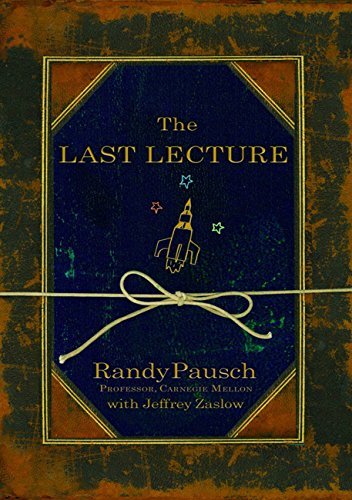
Why Randy Pausch Gives a Last Lecture
The book begins not with a principle of success but with an unsolvable problem. Pausch is physically active, married to Jai, and the father of three very young children, yet he has multiple tumors in his liver and has been told that his remaining time is short. His central concern is not simply his own death. It is the years of parenting that death will remove from the lives of Dylan, Logan and Chloe, who are too young to receive directly all the stories, advice and guidance he expected to give them as they grew.
That concern gives the lecture its first real purpose. Pausch realizes that a recorded public talk might become a kind of preserved version of himself, something his children could encounter when they were older. He describes the lecture as an imperfect engineering solution: he cannot create a substitute for a living father, but he can use the resources still available to leave memories, values and evidence of his personality behind.
Giving the lecture, however, creates a genuine conflict with Jai. The family has recently moved from Pittsburgh to Virginia so that Jai and the children will have extended family nearby after Pausch dies. Time is now their most precious resource, and preparing a major public presentation means diverting some of that resource away from his wife and children. The scheduled trip also requires Pausch to leave for Pittsburgh on Jai’s birthday, which she knows will probably be the last birthday they spend as husband and wife.
Pausch and Jai discuss the conflict with Michele Reiss, a therapist who works with families confronting terminal illness. Pausch does not pretend that his motives are entirely selfless. The lecture is partly about legacy, partly about saying goodbye to his professional community, partly about proving to himself that he can still perform at a high level, and partly about the dignity of remaining recognizably himself rather than becoming only “a dying man.” His image of an injured lion that still wants to roar captures both the courage and ego involved.
The decisive argument concerns the children. Dylan may retain fragments of direct memory, but Logan and especially Chloe may remember little or nothing of their father. Pausch imagines them growing older and urgently wanting to know what he was like. A living-room recording could preserve advice, but a public lecture would also preserve him in his natural habitat: teaching, joking, explaining ideas, showing enthusiasm and interacting with an audience. Jai eventually accepts the idea.
Once he commits, Pausch still must decide what the lecture is actually about. He refuses to make cancer the subject because cancer does not define what is distinctive about him. Instead, he asks what connects the most important things he has done. The answer comes through his childhood dreams. He has spent much of his life chasing goals that once seemed fantastical, and the process of pursuing them introduced him to teachers, mentors, failures, institutions and habits that shaped his character.
Preparation is intense. A visual thinker, Pausch builds a presentation consisting largely of photographs and images rather than a written script. He keeps revising even while chemotherapy leaves him nauseated and exhausted. His friend Steve Seabolt helps cut the presentation down, while Pausch continues reorganizing almost until he goes onstage.
The lecture itself begins by addressing what everyone in the auditorium already knows. Pausch shows scans of the tumors in his liver instead of asking the audience to ignore the subject. He explains the move to Virginia and makes clear that he is not denying his situation. Then he changes the emotional temperature of the room by dropping to the floor and doing push-ups, demonstrating that a terminal prognosis and immediate physical vitality can coexist.
That moment establishes the tone of both lecture and book. Death will remain present, but Pausch refuses to let it become the sole interpretive lens through which his life is viewed. The question is no longer whether he will die. That outcome cannot be changed. The question is what can still be done with the life that remains.
Really Achieving Your Childhood Dreams
Pausch’s account of childhood dreams begins by undermining the simplest possible interpretation of his later success. He does not portray himself as a self-created achiever who overcame everything through individual will. Instead, he says he “won the parent lottery,” crediting his mother and father with creating the intellectual, moral and emotional conditions in which dreaming became possible.
His father had served as a medic during World War II, later ran an insurance business and devoted significant effort to charitable work. He loved ideas, history and storytelling, and the Pausch family kept reference books close enough to the dinner table that questions could be investigated rather than merely speculated about. His mother, an English teacher, supplied high expectations and a useful antidote to her son’s natural confidence. When young Randy grew too impressed with himself, she reliably restored proportion.
Their parenting also allowed unusual kinds of creativity. As a teenager, Pausch asks permission to paint his bedroom walls with whatever matters to him. Instead of worrying primarily about resale value, his parents allow it. The room becomes a map of his imagination: mathematics, a rocket, an impossible elevator in a one-story house, chess pieces, a submarine, jokes and a version of Pandora’s box. His mother is initially skeptical, but the painted room remains intact long after he leaves home.
That freedom matters because Pausch’s dreams are often very specific and occasionally ridiculous. He does not merely want to become an astronaut; he mainly wants to experience weightlessness. Years later, when his Carnegie Mellon students win an opportunity to conduct an experiment on NASA’s reduced-gravity aircraft, Pausch discovers that faculty advisers are forbidden from flying with them. Rather than abandoning the goal, he studies the program’s rules and notices that journalists can participate.
Pausch therefore offers to resign temporarily as faculty adviser and accompany the students as a member of the media, while promising NASA useful publicity for the experiment. The maneuver succeeds because he does not simply demand an exception. He finds a legitimate category through which he can participate and offers something valuable in return. Decades after imagining weightlessness, he finally floats.
Not every childhood dream is fulfilled so literally. Pausch loves American football and once fantasizes about the NFL, but professional sports are never remotely realistic. He nevertheless regards football as one of the most important influences on his life because Coach Jim Graham teaches him lessons that survive long after the athletic dream disappears.
Graham emphasizes fundamentals before glamour. At an early practice he does not even bring footballs, pointing out that only one player at a time possesses the ball while everyone else must still understand positioning, blocking, tackling and teamwork. Pausch carries that lesson into teaching: sophisticated performance depends on basic skills mastered so thoroughly that they become reliable.
Graham also teaches him how to interpret criticism. After the coach rides young Randy particularly hard, an assistant explains that harsh correction is evidence that the coach still believes improvement is possible. The truly dangerous moment comes when people stop bothering to tell you what you are doing wrong. Pausch later turns that idea into a cornerstone of his educational philosophy.
Football introduces another concept that runs through the entire book: the “head fake.” In sport, a head fake misdirects an opponent, but Pausch uses the phrase for indirect learning. Children may believe they are learning football when the deeper lessons involve teamwork, persistence, self-discipline and dealing with adversity. The explicit activity is not necessarily the most important thing being taught.
Other dreams are smaller but reveal how seriously Pausch takes childhood imagination. His family once treasured the World Book Encyclopedia, and young Randy dreams of someday contributing to it. Decades later, after becoming an expert in virtual reality, he is invited to write its entry on the subject. The dream comes true not because he spends his career chasing an encyclopedia commission but because expertise eventually carries him into the position his younger self once admired.
Captain James T. Kirk provides another childhood model. Pausch is fascinated not because Kirk is the smartest person aboard the Enterprise, but because he knows how to lead specialists who possess knowledge he lacks. Spock is more logical, McCoy understands medicine, Scotty understands engineering, yet Kirk sets direction, manages morale and coordinates the team. Pausch comes to see leadership as a distinct skill rather than a reward automatically granted to the person with the greatest technical knowledge.
Years later, William Shatner visits Pausch’s virtual-reality laboratory. Pausch is impressed by Shatner’s willingness to ask basic questions until he understands what the researchers are doing. The encounter turns admiration for a fictional captain into respect for an actual person’s curiosity. During Pausch’s cancer treatment, the Star Trek idea of refusing to accept a “no-win scenario” also becomes an emotional reference point, although Pausch never confuses determination with control over the medical outcome.
His carnival obsession is lighter. Pausch has long associated winning giant stuffed animals with being the coolest person at an amusement park, and he becomes remarkably persistent at acquiring them. During the lecture, he produces some of the actual prizes to prove the photographs are genuine and invites audience members to take them home. One elephant is chosen by a student who also has cancer, giving the earlier “elephant in the room” metaphor an unexpectedly tangible echo.
The most consequential dream in this part begins with Disneyland. As an eight-year-old visitor, Pausch is less interested in merely consuming Disney attractions than in imagining what it would be like to create them. After earning a PhD, he applies to Walt Disney Imagineering and is politely rejected. The rejection becomes the foundation of his “brick wall” metaphor: obstacles reveal how badly someone wants something because people with weaker commitment will often stop.
Years later, Pausch’s work in affordable virtual reality brings him close to Disney’s experimental Aladdin attraction. He persistently works through contacts until he reaches Imagineer Jon Snoddy, then prepares intensively for their meeting. Pausch eventually arranges a sabbatical with Imagineering, although first he must overcome resistance within his own university from administrators worried about intellectual property.
What makes the Disney story more interesting than a generic tale of persistence is the number of ingredients involved. Pausch needs desire, but desire alone does not get him inside Imagineering. He also needs professional expertise, years of work, preparation, institutional negotiation, social skill, an advocate willing to listen and a moment when Disney happens to need something close to what he can provide. The dream comes true because persistence intersects with competence and opportunity.
By the end of this part, childhood dreams have already changed meaning. Their value does not lie only in getting what the child originally imagined. Football matters precisely because the NFL dream fails, while Disney matters because the dream eventually succeeds. In both cases, pursuing something difficult forces Pausch to learn how effort, feedback, preparation and other people shape achievement.
Adventures, Cancer, Marriage and Lessons Learned
The book’s third part moves away from the relatively clean narrative of childhood dreams and into adulthood, where the problems are messier and the stakes much higher. Pausch now has to deal with terminal illness, his own personality flaws, love, parenthood and situations in which persistence cannot guarantee a happy result. These chapters are crucial because they test his philosophy against circumstances he cannot simply engineer away.
His cancer story begins in 2006 with abdominal discomfort and jaundice. Imaging reveals pancreatic cancer, a diagnosis Pausch immediately investigates with the intensity he brings to technical problems. He records medical conversations, reads research, asks detailed questions and tries to become an informed participant in his own treatment rather than a passive patient.
He is eligible for the Whipple procedure, a major surgery that removes the tumor along with parts of several digestive organs. He then undergoes punishing chemotherapy and radiation, losing substantial weight and physical strength. For a time, scans show no detectable cancer, creating hope that the treatment may have succeeded.
That hope collapses in August 2007. While Pausch and Jai wait to meet oncologist Robert Wolff at MD Anderson, they discover that a computer in the examination room has been left logged into his medical record. Pausch checks his test results and sees evidence that something is seriously wrong, then opens the scan and counts tumors in his liver. By the time Wolff enters, they already know the cancer has metastasized.
The scene reveals both Pausch’s strengths and the peculiarities of his personality. Jai is devastated, while Pausch is devastated and simultaneously studying how the doctor delivers catastrophic news. He notices body language, wording and even the absence of tissues in the room. The engineer and teacher in him remain active during one of the worst moments of his life.
Wolff explains that treatment will no longer be aimed at cure. The medical goal is now to preserve quality of life and, if possible, extend the amount of good time Pausch has left. When the couple asks how long that might be, the doctor frames the answer in terms of months of good health rather than a countdown to death. Pausch compares the phrasing to Disney employees describing how long a park remains open instead of emphasizing when it closes.
This is not denial. Pausch knows exactly what the scan means, and the family reorganizes its life accordingly. What changes is his unit of attention. Instead of living mentally inside an unavoidable future death, he tries to concentrate on the still-available present.
A small incident confirms that the attitude is not entirely public performance. Carnegie Mellon administrator Robbee Kosak happens to see Pausch alone in his convertible, roof down, listening to music and visibly enjoying an ordinary evening. She later tells him how much the sight affected her. Because Pausch did not know he was being watched, he takes the observation as evidence that his pleasure in being alive is authentic rather than something he performs for other people.
The book is equally willing to acknowledge less flattering characteristics. Pausch describes himself as someone with confidence, strong opinions and limited patience for incompetence. As a young man at Brown University, he could be arrogant and tactless, and his academic success made it easy to believe that other people’s reactions were their problem.
Professor Andy van Dam intervenes with an exquisitely phrased piece of criticism. Rather than simply calling Pausch a jerk, he explains that being perceived as arrogant will limit what Pausch can accomplish. The feedback works because it appeals simultaneously to Pausch’s ambition and his capacity for self-correction. Pausch later adopts the label “recovering jerk,” not because all traces of his personality disappear but because he learns to treat outside feedback as data about himself.
Family stories then complicate his philosophy in other directions. Before becoming a father, Pausch is a devoted uncle to his sister’s children, Chris and Laura. When his sister warns them not to damage Pausch’s new convertible, he deliberately pours soda on the back seat. His message is that possessions should not become more important than people. The point becomes practical when Chris later gets sick in the car and is spared the added fear that he has ruined something precious.
Knowing that he will not live to accompany his own children into adolescence, Pausch asks Chris and Laura to remain present in their lives. They can become links between his past and his children’s future, telling them how their father behaved with them and creating new experiences in his spirit. Legacy again emerges not merely as a recording but as a network of people through whom memories can travel.
Jai represents Pausch’s most difficult “brick wall,” although the story must be understood more carefully than the metaphor initially suggests. They meet when Pausch visits the University of North Carolina, where Jai is a graduate student. Attraction becomes a long-distance relationship, and Pausch eventually asks her to move to Pittsburgh.
Jai becomes frightened and tells him the relationship will not work. At one point she says that she does not love him the way he wants her to. Pausch is devastated, but instead of intensifying the pursuit, he follows his parents’ advice to remain supportive and give her room. Jai eventually realizes that she does miss him and chooses the relationship. The outcome is less a lesson that refusal should be ignored than a story about patience, emotional uncertainty and the fact that her final decision must be her own.
Their wedding produces one of the book’s most cinematic anecdotes. They leave the reception in a hot-air balloon, expecting a fairy-tale exit, only for winds and darkness to make landing unexpectedly dangerous. The balloon descends near railway tracks while a train approaches, turning a romantic spectacle into an engineering problem. They ultimately land safely, shaken but unharmed.
Another marriage story is smaller but revealing. Jai accidentally backs one family car into another and spends the day worrying about how Pausch will react. He does not become angry because both vehicles still work and he sees no reason to treat cosmetic damage as a major problem. His philosophy again reduces the emotional status of possessions relative to relationships.
The stakes become far higher with the birth of their first child, Dylan. While seven months pregnant, Jai begins bleeding severely from placental abruption. Pausch rushes her to the hospital, where she requires an emergency Caesarean section. An anesthesiologist gives Pausch a specific responsibility: help keep Jai calm because panic could worsen her already dangerous condition.
Dylan is born extremely premature at two pounds, fifteen ounces, but he is breathing. The weeks that follow are filled with fear. At one point Pausch and Jai arrive to discover his bassinet missing and assume something terrible has happened, only to learn that he has improved enough to be moved to a less intensive unit.
For Pausch, the episode becomes an example of agency under constraint. He and Jai cannot control the placental abruption or guarantee Dylan’s survival, but they can still do things that might improve the situation. The lesson is not that positive thinking produces favorable outcomes. It is that catastrophic circumstances often contain at least some decisions that remain available.
His father’s death produces a different lesson. Going through his belongings, the family discovers documentation showing that he had received a Bronze Star for treating wounded soldiers under fire during World War II. In fifty years of marriage and countless family conversations, he had apparently never considered the achievement important enough to mention. For Pausch, the discovery turns humility from an abstract virtue into a startling fact about the man he most admires.
The chapter devoted to Jai is particularly important because it moves beyond the heroic-patient narrative. Terminal illness affects a family system, not just the person with the diagnosis. Jai must handle grief, caregiving, parenting, household responsibilities, financial and logistical questions, and the ordinary irritations of being married to someone who remains recognizably himself.
Pausch is messy, intensely work-focused and capable of annoying her even while dying. Their therapist helps Jai distinguish between problems worth confronting and trivial irritations that can be allowed to pass. She journals, talks with other caregivers and tries to live in the present without pretending that the future is not terrifying. Pausch’s admiration for her sits beside an awareness that his illness and personality impose costs she must absorb.
The part ends with a comic story about honesty. After moving to Virginia, Pausch is stopped for speeding and tells the police officer that the family moved because he has terminal cancer. The officer suspects that the healthy-looking driver may be inventing an excuse, so Pausch eventually exposes his surgical scars. The officer lets him go with a warning, allowing Pausch to joke that for once the terrible truth has literally set him free.
Taken together, these chapters make The Last Lecture much more than a book about getting what you want. Pausch’s adult life includes situations in which what he wants most—cure, decades with Jai, watching his children grow up—is unavailable. His philosophy therefore shifts toward a harder question: how should a person act when the central problem cannot be solved?
Enabling the Dreams of Others
Part IV marks one of the book’s most important transitions. Pausch begins with the excitement of realizing his own childhood ambitions, but professional maturity changes the scale of what feels rewarding. Helping another person achieve a dream, and eventually building systems that allow thousands or millions of people to develop their abilities, becomes more meaningful than adding another experience to his own list.
The transition begins with time. After being accidentally charged twice at a grocery-store self-checkout, Pausch realizes that recovering a relatively small amount of money would require spending minutes he values more than the refund. Terminal illness makes the trade-off especially visible, but he says he has always treated time as a resource that must be managed deliberately.
His advice is practical rather than mystical. Plans should be broken into manageable tasks, schedules should reflect actual priorities, administrative systems should reduce wasted effort, delegation should occur whenever appropriate, and vacations should genuinely interrupt work. The cancer diagnosis intensifies these ideas but does not create them. Pausch’s goal has long been to use finite time in ways that produce the greatest value.
Teaching raises a related problem: how can people improve if they cannot evaluate themselves accurately? Pausch argues that education should not merely transfer knowledge. Students must learn to recognize their own strengths, weaknesses and effect on collaborators.
In Building Virtual Worlds, he has students repeatedly evaluate their teammates on work, creativity and ease of collaboration. The results produce quantitative and written feedback that can be difficult to rationalize away. One student who assumes he is merely near the lower edge of an acceptable range discovers that classmates have actually ranked him dead last for teamwork. Pausch tells him that he once suffered from similar blindness and improved because someone cared enough to confront him.
The chapter about Tommy Burnett shows what such mentorship can produce. As a young artist and computer-graphics specialist, Burnett tells Pausch that his childhood dream is to work on a future Star Wars film, even though no new films have yet been announced. Pausch hires him anyway, seeing value in the ambition even if the literal dream never occurs.
Burnett’s time in Pausch’s research group gives him the programming expertise that later gets him hired by Industrial Light & Magic. When new Star Wars films are eventually produced, he works on them and rises to major technical responsibilities. Years later, he speaks to Pausch’s students about the role their professor played in his career, thereby becoming part of the mentoring chain himself.
Pausch then asks whether dream-enabling can operate on a larger scale. Building Virtual Worlds becomes his answer. At Carnegie Mellon, students from technical and artistic disciplines form small teams and receive short deadlines to create interactive virtual experiences. The emphasis is not on reproducing what one discipline already knows how to do but on making programmers, artists, writers, performers and designers depend on one another.
The first student projects exceed Pausch’s expectations so thoroughly that he calls Andy van Dam for advice. Van Dam tells him not to establish an artificial ceiling by announcing that the work is already exceptional. Instead, Pausch should tell the students that they did well and that he knows they can do better. The advice gives Pausch permission to set expectations according to students’ capacity rather than according to his own previous assumptions.
The class grows into a public spectacle, with presentations drawing large audiences. Pausch and drama professor Don Marinelli then extend the model through Carnegie Mellon’s Entertainment Technology Center, where artists and technologists work together on games, interactive entertainment and other experimental projects. Mentorship is becoming institutional.
Alice takes the idea further still. The software allows beginners to create animated stories and interactive worlds through a more accessible visual environment, while indirectly teaching programming concepts. This is the head fake transformed into educational technology: users may believe they are creating stories, but they are simultaneously learning computational thinking.
Pausch knows he will not live to see the project’s full development. He compares himself to Moses seeing the Promised Land from a distance, satisfied that others can continue without him. That expectation proved meaningful: Carnegie Mellon has continued developing and supporting Alice decades after Pausch’s death, and the project remains connected to the goal of making programming approachable through creativity and storytelling.
The movement from Tommy to Building Virtual Worlds to the Entertainment Technology Center to Alice is one of the book’s strongest pieces of architecture. Pausch starts by helping one person, then a class, then an institution, then a potentially vast population of learners. By this point, the meaning of achievement has changed. The mature dream is not simply to reach the Promised Land yourself but to help build a road that other people can continue using after you are gone.
How Pausch Says to Live Your Life
Part V changes the book’s form. Instead of sustained episodes about childhood dreams, cancer or large educational projects, Pausch offers thirty-one short chapters built around individual habits and principles. Some are substantial arguments and others are closer to family sayings, but together they reveal the everyday behavior he believes supports the larger dreams described earlier.
The section is therefore best read as Pausch’s personal operating manual rather than a scientific theory of human flourishing. Many principles are explicitly presented as things that worked for him, and their value often lies in how concretely he connects them to decisions.
Dreaming, Earnestness, Compromise and Solving the Real Problem
Pausch begins with the scale of aspiration itself. Watching the Apollo program as a child convinces him that human beings can attempt seemingly impossible projects. He remembers being irritated when camp counselors send the children to bed before Neil Armstrong actually walks on the Moon; from Pausch’s perspective, ordinary bedtime rules are absurdly small compared with witnessing humanity step onto another world.
That admiration for ambitious achievement is paired with an affection for earnestness. Pausch distrusts performative coolness because it often depends on detachment, while earnest people commit themselves openly to things that may matter for decades. His own unfashionable clothes become part of the joke: he prefers durability and usefulness to signaling status.
Other chapters concern knowing when not to fight. For years, Pausch resists his mother’s insistence on calling him “Randolph,” even returning mail addressed that way. Eventually he decides that being right about his preferred name matters less than preserving peace with someone he loves. Terminal illness makes the smallness of the disagreement particularly obvious.
A similar family conflict produces a more engineered compromise. Pausch likes leaning back on two legs of his mother’s dining chair, while she fears he will break it. They agree that he may continue, but if the chair breaks he will replace the whole set. The agreement turns repeated conflict into explicit responsibility.
His impatience with complaining is considerably stronger. Pausch believes that energy directed toward complaint is often better spent trying to change the underlying situation. He admires people such as his former landlord Sandy Blatt, who became quadriplegic after an accident yet built a professional and family life, and Jackie Robinson, who endured extraordinary racist abuse while integrating Major League Baseball.
The principle works best when Pausch is talking about his own preference for action, but it becomes more complicated when extended to injustice or suffering that cannot simply be solved by an individual. Robinson’s refusal to retaliate under the specific conditions of baseball integration does not establish that protest itself is wasteful. The chapter nevertheless reveals Pausch’s instinctive question whenever a problem appears: what action is still possible?
That instinct appears again in “Treat the Disease, Not the Symptom.” A former girlfriend is anxious because she is in debt and uses a weekly yoga class to manage the stress. Pausch suggests temporarily working during that time and using the additional income to eliminate the debt itself. The story is a perfect example of his engineering mindset, although its simplicity depends on the underlying problem being tractable in exactly that way.
His chapter about worrying what other people think extends the same efficiency logic to social uncertainty. Pausch tells colleagues that they do not need to speculate about his opinions because he will tell them directly. He jokingly claims that this makes them 33 percent more effective, openly using fake numerical precision as part of his scientist persona rather than presenting a researched finding.
Teamwork, Feedback, Failure, Gratitude and Loyalty
Pausch’s advice about groups is more systematic. He tells students to begin with basic social behavior: learn names, exchange contact information, identify common ground, allow everyone to speak, reduce ego competition and phrase alternatives in ways that invite discussion rather than defensiveness. The advice seems obvious until he demonstrates that students who believe they understand teamwork have not even bothered to sit with the teammates assigned to them.
“Look for the Best in Everybody” introduces a gentler interpersonal rule. Jon Snoddy teaches Pausch that people often need time to reveal their better qualities, and frustration may arise because judgment arrives too quickly. The lesson is unusually patient for someone whose default mode is demanding evaluation.
A short chapter about romantic relationships condenses another lesson into behavior rather than words. Pausch wants Chloe, and eventually his sons, to judge romantic interest according to what a person consistently does rather than what they promise. The principle fits the book’s wider distrust of unearned claims: character should become visible through action.
Pausch is also unapologetic about clichés. He argues that sayings become clichés partly because many remain useful, and younger people may encounter familiar wisdom for the first time. This willingness to reuse old principles explains both the accessibility of The Last Lecture and one of its limitations: Pausch often makes inherited advice memorable through personality rather than inventing genuinely new moral ideas.
His treatment of failure is more distinctive. In Building Virtual Worlds, he develops the “First Penguin Award” for teams that attempt something ambitious and fail meaningfully. The name evokes the penguin that enters potentially dangerous water before the rest of the colony. Failure becomes valuable when it results from intelligent risk rather than carelessness.
The distinction matters. Pausch is not claiming that failure is automatically beneficial. A safe, unimaginative project that succeeds may teach less than an ambitious project that exposes important technical or collaborative limits. The educational task is to create conditions in which students can fail without learning to fear experimentation itself.
He occasionally relies on theatrical methods to make such lessons memorable. Frustrated by badly designed technology, he destroys a VCR with a sledgehammer in class to impress upon interface designers that poor usability has real consequences for users. The performance echoes the last lecture itself: Pausch often teaches by creating an image people are unlikely to forget.
Gratitude receives similarly concrete treatment. He prefers handwritten thank-you notes and recounts an admissions case in which an applicant’s unexpected note to a staff member influences how the institution perceives her character. The point is not that gratitude should be strategically performed for advantage. It is that small, voluntary behavior reveals how someone treats people from whom they are not obviously trying to gain status.
Loyalty, for Pausch, also works in both directions. Dennis Cosgrove struggles academically, and Pausch risks professional capital to argue that the young man’s failures do not justify abandoning his potential. Cosgrove later becomes important to Alice. The story allows Pausch to show that investing in someone before the outcome is certain can create the relationships through which later achievements become possible.
Work, Preparation, Apology, Honesty and Humility
Pausch’s work ethic is demanding. Asked how he achieved tenure quickly, he points not to a secret technique but to the accumulated advantage of working while other people were not. He describes late Friday nights in the office as part of that compound effort, arguing that sustained work gradually increases what a person knows and can do.
The principle clearly helped Pausch, but it also exposes the tension between his professional philosophy and his family life. The same intensity that allows him to build ambitious projects contributes to Jai’s worry that preparing the last lecture will consume precious time. The Last Lecture is more interesting because the book never fully resolves that tension.
Gratitude appears again when Pausch takes members of his research group to Disney World after receiving tenure. He understands tenure as something supported by many other people’s labor, not a purely individual victory. Elsewhere he recommends small gestures such as including Girl Scout cookies with tedious requests, using humor to express a serious belief that other people’s time and effort should not be treated as invisible.
Preparedness is another recurring principle. Pausch admires people who carry what they might need rather than assuming conditions will remain ideal. His joking “Eaten By Wolves Factor” dramatizes contingency planning: if something unexpected removes you from the system, can the work continue?
That habit becomes especially significant once he is terminally ill. Planning for failure is not pessimism in Pausch’s worldview. It is what makes optimism operational because hopeful action becomes more robust when obvious risks have already been considered.
His discussion of apologies is similarly procedural. A bad apology avoids responsibility, while a useful one acknowledges wrongdoing, expresses regret for the harm and asks what can be done to repair the relationship. Pausch prefers this concrete model because it makes remorse visible through responsibility rather than language alone.
Honesty is treated as both moral principle and efficiency mechanism. When people trust one another, less effort has to be spent verifying claims, protecting against manipulation and reconstructing what actually happened. Pausch admires systems such as honor codes because trust reduces friction.
He also acknowledges that his own moral certainty could become rigid. The chapter built around crayons describes a younger tendency to divide issues sharply into right and wrong. Age has made him more appreciative of shades and ambiguities, even if his writing still frequently relies on strong binaries.
A Disney customer-service story reinforces his belief in long-term thinking. When Pausch and his sister accidentally break a souvenir, Disney replaces it. Their parents remember the generosity and continue spending money with the company for years. A small act that might look economically irrational in isolation becomes sensible when relationships rather than transactions define the time horizon.
Adaptation, Persistence, Community, Asking, Fun and Optimism
Pausch rejects the idea that prestigious credentials make ordinary work beneath someone. He remembers doing manual labor when younger and credits his father with teaching him to respect work according to whether it contributes something useful rather than according to status. That attitude becomes especially relevant when technically gifted graduates enter organizations expecting immediate authority.
Disney also teaches him that expertise is contextual. Academic prestige does not automatically command respect inside Imagineering, where different standards, vocabulary and forms of evidence matter. Pausch has to learn the culture rather than assuming that the institution should adapt to him.
Persistence remains central. He recounts being wait-listed by Brown University and rejected from Carnegie Mellon graduate school, then continuing to pursue openings through advocacy, conversation and additional effort. As with the Disney story, mentors and institutional gatekeepers play important roles alongside personal determination.
“Be a Communitarian” adds an essential corrective to the book’s individualistic tone. Pausch argues that membership in institutions and communities creates responsibilities as well as rights. People should contribute to systems from which they benefit rather than treating participation as a one-way transaction.
Another short chapter encourages asking for opportunities rather than pre-rejecting oneself. Pausch has obtained unusual experiences partly because he is willing to contact people, request access and risk hearing no. The method is low-cost compared with assuming a door is closed without testing it.
His attitude toward life is finally reduced to two Winnie-the-Pooh characters: Tigger and Eeyore. Pausch chooses Tigger, the energetic optimist who takes pleasure in being alive, rather than organizing his remaining months around resentment. He continues celebrating Halloween, visiting friends and enjoying experiences even when death is approaching.
The following chapter, however, is essential because it prevents this metaphor from becoming simplistic positive thinking. Pausch does not believe optimism can cure metastatic cancer, nor does he think cancer patients who deteriorate have failed psychologically. His optimism concerns behavior rather than magical control over outcomes. He knows the prognosis and continues acting because despair would not improve it.
That distinction is one of the most responsible ideas in the book. Pausch’s preferred attitude is not “everything will work out.” It is closer to “the outcome may be terrible, but useful action and genuine enjoyment may still be available before it arrives.”
Part V concludes by returning to other people. Messages from former students, colleagues and strangers show Pausch how widely his lecture has travelled. He discusses religion but explains why he chose to keep the public lecture focused on principles that did not require a particular faith commitment.
A minister offers him one final metaphor: “emotional insurance.” Pausch cannot prevent the emotional loss his children will experience, but he can create recordings, memories and evidence of love that may help them live with it. The phrase brings the practical lessons of Part V back to the book’s deepest purpose. Even legacy becomes something Pausch tries to plan.
Final Remarks: His Children, Jai and the Two Head Fakes
The final part abandons nearly every remaining layer of professional distance. Pausch stops speaking primarily as professor, technologist or motivational storyteller and addresses the people who stand to lose the most when he dies. Chapters 59–61 explain what he hopes to leave his children, what he fears for Jai and what the lecture has actually been about all along.
Pausch’s children are still young enough that their personalities are emerging faster than stable memories can form. Dylan, the eldest, is the child most likely to remember him directly. Logan and especially Chloe may retain little independent memory. Pausch therefore tries to record specific impressions of who they are now, creating material that can later demonstrate not only that he loved “his children” abstractly but that he saw them as individual people.
He thinks about what advice he wishes he could deliver as they grow older, yet one of his most important decisions is not to decide their futures for them. A book about achieving childhood dreams could easily end with a father assigning dreams to his children. Pausch refuses. He wants them to discover what they want rather than treating his ambitions as an inheritance they must fulfill.
This gives the book’s language of childhood dreams its final moral dimension. A good parent does not manufacture a child’s dream. The parent’s role is to provide love, opportunity, encouragement, standards and enough freedom for the child to discover one.
The chapter about Jai is even more painful because she fully understands what is happening. Children can be protected temporarily by their age, but husband and wife cannot avoid discussing a future in which she will raise them alone. Pausch acknowledges that caregivers can disappear inside stories centered on the dying patient even though they often carry extraordinary burdens.
At the lecture, Pausch tries to repair the fact that preparation forced him to leave Jai on her birthday. He surprises her with a cake onstage while the audience sings to her. The gesture is theatrical, but that is precisely Pausch’s language of affection: he likes turning emotional meaning into memorable action.
Privately, their conversations are harder. He worries that Jai may try to compensate for the children’s loss materially or become impossibly demanding of herself as a single parent. He wants her to accept that mistakes are inevitable. He also has to face the possibility of another man eventually entering her life, one of many parts of the future he will neither control nor witness.
The final chapter returns to the lecture itself. Pausch reveals that the audience has been learning through a head fake. The apparent subject was how to achieve childhood dreams, but the deeper subject was how to live in ways that make such dreams possible: work hard, accept feedback, help people, show gratitude, prepare, persevere, tell the truth and remain engaged with the world.
Then comes the second head fake. The lecture was never ultimately designed for the four hundred people in the room, or even for the millions who would later encounter it. Its most important audience was three children who were not yet old enough to understand it.
That revelation changes the emotional meaning of everything that came before. The football stories, Disney stories, lessons about honesty, warnings about arrogance, principles of teamwork and insistence on gratitude are not merely advice to strangers. They are fragments of fatherhood pushed forward in time.
The book ends with Pausch and his children together. The public lecture has completed its transformation into a private inheritance.
What The Last Lecture Is Really About: Legacy, Not Achievement
The title of Pausch’s original lecture encourages readers to interpret the book through achievement. He floats in zero gravity, works at Disney, contributes to an encyclopedia, builds influential educational projects and meets people he once admired from afar. Read superficially, The Last Lecture can therefore look like a high-achiever explaining how to become another high-achiever.
The book’s architecture points somewhere else. Pausch’s dreams matter first because they reveal his personality, then because pursuing them teaches him skills, and finally because those skills allow him to create opportunities for other people. The trajectory moves from receiving support to becoming a source of support.
That movement is clearest in education. Coach Graham teaches Pausch through demanding feedback. Andy van Dam later teaches the adult Pausch how arrogance may undermine his potential. Pausch then becomes the demanding mentor for students such as Tommy Burnett, Dennis Cosgrove and Caitlin Kelleher. Those students eventually develop other people, technologies and institutions.
Legacy therefore becomes less about being remembered than about remaining causally useful after death. Alice can continue introducing children to programming. Former students can teach what Pausch taught them. His niece and nephew can tell stories to his children. Video can preserve his voice and gestures. The book can preserve anecdotes that a five-year-old cannot yet understand.
Seen this way, Pausch treats mortality as an engineering problem without pretending that engineering can solve death. He cannot change the terminal constraint, so he asks which outputs are still possible under that constraint. The last lecture, book, letters, recordings, educational programs and relationships become multiple channels through which something of him can continue functioning.
This interpretation also explains why the lecture is simultaneously selfless and self-conscious. Pausch admits that he likes the stage, wants to demonstrate vitality and cares about how people will remember him. The book does not require readers to pretend these motives disappear. Instead, personal pride, professional identity, parental love and desire for usefulness coexist.
The strongest form of his legacy is not a set of slogans. It is the pattern visible across his life: someone gives him freedom, correction or opportunity; he uses it; then he tries to create an equivalent opening for someone else. Achievement is meaningful because it eventually becomes transmission.
Randy Pausch as Narrator: The Engineer, Teacher and “Recovering Jerk”
Pausch’s personality is inseparable from the book’s appeal. He does not present himself as contemplative, mysterious or spiritually transformed by illness. He remains recognizably an engineer and teacher: analytical, energetic, competitive, amused by systems and convinced that many problems improve when they are defined accurately.
That temperament gives The Last Lecture unusual concreteness. Pausch does not merely say time is precious; he discusses grocery refunds, telephone habits, filing systems and schedules. He does not merely praise teamwork; he measures peer feedback. He does not merely say people should apologize; he breaks an apology into components.
The same mind can become inflexible. Pausch knows he is blunt and acknowledges that he has offended people, dominated conversations and behaved arrogantly. Calling himself a “recovering jerk” is important because it prevents the book from presenting success as proof of perfect character. He explicitly credits other people with correcting qualities he did not recognize on his own.
Yet self-awareness does not mean the memoir is unfiltered. Like all autobiographical writing, The Last Lecture is curated. Pausch chooses stories that support the lessons he wants to preserve and generally retains interpretive control over how his own flaws are understood. He often admits arrogance through anecdotes that end by demonstrating growth.
That is one reason Jai Pausch’s later account of caregiving and marriage is a useful counterpoint. Her perspective does not invalidate Randy’s self-description, but it reminds readers that the driven, argumentative, work-focused traits he presents humorously could be more difficult from the perspective of the spouse living beside them.
This does not make Pausch unreliable in any simple sense. In fact, his willingness to include criticism from Jai, Andy van Dam and others makes him more credible than a narrator who erases every weakness. The limitation is subtler: he is unusually skilled at converting flaws into lessons, which can make the finished narrative feel more resolved than real personality usually is.
His humor helps. Cancer does not make him solemn, and he repeatedly uses jokes to prevent his terminal illness from turning him into a symbol rather than a person. The reader gets the impression that the lecture preserves him partly because it preserves this combination of analytical confidence, showmanship, geeky enthusiasm and self-mockery.
The People Behind Pausch’s Philosophy
Although The Last Lecture often speaks the language of personal agency, its actual stories are deeply relational. Pausch succeeds because other people teach him, criticize him, indulge his imagination, open doors, tolerate difficult parts of his personality and sometimes believe in him before a result exists. The book’s mature philosophy emerges when he recognizes that he should become that kind of person for others.
His Parents: Curiosity, Humility, Service and Freedom
Pausch’s parents provide the earliest model. His father’s intellectual curiosity teaches him that questions should lead to investigation. His charitable work demonstrates that success should create obligations beyond the household, while the later discovery of his Bronze Star reveals a humility Pausch admires precisely because it was never advertised.
His mother plays a different role. She is demanding, practical and repeatedly capable of cutting her son’s ego down to size. Pausch’s later enthusiasm for feedback owes something to growing up in a household where affection did not require constant praise.
Their permission also matters. The painted bedroom becomes a symbol of adults allowing a child’s imagination to become concrete. Pausch’s insistence that parents should enable dreams does not come from abstract parenting theory; it comes from remembering what it felt like when his own parents allowed him to turn walls into a physical extension of his mind.
Jai: Love, Friction, Caregiving and the Cost of His Philosophy
Jai is essential because she reveals what Pausch’s philosophy looks like from close range. His optimism, efficiency and relentless activity can be admirable, but they can also mean that work absorbs attention and that emotions are quickly converted into problems to be analyzed. Their marriage therefore prevents the book from becoming a one-dimensional celebration of his temperament.
The dispute over giving the last lecture demonstrates this tension clearly. For Pausch, the lecture is legacy, dignity and a gift to the children. For Jai, it is also time removed from a family that has almost none left. Both positions are reasonable, and the book is stronger because it does not pretend otherwise.
Caregiving adds another dimension. Jai must prepare for widowhood while continuing to parent, manage a household and remain emotionally available to a dying husband. She learns to let trivial irritations pass, but that adaptation should not be confused with evidence that the irritations are imaginary. Terminal illness forces the couple to renegotiate which conflicts deserve their scarce attention.
Pausch’s romantic brick-wall story also needs to be interpreted through Jai’s agency. His persistence works because, after space and reflection, she chooses the relationship. The lesson cannot responsibly become a rule that another person’s refusal is merely an obstacle to overcome. What matters in the actual story is that Pausch ultimately supports her rather than coercing an outcome.
Coaches, Mentors and Students: Feedback and Inheritance
Coach Graham and Andy van Dam form a chain of demanding mentorship. Graham teaches the child that fundamentals, effort and criticism matter more than comfort. Van Dam later teaches the successful young adult that intelligence and achievement do not exempt him from examining how other people experience him.
Jon Snoddy adds professional generosity and cultural intelligence. Disney is a dream partly because someone inside the institution eventually treats Pausch’s enthusiasm as worth exploring. Snoddy also teaches patience with people, balancing Pausch’s tendency toward rapid judgment.
Pausch then reproduces these patterns with students. Tommy Burnett’s Star Wars dream is taken seriously before its fulfillment is remotely certain. Dennis Cosgrove receives advocacy when academic performance makes dismissal easier. Caitlin Kelleher is given space to question whether Alice is equally engaging for girls and develops storytelling approaches that push the project further.
Don Marinelli represents a slightly different relationship: productive collaboration between people with contrasting disciplines and temperaments. Their work on the Entertainment Technology Center demonstrates that enabling dreams sometimes requires constructing environments where differences are not merely tolerated but made operationally useful.
These relationships expose the limits of purely individualist readings of The Last Lecture. Pausch believes people should work hard, but his own life repeatedly depends on someone caring enough to coach, recommend, introduce, defend or challenge him. The ethic becomes complete only when receiving those interventions creates a responsibility to offer them to somebody else.
Brick Walls, Head Fakes and Childhood Motifs
Pausch’s most memorable concepts are not formal theories. They are metaphors drawn from play, sport, engineering and childhood, which makes them easy to remember even when their boundaries are imprecise. Brick walls and head fakes are particularly important because they organize both the content of his life stories and the structure of the lecture itself.
Brick Walls and Persistence
Brick walls represent obstacles that test commitment. Disney rejects Pausch early in his career, university administrators resist his later sabbatical, graduate programs reject or delay him, and Jai temporarily pulls away from the relationship. Pausch interprets these barriers as invitations to demonstrate how seriously he wants the outcome.
The Disney example is the metaphor at its strongest. Pausch does not repeatedly knock on the same locked door while refusing to change. He becomes more qualified, finds a new route, does extensive preparation, understands Disney’s interests and brings something valuable to the interaction. Persistence is adaptive rather than merely repetitive.
Problems arise when the metaphor is universalized. Some walls are not tests placed in front of the insufficiently committed. They may represent legitimate boundaries, discriminatory structures, lack of resources, incompatible goals, random misfortune or constraints that cannot be overcome through greater effort. Terminal cancer itself becomes the book’s ultimate example of a wall that persistence does not remove.
Pausch’s best stories implicitly recognize this distinction. He cannot force NASA to erase a rule, so he finds a category that legitimately permits him aboard. He cannot make Jai love him, so he eventually gives her room to decide. He cannot cure his metastatic cancer, so he redirects effort toward family, teaching and legacy. The deeper principle is therefore not “never accept no.” It is “understand what kind of no you are facing.”
Head Fakes and Indirect Learning
Head fakes are more intellectually interesting because they describe how education often works. Children may join football because they want to play a game while actually developing resilience and teamwork. Students may create virtual worlds because they want to make something entertaining while learning collaboration across disciplines.
Alice embodies the concept technologically. Students believe they are animating characters or telling stories while simultaneously learning principles of programming. The immediate motivation keeps them engaged with a skill that might otherwise feel abstract or intimidating.
The last lecture itself is Pausch’s largest head fake. The audience believes it is hearing a lecture about childhood dreams, but the stories indirectly teach a philosophy of life. Then the final chapter reveals another layer: the public audience has been participating in the creation of a message for his children.
That structure gives the concept more than rhetorical charm. Pausch is arguing that some of the most important learning occurs when the lesson is embedded inside meaningful activity rather than delivered as an isolated moral instruction. The book practices what it describes.
Disney, Football, Crayons, Stuffed Animals and Play
Childhood imagery keeps returning even as Pausch faces terminal illness. Disney represents engineered imagination, football represents fundamentals and indirect education, crayons represent creativity, and giant stuffed animals preserve the absurd pleasure of winning something simply because it delighted the child he once was.
These objects prevent Pausch’s philosophy from becoming austere. He values discipline and hard work, but he does not describe a good life as one optimized only for productivity. Play, silliness, spectacle, toys, amusement parks and popular culture occupy enormous emotional space in his memories.
The elephant is especially effective because it changes meaning. The “elephant in the room” begins as the cancer everyone knows about but is reluctant to discuss. Later, an actual giant stuffed elephant is taken home by another student with cancer. The metaphor becomes physical and playful without erasing the seriousness that created it.
The Promised Land works differently. Alice will outlive Pausch, and he accepts that he will not witness what it becomes. The biblical image allows him to describe professional mortality without turning unfinished work into failure. Seeing that others can continue is enough.
Teaching as a Way of Enabling Dreams
Education is arguably the strongest and most distinctive material in The Last Lecture. Pausch’s advice about optimism or hard work is often familiar, but his ideas about feedback, interdisciplinary collaboration and educational design emerge from years of concrete teaching practice. This is where his personal philosophy becomes most operational.
Feedback, High Standards and Productive Failure
Pausch believes self-esteem should be built through competence rather than distributed through praise. Coach Graham teaches this physically: give a child something difficult, require effort and let confidence emerge from discovering that today’s impossibility can become tomorrow’s skill.
Andy van Dam applies the same principle to personality. Pausch does not improve because somebody tells him he is fundamentally wonderful. He improves because a respected mentor tells him that arrogance is creating a real limitation and delivers the criticism in a form he can hear.
Pausch later tries to institutionalize that process. Peer feedback in his classes gives students repeated information about effort, creativity and collaboration. The system matters because talented people can otherwise explain away interpersonal problems. If fifteen separate teammates consistently report that someone is hard to work with, the student has evidence that self-perception needs revision.
The First Penguin concept addresses another educational failure: students learn to optimize for grades rather than experimentation. Rewarding an intelligent failure changes the incentive structure. A student can discover that reaching beyond current ability is itself valued, provided the attempt produces learning.
This combination of high standards and tolerance for meaningful failure distinguishes Pausch’s approach from simplistic toughness. He wants students to be corrected aggressively, but he also wants environments where ambitious mistakes do not produce humiliation severe enough to stop future risk-taking. Feedback should increase capability, not merely establish hierarchy.
Building Virtual Worlds, the ETC and Alice
Building Virtual Worlds turns those principles into a course design. Students from different disciplines form temporary teams and repeatedly create interactive experiences under short deadlines. The rapid cycles make perfection impossible while creating many opportunities for feedback, adaptation and new collaboration.
The interdisciplinary structure is deliberate. Pausch knows that technical brilliance alone does not produce compelling interactive worlds, just as artistic imagination alone cannot make them function. Students must learn to depend on abilities they do not personally possess.
The Entertainment Technology Center scales the same idea institutionally. Pausch and Don Marinelli embody the collision between technology and the arts, and the program is designed to make that collision productive. Students build things rather than merely discuss collaboration.
Alice scales the philosophy further because software can reach learners Pausch will never meet. Its storytelling and visual environment embody head-fake learning, making an intimidating technical subject feel like creative activity. That approach also shows Pausch’s willingness to let students improve his original assumptions: Caitlin Kelleher’s work on storytelling pushes the software toward forms of engagement he had not initially prioritized.
Pausch’s professional legacy is therefore unusually aligned with the book’s argument. He says the mature form of dreaming is enabling other people’s dreams, and his largest projects are designed to do exactly that. The fact that Alice continued long after his death gives this part of the book unusual retrospective force.
Time, Mortality and Realistic Optimism
Death is everywhere in The Last Lecture, but Pausch rarely approaches it through metaphysics. He is less interested in explaining what death means cosmically than in asking what mortality changes about planning, attention and responsibility. His response is characteristically practical: if time is finite, treat it like a resource whose allocation matters.
Terminal illness makes this visible in extreme form. A fifteen-minute dispute about a grocery charge has a different emotional weight when remaining months are being measured. Yet Pausch’s broader principle does not depend on cancer. Everyone has finite time; most simply experience that fact less vividly.
His attitude is sometimes summarized through Tigger and Eeyore, but the following chapter must always be read alongside the metaphor. Pausch is not claiming that sufficient optimism prevents disease, guarantees success or makes grief illegitimate. He explicitly rejects the idea that cancer patients should feel responsible for outcomes because they were not positive enough.
Current American Cancer Society pancreatic-cancer survival data are better than the general figures Pausch encountered in the mid-2000s, although pancreatic cancer remains a highly dangerous disease and outcomes vary enormously according to stage and other clinical factors. That change does not retroactively make Pausch’s understanding of his own prognosis unreasonable, particularly after his disease had metastasized. Population statistics also cannot predict any individual patient’s course.
The distinction between optimism and prediction is central. Pausch’s optimism concerns what attitude makes constructive action possible under uncertainty. He knows he is likely to die and plans accordingly. The family moves to Virginia, he prepares documents, records memories and thinks about Jai’s future precisely because he is not pretending everything will somehow work out.
Preparedness therefore supports rather than contradicts his optimism. A person who assumes nothing will go wrong has no reason to create backups, succession plans or emotional insurance. Pausch plans for bad outcomes because acknowledging them allows him to preserve more value if they occur.
This is also why the book’s famous statement about playing the hand you are dealt is stronger than some of its more sweeping advice about persistence. Cards introduce limits. You do not choose what enters your hand, but you retain meaningful decisions about how to play it. Pausch’s terminal illness makes the distinction impossible to ignore.
How the Book Is Written: From Lecture Performance to Memoir
The Last Lecture does not read like a conventional memoir. It contains chronological material, but its sixty-one short chapters are organized primarily around ideas. Each usually begins with an anecdote, extracts a principle and ends before the concept becomes abstract enough to lose the personality of the story.
That structure reflects the book’s origins. Pausch was an experienced lecturer whose public persona depended on images, jokes, demonstrations and compact memorable ideas. Jeffrey Zaslow’s role was not simply to transcribe the Carnegie Mellon talk but to help transform additional stories recorded during Pausch’s bicycle rides into a readable narrative extension of the lecture.
The result has an oral quality. Pausch sounds as though he is speaking directly to a room rather than composing a literary memoir in isolation. His analogies come from Disney, football, Star Trek, engineering, customer service and popular culture, keeping difficult subjects approachable.
Humor is particularly important. Pausch repeatedly interrupts the expected solemnity of terminal illness with jokes about academia, his mother, technology, marriage and his own ego. The humor does not trivialize death so much as resist the reduction of his identity to death.
The micro-chapter format also creates weaknesses. Some chapters state ideas that are familiar enough to resemble motivational commonplaces, and the accumulation of brief morals can become repetitive. A contemporary critique of the book’s inspirational mode usefully points toward this tension: Pausch is often most memorable when recounting the strange, specific details of his own life rather than when restating familiar wisdom.
Yet the apparent miscellany gains coherence at the end. The reader eventually understands why a dying professor is preserving dozens of stories that might otherwise seem too small for memoir. He is not merely building an argument for strangers. He is constructing a personality archive for children who may someday care as much about how their father thought about broken chairs or stuffed animals as about his largest professional achievements.
The Ending Explained: Why the Second Head Fake Changes the Book
Literally, the ending is straightforward. Pausch has explained his dreams, adult experiences, teaching philosophy and practical rules for living. He then turns explicitly toward Dylan, Logan, Chloe and Jai, acknowledging what his death will remove from their lives and what pieces of himself he is trying to leave behind.
The first head fake explains the intellectual structure of the lecture. Childhood dreams were never really the final subject. They were an attractive way to teach the habits Pausch believes make a good life possible: effort, curiosity, preparation, feedback, gratitude, honesty, persistence, collaboration and service.
The second head fake changes the emotional structure. The audience believes Pausch has been teaching them, but they are partly witnessing a father record himself for children who cannot yet understand what he needs to tell them. The public usefulness of the lecture is real, but it is almost a by-product of a private parental purpose.
That revelation changes how earlier material reads. The chapter about Pausch’s father is now also instruction about the kind of father Randy hopes to remain in memory. The stories about football and criticism become advice his children may someday need when someone corrects them. His discussion of romantic behavior becomes a message to Chloe and the boys. His obsession with time becomes an explanation for why he spent the remaining months as deliberately as he did.
Even the apparent egotism of giving a major public lecture becomes more complicated. Pausch wants to be seen and remembered, but he also knows his children will eventually need evidence of the person being remembered. A professionally produced, publicly received lecture preserves something a private list of parental commandments could not: tone, timing, confidence, humor, enthusiasm and the sight of their father doing what he loved.
The second head fake also prevents the book from collapsing into conventional self-help. If its deepest purpose were simply to teach readers how to succeed, the value of Pausch’s advice would depend heavily on whether every rule generalizes. Once the book is understood as inheritance, personal specificity becomes a strength rather than a defect.
The book is therefore not finally arguing that everyone should become Randy Pausch. It is showing three children what being Randy Pausch meant to their father and offering everyone else the chance to take whatever parts of that example prove useful.
Critical Review: What The Last Lecture Achieves—and Where It Falls Short
The Last Lecture has to be judged as several books at once. It is autobiographical narrative, a terminal-illness legacy document, a collection of practical advice and a statement of educational philosophy. Its strengths are not evenly distributed across those forms, but the unusual combination is precisely what gives the book its staying power.
What the Book Does Exceptionally Well
Its greatest achievement is converting mortality into specificity. Books about dying can become abstract very quickly, but Pausch keeps returning to concrete problems: where the family should live, how children will remember him, which projects can survive him, how Jai will manage, what stories need to be recorded and which arguments are no longer worth having. Mortality becomes visible through decisions.
The storytelling is equally effective. Zero-gravity flights, Disney rejections, painted walls, premature birth, peer-feedback charts, giant stuffed animals and a near-disastrous wedding balloon are easier to remember than generalized principles. Pausch understands instinctively that people absorb ideas through narrative.
The educational material is especially strong. His insistence on honest feedback, interdisciplinary teamwork, fundamentals, meaningful failure and helping students judge themselves remains more substantial than many of the book’s broader motivational claims. These ideas are grounded in identifiable teaching practices rather than simply asserted as wisdom.
The movement from personal dreams toward enabling other people is also intellectually satisfying. Pausch does not remain trapped inside a heroic autobiography in which success means accumulating impressive experiences. Tommy Burnett, Building Virtual Worlds, the Entertainment Technology Center and Alice show him increasingly interested in creating systems that do not require his permanent presence.
His self-awareness prevents the book from becoming unbearable. Pausch clearly has a large ego, but he knows that fact and repeatedly tells stories about people puncturing it. His willingness to call himself a recovering jerk gives the reader permission to admire his drive without pretending every aspect of his personality is desirable.
The emotional restraint is another strength. Pausch knows his circumstances are devastating and does not need to manufacture sentiment. The most affecting moments often arise because he discusses impossible subjects in practical language: what Jai will do after he dies, what memories the children may retain, what he can still record and what he will never see.
Finally, the ending is structurally excellent. The second head fake transforms what might otherwise feel like a loose collection of aphorisms into a deliberate act of fatherhood. The book becomes more moving after the reader understands why so many apparently minor stories needed to be preserved.
Where Pausch’s Philosophy Needs Qualification
The main limitation is evidentiary. Pausch’s method is autobiographical: a story happens, he extracts a lesson, and the lesson is often expressed broadly. That works beautifully as memoir but less reliably as universal guidance because a personally effective habit is not automatically a general law.
His emphasis on effort and persistence sometimes risks understating structural conditions. Pausch had extraordinary energy, substantial education, supportive parents, respected mentors, professional networks and access to institutions such as Brown, Carnegie Mellon, NASA and Disney. He acknowledges luck and opportunity more openly than many success writers, but the rhetoric of brick walls can still encourage readers to interpret barriers primarily as tests of desire.
That metaphor becomes particularly dangerous when applied to interpersonal boundaries. Pausch’s courtship with Jai ends well because she independently decides that she wants the relationship. It should not become evidence that another person’s rejection is merely a challenge to overcome through greater persistence.
The chapter about complaining also requires qualification. Pausch is persuasive when he argues that repetitive complaint can consume energy that could be directed toward a solvable problem. He is much less persuasive if the principle is taken to imply that publicly naming discrimination, injustice or systemic failure is unproductive. His use of Jackie Robinson can blur that distinction because Robinson’s strategic restraint under extraordinary historical circumstances cannot establish a general rule against protest.
The Tigger/Eeyore metaphor has similar limits. Choosing engagement over habitual pessimism can be useful, but human responses to grief, illness and trauma cannot always be divided into cheerful and gloomy characters. People experiencing depression or overwhelming loss may not simply be choosing the wrong attitude.
Pausch partly protects himself from this criticism through his chapter on realistic optimism. He does not claim that positivity cures cancer or that people who deteriorate have failed psychologically. That distinction matters enormously and separates his strongest advice from the more troubling forms of compulsory optimism sometimes found in adversity literature. A related discussion of the limits of treating positivity and agency as universal responses to crisis is useful here: preserving agency can help without requiring every crisis to become a growth opportunity.
His work ethic also deserves scrutiny. Pausch treats long hours as one source of his professional success, and the claim is plainly autobiographically true. But a philosophy built partly around late Friday nights needs to acknowledge opportunity costs, especially when the same book contains Jai’s concern that professional intensity absorbs family time. The tension is present but not fully resolved.
The root-cause mindset is similarly powerful when problems are straightforward and potentially reductive when they are not. Debt that can be eliminated through temporary extra work is different from chronic illness, structural poverty, mental-health conditions or relationship conflict. Engineering metaphors encourage precise action, but human problems do not always have a single underlying variable waiting to be corrected.
The memoir’s perspective is also curated. Pausch tells us that he was arrogant, messy, demanding and difficult, but usually from the retrospective position of someone who has understood and partially corrected those flaws. Jai’s later perspective reminds readers that living with those traits could be more complicated than the polished memoir occasionally suggests.
None of these criticisms destroys the book’s central project because Pausch repeatedly frames the material as what worked for him rather than as a fully evidenced science of human behavior. The trouble begins when readers detach memorable slogans from the autobiographical conditions that made them meaningful.
What Has Lasted Since 2008
Some surface details naturally show their age. Technology has changed, Pausch’s references belong to a particular generation of American popular culture, and medical outcomes for pancreatic cancer have improved somewhat since the statistics he encountered. Those changes matter for factual context but do not significantly alter the book’s central drama.
The educational philosophy has aged particularly well. Honest feedback, interdisciplinary teams, experiential learning and designing environments where intelligent failure is survivable remain compelling ideas. Alice’s continuing existence strengthens rather than weakens the section in which Pausch imagines professional work continuing without him.
The concept of legacy has also gained force with time. Pausch could only hope that the lecture, students and projects would survive him; readers now know that at least parts of that hope were realized. The enduring cultural memory of the lecture itself demonstrates one of his assumptions: a well-made artifact can carry a person’s voice farther into the future than its creator could.
What has aged less comfortably is some of the binary language. Contemporary readers may be more cautious about dividing people into complainers and workers, optimists and pessimists, or those who want something badly enough and those who do not. The most durable version of Pausch’s philosophy emerges when those binaries are softened by his own life: he plans for failure, accepts terminal reality, credits luck and mentors, and acknowledges that some obstacles cannot be beaten.
That is also why the book remains worth reading. Its value does not depend on treating every maxim as universally true. It comes from watching a particular person decide what parts of his life he wants to preserve when he knows he cannot preserve himself.
The Last Lecture is strongest as a father’s legacy and a teacher’s philosophy rather than as a comprehensive theory of success. Readers looking for evidence-based psychology, a nuanced model of grief or a systematic account of structural inequality will need other books. Pausch is writing from one highly specific life, and the article-sized lessons he extracts from that life should remain attached to their context.
For educators, mentors and students, the sections on feedback, productive failure and enabling other people’s dreams are especially valuable. For parents, the deeper emotional arc may matter more: Pausch gradually reveals that love is expressed not only through affection but through preparation, stories, standards, permission and the effort to leave children enough material to construct a relationship with someone they will lose too soon.
For readers facing finite time—which ultimately means everyone—the book offers a more defensible principle than its most famous slogans. Pausch cannot choose the cards he receives, and he cannot make terminal cancer disappear through optimism or effort. What remains available is attention: where to spend time, whom to help, what to repair, what to let go, what to teach and what to leave behind.
That is why the second head fake matters so much. The Last Lecture appears to be a dying professor telling the world how to achieve dreams. By the end, it becomes something quieter and more enduring: a father arranging his memories so that, years after he is gone, his children can still meet him.
Last Updated on August 13, 2026 by Aseem Gupta