
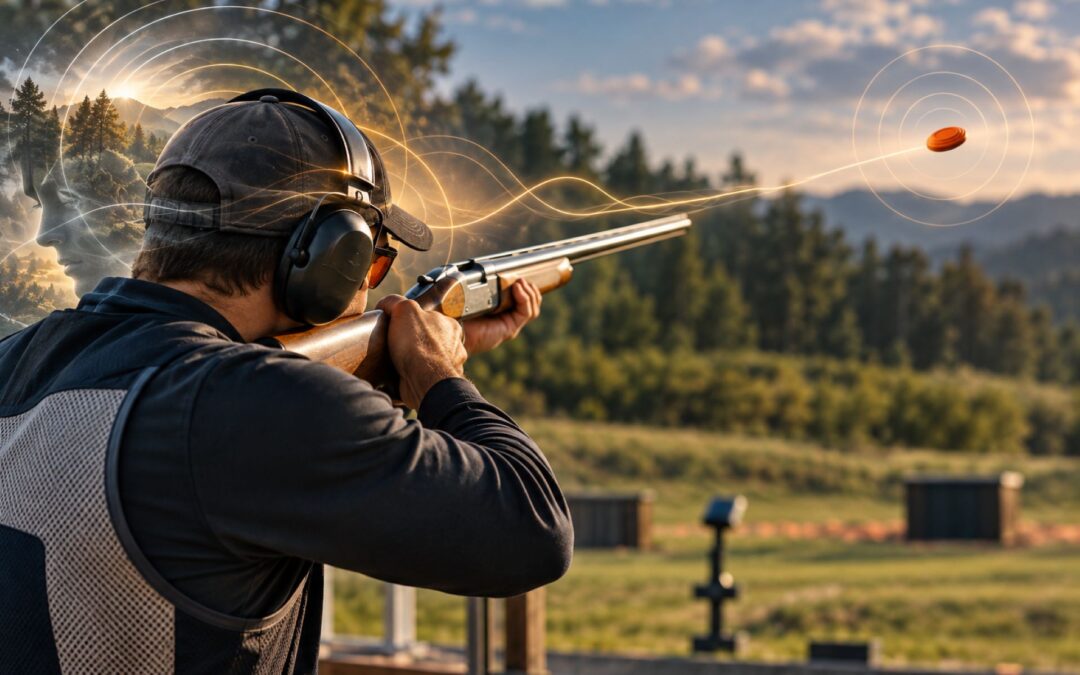
On Target: Shooting with Confidence is an unusually short book about an unusually narrow part of shooting performance. A. Kenneth Fuller and Trey Lanier are not trying to teach the reader everything about marksmanship, equipment, ballistics, or hunting technique. Their concern is what happens after a shooter has already practiced those skills: whether training can be translated into calm, confident execution when a shot actually matters.
That makes the book closer to a compact sports-psychology program than a conventional shooting manual. Its central idea is that confidence should grow from preparation, and that repeated mental conditioning can help a practiced shooter enter a state in which attention narrows, unnecessary conscious interference falls away, and trained actions become increasingly automatic. Fuller gives this process a simple structure—Signal, Reflex, Outcome—while much of the book itself takes the form of repetitive affirmations, visualization, breathing cues, and mental rehearsal intended to condition the listener rather than merely explain a theory.
The distinction matters because the book is both more interesting and more questionable than a collection of motivational slogans. Several of the techniques it combines have recognizable parallels in modern sports psychology, including pre-performance routines, imagery, self-talk, attentional control, and arousal regulation. The larger claim—that Fuller’s particular conditioning system can reliably turn those techniques into a desired reflexive performance state—is much less firmly established.

How the Book Builds Shooting Confidence: Complete Chapter-by-Chapter Summary
The book contains an introduction followed by six short chapters. Its progression is straightforward: first define confidence as the product of preparation, then present the Signal–Reflex–Outcome model, establish safety as a non-negotiable condition, use repeated mental scripts to condition calm and focused execution, and finally explain how the same system should help a shooter recover from mistakes and maintain confidence over time.
Introduction: Confidence Before the Shot
The introduction begins from the premise that confidence cannot simply be summoned when competition or hunting begins. Fuller and Lanier connect genuine confidence to the accumulation of practice, experience, familiarity, and disciplined preparation. The shooter should arrive at the moment of performance with evidence that the necessary work has already been done.
The book uses the physical environment of shooting to help establish this state. Outdoor surroundings, familiar equipment, and repeated routines are presented as cues that can become associated with calmness and readiness. As experience grows, handling and movement that once required deliberate thought are supposed to become increasingly natural, allowing the shooter to concentrate on the immediate task rather than consciously reconstructing every element of technique.
This is the first important distinction in the book. Confidence is not presented merely as positive thinking or optimism. It is supposed to arise because preparation has produced competence, and competence gives the shooter a reason to trust what the body has learned. The mental challenge is therefore not creating skill at the last moment but preventing anxiety, distraction, or excessive thought from interfering with skill that already exists.
Chapter 1: Shooting as a Mental as Well as Physical Skill
Chapter 1 broadens the discussion from hunting to recreational and competitive shooting more generally. Fuller and Lanier emphasize that shooting combines physical execution with speed, accuracy, environmental awareness, equipment familiarity, concentration, and emotional control. Once the mechanics have been practiced, the authors argue, the quality of attention becomes increasingly important.
This chapter introduces the book’s central framework: Signal → Reflex → Outcome. A signal is a cue associated with performance. Through repetition, that cue is supposed to trigger a reflexive internal response such as calmness, confidence, concentration, or readiness. The desired mental reflex then contributes to the outcome—accurate, controlled execution.
The logic is intentionally simple. Instead of asking the shooter to reason through a long list of instructions under pressure, the book seeks to create a mental shortcut. A familiar signal should eventually evoke the required psychological state without extensive conscious analysis.
The chapter also places the book within a large recreational culture. Fuller and Lanier describe shooting sports as involving roughly 50 million participants in the United States. More recent federal research remains broadly consistent with the scale of that claim: a U.S. Fish and Wildlife Service report on target shooting estimates about 47 million firearm target shooters from the underlying survey data, although changes in survey methodology make simple comparisons across years inappropriate.
What matters within the book, however, is not the population figure itself. The authors use the scale and variety of recreational shooting to argue that the mental problem they are addressing is not confined to elite competitors. Anyone who has practiced a skill and then struggled to reproduce it under pressure can recognize the gap between technical ability and confident execution.
Chapter 2: Safety as a Non-Negotiable Condition
The second chapter deliberately interrupts the psychological program to emphasize firearm safety. The authors make clear that confidence and automaticity must never be interpreted as permission for casual handling. Mental conditioning is useful only inside a framework of continuing attention, discipline, proper training, and responsible behavior.
Safety is treated as both an individual and shared responsibility. The shooter must remain attentive to circumstances rather than assuming that familiarity makes vigilance unnecessary, while instructors, officials, and other participants also contribute to a culture in which careless behavior is not normalized.
The placement of this chapter is important. The book has just begun arguing that successful performance should become increasingly automatic, but it immediately establishes a boundary around that idea. The authors want shooting actions to feel fluent without allowing fluency to become complacency.
Chapter 3: Training the Mind Through Repetition
Chapter 3 changes the form of the book. Instead of primarily explaining the method, Fuller begins using a repetitive mental-conditioning script built from first-person statements about confidence, calmness, concentration, motivation, breathing, successful performance, and control of attention.
The underlying assumption is that repetition can change the associations a shooter carries into performance. Successful experiences are mentally revisited and connected with future confidence. Breathing becomes associated with calmness. Familiar cues become reminders to narrow attention. Positive self-statements are repeated until the desired thoughts are supposed to arise more naturally.
Visualization also becomes increasingly important. The shooter is encouraged to imagine competent performance and to connect physical sensations, surroundings, previous successes, and deliberate mental cues into a unified experience. What begins as several consciously monitored elements of performance is supposed to become an integrated routine.
The chapter therefore treats conscious thought as both necessary and temporary. During training, the shooter deliberately constructs useful associations. During actual performance, however, the goal is not to keep consciously narrating every step. Repetition is meant to move parts of the process into the background so that attention can remain on what is immediately relevant.
This helps explain why the prose becomes so repetitive. The book is not simply telling the reader that repetition matters; it is attempting to perform that repetition. The text becomes part explanation and part exercise.
Chapter 4: Safety in Practice
Chapter 4 returns to safety with more concrete emphasis on habitual responsible behavior. The repetition might initially seem unnecessary in such a short book, but it follows the same logic the authors apply to performance psychology: important responses should become deeply practiced rather than improvised.
The chapter reinforces continuing caution, responsible handling, awareness of the surrounding environment, and the need to treat safety procedures as essential regardless of familiarity or confidence. Mechanical safeguards are not presented as substitutes for disciplined human attention.
This second safety section therefore performs an important structural function. Chapter 3 has encouraged the reader to trust increasingly automatic performance, while Chapter 4 reminds the reader that automatic skill must never become unthinking behavior. The authors want practiced confidence and practiced caution to coexist.
Chapter 5: Entering the Mental Zone
Chapter 5 contains the fullest version of the book’s mental-performance system. Fuller develops what he calls the “mental zone,” a state in which concentration is narrow, confidence is available without deliberate effort, and the performer’s attention is less vulnerable to distraction or disruptive self-consciousness.
Breathing becomes one of the primary cues for entering this condition. The goal is not necessarily to eliminate every sign of activation or nervousness. The book recognizes that some arousal can accompany effective performance and treats adrenaline as something that may be directed rather than simply suppressed.
This is an important refinement because the authors do not define confidence as emotional numbness. The desired state combines calm control with sufficient energy and alertness to perform. Anxiety becomes a problem when it captures attention, creates doubt, or causes the shooter to interfere with well-practiced movements.
The chapter also expands the system beyond words. Familiar sights, sounds, physical sensations, outdoor environments, memories of previous successes, and competition routines can all become signals associated with the desired mental state. The more consistently these cues are paired with focused performance, the more readily the authors believe they can evoke confidence later.
In this sense, the mental zone is not presented as a mysterious state that suddenly appears. It is supposed to be constructed from repeated experience. A shooter encounters familiar cues, recognizes the setting, experiences controlled breathing and attentional narrowing, and increasingly trusts the body’s learned response.
The chapter also deepens the book’s interest in automaticity. Performance improves, in the authors’ account, when conscious attention stops interfering with actions that have already been learned. The shooter should still perceive relevant information, but not attempt to control every movement through internal commentary.
That distinction between awareness and overcontrol runs through the entire book. Fuller and Lanier are not arguing against practice or technical instruction; they are arguing that the purpose of practice is eventually to make constant conscious supervision unnecessary.
Chapter 6: Recovering, Reinforcing, and Repeating Success
The final chapter asks what happens when confidence is disrupted by a mistake. Fuller and Lanier argue that the shooter must resist allowing one missed or poor attempt to occupy attention needed for the next one. The past shot can be examined briefly, but it cannot be allowed to become an ongoing mental event.
The book therefore distinguishes correction from rumination. If an error contains useful information, the shooter should recognize it, make whatever mental adjustment is required, and return attention to the present. Replaying disappointment, anger, or embarrassment serves no performance function once the relevant lesson has been extracted.
Mental rehearsal becomes part of this recovery process. A mistake can be reconsidered in corrected form rather than endlessly rehearsed as failure, while successful performances should be remembered and reinforced because they provide evidence that the desired outcome is achievable.
The recurring phrase “on target” functions as a mental cue for this return to the present. Rather than asking the shooter to solve the entire history of previous performance, it points attention back toward the immediate task.
The chapter also closes the confidence loop established in the introduction. Practice produces successful experiences; successful experiences provide evidence for confidence; confidence supports less inhibited execution; and further successful execution strengthens the association between the performance situation and a useful mental state.
Fuller recommends repeated exposure to the therapeutic script—28 readings or listenings in the audiobook version—to strengthen the conditioning process. Lanier likewise stresses continued physical practice and periodic “booster” use of the mental program. The book therefore ends by treating confidence not as an achievement permanently acquired once, but as something maintained through continuing reinforcement.
The Signal–Reflex–Outcome Framework
Signal–Reflex–Outcome is the book’s simplest and most distinctive organizing device. The signal is whatever cue becomes associated with performance: a word, physical routine, breathing pattern, sensory environment, or other familiar trigger. The reflex is the psychological or behavioral state that repeated conditioning is intended to produce, while the outcome is the desired execution that follows.
As a teaching device, this has considerable value. It condenses a complicated performance problem into a sequence that is easy to remember and gives the reader a way to connect practice, mental preparation, competition cues, and eventual execution. Instead of viewing confidence as an abstract personality trait, the system treats it as something that can become tied to repeatable circumstances.
The difficulty begins when the simplicity of the model starts sounding like scientific precision. “Reflex” can describe several different phenomena in everyday psychological language, but the book does not carefully distinguish conditioning, habit, automaticity, learned routines, attentional cues, and physiological reflexes. These ideas overlap, yet they are not interchangeable.
Modern sports psychology offers a more cautious way to understand what Fuller is trying to do. A substantial literature exists around pre-performance routines, in which athletes use consistent sequences of thoughts, behaviors, and attentional cues immediately before execution. A meta-analysis of pre-performance routines in sport found that such routines can improve performance, including under pressure.
That evidence makes the general direction of Fuller’s advice plausible without proving his particular mechanism. “Signal–Reflex–Outcome” works well as an accessible model for organizing cues and routines, but the book does not demonstrate that it represents a separately validated psychological system.
Its real strength lies elsewhere. The model forces the reader to think about what happens before execution. If a shooter repeatedly approaches performance with changing thoughts, uncontrolled attention, and no reliable pre-shot mental routine, then anxiety has more opportunities to occupy the available space. A familiar cue followed by a familiar mental response can reduce that variability even if the underlying process is better described as routine and learned association than as a literal reflex.
Confidence, Automaticity, Self-Talk, Imagery, and Breathing
The most useful way to analyze On Target is to separate techniques that the book frequently blends together. Its performance system combines earned confidence, automaticity, self-talk, mental imagery, breathing, attentional control, sensory association, and repetition. They support one another, but they do not all work through the same mechanism.
Confidence is the foundation. Fuller and Lanier repeatedly imply that durable confidence should be retrospective: the shooter looks back at preparation, successful repetitions, and accumulated experience and concludes that competent performance is justified. This is more substantial than simply telling oneself to feel confident because it connects belief with evidence.
Automaticity follows from the same training history. Skills initially require conscious monitoring, but repeated practice can make parts of execution faster and less cognitively demanding. The book’s concern is that performers sometimes reintroduce excessive conscious control when pressure increases, effectively trying to supervise actions that normally work better when allowed to run.
Self-talk is meant to oppose that interference. The first-person affirmations in Chapters 3 and 5 repeatedly connect calmness, concentration, preparation, and successful performance. Research does provide support for this general category of intervention: a meta-analysis of self-talk and sports performance found an overall beneficial effect, although effectiveness depends on the type of task, the form of self-talk, and how it is implemented.
The book’s imagery practices also have a recognizable evidence base. Fuller repeatedly asks the performer to recreate successful experiences, anticipate competent execution, and mentally correct errors. A more recent systematic review and meta-analysis of imagery practice in athletes likewise found positive effects on performance, while also showing that imagery is not a single uniform treatment whose results can be assumed across every context.
Breathing occupies a somewhat different position. In On Target, breathing functions both physiologically and symbolically: it is supposed to reduce disruptive activation while also becoming a learned cue that says, in effect, “enter the performance state now.” Research on breathing techniques in sport offers some support for psychological and performance benefits, but a systematic review of breathing techniques and sports performance also highlights substantial variation in interventions and evidence quality.
The book is therefore strongest when these practices are understood as a coordinated routine rather than as a guaranteed formula. Breathing can create a transition into performance, self-talk can direct attention, imagery can strengthen expectations and rehearsal, and previous preparation can make confidence credible. None of those components requires believing that a precisely defined neurological “reflex” has been created.
Pressure, Adrenaline, Mistakes, and the Next-Shot Mindset
One of the better features of On Target is that it does not define ideal performance as the complete absence of nervous activation. Fuller recognizes that competition and consequential shots can produce adrenaline and anxiety, and the objective is to keep that energy within a range that remains compatible with focused execution.
This matters because fear of anxiety can create a second performance problem. A shooter notices increased heart rate or tension, interprets those sensations as evidence that confidence has disappeared, and becomes preoccupied with trying to eliminate them. The book instead encourages the performer to treat activation as something that can coexist with readiness.
The same logic appears in the treatment of mistakes. A missed attempt becomes damaging when it continues occupying attention after its informational value has expired. Fuller and Lanier therefore urge a rapid shift from evaluating what happened to recommitting to what must happen next.
There is a valuable distinction here between learning from an error and mentally living inside an error. The former can improve future performance; the latter consumes working attention with anger, embarrassment, fear of repetition, or technical overanalysis. The “next-shot” mindset is the book’s practical answer to that problem.
Its mental-rehearsal technique extends this idea. A poor performance can be revisited in corrected form, allowing the shooter to practice an improved response rather than repeatedly strengthening the memory of failure. Successful attempts are then deliberately recalled because they provide both technical and emotional evidence for what competent execution feels like.
The book occasionally pushes this logic too far. Negative memories cannot simply be made irrelevant by replacing them with positive ones, and serious performance anxiety may not disappear because a person refuses to dwell on it. What On Target gets right is the narrower principle that attention is finite: once a useful correction has been identified, continued rumination can interfere with the next task.
Why Safety Appears Twice in Such a Short Book
Two separate safety chapters consume a notable portion of a book that lasts less than half an hour in audio form. That allocation makes sense once safety is viewed through the same learning philosophy as the performance material.
Fuller and Lanier want the skilled shooter to rely on practiced automaticity, but automaticity creates an obvious danger if it is confused with inattention. Familiarity can make actions feel effortless, and effortless action can encourage people to stop consciously respecting consequences. The safety chapters are the authors’ attempt to prevent that interpretation.
Their underlying position is that responsible behavior must become habitual without becoming invisible. Confidence should reduce unnecessary hesitation during performance, but it should not weaken vigilance. The shooter’s growing trust in trained motor skills therefore has to be accompanied by equally ingrained safety discipline.
That creates one of the book’s more interesting internal tensions. The ideal performer should not consciously micromanage every technical movement, yet must continue monitoring the broader environment and making deliberate judgments where safety is concerned. On Target never develops this distinction theoretically, but the repeated safety sections show that the authors recognize it.
The Book as a Therapeutic Script
A conventional summary can make On Target sound thinner than it actually is because many of its pages or minutes are not primarily expository. Fuller is attempting to produce a psychological experience through repetition. The reader or listener is repeatedly exposed to statements of calmness, preparedness, confidence, concentration, successful imagery, and control of attention.
The result resembles a guided performance script. Its language is frequently first-person, its concepts recur in slightly different forms, and sensory imagery is used to connect internal states with familiar environments. The phrase “on target” itself gradually becomes more than a description of accuracy; it is intended to function as a compressed cue for the entire performance state.
This makes the audiobook format particularly suitable. Repeated phrases that can feel redundant on the page may work differently when heard as guided rehearsal. Breathing, rhythm, mental imagery, and verbal suggestion become part of the experience rather than merely objects of explanation.
The same feature also limits the book as conventional nonfiction. Readers looking for a rigorous explanation of performance psychology may find that the book spends far more time asserting and rehearsing desired mental states than explaining why the method should work. Concepts are introduced quickly, repeated frequently, and rarely subjected to theoretical or empirical examination.
Its repetition should therefore neither be dismissed as simple padding nor defended automatically as necessary. It is functional repetition because the book explicitly aims to condition the reader. Whether that conditioning succeeds will vary far more by individual than the confident tone sometimes suggests.
Does the Psychology of On Target Hold Up?
The fairest evaluation begins by avoiding two opposite mistakes. It would be unreasonable to treat every psychological claim in On Target as scientifically established simply because the terminology sounds clinical, but it would be equally inaccurate to dismiss the book as unsupported positive thinking.
Several of its components fit comfortably within established sports-psychology practice. The meta-analysis of pre-performance routines supports the general principle that consistent cognitive and behavioral routines can improve execution, including in stressful conditions. That aligns closely with the book’s attempt to make familiar cues precede a familiar performance state.
The evidence for self-talk is also relevant. The meta-analytic research on self-talk interventions indicates that structured internal language can influence athletic performance, particularly when it is designed around the requirements of the task rather than used as vague encouragement. Fuller’s repeated statements about concentration and confidence therefore belong to a broader family of recognizable interventions.
Imagery provides another point of overlap. The 2025 systematic review and meta-analysis of imagery practice supports the conclusion that mental rehearsal can contribute to athletic performance. On Target uses imagery both prospectively, by rehearsing successful execution, and retrospectively, by mentally correcting mistakes and reinforcing successful memories.
Breathing is somewhat less straightforward. The book treats controlled breathing as a way to regulate activation and as a cue for entering the mental zone. A systematic review and meta-analysis of breathing techniques in sport suggests possible benefits but also shows that the research varies substantially in technique, outcome, and methodological quality. Fuller is therefore on firmer ground recommending breathing as a potentially useful routine than implying a universally predictable effect.
The evidence gap appears when these ingredients are assembled into Signal–Reflex–Outcome. The fact that routines, self-talk, imagery, and breathing can each be useful does not independently validate Fuller’s particular framework or prove that a shooter will develop the specific reflexive mental state the book promises. Component evidence cannot simply be added together and treated as validation of the complete package.
There is also a question of individual variation. Some performers benefit from verbal self-instruction; others find verbal thinking intrusive. Some use vivid imagery easily; others do not. Some perform best after deliberate calming, while others need to increase activation. On Target acknowledges differing levels of anxiety only briefly and otherwise presents its program with relatively little discussion of who may respond differently.
Its strongest psychological claim is therefore also its simplest: performance can improve when preparation is paired with a consistent mental routine that helps attention remain on the present task. Its weakest claim is the suggestion that repeating one prescribed script will reliably condition essentially the same desirable response across shooters.
Critical Review: What On Target Gets Right—and Where It Overreaches
The strongest quality of On Target is its understanding of the difference between possessing skill and accessing skill under pressure. Many instructional books concentrate almost entirely on technique, as though a person who performs correctly during practice will automatically reproduce the same actions when evaluation, competition, excitement, or fear becomes significant. Fuller and Lanier recognize that this transfer is itself a performance problem.
Their answer is admirably practical. Preparation should create evidence for confidence; routines should reduce unnecessary mental variation; breathing and familiar cues should help establish a recognizable performance state; mistakes should be processed without being mentally prolonged; and attention should return to the immediate task. None of those ideas requires elaborate theory to be useful.
The book is also stronger than generic confidence literature because it repeatedly grounds belief in preparation. It does not simply tell the reader to imagine being excellent and expect excellence to follow. The desired confidence is supposed to rest on practice, familiarity, and accumulated success, which makes the psychological advice more credible.
The treatment of mistakes is another strength. The distinction between correcting an error and continuing to emotionally rehearse it is especially useful in repetitive sports where one attempt must quickly be followed by another. A performance routine that helps an athlete re-establish present-focused attention can be valuable even when nothing about the underlying physical technique has changed.
The repeated safety emphasis also improves the book. Because Fuller and Lanier praise subconscious and automatic action, they could easily create the impression that less thought is always better. Their decision to interrupt the mental program twice to restate safety responsibilities shows that they understand automatic execution must operate inside deliberate limits.
The greatest weakness is evidentiary. Fuller presents Signal–Reflex–Outcome with the confidence of a coherent psychological mechanism, yet the book does not supply research demonstrating that this named model has been tested as a distinct intervention. The scientific support comes instead from neighboring areas—routines, imagery, self-talk, attentional regulation, and breathing—which make parts of the method plausible without validating the complete system.
Its terminology sometimes contributes to the problem. Words such as “reflex,” “subconscious,” and “conditioning” carry scientific associations that the book uses more loosely than a technical psychology text would. Readers may therefore come away believing that the authors have described a more precisely established process than the evidence actually supports.
The book’s brevity produces a second limitation. It says little about performers whose problems arise from genuinely inadequate technical preparation, severe anxiety, distorted confidence, inappropriate coaching, or individual differences in response to imagery and self-talk. Confidence can be useful when it accurately reflects competence, but confidence that exceeds competence is not automatically beneficial.
The recommendation to repeat the therapeutic script 28 times is another example of the book’s tendency toward specificity without equivalent justification. Repetition is integral to learning, and repeated use of a routine can certainly strengthen familiarity, but the text does not establish why 28 exposures should represent a generally meaningful threshold. The number is presented more confidently than the underlying evidence warrants.
As writing, On Target is simultaneously efficient and repetitive. It can explain its basic thesis in a few minutes, then spends much of the remaining time reinforcing the desired state through repeated language. Readers expecting dense information may regard this as underdeveloped, while listeners using the audiobook as a rehearsal tool may regard the repetition as the point.
Originality is similarly mixed. The individual ideas—practice, confidence, visualization, breathing, positive self-talk, routine, present-focus, and moving on from mistakes—are not especially novel in sports psychology. The book’s distinctiveness lies in packaging them into a very short shooting-specific conditioning script and using the Signal–Reflex–Outcome model as an easily remembered framework.
Its lasting value therefore depends less on whether Fuller invented a new psychological mechanism than on whether the book successfully converts familiar performance principles into something a shooter can repeatedly use. On that narrower standard, it succeeds better than its scientific language sometimes suggests.
Is On Target Worth Reading?
On Target: Shooting with Confidence is worth reading—or, perhaps more appropriately, listening to—for someone who already understands the physical fundamentals of their sport and wants a concise mental routine for translating practice into performance. Its strongest ideas are preparation-based confidence, deliberate pre-performance cues, focused attention, constructive imagery, rapid recovery after mistakes, and the recognition that effective performance does not require the total absence of nervous energy.
It is much less suitable as a comprehensive shooting manual or as a rigorous introduction to performance psychology. The book explains neither technical marksmanship nor the scientific literature in depth, and its Signal–Reflex–Outcome framework should be treated as a practical organizing model rather than an independently validated psychological law.
That distinction ultimately makes the book easier to evaluate fairly. Fuller and Lanier do not need to prove that they discovered a unique reflex-conditioning mechanism for the book to contain useful advice. The more durable insight is that practiced ability can be undermined when attention becomes occupied by anxiety, overcontrol, or the previous mistake, and that consistent routines can help a performer return attention to what training has prepared them to do.
Read in that spirit, On Target is a compact and sometimes repetitive performance script with a sensible core. Its psychology is strongest where it overlaps with established ideas about routines, imagery, self-talk, automaticity, and present-focused attention, and weakest where those useful ingredients are presented as though they conclusively validate a single conditioning system. The book remains valuable when its simplicity is treated as a coaching tool rather than mistaken for scientific proof.
Last Updated on October 5, 2026 by Aseem Gupta