
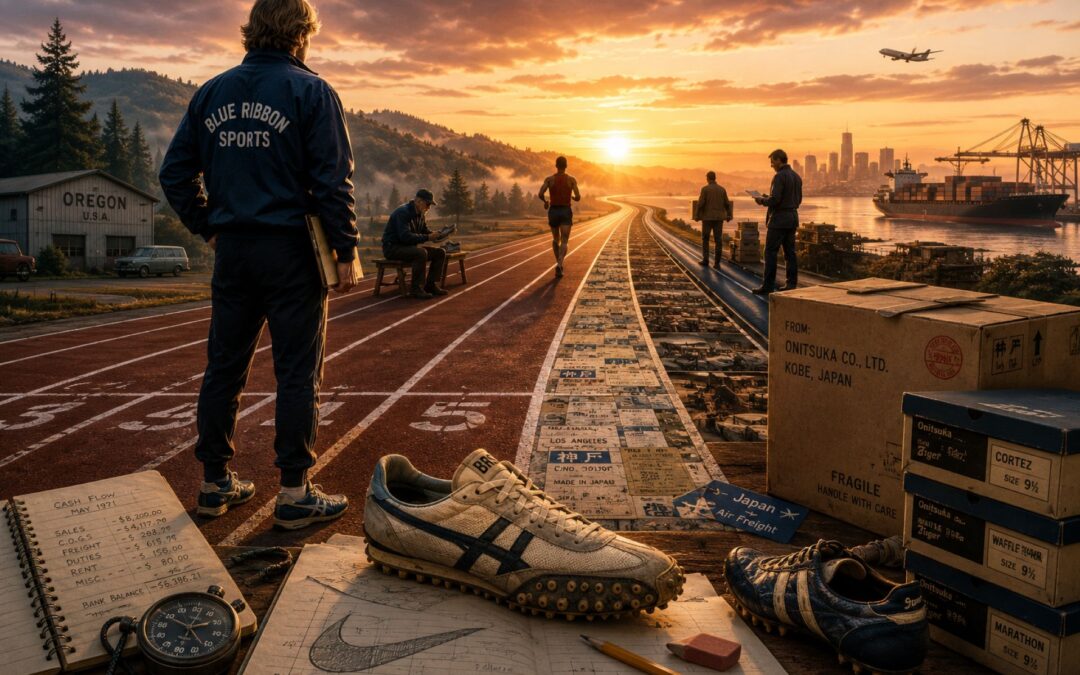
Phil Knight’s Shoe Dog is usually shelved with business books, but it does not read like a conventional guide to entrepreneurship. There is no orderly founder’s framework, no sequence of principles that supposedly guarantees success, and very little attempt to make Nike’s rise look rational in hindsight. Instead, Knight reconstructs a company that seems to spend much of its early life one bad shipment, one withdrawn credit line, one supplier dispute, or one legal judgment away from disappearing.
That uncertainty is what makes the memoir distinctive. Nike is now so culturally familiar that its existence feels inevitable, but Knight’s story begins before there is a Nike, before there is even a real Blue Ribbon Sports, with a twenty-four-year-old runner trying to persuade himself that a business-school paper about Japanese running shoes might be worth building a life around. The 2016 Scribner edition of Shoe Dog follows that idea from 1962 through Nike’s 1980 initial public offering, then moves forward in its closing section, “Night,” to Knight’s later reflections on family, death, labor controversies, friendship, luck, and the meaning of what he created.
This article covers the complete memoir, including the IPO, Steve Prefontaine’s death, the death of Knight’s son Matthew, and the retrospective material in “Night.” Read as a whole, Shoe Dog is not simply a celebration of persistence. It is an origin story built from obsession, improvisation, deception, product experimentation, debt, extraordinary collaborators, favorable accidents, painful losses, and repeated rescue by people whom Knight persuaded to believe in him. Its greatest achievement is making success feel contingent again. Its greatest limitation is that Knight ends the detailed Nike story in 1980, just as the company is about to become the global corporate and cultural power whose later history would complicate that romantic founding narrative.

From the “Crazy Idea” to Blue Ribbon Sports: 1962–1964
Shoe Dog begins not with Nike, shoes, or even business, but with a young man trying to decide what his life is for. In “Dawn,” Knight is back in Oregon in 1962 after graduating from Stanford Business School and serving in the Army. He goes for an early-morning run and thinks about the possibility that work might be something more than employment. Running has already given him a way of understanding commitment: the runner keeps moving despite discomfort, uncertainty, and the knowledge that the finish line is always coming closer.
The idea consuming him originated in a Stanford paper. Knight had argued that Japanese running shoes might be able to challenge the German companies that dominated the American athletic-shoe market, much as Japanese camera makers had begun challenging German camera manufacturers. The proposition sounds modest after decades of Japanese manufacturing success, but Knight is proposing it while Adidas and Puma possess far greater prestige among serious athletes and American consumers know little about Japanese running footwear.
Knight calls this his “Crazy Idea.” The phrase is important because he does not present himself as possessing the calm certainty associated with later founder mythology. He is excited by the idea and embarrassed by it, afraid of wasting his life and afraid of looking foolish if he tries something unconventional. His first major obstacle is therefore not a competitor. It is the need to turn an intellectual possibility into an action before adulthood settles into a respectable, permanent shape.
In 1962 he approaches his father, Bill Knight, for money to travel. His father is a successful but conservative man who values respectability, and Knight expects him to reject the plan. Instead, Bill agrees to support the trip. That decision matters throughout the memoir because Knight’s relationship with his father is filled with tension: he wants approval from a man who rarely expresses it openly, yet that supposedly cautious father provides the financial and emotional permission that makes the whole adventure possible.
Knight sets out with his Stanford friend Carter. Hawaii is supposed to be only the first stop, but the two men are seduced by the place and briefly consider making lives there. They find work, and Knight tries selling investments, discovering quickly that he is uncomfortable selling something he does not understand or care about. Carter falls in love and stays. Knight, restless again, continues alone.
His route takes him across Asia, Africa, the Middle East, and Europe, but Japan is the decisive stop. In Kobe he arranges a meeting with Onitsuka, the company that manufactures Tiger running shoes. Knight has no functioning American distribution company and very little commercial experience. When the Onitsuka executives ask whom he represents, he looks back mentally toward the blue ribbons from his running days and improvises the name “Blue Ribbon Sports.”
The deception is foundational. Knight does not arrive with a fully formed company and persuade Onitsuka to back it; he claims to represent the company he hopes might exist if the meeting goes well. He then gives the argument from his Stanford paper, explaining that the American market is large, that German shoes are expensive, and that Onitsuka could compete by offering good Japanese shoes at lower prices. The executives surprise him by asking whether Blue Ribbon would be interested in representing Tiger in the United States.
Knight says yes before there is much of anything to say yes on behalf of. He orders samples and cables his father for money. The company that will eventually become Nike therefore begins in one of the memoir’s recurring patterns: Knight creates an obligation first, then tries to build the reality required to meet it.
The rest of his trip gives the episode a mythic afterglow it did not possess at the time. In Greece, Knight visits the Temple of Athena Nike and absorbs the name of the goddess associated with victory without any knowledge that it will later become the name of his company. The coincidence is irresistible to a memoirist looking backward, but Knight is generally careful to present it as coincidence rather than destiny.
When he returns to Oregon in 1963, nothing happens. Months pass without the promised Tiger samples. The grand world adventure collapses into waiting, and Knight starts to fear that he has already experienced the most meaningful episode of his life. He moves toward accounting, studying for professional certification and taking a conventional job.
This apparent retreat becomes one of the most useful accidents in Nike’s history. Knight’s accounting knowledge will later help him understand balance sheets, credit, inventory, taxation, and cash flow at moments when the survival of Blue Ribbon depends on precisely those issues. Shoe Dog repeatedly undermines the idea that careers develop along clean lines. The respectable profession Knight fears will imprison him equips him to pursue the less respectable obsession he cannot abandon.
Early in 1964, the Tiger samples finally arrive. Knight sends two pairs to the man whose opinion matters more than almost anyone’s: Bill Bowerman, his former track coach at the University of Oregon.
Bowerman has already spent years obsessing over shoes. He modifies his athletes’ footwear, experiments with materials, reduces unnecessary weight, studies how shoes interact with different feet, and treats equipment as something that can always be improved. Knight assumes Bowerman might recommend the Tigers or order some for his runners. Instead, Bowerman asks to become his business partner.
Their partnership changes Blue Ribbon immediately. Knight now has something more valuable than a sales pitch: the most respected figure in his athletic life has validated the idea. Bowerman also gives Blue Ribbon a direct link to elite runners and a product innovator who has spent years trying to solve the technical problem at the center of the business.
Knight orders 300 pairs of Tigers. Conventional sporting-goods retailers are mostly uninterested, so he sells the shoes himself at track meets, to coaches, and directly to runners, often working from his car. This is where he discovers that his earlier difficulty with selling was not necessarily a lack of sales ability. He had disliked selling products that meant nothing to him. He can talk enthusiastically about running shoes because he understands the customer, believes in the product, and knows the small world he is entering.
The first inventory sells, and success immediately creates a new problem. To order more shoes, Knight needs more money before the proceeds from future sales exist. Blue Ribbon begins the cycle that will define most of the memoir: higher demand requires larger orders, larger orders require more credit, and more credit increases the company’s vulnerability.
Knight also encounters Jeff Johnson, another runner whose eccentricity and intensity initially make him seem more like a memorable acquaintance than a future institutional pillar. Johnson will soon become the person who turns Blue Ribbon’s scattered buyers into something resembling a community.
Meanwhile, an East Coast distributor claims rights to Tiger shoes that threaten Knight’s position. Knight returns to Japan to argue for his territory. Onitsuka allows him to continue in the western United States, preserving the business but leaving its national ambitions unresolved.
By the end of 1964, Blue Ribbon Sports has become real enough to fail. It has a partner, inventory, customers, a supplier, a growing reputation among runners, and financial obligations. Knight’s Crazy Idea has survived the transition from imagination to commerce, but nothing about the company yet resembles the stability that later Nike mythology might lead readers to assume was always waiting ahead.
Building a Running Company on Debt and Obsession: 1965–1970
The next six years transform Blue Ribbon from Knight and Bowerman’s side venture into an increasingly serious company. They also establish the contradiction that dominates Nike’s early financial history: sales can rise quickly while the business becomes more precarious. Knight experiences growth not as relief but as a demand for still more inventory, still more credit, and still greater exposure if anything goes wrong.
Jeff Johnson becomes the clearest example of how much of the company is built by people whose strengths differ sharply from Knight’s. Johnson has tried the Tigers Knight sent him and discovered that other runners constantly ask about them. He begins selling shoes, then sends Knight an extraordinary volume of correspondence describing customers, advertising experiments, sales opportunities, injuries, shoe problems, and ideas.
Knight often fails to reply. Partly this is personality: he is reserved, conflict-avoidant, and inclined to imitate the emotionally sparse men he admires, especially Bowerman and his father. Johnson wants communication and affirmation; Knight gives autonomy and silence. The mismatch creates frustration, but it also produces something neither man fully designs.
Johnson begins maintaining detailed customer records. He remembers shoe sizes and preferences, responds to complaints, asks about injuries, recommends models, and continues corresponding after the sale. He places small advertisements in running publications and follows up obsessively. Long before modern brands made “community” a marketing slogan, Johnson is building one through index cards, letters, telephone calls, and personal attention.
In 1965 he leaves social work to become Blue Ribbon’s first full-time employee. That decision increases the company’s responsibility toward him at exactly the moment when Knight is still working at Price Waterhouse and trying to keep his supposedly secondary business from consuming every hour. Knight’s professional accounting career gives him financial security, but his emotional life is already centered on Blue Ribbon.
Bowerman is simultaneously pushing Onitsuka toward better products. His concern is not abstract innovation. He wants lighter shoes, better traction, improved fit, and designs shaped by what runners actually experience. Blue Ribbon therefore begins influencing the product rather than merely redistributing it, an important change in the company’s relationship with its Japanese supplier.
The company’s financial problem grows with these successes. Knight believes the greatest danger is being unable to supply demand. His bankers see another danger: he continually puts available cash into more inventory, leaving little equity and almost no financial cushion. From the bank’s perspective, Blue Ribbon grows too fast for its balance sheet. From Knight’s perspective, slowing down means allowing competitors to take the market.
That difference becomes one of the most instructive conflicts in the memoir because neither side is completely irrational. A bank has no reason to admire growth that makes repayment less certain. Knight has no reason to celebrate conservative liquidity if it means repeatedly selling out and forfeiting customers. Nike’s eventual scale can make Knight’s side appear obviously correct, but Shoe Dog is strongest when it preserves how dangerous that strategy actually was.
In 1966 Johnson’s importance increases. He works constantly, expands his customer files, experiments with promotions, and survives a serious car accident without losing his obsession with the company. Blue Ribbon opens a store in Santa Monica that functions not just as retail space but as a meeting place for runners. The company is beginning to have a culture before it has the resources normally associated with one.
The larger territorial problem with Onitsuka remains. Knight’s original arrangement does not give him straightforward national control, and expansion brings him into conflict with other distributors. He travels again to Japan and pushes Onitsuka to recognize Blue Ribbon nationally.
Here Knight resorts to another bluff. To persuade Onitsuka that Blue Ribbon can handle the East Coast, he implies that the company already has a meaningful operation there. It does not. Onitsuka nevertheless grants Blue Ribbon a three-year national distributorship, leaving Knight with the task of making his claim true after the fact.
That means sending Johnson east. Knight delays telling him because he anticipates the reaction, then handles the situation badly when he finally does. Johnson has already sacrificed stability for Blue Ribbon and feels he deserves recognition, better compensation, and greater consultation. The episode exposes one of Knight’s recurrent managerial weaknesses: he can take enormous commercial risks yet avoid uncomfortable conversations with people close to him.
Johnson eventually goes east and builds the operation. The assignment demonstrates how dependent Knight has become on a man whose need for communication he rarely satisfies.
In 1967 another crucial figure enters the story. Bob Woodell had been a promising runner before a terrible accident left him using a wheelchair. The loss of his athletic future could have isolated him from the running world, but Blue Ribbon gives him another route into it. Woodell becomes one of the company’s most capable organizers.
His personality complements Knight’s almost perfectly. Knight is imaginative but chaotic, ambitious but sometimes evasive, comfortable with uncertainty and perpetually pushing beyond existing systems. Woodell is calm, practical, methodical, and extraordinarily persistent. He helps with inventory, shipping, administration, warehousing, and the innumerable physical tasks required to move growing quantities of shoes through an organization that has not yet developed a professional infrastructure.
The company is also fortunate in its timing. Bowerman’s advocacy of jogging helps recreational running become more culturally acceptable in the United States. The market Blue Ribbon serves is not simply taking customers from competitors; the number of people interested in running itself is growing.
Product development produces the name that will become one of Nike’s longest-lived shoe lines. A shoe associated with the name Aztec runs into an objection from Adidas because of its Azteca Gold model. Blue Ribbon and Onitsuka settle on “Cortez.” The episode is small compared with later crises, but it demonstrates a continuing truth about Nike’s early products: names, designs, legal constraints, coach input, manufacturing, and marketing all evolve together rather than in isolated departments.
By 1968 Knight’s double life becomes impossible to sustain. He is working long weeks at Price Waterhouse while giving mornings, nights, weekends, and vacations to Blue Ribbon. He wants not more balance but less. Ordinary life increasingly feels like interference with the thing that gives him purpose.
He moves into teaching accounting at Portland State, which offers a schedule more compatible with Blue Ribbon. There he meets Penny Parks, one of his students. She begins helping with Blue Ribbon’s books, becomes increasingly important in Knight’s personal life, and eventually marries him.
Penny’s entrance matters because company and family are now inseparable. Blue Ribbon is not a project Knight leaves at an office. It shapes his friendships, his marriage, his finances, and eventually his relationship with his children. The costs of that fusion remain partly hidden during the high-energy founding years and become much clearer in “Night.”
Knight’s relationship with Onitsuka also becomes more personal and more complicated. He befriends Fujimoto, an employee at the Japanese company, and helps him after a typhoon damages his home. The gesture creates genuine loyalty. Fujimoto later becomes an important source of information about what Onitsuka is considering behind Blue Ribbon’s back.
This network of personal obligations complicates any simple picture of business as contracts between firms. Knight repeatedly survives because individuals choose to help him. The company’s Japanese relationships include formal distribution agreements, but they also include friendship, gratitude, suspicion, cultural misunderstanding, and private information.
By 1969 Blue Ribbon is large enough for Knight to leave teaching and become its full-time chief executive. That transition should look like a victory, yet the company immediately presents him with new management problems. More sales representatives are hired, many of them former runners who understand the product and the customer. Warehousing grows more complicated, and Woodell becomes increasingly indispensable.
Carolyn Davidson also enters Blue Ribbon’s orbit as a young designer. Her most famous contribution is still ahead, but her arrival is another reminder that Nike’s visual identity will be created by people who initially occupy relatively modest positions around the company.
Bowerman returns from the 1968 Mexico City Olympics frustrated by the dominance of Adidas and Puma at elite events. Blue Ribbon may have a growing network of committed customers, but global athletic prestige still belongs overwhelmingly to larger brands. The company has demand without cultural dominance.
Knight and Penny’s first son, Matthew, is born. The memoir mentions family milestones alongside inventory, employees, suppliers, and financing, but Knight’s attention remains disproportionately directed toward the company. At this point he does not fully understand what that imbalance will mean.
Blue Ribbon also experiences personnel conflict. Knight can be unsentimental when he concludes that someone is wrong for the organization, yet he often delegates the emotional work of difficult management to people such as Woodell. The gap between his strengths as founder and his weaknesses as interpersonal manager becomes increasingly visible.
In 1970 the financial problem reaches another level. Knight wants to place bigger orders with Onitsuka because demand is rising, but the bank sees an enterprise that refuses to accumulate the equity normally expected of a growing borrower. Blue Ribbon’s cash is perpetually committed to the next shipment before the present one has fully completed its cycle.
Knight tries to find more capital. Raising conventional equity proves difficult, and he is wary of surrendering control. He gradually becomes interested in Japanese trading companies, institutions capable of financing international commerce differently from the American banks that keep warning him to slow down.
This brings Nissho Iwai into the story. Nissho eventually becomes far more than another creditor. Its willingness to finance inventory gives Blue Ribbon access to the working capital necessary to keep growing, and its representatives later make one of the decisive judgments in Nike’s survival.
At almost the same moment that Knight finds a possible answer to his financing problem, the deeper weakness in the business becomes impossible to ignore. Blue Ribbon does not own the Tiger brand. It does not control the factories. Its relationship with Onitsuka can be terminated, altered, or transferred.
Knight learns through Fujimoto and other channels that Onitsuka is investigating other American distributors. The news changes the meaning of everything Blue Ribbon has built. Its employees, customer relationships, product knowledge, and sales network are valuable, but the company is still fundamentally dependent on another company’s willingness to let it sell someone else’s shoes.
By the end of 1970, Blue Ribbon has become successful enough to be worth replacing. That is the paradox driving the next phase of Shoe Dog: the better Knight becomes at selling Tigers, the more dangerous it becomes that Onitsuka owns the product Blue Ribbon has made valuable in America.
Breaking with Onitsuka and Creating Nike: 1971–1972
Nike is born not because Knight begins 1971 with a clear vision for an independent global brand, but because Blue Ribbon’s dependence on Onitsuka has become intolerable. The company needs its own identity because the supplier that made the business possible now appears capable of taking that business away. The Swoosh and the name Nike are famous pieces of design history, but in Shoe Dog they emerge inside a supplier crisis.
Onitsuka executive Kitami comes to the United States in 1971. Knight and his colleagues try to impress him while suspecting that his wider American itinerary includes meetings with potential replacement distributors. Their distrust is justified.
During the visit, Knight secretly examines Kitami’s briefcase. He finds material that confirms Onitsuka is evaluating alternatives. Knight reports the incident candidly, but candor does not make the behavior ethically neutral. It is another example of a pattern that the memoir repeatedly asks readers to process: when Knight believes the company’s survival is at stake, he becomes willing to cross boundaries that he would probably describe differently if a rival crossed them against him.
Kitami eventually proposes a more direct solution. Onitsuka could buy a controlling share of Blue Ribbon. From one perspective, the offer could end the uncertainty that has exhausted Knight for years. The company would have the backing of its supplier, and many of its financing problems might become easier.
Knight refuses. Control matters too much to him. The decision reveals that Blue Ribbon is no longer simply an entrepreneurial experiment or a route to financial success. Knight’s identity is so fused with the company that surrendering ownership would feel like giving away the purpose around which his life has reorganized itself.
Nissho Iwai becomes increasingly important during this period, but Knight is similarly cautious about giving Nissho equity. He wants capital and commercial partnership without losing the ability to decide what the company becomes. That tension between needing outsiders and resisting their control will later shape Nike’s unusual route to the public markets.
If Blue Ribbon cannot rely permanently on Onitsuka, it needs shoes of its own. Knight begins arranging manufacturing outside the Tiger relationship, including a Mexican factory named Canada. The first results are poor. Some of the football shoes are badly made and unsuitable for the conditions in which customers try to use them.
The failure is important because Nike’s creation is often remembered backward from its later design prestige. In Shoe Dog, becoming a manufacturer and brand owner means entering a field in which Blue Ribbon has much to learn. Independence is not instantly accompanied by competence.
The new shoes also need a visual mark. Knight asks Carolyn Davidson to produce something that can appear on the side of the shoe and suggest motion. She creates several possibilities, including the shape that becomes the Swoosh. Knight is not immediately captivated by it. He chooses under deadline pressure because production cannot wait indefinitely for an epiphany.
The name develops in much the same way. Knight prefers “Dimension Six,” a suggestion his colleagues dislike. Other possibilities circulate until Jeff Johnson reports that the name Nike came to him in a dream. The reference to the Greek goddess of victory helps, as do the practical qualities of a short, energetic word.
Knight remains uncertain but has to decide. The company moves forward with Nike.
This is one of the most revealing aspects of the origin story. Two of the most recognizable components of modern brand identity—the name Nike and the Swoosh—are not presented as products of Knight’s solitary genius. Johnson supplies the name, Davidson supplies the symbol, deadlines force action, and Knight approves choices he does not yet know will become iconic.
Nissho helps Blue Ribbon locate additional manufacturing capacity in Japan. The company is learning to coordinate a more complicated international supply system at the same time that relations with Onitsuka continue deteriorating.
Everything comes to a head in 1972 at the National Sporting Goods Association show in Chicago. Blue Ribbon plans to show Nike shoes alongside Tigers, effectively presenting an alternative future before its old relationship has been cleanly resolved. The new products are not perfect. Some have obvious quality problems, and even the placement of the Swoosh can look amateurish.
Dealers order them anyway. They are buying partly on the strength of the shoes and partly because Blue Ribbon has spent years earning their trust.
Onitsuka soon discovers that Blue Ribbon is selling Nike products. The supplier terminates the relationship, and the conflict moves toward litigation.
For employees, the moment is terrifying. Tiger is still a major part of the business. Knight nevertheless frames the rupture as liberation. If Onitsuka can revoke Blue Ribbon’s future, then dependence itself has become the greater risk. Nike now has to succeed because the fallback position is disappearing.
The company’s emerging brand identity is also being shaped by athletes. The 1972 U.S. Olympic Trials bring Steve Prefontaine to the center of Knight’s emotional and commercial world. Prefontaine is already a famous Oregon runner coached by Bowerman, and his aggressive racing style embodies almost everything Knight admires: courage, speed, defiance, impatience with conventional caution, and a willingness to make competition personal.
The Munich Olympics then remind everyone in the track world that sport exists inside history rather than outside it. The murder of eleven members of the Israeli Olympic team shocks the Games. Bowerman is close enough to the events for the danger to feel immediate, and Prefontaine’s own Olympic disappointment becomes inseparable in memory from the horror around the competition.
Prefontaine finishes fourth in his race. For an ordinary athlete, fourth in the world would be extraordinary. For Pre, who believes he should have won and knows he raced stubbornly rather than strategically, it becomes a source of anger.
Nike also begins learning the commercial power of athlete relationships more deliberately. Tennis player Ilie Năstase becomes an early prominent Nike endorser. The strategy will later become central to the company’s identity, but at this stage it remains an extension of the principle Blue Ribbon has followed from the beginning: credibility comes from people who actually live inside sport.
By the end of 1972, Blue Ribbon has crossed from distribution into something far more dangerous. The company is responsible for its own name, logo, suppliers, designs, reputation, and legal survival. Losing Onitsuka nearly destroys the old business, but it also removes the structure that had prevented the new one from becoming fully independent.
Lawsuits, Growth, and the Cost of Survival: 1973–1975
The three years from 1973 through 1975 contain some of Shoe Dog’s most consequential events. Nike secures legal independence, develops systems that help manage its growth, nearly collapses financially, survives because a creditor chooses not to abandon it, and then suffers the sudden death of the athlete who had come to represent its deepest sporting values. Business survival and personal mortality become inseparable.
Prefontaine remains dissatisfied after the Munich Olympics. He feels that he failed himself and others, and he is also increasingly angry at the rules governing amateur athletes. Elite runners are expected to train at extraordinary levels while accepting severe restrictions on how they can support themselves financially.
Nike finds ways to keep Pre close. He becomes an employee and brand ambassador, travels, speaks, competes, and gives the company a charismatic human identity. He is not valuable simply because people recognize him. He embodies the kind of athlete Knight wants Nike to serve: intense, unruly, ambitious, and unwilling to compete cautiously.
Meanwhile, Blue Ribbon prepares for its legal battle with Onitsuka. Rob Strasser enters the story through the litigation and quickly becomes more than an outside lawyer. He possesses the appetite for conflict that Knight often lacks. Where Knight can be private and avoidant, Strasser becomes energized by a fight.
The company also needs a better way to predict demand. Chronic under-ordering causes shortages, but ordering aggressively without reliable commitments worsens the cash problem. Nike develops the Futures program, offering retailers favorable terms in exchange for firm advance orders.
Futures is one of the memoir’s most important operational innovations because it changes uncertainty rather than eliminating it. Nike can see more of the next season’s demand before committing to manufacturing. Dealers gain incentives to order early, factories receive clearer volume expectations, and Nike can plan inventory with less guesswork.
The system does not make the company financially safe. It merely gives Knight another tool for surviving the scale he keeps pursuing.
At home, Penny gives birth to Knight’s second son, Travis. Family continues developing beside the company, but Knight’s emotional attention remains overwhelmingly drawn toward Nike’s crises. The imbalance will matter far more in the retrospective sections than it appears to matter during these years.
In 1974 the Onitsuka dispute reaches federal court. For Knight, the trial is both a business crisis and an examination of his personal credibility. His history of improvisation and secrecy can no longer remain within the affectionate tone of a founder story. Lawyers can use the same behavior to argue that he is dishonest.
Knight has indeed given them material. He invented Blue Ribbon’s status in his first meeting with Onitsuka, exaggerated its capabilities, used Fujimoto as a private source, and examined Kitami’s papers. The memoir does not erase these facts. What it does, more subtly, is place them inside a narrative of existential business struggle in which questionable behavior can begin to feel like ingenuity.
The court must also untangle product history. Bowerman, Johnson, and others help establish Blue Ribbon’s contributions to shoes associated with names such as the Boston and Cortez. The legal questions are not merely about who signed what contract; they concern who created value inside a collaboration that had blurred the line between Japanese manufacturer and American distributor.
Blue Ribbon ultimately emerges with the right to continue building Nike independently, and the dispute is settled. The result matters enormously. Onitsuka can no longer plausibly reclaim the American business that Knight’s group has spent a decade constructing.
Nike’s product story is improving at the same time. Bowerman’s experiments with outsole patterns lead toward the famous waffle designs. He is trying to create traction without unnecessary weight, turning an everyday waffle iron into a tool for testing the shape of rubber soles.
The resulting Waffle Trainer becomes one of Nike’s first major product successes. The point is not merely that Bowerman has a clever idea. His innovation emerges from decades of thinking about what runners need, trying materials, altering shoes, listening to athletes, and treating established designs as provisional.
Legal victory and product success still do not solve Nike’s fundamental financial problem. In 1975 the company’s scale pushes its banking strategy toward collapse.
Knight’s rule is to pay Nissho first. Nissho’s credit effectively supports the inventory on which Nike’s growth depends, and Knight believes losing the Japanese trading company would be catastrophic. He therefore prioritizes Nissho even when doing so creates problems elsewhere.
The system becomes increasingly dangerous. Nike stretches transfers, timing, and bank balances in ways that depend on cash arriving before obligations become impossible to cover. What can look like nimble cash management when everything works begins to look much more alarming when the timing fails.
The bank finally loses patience and terminates Nike’s relationship. Knight suddenly confronts the possibility that the company may not have the ordinary banking access necessary to continue operating. The financial irregularities are serious enough that he also fears legal consequences.
The crisis forces Nike’s books into the hands of Nissho’s representatives. Knight is terrified because he knows the trading company may discover aspects of the business it does not fully understand, including commitments around the Exeter manufacturing operation. If Nissho decides that Nike has crossed from aggressive growth into unacceptable irresponsibility, the company may lose the support that has been keeping it alive.
Instead, Nissho reaches a different conclusion. Its representatives see a badly undercapitalized company with frightening financial habits, but they also see real demand, growing sales, valuable products, and a business whose underlying problem is not the absence of customers. Nike is chaotic, but it is not empty.
Nissho chooses to support the company.
That decision is one of the defining moments of Shoe Dog because it destroys the simplest version of the founder myth. Knight does not save Nike alone through force of will. A major outside institution studies the company and decides that its future is worth protecting. Without that judgment, persistence might have produced nothing except a more dramatic bankruptcy.
Nike still needs a bank. After a string of rejections, the company finds a smaller Oregon bank willing to establish a relationship. Survival creates no victory parade; the next practical problem arrives too quickly.
Then the story changes register completely.
Over Memorial Day weekend in 1975, Prefontaine races at Hayward Field and defeats elite competition. Hours later, driving through Eugene, he crashes and dies. He is twenty-four.
The loss devastates Nike’s inner circle. Bowerman has lost one of the athletes most closely associated with him. Knight has lost someone who represented the kind of fearless competitive identity he wants the company to possess. The broader running community loses a figure whose emotional force exceeds his race results.
The crash site becomes Pre’s Rock, where runners leave notes, medals, shoes, and other objects. Knight decides Nike should help preserve it. The choice has no obvious short-term commercial rationale, which is exactly why it matters. Nike’s founders want the company to remember the athlete as part of its own history.
Placed immediately after the financial crisis, Prefontaine’s death changes the meaning of the word “survival.” Nike has escaped the possibility of corporate extinction, only to be reminded that no amount of commercial success gives human beings the same option. The memoir’s later obsession with mortality is already fully present here.
From Scrappy Startup to Public Company: 1976–1980
Once Nike survives 1975, Knight finally has enough room to ask a different question. The company no longer needs only to determine how to stay alive until next month; it has to decide what kind of institution it will become if survival continues. The problems of a startup—inventory, supplier leverage, loans, product failures—do not disappear, but they are joined by questions of culture, governance, regulation, international expansion, and ownership.
Knight admires companies such as Sony, but he does not want Nike to become an ordinary corporation. He and the early team identify strongly with their status as runners, outsiders, oddballs, and people who would not naturally fit a polished hierarchy. The irreverent group culture associated with the “Buttface” gatherings captures both the attraction and the limitations of this identity.
The name is deliberately juvenile. What matters is that the founders experience trust through informality, mockery, eccentricity, shared history, and the belief that they are fundamentally different from conventional executives. Nike’s culture is being created by people who remember selling shoes from cars and surviving bounced checks, not by managers recruited into a mature corporation.
Going public therefore creates anxiety long before the IPO. Knight understands the financial appeal. Public capital could strengthen Nike’s balance sheet and reduce the dependence on debt that has repeatedly brought the company close to ruin.
What frightens him is control. If outside shareholders can dictate policy, replace management, or impose conventional expectations, Knight fears that the thing he has spent his life building could survive financially while becoming unrecognizable culturally.
Manufacturing also becomes more international and more complex. Nike explores Taiwan and other production bases as it diversifies beyond the supplier relationships of its early years. The company is now coordinating design, financing, sales, marketing, manufacturing, and logistics across multiple countries.
Bowerman gradually reduces his ownership and involvement. He remains central to Nike’s identity and product history, but the company has grown far beyond the partnership he and Knight formed with a handshake in 1964. The change is one of several signs that Nike is becoming an institution independent of the original people, even while it continues to define itself through them.
Knight’s family life remains strained. Matthew in particular does not naturally connect with the athletic worldview that has organized his father’s entire adult life. Knight knows something is missing between them but is poorly equipped to repair it while the company continues demanding his attention.
In 1977 another unconventional outsider arrives with an idea. M. Frank Rudy, a former aerospace engineer, proposes placing pressurized gas inside shoe soles to provide cushioning. Knight initially doubts the concept.
Rudy persuades him through experience rather than theory. Knight tries a prototype, feels the difference while running, and changes his mind.
The technology becomes Nike Air. In retrospect it is easy to treat Air as an obvious extension of Nike’s design brilliance, but Shoe Dog presents the episode differently. Rudy brings the technical breakthrough. Knight’s contribution is recognizing its potential after direct testing and allowing an unfamiliar idea into the product system.
At the same time, the company faces a new kind of existential threat. U.S. Customs assesses Nike under the American Selling Price system in a way that exposes the company to an enormous potential bill. The dispute is complicated, but the practical point is simple: the government’s method of valuing imported shoes could create liabilities large enough to cripple Nike.
The threat teaches Knight that scale changes the nature of competition. Blue Ribbon once fought another distributor for Tiger territory. Nike now confronts trade rules, federal bureaucracy, legal interpretation, and domestic competitors whose interests may align with regulatory structures unfavorable to imported shoes.
In 1978 Rob Strasser becomes one of the central figures in the customs fight. His anger is useful because he treats institutional conflict as something to attack rather than endure. Nike adds legal, political, and technical expertise because founder improvisation is no longer enough.
The company also experiments with more domestic manufacturing and moves into areas such as apparel. Expansion increases complexity, and complexity produces failures as well as breakthroughs.
The Tailwind is one of the clearest examples. It is an important early commercial application of Nike Air and initially seems to validate the company’s technological direction. Then the shoe begins failing because of problems involving its materials.
Returns and losses follow. Nike has to absorb the consequences.
The episode matters because the memoir’s innovation story is unusually willing to preserve embarrassment. Successful product development is not a sequence in which Bowerman invents waffles, Rudy invents Air, and Nike marches forward. New technologies interact with manufacturing realities, material choices, costs, and quality control. A good idea can still become a bad product.
Strasser takes these failures intensely personally. The emotional pressure on Nike’s senior people grows along with the stakes. The company’s culture rewards total commitment, but the same commitment can make each commercial problem feel like a judgment on identity.
By 1979 Knight is spending time in Washington trying to influence the customs dispute. The work is alien to him. Instead of runners, factory representatives, or bankers, he is dealing with bureaucrats, lawyers, politicians, and rules whose language seems far removed from the physical reality of shoes.
The experience broadens his understanding of what running a large company requires. Nike cannot remain a romantic collection of shoe dogs who care only about athletes. It has to learn government.
Oregon Senator Mark Hatfield becomes an important ally. Strasser and others pursue legal and political strategies, while Nike searches for a way to attack the customs valuation itself rather than merely arguing about the amount it owes.
At the same time, China appears as a major strategic possibility. Knight sees an enormous population and therefore both a potential production base and a future consumer market. The opening seems particularly important because China has been largely inaccessible to American businesses for decades.
Entering the country requires relationships and political navigation. Nike works with people who understand Chinese institutions and begins planning a visit.
In 1980 the customs strategy becomes more aggressive. One of Nike’s approaches involves producing a low-priced shoe in the United States that can affect the reference price used in calculating duties. The company is learning to use the structure of the regulation against the assessment threatening it.
Eventually Nike reaches a settlement with the government. The company still pays millions, but the amount is survivable, and the dispute no longer blocks the larger transformation Knight has been considering.
China develops simultaneously. Knight and colleagues travel through a country that is only beginning to reopen commercially after decades of political separation from the United States. They negotiate manufacturing arrangements and establish relationships with the Chinese sports system.
For Knight, the trip also resonates with the international journey that began the memoir. In 1962 he had looked toward China as a young traveler with little more than curiosity. By 1980 he returns to Asia as the head of a company large enough to negotiate institutional agreements.
The final obstacle to an IPO is philosophical rather than financial. Knight still fears that going public means giving away Nike’s culture.
The answer is a dual-class share structure. Different classes of stock can separate economic participation from voting power, allowing public investors to buy into Nike while preserving a much greater degree of control for existing insiders.
The structure does not remove every governance problem, but it solves the problem as Knight defines it. Nike can gain the capital and liquidity associated with public ownership without simply handing the company over to whoever can accumulate the most public shares.
The IPO process is exhausting. Nike prepares filings, works with underwriters, travels to present the company to investors, and tries to explain why a business that has spent much of its life appearing financially dangerous now deserves public confidence.
The roadshow also forces the founders to narrate their own history. Knight can explain Nike more easily than he can explain himself. He talks about Bowerman, running, product innovation, the waffle experiments, Johnson, and the unusual path by which the company developed.
The moment is striking because Wall Street now wants the story that banks once considered evidence of irresponsibility. The same growth that repeatedly terrified creditors can be presented as evidence of extraordinary opportunity once Nike has enough scale, products, distribution, and cultural recognition.
On December 2, 1980, Nike goes public. Knight’s shares make him enormously wealthy.
A conventional business memoir could end there, with the founder staring at a bank balance and experiencing vindication. Knight gives the moment very little such satisfaction. He wakes the next morning and discovers that he is still himself.
He goes back to work.
The emotional flatness is not an anticlimax by accident. It suggests that the company was never simply a mechanism for becoming rich. Money can resolve the capital structure, reward early shareholders, and confirm Nike’s market value, but it cannot supply the final meaning Knight has spent the book chasing.
That question belongs to “Night.”
“Night”: What Knight Says the Success Cost
“Night” moves the memoir forward to Christmas 2007. The young man running alone in Oregon has become an older man who has spent decades watching the company from his Crazy Idea grow into a global institution. Nike now possesses the scale, cultural power, corporate campus, athletes, buildings, products, and recognition that could barely have been imagined during Blue Ribbon’s first years.
Knight looks across that success and sees ghosts.
The Nike campus has become a physical map of memory. Roads, buildings, gardens, and facilities preserve the names of people and institutions connected to the company’s development. Bowerman, Hayes, Prefontaine, Nissho, athletes, and other figures have been absorbed into the landscape.
Knight takes genuine pleasure in this memorial culture. Younger Nike employees want to hear the old stories, and the founding period has become company folklore. Yet the very act of preserving those stories reveals how much time has passed.
Bowerman is dead. Rob Strasser is dead. Other friends and colleagues are gone or distant. Knight has stepped back from the role that once consumed every day of his life.
The book’s deepest personal grief concerns Matthew.
As a child and young man, Matthew struggles to understand his relationship with his father. He does not naturally share Knight’s obsession with running and sport, and Knight increasingly recognizes that he spent years expecting family life to organize itself around the demands of Nike.
Matthew’s search for identity becomes painful precisely because his father’s identity seems so absolute. Knight found a calling early and pursued it with unusual focus. His son does not receive that same clarity.
As an adult Matthew travels to El Salvador and becomes involved in charitable work. During a scuba-diving trip at Lake Ilopango, he dies.
Knight’s account of the loss strips much of the entrepreneurial mythology from the book. There is no business solution, no extra effort that reverses the result, and no argument that Nike’s success compensates for the absence he now sees in his earlier life.
He thinks about Matthew’s final moments and tries to imagine whether his son suffered. He thinks about the messages and calls that arrive, including those from Nike athletes. The global network the company created can surround Knight with sympathy, but it cannot change the central fact.
The tragedy also transforms the memoir’s earlier treatment of sacrifice. During the founding years, Knight’s willingness to give nearly everything to Blue Ribbon can seem admirable because the company survives. In “Night,” he acknowledges more clearly that every hour given to the company was also an hour unavailable somewhere else.
The book does not resolve this into a tidy confession. Knight does not say that building Nike was a mistake. He remains proud of it, grateful for it, and convinced that pursuing a calling can make a life meaningful.
What changes is his willingness to treat cost as real.
“Night” also addresses the issue that most strongly complicates Nike’s later moral reputation: labor conditions in overseas supplier factories. Knight remembers the sweatshop accusations and acknowledges that Nike initially responded defensively and badly. He argues that criticism eventually pushed the company to develop stronger standards, monitoring, and compliance systems.
There is evidence for genuine institutional change. Nike developed a substantial compliance program, and the Fair Labor Association’s assessment of Nike documents the company’s 2005 accreditation within the FLA system. That makes it too simple to claim that Nike merely ignored the controversy permanently.
It is equally important not to treat accreditation or monitoring as proof that the underlying problems were solved. Research by Richard Locke, Fei Qin, and Alberto Brause examining labor standards across hundreds of Nike supplier factories found that monitoring alone produced inconsistent improvements. Better outcomes depended on broader changes in the way suppliers were managed and production systems were organized.
That distinction matters because Shoe Dog gives Knight control over the retrospective moral accounting. His admission that Nike handled criticism poorly is meaningful, but the reader should not confuse self-criticism with an independent audit of the company’s later conduct.
Knight also reflects on globalization in more personal terms. He remembers the Japanese partners who supported Blue Ribbon, revisits places connected to Nike’s production history, considers the company’s enormous presence in Asia, and thinks about how strange it is that an idea once dependent on Japanese imports now connects consumers, athletes, factories, employees, and markets across the world.
Philanthropy becomes part of his later life as well. Wealth that felt emotionally anticlimactic at the IPO can eventually be directed toward institutions, education, research, and causes beyond Nike. The memoir does not turn philanthropy into redemption, but it shows Knight continuing to ask what the accumulated results of his work should be used for.
Most importantly, Knight gives luck a prominent place in the story. That choice prevents Shoe Dog from becoming an uncomplicated monument to entrepreneurial merit.
He worked obsessively. Bowerman innovated relentlessly. Johnson, Woodell, Hayes, Strasser, Penny, Nissho’s representatives, factory partners, athletes, and many others made indispensable contributions. Nike also encountered favorable timing, fortunate relationships, unlikely rescues, competitors’ mistakes, regulatory outcomes, cultural shifts, and opportunities that no founder could have manufactured alone.
Knight’s final understanding of the Crazy Idea is therefore less triumphant than the phrase might suggest. He still believes people should search for meaningful work and pursue it seriously. What he can no longer pretend is that passion gives anyone control over the outcome.
“Dawn” began with a young man afraid of wasting a finite life. “Night” ends with an old man who has achieved more than that young man could reasonably have expected and still finds himself surrounded by mortality.
Nike survived. Many of the people who made it possible did not.
That is the tension the rest of the memoir finally cannot escape.
Phil Knight as Narrator: Ambition, Secrecy, Luck, and Self-Mythology
Knight is an unusually effective narrator partly because he resists one of the easiest temptations of founder autobiography: presenting himself as the most intelligent person in every room. He repeatedly describes being frightened, confused, socially awkward, badly prepared, dependent on others, or simply lucky. He admits to decisions that look foolish even after the fact and gives collaborators substantial credit for ideas that later became synonymous with Nike.
His self-portrait is nevertheless carefully constructed. The Knight of Shoe Dog is introverted but daring, secretive but loyal, ethically flexible but fundamentally committed to his people, anxious but persistent, and skeptical of conventional authority without being indifferent to approval. Those contradictions make him psychologically more interesting than a polished entrepreneurial hero.
One of the strongest threads is his hunger for recognition from emotionally distant men. His father and Bowerman are both formidable Bills whose approval is difficult to obtain. Knight admires them, fears disappointing them, and models parts of his own communication style on their restraint.
That helps explain his treatment of employees such as Johnson. Knight frequently assumes that autonomy should communicate trust, while Johnson experiences silence as neglect. The result is a recurring pattern in which Knight can identify extraordinary people more easily than he can manage their emotional needs.
He is also conflict-avoidant in oddly selective ways. Knight will fly to Japan to confront a multinational supplier, risk the future of the company on aggressive orders, enter litigation, and accumulate alarming financial exposure. Yet he procrastinates before difficult conversations with employees and often hopes interpersonal problems will somehow resolve themselves.
Secrecy is another central trait. Knight believes information can be dangerous when control is uncertain, so he compartmentalizes, withholds, bluffs, and occasionally deceives. Some of this behavior is strategically understandable; some crosses ethical lines.
The briefcase episode with Kitami is the clearest example. Knight fears Onitsuka is preparing to betray Blue Ribbon, and the papers he discovers help confirm that suspicion. The fact that the suspicion is correct does not retroactively make searching another person’s private documents ethical.
The same applies to his early exaggerations. Pretending Blue Ribbon already exists in 1962 creates the opportunity that eventually allows it to exist. Claiming an East Coast presence before building one helps secure national rights and then forces the company to create the operation afterward.
These stories are entertaining because the bluff works. That outcome can subtly distort judgment.
If Blue Ribbon had collapsed, the same acts might appear less like entrepreneurial courage and more like reckless misrepresentation. Knight’s memoir acknowledges this problem indirectly through his repeated emphasis on luck, but readers still have to resist allowing success to serve as moral proof.
His financial risk-taking presents a similar issue. Knight’s instinct that Nike must grow aggressively turns out to be commercially powerful. It also repeatedly brings the company close to insolvency.
The memoir’s survival structure encourages admiration because Knight keeps escaping. But survival is not evidence that the preceding risk was prudent. Sometimes it means someone else was willing to rescue a company whose founder had pushed it too far.
Knight is at his most convincing when he allows that distinction to remain uncomfortable. Nissho’s decision in 1975 is not evidence that he had everything under control. It is evidence that Nike’s underlying business was strong enough for an outside partner to tolerate a level of financial disorder that could easily have proved fatal.
The retrospective narrator also knows what the young Knight does not: Nike wins.
Shoe Dog manages this hindsight problem well. Knight generally narrates each period from inside its uncertainty rather than constantly reassuring readers that everything will turn out fine. Because the memoir delays the emotional certainty of later success, familiar milestones such as the Swoosh or Air can still feel provisional when they first appear.
Yet the older narrator still chooses what becomes meaningful. He can turn the Greek Temple of Nike into foreshadowing, make the early Onitsuka bluff the first act of a legendary company, and arrange decades of chaos into a story with a beginning, middle, and reflective end.
That is what memoir does. The problem arises only when narrative coherence is mistaken for historical completeness.
Knight’s most important protection against self-mythology is his insistence on other people. Bowerman knows shoes better. Johnson understands customers differently. Woodell brings operational discipline. Hayes understands money and structure. Strasser thrives in conflict. Davidson creates the Swoosh. Rudy brings Air. Nissho provides financing and rescue. Athletes give Nike authenticity and identity.
The company emerges from a network rather than from one mind.
Even so, the network reaches readers through Knight. He decides which collaborators receive depth, which conflicts become funny stories, which betrayals deserve emphasis, and which later controversies fit into a retrospective chapter instead of the main narrative.
The result is not unreliable in the simple sense of being untrustworthy. It is reliable in the more interesting way memoir often is: it reveals both the remembered history and the identity the narrator has built from that history.
The People Who Built Nike
One of Shoe Dog’s strongest achievements is the amount of room Knight gives the people around him. The story is still unmistakably his, but he does not pretend that having the original Crazy Idea meant possessing the abilities required to build Nike. Again and again, the company survives because Knight recognizes people whose strengths compensate for his own weaknesses and gives them enough room to become indispensable.
The founding group is also unusually connected by sport. Many of these people are runners or former runners, and even those who are not absorb a culture shaped by competition, endurance, physical discomfort, and the belief that shoes matter because athletes can feel the difference. That common language helps explain why Blue Ribbon develops such intense loyalty before it develops conventional corporate systems.
Bill Bowerman: Coach, Innovator, and Moral Authority
Bowerman enters the business as Knight’s former coach, but his role quickly becomes much larger than celebrity endorsement. He gives Blue Ribbon legitimacy when legitimacy is scarce. If one of America’s most respected track coaches believes the shoes deserve attention, Knight is no longer simply a young importer trying to persuade people that Japanese running footwear matters.
More importantly, Bowerman is a product obsessive. He has spent years altering athletes’ shoes because he believes unnecessary weight wastes energy and poor design interferes with performance. His runners become sources of information, and their feet become problems to solve rather than bodies that should simply adapt to whatever manufacturers already sell.
That mindset shapes Blue Ribbon’s relationship with Onitsuka. Bowerman suggests alterations and develops ideas that push the supplier toward different shoes. The partnership is therefore not just Knight importing Japanese innovation into America; American runners and a coach are feeding design knowledge back into the manufacturing process.
The Cortez and waffle innovations make Bowerman’s importance especially visible. His experiments arise from practical questions about cushioning, traction, weight, and speed. The famous waffle iron matters because it represents a habit of experimentation, not because kitchen equipment is inherently magical.
Bowerman is also psychologically central to Knight. Knight wants his approval with an intensity similar to what he feels toward his father. Bowerman is demanding, laconic, and difficult to impress, which makes his decision to become Knight’s partner feel like a form of recognition as much as a business agreement.
As Nike grows, Bowerman becomes less involved in daily operations and reduces his ownership. The company he helped create is moving beyond the scale and shape of the original partnership.
His influence nevertheless remains everywhere. Nike’s product obsession, its credibility with runners, its reverence for athletic performance, and its internal mythology all retain Bowerman’s imprint long after he stops being one of the people solving everyday problems.
Jeff Johnson: Customer Obsession and the First Nike Community
Jeff Johnson may be the most important person in Shoe Dog for understanding how a product becomes a relationship. He is not initially a celebrated executive or designer. He is an obsessive runner and salesman who seems constitutionally incapable of giving customers only the amount of attention normal retailing would require.
Johnson writes letters, keeps records, follows up after purchases, remembers injuries, tracks preferences, places specialized advertisements, and recommends shoes based on what individual runners tell him. His index-card files become a primitive customer database built from genuine human curiosity.
The effect goes beyond sales. Johnson turns Blue Ribbon into an organization that runners can contact when they need advice. Customers are not just transactions; they become recurring correspondents.
This approach matters because Blue Ribbon cannot outspend Adidas or Puma. It can, however, know a small community more intimately.
Johnson also demonstrates the cost of Knight’s managerial style. He wants acknowledgment and communication from a boss who often provides neither. Knight interprets freedom as trust, while Johnson sometimes experiences it as abandonment.
Their relationship survives repeated strains, including Knight sending Johnson across the country to create an East Coast operation after implying to Onitsuka that one already exists. Johnson complains, threatens, argues, and keeps working.
His contribution to the Nike name is perfectly characteristic. The most famous brand name in sports does not emerge from a professional naming agency or Knight’s preferred idea. Johnson reports that “Nike” came to him in a dream, and a deadline helps force the company to accept it.
That episode should not reduce Johnson to the man who named Nike. His deeper contribution was helping define what kind of organization Nike would be when it had almost no money for conventional marketing: one in which runners spoke to runners.
Bob Woodell, Del Hayes, and Rob Strasser: The Operating Core
Bob Woodell, Del Hayes, and Rob Strasser illustrate a later stage of Nike’s development. Knight and Bowerman can begin the company, and Johnson can help build its market, but an organization moving increasingly large volumes of shoes through multiple countries requires operations, finance, legal strategy, negotiation, and internal structure.
Woodell may be Knight’s most important complement. His running career is destroyed by an accident that leaves him using a wheelchair, yet he becomes one of the people most responsible for making Blue Ribbon functional. He handles logistical problems with a steadiness Knight often lacks.
Where Knight improvises, Woodell organizes. Where Knight becomes overwhelmed by too many moving pieces, Woodell turns problems into processes. His physical circumstances also make some of his work extraordinarily demanding, but Knight does not portray him as a symbol of inspirational adversity. He portrays him as competent.
That distinction gives Woodell dignity. He matters because of what he does, not because the memoir needs an uplifting story about disability.
Del Hayes brings another missing ability. Knight knows accounting, but as Nike grows he needs financial and structural intelligence from people who can live inside the company’s increasingly complicated money problems. Hayes becomes a trusted partner in the exhausting work of moving cash, dealing with creditors, understanding obligations, and preserving the enterprise through crisis.
His role is particularly important during the 1975 collapse, when Nike’s system of prioritizing Nissho and stretching other relationships reaches its limit. Hayes and Knight operate inside a financial strategy that is both ingenious and frightening. Their partnership shows how survival often depends on technical execution rather than broad visionary rhetoric.
Strasser arrives through conflict. The Onitsuka litigation introduces Knight to a lawyer whose temperament is almost the opposite of his own conflict avoidance. Strasser enjoys fighting for Nike.
That appetite becomes valuable during the court case, the customs dispute, and later institutional battles. He translates loyalty to Nike into legal and strategic aggression.
Strasser also helps create the emotional culture of the founding group. He is intense, funny, volatile, loyal, and deeply invested in the idea that Nike’s fights are personal. The same emotional intensity that makes him effective can also make failure devastating.
Together, Woodell, Hayes, and Strasser demonstrate how companies change as they grow. Nike does not scale because Knight somehow learns every professional specialty. It scales because the organization accumulates people who can do what he cannot.
Penny Knight and the Family Cost of the Company
Penny enters Knight’s life at Portland State, first as a student, then as someone who helps with Blue Ribbon’s books, and finally as his wife. Her relationship to Nike is therefore present from the beginning of their marriage. She does not encounter the company later as an established corporation; she marries a man already disappearing into it.
Knight generally portrays Penny as patient, tough, loyal, and more emotionally grounded than he is. She tolerates financial uncertainty, long absences, obsessive work, and the constant presence of company problems inside family life.
Their sons, Matthew and Travis, grow up with Nike as an almost additional member of the household. The company is the source of their father’s energy, anxiety, prestige, wealth, and absence.
Matthew’s story becomes the sharpest challenge to any romantic reading of total entrepreneurial commitment. He does not naturally fit the athletic identity that dominates Knight’s world, and the distance between father and son becomes part of Matthew’s search for a life of his own.
Knight recognizes the problem late. That recognition is painful precisely because it cannot be converted into an actionable founder lesson. He cannot go back and redistribute the hours.
Matthew’s death makes the cost irreversible.
Penny’s importance in the memoir is therefore greater than the number of business decisions attached to her name. She represents the life that had to coexist with Nike and absorb its demands.
The family sections also prevent Shoe Dog from making a simple moral claim that work becomes virtuous when it feels like calling. A calling can create meaning for the person pursuing it while imposing consequences on people who did not choose it with the same intensity.
Steve Prefontaine and the Athlete as Brand Identity
Steve Prefontaine occupies a unique position because he is simultaneously athlete, employee, friend, symbol, and part of Nike’s mythology. Knight admires him not merely because he is fast but because of how he races.
Pre resists caution. He wants to test himself directly against other runners, often leading aggressively rather than conserving energy for the safest possible finish. That style can be tactically costly, as his Olympic disappointment demonstrates, but it makes competition emotionally legible.
For Knight, this matters more than a polished winning percentage. Prefontaine represents courage that spectators can see.
Nike’s relationship with him also exposes the contradictions of amateur athletics. An elite runner can generate public attention and national pride while facing restrictions on how to support himself. Nike’s involvement with Pre gives the company a way to align itself with athletes rather than with the institutions controlling them.
His sudden death turns brand identity into memory. Pre’s Rock and the company’s continued reverence for him show that Nike does not simply move to the next spokesperson after losing an athlete.
That grief becomes part of the brand’s internal story.
There is a commercial dimension to all of this, but reducing Prefontaine to marketing would miss Knight’s emotional investment. Pre represents the kind of person Knight believes Nike exists to serve.
His importance also clarifies why athlete endorsement becomes so powerful for the company. The most effective Nike athletes do not merely wear products. They embody qualities the company wants consumers to associate with the Swoosh.
What Shoe Dog Is Really About
Because Shoe Dog is structured chronologically, its larger ideas emerge gradually rather than appearing as formal principles. Knight tells stories first and allows patterns to accumulate across decades. The result is richer than a list of entrepreneurial lessons because many of those patterns remain contradictory: persistence is admirable but can become obsession, risk produces growth but nearly causes collapse, loyalty saves the company but can create insularity, and work as calling gives Knight meaning while depriving his family of parts of him they cannot recover.
The memoir’s major themes are therefore connected by one question. What happens when a person organizes almost an entire identity around something he believes must continue moving?
Work as Calling, Play, and Identity
Knight’s dissatisfaction at the beginning of Shoe Dog is not primarily financial. He has plausible routes toward a comfortable professional life. What frightens him is the possibility that comfort might arrive before meaning.
Running provides the alternative model. A runner voluntarily chooses discomfort because the activity itself matters. The value cannot be reduced to external reward.
Knight wants work to feel like that.
Blue Ribbon eventually gives him the experience he is seeking. The company is exhausting, frightening, financially unstable, and socially consuming, yet he repeatedly describes himself as most alive when he is absorbed by it.
That makes Shoe Dog persuasive to readers who have experienced the difference between work they merely tolerate and work that recruits their full attention.
It also makes the memoir potentially dangerous when simplified. Knight’s experience can encourage the belief that total commitment is evidence of authenticity.
“Night” complicates that idea. If work becomes identity, every demand from the company can feel morally justified because serving the company feels identical to serving the self.
That is how the language of calling can conceal opportunity cost.
Knight does not ultimately abandon the concept. His later reflections still encourage people to search for work that feels meaningful rather than merely respectable. What changes is the maturity of the claim.
A calling may be worth pursuing. It is not free.
Growth, Risk, and the Difference Between Persistence and Survival
The most famous popular lesson associated with founder memoirs is persistence: refuse to quit and eventually the breakthrough arrives. Shoe Dog certainly values endurance, but its actual narrative is much less comforting.
Knight persists through delayed samples, territorial disputes, supplier threats, bank rejections, defective products, litigation, customs assessments, and repeated shortages. If he had stopped at many points, Nike would not exist.
That does not mean persistence causes the outcome by itself.
Blue Ribbon benefits from a growing running culture. Bowerman gives it credibility and product knowledge. Johnson creates customer intimacy. Woodell professionalizes operations. Nissho extends financing and later chooses not to abandon the company. Retailers place orders for imperfect Nike shoes because they trust the people selling them. Courts and regulators reach survivable outcomes. Rudy brings technology Knight did not invent.
Persistence makes it possible for Knight to remain present long enough for these advantages to matter. It does not manufacture all of them.
This is why Knight’s emphasis on luck is so important. He understands that entrepreneurial stories are usually told by survivors.
The dead companies do not publish memoirs explaining that their founders also refused to quit.
Nike’s financial history makes the point concrete. Knight is often directionally right about demand and strategically right that the company should keep investing in growth. He is also repeatedly close to disaster because his financing cannot safely support the speed he demands.
When the company survives, hindsight can make the risk look justified. In real time, it was risk.
The better lesson is therefore not that persistence guarantees survival. It is that persistence is valuable only inside a larger system involving real demand, adaptability, trust, resources, timing, and the willingness of other people to continue supporting the effort.
Competition, Running, and the Spiritual Language of Sport
Running is the memoir’s central metaphor because Knight does not experience business as an abstract economic contest. He interprets the company through the body.
A runner understands forward motion physically. Progress can hurt. Fear can coexist with movement. The finish line may be visible or hidden, but the immediate task remains the next step.
This metaphor gives Shoe Dog emotional coherence. Knight can move from a morning run in 1962 to an IPO eighteen years later without making business feel disconnected from the athlete he used to be.
Competition is equally important. Bowerman hates losing. Prefontaine wants races in which he has to confront the best. Knight compares commercial battles to athletic contests because he understands opposition as something that gives effort shape.
The danger is that competition can also simplify ethics. If Onitsuka becomes an opponent rather than a partner with legitimate interests, aggressive behavior can feel more defensible. If customs officials are experienced as adversaries, every regulatory dispute can become a race Nike is entitled to win.
Sport provides moral energy, but it does not automatically provide moral clarity.
Prefontaine embodies both the beauty and danger of Knight’s competitive philosophy. His refusal to race cautiously makes him magnetic, yet stubbornness also contributes to disappointment.
The memoir admires that willingness to risk losing in order to compete honestly against one’s own limits.
That may be the closest Shoe Dog comes to a spiritual claim about business. Victory matters, but what gives victory meaning is the quality of the effort made before the result is known.
Tribe, Loyalty, and the Culture of Misfits
Nike’s early culture is not built through formal values statements. It develops from the fact that a small number of people survive stressful situations together.
Johnson tolerates Knight’s silence. Woodell keeps solving problems. Hayes helps manage frightening financial situations. Strasser turns litigation into personal combat. Bowerman keeps experimenting. Penny absorbs the company into family life. Nissho’s representatives decide Nike is worth backing.
Trust accumulates through crisis.
The founding group also shares a sense of being outsiders. Runners are still culturally strange during the early Blue Ribbon years, and many employees are eccentric former athletes rather than polished executives. The company turns that difference into identity.
This creates real advantages. People feel personal ownership even when their legal ownership varies. Problems are not just tasks; they are threats to something the group considers its own.
The “Buttface” culture dramatizes that intimacy. The group’s humor, nicknames, insults, and informal rituals become ways of reinforcing belonging.
Yet tribes have limitations. Loyalty can make insiders overconfident in one another’s judgment. Strong internal culture can become hostile to outsiders or resistant to necessary professionalization.
The later Nike inevitably needs systems that cannot depend on everyone having survived the same early crises.
Shoe Dog is most affectionate toward the period when the tribe and the company are almost the same thing. By 1980 they are already separating.
Sacrifice, Family, and the Moral Cost of Obsession
Knight’s early life gives entrepreneurial sacrifice an attractive form. He works long hours because he cares. He gives up balance because balance feels less meaningful than total engagement.
For much of the memoir, the sacrifices appear primarily personal. Knight is tired, frightened, financially exposed, and consumed by work, but he is choosing those conditions.
Family changes the moral calculation.
Penny and the children live with the consequences of decisions they do not control. Knight can tell himself that Nike needs him, and often it genuinely does. The cumulative effect is still absence.
Matthew’s difficulty finding common ground with his father reveals how narrow Knight’s emotional vocabulary can become. Sport and business give him powerful ways to understand competition, progress, risk, and loyalty. They do not necessarily teach him how to be present for a son whose identity develops outside those categories.
“Night” finally makes mortality the measure against which sacrifice has to be judged.
Knight cannot recover time with Matthew after Matthew dies. He cannot treat regret like a cash-flow crisis, restructure it, or work harder until it becomes an advantage.
This does not produce the simplistic conclusion that ambitious work is selfish. Penny remains part of Knight’s life, the family benefits enormously from Nike’s success, and Knight’s work creates relationships and meaning that he clearly values.
The more difficult conclusion is that meaningful choices can produce meaningful losses. A life can contain an achievement worth being proud of and a regret that the achievement does not erase.
That moral ambiguity gives Shoe Dog more depth than most founder memoirs.
How Nike Actually Gets Built: Money, Product, Brand, and Supply
The narrative excitement of Shoe Dog can obscure how much concrete business mechanism the book contains. Nike is not built by “believing in the dream” in any useful operational sense. It grows through a particular interaction among inventory finance, product experimentation, athlete credibility, supplier relationships, demand forecasting, international manufacturing, and eventually public capital.
Understanding those mechanisms is important because it separates what can actually be learned from the memoir from the motivational mythology surrounding it. Knight’s conviction matters, but conviction only becomes a company when shoes can be designed, financed, manufactured, shipped, sold, reordered, and paid for.
Why Growth Nearly Bankrupts the Company
Blue Ribbon’s financial problem can sound paradoxical: if sales keep increasing, why does the company keep running out of money?
The answer is timing.
To sell more imported shoes, Blue Ribbon has to order more shoes before customers buy them. The supplier needs payment, or at least financing arrangements, while inventory spends time being manufactured and shipped. Retailers may not pay immediately after receiving goods.
Growth therefore consumes cash before it generates the cash associated with the new sales.
If the company wants each shipment to be much larger than the last, the financing requirement grows continuously. Knight’s instinct is to put almost everything back into inventory because he fears missing demand.
His banks see the weakness. Blue Ribbon carries too little equity and too little cash relative to the obligations created by its expansion.
Knight often describes bankers as unable to understand the opportunity. There is some truth in that criticism because traditional lenders can be badly suited to businesses whose growth outpaces conventional expectations.
The bankers are also identifying a real risk.
A company can be profitable on paper and still fail because it cannot meet obligations when they come due. Nike repeatedly approaches that point.
Nissho changes the structure by providing trade financing that behaves, from Knight’s perspective, more flexibly than ordinary bank credit. This allows Nike to order more inventory and keep growing.
The relationship becomes so important that Knight prioritizes paying Nissho even when other financial relationships suffer.
The 1975 crisis is the predictable extreme of that strategy. Nike has demand but lacks a safe financial architecture.
Nissho’s rescue should therefore be understood as both validation and warning. Its representatives decide the business is fundamentally worth supporting, which suggests Knight was right about Nike’s underlying commercial potential.
The fact that rescue is required suggests the banks were right that the capital structure was dangerous.
Futures is one of Nike’s smartest responses because it improves information. Advance retailer commitments make demand less speculative and give Nike better grounds for placing factory orders.
The eventual IPO addresses the problem more structurally. Instead of financing almost everything through operating cash, supplier credit, and bank borrowing, Nike can raise equity from public investors.
The dual-class arrangement allows Knight to accept that capital without fully accepting the loss of control he associates with conventional public ownership.
The Cortez, Waffles, Air, and Product Experimentation
Knight is the narrator of Shoe Dog, but he is not Nike’s principal technical innovator. That role belongs first to Bowerman and later to other designers, engineers, athletes, and product specialists.
Bowerman’s importance begins with a simple refusal to assume existing shoes are good enough. He modifies footwear according to runners’ feet and racing needs, treating each design as an experiment.
The Cortez develops from this interaction among coaching knowledge, Onitsuka manufacturing, Blue Ribbon’s market experience, and naming constraints. It becomes valuable because it performs, not because the company begins with a sophisticated branding plan.
The waffle experiments deepen the same philosophy. Bowerman wants traction without excessive weight and begins testing outsole patterns using a household waffle iron.
The anecdote is memorable enough to become corporate legend, but its deeper meaning is practical. Bowerman is willing to make prototypes from whatever tools are available.
Nike’s later scale can make innovation look like an institutional process backed by research budgets. In the beginning it is closer to informed tinkering.
Frank Rudy’s Air technology shows how that process evolves. Rudy is an outsider bringing aerospace knowledge into footwear. Knight does not understand the idea immediately and does not accept it simply because it sounds futuristic.
He runs in the prototype.
The physical test changes his judgment.
This is one of the most consistent product principles in the book: credibility returns to the athlete’s experience. The shoe ultimately has to work on a body in motion.
The Tailwind failure is therefore essential to the story. Nike has a promising technology but produces a commercial product whose materials create severe problems.
Innovation fails when engineering, materials, manufacturing, and quality control fail to align.
That is a more useful picture of product development than the mythology of constant breakthrough. Nike succeeds partly because it keeps experimenting after failures rather than because all its experiments succeed.
The Swoosh, the Nike Name, and Athlete Endorsements
Nike’s brand is famous enough that its early creation can look like evidence of brilliant strategic planning. Shoe Dog makes the reality much messier.
Carolyn Davidson creates the Swoosh because Blue Ribbon needs a distinctive mark for an independent shoe. Knight gives her broad direction around movement but does not experience the final design as obvious greatness.
Time pressure matters.
Jeff Johnson’s suggestion of “Nike” is similarly contingent. Knight wants another name, and the company lacks consensus. Johnson’s dream supplies a possibility that wins partly because a manufacturing deadline makes indecision impossible.
These origins matter because they show that brand meaning often develops after a name and symbol are chosen.
The Swoosh becomes powerful because Nike repeatedly attaches it to products, athletes, races, stories, victories, failures, and cultural moments. The mark accumulates meaning.
Athletes are essential to that accumulation. Năstase gives Nike visibility in tennis. Prefontaine gives it something more intimate: a personality the founders genuinely admire.
The relationship between athlete and brand is most effective when the person wearing the shoe appears to express qualities the company already values.
That principle will later become one of Nike’s greatest marketing strengths, although Shoe Dog ends its detailed chronology before the celebrity-athlete strategy reaches the cultural scale associated with later decades.
In the memoir’s founding period, endorsement still feels close to relationship. Knight knows many of the athletes personally, Bowerman coaches them, and employees participate in the same running world.
That intimacy gives the early brand authenticity that money alone would have struggled to manufacture.
Onitsuka, Nissho, Factories, and the Risks of Global Supply
Nike begins as an international business. There is no purely American phase in which the company first becomes successful domestically and only later discovers globalization.
The original idea depends on Japanese production.
Onitsuka provides the product that allows Blue Ribbon to exist. The relationship also teaches Knight the danger of relying on a supplier that controls the brand, manufacturing, and ultimately the right to continue the distributorship.
The Onitsuka rupture therefore forces vertical change. Blue Ribbon must become more than a distributor.
It needs its own identity and multiple factories.
Nissho occupies a different role. It is a financier, connector, commercial partner, and eventually rescuer. Its support demonstrates that international relationships can provide forms of capital and trust unavailable from domestic institutions.
Manufacturing then spreads across different locations as Nike tries to secure enough capacity, reduce dependence, improve quality, and control costs.
This system creates enormous flexibility and becomes one of the foundations of Nike’s later scale.
It also creates the moral problem that appears more fully only in “Night.” A company whose supply chain extends through factories it does not directly own has to decide what responsibility it bears for the people producing its goods.
Knight’s founding narrative concentrates on whether factories can make shoes at the required quality, price, and volume. Later critics ask an additional question: under what conditions are those shoes being made?
That shift in perspective is not an external distraction from the Nike story. It grows directly from the global production model that made the story possible.
Structure, Voice, and Storytelling
Shoe Dog succeeds as narrative because Knight organizes business history around suspense rather than explanation. Readers already know that Nike survives. The memoir’s technical challenge is therefore to make survival feel uncertain despite an outcome that cannot genuinely surprise anyone.
The year-by-year structure helps. Most chapters cover a single year, creating a sequence in which each period brings a fresh problem: delayed shipments, territorial disputes, bank pressure, Onitsuka, manufacturing failures, litigation, liquidity, customs, governance, or product trouble.
The repetition could become exhausting, but it creates a rhythm close to the way Knight says the business felt. Every solved problem reveals the next one.
“Dawn” and “Night” give that chronology a larger frame. Dawn is youth, beginning, possibility, and motion before the day has declared what it will become. Night is mortality, memory, and the knowledge that every accomplishment exists inside a finite life.
The framing could have been heavy-handed. It works because Knight does not end “Night” with the claim that success answered the question posed in “Dawn.”
If anything, age makes the question harder.
The first-person perspective is similarly effective because Knight does not narrate himself as a conventional charismatic founder. He is awkward, anxious, frequently uncertain, and often silent when employees wish he would speak.
His humor helps keep the book from becoming self-important. He is willing to make himself ridiculous, particularly when describing negotiations he barely understands, personal interactions he mishandles, or plans that succeed for reasons he could not have predicted.
The memoir also uses reconstructed scenes and dialogue extensively. That makes the story vivid, but readers should remember that this is retrospective memoir rather than a transcript of conversations recorded over eighteen years.
The exact wording is part of narrative reconstruction.
Knight’s acknowledgments are relevant to the book’s polish because he credits J. R. Moehringer with extensive help shaping the storytelling across drafts. That should not be inflated into an unsupported claim that Moehringer secretly authored the book, but the collaboration helps explain how smoothly the memoir turns decades of commercial history into scene-driven narrative.
Another effective technique is Knight’s restraint with hindsight. He does not constantly interrupt 1964 to tell readers how enormous Nike will become or explain 1971 as though the Swoosh is already one of the world’s most recognizable symbols.
The younger Knight is allowed to be uncertain.
That choice protects suspense and also serves the memoir’s central argument. Nike’s later success becomes meaningful only if readers can experience how improbable it once looked.
The same technique contributes to self-mythology. When a memoir carefully restores uncertainty and then reveals that the improbable company became Nike, every survival can acquire heroic significance.
The annual structure transforms chaos into a pilgrimage.
That does not make the story false. It means narrative form participates in interpretation.
Knight is not simply telling readers what happened. He is deciding what shape those events have when remembered as a life.
Where the Memoir’s Candor Stops
Knight deserves credit for admitting far more uncertainty, questionable judgment, managerial weakness, financial danger, and personal regret than many founder memoirs allow. Shoe Dog is often candid enough to feel anti-mythological. Yet its most important limitation comes from the boundary Knight places around the detailed story.
The main chronology ends in 1980.
Artistically, the choice is excellent. The IPO completes the founding arc. The Crazy Idea has become an independent, public company whose survival no longer depends on Knight finding another shipment’s financing by sheer improvisation.
Historically, the cutoff is much more consequential.
Nike in 1980 is not yet the full Nike that dominates global popular memory. Much of the company’s later celebrity marketing, basketball expansion, cultural power, enormous global supply network, and most controversial labor history lies outside the detailed year-by-year narrative.
That means Knight can tell the period in which Nike is most vulnerable with extraordinary intimacy while treating the period in which Nike possesses much more power at greater distance.
A contemporary review in Business Standard identified this structural issue soon after publication: the memoir stops its main story before major later developments that would become central to understanding Nike as a global company.
That is not automatically a flaw. Memoirs need selection, and the founding years provide a coherent narrative that a complete corporate history would not.
The limitation matters when readers assume Shoe Dog has explained Nike rather than Nike’s creation.
Labor is the clearest example.
The young company’s overseas factories appear primarily as manufacturing solutions. Knight worries about quality, cost, capacity, delivery, and supplier relationships because those are the pressures he experiences directly.
Workers inside those factories rarely become people with narrative depth comparable to Bowerman, Johnson, Woodell, Strasser, or Nissho’s representatives.
By the time labor conditions become a major issue in the memoir, Nike has already become enormous and the discussion is retrospective.
Knight acknowledges mistakes and describes reforms. That candor is meaningful. Independent evidence shows both real institutional changes and the limits of treating monitoring as sufficient, which is why the controversy cannot be responsibly closed using the founder’s summary alone.
The perspective problem extends beyond labor. Onitsuka is largely experienced through Knight’s fear of being betrayed. Banks are often obstacles to growth. Customs officials become antagonists. Employees who leave the central group usually receive less interpretive space than the people who stay.
That is normal for first-person memoir. It becomes problematic only when the narrative’s emotional clarity is mistaken for neutrality.
Knight’s confessions can also disarm criticism. A narrator who tells readers that he snooped, bluffed, withheld information, and pushed finances dangerously hard appears refreshingly honest.
He is.
The rhetorical effect of confession, however, can be to convert misconduct into charm. The reader thinks, at least he admits it, and the admission becomes part of the founder’s appeal.
Success strengthens that effect because the questionable acts are embedded in a story whose ending is already known.
The memoir also contains less detailed manufacturing explanation than some business readers may expect. Knight is excellent on cash pressure, negotiation, personalities, distributors, suppliers, and the emotional reality of crisis. The actual industrial systems that make millions of shoes possible receive less sustained technical treatment.
Again, this reflects form. Shoe Dog is memoir, not an operations textbook.
The larger issue is survivorship bias. Knight repeatedly emphasizes luck, which makes him more self-aware than many entrepreneurial narrators, but the book remains a story told by the winner.
A dangerous reader can extract “never stop” from the narrative and ignore the fact that relentless persistence can also trap people inside bad businesses, destructive identities, or financial strategies that deserve to end.
Knight’s story supports a narrower proposition. Persistence matters when something real is being built, when evidence continues to justify belief, when adaptation remains possible, and when other people independently see enough value to keep participating.
Nike’s survival does not prove that stubbornness is always wisdom.
The most useful way to read Shoe Dog is therefore to accept its intimacy and resist its completeness. Knight gives readers a remarkably rich account of what creating Nike felt like from his position.
He does not give them every position.
That difference is the boundary between memoir and history.
Critical Review: Why Shoe Dog Works—and Where It Falls Short
Judged as a founder memoir, Shoe Dog is exceptionally successful. It has narrative propulsion, memorable people, clear stakes, a distinctive voice, meaningful self-criticism, and enough business detail to show how precarious growth actually works without becoming a technical manual. Its strongest sections turn familiar corporate history back into lived uncertainty.
Judged as a complete account of Nike, it is necessarily weaker because that is not really the book Knight chose to write. The cutoff in 1980 excludes much of the period in which Nike’s economic, cultural, and ethical significance becomes largest. The final retrospective acknowledges later complications but cannot provide the same granularity the founding years receive.
Those two judgments can coexist. A book does not fail simply because it is narrower than the institution it describes. The question is whether the chosen narrowness creates insight powerful enough to justify what remains outside the frame.
In Shoe Dog, it does.
Its Greatest Achievement: Making Success Feel Contingent
The most impressive thing about Shoe Dog is not that it explains how Nike won. It explains how long Nike did not look like a winner.
The distinction matters.
Famous-company histories are vulnerable to hindsight because every early decision can be narrated as a step toward an outcome readers already know. The Swoosh looks destined to become iconic because it did. Nike sounds like an inspired name because billions of dollars of subsequent meaning have accumulated around it. Bowerman’s waffle experiment appears legendary because the company survived long enough to preserve the waffle iron as a relic.
Knight repeatedly restores the earlier uncertainty.
The Swoosh is selected under pressure. Knight prefers another company name. The first independent shoes have defects. Banks think the financial structure is reckless. Onitsuka can take the distribution relationship away. Nissho has enough leverage to decide whether Nike deserves continued life. Air is brought in by an outsider. Tailwind fails.
These details do more than humanize the story. They change the reader’s model of entrepreneurship.
Nike is not created by executing a brilliant original plan. The original idea changes repeatedly as reality pushes against it.
Knight begins as a distributor. Supplier risk forces him toward independent branding. Financing constraints push him toward Nissho and Futures. Product problems produce experimentation. Growth produces new governance needs. Customs problems force political sophistication. Control concerns shape the IPO structure.
The company that survives is not identical to the company Knight imagined in 1962.
That adaptability may be more important than persistence itself.
The book is also unusually generous toward collaborators. Knight is clearly proud of his role, but the story repeatedly shows that Nike’s greatest assets arrive through other people.
That makes the memoir emotionally richer and historically more plausible.
Bowerman, Johnson, Woodell, Hayes, Strasser, Davidson, Rudy, Penny, athletes, Japanese partners, factories, bankers who eventually say yes, and many others become part of the explanation.
Knight’s willingness to foreground luck strengthens the effect. A weaker memoir would retroactively convert every lucky turn into evidence of founder genius.
Shoe Dog allows the reader to see that extraordinary work and extraordinary fortune can occupy the same story.
Its emotional depth also improves as it proceeds. Prefontaine’s death interrupts business survival with mortality. Matthew’s death eventually changes the moral weight of Knight’s sacrifices.
The IPO therefore cannot serve as a simple happy ending.
The result is a book about ambition that genuinely understands that achievement and loss are not opposites. They can accumulate together.
Its Greatest Limitation: The Frame Protects the Founder
The memoir’s greatest structural strength is also its greatest limitation.
Ending the detailed chronology with the IPO gives Shoe Dog shape. A twenty-year continuation through every later Nike expansion, athlete deal, management conflict, labor controversy, marketing revolution, and global strategic shift could easily have produced a sprawling corporate history instead of a focused memoir.
The cutoff also protects the story’s emotional center.
Before 1980, Nike is usually the underdog. It is smaller than the institutions confronting it, dependent on suppliers and financiers, and continually at risk.
Underdogs are easy to sympathize with.
Later Nike is frequently the powerful institution. That version of the company creates different moral questions: not simply whether Nike can survive, but what obligations accompany its enormous power.
“Shoe Dog” addresses some of those questions in “Night,” especially around labor. Knight acknowledges defensiveness, criticism, reform, and regret.
The compressed retrospective form still means readers receive far less detail about Nike’s exercise of power than about Nike’s struggle against other people’s power.
That asymmetry matters.
Knight’s account also benefits from the charm of confessed imperfection. His bluffs, secrecy, financial aggression, and managerial failures make him seem human.
Sometimes they deserve harsher examination than the adventure narrative naturally gives them.
The company’s survival cannot be used to prove that the risk was wise, and loyalty cannot automatically justify deception.
This does not make Knight uniquely unethical. If anything, the fact that he includes uncomfortable material makes Shoe Dog more serious than a sanitized founder memoir.
The appropriate criticism is that the reader has to finish some of the ethical work Knight begins.
The book’s usefulness as business instruction should also be qualified. Readers seeking a repeatable startup method will find memorable principles but no reliable system.
Knight’s circumstances are too specific.
He benefits from postwar Japanese industrial growth, changing American running culture, Bowerman’s extraordinary coaching position, favorable timing, distinctive collaborators, trading-company finance, and opportunities particular to the athletic-footwear market.
Copying his behavior mechanically would be absurd.
A founder who lies about capacity, operates with minimal cash, prioritizes growth over financial safety, and assumes persistence will eventually attract rescue may simply fail.
The book becomes much more valuable when read diagnostically rather than prescriptively. It shows what obsession, customer intimacy, product iteration, supplier dependence, working-capital stress, organizational culture, and founder control can look like inside a particular company.
It does not prove that the same configuration should be recreated.
The omissions therefore reduce the memoir’s comprehensiveness without destroying its central achievement. Shoe Dog is not the definitive history of Nike.
It is a remarkably effective account of what Nike’s creation meant to Phil Knight.
Who Should Read Shoe Dog—and Why It Still Matters
Readers interested in entrepreneurship have the most obvious reason to read Shoe Dog, but they should approach it differently from a conventional business manual. Its value lies less in extracting rules than in understanding uncertainty.
The book is especially good at showing the difference between a company as later described and a company as actually experienced while being built.
That distinction is useful for founders because real organizations rarely develop according to clean retrospective frameworks. Product decisions collide with financing, financing collides with supplier power, personal relationships become operational assets, and opportunities often become visible only after someone has already committed too much to retreat comfortably.
Sports readers may enjoy the book just as much. Bowerman, Prefontaine, running culture, footwear experimentation, and the early relationship between athletes and Nike give the company story a strong physical dimension.
Knight does not treat sport as a market category he happened to enter. Running is the language through which he understands himself.
Readers interested in brands will find the Swoosh and Nike-name stories particularly useful because they puncture myths about perfect branding strategy. A symbol can be selected under deadline pressure and become powerful later through accumulated meaning.
A name can emerge from disagreement rather than consensus.
Readers interested in leadership will find a more ambiguous picture. Knight is excellent at recognizing certain kinds of talent and creating enough freedom for unconventional people to contribute. He is less impressive at communication, emotional management, and balance.
His greatest organizational achievement may be assembling people who could compensate for him.
Anyone seeking a full institutional history of Nike will need more than Shoe Dog. The main narrative ends before many of the company’s most culturally famous and ethically contested decades.
Likewise, anyone specifically researching labor, globalization, corporate governance, advertising, or Nike’s later athlete strategy should treat Knight’s memoir as one perspective rather than final authority.
The book still matters because it is honest enough to resist the easiest mythology without pretending to escape mythology entirely.
That makes it more useful, not less.
Is Shoe Dog Worth Reading?
Yes. Shoe Dog remains one of the strongest founder memoirs because it understands that the interesting part of success is not the final scale of the company but the period when nobody knows whether the company will survive long enough to become significant.
Knight restores that uncertainty with unusual effectiveness. Blue Ribbon begins as a company invented in a meeting, survives on borrowed money and personal credibility, grows through the work of obsessive runners and unconventional operators, nearly loses its supplier, creates Nike under pressure, survives financial collapse because Nissho chooses to support it, loses Prefontaine just after escaping one of its worst crises, and eventually reaches the public markets without giving Knight the emotional resolution that wealth is supposed to provide.
The book is particularly worth reading for entrepreneurs who can resist treating autobiography as instruction. The useful questions are not “How do I imitate Phil Knight?” or “What are the seven rules of Nike?” but rather: What evidence justified his continued belief? Which risks were necessary and which were reckless? Which people compensated for his weaknesses? Why did customers care? How did supplier and financing structures shape strategic decisions? Where did luck matter? What costs became visible only later?
Sports readers and readers interested in branding will also find a great deal here. Bowerman’s product obsession, Johnson’s customer relationships, Prefontaine’s emotional importance, the accidental quality of the Nike name and Swoosh, and the integration of athletes into brand identity explain why Nike never develops in the memoir as merely a shoe merchant.
Readers wanting a complete history of Nike should be more cautious. Shoe Dog ends its detailed story in 1980, before the company’s later global power creates many of the questions by which Nike is now judged. Knight’s reflections on labor practices and other controversies are valuable because they show how he understands them, but they cannot substitute for independent histories or evidence.
That limitation does not diminish what the memoir does best. Knight writes about the years when Nike could still disappear and about the people who kept it alive. He is candid enough to admit fear, deception, bad management, defective products, financial recklessness, dependence, grief, and luck, even if the memoir sometimes converts those admissions into part of the founder legend.
The lasting value of Shoe Dog lies in that tension. It is both an unusually revealing account of entrepreneurial uncertainty and a carefully shaped origin story told by the man who ultimately won.
Its greatest wisdom comes when those two versions of the book remain visible at the same time. Nike’s rise was not inevitable, Phil Knight did not build it alone, persistence did not control every outcome, and becoming enormously successful did not settle the question with which he began his morning run in 1962: what makes a finite life worth spending on one consuming idea?
Last Updated on August 27, 2026 by Aseem Gupta