
Reading Time: 17 Minutes
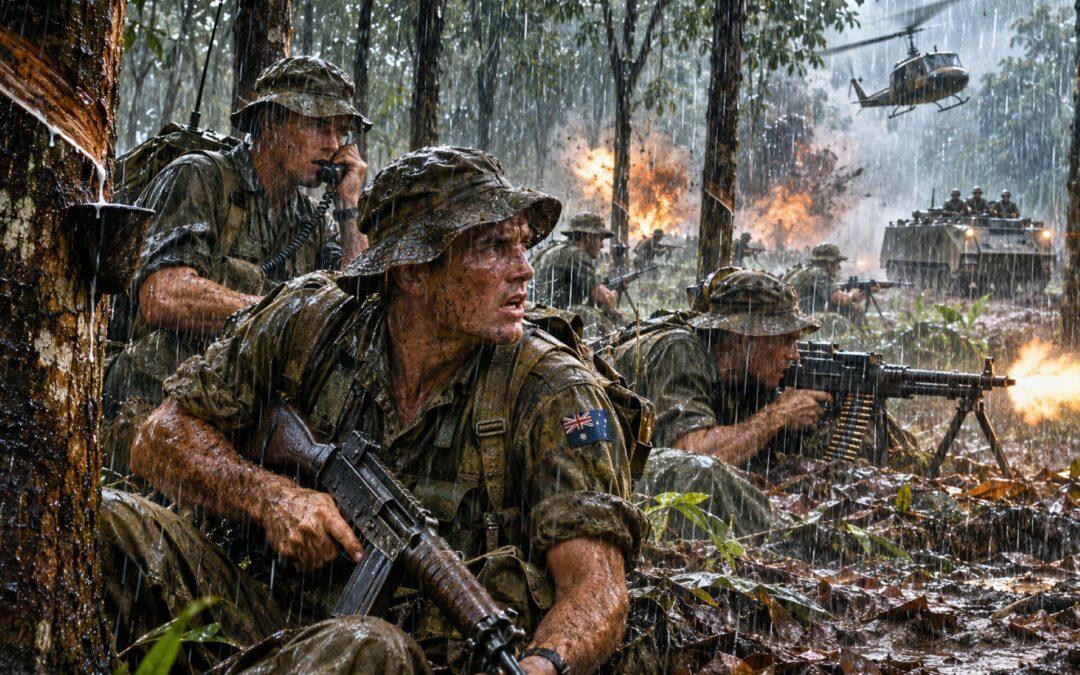
On the afternoon of 18 August 1966, monsoon rain swept through a rubber plantation in South Vietnam as an Australian infantry company fought to avoid destruction. Rifle and machine-gun fire came from among the trees. Its platoons had become separated, men were dead or wounded, and ammunition was dwindling. Several kilometres away, artillery crews fired into the storm, trying to keep the attackers from closing in.
The force in the plantation consisted of 105 Australians and three New Zealand artillerymen. They had set out to investigate an enemy bombardment, not to fight a major battle. Instead, they had encountered a much larger Vietnamese force. For hours, the survival of D Company, 6th Battalion, Royal Australian Regiment, depended on decisions made under fire, communication across difficult terrain, and reinforcements struggling to reach them before darkness.
The Battle of Long Tan became one of Australia’s best-known military engagements. Its real history is more complicated, and more remarkable, than the familiar image of a small company standing alone against overwhelming odds.
Why Australia Was Fighting in Phuoc Tuy Province
Australia’s involvement in the Vietnam War grew from Cold War fears that communist victories in Southeast Asia could undermine the security of neighbouring countries. After sending military advisers in 1962, Australia committed combat troops in 1965 and expanded its deployment the following year. Australian leaders viewed support for South Vietnam as both a regional security policy and a way of maintaining their alliance with the United States.
By May and June 1966, the 1st Australian Task Force, or 1 ATF, was establishing itself at Nui Dat in Phuoc Tuy Province, southeast of Saigon. The task force included infantry, artillery, engineers and supporting units, and operated alongside New Zealand and American forces. The 6th Battalion, Royal Australian Regiment, known as 6RAR, was among its principal infantry formations. Rather than conduct exclusively large, American-style search-and-destroy operations, the Australians frequently relied on dispersed patrols, ambushes and careful observation, drawing partly on earlier counterinsurgency experience.
Phuoc Tuy was not an empty battlefield. Villages, plantations, fields and tracks connected a population whose lives had already been shaped by years of conflict. Local Viet Cong units drew on networks for food, recruits, shelter and information. The communist D445 Battalion, which operated in the province, had considerable experience fighting South Vietnamese government forces and continued to challenge Australian control long after Long Tan.
The Australians, meanwhile, wanted to protect their base and prevent armed revolutionary forces from operating freely among nearby communities. The establishment of Nui Dat involved relocating residents of Long Tan and Long Phuoc, severing some of the relationships between local people and communist units. Such measures could improve the military security of the base while imposing real costs on Vietnamese civilians. They also gave the opposing forces a powerful reason to contest the Australian presence.
Control of the countryside was a central problem for both sides. A patrol might find enemy weapons or tracks without discovering the relationships that allowed an armed unit to disappear, obtain supplies and reappear elsewhere. Securing Nui Dat could protect the Australians while also making the villages around it more contested. This is why Long Tan cannot be understood only as an unexpected clash between two groups of soldiers. For the Australians, holding Nui Dat was essential to their new operational foothold. For Vietnamese communist commanders, challenging that foothold offered a chance to restore influence in surrounding villages and demonstrate that the foreigners could not dictate security in the province. Each side understood the ground in political as well as military terms.
The Warning Signs Before Long Tan
The Australian task force had reason to suspect that a substantial enemy force was moving toward Nui Dat. In the weeks before the battle, a signals-intelligence unit tracked radio transmissions associated with the Viet Cong 275th Regiment as they approached from the east. The transmissions reportedly ceased near Nui Dat 2, a feature several kilometres from the Australian base. Yet patrols sent into the area found no clear concentration of enemy troops.
Intelligence of this kind was inherently incomplete. A radio signal could suggest where a headquarters or formation might be, but it could not reveal every soldier’s location or intentions. Access was also tightly restricted: information gathered by 547 Signal Troop did not become a detailed warning given to every infantry commander. The men sent to search for an enemy mortar team were not necessarily aware of the larger threat developing around them.
In the early hours of 17 August, mortars and recoilless rifles struck Nui Dat. The bombardment lasted about 22 minutes, damaged equipment and wounded Australian personnel. The defenders prepared for a possible ground attack, but none followed. One possibility was that the bombardment was intended to provoke a response; the exact relationship between the shelling and the subsequent battle remains disputed.
The mortar positions themselves were important clues. A crew firing indirect weapons could strike a defended base while remaining outside its perimeter, then leave before an infantry patrol arrived. Finding the firing sites was therefore not the same as identifying the unit behind them or establishing where it had moved. B Company of 6RAR was sent out to trace the firing positions and follow tracks left by the attackers. Its soldiers found evidence of enemy activity but did not encounter the force responsible. The search continued into 18 August, even as some at the base assumed the danger had passed or the enemy had withdrawn.
The distinction matters. Long Tan is sometimes described simply as an ambush into which an unsuspecting patrol walked. The Australians were certainly surprised by the scale of resistance, but historians also describe it as an encounter battle: moving forces came into contact, both sides reacted, and the fighting expanded rapidly. Whether Vietnamese commanders had planned a larger assault on Nui Dat, hoped to draw Australians out, or adapted to an unexpected opportunity remains contested.
What can be established is that the patrol was operating within reach of a sizeable, capable enemy formation. The gap between what intelligence suggested and what D Company understood would become painfully important once the firing began.
D Company’s Patrol into the Rubber Plantation
On 18 August, the soldiers at Nui Dat had something more pleasant to anticipate than another patrol. Australian entertainers, including Col Joye and the young singer Little Pattie, were visiting the base for a concert. Some of the men of D Company could hear preparations as they received orders to take over B Company’s search. The prospect of missing the performance became one of the ordinary human details later recalled about an extraordinary day.
Major Harry Smith commanded D Company, which had three rifle platoons: 10 Platoon under Second Lieutenant Geoff Kendall, 11 Platoon under Second Lieutenant Gordon Sharp, and 12 Platoon under Second Lieutenant David Sabben. The company also had a headquarters element and a three-man New Zealand artillery forward-observation party under Captain Maurice, or Morrie, Stanley. Those observers would provide the crucial link between the infantry and guns positioned at Nui Dat.
D Company left the base late that morning and met B Company near the plantation at around 1 p.m. After the handover and a meal of field rations, Smith’s men advanced among the long, regularly spaced rubber trees. The plantation’s straight rows offered some visibility, but vegetation, uneven ground and distances between platoons made mutual support difficult. The heavy rain that developed later would reduce visibility and complicate movement still further.
At roughly 3:15 p.m., D Company had entered the plantation. Its leading soldiers encountered a small group of armed Vietnamese men. Shots were fired, and the Vietnamese withdrew. Sergeant Bob Buick of 11 Platoon was among the Australians who engaged them. The men’s clothing and weapons suggested that this was not necessarily an ordinary local guerrilla patrol.
The Australians had reason to be cautious but little reason to imagine the scale of what lay ahead. The enemy was not restricted to a few fighters darting between trees. Its larger force could apply machine-gun fire, manoeuvre against separated groups and attempt to prevent one platoon from reaching another. Sharp’s 11 Platoon continued after the retreating men. Around 3:40 p.m., contact developed into intense machine-gun and rifle fire; by shortly after 4 p.m., the platoon was taking heavy casualties. Accounts vary slightly over the exact minute at which scattered firing became the main engagement, but the larger sequence is clear. A search for a small enemy party had suddenly exposed the forward platoon to a much larger force.
Smith could not see the entire battlefield or immediately know the enemy’s strength. His soldiers were spread across a plantation that had turned from familiar patrol terrain into a dangerous network of firing positions. When the monsoon downpour arrived, the small company’s ability to identify friendly locations, move between platoons and direct supporting fire was tested at once.
Eleven Platoon’s Desperate Fight for Survival
Eleven Platoon took the first devastating blow. The Vietnamese force used automatic weapons and machine guns to pin the Australians down, then pressed toward their position. Men were hit in the initial bursts, and the platoon struggled to understand how many enemies were advancing through the plantation. The possibility of simply disengaging became more remote as fire swept the ground around them.
Second Lieutenant Gordon Sharp attempted to control the response and obtain artillery support. As the platoon fought in worsening rain, he was shot and killed. Command fell to Sergeant Bob Buick, who had to reorganise the survivors while enemy fire continued. By this stage, a substantial fraction of the platoon had been killed or wounded; it was no longer capable of acting as a normal, fully staffed infantry formation.
Radio communications were vital but fragile. A damaged aerial or destroyed radio could isolate a platoon even when friendly soldiers were only a few hundred metres away. Buick’s radio antenna was hit, forcing improvisation under circumstances in which accurate requests for artillery were also a matter of survival. The soldiers needed to prevent the enemy from approaching close enough to overrun their position while avoiding shells falling among their own men.
Smith initially ordered Kendall’s 10 Platoon toward the isolated troops. It fought through an enemy group, only to encounter heavy fire from several directions. With casualties mounting and communications disrupted, its own position became threatened. Private William “Yank” Arkell moved forward under fire with a replacement radio, restoring a connection that allowed Smith to regain some control of the situation. Kendall’s men were then ordered to pull back toward company headquarters.
Meanwhile, the survivors of 11 Platoon remained exposed. Their immediate tasks were practical and relentless: keep weapons working, share ammunition, cover neighbouring positions, move or protect the wounded when possible, and maintain contact with the artillery. Buick continued calling for defensive fire close to his men. The shells could break up attackers before they reached the platoon, but bringing high explosives so near friendly soldiers required accurate communication and enormous trust.
At around 5:15 p.m., with 10 Platoon back near headquarters, Smith sent a new rescue party. Second Lieutenant David Sabben took about twenty men from 12 Platoon toward Buick’s position. They met Vietnamese soldiers trying to work around the Australian flank and were drawn into another fierce engagement. Several of Sabben’s men were wounded, and for a time his party was also unable to reach the isolated platoon.
The attempted rescues also illustrate why the simple phrase “held their ground” is inadequate. Smith had to decide whether to send scarce soldiers toward a trapped platoon or hold them back for the protection of the company headquarters. Both choices carried risks: movement could create additional casualties, but leaving 11 Platoon isolated might allow the enemy to defeat D Company piecemeal. The rescue was not a smooth advance by a fresh unit to a clearly marked location. Every movement exposed soldiers to new fields of fire, while rain, radio difficulties and overlapping friendly and enemy positions made coordination dangerous. For the men of 11 Platoon, there was no certainty that help would arrive. They were holding on with shrinking numbers and little ammunition, knowing that a break in their defence could leave the rest of the company exposed.
Eventually Buick gathered the survivors and moved toward 12 Platoon. The two groups linked up and fought their way back to Smith’s main position, using the brief opportunities created by supporting fire. Their return did not end the battle. It meant that D Company could at last concentrate more of its remaining strength in a coordinated perimeter, rather than allowing its fragments to be destroyed separately.
Artillery, Helicopters and the Battle to Hold the Line
The most important weapon supporting D Company was not inside the plantation. It was several kilometres away at Nui Dat, where Australian, New Zealand and American gunners worked to bring concentrated fire onto the attacking force. Captain Morrie Stanley and his forward-observation team were responsible for translating reports from the infantry’s dangerous position into firing instructions for the artillery batteries.
An artillery observer did much more than ask for shells. He had to determine where the enemy was relative to friendly positions, direct the initial rounds, judge where they landed and request corrections. Those calculations became particularly difficult when rain obscured landmarks and the platoons were shifting positions. Early rounds did not always land as intended, making adjustment urgent. Once accurate fire was established, however, it provided a barrier that enemy infantry could not cross without suffering heavy losses.
New Zealand’s 161 Field Battery was among the first to respond, followed by the Australian 103rd and 105th Field Batteries and American support. The Australian War Memorial’s reconstruction of the battle describes sustained artillery fire and the extraordinary pressure on gun crews as requests arrived from the plantation. At peak intensity, batteries were delivering more than a hundred rounds per minute. Personnel elsewhere on the base helped handle ammunition so that the gunners could keep firing.
The effect of artillery was not merely the casualties it inflicted. A burst among soldiers assembling to attack could disrupt their timing, force them to seek cover and give the defenders moments to move, reload or re-establish communications. Conversely, if observers lost track of a friendly platoon, a shell intended to save it could become a danger. That tension explains the premium placed on working radios and trained observers. The barrage did not eliminate the need for the infantry to fight. Vietnamese soldiers still approached from different directions, and Australian machine guns and rifles remained the final defence against a close assault. But artillery repeatedly disrupted groups forming for an attack and helped the company survive while its platoons tried to reunite. It was the combination of disciplined small-arms fire and sustained external support that made continued resistance possible.
There was another urgent problem. The company was consuming ammunition faster than it could replace it. Soldiers facing repeated attacks could not simply fire at every movement; they had to conserve rounds and share what remained. By late afternoon, requests from the plantation made the shortage unmistakable. Even a tactically well-organised defence could collapse if ammunition ran out before reinforcements arrived.
Ordinary aircraft support was restricted by the weather. Low cloud and torrential rain made close air strikes hazardous, particularly with Australians and Vietnamese fighting at such short distances. But two Royal Australian Air Force Iroquois helicopters from No. 9 Squadron attempted a different mission: they flew into the storm carrying boxes of ammunition and supplies for D Company.
The crews had to locate the company’s position through poor visibility, come down toward the treetops and drop the supplies without landing. The ammunition was released from the helicopters, not delivered in a routine landing or a neat sling load. Blankets helped protect the boxes during the drop. The aircrew faced risks from the weather, the trees and fire from the ground, while the men below had to recover the precious rounds under continuing pressure.
Warrant Officer Jack Kirby, D Company’s company sergeant major, became central to turning the drop into usable ammunition. He helped distribute rounds among soldiers lying in defensive positions, organised care for casualties and moved through exposed areas to keep the company functioning. Accounts also describe him attacking an enemy machine-gun position that threatened the perimeter. His contribution illustrates a kind of leadership that rarely fits into a simple description of officers issuing orders and soldiers following them.
The men also had reason to fear that the supplies might not be enough. By early evening, they had suffered serious casualties, had only recently recovered their isolated platoons, and could hear or see evidence of Vietnamese forces preparing further attacks. The helicopters had bought them time, just as the artillery had; neither guaranteed that they would live through the next assault.
The Final Assault and the Arrival of Reinforcements
While D Company tried to consolidate, a relief force was moving out from Nui Dat. Armoured personnel carriers from 3 Troop, 1 Armoured Personnel Carrier Squadron, carried infantry from A Company, 6RAR, under an urgent order to reach Smith’s position. The carriers were not tanks, but their armour, mobility and mounted machine guns provided a different kind of fighting power from anything available to the besieged company.
Unlike soldiers on foot, the crews could use their vehicles to cross exposed stretches with some protection and respond with mounted weapons. Yet armour did not make them immune to fire, mechanical problems or terrain. A carrier forced onto an unsuitable track or separated from the others could also jeopardise the rescue. Getting there was neither immediate nor straightforward. The vehicles had to navigate wet ground, obstacles and enemy positions, and parts of the force became engaged before reaching D Company. Lieutenant Adrian Roberts commanded the armoured troop; the men in the carriers could not simply drive unopposed to the plantation and collect the survivors. Other Australian infantry, including elements of B Company, also moved to support the operation.
Around 6:30 p.m., Vietnamese attacks continued against D Company’s perimeter. The Australians used rifles, machine guns and artillery to prevent attackers from closing in. The approaching darkness created a grim deadline: at night, recognising friend from foe and coordinating the rescue would become even harder. Smith and his platoon leaders had reorganised the survivors for all-round defence, but their line was badly depleted.
The armoured carriers fought through resistance and eventually linked up with the beleaguered soldiers around dusk, close to 7 p.m. Their arrival added firepower, created an avenue for relief and contributed to the end of the immediate threat. Australian accounts describe Vietnamese soldiers withdrawing into the plantation as the battle subsided. The exact timing and causes of that withdrawal cannot be reduced to one dramatic moment, but the reinforcement was decisive for D Company’s security.
The firing diminished, yet the soldiers could not assume the danger had passed. They reorganised, checked ammunition, searched for the wounded and prepared in case the enemy returned. Evacuating casualties was a further operation in difficult conditions, with helicopters later carrying men away from a landing zone outside the plantation. Some dead and missing Australians could not be recovered before morning.
The Aftermath and the Disputed Cost of Victory
On 19 August, Australian troops returned in strength to search the battlefield. The task was both military and deeply personal: locate missing comrades, evacuate survivors, identify enemy units, and recover weapons and documents. In the positions where 11 Platoon had fought, the bodies of Australian soldiers were found near the ground they had defended. Two men previously feared lost were discovered alive despite spending the night wounded in the plantation.
The final Australian toll was eighteen dead and twenty-four wounded. Seventeen soldiers died during the battle, and another died of his wounds nine days later. Most of the dead were from D Company, with one associated with the armoured relief force. The losses were devastating for a company that had entered the plantation with only 108 personnel, including its New Zealand observers. Eleven of those killed were Australian national servicemen; the deaths reached families whose sons had been drawn into an increasingly divisive war.
The Australians counted 245 Vietnamese dead during their battlefield clearance and found evidence that other casualties had been removed. Australian accounts also recorded captured weapons, supplies and documents. Estimates of the total Vietnamese force vary, with Australian official histories commonly giving a figure of about 2,500 troops from the Viet Cong 275th Regiment, D445 Battalion and other North Vietnamese elements. Not all of those men necessarily fought directly against D Company at the same time.
The casualty figures require care. The count of bodies found by Australian troops is a documented battlefield finding, not an independently established final total of all Vietnamese deaths. Some estimates include additional men believed killed or wounded; Vietnamese accounts differ on both losses and the number of troops committed. The often-repeated image of 108 men defeating 2,000 should therefore be understood as shorthand for a profoundly unequal engagement, not a precise measurement of every soldier fighting at each moment.
Vietnamese perspectives also reveal a different understanding of what was at stake. In the Australian Army Research Centre’s discussion of D445 Battalion’s history, the struggle is inseparable from control of local communities, sources of food and political influence. Vietnamese official accounts at times reported sweeping victories over Australian units that are contradicted by Australian casualty and equipment records. Those claims should be scrutinised rather than repeated uncritically, just as Australian estimates and interpretations should be attributed accurately.
The battle was a major tactical success for the Australian force: D Company survived, the attacks ended, and its opponents suffered substantial casualties. But it did not destroy the Vietnamese units or settle the struggle for Phuoc Tuy. D445 remained active, and communist forces continued fighting in the province for years. Nor did the survival of one Australian company reverse the larger outcome of the war, which ended in the collapse of South Vietnam in 1975.
Long Tan demonstrated the capabilities of trained infantry supported by responsive artillery, effective communications, helicopters and armour. It also exposed the dangers of incomplete intelligence, dispersed patrols and a war in which conventional battlefield success did not automatically translate into lasting political control. Both conclusions are needed for a serious assessment of the battle.
How Long Tan Became a Symbol of Australian Military History
For the survivors, Long Tan was first a memory of comrades killed and injured, not a ready-made national legend. Their conduct drew recognition, including a United States Presidential Unit Citation for D Company and Commonwealth decorations for individual soldiers. Yet many veterans believed the initial awards fell far short of acknowledging what had happened. Major Harry Smith and others spent decades pressing for a fuller review of gallantry and leadership during the battle.
The controversy was sharpened by an awkward early episode. South Vietnamese authorities proposed presenting their own gallantry awards, but Australian restrictions on accepting foreign decorations prevented the ceremony from proceeding as planned. Gifts were substituted instead. For men who had witnessed the battle, the contrast between their experience and the bureaucracy of honours could feel particularly bitter. Subsequent reviews and recognitions reflected the persistence of those concerns, even as opinions about particular awards differed.
A more enduring act of remembrance took place on 18 August 1969, when Australian and New Zealand soldiers erected a white concrete cross in the plantation near the site of 11 Platoon’s last stand. The cross later passed into Vietnamese museum custody, while a replica marked the site. The original was eventually placed on permanent display at the Australian War Memorial. Its history embodies both the desire of veterans to remember their fallen companions and the sensitivities involved in commemorating a battle on another country’s soil.
The anniversary itself acquired a broader meaning. What began as Long Tan Day became a focal point for remembering Australians who served throughout the Vietnam War, including those whose experiences were far removed from this one plantation. In the late 1980s, 18 August was formally established as Vietnam Veterans’ Day. The commemoration now recognises the service, losses, trauma and difficult homecomings associated with the war, not merely a single battlefield result.
The importance of Long Tan also belongs within Australia’s wider history: a country whose participation in Vietnam reflected alliance commitments, strategic anxieties and domestic political divisions. Many Australians opposed the war and conscription, and veterans’ experiences after returning home were not uniform. Remembering their courage need not require agreement with every political decision that sent them to Vietnam.
The battle’s fiftieth anniversary in 2016 and sixtieth in 2026 prompted renewed commemorations and historical reflection. Later generations have encountered Long Tan through veterans’ accounts, scholarship, memorials and dramatizations. The most useful remembrance allows those stories to coexist with unanswered questions, the Vietnamese experience and the recognition that battlefield heroism and military victory are not the same thing.
The men of D Company did not prevail because courage made them invulnerable. They endured because soldiers kept fighting after their platoons were shattered, leaders improvised when communications failed, gunners delivered fire through the rain, helicopter crews brought ammunition, and an armoured relief force reached them before the position collapsed. Each part mattered, and none erased the lives lost.
Long Tan remains a story of discipline, courage and determination. It is also a reminder that war’s most compelling stories become more meaningful, not less, when the full human cost and the limits of victory are understood.
Last Updated on November 20, 2026 by Aseem Gupta