
Reading Time: 14 Minutes
On 26 July 811, the Byzantine Empire lost an emperor in the mountains of Bulgaria. Nikephoros I had marched north with an imposing army, seized the political centre of his enemy and celebrated a victory that seemed to have broken Bulgarian resistance. Days later, much of that army lay dead, trapped between an enemy counterattack, a difficult river crossing and barriers erected along its route.
The defeat, remembered as the Battle of Pliska or the Battle of Vărbitsa Pass, was more than an ambush that went disastrously wrong. It exposed the difference between capturing a capital and defeating a state. Khan Krum, whose forces had suffered grievously during the invasion, had turned the geography of the Balkans and the disarray of a retreating army into a victory that shook Constantinople.
The Byzantine Empire and the Rising Power of Bulgaria
By the early ninth century, the Byzantine Empire remained a formidable political and military power, but its authority in the Balkans was contested. Its emperors considered much of the region south of the Danube part of their rightful sphere, a claim inherited from centuries of Roman rule. Control on the ground was another matter. Mountains, frontier communities and rival rulers made the region hard to govern from Constantinople.
The First Bulgarian Empire had emerged in 680–681, when forces associated with Khan Asparuh defeated a Byzantine expedition and secured recognition of their settlement south of the lower Danube. The new polity joined Bulgar ruling traditions with Slavic-speaking communities and other populations. It developed into a durable rival rather than a temporary raiding force that could simply be driven away.
Geography shaped the confrontation. Bulgaria’s northern heartland lay across the Balkan Mountains, whose passes linked the Danubian plain to Byzantine Thrace. These routes could carry trade, tribute and armies; they could also restrict movement and expose travellers to attacks from surrounding high ground. A campaign against Bulgaria would depend not only on winning battles but on crossing and recrossing those mountains.
Krum, who ruled from roughly 803 to 814, enlarged his power during the disintegration of the Avar political order to Bulgaria’s northwest. His influence extended toward the middle Danube, while warfare along the Byzantine frontier sharpened the struggle for towns, manpower and strategic routes. He commanded a state capable of drawing on several communities, not merely a band of horsemen confronting an organized empire.
Why Emperor Nikephoros Invaded Bulgaria in 811
Nikephoros became emperor in 802 after the overthrow of Empress Irene. A former senior financial official, he sought to strengthen imperial revenues, restore political authority and supply the forces needed to defend Byzantium’s extensive frontiers. Those efforts could impose heavy demands on subjects, and later religious writers often portrayed his fiscal policies with particular hostility. Yet financing armies and defending vulnerable provinces were real problems, not simply expressions of personal greed.
The Bulgarian frontier offered repeated provocations. In 809 Krum captured Serdica, the important fortified settlement on the site of modern Sofia. Byzantine accounts describe heavy losses among the garrison and inhabitants. The capture threatened a route connecting regions of the central Balkans, and Nikephoros responded with military activity and attempts to strengthen imperial control, including settlement and garrison measures in contested territory.
By 811, the emperor was prepared for a far larger operation. He assembled troops from the Balkan military districts and from Anatolia, together with elite regiments known as the tagmata. Among them were the Excubitors, the Vigla and the Hikanatoi. The latter had close links with the emperor’s son Staurakios, who accompanied the expedition; Michael Rangabe, Nikephoros’s son-in-law, also went with him. The presence of senior commanders and their families made the campaign an exceptionally consequential gathering of imperial military leadership.
The expedition was intended to do more than punish a border raid. Striking deep into Bulgaria could damage Krum’s political authority, seize his resources and demonstrate that the emperor could dictate the terms of peace. Contemporary writers sometimes present the army as overwhelmingly large, but dependable figures for its total strength do not survive. What matters is its composition: seasoned imperial units, regional troops and additional men assembled for a major offensive.
For Nikephoros, the opportunity looked promising. Krum faced an enemy capable of bringing considerable force to bear and of advancing directly toward his seat of power. But the strength that made such an invasion possible also created a formidable logistical challenge. A large force needed food, cohesion and secure lines of movement in territory where its opponents knew the routes far better.
The Invasion of Bulgaria and the Sack of Pliska
The Byzantines crossed the Balkan Mountains in July 811 and advanced into northeastern Bulgaria. Krum’s troops initially withdrew rather than accept a decisive battle against the invading army. Their retreat allowed Nikephoros to push toward the Bulgarian ruler’s principal centre, traditionally identified as Pliska. From an imperial perspective, that advance looked like confirmation that the campaign was succeeding.
An anonymous Byzantine narrative known as the Chronicle of 811 describes fighting against Bulgarian defenders near Krum’s residence and then another victory over a larger opposing force. It supplies striking numerical totals for those killed. Such figures should not be treated as verified battlefield statistics, but the underlying point is clear: Byzantine troops broke the resistance they encountered and entered the ruler’s complex.
The account translated and studied by historian Paul Stephenson describes Nikephoros searching the treasuries and distributing captured money, clothing and other valuables among his soldiers. Stores of wine were opened as well. For the army, the spoils were tangible proof of success; for Krum, they represented the plunder of resources and a centre of political prestige.
The same chronicle attributes to Nikephoros a boast that he would establish a city bearing his own name on the site. The statement cannot be verified as spoken dialogue. It nevertheless conveys how the author wanted readers to understand the emperor’s mood: military success had become confidence that Bulgaria itself was finished. Nikephoros then ordered or permitted the destruction of buildings and timber defences, leaving devastation behind as the invaders moved onward.
Other Byzantine traditions report that Krum offered peace and that the emperor rejected his overtures. The precise sequence and wording of these negotiations remain uncertain. If the account is substantially accurate, Nikephoros missed a possible opportunity to end the expedition after achieving a conspicuous political and military success. Refusing an agreement was not necessarily irrational, but it left the army operating in hostile country while the Bulgarian ruler remained free.
The chroniclers also accuse the invading troops of burning unharvested fields, slaughtering animals and committing other abuses. Their descriptions are morally charged, yet they fit the wider picture of a destructive expedition that damaged civilian livelihoods. Pliska had been overrun; it had not become a secure Byzantine possession. Krum still possessed followers, access to the countryside and the possibility of gathering fresh support.
How Khan Krum Prepared the Mountain Ambush
Krum had avoided the fate of the defenders at his political centre. That survival mattered more than Nikephoros may have appreciated. A ruler whose army was scattered could still rebuild a fighting force if he retained the loyalty of local communities and could reach allies beyond the immediate battlefield.
The Chronicle of 811 says the Bulgarians recruited Avars and neighbouring Slavs to strengthen their numbers, and even describes women being armed. These are claims from a hostile Byzantine account rather than a reliable census of Krum’s army. They suggest emergency mobilization on a broad scale, but do not establish the exact proportions of Bulgar, Avar and Slavic participants or the roles each played.
Krum’s preparations exploited a crucial weakness in the Byzantine position: an invading army had to leave Bulgaria by traversing restricted routes. In the mountains, formations could become stretched out, commands travel slowly and troops find themselves separated by difficult ground. The defenders did not need to defeat the whole expedition in an open field if they could attack its camp and block escape routes.
Byzantine accounts describe substantial wooden barriers or palisades, reinforced by ditches, across parts of the retreating army’s route. These were not incidental obstacles. A barrier that held cavalry in place or forced men to abandon their mounts could turn flight into a second encounter with danger, even for soldiers who escaped the initial assault. The river and marshy approaches described in the sources compounded the trap.
The location is less certain than the familiar name Battle of Vărbitsa Pass implies. Vărbitsa is the traditional identification, but historians have also considered Riš, Kotel and other passes or valleys. The surviving descriptions are not precise enough to fix the entire engagement on a modern map without debate. The operational pattern, however, is supported by the accounts: Krum’s forces confronted an imperial army whose retreat was constrained by the terrain and deliberately constructed obstructions.
There were vulnerabilities within the invading force as well. Its soldiers were dispersed, many burdened with plunder, and its commander appears to have lost control over discipline and coordination. One narrative depicts Nikephoros as withdrawn and unwilling to listen to advisers. Whether or not that personal portrait is fair, the attack would expose the consequences of camping in separated groups without an effective common defence.
The Battle of 26 July 811: The Byzantine Army Destroyed
The decisive disaster is conventionally dated to 26 July 811, with the attack beginning around dawn after the night of 25–26 July. The surviving chronicle gives a conflicting calendar reference, one reason historians reconstruct the sequence cautiously. There is no reliable, minute-by-minute record of where each unit stood or exactly when every obstruction was reached.
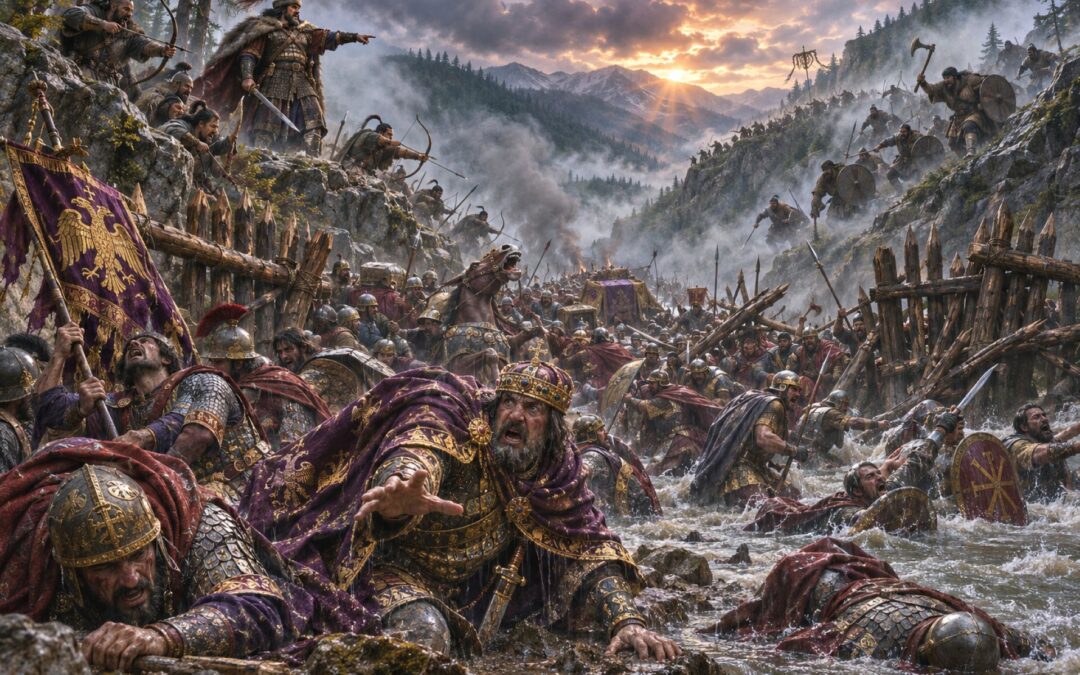
The anonymous account begins with Bulgarian forces attacking men who were still partly asleep. Soldiers rushed to arm themselves, but the Byzantine regiments were camped far enough apart that troops elsewhere did not immediately understand what was happening. Rather than striking every formation simultaneously, the attackers concentrated on the emperor’s encampment, the point where the loss of command could have consequences far beyond the ground it occupied.
The imperial camp resisted briefly, according to the narrative, before men began fleeing from the attack. Once soldiers abandoned their positions, the separation between camps made it difficult to assemble a coherent response.
The chronicle’s description of a nearby river is among its most harrowing passages. The watercourse was bordered by swampy ground, and fugitives could not readily find a crossing. Men entered with their horses, only to become trapped in mud and water. As more soldiers pressed forward, those behind pushed into those already struggling. Some drowned; others were trampled. The writer presents the crossing not as a tidy withdrawal but as a crush of people and animals under enemy pressure.
Even escaping the river did not mean safety. Survivors encountered the Bulgarian timber barrier. Mounted men could not simply ride through it, so some abandoned their horses and climbed over. But the far side concealed a deep ditch. The chronicle says soldiers who leapt down broke limbs, while others, injured and unable to move, succumbed after struggling a short distance. In this account, the geography of retreat had become a succession of traps.
Other fugitives attempted to burn through the palisade. Fire weakened the fastenings and brought down sections of timber, but the collapsing structure fell into the trench. Soldiers and horses moving across the broken barrier were thrown into the pit, now filled with burning material. Whether every detail happened exactly as narrated cannot be proved; taken together, the accounts depict a desperate and disorganized escape against obstacles prepared before the attack.
The fighting did not end neatly when the imperial camp was overwhelmed. Groups fleeing different directions faced pursuit, terrain and their own crowded routes. The chronicle says senior officers fell around the crossing and that many of the few who escaped the immediate carnage later died from injuries or exhaustion. Such sweeping language reflects an author mourning a disaster, but it is consistent with the substantial military losses described by other Byzantine sources.
One particularly revealing episode concerns the Hikanatoi, a regiment associated with Staurakios. The chronicler dwells on the sons of commanders, some newly married, who died among the troops. This was not merely the loss of anonymous soldiers. The expedition had taken members of leading families into Bulgaria, and its destruction struck the next generation of the imperial military elite as well as its experienced commanders.
Nikephoros himself died during the attack on the imperial camp. The chronicle expressly says that no one could state precisely how he was killed. That admission deserves more attention than later retellings that supply a confident account of his final moments. An emperor had entered Bulgaria at the head of a major expedition; he now died in an engagement whose confusion prevented even his own side from recording the circumstances with certainty.
The outcome was not quite the literal extinction of every Byzantine soldier. Staurakios, Michael Rangabe and other survivors made their way back. Nevertheless, the loss of the emperor, commanders, elite men and a substantial portion of the fighting force made the Battle of Pliska one of the most destructive Byzantine defeats of the early medieval period. It was the stark reversal of an invasion that had appeared successful only days earlier.
Nikephoros’s Death and the Crisis of Succession
An emperor killed in battle was an extraordinary event for Byzantium. Nikephoros is commonly identified as the first reigning Roman emperor to die fighting an external enemy since Valens fell at Adrianople in 378. The comparison is meaningful not because the battles were identical, but because each death turned a military defeat into a crisis of imperial legitimacy and succession.
Reports about Nikephoros’s remains became part of the battle’s notoriety. Theophanes the Confessor recounts that Krum had the emperor’s head displayed and later made his skull into a drinking vessel lined with silver, from which Slavic leaders drank. The story may preserve an actual act of ritual humiliation, but it also resembles traditions used to portray defeated rulers and supposedly savage enemies. No surviving object establishes the episode as fact; it should be understood as a reported tradition rather than a demonstrated physical detail.
The political consequences were more immediate and certain. Nikephoros’s son Staurakios survived the battle but suffered a grave injury to his spine. He had already been crowned co-emperor, making him the formal successor, and was proclaimed sole emperor after the disaster. Transporting a badly wounded ruler back through Byzantine territory posed difficulties of its own, and his condition left serious doubts about his ability to govern.
The Prosopography of the Byzantine Empire’s record of Staurakios traces a short, troubled reign. His sister Prokopia was married to Michael Rangabe, another survivor of the expedition, and competing expectations developed around the succession. On 2 October 811, Michael became emperor while Staurakios was removed from power and entered a monastery. Staurakios died in January 812, months after the wound that had effectively ended his ability to rule.
This succession was not simply a family dispute detached from the battlefield. A triumphant emperor might have returned with enhanced authority and a son prepared to inherit securely. Instead, Nikephoros’s death and Staurakios’s disability left courtiers, officers and church leaders confronting urgent questions of continuity. Bulgaria had inflicted a defeat whose effects reached into the Byzantine palace itself.
How the Battle Changed the Byzantine–Bulgarian Wars
Krum’s victory did not make Bulgaria invulnerable or leave the Byzantine Empire permanently helpless. Nikephoros had devastated Bulgarian territory, and rebuilding after the invasion imposed costs on the victor. Nevertheless, the death of the emperor and the destruction of experienced troops sharply weakened the immediate Byzantine capacity to dictate events on its northern frontier.
Krum seized the initiative. In 812 his forces captured Develtos, an important settlement near the Black Sea, and later Mesembria, another valuable coastal stronghold. Those operations threatened Byzantine positions in Thrace and demonstrated that the ruler who had lost Pliska could now carry war into imperial territory. People living along the frontier experienced the outcome not as a single commemorated victory but as continuing insecurity, displacement and military pressure.
Peace remained possible. Krum offered terms during Michael I Rangabe’s reign, but the Byzantine government did not accept the proposed settlement. The reasons are debated, and an apparent opportunity for accommodation gave way to renewed campaigning. For Michael, failure to contain Bulgaria risked confirming the weakness already revealed by the catastrophe of 811.
In June 813 another imperial army met Krum’s forces at Versinikia, near Adrianople, and suffered defeat. The collapse of Michael’s position helped bring Leo V to the throne. The two successive military reverses, separated by a change of emperor, showed that the problem was not merely the loss of a single army under Nikephoros. Byzantium still struggled to restore a favourable balance in the Balkans.
Krum advanced toward Constantinople in 813, confronting the imperial capital and participating in a cycle of attacks and diplomatic exchanges. He prepared further operations, but died in April 814 before he could carry them out. His death prevented the escalation from taking the course that contemporary observers had feared, without erasing the power Bulgaria had established under his rule.
Under Krum’s successor Omurtag, a longer-term peace was arranged with Byzantium, generally dated to 815–816. It gave both governments room to consolidate after years of conflict. The settlement also illustrates the limits of interpreting Pliska as a final victory over the empire: the Byzantine state endured, negotiated and would campaign again in the Balkans in later generations.
For Bulgaria, the battle helped establish Krum as a ruler capable of surviving an assault on his seat of power and defeating an emperor in return. Its significance lay partly in military leadership, but also in the ability of a developing state to mobilize resources, rebuild forces and use geography against a powerful neighbour. The engagement became a dramatic landmark in the longer struggle over who could control the Balkan frontier.
What Historians Know—and Debate—About the Battle
The Battle of Pliska is unusually vivid because Byzantine writers preserved descriptions of the campaign and the retreat. Yet those writers were not neutral observers assembling a modern operational report. They worked within political, religious and literary traditions that shaped which details they emphasized and how they judged the people involved.
The most striking source is the anonymous Chronicle of 811, sometimes called the Dujčev Fragment. It survives in a thirteenth-century Vatican manuscript, although the composition itself is considerably earlier. Its account includes the attack on the imperial camp, the river and palisades, the deaths among the Hikanatoi and the claim that the defeated Christians suffered persecution. Scholars disagree about its original date, its relationship to other historical fragments and whether some religious language was added later.
As a Cambridge study of the Chronicle of 811 explains, the author presents the disaster as a moral warning. Nikephoros appears proud, negligent and ultimately responsible for the suffering of his own troops. The account closes by lamenting the dead and urging Christian conduct. Such a purpose does not make every battlefield detail false, but it warns against accepting the portrait of an almost irrational emperor without scrutiny.
Theophanes the Confessor, another essential Byzantine chronicler, was hostile to Nikephoros and supplies the influential skull-cup story. His chronicle and the anonymous narrative overlap in important ways, but differing emphases and chronology complicate attempts to combine them into one seamless account. The relative silence of Bulgarian contemporary narrative sources means the campaign is largely seen through the writings of the empire that lost it.
Some uncertainty concerns numbers. Medieval accounts provide extraordinarily large totals for the defenders defeated during the invasion and strong language about the destruction of the imperial army. These statements convey the scale of victory or catastrophe but are not precise casualty records. Modern estimates of army strength also depend on contested assumptions about troop mobilization, garrisons and the number of men who could traverse the mountains.
Geography raises another unresolved question. The traditional Vărbitsa location has serious competitors, including Riš and Kotel, because different reconstructions place the retreat along different routes. Even the date requires care: the chronicle’s reference to 23 July conflicts with the generally accepted 26 July dating. A responsible account can explain the ambush and its consequences without pretending that every mile of the retreat has been established.
There are things historians can say with much greater confidence. Nikephoros invaded Bulgaria, overcame resistance and devastated Krum’s political centre. During the subsequent movement of the Byzantine force, Krum’s counterattack produced a disastrous defeat in which the emperor was killed and his son severely wounded. The surviving accounts disagree about details and motives, but not about the extraordinary reversal of fortune that followed the capture of Pliska.
The disaster offers no simple lesson that attacking an enemy capital is always foolish or that mountains automatically defeat armies. Nikephoros achieved real gains, but he failed to turn them into a secure political settlement or a protected withdrawal. Krum, despite severe losses, preserved enough leadership and support to exploit the invaders’ difficulties. In the summer of 811, those contrasting outcomes transformed the fortunes of two rival states.
Last Updated on November 20, 2026 by Aseem Gupta