
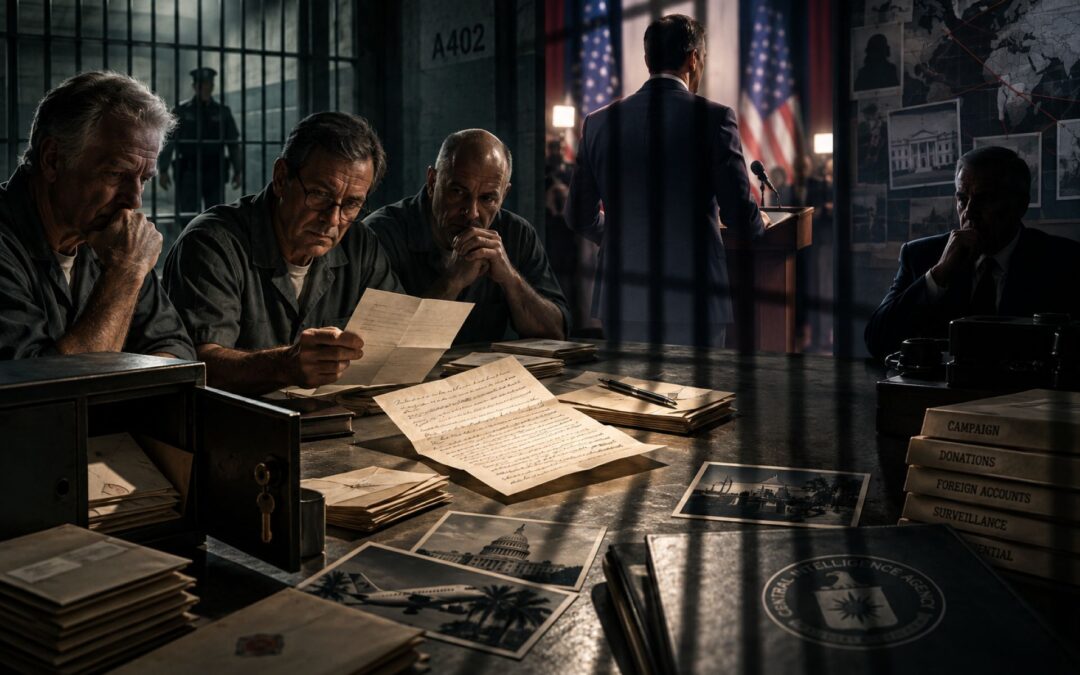
John Grisham’s The Brethren begins with an almost comic idea: three disgraced former judges, serving federal sentences in a minimum-security prison, create their own unofficial court and spend their days settling disputes among fellow inmates. Their judicial careers have collapsed, but Joe Roy Spicer, Finn Yarber, and Hatlee Beech have discovered that authority can survive even after legitimacy is gone. More importantly, they have devised a profitable sideline involving fictitious personal ads, invented identities, secret correspondence, and blackmail.
Running beside that prison story is a much larger conspiracy. CIA director Teddy Maynard has concluded that the United States needs a massive military buildup, but he does not trust ordinary democratic politics to produce it. He therefore chooses Congressman Aaron Lake as a presidential candidate, promises to supply the money and circumstances needed to make him viable, and uses intelligence, political pressure, surveillance, and public fear to push Lake toward the White House. When Lake secretly begins corresponding with one of the Brethren’s invented young men, the prisoners’ small extortion business collides with Teddy’s enormous political operation.
First published by Doubleday in 2000—an original publication date recorded by Penguin Random House—The Brethren is less a conventional courtroom novel than a legal-political conspiracy thriller about information and leverage. John Grisham’s official page for the novel also identifies it as a #1 New York Times bestseller. Its distinctive feature is not simply that criminals blackmail a presidential candidate, but that the novel places two systems of manipulation beside each other: one converts private shame into money, while the other converts classified knowledge and public fear into political power.
Spoiler warning: the discussion below covers the entire novel, including every major revelation and the ending.

Two Schemes Begin: Trumble’s Blackmailers and Teddy Maynard’s Candidate
The novel opens at Trumble, a minimum-security federal prison in Florida where violence is rare, inmates have considerable freedom of movement, and life has acquired its own routines and institutions. One of those institutions is the Brethren’s informal court. Former Mississippi justice of the peace Joe Roy Spicer, former California chief justice Finn Yarber, and former federal judge Hatlee Beech sit together and resolve other prisoners’ disputes, beginning with an argument between inmates called Rook and Whiz over a stock transaction. Their proceedings are ridiculous enough to be funny, but they also establish something important about the novel’s world: formal status may disappear, yet people immediately reconstruct systems of authority around whoever has knowledge, confidence, or bargaining power.
The three men did not arrive at Trumble through identical failures. Spicer is the most naturally corrupt of them, a gambler whose appetite for money and schemes survived his conviction. Yarber is quieter and more disciplined, carrying a sense that his own prosecution and imprisonment were excessive even while he participates willingly in new crimes. Beech has fallen the farthest psychologically. Once protected by the prestige and security of a federal judgeship, he destroyed his career through conduct linked to alcohol and a fatal accident, lost his public identity, became estranged from his family, and sank into depression.
Their more important enterprise operates from the prison law library. Using advertisements in magazines read by gay men, the Brethren invent younger male correspondents—most notably Ricky and Percy—and begin writing to older, financially secure men who have reasons to conceal their sexuality. The letters are designed to create intimacy gradually. The fictional young men appear lonely, vulnerable, attractive, and interested in genuine emotional connection. Once a correspondent has disclosed enough information to identify himself, the tone changes and the Brethren exploit the possibility of exposure.
Because prisoners cannot simply run a nationwide mail operation from inside Trumble, they need an outside partner. Trevor Carson, a small-time lawyer in Neptune Beach, carries correspondence in and out, maintains mailboxes, handles some legitimate legal work for inmates, and helps investigate potential targets. Trevor is hardly a mastermind. He drinks heavily, gambles, lives carelessly, and operates from a shabby practice, but those weaknesses initially make him compatible with Spicer. Both men are greedy, both enjoy gambling, and both assume they are clever enough to cheat the other if an opportunity appears.
The scheme becomes serious when the Brethren identify Quince Garbe, an Iowa banker with a powerful father and a conventional public life that could be destroyed by exposure. Quince has been corresponding with Ricky and believes he has developed a private emotional relationship. Once the Brethren know who he is, they demand a large payment. Quince’s terror demonstrates the central mechanism of their operation: they are not selling silence in the abstract but calculating exactly how much a man’s existing life is worth to him.
At the same time, another operation is beginning in Washington. Aaron Lake is a veteran congressman from Arizona, a widower with a reputation for discipline, seriousness, and strong interest in national defense. CIA director Teddy Maynard secretly summons him to Langley and describes what he sees as an increasingly dangerous international environment, particularly the rise of Russian figures Natli Chenkov and Yuri Goltsin. Teddy believes the United States has allowed its military capacity to deteriorate and wants a president willing to reverse that trend dramatically.
Teddy does not merely ask Lake to promote higher defense spending. He proposes that Lake run for president on a promise to double military expenditure, and he offers to create the conditions necessary for victory. Money will appear. Political resistance can be managed. Events abroad will make the electorate more receptive to warnings about danger. Lake is initially startled by the scale of the proposition, but he is ambitious enough to accept the opportunity and begins discreetly testing support.
That decision is crucial to Lake’s later character arc because he is not dragged unknowingly into Teddy’s project. He accepts a partnership whose unusual nature is clear from the beginning, even if he does not yet comprehend how far Teddy is prepared to go. The arrangement promises him enormous power, but it also establishes a debt that will eventually become a form of ownership.
Lake publicly launches his campaign at defense contractor D-L Trilling in a carefully staged patriotic setting. His message is straightforward: the world is becoming more dangerous, American military strength has declined, and the country must spend massively to rebuild it. The announcement initially looks like the beginning of an outsider candidacy built around one dominant issue, but Teddy is already working behind the scenes to ensure that Lake will not remain an outsider for long.
The novel also begins pairing the two plots thematically before their characters have any connection. The Brethren gather private information that can damage powerful men; Teddy possesses political and personal intelligence that can damage rival candidates. When Senator Dan Britt becomes an obstacle, private information around him is used to neutralize his candidacy. In both worlds, the decisive weapon is not law or public argument but something embarrassing that another person does not want revealed.
Quince Garbe experiences this logic at its most personal. The demand for money leaves him terrified of losing his family, position, and father’s approval. His fear becomes so intense that suicide enters his thoughts. What looks from the Brethren’s side like an ingenious business model is already revealed from the victim’s side as psychological coercion.
By the end of the novel’s opening movement, Grisham has therefore established two enterprises that initially seem unrelated. Three prisoners are converting hidden sexuality into cash, while the country’s most powerful intelligence official is converting secrets, money, and insecurity into a presidential campaign. Both depend on controlling information that other people cannot afford to have exposed.
The Schemes Accelerate: Money, Fear, and Political Momentum
As both schemes expand, Grisham alternates between comic prison life and increasingly disturbing events outside. At Trumble, the Brethren continue hearing cases, including an absurd complaint involving an inmate nicknamed Picasso, another prisoner called Sherlock, and a rose garden being repeatedly urinated on. These scenes give the prison chapters a loose, sardonic atmosphere, but they also keep returning to the idea that the Brethren still enjoy judging others despite having been judged and imprisoned themselves.
Their blackmail business becomes much more attractive once Quince’s first large payment arrives. The money is routed offshore through the Bahamas, Trevor takes his share, and everyone immediately begins imagining how much larger the operation could become. Success does not make the partnership more stable. Trevor starts wondering how he might keep more of the proceeds, while Spicer becomes increasingly suspicious that a lawyer with access to the outside accounts could eventually steal from them.
Meanwhile, the financial architecture around Lake’s campaign expands on a completely different scale. D-PAC, a powerful political-action organization devoted to defense issues, appears with substantial backing and quickly gains money, staff, lobbying power, and media reach. Elaine Tyner, a formidable Washington lawyer and lobbyist, becomes part of the operation. Defense interests that would benefit enormously from Lake’s proposed buildup now have an obvious reason to invest in his success.
Lake’s campaign therefore acquires something that most insurgent candidates lack: money on a scale capable of manufacturing visibility. Advertising becomes relentless, and Teddy’s political strategy increasingly emphasizes fear. Rather than asking voters merely to compare budgets or foreign-policy doctrines, the campaign is designed to make danger feel immediate.
The moral cost of that strategy becomes unmistakable with Cairo. CIA operative Lufkin learns that Yidal’s terrorist network is preparing an imminent attack on the American embassy. Teddy receives the warning and chooses not to intervene. The terrorists—not the CIA—carry out the bombing, but Teddy’s decision allows a preventable attack to proceed because the resulting national trauma will reinforce the political atmosphere he wants.
The attack kills scores of people. Coffins return to the United States, mourning dominates public life, and Lake responds with the forceful national-security message his campaign has been built to deliver. His warnings about military weakness suddenly sound more urgent to voters because a real atrocity has supplied the emotional context that advertising alone could not create.
That distinction matters. Teddy does not secretly plant the Cairo bomb or hire the attackers. His wrongdoing is colder and in some ways more revealing: he possesses information that could save lives and deliberately withholds action because a catastrophe serves a strategic purpose. People become variables in a political calculation.
The Brethren’s victims face a smaller version of the same instrumental logic. Quince is pressured again even after his first payment. Coleman Lee recognizes the fraud more quickly and proves difficult to manipulate, while Curtis Vann Gates reacts with fear when his correspondence becomes a threat. The men are not treated as people whose private lives matter to the Brethren; they are evaluated according to how much money their panic might produce.
Quince’s experience is particularly important because it prevents the scheme from remaining a harmless caper. His shame, desperation, and inability to confide safely in the people around him show why the threat works. The Brethren do not need to prove that the correspondence would actually destroy every victim. They only need each man to believe that exposure could destroy enough.
Another correspondent, Ned, provides a different response. Suspicious of the Percy persona, he investigates rather than paying. He travels to the Florida address connected with the correspondence, watches the mailbox, follows the collection process, and eventually traces the operation toward Trevor Carson’s law office. Ned does not become the person who finally destroys the scheme, but his investigation demonstrates that it is vulnerable. The Brethren’s success depends on victims being more frightened than curious.
While the extortion business develops, Lake races upward politically. Advertising before the Arizona and Michigan primaries helps transform him from an interesting candidate into a serious national contender. The money around him seems almost limitless, and his single overriding message—American vulnerability in a dangerous world—fits the atmosphere Teddy has helped cultivate.
Lake, however, has a secret that neither the press nor most of his campaign knows. Using the alias Al Konyers, he has begun corresponding with Ricky. He protects the identity carefully, using a private mailbox in Chevy Chase and avoiding the obvious links that would connect Al to Congressman Lake. The correspondence gives him a private space separate from the carefully controlled identity he presents to the public.
That secrecy becomes dangerous when Lake visits the mailbox in disguise. Teddy’s surveillance apparatus is already watching him closely enough to notice the trip. To the campaign, Lake is the indispensable candidate; to Teddy, he is also an asset who must be monitored. The unexplained mailbox therefore becomes a problem requiring investigation.
Trevor’s own life is becoming less controlled just as Lake’s is becoming more watched. He drinks more, gambles more aggressively, and starts calculating how much money he could keep if the Brethren ceased to be useful. Spicer reaches the same relationship from the opposite direction, resenting the share Trevor receives and wanting to reduce his dependence on him. Their partnership remains profitable, but profit has created more mistrust rather than loyalty.
The CIA’s discovery of Lake’s hidden correspondence changes the scale of the novel. Teddy’s people intercept a letter waiting for Al Konyers and begin reconstructing the Ricky identity. Trevor’s movements are followed. His office is entered, searched, and bugged. Mail traveling through his hands is secretly opened, copied, resealed, and returned.
A prison blackmail operation that had previously attracted attention only from its victims is now being examined by an intelligence service with vast resources. The Brethren do not yet know it, but by catching Aaron Lake they have threatened a political project involving the CIA director, enormous campaign expenditures, defense interests, and the presidency itself. Their little business has become a national-security problem—not because the scam itself threatens the country, but because the information inside it threatens Teddy Maynard’s candidate.
The CIA Finds Ricky: Surveillance Tightens Around the Brethren
The next phase of the novel is driven by asymmetry. The Brethren still think they are managing a profitable blackmail operation from prison, but Teddy’s organization can watch mailboxes, infiltrate offices, fabricate identities, manipulate prison procedures, and move people across the country. The challenge for the CIA is not discovering that something illegal is happening; it is learning exactly what evidence exists and who might possess copies.
At the same time, Teddy continues manipulating international information for political purposes. Before primaries in Virginia and Washington, the United States conducts an air strike against a terrorist compound in Tunisia. The intended targets have already departed, and civilians suffer instead. Teddy had intelligence relevant to the attack and had advised against it, but he does not ensure that all crucial information reaches the people making the decision.
The Tunisia episode differs from Cairo, and the difference is important. At Cairo, Teddy knows an attack is coming and allows it to happen. In Tunisia, he withholds or controls intelligence within a broader decision-making process and then operates inside the political consequences. Grisham repeatedly gives Teddy power not by making him the literal author of every disaster but by making him the person who knows more than everyone else and decides who is allowed to know what.
Teddy’s conversations with Lake become increasingly explicit about the political value of fear. Lake is winning, but Teddy wants him to keep repeating the same message because worsening international conditions make that message stronger. When intelligence reveals a Russian long-range missile with nuclear capability moving through the Khyber Pass toward Iran, Teddy thinks about the situation not only as a security threat but as something that could intensify public anxiety.
Lake is already learning that his candidacy exists inside an environment he does not control. He receives extraordinary support, but the source of that support also decides what information matters, which dangers should dominate public attention, and how aggressively the campaign should exploit them. Lake can deliver the speeches, but Teddy increasingly shapes the world in which those speeches are heard.
The CIA’s investigation of the Brethren becomes more methodical when agents approach Quince Garbe directly. Wes and Chap travel to Iowa posing as federal banking inspectors, confront him with knowledge of Ricky, and persuade him to surrender the correspondence. Quince, already exhausted by fear, has little reason to protect the men blackmailing him.
His letters give Teddy’s team an invaluable reverse view of the operation. Instead of merely watching Trevor carry envelopes, they can examine how Ricky’s relationship with a target develops, what questions are asked, when the tone changes, and how the threat is delivered. What had looked like a collection of strange personal letters can now be understood as a repeatable extortion system.
The CIA then moves from surveillance into active deception by inventing Brant White. Brant is presented as a wealthy, married Pennsylvania man with the kind of life the Brethren would expect to yield an enormous payout. He is not merely an imaginary correspondent; his entire apparent background is designed to survive the investigation the Brethren will ask Trevor to conduct.
The trap works because the Brethren have become ambitious. A photograph of Brant beside a private aircraft suggests exceptional wealth, and Spicer immediately imagines a larger score than the ones they have already collected. Rather than treating the new correspondent cautiously, the Brethren want Trevor to identify him quickly so that they can begin applying pressure.
Teddy’s people also use the Bureau of Prisons to restrict Trevor’s unusually frequent contact with Trumble. On its face, the measure can look like ordinary administrative enforcement. In practice, it is another way of narrowing the channel between the prisoners and their outside agent while the CIA learns more about the scheme.
Lake’s own position becomes increasingly precarious. After major primary victories, he is no longer merely one candidate among many. Replacing him would mean abandoning enormous political investment and perhaps losing the chance to obtain the defense buildup Teddy wants. That makes his correspondence with Ricky more dangerous, not less, because the cost of scandal rises with every delegate he wins.
Teddy’s operatives therefore try not only to intercept the letters but to discover where Lake keeps his originals. The physical documents matter because a scandal depends on evidence that can be produced, copied, or leaked. A rumor about Lake can be denied; handwritten correspondence tying him to a fictitious young man created by convicted judges is much more difficult to contain.
Lake himself senses the danger before he knows the full extent of the surveillance. He wants to slow and then end the correspondence. What began as a hidden emotional outlet now threatens everything the campaign has created around him.
Inside Trumble, a seemingly separate subplot introduces Buster, a young man serving a forty-eight-year sentence connected with a drug conspiracy involving his family’s fishing-boat business. Yarber listens to his story and becomes convinced that Buster has been crushed by an excessive prosecution. The former chief justice, himself imprisoned and participating in an extortion racket, nevertheless responds strongly to what he sees as an injustice.
Buster complicates the Brethren because he draws out a capacity for sympathy that the blackmail victims rarely receive. Yarber begins advising him, and even Spicer feels some concern for the young inmate. Yet Spicer’s opportunism remains intact; a younger prisoner might also be useful to the scam. Grisham does not suddenly transform the Brethren into good men, but he allows their moral capacities to remain uneven rather than nonexistent.
The Brant White operation soon reaches the point Teddy needs. Trevor travels to investigate the supposed wealthy correspondent, unaware that the entire identity has been constructed for him. The CIA learns how Trevor verifies targets and how information moves from outside research back to the prison.
The Brethren, meanwhile, decide Trevor’s percentage is too large. Their biggest apparent prospect has appeared just as their trust in their lawyer is eroding. That combination—greater potential profit and weaker internal loyalty—leaves the enterprise especially vulnerable.
By this stage, Teddy’s people understand the mechanics of the scam, know about Lake’s involvement, have obtained victim correspondence, and can manipulate the Brethren’s incoming mail. What they still do not know is whether the prisoners themselves have recognized Lake or created safeguards against being silenced. The CIA therefore has information superiority, but it does not yet have control.
Aaron Lake Is Exposed: The Two Plots Finally Collide
As Lake moves toward the Republican nomination, the Brethren’s danger to him becomes increasingly disproportionate to their apparent importance. Three prisoners in Florida know nothing about presidential strategy, CIA planning, or the larger purpose behind Lake’s candidacy. Yet if they can prove that the likely nominee secretly corresponded under an alias with Ricky, their files may be worth more than anything they have previously imagined.
Lake’s political position strengthens across the South. His message about military strength appeals to conservative voters, his advertising remains overwhelming, and his delegate advantage grows. Governor Tarry continues to oppose him, but the scale of Lake’s organization and financing makes it increasingly difficult to stop his momentum.
At Trumble, Yarber devotes more attention to Buster. Convinced that ordinary legal remedies are unlikely to repair the young man’s sentence, he crosses a line that would once have been unimaginable for a chief justice and effectively advises him to think about escape. Yarber suggests that Buster could disappear abroad and begin again rather than spend most of his life serving a punishment Yarber regards as fundamentally unjust.
Lake and Tarry eventually debate after weeks of campaigning around each other. Tarry attacks the extraordinary financial machine behind Lake and tries to expose the narrowness of his candidacy, but Lake performs better than expected outside his signature defense issue. The debate strengthens the impression that he can survive the general election rather than merely dominate a frightened primary electorate.
Shortly afterward, a crisis aboard Lake’s aircraft forces an emergency landing after smoke and fire appear during flight. Lake survives, and crucially, so does the correspondence connected with his secret life. Teddy’s reaction exposes the coldness of his calculation: Lake’s death would destroy the carefully constructed candidacy, but it would also eliminate the personal scandal that now threatens the entire operation.
The decisive breakthrough does not come from brilliant detective work by the Brethren. It comes through an accident. Teddy’s document team prepares another forged letter from Al to Ricky, attempting to manage the correspondence and keep it under control. When Trevor collects the prison mail, however, the material reaching the Brethren includes three documents whose relationship immediately looks wrong.
One is the CIA-created typed letter from Al, with a carefully forged signature. Another is Lake’s genuine handwritten note trying to end his correspondence with Ricky. The third is a handwritten campaign thank-you card intended for a woman named Carol, praising her work after a debate and urging continued effort in Pennsylvania. The card bears Aaron Lake’s name, and it has accidentally been sent with the Ricky material.
The Brethren compare the handwriting. The genuine note from Al and the campaign card from Aaron Lake match. The fake typed letter conflicts in tone and timing with the authentic note, revealing that somebody else has gained access to the correspondence and is attempting to manipulate it.
Other details reinforce the conclusion. Al uses a Washington-area mailbox, which fits Lake’s life. He has avoided sending a photograph. His travel and campaign schedule help explain postmarks and delays. The Brethren finally reach the conclusion that changes the novel: Al Konyers is Aaron Lake.
They also understand that someone powerful is already interfering. That prevents Spicer from immediately sending a reckless extortion demand. The prisoners have stumbled upon the most famous politician in the country at exactly the moment when an unknown organization has begun altering mail connected with him. Their opportunity is enormous, but so is the danger.
Spicer contacts Trevor and tells him to investigate the Chevy Chase mailbox. Before Trevor can decide how to proceed independently, Wes and Chap confront him. By this point the CIA has enough evidence to destroy him legally and financially. They know about the mail operation, the offshore accounts, and his role in the extortion scheme.
Instead of simply arresting Trevor, they buy and coerce him. He is offered $1 million to cooperate with the mysterious powerful client they claim to represent. Trevor does not know the whole political operation, but he understands immediately that the people confronting him have resources he cannot match.
Chap installs himself in Trevor’s law office as a supposed paralegal, while Wes and the broader surveillance team effectively take over Trevor’s daily environment. Trevor talks more than he should. He explains the scale of Ricky and Percy’s correspondence, the number of men involved, and the mechanics of the scheme.
For a brief period he appears to have made an extraordinary deal: a million dollars in exchange for information about partners he has already begun to distrust. In reality, he has lost almost all autonomy. His office is occupied, his movements are watched, and the people paying him have no reason to let him walk away carrying knowledge about their operation.
Trevor’s meeting with the Brethren brings the partnership to its breaking point. He tries to conceal the true situation, but Spicer senses inconsistencies in his story. The Brethren fire him. Trevor, perhaps out of resentment and perhaps out of lingering attachment, warns them indirectly that whoever stands behind Konyers is powerful and already watching them.
Trevor then betrays the CIA as well. He slips surveillance, leaves his car behind, improvises transportation, and heads toward Daytona in search of a charter flight. Once he reaches Nassau, he moves quickly to protect the money he has received, transferring funds through offshore banks and planning to continue moving them until he feels safe.
He even has an opportunity to steal the Brethren’s existing money but decides against taking everything. The decision does not make him noble; he has already taken the CIA’s money and abandoned both sides. Yet it shows that his relationship with the prisoners is not reducible to pure hatred. They have cheated and threatened each other, but years of familiarity still matter.
The CIA’s failure to keep Trevor under surveillance infuriates Teddy. An operation that has followed mailboxes, bank accounts, prison visits, homes, and offices has lost the one unstable civilian who knows enough to become dangerous. Teddy responds in character: instead of retreating, he expands the operation.
Because Trevor can no longer serve as a controlled channel into Trumble, Teddy decides to place an operative inside the prison itself.
At roughly the same stage, Buster acts on the possibility Yarber has helped him imagine. He escapes Trumble and heads west, eventually making his way toward Mexico. His disappearance is one of the novel’s quieter but important reversals: a man serving an extraordinarily long sentence for a crime Yarber believes has been punished unjustly simply walks away from the system.
Lake, meanwhile, continues winning. The more likely he becomes to reach the White House, the less room Teddy has to abandon him and the more urgently the Brethren’s information must be neutralized. The novel has now completed its convergence. The scam and the campaign can no longer be separated.
The CIA Enters Trumble and Closes the Trap
The Pennsylvania primary effectively ends meaningful resistance to Lake’s nomination. Governor Tarry is running out of political road, while Lake’s extraordinary funding, advertising, and momentum have turned Teddy’s chosen candidate into the presumptive nominee. At almost the same moment, a new prisoner arrives at Trumble under the name Wilson Argrow.
Argrow appears to be a thirty-nine-year-old bank-fraud convict transferred from another federal institution. His paperwork, background, and manner are convincing enough to survive routine prison scrutiny. In reality, he is Kenny Sands, an experienced CIA officer with no criminal sentence at all.
The operation demonstrates the difference between the Brethren’s deception and Teddy’s. Ricky and Percy exist through letters and rented mailboxes. Argrow is supported by the resources of the state: records, transportation, personnel, and an institutional apparatus capable of placing a false prisoner inside a federal facility. Both sides fabricate identity, but only one can make its fiction bureaucratically real.
The Brethren soon send a message that makes the threat against Lake explicit. They know who Al Konyers is. At Langley, the problem becomes much more serious because nobody can be certain what copies exist, what instructions may have been left outside Trumble, or whether the prisoners have arranged for evidence to be released if they die.
That uncertainty is what protects them. Teddy and his advisers can contemplate killing three prisoners, but killing them without locating every copy of the correspondence could turn a containable scandal into an uncontrollable one. If evidence emerges immediately after suspicious deaths, Lake’s situation may become even worse.
Trevor presents a similar problem but without the same protection. The CIA traces him through his movements in the Caribbean, including Bermuda and ultimately Jamaica. Trevor believes that money and distance might allow him to disappear, but he is a solitary man fleeing an organization designed to find people.
News of his death eventually reaches Trumble through the Jacksonville newspaper. Trevor has been found outside a Kingston hotel, shot twice in the head. The Brethren cannot initially know with certainty who killed him, but they immediately suspect that the powerful people surrounding Konyers may be responsible.
The novel later removes the ambiguity: Trevor was murdered by the CIA. His wallet was taken and his hotel room searched as part of the cleanup. Teddy’s organization has moved from monitoring mail and manipulating politics to eliminating a civilian liability.
Trevor’s death creates exactly the opening Wilson Argrow needs. The Brethren have lost their lawyer, their courier, and their link to offshore money. They do not know whether their funds are safe, and they cannot easily communicate with the institutions holding them.
Argrow presents himself as a man who understands banking and offshore finance. His supposed brother, Jack, can help with transactions outside the prison. The offer is almost perfectly tailored to the Brethren’s immediate problem, which is why it works.
At the same time, Lake instructs Jayne Cordell to close the Al Konyers mailbox. The most obvious physical connection between his public identity and Ricky is being eliminated, but the dangerous correspondence already exists elsewhere. Closing the box solves a future problem, not the past one.
Argrow gradually earns trust by doing something measurable. Through the fictional outside network surrounding him, he helps the Brethren verify and then move their offshore funds to the First Coast Bank of Panama. Once money they feared lost appears safely under new arrangements, Argrow stops looking like an opportunistic fellow prisoner and starts looking like the solution to their predicament.
The CIA also cleans up Trevor’s world. His mother and aunt arrive to deal with his house, office, body, and confused financial affairs, while operatives who had occupied his practice quietly dismantle the surveillance structure. To Trevor’s family, he has died violently and left behind a disordered life. To Teddy’s organization, he is an operation that needs to be closed.
Even the money Trevor hid reflects the limits of Teddy’s omniscience. Trevor had moved approximately $900,000 in CIA funds beyond their immediate reach, and his killers do not recover everything. The agency is enormously powerful, but Grisham avoids making it literally all-knowing.
The Brethren, meanwhile, now understand the basic strategic shape of the confrontation. The people behind Lake can reach Trevor anywhere, manipulate the prison system, and probably harm them. Their only protection is the possibility that copies of Lake’s correspondence might survive them.
That creates a stalemate. Teddy possesses overwhelming physical and institutional power, while the Brethren possess a small packet of information whose potential political value makes direct violence dangerous. The conflict therefore moves toward negotiation.
Pardons, Payoff, and Freedom
To resolve the crisis, Teddy needs something even the CIA cannot simply manufacture: legitimate presidential pardons. He goes to the White House and asks the outgoing President to free three obscure former judges. He does not explain the real reason, relying instead on the accumulated political influence and confidential relationships built over decades.
The scene is one of the novel’s clearest examples of formal authority being redirected by informal power. A presidential pardon is a constitutional act carrying the appearance of lawful mercy. Here it becomes a component in a secret bargain designed to protect a presidential candidate and close a blackmail operation.
Argrow becomes the negotiating channel. He tells the Brethren that his supposed outside contacts can reach the people around Lake. The prisoners respond by naming their price: $2 million apiece, presidential pardons, safe release, and the ability to leave the country in exchange for the files and permanent silence.
Their demand is audacious, but they have correctly understood the value of what they possess. Six million dollars is trivial compared with the money already moving through Lake’s campaign and the political consequences of public exposure. Pardons are more difficult, but money alone is useless to men who remain in prison.
The Brethren also claim that they have created a form of insurance: if something happens to them, evidence will reach the outside world. Whether every detail of that protection is as secure as they imply matters less than Teddy’s inability to prove that it is not. Once information can be copied, uncertainty becomes leverage.
Teddy’s side accepts the price. Argrow presents signed pardons, and the machinery of the federal prison system releases the three men. After years of confinement, Spicer, Yarber, and Beech walk out legally rather than escape.
Their first hours outside reveal how differently they understand freedom. Beech experiences the most profound emotional change. He had expected to die in Trumble and had contemplated suicide; now, in his mid-fifties, healthier and lighter than before, he suddenly sees a future filled with ordinary pleasures.
Spicer thinks immediately about gambling, drinking, women, and whether Europe has good casinos. Prison has not modified his appetites so much as interrupted them. Yarber is more restrained. He imagines leaving the United States permanently, traveling through Europe, and building an entirely different life.
The CIA provides the men with false identities, official-looking papers, credit cards, cash, and eventually passports. Once again, identity in the novel is something that can be manufactured if the right people possess enough institutional power. The Brethren once created Ricky and Percy with stationery and rented boxes; Teddy’s people now create complete alternative citizens.
Yarber travels first, using the name William McCoy. In London he confirms that the promised $6 million has reached the designated account. Distrustful even after receiving what was promised, he moves the money onward to Switzerland.
Only once the financial transfer has succeeded do Spicer and Beech feel safe following him. The three eventually leave for continental Europe, changing destinations and trying to make surveillance more difficult. They have surrendered the files, received pardons, and collected the fortune they demanded.
Mechanically, the central thriller conflict is solved. The Brethren have been paid to disappear, Lake’s secret has supposedly been contained, and Teddy has preserved the candidate around whom his larger geopolitical project has been constructed. Yet the settlement resolves almost nothing morally, which is why the final chapter matters so much.
What Happens at the End of The Brethren
Chapter 39 closes the novel by showing where the major characters end up rather than by giving them a conventional moral reckoning. Buster, whose forty-eight-year sentence Yarber regarded as grotesquely unjust, crosses the United States and reaches San Diego before moving on to Los Cabos, Mexico. He finds work on fishing boats, earns cash from wealthy American tourists, lives modestly, and gradually stops looking over his shoulder.
Wilson Argrow disappears just as easily as he appeared. His fictitious prisoner identity is transferred to a halfway house and then effectively ceases to exist. Kenny Sands and the operative who played his supposed brother return to Langley and await their next assignment.
Three days before Lake leaves for the Republican convention in Denver, he meets Teddy again. The campaign has succeeded beyond what originally seemed possible, and Lake expects a celebratory conversation about his acceptance speech. Instead, Teddy tells him that a major nuclear-related crisis will occur in October, after which terrified voters will rally behind his national-security message.
Teddy predicts casualties but says they will not be American. Natli Chenkov will receive the blame. Lake understands from Teddy’s manner that whatever operation or crisis is being contemplated is already beyond his control.
The novel does not dramatize this October event, so its precise mechanics should not be invented. What matters is Lake’s realization that Teddy’s political engineering has reached a level where even the presidential candidate cannot meaningfully object. Lake may become the most powerful elected official in the country, but he cannot stop the man who created the circumstances of his rise.
Teddy then changes the subject and begins discussing Lake’s future private life. He tells him that a president needs a First Lady and suggests Jayne Cordell, a divorced woman on Lake’s staff, as the appropriate choice. Lake initially reacts with disbelief and anger.
Teddy then reveals that the CIA knows about Ricky. He produces a copy of Lake’s final note and makes clear that the file remains in his possession.
Lake immediately understands what has changed. Teddy is no longer merely the patron who helped create his candidacy. He now has personal leverage capable of destroying Lake’s public career.
Lake submits. He agrees that Jayne could become his partner, accepts Teddy’s suggestions about creating a public romance and marriage, and apologizes for the Ricky correspondence. Teddy makes the balance of power explicit by reminding Lake that he possesses the file.
The future President therefore leaves Langley with his political victory intact but his private autonomy sharply reduced. Later in the chapter, the election result is confirmed retrospectively: Lake wins in a landslide. His public ascent is complete.
The Brethren, meanwhile, have settled in Monte Carlo after months of moving through Europe. Their interests begin pulling them apart. Spicer gravitates toward casinos and nightlife, Beech enjoys the sea, and Yarber travels through European history and culture. They remain in contact because none fully trusts the others to disappear without explanation.
On Thanksgiving, Yarber is sitting at a café in Monte Carlo when Wilson Argrow unexpectedly appears. The encounter proves that the CIA has continued tracking them despite their movement across borders and their attempts to vanish.
Argrow produces a European magazine containing a personal advertisement that is unmistakably similar to the old Ricky/Percy operation. The address leads to a newly rented Monte Carlo post-office box under a false name. The Brethren have already restarted the scam.
Yarber does not confess. Argrow does not arrest him. Their conversation almost resembles two professionals recognizing each other’s persistence.
The final exchange captures the novel’s bleak comic logic. The Brethren already have $6 million, pardons, new identities, and freedom, yet money was never the only reason they ran the scheme. The operation gave them occupation, excitement, power, and something to do. Once free, they recreate it.
Trumble and Washington: Two Systems of Power
The novel’s two principal environments initially seem like opposites. Trumble is a low-security federal prison inhabited by men whose formal power has been stripped away, while Washington and Langley represent some of the strongest political and institutional authority in the United States. Yet Grisham steadily makes the two worlds resemble each other.
At Trumble, official prison regulations exist, but much of daily life depends on informal arrangements. Inmates barter, gamble, bribe, gossip, trade favors, use nicknames, and solve disputes outside formal channels. The Brethren’s court has no legal jurisdiction, but prisoners recognize it because it is convenient, relatively predictable, and backed by the former judges’ expertise.
Their blackmail business follows the same logic. It operates inside gaps between formal systems. Mail can leave the prison through Trevor, personal ads allow strangers to communicate anonymously, offshore banking separates money from the people who obtained it, and victims avoid law enforcement because reporting the crime would expose the very secret being used against them.
Teddy’s world is vastly more sophisticated but depends on comparable informal mechanisms. Lake’s campaign is formally legitimate, yet the money and intelligence surrounding it come through networks voters cannot see. D-PAC, lobbyists, wealthy donors, CIA surveillance teams, confidential intelligence, private pressure on rivals, and secret conversations shape political events outside ordinary public scrutiny.
The difference is therefore not that the Brethren operate illegally while Washington operates transparently. The deeper distinction is one of scale and institutional capacity. Spicer, Yarber, and Beech need Trevor to carry letters because prison walls restrict them. Teddy can make prison administrators alter access rules, construct a false inmate, influence the President, and track people internationally.
Grisham’s most effective structural joke is that the physically imprisoned men sometimes possess more meaningful freedom than the people outside. The Brethren cannot leave Trumble, but they create businesses, make decisions, gamble, judge disputes, manipulate strangers, and eventually negotiate their own release. Lake can travel across the country before cheering crowds, yet his campaign, information environment, and finally his private future become increasingly controlled by Teddy.
That does not make the Brethren heroic rebels against the system. Their freedom is funded by harming vulnerable people. The point is more cynical: formal legality and visible status are unreliable measures of who actually has power.
Trumble is also more convincingly rendered than some of the geopolitical machinery because Grisham has a natural feel for institutional routine. The law library, attorney visits, prison gossip, inmate disputes, recreational habits, and low-level negotiations produce a lived-in environment. Washington is deliberately broader and more schematic, built to sustain the conspiracy rather than reproduce every complexity of American politics.
The contrast works because the two settings ultimately answer the same question: who can make other people do things? In Trumble, the answer may be a prisoner with compromising letters. At Langley, it may be an unelected intelligence director with classified information, surveillance capacity, political money, and decades of accumulated leverage.
Character Analysis: Criminals, Candidates, and Controllers
The Brethren is unusual among Grisham thrillers because it offers no obvious heroic center. Its main characters are criminals, compromised politicians, intelligence operatives, gamblers, extortionists, and victims who usually appear only long enough to demonstrate the consequences of somebody else’s scheme. A contemporary Publishers Weekly review noticed this absence of conventional heroes and praised the novel’s complicated plotting and sardonic moral atmosphere.
That choice gives the book much of its distinctive energy, but it also creates emotional distance. The reader’s interest comes primarily from watching competing schemes collide rather than hoping that a morally admirable protagonist will prevail.
Joe Roy Spicer
Joe Roy Spicer is the engine of the Brethren’s operation. More than Yarber or Beech, he possesses the appetite necessary to convert an unusual idea into a repeated criminal business. He likes gambling, money, action, and the pleasure of manipulating a system.
His background as a corrupt judge fits the personality he brings to Trumble. Prison has not produced remorse. It has simply removed one arena in which he could exercise opportunism, so he creates another.
Spicer also understands instinctively that information can be priced. Where Quince sees exposure as the possible destruction of his life, Spicer sees a negotiable figure. He constantly asks not whether a victim should be blackmailed but how much the victim can be made to pay.
His relationship with Trevor shows the limits of his trust. He needs an outside lawyer, but dependence makes him suspicious. As the scam grows, he becomes increasingly resentful of Trevor’s share and increasingly certain that the lawyer will eventually steal from them.
Spicer changes least over the course of the novel. Freedom expands the range of pleasures available to him but does not alter what he wants. By Monte Carlo he has casinos, money, women, travel, and no prison sentence, yet the group is already rebuilding the same extortion operation.
That lack of development is deliberate. Spicer is not a character whose arc moves toward insight; he embodies recurrence. External conditions change dramatically, but appetite survives them.
Finn Yarber
Finn Yarber is the most restrained member of the trio and the one most capable of behaving according to a principle that is not immediately financial. His background as a former chief justice gives him an intellectual seriousness different from Spicer’s hustle, and prison has not completely erased his belief that some legal outcomes can be unjust even when they are technically lawful.
His relationship with Carmen confirms how much his conviction has destroyed his former life. When she arrives seeking a divorce, Yarber does not fight to preserve a marriage that is effectively over. He accepts the separation while making sure she does not learn about the money generated by the blackmail scheme.
Buster brings out Yarber’s strongest sympathetic impulse. Listening to the young man’s account of a forty-eight-year drug sentence, Yarber concludes that the formal system has produced something grotesquely disproportionate. His response eventually ceases to be legalistic; he encourages Buster to imagine escape.
That decision is morally complicated rather than purely noble. Yarber is a convicted judge advising a prisoner to evade lawful custody. Yet the subplot exposes his continuing sensitivity to the difference between law and justice, a distinction that much of the novel’s institutional world ignores.
After release, Yarber wants neither reconciliation with America nor the conspicuous pleasures Spicer pursues. He plans to remain abroad, study, travel, and build a life around intellectual curiosity. This makes him the Brethren member most capable of imagining an existence different from the one he had before prison.
Nevertheless, he returns to the scam. His final conversation with Argrow makes the contradiction unmistakable. Yarber can recognize injustice, live modestly, and prefer history to casinos, but those qualities never become repentance for exploiting frightened men.
Hatlee Beech
Hatlee Beech has the deepest psychological fall of the three. A federal judgeship had given him wealth, prestige, status, and the expectation of professional permanence. His conviction destroys not only a career but the identity around which his life had been organized.
At Trumble, Beech experiences depression severe enough that he assumes he may die in prison and considers suicide. His children become distant, his marriage disappears, and the authority associated with being “Judge Beech” becomes an echo of a world he no longer inhabits.
His participation in the Brethren’s scheme gives him purpose but does not produce Spicer’s excitement. Beech is capable of enforcing standards inside their informal court and participating fully in blackmail, yet he remains more visibly damaged by confinement than his partners.
That is why release affects him so powerfully. Walking outside, eating at a café, noticing women, thinking about the sea, and recognizing that he may have decades of life left all feel like a genuine resurrection. Among the Brethren, he experiences freedom most emotionally.
Grisham deliberately refuses to turn that rebirth into moral reform. Beech has been given a second chance through a corrupt bargain rather than exoneration, and he uses it to enjoy life while remaining part of the group’s renewed scam. His restoration is personal, not ethical.
Aaron Lake
Aaron Lake begins as one of the novel’s most disciplined characters. He has served fourteen years in Congress, built expertise in national defense, survived personal loss, and maintained a public reputation largely untouched by scandal. Compared with the Brethren and Trevor, he initially appears almost austere.
His first meeting with Teddy changes everything because it awakens an ambition that his congressional career has not fulfilled. Lake is offered a plausible path to the presidency, not through an ordinary insurgent campaign but through a secret alliance with one of the most powerful unelected men in Washington.
It would be too simple to describe Lake as an innocent corrupted by Teddy. He knowingly accepts extraordinary help. He sees money pour into the race, benefits from the destruction or weakening of rivals, repeats the fear-based defense message, and continues taking Teddy’s advice because it works.
Yet Lake does not know the entire system. He does not know in advance that Teddy will allow the Cairo attack to proceed. He does not control CIA surveillance. He does not order Trevor’s murder. His complicity is therefore real but incomplete.
The Al Konyers correspondence reveals the difference between Lake’s public self-control and private needs. Under an alias, he permits himself an intimacy that would be politically dangerous if exposed. He is careful enough to use a rented mailbox and avoid photographs, but not careful enough to prevent the correspondence from becoming physical evidence.
His attempt to end the relationship is significant because it shows awareness of risk before the CIA openly confronts him. By then, however, the problem has escaped his control. The Brethren know his identity, and Teddy knows the Brethren know it.
Lake’s final meeting with Teddy completes his arc. The candidate who once believed he was accepting powerful assistance discovers that assistance has become permanent leverage. Teddy can dictate not only campaign strategy but Lake’s public domestic life.
Lake’s landslide therefore contains the novel’s sharpest irony. He appears to have acquired maximum political power at the exact moment when his personal independence has reached its minimum.
Teddy Maynard
Teddy Maynard is the novel’s most consequential character because he operates at a scale nobody else can match. He does not merely react to events; he selects Lake, shapes campaign conditions, controls intelligence, manipulates rivals, deploys surveillance, infiltrates a federal prison, arranges murder, obtains pardons, and finally blackmails the candidate he has elevated.
He is not portrayed as a simple sadist. Teddy believes in the geopolitical problem he describes. He genuinely thinks the United States must rebuild its military strength, and he considers Lake the political vehicle capable of producing that result.
The danger lies in what Teddy believes that goal permits. If a terrorist attack strengthens the case for military expansion, preventing the attack becomes optional. If a rival candidate threatens the plan, private pressure becomes acceptable. If Trevor becomes dangerous, his life becomes expendable.
Teddy’s moral logic is thoroughly instrumental. Individuals matter according to their usefulness to a strategic objective. The Cairo victims, Lake, Trevor, the Brethren, Jayne Cordell, and even the President are all pieces inside a project Teddy believes is larger than any one of them.
His physical frailty makes this power more striking. He is old, often exhausted, dependent on aides, medications, blankets, and a wheelchair, yet he can alter lives across continents. Grisham repeatedly contrasts the weakness of Teddy’s body with the reach of the system he commands.
The ending reveals that Lake was never meant to become independent once elected. Teddy wants a President who will implement the military program Teddy considers necessary. Possession of the Ricky file guarantees that Lake’s gratitude can be supplemented by fear whenever gratitude is insufficient.
Teddy is therefore the clearest embodiment of the novel’s central question about accountability. His intelligence and strategic foresight may be impressive, but almost none of the power he exercises is subjected to meaningful public consent.
Trevor Carson, Wilson Argrow, and the Supporting Cast
Trevor Carson occupies the dangerous middle ground between amateurs and institutions. He is essential to the Brethren because he can move between prison and the outside world, but he lacks both their collective discipline and the CIA’s resources. His alcoholism, gambling, greed, and vanity make him vulnerable to almost everyone.
His tragedy is partly self-created. Trevor repeatedly imagines that the next payment, wager, or secret deal will free him from his shabby life. When Wes and Chap offer $1 million, he thinks he has finally secured a decisive advantage, yet the money binds him to people who have no reason to let him remain independent.
His escape briefly looks clever. He slips surveillance, reaches offshore banks, moves the money, and evades people who have been watching him intensively. But he is still one man against an intelligence organization, and his murder in Jamaica confirms the imbalance.
Wilson Argrow, or Kenny Sands, is Trevor’s structural opposite. Where Trevor improvises badly, Argrow performs a carefully designed identity. Where Trevor drinks, talks, gambles, and panics, Argrow remains disciplined. Where Trevor’s lies are personal, Argrow’s lies are institutionally supported.
Quince Garbe supplies the emotional reality the principal schemers frequently ignore. His terror illustrates that blackmail is not merely an exchange of letters and money. It colonizes a victim’s thoughts, family relationships, sense of safety, and ability to make rational decisions.
Buster serves a different function. His story allows the novel to distinguish illegal action from obvious moral equivalence. Escaping a forty-eight-year sentence is a crime, but Grisham presents his case in a way that encourages readers to question whether the legal system’s punishment deserves automatic moral respect.
Jayne Cordell becomes particularly important at the end despite having less direct narrative space. Teddy treats her as a suitable future First Lady and instructs Lake to transform a staff relationship into a politically useful romance. Her role shows how casually the men controlling the larger project assume that another person’s life can be arranged for public effect.
Together, these supporting characters keep the novel from becoming a simple chess match among Spicer, Lake, and Teddy. They show what the schemes do to people who possess less information and fewer options.
Relationships and the Logic of Mutual Compromise
The Brethren’s partnership survives because their interests overlap, not because the three men possess unusually deep loyalty. Spicer contributes entrepreneurial aggression, Yarber restraint and analytical judgment, and Beech legal experience and emotional seriousness. They quarrel, distrust one another, and imagine different futures, but each is safer and more effective as part of the trio.
Their relationship with Trevor is more openly transactional. He needs income, access to gambling money, and the sense that he is involved in something larger than his failing practice. They need a lawyer who can carry mail, operate bank accounts, rent boxes, and investigate identities.
Because everybody knows the relationship is based on money, suspicion is built into it from the start. Trevor wonders whether he can take more. Spicer wonders whether Trevor already has. When pressure arrives, there is no deeper loyalty strong enough to prevent the partnership from collapsing.
The Brethren’s relationships with their victims are manufactured versions of intimacy. Ricky and Percy write as though they are lonely young men searching for connection, encouraging correspondents to reveal emotions they may not share elsewhere. The emotional opening is then converted into a financial vulnerability.
That mechanism makes the scam more than ordinary fraud. The Brethren do not simply invent a nonexistent investment or product. They create a relationship, invite trust, and then weaponize the trust once it has produced enough information.
Yarber’s bond with Buster is one of the few relationships that develops in the opposite direction. It begins with an inmate asking the former judges to examine his legal situation, but Yarber gradually becomes personally invested in the young man’s fate. There is no money to be made from helping him escape.
Argrow’s friendship with the Brethren looks similar on the surface but is entirely synthetic. He presents exactly the skills and outside connections they need at exactly the moment they are vulnerable. Every step of the relationship is designed by the institution behind him.
The most important relationship in the novel is Teddy and Lake. It begins as patronage: Teddy recognizes a candidate with the right background and offers him the opportunity of a lifetime. Lake responds with gratitude, trust, and willingness to follow strategic advice.
Success gradually changes the nature of the relationship. The more money and momentum Teddy’s system creates, the harder it becomes for Lake to distinguish his own achievement from the machinery surrounding him. By the time Lake becomes indispensable to the project, Teddy also knows enough about him to make independence impossible.
The Ricky file completes the transformation from patronage to coercion. Teddy no longer needs Lake simply to trust his judgment. He can compel obedience if necessary.
That pattern captures a broader principle running through the novel: relationships become dangerous when one party possesses information the other cannot afford to have exposed. Friendship, professional alliance, political sponsorship, and romantic correspondence are all vulnerable to the same conversion into leverage.
Themes: Secrecy, Fear, Money, Justice, and Moral Contagion
The plot of The Brethren moves through blackmail, campaigning, espionage, and prison politics, but those mechanisms repeatedly return to a small set of ideas. Grisham is especially interested in the difference between visible authority and real power, and the novel repeatedly shows that the person with the most useful secret can control someone with far greater official status.
The book’s cynicism comes from how widely that logic spreads. Prisoners, lawyers, bankers, candidates, lobbyists, intelligence officials, presidents, and private citizens operate in different worlds, yet the methods that govern those worlds begin to resemble one another.
Secrecy, Identity, and Blackmail
Almost every major plot development depends on somebody maintaining more than one identity. Ricky and Percy are fictional young men created by prisoners. Al Konyers is Aaron Lake’s hidden name. Brant White is a CIA construction. Wilson Argrow is Kenny Sands. After release, the Brethren themselves receive new identities.
These aliases are not merely decorative thriller devices. Each exists because the person behind it wants the freedom to act without carrying the consequences into another part of life. Lake wants private correspondence separated from his political identity. The Brethren want the emotional power of attractive young correspondents without exposing themselves as imprisoned former judges.
The problem is that secrecy creates value for whoever can penetrate it. Once the Brethren connect Al Konyers to Lake, the alias stops protecting him and becomes evidence against him. Once Teddy connects Ricky to the Brethren, their invented identity becomes a channel through which the CIA can manipulate them.
Blackmail in the novel therefore depends on a simple asymmetry: one person knows something another person desperately wants to keep hidden. The content of the secret matters, but control of the secret matters more.
That principle explains why three prisoners can bargain successfully with the CIA. They have virtually no institutional power, but they possess information whose release could destroy something Teddy has spent enormous resources constructing.
Teddy’s final use of the Ricky file proves that he understands the Brethren’s method perfectly. After eliminating their threat through money and pardons, he keeps the same information and uses it for his own purpose. The blackmail changes hands rather than disappearing.
Fear and Political Power
The Brethren make money by producing highly individualized fear. Each victim imagines exposure differently: a marriage collapsing, a father discovering the truth, a professional reputation being destroyed, or a carefully maintained social identity becoming impossible.
Teddy works at national scale. His campaign strategy depends on Americans becoming sufficiently frightened by terrorism, Russian militarism, nuclear proliferation, and geopolitical instability that Lake’s promise of massive defense spending seems necessary.
The parallel is strong but should not be flattened into perfect equivalence. The Brethren intentionally create a threat by inventing relationships and then extorting correspondents. Teddy often exploits genuine international dangers, but he also manipulates information about them, withholds intervention, and treats public fear as something that can be cultivated.
Cairo is the clearest example. The terrorist organization is real within the novel, and the attack is not fabricated by the CIA. Teddy’s moral failure lies in allowing an atrocity he could potentially help prevent because its consequences serve his political objective.
This is why fear becomes the book’s most important political resource. The frightened victim pays. The frightened voter supports military expansion. The frightened candidate obeys the man holding his secret.
Fear rarely produces clearer judgment in the novel. It narrows people’s options until the person controlling the threat can define what counts as safety.
Money and Corruption
Money circulates through almost every relationship in The Brethren. Quince wires blackmail payments. Trevor takes a percentage and gambles. The Brethren store proceeds offshore. D-PAC gathers millions. Defense companies have enormous financial interest in Lake’s policy. Teddy’s people offer Trevor $1 million. The final bargain costs $6 million.
The novel does not treat every form of money as morally identical, but the constant circulation creates deliberate echoes. At both Trumble and Washington, cash turns influence into something operational.
Spicer’s greed is obvious because he talks constantly about money and gambling. Political finance is more respectable in appearance, but its scale makes the connection between policy and private interest impossible to ignore. Lake’s promise to double defense spending naturally attracts people positioned to benefit from such a transformation.
Trevor illustrates money’s inability to provide security when the underlying relationships remain unstable. Every new payment makes him feel briefly closer to freedom, but his gambling and drinking keep converting money into another source of anxiety.
The Brethren’s final $6 million settlement is the ultimate expression of their worldview. A political scandal, three pardons, files containing private correspondence, and permanent silence can all be translated into a price.
Yet the ending also reveals that money was never enough. Once the Brethren possess fortunes, they restart the scheme anyway. The activity itself—the deception, leverage, risk, and sensation of power—has become part of what they want.
Justice and Institutional Legitimacy
The novel fills its cast with people whose relationship to law is deeply ironic. Three judges become federal prisoners and then resume judging fellow inmates. A CIA director repeatedly breaks ethical and legal boundaries while claiming to defend the country. A President uses the pardon power without understanding the real reason the pardons have been requested.
Trumble’s informal court exposes the difference between legality and practical legitimacy. The Brethren have no authority to decide inmate disputes, yet people bring cases to them because their decisions are quick and often sensible. The institution works socially even though it has no formal legal standing.
The Brethren’s blackmail business, by contrast, is plainly abusive despite being run by men trained to understand law. Professional knowledge has not produced virtue. In some respects, it has made them better at identifying vulnerabilities and managing risk.
Buster’s case pushes the question in another direction. The legal system has imposed an enormous sentence, but Yarber concludes that the result is unjust. The novel does not provide a systematic argument about sentencing policy; instead, it uses Buster to unsettle the assumption that legality automatically settles the moral issue.
The pardons create the reverse problem. They are legally valid, but their purpose is corrupt. The Brethren leave prison through a formal exercise of executive authority even though neither innocence nor rehabilitation has anything to do with the decision.
Grisham’s institutional skepticism therefore cuts in several directions. Unofficial systems can sometimes produce reasonable outcomes, while official systems can be exploited for hidden purposes. The book does not offer a superior institution as the solution because every structure it depicts can be bent by people with enough information, money, or access.
Freedom, Confinement, and Repetition
Physical imprisonment is the novel’s most obvious form of confinement, but it becomes progressively less important as other forms of control emerge. The Brethren begin behind fences and locked doors. By the ending they can cross Europe, spend millions, gamble, fish, study, and invent new lives.
Lake moves in the opposite direction. He begins as a free congressman with ambition and a private secret. As his political power expands, his actual range of independent choice contracts.
The final Teddy meeting makes that inversion complete. The President-elect can influence national policy, yet another man tells him whom he should marry, how the relationship should be presented, and what kind of family image he should construct. Lake understands that refusal risks exposure.
Buster offers a third version of freedom. He escapes illegally but seeks neither wealth nor political importance. In Mexico he works around boats, earns cash, lives simply, and eventually stops expecting capture.
The contrast does not make Buster morally uncomplicated, but it gives his ending an unusual serenity. He appears less imprisoned by appetite than Spicer, less controlled by institutions than Lake, and less committed to manipulation than Teddy.
The Brethren’s return to blackmail completes the theme through repetition. Their legal confinement is over, but their habits remain. Freedom changes geography without changing character.
Symbols and Motifs: Letters, Mailboxes, Money, Surveillance, and Escape
Letters are the most important recurring objects in the novel because they turn hidden desire and fabricated identity into physical evidence. A conversation can be denied or forgotten, but handwriting, envelopes, signatures, postmarks, and stored correspondence can be compared. Lake’s entire political future eventually depends on pieces of paper small enough to fit inside a prison file.
The handwritten mistake in Chapter 25 captures this perfectly. Lake’s campaign thank-you note is innocuous by itself, and his note to Ricky is dangerous primarily because of context. Once the Brethren compare the handwriting, two separate identities collapse into one.
Mailboxes function as thresholds between private and public selves. They allow correspondents to create distance from their homes, workplaces, and official identities. Trevor uses boxes to route the Brethren’s mail; Lake uses one to keep Al Konyers separate from Congressman Aaron Lake.
Yet the apparent privacy of a mailbox is repeatedly undermined by surveillance. Ned watches one. CIA officers track another. Letters are removed, photographed, copied, resealed, and returned. The object that is supposed to protect anonymity instead becomes a fixed point around which observation can be organized.
False names perform a related function. Ricky, Percy, Al Konyers, Brant White, Wilson Argrow, Jack Argrow, and the Brethren’s later identities demonstrate how often the novel separates identity from truth. A name is useful because institutions and strangers agree to treat it as real.
Money acquires similar symbolic force because it represents the hope of becoming untraceable. Offshore accounts in the Bahamas, Bermuda, Panama, and Switzerland promise distance from the people and institutions that might claim or seize the funds.
But money rarely provides the clean escape its owners expect. Trevor moves his money repeatedly and still gets killed. The Brethren move theirs and remain trackable. Financial invisibility is always temporary when another institution possesses better information.
Surveillance is the visual counterpart to secrecy. Characters watch mailboxes, offices, homes, airports, bank movements, prison visits, and one another. The novel’s world is full of people attempting to remain unseen while somebody else quietly documents their movements.
That is why escape recurs so often. Trevor flees to the Caribbean. Buster travels west and then south. The Brethren move through Europe. Lake tries to terminate the correspondence. Everyone believes distance or closure might sever the connection between past actions and future consequences.
Only Buster comes close to achieving that kind of escape. Trevor is caught, Lake remains controlled, and the Brethren are found in Monte Carlo. In Grisham’s world, movement can change circumstances, but it rarely erases information.
How Grisham Builds the Thriller: Structure, Style, Tone, and Pacing
The Brethren is constructed from two major narrative lines that initially alternate with only thematic connections. One follows three imprisoned judges, their lawyer, and their victims. The other follows Teddy Maynard, Aaron Lake, the campaign, and the CIA apparatus around them.
Grisham spends enough time making each plot independently functional before connecting them. The Brethren’s scam already has victims, profits, routines, and internal tensions before Lake becomes important to it. Lake’s campaign already has money, geopolitical logic, and political momentum before Teddy discovers Ricky.
That patience makes the convergence satisfying. Aaron Lake is not introduced as “the man the Brethren will blackmail”; he first exists as a fully separate participant in another scheme. When the mail finally creates the connection, two established systems collide rather than one subplot merely entering another.
The narrative viewpoint moves freely among characters in third person. Grisham follows Spicer, Yarber, Beech, Trevor, Quince, Lake, Teddy, CIA operatives, and secondary figures as needed. The approach sacrifices some psychological depth in exchange for speed and informational control.
That control is essential because suspense comes mainly from asymmetrical knowledge. Readers may know that Teddy’s people are watching Trevor while Trevor does not. The CIA may know that the Brethren are extorting people without knowing what safeguards they have created. The Brethren may know Lake’s identity without knowing who is manipulating his mail.
The key dramatic question is repeatedly “Who knows what now?” rather than “Who will win the courtroom argument?” Even violent events such as Cairo and Trevor’s murder matter primarily because of the information surrounding them: who had advance warning, who ordered what, who can prove responsibility, and who understands the consequences.
Grisham also relies heavily on procedural detail. He explains how mail travels, how boxes are rented, how bank transfers work, how campaign money accumulates, how surveillance teams follow targets, how prison visits can be restricted, and how a CIA operative might be inserted under a false identity.
That procedural texture gives plausibility to individual operations even when the overall political conspiracy asks for a much larger suspension of disbelief. The reader may question whether an intelligence director could realistically shape a presidential election on Teddy’s scale while still enjoying the smaller mechanics of intercepted mail and offshore banking.
The prison chapters provide most of the black comedy. The Brethren solemnly adjudicate ridiculous inmate grievances, maintain habits from their former judicial careers, and discuss extortion with the language of professional business. Their dignity and corruption coexist in ways that make them funny without making them harmless.
Trevor contributes another kind of comedy through incompetence and appetite. He is constantly drinking, gambling, calculating, and convincing himself that he is on the verge of finally beating everyone else. Because his eventual fate is brutal, that comedy gradually becomes darker.
The absence of a conventional hero changes the book’s emotional structure. Readers are not waiting for an idealistic lawyer to expose corruption or save an innocent client. Instead, suspense comes from watching unsympathetic or compromised actors outmaneuver one another.
That approach gives the novel a distinctive moral texture but can also make it harder to care about the outcome beyond curiosity. If the Brethren lose, extortionists are defeated. If Teddy loses, an unaccountable political manipulator is defeated. If Lake loses, an ambitious man who knowingly accepted extraordinary hidden assistance faces consequences.
Grisham compensates by making the collision itself compelling. The reader wants to see what happens when a tiny blackmail scheme accidentally catches a man protected by the CIA. Plot becomes the principal source of emotional momentum.
The novel also depends on coincidence more than its best procedural passages might suggest. The accidental inclusion of Lake’s campaign thank-you card in the Ricky mail is the most important example. Without that mistake, the Brethren might never prove Al’s identity with the same confidence.
The coincidence is effective because Grisham prepares the surrounding logic carefully. The Brethren already suspect interference, already possess Al’s genuine handwriting, and already know enough about his circumstances to investigate further. The mistaken card supplies the decisive bridge rather than creating the entire mystery from nothing.
Still, it remains obvious plot machinery. Readers who require conspiracies to unfold through highly probable chains of events may find the device convenient. Readers who value pace and reversal may accept it as the moment that releases the novel’s strongest conflict.
The political conspiracy requires an even larger willingness to accept Teddy’s reach. He can manipulate candidates, control sensitive intelligence, influence campaign money, infiltrate Trumble, arrange murder, obtain presidential pardons, and apparently prepare a future international crisis. The thriller functions best when Teddy is understood as a deliberately exaggerated embodiment of hidden institutional power rather than a documentary portrait of intelligence procedure.
The prose itself is characteristically direct. Grisham rarely pauses for elaborate description when dialogue, transaction, or movement can advance the story. Chapters tend to move quickly between scenes and often end after a new piece of information changes what a character can do next.
This efficiency is the novel’s great technical strength. Thirty-nine chapters, multiple cities, numerous aliases, several victims, a national campaign, offshore banking, prison operations, and CIA surveillance remain surprisingly easy to follow.
The cost is that many characters outside the central group remain functional. Campaign aides, intelligence officers, victims, politicians, and family members often exist primarily to carry information or create the next procedural step. Grisham’s attention is concentrated on the machinery of the story rather than on building an equally rich interior life for everyone caught inside it.
The Ending Explained: Who Is Free, Who Is Trapped, and Why the Scam Restarts
The ending works because it separates legal status, physical freedom, and actual autonomy. If freedom meant simply being outside prison, the Brethren would have the happiest ending. They possess pardons, millions of dollars, new identities, and the ability to live anywhere they choose.
Yet their return to blackmail shows that they have not escaped the psychological system they built at Trumble. Spicer still needs risk and money, while Yarber and Beech remain willing to participate despite having no financial necessity. The scam has become a form of identity.
Their freedom is therefore real but incomplete. They are physically liberated and materially secure, but they remain governed by habits that reproduce the same dangers.
Buster’s ending is quieter and in some ways more genuinely liberating. He escapes an institution that intended to imprison him for decades and builds a small life around the sea and physical work. He does not appear to be constructing another scheme or trying to accumulate power.
The novel does not ask the reader to forget that Buster escaped custody. Instead, his peace intensifies the question Yarber’s interest in his case introduced earlier: can an illegal act sometimes feel morally less disturbing than the legal condition from which a person escapes?
Argrow represents the opposite possibility. He never needed liberation because Wilson Argrow was never truly imprisoned. The identity disappears when the assignment ends, and Kenny Sands returns to the CIA.
His later appearance in Monte Carlo demonstrates institutional continuity. Individual cover identities can vanish, but the organization behind them remains present. The Brethren can move from country to country, but they never know whether somebody from Teddy’s world is nearby.
Lake’s position is the most paradoxical. He has won the presidency in a landslide, which should represent the culmination of individual ambition. Yet his meeting with Teddy reveals that public authority and personal freedom have moved in opposite directions.
Teddy controls the secret Lake most fears having exposed. More importantly, Lake now understands what Teddy is willing to do in pursuit of strategic goals. The man holding the file is also the man who allowed Cairo to proceed and whose organization murdered Trevor.
When Teddy recommends Jayne Cordell as the future First Lady, the suggestion is therefore not ordinary political advice. Lake initially recognizes its absurd intrusion into his private life, but once Ricky is mentioned he accepts the arrangement.
The scene redefines everything that came before. Lake thought Teddy had helped make him President because their policy objectives aligned. Now he realizes Teddy has also created the means to manage the President after the election.
The final power relationship mirrors the Brethren’s original scam. A hidden sexual correspondence produces leverage. The difference is that Teddy does not ask Lake for cash. He asks for political obedience and control over public image.
The Brethren restarting the scam completes the structural circle. Their criminal enterprise survives the CIA operation, imprisonment, Trevor’s death, the $6 million settlement, and relocation to Europe. Nothing that happened persuaded them to stop.
That recurrence keeps the ending from becoming a conventional victory for anyone. Teddy preserves Lake and wins the election he wanted, but the Brethren remain active. The Brethren secure freedom and money, but the CIA can still find them. Lake gains the presidency but loses independence.
The plot is resolved because every immediate problem has been negotiated. The moral conflict remains because the institutions and appetites that generated the problems are still intact.
Critical Review: What The Brethren Does Well—and Where It Falls Short
The strongest achievement of The Brethren is its narrative engineering. Grisham constructs two plots that could almost belong to different novels—a prison blackmail story and a presidential intelligence conspiracy—and makes their convergence feel inevitable once Aaron Lake becomes Al Konyers.
The setup is especially effective because neither plot exists solely to serve the other. The Brethren would have a functioning criminal operation without Lake, and Teddy would have a functioning political project without the Brethren. Their collision creates a genuine escalation rather than revealing that one storyline was only background.
Grisham is also very good at explaining practical mechanisms without burying the reader. Mailboxes, handwritten notes, bank accounts, PAC money, attorney visits, surveillance teams, forged identities, prison transfers, and offshore transfers all become suspense devices because each changes who can act next.
That makes the novel unusually information-driven. The key weapon is almost always knowledge: a victim’s real name, Lake’s handwriting, Trevor’s movements, the location of money, an incoming terrorist attack, or the existence of copied letters.
The Brethren themselves are another success. Spicer, Yarber, and Beech could easily have become one collective comic device, but Grisham differentiates them enough to make the trio function dramatically. Spicer’s greed, Yarber’s restraint, and Beech’s depression give the same scheme three different psychological centers.
Their lack of redemption is also effective. A weaker ending might have treated prison as a moral education and release as a second chance. Grisham instead allows them to become healthier, happier, richer, and freer without becoming better.
Teddy is memorable for a different reason. He is frightening not because he erupts emotionally but because he processes catastrophe as strategy. Cairo, campaign rivals, Trevor’s life, presidential pardons, and Lake’s future marriage all become logistical questions.
The contrast between Teddy’s physical weakness and institutional power sharpens the characterization. A frail old man under blankets can exert more influence than younger men surrounded by crowds, money, and formal titles.
Lake’s arc gives that power a satisfying final target. His transformation from apparently disciplined congressman to President-elect under private coercion is one of the book’s strongest ironies. The more successful he becomes publicly, the less independent he becomes privately.
The dark humour also distinguishes the novel from a purely grim conspiracy thriller. Trumble’s mock court, petty inmate litigation, Spicer’s obsession with gambling, and the Brethren’s businesslike treatment of extortion create a comic rhythm that makes the darker material more unsettling when violence finally enters.
Contemporary reception reflected the novel’s strengths and weaknesses. A Publishers Weekly review praised its complicated plotting, cast, and sardonic moral atmosphere, while Chris Petit in The Guardian was much less persuaded by the political plausibility and comic construction. Both reactions identify something real about the book: its effectiveness depends heavily on whether the reader accepts an exaggerated conspiracy in exchange for the pleasure of watching its mechanisms operate.
Plausibility is the novel’s largest weakness. Teddy’s power becomes so extensive that almost any obstacle can be answered with another hidden resource. His people can intercept mail, penetrate offices, manipulate prison administration, construct false identities, influence campaign finance, track fugitives, kill Trevor, obtain presidential pardons, and continue following the Brethren across Europe.
Thrillers often require unusually capable conspirators, and Teddy’s reach is part of the book’s design. Even so, his near-omnipotence occasionally reduces suspense because readers can assume that another layer of institutional capacity exists whenever the plot requires it.
The geopolitical material is similarly broad. Russian hardliners, nuclear missiles, Middle Eastern terrorism, defense decline, and international instability create an effective atmosphere of danger, but they operate more as thriller pressure than as deeply developed political analysis.
That is not necessarily a flaw in a commercial conspiracy novel. The problem appears when the book’s strategic claims are read more literally than the narrative can support. Grisham is constructing the conditions Teddy uses to justify his actions, not producing a detailed study of post-Cold-War security policy.
The treatment of sexuality has aged more noticeably. The blackmail scheme depends on a social environment in which closeted men believe exposure could destroy marriages, careers, family relationships, or political futures. That fear is psychologically credible within the novel and historically important to its mechanism.
However, most gay or closeted characters appear primarily as vulnerable targets. Their sexuality matters less as part of a full human identity than as a secret criminals can monetize. Lake’s correspondence receives more narrative weight because of his political importance, but even there the issue is framed mainly through scandal and concealment.
A contemporary reading should therefore distinguish between the novel depicting the power of homophobic social pressure and the novel itself relying heavily on that pressure as thriller machinery. The mechanism remains understandable, but its repeated use can make the victims feel instrumentalized.
Character depth is uneven more generally. Spicer, Yarber, Beech, Lake, Teddy, and Trevor receive enough material to become distinct. Quince and Buster also emerge clearly despite smaller roles.
Many others remain functions of the plot. Campaign staffers organize, operatives surveil, victims provide letters, lobbyists raise money, and politicians create obstacles. The approach keeps the novel fast but limits its emotional range.
Trevor’s death demonstrates both strengths and limitations at once. Structurally, it is excellent: the unreliable intermediary who has betrayed both sides becomes expendable once neither trusts him. Emotionally, however, the novel moves past his murder with the same procedural efficiency that Teddy’s organization displays.
That detachment is partly intentional. The Brethren inhabits a world in which nearly everyone treats other people as instruments. Still, when a novel adopts its characters’ coldness too fully, the reader may understand the stakes intellectually without feeling them deeply.
The plot also relies on a conspicuous coincidence when Lake’s campaign note reaches the Brethren with Ricky’s mail. The handwriting comparison is an elegant way to expose Al Konyers, and the surrounding investigation makes the discovery believable once the documents exist.
But the accidental inclusion itself is undeniably convenient. It is the kind of device that works better while the novel is moving quickly than when reconstructed afterward.
Grisham’s pacing helps enormously in that respect. Scenes rarely linger after their function has been completed. New information arrives, somebody reacts, and the narrative shifts to the next person whose situation has changed.
That efficiency makes a complex story unusually readable. It also means the novel can move across dozens of locations, multiple aliases, political contests, blackmail victims, intelligence operations, and banking arrangements without collapsing under its own machinery.
The absence of a traditional hero remains one of the book’s boldest choices. There is no moral center capable of restoring order. Buster is sympathetic but peripheral. Quince is a victim rather than protagonist. Lake is compromised. The Brethren are criminals. Teddy is far more dangerous than the people he is containing.
For some readers, that moral emptiness is precisely what makes the book fresh. The pleasure lies in observing systems collide without pretending that one side represents justice. For others, the lack of someone worth rooting for may make the novel feel emotionally thin.
The ending justifies the choice better than a conventional triumph could have. If a heroic figure suddenly exposed Teddy, redeemed the Brethren, or purified Lake’s campaign, the preceding cynicism would feel dishonest. Instead, everybody survives through compromise, leverage, or escape.
The Brethren receive pardons they do not morally deserve. Teddy preserves a political project built partly through manipulation and death. Lake becomes President while carrying a private chain around his neck. Buster, the character least interested in power, quietly builds a new life in Mexico.
The final return to blackmail is both funny and bleak. Six million dollars has not satisfied the Brethren because the scheme was never just about money. Manipulation has become recreation, identity, and proof that they can still exert power.
That circularity makes the ending satisfying on the novel’s own terms, even though it deliberately withholds catharsis. The immediate thriller problem has been solved, but none of the systems that produced it has been corrected.
More than two decades after publication, some of The Brethren’s technology and social assumptions clearly belong to the turn of the millennium. Physical letters and rented mailboxes carry a level of importance that digital communication would complicate today. Political campaigning has also changed dramatically in the social-media era, while public attitudes toward sexuality are not identical to those on which the blackmail scheme depends.
Those changes date the mechanics without destroying the central idea. Secrets still create leverage. Information still moves unequally. Political fear can still be exploited. People and institutions still justify extraordinary behavior by claiming that a larger goal makes ordinary constraints inconvenient.
As a legal thriller, The Brethren may disappoint readers expecting trials, heroic attorneys, or courtroom reversals. Its judges are already convicted, its most important legal instruments are pardons and prison rules, and the decisive negotiations occur in secret.
As a conspiracy thriller, however, it is more distinctive. The book’s best idea is not simply that three imprisoned judges accidentally blackmail a presidential candidate. It is that their crude private scam and Teddy Maynard’s sophisticated national operation obey increasingly similar rules.
Both require invented identities. Both study vulnerability. Both convert fear into compliance. Both assume that morality matters less than whether the other person can be forced to cooperate.
The difference is scale. Spicer wants money. Teddy wants a President.
That distinction is what gives the novel its lasting bite. The Brethren are obviously criminals because their coercion is small enough to recognize immediately. Teddy’s methods are surrounded by patriotism, intelligence briefings, national-security language, political finance, and institutional authority, which makes the coercion more difficult to name even when its consequences are vastly greater.
The Brethren is therefore best read as a fast, cynical political thriller rather than one of Grisham’s classic courtroom dramas. Readers who enjoy intricate plotting, multiple converging schemes, procedural detail, morally compromised characters, and dark institutional satire are likely to find it rewarding. Readers looking primarily for psychological depth, strict political realism, sympathetic protagonists, or a conventional battle between justice and corruption may find its machinery more impressive than its humanity.
Its most memorable achievement is the final inversion it creates. Three convicted judges begin the story visibly imprisoned and end it wealthy, mobile, and largely able to choose their lives. Aaron Lake begins as a free and ambitious congressman and ends as the President-elect, yet he has become answerable to a man who knows the secret capable of destroying him.
The prison doors open, the election is won, the money is paid, and the scandal disappears from public view. None of those outcomes produces genuine moral resolution. Grisham’s closing joke is that everyone gets what he thought he wanted, only to reveal what was controlling him all along.
Last Updated on September 23, 2026 by Aseem Gupta