
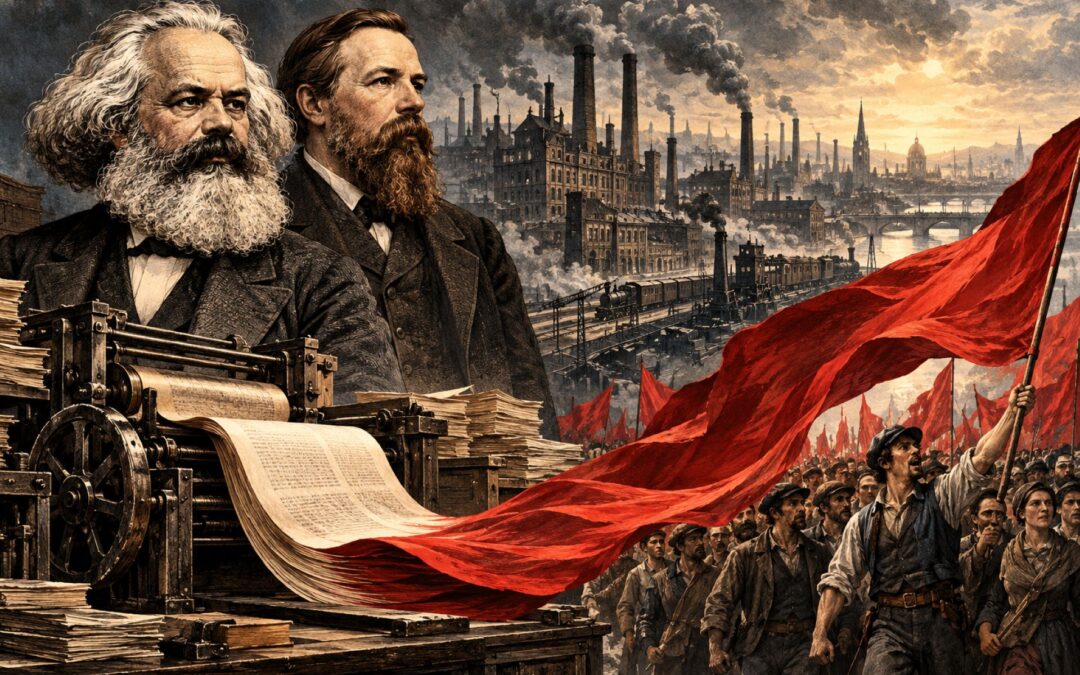
The Communist Manifesto, written by Karl Marx and Friedrich Engels and first published in February 1848, is one of the most influential political texts in modern history. In a relatively short pamphlet, its authors offer an interpretation of historical change, explain the emergence of industrial capitalism, identify the conflict between workers and property owners as the defining struggle of modern society, and argue that capitalism will eventually be replaced by communism.
The book is unusual in its treatment of capitalism. Marx and Engels admire the extraordinary productive powers unleashed by industrial development, even as they condemn the social relationships through which those powers are controlled. They believe the bourgeoisie has transformed the world more dramatically than any previous ruling class, but that the same economic system creates crises, insecurity, and a working class capable of overthrowing it.
Their argument culminates in a programme of revolutionary political change, including the abolition of bourgeois private property and the eventual creation of a classless society. Yet the book’s historical importance does not mean that all its predictions have been fulfilled or that its political prescriptions follow inevitably from its economic analysis. Understanding The Communist Manifesto requires examining both the remarkable insight of its account of capitalism and the considerable uncertainties surrounding its proposed alternative.

Why Marx and Engels Issued the Manifesto
Marx and Engels wrote The Communist Manifesto for the Communist League, an international revolutionary organisation whose members wanted a clear statement of their political principles. The League commissioned the authors at its November 1847 congress in London, and the pamphlet appeared shortly before the European revolutions of 1848. The 1888 English edition of the manifesto, translated by Samuel Moore and revised with Engels, provides the text discussed here.
The manifesto begins by declaring that communism has become a recognised political force in Europe. Marx and Engels describe established authorities and opposing political movements as united in their fear of it. They argue that because communists are already being accused of threatening the existing social order, they should explain their actual objectives in public.
This opening establishes the pamphlet’s purpose. Marx and Engels are addressing workers who might join the revolutionary movement, opponents who misunderstand or misrepresent it, and rival political groups whose objectives differ from their own. They intend to demonstrate that communism arises from historical developments already underway, rather than from an abstract desire to redesign society.
The central conflict, they argue, concerns the ownership and control of economic production. To explain why they believe revolution is necessary, they begin with a history of class relationships and the emergence of modern capitalism.
How the Bourgeoisie Transformed Society
Marx and Engels begin their historical account with the assertion that class struggle has characterised the history of societies divided into opposing social groups. Ancient societies had freemen and slaves, patricians and plebeians; medieval Europe had feudal lords, serfs, guild masters, and apprentices. Although the structure of each society differed, the authors see recurring conflicts between groups possessing economic and political power and those subordinated to them.
These conflicts sometimes produced revolutionary changes in society and sometimes ended in the destruction of the contending groups. For Marx and Engels, historical institutions are therefore neither natural nor permanent. Property arrangements, political authority, and social hierarchies emerge under particular material conditions and can disappear when those conditions change.
Modern capitalism, they argue, developed from the breakdown of feudal society. The growth of medieval towns created increasingly influential merchants and artisans. Expanding trade, European maritime exploration, colonial markets, and commercial connections with distant regions stimulated demand beyond the capacity of older systems of production.
The traditional guild organisation could no longer satisfy growing markets. Manufacturing developed through a greater division of labour, allowing production on a larger scale. Eventually, machinery, steam power, and the factory system transformed manufacturing into modern industry.
These economic changes produced a new dominant class: the bourgeoisie. In the manifesto, this term refers chiefly to the owners of capital and the means of production, rather than simply to everyone with a comfortable income or middle-class occupation.
As commercial and industrial power expanded, the bourgeoisie acquired increasing political influence. Marx and Engels associate its rise with the decline of hereditary privilege, the consolidation of modern states, and the emergence of political institutions suited to capitalist property relations. They famously characterise the executive power of the modern state as serving the common affairs of the bourgeoisie, presenting political authority as closely connected to the economic interests of the dominant class.
Yet their description of the bourgeoisie is far from uniformly hostile. They credit it with achievements that previous civilisations could scarcely have imagined. Modern industry has developed powerful machinery, transformed transport and communications, expanded scientific and technological applications, and increased the productive capacity of human societies.
Unlike earlier ruling classes, the bourgeoisie cannot maintain its position without continually changing the methods of production. Competition pushes businesses to introduce new technologies, reorganise labour, reduce costs, and seek additional markets. These changes unsettle established occupations, traditional relationships, and inherited ways of thinking.
This instability extends beyond the factory. Older bonds of personal dependence give way to commercial relationships mediated by money and exchange. Occupations once associated with inherited status or special privileges increasingly become forms of paid employment. Marx and Engels argue that the pursuit of profit transforms the relationships through which people work, live, and understand their social position.
Capitalism also creates a world market. Industrial producers obtain raw materials from distant places and sell finished goods across national boundaries. Local industries face competition from international production, while goods, ideas, and cultural forms circulate more widely.
The authors see this international expansion as economically transformative. The bourgeoisie makes societies increasingly dependent upon one another, concentrates populations in cities, and brings previously separated regions into a common commercial system. Industrial development draws rural populations into urban economic life, while the concentration of capital and production helps bring political and administrative structures under greater central control.
Their description of this expansion also reflects nineteenth-century European assumptions. Marx and Engels sometimes portray non-European societies as backward or subordinate to European industrial development. Those judgments are part of the manifesto’s historical perspective, and its account of global capitalism cannot be separated entirely from the imperial conditions in which that expansion occurred.
The result is a striking historical argument: capitalism has transformed the world by creating immense productive capacities, weakening inherited hierarchies, and connecting distant societies. Its achievements, however, generate new forms of dependence and conflict. The bourgeoisie has revolutionised production, but Marx and Engels believe it cannot permanently control the consequences.
How Capitalism Creates Crises and a Revolutionary Working Class
After describing capitalism’s achievements, Marx and Engels turn to its internal contradictions. Their central claim is that the economic system continually develops productive capacities that become increasingly difficult to manage within capitalist property relations.
They compare the bourgeoisie to a force that has summoned powers it can no longer control. Factories, machinery, commercial networks, and industrial organisation make it possible to produce goods on an unprecedented scale. Yet production is organised around private ownership, competition, and profitable exchange rather than directly around the satisfaction of human needs.
This creates what the authors call crises of overproduction. Industries can produce more commodities than can be sold profitably under existing market conditions. Factories may close, commercial relationships collapse, and workers become unemployed even though society possesses the capacity to produce an abundance of useful goods.
The apparent contradiction is important. Economic hardship arises from the organisation of production and exchange, rather than necessarily from an absolute shortage of productive resources. A society capable of producing more can experience a crisis precisely because its markets cannot absorb that output on profitable terms.
Marx and Engels argue that the bourgeoisie responds by destroying or idling productive forces, finding new markets, and exploiting existing markets more intensively. These responses may temporarily restore economic activity, but they extend the same system and create conditions for further instability.
The authors then identify the class most directly affected by capitalist production: the proletariat.
The proletariat consists of workers who lack sufficient productive property to support themselves independently and must therefore sell their capacity to work in exchange for wages. Workers may possess personal belongings, skills, and other resources, but they do not control the factories, machinery, land, or capital necessary to organise large-scale production on their own terms.
As industry expands, the proletariat grows. Workers become dependent upon businesses whose owners control employment, production, and investment. Their livelihoods fluctuate with demand, competition, technological change, and the commercial fortunes of their employers.
Machinery and the division of labour intensify this dependence. In the manifesto’s account, industrial work increasingly reduces employees to repetitive tasks. Workers lose control over the products they make and the methods they use, while employers impose strict factory discipline.
Marx and Engels describe the worker as subordinated to machinery, factory supervision, and the capitalist who owns the enterprise. They argue that competition encourages employers to minimise labour costs and that machinery can reduce the bargaining power of workers whose skills become easier to replace.
The authors also describe the growing employment of women and children in industrial production. They portray this development through the economic logic of cheaper labour and the disruption of older family arrangements. Their language reflects the assumptions of their period, but the essential observation is that industrial capitalism reorganises employment and family life together.
The effects reach beyond industrial workers already employed in factories. Small manufacturers, shopkeepers, artisans, and sections of the peasantry can lose their independent economic positions when they cannot compete with larger businesses or modern methods of production. Marx and Engels expect many such groups eventually to enter the proletariat.
Not every disadvantaged group, however, occupies the same political position in their theory. They distinguish the proletariat from small property owners who may seek to preserve older economic arrangements. They also discuss the lumpenproletariat, a loosely defined marginalised population that they regard as susceptible to manipulation by reactionary movements.
Their emphasis is on the proletariat because it is created and concentrated by modern industry itself.
Initially, workers resist capitalism in fragmented ways. Individual labourers struggle against particular employers, and groups of workers sometimes attack machinery or goods associated with the destruction of traditional employment. At this stage, their resistance may be directed at the immediate instruments of industrial change rather than at capitalist property relations.
As factories concentrate larger numbers of employees, however, workers develop common interests and opportunities for organisation. They establish associations, defend wages, organise strikes, and begin to coordinate their demands.
Improved transport and communication allow struggles that were once isolated to become connected. Workers in different towns discover similarities in their conditions and begin to act as members of a wider class.
Marx and Engels also recognise that political conflicts among sections of the ruling class can create opportunities for working-class organisation. As the bourgeoisie struggles against aristocratic forces, competing industrial interests, and foreign powers, it draws workers into political activity and supplies them with knowledge and organisational experience.
The manifesto points to the English Ten Hours Act as an example of political progress achieved through organised labour. Legislation limiting working hours demonstrates that collective action can move beyond immediate disputes within individual workplaces and influence the law.
For the authors, these developments gradually transform the proletariat from a social category into a political force conscious of its shared interests.
The bourgeoisie possesses economic power because it owns productive resources. The proletariat, by contrast, derives its possible strength from its numbers, its position within modern production, and its capacity for collective organisation.
Marx and Engels argue that the working class occupies a historically distinctive position because its emancipation requires ending the class relationship on which capitalist society depends. Earlier revolutionary classes often replaced one form of property domination with another. The proletariat, they claim, can achieve lasting freedom only by abolishing the system that divides society into owners and propertyless wage workers.
This produces the manifesto’s decisive prediction. Capitalism creates the industrial working class, concentrates it, develops its ability to organise, and repeatedly exposes it to economic crises. The authors conclude that the bourgeoisie is therefore producing the social force that will overthrow it.
Their confidence rests on a series of connected claims: capitalist competition will increase working-class insecurity; industry will expand and unite the proletariat; recurring crises will undermine the legitimacy and stability of bourgeois rule; and workers will ultimately develop the political strength needed for revolution.
The section ends by presenting the bourgeoisie’s downfall and the proletariat’s victory as historically inevitable. That conclusion is central to the manifesto, although the arguments preceding it do not establish inevitability with the same certainty that they establish capitalism’s capacity to create conflict.
What Communists Want and Why They Oppose Bourgeois Property
The second section addresses the political objectives of communists and their relationship to the wider working-class movement.
Marx and Engels begin by rejecting the idea that communists represent a separate set of interests opposed to workers generally. Communists participate in the same struggles as other proletarian movements, but the authors claim that they recognise the shared interests of workers across national boundaries and understand the historical direction of the struggle more clearly.
Their immediate political objectives are to organise the proletariat into a class, overthrow bourgeois political supremacy, and secure political power for workers.
The central economic objective is the abolition of bourgeois private property. This statement requires careful explanation because the authors do not define all forms of ownership as identical.
They distinguish property used for personal consumption from the ownership of productive resources that permits one class to control the labour of another. Their principal target is capital: accumulated wealth that functions as the basis of capitalist production and class power.
In the manifesto’s argument, capital is not simply a collection of machines, buildings, money, or other valuable things. It operates within a social relationship. Factories and other productive assets are used by workers whose collective labour generates goods, while the owners exercise authority over production and control the resulting economic returns.
Marx and Engels therefore describe capital as a social power. Its existence depends on the organised activity of many people, even when its legal ownership belongs to private individuals.
This distinction underlies their criticism of bourgeois property. The authors argue that a system of collective production controlled through private capital allows the owners of productive resources to appropriate the results of other people’s work.
They challenge the familiar defence that private property is simply the result of individual effort and saving. In their view, modern capitalist property is sustained through the wage relationship, in which most people must work for those who possess capital.
The authors also reject the accusation that communism would abolish every person’s ability to obtain and use goods. They do not object to the consumption of food, clothing, housing, and other necessities as such. Their concern is with the transformation of property into capital that confers power over the labour of others.
The distinction does not make their programme a modest proposal for redistribution. They seek to abolish the class character of capitalist ownership, not merely tax some wealthy individuals while preserving the existing structure of productive property.
Their treatment of wage labour follows the same reasoning. Workers receive wages for their labour, but the authors argue that these wages ordinarily provide the means necessary to reproduce their existence as workers. Meanwhile, the capitalist system allows accumulated capital to expand and continue commanding labour.
The authors treat the wage relationship as structurally unequal even when an employer and employee formally enter into a contract. One party controls productive property; the other depends on access to that property for a livelihood.
They also challenge the argument that removing capitalist ownership would destroy the incentive to work. If the existence of a propertyless majority has not prevented society from producing goods, they ask, why should removing the privileged position of a property-owning minority bring productive activity to an end?
This response is polemical rather than a complete account of economic incentives in a communist society. It identifies a contradiction the authors see in the defence of private property, but it does not specify how productive decisions and individual rewards would be organised after capitalism.
The wider political purpose remains clear. Marx and Engels want to replace a system in which social production is directed through private class ownership with one in which productive resources are controlled collectively.
The Disputes Over Freedom, Family, Women, and Nations
Marx and Engels anticipate that their proposal to abolish bourgeois property will be attacked as a threat to liberty and individuality. They respond by questioning what those concepts mean under capitalism.
Their argument is that bourgeois freedom is closely connected to commercial exchange and the rights of property owners. A person may be legally free to sell labour, but that freedom exists alongside economic dependence when the person lacks access to productive property.
The authors therefore distinguish formal market freedom from the social conditions necessary for meaningful independence. They contend that communist ownership would abolish the ability to use capital as a means of dominating other people’s labour.
They make a similar argument about individuality. Bourgeois society praises individual independence, they suggest, while organising economic life so that the freedom enjoyed by property owners depends upon the subordinate position of wage workers.
Another objection concerns culture and intellectual life. Critics accuse communists of threatening the education, traditions, and cultural achievements associated with bourgeois society. Marx and Engels respond that access to such achievements is already shaped by class privilege, while the intellectual standards defended as universal frequently reflect the circumstances of a particular ruling class.
Their discussion of education makes this argument more concrete. They challenge the assumption that schooling is independent of social and political institutions. Education already prepares people for roles within an existing society, and the authors believe a communist transformation would change the class purposes served by educational arrangements.
The controversy then turns to the family.
Marx and Engels argue that the bourgeois family is closely connected to capital, inheritance, and private property. They claim that the ideal of a stable, prosperous bourgeois household rests upon economic arrangements unavailable to much of the working class.
Industrial employment also changes family relationships. The participation of women and children in factory labour subjects them to the pressures of capitalist production and can weaken traditional forms of household authority.
When critics accuse communists of intending to abolish the family, the authors respond that capitalism itself has already disrupted family life for many workers. Their proposed transformation concerns the economic foundations and class character of domestic relationships.
The argument becomes more provocative when they address the accusation that communists advocate the communal possession of women.
Marx and Engels reject the accusation by arguing that bourgeois society already treats women as instruments of production or as objects subordinated to male property interests. They criticise prostitution and sexual hypocrisy, suggesting that the existing system is hardly entitled to claim moral superiority.
Their response exposes how marriage and sexuality can be shaped by economic power, but it is not a comprehensive account of gender equality. The discussion is framed mainly through criticism of bourgeois property and male hypocrisy rather than an independent analysis of women’s autonomy or unpaid domestic labour.
National identity provides another source of opposition.
Critics accuse communists of wanting to abolish countries and nationalities. Marx and Engels respond that workers, lacking control over national property and political power, do not possess a country in the same sense as its ruling class.
At the same time, the authors recognise that workers must first struggle politically within existing national societies. The proletariat must acquire political power in its own country before class domination can be transformed internationally.
Their internationalism therefore does not mean ignoring every national political conflict. Rather, they expect the spread of capitalist production and working-class solidarity to weaken antagonisms between nations.
Finally, Marx and Engels address accusations concerning religion, morality, philosophy, and law. Their response is that dominant ideas cannot be understood independently of the societies producing them.
Religious and moral beliefs, legal principles, and philosophical systems change as material and social relationships change. The authors challenge the assumption that the ideas governing bourgeois society express timeless truths untouched by economic history.
They do not provide a systematic treatment of every religious or ethical question. Their immediate purpose is to undermine the claim that communist proposals must be wrong simply because they conflict with established ideas about property, family, freedom, or justice.
The Ten Measures and the Vision of a Classless Society
Having defended their objectives, Marx and Engels turn to the political transition they believe necessary to achieve them.
They argue that the first stage of a workers’ revolution involves establishing the proletariat as the politically dominant class. Working-class political power would then be used to transform the ownership and organisation of production.
The authors anticipate that this process will involve interventions into existing property rights and bourgeois economic relationships. They acknowledge that the specific measures would differ according to the circumstances of individual countries.
Nevertheless, they identify ten measures that they consider broadly applicable to the most developed societies of their period.
Abolition of private property in land and public use of land rents. The first measure proposes transferring the economic benefits associated with landownership away from private landlords and towards public purposes. This would challenge one of the traditional foundations of inherited wealth and economic power.
A heavy progressive or graduated income tax. The second measure calls for taxation that rises with income. Such a system would place a greater relative burden on those receiving higher incomes, contributing to the redistribution of resources and the financing of collective activity.
Abolition of inheritance rights. The third measure attacks the intergenerational transmission of property. Marx and Engels regard inherited wealth as an important mechanism through which class differences reproduce themselves, allowing ownership and privilege to pass between generations independently of productive contribution.
Confiscation of the property of emigrants and rebels. The fourth measure proposes confiscation directed at those described as emigrants and rebels. Its coercive implications are significant: the proposal gives revolutionary political authority substantial power over property on the basis of political status or opposition. The manifesto does not provide detailed safeguards against the abuse of such authority.
Centralisation of credit through a national bank. The fifth measure proposes concentrating credit in the hands of the state through a national bank possessing state capital and an exclusive monopoly. Control over credit would give public authority considerable influence over investment, financing, and the allocation of economic resources.
Centralisation of transport and communications. The sixth measure extends public control to the networks through which people, goods, and information move. These systems are essential to industrial coordination and commercial activity, so their centralisation would alter the distribution of economic power.
Expansion of publicly owned productive resources. The seventh measure calls for extending factories and other instruments of production owned by the state. It also proposes cultivating unused land and improving land generally according to a common plan, linking agricultural development with coordinated economic management.
Equal obligation to work and the establishment of industrial armies. The eighth measure proposes a general responsibility to participate in productive labour, including organised industrial armies, especially for agriculture. It expresses opposition to a class structure in which some people live primarily through ownership while others must work. Yet the language of industrial armies also raises serious questions about coercion, freedom of occupation, and the power of public authorities over workers.
Combination of agriculture and manufacturing. The ninth measure calls for integrating agricultural and industrial activity and gradually diminishing the distinction between town and country through a more balanced distribution of population. Marx and Engels associate the existing separation with unequal development and the concentration of productive and social opportunities.
Free public education and the abolition of existing forms of children’s factory labour. The final measure proposes free education for all children in public schools, ending children’s factory labour in its prevailing form and combining education with industrial production. The intention is to transform education and labour together, replacing the exploitation of children with an arrangement that integrates learning and productive knowledge.
Taken together, these measures would substantially alter property rights, credit, industry, labour, education, and the economic role of the state. They are not simply a list of welfare reforms. Some aim to redistribute resources, while others propose centralising economic authority and directly reorganising productive activity.
Their differences also matter when assessing the programme. Progressive taxation and public education are compatible with several political and economic systems, including systems that preserve private enterprise. The abolition of inheritance, state credit monopoly, confiscation, and compulsory labour arrangements involve much more fundamental interventions.
Marx and Engels conceive these policies as transitional steps rather than a permanent institutional description of communist society. They expect the proletariat to use political supremacy to transform economic ownership and expand productive capacities under collective control.
Their ultimate objective is the abolition of class distinctions.
In the authors’ account, the state exercises political power partly because society is divided into classes with opposing economic interests. Political authority serves as an organised instrument through which one class maintains its dominance over another.
If class distinctions disappear, they argue, political power would lose this specifically oppressive class character. Society would no longer be organised around one class controlling productive resources and another being compelled to work under that control.
The authors conclude with a vision of an association in which the free development of each person becomes a condition of the free development of everyone.
This is an important difference between the final objective and the transitional programme. The proposed revolution initially concentrates substantial economic power under political authority, but the desired outcome is a society no longer governed by class domination.
The manifesto does not explain in institutional detail how one stage reliably produces the other. It leaves unresolved how collective ownership would be administered, how disagreements would be settled, how economic decisions would be made, and what would prevent transitional authorities from acquiring interests of their own.
Those questions become central to any assessment of the political programme, even though the authors present the movement from proletarian rule to a classless association as a historical development rather than a constitutional design problem.
Marx and Engels Against Other Kinds of Socialism
The third section distinguishes the communism advocated by Marx and Engels from several other movements that criticise capitalism. Its purpose is political and intellectual: opposition to bourgeois society does not necessarily imply agreement about what should replace it or which social forces should bring about change.
The authors divide rival socialist literature according to the historical interests, social positions, and political strategies they believe it represents. Their judgments are often severe, but they also acknowledge that some competing schools accurately identify important problems in capitalist society.
Feudal, Petty-Bourgeois, and German “True” Socialism
The first category is reactionary socialism, which includes several movements that criticise capitalism from positions associated with older social arrangements.
Feudal socialism emerges from aristocratic groups whose privileges have been weakened by the rise of the bourgeoisie. Marx and Engels argue that these aristocrats attack capitalist exploitation and express sympathy for workers partly because capitalism has displaced their own former power.
The authors regard this sympathy as contradictory. Feudal elites may condemn the suffering produced by modern industry, but their preferred alternative often resembles the restoration of hierarchical arrangements that also subjected working people to domination.
Clerical or Christian socialism receives related criticism. Marx and Engels portray religiously framed attacks on capitalism as capable of expressing moral concern while preserving or legitimising inherited forms of authority. Their objection is not that religious language can never describe suffering, but that its political use may conceal a defence of older hierarchies.
Petty-bourgeois socialism occupies a different position. It represents the concerns of small manufacturers, artisans, shopkeepers, and peasants threatened by industrial concentration and competition.
Marx and Engels identify the economist Jean Charles Léonard de Sismondi as an important representative of this tradition. They acknowledge that such critics have exposed genuine problems: the concentration of capital, machinery’s destructive effects on established livelihoods, crises of production, and the insecurity created by industrial development.
Their disagreement concerns the proposed solution. Petty-bourgeois socialism, in their view, often seeks to restore smaller forms of property ownership or protect older arrangements against large-scale industry. Marx and Engels regard this as historically backward-looking because they believe modern productive forces cannot simply be returned to an earlier social organisation.
German or “True” Socialism receives criticism for a different reason. French socialist writings entered Germany while German political and economic conditions differed from those of France.
Marx and Engels argue that German intellectuals transformed concrete French criticisms of bourgeois society into abstract philosophical language. Political struggles over property and class became general reflections about human nature, alienation, and moral ideals.
Detached from their original circumstances, these ideas could then be used against the German bourgeoisie’s struggle with absolutism and feudal authority. The authors accuse German “True” Socialism of providing intellectual cover for conservative forces by discouraging political changes that had not yet occurred in Germany.
The common element in these three criticisms is the relationship between socialist ideas and the social interests they represent. Marx and Engels argue that a movement’s opposition to capitalism must be judged by the historical direction of the change it advocates.
Conservative or Bourgeois Socialism
Conservative or bourgeois socialism arises among people who recognise capitalism’s social problems but wish to preserve the basic structure of bourgeois society.
Marx and Engels include reformers, philanthropists, economists, and other advocates of social improvement in this category. They identify Pierre-Joseph Proudhon’s Philosophy of Poverty as an example of the literature they oppose.
The defining objective, as they describe it, is to remove the suffering and disorder associated with capitalism without abolishing capitalist class relationships. Such reformers may support measures intended to improve working conditions, reduce poverty, promote charity, or make economic institutions operate more smoothly.
Marx and Engels argue that these efforts leave the underlying relationship between capital and wage labour intact. Reform can make bourgeois society more stable and acceptable without changing who controls production.
Their criticism is therefore directed at the limits of reform as a route to communist emancipation. They do not demonstrate that every reform is incapable of improving people’s lives; rather, they contend that improvements achieved within capitalism do not by themselves abolish capitalist class power.
Critical-Utopian Socialism and Communism
The final category includes the early socialist thinkers Henri de Saint-Simon, Charles Fourier, and Robert Owen.
Marx and Engels treat these figures more sympathetically than many other rivals. They recognise that the early utopian socialists criticised class division, economic inequality, the organisation of labour, and the social damage caused by existing property relationships.
These thinkers also imagined alternative forms of social organisation. Their proposals included redesigned communities, cooperative arrangements, different relationships between work and social life, and systems intended to replace competition with more harmonious forms of production.
The manifesto acknowledges the significance of these ideas in the historical period when they emerged. Industrial capitalism had not yet produced a sufficiently developed proletarian movement capable of independent revolutionary action. As a result, early socialist reformers often tried to discover ideal social arrangements through reason, experiment, and persuasion.
Their programmes could depend on wealthy patrons, enlightened rulers, philanthropic support, or the establishment of experimental communities that would demonstrate the superiority of the proposed system.
Marx and Engels argue that these methods become inadequate as industrial capitalism develops and workers acquire greater organisational strength.
In their view, communism should arise from the actual conflicts and material conditions of capitalist society, rather than from the implementation of an ideal model devised by reformers. They object particularly to later followers of utopian socialism who continue to reject political struggle and independent proletarian action even after organised working-class movements have emerged.
The distinction is crucial to the authors’ self-understanding. They claim that their communism does not depend primarily on persuading society to adopt a morally attractive design. It rests on the proposition that capitalism creates both the need for transformation and the class capable of carrying it out.
Nevertheless, their dismissal of alternative strategies also reveals the manifesto’s confidence that historical development has a particular revolutionary destination. The possibility that cooperative, democratic, or reformist movements might produce durable improvements without the predicted revolution receives little serious consideration.
Revolutionary Alliances and the Manifesto’s Final Call
The fourth and final section explains how communists should relate to existing political opposition movements. Its main concern is the practical relationship between immediate political struggles and the long-term objective of abolishing bourgeois property.
Marx and Engels argue that communists should support movements advancing workers’ interests while preserving an independent understanding of the wider class struggle. Political cooperation is therefore legitimate even when communists disagree with their allies about the ultimate organisation of society.
In France, they support cooperation with the Socialist-Democratic movement against conservative and radical sections of the bourgeoisie, while maintaining a critical attitude towards illusions associated with the revolutionary traditions of the French past. The authors recognise the tactical importance of broader opposition movements without identifying those movements completely with communism.
In Switzerland, communists are instructed to support the Radicals while remaining aware that the party contains conflicting interests, including socialist and bourgeois elements. Again, cooperation does not remove the differences between the groups involved.
In Poland, the authors support the party that links national emancipation to an agrarian revolution. They refer to the movement associated with the Kraków uprising of 1846, emphasising that the struggle for national liberation must be connected to changes in landownership and class relations.
Germany receives particular attention because Marx and Engels expect an approaching bourgeois revolution against absolute monarchy and feudal power. Communists should fight alongside the bourgeoisie when it acts revolutionarily against those older institutions.
However, workers must simultaneously develop an understanding of their antagonism with the bourgeoisie. Marx and Engels anticipate that a successful bourgeois revolution in Germany could provide the immediate conditions for a subsequent proletarian revolution.
Their expectation reflects the political circumstances and revolutionary optimism of 1848. They believe Germany’s relatively advanced European setting, combined with its still-unresolved struggle against feudal and monarchical power, could accelerate the transition from bourgeois revolution to proletarian struggle.
The manifesto concludes by affirming communist support for revolutionary movements against the existing social and political order. Throughout these alliances, the authors insist that the property question must remain central.
The ending openly embraces the revolutionary overthrow of existing social relations and appeals to workers across national boundaries to unite.
This conclusion brings the pamphlet’s historical and political arguments together. If capitalism has created an international economic system and a working class with shared interests, the authors believe that working-class political action must eventually become international as well.
The final appeal is therefore more than an expression of solidarity. It follows from their account of capitalist development, their theory of class conflict, and their conviction that workers can achieve emancipation only through collective political struggle.
Class Struggle and the Materialist View of History
The manifesto’s historical argument depends on an understanding of social change commonly associated with historical materialism.
Its central proposition is that the material organisation of society helps explain its political institutions, dominant ideas, and historical transformations. The way people produce and distribute the necessities of life shapes the relationships through which they exercise power.
A feudal society based on landed estates, agricultural production, and hereditary obligations develops different class relationships from an industrial society organised around factories, wage labour, and capital. These differences also influence political authority, legal arrangements, and the values through which social institutions are justified.
For Marx and Engels, class struggle arises because groups occupy conflicting positions within these productive arrangements. Landowners and peasants, masters and slaves, or capitalists and wage workers do not simply disagree about ideas. Their conflicts are connected to their different relationships with property, labour, and the distribution of economic benefits.
The authors therefore treat history as a process in which economic development can undermine established social structures. New productive methods emerge within older institutions, but eventually those institutions may become obstacles to further development.
The rise of capitalism supplies their principal example. Commercial expansion and industrial production transform economic life, weakening the property relationships and political authorities associated with feudalism. The bourgeoisie becomes the class capable of reorganising society around the new productive forces.
Marx and Engels expect a similar conflict within capitalism. Modern production becomes increasingly collective, involving large numbers of workers and interconnected enterprises, while ownership remains concentrated in a distinct class.
Their historical explanation has considerable power because it connects political change with material circumstances that conventional accounts focused on kings, constitutions, or individual leaders might overlook.
It also raises difficult questions about causation.
Economic development plainly influences social and political institutions, but those institutions can also shape economic activity. Laws, religious traditions, political movements, wars, cultural identities, and state policies may have causal importance that cannot always be reduced to class relationships.
The Stanford Encyclopedia of Philosophy’s discussion of Marx’s theory of history explains both the explanatory appeal of historical materialism and the problems involved in establishing its stronger claims.
One difficulty concerns the suggestion that forms of society persist because they develop productive power and disappear when they obstruct it. History contains periods of stagnation, institutional survival, and unexpected political change that complicate such a general rule.
Another difficulty concerns the difference between explaining past transformations and predicting future ones. Showing that economic relationships contributed to the breakdown of feudal institutions does not establish that capitalism must be replaced in a particular way.
The manifesto’s historical theory remains valuable as a method of examining the connection between economic power and social institutions. It becomes more controversial when treated as a law capable of determining the inevitable destination of history.
Capital, Wage Labour, and the Problem of Exploitation
The relationship between capital and wage labour is the economic foundation of the manifesto’s political argument.
Capitalists own productive resources and employ workers who receive wages. Workers participate in the creation of goods and services, while owners control the enterprises through which production occurs.
Marx and Engels regard this relationship as structurally unequal because ownership gives one class power over the conditions under which another class works.
The economic exchange may be legally voluntary, but the worker’s need to earn a livelihood limits the practical alternatives available. A person without independent productive resources must ordinarily find an employer or some other way to obtain access to income-generating activity.
Capital therefore has a social dimension beyond the physical assets possessed by the owner. Its power depends on the organisation of labour, markets, property rights, and institutions that permit privately owned resources to direct collective productive activity.
The manifesto connects this arrangement to exploitation. In its account, the capitalist class benefits from a system in which workers create economic value but do not collectively control the productive property or the resulting accumulation of capital.
Marx would later develop a much more elaborate analysis of value, labour, and surplus value, particularly in Capital. That later theory should not be read back into the manifesto as though all its technical arguments were already present.
The pamphlet is primarily concerned with the political meaning of the wage relationship. It emphasises dependence, class power, the accumulation of capital, and the increasing organisation of production around private profit.
This approach is particularly effective when explaining why ownership matters even in societies where workers have formal legal rights. Legal equality does not necessarily eliminate inequalities of bargaining power, economic security, or control over workplaces.
However, the manifesto tends to treat the economic interests of employers and workers as fundamentally antagonistic. That emphasis can understate circumstances in which productivity improvements, competition for labour, collective bargaining, and public policy increase workers’ incomes or improve their conditions without abolishing private ownership.
Such developments do not prove that exploitation or unequal power has disappeared. They indicate that the consequences of wage labour are more variable than the manifesto’s strongest generalisations suggest.
The lasting significance of its account lies in the distinction between performing productive work and controlling the resources through which that work is organised. Whether or not one accepts its revolutionary conclusion, that distinction remains important for understanding economic inequality and institutional power.
The Paradox of Capitalist Progress and Breakdown
One of the manifesto’s most distinctive features is its treatment of capitalism as a system that advances productive development while simultaneously producing conditions of instability.
Marx and Engels do not imagine the bourgeoisie as a class committed to preserving an unchanging social order. Instead, capitalist competition compels businesses to transform production continuously.
New machinery makes earlier methods less efficient. Expanding enterprises compete with smaller producers, while markets widen as manufacturers seek customers and resources across the world. Technological development increases productive capacity but can make established skills, businesses, and livelihoods obsolete.
The authors see these changes as evidence of capitalism’s extraordinary dynamism. Economic growth does not leave society untouched; it transforms occupations, family arrangements, urban life, international relationships, and political institutions.
Yet capitalist production remains governed by the pursuit of profit. Businesses invest and produce according to their expectations of profitable sales, while workers’ ability to purchase goods depends largely on income earned through employment.
This separation between productive capacity and profitable demand helps explain the crises that concern Marx and Engels. Factories may be technologically capable of producing more goods than can be sold at prices that sustain production under existing conditions.
The authors interpret such crises as evidence of a conflict between the productive powers developed by society and the property arrangements through which they are controlled.
Their insight is strongest when describing capitalism’s tendency towards recurring disruption. Industries expand and contract, technologies displace older occupations, investment shifts between regions, and economic shocks can spread through interconnected markets.
The argument becomes less secure when it moves from recurring instability to inevitable systemic collapse.
In George R. Boyer’s historical analysis of the manifesto, the authors’ account of capitalism is placed alongside the industrial conditions of Manchester and surrounding textile towns during the 1830s and 1840s. Their experience of rapidly changing industrial society helps explain both the force of their observations and their confidence that capitalism faced an approaching revolutionary crisis.
The conditions they studied were important, but they did not establish the future trajectory of every capitalist society. Economic crises can lead to institutional reforms, changes in business organisation, monetary and fiscal intervention, technological restructuring, or political compromises rather than revolutionary collapse.
Capitalism’s capacity to adapt does not make its instability imaginary. It does, however, undermine the manifesto’s assumption that the economic contradictions it identifies must culminate in one predetermined outcome.
The distinction is essential to evaluating the book. Marx and Engels provide a powerful account of the social consequences of economic transformation. Their claim that those consequences make proletarian victory inevitable is a further argument requiring evidence that the pamphlet does not adequately supply.
Property, Freedom, Gender, and National Belonging
Marx and Engels repeatedly challenge the assumption that established social institutions express universal human interests. They argue that property rights, individual freedom, family arrangements, and national identity are shaped by historical relations of production.
Their discussion of property provides the clearest example. Bourgeois society presents private ownership as an expression of personal independence and individual effort, while the authors argue that capitalist ownership allows a minority to control resources on which the livelihood of the majority depends.
Freedom therefore has more than one possible meaning. An employer may value freedom of contract and the right to control capital, while an employee may value freedom from economic insecurity, arbitrary dismissal, and dependence upon a single source of livelihood.
The manifesto suggests that the legal freedoms of bourgeois society do not necessarily provide equal opportunities for meaningful independence. Economic power can influence how freely individuals are able to exercise their formal rights.
This is a serious philosophical challenge to treating property rights as independent of their social consequences. Yet it does not completely settle the question of how property and personal freedom should be balanced.
Private ownership can create domination, but collective or state ownership can also generate unequal power if institutions do not adequately protect individuals. A full account of emancipation needs to examine freedom under the proposed alternative as carefully as it examines freedom under capitalism.
The manifesto’s discussion of the family extends its materialist approach into domestic life. Marriage, inheritance, education, and relations between parents and children are connected to economic institutions rather than treated as entirely private matters.
This is an important insight. Families are affected by employment conditions, access to property, unpaid labour, economic dependence, and the resources available to different household members.
However, Marx and Engels devote much more attention to the economic interests of the bourgeois family than to the experiences and agency of women themselves.
Their criticism of bourgeois marriage exposes patriarchal assumptions and sexual hypocrisy, but women frequently appear within an argument primarily concerned with class power. The distinct organisation of unpaid care, domestic work, childbirth, and social reproduction receives comparatively little independent analysis.
Later feminist scholarship, including Susan Himmelweit’s work on reproduction and the materialist conception of history, helps clarify why the production of commodities cannot by itself explain every form of economic dependence and social inequality.
The manifesto’s treatment of nationality contains a related tension between universal ambitions and historically situated assumptions.
Marx and Engels expect capitalist globalisation to make national economies increasingly interdependent. They also believe workers across national boundaries can recognise common interests arising from their shared position within capitalist production.
Nevertheless, the actual revolutionary strategy remains organised through national political struggles. Workers must confront the institutions and ruling classes exercising authority in their own societies.
International solidarity and national political action therefore coexist in the authors’ programme, but the relationship between them remains incompletely specified.
Their language about industrial Europe and supposedly less developed societies creates a further problem. The account of capitalist expansion often treats European industrialisation as the model of historical progress, while paying insufficient attention to the violence, extraction, and political domination associated with colonial expansion.
The manifesto recognises the worldwide consequences of capitalist development more clearly than many political writings of its period. Its assumptions about the historical position of non-European societies are nevertheless too narrow to provide a satisfactory account of colonialism or the diversity of possible paths of development.
Across these subjects, the strongest element of the authors’ approach is their insistence that institutions should be understood in relation to material conditions and distributions of power. Its weakness is the tendency to make class relations carry more explanatory weight than they can always sustain.
Revolution, Political Power, and the Problem of the State
The manifesto’s political programme raises a question that its account of capitalism does not resolve: how can a revolution intended to abolish domination avoid creating new forms of domination?
Marx and Engels argue that the proletariat must acquire political power because capitalist property relations are sustained through legal and political institutions. Economic transformation cannot simply be achieved through individual goodwill or voluntary changes in consumption.
The existing distribution of property is protected by laws, courts, administrative institutions, and the coercive powers of the state. A movement seeking to abolish bourgeois ownership must therefore confront the political order that maintains it.
The authors expect a workers’ revolution to establish proletarian political supremacy and use it to transform economic relationships. The ten measures provide examples of this transitional process.
Several proposals involve extensive state control. Credit, transport, communications, land revenues, and significant productive assets would be placed under public authority. Other measures, such as confiscation and compulsory obligations to work, give that authority coercive functions.
Marx and Engels regard these interventions as necessary steps towards eliminating the economic basis of class domination.
Their final objective is different from the transitional system. Once class distinctions disappear, political power as an instrument of one class’s oppression of another is expected to lose its existing character.
The difficulty concerns the path between these stages.
A revolutionary state controlling production, credit, property, and labour would possess enormous power over everyday life. The manifesto does not explain what constitutional limits would govern that power, how political opposition would be protected, or how workers would exercise effective control over administrators acting in their name.
Collective ownership does not automatically guarantee democratic control. Economic resources formally held by the state can be administered by political officials, bureaucracies, managers, or party organisations whose interests do not necessarily coincide with those of ordinary workers.
The text also provides little detailed explanation of how disagreement would operate in a classless society. People might continue to differ over the distribution of resources, working conditions, economic priorities, cultural practices, or political decisions even if private ownership of major productive assets were abolished.
Such disagreements would require institutions capable of making collective decisions while limiting arbitrary authority. The eventual disappearance of class antagonism would not necessarily remove every conflict requiring political mediation.
The authors’ historical theory gives them confidence that changing property relations will transform political power itself. Yet the expectation that institutions will become emancipatory because their class foundation has changed is not equivalent to showing how their authority will be controlled.
This is one of the manifesto’s most serious political limitations. Its criticism of bourgeois domination is more developed than its account of the safeguards necessary to prevent domination under revolutionary government.
At the same time, it would be inaccurate to treat the manifesto as a detailed blueprint for every institution later established by communist governments. It supplies broad objectives and transitional measures, leaving many practical arrangements unspecified.
Its political proposals deserve criticism on their own terms, particularly where they endorse coercion and centralisation. Later regimes should be examined in relation to those proposals without assuming that every feature of their institutions was directly prescribed in 1848.
Why the Manifesto Speaks as a Political Weapon
The literary form of The Communist Manifesto helps explain its extraordinary influence. Marx and Engels write with the urgency of political organisers, combining historical interpretation with direct argument, accusation, satire, and calls for action.
The opening image of communism as a spectre immediately creates an atmosphere of confrontation. Rather than beginning with definitions or statistical evidence, the authors turn the fear expressed by their opponents into proof that the movement deserves political recognition.
Their prose then expands from historical class relationships to the transformation of the modern world. The rise of the bourgeoisie is described through images of disruption, movement, innovation, and dissolution.
The language mirrors the process being described. Capitalism unsettles familiar arrangements, while the prose repeatedly moves from one sphere of life to another: manufacturing, trade, family relationships, politics, national boundaries, and intellectual culture.
This accumulation gives the reader a sense of an economic force transforming society in its entirety.
The authors also make extensive use of contrast. The bourgeoisie destroys older privileges but establishes new inequalities. Machinery increases productive capacities while reducing workers’ control over their labour. Global markets connect societies while exposing them to economic instability.
These contrasts are fundamental to the argument, not merely decorative devices. They allow Marx and Engels to portray capitalism as a system whose greatest achievements contribute to its eventual downfall.
The second section shifts into direct debate with imagined bourgeois critics. Accusations against communism are presented and answered in a style that is frequently sarcastic and confrontational.
This technique makes complex questions of property, marriage, education, and freedom accessible as political disputes. It also has limitations: the authors often present their opponents’ positions in simplified or uncharitable forms, leaving less room for objections that cannot be dismissed through rhetorical reversal.
The third section becomes a polemic against rival socialist schools. Sharp descriptions and deliberately dismissive language help distinguish the authors’ movement from competitors, but they can also obscure the intellectual diversity of the traditions under attack.
The final section returns to immediate political action and ends with an international appeal. Its movement from analysis towards mobilisation gives the pamphlet a sense of direction and purpose.
The manifesto succeeds as political writing because its structure makes its historical interpretation and revolutionary objectives appear inseparable. Readers are led from an account of capitalism’s emergence to the conviction that organised political transformation is its logical consequence.
That persuasive achievement should be distinguished from the validity of the historical prediction. Rhetorical force can make an argument compelling without resolving all the questions on which its conclusions depend.
How Later Prefaces Qualified the Original Programme
Marx and Engels did not leave the manifesto entirely uninterpreted after its publication. As political conditions changed, they added prefaces to later editions explaining its historical circumstances and reconsidering parts of its argument.
These later prefaces to the manifesto are especially valuable because they distinguish the authors’ enduring theoretical commitments from political measures they came to regard as historically limited.
The most important qualification appears in the joint preface to the German edition of 1872.
Marx and Engels maintain that the manifesto’s general principles remain broadly correct, but they acknowledge that its practical application depends on the historical conditions of particular places and periods.
They specifically identify the measures proposed at the end of Section II as requiring reconsideration. Industrial development and the growth of working-class organisation since 1848 had changed the circumstances under which revolutionary politics would operate.
The experience of the Paris Commune of 1871 also affected their understanding of the state.
Marx and Engels argue that workers cannot simply take over the existing state machinery and operate it for their own purposes. This qualification complicates any interpretation of the original programme as straightforwardly advocating the transfer of existing governmental institutions into proletarian hands without changing their structure.
They further acknowledge that the manifesto’s discussion of socialist literature had become historically incomplete and that the political alliances described in its final section were outdated.
Rather than rewriting the pamphlet, however, they preserved it as a document of its historical moment.
The Russian preface of 1882 introduces another important qualification. Marx and Engels consider whether Russia’s existing traditions of communal landownership might provide a foundation for communist development without reproducing every stage of Western European capitalist history.
Their answer is conditional. They suggest that such a possibility might arise if revolutionary change in Russia were connected with proletarian revolution in the West.
This does not amount to abandoning the importance of capitalist development, but it complicates a rigid interpretation in which every society must follow precisely the same historical sequence.
Engels’s 1883 preface credits Marx with the manifesto’s underlying historical theory. The 1888 English preface explains the Communist League’s origins, the distinction between socialism and communism as understood in the 1840s, and the pamphlet’s subsequent reception.
Engels also acknowledges that its political influence developed through later working-class movements rather than emerging fully formed at the moment of publication.
The later prefaces demonstrate that the authors themselves recognised historical change and the need to reconsider particular political judgments. They strengthen the case for reading the manifesto as an intervention within a developing body of thought, rather than as an unchanging programme whose every proposal was intended to apply universally.
Where the Manifesto Is Most Convincing
The manifesto’s greatest achievement is its account of capitalism as a dynamic system that transforms society while continually producing new conflicts.
Marx and Engels understand that capitalism cannot be adequately described as a stable arrangement of private owners, workers, and markets. Competition creates pressures for innovation, expansion, cost reduction, and organisational change, all of which reshape the societies in which businesses operate.
Their description of technological development is particularly perceptive. New productive methods do not simply increase the quantity of goods available. They alter employment, undermine established occupations, change economic relationships, and affect the distribution of political and social power.
The manifesto is similarly effective in explaining the international consequences of capitalist development. Its account of widening markets, global production, and growing economic interdependence remains recognisable in an era of multinational enterprises and globally connected industries.
Its language about the relationship between economic and political power also raises important questions. Ownership influences not only the distribution of income but also decisions about investment, employment, workplaces, and the allocation of resources.
The authors’ emphasis on organised labour provides another significant contribution. They understand that workers can possess common interests without automatically possessing the institutions needed to pursue them.
Their account of workers progressing from isolated disputes towards associations and political movements identifies the importance of organisation in transforming economic grievances into political demands.
The manifesto also recognises the social consequences of economic crises. Periods of unemployment and insecurity can occur despite substantial productive capacity, revealing that material abundance and economic stability are not the same thing.
These observations are especially valuable because Marx and Engels connect phenomena frequently treated separately. Industrial growth, property ownership, working conditions, technological change, class organisation, and political institutions become parts of a common explanation.
Their synthesis was not created entirely from original discoveries. Earlier socialist thinkers, political economists, and critics of industrial society had already examined many of these questions. What makes the manifesto distinctive is the force with which it combines them into a historical theory and a programme of political action.
As political literature, the book is exceptionally economical. Its memorable language and tightly directed argument have helped it reach audiences far beyond those likely to read extended works of philosophy or economics.
Even readers who reject its conclusions can benefit from its insistence that economic development should be examined in terms of social relationships and institutional power, rather than only aggregate production or individual exchange.
Where Its Predictions and Arguments Falter
The manifesto becomes substantially less convincing when its account of capitalism’s tendencies turns into a confident prediction of inevitable revolution and communist victory.
Marx and Engels expect capitalist development to intensify class divisions, undermine workers’ conditions, increase social polarisation, and eventually make bourgeois society incapable of maintaining its own existence.
Some elements of this argument identify real pressures. Economic concentration, insecurity, exploitation, unemployment, and crises have remained important features of capitalist societies.
But the historical development of capitalism has been considerably more varied than the manifesto’s revolutionary model anticipates.
In many industrialised societies, living standards, wages, public health, education, and working conditions improved substantially over the long term. These improvements were uneven, often contested, and frequently achieved through labour organisation and political intervention. They nevertheless undermine the proposition that capitalist development must produce a continuously worsening material condition for workers.
The expansion of labour rights, social insurance, public services, collective bargaining, and democratic participation also demonstrates the capacity of capitalist institutions to undergo major changes without abolishing private ownership of production.
Marx and Engels recognise the possibility of workers winning reforms, as their reference to the English Ten Hours Act demonstrates. Their larger argument, however, does not adequately anticipate how extensively reforms might reshape the relationship between labour and capital.
Historical experience has also complicated their expectation of increasing polarisation into two dominant classes.
Modern societies contain a range of economic positions: wage workers, small business owners, self-employed professionals, managers, public employees, and people whose incomes combine labour and ownership. These categories do not eliminate class inequality, but their interests and political behaviour cannot always be reduced to a direct confrontation between two homogeneous camps.
Even within the working class, differences of skill, occupation, income, region, nationality, religion, and political belief can prevent the emergence of the unified revolutionary consciousness the manifesto predicts.
Workers have sometimes supported socialist or communist movements, but they have also organised through trade unions, parliamentary parties, social-democratic institutions, nationalist organisations, religious movements, and other political traditions.
The resulting history is far more complicated than the expectation that industrial development will progressively unite workers behind a common revolutionary programme.
The economic prediction presents a related difficulty.
Capitalism has experienced severe crises, but crises have not inevitably produced its final collapse. Economic systems can change through institutional reform, technological adjustment, new markets, state intervention, and alterations in financial or business organisation.
This does not establish that capitalism is free from structural contradictions. It shows that identifying contradictions is insufficient to demonstrate that no durable response to them is possible.
Boyer’s historical study of the manifesto is important here because it connects the authors’ revolutionary expectations to the particular industrial circumstances of the 1840s. The social and economic pressures they observed were genuine, but the assumption that those pressures signalled capitalism’s imminent terminal crisis proved mistaken.
The book’s evidentiary method contributes to this weakness.
Marx and Engels move rapidly from broad historical observations to sweeping claims about the direction of social development. Their examples illustrate important tendencies, but they do not provide enough evidence to establish that those tendencies must operate uniformly across different societies.
Nor do they adequately demonstrate why economic crises should produce communist revolution rather than reform, authoritarian reaction, nationalist mobilisation, or some other political outcome.
Their account of ideology and class consciousness likewise leaves difficult questions unresolved. Workers may share an economic position without sharing political values or a common understanding of their interests.
The manifesto treats the proletariat as the class capable of achieving universal emancipation, but it does not fully explain why workers who acquire political power would necessarily use it to abolish every form of domination.
That uncertainty becomes particularly serious in the revolutionary programme.
The authors propose concentrated political and economic power as a means of eliminating capitalist class rule. Yet concentrating authority can also produce coercion, dependency, and opportunities for abuse.
The proposal to confiscate the property of emigrants and rebels raises obvious questions about political dissent and individual protection. The establishment of industrial armies raises concerns about freedom of occupation and compulsory labour. State monopolies over credit, transport, and communications would create substantial administrative powers whose accountability the manifesto does not explain.
These problems are not resolved simply by asserting that the state would represent the proletariat. A government claiming to act for workers might still make decisions that workers cannot meaningfully challenge.
The historical experience of twentieth-century communist states makes such questions especially important, although their particular institutions and actions cannot all be attributed directly to the manifesto.
The pamphlet does not prescribe a complete system of one-party government, a detailed constitutional structure, or every coercive practice that later emerged under governments identifying themselves as communist.
Still, the possibility of political domination within a centrally controlled economy is a legitimate criticism of the institutional direction proposed in the text.
The manifesto’s treatment of gender and colonial society also shows the limitations of its explanatory framework.
Its criticism of the bourgeois family identifies important connections between property and domestic relationships, but it leaves insufficient room for the distinctive experiences of women and the social organisation of unpaid care.
Its account of capitalist globalisation recognises international economic dependence while relying in places on a European-centred conception of historical development. Colonial domination and differences among non-European societies require more careful analysis than the manifesto provides.
Some of these limitations reflect the pamphlet’s form and immediate political purpose. Marx and Engels were writing a revolutionary programme, not an exhaustive scholarly study of every political, economic, and social institution.
That context helps explain the compression of its arguments, but it cannot make the resulting gaps irrelevant.
The decisive weakness is the distance between explaining why capitalism generates conflicts and demonstrating that those conflicts will necessarily produce the society the authors desire.
The manifesto often treats this final step as the completion of a historical process already visible in industrial development. Yet it is precisely the step that requires the strongest independent justification.
A political transformation may be desirable to its advocates without being historically inevitable, and a criticism of an existing system does not establish the institutional superiority of every proposed replacement.
The Manifesto’s Influence and Who Should Read It Today
The Communist Manifesto acquired influence far beyond the immediate circumstances of its publication. Its language and ideas became central to international communist movements, socialist organisations, political parties, labour struggles, and debates about capitalism throughout the nineteenth and twentieth centuries.
That influence did not develop in a simple or uniform way.
The revolutions of 1848 did not produce the proletarian transformation Marx and Engels anticipated. As later labour movements developed, political organisations interpreted the manifesto differently, sometimes embracing revolutionary struggle and sometimes pursuing parliamentary reform, trade-union organisation, and social legislation.
Historical scholarship, including David Ireland’s study of the manifesto in the revolutionary politics of 1848, complicates the assumption that the pamphlet immediately possessed the political importance it later acquired. Its reputation grew through subsequent struggles, changing political organisations, and the broader influence of Marxist ideas.
The manifesto also became a reference point for political movements that disagreed deeply about the meaning of socialism and the methods necessary to achieve it. Revolutionary communists, democratic socialists, labour organisers, and critics of capitalism have drawn different conclusions from the same text.
This variety of interpretation is unsurprising. The pamphlet combines a theory of historical development, a critique of capitalist property, an account of working-class political organisation, and a transitional revolutionary programme. Readers may accept some of those arguments while rejecting others.
Its influence on working-class political movements is especially complex. The history of the manifesto’s relationship with Western European working-class parties illustrates the difference between the revolutionary aspirations of the original document and the diverse political strategies subsequently adopted by labour movements.
The book remains valuable for readers interested in the history of political thought, the development of capitalism, industrialisation, economic inequality, revolutionary movements, and the relationship between property and political power.
It is also useful for understanding debates that continue to shape modern politics: whether formal freedom can coexist with deep economic dependence, how technological innovation affects workers, what ownership means in large productive organisations, and how institutions distribute the benefits of economic growth.
Readers seeking a rigorous technical account of capitalist economics will need more than this pamphlet. Marx’s later writings develop a substantially different level of economic detail, while modern economic history provides evidence unavailable to the authors in 1848.
Those seeking a complete institutional design for a communist society will also find the manifesto insufficient. Its vision of emancipation is much clearer than its explanation of how a revolutionary state would be prevented from becoming a new source of domination.
These limitations do not erase its intellectual achievement. Few political pamphlets have described capitalism’s transformative effects with comparable force, or connected industrial development, class relationships, global markets, and political struggle in such a concentrated argument.
The fairest assessment is that The Communist Manifesto remains more convincing as a diagnosis of important tensions within capitalist society than as a prediction of capitalism’s inevitable collapse or a practical demonstration of communist emancipation.
It deserves to be read neither as an infallible account of historical laws nor as a document whose importance disappeared because its central prediction failed. Its enduring value lies in the questions it forces readers to confront about the ownership of productive resources, the social consequences of economic progress, and the relationship between material power and political freedom. Those questions remain significant even when the answers proposed by Marx and Engels are subjected to the same critical scrutiny they applied to the society they sought to transform.
Last Updated on October 10, 2026 by Aseem Gupta