
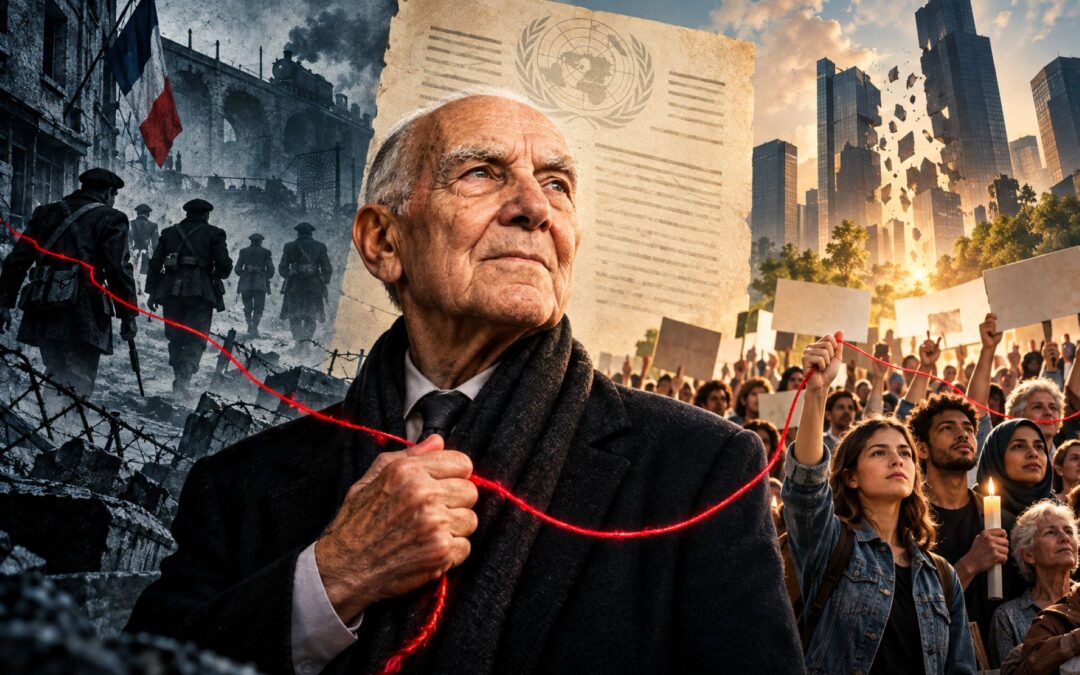
When Stéphane Hessel published Indignez-vous! in France in 2010, he was ninety-three years old. The text was scarcely long enough to qualify as a conventional political book, yet it became an international publishing phenomenon and helped supply a language of indignation to a period already unsettled by the financial crisis, austerity, widening economic anxiety, environmental fears, and political disillusionment. Hessel’s biography gave the pamphlet unusual authority: he had fought with the French Resistance, survived Nazi concentration camps, entered the postwar diplomatic world, and spent decades defending human rights.
Its reputation can nevertheless produce a misleading first impression. Time for Outrage! is sometimes reduced to a simple instruction to become angry at injustice, but Hessel’s actual argument is more disciplined than that. Outrage is only the beginning. Moral indignation should lead to engagement; engagement should be grounded in universal human rights; despair should not become terrorism or indiscriminate violence; and resistance should ultimately remain hopeful, creative, and nonviolent.
That distinction explains both the pamphlet’s enduring appeal and its weaknesses. Hessel is compelling when he writes as a witness transmitting an ethical inheritance from the Resistance generation to younger readers. He is less convincing when moral urgency substitutes for detailed economic evidence, historical qualification, or a practical theory of political change. The resulting work is neither a rigorous political philosophy nor a policy programme. It is a deliberately compressed appeal against civic resignation.

What Time for Outrage! Is Arguing
Hessel begins with the generation of the French Resistance because he believes its achievement offers more than a heroic memory. Resistance fighters eventually helped formulate an ambitious postwar social programme that treated pensions, social security, education, freedom of the press, economic regulation, and the public interest as political obligations rather than optional luxuries. For Hessel, the crucial lesson is that people living under extraordinarily difficult conditions still believed society could be reconstructed according to principles of dignity and justice.
His challenge to contemporary readers follows directly from that memory. Modern societies are wealthier than postwar France, yet governments repeatedly present social protections as unaffordable while financial institutions and concentrated wealth acquire enormous power. The specific enemies are harder to identify than a military occupation, but this complexity does not excuse political indifference. Citizens should look closely at the world around them, discover what they regard as intolerable, and refuse to accept that nothing can be changed.
Hessel calls that first reaction indignation or outrage. He does not consider indignation sufficient in itself. It should awaken a sense of personal responsibility, which he connects to Jean-Paul Sartre’s insistence that individuals remain responsible for what they choose to do within the situations they inherit.
The standard by which injustice should be recognized is supplied largely by the postwar human-rights tradition. Hessel repeatedly returns to the Universal Declaration of Human Rights and to the belief that certain claims to dignity, social security, political participation, and freedom belong to human beings as human beings rather than as favors granted by particular governments.
The most difficult part of the pamphlet concerns violence. Palestine becomes Hessel’s central example of a situation capable of producing both justified indignation and destructive desperation. He condemns terrorism but argues that sustained humiliation and hopelessness can create what he calls exasperation, a condition in which violence becomes psychologically and politically easier to understand even when it remains unacceptable.
His answer is nonviolence. Hessel invokes figures such as Nelson Mandela and Martin Luther King Jr. to argue that resistance need not mean passivity, but neither should resistance reproduce the hatred it opposes. The book therefore ends not with an appeal for permanent anger but with the idea of a “peaceful insurrection”: determined opposition to injustice joined to hope, creativity, human rights, and the possibility of a more just social order.
The Resistance as Hessel’s Political Starting Point
Hessel’s argument begins in the French Resistance because that is the political world that formed him. During World War II, France was occupied by Nazi Germany, and numerous resistance networks emerged under extraordinarily dangerous conditions. Jean Moulin became central to efforts to unify those groups, eventually helping create the National Council of the Resistance, or Conseil National de la Résistance.
For Hessel, the importance of the Resistance extends beyond clandestine warfare. In March 1944, while liberation was still incomplete, the National Council of the Resistance adopted a programme for the France that should emerge from occupation. Hessel remembers that programme as a commitment to economic and social reconstruction: social security, pensions, access to education, protection of workers, freedom of the press, and public control over parts of the economy regarded as too important to be left entirely to private interests.
The contrast with the present provides the pamphlet’s first major argument. Hessel sees governments weakening or questioning precisely the social achievements that an impoverished and devastated postwar society had considered essential. If a ruined country could construct such institutions, he asks in effect, how can much wealthier modern societies claim that decent pensions, social protections, education, or public services have become impossible?
This is already more than an argument about government spending. Hessel treats the postwar settlement as evidence of a particular political priority: the general interest should take precedence over the unrestricted power of money. He fears that this hierarchy has been reversed. Financial interests have become more powerful, economic competition has penetrated more areas of life, and the social state created after liberation is increasingly represented as an obstacle rather than an achievement.
His concern also reaches beyond economics. Hessel worries about the concentration of media ownership, the treatment of immigrants and undocumented people, and reforms that in his view weaken education and social solidarity. These subjects are not developed with the evidentiary detail of a conventional political study. Instead, they appear as signs that the moral inheritance of the Resistance is being forgotten.
That rhetorical strategy gives the pamphlet both its force and one of its first limitations. Resistance to Nazi occupation involved an unusually clear confrontation with a murderous dictatorship. Pension reform, financial deregulation, media concentration, immigration policy, and education policy exist within more complicated political arguments in which disagreement cannot automatically be equated with collaboration or moral cowardice. Hessel does not literally claim that every policy dispute is equivalent to fascist occupation, but the prestige of the Resistance supplies his entire argument with a level of moral clarity that modern democratic conflicts do not always possess.
Even so, the analogy performs an important function. Hessel is less interested in claiming that the historical situations are identical than in preserving the political attitude that made resistance possible. He wants readers to reject the assumption that existing arrangements are inevitable. The Resistance generation, in his telling, did not merely endure the world it inherited; it imagined institutions that did not yet exist and then attempted to create them.
The opening section therefore establishes the book’s deepest historical premise. Political achievements can be lost when citizens cease to defend them, and circumstances that appear fixed can change when enough people decide they are unacceptable. The memory of Resistance matters because it turns history into an argument against resignation.
From Outrage to Engagement
Hessel next asks what could play the role of resistance in a world without an occupying army providing an obvious enemy. His answer begins with economic power. Banks and financial markets seem to him increasingly influential, while inequality widens and governments tell citizens that social protections must be curtailed because they are too expensive.
The argument carried particular force when Time for Outrage! appeared. Europe was still experiencing the political consequences of the 2008 financial crisis, during which severe failures inside the financial system produced enormous economic damage while governments intervened to prevent major institutions from collapsing. In that atmosphere, Hessel’s suspicion that finance had accumulated power without corresponding democratic accountability did not sound abstract.
He nevertheless does not offer a detailed economic explanation of the crisis or a developed account of capitalism. Banks, wealth, competition, privatization, and inequality function mainly as examples of conditions that should awaken moral attention. This is characteristic of the pamphlet: Hessel is more interested in asking why people tolerate what they recognize as wrong than in providing a complete causal explanation of why those conditions exist.
That brings him to indignation. The Resistance generation had obvious reasons for outrage; younger generations must discover their own. Hessel does not prescribe a single mandatory cause. He instead argues that people should examine society closely enough to find something that violates their sense of justice and then allow that recognition to interrupt political passivity.
Indignation, however, is not the endpoint. Once someone recognizes an injustice, Hessel believes a question of responsibility follows. To see suffering or humiliation clearly and then declare oneself uninvolved is itself a choice. Political complexity may make action difficult, but complexity should not become a sophisticated excuse for indifference.
This idea connects Hessel to Jean-Paul Sartre. Sartre’s existentialism emphasized that human beings exist within circumstances they did not choose while nevertheless remaining responsible for their responses to those circumstances. Hessel takes from this tradition an ethic of engagement: one cannot simply surrender one’s agency by claiming that systems, history, institutions, or other people have already determined everything.
The pamphlet then introduces a broader philosophy of history. Hessel remembers being influenced by Hegel’s attempt to interpret history as a development toward greater freedom. Across long periods filled with violence and reversal, human societies have abolished forms of domination, expanded political rights, created international institutions, decolonized empires, and recognized categories of people previously excluded from citizenship.
Yet Hessel also invokes Walter Benjamin, whose famous image of the “angel of history” points in almost the opposite direction. Where optimistic accounts see progress, Benjamin’s angel sees catastrophe accumulating upon catastrophe while a storm drives humanity relentlessly forward. The contrast is crucial because it prevents Time for Outrage! from resting comfortably on the belief that history automatically improves.
Hessel never completely resolves the contradiction. He wants to believe in progress, but his own argument depends upon the possibility of regression. Social protections can be dismantled, racism can return, environmental destruction can accelerate, war can follow apparent peace, and institutions created after catastrophe can weaken when their moral foundations are forgotten.
His solution is practical rather than philosophical. History may contain a movement toward greater freedom, but there is no guarantee that the movement will continue without human action. Hope therefore becomes inseparable from engagement. One acts because improvement is possible, not because improvement is inevitable.
Indifference, Universal Rights, and the Duties of Citizenship
Hessel recognizes that finding an object of resistance is harder in contemporary societies. Nazi occupation concentrated coercive power in a visible enemy, whereas modern political and economic systems are dispersed across governments, corporations, markets, media institutions, bureaucracies, international organizations, and countless individual choices. That complexity can encourage people to believe that responsibility has become impossible to locate.
For Hessel, the dangerous response is indifference. Someone who says that the world is too complicated to understand can eventually conclude that nothing deserves engagement. Indignation is valuable partly because it interrupts this retreat: it signals that a person still possesses the ability to distinguish between what should and should not be tolerated.
He identifies two broad areas that especially require such attention. One is the widening distance between extreme wealth and severe deprivation. The other combines human rights with the condition of the planet, suggesting that Hessel already sees social justice and environmental sustainability as parts of the same problem of responsibility toward other human beings and future generations.
The Universal Declaration of Human Rights becomes crucial at this point because it gives indignation a standard beyond personal preference. Adopted by the United Nations General Assembly in 1948, the Declaration states that human beings possess rights that do not depend entirely on nationality, race, religion, political allegiance, or the generosity of individual governments.
Hessel writes from personal proximity to this history, but his role should be described accurately. In a later interview with El País, he explained that he was too junior to have been one of the Declaration’s principal authors. He was nevertheless present in the early United Nations environment in which the document was developed and helped with the organization of meetings connected to the work.
That distinction matters because the moral force of Hessel’s book does not depend on exaggerating his institutional importance. Figures such as Eleanor Roosevelt and René Cassin had much more direct roles in drafting and shaping the Declaration. Hessel’s significance lies instead in belonging to the generation that treated universal human rights as an urgent response to the catastrophes of fascism, genocide, war, and state persecution.
Hessel emphasizes the radical meaning of the word “universal.” Rights should not be understood merely as privileges that sovereign governments may selectively grant to favored citizens. They establish standards by which governments themselves can be criticized. A state may enact a law, but legality alone does not settle whether the treatment of human beings is just.
He refers specifically to rights involving nationality and social security because his political imagination does not separate civil liberty from social dignity. Freedom from arbitrary persecution matters, but so does the ability to live without conditions of extreme insecurity. His human-rights politics consequently overlaps with his defense of the postwar welfare state.
This framework also shapes his concern for immigrants, undocumented people, and Roma communities. Hessel worries that human beings become politically vulnerable when societies begin treating legal status, ethnicity, or national belonging as reasons to withdraw ordinary moral concern. Universalism means that the stranger’s rights cannot be dismissed simply because the stranger is unpopular.
He also points to organizations such as Amnesty International, ATTAC, and the International Federation for Human Rights as examples of modern engagement. Their importance lies partly in their networked character. Contemporary injustice may be dispersed, but citizens can also organize across borders, share information, mobilize public pressure, and create institutions outside formal party politics.
The movement of the argument is now clear. Outrage is not supposed to mean reacting emotionally to whatever provokes anger. Hessel places indignation inside a moral architecture composed of dignity, rights, social solidarity, and universal responsibility. The question is not simply what makes us angry, but what ought to make us unwilling to remain indifferent.
Palestine, Violence, and the Turn Toward Nonviolence
No subject in Time for Outrage! evokes stronger emotion from Hessel than the Israeli-Palestinian conflict. He writes about visits to Gaza and the West Bank between 2002 and 2009 and describes conditions he regards as intolerable: occupation, blockade, severe restrictions on ordinary life, destruction produced by military operations, and the continuing insecurity of Palestinian refugees.
The immediate background is the 2008–09 Gaza war, commonly known as Operation Cast Lead. Hessel refers to the United Nations Fact-Finding Mission on the Gaza Conflict, chaired by the South African jurist Richard Goldstone, which investigated alleged violations of international humanitarian and human-rights law by both Israeli forces and Palestinian armed groups.
Hessel sees Gaza as a concrete test of the universalism he has just defended. Human-rights commitments mean little, he suggests, if people apply them only when violations are committed by political enemies. The treatment of civilians should matter regardless of whether the perpetrator is a state, an insurgent organization, or a movement one otherwise supports.
His own account nevertheless reflects a clear political sympathy for Palestinians living under occupation and blockade. He describes hardship and destruction, but he also emphasizes resilience, ingenuity, and the efforts of people to maintain ordinary life under extraordinary restrictions. His indignation is directed especially at what he sees as the disproportion between overwhelming military power and a largely trapped civilian population.
Hessel does not excuse Hamas rocket attacks. He explicitly rejects terrorism and insists that indiscriminate violence against civilians is unacceptable. Yet he tries to explain how such violence emerges, and this leads him to one of the pamphlet’s most important distinctions: the difference between indignation and exasperation.
Indignation still contains a belief that action can matter. A person becomes outraged because reality appears wrong but also changeable. Exasperation develops when people experience humiliation and powerlessness for so long that hope begins to disappear.
For Hessel, terrorism can grow from this condition of hopelessness. That does not transform terrorism into legitimate resistance; explanation is not the same as justification. His argument is instead that societies interested in reducing political violence must understand the conditions that make violent desperation attractive.
This is a delicate claim because explanations of terrorism can easily be heard as excuses, while condemnations of terrorism can be used to avoid examining underlying political conditions. Hessel tries to hold both positions simultaneously. Violence against civilians is wrong, but political systems that generate permanent humiliation and hopelessness cannot treat the resulting violence as though it appeared without context.
The argument leads directly into his reconsideration of revolutionary violence. Sartre, whom Hessel otherwise admires, could defend violence as part of anti-colonial liberation and revolutionary transformation. Hessel moves away from that conclusion. By the time he writes Time for Outrage!, he considers nonviolence more promising both ethically and politically.
Nelson Mandela and Martin Luther King Jr. become emblematic because each represents determined resistance without making indiscriminate violence the organizing principle of political action. Hessel is not advocating submission. Nonviolence can involve demonstrations, strikes, boycotts, civil disobedience, public confrontation, refusal, and organized resistance. Its purpose is to oppose injustice without allowing opposition itself to become governed by hatred.
Hope is essential to this position. Negotiation requires at least the possibility that political enemies can eventually enter a common future. Violence often makes that possibility more difficult by producing grief, retaliation, fear, and new demands for revenge.
This is the point at which the pamphlet’s title becomes easiest to misunderstand. Hessel does not want readers to cultivate anger for its own sake. Anger without hope can become exasperation; exasperation can become destruction. Indignation must therefore be disciplined by a political ethic capable of moving from refusal toward creation.
Peaceful Insurrection and Hessel’s Final Appeal
Hessel’s final section gives that ethic its most provocative name: a peaceful insurrection. He points to the Palestinian village of Bil’in and its protests against the separation barrier as an example of resistance that remains confrontational without being organized around armed violence. The example allows him to preserve the militant spirit of resistance while rejecting the assumption that militancy necessarily requires weapons.
The concluding argument then expands far beyond Palestine. Hessel criticizes a civilization organized around productivity, accumulation, consumption, and the demand for “more, always more.” This pursuit of expansion is ethically troubling because extreme wealth coexists with deprivation, but it is also environmentally unsustainable because endless material growth encounters the limits of a finite planet.
He does not present an economic model for an alternative system. As elsewhere, his purpose is normative. Human societies should judge progress by justice, dignity, solidarity, and ecological viability rather than by production or consumption alone.
Hessel refuses pure pessimism. He points to enormous political advances during his lifetime, including decolonization, the destruction of apartheid, and the collapse of Soviet domination in Eastern Europe. These events support his continuing belief that apparently permanent systems can disappear and that political action can enlarge freedom.
At the same time, he sees the first decade of the twenty-first century as a period of regression. The September 11 attacks and the wars that followed, the invasion of Iraq, economic crisis, continuing inequality, and disappointment surrounding international climate negotiations all appear to him as evidence that progress can stall or reverse.
The international system nonetheless retains possibilities. Hessel refers to the series of United Nations conferences held during the 1990s and to the Millennium Development Goals as attempts to transform moral aspirations into measurable international commitments. His confidence in institutions is never absolute, but neither does he embrace the idea that politics must occur entirely outside them.
The final appeal returns explicitly to the Resistance generation. Hessel invokes a 2004 statement by former resistance figures warning younger citizens against forgetting the social and democratic achievements that followed liberation. He extends their concern to contemporary problems including concentrated media power, treatment of vulnerable populations, the weakening of cultural values, excessive competition, and consumerism.
“Insurrection” therefore describes a refusal to accommodate oneself psychologically to injustice. “Peaceful” establishes the boundary within which that refusal should operate. The two words are deliberately held together because Hessel wants resistance vigorous enough to challenge entrenched power without reproducing the brutality it opposes.
The pamphlet ends by joining resistance to creation. The connection summarizes the entire book. Resistance that merely destroys is insufficient, while creation without resistance risks adapting itself to unjust conditions. Political responsibility requires both the refusal of what should not continue and the imaginative construction of what might replace it.
Charles Glass’s Afterword: Why This Pamphlet Became a Political Event
The supplied edition continues beyond Hessel’s text with Charles Glass’s essay on the American publication of Indignez-vous!. The distinction in authorship matters. Glass is not extending Hessel’s argument on Hessel’s behalf; he is explaining the life, historical experience, and extraordinary reception that made such a small pamphlet politically resonant.
Glass begins with the book’s unexpected success. In France, the pamphlet sold hundreds of thousands of copies within months, remarkable for a short political intervention by a man in his nineties. Its circulation eventually expanded across Europe and beyond, and Hessel’s language of indignation became associated with protest movements operating in a climate of economic crisis and political dissatisfaction.
This phenomenon was inseparable from Hessel’s biography. He was born in Berlin in 1917 to a German Jewish family with a culturally cosmopolitan background and later became a French citizen. During World War II he joined the Free French cause, participated in Resistance activity, was captured by the Gestapo, tortured, and deported to concentration camps.
At Buchenwald, Hessel escaped execution by assuming the identity of another prisoner who had died. He was later transferred through the camp system, endured imprisonment at Dora, and eventually escaped during transport near the end of the war. These experiences matter not because suffering automatically makes political judgment correct but because they explain why words such as resistance, dignity, fascism, and human rights were not abstractions for him.
After the war Hessel entered diplomatic and international service. He became associated with the young United Nations and with the postwar world in which governments tried to create institutions capable of preventing a repetition of the disasters Europe had just experienced. Human rights, international cooperation, decolonization, and social reconstruction became central concerns of his public life.
Glass provides more detail than Hessel about the postwar political settlement. The social-democratic institutions defended in the pamphlet were part of a broader European response to depression, fascism, war, class conflict, and the political strength of socialist and communist movements. In both France and Britain, governments expanded social protection and accepted forms of economic intervention that would later be contested by market-oriented reforms.
This context helps explain why Hessel reacts so strongly to the erosion of social programmes. He does not see them merely as administrative arrangements that governments are free to redesign whenever economic fashions change. He sees them as part of a moral settlement built from the experience of catastrophe.
Glass also deepens the Palestine material. Hessel’s criticism of Israeli policy was among the most controversial parts of his later activism, particularly because his Jewish background and Resistance credentials made attempts to dismiss him through simple political labeling more difficult. Glass describes disputes involving public meetings, boycott activism, free expression, and accusations surrounding criticism of Israel.
The afterword therefore demonstrates something the pamphlet itself only implies: Hessel’s political authority depends heavily on the continuity he perceived between different stages of his life. The Resistance, postwar human rights, opposition to colonial domination, concern for refugees, defense of immigrants, criticism of inequality, environmental anxiety, and support for Palestinians all belonged, in his own understanding, to one ethical commitment against humiliation and arbitrary power.
Whether every political judgment followed correctly from that commitment is a separate question. Glass’s essay is valuable precisely because it allows readers to see why Hessel believed they did. The pamphlet became a political event not because its arguments were unusually elaborate but because an extraordinary biography had been condensed into a remarkably portable moral appeal.
Outrage as a Political and Moral Concept
The key word in Hessel’s title is easy to translate badly in spirit even when translated correctly in language. “Outrage” can suggest fury, social-media anger, vindictiveness, or the pleasure of declaring other people morally contemptible. Hessel means something closer to an awakened refusal: the moment when a person recognizes that a condition has crossed the boundary between regrettable and intolerable.
His later description of the pamphlet reinforces this reading. He considered it a short inspirational message rather than an exhaustive political treatise. Its purpose was to reactivate a capacity for engagement that he feared comfortable or overwhelmed societies were losing.
That still leaves an important question. Outrage can motivate campaigns for democracy and human rights, but people can also become outraged by racial integration, religious freedom, immigration, gender equality, scientific evidence, or the existence of political opponents. Emotion does not contain its own moral compass. Hessel therefore needs the human-rights framework surrounding indignation, even though the pamphlet sometimes allows the emotionally powerful word to overshadow the standards that are supposed to discipline it.
Outrage Versus Indifference
Indifference is the book’s most persistent enemy because it represents moral disengagement before any political debate even begins. Hessel does not demand that everyone share identical priorities. He demands that people refuse the habit of looking at suffering, humiliation, or preventable injustice and concluding that none of it creates any obligation.
This makes indignation epistemic as well as emotional: it begins with paying attention. The indifferent citizen accepts the world as background noise, while the indignant citizen notices particular conditions and asks why they exist. Hessel’s frequent command to “look” is therefore as important as his command to resist.
There is nevertheless a danger in equating strong feeling with accurate perception. People can misidentify causes, exaggerate threats, believe propaganda, or become morally certain about events they poorly understand. Outrage may motivate investigation, but it cannot substitute for investigation.
Hessel’s strongest version of the argument therefore requires a sequence that the pamphlet sometimes compresses too quickly. Attention should produce concern; concern should produce inquiry; inquiry should clarify responsibility; and only then should indignation become organized engagement. Without those intermediate steps, outrage can become politically energetic while remaining intellectually careless.
Outrage Versus Exasperation
Exasperation is darker because it emerges after people have ceased believing that ordinary engagement can succeed. Someone who is indignant still sees an opening between the existing world and a different one. Someone who is exasperated may experience the world as closed.
Hessel introduces the concept to explain political violence, especially in relation to Palestinians. Persistent humiliation, insecurity, and powerlessness can make violence appear to some people as the only remaining form of agency. The analysis is psychological as much as political: hopelessness changes what actions seem imaginable.
He is careful to maintain a moral distinction between explaining violence and endorsing it. Terrorism remains unacceptable because civilians cannot be made legitimate instruments for expressing political despair. Yet condemnation that refuses to investigate the production of despair will not necessarily reduce future violence.
The distinction also reveals why hope matters so much to Hessel’s politics. Hope is not merely optimism or emotional comfort. It preserves the possibility of choosing tactics other than destruction. A political system that wants less violence therefore has an interest in creating credible nonviolent routes through which grievances can be recognized and change can occur.
This insight is among the pamphlet’s strongest. Anger alone is unstable. When connected to hope and responsibility, it can sustain resistance; when connected to hopelessness, humiliation, and absolutism, it can become destructive.
History, Responsibility, and the Meaning of Resistance
Hessel’s philosophical references occupy only a few pages, but they determine much of the book’s deeper structure. Sartre gives him a language of individual responsibility, Hegel offers a long view of expanding freedom, and Benjamin supplies a warning that what societies call progress may conceal accumulated destruction.
These thinkers are not treated systematically. Hessel borrows what he needs from them, sometimes leaving tensions unresolved. That is appropriate to the pamphlet’s form, but a complete reading has to take those tensions seriously because they explain why his politics combines optimism with urgency.
Sartre and Individual Responsibility
From Sartre, Hessel takes above all the idea of engagement. Human beings find themselves in social and historical circumstances they did not design, but those circumstances do not erase responsibility. Choosing not to intervene remains a way of positioning oneself in relation to the world.
This is the philosophical foundation of Hessel’s attack on indifference. A person may truthfully say that they did not create poverty, war, racism, authoritarianism, climate change, or financial inequality. Hessel’s reply is that innocence regarding origins does not necessarily eliminate responsibility regarding response.
Such a principle avoids one common political excuse: the claim that because no individual can solve a systemic problem, individual action is therefore meaningless. Hessel rejects the inference. A single person may possess little power, but collective political life consists of individuals joining institutions, movements, associations, parties, campaigns, unions, professional bodies, and informal networks.
The idea can nevertheless become too demanding if interpreted without limits. Human beings face thousands of injustices they cannot personally investigate, much less combat. Time, knowledge, money, location, family obligations, and competing duties constrain engagement.
Hessel’s pamphlet works best when read not as a demand that everyone become an activist on every issue but as a rejection of generalized disengagement. Choose something that genuinely violates your moral standards, he suggests, and do not automatically assume that someone else will deal with it.
His relationship with Sartre also exposes the book’s position on violence. Hessel values Sartrean responsibility while ultimately rejecting the more revolutionary willingness to justify violence that appeared in some of Sartre’s political writing. Engagement remains necessary, but the means used in engagement remain subject to moral judgment.
Hegel and Benjamin: Progress or Catastrophe?
Hessel’s attraction to Hegel reflects his desire to see intelligible progress across history. Slavery is abolished in many societies, empires dissolve, political participation expands, colonial subjects become citizens of independent states, dictatorships collapse, international law develops, and categories of people excluded from rights gradually win recognition.
His own lifetime offered extraordinary evidence for such hope. He witnessed fascism’s military defeat, European reconstruction, decolonization, the creation of the United Nations, apartheid’s end, democratic transitions, and the collapse of Soviet domination in Eastern Europe. History did not simply remain trapped in the political conditions into which he was born.
Yet the Benjaminian counterimage is unavoidable. The same period contained genocide, nuclear weapons, colonial wars, authoritarian regimes, mass displacement, ecological degradation, and repeated atrocities committed by states and movements speaking the language of progress. Improvements in one sphere could coexist with devastation in another.
Walter Benjamin’s image of history as an accumulating catastrophe therefore destabilizes Hessel’s optimism. Progress cannot be measured simply by technological development, economic production, or the forward movement of time. Societies may call something progress while the people crushed beneath it experience only disaster.
This contradiction becomes productive rather than fatal to Hessel’s argument. If progress were automatic, indignation would be less necessary because history would eventually correct injustice on its own. If catastrophe were inevitable, engagement would be pointless because resistance could never meaningfully alter the future.
Hessel occupies the unstable space between the two. Improvement is possible but reversible. Catastrophe is real but not destiny. Human beings therefore inherit responsibility precisely because history remains open.
That position also clarifies the meaning of Resistance in the book. Resistance is not only an episode between 1940 and 1944. It becomes a general political posture appropriate whenever people encounter institutions or conditions that violate fundamental principles and begin presenting themselves as unavoidable.
The analogy must still be handled carefully. Fascist occupation establishes a moral benchmark so extreme that invoking it can make later disagreements appear clearer than they are. Democratic societies require compromise, expertise, institutional procedure, and tolerance for legitimate disagreement as well as resistance.
Hessel is most persuasive when Resistance means refusing fatalism rather than treating every contested policy as an existential confrontation. The transferable lesson is not that modern opponents are equivalent to Nazis. It is that political arrangements are human creations and can therefore be challenged by human beings.
Universal Rights, Social Rights, and the Postwar Settlement
Two historical projects anchor Hessel’s worldview: the French Resistance’s social programme and the Universal Declaration of Human Rights. He treats them as related expressions of one conviction—that human dignity requires institutions capable of protecting people from both political oppression and severe material insecurity.
The connection is important because contemporary discussions often separate civil liberties from social and economic rights. Freedom of expression, fair legal treatment, and protection from arbitrary detention may be discussed as fundamental rights, while pensions, healthcare, housing, education, or social security are treated as ordinary policy preferences. Hessel is much less willing to accept that division.
His Resistance inheritance teaches him that democracy depends partly on social conditions. A citizen facing extreme insecurity may formally possess political liberty while lacking meaningful control over important dimensions of life. Social rights therefore become part of the infrastructure that allows freedom to be exercised rather than merely declared.
The Universal Declaration reinforced this idea internationally. It includes civil and political protections, but it also recognizes social security, work, education, and an adequate standard of living. Hessel’s politics draws heavily from this integrated postwar conception of dignity.
That does not mean the Declaration itself mandates every institution Hessel prefers. Universal rights can justify obligations toward social welfare without proving that one specific pension system, nationalization programme, tax structure, or regulatory arrangement is permanently optimal. Here the pamphlet sometimes moves too quickly from moral principle to institutional nostalgia.
The postwar settlement was historically contingent. It emerged from economic conditions, strong labor movements, fear of political extremism, memories of depression and war, national reconstruction, demographic circumstances, and particular party systems. Defending social dignity in a later period may require preserving some institutions, reforming others, or creating new ones.
Hessel’s deeper contribution survives this qualification. Economic arrangements are not morally neutral simply because they are described as technical necessities. Decisions about taxation, pensions, healthcare, unemployment protection, immigration, labor rights, and education distribute security, opportunity, risk, and power among human beings.
Universalism similarly asks citizens to evaluate how societies treat people with little political leverage. Migrants, refugees, undocumented workers, minority populations, and stateless people become tests precisely because majorities can often disregard them without immediate electoral cost.
Hessel therefore links social rights and human rights through a shared opposition to humiliation. The victim of arbitrary state power and the person abandoned to extreme material insecurity encounter different forms of vulnerability, but both reveal the danger of allowing institutions to treat human beings as disposable.
The strength of this framework is its moral coherence. Its limitation is that moral coherence cannot settle every policy dispute. Rights may conflict, resources remain finite, institutions produce unintended consequences, and governments must make choices among legitimate priorities.
Time for Outrage! rarely enters that terrain. It remains deliberately on the prior question: before debating the best policy, what obligations are societies unwilling to abandon? Hessel wants readers to recover those limits before political language reduces every question to efficiency, competitiveness, or affordability.
Nonviolence, Hope, and the Limits of Political Anger
The title of Hessel’s book emphasizes outrage, but its mature political concept is nonviolence. Indignation identifies the intolerable; nonviolence determines how resistance should proceed once anger has been awakened. The distinction protects the pamphlet from becoming a generalized defense of political fury.
Hessel’s preference for nonviolence is partly ethical. If the purpose of resistance is to defend human dignity, tactics that intentionally destroy innocent human beings contradict that purpose. The victim’s suffering does not become less significant because the perpetrator possesses a righteous grievance.
His argument is also strategic. Violence can strengthen the most authoritarian actors on both sides of a conflict. Governments use attacks to justify repression, movements become organized around secrecy and militarization, civilians grow fearful, and each death produces constituencies demanding retaliation.
Nonviolent resistance may create different political possibilities. Demonstrations, boycotts, strikes, civil disobedience, refusal to cooperate, documentation of abuses, international advocacy, legal action, electoral organization, and cultural protest can impose costs without making the destruction of opponents the central mechanism of change.
Mandela and King appear in the pamphlet as moral exemplars, although their histories are more complicated than the compressed references can show. What matters for Hessel is the possibility of disciplined resistance capable of confronting entrenched injustice while leaving room for a political future shared with former enemies.
Hope becomes the psychological condition that makes such strategies plausible. A person who believes all political channels are permanently closed will be more tempted by nihilism, withdrawal, or violence. Someone who believes change remains possible can endure the frustrating slowness of organization, persuasion, negotiation, and institution-building.
The limitation of Hessel’s argument is that nonviolence cannot simply be assumed to succeed in every circumstance. Some regimes brutally repress peaceful dissent; some conflicts involve actors unwilling to negotiate; some historical liberation movements have combined violent and nonviolent strategies. Ethical superiority and empirical effectiveness are related questions, but they are not identical.
Hessel never provides a general theory capable of deciding those cases. His position is more modest and more personal. Having lived through one of the most violent political periods in European history, he ends by preferring forms of action that do not endlessly reproduce the logic of violence.
This preference also changes the meaning of outrage. Political anger is useful only if it can be governed. Anger that destroys judgment, universalism, or concern for innocent people becomes another form of the injustice it originally opposed.
The pamphlet therefore asks more of its readers than emotional intensity. It asks them to remain indignant without becoming consumed by hatred, committed without becoming fanatical, and militant without surrendering the possibility of reconciliation. Those are difficult demands, but they constitute the book’s most substantial political ethic.
How the Book’s Claims Have Aged
More than fifteen years after Time for Outrage! appeared, some of Hessel’s warnings look unusually durable while others require substantial qualification. The fairest retrospective approach is neither to search for every prediction he got right nor to treat later events as a referendum on every sentence.
The important question is whether evidence that emerged after 2010 strengthens or weakens claims central to his argument. Four areas matter most: inequality and financial power, global poverty, climate change, and the historical controversy surrounding his discussion of Gaza.
Inequality and Financial Power
Hessel’s concern about concentrated wealth has not become obsolete. The World Inequality Report 2026 describes a world in which the richest 10 percent receive more income than the remaining 90 percent combined and possess roughly three-quarters of global wealth, while the poorest half of humanity owns only a very small share.
Those figures support the basic concern behind Hessel’s complaint: enormous economic growth does not automatically produce broadly distributed economic power. Highly unequal ownership gives a relatively small part of society disproportionate control over investment, assets, and opportunities.
What the evidence does not prove is Hessel’s entire political diagnosis. Inequality varies substantially among countries, periods, tax systems, and measures. Financial institutions perform necessary economic functions even when particular practices create instability or excessive concentration. Governments also possess varying degrees of capacity to regulate markets.
Hessel is therefore strongest at the level of moral attention. The existence of great aggregate wealth does not eliminate the political question of who owns it, who receives the income it produces, who bears economic risks, and whether concentrated resources translate into concentrated political influence.
His weakness is explanatory depth. Readers seeking a theory of inequality, banking, financialization, taxation, productivity, or wealth accumulation will not find one in Time for Outrage!. The pamphlet identifies a problem much more effectively than it explains its mechanisms.
Poverty and Human Progress
Hessel’s tendency to describe the contemporary period as a retreat needs stronger qualification when global poverty is considered. The United Nations’ assessment of the Millennium Development Goals records one of the largest improvements in material living conditions in modern history: the target of halving the global extreme-poverty rate was reached ahead of schedule, and more than a billion people moved out of extreme poverty compared with 1990 levels.
This matters for the book’s philosophy of history. If readers focused only on Hessel’s rhetoric of declining social solidarity, they could miss forms of progress occurring simultaneously elsewhere. Global improvements in income, health, education, child survival, and access to services complicate any simple story that humanity entered the twenty-first century only in regression.
The opposite mistake would be to treat earlier progress as proof that poverty is solving itself. The World Bank’s 2024 assessment of poverty and shared prosperity warned that progress in eliminating extreme poverty had slowed sharply, with hundreds of millions of people still living below the extreme-poverty threshold.
The COVID-19 pandemic, conflict, debt, weak growth in poor countries, climate shocks, and persistent inequality have made further improvement more difficult. Progress remains real, but so does the possibility of stagnation or reversal.
The evidence therefore supports the tension already present between Hegel and Benjamin in Hessel’s book. Humanity can produce extraordinary gains without abolishing catastrophe. A world capable of lifting vast numbers of people out of extreme poverty can simultaneously tolerate severe inequality and leave hundreds of millions in desperate conditions.
Climate Risk
Hessel’s environmental anxiety has aged more strongly than many of the pamphlet’s other claims. Climate change was already scientifically established when he wrote, but the intervening years have produced stronger observational evidence, more detailed attribution of extreme events, and increasingly precise estimates of the risks created by continued greenhouse-gas emissions.
The United Nations Environment Programme’s Emissions Gap Report 2025 concluded that existing policies still place the world on a warming trajectory far beyond the most ambitious international targets. The precise effects vary by region and warming level, but higher temperatures increase risks involving extreme heat, sea-level rise, water stress, ecosystems, food production, wildfire, and severe weather.
Hessel’s broader criticism of “more, always more” therefore retains obvious relevance. An economic system can increase production while failing to account adequately for environmental damage whose costs emerge elsewhere or later.
His formulation still requires care. Climate science does not support replacing precise risk assessment with generalized apocalypse. Different warming pathways produce different consequences, adaptation matters, and technological and policy changes can alter outcomes.
The strongest version of Hessel’s argument is accordingly not that economic growth itself is always immoral or that the planet is simply destined to become uninhabitable. It is that progress cannot be measured by consumption alone when production imposes ecological costs on people who may not share equally in its benefits.
Palestine and the Goldstone Controversy
The Palestine section requires more historical qualification than any other part of the book because the evidence and legal debates surrounding Operation Cast Lead continued developing after Hessel wrote. The original United Nations Fact-Finding Mission on the Gaza Conflict examined alleged violations committed by both Israeli forces and Palestinian armed groups during the 2008–09 conflict and made serious findings regarding the conduct of both sides.
In April 2011, Richard Goldstone subsequently reconsidered an important part of the report. In particular, he wrote that information emerging from later Israeli investigations had changed his view concerning the allegation that intentionally targeting civilians had been a matter of Israeli policy.
That development is sometimes described too broadly as a complete retraction of the Goldstone Report. It was not. The mission’s three other members—Hina Jilani, Christine Chinkin, and Desmond Travers—publicly stood by the report and rejected the idea that subsequent developments justified withdrawing it.
A responsible reading of Hessel therefore needs to preserve the chronology. When he wrote, he was relying on a major United Nations inquiry whose conclusions were part of contemporary international debate. Later, the mission’s chair revised one consequential judgment, while the other investigators did not accept that his reconsideration invalidated the mission’s findings as a whole.
The broader legal environment has also continued changing. In its July 2024 advisory opinion, the International Court of Justice concluded that Israel’s continued presence in the occupied Palestinian territory was unlawful and addressed obligations concerning occupation and settlement activity. That later legal opinion concerns a much broader historical and legal question than Operation Cast Lead, so it should not be used retroactively to prove every empirical claim Hessel made about Gaza.
Nor should later events be treated as though they settle his explanation of political violence. Hessel’s concept of exasperation is an interpretation of why hopeless conditions may produce violence, not a legal defense of attacks on civilians. Its plausibility has to be judged separately from the factual accuracy of every claim he makes about particular incidents.
What has aged most strongly is the underlying universalist challenge. If human rights are genuinely universal, then civilian suffering cannot become morally invisible because of the identity of either the victim or the perpetrator. That standard applies to Israeli civilians attacked by Palestinian armed groups, Palestinian civilians harmed by Israeli military action, hostages, prisoners, displaced populations, and everyone else whose basic rights are implicated.
Hessel’s own treatment is not always balanced enough to satisfy readers looking for a comprehensive history of the conflict. It was never intended to be one. Its purpose is to show what happens when the abstract language of universal rights encounters a political conflict to which the author is personally and emotionally committed.
That makes the section valuable precisely because it exposes a difficulty running through the whole pamphlet. Universal principles are easiest to affirm in the abstract. Their real test begins when applying them consistently becomes politically uncomfortable.
Style, Structure, and the Power of Brevity
Time for Outrage! is inseparable from its form. Hessel did not write a conventional political book and later described the text as a short inspirational message. Judging it solely by the standards of a detailed academic monograph would therefore misunderstand its purpose.
Its great stylistic advantage is compression. Hessel moves rapidly from personal history to social policy, philosophy, human rights, Palestine, nonviolence, environmental responsibility, and civic resistance without requiring specialized knowledge from readers. Difficult names such as Hegel, Sartre, and Benjamin appear as intellectual landmarks rather than barriers.
The first-person voice strengthens this accessibility. Hessel rarely presents himself as an impersonal analyst. He writes as someone transmitting convictions formed by experience, and this produces an intimacy unusual in political argument. The reader is not simply being told what to think about politics; the reader is being addressed by a witness who believes a generation is in danger of forgetting why earlier political victories mattered.
The imperative style also explains the pamphlet’s extraordinary portability. “Become indignant,” “look around,” “engage,” “resist,” and “create” can migrate easily from a book into speeches, demonstrations, interviews, slogans, conversations, and political movements. Complex political theories rarely travel so efficiently.
Charles Glass’s account of the book’s reception in The Nation shows how extraordinary that circulation became. A tiny French pamphlet by a nonagenarian former diplomat achieved an audience that most works of political theory never approach and became associated with a broader atmosphere of protest across Europe and beyond.
The same qualities create the work’s central intellectual limitation. Compression eliminates qualifications. Large economic claims are asserted rather than demonstrated, philosophical traditions are invoked rather than examined, political conflicts are summarized from a particular perspective, and institutional alternatives remain mostly unspecified.
Hessel’s biography can sometimes compensate rhetorically for these gaps. A reader may grant more authority to a concentration-camp survivor and veteran of the Resistance than to an ordinary political commentator. That response is understandable, but moral authority and argumentative authority are not identical.
Surviving fascism gives Hessel unusual credibility when describing the importance of resistance, dignity, and human rights. It does not automatically make every later judgment about economics, international politics, environmental policy, or political strategy correct. His experiences explain his commitments; they cannot substitute for evidence where evidence is required.
That distinction allows the book to be evaluated fairly. Its brevity is not an accidental defect that could simply have been corrected by adding several hundred pages. The brevity is the mechanism that gave the pamphlet its reach.
A longer work might have contained stronger evidence and more carefully answered objections, but it might never have become the object that millions of ordinary readers could buy cheaply, read quickly, discuss immediately, and carry into political life. Time for Outrage! gains influence by sacrificing completeness.
The style therefore mirrors the political theory. Hessel wants to produce motion rather than closure. He does not want the reader to finish with a complete explanation of the modern world. He wants the reader to finish unable to say that nothing deserves attention.
Critical Review: Is Time for Outrage! Still Worth Reading?
The fairest way to judge Time for Outrage! is to begin with what Stéphane Hessel was actually trying to accomplish. He was not constructing a comprehensive theory of capitalism, publishing a diplomatic history, designing a programme for a political party, or writing an academic treatise on civil resistance. He was attempting to transmit an ethic of civic engagement from a generation shaped by fascism, Resistance, war, reconstruction, decolonization, and the birth of the modern human-rights order.
Measured against that purpose, the pamphlet succeeds remarkably well. Its central movement is clear and memorable: notice injustice, refuse indifference, accept responsibility, defend universal dignity, resist without surrendering to hatred, and preserve enough hope to create alternatives. The argument can be understood in a single sitting without becoming trivial.
Its strongest contribution is the attack on political fatalism. Hessel writes against the sentence “there is nothing we can do,” regardless of whether that sentence is produced by comfort, cynicism, complexity, bureaucracy, or despair. Political institutions are human constructions, and human constructions remain open to alteration.
That message retains considerable force because modern systems often appear impersonal precisely when they exercise the greatest power. Financial markets, digital platforms, multinational corporations, governments, international supply chains, climate systems, and bureaucratic institutions can make responsibility feel impossibly dispersed. Hessel reminds readers that difficulty identifying a single villain does not mean there are no decisions, incentives, institutions, laws, owners, voters, officials, or organized interests involved.
His second major achievement is distinguishing outrage from violence. A more superficial manifesto might have celebrated anger as inherently authentic or revolutionary. Hessel instead insists that indignation must remain connected to human rights and nonviolence.
This gives the book an ethical discipline that its title alone does not reveal. Someone who becomes outraged by injustice but then abandons concern for innocent people has betrayed the universalism that supposedly justified the outrage. Resistance is not morally protected simply because it calls itself resistance.
The pamphlet’s third major strength is the integration of social and political rights. Hessel does not accept a version of liberty in which citizens possess formal political freedoms while severe material insecurity is treated as irrelevant to dignity. His postwar worldview understands social protection as part of democratic civilization.
That conviction remains politically contested, but it cannot easily be dismissed as obsolete nostalgia. Contemporary debates over healthcare, housing, pensions, education, unemployment, migration, labor insecurity, inequality, and taxation continue asking variations of the same question: what conditions does a society owe people simply because they are members of a political community or human beings entitled to dignity?
Hessel’s emphasis on universalism also remains important in an era of intense political polarization. Human rights become meaningless when they are applied only to sympathetic victims. A universalist must be capable of condemning abuses committed by allies, defending rights possessed by opponents, and recognizing suffering even when doing so complicates an otherwise convenient political narrative.
The book’s greatest weakness is that moral clarity repeatedly runs ahead of analysis. Hessel often knows what he opposes more precisely than he can explain the mechanisms producing it. Financial power, inequality, consumerism, environmental destruction, media concentration, xenophobia, and social retrenchment appear as connected symptoms, but the connections are asserted more often than demonstrated.
That matters because diagnosis affects strategy. If inequality results from several distinct mechanisms, different reforms may be required. If a pension system faces genuine demographic pressure, defending social solidarity may require redesign rather than simple preservation. If climate change arises from a global energy system supporting billions of livelihoods, moral condemnation alone cannot determine an effective transition.
Hessel’s call to identify reasons for outrage has a related weakness. Indignation is politically indeterminate. People with incompatible ideologies can all believe that they are courageously resisting injustice.
Historical fascists were capable of mobilizing grievance and indignation. Racists can feel outraged by migration. Authoritarians can feel outraged by dissent. Conspiracy movements often flourish by convincing people that hidden enemies are humiliating them while ordinary institutions refuse to respond.
The pamphlet partially solves this problem by grounding indignation in universal human rights, but it never fully examines the issue. A more complete theory would have to explain how citizens distinguish justified moral outrage from prejudice, misinformation, tribal loyalty, paranoia, or ideological absolutism.
Its repeated invocation of the Resistance introduces another danger. Few historical conflicts offer greater moral clarity than resistance to Nazi occupation. Modern democratic politics usually operates in a murkier space where opponents may be mistaken without being evil and compromise may be necessary without being cowardly.
Used carelessly, Resistance language can encourage citizens to treat ordinary political disagreement as a struggle between collaborators and heroes. Hessel himself does not consistently fall into that trap, especially because his defense of nonviolence and universalism restrains the analogy. The danger nevertheless follows naturally from his rhetoric.
The Palestine sections are the clearest example of the tension between moral conviction and evidentiary complexity. Hessel’s concern for Palestinians is genuine and consistent with his broader human-rights commitments, and later legal developments have certainly not made questions concerning occupation, settlements, civilian protection, or Palestinian rights irrelevant. Yet the complicated history of the Goldstone Report demonstrates why political claims made during conflict require careful updating rather than retrospective certainty.
His treatment also illustrates the difference between a moral intervention and a complete analysis. Readers looking for a comprehensive explanation of Israeli security concerns, Palestinian political divisions, the historical development of the conflict, regional geopolitics, competing national narratives, international law, or the internal politics of either society will not find it here.
That is a limitation, but it is not necessarily a failure on the book’s own terms. Hessel selects Palestine because it is the injustice that most powerfully engages his own indignation. The example is meant to demonstrate moral attention, not provide a history of the Middle East.
His philosophy of nonviolence similarly deserves respect without being romanticized. Hessel is persuasive in arguing that violence can reproduce hatred and that movements should not assume moral legitimacy licenses any tactic. He is less equipped to prove that nonviolent action will always succeed against every form of repression.
Still, the fact that nonviolence does not guarantee success does not make the preference naïve. Political violence also fails frequently and imposes immense costs even when it succeeds. Hessel’s demand is therefore better understood as a presumption: resistance should seek methods compatible with the society it hopes to create unless compelling circumstances demonstrate otherwise.
The book has aged particularly well in its concern about inequality and climate change. Current distributional evidence still supports serious concern about concentrated wealth, while contemporary climate assessments make environmental sustainability more central to politics than it appeared to many readers in 2010.
Other parts require qualification. The enormous reduction in global extreme poverty since 1990 complicates Hessel’s tendency to describe recent history mainly through social regression. Humanity has demonstrated capacities for progress that his darker passages understate, even though subsequent stagnation shows that those gains are neither automatic nor secure.
That mixture of progress and danger is ultimately more faithful to the philosophical tension already present in the book. Hegel and Benjamin remain side by side. History contains liberation and catastrophe, expanding rights and recurring oppression, scientific achievement and new forms of destruction.
The pamphlet’s continued value comes from refusing the two easiest responses to that ambiguity. One is complacency: the belief that progress will continue automatically because modern institutions have already solved the important problems. The other is nihilism: the belief that politics is so corrupt, power so entrenched, and history so violent that engagement is pointless.
Hessel rejects both. Progress is possible because people have achieved it before, but progress remains vulnerable because every political settlement depends on institutions and citizens willing to defend it.
Readers seeking technical policy will therefore need other books. Readers seeking rigorous economic theory, a complete philosophy of political obligation, a systematic account of nonviolent resistance, or a balanced history of the Israeli-Palestinian conflict will also need to go elsewhere.
But those absences do not make Time for Outrage! useless. Its achievement lies in asking the question that often comes before specialized analysis: why should anyone care enough to begin?
The pamphlet became influential because Hessel could ask that question with unusual credibility. His life connected the most catastrophic failures of twentieth-century Europe to some of its most ambitious attempts at reconstruction. He had experienced what happens when institutions collapse into barbarism and had participated in a generation that responded by building new ones.
That biography should not shield his arguments from criticism. It should instead clarify why the book speaks with such urgency. Hessel had seen political arrangements that once appeared powerful disappear, and he had seen principles that once appeared utopian become institutions.
His final idea of peaceful insurrection makes sense in that light. He does not ask readers to remain permanently furious. He asks them to preserve enough moral sensitivity to recognize when accommodation becomes complicity, enough intellectual discipline to distinguish injustice from mere frustration, enough hope to believe change remains possible, and enough restraint to resist without abandoning the humanity they claim to defend.
That is still a demanding political standard. It is also why Time for Outrage! remains worth reading. Its factual claims sometimes require correction, its arguments often need supplementation, and its moral certainty can exceed its evidence, but the book’s central challenge has not disappeared: a society can possess extraordinary information, wealth, and institutional capacity while teaching its citizens to regard preventable injustice as somebody else’s problem.
Hessel’s answer is not that outrage solves politics. It is that no serious politics begins until indifference ends.
Last Updated on October 6, 2026 by Aseem Gupta