
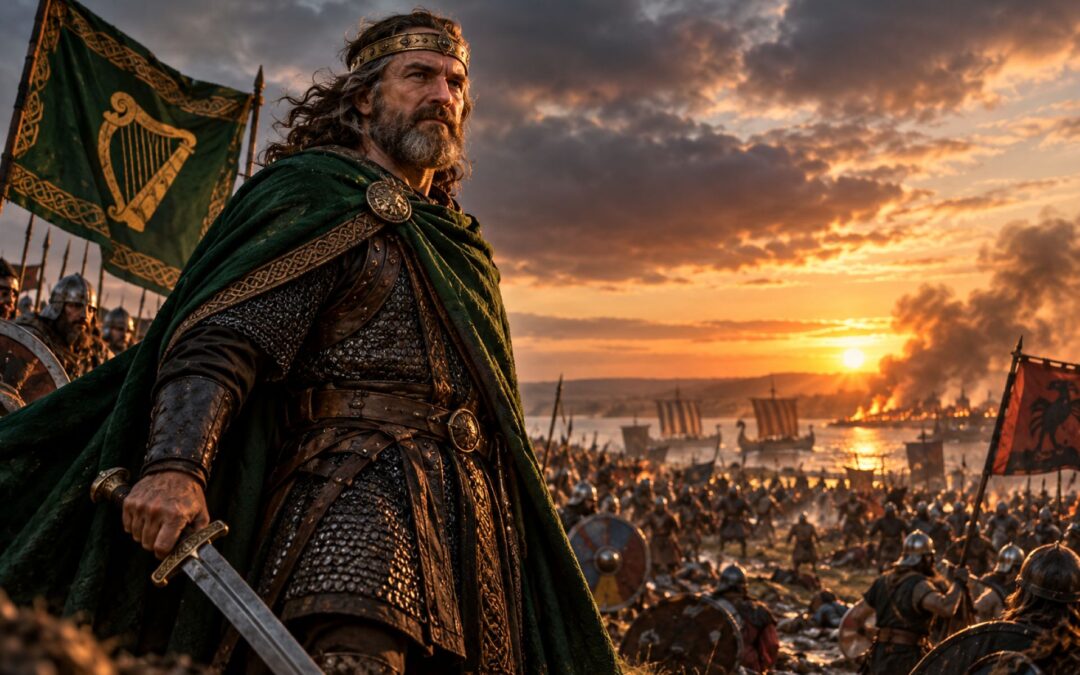
On 23 April 1014, two armies fought a bloody battle outside Dublin that would become one of the defining events in Irish history. By the end of the day, the forces of Brian Boru, the High King of Ireland, had defeated a coalition of warriors from Leinster, Dublin, and the wider Scandinavian world. The victory was extraordinary, but Brian would never enjoy it. The ageing king was killed during the fighting, along with his son Murchad and his grandson Tairdelbach.
Brian’s death created a remarkable paradox. He had spent decades expanding his authority from a relatively modest dynastic base in Munster until kings across Ireland acknowledged his supremacy. Yet his greatest and most celebrated military victory came at the moment when the political order he had built lost its central figure. Within a short time, rival rulers were competing for the authority he had exercised, and the dream of a permanently united Ireland remained unrealized.
Over the following centuries, Brian Boru became something more than a medieval ruler. He was remembered as the king who united Ireland, defeated the Vikings, protected Christianity, and sacrificed his life for his people. The historical reality was more complicated, involving rival Irish dynasties, powerful Viking trading cities, strategic marriages, religious patronage, and a system of kingship in which loyalty was constantly negotiated or enforced. Understanding how Brian rose to power, what he actually accomplished, and why his reputation endured reveals an exceptionally important chapter in Ireland’s history.
Ireland Before Brian Boru: Rival Kings and Viking Cities
When Brian Boru was born around 941, Ireland was not a unified kingdom in the modern sense. The island was divided into numerous political communities known as túatha, each traditionally governed by its own king. These communities were connected through kinship, marriage, tribute, warfare, and shifting alliances, forming larger regional kingdoms whose rulers competed for supremacy.
Kingship operated at several levels. A local king might acknowledge a more powerful regional ruler, who could in turn recognize the authority of an overking. Such relationships were rarely permanent or unconditional. Submission might involve handing over hostages, paying tribute, supplying warriors, or accepting restrictions on independent action, but a change in military fortunes could quickly overturn an agreement.
Above these regional rulers stood the ideal of the High King, or Ard Rí, whose authority was associated with the kingship of Tara. For centuries, the powerful Uí Néill dynasties had dominated this position, although their ability to command obedience varied considerably. Earlier kings had exercised extensive influence across Ireland, so Brian did not invent the idea of island-wide supremacy. His achievement would be to challenge the dynastic expectations surrounding it and establish an unusually powerful position for a ruler from Munster.
Ireland’s political landscape had also been transformed by the arrival of Scandinavian raiders. The first recorded Viking attack occurred in 795, and the initially sporadic raids gradually developed into sustained military activity. Monasteries and coastal settlements were attractive targets because they contained portable wealth, religious treasures, livestock, and people who could be captured and enslaved.
By the ninth century, Viking groups were establishing fortified bases known as longphorts. Some developed into permanent settlements and eventually into important towns, including Dublin, Limerick, and Waterford. These settlements connected Ireland to trading networks stretching across the Irish Sea, Britain, Scandinavia, and continental Europe. Dublin became especially important as a center of commerce, maritime power, and political ambition.
The Viking presence was not simply a matter of foreign invaders fighting native Irish defenders. Scandinavian settlers established families, formed alliances with Irish rulers, adopted Christianity, and participated in local political struggles. Irish kings sometimes fought Viking leaders and sometimes hired their warriors, used their fleets, or sought control of their trading towns. These developments formed part of the wider Viking transformation of the British Isles, where settlement, conquest, cultural exchange, and political integration frequently occurred together.
As Trinity College Dublin’s account of Brian Boru’s world demonstrates, the interaction between Gaelic and Scandinavian societies produced new forms of wealth, warfare, and political opportunity. For Brian’s family, the Viking settlement at Limerick was particularly consequential. Positioned on the River Shannon close to their territory, it represented both a formidable military rival and an economic prize that could help an ambitious dynasty challenge the established rulers of Munster.
The Dál Cais: Brian’s Family and the Rise of a Munster Dynasty
Brian belonged to the Dál Cais, a dynasty whose principal territory lay in the region of Thomond, especially around the area corresponding to modern County Clare. Their lands occupied a strategically important position near the Shannon, providing access to river routes, agricultural resources, and the approaches to Limerick. The dynasty’s eventual prominence would be closely associated with its ability to exploit this geography.
The Dál Cais had not always dominated Munster. The province had traditionally been ruled by branches of the Eóganachta, a powerful dynastic grouping closely associated with Cashel. The political order was not entirely static, however, and regional rivalries created opportunities for families whose military and political resources were expanding. By the tenth century, the Dál Cais had become one of the most serious challengers to the established balance of power.
Their traditional genealogy traced the dynasty to Cormac Cas, a legendary ancestor from whom the name Dál Cais, meaning the people or descendants of Cas, was derived. Such genealogies mattered because political authority in medieval Ireland depended partly on claims of legitimate descent. They were also shaped by later dynastic interests, and legendary ancestors should not be confused with securely documented historical figures. Cormac Cas belonged to a much earlier genealogical tradition, not to the generation of Brian’s father.
Brian’s father, Cennétig mac Lorcáin, was an important figure in the dynasty’s rise. He possessed sufficient standing to be described in the annals as a potential successor to the kingship of Cashel, demonstrating how far the Dál Cais had advanced within Munster’s political hierarchy. His death in 951 left an increasingly powerful family whose ambitions extended beyond its traditional territory.
Brian’s mother is identified in medieval genealogical material as Bébinn, a daughter of Urchad mac Murchada, a ruler associated with western Connacht. This connection illustrates how dynastic relationships could extend beyond provincial boundaries. Such marriages were not simply private arrangements between families; they could create political relationships, establish claims of kinship, and provide opportunities for cooperation across competing kingdoms.
According to the surviving tradition, Brian was born around 941, although the exact year is uncertain. His association with the area around Killaloe and Kincora, near the Shannon, places his early life close to the territory that would later become the center of his power. The familiar name Boru derives from Bórama, associated with a place near Killaloe, and appears to have become attached to him after his death. During his lifetime, he would ordinarily have been identified through his personal name, parentage, and political position.
Very little reliable information survives about Brian’s childhood. It is reasonable to suppose that a young member of an ambitious ruling family would have encountered warfare, dynastic politics, customary law, and the responsibilities of kingship, but specific stories about his education or early ambitions cannot be independently established. Máire Ní Mhaonaigh’s biography in the Dictionary of Irish Biography makes clear that the surviving evidence becomes substantially stronger once Brian emerges as a political and military actor.
The person who initially carried the family’s ambitions forward was not Brian but his elder brother Mathgamain. After Cennétig’s death, Mathgamain expanded the influence of the Dál Cais and eventually became king of Munster. His achievements created the foundation Brian would inherit, although the circumstances of Mathgamain’s death would force the younger brother to secure that inheritance through warfare.
Mathgamain’s Murder and Brian’s Conquest of Munster
During the 960s, the conflict between the Dál Cais and the Viking rulers of Limerick became a turning point in Munster’s political history. Limerick’s Scandinavian leadership controlled an important settlement on the Shannon, with access to commerce and military resources that could threaten neighboring Irish dynasties. For Mathgamain, defeating the city offered the prospect of both greater security and considerable political prestige.
In 967, the Dál Cais defeated the Limerick Vikings and plundered their settlement. The victory significantly enhanced Mathgamain’s standing and helped him establish himself as king of Munster. It also demonstrated that the established Eóganachta order was increasingly vulnerable to an aggressive challenger with a strong territorial base.
Yet Mathgamain’s new position remained contested. Rival Munster factions continued to resist Dál Cais dominance, and some cooperated with Scandinavian leaders whose interests had been damaged by his victories. The struggle therefore involved more than an ethnic division between Irish and Viking forces. Irish rivals could seek Viking assistance, while Irish kings could turn against one another even when they faced common external enemies.
In 976, Mathgamain was murdered after being drawn into the power struggles surrounding his kingship. The surviving accounts implicate rival political interests, including members of the Eóganachta-associated opposition. Later narratives dramatized the circumstances of his betrayal, but the essential consequence is clear: the Dál Cais lost the man who had established their provincial supremacy, and Brian inherited a dangerously unstable position.
Brian’s response was to attack the political and military forces associated with his brother’s enemies. His immediate task was not the conquest of all Ireland but the preservation of his family’s authority in Munster. Without that power base, any larger ambitions would have been impossible.
In 977, Brian attacked Scattery Island, a religious center in the Shannon estuary associated with St Senán. There he killed Ívarr, the Viking king connected with Limerick, along with members of his family. The attack was strategically important because it removed a formidable regional opponent and helped bring Limerick more securely within Brian’s sphere of influence.
The setting also reveals something about the warfare of the period. Religious institutions possessed considerable prestige, but their sanctity did not always protect the people who sought refuge within them. Brian would later become celebrated as a defender and patron of Christianity, yet his early career included violent actions that complicate any portrait of him as an exclusively pious warrior. Medieval kings could support churches while simultaneously employing ruthless methods against their enemies.
The decisive confrontation with the remaining Munster opposition came in 978 at the Battle of Belach Lechta. Brian defeated Máel Muad mac Brain, one of the principal figures associated with the resistance to Dál Cais authority. Máel Muad was killed, eliminating another major rival and substantially strengthening Brian’s claim to the kingship of Munster.
These victories did not immediately remove every competing interest in the province. Local rulers retained their territories, loyalties could change, and members of defeated families continued to possess political significance. Brian’s later relationships with descendants of his former enemies demonstrate that conquest was often followed by renewed negotiation and alliance-making.
Nevertheless, the transformation was substantial. Within a few years of Mathgamain’s murder, Brian had defeated the principal forces threatening his succession, gained control of strategically important territories, and established himself as the dominant ruler in Munster. He had accomplished this through a combination of military violence, political persistence, and an ability to turn temporary victories into lasting advantages.
The conquest of Munster established the resources upon which the rest of his career depended. Its warriors could support campaigns beyond the province, its agricultural wealth could sustain a royal household, and its connections with Limerick and other settlements opened access to naval and commercial networks. Brian now possessed the means to challenge rulers whose authority had traditionally extended far beyond anything the Dál Cais had previously achieved.
From Munster to Dublin: Brian’s Struggle for Supremacy
Once Brian had secured his position in Munster, he began extending his power into neighboring territories. His early campaigns targeted Osraige, a strategically important kingdom between Munster and Leinster. Control over its approaches mattered because armies moving eastward needed passage through territories governed by rulers whose loyalties could not be taken for granted.
Brian repeatedly campaigned in Osraige during the 980s, demonstrating a willingness to return against opponents who had not yet accepted his authority. These operations involved raids, military pressure, and demands for submission rather than the permanent occupation of every defeated territory. The objective was to make resistance costly while strengthening his ability to move troops beyond Munster.
He also exploited divisions among Scandinavian rulers. In 984, Brian cooperated with forces associated with Waterford and the Isle of Man against Dublin. Such alliances show why describing him primarily as an enemy of the Vikings is misleading. Brian was prepared to cooperate with Scandinavian leaders when their interests aligned with his own, just as he was prepared to attack them when they opposed his expansion.
The most important political obstacle to Brian’s ambitions was Máel Sechnaill mac Domnaill, the powerful ruler of Mide and king of Tara. Máel Sechnaill belonged to the Southern Uí Néill and possessed substantial military resources, recognized dynastic prestige, and a political network extending across central and northern Ireland. He had also demonstrated his ability to challenge Scandinavian power, notably by defeating Dublin’s forces at the Battle of Tara in 980.
Brian’s growing influence brought the two rulers into direct competition. In 988, he attacked territories in Mide and Uisnech and achieved significant naval success in Connacht. Campaigns of this kind were designed to weaken opponents, acquire wealth, and demonstrate that Munster’s ruler could project power far beyond his home territory.
His progress was uneven. Some expeditions produced little reward, and Máel Sechnaill defeated Brian’s forces on more than one occasion. The rivalry therefore cannot be understood as a succession of inevitable victories leading smoothly to High Kingship. Brian had to absorb setbacks, rebuild alliances, and repeatedly demonstrate that continued opposition would be expensive.
By 997, the two kings reached an accommodation. One southern annalistic tradition presents the settlement as a division of Ireland between northern and southern spheres, often associated with the traditional divisions of Leth Cuinn and Leth Moga. Whether the agreement was as comprehensive as that description implies is uncertain, but it indicates that Máel Sechnaill could no longer ignore Brian’s authority in the south.
The settlement gave Brian an opportunity to strengthen his position without immediately confronting his strongest rival. It also left the eastern kingdoms and Dublin as crucial centers of competition. Whoever controlled these territories could influence trade, military movement, and the political relationships linking Ireland with the wider Irish Sea.
In 999, Brian won a major victory at the Battle of Glenn Máma against the forces of Dublin and Leinster. Some chronicles indicate that Máel Sechnaill participated alongside him, although the precise alignment of the forces is not equally clear in every surviving account. What is certain is that Brian defeated the Dublin-Leinster coalition and substantially strengthened his position in eastern Ireland.
The subsequent campaign against Dublin allowed him to impose terms on its rulers. Sitriuc Silkbeard, the city’s king, was eventually restored to power under conditions reflecting Brian’s supremacy. This was characteristic of medieval overlordship: a defeated ruler might remain in office, provided he acknowledged the superior king and accepted obligations to him.
Brian’s relationship with Máel Sechnaill then deteriorated further. An expedition into southern Mide in 1001 did not achieve the desired result, and Máel Sechnaill continued seeking assistance from other kings. Yet Brian’s military and diplomatic resources were now considerable, and the following year brought the decisive political breakthrough.
In 1002, Brian obtained the submission of Máel Sechnaill and the king of Connacht. The traditional holder of Ireland’s most prestigious kingship had yielded to a ruler from Munster, overturning the political hierarchy that had shaped Irish affairs for generations. Brian had reached the highest position in the country, but the challenge of making that authority meaningful across the island was only beginning.
High King of Ireland: The Extent and Limits of Brian’s Power
Brian’s accession to the High Kingship in 1002 marked the greatest achievement of his career. A ruler whose dynasty had been regionally important only a few generations earlier had compelled the submission of one of Ireland’s most powerful established kings. The result demonstrated that the Uí Néill could no longer assume an exclusive right to exercise supremacy over the island.
The title itself did not give Brian an administrative apparatus capable of governing every kingdom directly. Ireland contained numerous rulers whose authority rested on inherited territories, military followings, religious connections, and relationships with subordinate families. Brian could demand recognition, tribute, hostages, and military cooperation, but he could not replace all these institutions with a single centralized government.
His immediate problem was to convert formal submission into effective control. Máel Sechnaill’s acknowledgment had substantially strengthened Brian’s position in the middle of Ireland, but northern dynasties remained formidable. Some possessed long traditions of independence, while others had their own claims to the prestigious kingship of Tara.
Brian’s initial northern campaigns encountered determined opposition. Expeditions against Cenél nEógain in 1002 and 1004 did not produce the success he sought. These setbacks underline the continuing limitations of his authority: becoming High King did not automatically mean that every other ruler accepted his commands.
In 1005, Brian achieved an important success by reaching Armagh, one of the most prestigious religious centers in Ireland. The town was closely associated with St Patrick and enjoyed particular importance within Irish ecclesiastical politics. Brian’s association with Armagh helped him establish legitimacy in a region where the Uí Néill had traditionally enjoyed substantial influence.
His relationship with the church is documented in the Book of Armagh, which records an agreement associated with his visit. The entry describes Brian as imperator Scotorum, commonly translated in this context as Emperor of the Irish. The title was an extraordinary expression of prestige, although it should not be interpreted as proof that Brian governed a centralized empire resembling the contemporary imperial institutions of continental Europe.
Brian reportedly left twenty ounces of gold on Armagh’s altar, an act that reinforced his relationship with the church and demonstrated his ability to distribute valuable resources. Such patronage carried religious significance, but it was also politically useful. Religious institutions preserved written records, commanded extensive networks of influence, and could help establish the legitimacy of rulers whose claims were contested.
As Trinity College Dublin’s examination of Brian’s rise to power explains, the agreement with Armagh was a significant element of his relationship with the northern kingdoms. It associated his political supremacy with an institution whose religious prestige reached across Ireland, strengthening the image of Brian as more than a successful regional conqueror.
Brian continued campaigning in the north after 1005. He made another major circuit in 1006, and further expeditions were required when rulers resisted or failed to maintain their obligations. In 1011, he campaigned against Cenél Conaill by land and sea, and the Annals of Inisfallen describe a submission accompanied by the payment of a substantial stipend to a northern ruler.
These campaigns reveal the practical nature of his supremacy. Brian did not simply receive recognition once and retire to govern a peaceful kingdom. His authority required continual demonstration, and submissions could involve payment, negotiation, coercion, or some combination of the three.
He also intervened directly in the affairs of other kingdoms. In 1003, for example, he influenced the kingship of Leinster by removing one ruler and supporting Máel Mórda mac Murchada. Such actions allowed him to shape regional leadership without eliminating local institutions, although the rulers he promoted could eventually become opponents themselves.
Brian was therefore more than a ceremonial High King, but less than an absolute monarch. He possessed exceptional military reach, could compel powerful rivals to acknowledge him, and successfully challenged traditional dynastic supremacy. Yet the political order remained dependent on his personal resources, relationships, and capacity to enforce decisions.
His accomplishments were substantial precisely because the system was so difficult to control. Establishing island-wide recognition required repeated campaigns and sophisticated political management, and the relationships that sustained his authority were always vulnerable to reversal.
Marriage, Kinship, and the Politics of Loyalty
Military success alone could not hold together Brian’s expanding political network. Medieval Irish kingship was deeply influenced by family relationships, and marriage offered rulers a way to establish alliances with dynasties whose support might otherwise be difficult to secure. Brian and his family participated in these arrangements across Munster, Leinster, Connacht, Dublin, and the territories of the Uí Néill.
One of the most significant figures in this network was Gormlaith, daughter of Murchad mac Finn, a ruler associated with Leinster. She belonged to an influential political family and was the sister of Máel Mórda, the king of Leinster who would later oppose Brian at Clontarf. Her relationships connected several of the most important royal households in Ireland.
Gormlaith had previously been married to Amlaíb Cuarán, the powerful Scandinavian king of Dublin, with whom she had a son, Sitriuc Silkbeard. She was also married to Máel Sechnaill, Brian’s great rival for the High Kingship, before becoming Brian’s wife. These connections demonstrate the extraordinary overlap between families that competed for authority across Ireland.
Brian and Gormlaith had a son, Donnchad, who survived Clontarf and became one of the principal figures in Munster’s subsequent political struggles. The marriage itself may have been connected to Brian’s efforts to extend his influence into Leinster, although the exact political circumstances cannot be reconstructed with certainty. Its later breakdown became an important element in stories explaining the conflict that culminated in 1014.
A particularly revealing alliance involved Brian’s daughter Sláine and Sitriuc Silkbeard, Gormlaith’s son from her marriage to Amlaíb. Sláine’s marriage to the king of Dublin helped reinforce the political settlement following Brian’s victory at Glenn Máma. It also meant that Brian’s daughter was married to the ruler who would eventually become one of his principal enemies.
The complexity of these arrangements is documented in Trinity College Dublin’s examination of Viking-Irish alliances. Relationships between Irish and Scandinavian ruling families cannot be reduced to permanent ethnic loyalties. A marriage might establish peace for a period, but it did not prevent conflict when political interests changed.
Brian’s other marriages connected him with important families elsewhere in Ireland. His first wife is identified as a daughter of Eiden mac Cléirig, king of Uí Fiachrach Aidne in southern Connacht. Their descendants included Murchad, the son who played a central role in Brian’s military campaigns and died at Clontarf.
Another wife, Echrad, belonged to the Uí Áeda Odba, a dynasty within the sphere of the Southern Uí Néill. Her son Tadc became especially important because his descendants included Tairdelbach Ua Briain and Muirchertach Ua Briain, rulers who would later revive the family’s wider political ambitions.
Brian was also associated with Dub Choblaig, daughter of Cathal mac Conchobair, king of Connacht. The relationship was consistent with his broader network of alliances in that province, although the surviving records do not establish every detail of the marriage or whether it produced children.
His daughters likewise participated in connections with powerful families. Bébinn married Flaithbertach Ua Néill of the northern Uí Néill, while Sadb was associated with Cian, whose father Máel Muad had been one of Brian’s most important enemies during the struggle for Munster. These relationships illustrate the possibility of political accommodation even between families with histories of violent conflict.
The surviving genealogies provide valuable evidence of these connections, but they do not explain every motive behind them. A marriage might offer protection, cooperation, prestige, territorial advantage, or reconciliation, yet the precise intentions of the individuals involved are often unknown.
Later literature transformed some of these relationships into dramatic stories of betrayal and revenge. Gormlaith, in particular, became portrayed as a manipulative figure whose bitterness helped provoke the war against Brian. Such accounts reveal much about the storytelling traditions that developed after Clontarf, but they offer limited reliable evidence about Gormlaith’s character or personal responsibility for the conflict.
The larger lesson of Brian’s family history is that kinship could support political supremacy without guaranteeing permanent loyalty. His marriages extended his network across Ireland, but they also tied his household to rulers who retained independent ambitions. The same relationships that helped him accumulate power could become sources of tension when the balance of power shifted.
Governing Brian’s Ireland: Tribute, Fortresses, and the Church
Brian’s reign is often described as a period of unprecedented peace and prosperity, but the surviving historical evidence supports a more complicated picture. His authority expanded enormously, yet he spent much of his career conducting campaigns, demanding submission, and responding to resistance. His government was built upon the institutions of medieval Irish kingship rather than a comprehensive system of administrative reforms.
A powerful king expected subordinate rulers to acknowledge his position through tribute, hostages, military service, and political cooperation. Hostages were especially important because they provided tangible guarantees that agreements would be respected. Their exchange or retention could reduce the immediate need for violence, although the possibility of coercion remained central to the system.
Tribute and warfare were closely connected. Successful campaigns could produce livestock, precious metals, supplies, and other forms of wealth, some of which could then be distributed to allies or religious institutions. Such resources helped maintain military followings, reward loyalty, and demonstrate the superior king’s capacity to command wealth beyond his home territory.
Brian also invested in the defense of his political centers. The Annals of Inisfallen record that several fortifications were constructed or strengthened under his authority in 1012, including Cenn Corad, associated with his royal center at Kincora near Killaloe. This evidence provides a concrete example of military infrastructure during his reign.
Fortifications served several purposes. They offered protection for royal households and resources, strengthened control over strategically important routes, and demonstrated a ruler’s ability to organize substantial work. Their importance was particularly evident in a political environment where armies could move rapidly and rulers were frequently absent on campaign.
The economic foundation of Irish society remained overwhelmingly agricultural. Livestock, especially cattle, possessed considerable economic and political importance, while farming supported households, religious communities, and regional rulers. The prosperity of a kingdom depended partly on the ability to secure productive land and prevent rivals from carrying away its resources.
Viking-founded towns added another dimension to this economy. Dublin, Limerick, and Waterford connected agricultural communities with maritime trading networks through which goods, people, and wealth circulated. Dublin’s silver coinage, introduced under Sitriuc Silkbeard around the end of the tenth century, illustrates the development of an increasingly sophisticated urban economy linked to overseas commerce.
Brian’s efforts to control these settlements were therefore motivated by more than military prestige. Their fleets and commercial connections could provide strategic advantages to an ambitious king, while their wealth made them desirable political assets. Control over a trading center did not necessarily require expelling its existing ruler; imposing overlordship could provide access to its resources while preserving its established institutions.
Religious foundations were equally important. Monasteries and churches possessed land, wealth, learning, and political influence, and their leaders frequently interacted with secular rulers. Brian’s relationship with Armagh demonstrates how religious patronage could reinforce claims to authority across different kingdoms.
Irish monastic culture had already developed sophisticated traditions of scholarship, manuscript production, metalworking, and religious art long before Brian’s lifetime. These activities continued during his reign, alongside cultural exchanges with Scandinavian communities. Yet it would be misleading to claim that Brian personally created a golden age of Irish scholarship or commissioned every major cultural development associated with the period.
The surviving records also provide occasional references to officials who helped administer Brian’s affairs, suggesting that his rule involved more than the personal leadership of an army. However, the precise structure of his household and government remains uncertain. Claims that he systematically standardized Ireland’s laws, abolished local autonomy, or established a national bureaucracy go beyond what the available evidence can demonstrate.
Brian’s method of government was practical rather than revolutionary in the institutional sense. He used existing political structures more effectively than most of his contemporaries, extending his authority through military force, family relationships, tribute, religious legitimacy, and strategic control of important territories. The difficulty of maintaining that system would become increasingly apparent in the final years of his reign.
The Road to Clontarf: Leinster and Dublin Rebel
By the beginning of the eleventh century’s second decade, Brian had acquired a degree of authority that few Irish rulers had achieved. Yet recognition of his supremacy did not remove the ambitions of the kings who had submitted to him. Leinster and Dublin remained particularly sensitive because their wealth, political connections, and strategic position made them essential to the balance of power in eastern Ireland.
The ruler of Leinster was Máel Mórda mac Murchada, a member of the influential Uí Fáeláin dynasty and brother of Gormlaith. He had benefited from Brian’s intervention in Leinster’s political affairs, but his relationship with the High King eventually became hostile. The reasons were probably rooted in competing interests over authority, territory, and the obligations imposed upon Leinster.
Dublin presented an equally complicated challenge. Sitriuc Silkbeard had survived earlier defeats and retained his kingship under Brian’s overlordship. He possessed valuable maritime connections, access to trade, and relationships with powerful Scandinavian and Irish families. For a ruler in his position, escaping Munster’s dominance would have offered considerable political advantages.
The close family connections among the protagonists did not prevent war. Sitriuc was Gormlaith’s son and Brian’s son-in-law, while Máel Mórda was connected to Brian through Gormlaith’s family. These relationships had once supported arrangements of cooperation, but they could not permanently reconcile the independent ambitions of Dublin, Leinster, and Munster.
In 1013, large-scale warfare broke out between Brian and the Dublin-Leinster coalition. Fighting extended across Leinster and surrounding territories, while maritime forces operated elsewhere around the Irish coast. The Annals of Inisfallen describe prolonged campaigns in which Brian attacked territories in Osraige and Leinster from September toward Christmas without securing a lasting peace.
The inability to settle the conflict demonstrated the limits of Brian’s authority. Military pressure had forced submissions before, but Dublin and Leinster retained sufficient resources and connections to resist again. Their rebellion threatened not only Brian’s control over eastern Ireland but also the credibility of his island-wide supremacy.
Sitriuc and his allies sought support beyond Ireland. Scandinavian and Norse-Gaelic warriors could be recruited from territories around the Irish Sea, including Orkney and the Hebrides. These connections had developed over generations of trade, migration, dynastic marriage, and warfare, making the region a politically interconnected world rather than a collection of isolated kingdoms.
Among the most important overseas leaders associated with the coalition was Sigurd the Stout, Earl of Orkney. Another was Brodir, a warrior leader connected with the Irish Sea and often associated with the Isle of Man. The precise circumstances of their recruitment and the promises made to them are difficult to establish because much of the surviving narrative detail comes from later sources.
The wider political atmosphere may also have influenced the conflict. Scandinavian power in England was expanding dramatically, culminating in the Danish conquest of 1013 under Sweyn Forkbeard. These events demonstrated the military potential of Scandinavian networks, although there is no conclusive evidence that the forces assembled against Brian operated under a unified plan to conquer Ireland.
For Brian, the issue was immediate and personal in political terms. His authority depended on the obedience of rulers who had previously recognized him, and the Dublin-Leinster coalition represented a direct challenge to that position. Failure to respond could encourage resistance elsewhere, weakening the political system he had spent decades building.
The campaigns of 1013 failed to produce a stable settlement, and the conflict continued into the following spring. Brian assembled forces from Munster and allied territories, while Dublin and Leinster prepared to meet him with substantial overseas assistance. Their confrontation would take place near Dublin on Good Friday, 23 April 1014.
The Battle of Clontarf: Brian’s Victory and Death
The Battle of Clontarf has become one of the most famous engagements in Irish history, but reconstructing precisely what happened is surprisingly difficult. The essential outcome is well established: Brian’s forces defeated the coalition of Dublin, Leinster, and their overseas allies, while Brian himself and several leading members of his family were killed. Many familiar details of the fighting, however, come from narratives written generations after the event.
Even the exact location requires careful explanation. The earliest annalistic accounts identify the confrontation with Dublin rather than providing a precise battlefield description. Later traditions associate it with Clontarf, an area to the northeast of medieval Dublin, near the River Tolka and the shoreline of Dublin Bay.
The geography has changed substantially over the intervening centuries. Reclamation, urban development, and changes to the coastline have altered the relationship between the river, tidal flats, and the surrounding land. Historians generally place the battle near the northern shore of Dublin Bay, but the precise alignment of the armies and the detailed movements of individual units cannot be established with certainty.
Brian’s army drew its strength principally from Munster, especially his own Dál Cais followers and other regional forces. He also received support from southern Connacht, including warriors associated with Uí Maine and Uí Fiachrach. The surviving records identify a number of important leaders who died on his side, showing that the army represented a coalition rather than a force drawn exclusively from his personal household.
One of the more debated participants was Máel Sechnaill, Brian’s former rival for the High Kingship. The Annals of Ulster describe Brian and Máel Sechnaill leading an army toward Dublin, which supports the view that the ruler of Mide participated in the campaign. Later narratives sometimes minimize his contribution or portray him as withdrawing from the fighting, and historians continue to debate the extent of his battlefield involvement.
Brian’s opposing coalition consisted of warriors from Leinster and Dublin, supported by contingents from outside Ireland. Máel Mórda led the Leinster forces, while Sitriuc Silkbeard was the principal Dublin ruler associated with the resistance. Accounts differ about whether Sitriuc personally fought in the battle or remained in Dublin, but his kingdom’s political and military role was central to the conflict.
The overseas forces included warriors associated with Sigurd of Orkney and Brodir, along with contingents from the wider Irish Sea world. These fighters were not necessarily united by a common national identity or religious purpose. Some were connected to Dublin through long-established political relationships, while others may have been recruited through arrangements involving payment, prestige, or expectations of reward.
The presence of Scandinavian warriors on the opposing side has encouraged later descriptions of Clontarf as a final battle between the Irish and the Vikings. That interpretation ignores the extensive history of cooperation between Gaelic and Scandinavian rulers. Brian himself had used Viking allies during his career, and some Scandinavian fighters may have served within the forces associated with Munster.
Religious divisions were equally complicated. By 1014, important Norse rulers in Ireland had adopted Christianity, and their communities supported churches and participated in Christian society. The conflict was therefore not a straightforward confrontation between Christian Ireland and a pagan invasion force, even though later writers found that image useful.
The battle took place on Good Friday, one of the most sacred days in the Christian calendar. Its timing later acquired enormous symbolic importance because it allowed storytellers to present Brian’s death as a form of religious sacrifice. The day itself is historically secure, but the spiritual interpretation attached to it developed through subsequent literature.
The surviving accounts suggest that the battle was prolonged, fierce, and extremely destructive. Warriors fought at close quarters, and casualties were heavy among both the principal leaders and their followers. The precise sequence of attacks and counterattacks cannot be reconstructed confidently, although later narratives provide elaborate descriptions of individual combats.
The relationship between the battlefield and the sea was potentially significant. Dublin Bay’s extensive tidal shallows could complicate the movement of ships and the withdrawal of warriors attempting to reach them. Later traditions describe men being drowned while fleeing, sometimes connecting their deaths with the rising tide and a coastal weir.
The famous story of Brian’s grandson Tairdelbach illustrates both the importance and the limitations of these accounts. Later literature describes the young warrior pursuing fleeing enemies into the water before drowning near the weir at Clontarf. His death is supported by the annals, but the dramatic circumstances and the specific details of his final moments belong to a narrative tradition that cannot be independently confirmed.
As the fighting continued, Brian’s forces gained the advantage. Major figures in the opposing coalition were killed, including Máel Mórda of Leinster and Sigurd of Orkney. Their deaths were significant because they deprived the resistance of important political and military leaders.
The Annals of Ulster’s account of the battle presents the defeat of the Leinster and Scandinavian forces as exceptionally severe. It records the deaths of numerous leaders and gives a figure of thousands killed or drowned. Such numbers should be understood as figures transmitted by medieval chroniclers rather than independently verified casualty totals.
The scale of the losses nevertheless indicates why Clontarf became so memorable. Both coalitions suffered the deaths of prominent commanders, and the outcome damaged the leadership of Leinster and its overseas allies. For Brian’s supporters, the battle represented a military victory against rulers who had challenged his supremacy.
The king himself probably did not lead the fighting from the front. Born around 941, Brian would have been in his early seventies in 1014, an advanced age for a military commander of the period. The historical record suggests that his son Murchad played a particularly important role in leading the army, while Brian remained away from the main fighting.
The circumstances of Brian’s death became one of the most celebrated elements of the Clontarf story. The annals identify Brodir, or Brotor, as his killer, while later narratives describe the Viking leader reaching Brian’s position after the battle had begun to turn against his forces. According to the familiar account, Brian was praying in his tent when Brodir attacked.
The image of an elderly Christian king being killed during prayer became central to Brian’s reputation. Yet the earliest detailed version of the scene was written decades after the battle, and later sources embellished the confrontation in different ways. Some portray Brian as a passive martyr; others describe him taking up a sword and fighting his attacker. These versions cannot all be literal accounts of the same event.
Historian Seán Duffy’s reconstruction of what happened at Clontarf emphasizes the difficulty of separating reliable evidence from literary elaboration. He also highlights the broader political significance of the confrontation, including Dublin’s ambitions and the potential implications of Scandinavian military activity elsewhere in the British Isles.
Whatever the precise circumstances, Brian was killed during the battle, and his death was accompanied by a devastating series of losses within his family. His son Murchad died, as did Murchad’s son Tairdelbach. Brian’s nephew Conaing and several other prominent Munster and Connacht leaders were also among the dead.
These casualties mattered beyond the immediate grief of the ruling household. Murchad had been a major military leader and an important potential successor. His death removed a figure capable of continuing Brian’s political and military work, while the loss of other experienced commanders weakened the network upon which Munster’s supremacy depended.
Brian’s army had won the battle, but victory did not mean that the political struggle was settled. Sitriuc Silkbeard survived and remained king of Dublin, while the destruction of the opposing coalition did not automatically place every Irish kingdom under the permanent control of the Dál Cais. The High King who had spent decades establishing his authority was dead, and no successor possessed precisely the same combination of prestige, alliances, and military power.
Clontarf was therefore both a triumph and a catastrophe. It demonstrated the extraordinary strength Brian had accumulated, but it also destroyed the personal leadership around which much of that strength had been organized. The consequences would become apparent almost immediately.
After Clontarf: The Collapse of Brian’s Supremacy
The aftermath of Clontarf was marked by mourning, political uncertainty, and renewed competition among Ireland’s ruling dynasties. Although Brian’s forces had defeated their enemies, the deaths of the High King, his son Murchad, and other prominent leaders created a serious succession problem. The military victory had not preserved the leadership structure needed to maintain Brian’s authority across the island.
The treatment of Brian’s remains reflected the extraordinary status he had achieved. According to Trinity College Dublin’s account of his funeral and legacy, his body and that of Murchad were taken to Swords, north of Dublin. There they were met by representatives of the church of Armagh, who escorted the remains northward for burial.
The Annals of Ulster record that Brian and the other honored dead were buried at Armagh after an extended period of mourning. This was a significant recognition of the relationship Brian had established with the church during his lifetime. Armagh’s participation in his funeral reinforced the religious prestige associated with his kingship, even as his political power was passing into the hands of competing rulers.
The most immediate beneficiary of Brian’s death was Máel Sechnaill mac Domnaill, who resumed the position of High King. His return demonstrated that the old dynastic hierarchy had not disappeared during Brian’s years of supremacy. The Uí Néill retained substantial resources and prestige, and Brian’s death created an opportunity for their leading representative to recover his former position.
Within Munster, Brian’s surviving sons faced the difficult task of preserving the dynasty’s authority. Donnchad emerged as an important figure, but his position was contested by members of the wider family and other political rivals. The struggle for leadership reflected the absence of an automatic, uncontested hereditary succession comparable to the rules associated with some later monarchies.
Donnchad’s brother Tadc also possessed a claim to political influence, and their relationship became part of the subsequent struggle for Munster. The Annals of Ulster record conflict between them in the aftermath of Clontarf, demonstrating how quickly dynastic rivalries reappeared once Brian’s authority was removed.
The deaths of Murchad and his son Tairdelbach also require clarification because later generations of the family included another prominent ruler with the same name. The Tairdelbach killed at Clontarf was Murchad’s son. The later Tairdelbach Ua Briain, who became king of Munster and exercised substantial power across Ireland during the eleventh century, was a different grandson of Brian, descended through his son Tadc.
Brian’s dynasty therefore did not disappear after 1014. Its immediate position was weakened, and its internal rivalries were serious, but the family continued to exercise considerable influence in Munster. Over subsequent generations, descendants of Brian would again become important contenders for supremacy across Ireland.
Tairdelbach Ua Briain and his son Muirchertach Ua Briain were particularly significant in reviving the dynasty’s wider ambitions. Their achievements demonstrated that Brian had created more than a temporary military following. His descendants inherited a powerful regional base, a prestigious family identity, and a political reputation that could be used to strengthen their claims.
Dublin likewise continued to matter after Clontarf. Sitriuc remained in control of the city, and its Norse-Gaelic population continued trading, participating in warfare, and maintaining political relationships with Irish rulers. The battle did not expel Scandinavians from Ireland or destroy the urban communities they had established.
Over the following generations, the political independence of the Scandinavian towns became increasingly constrained by powerful Irish kings. Yet their commercial and cultural importance endured, and their inhabitants continued contributing to the evolving society of medieval Ireland.
Clontarf had therefore changed the balance of power without ending Ireland’s competing kingships. Brian’s immediate supremacy fractured, but the institutions, dynastic claims, and political connections that had shaped his career survived. His descendants would pursue similar ambitions, while his personal reputation became an increasingly valuable political resource.
From High King to National Hero: How Brian Boru Became a Legend
Brian Boru’s historical importance rests partly on his achievements and partly on the extraordinary reputation constructed after his death. The two are closely connected, but they are not identical. Brian was genuinely one of the most powerful rulers of early medieval Ireland, yet many of the claims most frequently associated with him developed through later literature rather than contemporary evidence.
The earliest annals provide a foundation for reconstructing his career. They record deaths, battles, military expeditions, submissions, and significant political events, usually in relatively brief entries. Although these chronicles contain biases and were preserved through later manuscript traditions, they provide more reliable access to the basic sequence of events than the elaborate heroic stories composed generations afterward.
One of the most influential later narratives was Cogadh Gáedhel re Gallaib, commonly translated as The War of the Irish Against the Foreigners. Written in the early twelfth century, it presented Brian’s struggles as a heroic conflict against Viking enemies and culminated in his victory and death at Clontarf. The work became a foundational account of Brian’s career, influencing how subsequent generations understood both the king and the battle.
The narrative was closely connected with the political interests of Brian’s descendants. In particular, the reputation of Muirchertach Ua Briain, Brian’s great-grandson, benefited from a literary tradition that celebrated the achievements of the family’s most famous ancestor. A dynasty claiming supremacy over Ireland could strengthen its position by presenting itself as the rightful heir to a ruler of exceptional military ability and religious virtue.
The result was a story in which Brian became the ideal Christian king, defending Ireland against threatening foreign invaders and sacrificing his life for his people. His opponents were frequently portrayed as cruel, treacherous, or irreligious, while his own achievements were elevated into an exemplary struggle for national survival.
This interpretation simplified a much more complicated political reality. Brian had repeatedly formed alliances with Viking rulers, and his enemies at Clontarf included Irish warriors from Leinster. Christianity was present on both sides of the conflict, and the immediate political objectives concerned control over territories, trading centers, and the authority of kings.
The portrayal of Gormlaith illustrates how historical figures were reshaped to serve the later narrative. In some stories, she became a bitter and manipulative woman whose personal hostility toward Brian helped provoke the war. The earliest accounts of Clontarf do not assign her such a role, and the evidence concerning her actual political activities is limited.
Máel Sechnaill’s reputation also changed in some versions of the story. Whereas the earlier annals associate him with Brian’s campaign, later narratives sometimes portray him as withdrawing from the battle or betraying the High King. Such changes diminished the contribution of a rival dynasty and concentrated the glory of the victory upon Brian and the Dál Cais.
The battle’s supernatural elements expanded with successive retellings. Medieval accounts described prophecies, extraordinary omens, mysterious women, and beings associated with death and the battlefield. Scandinavian traditions, including Njáls saga, incorporated Clontarf into a wider world of Norse storytelling, demonstrating how Brian’s reputation spread beyond Ireland.
One famous Norse narrative presents Valkyries weaving a terrifying cloth made from the bodies and weapons of warriors as they foretell the losses at Clontarf. The episode is a striking example of medieval literary imagination, but it provides evidence of how the battle was remembered rather than a factual description of what occurred in 1014.
Brian’s personal death acquired similar symbolic importance. An elderly king killed while praying on Good Friday could be represented as a martyr whose sacrifice resembled Christian ideals of selflessness and spiritual triumph. Later accounts even combined prayer and combat, presenting Brian as both a saintly figure and a warrior who resisted his killer to the end.
As historian Clare Downham explains in her study of Clontarf’s history and legend, these narratives were shaped by political circumstances, literary conventions, and changing understandings of Irish identity. Each generation inherited an important historical event and interpreted it in ways that reflected its own concerns.
During the later Middle Ages, when English power had become an increasingly important force in Ireland, Brian’s victory over the Vikings could be interpreted as an earlier example of resistance to foreign domination. The political circumstances of the eleventh century differed considerably from those of later medieval Ireland, but the symbolic resemblance gave his story continuing relevance.
Brian’s image became particularly powerful during periods of cultural revival and nationalism. Nineteenth-century Irish leaders and writers could portray him as a historical representative of independence, unity, and resistance. Such interpretations helped connect contemporary political aspirations with a heroic image of Ireland’s medieval past.
The significance of Clontarf as a place of memory was demonstrated in 1843, when Daniel O’Connell planned to hold a major meeting there as part of his campaign for repeal of the union with Great Britain. The British authorities prohibited the gathering, reflecting the political sensitivity of a location already associated with Irish resistance and national identity.
During the nineteenth and twentieth centuries, Brian also appeared in paintings, poems, historical dramas, textbooks, and popular representations of Irish history. These works often emphasized his courage and religious devotion, sometimes presenting the battle as a simple national victory over foreign invaders.
The famous Brian Boru harp provides another revealing example of the distinction between historical memory and documentary fact. The instrument, preserved at Trinity College Dublin and associated with Ireland’s national emblem, dates from several centuries after Brian’s death. Its association with him is traditional rather than historically authentic, but the connection illustrates how his name became attached to objects representing Irish identity.
Modern scholarship has increasingly challenged the simplified heroic narrative without denying Brian’s accomplishments. Historians recognize the remarkable scale of his political career while emphasizing the divisions among Irish kingdoms, the importance of Norse-Gaelic cooperation, and the difficulty of establishing exactly what happened at Clontarf.
There is also disagreement over the battle’s broader historical importance. Some historians emphasize its role in resisting the growing ambitions of Dublin and potentially more extensive Scandinavian intervention. Others stress that it was fundamentally a conflict over regional and island-wide supremacy within an already interconnected Irish political world.
Both perspectives recognize that the battle was significant, but neither requires the conclusion that it permanently ended Viking power or created a lasting unified Irish state. The surviving Scandinavian towns continued to develop, while competition among Irish kings remained a defining feature of political life.
Brian’s reputation therefore survives in several overlapping forms. He was a historical king who transformed his dynasty’s standing, a military leader who challenged established political hierarchies, a religious patron whose authority reached across Ireland, and a legendary hero whose image was repeatedly adapted by later generations.
The most compelling aspect of his legacy is that the historical Brian does not need to be identical to the mythical one to remain extraordinary. His rise from Munster to the High Kingship was a major political accomplishment, and his death at Clontarf genuinely changed the course of Irish kingship. The legend enlarged these achievements, but it did not invent their importance.
Brian Boru did not create a permanently united Ireland, abolish the authority of its regional kings, or eliminate the Scandinavian presence from the island. His power depended on the same difficult relationships that shaped the careers of other medieval rulers, although he managed them with exceptional success over several decades.
His achievement was to raise the Dál Cais from a regional dynasty into a power capable of challenging the traditional supremacy of the Uí Néill and commanding recognition across Ireland. Through warfare, diplomacy, dynastic alliances, and religious patronage, he established a level of authority that few contemporaries could match.
Clontarf revealed both the strength and fragility of that achievement. Brian’s forces defeated a formidable coalition, but the deaths of the king and his leading supporters prevented the victory from securing the political order he had constructed. The immediate unity of his reign did not survive him, yet the power and prestige he had created continued to influence his descendants.
The historical Brian Boru was neither an uncomplicated national liberator nor merely a successful regional warlord. He was an exceptionally capable ruler operating within the realities of his age, whose ambitions changed the possibilities of Irish kingship. More than a thousand years after his death, his story remains important because it reveals how political power is acquired, why it can prove difficult to preserve, and how the memory of one ruler can become inseparable from a nation’s understanding of its past.
Last Updated on October 30, 2026 by Aseem Gupta